!Three Amigos! (1986)

By Richard Winters

My Rating: 2 out of 10

4-Word Review: Western stars travel south.

El Guapo (Alfonso Arau) and his gang terrorize a small village in 1916 Mexico by demanding that its residents pay him ‘protection money’ or risk getting pillaged. Carmen (Patrice Martinez), who is the daughter of one of the village elders, tries to come up with a plan to stop them and finds her solution after watching a silent film featuring The Three Amigos (Steve Martin, Chevy Chase, Martin Short) who  fight evil doers and injustice. Thinking they are real heroes she sends them a telegram inviting them to her town to fight El Guapo. The Amigos, who have just gotten fired, think it’s an invitation to do a show and in desperate need of money travel across the border unaware of the dangers that await.

While the concept is ripe for great comic potential the script almost immediately starts showing its cracks. Now, I was not around in 1916, but it seems to me that people would’ve still been sophisticated enough to know the difference between movie acting and the real thing and the fact that Carmen, who is well over 18, doesn’t makes her seem a bit too naive. The three amigos aren’t much better as they fail to know the meaning of such words as infamous, tequila, or even veranda. Comedies based on misunderstandings can be highly enjoyable, but it still depends on the characters being reasonably intelligent to make it work and the group here are just too dumb to be believed making the whole scenario weak and watered down from the get-go.

What’s even more aggravating is that the film cheats on its own rules. Steve Martin scolds the bandits for using real bullets, as at that point he was still under the impression that they were fellow actors, but then the amigos’ guns end up having real bullets too even though if they were really just actors they should’ve been stage props with blanks. They turn out to be great shots too, able to shoot the bad guys even from long distance making them seem like actual gunfighters and not actors at all. There’s also a scene where Martin gets shot in the arm and while this might not be fatal it could still cause severe pain and infection, but there’s no scene showing it getting removed and bandaged up and  he continues to move it like it wasn’t even injured.

While it was interesting seeing Chase getting laughs for being a doofus as opposed to his snarky quips I still felt the three characters were too transparent. Not only is there very little contrast between their personalities, but there personal lives are never shown. These were supposedly big stars who should’ve had a big fan base, agents, friends, or wives/girlfriends, so the idea that they had ‘nothing to go back to’ and thus decided to remain in Mexico didn’t really make sense. Even with the argument that they had recently gotten fired from their jobs they should’ve had enough fame and connections in L.A. to find other gigs without immediately being so hard-up.

There’s a scene too where the three are shown sleeping together in a small bed, which seemed to intimate that they were gay. This never gets confirmed, but the film might’ve been more interesting had they been.

The moment where the three sing ‘My Little Buttercup’ inside a rough Mexican bar filled with bandits is the high point, but everything else is downhill. Instead for forcing these dimwitted actors to face the harsh realities of true western life outside of their Hollywood safe place it deviates into ill-advised surreal fantasy that contradicts the whole premise. The worst moment is when they sing a song in front of an incredibly fake looking sunset backdrop that features talking animals, which is so stupid that it destroys everything else that comes either before or after it.

My Rating: 2 out of 10

Released: December 10, 1986

Runtime: 1 Hour 43 Minutes

Rated PG

Director: John Landis

Studio: Orion Pictures

Available: DVD, Blu-ray, Amazon Video, YouTube

Heartland (1979)

By Richard Winters

My Rating: 7 out of 10

4-Word Review: Life on the frontier.

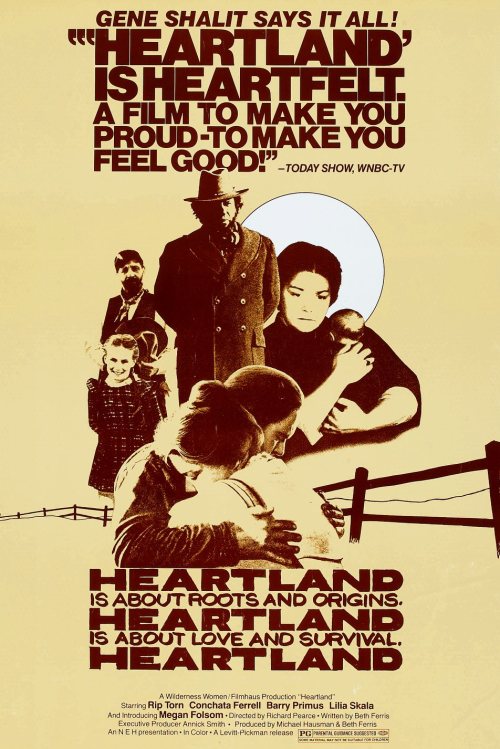
In 1910 a widow named Elinore (Conchata Ferrell) and her 7-year-old daughter Jerrine (Megan Folsom) travel to Wyoming where she gets a job as a housekeeper to rancher named Clyde (Rip Torn). The two slowly fall-in-love, eventually marry, and have a baby of their own. Unfortunately the harsh winter and remote locale takes its toll causing tragedy to both their small family and to the ranch itself.

The story is based on the letters written by Elinore Pruitt Stewart to her former employer as she described her adventures working on a ranch as a homesteader to Henry Clyde Stewart during the years of 1910 to 1914. The film stays very faithful in tone and content to the period and some of the most fascinating moments are simply observing the different chores that they had to do back then and what now comes off as very archaic.  Shooting the film on-location in the Rocky Mountain region, substituting Montana for Wyoming, and capturing all four seasons helps add to the authenticity.

Farrell’s strong personality gives life to her character and reveals the inner strength required to endure and survive the hardships of frontier life and it’s amazing how closely she resembled the real Elinore Stewart as evidenced by an old photograph of her taken in 1913. Torn is also quite good, but his thick Scandinavian accent makes it difficult to understand everything he says. I also really enjoyed Folsom as the young girl, who doesn’t have much dialogue, but more than makes up for it with her expressive face. Lilia Skala is also good as Mrs. Landuer a headstrong elderly neighbor who goes by the nickname of Grandma.

While the soundtrack matches the period flavor I felt there was too much of it and would’ve enjoyed more silence as that is pretty much all you would’ve heard anyways on the frontier during that time. I would’ve also liked more of a backstory to Elinore, specifically showing why she was widowed, in real-life her husband died in a railroad accident before their daughter Jerrine was even born, and yet it would’ve helped the viewer understand Elinore better had this been dramatized, or at least touched on.

The ending is also too abrupt. It brings up all the challenges in maintaining the ranch, but no conclusion as to whether they were able to withstand them all or not. Several story threads get left hanging even though in real-life Elinore lived 19 years past when this story took place and Clyde lived for another 35 years, so having some denouncement at the end explaining where they ultimately ended up past what we see here was in my opinion very much needed and the fact that it doesn’t occur makes the film seem like only half-a-movie.

There’s also some scenes that may make certain viewers uncomfortable. Many of them deal with animals getting killed including a wild pig that gets shot at point blank range and then skinned and gutted. Since this was apart of the frontier life back then I didn’t have a real problem with it, but others might. The most disturbing scene though deals with a cow trying to give birth and requires both Torn and Farrell sticking their hands inside the cow’s vagina at the same time in order to turn the calf around, so that its head will come out first. They then tie a rope around the calf’s head and yank him out in extremely explicit fashion. While some may consider this the miracle of birth others may not be able to stomach it, but overall it does help to heighten the realism either way.

My Rating: 7 out of 10

Released: September 22, 1979

Runtime: 1 Hour 36 Minutes

Rated PG

Director: Richard Pearce

Studio: Filmhaus

Available: DVD, Amazon Video

Taps (1981)

By Richard Winters

My Rating: 3 out of 10

4-Word Review: Cadets take over academy.

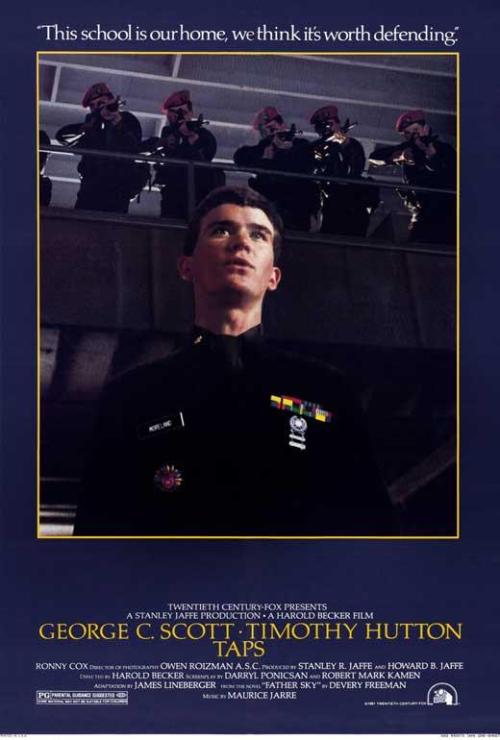
At the conclusion of another school year at Bunker Hill Military Academy, General Harlan Bache (George C. Scott) announces, to his shocked cadets during the commencement proceedings, that their school has been sold to real estate developers and will be closed in 1 year. Then that evening tragedy strikes forcing the board of trustees to close the school immediately. The students lead by Brian Moreland (Timothy Hutton) who had just been promoted to Cadet Major decide to take matters into their own hands by taking over the school with force and refusing to leave it unless guarantees are made to keep it open.

The film is based on the novel ‘Father Sky’ by Devery Freeman and the first half has excellent potential. The drama is intense and on-target and brings up a myriad of interesting conundrums dealing with the thin line between loyalty versus rebellion and how at different times both can be good and bad. It also deftly examines how bad things can come from the best of intentions.

Unfortunately all the action takes place in the first hour leaving the second half woefully undernourished with nothing happening. Everyone stands around expounding until all the tension that had been so nicely built-up at the beginning gets sapped away leaving boredom in its wake. The film also tries too hard to make its point becoming overwrought and preachy in the process. The dialogue between the characters loses its conversational quality and instead starts to sound like mini speeches.

The acting by the soon-to-be-stars is good and includes Sean Penn in his film debut as well as Tom Cruise in a breakout role that originally he rejected because he was only hired to be a background character, but his presence during rehearsals so impressed director Harold Becker that he decided to give him a bigger part and he  leaves a lasting impression particularly at the very end. Hutton, who was just coming off his Academy Award winning work from Ordinary People is effective too despite his thin frame and the scene he has where he discusses the situation with the cadets’ distressed parents are his best moment.

Scott on the other hand comes off as old and tired, granted that was the type of character he was playing, but it still isn’t a showy role for an otherwise famous actor and in fact he only appears in the film’s first act. The scene dealing with him trying to break up a ruckus between a group of students and cadets is poorly edited. One shot has his gun being taken out of its holster by another student only to magically reappear in Scott’s hands in a later shot, which comes off looking like a jump cut.

From a simply logical perspective it becomes abundantly evident right from the beginning that these kids have gotten in way over their heads with no endgame and nothing is worse than seating through a plodding plot that you know won’t end well.

My Rating: 3 out of 10

Released: December 9, 1981

Runtime: 2 Hours 6 Minutes

Rated PG

Director: Harold Becker

Studio: 20th Century Fox

Available: DVD, Blu-ray, Amazon Video, YouTube

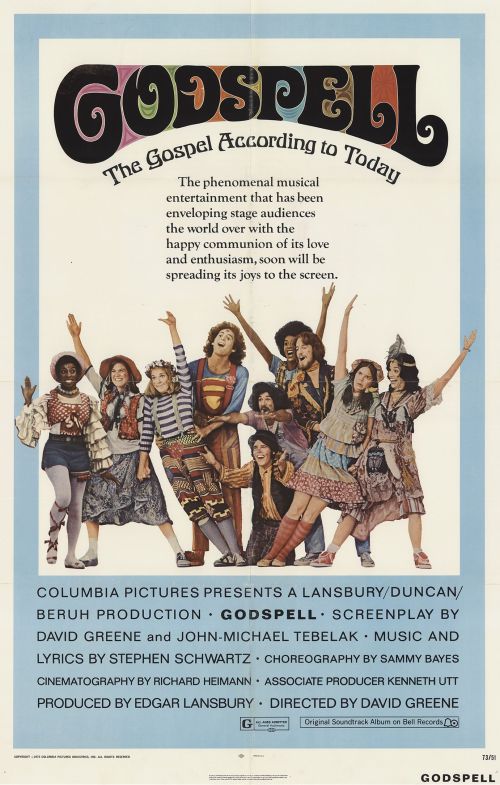
Godspell (1973)

By Richard Winters

My Rating: 3 out of 10

4-Word Review: Jesus is a hippie.

A group of modern day young adults dissatisfied with their mundane lives decide to follow the calling of John the Baptist (David Haskell) to learn the teachings of Jesus (Victor Garber). They spend their days roaming the vacant streets of New York City while doing song and dances that are inspired by the Gospel of St. Matthew.

This film is based on the hit Broadway play that in turn was the brainchild of John-Micheal Tebelak. Tebelak was a student at Carnegie Mellon University in 1970 when he attended an Easter Vigil at St. Paul’s Cathedral only to end up getting frisked for drugs by the police simply because his clothing attire resembled that of a hippie. He became incensed that the modern day Christian was out-of-touch with the younger generation and became compelled to bridge-the-gap by going home and writing this play, which lead to him getting offers to produce and direct it, first at experimental off-Broadway theaters and then finally Broadway itself.

While this film’s intentions may be noble, it doesn’t completely succeed although its ability to take advantage of the New York City locations is a chief asset. Many prominent sites of the city get used including the Bethesda Fountain in Central Park, the Brooklyn Bridge, and even a breath-taking dance sequence on top of the still being built World Trade Center. The film also manages to somehow, outside of the very beginning and very end, clear out all the other people from the city making the Big Apple seem like a giant ghost town, which in a way gives off a good surreal vibe, but it also would’ve been interesting seeing this troupe dealing with the everyday person and the reactions that would come from that.

The song and dance numbers are well choreographed, but there ends up being too many of them. The story lacks a plot and to a degree comes off as nonsensical. I realize they’re singing about parables from the Bible, but the viewer isn’t paying attention to that and instead focused on the colorful locales and comical antics of the hammy performers and it’s quite doubtful that a non-believer would suddenly get ‘inspired’ by anything that goes on here. Young children will most likely by confused and even frightened by it while teens and young adults, which was the target audience, will by today’s standards roll-their-eyes and consider it a relic of a bygone, drug-trippy era.

The cast shows a lot of energy and many of them were from the original stage version, but ultimately there’s no distinction between them. While most musicals have at least some dialogue and drama between the songs this one has none. It’s just two hours of non-stop singing and unless you’re deeply into the message this won’t really gel well with most viewers. The clothing styles, which at the time may have been ‘hip’, now look silly including having Jesus with an afro and walking around in over-sized shoes, which to me resembled a clown.

This might’ve worked better on stage where the intimate setting would allow one to feed off the vibe of the other audience members, but as a film it’s off-putting and the dazzling visual direction cannot overcome its other shortcomings.

My Rating: 3 out of 10

Released: March 21, 1973

Runtime: 1 Hour 43 Minutes

Rated G

Director: David Greene

Studio: Columbia Pictures

Available: DVD, Amazon Video

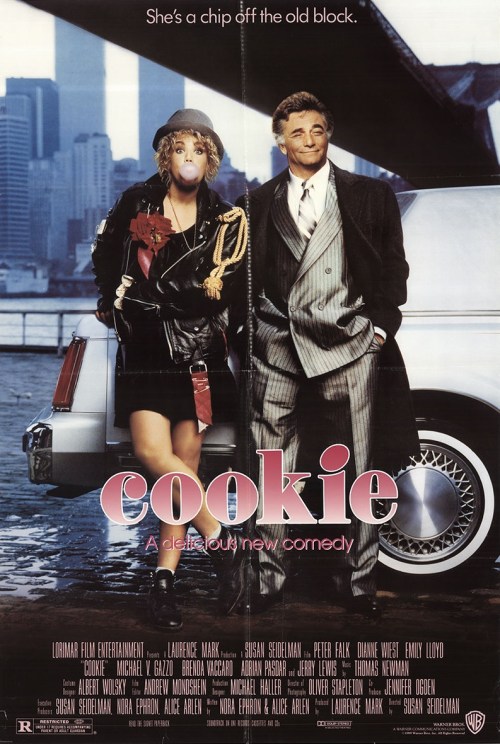
Cookie (1989)

By Richard Winters

My Rating: 3 out of 10

4-Word Review: Daughter becomes getaway driver.

Dino (Peter Falk), a longtime racketeer, gets released from prison after a 13-year sentence. He meets up with his long time crony Carmine (Michael V. Gazz0) only to learn that Carmine sold off his share of the business, but now refuses to give him his entitled proceeds. Dino then plots an elaborate revenge and uses his estranged daughter Cookie (Emily Lloyd) to help him. At first the two don’t get along,but eventually forge a friendship when she proves to be quite resourceful as a getaway driver.

This movie proved to be the start of Lloyd’s career downfall. She burst onto the scene with her acclaimed performance in Wish You Were Here, which had all the critics fawning over her including Roger Ebert who called her performance “one of the great debut roles of a young actress”. With her new found fame she moved to New York at the age of 17 and immediately got the starring role in this film, which unfortunately proved to be her undoing as she showed erratic behavior on the set due to a condition that was later diagnosed as being attention deficit disorder. At one point during filming her irritated co-star Falk slapped her because she repeatedly flubbed of her lines, which caused her to then reportedly slap him.  It was behind-the-scenes stories like these that made studios reluctant to hire her and costing her to miss out on a lot of big roles.

While I’ll commend her ability to put on a very effective Brooklyn accent where you can’t even hear a hint of her native British one I still felt overall her performance here is quite weak and one of the main reasons that the film fails. Her facial expressions are too one-note and she shows an aloof detachment in all of her scenes almost like she really doesn’t want to be there. It’s evident onscreen that she and Falk didn’t care for each other making the bonding that their two characters have come-off as forced and insincere. I didn’t know why her character was even needed, I presume it was done to attract the all-important teen demographic, but she’s not funny and there’s long stretches where she doesn’t even appear. Her attire looks too much like the clothing style worn by Molly Ringwald during the 80’s and while that may have been the fashion it’s still good to have a character come up with a clothing style that is unique to them, so she doesn’t end up looking like just a leftover cast member from a John Hughes’ movie.

The supporting cast are what make this movie funny and had the story centered around them it could’ve been special. Gazzo is great as the mob boss who is intimidating one minute and then frightened and contrite the next. Dianne Weist, is quite funny too, particularly her extended crying bouts, as Falk’s mistress and Brenda Vaccaro steals a few scenes as his dog groomer wife. You can also spot Joy Behar in a brief bit as well as Jerry Lewis although his part is quite colorless and I’m surprised he even took it.

The script by Nora Ephron and Alice Arden relies too much on Mafia cliches while failing to add a unique or interesting spin to it. There’s also too many scenes, three of them to be exact, involving the explosion of a limo. One time is okay, but it saps away the surprise/shock value when it keeps happening and much like the movie itself fizzles out with a whimper.

My Rating: 3 out of 10

Released: August 23, 1989

Runtime: 1 Hour 33 Minutes

Rated R

Director: Susan Seidelman

Studio: Warner Brothers

Available: DVD-R (Warner Archive), Amazon Video, YouTube

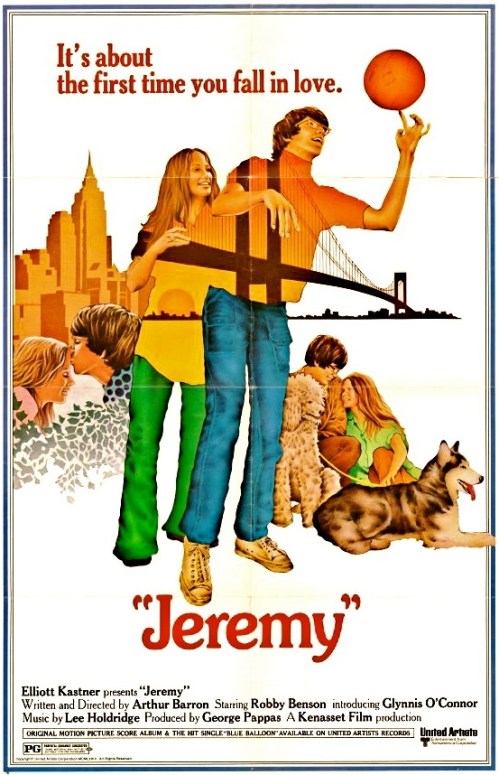
Jeremy (1973)

By Richard Winters

My Rating: 4 out of 10

4-Word Review: A teen’s first romance.

Jeremy (Robby Benson) is a teen cellist going to a New York school for artistically inclined students. It is there that he meets Susan (Glynnis O’Connor), who is training to be a ballerina, but he’s too shy to ask her out, so his friend Ralph (Len Bari) asks her for him. Eventually the two start dating and after 3-weeks find themselves in a deep and committed relationship only to have happenstance tear them apart.

The film tries hard for realism, at least to some degree, and for that reason it partially succeeds. The best moments are the ones where Jeremy frets about asking Susan out and is unable to get up the nerve to do it, which I enjoyed as few movies deal with this very real issue. In fact a study was done during the 70’s dealing with so-called ‘love-shy’ men and of those over 300 considered this their favorite movie with some having watched it 20 or more times and one individual in his late 30’s having seen it 86 times.

Unfortunately the pace is inconsistent with too much time spent during the first 30-minutes dealing with Jeremy’s cello playing, which is something that by the third act gets forgotten and not even mentioned. There are also two sappy songs that are played, one sung by Robby and the other by Glynnis, and nothing is more annoying than a film that tries to be realistic one minute only to bog things down with needless music montages the next.

Benson’s acting here borders on being excruciating to watch. Shy, awkward teens are fine, but Robby becomes the poster child for it making it almost cringe-worthy. O’Connor is more confident and she should’ve been paired with somebody that would’ve equaled it. I realize that the two in real-life got into a long term relationship during the filming of this and 3 years later appeared together in Ode to Billy Joe where Benson’s acting ability and scrawny physique had improved, but here he’s too much of a caricature and it would’ve been more interesting had the character been someone with a confident facade only to be gun-shy romantically when the pressure was on.

Spoiler Alert!

The third act is a disappointment as it involves Susan and Jeremy being forced to break-up when her father (Ned Wilson) gets a job offer in Detroit. I realize this was before the internet age and long distance relationships can always be a challenge, but I didn’t feel this necessarily had to signify the end of it. They could’ve continued to write letters and talk over the phone and they were only two years away from turning 18 and by then they would be free to move away from their parents and start back together, so this story twist came-off like a cop-out. I would’ve preferred a more concrete reason to why their relationship ended, like realizing once the infatuated puppy-love phase died down that they just weren’t compatible, which is how the majority of relationships ultimately end.

My Rating: 4 out of 10

Released: August 1, 1973

Runtime: 1 Hour 30 Minutes

Rated PG

Director: Arthur Barron

Studio: United Artists

Available: DVD, Amazon Video

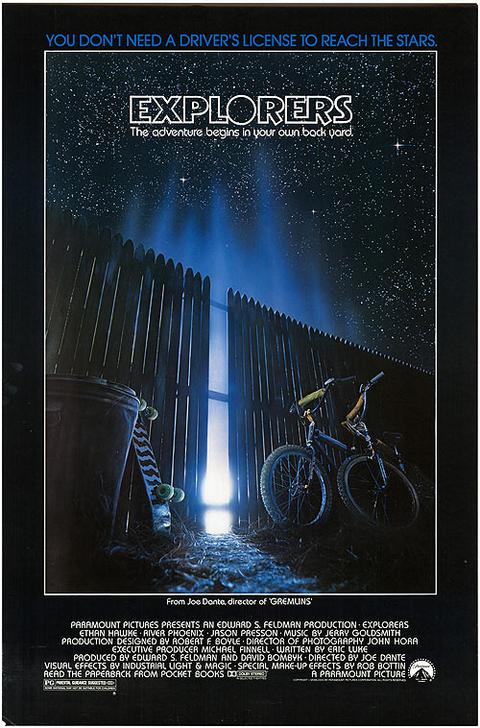
Explorers (1985)

By Richard Winters

My Rating: 2 out of 10

4-Word Review: Kids go into space.

Ben (Ethan Hawke) is a teen who keeps having dreams dealing with a spacecraft and eventually writes down the dimensions of it onto paper and then sends it to his super smart friend Wolfgang (River Phoenix) who uses it as a blueprint to eventually create it in real-life using various parts that they find in a junkyard. Once completed Ben, Wolfgang, and their other friend Darren (Jason Presson) decide to take it for a ride. Initially they fly it around their coastal California town, which catches the eye of the police (Dick Miller), who chases after it to no avail. Eventually though they decide to take it into outer space where they visit aliens inside a intergalactic space station.

Out of all of the sci-fi movies that came out during the 80’s this one has gotten lost in the shuffle and wasn’t too well received by the critics when it was first released though it has achieved a cult following since then. Director Joe Dante has complained that the final cut was taken out of his hands and he was never able to complete the ending that he wanted though for the most part the film never really gels, has a slow pace and only spotty moments where it becomes even halfway amusing.

One of the things that I did like was that the cast is age appropriate for their parts and the scenes done on a junior high campus have a student body that really looks to be teens instead of older college age actors trying to look younger, which happens in so many other teen films. The three leads thankfully aren’t crude or foul mouthed and aren’t obsessed with parlaying a ‘cool’, trendy image, which is also nice, but they seem just a bit too smart and able to do things that most adults can’t like welding and carpentry and  building a craft to exact specifications without any hitch or screw-up. Sure that Wolfgang kid is supposed to be smart, but even geniuses can make incorrect estimations, but this guy never does.

Watching the silly looking contraption actually get off the ground is farcical as in reality it most likely wouldn’t and the science gets completely thrown out the window. When they go out into space on their second trip they don’t even bother to equip themselves with oxygen and since there’s none in space I wasn’t able to figure out how they could breath. There’s no explanation either for how they were able to survive the extreme drop in temperature that occurs in high altitudes nor how the craft was able to get back through the earth’s atmosphere without burning up.

Spoiler Alert!

The scenes where the boys fly the craft around their town and even disrupt a sci-fi movie that is being shown at a local drive-in is when its funny and where the story should’ve stayed. Having it venture out into space and meeting other teen aliens is when it jumps-the-shark. The first hour plays like a whimsical fantasy, which is passable, but the third act becomes too campy. It also criminally under-uses Amanda Peterson, who plays Ben’s attractive love interest, who gets barely seen at all even though she should’ve gone on the trip with the other three boys, which would’ve bolstered the entertainment value and the fact that she doesn’t makes this already weak file even weaker.

My Rating: 2 out of 10

Released: July 12, 1985

Runtime: 1 Hour 49 Minutes

Rated PG

Director: Joe Dante

Studio: Paramount Pictures

Available: DVD, Amazon Video, YouTube

North Avenue Irregulars (1979)

By Richard Winters

My Rating: 7 out of 10

4-Word Review: Church ladies battle mobsters.

Reverend Michael Hill (Edward Herrmann) becomes the new pastor at the North Avenue Presbyterian Church, but right away things get off to a rocky start when the church’s funds get gambled away on a horse race. When Hill tries to retrieve the money he finds out that it is an illegal gambling joint run behind a dry cleaning business, who are always able to skillfully remove their presence before the police arrive. Hill goes on TV to lambaste organized crime in their town, which catches the attention of two treasury agents (Michael Constantine, Steve Franken) who want Hill to help them close down the gambling joints by having him hire men from his church to place bets at the parlors, but all of the men refuse. Hill then asks for the help of the church women who agree to do it and after some initial setbacks begin to make headway in taking down the area mobsters.

Usually I always say it’s important for films that are aimed for a young audience to have children playing the protagonist, but in this case the children characters have only small supporting roles and yet the film still manages to deliver the laughs. The main reason is the talented female cast who have distinctive personalities and convey comic form in different ways. Cloris Leachman is amusing as the middle-aged cougar with long finger nails, Virginia Capers is quite funny too as a heavy-set woman who doesn’t allow her big build to stop her from running several blocks in order to tail the bad guys and the variety of vehicles she drives with funny phrases painted on their windshields, which are all from her husband’s used car dealership, are humorous too. Barbara Harris as a suburban mother who chases the mobsters while driving in a station wagon packed full of kids in it is great too.

What may be surprising to many is that it’s all based on true events that occurred to Revenrend Albert Fay Hill when he took over as the minister at the North Avenue Presbyterian Church in New Rochelle, NY in 1961. It was there that he became a crusader against organized crime after the murder of a young man for not repaying his gambling debts. Like in the movie his fight gained the attention of US Treasury agents who wanted him to get his male parishioners to place bets with the mobsters, but the men all refused so he recruited their wives whose efforts managed to shut down several gambling houses, which lead to a front page write-up in The New York Times as well as Look magazine.

Of course the movie exaggerates things for comic effect, but it’s forgiven because the stunts are quite funny, which culminates in a massive car pile-up consisting of the demolition of 14 cars at the cost of $155,000. The scene involving the church getting blown up is amusing too because behind-the-scenes when it was first done the cinematographer forgot to put film in the camera forcing the crew to painstakingly rebuild the church just so they could try to do it all over again.

The film’s only weak element is Herrmann whose performance is certainly sincere and likable, but he’s never funny while Constantine is hilarious as the exasperated agent who has a virtual nervous breakdown dealing with the women and for that reason the film would’ve been more engaging had he been the lead character. I was also confused why the Reverend was  a single parent as there’s no explanation I could remember for what happened to the wife. In the book that this film is based, and in the true-life incident, the minster was married, so why was it decided that he should be single here? I got the idea it was because they wanted to create a romance between he and his secretary played by Susan Clark, but since nothing much comes from that it seemed unnecessary.

My Rating: 7 out of 10

Released: February 9, 1979

Runtime: 1 Hour 40 Minutes

Rated G

Director: Bruce Bilson

Studio: Buena Vista

Available: DVD, Amazon Video, YouTube

The Front (1976)

By Richard Winters

My Rating: 6 out of 10

4-Word Review: Covering for blacklisted writers.

In 1953 during the height of the Red Scare where many working in Hollywood were blacklisted if they had any connections with communist sympathizers writer Alfred Miller (Michael Murphy) suddenly finds himself out of work and unable sell any of his scripts. He asks his friend Howard (Woody Allen) who works as a cashier at a cafe to act as a ‘front’ for him by selling his scripts to producers and acting as if he wrote them instead of Alfred. In exchange Howard would be able to collect 10 % of the profit, which he readily accepts. Soon Alfred’s other writer friends hire Howard to sell their scripts, which quickly makes him financially comfortable, but he soon sees the dark side of the business especially when he gets investigated for being communist sympathizer himself.

The film was written and directed by those who personally went through the blacklisting when it happened, which is great, but the film cannot seem to decide whether it wants to be a drama or comedy and takes too much of a timid, middle-of-the-road approach that is neither impactful nor memorable.  Lots of prime comedic potential gets completely glossed over like when Howard is forced to do a rewrite on a script in a hurry despite having no background, or knowledge on how to do it. This occurs twice and both times the film fails to show what he does to get out of the jam, he is shown for a couple of seconds on the phone presumably with Alfred getting advice, but it would’ve been funny hearing their conversation and seeing him quite literally sweat his way through the process.

Spoiler Alert!

The drama gets handled in too much of a genteel way too making the intended message mild and not something that completely connects emotionally with the viewer. The scene where Zero Mostel jumps out of a hotel window when he realizes his career is over happens much too fast. One second we hear the window being opened and the next second the camera quickly pans over to see that Mostel is no longer standing in the room making it seem more like he just disappeared into thin air. The ending where Howard finds himself forced to testify in front of the House of UnAmerican Activities panel is weak as well. The final 20 minutes is spent with this big build-up of what Howard will do when he is put in front of them, but the payoff is slight and hinges on him telling them to go ‘fuck themselves’, which is such an overused expression in this modern age that it hardly resonates as it once might’ve been.

End of Spoiler Alert!

Allen is an obnoxious protagonist that I did not find funny or sympathetic. He became so unlikable that I started wanting to see him get caught and even humiliated, which I don’t think was what the filmmakers intended the viewer to feel. I also thought it was ridiculous that this scrawny, dorky looking guy would be so brazen to come-on to hot looking women like he does. I know in the movies that he directs this always occurs and I looked past it as Woody simply revealing his diluted, narcisstic ego, but this film was done by a different director, so things should’ve been presented in a more realistic way by having the beautiful women laugh at Woody when he attempted to ask them out and forcing him to settle for someone his physical equal. I realize that Andrea Marcovicci’s character falls for Woody because she thinks he’s the writer of the scripts, but I would think after she went out with him for awhile she’d start to realize he wasn’t the same person she thought he was and not have to have it explicitly spelled out  for like it ultimately is.

It would’ve worked much better had Michael Murphy been cast as Howard as he was more able to convey likable qualities. Zero Mostel is also quite strong as the desperate comedian and had his character been cast in the lead it would’ve given the viewer a stronger feeling of what it was like to be blacklisted during that era as the story would’ve been told from the victim’s point-of-view instead of having those directly affected by the McCarthyism relegated to only supporting parts.

My Rating: 6 out of 10

Released: September 30, 1976

Runtime: 1 Hour 35 Minutes

Rated PG

Director: Martin Ritt

Studio: Columbia Pictures

Available: DVD, Amazon Video, YouTube

Midnight Madness (1980)

By Richard Winters

My Rating: 4 out of 10

4-Word Review: All night scavenger hunt.

Leon (Alan Solomon) is a geeky college student who comes up with an elaborate scavenger hunt to be played by his fellow students. The object of the game is to pick-up on certain clues hidden throughout the city of Los Angeles and each team must solve the clue given to them before they can move onto the next one. The game is played by 5 teams who have 5 members each: David Naughton heads the preppy Yellow team, Maggie Roswell plays the leader of the nerdy girls red team, Eddie Deezen leads the geeky white team, Brad Wilken leads the green team, which is made up of party animal jocks, and Stephen Furst heads the anti-social/misfit blue team.

On the surface this comes off as just another crude, sophomoric 80’s teen comedy complete with gross out humor of having to watch overweight Furst constantly stuffing his face with food, which is genuinely painful to watch when you realize that in real life he had a big issue with diabetes that made him retire from acting and he ultimately died from the illness. The film fails to have anything all that funny in it and it doesn’t even show any skin from its attractive female cast, which most likely was a result of it being financed by Disney.

The game itself though is kind of interesting and posses some legitimate logic oriented clues that force both the viewer and participants to think it through in order to solve. There is also some interesting on-location shooting done in famous landmark locations throughout Los Angeles including the Griffith Observatory, Grauman’s Chinese Theater, and the Westin Bonaventure Hotel, which helps give this otherwise low budget production a bit of a visual spark.

Even with these elements in place the film fails to take full advantage of its setting. If this is all supposed to take place during the wee hours of the night then there really shouldn’t be such large crowds present at the locations they go to including tours going on at the Pabst Blue Ribbon beer plant. It would’ve been more of a surreal ambiance had it just been the players of the game roaming around an otherwise shuttered city while everyone else was fast asleep. The final part of the game takes place in the daytime, which again ruins the nightime/midnight theme and effort should’ve been made to have the entire story take place while it was dark.

The story is also full of a ton of logic loopholes including never explaining how Leon was able to get his face painted on the side of beer cartons at the beer plant as well as a wide assortment of other issues. One also had to wonder why Leon goes to such great lengths to create such an elaborate game that doesn’t really seem to benefit him directly. If this kid is so smart to create such an intricate game then why doesn’t he put his creative energies into forming a profitable business so he doesn’t have to live in a rundown apartment that has paper thin walls and a crabby landlady screaming at him every time he makes any noise?

The cast has some familiar faces in small roles including Paul Reubens (aka Pee Wee Herman) in a bit part at a game arcade and Marvin Kaplan, an aging character actor best known for his work in Adam’s Rib and the TV-show ‘Alice’, as an overwhelmed hotel desk clerk. Kudos also go out to Irene Tedrow as an elderly and quite obnoxious landlord and Dirk Blocker, who is the son of famous ‘Bonanza’ star Dan Blocker and looks just like him, as a dim-witted party animal who just can’t get enough beer.

Naughton though is quite stale in the lead and doesn’t seem to have much acting talent at all although I did like the in-joke of seeing him drink a Dr. Pepper since he’s probably best known for singing the ‘I’m a Pepper’ jingle in TV commercials during the 70’s. This also marks Michael J. Fox’s film debut who plays the younger brother to Naughton though the subplot dealing with his anger at being taken for granted by his older sibling is misplaced and heavy-handed in a film that is otherwise super silly.

My Rating: 4 out of 10

Released: February 8, 1980

Runtime: 1 Hour 52 Minutes

Rated PG

Director: Micheal Nankin, David Wechter

Studio: Buena Vista Distribution Company

Available: DVD, Amazon Video, YouTube