Going Places (1974)

going places

By Richard Winters

My Rating: 9 out of 10

4-Word Review: Guys with no morals.

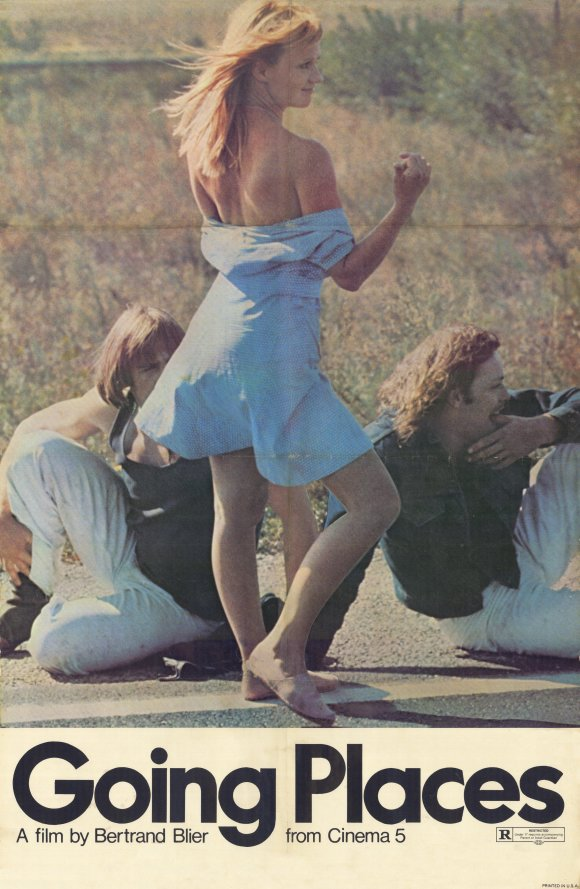
Two small time hoods (Gerard Depardieu, Patrick Dewaere) spend their days roaming the streets, robbing stores, and molesting women. In some ways this is truly an amazing film in what it is able to get away with. The two main characters are immoral, ignorant, insensitive, and brutal and the women are demeaned and degraded. The overall content is vulgar and perverse and yet somehow this thing comes off as a lyrical, offbeat delight that is pure entertainment.

It’s a definite original with every scene being an ingenious comic set-up. The scenario structure and use of locations is perfect. The pacing is fluid and director Bertrand Blier’s eye for detail near brilliant. The two hours move along like a breeze. It never gets boring and I actually almost wished it could have been longer.

The comic threads are hilarious and they get funnier and funnier as they go along. The guys’ constant, futile and very explicit attempts at getting a frigid woman (Miou-Miou) excited are a particular standout.

This is the type of black comedy that should be used as an example for all others. It’s consistently unique and manages to balance the ugly elements with the lighthearted without going overboard on either. It even throws in a surreal angle without a hitch.

Veteran French actress Jeanne Moreau has one of her finest latter career roles playing a lonely lady in desperate need of male attention. Her scene is well played out and even has a shocking conclusion. Depardieus ‘friendly’ conversation with a shopping mall security guard is another standout. The ultimate joke though may be in the film’s title as these guys are truly going nowhere.

My Rating: 9 out of 10

Released: March 20, 1974

Runtime: 1Hour 57Minutes

Rated R

Director: Bertrand Blier

Studio: Universal Pictures France

Available: VHS, DVD (Region 1 & 2), Amazon Instant Video

Perfect Strangers (1984)

perfect strangers

By Richard Winters

My Rating: 6 out of 10

4-Word Review: Kid witnesses a murder.

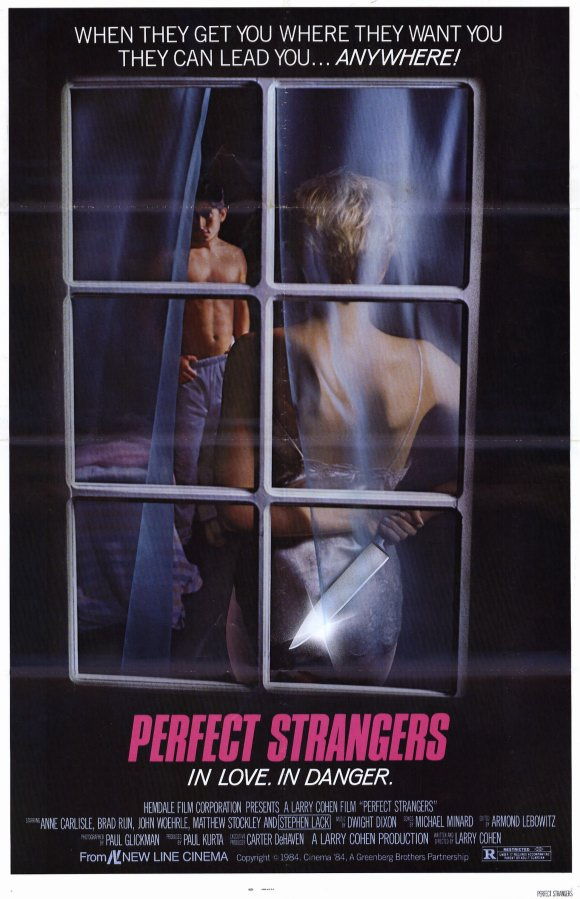
Johnny (Brad Rijn) is a local hit-man who knifes someone to death in a back alley. Little does he know that behind a nearby fence is a 2-year-old toddler peeking out through a small opening and witnessing the whole thing.  As Johnny is about to leave he suddenly becomes aware of the child, but as the police are coming he runs. He is connected to the mob and when he tells them of the incident they advise him that he must kill the child simply to be extra cautious. Johnny then decides to get in a relationship with the boy’s attractive single mother Sally (Anne Carlisle) with the idea that he will get close enough to her that she will trust him to be alone with the kid where he will then off him and make it look like an accident.

The child who is played by a very young actor named Matthew Stockley is extremely cute to the point of being adorable. The idea of any harm coming to him is almost unthinkable, which helps create some tension and the climatic sequence where he is chased by Johnny though an abandoned, shadowy warehouse is well done.

However, the film’s biggest weakness is the Johnny character who is too damn nice to the point that I even started to like him as the film progressed. The guy is great with the kid and shows a definite sensitive side and is reluctant to harm the child and only considers it because the rest of the mob pushes him to. This then pretty much mutes the tension and the film would have been more exciting had the character been portrayed as a cold-hearted psycho. I also found it a bit contradicting that this otherwise nice guy could so easily kill other people. The extremes in the personality didn’t connect although at one point he does at least say ‘sorry’ to one of his victims as he drags the dead body away after viciously killing him.

Carlisle is excellent. She is probably best known for starring in as well as writing the screenplay for the cult hit Liquid Sky. There she played a teenage punk, but here filmed only 2 years later she comes off as a mature full-grown woman and her effective performance helps carry the film. Otto von Wernherr who was also in that movie appears as a private eye hired to follow Johnny around.

Stephan Lack who was in Scanners and just about ruined the film with his terrible performance is surprisingly good here as an aggressive police detective who hounds Sally for answers and won’t leave her alone. Ann Magnuson is somewhat amusing as a man-hating feminist Nazi.

If writer/director Larry Cohen scores anywhere it is in his ability to vividly show the street culture and eclectic, busy atmosphere of New York City life. One bit has hundreds of woman marching down the street in an anti-rape parade and when Johnny tries to get involved in it the woman aggressively pushes him back out. Things flow enough to make it mildly entertaining, but the film lacks distinction and is ultimately forgettable.

My Rating: 6 out of 10

Released: November 24, 1984

Runtime: 1Hour 31Minutes

Rated R

Director: Larry Cohen

Studio: Larco Productions

Available: DVD

The Trip (1967)

the trip

By Richard Winters

My Rating: 5 out of 10

4-Word Review: He tries some acid.

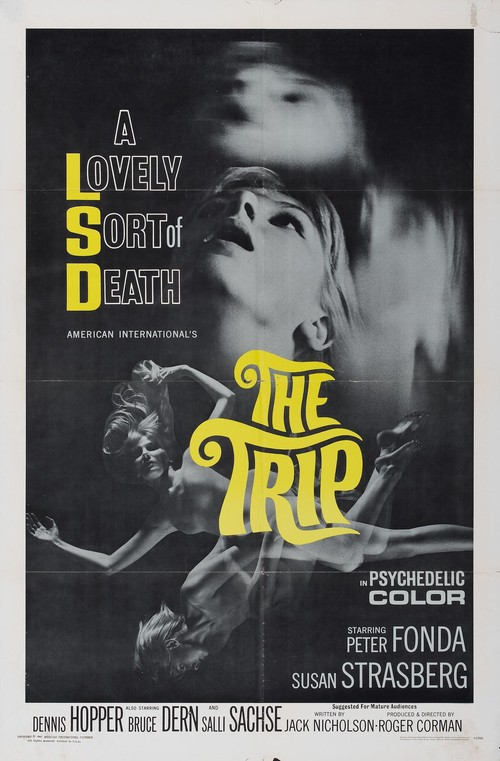
Jack Nicholson wrote the screenplay to this film which is based loosely experiences he had while taking LSD as well as the break-up of his marriage to actress Sandra Knight. The story centers on Paul (Peter Fonda) a director of TV commercials whose marriage to Sally (Susan Strasberg) is on the rocks. He has a need to ‘find himself’ and seeks help from his friend John (Bruce Dern) who is a self-styled acid guru. John gives Paul some acid while promising that he will stay with him during his drug induced trip. The rest of the film then deals with Paul’s experiences both in his mind and in his dealings with the outside world while he is hallucinating.

To prepare for the film Nicholson, Fonda and Dennis Hopper, who appears in a minor supporting role, all took part in a group LSD trip and the various visions that they experienced are incorporated here. Director Roger Corman also tried LSD at a different time to prepare for the film. The only one not to try it was Dern who was staunchly opposed to recreational drug use and in fact even his character doesn’t take any as evidenced by a scene where everyone is taking a puff of some marijuana and when it gets passed to him he simply passes it to the next person without trying even though everyone else does.

The scenes recreating the acid trip are not all that interesting or imaginative. It’s all pretty much what you would expect with a barrage of artsy colorful designs popping up at the viewer in split second intervals that reminded me very much of looking through a kaleidoscope. The images aren’t coherent, nor meant to be, and become vapid in the process. The scene involving Paul sitting on a merry-go-round while trying to justify his existence to Hopper who is dressed in a devil-like costume gets quite tedious.

Things improve during the second half when John, who promised he would stay at Paul’s side during his trip, ends up leaving him momentarily to retrieve some apple juice. During this time Paul escapes from the home he is in and goes out onto the city streets. The editing and effects here are impressive and ahead of its time. Some of the visits he has with the people he meets prove interesting including an offbeat conversation that he has with a lady that he meets inside a Laundromat as well as one he has with a very young girl inside her house.

Although he starts out shaky I felt Fonda’s performance was pretty good and this may be one of the best roles of his career. Strasberg who receives second billing appears just briefly and has very few speaking lines. Dern is always fun when he is playing eccentric or intense characters, but here where he is playing a relatively normal one he is boring. His part was originally written for Nicholson to play and I think he would have done better.

I was expecting some sort of tragic or profound-like ending especially with the opening paragraph that starts the film and is read by a narrator with a very authoritative newsman-like voice describing the ‘horrors’ of drug use and how it is becoming a serious societal problem. However, nothing really happens. The movie just kind of stops and that is it. The weak conclusion hurts what is already a so-so film making it like the drug itself an interesting experiment, but nothing more.

My Rating: 5 out of 10

Released: August 23, 1967

Runtime: 1Hour 25Minutes

Not Rated

Director: Roger Corman

Studio: American International Pictures

Available: VHS, DVD, Amazon Instant Video

Where’s Poppa? (1970)

wheres poppa 2

By Richard Winters

My Rating: 9 out of 10

4-Word Review: Mother has to go.

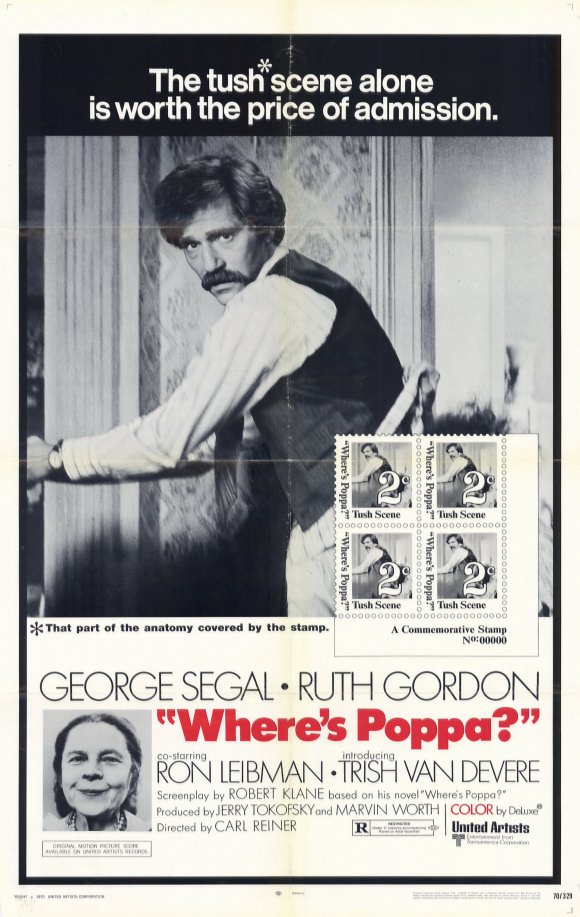
A beleaguered Gordon (George Segal) is a man who must take care of his invalid mother (Ruth Gordon). Despite being a handsome young lawyer he has literally become trapped by this very difficult woman. The majority of the film takes place in a 1940’s styled apartment. It’s gray, dusty bleakness permeates every shot and shows just how lodged Gordon is in his mother’s world. He is a normal man that is slowly being sucked into madness. He is becoming mad because the world he lives in and life in general is driving him to it. The wall between what he really wants to do in life and his obligations have become so thick that going crazy may be the only real answer.

In fact madness maybe pretty much is what this film is really about. It seems to be saying that there is a certain functioning normality to it and at times even a necessity for it. Everyone in this film conveys their own unique form of madness. There’s the overzealous war general (hilariously played by Barnard Hughes) There’s also the henpecked brother/husband Sidney (Ron Leibman) who goes to almost absurd lengths to make sure everyone is happy. Even innocent, conservative Louise (Trish Van Devere) opens into the crazy world when explaining her rather unique honeymoon experience. The film delves so deeply and consistently into the world of the absurd that at times the senile Mother really doesn’t seem so nutty.

This is the film’s genius. It takes everything we have always accepted and turns it inside out. It takes some of life’s most depressing things and then makes it into an inspired and creative masterpiece. A trip to the old folk’s home has never been considered by many to be funny or memorable, yet a trip to Paul Sorvino’s old folk’s home is. In fact it maybe one of the funniest scenes you’ll ever see.

Writer Robert Klane and director Carl Reiner show an amazing grasp of their material, which is crucial for its success. Everything is fluid and consistent in tone. It shows how you can indeed have an offbeat idea, do it in an offbeat way, and still succeed without compromising.

My Rating: 9 out of 10

Released: July 9, 1970

Runtime: 1Hour 22minutes

Rated R

Director: Carl Reiner

Studio: United Artists

Available: VHS, DVD

Cadillac Man (1990)

cadillac man2

By Richard Winters

My Rating: 6 out of 10

4-Word Review: Car salesman versus gunman.

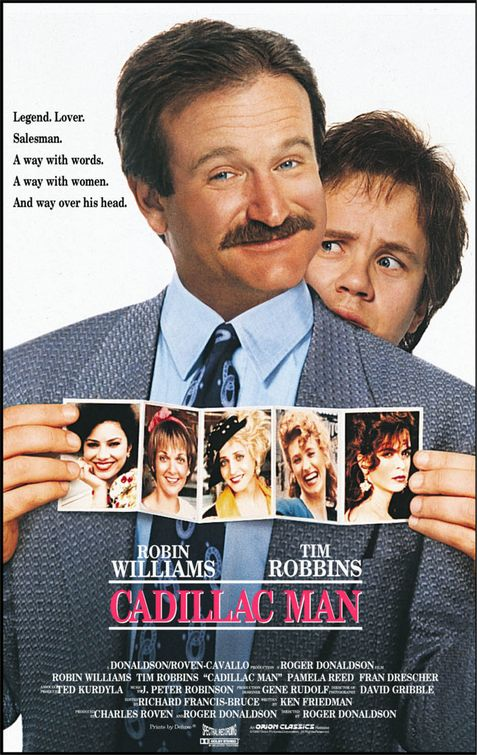
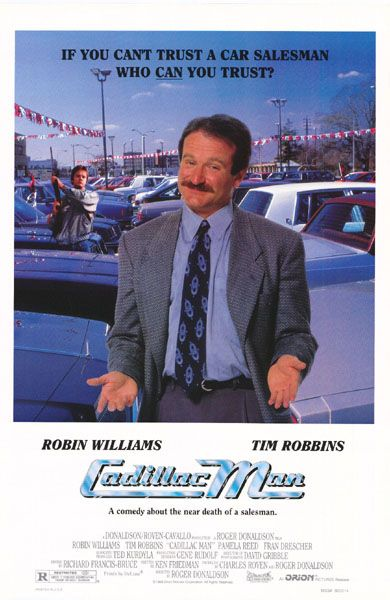
A jilted husband (Tim Robbins) goes off the deep end and with rifle in hand takes over a car dealership where he threatens to kill everybody inside. It’s up to Joey (Robin Williams) a quick-on-his-feet car salesman to use his ‘people skills’ to get everyone out of the predicament.

Outside of a funny opening funeral procession bit, the first thirty minutes are pretty dull. Too much time is spent on Joey’s interactions with friends and family members that are not funny or interesting. In fact the majority of the film seems more like a drama dealing with the daily stresses of life than it does a comedy. When the gunman first breaks into the dealership it is quite intense and even a bit horrific. The film does eventually catch its stride, but it all seems kind of transparent by the end. There is nothing to really distinguish this film from all the rest, which probably explains why it has pretty much been ignored. In many ways it seems very similar to Dog Day Afternoon.

However, I did like that everything is kept on a realistic and plausible level with dialogue and characters that are quite believable. Robbins makes for an engaging gunman and once the film settles into the hostage crisis there are a few genuinely funny moments. Fran Drescher’s pet poodle is memorable and one of the best pet performers I’ve seen.

If you are looking for a passable time-filler then this film has enough comedy and good moments to make it worth it, but it’s nothing more than that. Williams is energetic as always and it’s interesting to see him juggle both a comedy and drama here. It is also worth catching just to see Robbins in his breakout role.

cadillac man1

My Rating: 6 out of 10

Released: May 18, 1990

Runtime: 1Hour 37Minutes

Rated R

Director: Roger Donaldson

Studio: Orion Pictures

Available: VHS, DVD

The Stuff (1985)

the stuff

By Richard Winters

My Rating: 5 out of 10

4-Word Review: Ice cream can kill

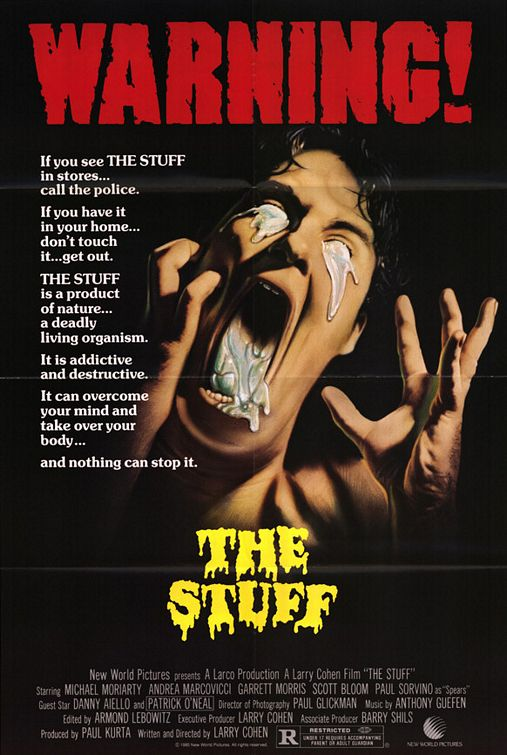
An old man comes upon some white stuff bubbling up from the ground and when he tries it he becomes addicted to its delicious taste. Soon everybody in the small town he is in becomes hooked to it as well. Some businessmen, who would never touch the stuff themselves, decide to market it as the next new variation of ice cream and call it The Stuff. It becomes a national craze, but when 11-year-old Jason (Scott Bloom) finds it crawling around in his refrigerator late one night he becomes convinced that there is something wrong with it, but he can’t get his family to stop eating it. Mo Rutherford (Michael Moriarty) begins to get his suspicions as well when he is hired by a competing company to find out what the secret ingredients are only to come at a dead-end with people he talks to. When everyone starts to display odd zombie-like behavior the two join forces to shut down the company that produces.

It is really hard to figure out what genre to put this thing into. Most movie sites list it under the horror category, but there really isn’t anything that scary in it. I might actually put it as sci-fi, but it is a bit vapid at that level. If anything I would say the true category would be as a parody of all those old sci-fi movies from the 50’s as well as a satire on mass consumerism.

The film does feature some goofy commercials advertising the product that is spread throughout the story and features famous B-celebrities as the spokes people. My favorite was the one with Abe Vigoda and Clara Peller. Peller was famous for doing a Wendy’s commercial in the 80’s where she asked “Where’s the beef?” and in the ad here she asks “Where’s The Stuff?”

The special effects are hit and miss. The best ones feature the white liquid that looks like a cross between marshmallow topping, shaving cream and the white foamy stuff that comes out of a fire extinguisher. The best moment is when it starts to spew out of a pillow in a hotel room with such force that it completely covers a man with it and sticks him onto the ceiling. I also liked the part where actor Garret Morris has his mouth opened to an extreme size before he spits it out and then has his head explode.

Moriarty with his unique acting style scores again as a sort of anti-hero. His presence gives the movie an interesting edge. His bowl haircut, Cheshire grin and beady eyes make him almost look like some loner psycho killer from the sticks and allow for one funny exchange between him and actor Alexander Scourby’s character:

Scourby: You’re not as dumb as you look.

Moriarty: Nobody could be as dumb as I look.

As much as I love Andrea Marcovicci who is a truly beautiful woman to look at as well as a great actress I felt her character was not needed. She plays a woman who also teams up with Mo and Jason in their crusade to stop the Stuff. The romantic interplay between Mo and her character didn’t work and takes away from the quirkiness and edge that the Mo character had at the beginning. Having the heroes exclusively been between a kid and a middle-aged man would have been much more of a fun novelty.

The film does not have the schlocky, low budget production values that are a characteristic of most Larry Cohen movies. The lighting, variety of locales and reproduction of an Ice Cream factory are actually quite impressive. This is also one of the few films where you get to see the inside of a liquid storage truck. However, it lacks any type of interesting twist or payoff. There is never any explanation about what this white stuff is, or how it got there. There is also hundreds of potentially interesting scenarios and story threads that it could have taken, but doesn’t. In the end I felt this thing was just tapping the surface and the final result is rather empty and forgettable.

My Rating: 5 out of 10

Released: June 14, 1985

Runtime: 1Hour 26Minutes

Rated R

Director: Larry Cohen

Studio: New World Pictures

Available: VHS, DVD, Amazon Instant Video, Netflix streaming

Daddy’s Gone A-Hunting (1969)

daddys gone a hunting

By Richard Winters

My Rating: 7 out of 10

4-Word Review: Don’t kill his baby.

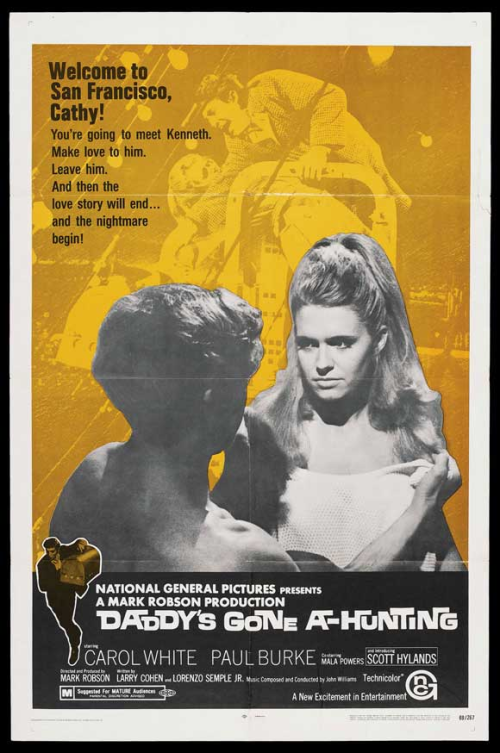
Cathy (Carol White) moves from England to San Francisco and almost immediately meets Kenneth (Scott Hylands) and the two get into a relationship. Cathy though slowly sees a dark side to him that she doesn’t like so she breaks up with him, but only after she finds out that she is pregnant. Since she is struggling to make it on her own she decides to have an abortion, which her friend Meg (Mala Powers) informs her is no worse than having a ‘hangnail’. When Kenneth learns of this he becomes enraged and promises revenge. He continues to stalk her from afar as she gets into a new relationship and then eventually marries prominent politician Jack Byrnes (Paul Burke). When she becomes pregnant again Kenneth reappears and tells her that this baby must be killed to make up for the one she ‘murdered’. After the baby is born he kidnaps it setting off a police manhunt throughout the city to find him and save the child.

Although this is a thriller you would hardly know it at the beginning as the movie starts out with a bouncy jazz score that does not create any type of menacing mood. It also initially dwells on Cathy and Kenneth’s early courtship and even has a sappy love song played over scenes of them kissing and walking hand-in-hand, which is awkward and even corny. I believe all thrillers should give some clue or warning to the tension and horror that is coming right from the start and this one doesn’t, which is weak.

However, after the first fifteen minutes it starts to get going from the suspense end and the rest of the way it is good if not excellent. I liked how the viewer is kept in the dark as to whether Kenneth is really stalking Cathy or it is all in her paranoid mind, which helps add an extra level of intrigue.

Director Mark Robson’s career was up and down, but he really scores here. The shot of a close-up of a cat’s eye showing the reflection of Cathy and Kenneth making love on a sofa was novel. I also liked how the abortion sequence is handled by showing a stark shot of the operating table coupled with Cathy’s nervous expression, which is surprisingly quite effective and brings out the horrors of the procedure, but without going overboard. I also appreciated that a real infant is used and not just a doll wrapped in a cloth like with some films. Showing a real live kicking and crying baby especially in close-ups makes it all the more emotionally compelling for the viewer when Kenneth tries to harm it.

Hylands is fantastic in the lead and one of the reasons this film works. He has the perfectly creepy face and menacing ability and this is by far his best performance in his long, but otherwise undistinguished career. White is also really good although she was far from being the producers first choice. Her blonde hair, accent, and angelic features make a perfect contrast to Hyland’s. Paul Burke is solid as the husband. It’s a bland part, but he tends to be good in those.

Although the abortion issue continues to be a hot and emotional topic for most this is not a political film and the emphasis is on being a thriller. However, when you couple this with screenwriter Larry Cohen’s It’s Alive movies you can probably assume he has an agenda in this political arena. Some may enjoy the way Kenneth relentlessly torments Cathy and refuses to allow her to forget what she did. He also kills the doctor who performed the procedure and what he does with the dead body afterwards is well…interesting.

Cohen and co-scripter Lorenzo Semple Jr. put their very creative minds in full gear here. The scenarios are well thought out and the tension builds at a great pace. The climatic sequence that takes place on top of the Mark Hopkins hotel at the Top of the Mark bar is exciting and visually well captured.

The only major flaw I saw with the film is at the beginning when Kenneth first sees Cathy standing on the sidewalk in downtown San Francisco he grabs some snow that is on a nearby car, makes it into a snowball, and then throws it at her to get her attention, but why in the world would there be snow on a car in downtown Frisco? This is never explained, but I felt it should have been.

My Rating: 7 out of 10

Released: July 2, 1969

Runtime: 1Hour 48Minutes

Rated M

Director: Mark Robson

Studio: National General Pictures

Available: VHS, DVD (Warner Archive), Amazon Instant Video

Little Murders (1971)

little murders

By Richard Winters

My Rating: 7 out of 10

4-Word Review:  They shoot at people.

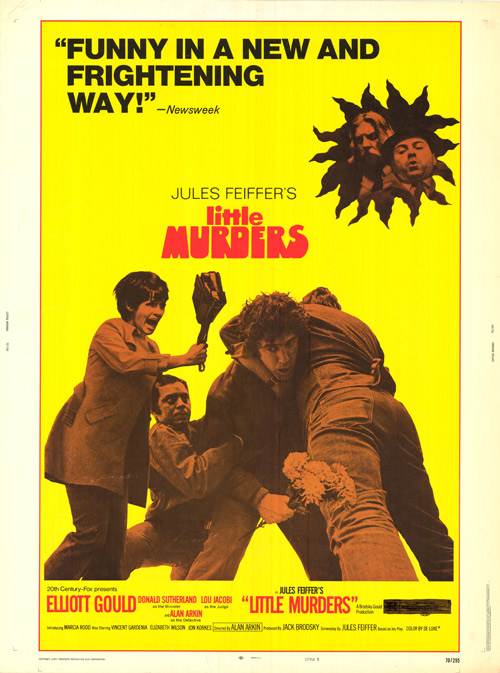
Patsy (Marcia Rodd) is a woman who practices the art of positive thinking despite her dismal urban surroundings. She meets Alfred (Elliot Gould) who is very detached and dropped out of society and no longer shares any hope in humanity, but she decides to marry him anyways and ‘reform’ him.

For a black comedy this one has got to be tops. It stays on a grimly humorous level from the beginning and doesn’t let up especially with its wicked ending. Everything gets the offbeat treatment and if it starts out conventional it is soon turned upside down until it is absurd. The funniest scenes involve Patsy taking Alfred home to meet her parents where things become very odd until they are absolutely hilarious. The wedding scene is also a classic where Donald Sutherland plays a hippie minister and gives a speech about masturbation that is as outrageously funny today as it was back then. Yet it is the surreal scene of seeing Alfred riding a subway car while dripping with blood and nobody saying anything that leaves the strongest impact. The targets that this film satirizes are just as potent today as they were back then. The film also manages to dig a bit deeper than most and successfully analyzes the myriad of societal complexities while not siding with any particular social movement or philosophy.

Rodd is terrific in her film debut and Gould is good in a surprisingly restrained performance. Jon Korkes is also excellent as an infantile adult son in an over-the-top send-up of grown children still living at home. However, it is Vincent Gardenia that ultimately steals it playing a hard-liner conservative father who finds himself becoming literally imprisoned by the increasingly insane world around him.

Although still potent this outrageous story seems to have lost some of its zing through the years and doesn’t seem to be as offbeat or ‘out there’ as it once did. It also lacks any type of cinematic flair and at times seems to be nothing more than a filmed stage play.

However, for fans of black comedy and relics of a bygone era it doesn’t come much better than this. Although it has softened a bit there are still enough bizarre and funny moments to please those with an acquired taste.

My Rating: 7 out of 10

Released: February 9, 1971

Runtime: 1Hour 50Minutes

Rated R

Director: Alan Arkin

Studio: 20th Century Fox

Available: VHS, DVD

Special Effects (1984)

special effects

By Richard Winters

My Rating: 5 out of 10

4-Word Review: Murder her on film.

Snuff movies have become the thing of urban legends and apparently tapped into society’s morbid curiosity. It is really surprising how many movies and TV-shows have dealt with the topic especially recently. It all started in 1971 with the film Snuff that purportedly dealt with an actual murder of an actress done in front of the camera even though it was faked and not very good, but the film’s tagline ‘Filmed in South America where life is CHEAP’ is at least amusing. There have been films that have tried to make it look very convincing particularly the disturbing ‘Guinea Pig’ series from Japan as well as Cannibal Holocaust that got director Rogero Deodato taken to court to prove that he didn’t actually kill his cast. Although there have been executions, assassinations and suicides that have been recorded and sometimes put into documentaries there has yet to be a performer murdered in front of the camera for commercial purposes.

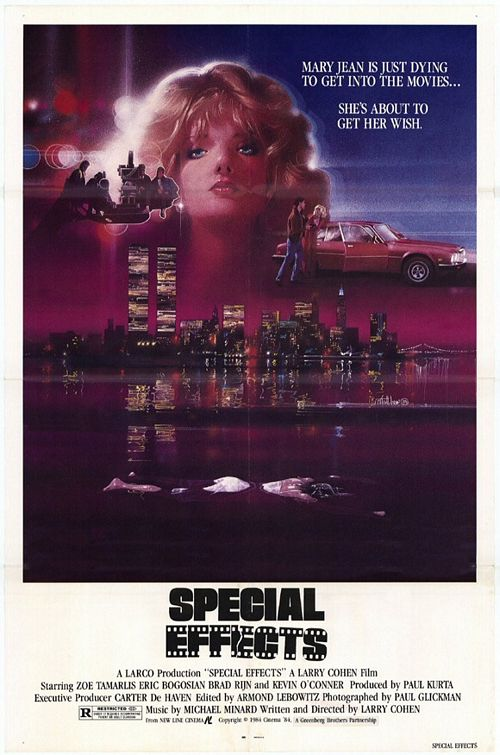
In today’s movie writer/director Larry Cohen takes this concept and gives it an intriguing spin. Neville (Eric Bogosian) is a down-and-out filmmaker. His last picture bombed at the box office and he is looking to make a buzz with his next project. He is fascinated with the capturing of the killing of Lee Harvey Oswald and how movies can never quite recreate death in the same way. Struggling actress Andrea (Zoe Tamerlis) answers an ad and shows up in his apartment/studio for an audition. Neville uses the allure of potential fame to get the women into bed with him, which he usually films with a camera hidden behind a two-way mirror. During the sex Andrea begins to belittle him, which angers him enough that he strangles her. Realizing that he has the murder captured on film he decides to use it to his advantage. He disposes of the dead body and then hires another woman named Elaine (also played by Tamerlis) who looks just like Andrea to star in his next film. He will then incorporate the scene of the murder into the movie. Audiences will think it was done with special effects and be so impressed with how realistic it looks that it will give Neville numerous accolades for his film making skill and bring him back to the top of the directing world.

Cohen uses the story as an excuse to expose the seedy, unglamorous side of low budget filmmaking many of which based on his own observations from working in the business. One of the more startling revelations that he shows is how the movie world is such an allure to some people that they will completely sell-out to get into it even if it means losing their dignity. This comes to a head in what is probably the film’s strongest scene when Neville is very rude and brash with Elaine when he first meets her. He shouts at her like she is sub-human and simply a piece of property, but the prospect of starring in a movie is so strong that she doesn’t walk out of there like most people would probably want to do. What is worse is the fact that Neville is aware of this and realizes he can get away with it.

The movie also looks how demeaning it can sometimes be being a filmmaker as well. Having to work and deal with various personalities and egos as well as fighting to remain in control of the project and vision. He also shows how exhausting the research phase of a production can be and how breakthroughs and inspirations usually come about by complete accident. The extended scene dealing with them trying to find an actress who resembles Andrea and auditioning hundreds of different women without any luck only to come upon Elaine by complete accident when they go to a Salvation Army store is a good example of this.

Cohen also infuses some creative camera work and directorial flair. The opening sequence showing Andrea prancing around topless in what looks to be the Oval Office of The White House has panache. The shot showing rows upon rows of hundreds of headshots of young and aspiring actresses, which includes an amusing one of Dustin Hoffman in his Tootsie character, lining the floor is impressive. I also liked the way Neville’s apartment is captured when Andrea first walks into it as well as extreme close-ups of circuit breakers being put back into a circuit box, which is really cool.

Tamerlis is fantastic in the lead. She shows a great awareness and natural acting ability in front of the camera. She plays the dual roles with two very distinct personalities and accents both of which are good. Her presence makes the film more interesting and the scenes that she is not in lack the same energy.

Bogosian easily conveys the obnoxious sarcastic personality of his character, but at times his facial expressions seem to be either lacking or over-exaggerated. Brad Rijn who plays Andrea’s husband who later gets involved in Neville’s project is weak and annoying. In some ways he seems to be the right pick for someone playing a country hick, but he has no charisma and looks too scrawny especially with his clothes off.

For a low budget 80’s flick the film has enough twists and a good enough pace to be marginally entertaining. The only thing that I really didn’t like was the synthesized electronic music score that drones on endlessly like in one of those 80’s porn flicks. I think the reason I liked the scene where Andrea’s dead body is shown inside a parked car in a lonely area of Coney Island is because it didn’t have any music and instead used the natural ambience of the location, which helped make it distinct and should’ve been done with the rest of the movie.

My Rating: 5 out of 10

Released: November 16, 1984

Runtime: 1Hour 33Minutes

Rated R

Director: Larry Cohen

Studio: New Line Cinema

Available: VHS, DVD

The Great Escape (1963)

the great escape 3

By Richard Winters

My Rating: 8 out of 10

4-Word Review: Tom, Dick and Harry

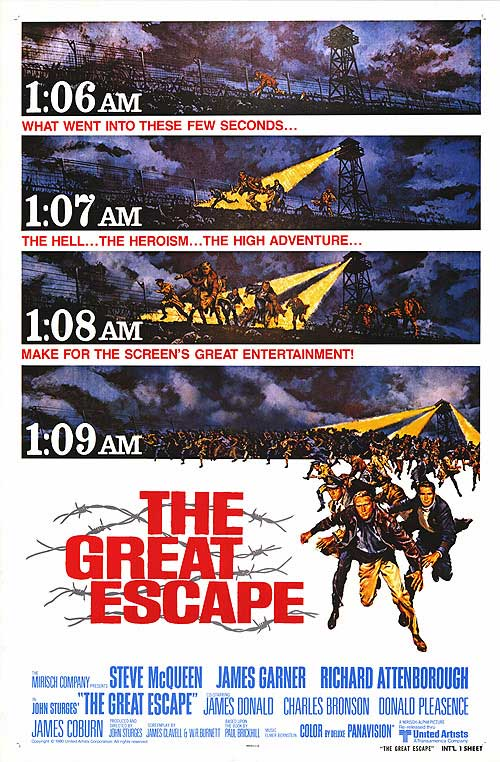
Based on a true story involving POW’s in an ‘escape proof’ German Prison camp who devise a way to get out by digging three tunnels, which will go under the barbed wire fence and allow them to get out under the cover of a nearby forest. They decide to build three tunnels and call them Tom, Dick and Harry, so if the German guards discover one of the tunnels they can simply continue to work on the other two.

The producers built a complete replica of Stalag Luft III were the actual events took place and used Wally Floody who was a prisoner of the camp and took part in the escape as an advisor. The movie moves at a polished pace grabbing in you immediately and keeping you involved all the way through. The characters share a great camaraderie and it’s a terrific testament to teamwork and how by everybody playing a little role can help make great things happen. Their resolve and ‘can-do’ spirit is infectious and one of the major reasons the film is so compelling. The bouncy, upbeat patriotic music is good although it gets played a lot and most viewers will most likely hear it playing in their head long after it is over.

I did feel that the depiction of the camp seemed a bit too cozy. The men are allowed to freely walk around and congregate in large meetings where they make their plans and it seemed to me that a heavily fortified prison camp wouldn’t allow for that, or at least be more on top of things. I wouldn’t say the German’s are portrayed on a ‘Hogan’s Heroes’ dumb level, but at times it gets close. For instance when the James Garner character lifts the wallet out of the pocket of one of the guards he does not become aware that it is missing for what seems like several days and then when he does he doesn’t suspect the Garner character and instead goes back to him and naively asks for his help in finding it. When the Germans find one of the tunnels there are no reprisals even though I and some of the others in my movie group who watched it with me felt that there should have been. Also, when the Steve McQueen character attacks one of the German guards when they shoot his friend who is trying to escape he is not sent to the cooler even though he had previously been sent there for far less infractions.

On the acting side it is all top-notch. McQueen is as cool as ever. I love his detached manner and rugged willing to take risks personality. His escape by motorcycle, which was added into the story by his request, is exciting and one of the most memorable moments in the film. Charles Bronson is good as one of the characters who are most instrumental at digging the tunnels however I felt that it seemed a bit far-fetched and like tacky Hollywood melodrama that he had spent so much time working inside the tunnels only to suddenly get claustrophobic about them just as they are trying to escape. David McCallum has very few words, but gets gunned down in exciting style at a train station. I normally love James Coburn and his character is appealing, but his attempt at an Australian accent is atrocious.

Spoiler Alert!

Despite its title the film really doesn’t seem like all that great of an escape. For one thing out of the predicted 250 that were supposed to escape through the tunnel only 76 made it out before the Germans caught onto it and closed it off. Of those 76 there are 50 who get caught, rounded up and shot at point blank range. 12 get returned to the camp and only 3 actually make it to safety. When the Steve McQueen character gets sent back to the cooler in the film’s final scene I felt a bit frustrated and depressed and that the big ballyhooed escape had really lead nowhere.

My Rating: 8 out of 10

Released: July 4, 1963

Runtime: 2Hours 52Minutes

Not Rated

Director: John Sturges

Studio: United Artists

Available: VHS, DVD, Blu-ray, Amazon Instant Video