Up the Sandbox (1972)

up the sandbox 2

By Richard Winters

My Rating: 7 out of 10

4-Word Review: Housewife has secret fantasies.

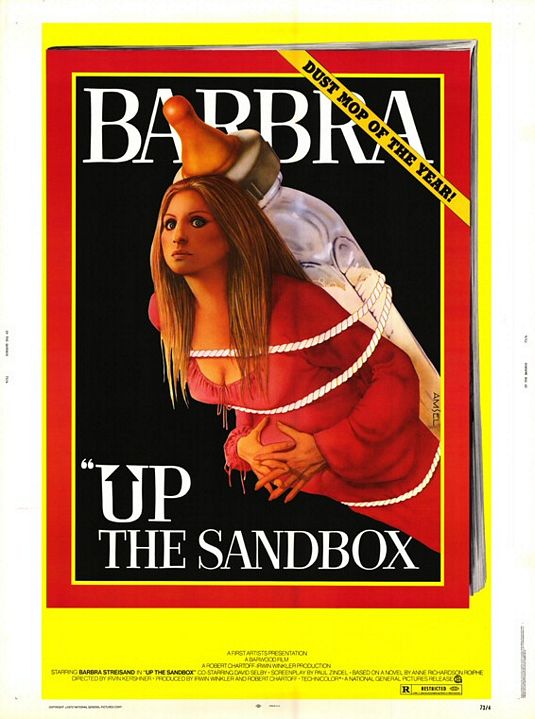
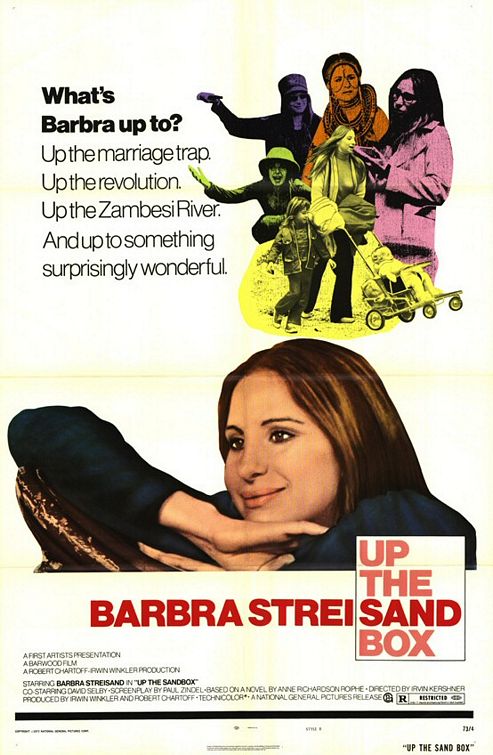
Margaret (Barbra Streisand) is a neglected housewife taking care of her two children while her husband Paul (David Selby) busily works on his novel and thesis. She lives in a rundown New York apartment that seems to have bugs crawling from everywhere. Her nagging mother (Jane Hoffman) pressures her to move back with them to the suburbs, but she enjoys the excitement and independence of city life over lily white suburbia, so she resists. Now she finds that she is pregnant with her third child and this along with the other stresses causes her to slip into secret fantasies that become more and more outlandish.

This film didn’t do well upon its initial release and is a bit forgotten, but deserves a look simply for its unique and memorable fantasy segments. The scene where she joins a black militant group that gets inside the Statue of Liberty and wires it with explosives is pretty good as is the part at a party where her stomach suddenly balloons out as if she is pregnant and when she pushes it in it makes her breasts larger. The scene where she meets a Fidel Castro-like dictator who takes off his shirt to expose that he has female breasts is funny and the finale that takes place inside an abortion clinic is interesting. The best though is when she is captured by an African tribe of topless women. The shot of their grossly overweight leader whose gigantic, sagging breasts seem to overlap her entire body ends up being the film’s most lasting image.

Hoffman is hilarious and a perfect caricature of a meddling mother of adult children. The part where Margaret fantasies about stuffing her mother’s face into an anniversary cake and then the two roll around on the floor where Margaret then punches her in the face had me laughing-out-loud.

Paul Zindel’s script nicely balances the fantasy with the gritty reality of urban living. It also envelopes the feminist issues with the social upheaval of the times and the speech that Margaret gives about women needing to be less like men and more like themselves is excellent.

Director Irvin Kerschner makes fine use of the New York locales giving the viewer an eclectic taste of its crowded neighborhoods and street culture as well as its epic skyline. I loved the cinema vertite style that has a sophisticated and trendy feel.

Streisand herself seems to be having a lot of fun and purportedly this is her favorite out of all the films that she has done. This was just before she went through her frizzy hair phase and the long straight style that she has here I feel makes her look sexy.

The pace is unusual especially for a comedy in that it isn’t frantic and does not have any quick edits. Instead the set-ups are quite slow and seem at times to be almost dramatic before throwing in a surprise punchline. Personally I liked this approach, but the unconventional style might have proved confusing to certain audience members who didn’t know what genre to place it in and may have been the reason for the poor box office returns, which is shame as the production overall is excellent and intriguing.
up the sandbox 1

My Rating: 7 out of 10

Released: December 21, 1972

Runtime: 1Hour 37Minutes

Rated R

Director: Irvin Kerschner

Studio: National General Pictures

Available: VHS, DVD
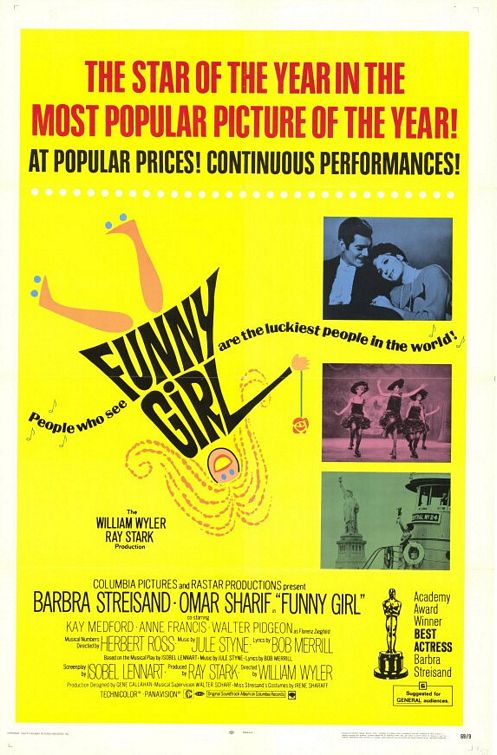
Funny Girl (1968)

funny girl

By Richard Winters

My Rating: 6 out of 10

4-Word Review: Fanny’s rise to stardom.

Barbra Streisand, in her film debut, plays Fanny Brice in this loose biography about the Jewish comedian’s rise to stardom in the Ziegfield Follies during the 20’s and 30’s. The story examines how she uses her homely looks to her advantage by honing in her comedic skills to allow her to stand-out. The second half of the film examines her romance and eventual marriage to professional gambler Nick Arnstein (Omar Sharif).

Streisand recreates her Broadway role in grand style and deserved her Oscar win in which she famously tied Katherine Hepburn that year for Best Actress. I’ve always liked her best when she is doing comedy and she has always shown a good knack for timing and delivery. Although stories abound how she was very difficult during the production and showed a tremendous ego, which culminated in the film going through two directors and cinematographers she still plays the very insecure Brice effectively and it’s this appealing ingredient the carries the film and character.

William Wyler’s direction is also outstanding and helps make up for a story that at times seems pretty light. He replaced Sidney Lumet early on and gives the film an added flair with lavish sets. I loved the French-style restaurant and expansive old fashioned New York train station. There is some excellent dance numbers in which Wyler takes full advantage of the visual element including a nifty ballet segment. The recreation of the period is authentic and there are even a few moments of dazzling camera work including the shot showing Fanny singing on top of a tugboat all alone in the New York harbor while the camera circles above her and then careens down.

Kay Medford adds good support as Fanny’s mother and it earned her an Academy Award nomination for supporting actress. Sharif is always solid, but the character seemed poorly fleshed-out and more of a personal background needed to be explored to help explain why he was so infatuated with the extremely insecure and awkward Brice when he could have easily attracted any girl. Walter Pidgeon lacks the commanding presence needed in the part of Florenz Ziegfield and instead comes off as a tired old man getting badly upstaged by Streisand in every scene he has with her.

The songs are pleasing and you may find yourself humming some of them for days afterwards, but I was surprised how few of them there really were with long dramatic intervals in-between. The story itself is placid as Brice’s rise to the top happens too quickly and too much time is spent on the romantic angle making the film seem unbalanced but it manages to be entertaining anyways due mainly to the high production values.

My Rating: 6 out of 10

Released: September 18, 1968

Runtime: 2Hours 30Minutes

Rated G

Director: William Wyler

Studio: Columbia Pictures

Available: VHS, DVD, Blu-ray, Amazon Instant Video

Nuts (1987)

nuts

By Richard Winters

My Rating: 7 out of 10

4-Word Review: Fighting for her sanity.

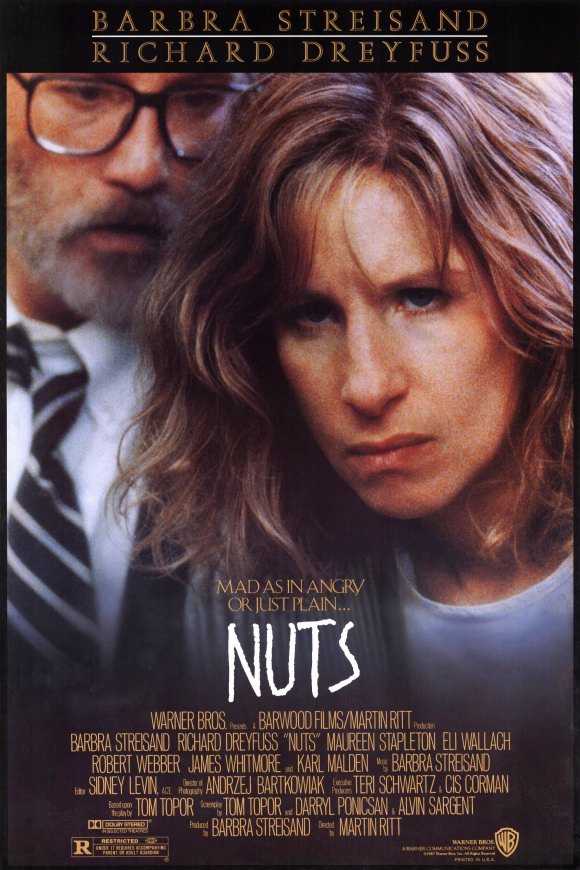
In celebration of Barbra Streisand turning 72 on April 24th we will be reviewing three of her films, one from each decade during the week. This one is based on the Broadway play by Tom Topor dealing with a high priced call girl named Claudia Draper (Barbra Streisand) who murders one of her customers (Leslie Nielson) in self-defense and is arrested. Her mother (Maureen Stapleton) and step father (Karl Malden) think she should be diagnosed as incompetent to stand trial and sent to a mental institution, but she with the help of her lawyer (Richard Dreyfuss) fight for her right to stand trial.

The story and characters evolve in layers, which I liked, but Streisand doesn’t seem right for the part. Her presence makes it seem too much like a star vehicle instead of the character driven story that it should be. Her cantankerous outbursts become a bit excessive and self-destructive making it hard at times to cheer for her or empathize. In the Broadway play the character was played by a woman in her twenties, which made more sense and would’ve worked better instead of casting someone who was already 45.

Seeing her in provocative poises in snapshots that her lawyer obtains is a bit weird but fun as a novelty as is the scene where she spreads her legs without the benefit of any underwear for Dreyfuss, but having her constantly shown with a bright spotlight around her seems disconcerting. It gives her a ghostly appearance and makes her stand out in the wrong way.

The veteran supporting cast comes off better since they wisely underplay it as opposed to her overplaying. Stapleton is quite good especially the moving scenes showing her crying as she listens to her daughter’s testimony. James Whitmore is solid as the thoughtful judge, but it’s Dreyfuss who carries it as the feisty and sometimes exasperated counsel.

This film is also a milestone as it is the last time Leslie Neilson performed in a non-comedic role. He is surprisingly chilling as the psychotic attacker who was apparently so convincing that it scared Streisand during the filming of the scene.

There are times when it gets a bit too theatrical. The judge advises Claudia to quit disrupting the proceedings, but then she continues to do so anyways, which would have gotten most people thrown out of the courtroom. The scene where she sits on the witness stand and describes being a hooker in a very sensual and seductive way seemed over-the-top in a court of law as is the part where she is allowed to wander around the courtroom going on a long rant while everyone else just sits there and passively listens.

Still on the whole I found most of it to be quite riveting and as a drama its first- rate. I just felt Striesand’s presence didn’t help it. She can be quite good in certain other roles just not here. The part was originally intended for Debra Winger who I feel would have fared better.

My Rating: 7 out of 10

Released: November 20, 1987

Runtime: 1Hour 56Minutes

Rated R

Director: Martin Ritt

Studio: Warner Brothers

Available: VHS, DVD, Amazon Instant Video

Natural Enemies (1979)

natural enemies 2

By Richard Winters

My Rating: 6 out of 10

4-Word Review:  Man kills his family.

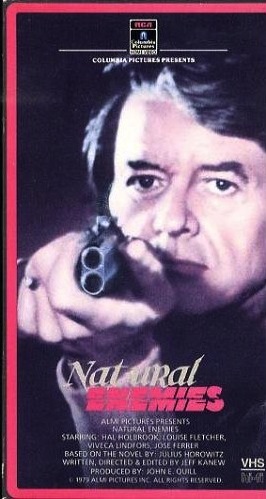
Paul Steward (Hal Holbrook) is a middle-aged suburban father who wakes up one morning having decided that by the end of the day he will shoot and kill his wife and three children with his hunting rifle. His rationale being that life is full of inevitable disappointments and his kids are ill prepared to face life’s harsh realities, so by killing them he will be in a sense ‘protecting’ and ‘saving’ them. The rest of the film deals with conversations he has with his friends debating on whether he should go through with it or not.

Writer/director Jeff Kanew is probably best known for having done Revenge of the Nerds and this film is probably as different from that one as you can get. It is an excellent and interesting directorial debut for the most part. It is not completely successful, but you have to give him credit for putting such challenging material onto the screen. It is based on the novel by Julius Horowitz, which was probably never intended to be made into a movie, but Kanew uses the voice-over narration to its full effectiveness and I loved the quant and remote setting of the colonial home that Paul resides in.

It is really the conversations and the ongoing philosophical debates that Paul has with various acquaintances that gives it a fascinating and intellectual subtext. I especially liked his discussion with Harry (Jose Ferrer) a concentration camp survivor as well as an unintentionally amusing one with a cab driver who complains that a 247 a month rent on a 3 bedroom apartment in Queens is ‘too expensive’ even though you would be unable to find one there that cheap today. The strongest is the one that he has with his wife Miriam (Louise Fletcher) at the end that proves to be not only revealing, but riveting.

The scene where he has sex with five prostitutes is also quite well done including having classical music played over the sex scenes, which creates an unusual erotic quality. The conversation he has with them is equally interesting, but I would’ve liked to have seen a few more verbal reactions from the women.

I’ve always considered Holbrook to be one of the finest actors around and his performance here is flawless and helps give the film its impact. Fletcher is also quite good playing the polar opposite of her Nurse Ratched character. Here she is vulnerable and fragile instead of rigid and authoritative and even has a scene inside a mental hospital as a patient. The fact that she can play such different characters so solidly proves what a brilliant actress she is.

The tone is incessantly bleak and downbeat, which could easily be a turnoff for most viewers, but doesn’t lessen the validity of many of the points that it makes. There is a strong Ingmar Bergmanesque quality to this that I really liked and this film could prove quite provocative for those looking for something that is thought provoking and outside of the mainstream.

My Rating: 6 out of 10

Released: November 1, 1979

Runtime: 1Hour 40Minutes

Rated R

Director: Jeff Kanew

Studio: Cinema 5 Releasing

Available: VHS

Flareup (1969)

flareup

By Richard Winters

My Rating: 3 out of 10

4-Word Review: Stalker terrorizes go-go dancer.

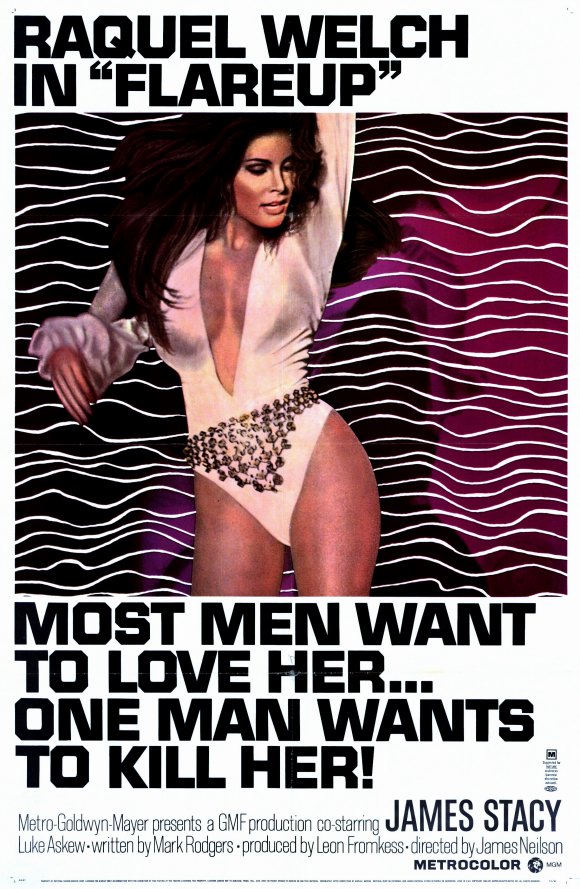
Michele (Raquel Welch) is a Las Vegas go-go dancer that attracts the unwanted attention of Alan (Luke Askew) who blames her for the breakup of his marriage. After killing his wife he then sets his sights on Michele who moves to Los Angeles in an attempt to lose him, but he figures out what club she is dancing at and continues his reign of terror. When Michele finds a new boyfriend named Joe (James Stacy) the psycho decides to add him to his already growing hit list.

Raquel is the whole movie. Her acting ability is definitely limited and at times even annoying, but in the looks department she gets an A+. In fact I’d say she is at her best looking here out of all the movies she has done. The scene where she gets on stage to gyrate her body during a provocative dance number is pretty much the highlight of the whole film. Although some of the other girls dance topless she does not and she very angrily rejects another female dancer who offers her some ‘woman love’, so there is no lesbian scene either, which could be a disappointment to some oversexed male viewers, but her presence offers enough eye candy to propel the movie on nonetheless.

Askew who wears a tacky bowl haircut looks a bit too clichéd, but he is a good enough actor to keep it tolerable. Stacy is decent as the love interest, but the romantic scenes bog down the pace. This was the last movie he did before he got into a motorcycle accident and lost his left leg and arm, which spiraled both his career and personal life downward and eventually led to a child molestation charge in 1995 that sent him to prison.

James Neilson’s direction is okay. The best part is the on-location shooting, which makes you feel like you are right back on the streets of Las Vegas from forty years ago and its fun seeing the different shops and billboards that were out during that era. The foot chase between Welch and Askew that occurs late at night in a zoo with wild animal noises heard in the background has potential, but should’ve gotten more extended.

The script though is one-note and gets stretched much too thin. The action starts out right away, but the pacing is poor and there is really never any tension. Everything gets done in a formulaic way with nothing that is unique or memorable.

Although I will give some credit to the finale that features a burning man the special effects are overall pretty shoddy. The psycho shoots at and kills people, but we never see any bullet holes or blood on the dead bodies. One scene has a security guard (Gordon Jump in an early role) shooting at Askew’s car and putting two bullet holes in its rear window, but then when the camera cuts away to a long view of the car the bullet holes have somehow miraculously disappeared.

My Rating: 3 out of 10

Released: November 10, 1969

Runtime: 1Hour 40Minutes

Rated M

Director: James Neilson

Studio: MGM

Available: VHS, DVD (Warner Archive)

Little Cigars (1973)

little cigars

By Richard Winters

My Rating: 3 out of 10

4-Word Review:  Midgets turn to crime.

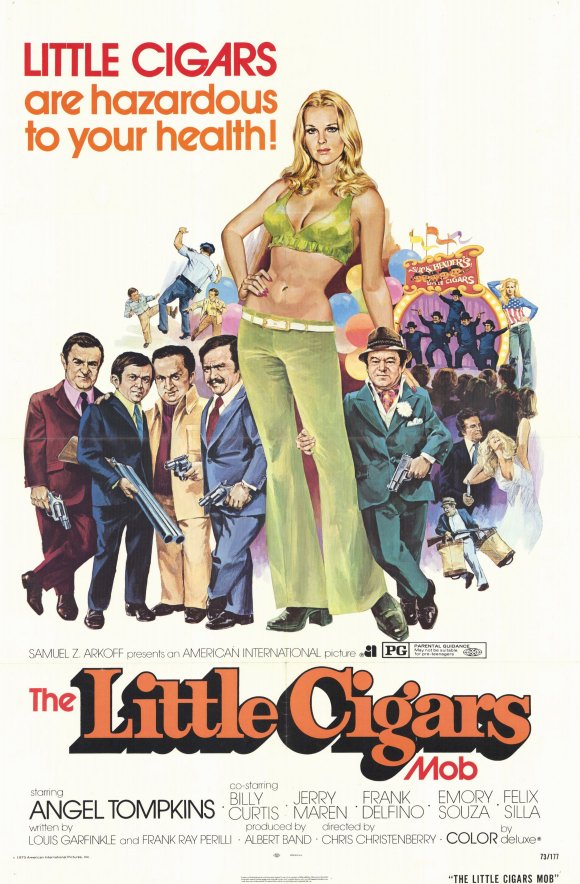
A young, beautiful blonde (Angel Tompkins) becomes an unlikely partner with a group of midgets who run a small (no pun intended) theft ring. With a title and premise like that you would expect a broad comedy, but that is not the case. Although there are a few snappy exchanges and a funny scene involving a police line-up of some very angry midgets, this is mainly handled on a gritty, violent level.

The midgets themselves aren’t too likable. This may be an attempt by the filmmakers to show them as real human beings and the effects of living in a society with a handicap, but they end up coming off as overly irritable, bad tempered, and vicious without ever confirming if this is some social statement.

Overall it’s just a standard crime yarn with midgets used instead of regular sized people. There is even a storyline involving a romance between Tompkins and head midget Billy Curtis showing how love can spring up between any two people no matter what their size. However, you can’t help but get a queasy feeling when you see a 60-year-old midget in bed kissing a young statuesque blonde.

The film leaves the viewer with a certain degree of unpleasantness too much actually, to consider it enjoyable or entertaining. The only part I really liked was the scene where Curtis goes into a tough bar and takes on a big guy who has his arms around ‘his’ girl, which is both amusing and exciting.

Also, Frank Bonner who later went on to play Herb in the classic TV-series ‘WKRP in Cincinnati’ can be seen very briefly as a hotel doorman.

My Rating: 3 out of 10

Released: June 11, 1973

Runtime: 1Hour 32Minutes

Rated PG

Director: Chris Christenberry

Studio: American International Pictures (AIP)

Available: DVD-R (MGM video on demand)

Sticky Fingers (1988)

sticky fingers 1

By Richard Winters

My Rating: 1 out of 10

4-Word Review: Roommates spend drug money.

Hattie (Helen Slater) and Lolly (Melanie Mayron) are two struggling musicians who share a crummy apartment run by slumlord Stella (Eileen Brennan). They are having trouble making ends meet when their friend Diane (Loretta Devine), who is a drug dealer, asks them to hold onto a bag for them while she is out of town. Inside the bag is $950,000. The girls decide to ‘borrow’ some to help pay their rent and then they continue to take more until they have spent $224,000 of it and when Diane comes back she is not too happy nor are the people that she works for.

For a film that is written and directed by a woman and co-scripted by Melanie Mayron it has every conceivably negative female stereotype placed on its two leading characters and if this had been done by a man he would be accused of being a sexist. The two women are ditzy shopaholics who lack any common sense are indecisive and greatly insecure and have no level of sophistication.

They spend tons of money on clothes and needless gadgetry, but then remain in the same rat hole of an apartment. If they had any brains they would have bought a house on the other side of the country and then escaped. The drug money couldn’t get reported to the police as stolen and since this was the 80’s and before cellphones and the internet it was a lot easier to ‘disappear’.

The strained arguments the two have about derivative issues, which are supposed to be funny, become annoying and unending instead. Their shouting over which color of sponge to use for dish washing was so ridiculous it almost made me want to turn it off.

Slater who was just a few years removed from her Billie Jean character gives a decent performance despite the limitations of the character. Mayron with her curly carrot top hairdo looks downright ugly and the fact that her character remains with her boyfriend even though he continues to have a not so subtle relationship with his previous girlfriend makes her seem pathetic.

I did like Brennan and some of her sardonic lines. If she had been cast in the lead the film would have been helped immensely.

There are definite shades of an independent movie trying to break out, but it lacks the style, attitude and hipness. The attempt at trying to revive the screwball comedy is a dismal failure and not even good for a few laughs. The only two things I liked was the concert the two perform in while wearing glow in the dark costumes and the crawl of the closing credits that rotates at different angles, which only proves how bad this movie is when the closing credits becomes the highlight!

My Rating: 1 out of 10

Released: May 6, 1988

Runtime: 1Hour 37Minutes

Rated PG-13

Director:  Catlin Adams

Studio: Hightop Productions

Available: VHS

The Sporting Club (1971)

the sporting club 2

By Richard Winters

My Rating: 4 out of 10

4-Word Review: Haves versus have-nots.

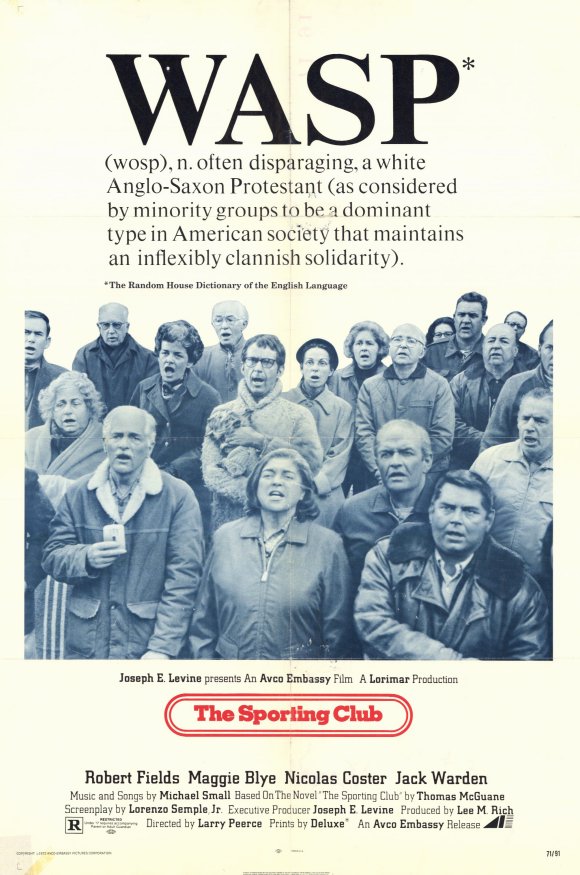
Jim (Nicholas Coster) finds out that his business is going under and he barely has any money left. To escape the stress he decides to take a trip to the wilderness of northern Michigan for a little R&R. Unfortunately once there he meets his friend Verner (Robert Fields) who has built a shooting range in his basement and wants to challenge everyone to a duel. The snotty sporting club that Jim belongs to wants to boot him out when they realize he is no longer making an income and rebel- rouser Earl Olive (Jack Warden) gets into a war with the elitist at the sporting club, which sends things spiraling out-of-control between the two sides with Jim right in the middle.

Based on the Thomas McGuane novel the film has the right concept, but not the fluid essence or wry humor of his writing. Some of his later work that was brought to the screen fared better. This film version is too uneven and takes too long to get anywhere. It becomes somewhat intriguing when we are given the idea of this set-up of a wild shoot-out between Olive’s biker gang and the elderly members of the club, but just as things seem to be getting interesting the film veers into a radically different direction and has all the sporting club members getting into a bizarre sex orgy. This may sound funny or even sexy, but it really isn’t as all the people were in their 60’s or 70’s and seeing their naked bodies cavorting around comes off as gross and sick.

The satirical jabs at the snotty club members are funny to some extent. They represent society’s old order people still clinging to age-old traditions and values even though the rest of the world around them is changing. They boast about their exclusive club membership even though it no longer has any allure and their stubbornness only makes them more insignificant and absurd. The scene where they stare blankly like lost children at the blown-up remnants of their cottage is probably the best moment in the film. However, their caricatures end up going overboard they become too illogical and ridiculous like crazed stupid creatures instead of human beings.

Most anti-establishment films of the era, which in the end is what this is, usually cast young stars in the lead, but here we have Coster who was already middle-aged making it look too much like the old guard vs. the old guard, which did not connect with the young filmgoers and they stayed away. The middle-age audience of the time was the establishment themselves and they found the film’s crass humor and scenarios off-putting and thus the film alienated everybody and bombed terribly at the box office.

Robert Fields gives an excellent performance as a budding sociopath and his scenes have an added tension. Warden is also very good in an unusual role for him as a joint smoking trouble maker who loves to rock-the-boat. The gun duel he has with Fields is interesting and his presence helps give the film a few extra points. Margaret Blye has a beautiful face making her a pleasure to look at no matter what she is doing. Jo Ann Harris is also sexy and the scene where she strips down to her panties with the phrase ‘my grandmother loves me’ stenciled on the rear is fun.

The film is weird enough to be worth a look as a curio. Director Larry Peerce infuses some interesting camera work into the proceedings and Michael Small’s moody folk rock score deserves its own album. Despite the locale looking very much like Michigan it was actually filmed near Hot Springs, Arkansas.

My Rating: 4 out of 10

Released: February 28, 1971

Runtime: 1Hour 45Minutes

Rated R

Director: Larry Peerce

Studio: Avco Embassy Pictures

Available: None at this time.

Perfect Friday (1970)

perfect friday

By Richard Winters

My Rating: 7 out of 10

4-Word Review: Kooky trio robs bank.

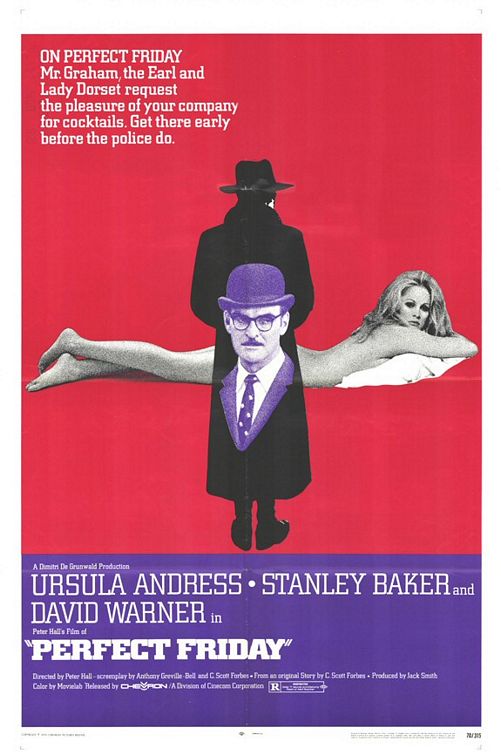
This uniquely structured and offbeat sleeper details an elaborate bank heist where staid bank employee Mr. Graham (Stanley Baker) uses his inside knowledge to pull off an ingenious robbery. Unfortunately he is dependent on the oddball couple of Nick (David Warner) and Britt (Ursula Andress) to help him.

This film is probably more of a kooky character study than it is a heist flick. The three characters are intrinsically different from each other and their constant bickering, feuding, and interplay are a treat. In fact they never get into the actual robbery or even the details of it until the last forty minutes.

Baker is fun in the lead. He is the perfect caricature of the stuffy British businessman. His contained pomposity and cryptic deliveries are right on-target. Warner makes for a good contrast. He is lazy and undisciplined with a tendency to wear outrageous looking outfits. It is interesting though that he can get serious when he needs to particularly during the crime itself.

Andress is the scene stealer and this is a perfect role for her limited acting abilities. She plays a greedy woman prone to outrageous extravagance and indulgence even if she lacks the funds for it. Her caricature of the materialistic woman gets taken to the extreme and is hilarious. In most cases she would be disliked, but here her beauty and innocuous way she delivers her lines make her amusing instead.

Director Peter Hall seems to pride himself on making it offbeat and full of many twists and succeeds most of the way even with his use of the glass offices that the bank employees have to work in. The robbery itself is intricate and believable and full of mounting tension. The film’s only real problem comes with its ending that is too abrupt and in many ways almost like a cop-out. There is such a fun chemistry between the three characters that it really could have been played out much more.

My Rating: 7 out of 10

Released: November 10, 1970

Runtime: 1Hour 34Minutes

Rated R

Director: Peter Hall

Studio: Chevron Pictures

Available: None at this time.

Tattoo (1981)

tattoo

By Richard Winters

My Rating: 2 out of 10

4-Word Review: He tattoos her body.

Karl Kinsky (Bruce Dern) is a tattoo artist hired to put tattoos on some models for a fashion shoot. There he becomes obsessed with one of the models named Maddy (Maude Adams). The two begin dating, but when he starts to show signs of being too possessive she breaks it off, which angers him. He then drugs and kidnaps her and takes her to an abandoned house where he becomes determined to put his ‘mark’ on her by spending weeks creating a tattoo that will eventually covers her entire body.

Bob Brooks who was best known for directing award-winning commercials particularly in the U.K. shows a rather lifeless effort here in his one and only cinematic effort. I thought it would have been more interesting to have given the viewer a close-up and clinical understanding of how a tattoo is implemented and the basic overall procedure, but unfortunately the film breezes past this part and tries turning it into a conventional thriller, which lacks tension or intrigue.

Dern’s character resembles that of a psycho caricature and the way he unravels so quickly is uninteresting. The story and pace meander badly and Joyce Bunuel’s script is more like an outline than a character or plot driven story.

Adams is badly miscast. For one thing she is a weak actress that fails to add any extra dimension to either the character or role. She is also too old. Most stalkers tend to prey on younger women and equate their perceived virginal innocence with a better ability to dominate and control them not a jaded 35-year-old woman who has already openly slept with a lot of different men and whose incessant, vapid yammering would be a turn-off to any guy.

When we finally get to see the finished tattoo at the end it looks like the most garish thing imaginable and second only to the awful one that he has on his back. Watching their tattooed bodies gyrate together during sex seems almost comical.

The film achieved some notoriety during its initial release when Dern stated during interviews that the sex the two had was real even though Adams insisted that it was simulated. Personally I think it was faked and Dern merely said this as a way to generate more interest in the movie. Either way it doesn’t matter because it’s a lousy movie anyways.

My Rating: 2 out of 10

Released: October 9, 1981

Runtime: 1Hour 43Minutes

Rated R

Director: Bob Brooks

Studio: 20th Century Fox

Available: VHS