Kes (1969)

kes 1

By Richard Winters

My Rating: 6 out of 10

4-Word Review: Boy trains a kestrel.

Billy (David Bradly) is a poor working class youth living in Yorkshire who finds his existence to be bleak and pointless. He is bullied constantly by his older brother Jeb (Freddie Fletcher) and ignored by his burdened mother (Lynne Perrie) while also being picked on at school. As means of some solace he finds a nest of baby kestrels inside an abandoned building. He takes one of them and keeps it in his backyard shed where he trains it, which in return gives him a sense of purpose.

The film is based on the novel by Barry Hines who also wrote the screenplay and although the plot is basically the same it does vary in two major ways. The first one being that in the book everything takes place in one day and with a lot of use of flashbacks to explain the backstory, which I liked better, but here it’s given a linear narrative. The book also explains a bit more about the otherwise absentee father and even has one scene involving him while here the character is non-existent and never even mentioned.

On a purely cinematic level it is well made and nicely exposes Billy’s hopeless working class world without ever being heavy-handed. The drama is fresh and natural with each scene and character ringing true. The segments involving the training of the bird is the most engaging and I wished had been extended.

The children are fantastic without being too cute or precocious and respond to things in ways that are honest to their nature. The adult cast is good as well although not as likable. The teachers and school administrators, with their very old fashioned approach to discipline, come off as genuine jerks. At one point one of them even raps the open palms of the children’s hands with a cane, which makes their eyes well up with tears and is unpleasant to watch.

The worst is the segment involves Billy’s physical ed. teacher Mr. Sugden, which is played by Brian Glover who was an actual high school instructor at the time as well as a former wrestling. Here he plays a coach who brutally bullies his students in a scene that makes its point and then goes on too long with it. I also didn’t like that director Kenneth Loach superimposes the score of the soccer (football) game that the students are playing onto the screen, which wasn’t necessary as who wins the game was not important at all and hurt the film’s realism by distracting the viewer and taking them out of the story.

Some have complained about the thick dialect of the characters, which makes it hard at times to understand what they are saying. Certain American versions have been dubbed to make the lines uttered clearer although the version I watched, which was from the Criterion Collection, seemed to have the original accents intact, which I preferred as it kept it more authentic and for the most part I didn’t have any problem with it.

Spoiler Alert!

The only real issue that I had with the film is its downbeat ending. I realize that it is the same as the one in the book, but felt a bit frustrated that every time there is a movie dealing with a child taking care of an animal it always for some reason has to end in tragedy, which made it a bit formulaic. The kid never gets a break and having the falcon get killed at the end was like rubbing salt into the wound. The bird that actor Bradly buries apparently died of ‘natural causes’ but at the time he was under the belief that it had been killed simply to suit the purposes of the film and the angry reaction that you see on his face was very real.

End of Spoiler Alert!

kes 2

My Rating: 6 out of 10

Released: November 16, 1969

Runtime: 1Hour 50Minutes

Rated GP

Director: Kenneth Loach

Available: DVD, Blu-ray, Amazon Instant Video
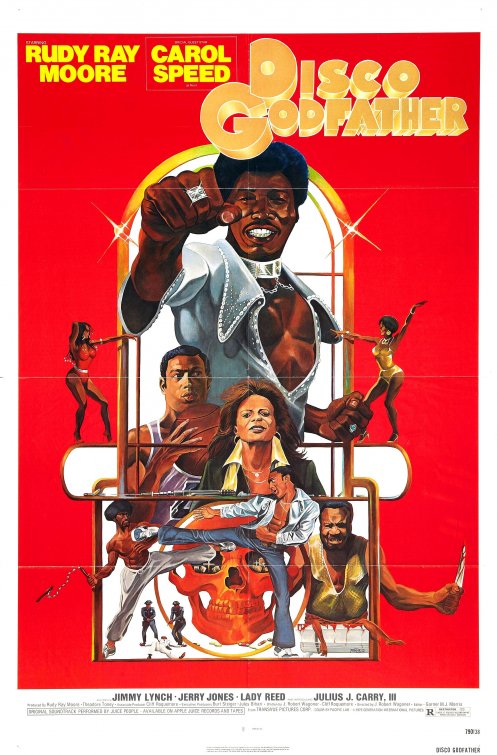
Disco Godfather (1979)

disco godfather

By Richard Winters

My Rating: 2 out of 10

4-Word Review: Don’t try angel dust.

Tucker (Rudy Ray Moore) is the DJ at a local discotic known as Blueberry Hill who becomes concerned when his nephew takes a new drug called angel dust that causes him to have weird hallucinations and forces him into the hospital. Since Tucker is also a former cop he decides to use his connections with the police force to take down the drug dealers and clean up the streets before they can corrupt any more of the youth, but the dealers have other ideas including kidnapping Tucker and forcing him to ingest the drug via a gas mask.

This was the fifth feature for Moore and the last one where he was credited as the star. The former comedian created a character for his stage act called Dolemite that proved so popular that in 1975 it was turned into a movie and Moore became a star at the age of 48. Yet by this time the act was starting to get old. He still had the energy, but seeing a man who was clearly in his 50’s somehow able to beat up guys who were much younger and bigger than him didn’t make a lot of sense.

The story itself is run-of-the-mill and splicing in disco dance numbers where the camera conspicuously focuses in on the scantily-clad gyrating bodies of the females doesn’t help and if anything makes it even more boring. The fight sequences looked quite staged and it’s obvious that the actors are pulling their punches and kicks.

The only thing that makes this otherwise uninspired low budget mess slightly diverting are the drug sequences in which the characters start tripping out on all sorts of weird hallucinations as well as a segment dealing with a religious group trying to ‘cure’ one of the victims through an exorcism. The final segment in which Moore sees his mother turning into a devil is goofy enough to give this thing 2 points and had this movie cut out the derivative drama and emphasized more of a surreal quality it would’ve done better.

My Rating: 2 out of 10

Released: September 3, 1979

Runtime: 1Hour 33Minutes

Rated R

Director: J. Robert Wagoner

Studio: Transvue Pictures Corporation

Available: DVD

Creator (1985)

creator

By Richard Winters

My Rating: 2 out of 10

4-Word Review: Cloning his dead wife.

Harry Wolper (Peter O’Toole) is an eccentric college professor obsessed with the idea of cloning his dead wife. With the help of an undergraduate assistant named Boris (Vincent Spano) he sets up a makeshift shed in his backyard and uses the university equipment for his experiments. He employs the services of Meli (Mariel Hemingway) a 19-year-old in desperate need of funds whose egg he uses as part of the cloning process. After a while she starts to fall in love with him and as the fetus of his dead wife takes shape she becomes jealous and feeling that he should be more concerned with the living than the dead.

O’Toole is engaging as ever in the type of role that most suits his talents. Had the film stayed centered on him it would have been a joy to watch, but unfortunately it enters in the generic Spano who looks like he was pulled straight off of the cover of a men’s modeling magazine. I presume this was because the studio felt a movie centered on a man over 50 wouldn’t attract the all-important 16-30 year-old demographic, but despite being an obvious chick-magnet he adds little and there was period in the middle where he isn’t seen for a long time to the point where I forgot about him and didn’t miss him at all.

Hemingway adds quirky energy as the free-spirit and her kooky romance with O’Toole adds genuine spark, but the film regresses by spending too more time focusing on Spano’s relationship with fellow coed Barbara (Virginia Madsen). This romance is very formulaic and makes the film seem like two movies in one while sucking all of its offbeat potential right out. If anything Spano should’ve fallen for his robot that is by far funniest thing in the movie.

Spoiler Alert!

David Ogden Stiers makes for a good antagonist and John Dehner, in his last theatrical film appearance, is solid as O’Toole’s loyal colleague, but the film’s biggest problem is when it shift gears and destroys the whole cloning angle completely. It then centers on a mysterious illness that befalls the Barbara character that like in Love Story never gets explained and comes out of nowhere. She goes into an immediate coma and is put on life support where her parents (Rance Howard, Ellen Geer) agrees much too quickly and without bothering to even get a second opinion to take her off of it and allow her to die. This then forces Spano to talk to her endlessly until just as the she is about to be disconnected she ‘miraculously’ comes back to life, which is too implausible, too contrived and too cute for even the most hopeless of romantics and helps ruin the engaging performances of its two lead stars, which is the only good thing about it.

End of Spoiler Alert!

My Rating: 2 out of 10

Released: September 20, 1985

Runtime: 1Hour 47Minutes

Rated R

Director: Ivan Passer

Studio: Universal

Available: VHS, DVD, Amazon Instant Video

The Strawberry Statement (1970)

strawberry statement 4

By Richard Winters

My Rating: 5 out of 10

4-Word Review: Students go on strike.

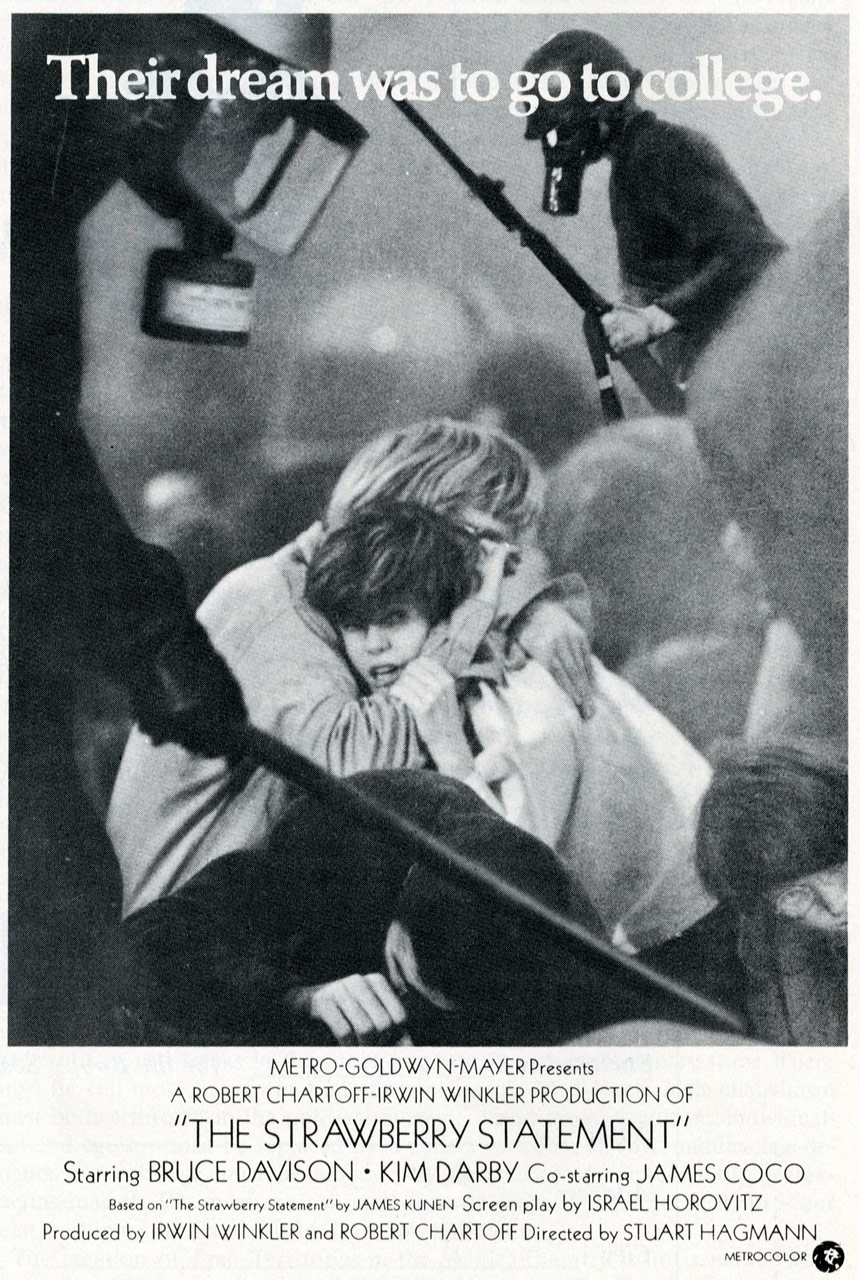
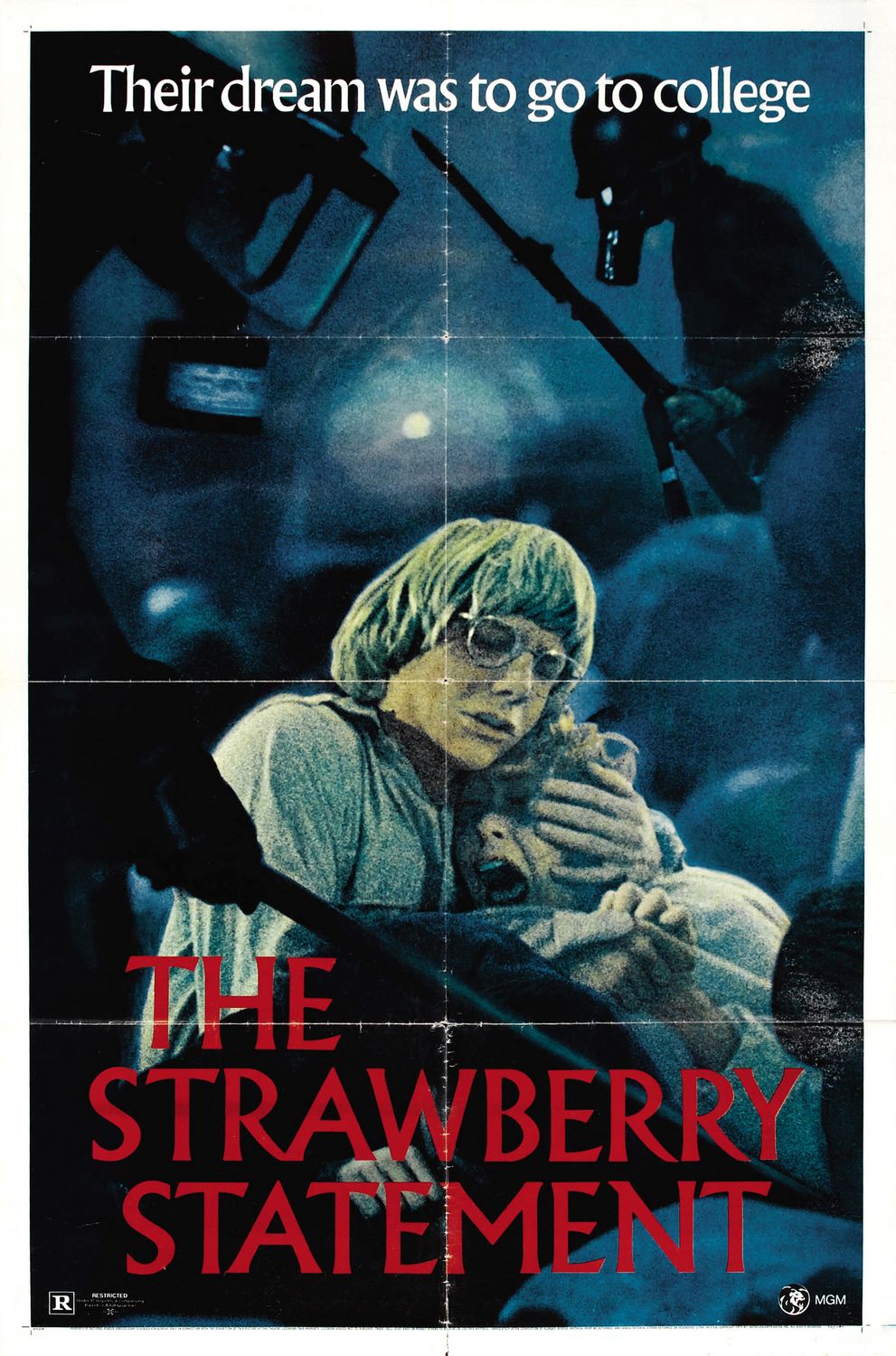
Simon (Bruce Davison) is a young college student attending a university simply as a means to get an education and find himself a good job. He has no real interest in the student revolt going on, but as a lark and a way to meet girls, he decides to passively get involved with students who have taken over the administrator’s building in protest of the school’s plan of building a gymnasium in an African American neighborhood. Slowly Simon finds himself taking up more of their cause and embracing their stance especially after meeting Linda (Kim Darby) who is much more of a student radical, but the two are ill-prepared for the brutal outcome when exasperated school officials have the police violently storm the building and haul the students out.

The film is based on the book ‘The Strawberry Statement: Notes of a College Revolutionary’ by James Kunen, which in turn is based on his experiences of being involved in a student sit-in that took place at Columbia University in April of 1968. The book’s narrative had more of an engagingly detached manner as it looked at the contradictions and hypocrisies of both sides while the screenplay by Israel Horovitz is nothing more than a commercialized effort to cash in on the counter-culture emotions of the time while glossing over or ignoring some of the book’s more perceptive points. The plot is too loosely structured and relies heavily on artsy camerawork and moody music to propel it until you get an hour into it and realize that nothing much has really happened. The whole thing would’ve been better focused had it been done with a voice-over narration by the main character.

strawberry statement 3

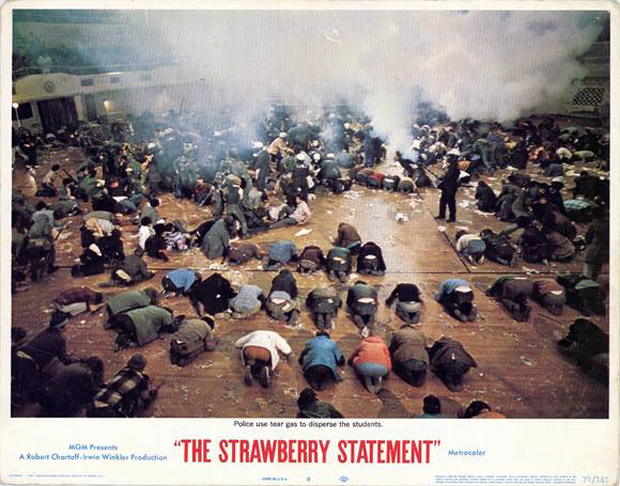
Although at times it borders on being pretentious I still found director Stuart Hagmann’s camerawork to be intoxicating especially the bird’s eye view of the students forming into several large circles as a way to block the police from entering and taking them out. Some of the scenes involving the demonstrations look staged and phony especially when compared to similar scenes of actual protests that were captured in Medium Cool that came out around the same time. However, the scene where the students grab a police officer, strip off his pants and force him down the slide and onto the swings at a children’s playground is downright amusing. The climatic sequence where the students are violently herded out of the building while sprayed with tear gas is well captured and by far the most startling and memorable thing about the movie.

Davison gives a solid performance and creates a middle-of-the-road character that is engaging enough to hold the thing together. It’s also great seeing Bud Cort playing an atypical role of an amorous girl-crazy coed who’s constantly looking to get laid. This film also marks the film debuts of David Dukes, Jeannie Berlin, Paul Willson, Andrew Parks, Kristina Holland and soap actress Jess Walton. You can also spot Horovitz and Kunen in brief cameo parts as well as character actor James Coco as a deli owner who’s all too willing to have his placed robbed simply so he can collect the insurance money.

Although they wanted to shoot the movie at Columbia where the incident actually occurred they were unable to get permission and were forced instead to do it at Berkeley, which in some ways helped it as the liberal, free-spirited look and mood of the region helped match the tone of the story. Ultimately though the film fails to ever really gel and comes off as being too placid and generic while failing to distinguish itself from the myriad of other student protest movies from that era.

strawberry statement 2

strawberry statement 1

My Rating: 5 out of 10

Released: June 15, 1970

Runtime: 1Hour 49Minutes

Rated R

Director: Stuart Hagmann

Studio: MGM

Available: DVD (Warner Archive), Amazon Instant Video

One Wild Moment (1977)

one wild moment 1

By Richard Winters

My Rating: 5 out of 10

4-Word Review: Fling with friend’s daughter.

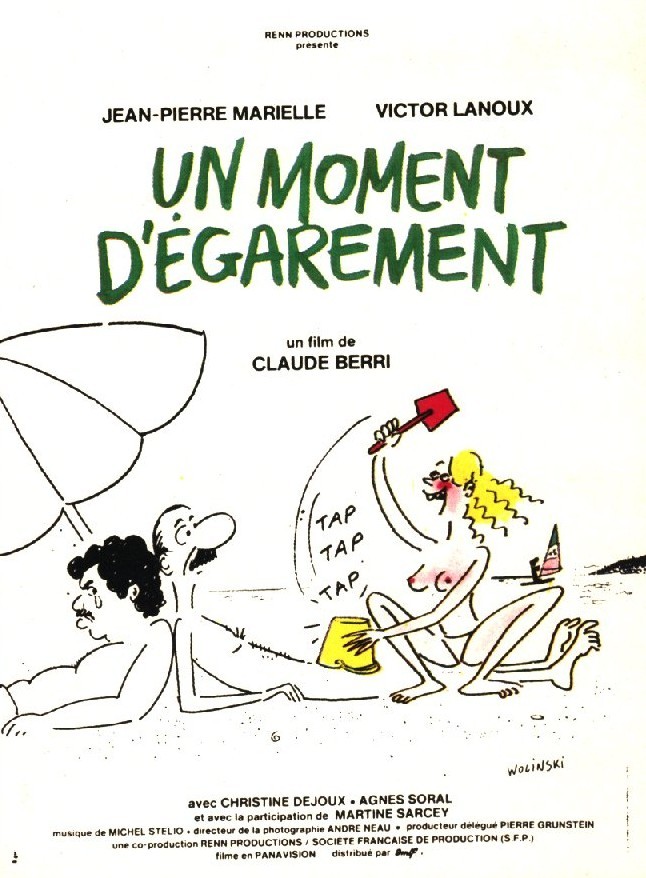
Pierre and Jacques (Jean-Pierre Marielle, Victor Lanoux) are longtime friends who decide to take a vacation together along the French Riviera and both bring along their 17-year-old daughters. One night Pierre and Victor’s daughter Francoise (Agnes Soral) attend a late night wedding party and the revelry and energy of the moment culminates with them having a tryst along the beach. Although Pierre has feelings for Francoise and vice-versa he wants to keep it from going any further for fear that it will jeopardize his friendship with Victor. Francoise though wants it to continue and the two quarrel with their mixed feelings as they ponder telling Victor about it.

Although this is not a great film it is still far superior to its American remake Blame it on Rio. For one thing it works more as a drama while the remake was played strictly for laughs. The dialogue has more of a realistic conversational quality and the characters are better rounded and more dimensional. The structure is  leisurely paced given it a day-in-the-life feel without having every scene forced to conform to contrived comedy like in the other one. The scene where the two make love has much more of a natural quality to it and less stagey. I also enjoyed more of an emphasis on subtly where the characters are not compelled to verbally describe their feelings, but instead it relies on their facial expressions, which is much more powerful.

Marielle gives a far better performance than Michael Caine did in the equivalent role who seemed awkward, stiff and uncomfortable throughout. The rift that the character has with his daughter Martine (Christine Dejoux) gets better fleshed out here while in the remake it is only briefly touched on. I also thought it was interesting that at one point Marielle’s character slaps his daughter during an argument when she comes back well after her curfew, which doesn’t get shown in the American film and I presume this is because of Hollywood’s concern that it might make the character less appealing as they always want to make their protagonists are wholly likable and politically correct, but in the process it also makes them less real.

The two daughters are much more believable and like young women ready to enter adulthood instead of a middle-aged man’s sexual fantasy like in the other one. I also found it amusing how when Francoise tells her father about her tryst he doesn’t immediately become upset about it like in the American film where sexual mores are more stringent, but only after she tells him it was with a man over 40.

Thankfully there is also no silly side-story involving one of the men’s wives having an affair with the other, which was the dumbest part about the remake and in fact there is no wife character here at all. The only real problem with this version is its abrupt ending that leaves open all sorts of loose endings and is quite unsatisfying and becomes unfortunately a major mark against it.

My Rating: 5 out of 10

Released: December 21, 1977

Runtime: 1Hour 28Minutes

Rated R

Director: Claude Berri

Studio: Quartet Films

Available: VHS

Blame it on Rio (1984)

blame it on rio 1

By Richard Winters

My Rating: 4 out of 10

4-Word Review: Sex with friend’s daughter.

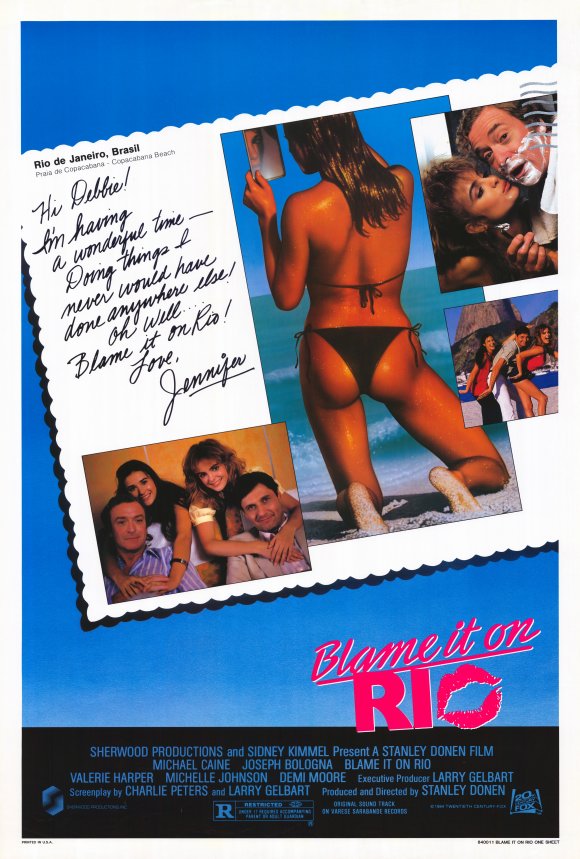
Victor (Joseph Bologna) is going through a messy divorce and in order to escape from the stress he invites his friend Matthew (Michael Caine) to join him and his daughter Jennifer (Michelle Johnson) on a trip to Rio de Janeiro. Initially Matthew was to bring along his wife Karen (Valerie Harper), but at the last minute she bails out, so instead he takes his daughter Nicole (Demi Moore) who is also Jennifer’s best friend. During the trip Jennifer’s long dormant feelings for Matthew come to a head and the two end up having a fling. Matthew sees this as a secret one-night-stand as he doesn’t want it to jeopardize his long friendship with Victor, but Jennifer wishes for it to blossom into a love affair and even considers, much to Matthew’s reluctance, informing her father about it.

The film, which has been the last theatrical feature to date to be directed by the legendary Stanley Donen, has a zesty start that features soothing music, luscious scenery and sharp dialogue. Unfortunately it goes downhill from there with the third act being the real problem. Instead of becoming an interesting character study and analyzing whether this otherwise strong friendship could survive such a shocking event it instead veers off into silliness by entering in a crazy twist of Mathew’s wife having a secret affair with Victor, which didn’t seem realistic or believable and cements the whole thing as being nothing more than a dumb, shallow lightweight comedy.

The usually reliable Caine is miscast and his big Harry Caray-like glasses become almost a distraction. His costar Bologna is the one who steals it in a role nicely attuned to his brash, hothead persona.

The weakest link though is Johnson who despite looking great topless clearly has very little acting talent. Her character is poorly defined and written by two middle-aged men who were out-of-touch with the younger generation and had no idea how they ticked.  At the beginning she behaves too much like a child and then suddenly when she gets it on with Matthew she is like an out-of-control sensuous vamp, which made the character come off like two different people altogether. The fact that she shows no apprehension at all in having sex with Matthew who is much older made little sense as I would think that any normal person  would feel nervous and despite the attraction even some reluctance. She also shows no concern for how stressed the whole thing made Matthew feel, which unintentionally made her appear quite selfish.

Moore would’ve been much better in Johnson’s role and in many ways sexier. I had to chuckle a bit because in Leonard Maltin’s review of this film he mentions that Demi seemed ‘intimidated’ during her topless scene at the beach, which is actually an understatement as she looks downright uncomfortable, which in turn makes the viewer feel the same way.

This film is the American remake of the French comedy One Wild Moment, which came out six years earlier and will be reviewed later this week.

My Rating: 4 out of 10

Released: February 17, 1984

Runtime: 1Hour 40Minutes

Rated R

Director: Stanley Donen

Studio: 20th Century Fox

Available: VHS, DVD, Amazon Instant Video, YouTube

30 is a Dangerous Age, Cynthia (1968)

30 is a dangerous age

By Richard Winters

My Rating: 6 out of 10

4-Word Review: Life crisis at 30.

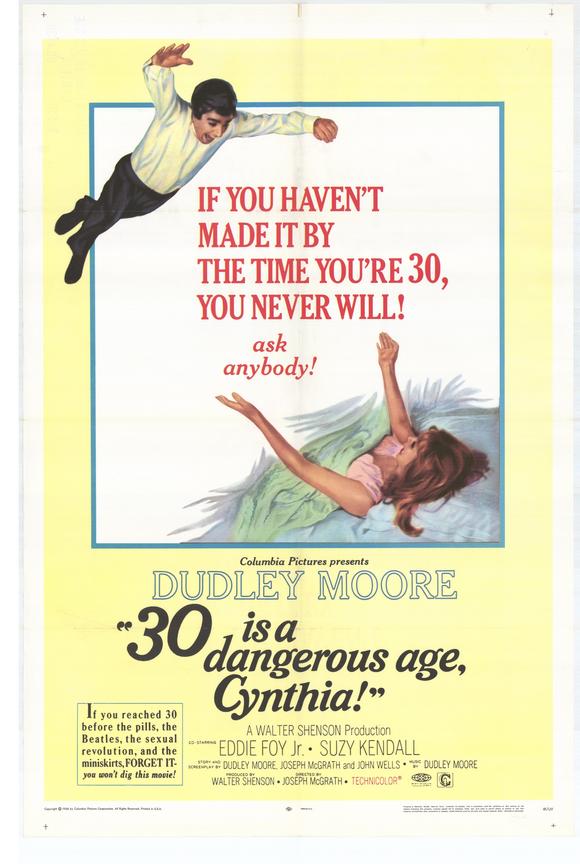
Rupert Street (Dudley Moore) is a struggling pianist and composer who with only six weeks until his thirtieth birthday feels that his life has been a failure. He sets out to change that by setting some very lofty goals, which is to write a musical and have it produced as well as getting married even though he has yet to find a girlfriend.

The film, which was directed by Joseph McGrath is filled with the wonderfully drool British humor that manages to be both lightly satirical and imaginative all at the same time. The rampant cutaways in which a character will be talking about something and then it cuts to show them doing what they are imagining or discussing lends a nice surreal quality. The banter that Moore has with a Registrar (Frank Thornton) where he tries to get a marriage license before even having picked out a woman is the high point of the film and a perfect example of the wacky humor of that era from that region of the world that balances being both subtle and over-the-top that I wish more American movies would be better able to replicate.

The supporting cast helps a lot and is full of comic pros. The elderly Eddie Foy Jr. is a scene stealer as Rupert’s best friend and so is Duncan Macrae, whose last film this was, as Rupert’s boss. Patricia Routledge is great as his kooky landlady and Suzy Kendall is highly attractive as his fiancée. There is also an amusing parody of 1940’s detective movies featuring John Bird as a self-styled film noir-like private eye.

Unfortunately the script, which was co-written by Moore, suffers from too much of loose structure. The jokes are poorly paced and many times the comic bits go on longer than they should. There is also an intermixing of musical numbers that features Moore at the piano, which does not work well with the rest of the film. Yes, Moore was also an excellent pianist, but this was no place to be showing it off and these segments only help to bog the film down as a whole. The ending, which features Moore having to witness the desecration of his musical by an overzealous director who has a different ‘vision’ for it is priceless, but in-between there are a lot of lulls and the film would’ve been helped immensely by having a tighter script and a more structured, plot driven story.

My Rating: 6 out of 10

Released: March 4, 1968

Runtime: 1Hour 25Minutes

Not Rated

Director: Joseph McGrath

Studio: Columbia Pictures

Available: VHS

Joe Kidd (1972)

joe kidd

By Richard Winters

My Rating: 3 out of 10

4-Word Review: Bounty hunter tracks revolutionary.

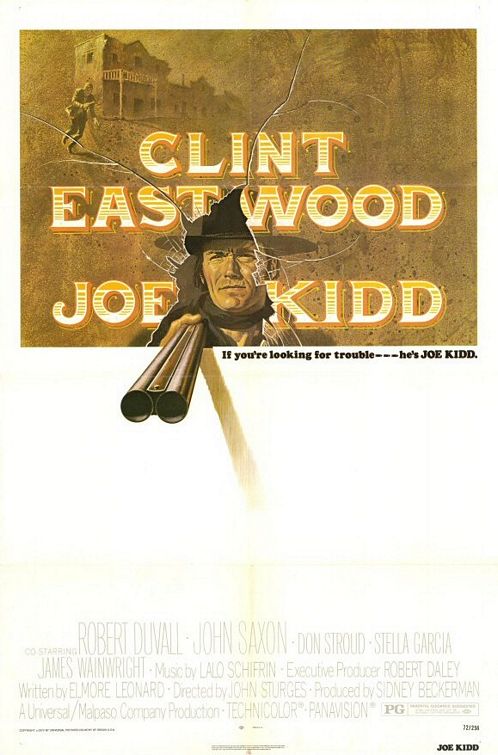
Joe Kidd (Clint Eastwood) is a bounty hunter sitting in jail on trumped up charges. As he is about to have his case heard the courthouse is invaded by Luis Chama (John Saxon) and his band of Mexican revolutionaries who are angered that their U.S. land claims have been denied. They threaten a full scale war against the American government and suddenly Kidd finds himself in the middle when powerful landowner Frank Harlan (Robert Duvall) wants to use Kidd’s abilities to track Chama down so that he can kill him before he can ferment any more unrest. Kidd and Frank do not like each other, but Kidd reluctantly goes along while planning at some point to stop Frank and his men before they can do anymore harm.

If there is one thing to take from this film it is Duvall’s performance. This is the movie where he really came into his own and his career transitioned from small character parts and guest spots in TV-shows to an all-around dynamic lead actor. His presence here is commanding and he plays the bad guy with such zeal that it ends up taking over the entire picture while smothering the usually reliable Eastwood until he and his character become bland and transparent.

Unfortunately the script written by Elmore Leonard cannot match the same energy or creativity. It starts out well and has all the rugged ingredients one expects from a good western and it’s even directed by John Sturges who’s noted for putting together great action flicks, but unfortunately at some point it goes flat and this is mainly because there is not much of a second or third act. The scenario itself is too predictable and gets played out in a mechanical, by-the-numbers fashion. It is also devoid of much action. The part where Kidd uses his telescope rifle to pick off a shooter at long range that the others can’t is okay, but the scene where he derails a train and sends it crashing through a saloon seems implausible and not as exciting to see as it may sound.

I enjoyed Kidd’s antagonistic relationship with Lamarr (Don Stroud) who is one of Harlan’s men and a young, long haired cocksure guy that immediately gets a vendetta against the more stoic Kidd, which adds some zest, but then the film squashes it too soon by having Kidd kill Lamarr in a rather unimaginative and uneventful way. In fact the whole climactic finish works in the same way with Kidd mechanically knocking off each of Harlan’s men in a fashion similar to what Gary Cooper did to the bad guys in High Noon, which was a far better movie. Kidd’s final shootout with Harlan is a particular letdown and should’ve been played out more while only helping to cement this as one of Eastwood’s weakest and more forgettable westerns that he has done.

My Rating: 3 out of 10

Released: July 14, 1972

Runtime: 1Hour 28Minutes

Rated PG

Director: John Sturges

Studio: Universal

Available: VHS, DVD, Blu-ray, Amazon Instant Video
Private Lessons (1981)

private lessons

By Richard Winters

My Rating: 4 out of 10

4-Word Review: Housekeeper seduces a minor.

Mallow (Sylvia Kristel) is an English nanny working for a rich client named Fillmore (Ron Foster) who gets involved in a scheme with the family’s chauffer Lester (Howard Hesseman) to seduce Fillmore’s 15-year-old son Philly (Eric Brown). The idea is for her to fake having a heart attack during their lovemaking and convince Philly that he has killed her and then Lester will blackmail him to take $10,000 out of the family’s safe and give it to him has hush money for not reporting it to the police, but Philly is smarter than they think and not only catches onto their scheme, but has a double-cross in store for them as well.

The idea of having an adult making love to a minor most likely wouldn’t have gotten the green light today. To me it reeked of being a major double-standard. If the genders had been reversed and it had been a 15-year-old girl seduced by an older man this thing would’ve been considered obscene and banned, but because it involves a teen boy with ‘raging hormones’ instead that somehow makes it ‘okay’ and is approached as being nothing more than an innocuous sexual ‘coming-of-age’ flick, which I found to be both annoying and aggravating.

The scene involving the young Brown getting naked and hopping into the tub with the equally naked Kristel where they then fondle and kiss each other seemed like child erotica and will most likely make viewers today who are now much more sensitive on this topic feel uncomfortable to watch. The ending in which the two go to bed together in a very drawn-out sensual segment that is done under a romantic context is downright smarmy. Viewers wanting to watch this simply to catch Kristel naked will be disappointed to know that most of her nude scenes were done using a body double named Judy Helden.

The script was written by Dan Greenburg, who also appears briefly as a seedy hotel owner and based on his 1969 novel ‘Philly’. He is a noted humorist who eight years earlier wrote the script to the film with the quirky title of I Could Never Have Sex with any Man Who has Such Little Respect for My Husband. For the most part this film is rather bland, but manages to pick up a bit during the second half when the story twist kicks in that at the very least makes it better than most other teen sex comedies, which are usually devoid of any discernable plot at all.

The script though is full of holes. For one thing it is highly doubtful that a rich parent would give their child a combination to a safe that has tons of money in it and there is never any explanation of what was put into the body bag that is hoisted into the ground and buried when Lester was still tricking Philly into believing it was the dead Mallow. Obviously it wasn’t her, so what was used to make it seem like a dead body? The film never says, but should’ve. Also, I found it hard to believe that Mallow and Philly could go out to a fancy restaurant and make out with each other openly in a booth and not have it create a stir and distraction with the other patrons especially when it was clearly involving an adult and a minor.

Brown whose only other claim to fame was playing Ken Berry’s son in the first two seasons of ‘Mama’s Family’ gives an engaging performance, but I couldn’t help but wonder what his parents where feeling and thinking during the love scenes. It’s also interesting to see Hesseman who wears a wig and has his mustache dyed brown in a rare turn as a heavy. Begley Jr. gets a few kudos in his attempt to play a ‘tough guy’ cop and Dan Barrows makes the most of his small role as the family’s gardener.

The film has a surprisingly great soundtrack that feature a lot of hits from the day which include: ‘Hot Legs’, ‘Tonight’s the Night’ and ‘You’re in My Heart’ by Rod Stewart as well as ‘Just When I Needed You the Most’ by Randy Van Warmer, ‘I Need a Lover’ by John Cougar, ‘Fantasy’ by Earth, Wind and Fire, ‘Next Time You See Her’ by Eric Clapton and ‘Lost in Love’ by Air Supply. How such a low budget movie was able to pay for the rights to these songs is a mystery, but it definitely adds pizazz and helps give the film an extra point.

My Rating: 4 out of 10

Released: August 28, 1981

Runtime: 1Hour 27Minutes

Rated R

Director: Alan Myerson

Studio: Jensen Farley Pictures

Available: VHS, DVD, Amazon Instant Video, Hulu

My Tutor (1983)

my tutor

By Richard Winters

My Rating: 1 out of 10

4-Word Review: Tutoring him in sex.

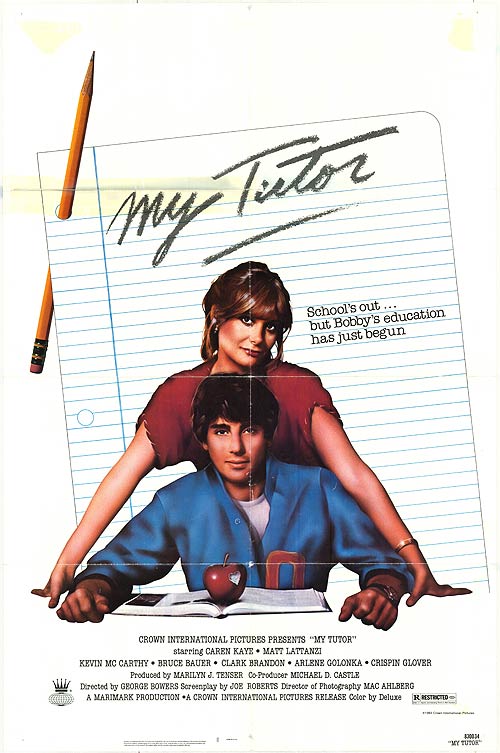
Bobby (Matt Latanzi) is a high school senior set to graduate and go onto Yale even though he would rather go to UCLA and study astrology. In either case he fails his French class, which impedes him from attending either school. His concerned and controlling father (Kevin McCarthy) decides to hire a tutor named Terry (Caren Kaye) to live with them in their mansion estate while helping Bobby with his French so he can pass the course. Bobby though starts to become attracted to Terry and the two eventually become lovers much to the consternation of his father who would rather have the attractive woman all to himself.

I was still in high school when this film came out and living in a small Minnesota town as a preacher’s kid. I remember my Dad getting a call from some man who had watched this film in the theater and become ‘outraged’ at its ‘pornographic’ nature. He wanted to form picketers at all the area theaters that where showing it and eventually create a nationwide protest movement that he hoped would eventually get the film banned for being what he considered ‘obscene’.

Although there certainly is nudity it is only of the topless variety and it’s no more ‘outrageous’ than any of the many other teen sex comedies of the ‘80s. If the film is offensive in any way it is because it is dumb and uninspired and filled with a lot of silly humor that would be better suited for a Disney flick. The romantic angle is formulaic and the scene of the two in bed together is more mechanical than erotic and hurt by a sappy love song that gets played over it.

Lattanzi, who at one time was married to singer Olivia Newton-John and the father of Chloe Lattanzi, has a deer-in-headlights look about him and a limited acting ability to match it. He looks too old to be playing a teen and appears to be more like 24, which is what he really was. The idea that this good-looking guy with chiseled features could not make it with any of the girls is hard to believe and in a lot of ways the character behaves more like he is a naïve 14 year-old than someone headed for college.

McCarthy is a far better actor who manages to have a screen presence, which the transparent Lattanzi clearly knows nothing about. The fact that the old man makes a play for the tutor should’ve been played up more and I was surprised that when she flatly rejects his advances he didn’t just up and fire her and replace her with some other tutor, which would’ve helped give the otherwise one-dimensional script more conflict.

Arlene Golonka adds some light levity as the ditzy mother and its great seeing Crispin Glover in his film debut playing one of Bobby’s friends and for a change a more ‘normal’ type of character, which is freaky in itself. Clark Brandon, who enjoyed a brief acting career in the ‘80s and an even briefer foray into directing during the ‘90s, is also fun as Bobby’s other friend Billy who also gets the film’s one-and-only funny exchange when he tries to ask a blonde for a dance:

Billy: Would you care to dance with me?

Blonde: No thank you.

Billy: Then I suppose a blow job is completely out of the question.

My Rating: 1 out of 10

Released: April 22, 1983

Runtime: 1Hour 37Minutes

Rated R

Director: George Bowers

Studio: Crown International Pictures

Available: VHS, DVD, Blu-ray, Amazon Instant Video