Category Archives: Romance

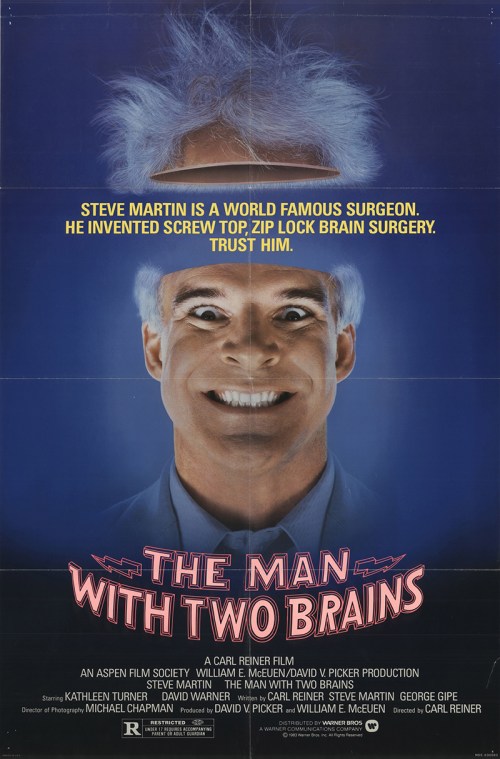
The Man with Two Brains (1983)

By Richard Winters

My Rating: 6 out of 10

4-Word Review: Brain in a jar.

Dr. Michael Hfuhruhurr (Steve Martin) is a world famous brain surgeon who accidentally hits Dolores Benedict (Kathleen Turner) one day while driving his car. He immediately does surgery on her and during the recovery the two get married. However, Dolores is only interested in Michael’s money and continues to see other men behind his back. Michael on-the-other hand  meets with Dr. Alfred Necessiter (David Warner) who keeps live brains in jars in his condo. Michael (Steve Martin) begins communicating with one of the brains (voice of Sissy Spacek) via telepathy and decides it is she that he really loves. When he becomes aware that the brain will not survive much longer on its own he desperately tries to find a suitable body to transplant it into.

This Steve Martin/Carl Reiner production, which is their third project together, certainly has its moments and I particularly liked the the mysterious elevator killer although once his identity is finally revealed viewers today will have no idea who that person actually is. However for the most part the film is highly uneven. Having it centered as a horror movie parody would’ve given it better focus and the jokes more of a point-of-view instead of just throwing in any haphazard gag it wants many of which have nothing to do with its already paper thin plot.

I realize this is all meant to be a very silly comedy, but having two victims get hit by a vehicle, once with Turner and then later on with Stephanie Kramer, in her film debut, where neither victim shows any sign of blood, scratches, or bruising is a bit ridiculous. This is where if it had been approached as a horror/comedy then they could’ve thrown in some gore, but in an over-the-top goofy way, that would’ve allowed a new dimension for laughs while also given it just a smidgen of reality to it, which otherwise is lacking.

Martin’s ability to have a conversation with a brain in a jar without any special apparatus connecting the two is equally ridiculous. The excuse is that it’s ‘telepathy’, but why is he able to communicate with just the one brain when there are many others that are also in the room? What special ability does this brain have over the others and why is Martin the only one that can hear it and no one else?

Having Martin hear Spacek’s voice as her thoughts come into his brain doesn’t make sense either. The definition of telepathy is the  communication of thoughts and ideas other than the known senses, but nothing to do with voices. Thoughts in themselves don’t have a distinct voice connected to them unless the brain is attached to a voice box, which this one isn’t.  It is true that thoughts going on in person’t own head may have that person’s voice, so Martin should actually be hearing his own voice as his brain deciphers the messages being sent to it from the other one much like if he were reading out loud a note that had been written by someone else.

This also marks an odd career choice for Turner who burst onto the scene with her sexy performance in Body Heat . I realize that in her effort to avoid typecasting she wanted to do something that was completely different from her first film, but her character is too campy and one-dimensional and she ends up getting completely upstaged by Martin in every scene they’re in. The role also has a creepy foreshadowing as her character gains a lot of weight much like she has in reality due to her rheumatoid arthritis. In real-life it’s the drugs and chemo that caused the weight gain while here it’s created through make-up and a body suit and intended for comical effect.

There’s also an interesting behind-the-scenes story dealing with a scene involving a 5-year-old girl, played by Mya Stark, who must verbally repeat back to Martin from memory a very complicated set of directions that he had just told her. Since she was too young to read no cue cards were used and director Reiner figured it would take all day to film the scene convinced that many retakes would inevitably be required for her to finally get the lines right, but instead to his shock she repeated the lines back correctly the very first time. Then 30 years later in 2012 Reiner was standing in line at a store when a female business executive approached him and introduced herself. She stated that they had met many years before, but Reiner didn’t recognize her until she told him that she was that little girl now all grown up.

My Rating: 6 out of 10

Released: June 3, 1983

Runtime: 1 Hour 31 Minutes

Rated R

Director: Carl Reiner

Studio: Warner Brothers

Available: DVD, Blu-ray, Amazon Video, YouTube
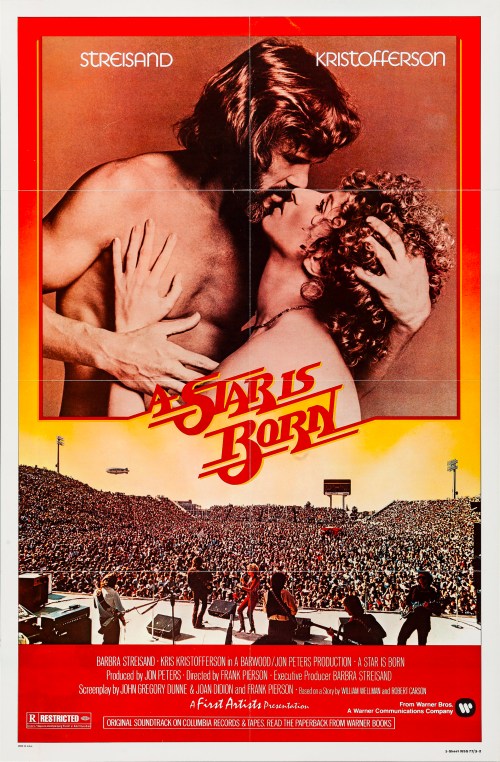
A Star is Born (1976)

By Richard Winters

My Rating: 4 out of 10

4-Word Review: His career goes downhill.

John Norman Howard (Kris Kristofferson) is a famous rock singer who’s found that his career on the road has taken its toll. He’s become jaded by the money and fame and now bored with it while spending his days and nights committing self-destructive acts that alienate the rest of his crew. One night after walking off the stage of his own concert after singing only a few songs he goes to a bar where he sees Esther (Barbra Streisand) singing on stage. He becomes impressed by her talent and uses his resources to make her a star. The two eventually get married, but as her career continues to rise his goes in decline.

This is the third remake of the story that was originally written by William A. Wellman and Robert Carson. The first version came out in 1937 and starred Frederic March and Janet Gaynor while the second one was released in 1954 and starred James Mason and Judy Garland. This version differs from the other two in that the setting was the music scene instead of the movie business, but overall the efforts here to revitalize the tired formula are trite and predictable.

A lot of the blame can go to Streisand who acted as both the star and producer to the project. For one thing she was too old for the part as she was already in her mid-30’s when this was filmed and wearing a tacky afro hairstyle to boot. It would’ve been more effective had a truly young person, like a woman who was 19, which is a typical age for someone to have dreams of breaking into the rock scene, was cast. Possibly having the character start out as one of Kristofferson’s groupies, instead of doing it like it’s done here where he just meets her at random at a bar, which is awkward and forced, and then through their time together he learns of her aspirations and talents and works to help her meet her potential.

It also would’ve helped had the young starlet had the same singing style as Kristofferson, which would’ve made the concert scene where he walks off stage and brings Esther onto it more believable. Kristofferson’s music, or what little we hear of it, has clearly a more hard rock edge while Streisand sings mellow love songs. In the movie we’re supposed to believe that all these fans who paid good money to see Kristofferson sing are suddenly without warning given Streisand instead and are so taken aback by her talent that they all clap and cheer when in reality I think they would’ve been upset and demanding their money back as they came to hear hard rock and not the lite stuff.

I enjoyed Kristofferson’s performance and his impulsive self-destructive acts give the film energy and edge. However, the chemistry between the two is non-existent and he later said that working with Streisand was “an experience which may of cured me of the movies.” His decline gets handled in a rushed, heavy-handed way. Music careers are by their very nature cyclical. Rock stars get replaced with every generation as teens prefer their own singing idols and not those of their parents. For him to become so quickly devastated when his record sales begin to plummet is unrealistic as nobody stays on top forever. He should have enough money to wade out the career lulls and simply held on to when his fans grew up and became nostalgic and then hit the retro tour circuit like many of the pop/rock icons from the past do.

Streisand’s character is flat, one-dimensional, and just plain too-good-to-be-true. She’s well known in real-life for her notorious ego, in fact director Frank Pierson described her as being egocentric, manipulative, and controlling and refused to ever work with her again, so having her then portray someone who is gracious and humble seems very phony and not something that she’s effectively able to convey. The original concept was to have the character be like Janis Joplin and go through a self-destructive decline of her own, but Streisand nixed this idea, which is unfortunate as it would’ve given the film some needed nuance.

The footage of the massive crowds at the concerts is the one element that I found impressive and the segment showing the vast stretch of land that Kristofferson owned in the middle of the Arizona desert was pretty cool too. Everything else though in this otherwise overlong film is boring. Fans of Streisand’s singing may take to it better, but there’s too much of it, making it seem like this was just one big vanity project for her and nothing more.

My Rating: 4 out of 10

Released: December 17, 1976

Runtime: 2 Hours 20 Minutes

Rated R

Director: Frank Pierson

Studio: Warner Brothers

Available: DVD-R (Warner Archive),  Blu-ray, Amazon Video, YouTube

Heartbeeps (1981)

By Richard Winters

My Rating: 1 out of 10

4-Word Review: Robots fall in love.

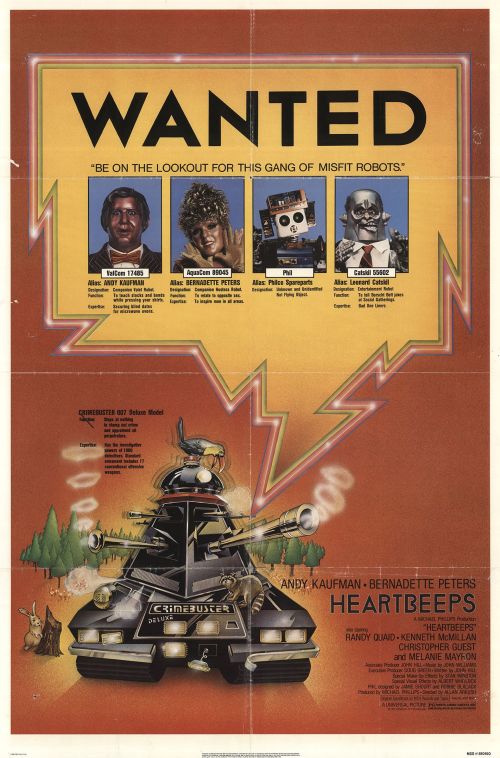
Val (Andy Kaufman) and Aqua (Bernadette Peters) are two robots who meet one day at the factory while awaiting repairs. They quickly fall in love and decide to escape out into the wilderness while bringing alone Phil a small robot who does not speak as well as Catskill (voice of Jack Carter) a robot made to resemble a cigar smoking vaudeville-type stand-up comedian. However, two employees from the factory, Max (Kenneth McMillan) and Charlie (Randy Quaid) go on a pursuit to retrieve them. There’s also the malfunctioning law enforcement robot known as Crimebuster who also chases after the robots and will stop at nothing to bring them back.

This is a highly unusual film in that it uses robots as its main characters and has their point-of-view the whole way through. Other films have had robots of course, but they are put in supporting roles to the humans.  Here director Allan Arkush was determined to keep it authentic to the ‘robot experience’, by implementing a computer-type logic to everything that goes on, which creates  some surreal moments, but ultimately falls flat.

To be a successful film you still need to have characters that the viewer finds relatable and the robots are too, pardon the pun, mechanical. They never say anything that is interesting or funny and while they at times have an endearing child-like quality they do not create any emotional bond with the audience.

There still needed to be a human as the centerpiece, maybe someone the robots met during their escape, who takes them in and helps them in their quest to hide from those that are after them while also having the robots in some way help their new human friend in whatever personal challenges or battles they were going through.  They are a couple of times that the robots do come into contact with people with one occurring when they crash a party at a swanky hilltop resort with Paul Bartel and Mary Woronov playing two of the partiers, but the guests at the party are broadly played caricatures and the scene itself too brief. They also later meet-up with a couple, played by Melanie Mayron and Christopher Guest, who run a junkyard, but this occurs too late in the movie and should’ve been introduced earlier.

While the wilderness setting is scenic it fails to add much in the way of either excitement or comedy. Having the two escape into a big city would’ve been more compelling. The crimebuster robot that chases after them is too goofy and offers no tension or intrigue. Sometimes even in a comedy it’s good to have a little bit of that, or at least a bad guy that is competent enough to make the viewer wonder, if even for a second, whether our heroes are going to safely outsmart him or not, which doesn’t occur here.

It would’ve been nice too had there actually been some genuine laughs. The only attempts at humor are when Catskill cracks one of his long line of incredibly dumb jokes, which are intended to be lame, but having a few that were actually clever, would’ve helped. Even the talented Kaufman flounders as he uses the same accent of his famous foreign man character that he did during his stand-up routines as well as in the TV-show ‘Taxi’ ultimately making it seem like Latka in a robot disguise.

The make-up effects by Stan Winston are impressive especially the opening credit sequence at the beginning where the camera focuses onto the robots’ various parts close-up. Winston used a gelatin substance that gave off a authentic looking metallic appearance versus how it had always been done before where it had been painted on. However, two holes where created around the robots eyes, which gives it a mask-like appearance and ultimately ruins the attempt although it gets kudos for at least making a strong effort. I also liked the  clicking sound effect every time one of the robots blinked their eyes, which resembled the noise of a camera taking a picture. but it’s not consistent as it’s heard during the first half, but not during the second part.

My Rating: 1 out of 10

Released: December 18, 1981

Runtime: 1 Hour 18 Minutes

Rated PG

Director: Allan Arkush

Studio: Universal

Available: DVD, Blu-ray, Amazon Video, YouTube
Fools (1970)

By Richard Winters

My Rating: 2 out of 10

4-Word Review: Lost souls find love.

Matthew (Jason Robards) is sitting in a park one day trying to read a book when two children begin taunting a dog, which causes it to bark and impedes Matthew’s peace and quiet. He then warns the children that if they don’t behave the dog will rip their arms out, which angers the dog’s owner (Marc Hannibal) who then proceeds to punch Matthew in the face. Anais (Katharine Ross), who was also in the park, comes to Matthew’s aid and the two quickly begin a romance, but she neglects to tell him that she’s being followed by a private detective (Robert C. Ferro Jr.) whose been hired by her jealous husband (Scott Hylands) who’ll stop at nothing to win her back.

The film is a very odd mix of drama and late 60’s quirkiness that never gels and most of the time comes-off as disjointed and amateurish. The relationship happens too fast and lacks any type of distinction from the thousands of other cookie-cutter romances already out there. The folk-tinged songs sung by Kenny Rogers and The First Edition are too sappy and bog the pace down, which is too slow and ambling to being with.

The biggest issue though is the way scriptwriter Robert Rudelson throws in all sorts of characters and bits that have nothing to do with the main plot. This includes two FBI agents appearing out-of-nowhere who raid the couple’s home and then just as quickly disappear and are forgotten. There’s also a weird bit where the couple confronts a trio of hippies, one of whom is played by Jack Nance in his film debut, who are strung-out on acid and it gets quite violent and ugly. Another segment deals with a psychiatrist (Mako) fighting off an oversexed patient (Laura Ash) and these two do not interact with the two main characters at all, so why this even gets put into the film is confusing.

85 minutes into its runtime the film also suddenly adds in flashbacks and surreal moments including Ross seeing herself jump off a tall building. Surrealism in film can be great, but it needs to get introduced earlier and trickle all the way through instead of popping up near the end, which throws off the tone completely.

Spoiler Alert!

The ending in which Ross gets violently gunned down inside a Church during a babies baptism is jarring, misplaced and like everything else comes completely out-of-nowhere. To some degree you can credit the film for being ahead-of-its-time as it deals with a stalking/jealous husband, which was a topic that had not yet come into the mainstream conversation, but the bird’s-eye view of Ross’ bloody corpse lying on the sidewalk is much too disturbing for a film that had otherwise been quite playful and lighthearted. The reactions by the other people inside the church, one of whom is played by a young Suzanne Somers, is off-putting too as they just stand there in a calm silence instead of screaming and panicking like you’d expect them to.

End of Spoiler Alert!

Robards, who is typically a very good actor, channels too much of the non-conformist quality similar to the character that he played in A Thousand Clowns, which in that film was charming, but here it’s annoying mainly because it doesn’t make sense. In that film he was poor and bordering on being homeless, so his contempt for society made sense, but here he’s a famous horror movie star renting a swanky apartment that overlooks the San Francisco skyline making his anger seem out-of-place. There’s also a brief bit where he attempts to climb over a barbed wire fence, the film cuts away so we don’t get to seem him fully do it, but it looked like a painful if not impossible thing to do and something that shouldn’t be done by someone who wasn’t insane.

Ross on the other-hand is appealing and quite beautiful in literally every shot she’s in, which is the only reason I’m giving this dopey production even two points, but she unfortunately is straddled with a script that appears to have no point to it and if it does it doesn’t convey it in any type of discernible way.

My Rating: 2 out of 10

Released: December 23, 1970

Runtime: 1 Hour 33 Minutes

Rated GP

Director: Tom Gries

Studio: Cinerama Releasing Corporation

Available: None at this time.

Jeremy (1973)

By Richard Winters

My Rating: 4 out of 10

4-Word Review: A teen’s first romance.

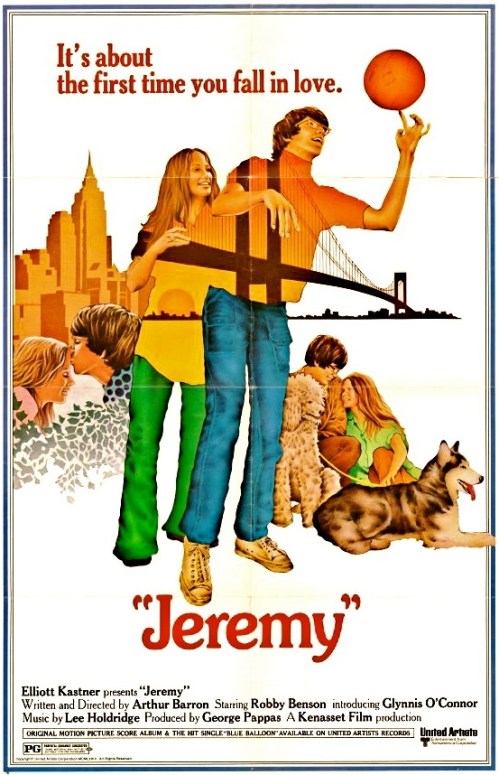
Jeremy (Robby Benson) is a teen cellist going to a New York school for artistically inclined students. It is there that he meets Susan (Glynnis O’Connor), who is training to be a ballerina, but he’s too shy to ask her out, so his friend Ralph (Len Bari) asks her for him. Eventually the two start dating and after 3-weeks find themselves in a deep and committed relationship only to have happenstance tear them apart.

The film tries hard for realism, at least to some degree, and for that reason it partially succeeds. The best moments are the ones where Jeremy frets about asking Susan out and is unable to get up the nerve to do it, which I enjoyed as few movies deal with this very real issue. In fact a study was done during the 70’s dealing with so-called ‘love-shy’ men and of those over 300 considered this their favorite movie with some having watched it 20 or more times and one individual in his late 30’s having seen it 86 times.

Unfortunately the pace is inconsistent with too much time spent during the first 30-minutes dealing with Jeremy’s cello playing, which is something that by the third act gets forgotten and not even mentioned. There are also two sappy songs that are played, one sung by Robby and the other by Glynnis, and nothing is more annoying than a film that tries to be realistic one minute only to bog things down with needless music montages the next.

Benson’s acting here borders on being excruciating to watch. Shy, awkward teens are fine, but Robby becomes the poster child for it making it almost cringe-worthy. O’Connor is more confident and she should’ve been paired with somebody that would’ve equaled it. I realize that the two in real-life got into a long term relationship during the filming of this and 3 years later appeared together in Ode to Billy Joe where Benson’s acting ability and scrawny physique had improved, but here he’s too much of a caricature and it would’ve been more interesting had the character been someone with a confident facade only to be gun-shy romantically when the pressure was on.

Spoiler Alert!

The third act is a disappointment as it involves Susan and Jeremy being forced to break-up when her father (Ned Wilson) gets a job offer in Detroit. I realize this was before the internet age and long distance relationships can always be a challenge, but I didn’t feel this necessarily had to signify the end of it. They could’ve continued to write letters and talk over the phone and they were only two years away from turning 18 and by then they would be free to move away from their parents and start back together, so this story twist came-off like a cop-out. I would’ve preferred a more concrete reason to why their relationship ended, like realizing once the infatuated puppy-love phase died down that they just weren’t compatible, which is how the majority of relationships ultimately end.

My Rating: 4 out of 10

Released: August 1, 1973

Runtime: 1 Hour 30 Minutes

Rated PG

Director: Arthur Barron

Studio: United Artists

Available: DVD, Amazon Video

There’s a Girl in My Soup (1970)

By Richard Winters

My Rating: 3 out of 10

4-Word Review: Playboy falls for hippie.

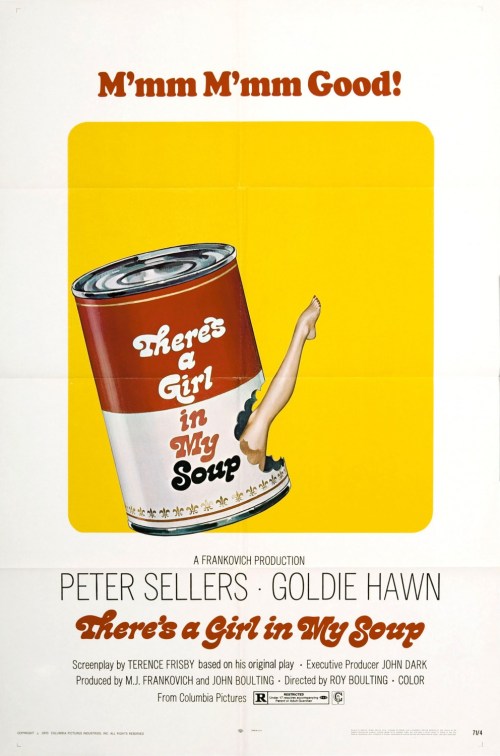
Robert (Peter Sellers) is a dashing playboy who enjoys having random sexual encounters with women, even having sex with a bride on her wedding day. Despite being in his 40’s he shows no signs of wanting to settle down and get married. Then he meets Marion (Goldie Hawn) a groupie for a rock band who finds out that its lead singer Jimmy (Nicky Henson) has been unfaithful to her. With nowhere else to go she lets Robert pick her up and take her back to his pad where he tries to seduce her, but without much luck.

Although the stageplay for which this film is based did quite well its translation to the screen leaves much to be desired.  Despite director Ray Boulting’s efforts to liven up the scenery by placing several scenes in exotic locales while also sprucing up Robert’s place by inserting his bathroom to have all mirrors in it that cover both the walls and ceiling, the film still ends up coming off like a filmed stageplay that lacks both energy and action. Even the dialogue, that usually helps  keep other plays that have evolved onto the big screen, lacks bite and becomes as stale as the rest of the proceedings.

The relationship is only funny when Marion rebuffs Robert’s advances and openly tells him how unsexy he really is, but when she foolishly ignores her better judgement and starts falling for the cad is when the whole thing goes downhill. There’s also confusion for why Robert, who openly enjoyed his single life and sleeping around with various beautiful women, which he seemed to have no trouble getting, would suddenly fall for a young woman that he didn’t have much in common with. For a relationship to begin both sides have to initially be looking for one and there is absolutely no hint that is what Robert wanted, so what about Marion got him to suddenly change his mind?

Sellers is okay although critics at the time complained that his performance was ‘lifeless’, which it is, but he makes up for it with his Cheshire cat grin. The role though doesn’t allow him to be inventive, or put on many of his different accents or personas, which he is so well known for. The character and situation are also too similar to the one that he played  in I Love You Alice B. Toklas, which he did just two years earlier.

Hawn is great and I enjoyed seeing her playing a snarky woman instead of the spacey blonde that she usually does, you even get a nice shot of her naked backside, but her character is too similar to one that she did in Butterflies are Free. In fact the two people that come-off best here are not the stars at all, but instead John Comer and Diana Dors as a middle-aged, bickering couple who should’ve been given more screen time.

Overall there’s just not enough laughs here to make sitting through it worth it. The plot has no point and the characters don’t grow or evolve making it a waste of time for its two leads whose talents are above this type of material.

My Rating: 3 out of 10

Released: December 15, 1970

Runtime: 1 Hour 36 Minutes

Rated R

Director: Ray Boulting

Studio: Columbia Pictures

Available: DVD, Amazon Video, YouTube

Children of a Lesser God (1986)

By Richard Winters

My Rating: 6 out of 10

4-Word Review: Romance with deaf woman.

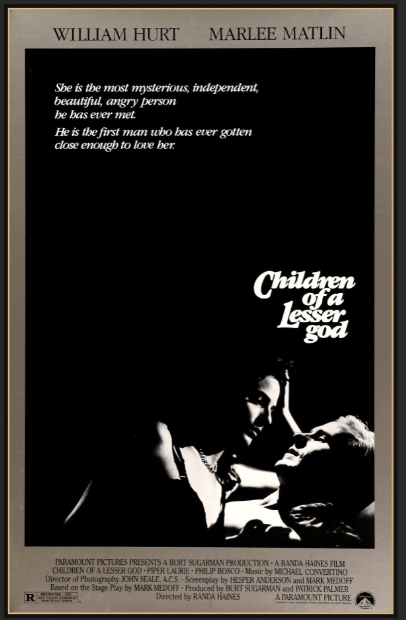
James (William Hurt) gets a job as an instructor at a school for the deaf. He’s brought in to try and teach the students to become less reliant on sign language and to speak more. It is there that he becomes infatuated with Sarah (Marlee Matlin) a 23-year old janitor who used to be a student there. She refuses to speak despite James’ efforts to get her to. Eventually they get into a relationship where James still insists that she must learn to speak, which creates a wedge between the two that could eventually drive them apart.

The film is based on the play of the same name by Mark Medoff, which in turn was based on the real-life experiences of deaf actress Phyllis Frelich  and her relationship with her husband Robert Steinberg. The play was quite successful and ran for 887 performances, but when it transitioned to film several changes were made most notably that in the play the Sarah character was a former student to James, but here that’s not the case, which to me didn’t make a lot of sense. It almost seemed like James became more obsessed with a janitor than his own students even though they suffered from the same fears of speaking as she did and the story could’ve been just as riveting had it stuck to his dealings with them, who otherwise end up getting seen only intermittently.

The whole romance angle comes off as forced especially since James blurts out the ‘I love you’ line before any relationship had even been established as they had  previously gone out to dinner as friends and not as a date. In many real-life situations when one partner says the ‘love’ statement too soon it can drive the other person away instead of bringing them closer and with Sarah being as defensive as she was that’s exactly what I think would’ve happened in this case.

It would’ve been better, especially since film is a visual medium, had we seen the relationship go the next level through actions and not words perhaps by having James impulsively jump into the pool that Sarah is swimming in and then have the two playfully splash each other before ending up with a passionate embrace and kiss, which would’ve hit-home the same point to the viewer, but without the melodramatic dialogue.

The constant use of the sign language that the two used to communicate with each other I liked, but got annoyed with the way James had to not only verbally repeat everything he said with his hands, but everything Sarah communicates with her hands as well. I would presume that a conversation done with sign language should be in silence, much like at the party that Sarah goes to with her deaf friends where everyone speaks with their hands while saying nothing with their mouths. I realize that it’s to the viewer’s benefit that James verbally ‘narrates’ what’s being said, but it comes-off as unrealistic and using subtitles during these segments would’ve been better.

Matlin’s Academy Award winning performance is excellent and proves that great acting isn’t just about conveying lines, which she, sans one sentence, doesn’t have, but also about facial expression which she does brilliantly. The scene where she goes swimming in an indoor pool and the viewer hears nothing but silence is excellent as well and helps us get inside the head of a deaf person and sense what their world is like. The story though goes on a bit too long and never really confirms if their relationship permanently works out long term, or not and for having to sit through so many of the couple’s ups-and-downs that’s one question that should’ve gotten answered.

My Rating: 6 out of 10

Released: October 31, 1986

Runtime: 1 Hour 59 Minutes

Rated R

Director: Randa Haines

Studio: Paramount

Available: DVD, Amazon Video, YouTube

Tell Me a Riddle (1980)

By Richard Winters

My Rating: 3 out of 10

4-Word Review: Adjusting to old age.

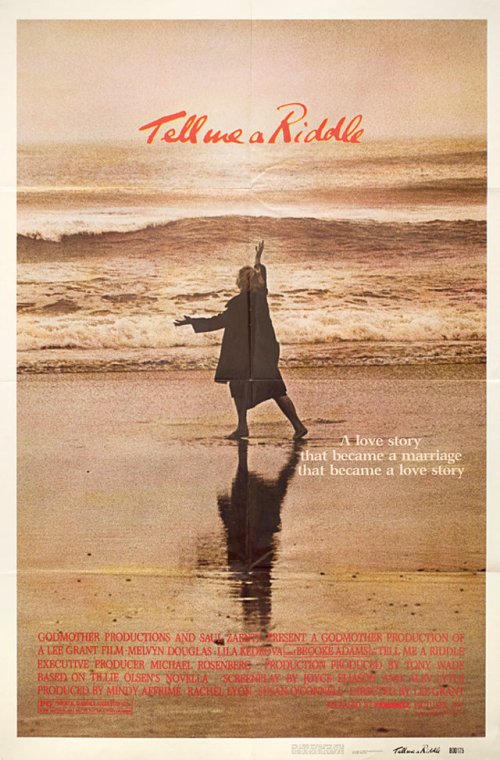
Eva (Lila Kedrova) is an elderly woman who has been diagnosed with cancer, but her husband David (Melvyn Douglas) does not tell her of the terminal disease and instead takes her on a cross country journey to visit their grandchildren in San Francisco. Eva though begins to feel homesick and wants to return to the place that she is used to only to learn that David sold the home without her knowledge and forged her signature on the papers, which creates a rift between the two just as she enters her final days of life.

This modest low budget film was notable as the first feature film in America to be written, directed, and produced by women. It is based on the 1961 short story by Tillie Olsen and the first feature directed by actress Lee Grant, who felt that after she won the Academy Award for best supporting actress in 1975 that her days on the screen were numbered due to her age and the only way to stay busy in the business was to go behind the camera. She choose this script because it tackled two topics most important to her: feminism and her fear of aging.

For the most part, at least at the beginning, the slow pace works as it helps replicate the elderly lifestyle. The flashbacks showing the couple when they were young, which features a then unknown Peter Coyote as the younger David, help to make the two main characters more multi-dimensional. The different locations that they go to and live-in on their trip, which includes sleeping in their daughter Jeannie’s (Brooke Adams) cramped apartment while she sleeps with her boyfriend across the hall as well as visiting an elderly friend, Mrs. Mays (Lili Valenty), who lives in a place no bigger than a small bedroom and forced to walk-up several flights of stairs just to get to it, helps to give the film an indie vibe.

Unfortunately the second half stagnates as the couple’s journey ends at Jennie’s apartment, which cuts off the visual variety that gave the movie energy during its slow spots. The cross country journey should’ve been played-up much more, like with Harry and Tonto, where the trip becomes the main focus by having the couple travel by car instead of by plane while still keeping the main crux of the story intact.

Douglas gives an impeccable performance and speaks in an authentic Eastern European accent and Adams does quite well in support. However, Kedrova barely says much of anything making her character seem like she’s suffering from a personality disorder and having Douglas do the majority of the talking comes off too much like he’s the ‘narrator’ and it doesn’t help. I also didn’t like the hearing aid cord dangling out of her ear either, which seemed overdone. My grandmother, who lived at the same time this movie was made, wore a hearing aid too, but it was much more inconspicuous and didn’t require any cords.

The film also suffers from an unrelentingly downbeat perspective making old age seem like it’s just one depressing thing after another. I liked the way this same subject matter was approached in Harry and Tonto  where it examined the elderly years from different angles showing how there could be some downsides to it (like with any age), but also some positive ones too. Instead of approaching it as an end-of-life scenario it presented it as a transition that was still full of possibilities and new adventures, which is what I wished this film had been better able to convey.

My Rating: 3 out of 10

Released: December 15, 1980

Runtime: 1 Hour 33 Minutes

Rated PG

Director: Lee Grant

Studio: Filmways Productions

Available: DVD, Amazon Video, YouTube

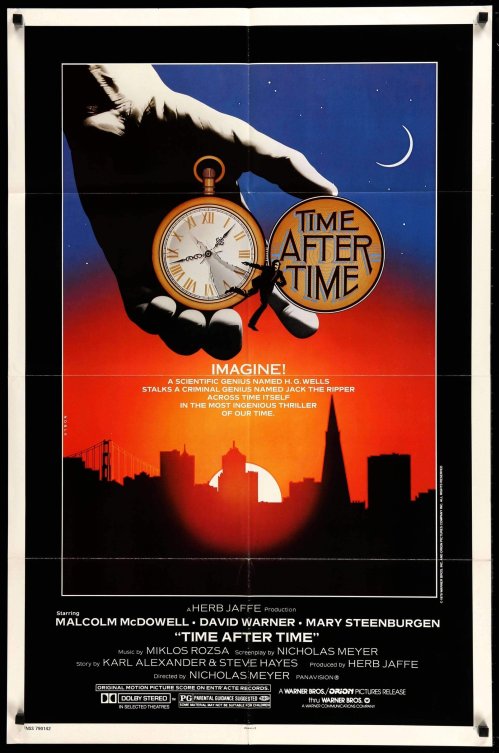
Time After Time (1979)

By Richard Winters

My Rating: 3 out of 10

4-Word Review: From 1893 to 1979.

In 1893  writer H.G. Wells (Malcolm McDowell) constructs a time machine and introduces it to his skeptical guests at a dinner party that he is hosting unaware that Dr. Stevenson (David Warner) who is also attending the party is the notorious Jack the Ripper. When the police surround the home looking for Ripper he jumps into the time machine and escapes to the year 1979. Wells then quickly follows him to modern day San Francisco and tries chasing him down, but along the way he meets Amy Robbins (Mary Steenburgen) who he fall in love with.

Initially I enjoyed seeing Wells’ confusion at dealing with modern society and the technology and had the film stayed at this level the whole way it could’ve been quite entertaining, but Wells ends up adapting too quickly. I was willing to accept that he was just a smart guy who could figure things out by being very observant, but Jack ends being the same way. Jack even attends a discotheque wearing a John Travolta-like white leisure suit, until it seemed like he was always a part of the modern world, and the original time traveling spin gets unfortunately phased out.

The romantic relationship that forms between Wells and Mary comes off as forced. Having her ask him out on a date while she’s working at her job and after only talking to him for a few minutes seemed too forward and unprofessional. Does she do this to all of her customers and if so how can she hold down a job if she’s coming on to all the men that she meets and if not then why would she ask out Wells so quickly after having just met him? Having the two end up going to bed together makes Wells seem too contemporary and not like a person from the Victorian era from which he came where sexual relations outside of marriage were much more taboo.

The script is full of a lot of loose ends too. For example: Wells goes to a jeweler to trade in his jewels for US currency, but the jeweler won’t accept them unless Wells shows a valid driver’s license, which he doesn’t have. The next day he goes to a different jeweler who gives him the money without asking for the ID, but why? In between Wells goes to a church where he speaks out loud in an awkward prayer, so are we then to presume that the second jeweler gave Wells the money without requesting the ID because of divine intervention?

There’s also a moment when Jack runs out into the street and gets struck by a car and is sent away to a nearby hospital, but then returns later showing no visible bruises or scratches. There’s also no explanation for how he was able to fool the nursing staff into thinking he had died as when Wells goes to the hospital that’s the explanation he’s given.

Spoiler Alert!

The ending is equally screwy. It has Wells and Mary going a few days into the future only to read a newspaper article reporting Mary getting killed inside her apartment by Jack, so they return to the present and then back to the apartment where Mary then takes a nap, which seemed hard to believe knowing that Jack was coming to kill her there and she’d be too tense and nervous to ever relax enough to go to sleep. Why even go anywhere near the apartment anyways and instead just find a room at a nearby hotel? There isn’t much tension to her potential death either since all Wells would need to do is go back a few days in his time machine and she’d be as good as new.

The explanation that Mary never got killed, but instead it was really her friend, who she had invited over to dinner is problematic too because even though there wasn’t DNA testing at that time they could still identify the victim through their dental records.

The story, which was based on a 55-page treatment written by Karl Alexander, who later expanded it to a novel, which was released at the same time as the movie, has a lot of potentially interesting ideas, but it ends up taking on too much. A decision should’ve been made to focus on either the romance or Wells’s pursuit of Jack, but not both. Trying to cram two plot-lines together results in a script that’s too rushed and poorly thought out.

My Rating: 3 out of 10

Released: September 28, 1979

Runtime: 1 Hour 52 Minutes

Rated PG

Director: Nicholas Meyer

Studio: Warner Brothers

Available: DVD, Blu-ray, Amazon Video, YouTube
Best Friends (1982)

By Richard Winters

My Rating: 3 out of 10

4-Word Review: Writing partners get married.

Richard (Burt Reynolds) and Paula (Goldie Hawn) have been working together as a screenwriting team for many years and have fallen in love in the process. Richard would like to take the next step and get married, but Paula resists afraid that this will ruin their friendship, but eventually she caves to his pressure and they tie-the-knot. Things though get rocky when they visit both of their relatives and when they return to L.A. seem destined for a break-up only to be forced to acclimate when they’re locked in a room and not allowed out until they revise the ending of their latest screenplay.

This film is similar to Romantic Comedy as both dealt with two people of the opposite sex working together as a writing team while romance blossomed in the process. Yet both films missed the mark by not focusing enough on the writing craft and the teamwork needed to get a script written. Only at the very end do we see the two working together, but because it waits so long to get to this point it’s not really worth it. In between we get immersed with drawn out segments dealing with each partner learning to deal with their kooky in-laws, which has been done in many other romances before and is neither fresh nor insightful.

I also didn’t like that it begins right away with them already in-love, which deprives the viewer the chance of seeing how the relationship began, which is usually half the fun. The couple are a bit too lovey-dovey and there’s never any fiery argument between them, which could’ve offered some tension in what is otherwise a flat story with very little that actually happens.

The script was written by Valerie Curtain and Barry Levinson, who based their own real-life experiences of working together and then ultimately marrying on the two characters and it would’ve been nice had they simply been cast as themselves. Hawn and Reynolds are okay but there’s a big age difference between the two and their presence also gives it too much of the glossy, big-star Hollywood treatment where as with Curtain and Levinson playing the roles would’ve made it seem more genuine and original.

My favorite part though is when they travel to Buffalo, New York in the dead-of-winter where they must deal with actual snow and cold and not the fake studio kind. However, Goldie’s parents, played by Barnard Hughes and Jessica Tandy, come-off too much like caricatures playing off the stereotype that everyone that gets old automatically become senile and eccentric. The things that they say and do are more cringe worthy than amusing and nothing that a real senior citizen would ever do.

Their visit with Burt’s parents, played by Keenan Wynn and Audra Lindley, improves a little as they act more normal, but it’s just as unfunny. The film also misses out on a prime comic opportunity as the two are informed that they need to revise their latest screenplay in a hurry and I thought it would’ve been quite amusing seeing them trying to work on it while cooped up in the home of Burt’s parents and trying to block out all the noise and chaos around them, but the film only teases with this idea, but eventually whiffs on it.

The story is unfocused and throws in all sorts of dumb things like Goldie’s sudden addiction to Valium pills that have nothing to do with the main plot. Having the film begin where it ends with the two locked in a room for days and forced to reassess their relationship while going back through certain highlights that the two had through flashback including showing how they first met would’ve given it more of a fragmented narrative and made it seem less drawn-out and mechanical.

My Rating: 3 out of 10

Released: December 17, 1982

Runtime: 1 Hour 56 Minutes

Rated PG

Director: Norman Jewison

Studio: Warner Brothers

Available: DVD, Amazon Video, YouTube