Category Archives: Robbing Banks

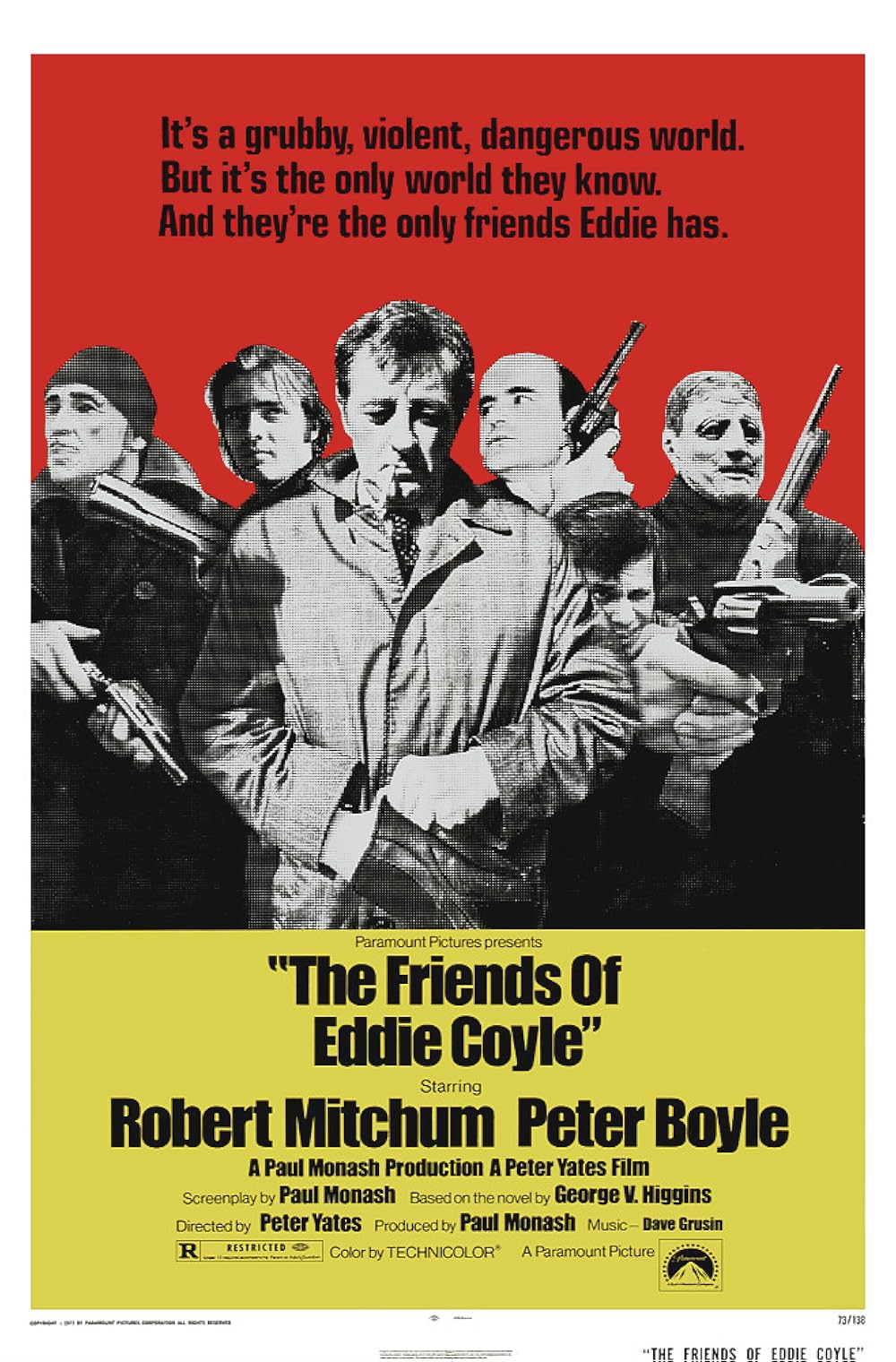
The Friends of Eddie Coyle (1973)

eddie

By Richard Winters

My Rating: 4 out of 10

4-Word Review: Gunrunner tries avoiding sentencing.

Eddie (Robert Mitchum) is an aging gunrunner living in Massachusetts whose career in crime has taken a toll on his family. He feels his life in and out of jail has caused him to lose connection with his kids and wants to avoid a repeated stint in the slammer. Another sentencing is likely as he’s been charged with hijacking a truck, so he works with special agent Dave Foley (Richard Jordan) to help reduce his pending time, or get it cleared altogether, by agreeing to give him tips of other crooks he’s worked with, of planned crimes that are about to take place including a string of bank robberies that have been occurring throughout the area and being carried out by people Eddie knows. While Eddie is able to give Dave some help it’s not enough and he continues to be squeezed to offer more names and when he does his former associates become convinced, he’ll sell-out on them, so they devise a plan that’ll quiet him once and for all. 

The film is based on the 1972 novel of the same by George V. Higgins that won numerous accolades including by such famous authors as Norman Mailer and Elmore Leonard who called it the ‘best crime novel ever written’. While the film does closely follow the story in the book, and received equally positive reviews, it did very poorly at the box office. A lot of the problem is that while the actions is captured in a gritty and unglamourous way, the idea behind the film was to give a harsher viewpoint of those working in the criminal underworld as The Godfather had been deemed at the time as being too romanticized, the characters are not people to get emotionally vested in and the plot fails to garner any momentum. The crimes get carried out in too much of a methodical way and lack tension. The viewer doesn’t care what happens to these people and thus the movie ends up lacking much of a point.

There were certain things that I did like. The gray and brown late autumn landscape helps accentuate the cold, soulless lives of the characters. The bank robberies are captivating for a while as it focuses on the intricacies of carrying out such daring heists and the planning though I felt seeing one of these was enough and having to go through two of them made it redundant and unnecessary. 

Mitchum gives an excellent performance and certainly appears and acts like someone who’s been beaten down enough by the system that’s he’s willing to do whatever he can to self-preserve. His attempts at a New England accent aren’t bad either. However, I would’ve liked to see some interaction with him and his kids as this is the whole motive for why he turns informant as he wants to spend more time with the family and not go to jail, but we never see any actual communication that he has with them albeit a brief moment with his wife. Had there been more family moments where the viewer could actually feel the character’s quandary on an emotional level than they might’ve been more wrapped-up in seeing him get through it, but by the way it gets done here there’s very little if any of that. He’s also not in it enough and there’s long stretches where we see Steven Keats, a fellow gunrunner, who’s more adept at showing the anxiety and paronia that goes into someone living the fringe lifestyle that he does and thus it would’ve been a more captivating film had it focused on him instead. 

Spoiler Alert!

The ending is the biggest letdown. While it’s the same one as in the book it’s too uneventful to be riveting or impactful. It features Eddie getting invited to a hockey game by Peter Boyle, a fellow hood, and another man who after the game take a drunken Eddie out for the ride where he passes-out and thus gives them the opportunity to conveniently shoot him, which they do. While I did enjoy close-up footage of an actual hockey game as it features players in an era where they didn’t have to wear helmets, I did find the way Eddie falls prey to the men to be too easy. This was a career criminal, so he should’ve in the back of his mind been well aware that his ‘friends’ may start to suspect him of being the snitch that he is and put on a more defensive mind set. I was fully expecting him to be faking passing out and at the last second jumping out of the car and trying to get away, which could’ve led to an exciting climactic foot chase, but stupidly falling into their trap without a peep of a fight isn’t an adequate payoff. He might as well had just shown up to the event with a bullseye tattooed to his forehead that said ‘shoot me’ as it ends-up playing-out in pretty much the same way. 

My Rating: 4 out of 10

Released: June 26, 1973

Runtime: 1 Hour 43 Minutes

Rated R

Director: Peter Yates

Studio: Paramount Pictures

Available: DVD, Blu-ray (The Criterion Collection), Amazon Video

Hold-Up (1985)

holdup

By Richard Winters

My Rating: 5 out of 10

4-Word Review: Robber disguised as clown.

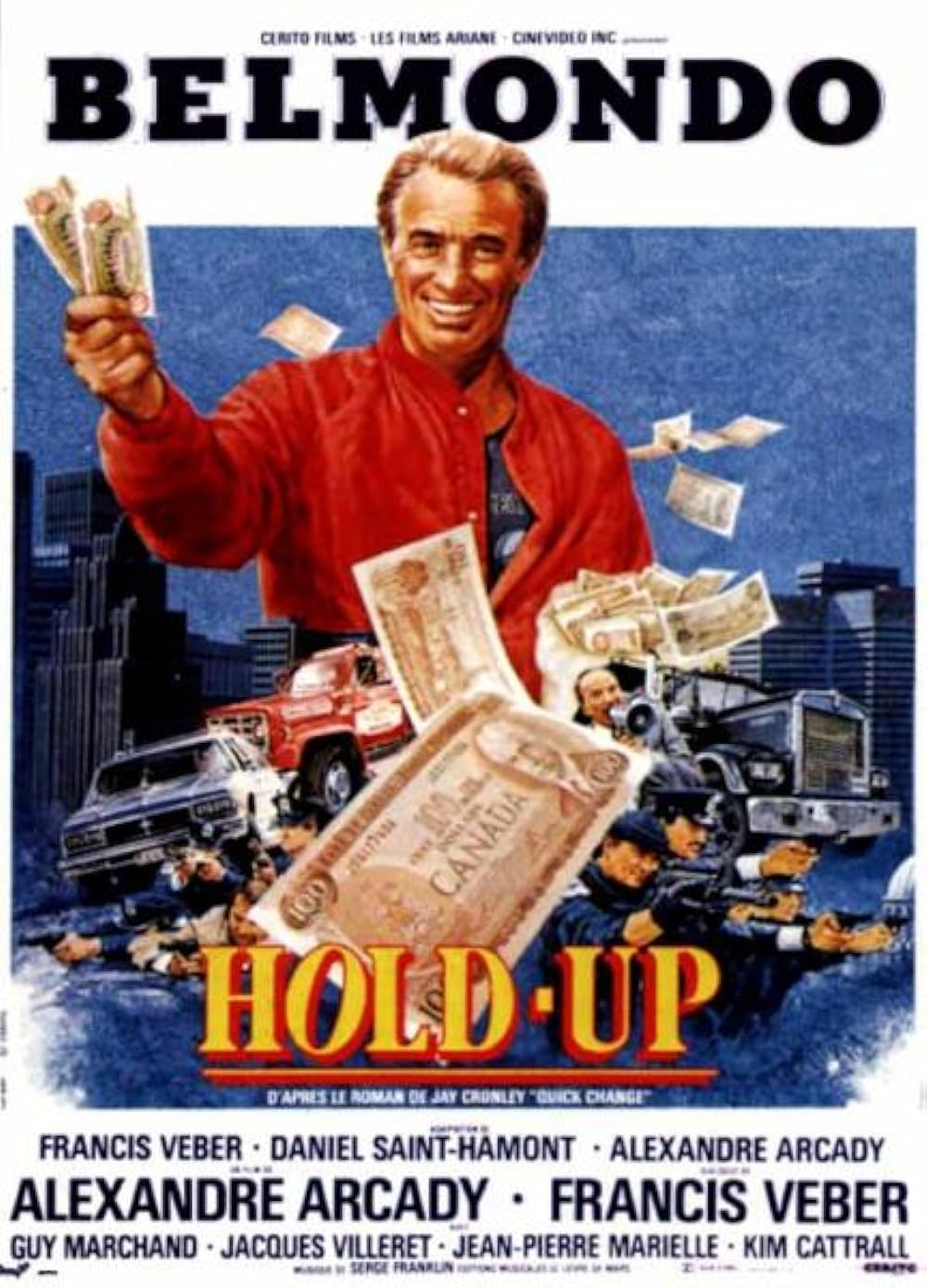
Grimm (Jean-Paul Belmondo) has come-up with what he considers to be an ingenious plan. He will rob a bank disguised as clown with two of his friends, Georges (Guy Marchand) and Lise (Kim Cattrall). While he’ll be a clown the other two will pretend to be bank customers and then when he agrees with the Police Commander Simon (Jean-Pierre Marielle), whom he is negotiating with via phone, to release some hostages he’ll let Georges and Lise ‘go’ and no one will know the difference. Meanwhile Grimm will take-off his clown disguise and put on a new one as an old man while pretending that the clown is still inside holding the rest of the bank employees and customers at gunpoint. By the time the police catch-on that there’s no longer any clown the three hope to have escaped on a plane and be far away. While the robbery works without a flaw the getting on the plane part becomes a major, if not impossible, challenge.

The story is based on the novel ‘Quick Change’ by Jay Cronley, which 5 years later was made into another, better known movie that starred Bill Murray. This was a French production that was filmed on-location in Montreal, Canada and one of the few movies that starred Belmondo that didn’t do well financially back in his home country and in-fact it was the first staring vehicle of his that didn’t crack the top 10 of highest grossing movies of that year, which was the first for him since 1976 when L’Alpagueur achieved only 19th place.

Belmondo is certainly a legendary actor whose long and storied career deserves to be admired, but I didn’t care for him here and felt his presence actually brought down the whole movie. He was apparently quite admired behind-the-scenes amongst the cast and crew and he did all of his own stunts including a scene where he climbs out of a moving car and manages to slither his way, while the vehicle is still going at high speeds, onto a tow truck and he did this while already being in his mid-50’s. However, his character is overly cocky and his glib conversational interplay between he and the police chief does not come-off as funny and more like you side with the chief and want to see this arrogant man caught. You’d think someone who had never pulled-off a robbery before would be much more nervous, or at least display some signs of anxiety, so his unbridled confidence seems completely out-of-place with the situation he’s in.

If anything I enjoyed Marchand and Cattrall far better as these two seemed much more human and displayed the insecurity you’d expect. They were like regular people full of foibles and someone you’d actually want to root for and thus I felt the movie would’ve been greatly improved had it just focused on the couple doing the robbing and cut-out Belmondo’s part completely. I also didn’t think the clown disguise worked as unlike in the American version his whole face isn’t covered with white paint and instead simply uses a red wig, a red clown nose, and some eyebrows, which I didn’t feel would be enough to hide his true identity and witnesses could’ve easily recognized who he was outside of the clown get-up and thus the whole disguise thing ends-up defeating its own purpose.

The first act works pretty well with shades of Dog Day Afternoon and some offbeat moments to the bank robbery theme by having one scene where the hostages are forced to get in a circle and sing a rendition of ‘London Bridges Falling Down’. The second and third acts though become protracted and seem to be the start of a whole different movie altogether. The bank segment has a crafty, sophisticated tone where the humor has a satirical bent and the main characters seem smart, savvy, and cool. In the second half the movie suddenly becomes like a live action cartoon with an abundance of car chases and the three leads, who had seemed so clever at the beginning, quickly become inept at seemingly every turn.

The biggest problem is the Lasky character played by Tex Konig. Konig is a big bearded guy that resembles Bluto from the old Popeye cartoons who’s also a tow truck driver who wants to get his hands on the stolen money and chases the three all around the city, which leads to many car stunts and crashes. Some may enjoy the smash-ups, but it comes across as unimaginative filler by filmmakers that didn’t know how to end the story cleverly, so they came-up with a lot of mindless action in order to keep it going.

The infighting between Cattrall and Marchand seems unnecessarily added in as well. This animosity needed to be introduced right at the start in order to make it consistent with the plot and not just thrown-in later to add some conflict for the sake of conflict. You’d think too that if she really resented the guy she would’ve refused to go ahead with the robbery unless someone else took his place.

Having the story then end with the three going to France and then Italy just furthers dilutes the plot, which no longer resembles a robbery flick at all, but more of a jet setting one. While not perfect the remake, which came-out in 1990, fares better in just about all phases.

My Rating: 5 out of 10

Released: October 23, 1985

Runtime: 1 Hour 54 Minutes

Not Rated

Director: Alexandre Arcady

Studio: Cinevideo

Available: DVD-R (dvdlady.com)

Quick Change (1990)

quick1

By Richard Winters

My Rating: 7 out of 10

4-Word Review: Clown robs a bank.

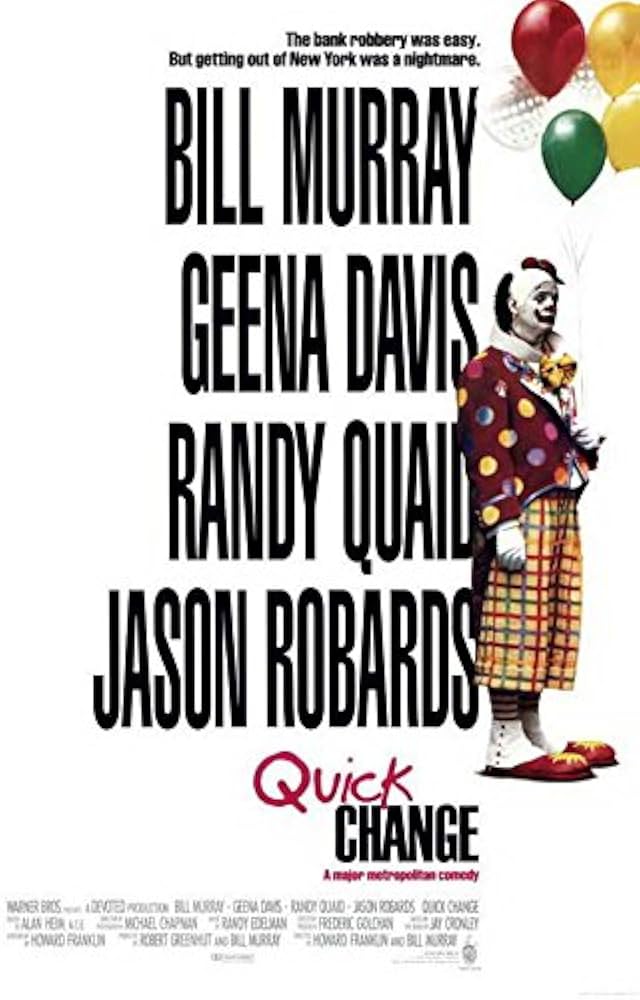
Grimm (Bill Murray) has had it with New York City. He wants to get out of there and move somewhere tropical as soon as possible and conspires to rob a bank in order to get the money to do it. He dresses as a clown and then has his girlfriend Phyllis (Geena Davis) and friend Loomis (Randy Quaid) pretend to be customers at the bank, so that when he releases the ‘hostages’ they can be two of them. The robbery goes smoothly as they’re able to get $1 million out of the bank, but trying to get out of the city itself proves trying as they get lost on their way to the airport and then their getaway car gets demolished. Police Chief Walt Rotzinger (Jason Robards) is hot-on-their-tale and relentless in his quest to haul them in as he proves to be just one slight step behind them where ever they go and moving in closer with every waking second.

This is the second version of the story that was adapted from a 1981 novel of the same name written by Jay Cronley, a humorist who resided in Tulsa, Oklahoma, who two other novels, Funny Farm and Let It Ride that were also made into movies as well as Hold-Up that was a French film shot in Canada that was the first rendition of this plot. This adaptation proves to be the better one as it takes place, like in the novel, in New York City and takes full advantage of the city’s ambience making it feel almost like it’s a third character.

This is the perfect role for Murray and some critics felt this was his best acting performance of his career he also doubles not only as the producer, but also the co-director as he took over the reins in order to save the project when the originally directing choice Jonathan Demme decided to bow-out at the last minute. The snarky, glib personality of the character is played to the hilt by Bill who has the magical ability to be the world’s biggest smart ass and still have a unique charm about it. Great supporting work by Davis, though the two apparently didn’t get along behind-the-scenes and years later she accused him of sexually harassing her during the production. Good work too by Robards who doesn’t fall into the cliche of a stupid egotistical cop and instead proves to be pretty savvy, which helps accentuate the tension as he’s constantly on their heels and only a beat behind them no matter where they go.

The three acts are better tied together by placing the main nemesis as the city itself and creating a surreal After Hours vibe. Some of the potshots are subtle like watching all the hot dog vendors race over to where the robbery is taking place so that they can take advantage of the situation by selling food to all the onlookers. It also illuminates the ethnic, cultural mix of the Big Apple by featuring a jousting match between two Latinos on bicycles as well as the headaches of trying to find your way around the city and the confusing road signs and constant construction though some of this humor may not resonate with today’s viewers since with the advent of GPS many of these ‘asking for directions’ situations have now become a thing of the past.  The music score by Randy Edelman with its pounding, hard edge quality perfectly matches the city’s gritty, urban attitude.

While the robbery is slick I did find a few loopholes. The first is where does Murray get his other clothes when he changes out of his clown costume and disguises himself as one of the hostages to get away? He is not seen carrying a bag of any kind nor is Davis or Quaid, so not sure where the other suit came from. Some may argue that he was wearing it underneath his clown costume, but this doesn’t work since it was a shirt that came up to his neck that he’s seen coming out of the bank with and when he’s the clown he’s shown with a V-neck T-shirt that exposes the top of his chest. It also doesn’t explain where he gets the glasses, other wig, and shoes that he also has on when he walks out as the fake hostage.

The characterizations are a bit off too as both Davis and Quaid become easily rattled during the second half when they’re trying to get to the airport and become increasingly shaken that they’re going to be caught, but if they have a propensity to being that worried you wonder what gave them the nerve to go through with the robbery in the first place? During that segment they’re very cool and calm and even a bit ballsy, so why the sudden shift to overly panic the moment they get out? A way to have solved this would’ve had the Davis character with a penchant for risks, or enjoy living on the edge and taking chances, so every time they would get into a jam during their escape she’d see it as a certain thrill and not allow it to overtly alarm her.

Spoiler Alert!

The biggest beef though is with the ending in which Robards suddenly realizes, as he’s standing on the ground watching the jet fly overhead that has the three robbers onboard. The film acts like it’s now ‘too late’ and there’s nothing he can do about it, but there really is. All he has to do is go back to the airport and ask where the destination is of the plane that just took off, as I remember it was Paris, France. Since both the U.S. and France are members of Interpol he could easily contact the authorities there asking them to detain the three once the plane had landed. They could then be brought in for interrogation where a simply body search would expose all the money that they had taped to their bodies underneath their clothes, and in Quaid’s case in his duffel bag. This would be more than enough evidence to prove that they were the robbers and thus extradited back to the U.S. for prosecution.

My Rating: 7 out of 10

Released: July 13, 1990

Runtime: 1 Hour 29 Minutes

Rated R

Director: Howard Franklin, Bill Murray

Studio: Warner Brothers

Available: DVD, Blu-ray, Amazon Video, Tubi

Thieves Like Us (1974)

thieves

By Richard Winters

My Rating: 6 out of 10

4-Word Review: Convicts escape from jail.

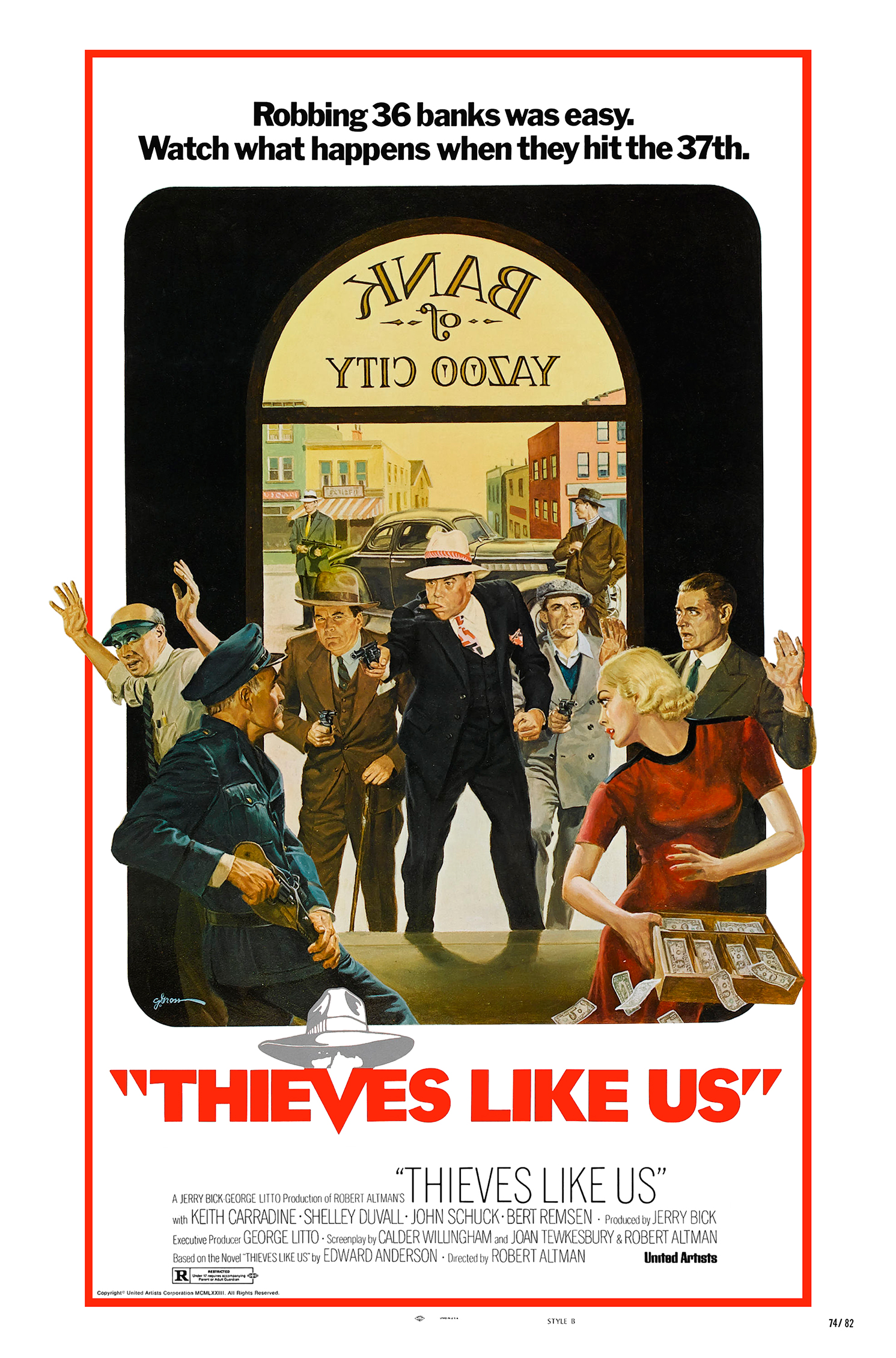
Bowie (Keith Carradine) is a young man stuck in jail due to a murder conviction from when he was a teenager. He teams up with Chicamaw (John Schuck) a middle-aged man to escape from prison and meet-up with T-Dub (Bert Remsen) an older man who has them hide-out at a local auto garage where Bowie meets the owner’s daughter Keechie (Shelley Duvall) and the two start-up a relationship. The three men return to their criminal ways by robbing banks, which goes well for awhile until the quick-triggered Chicamaw shoots and kills a bank clerk, which gets him recaptured and returned to prison. Bowie, who has now gotten Keechie pregnant, feels a loyalty to help get Chicamaw out, but Keechie wants him to settle down and get a conventional job while learning to become a family man. Bowie though resists the urge and after leaving Keechie at a motel cabin owned by Mattie (Louise Fletcher) sets out to help Chicamaw break-out for a second time, but this ultimately leads to tragedy.

The film was based on the novel of the same name written by Edward Anderson and published in 1937. The book had been adapted before in 1949 as They Live By Night, which Robert Altman was not aware of before taking on the project. Joan Tewksbury, his longtime screenwriter, adapted the book in a matter of 4-days, but getting it financied proved challenging and it was only after Altman and two of his other producers offered to mortgage their homes to help bring in needed capital that it eventually got green-lit. Unfortunately once it was completed the studio didn’t know how to promote it and ultimately released it without any advertising budget or fanfare. After a brief 3-week stay in the theaters it fell into obscurity before being resurrected by critical acclaim, which made it do well on cable television and has since gained a small cult following.

The atmosphere is probably the best thing as Altman achieves an authentic 1930’s setting. Other films that try to recreate the era always come-off a bit affected and cliched, but because Altman actually grew up during the period he’s able to give it the needed grittiness and I felt right from the start I was being transported to a different time versus feeling like I’m looking back at a bygone era through a modern day lens. The film has two very memorable moments. One of them is when Bowie goes to the prison to help Chicamaw breakout and meets up with the prison warden who’s residing in this country-style house and feasting on a large dinner. The contrast of this home cooked meal prepared by his wife like they were peacefully living out on a rural farm versus stationed right in the middle of a prison with dangerous criminals is something I really loved. The bank robbery game that the three men play with Mattie’s children where they turn their living room into a make believe bank with the children playing bank clerks and then the men proceed to ‘rob it’ is quite cute as well.

The acting is excellent by Carradine who starts to come into his own during his moments with Duvall, who is also good and does her very first fully nude scene. Lousie Fletcher, who’s first movie this was after she took a 10-year hiatus to help raise her kids, is supreme and helps give the proceedings a very definite, no-nonsense attitude and it’s just a shame she wasn’t in it more though the segments she does have she makes the most of. Tom Skeritt turns out to be a delightful surprise here. Normally I’ve found his work to be rather forgettable and under the radar, but here he stands-out as an alcoholic father who’s a pathetic character with darkly amusing lines.

The film though does suffer from Schmuck’s and Remsen’s characters seeming too much alike and I found the rapport between them to be quite unenlightening. Altman also takes a page out of Hitchcock’s directing book where like with what Hitch did in Frenzy he has the camera pull back away from the action going on inside the building and focusing instead on what’s going on outside. He especially does this during the robberies, which is initially kind of interesting, but he does it too much and then when he finally does show a robbery in progress he does solely from a bird’s-eye view with the camera nailed to the ceiling, which causes the viewer to feel too emotionally detached from what’s happening. He also completely skips over the part where T-Dub gets shot and killed and Chicamaw recaptured, the viewer only learns of this by hearing it reported on the radio, but these are pivotal moments to the story and the film is slow enough the way it is, so this is the type of action that should’ve been played-out.

Spoiler Alert!

The climactic sequence where the cabin that Bowie is in gets surrounded by Rangers and shot-up doesn’t work at all. This is mainly because it’s too reminiscent of the same type of shoot-up done in Bonnie and Clyde that was more famous and riveting. Here it comes-off like a second-rate imitation of that one and does nothing but make you want to go back and see that one while completely forgetting about this one in the process.

My Rating: 6 out of 10

Released: February 11, 1974

Runtime: 2 Hours 3 Minutes

Rated R

Director: Robert Altman

Studio: United Artists

Available: DVD, Blu-ray

The Frisco Kid (1979)

friscokid

By Richard Winters

My Rating: 4 out of 10

4-Word Review: Rabbi travels across America.

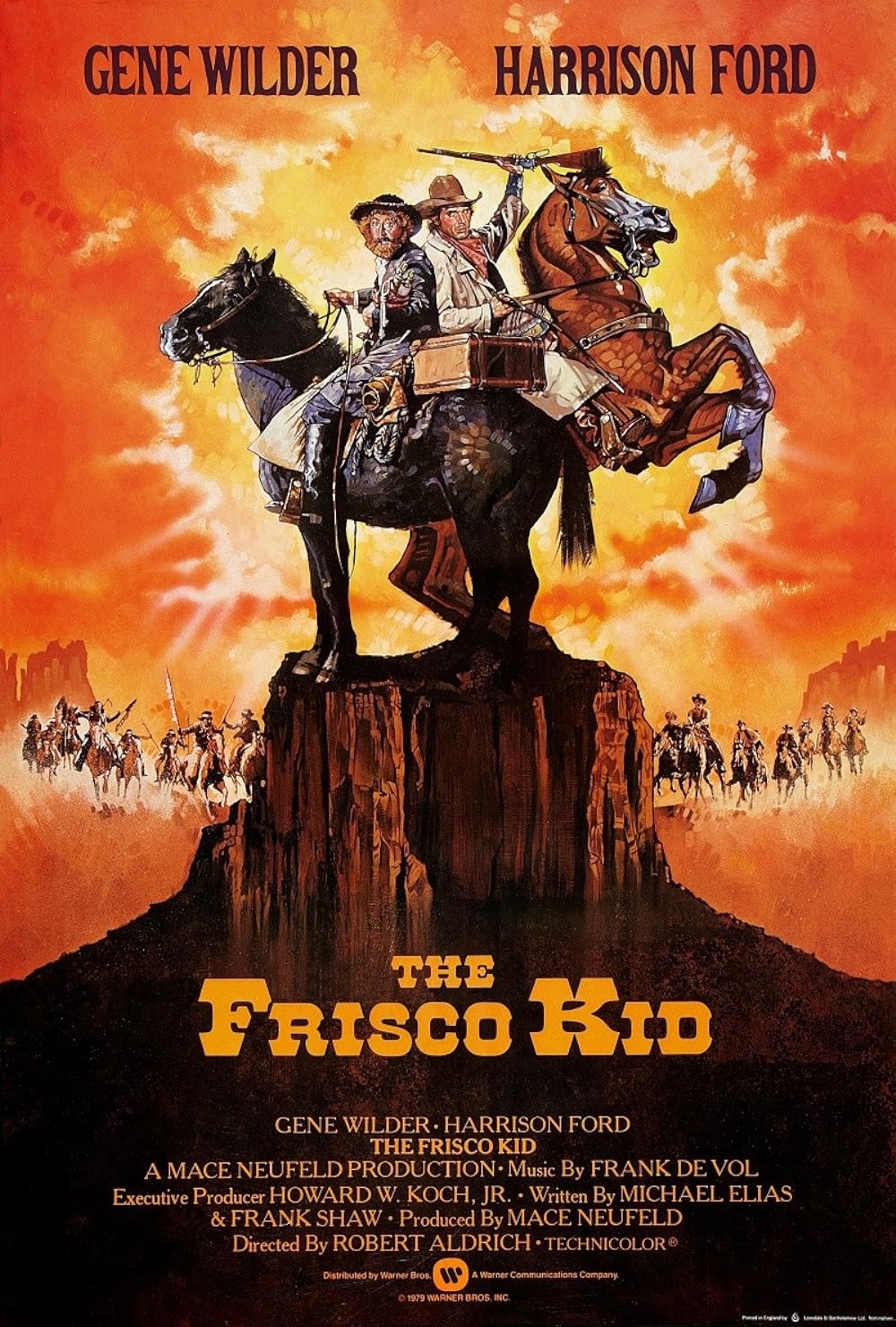
Avram (Gene Wilder) is a Polish rabbi traveling across the U.S. from Philadelphia to the west coast where he plans to head a congregation in San Francisco. He has all of his money taken from him by three unscrupulous men (George Di Cenzo, William Smith, Ramon Bieri) who initially befriend him only to eventually leave him stranded in the middle of nowhere. Avram is then offered some help by a local Amish community and even gets a job for awhile as part of a crew laying down train tracks. He’s eventually earns enough to buy himself a horse, so he can continue his travels. It is then that he meets up with Tommy (Harrison Ford), who unbeknownst to Avram is a robber. When Tommy steals money from one of the banks in a town that they pass through both he and Avram must go on-the-run in an effort to avoid getting caught.

The script was originally written in 1971 under the title ‘No Knife’ in reference to Avram who traveled with no weapon of any kind for protection. Originally John Wayne was considered for the role of Tommy, who was interested, but the studio could not meet his fee requirements so along with his declining health, he bowed-out. Dick Richards, who won praise for helming another western The Culpepper Cattle Companywas originally tabbed to direct this one, but during the pre-production phase he left the project, so it was given to Robert Aldrich, who, as Roger Ebert explained in his review, treated it like a routine assignment and didn’t put in a lot of heart into it.

The  shoddy effects are noticeable and really hurts the production. The interiors have a stage play quality and all of the outdoor scenes look like they were shot on a studio backlot. Certain long shots show steel silos in the background, which wouldn’t have existed during the turn-of-the-century time period that the story takes place while other shots are clearly just a matted photograph edited in. For a western to be fully effective it has to have some grit and atmosphere and this film unfortunately has neither. The first hour works more like darkly humored comical vignettes and while they succeed at being slightly amusing aren’t really all that captivating.

Wilder is excellent and probably the sole reason to see it, but I was more surprised by the presence of Ford who had just came-off starring in the landmark Star Wars, but here accepts second billing and isn’t even seen until 22-minutes in. I was more baffled by the motivations of his character and didn’t understand why he’d take-on the mission of helping Avram, a virtual stranger, through the perilous journey. This was a man who was quite self-sufficient and excellent with a gun and easily getting away with robbing people, so befriending a rabbi was just going to hold him back. A backstory was needed showing why he might seek-out a partner, even an awkward one like Avram. Possible  showing Tommy being a part of a larger gang who kick him out of the group and thus in a desperate need for companionship he befriends Avram, or maybe Avram gets Tommy out of some sort of jam and thus Tommy decides to help the rabbi on his travels in an effort to show his gratitude, but just having Tommy show up out of nowhere and become Avram’s instant buddy doesn’t really work. I would’ve liked to have seen a wider relationship arch too where Tommy would take much longer to warm-up to and understand Avram’s unique personality than he does.

Spoiler Alert!

The scene where Avram befriends an Indian Chief, played by Val Bisoglio, and teaches the Indian tribe how to do a Jewish dance is fun and the climactic duel between Wilder and Smith merits a few point as well. The scene though where Avram shoots a man gets botched. He had never used a gun before, so I would’ve expected him to miss his target especially since he was nervous and his hands shaking. The fact that he’s able to shoot the guy right through his heart the very first time he’s ever pulled a trigger is beating astronomical odds and not the least bit believable.

My Rating: 4 out of 10

Released: July 13, 1979

Runtime: 1 Hour 59 Minutes

Rated PG

Director: Robert Aldrich

Studio: Warner Brothers

Available: DVD, Blu-ray, Amazon Video, YouTube

The Last House on the Beach (1978)

By Richard Winters

My Rating: 7 out of 10

4-Word Review: Robbers hold nun hostage.

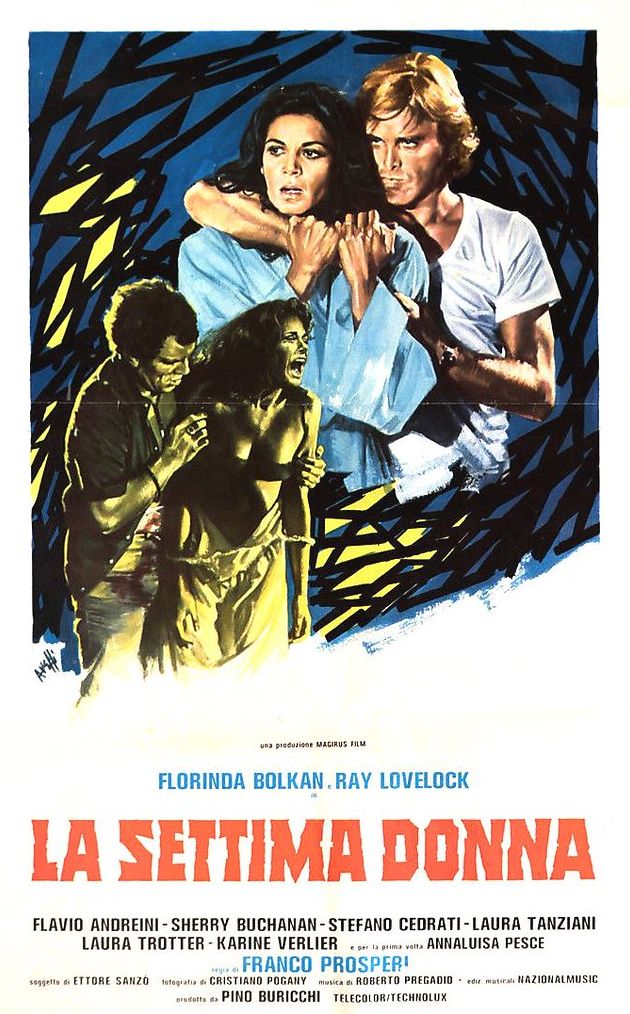
Aldo (Ray Lovelock) leads a gang of three robbers who stage a bank robbery in broad daylight, but things go wrong and lives get lost. During the getaway their car breaks down and they’re forced to hideout in a nearby home that sits next to a beach. Inside the home is Sister Christina (Florinda Bolkan) a nun who takes in wayward teen girls and helps them find their way. She was in the middle of rehearsing a play with them when the men break-in. The thugs soon takeover, raping two of them while terrorizing the rest. At first the women are compliant, feeling they have no other choice, but eventually they decide they’ve had enough and turn-the-tables on their captors.

While this film will initially come-off as just another Last House on the Left rip-off the production values are much better than most American low budget cheapies and the location quite scenic. The place didn’t look like any type of religious school to me and more like an ocean front pad for a rich person, it was more than likely the home of one of the film’s producers who decided to use it in place of a real school to save money, but the setting ultimately still works. Too many other horror movies feel the need to go for the cliché, like having things take place at night in some abandoned building, or rundown home, so having it work against this is a refreshing change. In some ways it makes it even scarier because it shows that bad things can happen even in the affluent suburbs and that nobody is truly immune from crime and violence.

I liked the way the bad guys were all good-looking too especially Aldo whose face could be on the cover of  teen heartthrob magazine. Again, other horror films feel the need to make the killer look menacing, disfigured, or creepy in some way, but working against this stereotype makes it more unsettling by showing that anyone can harbor evil. The women are all good-looking too with great figures, but in this regard it doesn’t work as it didn’t seem realistic that only women who looked like models would join this school and there needed to be at least one plain-looking, overweight one to give it balance.

The set-up happens a bit too quickly. It would’ve been more frightening if things had been shown at the start from the women’s perspective, rehearsing for the play, and then having these robbers burst in unannounced versus showing the robbery, which ends up getting reshown through flashback later on anyways, and everything from the men’s perspective. Horror works when there’s a surprise and in that regard this film misses a prime opportunity early on.

However, once it kicks in I was surprised how compelling it was. There isn’t a lot of violence, but when there is it’s bloody and pretty graphic, even the injury that one of them receives (Stefano Cedrati) looks quite realistic, and shown close-up, and I liked how this becomes and on-going part of the plot and doesn’t just magically heal and get forgotten.

The film also features two prolonged rape segments with the first one done in slow motion. Some may say this is exploiting the situation, but ultimately it ends up making it even more unsettling. The second rape  is equally disturbing as it features a woman (Sherry Buchanan) being violated by a wooden cane and done from her point-of-view.

Spoiler Alert!

The ending for me was the best part. Rape and revenge flicks have been done a lot and there’s also been films like Straw Dogs where a wimpy guy ultimately turns violent through necessity, but this film does it better than those. Seeing the angry looks on the once tranquil women’s faces as they take turns beating the man to death was actually pretty shocking as you’re not quite expecting it. It successfully hits-home the fact that anyone can be provoked into violence even those that deny they have that ability and gets the viewer to realize they harbor that tendency too since these guys were so vile you actually end-up enjoying seeing their comeuppance.

Alternate Title: La Settima Donna

My Rating: 7 out of 10

Released: April 20, 1978

Runtime: 1 Hour 26 Minutes

Not Rated

Director: Francesco Prosperi

Studio: Magirus Film

Available: DVD, Amazon Video

Raising Arizona (1987)

By Richard Winters

My Rating: 8 out of 10

4-Word Review: Childless couple kidnap baby.

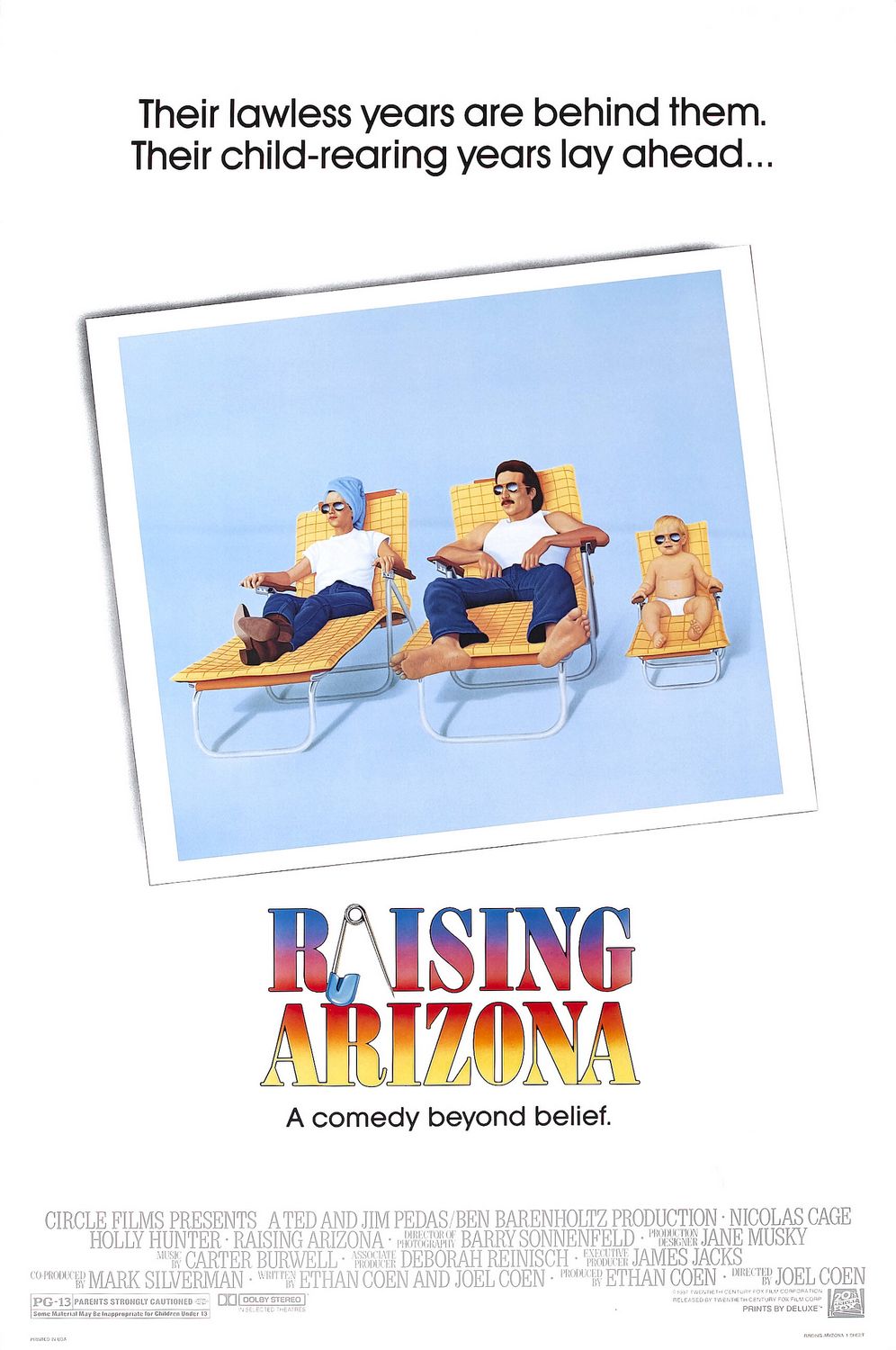
Hi McDunnough (Nicholas Cage) is a repeat offender who goes in and out of the state penitentiary. It is there that he meets Edwina (Holly Hunter) an officer in charge of taking his mugshot each time he gets rearrested for holding up convenience stores. Eventually the two form a bond and when he finally gets released they marry, but find that she’s unable to bear children. They then hatch a plan to kidnap one of the quintuplets of furniture store owner Nathan Arizona (Trey Wilson), but find this leads to more complications than they were prepared for.

While the Coen’s directing is sharp and on-target there were still those that criticized it as being overly stylistic and, as critic Vincent Canby stated, outside of the technical expertise the story has no life of it’s own, which is kind of true. The editing does give the film a personality, but there were times where slowing it down and allowing the scenes to breathe could’ve heightened the humor. For instance having Cage break into the Arizona residence to kidnap the baby happens much too quickly and there should’ve been a scene showing Cage trying to figure out which window to break into to get to the baby’s nursery as it was a big house, so how exactly would he have known where to go?

With that said there are still plenty of times where the distinct directorial touches spark the comedy and make it years ahead-of-its-time. I particularly liked the Coen’s patented camera tracking during Cage’s dream sequence where he views things from the bounty hunter’s (Randall ‘Tex’ Cobb) perspective as he rides his motorbike over obstacles on the front lawn and then supposedly straight into a bedroom. A chase sequence that starts out on the street and then winds up going through a person’s private residence is quite ingenious and the running-joke dealing Dr. Spock’s child rearing book is very funny too.

The script offers only caricatures, which would normally be a detriment, but here it just adds to the zaniness. I really enjoyed Wilson as the stereotypical aggressive, brash salesman and the scene where he talks to the police after the kidnapping has occurred I found to be the funniest moment of the movie. John Goodman and William Forsythe are also great as a pair of inept bank robbers and Sam McMurray and Frances McDormand are hilarious as the in-laws from hell.

Spoiler Alert!

My only real grievance, and it’s on a minor level, was the kidnap scenario, which could’ve been played-out more. I also thought it was weird that this rich couple would have all these kids and not hire a nanny to help them care for the babies. It’s a head-scratcher too that when Cage and Hunter decide to return the baby that they were able to break-into the same window that they did before. Wouldn’t you think that after a kidnapping this rich couple would’ve implemented crime alarms and cameras in ever room? Also, Nathan Arizona, catches the couple in the bedroom returning the kid to his crib and then after talking to them a bit he leaves the room with Cage and Hunter still with the baby, but you would think that after they took the kid once that the father would be too paranoid to ever leave the baby alone with them again.

The ending in typical Coen fashion doesn’t equal the same energy and imagination as the rest of the story and is a bit of a letdown. It deals with a dream that Cage has where he imagines having a really big family, but I thought it would’ve been funnier had the dream started out pleasant where he thinks about all the good things about family life only to have it slowly deteriorate into a nightmare where the harsh realities of raising kids come into play making him wake-up in a cold sweat and feeling lucky that they couldn’t have children after all.

My Rating: 8 out of 10

Released: April 17, 1987

Runtime: 1 Hour 34 Minutes

Rated PG-13

Director: Joel and Ethan Coen

Studio: 20th Century Fox

Available: DVD, Blu-ray, Amazon Video, YouTube

Sunday in the Country (1974)

By Richard Winters

My Rating: 4 out of 10

4-Word Review: Farmer holds robbers hostage.

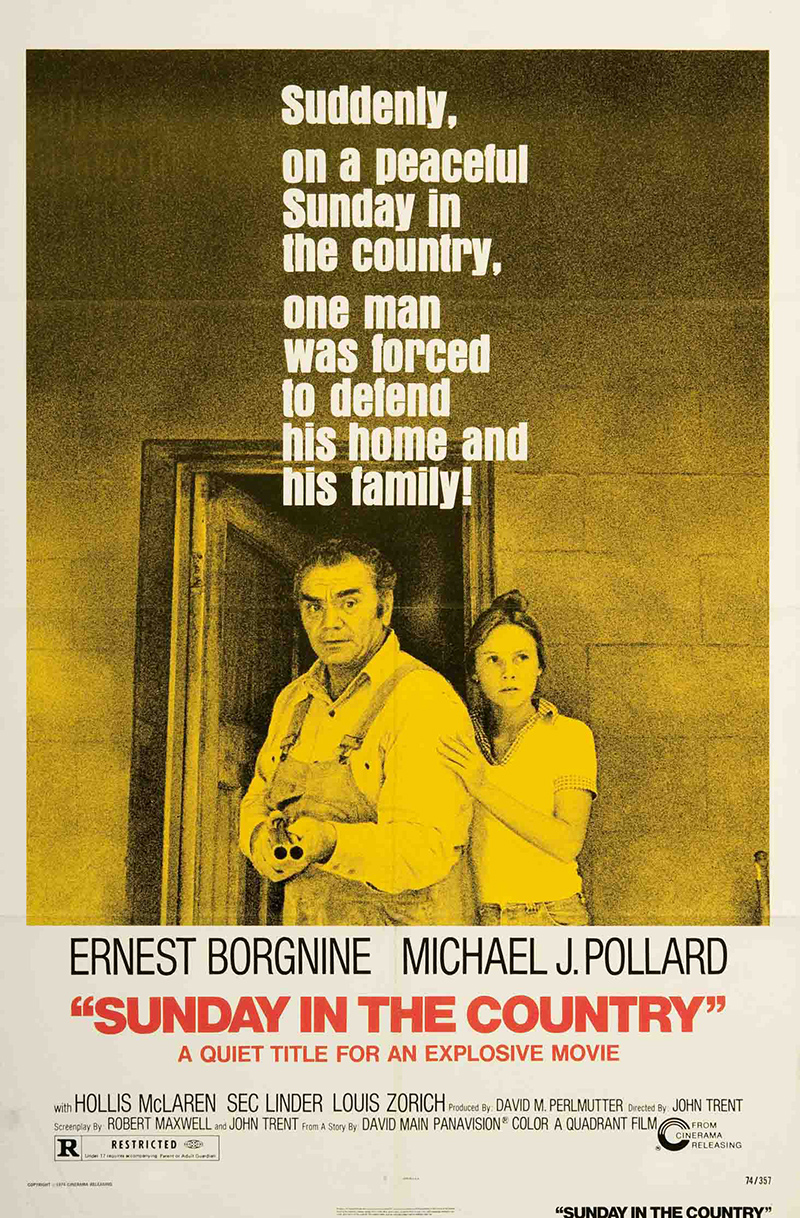
Adam Smith (Ernest Borgnine) is a Canadian farmer living in a rural home who becomes aware via the radio of reports of three bank robbers (Cec Linder, Louis Zorich, Michael J. Pollard) on the run in the area who’ve just killed a young man and his girlfriend who were his friends. He prepares for their arrival and when they come he shoots and kills one of them while taking the other two into his cellar where he hangs them on meat hooks. Smith’s granddaughter Lucy (Hollis McLaren) finds this treatment inhumane and wants to call the police, but Adam won’t let her and the two quarrel until he locks her in her room, but she escapes and runs for help, which enrages Adam even more.

The film almost gets ruined by an obnoxious musical score that is so heavily tinged with country twang that it seems almost like a parody of itself and makes the entire production come off as cheesy and amateurish. It would’ve been better without any music at all as it ends up taking you out of the action like having someone sitting beside you and rudely talking and not letting you concentrate on what’s happening on the screen.

As for the story it makes some good observations about just how thin the line can sometimes be between the good guy, or those that feel they’re morally justified to inflict whatever style justice they deem necessary, and the so-called bad guy. Unfortunately the character arch of the protagonist happens too quickly without much of a back story explaining why this otherwise law abiding farmer would deviate so quickly into an abuser. What makes him different from others who would’ve called the police? Just saying that he’s ‘old fashioned’ and ‘from a different era’ I didn’t feel was enough of an explanation.

With the exception of Pollard the robbers aren’t intimidating enough and it some ways came off as pathetic and not like professional crooks at all. This might’ve been intentional on the filmmaker’s part in an effort to make the viewer more sympathetic to their quandary once they are held hostage, but in the process it lessens the tension and makes them seem not as threatening.

Borgnine does a terrific job through his facial expressions of showing the character’s inner turmoil as well as constantly exposing his human side even as he forges ahead to doing some not-so-nice things. McLaren is also superb and her interactions with Borgnine are the most compelling aspect of the film.

Pollard is great here too and I was surprised as he’s not always able to find roles that match his unique talents and sometimes has been relegated to thankless and forgettable supporting parts, but here he’s viscous with a most creepy sounding laugh.

Unfortunately the eye-for-an-eye concept doesn’t get examined enough and the film could’ve gone a lot farther with it than it does. It still manages to bring out many interesting issues but the story should be remade and without the corny soundtrack.

Alternate Titles: Vengeance is Mine, Blood for Blood

My Rating: 4 out of 10

Released: November 22, 1974

Runtime: 1 Hour 33 Minutes

Rated R

Director: John Trent

Studio: Impact Films

Available: Amazon Video

The Apple Dumpling Gang (1975)

By Richard Winters

My Rating: 6 out of 10

4-Word Review: Orphaned kids strike gold.

Russell (Bill Bixby) is a slick gambler living in the old West who finds that he has unwittingly become the guardian to three orphaned children ( Clay O’Brien, Brad Savage, Stacy Manning). Initially he tries to pawn them off on other people, but eventually he takes a liking to them when he realizes that they’ve inherited a mine that has gold in it, which soon makes everyone else in town want to adopt them.

This Disney film, which was based on the 1971 Jack Bickham novel of the same name, fares better than most of their other films and in fact became its biggest money maker from the 70’s. It helps that the main character of Russell isn’t as squeaky clean as the typical Disney leading man as it’s strongly implied that he cheats at the poker games that he wins and the fact that he gradually softens towards the kids through time creates a nice character arch. Susan Clark, who’s the love interest, is good here too as she plays against type for a Disney leading lady by being more tom boyish and masculine despite the fact that apparently behind-the-scenes she was scared to death of horses and every scene that required her to ride one had her instead on a mechanical one although you could never tell.

The typical Disney comical trappings are given a unique spin here too, which also helps. Instead of having another boring barroom brawl, which is so common in many western comedies, we are treated to a funny lovers spat between Clark and Bixby inside the bar where props get thrown around between the two while everyone else sits frozen and unsure of what to do. There’s no cartoonish car chase at the end either, but instead a genuinely hair-raising battle between Bixby and Slim Pickens, who plays one of the bad guys, down the white rapids of a river. The shooting was also done on-location at Deschutes National Forest in Oregon, which improves the setting from the usual studio back lot.

Even the kids are tolerable without having their cuteness or innocence get overdone even though the running joke dealing with the young girl constantly having to go pee isn’t as funny as it seems when you think about it and most likely in reality would’ve been a warning sign of a very serious medical condition instead. Also, the scene showing the kids getting trapped in the mine after an earthquake should’ve also shown how they were able to get out instead of simply cutting to the next scene with them back in town of it without any explanation as to how they got there.

The real stars of the film though are Don Knotts and Tim Conway as the comically bumbling would-be crooks. This marked the first of five film appearances that the two did together and in many ways this is probably their best effort. I always liked seeing them together because it was a rare chance for Knotts to play the smarter of the two instead of always being the dope himself although some may find Conway’s extreme ineptness more annoying than funny. In either event they help enliven the proceedings and became the stars of the sequel The Apple Dumpling Gang Rides Again, which will be reviewed next week.

My Rating: 6 out of 10

Released: July 1, 1975

Runtime: 1 Hour 40 Minutes

Rated G

Director: Norman Tokar

Studio: Buena Vista

Available: DVD, Amazon Video, YouTube
Harry and Walter Go to New York (1976)

By Richard Winters

My Rating: 7 out of 10

4-Word Review: Two vaudevillians rob bank.

Harry and Walter (James Caan, Elliot Gould) are two down-on-their-luck marginally talented comedians living in the 1920’s who go to jail when they’re caught trying to rob their audience members during a tacky onstage ‘psychic’ stunt that goes horribly wrong. While in the slammer they meet up with Adam Worth (Michael Caine) a rich man from society’s upper crust who enjoys robbing banks just for the thrill of it. They come upon the blue print for his next proposed heist and take a picture of it and then after they escape from jail challenge Adam on who will be able to rob the bank first.

This is one of those 70’s movies that I found to be refreshingly original and quite funny, but when it was released it was met with harsh reviews and was a bomb at the box office. After some bad test audience reactions it was heavily cut much to director Mark Rydell’s dismay who felt a lot of the better jokes went missing although producer Tony Bill and star Caan blame Rydell for the film’s failure and insist that much of the humor in the original script was never even filmed or used.

I can’t explain why the film didn’t do well as I personally found as bank heist movies go this one to be quite  unique. So many bank robbing films from that era, and even today, paint the scheme in a one-dimensional way by portraying the robbers, who we are usually supposed to sympathize with, as a modern-day Robin Hood, while the cops and those out to stop them are represented as being the greedy,oppressive establishment, but this film takes things a step further, which is what I found interesting. The competition aspect gives it an extra.,likable edge and really made me want to root for Harry and Walter and their gang of losers who take on the arrogant Caine and his snotty buddies. Instead of the viewer just being intrigued at how they’re able to pull of the robbery as is the case with most heist films we are much more emotionally invested with its outcome.

Caan and Gould are what Warren Beatty and Dustin Hoffman should’ve been in Ishtar. These guys are definite losers, but still appealing and comical at the same time. Caan has never been known for his comedy and he has referred to this movie as ‘Harry and Walter Go to the Toilet’, which is a shame because he shows nice energy here and is able to keep Gould in check by not allowing him to drone on and steal the spotlight as he can sometimes do when left alone or with a less capable co-star.

If the film fails at all it’s by entering in too many supporting players. The title mentions only Harry and Walter and they should’ve pulled off the heist alone with maybe only Keaton tagging along for balance. As it is though a whole massive group gets in on it to the point that the two leads have little to do. While the group is busily trying to figure out how to open the safe Harry and Walter are on stage trying to extend a stage play  The film still works pretty well despite this issue, but technically the two men should be at the center of the action and in a lot of ways they really aren’t and in fact become almost like supporting players by the end.

The film also goes on too long with the denouncement being far more extended than it should, but it’s still a fun, breezy watch that reflects the gilded age flavor well and uses leftover sets from Hello Dolly to enhance the scenery perfectly.

My Rating: 7 out of 10

Released: June 17, 1976

Runtime: 1 Hour 55 Minutes

Rated PG

Director: Mark Rydell

Studio: Columbia Pictures

Available: DVD, Blu-ray, Amazon Video