Category Archives: Revisionist Western

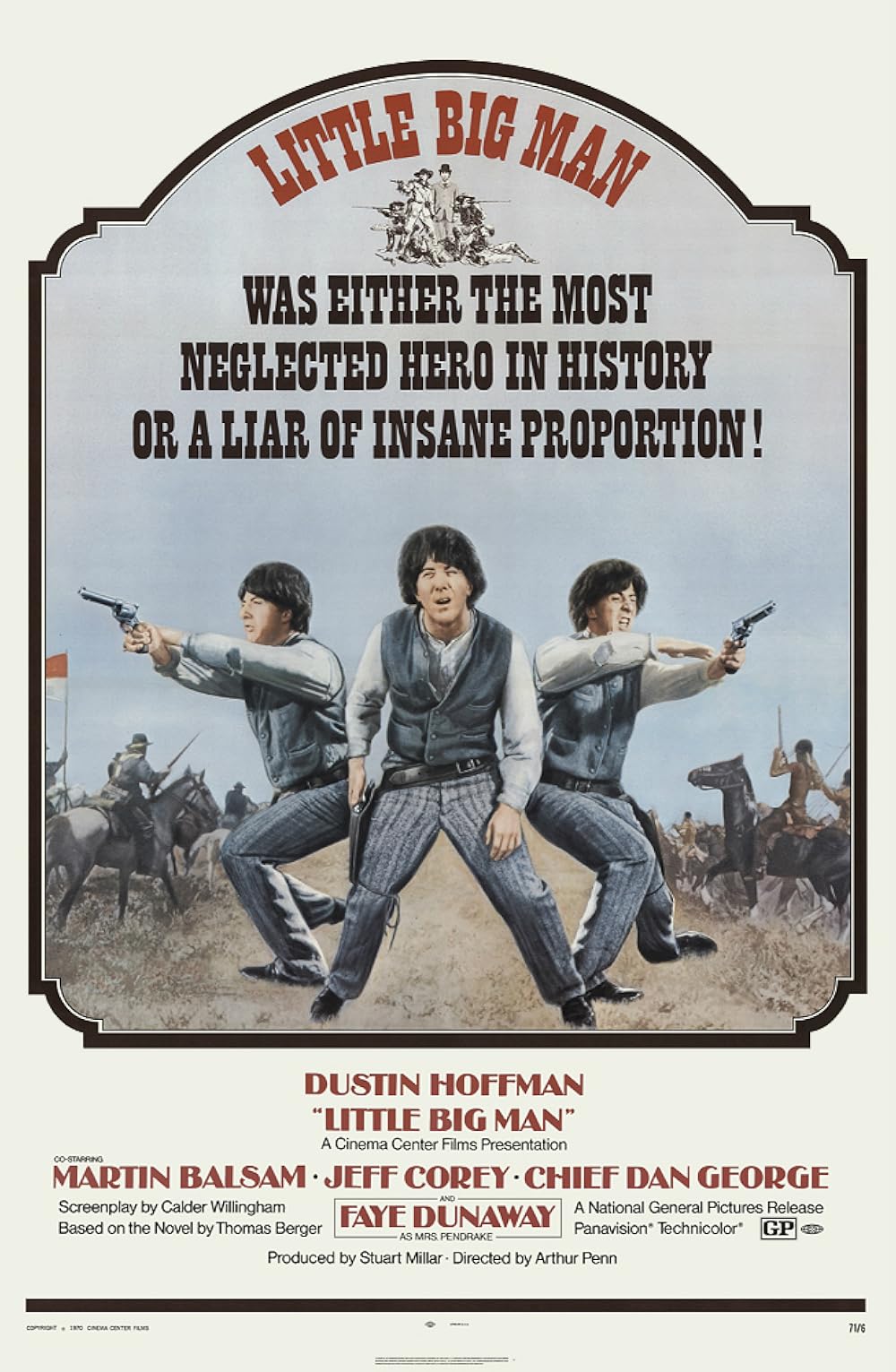
Little Big Man (1970)

By Richard Winters

My Rating: 8 out of 10

4-Word Review: Raised as an Indian.

Jack Crabb (Dustin Hoffman) has reached the age of 121 and agrees to a taped interview with a reporter (William Hickey). He recounts his life events including being kidnapped by Cheyenne Indians in 1859 when he was 10 and befriending their tribal leader Old Lodge Skins (Chief Dan George) who gives him the nickname Little Big Man. He then goes on to elaborate other life events like being captured by the U.S. Calvary where he is placed in the home of a Reverend (Thayer David) and his beautiful wife (Faye Dunaway) who despite her professed Christianity is having an affair with a soda shop owner, which disillusions Jack from religion altogether. He also goes through his marriage to a Swedish immigrant named Olga (Kelly Jean Peters) and how she gets kidnapped by the Cheyenne during a stagecoach ride and Jack’s attempts to find her, which reunites him with Old Lodge Skins and leads him to meet General Custer (Richard Mulligan), who he initially admires, but eventually learns to despise.

The film is based on the 1964 novel by Thomas Berger of the same name and wonderfully mixes the whimsical style of that book into the movie and maintains overall an excellent balance between quirky moments, of which there’s many and jarring scenes dealing with Indian Massacres by the U.S. Calvary, which remains effectively disturbing and impactful despite all the humor that goes on in between. The impressive cinematography by Harry Stradling Jr. that manages to capture the Big Sky Country, filmed on-location in Montanna where many of these historical events actually occurred, in all of its glory and makes you feel like you’ve genuinely been physically transported back to that era.

The most amazing element though, which comes up right away, is the makeup effects on Hoffman where he’s made to look about as elderly as you can get and hats-off to makeup artist Dick Smith to achieve it in such an effective way. While aging of characters has been attempted in other films, I’ve never seen it so realistic as here and in fact it still holds claim even after all these years in the Guiness Book of World Records as ‘The Greatest Age Span Portrayed by a Movie Actor’. My only quibble is that his eyes as an old man appear to be blue even though for the rest of the movie Hoffman’s eyes are clearly brown.

The acting all around is superb starting of course with Hoffman and then moving onto Dunaway whose first attempt at comedy this was and she’s really funny if not a complete scene-stealer. Thayer David awesome too as her bombastic minister husband and I wished there had been more scenes with him. Chief Dan George is quite memorable as the Indian Chief, he became the first Native American ever nominated for an Oscar for his work here, in a part that was originally intended for Marlon Brando who thankfully turned it down as having a genuine Native American makes it so much more compelling. Great work too by the lesser-known Kelly Jean Peters whose frantic screams of terror, as she’s being kidnapped, I found to be both funny and frightening at the same time.

While it doesn’t affect one’s enjoyment of the movie, the film does have a few drawbacks, or moments that could’ve been done slightly better. Having Hoffman constantly come back into contact with people he had been with years earlier got a bit too cute for its own good. I was okay with some of it, like his reunion with the Indian Chief, but having him literally re-meet everyone he had known before got unrealistic and almost monotonous. I also couldn’t understand why the people he meets again don’t recognize him right away as is the case with Dunaway, as Hoffman has a very distinct face that really doesn’t change much even as he ages, so forcing him to have to remind her who he was should’ve been quite unnecessary. Same goes in reverse with the reunion with his sister, played by Carole Androsky, I immediately recognized her voice even before seeing her face, but for Hoffman it takes a long time to remember who she is, but if I the viewer could detect her voice right away why couldn’t he?

Another issue is when he meets his wife Olga many years later when she’s become a part of an Indian tribe. When he married her she had a very strong Swedish accent and due to the language barrier could only say a very few words, basically just ‘Yah’. Then, when he sees her again, she speaks fluent English, but how could she have learned that by being in an Indian tribe? Also, she had completely lost her accent, which I don’t believe would happen. I’ve known people who have lived in this country for 30 or 40 years, but where originally from somewhere else and no matter how long they’ve been here, or how ‘Americanized’ they may become they still retain their original accent, or at least sufficient hints of it.

Spoiler Alert!

There’s also issues with the General Custer character. Acting wise I felt Richard Mulligan nailed it as he integrates a great blend of comic self-importance to him, but on the satire end it goes a little too far. He gets portrayed as being a complete buffoon with a clownish logic and such a severe narcissistic ego he’s unable to realize when everyone else around him thinks he’s an idiot. There were many different issues that went into the Battle of Little Big Horn, or more commonly known as Custer’s Last Stand, and this movie answers it by saying the guy running it was a self-deluded moron, which I suppose comically and emotionally is satisfying, but doesn’t sufficiently tackle the others nuances that were also involved. There’s also the argument over the demise of Wild Bill Hickok though having him get killed by a little kid was historically inaccurate I felt it was so humorously ironic that I was willing to forgive it.

The ending, where in the book Old Lodge Skins dies, but in the movie he doesn’t, annoyed some fans as well. Director Arthur Penn admitted in interviews that the earlier script drafts had him dying, but then he felt that would be ‘too depressing’ so they had him live, but I felt with such a picturesque back drop that having him lay down for his final resting place was appropriate. He was really old anyways and had also become blind, so having him get up and be led away by Hoffman was just prolonging the inevitable anyways, so they might as well have him go down when it was his time as ‘cheating it’ like they do here doesn’t really add all that much.

My Rating: 8 out of 10

Released: December 23, 1970

Runtime: 2 Hours 27 Minutes (Uncut) 2 Hour 19 Minutes (Studio Version)

Rated GP

Director: Arthur Penn

Studio: National General Pictures

Available: DVD, Blu-ray, Amazon Video, PlutoTV, YouTube
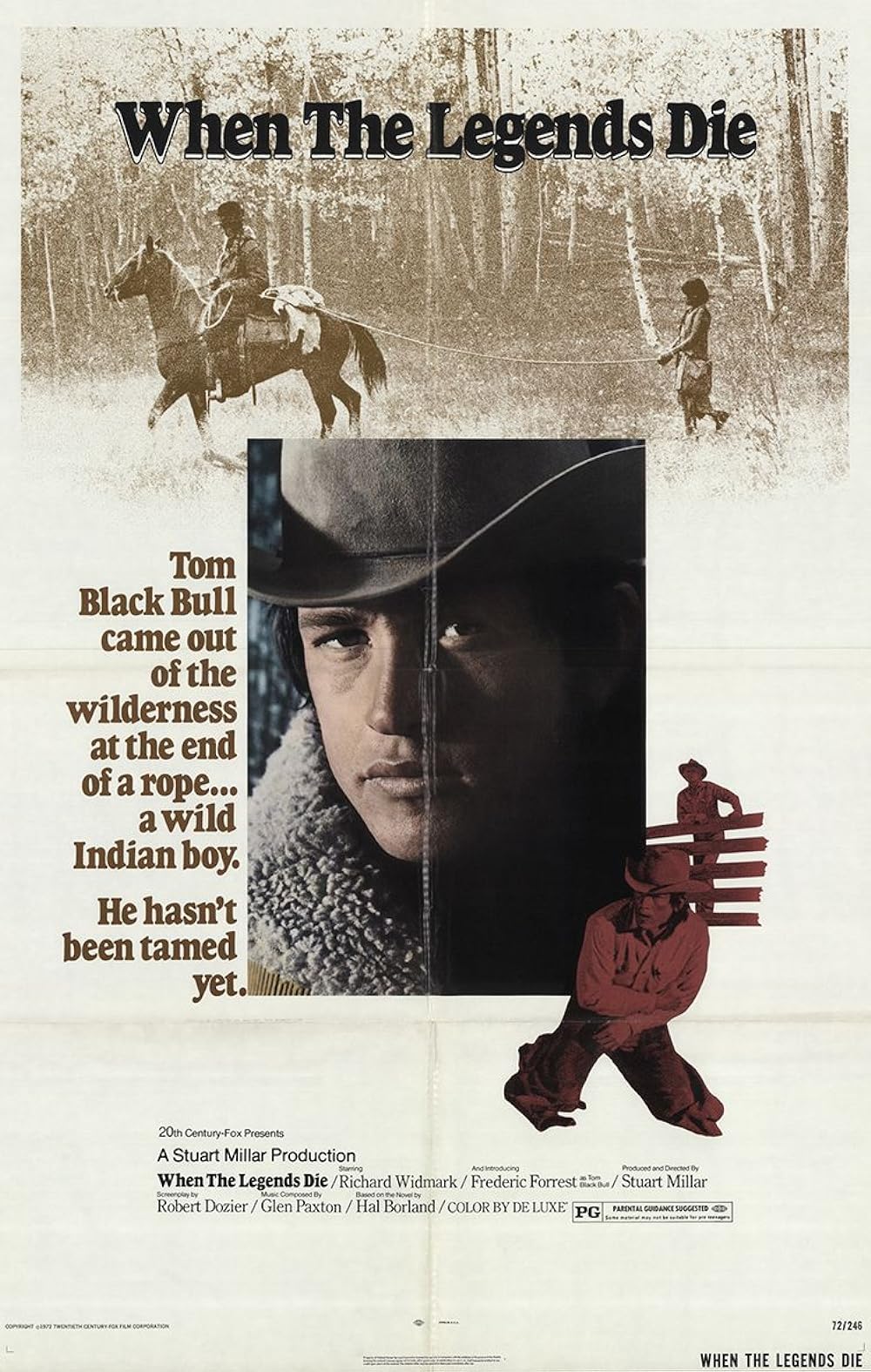
When the Legends Die (1972)

whenlegends

By Richard Winters

My Rating: 8 out of 10

4-Word Review: Indian becomes rodeo rider.

Tom Black Bull (Tillman Box) is a young Ute Indian orphan living in the wild with his pet bear. One day Blue Elk (John War Eagle) an Indian elder comes upon the child and decides it’s time to get him acclimated into society by having him enroll into a school where Tom does not get along with the other students and forcing him to begrudgingly release his bear. Over the years Tom grows to being a young adult (now played by Frederic Forrest), but is bitter with the racism that he must endure. By chance he gets spotted by Red (Richard Widmark) who’s impressed by the way Tom can ride and control a difficult horse and decides he’d like to train him into becoming a rodeo rider. Tom sees this as an opportunity to get out of the slums that he’s in, but soon realizes that Red, who suffers from alcoholism, is exploiting him just like the other white men by forcing him to intentionally lose contests in order to trick people into betting against him.

During the early 70’s there were many modern-day westerns that focused on the rodeo circuit including Junior Bonner, J.W. Coop, The Honkers and Riding TallWhile all of those were good in their own right I’ve found this one to be at the top. The others were more a character study with the rodeo atmosphere a side-story while this one examines the training and technique that it takes to be a successful bronco rider with a meticulous detail making it more revealing and informative. The others didn’t always do a adequate job of making it seem like the lead character was actually riding the kicking horse and many times looked like a shot of the guy on top of one of those bull machines you see inside western barrooms, but here it’s captured in an authentic style including a disturbing moment where Tom refuses to get off the horse as it continues to buck, which ultimately exhausts the animal and requires it to be shot.

The story is based on the 1962 novel of the same name by Hal Borland who was a journalist who specialized in writing novels with an outdoor setting. The book though was aimed more for young adults and split up into four different sections while the film just analyzes the third portion. It also updates the time period to the modern day versus the turn-of-the century like in the book. It’s expertly directed by Stuart Miller, better known as a producer, with a well-written script by Robert Dozier that has crisp dialogue that manages to intimate a lot while saying little and never overstating anything.

Forrest plays his role with a sullen expression that remains constant throughout and some might complain it makes it one-dimensional, but I felt this helped illustrate the character’s inner anger and it’s fascinating seeing the juxtaposition of someone who’s very rugged and savvy when it comes to nature and animals, but quite virginal, literally, when it has anything to do with societal elements like women, alcohol, and other vices.

Widmark is brilliant as usual and one of the few people who can play a miserable, brash, and genuinely unpleasant old guy and still keep it on a humanistic level. Watching him go from gruff and demanding as he’s clearly the more worldy-wise at the start to more of a vulnerable and even dependent one at the end is a fascinating journey to watch. In many ways his relationship with Tom is like a father and son where the older one starts out as the stern teacher only to have it flip with the younger one, now fully accustomed to the world, taking the reins and caring, albeit begrudgingly, to someone who can no longer do it themselves.

My only complaint with the film that is otherwise close to flawless is that I would’ve liked to have seen one moment where Widmark shows some actual kindness to Tom as all the way through he’s quite grouchy and condescending even when Tom offers him some much needed support. I realize his character was a victim of the hard world he lived in and thus it wasn’t natural for him to show any tender side, which he most likely possessed very little of anyways, but one even fleeting moment of gratitude, even if it just was putting his arm around the young man and showing him a slight gesturing hug, could’ve gone a long way to giving it a bit more emotional balance and the touching image that every hard-edge drama ultimately should have and needs.

My Rating: 8 out of 10

Released: October 19, 1972

Runtime: 1 Hour 47 Minutes

Rated PG

Director: Stuart Miller

Studio: 20th Century Fox

Available: DVD-R

Dirty Little Billy (1972)

dirty

By Richard Winters

My Rating: 9 out of 10

4-Word Review: From awkward to outlaw.

Loosely based on the life of Billy the Kid the film centers on a young Billy Bonney (Michael J. Pollard) who moves to Kansas with his mother (Dran Hamilton) and her new husband Henry (Willard Sage). Billy and Henry don’t get along as Henry feels Billy is lazy and doesn’t help out enough with the farm chores. When Henry informs Billy one night that he needs to leave and never come back Billy does just that by hopping onto the nearest train that’s traveling back east only to at the last minute hop off of it and into a nearby small town where he encounters Goldie (Richard Evans) and his girlfriend Berle (Lee Purcell) who run a small gang of outlaws and are holed-up inside a bar run by Jawbone (Josip Elic). Initially Goldie and Billy are incompatible, but eventually Berle softens towards him and even allows him to go to bed with her. When Billy comes to their rescue when they have a confrontation with another gang he’s eventually welcomed into the group and ultimately becomes its new leader.

By the early 70’s the revisionist western, which portrayed the west in a less ideal way focused more on the realism and merged the good and evil theme so that it became less clear who the hero and bad guy were, became all the rage. Films like The Wild Bunch and McCabe and Mrs. Miller were critical darlings and set the standard for all westerns that followed. This film I considered to be one of the best and yet has strangely been overlooked and isn’t even in Wikipeadia’s list of revisionist westerns from that period, which is a real shame as this masterpiece deserves from more attention and if anything should be at the top of the list and figured prominently.

What’s even more baffling is that it was directed by Stan Dragoti a man that started out in commercial photography and had no aspirations for film directing until finally, at the age of 40, getting the offer to direct this one. The film is so highly stylized and has such a strong a precise artistic vision that I would liken this directorial debut to those of Richard Linklater, Quentin Tarantino, or Jim Jarmusch who burst into the film scene with a distinct style that took audiences and critics by storm while ultimately continuing each of their follow-up projects with the same unique approach and theme, but with Dragoti, who was married to supermodel Cheryl Tiegs, that was not the case. The films he did after this were all lightweight comedies that had a generic look and no resemblance to this one. How someone with no background in movies could helm something as flawless as this is hard to answer, but in the music world you have obscure bands who manage to make it big with one song and they end up being called one-hit-wonders and I guess in Dragoti’s case that’s what this movie was to him and his career.

The acting is masterful as well especially Pollard whose career was quite up-and-down. While he had been appearing in TV productions from as early as the late 50’s it wasn’t until his breakout role in Bonnie and Clyde that he came to the attention of audiences and studio heads alike. Trying to subsequently cast him in a film where he’d be the right leading man though was no easy task. The first attempt was Little Faus and Big Halseywhich did not do well at the box office and rumors of him fighting with his co-star Robert Redford didn’t help things. This role though, where his moody presence is put to perfect use, was a terrific fit and despite already being in his early 30’s his boyish face still gave off the late adolescence look that was needed. Lee Purcell is also fantastic in a sort of plain-Jane role where she wears no make-up, but still looks striking and her knife fight with another woman, played by Rosary Nix, is one of the movie’s top moments.

Overall, outside of the gritty visuals that have an almost poetic quality, what I liked most was how the characters didn’t seem locked into their time period like so many other historical type films. Too many other movies trying to recreate past eras end up having people who seem antiquated and not relatable while this bunch, particularly Billy and the outlaws came-off like people who could’ve easily fit-in with the hippies of the 60’s, or anyone that was living outside the system. They were simply looking for purpose and finding it by lashing out at a society that didn’t seem to want them, which in many cases is the common thread of most criminals of today as well.

My Rating: 9 out of 10

Released: October 25, 1972

Runtime: 1 Hour 33 Minutes

Rated R

Director: Stan Dragoti

Studio: Columbia Pictures

Available: DVD-R

The Hired Hand (1971)

hired1

By Richard Winters

My Rating: 7 out of 10

4-Word Review: Returning to his wife.

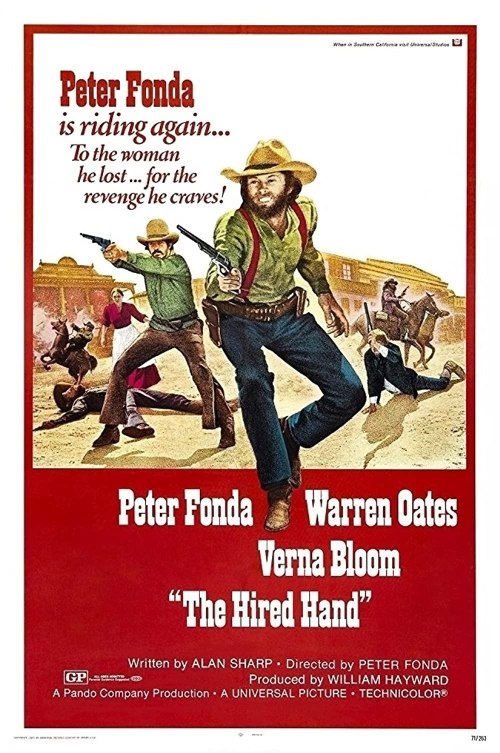
Harry (Peter Fonda) and Arch (Warren Oates) having been wandering the American West for many years, but Harry has grown weary of it. He informs Arch and their younger companion Dan (Robert Pratt) that he plans on going back to his wife Hannah (Verna Bloom) whom he abandoned many years before. Arch is not happy with this decision and tries to talk him out of it, but eventually relents and after the untimely death of Dan decides to head back with him to Harry’s former homestead. When they arrive they find that Hannah is still working the farm with her young daughter Janey (Megan Denver). Hannah is not pleased to see Harry as she had informed Janey that her father had died many years earlier. Harry tries to make amends, but Hannah resists only allowing him to stay as long as he agrees to become a hired hand and help with the chores. Both Harry and Arch agree to this, but when Arch decides to eventually head west alone and then gets abducted by a crooked sheriff (Severn Darden) Harry leaves Hannah to help save his friend much to the anger of Hannah who feels he’s again abandoning her.

This film was the product of Universal Pictures’ new policy of allowing independent pictures to be made under the studio system as Easy Rider had done well with a low budget, and no studio meddling, so they hoped to replicate that success with more films like that one. Besides this one the other movies included: Silent Running, Taking Off, The Last Movie, and American Graffiti and were all made with each director given $1 million to work with and then allowed to use his artistic freedom to create the kind of film he wanted without studio interference.

Unfortunately this movie did not do well at either the box office, or with the critics. Variety labeled it as ‘disjointed’ while Time described it as ‘pointless’. With the bad press and poor profits the studio decided to end its ‘independent movie’ division and films like this were no longer made, at least under the Hollywood umbrella. While this movie sat in near obscurity it finally found an audience in 2002 when it was shown at the Sundance Film Festival and has since acquired many admirers.

What I liked about it is how it goes against the western narrative where life in the old west isn’t portrayed as being about gunfights and saloon brawls, but instead quiet and slow paced. Harry and Arch spend their time raising livestock and doing other farm chores as just keeping the crops growing and animals fed was a mighty challenge enough. The acting by the entire cast is superb, but the real stars are Bruce Langhorn and his wonderfully unique music score, Vilmos Zsigmond’s cinematography and Frank Mazzola’s brilliant editing where he mixes in a lot of montages and overlapping still photography.

There are a few gunfights, but unlike shoot-outs in the conventional westerns this isn’t about tough brave men with nerves of steel. Instead the gunfights are seen as happening when goofball idiots, much like today, get their hands on a weapon after being triggered over something insignificant and shooting wildly before killing himself. Most westerns will prolong these moments, but here it’s quick lasting only a couple of minutes, like in real-life, and when it’s over all you see are dead bodies lying about making it seem more like a needless waste of life.

Harry and Arch’s long travels together through the desolate, lonely west are what really stands-out. You get a true sense of what the world was like back then where you might not see other people, or homes for days on end. You also get a good understanding for why Harry becomes so attached to Arch and willing to risk is life at the end to save him because for such long periods during their travels Arch was, at least from his perception, the only other person on the planet with him and this then created an indelible bond.

When it got broadcast on NBC in 1973 a 20-minute deleted scene featuring Larry Hagman as a sheriff was edited back into the film. This segment had gotten cut-out when director Fonda felt, after viewing it in the editing room, it wasn’t needed and didn’t really help propel the story. The footage can be found on the 2003 DVD issues from Sundance as a bonus extra. I watched it and enjoyed Hagman’s performance as, like with everything else in this movie, goes against the grain of the conventional western. Most of the time sheriffs where portrayed as stoic figures, but Hagman comes-off as nervous and jittery and not completely in control of the situation. I would think most lawmen back-in-the-day with dangerous outlaws roaming the countryside and invading small towns would behave much more like Hagman does here, so in that respect I felt these scenes were insightful, but ultimately agree with Fonda that they didn’t add much to the story and the film flows better without it.

My Rating: 7 out of 10

Released: July 16, 1971

Runtime: 1 Hour 30 Minutes

Rated R

Director: Peter Fonda

Studio: Universal

Available: DVD, Blu-ray, Plex

Junior Bonner (1972)

junior 1

By Richard Winters

My Rating: 7 out of 10

4-Word Review: An aging bull rider.

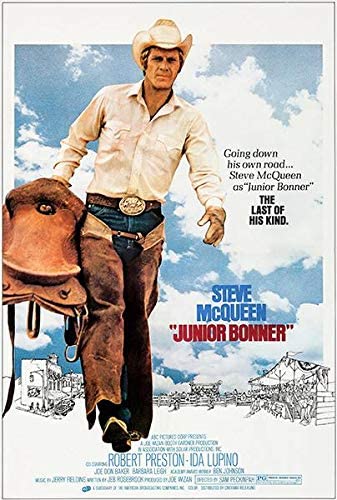
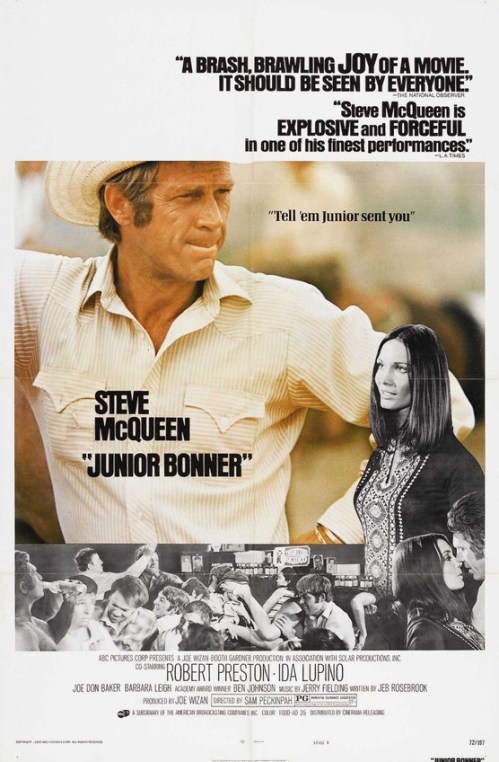
Junior (Steve McQueen) is a rodeo star whose better days are behind him. As he enters his 40’s, he needs to find other ways to make a living and returns to his boyhood home of Prescott, Arizona where the rest of his family including his father Ace (Robert Preston), his mother Elvira (Ida Lupino), and brother Curly (Joe Don Baker) reside. When he gets there he finds that his father’s home is being bulldozed by his brother’s company in order to make way for a track of newer homes. Junior decides that the only way to make ends meet for both himself and his father is to win the prize money by riding the ornery bull Sunshine during the rodeo competition. He had attempted to ride Sunshine at another rodeo, but was quickly bucked-off and injured, but this time he feels it will be different and convinces the rodeo owner Buck Roan (Ben Johnson) to give him one last shot.

This film is different from any other Sam Peckinpah movie you’ll see and many viewers/critics at the time didn’t know what to make of it. Peckinpah was known and even stigmatized for his violent movies including The Wild Bunch and Straw Dogs, which were deemed, especially the latter one, quite controversial and to an extent even glorifying violence. To help find a balance he decided to do something opposite from those by making a movie that was laid-back and didn’t feature any fighting except for one moment during a bar fight, which is done with a delightfully comic flair where everyone in the place gets punched except for Junior who goes off to a corner to makes-out with Charmagne (Barbara Leigh) even though he was the catalyst for why it began in the first place.

Unfortunately audiences and critics could not adjust to the extreme change in tone. They came to the theater expecting, based on Peckinpah’s reputation, bloody shoot-outs and got none and the end result is it doing quite poorly at the box recouping only $2.8 million from the original $3.2 million budget, which poisoned Peckinpah’s career as he was now deemed a financial risk and seriously affected the choice of projects he could do afterwards and how much control he’d have over them. Even normally friendly critics like Roger Ebert, who had been a fan of the director’s earlier works, bailed on this one calling it a “flat-out disappointment” and describing the material as being “terribly thin”. Another critic, Gary Arnold, described it as a film that “drifts across the screen and fades from your mind an instant later” and that there was “no compelling reason to see or remember it.”

I’ll admit the way it starts out had me a baffled. The story doesn’t go anywhere even after 30-minutes in and McQueen, normally this energetic, rugged action hero, looks like he’s in his 60’s and appearing perpetually tired. I started wondering whether this was just footage caught from a closed circuit camera that examined the slow way of life of small towns.

Things though do improve by the second act. The rodeo riding is captured in a vivid way making you feel like you’re riding the bull itself. Peckinpah’s uses his patented slow motion, but this time in a humorous vein like when Junior and Ace go riding away from a 4th of July parade and through the backyards of some houses where they inadvertently get caught up in some clothes lines. There’s even a couple of touching moments like Junior’s conversation with his father at a train station as well as Ace’s reconciliation with his wife. I was impressed with Joe Don Baker’s performance as well. I know some film-goers have mocked his acting in other movies, but I believe if given the right material he can be quite good though he wasn’t the director’s first choice as it was originally intended for Gene Hackman, but when his salary demands proved too high it was given to Baker much to Peckinpah’s regret as the two had many arguments during the production, which almost came to blows and only prevented when McQueen would get in the middle and calm both sides down.

For a modern day western this is one of the better ones and precipitated a boon of rodeo style movies  during the early 70’s. While its initial reception was not kind its been viewed in a better light today and even revered as being one of Peckinpah’s better works.

junior2

My Rating: 7 out of 10

Released: June 20, 1972

Runtime: 1 Hour 40 Minutes

Rated PG

Director: Sam Peckinpah

Studio: Cinerama Releasing Corporation

Available: DVD, Blu-ray

The White Buffalo (1977)

white

By Richard Winters

My Rating: 5 out of 10

4-Word Review: Buffalo haunts his dreams.

Based on the novel by Richard Sale, who also wrote the screenplay, the story, which takes place in 1874, centers around Wild Bill Hickok (Charles Bronson) who’s suffering from reoccurring dreams involving a giant white buffalo. He travels to the west in order to find the beast and confront it. It’s there that he meets Crazy Horse (Will Sampson). The two initially don’t get along. Bill is not a fan of Indians and once said “the only good Indian is a dead one”, but the two share a common bond as they’re both after the elusive buffalo in Crazy Horse’s case it’s to avenge the death of his infant daughter who was killed when the beast violently attacked their campsite. Having formed an uneasy alliance the two, along with old-timer Charlie Zane (Jack Warden) go out into the cold, wintry terrain in search for it while debating over whose land this country really belongs to: the white man or the Native Americans.  

Story-wise the film lacks any explanation for why Hickok is having these dreams, or what exactly the image of the white buffalo is meant to represent if anything. The plot goes off on a lot of tangents including a segment where Hickok visits an old-flame (Kim Novak) that doesn’t have much to do with the central story, nor propel the plot along, and could’ve easily been cut. There’s also a few proverbial gun fights though they’re generic in nature, don’t add much excitement, and quickly forgotten. 

Bronson gives his typical wooden performance though seeing him with dark circular glasses and sporting long hair does make him, in certain shots, resemble Ringo Starr. The rest of the cast if filled with familiar B-stars in minor roles including Stuart Whitman and Cara Williams, who have an amusing bit as a vulgar couple whom Hickok shares a stagecoach ride with. Jack Warden, who’s almost unrecognizable, has a fun moment when he takes out the glass eye that he’s wearing much to the shock of Crazy Horse.

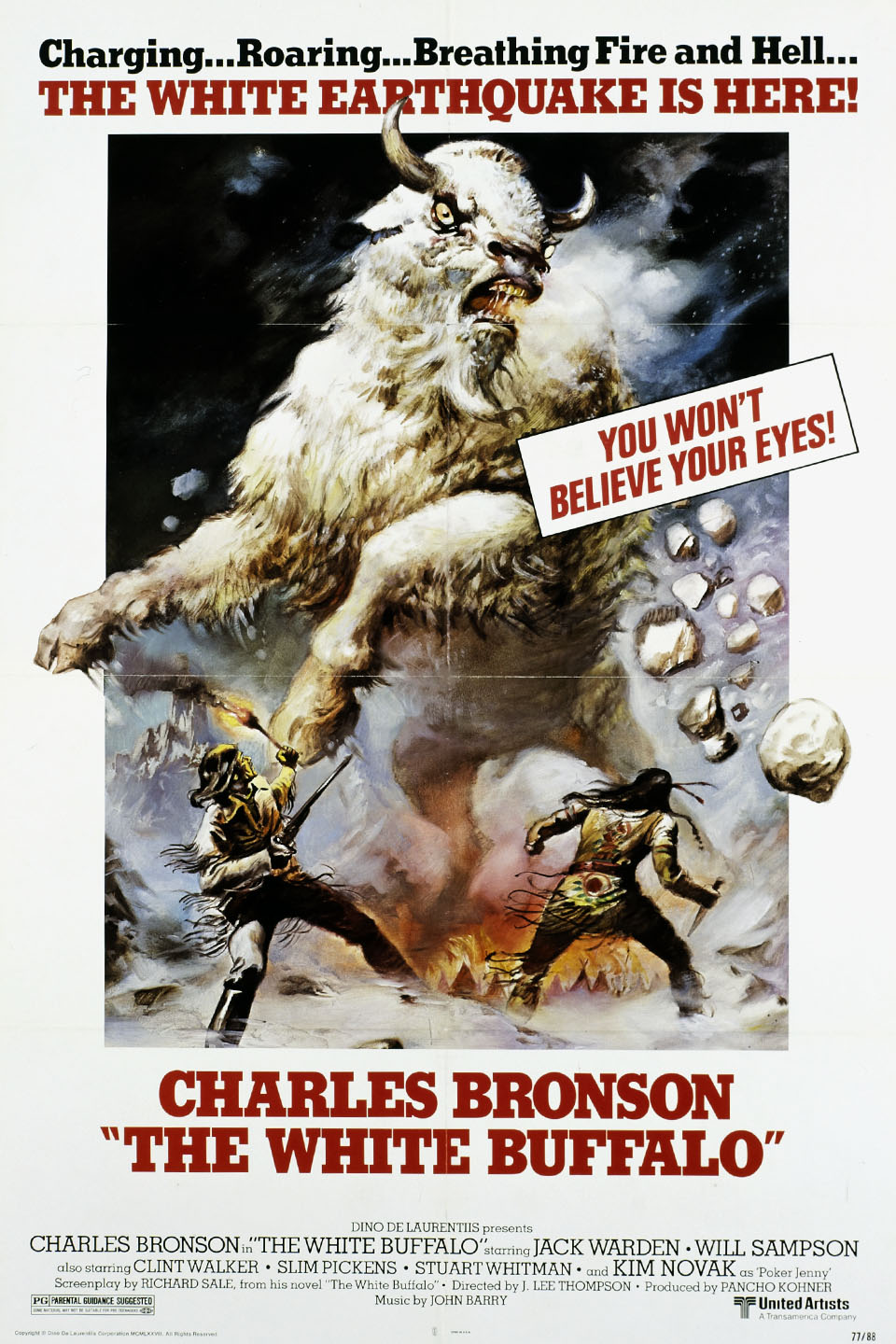
The only diverting element is the opening dream sequence that’s done over the credits where the viewer looks right into the eye of the beast close-up. Normally I’m not a fan of outdoor shots done on a sound stage, which always comes-off looking artificial, but in this instance it helps accentuate the surreal elements. The climactic sequence though in which both Hickok and Crazy Horse come face-to-face with the buffalo doesn’t work as it becomes painfully clear that the beast is special effects generated especially when Crazy Horse gets on top of it and repeatedly stabs it, which looks like someone stabbing into a sofa cushion with tacky fur stuck to it. We also never get to see a full-shot of the buffalo, just its head, so it’s difficult to gauge how big it really was. The truly disappointing part is that the illustration of the buffalo on the film’s promotional poster seen above is far more impressive looking than anything you’ll actually see in the movie.

Probably the only interesting aspect about the production is not what occurred in front the camera, but behind-the-scenes. Will Sampson, who’s by far the better actor and the story could’ve been centered around his character alone and it would’ve made it a more interesting movie, refused to read his lines for over 24 hours when he became aware that white actors had been hired to play the roles of the Native Americans and only went back to performing his role once the producers agreed to casting actual Indians for the parts. This then directly lead to the American Indian Registry of the Performing Arts, which he founded. 

My Rating: 5 out of 10

Released: May 6, 1977

Runtime: 1 Hour 37 Minutes

Rated PG

Director: J. Lee Thompson

Studio: United Artists

Available: DVD, Blu-ray, YouTube (with ads)


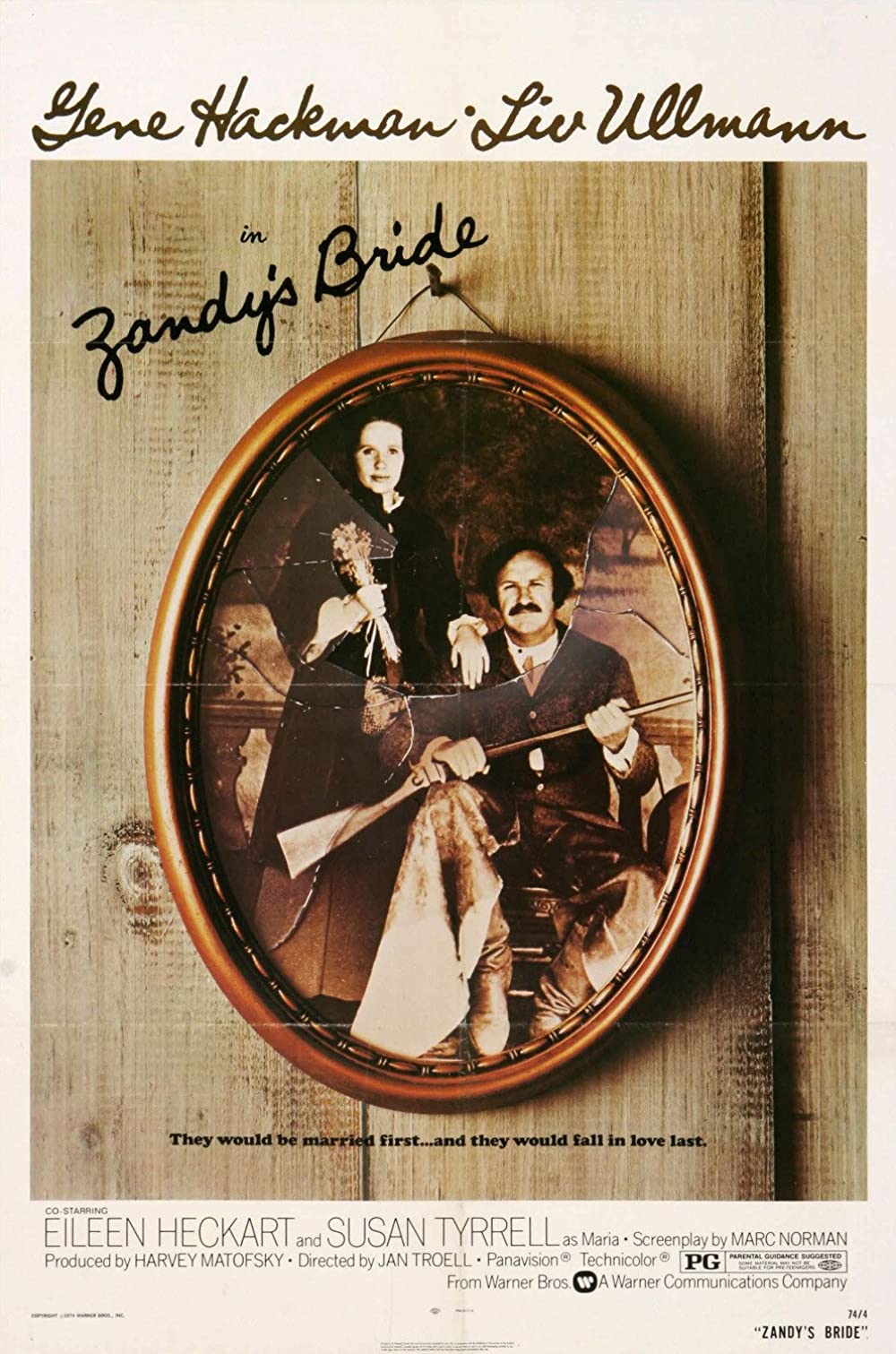
Zandy’s Bride (1974)

zandy1

By Richard Winters

My Rating: 7 out of 10

4-Word Review: A mail-order bride.

Based on the novel ‘The Stranger’ by Lillian Bos Ross the story centers on Zandy Allan (Gene Hackman) a rancher living in the remote frontier of the American west during the late 1800’s. He finds living alone while maintaining a ranch to be an arduous challenge and thus puts an ad in the newspaper for a bride. The inquiry catches the eye of Hannah (Liv Ullmann), a Swedish woman living outside of Minneapolis. She arrives in Zandy’s hometown, but Zandy is initially not pleased as she’s 32 instead of 25 and he feels she’ll be too old to bear him a son. Begrudgingly he takes her on the long horse ride back to his ranch while informing her there’ll be ‘no turning back’. Their relationship starts out rocky as Zandy expects to be able to order her around and have sex with her at will and is routinely abusive, but complains to his mother (Eileen Heckart) that he cannot understand why she doesn’t like him. Eventually the two, after many years and many fights, form a tenuous bond.

The film was directed by Jan Troell a Swedish director and cinematographer whose films The Emmigrants and The New Land gained international acclaim and won him a contract to direct a Hollywood film. Despite the presence of Ullmann, who had also starred in Troell’s other two films, and having the same frontier setting this one did not do as well either with the critics or the box office and culminated in making Troell’s foray into Hollywood filmmaking, which he said he didn’t like since union rules didn’t allow him to man his own camera like he had always done while making movies in his homeland, a short one.

A lot of the reason for this could be that it starts-off with a brutal rape scene, though not as graphic as in some other films, is still quite unpleasant particularly with Ullmann’s pleading blue-eyes and Hackman callously shouting that he ‘has a right’ as he violently strips off her clothes. While one can appreciate the film’s stark reality, as I’m sure in the remote frontier this sort-of thing could’ve easily happened, it still leaves a bad vibe since Hannah softens to Zandy despite his continually arrogant behavior too quickly. Most women would hate a man forever after that, so for the film to take the approach that love could still blossom is a bit hard to fathom. It should’ve at least taken the entire duration for this to occur instead of entering it in already by the second act.

Hackman is fantastic particularly for taking on such a unlikable role. Most other actors who’ve gained leading man status will rarely do this as they’ll feel it will affect their image, so it’s great to see an actor willing to stretch his range no matter the results. Ullmann is quite good too and it’s almost surreal hearing her speak English when I’ve seen so many films of her speaking in her native tongue. Her character though needed better fleshing-out. With Zandy we can see why he behaves the way he does when he visits his parents (Frank Cady, Eileen Heckart) and witnesses the poor way his father treats his mother, which clearly gives him the mindset that treating women that way is ‘normal’, but we get no such backstory with Hannah. Why did she choose to be a mail-order-bride when she’s so beautiful and you’d expect she’d find many suitors back where she lived? There’s no hint of her family history, or why she ended up in the situation that she does. I also felt she was too assertive too quickly and would’ve liked more of an arc where she starts out shy, but after going through the rigors that she does gains an assertiveness that she didn’t think she initially had.

Spoiler Alert!

The film ends on a hopeful note. Whether one feels this has been earned, or deserved is up to one’s subjective perspective though I was happy to see some redeeming qualities from Zandy as sitting through it watching him behave badly and never learning anything from it would’ve been too unbearable otherwise. I couldn’t help though but wonder during the many times that Zandy abandons her for months on end that one of the men from town wouldn’t have proposed to her in the process. In either case this ends up becoming the first and quite possibly only movie that could be categorized as a love story without any romance.

My Rating: 7 out of 10

Released: May 19, 1974

Runtime: 1 Hour 37 Minutes

Rated PG

Director: Jan Troell

Studio: Warner Brothers

Available: DVD-R (Warner Archive), Amazon Video

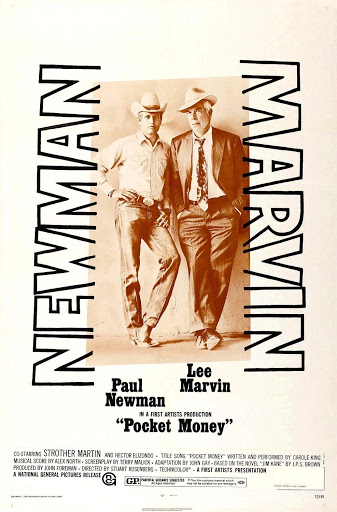
Pocket Money (1972)

By Richard Winters

My Rating: 6 out of 10

4-Word Review: Herding cattle for money.

Jim Kane (Paul Newman) is a not-too-bright modern-day cowboy living in Arizona that is broke and without a job. In desperation he takes an offer from a shady businessman named Bill Garrett (Strother Martin) who promises Jim a lot of money to buy a certain breed of cattle in Mexico and then bring them up to the US. Jim has his suspicions about the deal, but decides he has no choice but to take it. He elicits the help of his longtime pal Leonard (Lee Marving) another down-on-his-luck loser. Together they find the cattle and herd them to the states despite a lot of obstacles along the way, but when they return Bill and his cronies are nowhere in sight forcing Jim to seek him out and right the injustice.

Many people have complained about the film’s slow pace and the script, which was written by Terrence Malick and based off of a novel by J.P.S. Brown, has a lackadaisical quality, but to some extent I really didn’t mind it. Too many Hollywood movies are compelled to rush right into the plot while leaving atmosphere and characterizations behind, but here Laszlo Kovacs cinematography brings the rustic western locations to life. I had traveled just recently to a small town in Mexico earlier in the year and this film captures the same ambience that I saw including all the feral dogs running around, the old rundown buildings that make up the town center, as well as the pot-holed filled roads. It was almost like I can gone there a second straight time.

Newman is brilliant in a rare comedic turn. His character is dopey, but in a funny, lovable way where you laugh at his ineptness one minute and cheer him on the next. Marvin is good too and the banter the between them as well as their contrasting approaches to things help keep things interesting. Reports where that the two did not get along and Marvin even admitted as much in interviews stating that Newman ‘finessed’ him during their scenes and when you get two big name actors with heavy egos this sometimes happens, but they were at least professional enough not to let their animosity show through on the screen. Both Wayne Rogers and Strother Martin, who co-starred with Newman just 5 years earlier in the classic Cool Hand Luke lend great support and in Martin’s case should’ve been seen more.

Spoiler Alert!

My biggest beef comes with the ending, which is a complete letdown. The intention was to show the life of two aimless men who are going nowhere, which is fine, but there still needs to be a payoff at the end. Instead when Newman and Martin finally confront Rogers and Martin in a hotel room, after searching everywhere for them, nothing happens. They never get their money, or revenge, or anything. Even losers can have a random moment of small victory, which is what I felt was needed here, and to have nothing of substance occur makes the viewer feel like the joke was on them and sitting through this, despite the marvelous production values, becomes sadly a big waste of time.

End of Spoiler Alert!

This was another case of where Leonard Maltin’s review, or whoever wrote it for him, is off from what you end up seeing. He commends the performance by Jean Peters, who plays Newman’s ex-wife, like it’s something special when in reality it’s just a throw-away-bit that lasts for a couple of minutes and isn’t too memorable. He also comments on Marvin’s car, which he states is ‘the damnedest thing you’ll ever see’ even though despite a few multi-colored panels I didn’t see what was so unusual about it. The craziest car I’ve ever seen in a movie is the one the two teens drive in Robert Altman’s 1985 flick O.C. and Stiggs, but again watch both movies for yourself and then decide, but I believe most would end up agreeing with me.

My Rating: 6 out of 10

Released: February 1, 1972

Runtime: 1 Hour 42 Minutes

Rated GP

Director: Stuart Rosenberg

Studio: National General Pictures

Available: DVD-R (Warner Archive), Amazon Video

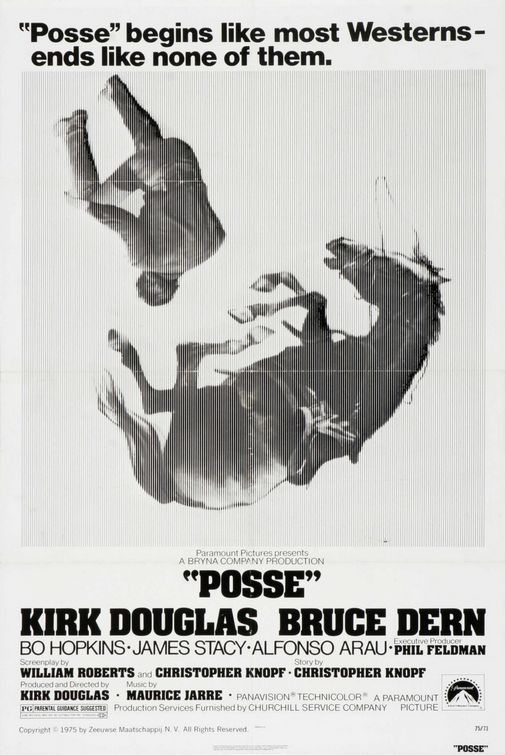
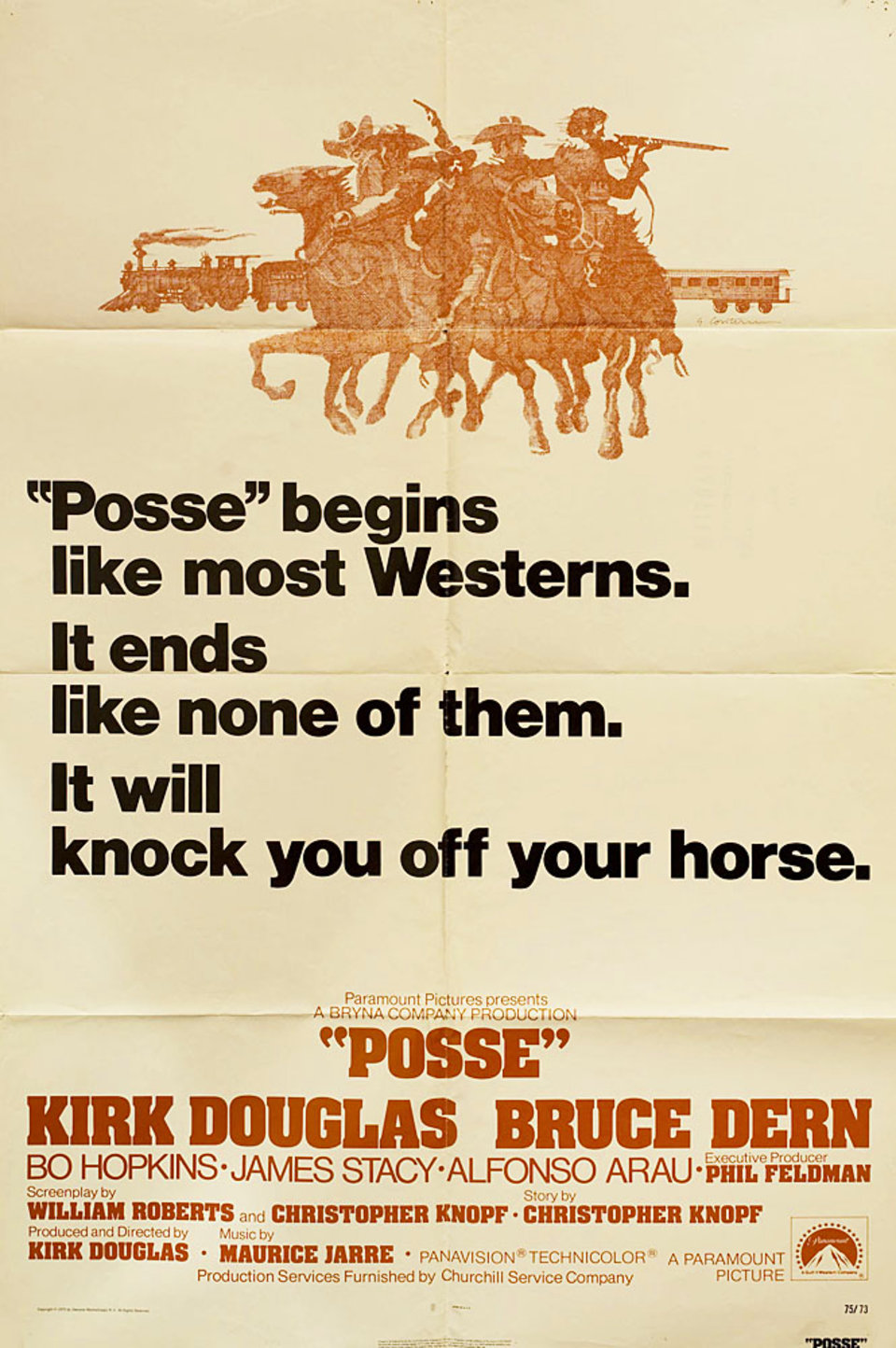
Posse (1975)

By Richard Winters

My Rating: 7 out of 10

4-Word Review: Everyone has their price.

Howard Nightingale (Kirk Douglas) is an ambitious Marshall looking to run for U.S. Senate and realizes his best bet of winning the seat is by bringing in the notorious train robbing gang led by Jack Strawhorn (Bruce Dern). Howard manages to kill off the gang by having his posse set fire to the hideout that they were in, but Jack escapes only to be captured later and brought to jail. While on the train ride to Austin where he’ll be hanged Jack comes up with an elaborate escape and turns-the-tables by handcuffing Howard and returning him to the town where they came from and holding him prisoner inside the local hotel. When the posse returns to the town everyone is convinced they’ll free Howard, or will they?

In an era where revisionist westerns were all the rage it’s confusing, at least initially, not to understand why this one, which story-wise goes completely against-the-grain of the conventional western, isn’t propped up there with the best of them and a lot of the blame could possibly be put on the direction. There’s nothing really wrong with the way it’s presented and there are some exciting moments including a realistic shootout as well as a running train being set on fire while also exploding from dynamite, but the rest of it does have a certain static feel. There’s too much reliance on music and not enough on mood or atmosphere as well as actors looking more like modern day people in period costume.

The script though, which is based on a 1971 short story called ‘The Train’ by Larry Cohen is full of many offbeat twists that keeps the viewer intrigued. Of course in an attempt to stretch out the short story into feature length there are some slow spots, particularly in the middle and the emphasis is more on concept than character development, but Jack’s crafty way at escaping is quite entertaining and the surprise ending is one of the best not because it’s a gimmick, which it isn’t, but more because it’s quite believable and yet something that’s never been done in any other western.

Douglas gives his conniving character just the right amount of pompous camp to make him enjoyable and it’s great to see James Stacy in his first movie role after his tragic motorcycle accident where he lost both his left arm and leg. In any other film this handicap would have to become a major issue, but here it doesn’t even get mentioned. The character doesn’t use it to feel sorry for himself nor is he treated any differently than anyone else, which I found to be quite refreshing.

A minor drawback though it that it’s supposed to take place in Texas and my hometown of Austin even gets mentioned a few times, which is kind of cool, but it was actually filmed in the state of Arizona. To some this might not be a big deal, but Arizona’s landscape is much sandier and has more mountains. Their cacti is of the upright kind while in Texas the cactus is of the bushy variety known as the prickly pear. All of which helps to ruin the film’s authenticity. If they didn’t have the funding to film it in Texas then have the story’s setting take place in California or Arizona, but trying to compromise it and hoping that astute viewers won’t know the difference doesn’t work.

My Rating: 7 out of 10

Released: June 4, 1975

Runtime: 1 Hour 32 Minutes

Rated PG

Director: Kirk Douglas

Studio: Paramount Pictures

Available: DVD, Amazon Video, YouTube

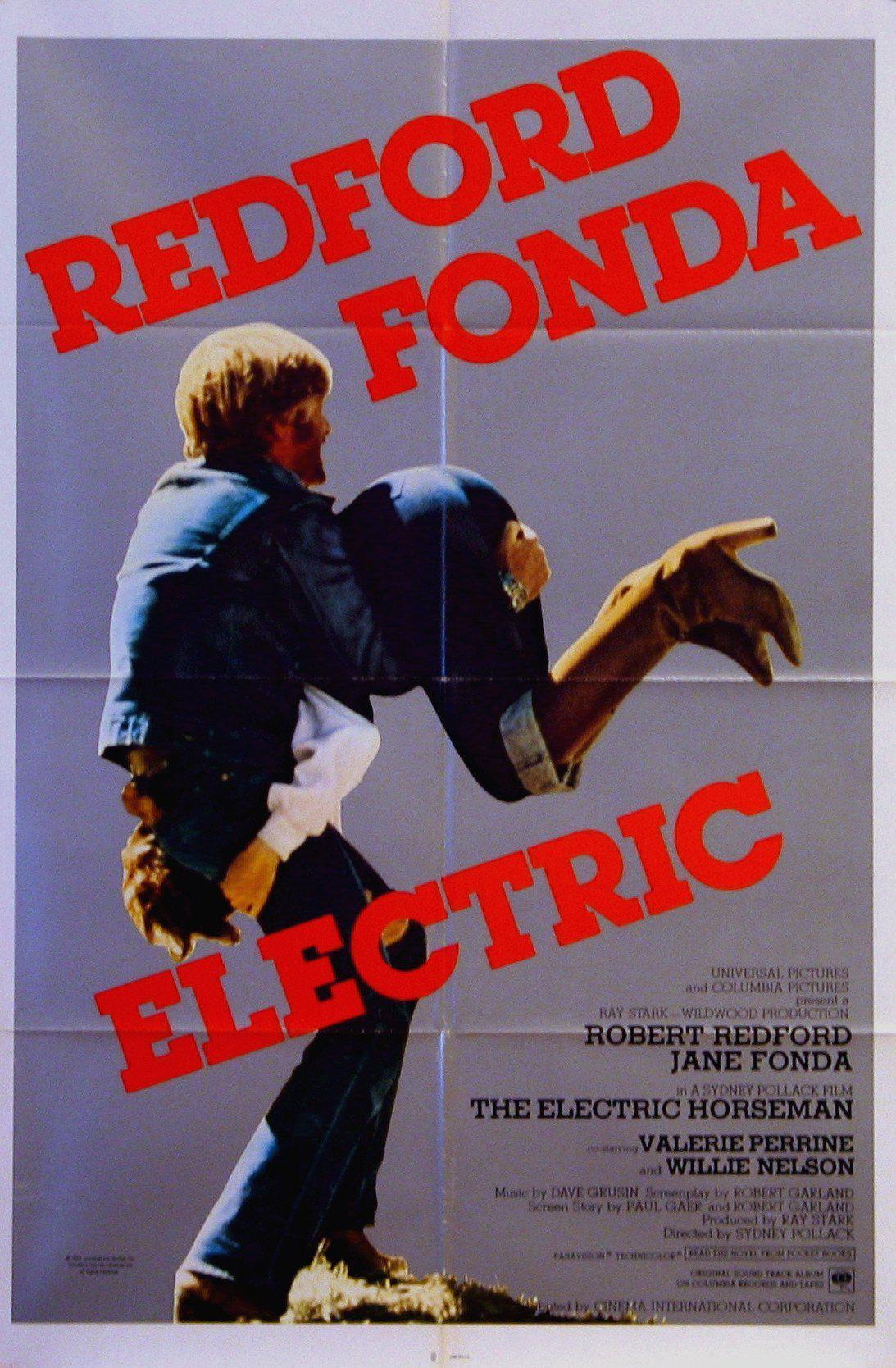
The Electric Horseman (1979)

By Richard Winters

My Rating: 3 out of 10

4-Word Review: Aging cowboy steals horse.

Sonny (Robert Redford) used to be a championship rodeo star, but those days are long behind him. Now he works as a spokesmodel for a cereal company and his next gig has him in Las Vegas where he’s set to ride a horse on stage while he wears a string of flashing lights. Sonny though has become disillusioned with the business as well as upset to find that the horse has been drugged, which propels him to ride off with it while the authorities and an aggressive TV reporter (Jane Fonda) are hot on his tail.

The story can best be described as a lightly comical variation of Lonely are the Bravebut without any of the strong dramatic impact. The biggest problem is that it reveals its cards too quickly making it too obvious what Sonny is planning to do, so when he finally does y abscond with the horse it’s not surprising or even interesting. I was intrigued at how he would get it out of the casino and past security, but the movie cheats this by cutting from him inside the casino one second to showing him outside on the street in the next frame, which takes away from potential action and excitement of having him fight his way out.

The chase inside a small town where Sonny and his horse outrun a mob of police cars and cops on motorbikes is fun, but it ends up being the only exciting moment in the film. Everything else gets toned down too much where even the bad guy, played by John Saxon, is boring because all he does is sit in a office while getting reports from others as to Sonny’s whereabouts instead of having him actively chase after the renegade cowboy himself, which would’ve heightened the tension.

Fonda’s character comes off like an unwanted house guest who tries to take over the place even when they weren’t invited. Her character is too abrasive and while everyone else is laid-back she comes of as being quite aggressive and otherwise out-of-place with the tone of the movie. Valerie Perrine, who has a much smaller part as Sonny’s ex-wife, does a far better job here and is more in step with the unglamorous, rugged western theme. Had she been the one to chase after Sonny then the romantic side-story that develops would’ve been cute and engaging, but having Fonda become the love interest just makes the whole thing seem forced.

Had the action and humor been  more jacked-up than it might’ve been a winner as Redford himself is quite good. I was a bit surprised too because I initially didn’t think this was the right fit for his talents, but his subtle country accent and brash attitude is fun and Willie Nelson, in his film debut, is quite good in support. Unfortunately the plot never catches its stride and in fact the more it goes on the boring it gets.

My Rating: 3 out of 10

Released: December 16, 1979

Runtime: 2 Hours 1 Minute

Rated PG

Director: Sydney Pollack

Studio: Universal Pictures

Available: DVD, Blu-ray (Region B/2)