Category Archives: Offbeat

A Zed & Two Noughts (1985)

zed 3

By Richard Winters

My Rating: 6 out of 10

4-Word Review: They’re really into decay.

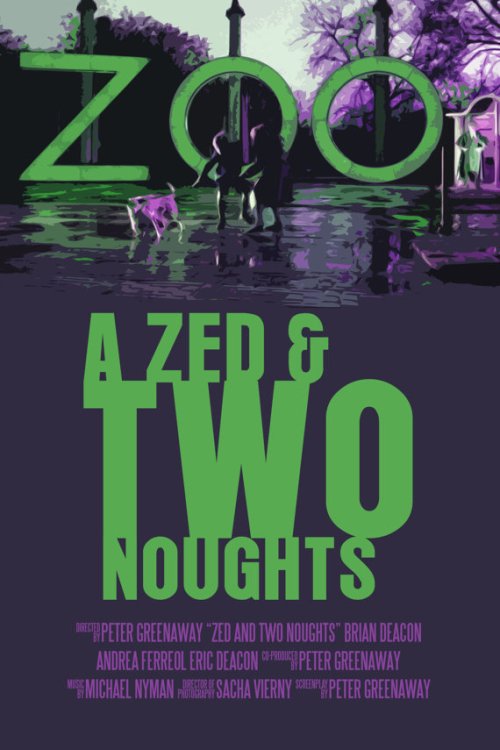
Oswald and Oliver (Brian and Eric Deacon) are twin brothers working at a zoo who become devastated to learn that both of their wives have died in the same freak accident in a car driven by Alba (Andrea Ferreol) who survives, but without her leg. Initially the brothers’ are angered with her, but this slowly grows into a strange attraction, which eventually forms into a ménage a trois. To help with their grief they begin doing time-lapse photography of the decaying process. They start with dead animals before deciding on a human subject with Alba as their chosen ‘star’.

From a completely visual level this film can be considered a great success. This was the first of ten projects that Director Peter Greenaway and cinematographer Sacha Vierny collaborated on and the result is stunning. The vivid contrasting colors, lighting and symmetrically designed sets make each and every shot look like its own painting. This is also one of the few films that completely transcend its era. Usually one can tell what decade a movie is from by watching it for only a few minutes, but this film is unlike any other ‘80s movie made, which is an achievement unto itself.

The best part of the movie is its depiction of the real-life decaying process captured in time-lapse form. I realize this may sound extremely morbid and ‘sick’, but it’s a natural process of the world we live in and if taken from a purely scientific perspective quite an interesting and fascinating phenomenon to watch. It gives the film a unique one-of-a-kind edge and something I wished had been shown even more.

The film’s drawbacks are the characters that come off as too weird and twisted, which is an issue in a lot of Greenaway’s movies that are always technically brilliant, but lacking in emotion or empathy. A good movie, no matter how ‘artistic’ it may be still needs relatable characters to help propel it and instead this movie has what amounts to mouth pieces in disguise as people who are simply used to relay a concept, but in no way connected to anyone you’d ever meet in real life. This results in leaving the viewer cold and making the film more of an ‘Avant-garde experiment’ than an actual story.

My Rating: 6 out of 10

Released: October 4, 1985

Runtime: 1Hour 55Minutes

Not Rated

Director: Peter Greenaway

Studio: British Film Institute

Available: VHS, DVD, Blu-ray
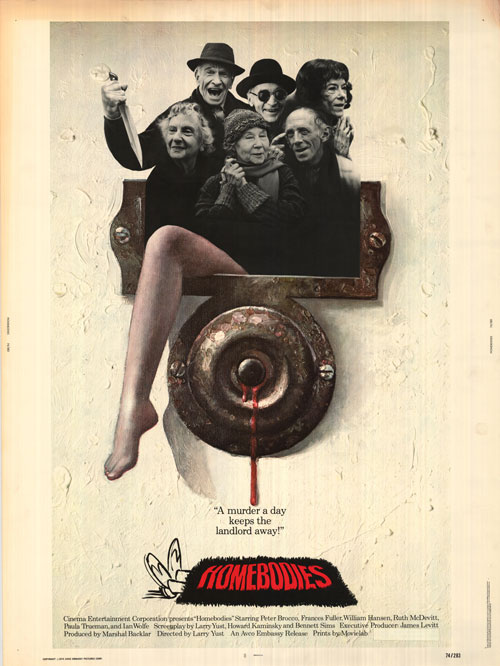
Homebodies (1974)

homebodies 2

By Richard Winters

My Rating: 5 out of 10

4-Word Review: Old people become killers.

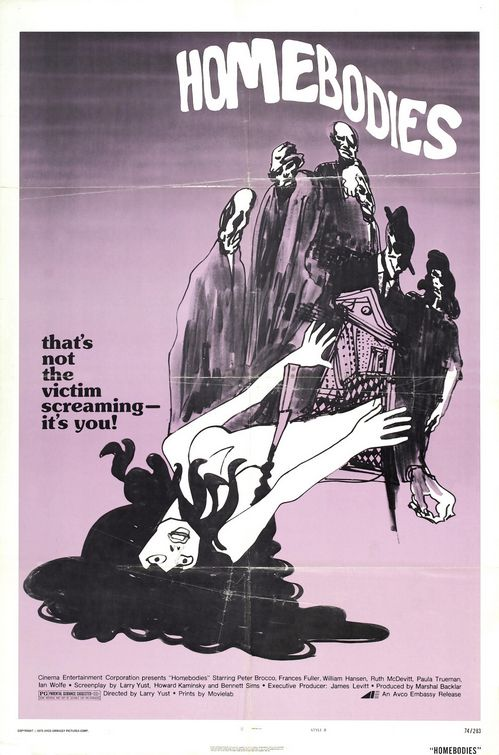
Senior citizens living in a rundown apartment building are shocked to learn that they will be evicted so that their place can be torn down and turned into an office complex. They resist the move and devise a scheme in which they will create ‘accidents’ at the construction site that will cause fatalities and hopefully impede the building process. They even do away with the project developer (Douglas Fowley) by drowning him in hardening cement, but then one of them, Mrs. Loomis, (Ruth McDevitt) begins to suffer from a guilty conscience. She considers going to the authorities, but the others try to stop her, which soon creates deceit and murder from within the group.

Shot on-location in Cincinnati the film has a neat offbeat concept, but it’s unable to execute it to its full potential. It tries too hard to mix in too many different story elements and shifts awkwardly between drama, dark comedy, horror and even social commentary. The result is a mixed bag that never gets off the ground. There are a few interesting moments, but the first half is slow and barely seems like a horror movie at all.

Part of the problem is that the deaths aren’t novel. Outside of the one where Fowley gets submerged in cement the rest are run-of-the-mill. We never see how the seniors are able to create the ‘accidents’ at the construction site and it seemed hard to believe that they would’ve been agile enough to get around inside a dark building, late at night to set up the booby traps to begin with. It would’ve been fun had the killings been caused by using items connected with old age like bashing the victims over the head with a cane, running them down with a walker, or forcing them to swallow a bottle of Geritol. The filmmakers work hard to create sympathy for the seniors, but portraying them as creepy, scary and threatening would’ve made it more edgy.

Paula Truman is good in the lead as well as Ruth McDevitt as the granny with mixed emotions. Fowley though is a bore as the heavy as his caricature of a brash, ego-driven developer is too one-dimensional and he looks just as elderly as the rest of the cast. Hiring a much younger actor to play the part would’ve created more of an interesting contrast.

Larry Yust’s direction is competent and helps keep the proceedings palatable, but as a whole it’s undercooked and undeserving of the cult classic status that they were clearly hoping for.

homebodies 4

My Rating: 5 out of 10

Released: September 29, 1974

Runtime: 1Hour 36Minutes

Rated PG

Director: Larry Yust

Studio: AVCO Embassy Pictures

Available: VHS

Slapstick (Of Another Kind) (1982)

slapstick

By Richard Winters

My Rating: 2 out of 10

4-Word Review: These twins are extraterrestrials.

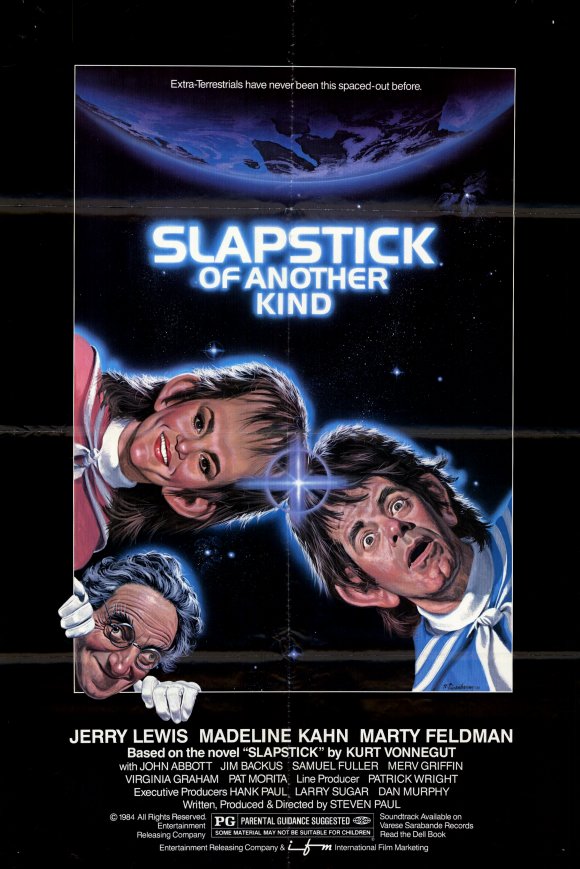
Based on the Kurt Vonnegut novel ‘Slapstick’ the story centers on a Caleb and Lutetia (Jerry Lewis, Madeline Kahn)  who are a rich and famous couple that give birth to deformed and ugly twins named Wilbur and Eliza (also played by Lewis and Kahn). The couple immediately disowns the children and has them put away into a home run by Sylvester (Marty Feldman) who acts as the children’s caretaker. Unbeknownst to anyone is the fact that twins are actually aliens implanted inside Lutetia by a race of super intelligent beings from a faraway planet as a way to help earthlings solve all of their problems. When the twins put their cone sized heads together they are super smart, but when they are separated they are dumb making everyone believe that they are mentally deficient and of no use to anyone.

The biggest problem with this disastrous attempt at a movie is the approach. Director Steven Paul who ironically made his acting debut in Happy Birthday, Wanda June, which was another Vonnegut book adaptation brought to the screen seems to have no idea what type of audience he is aiming for. The humor shifts wildly between child-like farce to satirical jabs with nothing in-between, which will alienate both adults and children alike. The grownups will find it incoherent and silly while the children will be frightened by the ugly visuals as well as the cold, callous nature of the characters and plot. There is also a strange side story that make no sense and deals with miniaturized Chinese men who are the size of a human thumb and fly around in a spaceship resembling an eggroll while trying to make contact with the twins in order for them the help make a deal on the sale of gravity?!!!!

Lewis and Kahn are relatively amusing as the snotty couple, but as the twins they are downright embarrassing. The scene where they have a food fight while yammering incessant baby talk is a degrading sight and a career low for both performers. I know Lewis has the reputation of doing some really silly, inane stuff, but even this should’ve been beneath him.

The eclectic supporting cast helps a little and the only reason that I’m giving it 2 points. Feldman is genuinely amusing and it’s great seeing Jim Backus in one of his last acting roles playing the President of the United States and hearing this predominantly kid-friendly performer utter the word shit…twice!

I have never read the novel from which this is based, but have heard that it is far superior, which isn’t a surprise. I’d be interested to know what Vonnegut, who apparently wrote the lyrics to a song sung by Kahn in the film, but then later cut, thought of this catastrophe. Some bad films are fun because you can make jokes about as it goes along, but this thing is so utterly bizarre from beginning to end that instead you sit in a stupor throughout and it becomes a surreal experience instead.

My Rating: 2 out of 10

Released: December 1, 1982

Runtime: 1Hour 22Minutes

Rated PG

Studio: International Film Marketing

Director: Steven Paul

Available: VHS, Amazon Instant Video

Brother John (1971)

brother john 1

By Richard Winters

My Rating: 7 out of 10

4-Word Review: Is an apocalypse coming?

Upon the death of his sister, John Kane (Sidney Poitier) returns to his hometown in Alabama to attend her funeral, but the town’s mayor (Bradford Dillman) and sheriff (Ramon Bieri) think he is an outside union agitator there to stir up trouble with the local factory. Doc Thomas (Will Geer) is an old man who’s been in the town his whole life and knows better. He recognizes that John has a special gift of some kind and can see into the future, but what John proclaims is not good as he states that an end of the world is coming and the human race will have to justify their existence to the almighty.

This film, which was written by Ernest Kinoy and directed by James Goldstone, is unique in that it never reveals too much and keeps the viewer in a shroud of mystery the whole time. We’re given certain hints that John may hold a special power, but never any explanation, which in some films could prove frustrating, but here it makes it intriguing and unusual. Everything is given the low-key treatment including a memorable scene where a racist police officer (Warren J. Kemmerling) invades an African American home bent on teaching John ‘a lesson’ by taking him into the basement only to get a surprise whooping of his own when John proves to be far superior.

Poitier is billed as the star, but he seems constrained in a part that allows for very little emotion. Geer is the one that gives the film its biggest impact particularly with the conversation that he has with Poitier while sitting in a jail cell at the end. I also got a kick out of the fact that he was able in a passing conversation to mention Frankfort, Indiana which was the town that he had been born and raised in, in real-life. Bieri is also quite good as the town’s corrupt sheriff who’s racist on one end, but then when things get out-of-control he then ‘negotiates’ with the town’s black pastor (P. Jay Sidney) to see if they can work together to quell the unrest.

Although the setting is supposedly Alabama it was actually filmed in the town of Marysville, California and for the most part it’s successfully able to camouflage it, but not quite. The ending like the rest of the film is vague and answers little of the questions that the plot puts forth, which may be a turn-off to some, but I enjoyed it. In an era where so many other films were intent on making statements and broad characterizations this one pulled back and much like with religion and faith kept things at an elusive level, which gives it a more sophisticated flair.

My Rating: 7 out of 10

Released: March 24, 1971

Runtime: 1Hour 35Minutes

Rated GP

Director: James Goldstone

Studio: Columbia Pictures

Available: VHS, DVD, Amazon Instant Video, YouTube

Penn & Teller Get Killed (1989)

penn and teller 2

By Richard Winters

My Rating: 7 out of 10

4-Word Review: A killer targets Penn.

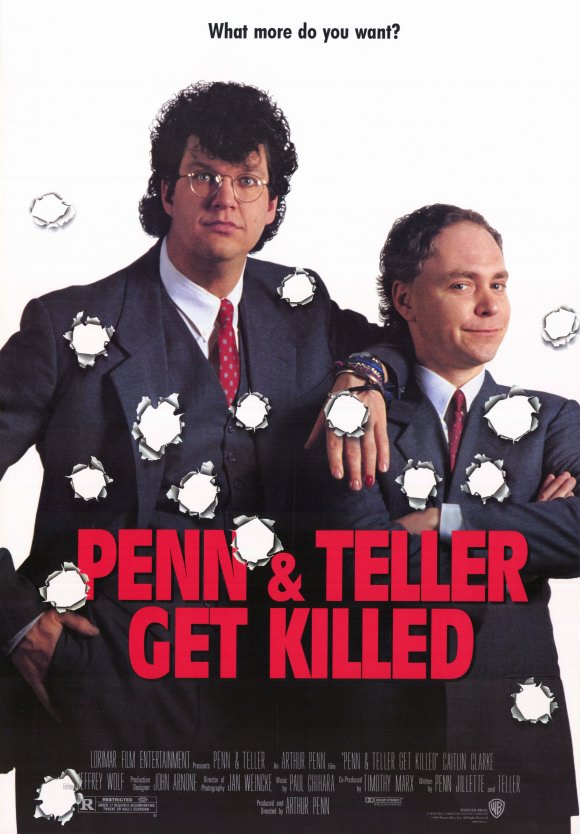
During an interview segment on a nationally televised talk show magician Penn Jillette jokes that it would be interesting to have someone out to kill him. After the show is over strange things begin to occur, but he initially thinks its practical jokes done by his partner Teller. Eventually he becomes aware that someone really is after him who even switches his identity so that he resembles Jillette. The two lay low and even hire an attractive lady cop (Caitlin Clarke) to protect them, but things are never quite as they seem in a film that features one crazy twist after another.

For the most part the film works well despite an unconventional structure that may take a while for some viewers to get used to. The script was written by the two stars and I enjoyed the surreal tone and the sort of mind games it plays with the viewer as one is never quite sure what’s real and what isn’t. The humor is offbeat and funny. I enjoyed their opening act that they do while hanging upside down and how the killer (David Patrick Kelly) tries to reenact it at the end of the film while using himself in Penn’s place. The segment where Teller keeps throwing coins at a man inside a casino was my favorite and I also got a kick out of Penn’s conversation with Teller inside a taxi cab after he is stabbed.

Penn seems like a natural in front of the camera and just like with their stage act does all the talking. Teller though gets a lot of screen time and is surprisingly engaging despite his silence. He finally does speak at the end, which I didn’t like as it broke the mystique of the character and really wasn’t all that clever or amusing. The late Caitlin Clarke gives solid support in the dual role as Penn’s girlfriend and the tough talking Officer McNamara. If you look closely you will also briefly spot Jon Cryer as a frat boy, Tom Sizemore as a mugger and famous atheist James Randi as the ‘3rd rope holder’.

Spoiler Alert!

The only real issue that I had with the film is the ending in which all the main characters end up dying either by being shot or committing suicide. I’m sure this may have seemed clever on paper, but it comes off as maudlin and overdone as well as hurting the film’s otherwise playful tone. I also didn’t get why the two characters after having been shot didn’t have bullet holes in their bodies or any type of blood coming out of them. These guys use blood quite liberally in their stage act and it gets used in other parts of the film, so why not have it when it really counts at the end? The female character kills herself by jumping out the window and yet in the very next shot two men are seen walking on the sidewalk just outside of the apartment, but there’s no dead body on the ground, which doesn’t make sense. Penn’s closing narration helps save it a little, but the segment still seems like they wrote themselves into a hole that they couldn’t get out of.

End of Spoiler Alert!

My Rating: 7 out of 10

Released: September 22, 1989

Runtime: 1Hour 30Minutes

Rated R

Director: Arthur Penn

Studio: Warner Brothers

Available: VHS, DVD (Warner Archive), Amazon Instant Video

David Holzman’s Diary (1967)

david holzman 1

By Richard Winters

My Rating: 8 out of 10

4-Word Review: He records his life.

David (L.M. Kit Carson) is a young college-aged movie fan who wants to use the camera to not only record his life, but help him better understand and interpret reality. Unfortunately he finds that instead of clarifying things the camera instead brings out even more of reality’s complexities making his life and the world he is in even more confusing. It also inadvertently exposes a darker side to his personality that he wasn’t aware of which his voyeurism to both an attractive woman across the street as well as his live-in girlfriend Penny (Eileen Dietz) who eventually gets fed up with his film and him and moves out.

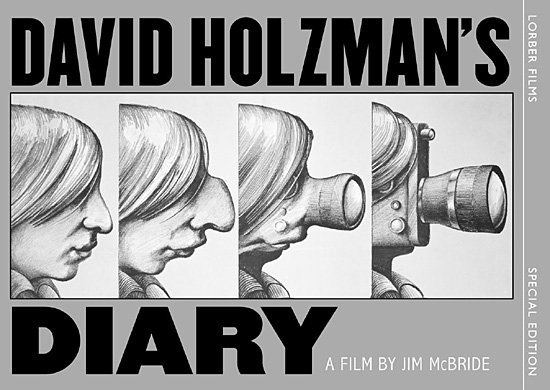
I realize the saying ‘ahead of its time’ can get a bit overused, but this is one case where that term really fits. This movie is cool on many different levels and features scenes and segments that you will never see done anywhere else. The Cinema verite style is perfect and I loved how the camera gets turned on itself as we are given a good background and visual to the type of camera that was used and why for its time was considered a cutting edge piece of machinery. The scene where he takes a shot of every image that he saw during a night of television viewing and then plays it back creating a mosaic of flashing images from shows and commercials is equally cool. The segment where he interviews a woman, which was apparently a man dressed in drag, but quite hard to tell, who stops her car in the middle of the street to tell him of her candid sexual desires while holding up traffic is quite amusing as is the part where he stalks a nervous lady from a subway car out onto the city streets.

The film also successfully transcends its time period. I have always said it is very easy to tell the time period or decade a movie was made usually after viewing it for only a few minutes, but this was one case where it is actually quite hard to tell. The detached, hip nature of the protagonist is still trendy and the film’s existential philosophical approach dealing with an artist’s need to recreate reality, but ultimately failing is as relevant today as ever. The loosely structured ad-libbed dialogue gives it a legitimate documentary feeling and was so believable that when audiences first viewed it during the 60’s they booed when they saw the closing credits and realized it had all been made-up. This was also the first American film to use the f-word and one of the first to feature full nudity, which is done by the attractive Dietz who later went on to play the face of the demon in the movie The Exorcist.

Although I saw this movie many years earlier and was already a big fan I watched it again during a special showing at the The Marchesa Theatre in Austin as a tribute to the film’s star who passed away in October of 2014. Afterwards many people got on stage to talk about how Carson had inspired them with their lives and careers and it included his son Hunter Carson as well as film director Guillermo del Toro who was probably the most entertaining.

If the film has any drawbacks it’s in the use of black frames that are shown in between shots where for several seconds the viewer will see no image at all and at times only a voice over. This might’ve been done for effect, but ends up giving it too much of an amateurish feel. There are also times when the camera stays too fixated on its subject making it look too much like talking heads with not enough cutaways or interesting camera angles. Overall though it’s still one-of-a-kind and worth checking out for a glimpse at experimental and original filmmaking at its purest.

david holzman 2

My Rating: 8 out of 10

Released: October 3, 1967

Runtime 1Hour 14Minutes

Not Rated

Director: Jim McBride

Studio: Direct Cinema Limited

Available: DVD, Blu-ray, Amazon Instant Video

Mr. Sycamore (1975)

mr sycamore 1

By Richard Winters

My Rating: 4 out of 10

4-Word Review: Mailman becomes a tree.

Bored with his job as a mailman and unhappy in his marriage John Gwilt (Jason Robards) decides one day to turn himself into an oak tree. He digs a hole in his backyard and ‘plants’ himself into it where he stands there day and night waiting to become a tree while his wife Jane (Sandy Dennis) tries desperately to talk him out of it, his neighbor Fred (Robert Easton) laughs at him and his minister (Mark Miller) tries to have him committed.

The film, which is based on a 1942 Broadway play, has a certain whimsical tone to it that might be pleasing to some if in the right mood and there is a certain strange intrigue at wondering just how this thing will end and whether he will eventually turn into a tree or not. However, the material would be better suited as a film short and the offbeat quality gets lost in a script that deals solely with a long parade of people who come into contact with John and their predictably shocked and confused responses when finding out what he is trying to do. The low budget is also an issue and outside of showing the inner-workings of a mail processing machine at the beginning there is no visual style at all.

Robards is a natural for the part, but he had already played a nonconformist looking to drop out of society earlier in the film and stage play A Thousand Clowns making his appearance here seem almost like typecasting. Jean Simmons gets wasted in a small bit as John’s secret love interest. Dennis, who usually plays kooky characters, becomes the most rational one here, which ultimately is the film’s weirdest element.

This definite curio does have a few amusing moments, but it lacks a second act or interesting side story and eventually talks its strange concept to death until it becomes boring.

My Rating: 4 out of 10

Released: December 12, 1975

Runtime: 1Hour 28Minutes

Rated G

Director: Pancho Kohner

Studio: Film Ventures International

Available: VHS

Static (1985)

static 1


By Richard Winters

My Rating: 5 out of 10

4-Word Review: Everybody sees only static.

Ernie Blick (Keith Gordon) works at a crucifix factory, but dreams of making it big with his secret invention. The whole town that he lives in is abuzz about it and many take bets as to what it is. However, once Ernie unveils it no one is impressed. Ernie insists that he has created a device that can show live images of heaven, but all anyone else can see on the TV screen is static. Ernie becomes frustrated that no one can appreciate what he has done so he hijacks a bus carrying a group of senior citizens in order to create a media event that will allow him to share his invention with the rest of the world, but things don’t go as planned.

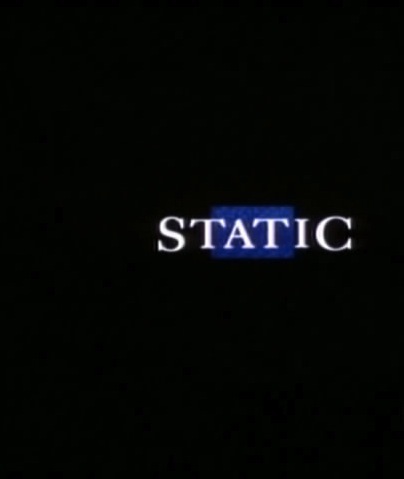
The film has that refreshing look and feel of an authentic indie flick made long before it was trendy and still in its infancy of being a trailblazer for original ideas. It’s fun and clever most of the way including a memorable shot of Ernie’s weird crucifix collection. The humor is subtle and hip with a cool music selection from lesser known 80’s bands. Director Mark Romanek shows great visual flair with his use of unique settings and color designs. The dialogue and characters are both engaging and quirky. I also loved the opening credits, which features a small, static filled TV screen in the distant background along with the sound of a low hum, which I found to be strangely hypnotic.

Gordon, who co-wrote the screenplay, does well in a difficult role where the viewer is supposed to find him likable and appealing despite the fact that he is clearly a bit unhinged. Amanda Plummer as his girlfriend gets a rare turn as being the most normal one in the film, which is interesting. Bob Gunton has a few choice moments as a conniving preacher man named Frank and Jane Hoffman is amusing as a senior citizen who tries to help Ernie on his mission.

Unfortunately the story doesn’t carry the quirky idea to a successful completion. It might have worked better had there been some image of some kind seen and then everyone could’ve debated whether that was indeed heaven or not instead of just seeing static, which comes off like a big buildup to nothing. The satire is too obvious and its overall message frustratingly vague. The violent and completely unexpected tragic ending is jarring and unnecessary and ruins its otherwise pleasant, whimsical tone.

There is also a scene where Gordon and Plummer go to a restaurant and order food, but when it gets served they barely touch it and then a minute later get up and leave after paying the bill, but why pay for something or even order if you’re just going to leave it there untouched? This is an annoying thing that I’ve seen happen in other films as well. I hate to sound preachy, but sometimes when I see these types of scenes I feel like screaming ‘There’s kids starving in Africa, so don’t waste your food people’!

static 2

My Rating: 5 out of 10

Released: October 1, 1985

Runtime: 1Hour 33Minutes

Rated R

Director: Mark Romanek

Studio: Siren

Available: VHS 

The Adventures of Buckaroo Banzai Across the 8th Dimension (1984)

adventures of buckaro banzai 1

By Richard Winters

My Rating: 5 out of 10

4-Word Review: This thing is weird.

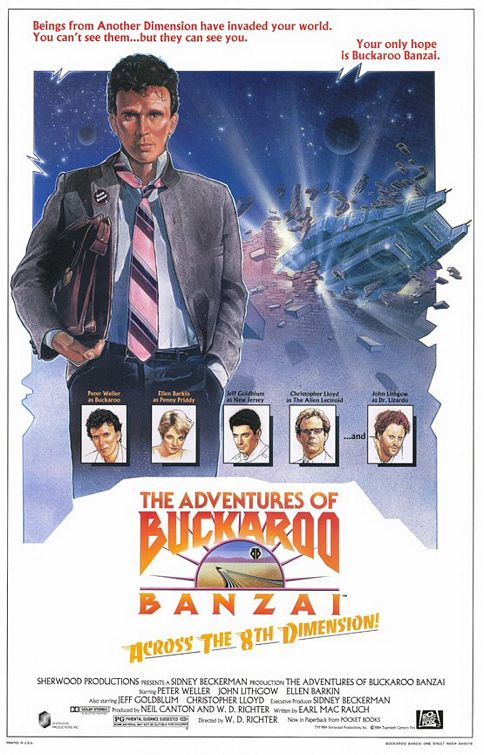
Buckaroo Banzai (Peter Weller) is part-time rock band singer who has invented a mechanism that he calls the oscillation overthruster that allows him to travel through rocks and other solid matter. He is somehow able to do this by tapping into the realms of the 8th dimension, but upon doing so he also attracts the attention of some aliens lead by Lord John Whorfin (Jon Lithgow) who wants to steal the device and use it for their own nefarious needs. Buckaroo, who is able to recognize these aliens who otherwise look human to everyone else after being zapped by some electronic component through a telephone receiver by a group of other aliens, gets a group of fellow geeks together to help fight the evil Whorfin and his men before it is too late.

In a lot of ways this film is a refreshing change-of-pace and it is not surprising that it has attained such a strong cult following. Most films with such an offbeat concept end up selling out and becoming quite formulaic and conventional with only a few odd elements thrown in for good measure, but this movie is completely weird in all facets and truly lives up to its campy over-the-top title. I loved the off-the-wall banter, ridiculously silly, but still quite entertaining special effects and characters that are uniformly warped. The comic book look is great and the story gets increasingly more absurd as it goes along. You have to tune out your logic and conventional movie mode to get into this and enjoy it, but the humor and chuckles are there if you let it.

Unfortunately the pace as well as the beginning become a bit too off. I found things to be completely confusing at the start that I really couldn’t understand what was going on for the whole first half-hour. The film seemed to jump from one outlandish scene and character to the next without any cohesion and the result was quite off-putting. It wasn’t until about 45 minutes in that I was able to finally get into the groove with it, but more of a background to the characters and a set-up would have helped greatly. There are still enough memorably unique moments to make it worth it including my favorite the Banzai Team March, which was filmed at the Sepulveda Dam in the San Fernando Valley and shown over the closing credits.

Weller is in fine form in the lead and seems much more at ease with this role than he was in Robocop where he came off as being miscast. Lithgow is a hoot as an over-the-top villain speaking with a heavy Russian/German accent. I also enjoyed Matt Clark as the Secretary of Defense who acts as if he is above all rules of protocol until finally being put into his place by a little kid with a rifle.

The closing credits listed a follow-up title that was supposedly going to be a sequel that unfortunately was never made due to the film’s production company going out of business, which is a shame as this thing had strong potential of becoming a major franchise. W.D. Richter who has an impressive screenwriting resume does well in his directorial debut and it’s an equal shame that he only helmed one other movie at this point as he shows potential to being uniquely talented in that position.

My Rating: 5 out of 10

Released: August 10, 1984

Runtime: 1Hour 43Minutes

Rated PG

Director: W.D. Richter

Studio: 20th Century Fox

Available: VHS, DVD, Amazon Instant Video

Who is Harry Kellerman and Why Is He Saying Those Terrible Things About Me? (1971)

who is harry kellerman 2

By Richard Winters

My Rating: 4 out of 10

4-Word Review: Paranoid songwriter self-destructs.

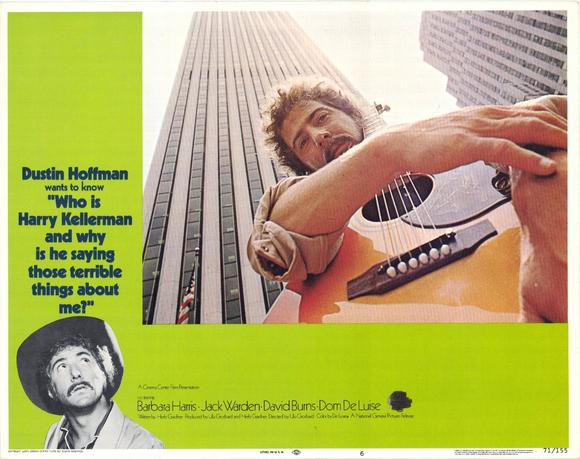
Georgie Soloway (Dustin Hoffman) is a successful songwriter who has written dozens of chart topping songs for different bands and yet feels alone and guilt ridden. He lives in his swanky Manhattan penthouse feeling paranoid after a man by the name of Harry Kellerman starts calling his friends and saying malicious things about him, which risks jeopardizing his career and reputation. He tells his problems to his psychiatrist (Jack Warden) while also searching for Kellerman, but makes no headway.

Story-wise the film is a misfire as Herb Gardner’s script has no discernable plot and a main character that doesn’t grow or evolve. Even if taken as a collection of vignettes it doesn’t work and it becomes more like a pointless one-man soliloquy instead. The final revelation of the mysterious Kellerman is not all that surprising or worth sitting through. Why the filmmakers thought viewers would be interested in watching a man essentially self-destruct for two hours is a mystery and it is as boring as it sounds. Besides it is hard for the average person to feel sorry for someone who seems to have it all and loaded with money and thus makes the character’s problems and issues seem quite minute and his perpetual whining overly monotonous.

The only thing that saves it is Ulu Grosbard’s creative direction. I enjoyed some of the surreal elements particularly those done during his sessions with his psychiatrist as well as a scene showing Georgie running through a long lighted tunnel that seems to have no end. The final segment done on a single-jet airplane is captivating especially as it flies through the clouds and watching two skiers’ glide through the snow from a bird’s-eye perspective has an equally mesmerizing effect. I also loved the way the film captures the New York skyline during a visual taken from the plane as it swoops over the city and a scene done in the early morning hours in downtown Manhattan without seemingly a single car driving on the street gives off a strangely unique feeling.

Barbara Harris, who doesn’t come on until the second half, is a scene stealer as an insecure actress who bombs at her audition, but then refuses to leave the stage. It was good enough to get her nominated for the Academy Award that year, but she lost out to Cloris Leachman and as much as I love Cloris Barb really should have won it as she is the one thing the enlivens this otherwise flat film and had her character been in it more this would have been a far better movie. David Burns, who died from a sudden heart attack while performing in a play three months before this film’s release, is touching as Georgie’s father.

Grosbard and Hoffman teamed up again seven years later for Straight Time, which is far superior and more worth your time to watch.

who is harry kellerman 3

My Rating: 4 out of 10

Released: June 15, 1971

Runtime: 1Hour 48Minutes

Rated R

Director: Ulu Grosbard

Studio: National General Pictures

Available: VHS, DVD