Category Archives: Offbeat

Life Size (1974)

life size 1

By Richard Winters

My Rating: 5 out of 10

4-Word Review: A sex doll obsession.

Michel (Michel Piccoli) runs a successful dental practice, but finds that his life is empty and his marriage to his wife Isabelle (Rada Rassimov) is no longer working. He has cheated on her before, but those affairs left him with the same empty feeling, so this time he decides to take a different route by purchasing a life size sex doll that looks so real that she almost seems human. He takes her everywhere and even brings her along to a visit with his mother (Valentine Tessier) so she can meet his new ‘girlfriend’.  The doll becomes the centerpiece of his very existence and he spends every waking moment he can with her until he sees footage, from a closed circuit camera that he has set-up in his house, of one of friends having sex with her while he was away. He becomes outraged at her ‘betrayal’ and decides that her punishment will be ‘death’.

The film, which can best be described as an early, distant cousin to Lars and the Real Girl, definitely has its share of unique and memorable moments. Writer/director Luis Garcia Berlanga does an admirable job of analyzing just what might happen if sexual fantasy gets taken to its most extreme level. The scenes showing Michel taking the doll to a clothing store in order to be measured and fitted with the latest fashions and marrying the doll in a makeshift wedding are by far the film’s two best segments.

However, it’s Michel’s scenes with his wife that I found to be the most unsettling. The scene where he fondles his wife’s naked breasts late at night as she sleeps while looking at a picture of the doll is quirky enough, but then later on, in the film’s most disturbing moment, she tries immersing completely into his sexual fantasy by pretending to be a sex doll herself in a desperate attempt to win him back.

What is initially considered the sexual substitute to the real thing soon becomes the preferable choice here and it reminded me of an article I read in a science journal a few years back about young men in their 20’s forced to be prescribed Viagra because they were no longer able to achieve erections with their wives/girlfriends because the proliferation of porn on the internet had somehow dulled their senses to real sex to the point that they found it to be a ‘turn-off’. Now, if you are a fan of porn then that’s great and I don’t mean to be appear like I’m trying to knock it, but I did find it fascinating that elements of that article correlated to what this film was showing and how successful this movie was at foreshadowing the phenomenon’s that we are now seeing in our modern day culture.

Although the film is adequately directed and more of a psychological study than a perverse sleaze feast it’s still not an overall success. The main issue is that the main character acts overtly freaky about the doll from the very beginning without enough backstory to tell us why and simply saying it’s due to a unhappy marriage is not enough. A far more compelling concept would’ve been to portray the main character as being more ‘normal’ by having him feel awkward about the doll and even a bit embarrassed only to grow increasingly more obsessed as the film progresses until his ultimate infatuation with it shocks even him.

Alternate Titles: Grandeur Nature, Love Doll, Tamano Natural

My Rating: 5 out of 10

Released: August 21, 1974

Runtime: 1Hour 41Minutes

Rated X

Director: Luis Garcia Berlanga

Studio: Cinema International Corporation

Available: None at this time.
Angel, Angel, Down We Go (1969)

angel angel 1

By Richard Winters

My Rating: 4 out of 10

4-Word Review: Singer manipulates rich family.

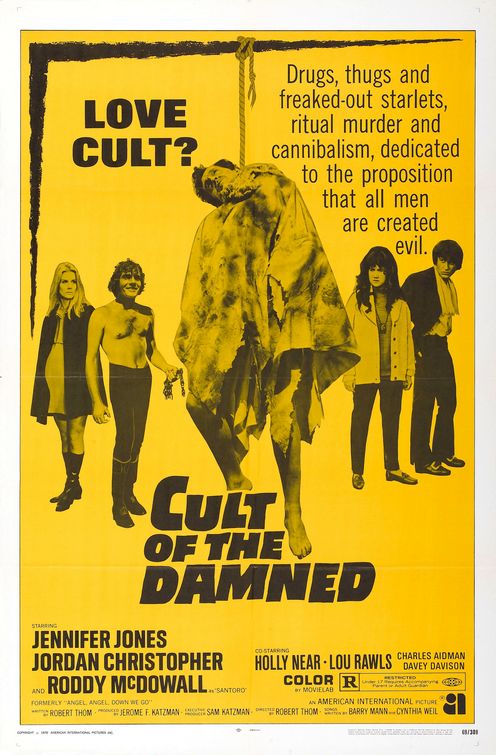
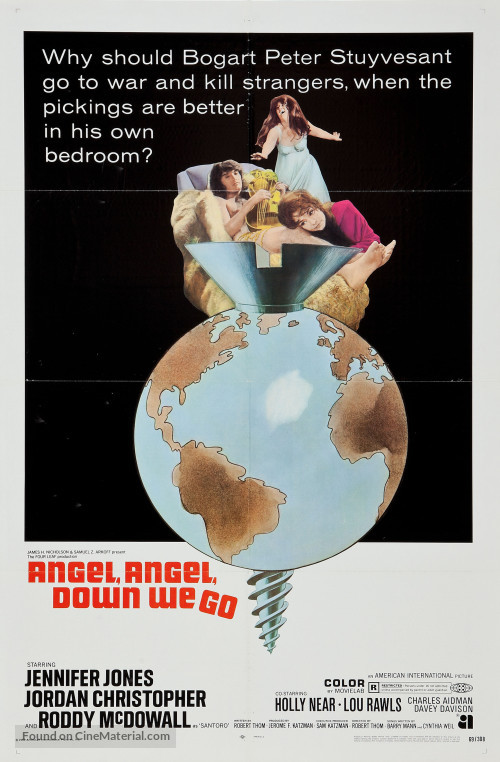
Tara (Holly Near) is an overweight teen who feels like a social outcast. Her family is rich, but empty on love. Her mother (Jennifer Jones) is a former star of stag films and boozes it up on the bottle, but still manages to look quite attractive, even better than her daughter, which she constantly reminds her of. Her father (Charles Aidman) is a closet homosexual who routinely brings in male lovers for entertainment. When a rock group with a dashing lead singer (Jordan Christopher) arrives at her sprawling family home to help host a party Tara doesn’t hesitate to fall into his open arms. At first he seems to be the answer to her loneliness, but after a while she realizes he has a plan of his own as he not only seduces the mother, but her father as well before manipulating his way into the family fortune.

The main reason to watch this film, if not the only one, is for the performance of Jones in this her second-to-last cinematic appearance. She gives an incredibly strong, multi-faceted portrayal of a middle-aged woman on the emotional edge who realizes she’s being used, but allows it to happen simply so she can still feel desirable. Her presence lifts the sleazy material to watchable heights and comes just a year after she herself tried to commit suicide after hearing of the death of a close friend in real-life.

Near, who has later become a well-known folk singer, gives an effectively sensitive portrayal of a troubled teen, which allows her to be the one character that the viewer has any sympathy for. The rest of the cast though, which includes Roddy McDowall and Lou Rawls as Christopher’s band mates, are essentially wasted although you will get a full view of McDowall’s bare bottom for those few who are interested.

The garishly colorful collages done by Shirley Kaplan are visually alluring, but writer/director Robert Thom goes back to them too often. The aerial skydiving footage is excellent, even breathtaking, but the script as a whole, despite its lurid and even groundbreaking subject matter, falls flat. A lot of the reason for this is the fact that it’s poorly paced with too much time given to Christopher who sings a total of five songs, which does nothing but slow the proceedings down to a screeching halt. The ending is vague and aloof, which only helps to cements this as a misfire and good only as a curio.

The film did quite poorly upon its initial release, so it was reissued under another a title called Cult of the Damned in hopes that it could cash in on the hysteria of the Manson murders that had occurred around the same time, even though the story doesn’t have anything to do with a religious cult and the movie still fared no better at the box office.

angel angel 2

Alternate Title: Cult of the Damned

My Rating: 4 out of 10

Released: August 19, 1969

Runtime: 1Hour 29Minutes

Rated R

Director: Robert Thom

Studio: American International Pictures

Available: DVD, Blu-ray, Amazon Instant Video

The Jogger (1988)

Capture 81

By Richard Winters

My Rating: 5 out of 10

4-Word Review: Jogging can be deadly.

Jerry (Terry O’Quinn) is a high-strung businessman with a type A personality who has been told by his doctor to take up jogging to help relieve is stress and improve his health. Like with everything else he goes overboard with it. Jogging excessively until it becomes like a second job. One day while out on another one of his morning runs he comes upon another jogger (Tom Morga). Jerry decides to challenge the man to a race and he ends up winning it making him feel quite vindicated, but the other jogger does not take kindly to losing. He begins to chase Jerry around the park while attempting to stab and kill him. When Jerry is finally able to make it back to his house he realizes that the jogger has followed him and he continues with his assault. In fact wherever Jerry goes the jogger follows making him believe that he will not be able to get rid of him unless he fights back.

For a low budget short film this isn’t too bad. The editing and camerawork is crisp and professional. We get a good idea of Jerry’s character in a short amount of time and it’s great seeing O’Quinn in an early role. The action is exciting and there is enough tension to keep it interesting. There are even a few genuine unexpected jolts and a surprise ending.

The story initially seems original, but as it progresses you realize that it is just another retelling of the classic ‘The Twilight Zone’ episode entitled ‘The Hitch-Hiker’ in which the Inger Stevens character is constantly hounded by a mysterious hitch-hiker who turns up wherever she goes. The surreal elements that get thrown into this thing don’t help and I would’ve liked something that had stayed more realistic and been more subtle. Yet it’s still enjoyable enough for its short running time and some may find the scenario to be more creative than I did.

My Rating: 5 out of 10

Released: 1988

Runtime: 25Minutes

Director: Robert Resnikoff

Available: None at this time.
One Way Pendulum (1965)

one way pendulum 1

By Richard Winters

My Rating: 4 out of 10

4-Word Review: An absurd little movie.

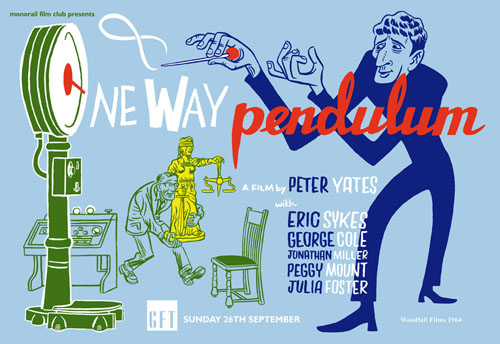
The Groomkirby family is one really absurd bunch. The father (Eric Sykes) wants to build a replica of the Old Baily courtroom in his living room and then have a trial, involving his son Kirby (Jonathan Miller) as the accused, reenacted. His daughter Sylvia (Julia Foster) wishes that she were an ape so that her arms would be longer and discusses this at length with her mother (Alison Leggatt). Kirby steals weight machines, which voices the person’s body weight, off the city streets and brings them back to the family’s attic were he then converts them into machines that sing. There’s also Aunt Mildred (Mona Washbourne) who thinks she’s waiting for a train that never comes as well as Mrs. Gantry (Peggy Mount) who’s paid to come over and eat the family’s unwanted leftovers.

The film is based on the stage play of the same name written by N.F. Simpson and was labeled as being ‘A farce in a new dimension’. John Cleese is purportedly a big fan of the movie and credits it as inspiring many of the absurd ideas that they used in their later Monty Python sketches. It was also directed by Peter Yates who went on to direct such quintessential hits as Bullitt, Breaking Away, and Year of the Comet.

The film certainly does have its share of funny and highly original moments. One of my favorite scenes is where the father carts the props that he needs to build his courtroom down a busy street of London using nothing but a wheel barrow and holding up traffic while he does it. Kirby’s ability to make the weight machines sing and sound like a genuine chorus is fun also as well as the climactic courtroom segment in which a myriad of comically absurd arguments, testimony, motions and reasoning is used until it becomes almost mind bending.

Unfortunately it all gets just a little too weird. Normally I’m a fan of the offbeat, but there still needs to be something to anchor it down and this film lacks it. The dialogue, characters and storyline are so progressively strange that it becomes downright nonsensical. The court case loses its edge as well because the father is somehow able to recreate it and the people in it in some magical way using a machine where kidnapping a magistrate and lawyers and forcing them perform in their makeshift court of law would’ve been funnier.

The movie will certainly satisfy those with inkling for the offbeat and the film seems intent to push the absurdity as far as it possibly can with a cast primed to pull it off, but it ends up being too weird for its own good and parts of it are confusing and hard to get into.

My Rating: 4 out of 10

Released: March 2, 1965

Runtime: 1Hour 20Minutes

Not Rated

Director: Peter Yates

Studio: United Artists

Available: None at this time

Watermelon Man (1970)

watermelon man 1

By Richard Winters

My Rating: 7 out of 10

4-Word Review: White man becomes black.

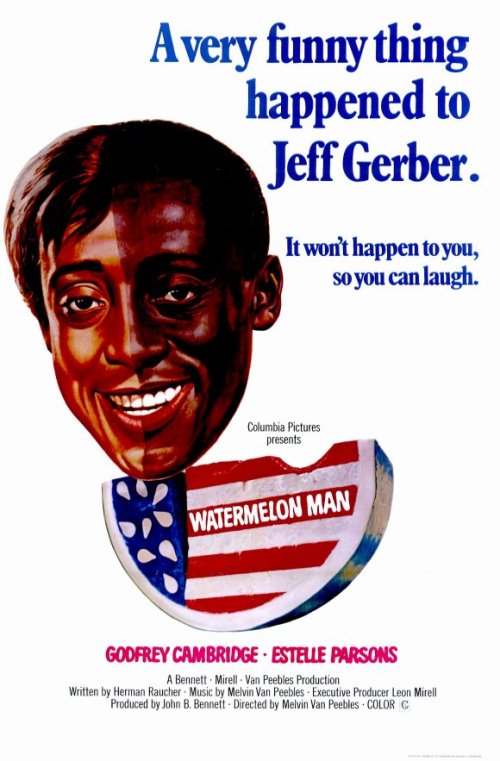
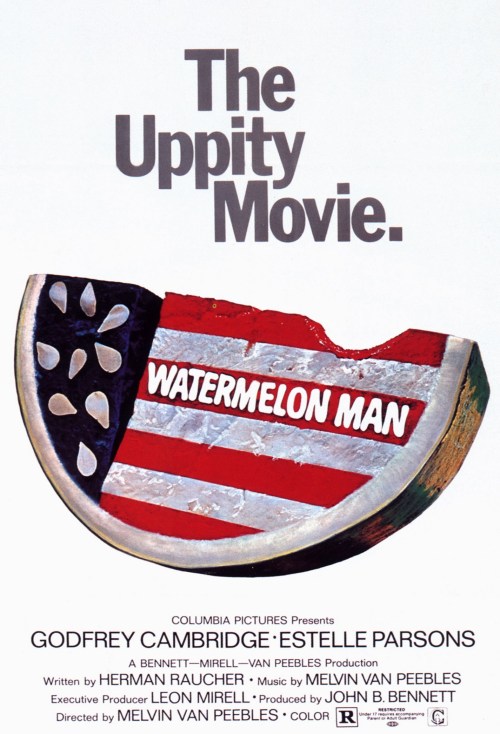
Jeff Gerber (Godfrey Cambridge) is a bigoted white man who wakes up one morning having suddenly turned black. At first he thinks he’s spent too much time under the sun lamp, but after he and his wife Althea (Estelle Parsons) try every concoction they can to return his skin back to its normal color and nothing works they finally accept the inevitable. Jeff’s lifestyle then changes in major ways. He loses his friends, his job and even forced to move out of his neighborhood giving him firsthand experience with how drastic the racial lines are.

The film was directed by Melvin Van Peeples who was at the front of the independent film movement during the ‘60s and doesn’t get enough credit for some of the groundbreaking films he made in that era, but this one remains his best and most famous work. While other films chose to present racial issues in very serious and dramatic ways this one takes the wacky comedy route and in a lot of ways becomes far more compelling. Some of the funniest moments comes when the characters discuss racial stereotypes, something filmmakers of today would shy away from for fear that they would be labeled racist, but here by bringing it all out-in-the-open it trusts that the viewer will see how silly and absurd they are without feeling the need to suppress anything.

Although Cambridge is never completely convincing as a white man despite an admirable job by the make-up department he still gives a splendidly engaging performance and without his presence this movie just wouldn’t have worked. Parsons is great as well with her character being quite supportive initially, but then eventually she turns her back on him like everyone else. Mantan Moreland is funny as a café waiter who laughs politely at all of Gerber’s dumb jokes when he is white, but gives him a completely different response once he turns black. Erin Moran can be spotted as the daughter and songwriter Paul Williams has a brief bit as a would-be employer.

There are moments where it shifts awkwardly between drama and comedy and there’s one scene where the action freezes completely and suddenly begins to display on-screen titles, which does nothing but take the viewer out of the story and should’ve been avoided. It also would’ve been nice had there been some explanation for why this all occurred. A potentially funny idea would’ve been having a scene where God decides to change Gerber into a black man to teach him a lesson and having the Almighty portrayed as being African American, which would’ve been considered quite edgy for the period and helped complement the already outrageous storyline.

Despite all the laughs the issues that it brings out are quite startling and not far from the truth, which makes this an integral part at revealing the problems that the black movement had during the early ‘70’s and still does and a film that deserves more critical praise than it’s been given.

watermelon man 2

My Rating: 7 out of 10

Released: May 27, 1970

Runtime: 1Hour 40Minutes

Rated R

Director: Melvin Van Peeples

Studio: Columbia Pictures

Available: DVD, Amazon Instant Video, YouTube

The Outside Man (1973)

outside man 2

By Richard Winters

My Rating: 7 out of 10

4-Word Review: Hit man is marked.

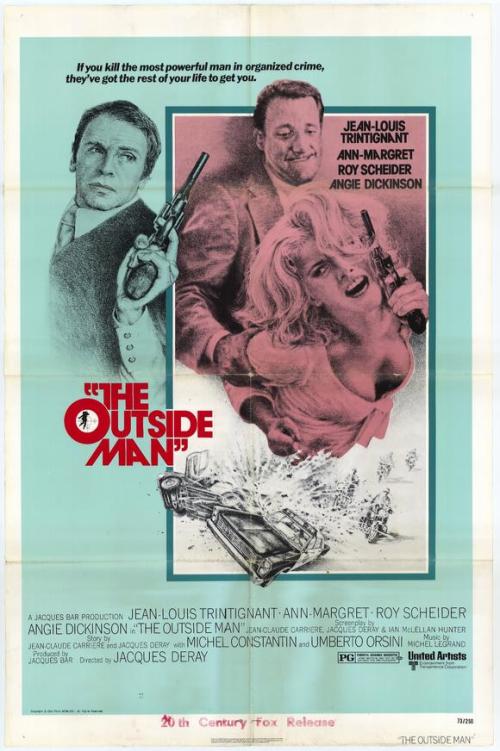
Lucien (Jean-Louise Trintignant) is a French hit man hired by an American family to assassinate a mob boss (Ted de Corsia) who’s living in Los Angeles. He’s able to pull off the job relatively easily, but then after it’s over he finds that he’s been targeted by another hit man (Roy Scheider) who is relentless and chases Lucien all over the city. Nancy (Ann-Margret) is the stripper who comes to Lucien’s aid by getting her boyfriend to create a passport for him so he can return to France, but just as he is about to board the plane he decides instead to stay in the states and turn-the-tables on the man who’s chasing him while finding who is behind the double-cross.

The film, which was done by a French production company, but filmed on-location in the states, is a lot of fun. The many offbeat touches and various stabs at dry humor keep it interesting and original while still remaining suspenseful and exciting. Some of the best moments include a hitchhiker (Edward Greenberg) who tries to convert Lucien to ‘Jesus’ as well the funeral, which eventually turns into a wild shootout amongst the various mob factions and has a corpse embalmed in a sitting position with a cigar in hand.

I also liked the way director Jacques Deray captures Los Angeles. Usually when a film is done in the City of Angels we always get shown shots of the Hollywood Walk of Fame, movie star homes, the beachfront and of course the great Hollywood sign, but here we see none of that. Instead the film captures the city’s less glamorous side including the rundown neighborhoods and even a shootout that takes place in abandoned buildings from an amusement park, which all helps to give the movie a unique vision as well as allowing the viewer to appreciate a side to the city that they may have not known even existed.

Trintignant is terrific and his perpetual look of confusion as he gets faced with one unexpected surprise after another is memorable and helps carry the film. Ann-Margret is solid as the streetwise, but kindly stripper and Scheider is quite good as the steely killer. Georgia Engel, who later became famous for playing Georgette on the ‘Mary Tyler Moore Show’ is funny as a spacy housewife who comes into contact with Lucien as he is trying to run from his killer. I especially liked the way that when a gun is pointed in her face she doesn’t scream or panic, but instead responds with silence and a deer-in-headlights look. This is also a great chance to see a young Jackie Earle Haley in his film debut as her precocious 10-year-old son.

The film’s only real downfall is its ending, which is too downbeat and ambiguous. It’s almost like they spent so much time coming up with creative concepts for the rest of it that by the time they came to the end they just plain rang out of ideas, which is a disappointment, but as a whole it’s still a gem.

My Rating: 7 out of 10

Released: January 18, 1973

Runtime: 1Hour 44Minutes

Rated PG

Director: Jacques Deray

Studio: United Artists

Available: DVD (MGM Limited Edition Collection), Amazon Instant Video

Pee Wee’s Big Adventure (1985)

pee wee big adventure

By Richard Winters

My Rating: 6 out of 10

4-Word Review: Searching for his bike.

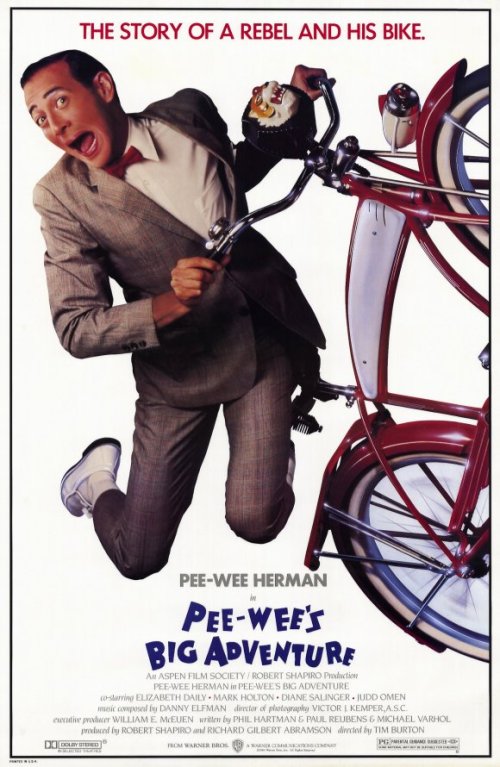
Due to the release this weekend of Pee Wee’s Big Holiday I thought it would be appropriate to go back and take a look at the ‘80s classic that started it all. Here we have Pee Wee (Paul Reubens) living with his small pet dog Speck inside a home full of colorful contraptions. His prized possession is his bicycle, which he takes great care of and carefully chains up every time he leaves it alone. However, a hateful bully named Francis (Mark Holton), who is from an affluent household and used to getting whatever he wants, decides that he wants Pee Wee’s bike for himself. When his monetary offer gets rejected he then hires a professional thief to steal it for him, which sends Pee Wee on a mad frenzy across the country to try and retrieve it.

The movie is an exercise in high camp that could’ve easily failed, but instead it succeeds mainly because it doesn’t put the eccentric main character into the real world, but instead pulls the viewer into the quirky 10-year-old mindset of the protagonist. Here we don’t deal with people who reject or mock him, but instead much like with all children he becomes the ‘king of his own domain’ where he is liked and accepted by most everyone he meets and in control of all situations while the harsher realities get ignored or overlooked completely.

The film also manages to accentuate Pee Wee’s odd personality with garishly colorful set-pieces and odd contraptions that almost become the film’s main attraction. Reubens plays the role in an engaging manner, but the character’s persona is one-dimensional and could border on getting annoying had it been the film’s sole avenue of humor, but fortunately director Tim Burton manages to give the film a complete vision by instilling a storyline and visual design that match the weirdness of its protagonist and makes the proceedings come off as fresh and inventive.

I also liked that it wasn’t geared completely towards children, but instead made to attract those of all ages with a taste for the offbeat and absurd. Going the kiddie flick route would’ve made it come off as formulaic and infantile, but instead by emphasizing the surreal it becomes intriguing and impossible to predict.

The loosely structured script, which was co-written by Reubens and actor Phil Hartman, manages to go a long way on what amounts to being pretty much just a one-joke premise, but it does eventually start to lose steam by the 60-minute mark only to recover in grand style at the end with a delightful chase through the backlot of the Warner Brothers studio. It is similar to the ending used in Blazing Saddles where the film breaks the fourth wall and becomes a movie-in-a-movie although I felt this one was funnier than the Mel Brooks version.

The film is sprinkled with a lot of cameo appearances as well with my favorite ones being Milton Berle as well as James Brolin playing Pee Wee in the Hollywood movie version and Morgan Fairchild as the Hollywoodized version of his girlfriend. I also got a kick out of Jason Hervey who is best known for playing Fred Savage’s older brother in ‘The Wonder Years’ and who does a very funny caricature of a spoiled child film star here.

The film is also known for making the ‘50s instrumental ‘Tequila’ by the Champs a very recognizable melody. In fact it is almost impossible to think of the Pee Wee character and not have that melody start to play in your head, or if you do hear the melody playing somewhere you can’t help but have the image of Pee Wee pop-up when you do. However, in the actual film the song ends up being played only briefly.

My Rating: 6 out of 10

Released: July 26, 1985

Runtime: 1Hour 31Minutes

Rated PG

Director: Tim Burton

Studio: Warner Brothers

Rosalie Goes Shopping (1989)

rosalie goes shopping

By Richard Winters

My Rating: 4 out of 10

4-Word Review: Shopaholic turns to crime.

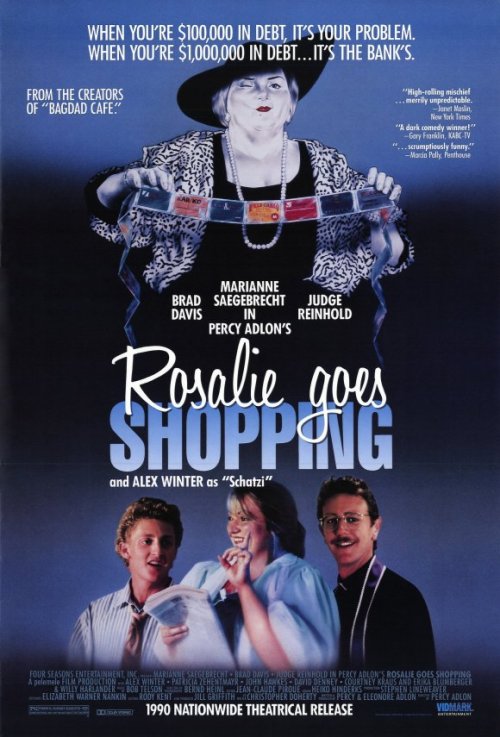
Rosalie (Marianne Sagebrecht) is a German immigrant who has married an American crop duster (Brad Davis) and moved onto a small ranch just outside of Stuttgart, Arkansas. There they raise a large family while also becoming obsessed with American consumerism by recording all the TV-shows on their VCR, but only so they can watch the commercials. Rosalie becomes a particularly obsessive shopper buying things that she really doesn’t need even when her money and credit become tapped out. She then figures out a way to hack into the accounts other people and companies via her home computer, which allows her to continue to pay for all her items by embezzling it from others.

This marks the fourth teaming of director Percy Adlon and star Sagebrecht and straight after their big success in the cult classic Bagdad Café. The film was made on-location in Arkansas, but financed by a German production company. I’m not sure what camera lens was used or the film stock, but the color contrast is quite unique and gives the whole thing an Avant-garde appearance. The storyline is original as well and veers off into unpredictable ways while making a great point, which is that unbridled capitalism can be just as dangerous and oppressive as any other form of government.

Sagebrecht is a delight and the moment where tears trickle down her checks as she becomes homesick for her native land while watching home movies taken in Germany is touching. Judge Reinhold is funny as the priest who becomes aware of Rosalie’s shenanigans through hearing them during confession, but completely exasperated about what to do about it. Brad Davis, a highly underrated actor who died too young, plays a rugged country man that’s completely against type from his more famous roles in the homoerotic films Midnight Express and Querelle.

Unfortunately the script, which was co-written by Adlon and his wife Eleonore veers too far into the whimsical and shows too much of a naiveté in regards to cyber technology. The idea that Rosalie could somehow ‘guess’ what everybody’s password was even those used by big companies and major banks is too farfetched and even if she did somehow figure them out all they’d have to do is change them once they realized their accounts had been hacked, which would’ve ended Rosalie’s cybercrimes right there.

The fact that she is able to cover up her crimes by doing even more outrageous ones and never, ever having to face the consequences of her actions is far too fanciful. It also makes light of a genuinely serious issue where the poor and lower middle-class do not have the same resources to get out of their financial predicaments as the rich do. They also do not have the convenience to magically cheat-the-system like the character here and those that do will almost always have it catch up with them where they will ultimately face harsh repercussions no matter how ‘justified’ they may have felt they were in doing it.

Some may argue that this was just a wish-fulfillment comedy, but even then there still needs to be some realm of possibility to it for it to be satisfying and this has none and it also makes the so-called clever twists lose their edge once you realize that none of it is plausible.

My Rating: 4 out of 10

Released: May 19, 1989

Runtime: 1Hour 34Minutes

Rated PG

Director: Percy Adlon

Studio: Pelemele Film

Available: VHS, DVD (Region 2), Amazon Instant Video

Coming Apart (1969)

coming apart 1

By Richard Winters

My Rating: 2 out of 10

4-Word Review: Psychiatrist secretly films people.

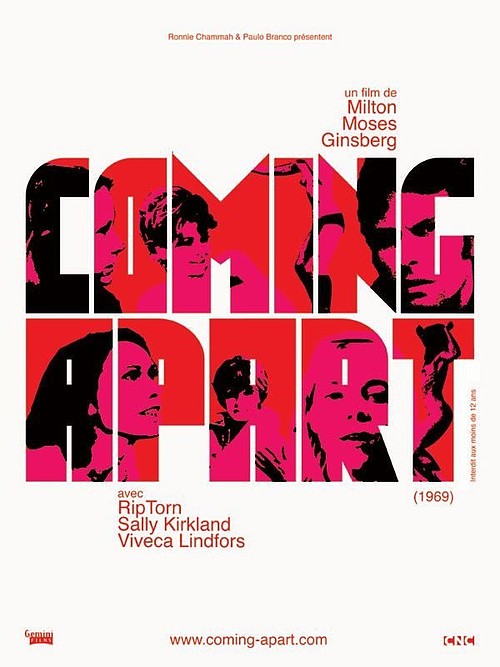
Rip Torn plays a psychiatrist living in a Manhattan apartment who has a camera secretly film everything that goes on there. Many of his female patients including Joann (Sally Kirkland) talk about their intimate desires and his ex-wife Monica (Viveca Lindfors) shares her darkest secrets thinking he is the only one hearing it, but instead a glass box resembling an antique camera sits in the living room and takes it all down.

The film’s concept is novel and if executed in a slightly better manner could’ve been brilliant. Without a doubt it breaks all the old filmmaking conventions and was year’s ahead-of-its-time. The sexual openness of its characters and tawdry subject matter make it quite voyeuristic and real. The actors have an amazingly natural quality to their delivery giving one the idea that it was ad-libbed when in actuality it wasn’t.

Kirland gives an emotionally over-the-top performance that is both remarkable and riveting. Her meltdown at the end in which she proceeds in slow motion to tear up the apartment is quite memorable and the best part of the whole film.

Writer/director Milton Moses Ginsberg manages to keep things relatively fresh by continuously introducing situations that become increasingly more provocative including a party that turns into a sex orgy and explicit love making between Torn and Kirkland that could almost be considered pornographic. There’s even an interesting scene involving a young lady looking to be barely 18 coming to the apartment with her baby in a carriage and propositioning herself to Torn and then having the two make love on the floor while the baby, still in the carriage, cries next to them. There is also a segment featuring recorded phone conversations that Joe has with his fellow psychiatrists that I found to be revealing as well.

Unfortunately despite these creative efforts the film is agonizingly boring to sit through. No matter what is going on in the scene the viewer is still forced to stare at the same wall, same mirror, and same skyline for almost two-hours. The scenes needed to be broken up with cutaways that would’ve taken the viewer out of the apartment and given them some other visual element to look at. Simply turning on a camera that’s nailed to the floor and then filming whatever happens in front of it is not a movie, but more like C-Span and the ultimate result is a failed experiment lacking the necessary cinematic touches that would have made it come off as a fluid whole.

My Rating: 2 out of 10

Released: October 26, 1969

Runtime: 1Hour 51Minutes

Not Rated

Director: Milton Moses Ginsberg

Studio: Kaleidoscope Films

Available: DVD

The Girl Most Likely to…(1973)

girl most likely 1

By Richard Winters

My Rating: 6 out of 10

4-Word Review: Ugly girl gets revenge.

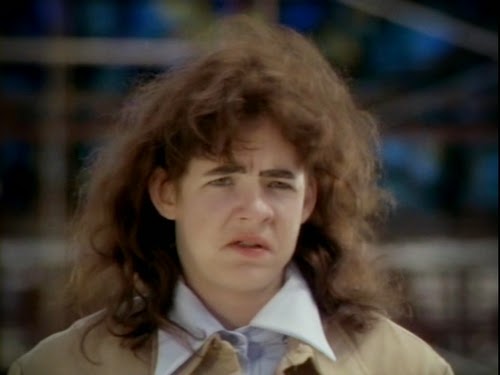
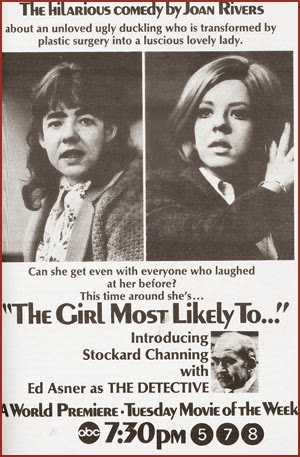
Miriam (Stockard Channing) is a homely student attending college who can’t seem to find a boyfriend or even any friends. Instead she is ostracized and rejected constantly in the cruelest ways possible. Upset by her depressing life she one day gets into her car and drives recklessly down the highway only to get into a crash, which forces surgeons to do major reconstructive surgery on her face that amazingly turns her into a beautiful woman. Now she can have any guy that she wants, but the bitterness of the way she was treated in the past eats away at her and she instead decides to get revenge by killing off all the people that rejected her using increasingly novel methods.

This made-for-TV film was written by Joan Rivers and it has the same humor that she used in her stand-up comedy act, which mainly focused on women’s deep seated insecurities involving their looks and the need to get married and please their husband. To some degree the whole thing is quite dated particularly the idea that a woman’s sole purpose in life is to use their looks to snare a rich husband who will then take care of them for the rest of their life. The humor and characters are also extremely clichéd and broad, but it still manages to have some funny bits.

Channing’s presence helps immensely and she manages to somehow carry off the role with dignity despite being degraded and humiliated at every turn. Her ugly makeover is impressive particularly the way they wadded up her nose to make her left nostril much larger than the right one, which had me reluctantly focused on it every time it came into view.

girl most likely 2

The supporting cast features many familiar faces in small, bit parts some of which are quite funny including Joe Flynn as a surgeon unable to find a patient’s appendix, Larry Wilcox as a dumb football player named Moose, Warren Berlinger as Miriam’s plumber fiancée and Susanne Zenor as the haughty roommate. This also marks the acting debut of Larry Manetti who can be spotted in a small role as a football player.

The murders themselves are what help stand this film apart from the others in what otherwise could be described as a Carrie precursor. The scene where Miriam kills off the Wilcox character while skydiving is impressively captured as is the segment where Berlinger drowns in a flood in his own bathroom. The only one that doesn’t quite make sense is when she tries to kill a pool player by having him hit the eight ball that is secretly a bomb. However, when it does finally go off, it explodes the entire pool hall, which would’ve easily killed Miriam along with the others had she not been inadvertently lead away at the last minute.

Fans of black humor should especially enjoy this and for a TV-movie it is far and away better than most. It also scores better than River’s theatrical feature Rabbit Test, which she did five years later and wasn’t funny at all.

girl most likely 3

My Rating: 6 out of 10

Released: November 6, 1973

Runtime: 1Hour 15Minutes

Not Rated

Director: Lee Phillips

Studio: ABC Circle Films

Available: DVD