Category Archives: Obscure Movies

Think Big (1989)

thinkbig1

By Richard Winters

My Rating: 1 out of 10

4-Word Review: Truckers with big muscles.

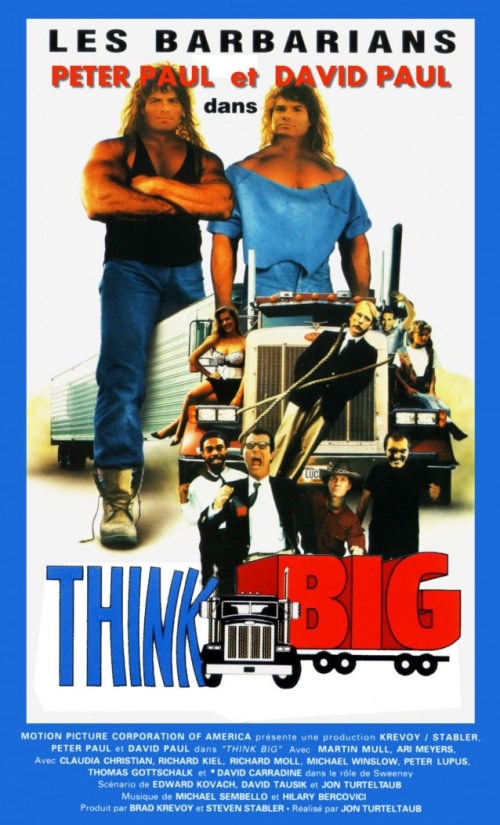
Rafe and Victor (Peter Paul, David Paul) are brothers who make a living driving a truck though they’re always missing the freight deadline to the constant consternation of their boss (Richard Moll). He gives them the ultimatum: either get this new delivery to its intended destination within 30 hours, or find a new job. Holly (Ari Meyers) is a teen genius who has invented a mechanism that can electronically deactivate any code allowing one to start, or stop any other device without having a key, or password to do it. When she finds out that the company she’s been working at, or more honestly enslaved at, wants to use her invention for unscrupulous means she escapes with her device in hand and then hides inside the brothers’ truck. Initially the brothers want to throw her out as they consider her presence a sign of bad luck, but eventually they help her out in her quest to avoid the bad guys.

The Pauls, who were bodybuilders before they got into acting, made their film debut in D.C. Cab, as The Barbarian Brothers, which lead to guest starring roles in TV-Shows like ‘Knight Rider’ that eventually got them starring in their own movie The Barbarians, that did well enough at the box office that producers gave them this comedic vehicle though it proved to be a disaster. Most of the problems lie with the silly script that’s filled with pseudo science, dated technology, and campy humor, which will amount to one long, continuous eye roll from the viewer.

The brothers are poor actors with their scenes in Natural Born Killers getting deleted because of what director Oliver Stone felt was shameless overacting, and their dialogue here doesn’t help. It’s one thing to be bit dimwitted, but these guys are infantile and their chicken bone chant that they do is highly redundant and annoying. For big guys they’re quite wimpy as they allow their boss to grab them by the neck and during fights they get punched by men who are far smaller and immediately fall down backwards by the power of the blow though you’d think in reality the person doing the punching would get their hand injured and they’d run-off hollering while these two big buys would remain standing. Their profession isn’t interesting either and puts to waste their big muscles. Instead of driving a big rig they should be working as club bouncers, or security for celebrities, or even just owning a workout gym.

The plot is also cluttered with villains. Martin Mull plays the head of the evil agency and while he does get a few funny ad-libs I didn’t feel his part was necessary. David Carradine, who plays this cantankerous repo man that tries to take back the brothers’ truck, gets wasted too. Initially I was surprised why a star with his stature would even appear in this though I did find him amusing and the caricature he creates to be colorful, but the stupidity of the script overshadows him and since he’s only seen sporadically his acting efforts get lost.

Richard Kiel was the one bad guy that I did like.  In his past roles he’s played the one who’s strong, but not bright, but in this film he’s the exasperated leader that gets irritated by the dummies around him. For this reason I thought he should’ve been the main heavy and Mull’s presence cut out completely. It’s also interesting seeing him take-on the Paul brothers as usually his physical presence dominates everyone else, but here it’s a much more of an even fight. I did though find it frustrating that we see him struggling to get out from underneath a car and the film then cuts away, only to see his character appear later, uninjured, with no explanation for how he got out of his predicament.

While Ari Meyers’, who’s best known for her work on the ‘Kate & Allie’ TV-show, acting isn’t the best she’s still easy-on-the-eyes and therefore should’ve been made the lead while the brothers could’ve been cast in support as these bumbling truckers she’d meet along the way, where their presence could be used as comic relief, but having the whole thing centered around them kills the movie right from the start. Throwing-in a sappy ‘life lesson’ speech at the end just makes it even worse and a genuine insult to the intelligence of anyone who sits through it.

My Rating: 1 out of 10

Released: October 23, 1989

Runtime: 1 Hour 26 Minutes

Rated PG-13

Director: Jon Turteltaub

Studio: Motion Picture Corporation of America

Available: VHS, DVD-R (dvdlady.com)
Hot Resort (1985)

hot

By Richard Winters

My Rating: 2 out of 10

4-Word Review: Looking for some action.

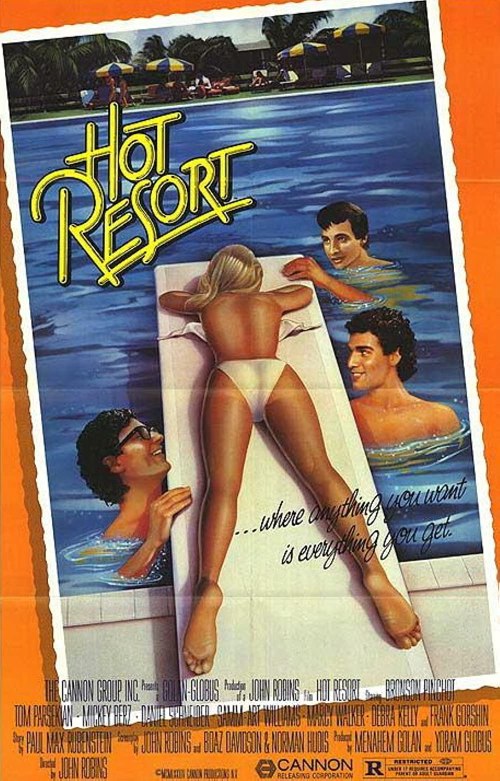
Filmed on the island of St. Kitts in the West Indies the story, or what little there is of it, follows around a group o college men lead by Brad (Bronson Pinchot) and Chuck (Dan Schneider) who travel there in order to work at the resort and earn some money over the summer. They hope also to hit-on the bikini-clad babes in-between shifts and seem to have sex much more on their minds than work. The resort manager (David Lipman) hires disciplinarian Bill Martin (Samm-Art Williams) to get them under control, but even he has a hard time keeping them in-line. The boys also clash with a group of snotty ivy leaguers, who are on the island to film a soup commercial. After having several run-ins with them the boys challenge the Ivy guys to a rowboat race and become determined to beat them even if it means cheating.

This yet another low budget production produced by The Cannon Group, which was run by Yoram Globus and his cousin Menaham Golan. They made a business of buying bottom barrel scripts and turning them into low budget productions and while some of them where a delightful surprise and even rivaled a standard Hollywood production this was certainly not one of them. The script was co-written by Boaz Davidson, who had earlier success with the Israeli teen comedy Lemon Popsicle, which was later Americanized into The Last American Virgin that was also written and directed by him, but this one has none of the comic spark of those and seems compelled to reach to the lowest common denominator possible almost challenging the viewer to see how much inane, low brow humor they’re willing to sit through before turning it off.

Granted 80’s teen sex comedies where never meant to be masterpieces, but this thing, even when compared to those others, is incredibly uninspired and adds nothing new to the otherwise tired mix. The only two things that are a bit different from the norms of that genre is that the fat guy, played by Schneider, who later went on to star in the TV-show ‘Head of the Class’, isn’t shown constantly stuffing his face with food, or the butt of all the jokes. In fact he’s portrayed as being just as hip as the others and getting more action than the rest of them.

The film also switches things around in that it isn’t the men that are on the aggressive make, but instead the women, who literally grab the guys as they’re walking and minding their own business and then bring them into a room for hot action. At one point they even swipe an elderly man off the sidewalk though it’s hard to believe that any woman could be that oversexed. It might’ve made the story more funny and at least given it a certain logic by having the females take some sort of drug that causes them to become sexual animals, but that’s not the explanation here, which just makes the shenanigans all the more insane.

I started to wonder too if these gals were on the pill because if not they risked getting pregnant, which would force them to either get a lot of abortions, or raising kids they really didn’t want all by themselves since they didn’t even bother to get the names of the guys they had fucked, and seemed to choose them at random. Also, if you really think about it, it comes-off like rape as the men constantly say no and resist making it more like we’re witnessing a crime than just a carefree sex.

The guys who play Ivy Leaguers speak in such an overblown accent that it’s not even mildly amusing, but genuinely irritating and there’s simply no way that anyone who talked like that, no matter how deluded they were, would think they were cool and not worried that people would be making fun of them behind their backs. I will give some props though to the scene where the emergency medical personal must come to the aid of a couple who get stuck inside a car that they were making love in forcing the fire department to saw off the roof of the vehicle to get them out though anyone who would even think of trying to have sex in the back seat of a tiny VW bug should have their heads examined.

Some of the supporting players are amusing particularly Stephen Stucker, who plays the same type of character that he did in Airplane! where he’d jump into a scene say something quirky and then quickly jump back out. I also enjoyed Frank Gorshin (billed as Mr. Frank Gorshin) a talented impressionist who rose to fame playing the Riddler on the ‘Batman’ TV-show. Here he plays a dirty minded middle-aged man who tries to teach the youngsters the finer points of hitting-on chicks much to the consternation of his wife (Zora Rasmussen) who sits next to him and listens in as he talks about it. Mae Questal though, who’s best known for being the voice of Betty Boop and Olive Oyl gets sorely wasted particularly in the scene where she gets ‘tricked’ into putting on a dress with a giant bullseye on the back, which her husband plans to use as a target to aim his gun at, though it’s hard to imagine any woman wouldn’t have seen this before she put it on, which just shows how stupid and poorly thought out the gags are.

Even on the level of cheap, soft core porn it’s no good. The nudity is infrequent and fleeting and the women aren’t exactly cover girls looking more like they’re around 30 and a bit ‘rough-around-the-edges’, so if you’re looking to grab this thing simply for some healthy voyeurism you’ll still end up sorely disappointed anyways.

My Rating: 2 out of 10

Released: January 14, 1985

Runtime: 1 Hour 33 Minutes

Rated R

Director: John Robins

Studio: The Cannon Group

Available: VHS, DVD-R (dvdlady.com)
Phobia (1980)

phobia1

By Richard Winters

My Rating: 3 out of 10

4-Word Review: His patients are dying.

Dr. Peter Ross (Paul Michael Glaser) is a Canadian psychiatrist who has come up with a radical new therapy to help cure those who suffer from phobias. The program includes having them watch their fears played out visually on the big screen and thus forcing them to conquer those irrational thoughts and be able to go on living normal lives. Peter feels he’s making great progress with his patients only to suddenly have them start to die-off one-by-one with each perishing in ways that reflects their private phobia that they had hoped to overcome.

This is definitely one of those movies where what happened behind-the-scenes had to be far more interesting than anything that occurred in front of the camera. Having John Huston, the legendary director who helmed such classics as The Maltese Falcon and Key Largo doing this one, which is nothing more than a cheap thriller with 80’s slasher instincts, has to be the most baffling thing about it. It wasn’t like his career was on the outs either as he went on to direct several more critically acclaimed flicks in the 80’s that were well financed with big name stars and he had just 5 years earlier did the well received The Man Who Would Be King, so why he decided to take a weird foray into doing this inept thing, which just by reading the script you could tell was a mess upfront, I don’t know.

It starts out with some visual panache, but otherwise could’ve easily been directed by a no-name, two-bit director and no one would’ve known the difference. The one segment dealing with a car chase down the city streets that culminates with a man falling from a tall building had some potential though I would’ve framed the shot differently showing it from a bird’s-eye view where the viewer could see how far off the ground the victim really was versus having the camera on the ground looking up, which is less dramatic. I suppose it might’ve given away the safety net that’s clearly present as you never see him hit the ground, it cuts away while he’s still in mid-air, but in either case it’s the only mildly diverting moment of the whole film.

Everything else is run-of-the-mill including the numerous deaths, which despite the tagline don’t all have to do with their phobias either. For instance one woman fears being in big crowds, so in order to ‘cure’ her, the doctor has her go onto a crowded subway, but she panics and runs back to his place where she ultimately dies when a bomb explodes. The segment dealing with a woman who fears men gets pretty ridiculous as he has her watch a movie of a woman getting gang raped, which would appall anyone and yet when she runs out of the room in disgust and shock he’s confused. The very fact that he talks about ‘curing’ his patients is a major red flag altogether as in psychiatry you never really ‘cure’ anybody, which just shows how poorly researched and shallow the script really is.

Paul Michael Glaser, better known for his work in the TV-show ‘Starsky and Hutch’, makes for a wretched leading man and it’s no surprise that he decided to get into directing after this one and has never starred in a theatrical film since. It’s not completely his fault as his character exudes a cold demeanor, so you never really care about him, or his quandary. John Colicos, as the police detective, is far superior and helps enliven the film with the few scenes that he is in though his interrogation techniques are highly unethical and the fact that he only focuses on one angle as to who the culprit is makes his character come-off as unintentionally inept.

The film does feature a twist at the end as to who the killer really is, but it’s dumb and not worth sitting through. In fact the ultimate reveal is so bad that it ruins everything else that came before it, as it had been watchable up until that point, but the climax solidifies it as a bomb.

My Rating: 3 out of 10

Released: September 26, 1980

Runtime: 1 Hour 30 Minutes

Rated R

Director: John Huston

Studio: Paramount Pictures

Available: Blu-ray

Buster and Billie (1974)

buster2

By Richard Winters

My Rating: 5 out of 10

4-Word Review: Dating a loose woman.

Buster (Jan-Michael Vincent) is a high school senior living in rural Georgia during the late 1940’s. He’s been dating Margie (Pamela Sue Martin), but finds her to be stuck-up and her unwillingness to have sex makes him frustrated. He begins seeing Billie Jo (Joan Goodfellow), who has moved into town and due to having limited social skills puts-out for the other boys by allowing them to have sex with her, one after the other, in the woods late at night. Buster at first dates her simply for the action, but eventually the two get into a serious relationship and he breaks-up with Margie. They begin going out publicly letting the whole town know that they’re a couple, but the other boys become jealous as they can no longer have easy sex like they use to and thus plot a dark revenge.

The story is based loosely on an actual event that occurred in Florence, South Carolina in 1948 that the film’s screenwriter Ron Turbeville remembered hearing about growing up. The recreation of the era though lacks style and this may be in large part due the film’s limited budget. While it gets a zero in  atmosphere I did at least like the way it doesn’t sugar coat things for nostalgic purposes. The teens behave in the same ways they do now and thus it’s gritty on that level.

The acting is good surprisingly even from Jan-Michael who in his other films tended to have a cardboard presence, but here he gives the thing most of its energy. He even appears, shockingly, fully nude and in fact this was the first mainstream American movie to show a male naked from the front, of which Jan stated in later interviews he was quite proud to expose of his well-endowed ‘equipment’. Goodfellow is also seen nude and is quite attractive though I wish she had more to say. Robert Englund, in his film debut, is the most memorable playing an albino with brown hair and his pale complexion makes him look creepier, at least I felt, than he did as Freddy Kruegar.

I didn’t understand though why Buster would risk his social standing for this ostracized girl. I got that Margie was annoying, so breaking-up with her wasn’t a stretch, and Billie was essentially ‘easy-pickings’, but why go public with it? It made more sense that they would’ve seen each other on the sly, but not wanting to risk the social scrutiny of letting everyone know about it. This would’ve clearly lost Buster’s social status not only amongst his friends, but the town as a whole including his own parents, so why add on all that needless stress? Billie too was very shy, so becoming center stage and having all eyes on her would be something she most likely would’ve wanted to avoid, which makes the second act overly idealistic.

It’s also frustrating that Billie doesn’t say much. You want to get to know this person, but never really do. The only time she’s ever given any insight is when Buster explains to his parents why she had sex with all the other guys (in order to be liked), but this is something we should’ve heard coming-out of her lips instead of his. By having Buster do almost all the talking, even when they’re alone together, makes it seem like she’s mentally handicapped, which I don’t believe was the intent and yet ultimately that’s how it comes-off and thus making their romantic moments sterile and uninteresting.

Spoiler Alert!

The final sequence though is where it really falls apart as the boys inadvertently kill Billie when they gang rape her (during a rainstorm even though the sky is still clear and sunny). Buster then tracks them down at a pool hall where he single-handily beats them up and ultimately kills two of them, but the guys just allow themselves to be beaten without attempting to throw a punch, which is not only unrealistic, but boring. Having a big brawl, where each side fights equally would’ve been far more exciting. The twist in which Buster somehow gets released from jail the day after her funeral, so that he can decorate her gravesite with all the flowers that he’s stolen from everyone else in town is far-fetched and overly forces the sentiment.

My Rating: 5 out of 10

Released: August 21, 1974

Runtime: 1 Hour 40 Minutes

Rated R

Director: Daniel Petrie

Studio: Columbia Pictures

Available: Amazon Video

Corky (1972)

corky

By Richard Winters

My Rating: 7 out of 10

4-Word Review: Race driver self destructs.

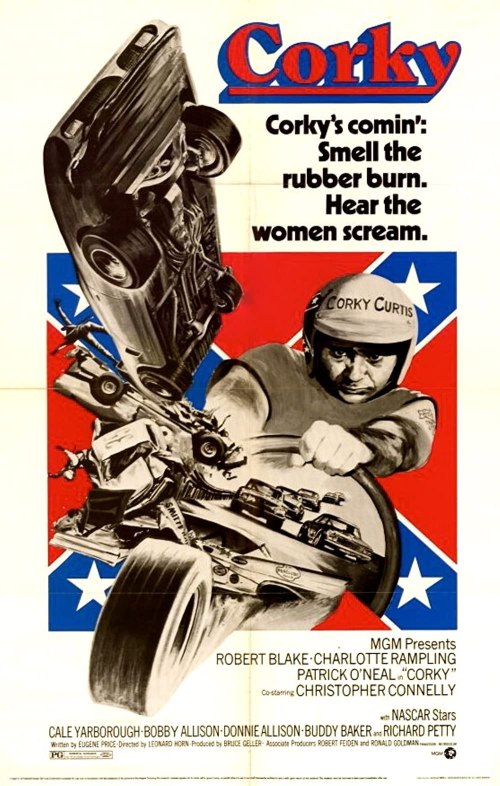
Corky (Robert Blake) works as a car mechanic during the day, but on weekends he drives in some of the local races. He’s aggressive nature though causes many accidents and damages in the race, so his boss Randy (Patrick O’Neal) decides to replace him with another driver named Steve (John Gruber). Corky resents being replaced and thus enters the next race anyways and rigs the front hood of his car, so it will pop-up at a strategic time, so that he can crash into Steve’s car while feigning that it was an ‘accident’ because he couldn’t see where he was going due to the hood. The crash though puts Steve in the hospital and it’s enoough for Randy to fire Corky from his job. Now, with no money left, he goes traveling to Georgia with his buddy Billy (Christopher Connelly). They enter a few races there, but Corky parties away all the winnings and eventually come back to Texas penniless. He tries to get back with his wife Peggy Jo (Charlotte Rampling), but finds that Randy has been helping her out and giving her enough money, so that she can go back to school to get a diploma and eventually be able to earn a living without Corky. This causes him to seethe with rage and he goes back to Randy’s place of work in order to exact a violent revenge.

The film was directed by Leonard Horn, who shot to fame for having directed some of the highest rated episodes of the ‘Mission Impossible’ TV-series, which garnard him enough attention to get him a contract to helm two cinematic features. His first one was The Magic Garden of Stanley Sweatheartwhich starred Don Johnson and while it wasn’t completely successful, and very little seen, it did have an interesting cinema verité style. This works the same way with a strong emphasis on atmosphere that gets small town living in rural Texas just right. Even the little moments like when Corky turns on his friend Billy in the middle of a desolate road during an impending rain storm leaves a memorable impression as does the envelope-pushing moment where Corky decides to strip down and go skinny dipping with two young boys (Matt Nelson Karstetter, Richard McGough) at a country watering hole.

Robert Blake is excellent. Sometimes it’s hard to imagine him as a leading man due to him at one time being a part of the ‘Little Rascals’ ensemble, and then rising to becoming a TV-star before falling into infamy at being accused of killing his child’s mother. However, with all that being said he was still a great actor who probably didn’t get as much starring roles as he deserved, but he plays the angry loner role to a perfect-T. Rampling as his wife, who was born in England, masks her British accent quite well and creates an odd, but interesting sounding Texas one in the process. I also liked that she sports blonde hair. O’Neal is good in support and there’s an fun collage of actual race driving champions like Richard Petty and Cale Yarborough who appear briefly as themselves though I was upset to read that Roddy McDowell’s scenes, where he plays a salesmen, got cut out completely as his appearance could’ve added an intriguing element.

Spoiler Alert!

The story itself is rather tepid at first. There were many films from the 70’s dealing with rugged individualists and hard drinking, womanizing rebels who couldn’t, or didn’t want to conform to societal rules and thus hit the road looking for adventure and to ‘find themselves’. This though, at least during the first two acts, adds nothing to the equation, or give us any new insights and in fact seems more like the same old, same old generic character study, but all that changes in the third act when Corky unravels completely and goes on a shooting spree. The films from that era always had the non-conformist getting ‘reeled-in’ at some point usually through the love of a romantic partner, or some familial obligation, but here it’s a meltdown to the extreme and it’s a movie way ahead of its time as it deals with what’s commonly known as a mass shooter these days. At that time this concept was rarely seen and for that it deserves definite kudos as does the message that being too irresponsible will catch-up with you and one can’t just live the outlaw image and not eventually have to pay the price.

My Rating: 7 out of 10

Released: March 15, 1972

Runtime: 1 Hour 28 Minutes

Rated PG

Director: Leonard Horn

Studio: MGM

Available: DVD-R (Warner Archive)

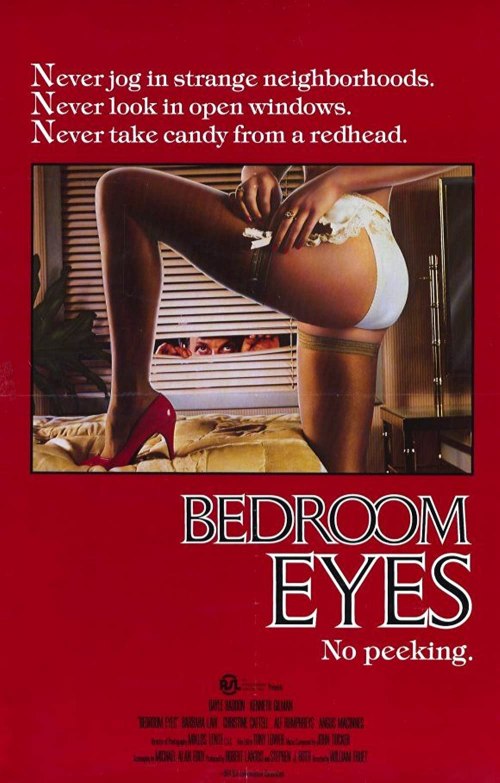
Bedroom Eyes (1984)

bedroom1

By Richard Winters

My Rating: 1 out of 10

4-Word Review: Voyeur witnesses a murder.

Harry Ross (Kenneth Gilman) is a businessman who enjoys taking a late night jog in the Toronto neighborhood in which he lives. One night he steps in dog poo and as he’s trying to scrape it off he notices a light coming from a nearby window. Out of curiosity he peers in and sees a half-naked woman (Jayne Catling) dancing provocatively. It turns him on and he decides to make it a point to peer into the window each night when he goes for a run. He though begins to feel guilty about what he’s doing and thinks he may be a ‘pervert’ and thus schedules an appoint with Alex (Dayle Haddon), who is a psychiatrist, so that they can talk it through. During their sessions he also becomes attracted to her and things slowly work into a relationship. While this is going on he continues to look into the window each night, but eventually witnesses the woman getting murdered and now must go into hiding inside Alex’s apartment as not only the police, who mistakenly think he did it as they get his prints off of the window, are after him, but so is the killer.

This film was directed by William Fruet, a prolific writer/director from Canada, who shot to fame with the excellent Wedding in White and then followed that up with a lot lame thrillers and horror films. While some of those were diverting this one isn’t and the tacky set-up is the biggest problem. The fact that Harry isn’t portrayed as being a life long voyeur, but instead quite literally just ‘stumbles’ upon it is farfetched and the character would’ve had more depth if this had been a constant trait that he had to deal with. Having him ‘panic’ that he was afraid this made him a ‘pervert’ was ridiculous too as I’d think just about any heterosexual guy would get aroused seeing a hot lady cavorting around erotically. The way he peers in, the camera captures it from the inside looking out, is quite obvious as his face is fully light, from the indoor lamps, and thus all the people needed to do was glance up briefly to see him, which I would think would’ve occurred at some point especially since he continues to do it over multiple nights. The fact that they always leave the window shade half open seems like they’re inviting someone to look in though the movie acts like this is unintentional and just a ‘coincidence’. The place is lit in a way that makes it seem like it’s a set for soft core porn flick and the woman behaves like an adult actress, which completely ruins any sliver of plausibility.

Initially I liked seeing Haddon, who was at one time a super model before she got into acting, cast as the therapist as this was traditionally at that time still more of a man’s profession, so she was playing against type, but having Harry immediately asks her out on a date was dumb. Due to this being a professional doctor and patient relationship he should’ve at least waited until after several sessions before he got up the nerve to do it and even then it’s putting her in an unethical spot and he should’ve known that. Fortunately she tells him ‘no’ the first couple of times, which is what she should’ve done, but I knew, going by how stupid this script had already been, that she’d eventually cave and of course she does, which makes the whole premise become even more ludicrous. Having her spot him at a fancy restaurant was too coincidental in such a big city and having his girlfriend perform a sexual act while inside the place with all sorts of people around was over-the-top. If anything Haddon should’ve just been cast as his girlfriend, who just happens to work as therapist, and he could’ve still spoken to her about his voyeurism in private when they were together and this would’ve helped made it more believable.

It does get a bit intriguing for a few minutes when the police begin to close-in on Harry and I enjoyed the inner-rivalry of the police department where the two lead detectives became irritated at how a young ‘wet-behind-the-ears’ kid (Alf Humphreys) was always coming up with new leads and clues before they did, but other than that there’s very little to recommend. The climactic sequence in which the killer ties Harry up while he’s inside Haddon’s apartment, is quite boring and the female actor who plays the culprit shows no panache and thus making her scenes quite dull. In 1989, at the request of no one, this was made into a sequel, but with a completely different writer, director and actors with the only thing connecting the two being the Harry Ross character.

My Rating: 2 out of 10

Released: November 30, 1984

Runtime: 1 Hour 30 Minutes

Rated R

Director: William Fruet

Studio: Pan-Canadian Film Distributors

Available: DVD-R

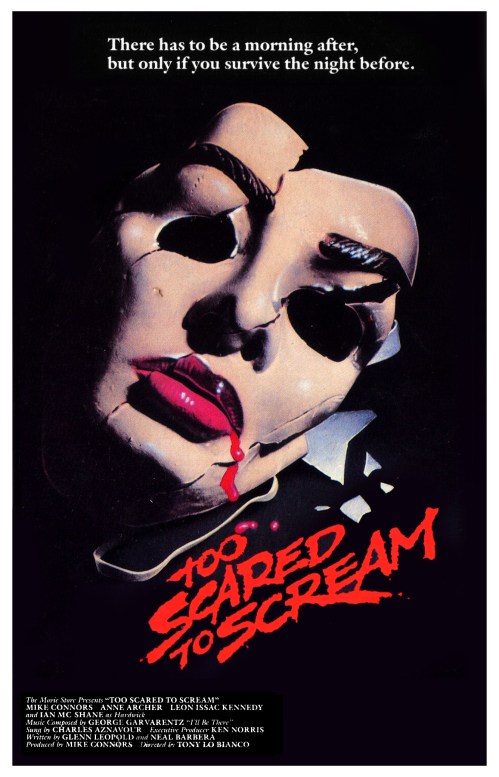
Too Scared to Scream (1984)

tooscared3

By Richard Winters

My Rating: 3 out of 10

4-Word Review: Who’s killing the tenants?

Female tenants living in a New York City high-rise building are turning-up dead in brutal fashion. Lieutenant Alex Dinardo (Mike Connors) and his younger, female partner Kate (Anne Archer) are convinced that the culprit is Vincent (Ian McShane) who works as the overnight watchmen at the apartment building and since all the crimes happen during his shift he quickly becomes suspect number one. Though getting enough evidence in order to arrest him becomes a delicate matter. Alex then decides to asks Kate to move-in to the building as a new tenant and thus keep tabs on what Vincent is doing and hopefully lure him into a situation where he’ll incriminate himself, but Kate soon finds herself in over-her-head as the killer is on-top of what’s going on and he soon bates her into a dangerous game of cat-and-mouse where Alex and the other policemen are not able to help her.

The film was an attempt at creating an American version of an Italian giallo complete with gory murders and an intricate mystery where you don’t know who the real killer is until the final twist ending. It’s also the only film to date to be directed by actor Tony Lo Bianco. Severely straddled during production as it was shot in 1982, but due to the production studio that financed the project going bankrupt it was never released until 3 years later where it was given little fanfare and came and went with few people seeing it.

The biggest problem with it is that it plays-up McShane’s role too much. Granted he’s a gifted actor who’s best known today for his work in the TV-series ‘Deadwood’, but by overemphasizing his character it makes it seem right from the start that he’s the culprit and thus making the investigation uninteresting because you feel it’s just a matter of time before he’s found out and thus little mystery, or intrigue. Granted there are a couple of other suspects, but they seem thrown-in simply as red herrings and aren’t seen much. The story would’ve had better tension had the suspects shared equal screen time and a more balance of clues making it seem like any one of them could’ve done it and thus some genuine interest at getting at what the truth is versus having it seem like it’s all spelled-out from the start. If anything Maureen O’Sullivan, who plays McShane’s near comatose mother whom he takes care of, is far more captivating, despite the fact that she doesn’t speak any line of dialogue and trapped in a wheelchair, then anything McShane himself does.

The unusual pairing of a 60-something male cop alongside a female one that appears to be only around 30 should’ve been what the film focused on as I found their contrasting personalities and different ways they approached their police work to be something that could’ve been played-off of more. Unfortunately the film taps into this just slightly and then quickly moves on and thus misses the opportunity for what could’ve lead to captivating confrontations and debates. Connor does seem a bit too old for this kind of thing and seeing him trying to chase down a young athletic man who was only 20 came-off as almost laughable and I was surprised he didn’t just fall over from a heart attack, or exhaustion before he ever managed to get near the guy. Having him lose a fight to the younger guy and have to depend on his partner to bail him out of it was realistic, so it gets props there, but the way he goes about his police work, which includes physically beating-up on suspects, is highly unethical and should’ve gotten him demoted, or fired.

Spoiler Alert!

I had issues with Archer’s character as well. This comes when she agrees to move into the apartment and work undercover, but seems woefully unprepared for it. She manages to carry a gun with her when she goes down to the basement of the building to do laundry, but then when she gets back to her place she does a goofy aerobics workout where she gets caught off-guard, but wouldn’t a seasoned cop know to carry a weapon on her at all times especially when she’s intentionally making herself a target to the killer? Also, what kind of person walks into their apartment and then doesn’t turn around and immediately lock the door once they’re inside? If you want to argue that this was intentional (I don’t think it was) because she wanted to lure the killer inside, so as to apprehend him, then fine, but she should then make damn sure she was a gun in-hand, pointed at him, when he does, which in this case she didn’t.

You must likely won’t be able to guess who the true killer is, but it’s not worth sitting through. The script doesn’t offer any clues, or hints either, so even an alert viewer won’t figure it out, but that doesn’t mean it’s a good mystery because it really isn’t. The story is sloppily put together without much imagination, or character development. Unlike a true giallo the murders are quick and without much blood, so if you’re a gorehound this thing won’t suffice. The concept had potential, but the execution is half-hearted.

My Rating: 3 out of 10

Released: September 28, 1984

Runtime: 1 Hour 40 Minutes

Rated R

Director: Tony Lo Bianco

Studio: International Film Marketing

Available: Blu-ray (Import), DVD-R

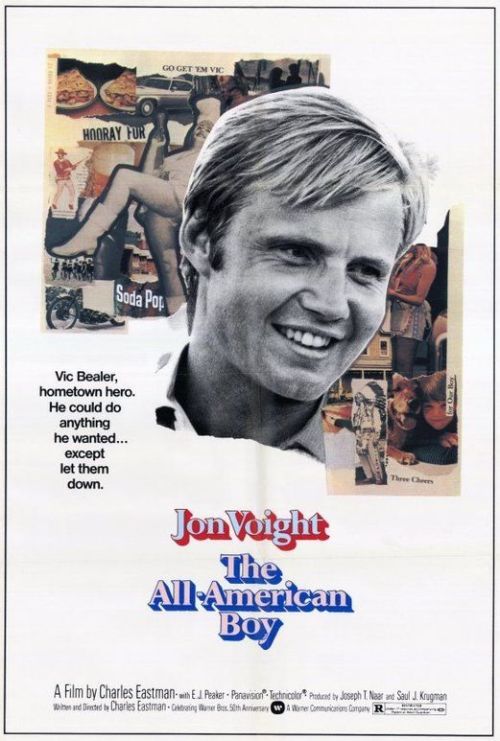
The All-American Boy (1973)

american

By Richard Winters

My Rating: 4 out of 10

4-Word Review: Amateur boxer seeks fame.

While Jon Voight is best known in the world of boxing movies for having done The Champ in 1979, which some consider infamous, his first go-around was actually this one though it remained stuck on the studio shelf long after it was filmed only to be released after his success in Midnight Cowboy. He plays the character of Vic (Jon Voight) a talented, good-looking man whose shown ability in the amateur ring and now is ambitious about making the Olympic team. Arty (Ned Glass) takes him under-his-wing, even lets him stay at his place, while he trains him, but then all of sudden Vic decides he doesn’t want to be a boxer anymore, to the shock of everyone, and never bothers to give anyone any explanation as to why.

The script was written by Charles Eastman, who also directed, and who was the brother of Carole Eastman, who wrote the script for Five Easy Pieces under the pseudonym of Adrien Joyce. Like with his sister’s script it works as a character study and the story is broken up in sections, in this case ‘The Manly Art in Six Rounds’. At various times, usually every 10-minutes, a title will appear on screen such as ‘Round 1’, or ‘Round 2’, but honestly I didn’t see the point  and it doesn’t really make it more interesting and could’ve easily be discarded and probably should’ve been.

On the writing end, particularly the dialogue, it works. Eastman creates a conversational quality where what the characters say is never ‘too on the nose’ (screenwriter’s lingo for being too specific) and the viewer must read into it in order to understand what they mean. In that area the film works, but it’s also highly talky and begins to have a stagnant feel. There’s also very little about the actual sport of boxing. If you’re expecting something like Rocky where there were long segments dealing with the his preparation you’ll be out of luck here. I got particularly frustrated with the scene dealing with Vic getting ready for a contest where he’s seen standing around while other participants and fans enter into the arena, which gets drawn-out, and then just as the fight is supposed to begin it cuts away showing Vic on the phone describing what happened, but to have to sit through a long build-up just to see no action is a letdown.

There finally is some boxing about 50-minutes in and the choreography in the ring, with each participant getting some hits on the other, appears realistic though there’s no blood, or bruising. What makes this segment unusual is more what occurs amongst the audience where one of the spectators, played by Noble ‘Kid’ Chissell, a former professional boxer from 1924 to 1934, begins to masturbate underneath his raincoat, which he has over his lap, which becomes painfully obvious to the other people around him.  Why this was put-in I don’t know. It’s not clear either whether he’s getting-off on the two boxes, or his attraction is to one of the pretty ladies in the audience (I’d presume it was the boxers), but such a bizarre character doing such a strange thing in public needed better fleshing-out and quite frankly more screentime as cringe or not I found his appearance to be one of the few diversions and far more intriguing than the main star.

Seeing a young Anne Archer, who looks almost like an adolescent here, this counts as her film debut since it was filmed before either The Honkers or Cancel My Reservationwhich were both released earlier, is a pleasure though her character doesn’t have a lot to do. E.J. Peaker is quite good as Vic’s on-again, off-again girlfriend, who has a memorable bit inside a recording studio as she attempts to boost her singing career. Jeanne Cooper, better known for her work on ‘The Young and Restless’, which lasted for 5-decades, is quite striking. The best acting though goes to Ned Glass, who is engaging as the foul-mouth manager who spews the F-word seemingly non-stop.

The ending in which Vic gets on a helicopter and is cheered on by his fans and supporters who gather to see him off is the film’s best moment. It’s not like anything super exciting happens, but the location, filmed in the hills just outside of Vacaville, California, where the grass is dark brown, but the trees that dot the landscape remain green gives-off a surreal effect. It goes on for a full 20-minutes all in this vast brown countryside with characters running around in it and at certain points even sliding down the hillsides. The unusual topography leaves a lasting impression and I’ll give props to the filmmakers for taking full-advantaged of it and the one element that allows this otherwise sterile production to stand-out.

My Rating: 4 out of 10

Released: October 24, 1973 (Filmed in 1970)

Runtime: 1 Hour 58 Minutes

Rated R

Director: Charles Eastman

Studio: Warner Brothers

Available: DVD-R (Warner Archive), Amazon Video

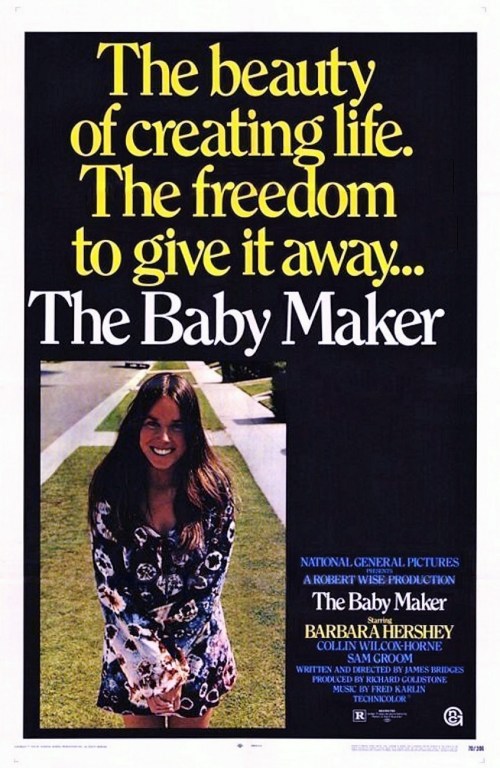
The Baby Maker (1970)

babymaker1

By Richard Winters

My Rating: 4 out of 10

4-Word Review: Paid to give birth.

Tish (Barbara Hershey) is a young, free-spirited women who’s a part of the hippie movement and looking for alternative ways to make money without having to do the usual 9-to-5 job. She becomes aware of the idea of being a surrogate mother hired to give birth to a baby from a couple who cannot have one themselves. The couple in this case are Jay (Sam Groom) and Suzanne (Collin Wilcox Paxton) who are middle-aged and due to a medical complication the wife is unable to have children. They agree to pay Tish an upfront allotment of money as well as covering the rent for the apartment that Tish shares with her boyfriend Tad (Scott Glenn). Things start smoothly enough, but ultimately underlying tensions soon surface like Suzanne’s concern that Tish is getting involved in too much physical activity and with her husband’s seemingly infatuation with the young woman. Tish’s boyfriend also begins to have problems with the agreement especially since Tish has stated she’ll not have sex with him during the course of the 9-month pregnancy.

This was the first film directed by James Bridges, who got his start writing teleplays for the ‘Alfred Hitchcock Presents’ TV-show before blossoming into a career helming such critically acclaimed efforts as The Paper Chase and Urban CowboyWhile the film is not perfect I did feel on the technical end it was well done with vivid cinematography that makes the viewer feel quite intimate to both the characters and their setting as well as a good time capsule to how things looked back in that era. The subject matter was quite unique for the period that even had some film critics labeling it as a ‘travesty’ while another called it ‘insufferable’. While I didn’t find it to be either it does show how provocative the issue was and thus overall making it a groundbreaking movie.

More than anything I really enjoyed the performance by Hershey who seems born to play this role and like she’s hardly even acting and instead just being herself. The carefreeness of her character really comes through especially when she decides to impulsively take-off her clothes while in front of the couple whom she’s just met, and jump into their backyard pool. You feel like she’s a perfect composite of most of the flower children back then and highly revealing to what made them tick. What I didn’t like though was how we never learn what gave her the idea to be a surrogate mother and I felt the film should’ve started from this point instead of having her already done it one time before without any backstory to what first gave her the motivation to even consider what at the time was not a typical thing that most people even the young hippies were doing.

I found the supporting characters to less interesting. Glenn, in his film debut, was the most baffling as he plays this overly selfless boyfriend who goes along too graciously with Tish’s idea of having someone else’s baby. Most guys would not be cool with this, or need more time to warm-up to it especially since it would require her sleeping with a married man. Having her then refuse to have sex with him while the pregnancy went on would be way too much for most men to handle, so the fact that he stays with her even after being told this made him seem unrealistic. Had he gotten into the relationship knowing upfront this is what she did for a living then maybe, but she just springs it on him after she’s agreed to the contract, which would’ve made anyone in that same situation quite upset, and justifiably so. I felt too that him ending up sleeping with one of her friends (Helena Kallianiotes) should’ve been understandable given the circumstances and Tish, being the supposedly open-minded, unconventional person that she is, should’ve allowed for it and possibly even invited it instead of growing jealous and throwing blue paint on them like she does.

I had the same issues with the couple. Collin Wilcox Paxton is excellent and light years away from her most famous role of Mayella Violet Ewell, the backwoods southern white woman who falsely accuses a black man of rape in To Kill a Mockingbird, but there’s just not enough tension between her and Tish, or in the scenes with her husband, which is the film’s biggest failing. It seems more concerned with tackling a novel concept in as genteel a way as possible, but in the process forgets that this is a drama and there needs to be conflict going on in order to keep it riveting. Certain potentially explosive problems are brought-up, but then quickly downplayed. There’s no surprise twist or altercation. It leisurely limps itself along to a hum-drum finish that has no impact at all and unfortunately ruins an intriguing concept that could’ve gone in many different, interesting directions, but ultimately doesn’t.

My Rating: 4 out of 10

Released: October 1, 1970

Runtime: 1 Hour 49 Minutes

Rated R

Director: James Bridges

Studio: National General Pictures

Available: DVD-R (Warner Archive), Amazon Video

That’s Life! (1986)

thats1

By Richard Winters

My Rating: 2 out of 10

4-Word Review: Wife frets over biopsy.

Gillian (Julie Andrews) is a singer who detects a lesion in her throat and goes to the doctors to have a biopsy done to see if it’s cancerous. The results of it won’t be ready until Monday forcing her to have to worry about it over the weekend. In an effort not to ruin things for the rest of her family she doesn’t tell them about it and puts on a facade like everything is fine. Meanwhile the other family members have their own problems. Harvey (Jack Lemmon), her husband, is depressed about turning 60, and not excited about the impending birthday celebration, or even being reminded of it. Her oldest daughter Megan (Jennifer Edwards) is going through the stresses of being pregnant while her younger daughter Kate (Emma Walton) fears that her boyfriend is cheating on her.

This was writer/director Blake Edwards first attempt at drama since the Days of Wine and Roses, which had also starred Lemmon. It was independently produced and thus requiring both the cast and crew to agree to work below scale, which caused controversy with the cinematographer’s union and created picketing at theaters in Hollywood when the movie was first released. The story was inspired by real-life events and problems that Edwards and his wife Julie were going through at the time as well as things that were happening with their grown children and the whole thing was shot on-location at the family home in Malibu.

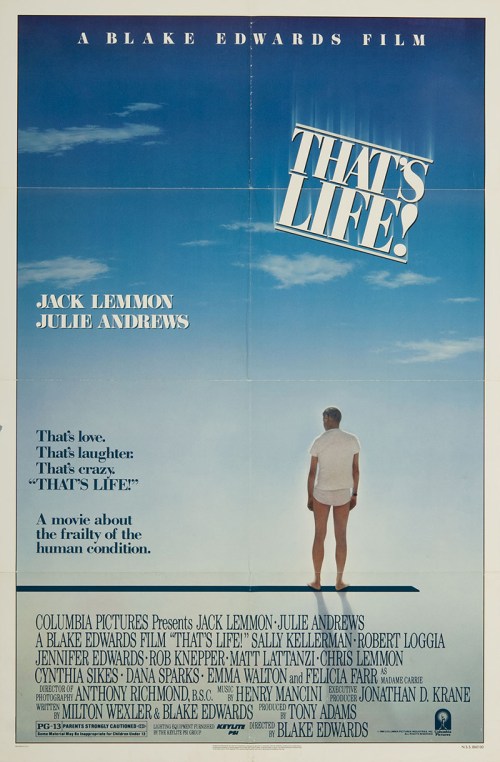
Lemmon, the movie’s promotional poster is a play-on the one for Save the Tigerthe movie he won the Oscar for as Best Actor, is the only fun thing about it. His constant bitching about everything is amusing without being forced and his presence helps give it some needed energy and it’s great seeing him do a few scenes with his real-life son Chris Lemmon, this was the only project they did together unless you count Airport ’77 though they never shared any scenes in that one, who also plays his actor son here. The only drawback is that he completely overshadows Andrews to the point that you start to forget about her even though technically she’s the protagonist that we’re supposed to be the most concerned about.

While the movie is meant to analyze the day-to-day realities of the human condition it does throw in some ‘comical’ side-stories that are really lame and end up dragging the whole film down. The first is Harvey’s relationship with Janice (Cynthia Sikes) a woman who has hired Harvey, who works as an architect, to design her dream house though her demands are constantly changing and many times unrealistic. Had this segment stopped there then it would’ve been insightful and humorous as many clients can make unreasonable requests, but since it’s ‘their money’ the person working for them feels the need not to speak up and go along with the crazy demands for fear they’ll lose out on the deal, which happens more than you think. However, the scene also has her coming on to him sexually, which made no sense. Harvey was significantly older than her, looking more like he was 70, with no guarantee that he could perform, which he ultimately can’t, so unless she had some sort of grandpa complex why would this highly attractive young woman, who could easily find a good-looking guy her age, even think about getting it on with this old duffer that virtually any other woman her age would consider ‘gross’?

The second ‘comical’ scenario is equally stupid as it features Lemmon’s actual wife Felicia Farr playing a psychic who has a sexual encounter with him at her place of business all for the measly price of $20 for a ‘reading’, but how often does this type of thing occur. I mean I’ve gone to a psychic a few times in my life, but it never turned hot-n-heavy; am I just missing out? She later has sex with one of Harvey’s friends making it seem like sex was all that she was into, but how long could she realistically retain the psychic facade before it all came crashing down and she was known simply as being the cheap neighborhood hooker? Why does she even bother with the phony psychic act at all? Why not just become a high-paid escort where she could be making a hell of a lot more money.

The third side-story deals with Harvey finding that the priest, played by Robert Loggia, whom he is confessing his infidelities to is actually his former college roommate that he hasn’t seen in decades, which again is pushing long odds not very likely to happen. The old friend angle doesn’t add much and actually would’ve been funnier had the priest remained someone he didn’t know and Harvey could feel that his confessions were completely confidential only to then get called up to the pulpit during a church service, like he does here, to read a Bible passage about infidelity, and thus getting the shock of his life that this supposedly benign man of the cloth may be on to him and his divulged sins not so safely protected.

Spoiler Alert!

The film’s wrap-up has all the problems getting neatly resolved, which gives it a sitcom quality. I was okay with Andrews learning that the lesion was not cancerous, but some of the other dramatic tangents that the family members went through should’ve not all worked out so nicely, because in real-life, which this film is attempting to be, things don’t always have happy endings. In fact this is what works against it as it’s too sterile for its own good. Nothing stands out making it a shallow, flat drama without much depth. Much like Gillian’s lesion it ultimately becomes benign.

My Rating: 2 out of 10

Released: October 10, 1986

Runtime: 1 Hour 42 Minutes

Rated PG-13

Director: Blake Edwards

Studio: Columbia Pictures

Available: DVD-R, VHS