Category Archives: Mystery

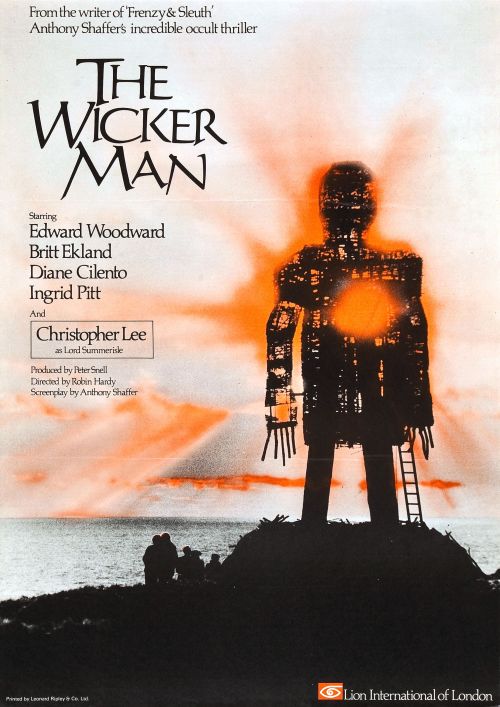
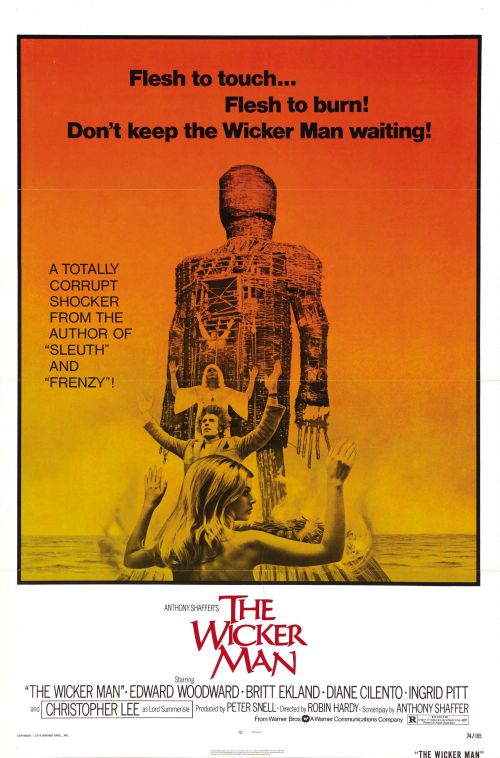
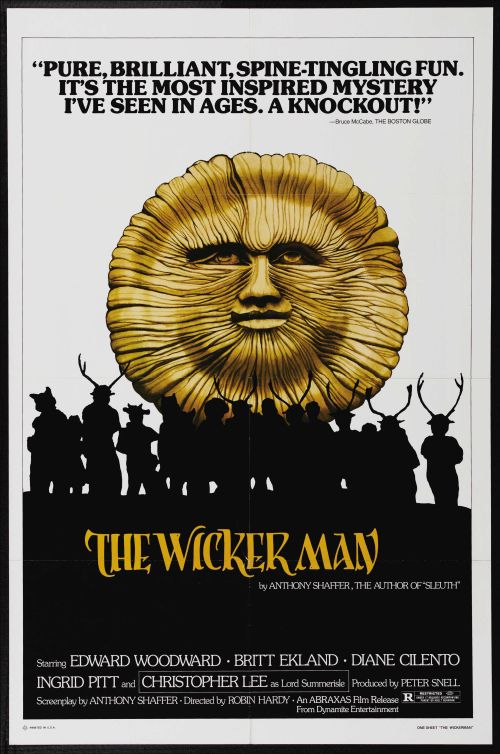
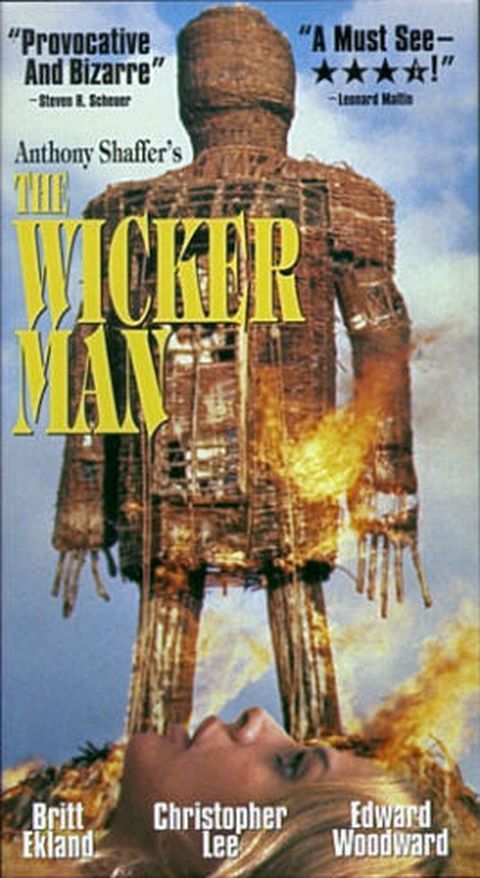
The Wicker Man (1973)

the wicker man 1

By Richard Winters

My Rating: 8 out of 10

4-Word Review: Pagans on an island.

Police sergeant Howie (Edward Woodward) receives a letter stating that their daughter named Rowan Morrison (Gerry Cowper) has disappeared and it compels him to travel by plane to an obscure island village off the coast of Scotland to find her. Once he arrives he finds nothing but resistance from the people and everyone denying that she even exists. He also learns that the people practice a pagan type of religion and begins to suspect that the girl’s disappearance may have something to do with the upcoming harvest celebration and decides to infiltrate the proceedings in order to weed-out the culprits and find the girl.

The film, which was inspired by the 1967 novel ‘Ritual’ by David Pinner, manages to be quite intriguing despite being material better suited for a short story. The whole concept is woven around the big twist that occurs at the end and everything that occurs beforehand is simply a lead up to that, which could’ve been a stretch for feature length but director Robin Hardy’s tight editing and deft use of atmosphere keeps things permanently lodged in the creepy and compelling even though I did figure out at around the 60 minute mark where it ultimately was headed. The film’s original length is supposedly longer than the 1Hour 28Minute release that is currently available, but to be honest I felt this was a perfect runtime for this type of story and stretching it out further would’ve simply been diluting it.

Edward Woodward, who later became familiar to American audiences with his starring role in the TV-show ‘The Equalizer’, is terrific in the lead and I liked that fact that the character wasn’t a completely ‘nice guy’ either, but instead rigidly entrenched in his Christian religious beliefs and arrogantly convinced that his spirituality was superior to anyone else’s. Christopher Lee again makes a good nemesis even though his mod hair style looks a bit goofy. Britt Ekland is on hand as well singing a weird song and even doing a provocative dance although the nude scenes of her from the waist down were done by a body double.

the wicker man 2

The only issue that I had with Anthony Shaffer’s script is the fact that the sergeant must go back to the mainland to get more men from the force to help him search for the girl, which to me was a bit of a loophole because I would think he could’ve just gotten on a phone and called in for more backup without arduously having to travel back. The facts that no one else knows where he is seemed a little implausible as well as most people working on the force have a supervisor that they must report to and who is at least somewhat aware of what case they are working on and where they are traveling to do it.

The ending though, which features an actual giant wicker man made of wood is an amazing site. When it gets set on fire with the victim and even some animals trapped inside of it is quite exciting and I liked how the point-of-view shifts between the people who view it from the ground as well as the victim seeing the people on the ground from inside the burning structure.

I remember seeing the 2006 remake starring Nicholas Cage in the theaters. While the details of it are vague I do recollect coming away from it finding grossly inferior in literally every way to this one and something that should be avoided at all costs.

the wicker man 3

the wicker man 4

My Rating: 8 out of 10

Released: December 10, 1973

Runtime: 1Hour 28Minutes

Rated R

Director: Robin Hardy

Studio: British Lion Film Corporation

Available: DVD, Blu-ray, Amazon Instant Video, YouTube

Clue (1985)

clue

By Richard Winters

My Rating: 3 out of 10

4-Word Review: Inspired by board game.

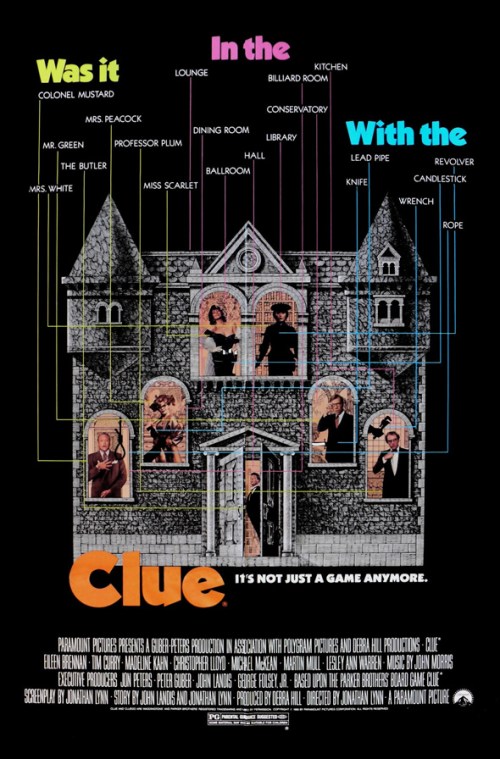
Six individuals (Martin Mull, Eileen Brennan, Lesley Ann Warren, Madeline Kahn, Michael McKean, Christopher Lloyd) are invited to an isolated New England mansion at the behest of Wadsworth (Tim Curry) the butler to the mansion’s owner. It seems that these six people have been blackmailed by Mr. Boddy (Lee Ving) and now Wadsworth, who is employed by Boddy, has decided it’s time to let them off the hook, but not before Boddy himself turns up dead having been murdered by one of the guests. As they try to unravel the mystery more homicides occur forcing the rest to find the killer before he/she finds them.

Initially this film, which is based on the famous Parker Brothers board game and currently being remade, is okay entertainment. The fast paced dialogue has a few good lines and the mystery element lends for some mild intrigue. The performances are also spot-on with each actor perfectly cast for their part. I especially liked Eileen Brennan as the nervous Mrs. Peacock as well as Warren as the sarcastic and snarky Miss Scarlet.

Unfortunately after an agreeable first 40 minutes it finally, like with its many victims, goes down with a thud. The concept just isn’t solid enough for feature length material and the idea of trying to stretch it out by adding more victims only convolutes things and makes an already ridiculous premise even more so. Having Curry spend the final part going back through all the things that had occurred before in an effort to ‘solve’ the case while rushing the rest of the cast from one part of the mansion to the other as he explains it is not amusing, but instead dizzying, redundant and pointless. What may have seemed initially like a novel idea instead becomes just another excursion into silliness and way too similar to Neil Simon’s Murder by Death, which came out in the ‘70’s and also starred Brennan.

True mystery buffs will be the most disappointed as the emphasis is completely on comedy and not in creating any type of elaborate whodunit for the viewer to figure out. The plot itself contains no real ‘clues’ and everything that occurs during the course of the film has nothing to do with who ultimately ends up being the culprit.

The film’s only real unique element is that it featured three different endings with different ones shown at various theaters. The DVD features all three with option to choose one at random. However, the first two are lame and only the third one, which features everyone as the murderer, is the only one that is halfway decent and should’ve been the sole one used.

My Rating: 3 out of 10

Released: December 13, 1985

Runtime: 1Hour 34Minutes (Includes all three endings)

Rated PG

Director: Jonathan Lynn

Studio: Paramount

Available: DVD, Blu-ray, Amazon Instant Video

The Lady in the Car with Glasses and a Gun (1970)

lady in the car

By Richard Winters

My Rating: 5 out of 10

4-Word Review: Dead body in trunk.

Dany (Samantha Eggar) works as a secretary for Michael (Oliver Reed) who asks her to come to his place one evening to help him type an urgent report that needs to go out the next day. She agrees and then spends the night in his guest bedroom. The next morning she travels with his family to the airport where they board a plane for a vacation while she is instructed to drive their car back home, but along the way she takes a wrong turn and begins to come upon people who say they’ve seen her before even though she can’t remember them. Then she finds a dead body in the trunk and things get really bizarre.

The film, which is based on the novel by Sebastien Jasprisot and remade in 1992 and then again in 2015, has a certain appeal as the story is offbeat enough to keep you intrigued and manages to give a logical, or at least an attempted one, explanation at the end for why everything that occurs to Dany happened and the reason behind it. Unfortunately Anatole Litvak’s direction is bland despite a colorful opening montage and Reed, with his hair dyed gray, is miscast as a stuffy businessman.

One of the biggest issues though is the main character who behaves in ways that make little sense. Going to her boss’s place after work hours to write a report and even be instructed to drive his car back from the airport seems to be going well beyond the normal duties of an ordinary secretary and one that most likely would be met with resistance by anyone else and yet Dany obliges to his demands without question like she is a robot. Later a strange man (John McEnery) enters her car and makes an aggressive pass at her. Instead of leaving or running for help she instead gets into the car with him and takes him back to her hotel and goes to bed with him before she even knows what his first name is.

Spoiler Alert!

At the end we find out that Dany’s boss has set the whole thing up to make it look like Dany shot the man, whose dead body was in the trunk, in order to cover up for his wife (Stephane Audran) who was the one who really did it. Apparently she had been having affairs with many different men and shot this one when he refused to continue to see her. The husband was aware of all of these transgressions and would pay off the men to quit seeing her and when he found out that his wife had killed this one he concocts an elaborate scheme to get her off the hook, but why? Most men would not feel the need to come to the defense of an unfaithful wife especially one that continues to do it over and over again, which makes the whole storyline quite weak since it’s completely off-the-mark in terms of realistic human behavior.

End of Spoiler Alert!

My Rating: 5 out of 10

Released: October 22, 1970

Runtime: 1Hour 38Minutes

Rated R

Director: Anatole Litvak

Studio: Columbia Pictures

Available: None at this time.
The Hitcher (1986)

hitcher

By Richard Winters

My Rating: 7 out of 10

4-Word Review: Chased by homicidal hitchhiker.

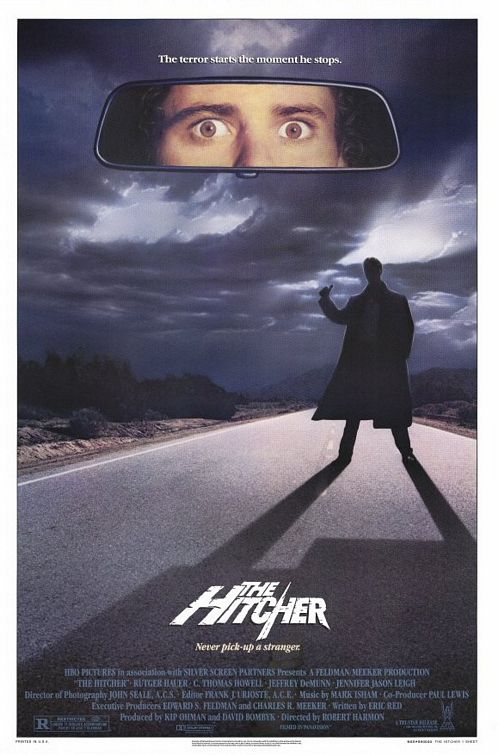
Jim Halsey (C. Thomas Howell) who is driving from Chicago to California finds himself falling asleep at the wheel as he travels late at night down a lonely desert highway. To keep himself awake he decides to pick-up a hitchhiker named John Ryder (Rutger Hauer) who immediately begins to behave strangely. Jim manages physically kick John out of the car when his life gets threatened, but then notices that he is continually coming upon him as his drive progresses. Soon the police are after him thinking that he is the one committing the murders that are really being done by John.

This film manages to be a nice blend between Spielberg’s TV-movie Duel and the classic episode of ‘The Twilight Zone’ in which Inger Stevens constantly sees the same hitchhiker as she drives her way through the desert. There are some really good suspenseful moments and a great performance by Hauer that almost makes up for its many transgressions, which unfortunately become more and more numerous.

Now, I did like this movie and tried to overlook a few of the logic loopholes, but eventually they become just too overblown. The biggest one is that John somehow manages to steel Jim’s wallet while also planting a knife on him that has blood from the victims that he has killed, but the only time they are together is when they are traveling in the car and I think Jim would’ve noticed John fishing through his pockets if that were the case. There’s also a lot of timing issues. For instance passengers stop and get off a bus to go inside a roadside café presumably for lunch, but then go right back into the bus just a couple of minutes later, which isn’t enough time for them to eat, go to the bathroom, or even stretch their legs. Another scene has Jim’s girlfriend Nash (Jennifer Jason Leigh) getting kidnapped from her hotel room by John who somehow is able to enter the room without explanation and then takes her out to the parking lot and ties her up between two trucks before the police get called in and try to intervene, but this all occurs in seemingly only a couple of minutes as Jim is in the bathroom when he hears Nash being taken out and he quickly runs out into the parking lot only to see Nash already tied up and the police there.

There is also the issue of how is John able to escape out of a police van after he is caught and handcuffed, which the movie doesn’t even bother to explain or show. Another question some viewers have brought up is why is Jim driving through Texas anyways, which is where this all occurs, since it seems too far to the south from where he needs to go. Some have speculated that maybe he was going to the southern portion of California and therefore would need to pass through the Panhandle of Texas to get there, which is plausible, but the landscape is all wrong. I live in Texas and know that the panhandle region, which I’ve been to, is flat and green and has farmland while the place Jim goes through is barren, sandy and very much a desert.

The film wasn’t even shot in Texas, but instead done in the Mojave Desert in California, which made me wonder why the setting couldn’t have been there since that was supposed to be Jim’s ultimate destination anyways. Then I realized that the police are portrayed as being quite hick and redneck and since Texas unfairly still has that stereotype I’m sure that was the reason for why it was chosen.

The script could’ve certainly been better thought out, which wouldn’t have required the viewer to take such massive leaps in logic in order to enjoy it, but overall I still liked it. I think this was mainly because of Hauer who is terrifically creepy as well as for an extremely exciting car chase that features incredible stunt work and without relying on any of computerized crap either.

My Rating: 7 out of 10

Released: February 21, 1986

Runtime: 1Hour 37Minutes

Rated R

Director: Robert Harmon

Studio: TriStar Pictures

Available: DVD


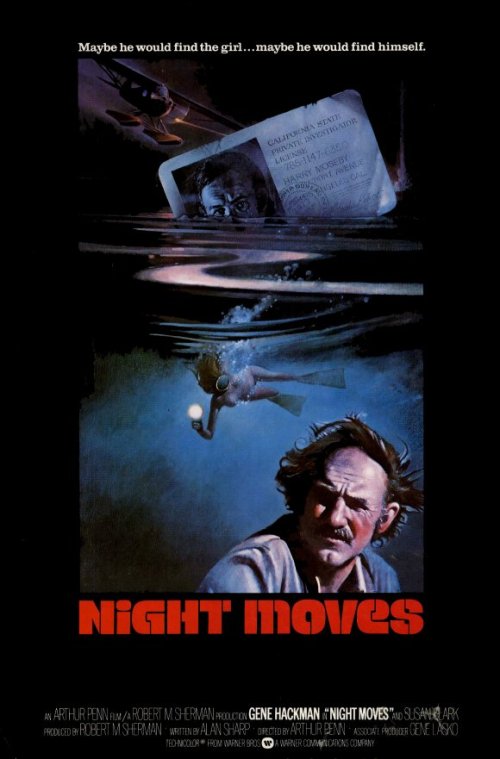
Night Moves (1975)

night moves 1

By Richard Winters

My Rating: 7 out of 10

4-Word Review: Searching for runaway teen.

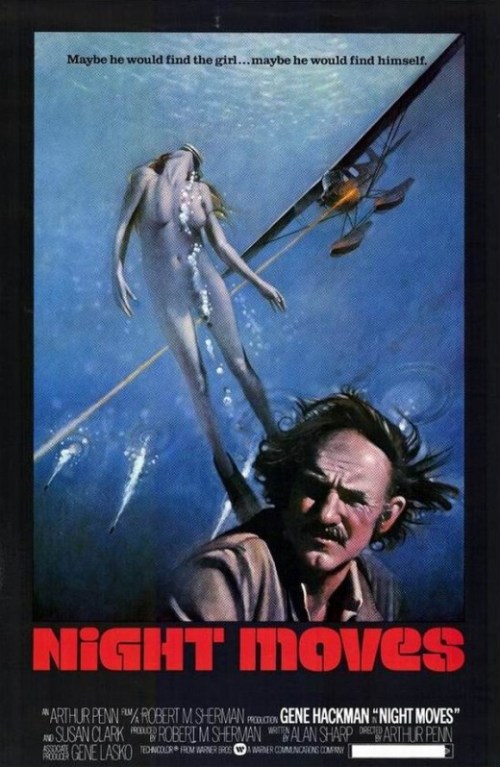
Harry Moseby (Gene Hackman) is a down-on-his-luck former football player who is now working as a private detective. The cases are not interesting and when his wife (Susan Clark) begins having an affair he feels like his life has hit rock bottom. Then he gets what he thinks is just another routine case which is finding the missing runaway teenage daughter (Melanie Griffith) of an aging, alcoholic actress (Janet Ward). The case though harbors many dark and unexpected turns that eventually gets Harry wrapped up into a world of art smuggling and murder.

To me one of the lasting impressions of the film, which I have seen many times over the years, is the way it incorporates nighttime into the story. The majority of the action and dialogue take place very late and makes full use of the sound of the night bugs croaking and chirping. In fact this becomes ‘the music’ for the scenes and helps create a third character as it reveals the darkness harboring inside the characters.

Hackman gives another outstanding performance playing a protagonist struggling against loneliness and frustration while realizing that it may be an inevitable part of life and something that cannot be ‘defeated’. His best line comes when he describes where he was when the Kennedys were shot. When John F. was assassinated he was playing football and still full of dreams, but then 5 years later when Bobby was killed his life had already fallen into an apathetic rut.

Jennifer Warren is good in support and looks terrific during a topless lovemaking scene. Griffith, Edward Binns and James Woods do quite well in their respective roles and the lesser-known Janet Ward plays a pathetic, boozing old broad about as well as anyone could.

The majority of the story is talky, but still intriguing. The only action comes near the end when Harry gets attacked by a seaplane while he is out on a boat. This scene is especially good because it plays off of the famous airplane segment in North by Northwest and is almost as riveting including the memorable and unique way Harry is finally able to identify the mysterious pilot.

The script, by Alan Sharp is overall smart, but does suffer from a few moments where things don’t make complete sense. One of those is when Griffith finds out that Harry plans on taking her back to her mother which she insists will ‘never’ happen, but then in the next shot we see her getting into his car, which I would think she’d resist doing for fear that she would be placing herself into too much of a vulnerable position and he would use the opportunity to ‘kidnap’ her and take her back to where she didn’t want to go.

Another moment comes when Griffith leaves a message on his answering machine that alerts Harry about something she feels he should look into. He begins listening to it, but then shuts it off when his wife enters the room yet he never goes back to listen to the rest of it even after Griffith later turns up dead.

When a death occurs on a movie set Harry is the one who gets called in to analyze the film footage showing the mishap, which isn’t realistic as the police would’ve been the ones doing the investigation and they most likely would’ve confiscated the footage in order to be used later as possible evidence.

night moves 2

My Rating: 7 out of 10

Released: June 11, 1975

Runtime: 1Hour 39Minutes

Rated R

Director: Arthur Penn

Studio: Warner Brothers

Available: DVD, Amazon Instant Video, YouTube

Jagged Edge (1985)

jagged edge

By Richard Winters

My Rating: 6 out of 10

4-Word Review: An old Corona typewriter.

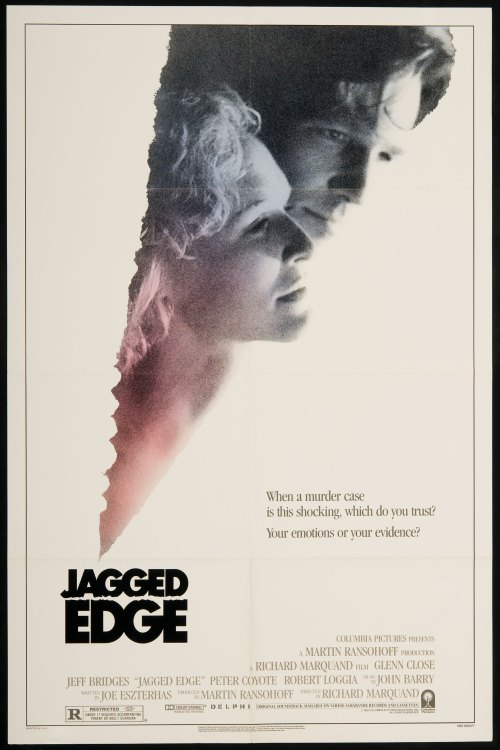
Rich socialite Paige Forrester (Maria Mayenzet) is brutally murdered in her own home the victim of wounds done by the jagged edge of an unusually curved hunting knife. Her husband Jack (Jeff Bridges) claims he was knocked unconscious and didn’t come to until after she was killed and the assailant gone, but when evidence points to his head wound being self-inflicted he gets arrested for the crime. Teddy Barnes (Glenn Close) becomes his reluctant public defender. She is initially not convinced of his innocence, but the more she gets to know him the more she believes it while also allowing herself to become romantically involved with him. As the court case progresses there are many twists and turns including mysterious, anonymous notes typed with the use of an old typewriter and sent to Teddy, which reveal intriguing clues about her client.

The film, written by Joe Eszterhas, has all the trappings of a great court drama. Lots of clues that go either way making the viewer unsure if the defendant is really guilty or not and working very much like real trials do. I felt for the most part the trial procedures were well research and believable including all the meticulous investigating that Barnes does on her own before the trial even begins. The only thing in this area that could’ve been done better was trying to string out the suspense a bit more by prolonging the length of the jury deliberation. In real-life this can go on for several days, even weeks, but this film made it seem like it was only a few short hours.

Close gives an outstanding performance in a part that was originally intended for Jane Fonda. I love the way she can show such a wide range of emotions and the simple, but effective way that her character’s eyes well up with tears as she listens to the testimony of a rape victim is one the ingredients that makes all of her performances impactful and endearing. Veteran actors Robert Loggia, as a gruff, foul-mouthed detective, and John Dehner as a stern, hard-lined judge are also terrific. I also liked the way Teddy’s children are portrayed as being much more savvy to the world and not just there to say cute and precocious things.

Spoiler Alert!!!

The film’s biggest downfall tough is with its twist ending as Teddy ends up finding the typewriter that had written all those mysterious notes inside Jack’s closet and convincing her that he had actually been guilty all along despite getting off as innocent. She then takes the typewriter with her back to her house and then a few hours later Jack breaks into her place and in an effort to ‘silence her’ tries to kill her, which is all quite ridiculous.

For one thing I didn’t understand why Jack would hide the typewriter in a closet that is only a few feet from where he and Teddy slept. The guy lives in a gigantic mansion, so why not place it where it would be hard-to-find and not where she could easily come upon it. Also, he doesn’t need to kill her at all, he simply needs to retrieve the typewriter, which she leaves sitting on the staircase and he walks right past it. Without the typewriter there is no evidence. He takes it back and destroys it and she has nothing on him. Trying to kill her like the character here proceeds to do is the dumbest thing possible because he would be killing her in the exact same manner that he did in his wife, which would immediately make him the prime suspect and quickly arrested. The Jack character had been so smart otherwise that I’m sure he would’ve thought of this, which makes the wrap-up quite weak and unfortunately hurts what is otherwise a slick and entertaining production.

End of Spoiler Alert!!!

My Rating: 6 out of 10

Released: October 4, 1985

Runtime: 1Hour 48Minutes

Rated R

Director: Richard Marquand

Studio: Columbia Pictures

Available: DVD, Amazon Instant Video

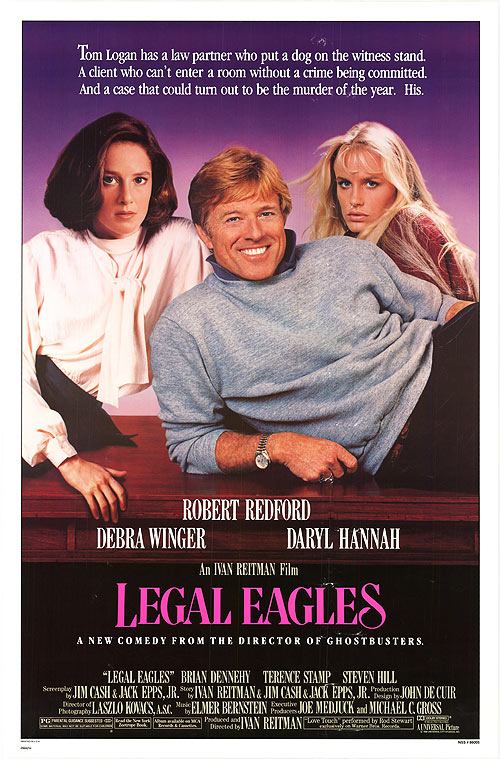
Legal Eagles (1986)

legal eagles

By Richard Winters

My Rating: 5 out of 10

4-Word Review: Searching for stolen paintings.

Successful district attorney Tom Logan (Robert Redford) suddenly finds himself in a big mess when defense lawyer Laura Kelly (Debra Winger) approaches him in regards to her quirky client Chelsea Deardon (Daryl Hannah). She feels that Chelsea is innocent of the charges against her and hopes to have them dropped before it goes to court. When Tom looks into the case he finds that there’s much more to it than initially assumed, which leads the three into danger, stolen paintings, murder and even a weird love triangle.

If you are expecting anything having to do with a legal drama then you’ll be highly disappointed as there is very little time spent in the actual courtroom. Instead you get what amounts to an ‘80s action flick with explosions, car chases and even shootouts as these two lawyers go through things that no other lawyer in the history of the universe has ever went through either before or after.

The main selling point, and the only thing that actually works, is the casting. Redford with his laid back style is terrific in this type of comedy and I enjoyed the way he tries to remain cool-under-pressure despite being exasperated with two very kooky females, who both have an interest in him, coming at him from both sides. Winger is fun too as a well-meaning young attorney who tries hard, but still seems a bit ‘rough-around-the-edges’. Hannah is also perfectly cast in a role that works well with her slightly flaky, free-spirited persona and she even has a scene where she performs a fire-laden performance art piece that she wrote herself.

The first hour has a nice balance between the interpersonal relationships of the three as well as an intriguing mystery, but the second half leans too much into the action and gets overblown. The supposedly ‘exciting’ finale only helped to get me bored and annoyed. It’s the chemistry of the three stars and the romantic entanglements that ensued between them that had me interested and are what made the plot unique. The film should’ve emphasized this area more and even played it up. Having things end up working out so conveniently between the three despite the fact that both women were for a time seemingly competing for Redford’s affections misses out on a lot of potential fireworks and amusingly comical scenarios.

Familiar faces pop up in minor roles including a young Christine Baranski as a fledgling member of Tom’s legal team as well as Terence Stamp in a role that ends up being so small and insignificant I was surprised he agreed to take it. The film also features Rod Stewart’s hit song ‘Love Touch’ that climbed to number 6 on the pop charts, but isn’t heard until the very end when it gets played over the closing credits.

My Rating: 5 out of 10

Released: June 20, 1986

Runtime: 1Hour 56Minutes

Rated PG

Director: Ivan Reitman

Studio: Universal

Available: VHS, DVD, Amazon Instant Video

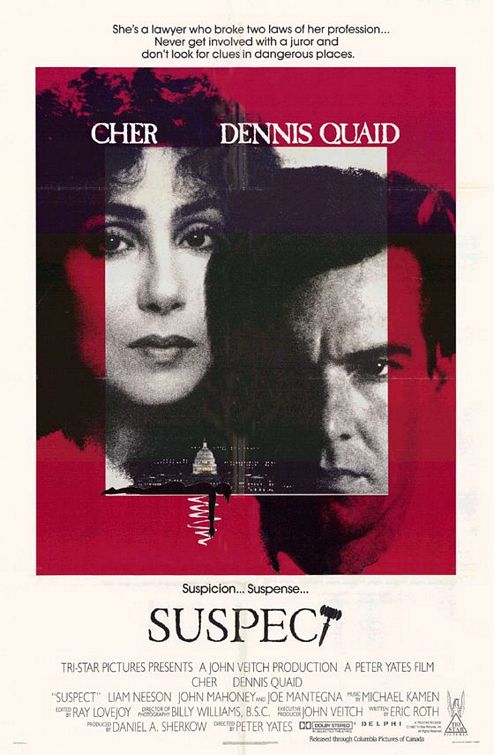
Suspect (1987)

suspect 3

By Richard Winters

My Rating: 4 out of 10

4-Word Review: Juror helps solve case.

Kathleen Riley (Cher) is a public defender who suddenly finds herself embroiled in what initially seems like an open-and-shut case. She’s been hired to defend Carl (Liam Neeson) a Vietnam Veteran who through illness is now both deaf and mute and living on the city streets as a homeless vagrant. He was caught near the body of a former file clerk to the justice department whose corpse was found floating near the Potomac River. As the case progresses Kathleen finds an unusual ally in Eddie (Dennis Quaid) who is one of the jurors on the case and who does some investigating of his own only to dig up evidence that points to the murder being connected to a top ranking political figure (Phillip Bosco).

The film starts out well and has all the ingredients of being a crafty court battle wrapped around an intricate mystery, but unlike most other courtroom dramas this one is not based on a novel written by an author with a legal background. Instead the story was penned directly for the screen by Eric Roth, who’s had plenty of success in his own right, but no expertise in legal proceedings, which would explain why this would-be drama ultimately becomes implausible and over-the-top.

The biggest problem I had was trying to understand why a juror would go so out of his way to investigate a case on his own. Nothing about the character’s background revealed a personality trait that would make him want to do this and if anything working as a lobbyist seemed to make him more of an opportunist than a truth seeker. The character was initially reluctant to even fulfill his jury duty requirement, so why does he suddenly make a 180 degree turn and spend his free time going into dangerous areas of the city simply to help solve a case that he has no emotional attachment to whatsoever? The concept makes no sense and is also illegal. The story would’ve been more believable had the character been a young member of Riley’s legal team and in an effort to prove himself went out of his way to find clues that would help solve the case.

The fact that the victim’s car remains impounded in the lot where she last parked it and never towed away even well after she had been murdered seems equally implausible as does the fact that Riley nor the police don’t think to search it until the case is almost over. There is also another scene where Eddie, in an effort to get out of the hotel room after the jury has been sequestered, puts a flame to a fire alarm to make it go off and thus create enough diversion to allow him to leave the building undetected, which he does, but it never shows how he is able to get back into his room undetected, which most likely could prove just as dicey.

Yet despite all these other issues, it is actually the theatrical, Hollywood-like court room showdown at the end that is the most absurd and relies too much on extreme circumstance and coincidence for it to be even remotely believable. Katherine’s foot chase through the darkened corridors of the court building by a shadowy figure is equally out-of-place and better suited for a thriller.

Cher is okay in a role that seemed to be stretching her acting range, but the fact that a juror feeds her all the clues and does almost all the investigative legwork that either her or her legal team should’ve done initially makes her character look lazy, sloppy and incompetent.

John Mahoney is effective as the stern, grim-faced judge and Liam Neeson does well cast in role that has no speaking lines, but his character doesn’t get shown enough and there are long stretches where he isn’t seen and the viewer almost forgets all about him. The segment though where Riley asks him if he committed the murder as he is sitting on the stand and his face goes from pale white to beet red in a matter of seconds is probably the film’s best moment.

My Rating: 4 out of 10

Released: October 23, 1987

Runtime: 2Hours 1Minute

Rated R

Director: Peter Yates

Studio: TriStar Pictures

Available: VHS, DVD, Amazon Instant Video, YouTube

Village of the Damned (1960)

village of the damned 2

By Richard Winters

My Rating: 6 out of 10

4-Word Review: The eyes have it.

Remade in 1995 and based on the John Wyndham novel ‘The Midwich Cuckoos’ the story centers on a small English village where one day everyone mysteriously falls asleep for several hours while under the spell of some invisible, odorless gas. When they awaken everything seems normal, but later on all the women become pregnant, even those that were not married or were still virgins. When the babies are born they are found to be different from their human counterparts as they have a higher intelligence, odd shaped heads and bright blonde hair. Later on these same children gain the ability to read other people’s minds and dispose of those that they don’t like penetrating them with the spell of their glowing eyes. As the rest of the village panics one man (George Sanders) feels that he may have the ability to stop them, but only if he can somehow control his own thoughts, so they won’t be able to tell what he is actually up to.

As a sci-fi thriller it’s not bad. The film’s short running time has a nice compact style to it with a story that evolves at a fast pace and continues to add new twists. The special effects for its day are realistic enough to be passable and the violence is surprisingly high. Sanders is effective in the lead and Martin Stephens as the leader of the children is quite creepy.

I found it a bit baffling though that the townspeople wouldn’t have quarantined the strange children from the start as it becomes quite obvious from the beginning that they aren’t normal. Instead they are allowed to roam freely even as they become increasingly more sinister. I would’ve also have thought that some of the mothers who gave birth to these strange beings would’ve disowned them and even refused to take care of them once their unnatural and frightening oddities became apparent.

The ending is frustrating as the film does not supply any answer as to who these kids where and what type of alien presence impregnated the women and why. The movie tells us that other places have been effected with these strange children as well, which leads one to believe that this is only a part of some other more sinister plot with far reaching consequences that never gets tackled. Instead we get left with a short film that acts like a small chapter to a fascinating idea with broad potential variables that unfortunately never gets followed through on.

My Rating: 6 out of 10

Released: July 5, 1960

Runtime: 1Hour 17Minutes

Not Rated

Director: Wolf Rilla

Studio: MGM

Available: DVD, Amazon Instant Video

Don’t Torture a Duckling (1972)

don't torture a duckling 2

By Richard Winters

My Rating: 4 out of 10

4-Word Review: Who’s killing the children?

The setting in this Italian giallo is a small, rural village where the children of the townspeople are being murdered. At first the police suspect and arrest a mentally handicapped man (Vito Passeri), but the killings continue. Soon even more suspects turn up including Maciara (Florinda Bolkan) the mother of a dead child herself who secretly practices voodoo using dolls made by her father and yet every time the authorities believe they’ve found the culprit more clues arise that leads them to someone else creating panic in a town already steeped in fear, suspicion and the superstitious.

As a story detailing a police investigation it’s not too bad. The plot works in a linear fashion that’s easy to follow without entering in too many subplots or red herrings although it’s still no better than your average episode of ‘Murder She Wrote’. I did enjoy the rural Italian landscape and the bird’s eye shot of the village whose decrepit, rundown buildings visually hit home the stifled, bleak nature of the residents and why they would turn so heavily to the spiritual world as their sole escape.

Balkan’s performance as the nutty lady is effective particularly when she has a seizure during her interrogation and the scene where she gets surrounded by men who belt her with chains is quite graphic and realistic.

The film though, like with a lot of Italian productions from that era, does have dubbing issues particularly director Lucio Fulci’s use of adding in all the sound effects giving it a certain over-the-top cartoon quality. For instance when a victim is being slapped by a man’s hand it sounds more like the lashing of a whip and even simple stuff like the shoveling of dirt comes off wrong because the sound effect is not in sync with the action on the screen.

The film also has a uncomfortable moment where an adult character (Barbara Bouchet), who is one of the protagonists, walks around naked in front of a 12-year-old boy and even asks him how many women ‘he’s done it with’.

Spoiler Alert!

Guessing who the real killer is was easy and I had the whole thing figured out after about 30 minutes making the rest of the mystery predictable and boring. The idea of a priest killing children might’ve been considered shocking at the time, but now as with Fulci’s criticism of the Catholic Church it comes off as heavy-handed and redundant.

The close-up, slow motion shot of the priest falling down a cliff at the end is the film’s most controversial moment as it is clearly a dummy whose blank eyes and unnaturally agape mouth looks incredibly fake. Some have argued that this was Fulci’s attempt at revealing the ‘inner ugliness’ of the character by showing something with such a distorted face, but since a similar looking mannequin is also used to portray one of the boy victim’s submerged in a tub of water earlier I think it can safely be said that it was more just the cheapness of the production than anything else.

End of Spoiler Alert!

don't torture a duckling 4

My Rating: 4 out of 10

Released: September 29, 1972

Runtime: 1Hour 42Minutes

Not Rated

Director: Lucio Fulci

Studio: Medusa Distribuzione

Available: DVD, Amazon Instant Video