Category Archives: Mystery

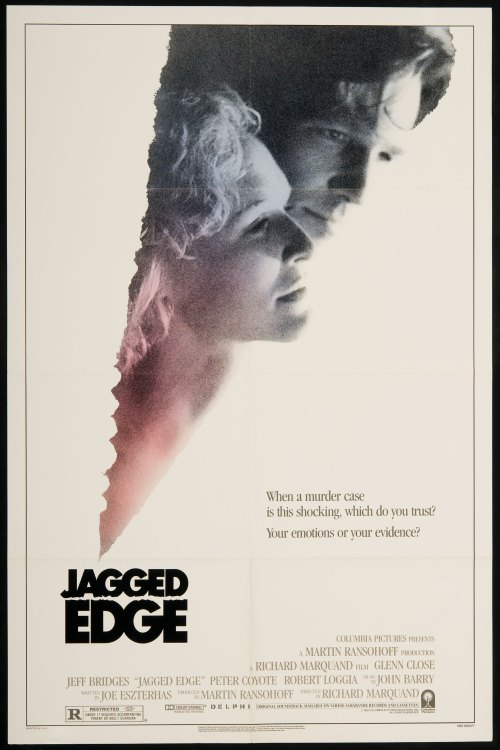
Jagged Edge (1985)

jagged edge

By Richard Winters

My Rating: 6 out of 10

4-Word Review: An old Corona typewriter.

Rich socialite Paige Forrester (Maria Mayenzet) is brutally murdered in her own home the victim of wounds done by the jagged edge of an unusually curved hunting knife. Her husband Jack (Jeff Bridges) claims he was knocked unconscious and didn’t come to until after she was killed and the assailant gone, but when evidence points to his head wound being self-inflicted he gets arrested for the crime. Teddy Barnes (Glenn Close) becomes his reluctant public defender. She is initially not convinced of his innocence, but the more she gets to know him the more she believes it while also allowing herself to become romantically involved with him. As the court case progresses there are many twists and turns including mysterious, anonymous notes typed with the use of an old typewriter and sent to Teddy, which reveal intriguing clues about her client.

The film, written by Joe Eszterhas, has all the trappings of a great court drama. Lots of clues that go either way making the viewer unsure if the defendant is really guilty or not and working very much like real trials do. I felt for the most part the trial procedures were well research and believable including all the meticulous investigating that Barnes does on her own before the trial even begins. The only thing in this area that could’ve been done better was trying to string out the suspense a bit more by prolonging the length of the jury deliberation. In real-life this can go on for several days, even weeks, but this film made it seem like it was only a few short hours.

Close gives an outstanding performance in a part that was originally intended for Jane Fonda. I love the way she can show such a wide range of emotions and the simple, but effective way that her character’s eyes well up with tears as she listens to the testimony of a rape victim is one the ingredients that makes all of her performances impactful and endearing. Veteran actors Robert Loggia, as a gruff, foul-mouthed detective, and John Dehner as a stern, hard-lined judge are also terrific. I also liked the way Teddy’s children are portrayed as being much more savvy to the world and not just there to say cute and precocious things.

Spoiler Alert!!!

The film’s biggest downfall tough is with its twist ending as Teddy ends up finding the typewriter that had written all those mysterious notes inside Jack’s closet and convincing her that he had actually been guilty all along despite getting off as innocent. She then takes the typewriter with her back to her house and then a few hours later Jack breaks into her place and in an effort to ‘silence her’ tries to kill her, which is all quite ridiculous.

For one thing I didn’t understand why Jack would hide the typewriter in a closet that is only a few feet from where he and Teddy slept. The guy lives in a gigantic mansion, so why not place it where it would be hard-to-find and not where she could easily come upon it. Also, he doesn’t need to kill her at all, he simply needs to retrieve the typewriter, which she leaves sitting on the staircase and he walks right past it. Without the typewriter there is no evidence. He takes it back and destroys it and she has nothing on him. Trying to kill her like the character here proceeds to do is the dumbest thing possible because he would be killing her in the exact same manner that he did in his wife, which would immediately make him the prime suspect and quickly arrested. The Jack character had been so smart otherwise that I’m sure he would’ve thought of this, which makes the wrap-up quite weak and unfortunately hurts what is otherwise a slick and entertaining production.

End of Spoiler Alert!!!

My Rating: 6 out of 10

Released: October 4, 1985

Runtime: 1Hour 48Minutes

Rated R

Director: Richard Marquand

Studio: Columbia Pictures

Available: DVD, Amazon Instant Video
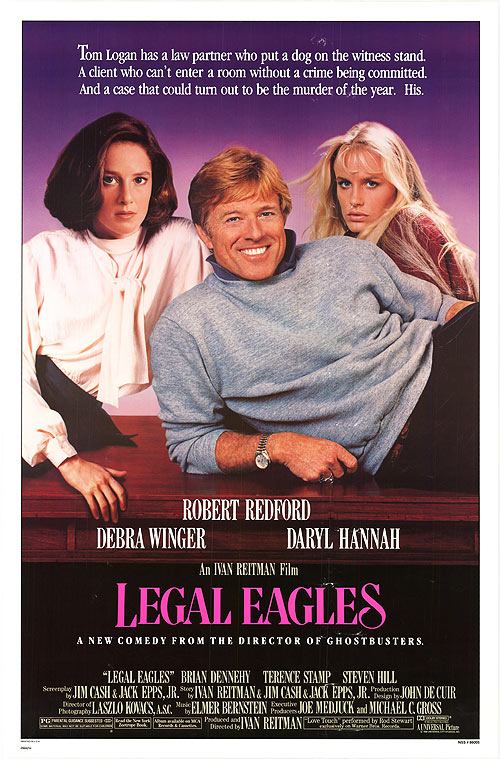
Legal Eagles (1986)

legal eagles

By Richard Winters

My Rating: 5 out of 10

4-Word Review: Searching for stolen paintings.

Successful district attorney Tom Logan (Robert Redford) suddenly finds himself in a big mess when defense lawyer Laura Kelly (Debra Winger) approaches him in regards to her quirky client Chelsea Deardon (Daryl Hannah). She feels that Chelsea is innocent of the charges against her and hopes to have them dropped before it goes to court. When Tom looks into the case he finds that there’s much more to it than initially assumed, which leads the three into danger, stolen paintings, murder and even a weird love triangle.

If you are expecting anything having to do with a legal drama then you’ll be highly disappointed as there is very little time spent in the actual courtroom. Instead you get what amounts to an ‘80s action flick with explosions, car chases and even shootouts as these two lawyers go through things that no other lawyer in the history of the universe has ever went through either before or after.

The main selling point, and the only thing that actually works, is the casting. Redford with his laid back style is terrific in this type of comedy and I enjoyed the way he tries to remain cool-under-pressure despite being exasperated with two very kooky females, who both have an interest in him, coming at him from both sides. Winger is fun too as a well-meaning young attorney who tries hard, but still seems a bit ‘rough-around-the-edges’. Hannah is also perfectly cast in a role that works well with her slightly flaky, free-spirited persona and she even has a scene where she performs a fire-laden performance art piece that she wrote herself.

The first hour has a nice balance between the interpersonal relationships of the three as well as an intriguing mystery, but the second half leans too much into the action and gets overblown. The supposedly ‘exciting’ finale only helped to get me bored and annoyed. It’s the chemistry of the three stars and the romantic entanglements that ensued between them that had me interested and are what made the plot unique. The film should’ve emphasized this area more and even played it up. Having things end up working out so conveniently between the three despite the fact that both women were for a time seemingly competing for Redford’s affections misses out on a lot of potential fireworks and amusingly comical scenarios.

Familiar faces pop up in minor roles including a young Christine Baranski as a fledgling member of Tom’s legal team as well as Terence Stamp in a role that ends up being so small and insignificant I was surprised he agreed to take it. The film also features Rod Stewart’s hit song ‘Love Touch’ that climbed to number 6 on the pop charts, but isn’t heard until the very end when it gets played over the closing credits.

My Rating: 5 out of 10

Released: June 20, 1986

Runtime: 1Hour 56Minutes

Rated PG

Director: Ivan Reitman

Studio: Universal

Available: VHS, DVD, Amazon Instant Video

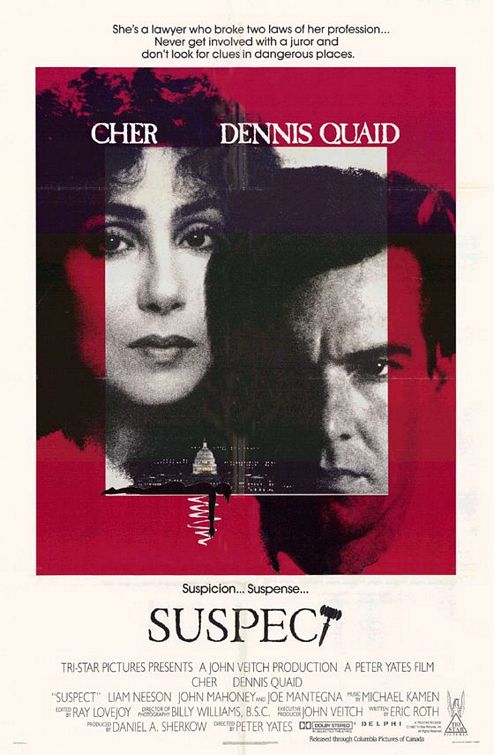
Suspect (1987)

suspect 3

By Richard Winters

My Rating: 4 out of 10

4-Word Review: Juror helps solve case.

Kathleen Riley (Cher) is a public defender who suddenly finds herself embroiled in what initially seems like an open-and-shut case. She’s been hired to defend Carl (Liam Neeson) a Vietnam Veteran who through illness is now both deaf and mute and living on the city streets as a homeless vagrant. He was caught near the body of a former file clerk to the justice department whose corpse was found floating near the Potomac River. As the case progresses Kathleen finds an unusual ally in Eddie (Dennis Quaid) who is one of the jurors on the case and who does some investigating of his own only to dig up evidence that points to the murder being connected to a top ranking political figure (Phillip Bosco).

The film starts out well and has all the ingredients of being a crafty court battle wrapped around an intricate mystery, but unlike most other courtroom dramas this one is not based on a novel written by an author with a legal background. Instead the story was penned directly for the screen by Eric Roth, who’s had plenty of success in his own right, but no expertise in legal proceedings, which would explain why this would-be drama ultimately becomes implausible and over-the-top.

The biggest problem I had was trying to understand why a juror would go so out of his way to investigate a case on his own. Nothing about the character’s background revealed a personality trait that would make him want to do this and if anything working as a lobbyist seemed to make him more of an opportunist than a truth seeker. The character was initially reluctant to even fulfill his jury duty requirement, so why does he suddenly make a 180 degree turn and spend his free time going into dangerous areas of the city simply to help solve a case that he has no emotional attachment to whatsoever? The concept makes no sense and is also illegal. The story would’ve been more believable had the character been a young member of Riley’s legal team and in an effort to prove himself went out of his way to find clues that would help solve the case.

The fact that the victim’s car remains impounded in the lot where she last parked it and never towed away even well after she had been murdered seems equally implausible as does the fact that Riley nor the police don’t think to search it until the case is almost over. There is also another scene where Eddie, in an effort to get out of the hotel room after the jury has been sequestered, puts a flame to a fire alarm to make it go off and thus create enough diversion to allow him to leave the building undetected, which he does, but it never shows how he is able to get back into his room undetected, which most likely could prove just as dicey.

Yet despite all these other issues, it is actually the theatrical, Hollywood-like court room showdown at the end that is the most absurd and relies too much on extreme circumstance and coincidence for it to be even remotely believable. Katherine’s foot chase through the darkened corridors of the court building by a shadowy figure is equally out-of-place and better suited for a thriller.

Cher is okay in a role that seemed to be stretching her acting range, but the fact that a juror feeds her all the clues and does almost all the investigative legwork that either her or her legal team should’ve done initially makes her character look lazy, sloppy and incompetent.

John Mahoney is effective as the stern, grim-faced judge and Liam Neeson does well cast in role that has no speaking lines, but his character doesn’t get shown enough and there are long stretches where he isn’t seen and the viewer almost forgets all about him. The segment though where Riley asks him if he committed the murder as he is sitting on the stand and his face goes from pale white to beet red in a matter of seconds is probably the film’s best moment.

My Rating: 4 out of 10

Released: October 23, 1987

Runtime: 2Hours 1Minute

Rated R

Director: Peter Yates

Studio: TriStar Pictures

Available: VHS, DVD, Amazon Instant Video, YouTube

Village of the Damned (1960)

village of the damned 2

By Richard Winters

My Rating: 6 out of 10

4-Word Review: The eyes have it.

Remade in 1995 and based on the John Wyndham novel ‘The Midwich Cuckoos’ the story centers on a small English village where one day everyone mysteriously falls asleep for several hours while under the spell of some invisible, odorless gas. When they awaken everything seems normal, but later on all the women become pregnant, even those that were not married or were still virgins. When the babies are born they are found to be different from their human counterparts as they have a higher intelligence, odd shaped heads and bright blonde hair. Later on these same children gain the ability to read other people’s minds and dispose of those that they don’t like penetrating them with the spell of their glowing eyes. As the rest of the village panics one man (George Sanders) feels that he may have the ability to stop them, but only if he can somehow control his own thoughts, so they won’t be able to tell what he is actually up to.

As a sci-fi thriller it’s not bad. The film’s short running time has a nice compact style to it with a story that evolves at a fast pace and continues to add new twists. The special effects for its day are realistic enough to be passable and the violence is surprisingly high. Sanders is effective in the lead and Martin Stephens as the leader of the children is quite creepy.

I found it a bit baffling though that the townspeople wouldn’t have quarantined the strange children from the start as it becomes quite obvious from the beginning that they aren’t normal. Instead they are allowed to roam freely even as they become increasingly more sinister. I would’ve also have thought that some of the mothers who gave birth to these strange beings would’ve disowned them and even refused to take care of them once their unnatural and frightening oddities became apparent.

The ending is frustrating as the film does not supply any answer as to who these kids where and what type of alien presence impregnated the women and why. The movie tells us that other places have been effected with these strange children as well, which leads one to believe that this is only a part of some other more sinister plot with far reaching consequences that never gets tackled. Instead we get left with a short film that acts like a small chapter to a fascinating idea with broad potential variables that unfortunately never gets followed through on.

My Rating: 6 out of 10

Released: July 5, 1960

Runtime: 1Hour 17Minutes

Not Rated

Director: Wolf Rilla

Studio: MGM

Available: DVD, Amazon Instant Video

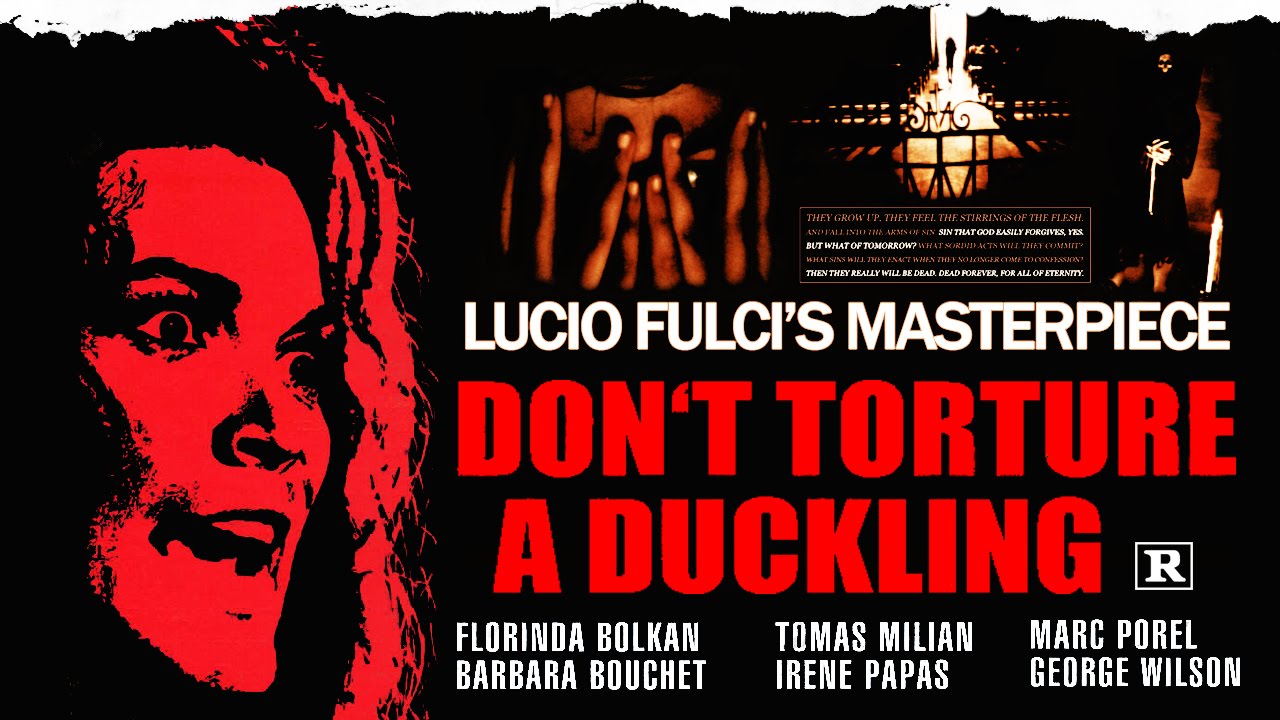
Don’t Torture a Duckling (1972)

don't torture a duckling 2

By Richard Winters

My Rating: 4 out of 10

4-Word Review: Who’s killing the children?

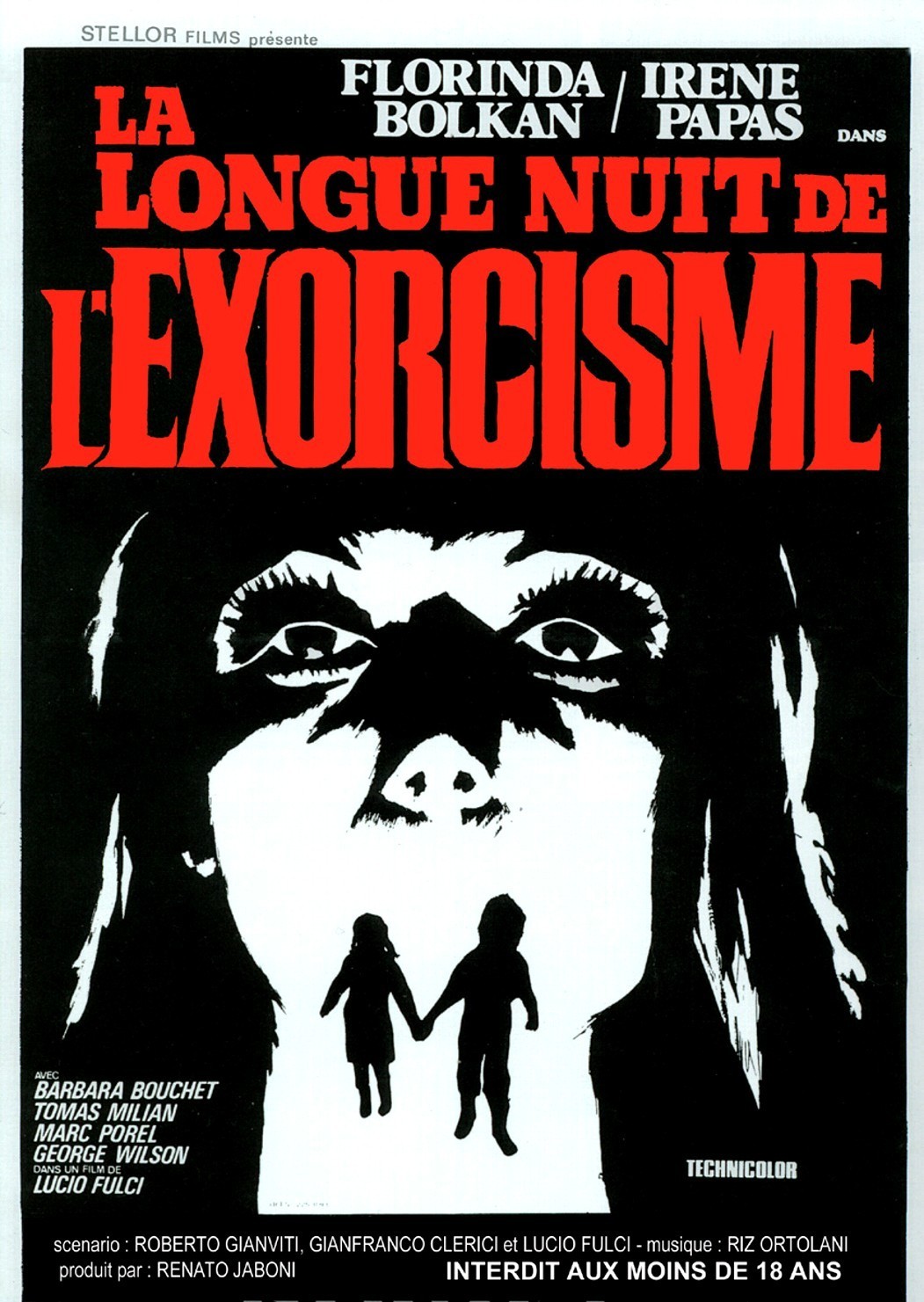
The setting in this Italian giallo is a small, rural village where the children of the townspeople are being murdered. At first the police suspect and arrest a mentally handicapped man (Vito Passeri), but the killings continue. Soon even more suspects turn up including Maciara (Florinda Bolkan) the mother of a dead child herself who secretly practices voodoo using dolls made by her father and yet every time the authorities believe they’ve found the culprit more clues arise that leads them to someone else creating panic in a town already steeped in fear, suspicion and the superstitious.

As a story detailing a police investigation it’s not too bad. The plot works in a linear fashion that’s easy to follow without entering in too many subplots or red herrings although it’s still no better than your average episode of ‘Murder She Wrote’. I did enjoy the rural Italian landscape and the bird’s eye shot of the village whose decrepit, rundown buildings visually hit home the stifled, bleak nature of the residents and why they would turn so heavily to the spiritual world as their sole escape.

Balkan’s performance as the nutty lady is effective particularly when she has a seizure during her interrogation and the scene where she gets surrounded by men who belt her with chains is quite graphic and realistic.

The film though, like with a lot of Italian productions from that era, does have dubbing issues particularly director Lucio Fulci’s use of adding in all the sound effects giving it a certain over-the-top cartoon quality. For instance when a victim is being slapped by a man’s hand it sounds more like the lashing of a whip and even simple stuff like the shoveling of dirt comes off wrong because the sound effect is not in sync with the action on the screen.

The film also has a uncomfortable moment where an adult character (Barbara Bouchet), who is one of the protagonists, walks around naked in front of a 12-year-old boy and even asks him how many women ‘he’s done it with’.

Spoiler Alert!

Guessing who the real killer is was easy and I had the whole thing figured out after about 30 minutes making the rest of the mystery predictable and boring. The idea of a priest killing children might’ve been considered shocking at the time, but now as with Fulci’s criticism of the Catholic Church it comes off as heavy-handed and redundant.

The close-up, slow motion shot of the priest falling down a cliff at the end is the film’s most controversial moment as it is clearly a dummy whose blank eyes and unnaturally agape mouth looks incredibly fake. Some have argued that this was Fulci’s attempt at revealing the ‘inner ugliness’ of the character by showing something with such a distorted face, but since a similar looking mannequin is also used to portray one of the boy victim’s submerged in a tub of water earlier I think it can safely be said that it was more just the cheapness of the production than anything else.

End of Spoiler Alert!

don't torture a duckling 4

My Rating: 4 out of 10

Released: September 29, 1972

Runtime: 1Hour 42Minutes

Not Rated

Director: Lucio Fulci

Studio: Medusa Distribuzione

Available: DVD, Amazon Instant Video
The Intruder (1977)

Capture 52

By Richard Winters

My Rating: 4 out of 10

4-Word Review: Terror on the road.

Based on a story by Dean R. Koontz and filmed in France under the title Les Passagers the plot centers on Alex (Jean-Louis Trintignant) who picks up his 11-year-old stepson Marc (Richard Constantini) from school and sets off to drive him across France and into Italy where they are to meet his mother Nicole (Mireille Darc). Along the way they become menaced by a strange man (Bernard Fresson) driving a black van that begins following them. At first Alex thinks nothing of it, but when the van tries driving them off the road they go to the police who prove to be unhelpful, which forces Alex to take things into his own hands in order to save both himself and the boy.

The film starts off well with definite hints to Steven Spielberg’s classic Duel. I enjoyed how initially everything is from Alex’s and Marc’s point-of-view where we do not know the identity of the driver in the black van, which is only seen through the perspective of their rear window that gives the vehicle a creepy presence. The banter between the boy and step father is engaging and the fact that the kid is smart and shows a keen awareness of things and not just there to be cute is great. I also liked the bawdy tune they sing together and the shot of the boy driving the car while the father leans out the passenger side window.

There is an exciting moment where the van tries pushing their car off the highway while they’re on a winding mountaintop road that is well photographed and realistic. The two are subsequently forced to ride the rest of the way in a tattered vehicle that has no windshield and looks almost as beat-up as the automobile in Planes, Trains and Automobiles.

I did not like however that fifteen minutes into the movie we are shown the face of the other driver, which takes away from the intriguing mystery angle that is what made Duel so interesting. The bad guy isn’t frightening and comes off as clumsy and careless, which makes him less threatening. The fact that he does not carry any type of weapon and must resort to grabbing a nearby fire ax in order to attack Trintignant’s character when the two confront each other didn’t make much sense.

Spoiler Alert!

The film’s biggest transgression though is that its twist ending isn’t surprising at all as the mystery man turns out to be the wife’s psycho ex-boyfriend, which is something I had guessed early on and most other viewers probably will too. It also leaves open a tremendous amount of loopholes like why Alex wouldn’t have been made aware of this boyfriend earlier as I’m sure he would’ve been stalking them long before she got remarried and why the boy wouldn’t have guessed that the stranger chasing them was this man as well as most likely he would’ve known about him too. The police investigation, which gets worked in as a sort of side story proves pointless to the plot and the fact that they end up being quite incompetent makes them seem similar to the ‘comic relief’ cops from Last House on the Left, which hurts the tension.

End of Spoiler Alert!

This film has managed to acquire a small cult following and it has good set-up, but it would’ve worked better had it been done solely from the point-of-view of the father and stepson and only revealed the face and identity of the bad guy at the very end.

My Rating: 4 out of 10

Alternate Title: Les Passagers

Released: March 9, 1977

Runtime: 1Hour 36Minutes

Not Rated

Director: Serge Leroy

Studio: Warner Brothers

Available: None at this time.

Brother John (1971)

brother john 1

By Richard Winters

My Rating: 7 out of 10

4-Word Review: Is an apocalypse coming?

Upon the death of his sister, John Kane (Sidney Poitier) returns to his hometown in Alabama to attend her funeral, but the town’s mayor (Bradford Dillman) and sheriff (Ramon Bieri) think he is an outside union agitator there to stir up trouble with the local factory. Doc Thomas (Will Geer) is an old man who’s been in the town his whole life and knows better. He recognizes that John has a special gift of some kind and can see into the future, but what John proclaims is not good as he states that an end of the world is coming and the human race will have to justify their existence to the almighty.

This film, which was written by Ernest Kinoy and directed by James Goldstone, is unique in that it never reveals too much and keeps the viewer in a shroud of mystery the whole time. We’re given certain hints that John may hold a special power, but never any explanation, which in some films could prove frustrating, but here it makes it intriguing and unusual. Everything is given the low-key treatment including a memorable scene where a racist police officer (Warren J. Kemmerling) invades an African American home bent on teaching John ‘a lesson’ by taking him into the basement only to get a surprise whooping of his own when John proves to be far superior.

Poitier is billed as the star, but he seems constrained in a part that allows for very little emotion. Geer is the one that gives the film its biggest impact particularly with the conversation that he has with Poitier while sitting in a jail cell at the end. I also got a kick out of the fact that he was able in a passing conversation to mention Frankfort, Indiana which was the town that he had been born and raised in, in real-life. Bieri is also quite good as the town’s corrupt sheriff who’s racist on one end, but then when things get out-of-control he then ‘negotiates’ with the town’s black pastor (P. Jay Sidney) to see if they can work together to quell the unrest.

Although the setting is supposedly Alabama it was actually filmed in the town of Marysville, California and for the most part it’s successfully able to camouflage it, but not quite. The ending like the rest of the film is vague and answers little of the questions that the plot puts forth, which may be a turn-off to some, but I enjoyed it. In an era where so many other films were intent on making statements and broad characterizations this one pulled back and much like with religion and faith kept things at an elusive level, which gives it a more sophisticated flair.

My Rating: 7 out of 10

Released: March 24, 1971

Runtime: 1Hour 35Minutes

Rated GP

Director: James Goldstone

Studio: Columbia Pictures

Available: VHS, DVD, Amazon Instant Video, YouTube

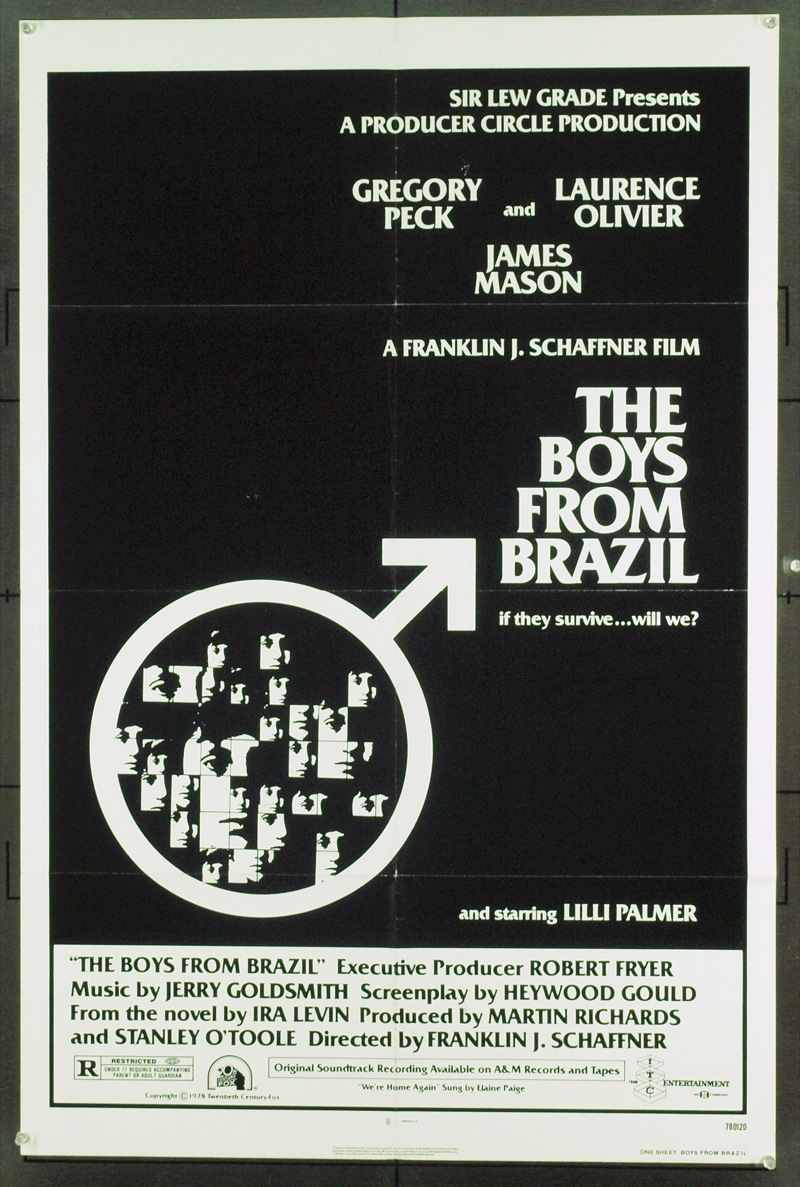
The Boys from Brazil (1978)

exorcist

By Richard Winters

My Rating: 4 out of 10

4-Word Review: Mad doctor clones Hitler.

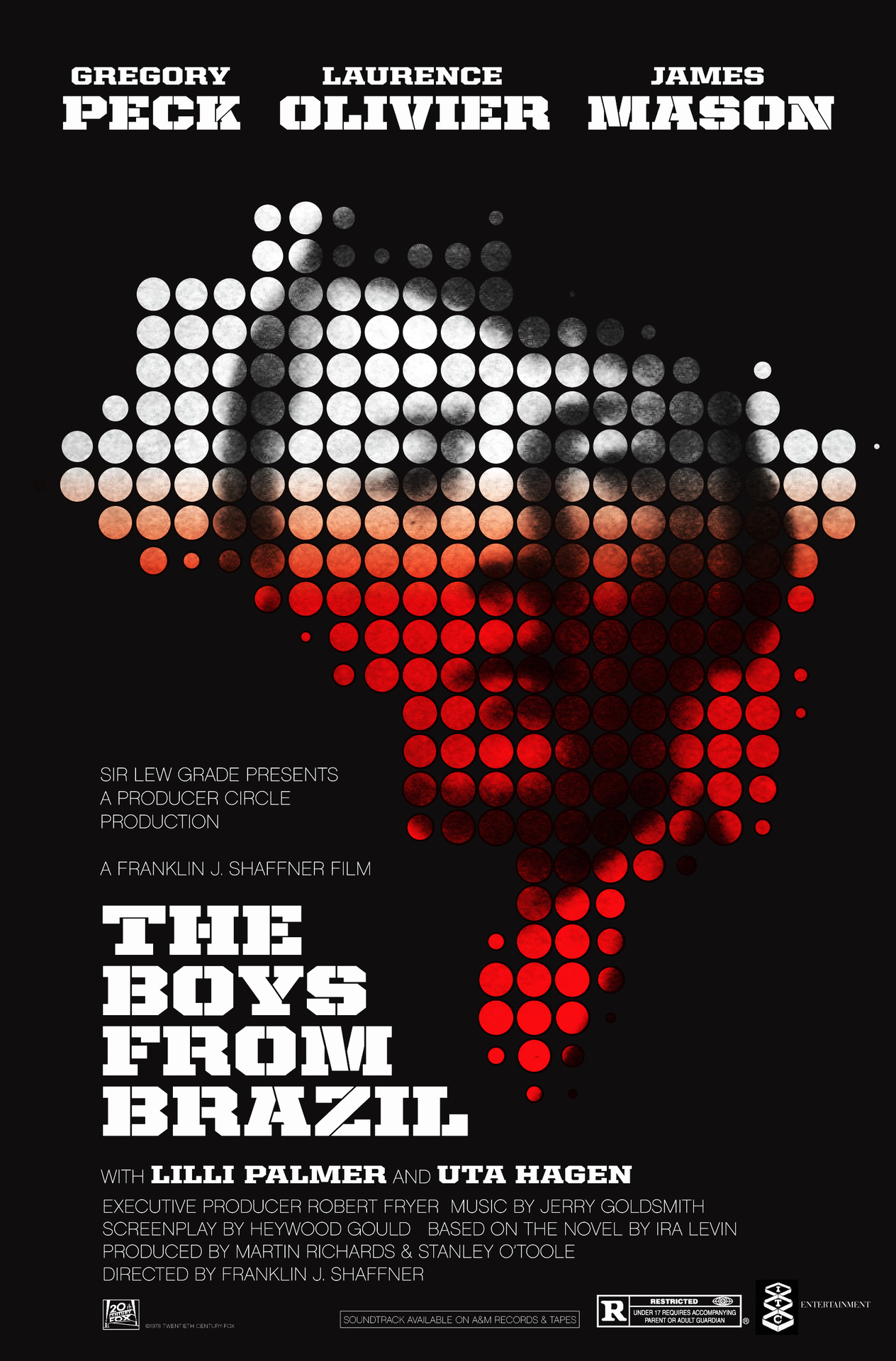
Based on the best-selling novel by Ira Levin the story details an elaborate plan devised by the elusive Josef Mengele (Gregory Peck) who has been hiding out in the jungles of Paraguay and has a secret meeting with several Third Reich war criminals that is overheard by novice Nazi Hunter Barry Kohler (Steven Guttenberg) and relayed to Ezra Lieberman (Laurence Olivier). The plan calls for these war criminals to go out and murder 94 65-year-old men who are living in various parts of the world as Mengele has saved a sample of Hitler’s DNA and impregnated 94 women with it at a Brazilian clinic. These Hitler clones have now grown to adolescence and need to be put in the exact same environment as the real Hitler had been in order to bring out the same personality traits, so it’s important that their fathers die at the same time as Hitler’s real father had. At first Lieberman cannot believe such an outrageous plot, but as the evidence mounts he realizes it is true and he may be unable to stop it.

The film has two great scenes which includes an eye popping death from a steep mountain bridge and a graphic moment where we see in close-up Mengele place the ovum with Hitler’s DNA into the women. Outside of these two moments the film is rather flat and cheesy with certain segments bordering on camp. The plot is intricate enough to keep you involved, but highly implausible and the characters take a long time to realize things that the viewer has already figured out long before.

It is fun seeing Peck playing a bad guy and this was his first villainous role since Duel in the Sun and although he does well in the part the character is so one dimensionally evil that it ultimately makes him boring. Olivier is not effective in the lead and comes off as frail and sickly with certain comical overtones given to the character that don’t work. The final confrontation between he and Peck in which the two roll around on the floor while grappling for a gun looks more pathetic than exciting and apparently the scene had to be reshoot several times because both actors kept breaking out into laughter over the absurdity of it. I did feel though that Guttenberg was perfectly cast as a wide-eyed schmuck that was in way over-his-head.

Spoiler Alert!

My biggest problem with the film though is the ending that turns out to be a big letdown. For one thing it takes place at a remote farmhouse, which seems too similar to a scene in Marathon Man, which came out just two years earlier, had a similar theme and also starred Olivier. It features nine Doberman pinchers with four of them that surround the farm’s owner (played by actor John Dehner) at all times. He uses them for protection as he is convinced someone is out to get him, which could’ve created quite an interesting scenario when Mengele travels to the home to kill him. However, the owner puts the dogs into another room the second Mengele tells him that they make him uncomfortable, which then allows Mengele to shoot the man without any problems, but why have the dogs for protection if you’re just going to put them away the minute some stranger doesn’t like them and if the character is so paranoid why even allow a stranger into your home without at least demanding some form of identification first?

End of Spoiler Alert!

The conclusion is unsatisfying as it leaves open a ton of unanswered questions. Not only is the plot full of loopholes, but it seems like only a springboard to a much more fascinating story, which is trying to hunt down all these Hitler clones that the film fails to realize.

the boys from brazil 1

My Rating: 4 out of 10

Released: October 5, 1978

Runtime: 2Hours 3Minutes

Rated R

Director: Franklin J. Schaffner

Studio: 20th Century Fox

Available: VHS, DVD, Blu-ray, Amazon Instant Video, Netflix Streaming

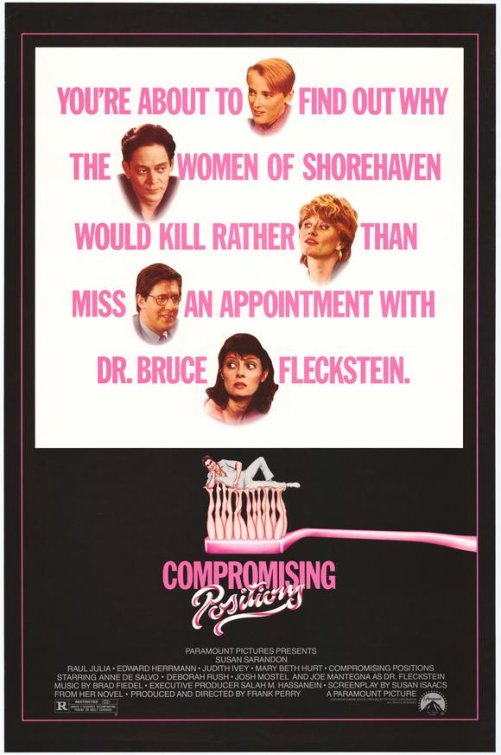
Compromising Positions (1985)

compromising positions

By Richard Winters

My Rating: 5 out of 10

4-Word Review: Who murdered the dentist?

Bruce Fleckstein (Joe Mantegna) is a successful dentist who puts new meaning to the term ‘bedside manner’ as he flirts with all of his female patients and has affairs with many of them. When he turns up murdered it becomes a question of which of the many suspects did it, which intrigues housewife Judith (Susan Sarandon) and propels her to start her own independent investigation much to the consternation of her husband Bob (Edward Herrmann) who thinks it’s too dangerous. As the clues accumulate so do the advances of police detective David (Raul Julia) that she is working with, which quickly puts her marriage into jeopardy.

The film was produced and directed by Frank Perry who made many influential films during the 60’s and 70’s with his screenwriter wife Eleanor, but after their divorce the quality of his films diminished considerably. The last two that he made were in collaboration with Susan Isaacs with this one based on her novel of the same name. To an extent it works as the mystery angle is realistic enough to be interesting and the dark humor keeps it mildly entertaining.

Sarandon’s presence helps a lot and without her it wouldn’t have worked. Julia plays against type and it’s fun seeing him in more of a subdued type of role. The real scene stealer though is Judith Ivey who has some funny sarcastic lines and should’ve been seen more.

I also really liked how Sarandon’s character remains faithful to her husband despite her conflicts with him and the many advances that she gets from the police detective. Too many Hollywood pictures give the impression that marriage should be one long blissful union and the minute one partner isn’t completely receptive to the needs of the other then that entitles the other to cheat on them. Herrmann’s character is a borderline jerk, but he has legitimate reasons for why he feels the way he does and the movie refreshingly even gives him a moment to vent and explain them. I also thought that Julia’s character comes onto Sarandon much too quickly and the way he barrages into her bedroom while making aggressive advances seemed almost creepy.

The story does have a dated quality. Fleckstein is found to be distributing and printing porn, the kind with consenting adults and not kids, which the film portrays as being a ‘shocking revelation’ even though these days with the proliferation of it all over the net it is nothing but an afterthought to most. I also thought the idea that this guy would have BDSM sex with a lot of married women and even take explicit pictures of them, but still turn around and throw them some lines that he ‘loved’ them and they would all fall for it was ridiculous and unfairly portrayed women as being too easily manipulated and unsophisticated.

The resolution is limp and the film lacks anything that would help make it distinctive or memorable. The humor gets lost by the second half and the Ivey character should’ve been given more screen time and possibly even used as Sarandon’s investigative partner as her caustic take on things are the best thing about it.

My Rating: 5 out of 10

Released: August 30, 1985

Runtime: 1Hour 39Minutes

Rated R

Director: Frank Perry

Studio: Paramount

Available: VHS

The Driver’s Seat (1974)

drivers seat 1

By Richard Winters

My Rating: 3 out of 10

4-Word Review: Crazy lady goes traveling.

Lise (Elizabeth Taylor) is a middle-aged woman with seemingly no past who travels to Rome looking for someone to kill her. Her erratic behavior and weird motivations confuse those that she comes into contact with. She then meets Bill (Ian Bannen) a man who’s more interested in her sexually than anything else and he follows her around in a veiled attempt to get ‘lucky’ despite her repeated rebuffs.

The film is basically a mess that goes nowhere. It was based on a novel by Muriel Spark, who had written some acclaimed stuff in her day including ‘The Prime of Miss Jean Brodie’, so I can only imagine that the book made more sense and only bits and pieces of it were taken to create this screenplay. In either case it was a highly strange career move for Miss Taylor who made a lot of weird movie choices in the 70’s, which helped to destroy her once megastar status and tainted her other stellar work.

Her performance by itself isn’t too bad and it’s the one thing that helps keep things watchable. The way that she can go from being passive and helpless to snippy and bitchy within seconds is kind of fun and on a purely camp level even enjoyable. The whole thing seems almost like an extension of the character that she played in Who’s Afraid of Virginia Woolf? , which became her signature role during her later years.

Bannen lends good support as his leering Cheshire cat grin is a perfect counterpart to Taylor’s crazed glare and he effectively equals her nuttiness. I also loved his so-called macrobiotic diet in which he must attain one orgasm a day for it to work and if he misses one then he must make up for it by having two the next day, which ultimately gives him ‘indigestion’. Mona Washbourne a character actress noted for playing delightfully daffy old ladies is also on hand as one of the people Taylor befriends and their encounter inside the stall of a public bathroom is a gem.

Director Giuseppe Patroni Griffi manages to infuse some interesting visuals, which along with its fragmented narrative helps keep things cheaply alluring, but it eventually plays itself out and by the end becomes quite tiring and tedious. The biggest issue is that there never is any explanation for who this woman is or why she’s doing this, which makes the whole thing quite empty and pointless.

My Rating: 3 out of 10

Released: May 20, 1974

Runtime: 1Hour 42Minutes

Rated R

Director: Giuseppe Patroni Griffi

Studio: AVCO Embassy Pictures

Available: DVD-R, Amazon Instant Video