Category Archives: Movies with Nudity

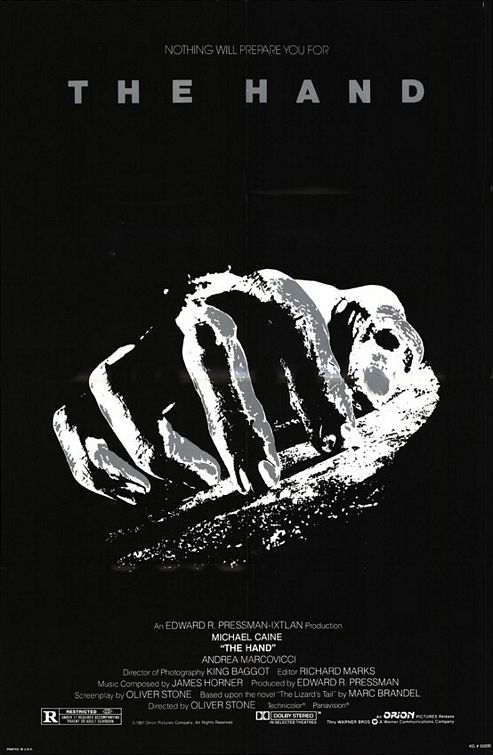
The Hand (1981)

By Richard Winters

My Rating: 5 out of 10

4-Word Review: He loses his hand.

Jon Lansdale (Michael Caine) is a gifted comic book illustrator who loses his hand in a freak car accident. They are unable to locate the missing limb at the scene and therefore unable to reattach, so he’s fitted with a prosthetic one made of metal. In the meantime the severed one goes on a murderous rampage killing all those that Jon has a problem with.

The film, which is based on the novel ‘The Lizard’s Tail’ by Marc Brandell, can best be described as an experimental horror and to some degree is quite intriguing. I liked the psychological subtext showing the hand as being a symbol to Jon’s subconscious and acting out the anger that he felt from others, but ordinarily too reluctant to do anything about. The story conveys a very universal message that we are in many ways two people, the one we choose to display to the world and the other more politically incorrect one that we try to hide from it.

Had it remained more on a subtle, intellectual side it might’ve worked, but showing the severed hand as much as it does is its biggest downfall. The scenes showing the hand strangling people looks quite tacky as instead of seeming like the victim is trying to pull the hand off of their throat it looks more like they are trying to hold it in place so it doesn’t fall off. It also brings up all sorts of unanswered questions like how is the hand able to move around so quickly and sneak inside buildings and cars and where does it get the strength to strangle people, or jump up to their throats when all the muscles connected to it have been severed away.

It would’ve worked better had the hand not been shown at all and kept a mystery as to what was causing the murders and then only at the end expose the hand as being the culprit, which would’ve made Jon’s final confrontation with it much more startling and impactful. An even better idea would’ve been to have the metal hand act as the one that does the killing since this one resembled Freddy Kruegar’s and looked far creepier.

Oliver Stone’s direction is interesting especially his technique of going from color to black and white and then back again, but the story drags on longer than it should and seems to give too much away. The twist at the end is great because it’s actually a logical one that makes perfect sense, but then at the last second Stone sells-out by throwing in tacky ‘second twist’ that is nothing but a gimmick that makes the whole thing seem too commercial.

On the acting side Caine is adequate, but I found his wavy hair far more fascinating than the hand and I especially enjoyed seeing how progressively disheveled it gets the more insane that he becomes. Andrea Marcovicci is standout as his wife. Initially I thought she was too young to play his spouse as there was a 16 year difference between the two, but her very expressive face particularly her blue eyes and the way it conveys fear helps heighten the suspense.

My Rating: 5 out of 10

Released: April 24, 1981

Runtime: 1 Hour 44 Minutes

Rated R

Director: Oliver Stone

Studio: Orion Pictures

Available: DVD, Amazon Video, YouTube

Hide and Go Shriek (1988)

By Richard Winters

My Rating: 2 out of 10

4-Word Review: Killer in a warehouse.

Despite the film’s corny title this has rated well with users on IMDB, so I approached it with interest, but whatever it was that they were getting out of it I didn’t. The very basic premise deals with a group of teens who spend the night in a furniture warehouse to party. They play a game of hide-and-seek and soon one-by-one start disappearing only to later turn up dead. The elusive killer puts on the clothing of the last person that he’s killed and some start to believe that he may be Fred (Jeff Levine) the new security guard who is also an ex-con.

The approach is derivative and stays locked in the basic slasher film construct even though by the late ‘80s that formula was wearing thin and getting tweaked heavily by most other horror films that were being released at the same time making this one seem laughable contrived right from the get-go. The characters also reek of excessive ‘80’s fashions while having personalities that lack any distinction.

It was shot in an abandoned L.A. warehouse, but the filmmakers don’t take enough advantage of their setting and seem to only film things occurring in small areas of the place instead of trying to capture the entire inside of the building with long shots and bird’s eye views. The interiors are also quite shadowy and sometimes not easy to completely follow the action. One character, in an effort to look ‘cool’, wears dark glasses almost the whole time even though it takes place at night in an already darkened place making him seem crazier than the psycho killer.

The film has some unintentionally funny moments particularly the overreacting of the teens when they find their dead friend’s bodies especially their revulsion when one young woman (Annette Sinclair), who was tied up on top of a loft elevator, gets decapitated when the elevator goes up and her severed head comes crashing to the floor. I also got a kick at how they rip off the arms and legs from the mannequins to use as weapons, which seems absurd as they are made of plastic, don’t weigh much and would be very ineffective in any type of ‘battle’. I also liked the part where the teens, now locked inside the warehouse, madly pound on a storefront window to get someone’s attention, while a homeless guy, played by the film’s screenwriter Michael Elliot, merely waves back at them.

The ultimate identity of the killer is somewhat creative and actually even plausible, but his ability to wear the clothes of each of his victims makes no sense since all the teens have different body types so most of the outfits would not have fit. The film needed a killer with a distinct appearance and not just some shadowy figure lurking in the background like here, which is neither scary nor interesting.

If you enjoy original, quality cinema then this film is not for you. However, if you like cheesy, cardboard schlock with all sorts of clichés thrown in then this will be a perfect night of entertainment.

My Rating: 2 out of 10

Released: November 1, 1988

Runtime: 1 Hour 28 Minutes

Rated R

Director: Skip Schoolnik

Studio: New Star Entertainment

Available: DVD (B/2), Blu-ray

The Killing Kind (1973)

By Richard Winters

My Rating: 5 out of 10

4-Word Review: Always a good boy.

Terry (John Savage) is an angry man suffering from the inner torment of being sent to prison for a gang rape he was forced to participate in. Once he gets out he moves back in with his oppressive mother (Ann Sothern) who dotes over him and ignores all the troubling signs that he clearly displays. Instead of getting a job he spends his time exacting revenge on those who wronged him and then sets his sights on an attractive young lady (Cindy Williams) who has rented a room in his mother’s house. When Terry ends up murdering her his mother decides to help him cover it up because in her mind he will always be a ‘good boy’ no matter what he does.

The film is cheaply made with faded color, grainy film stock and an annoying humming sound that is apparent throughout, but Curtis Harrington’s direction gives it life and keeps you intrigued with its offbeat approach. It reminded me a lot of Paul Bartel’s Private Parts particularly with its emphasis on voyeurism especially how Terry secretly watches their tenant while the neighbor lady (Luana Anders) does the same to Terry.

Unfortunately there’s not enough of a payoff. The action is spotty and the gore is kept at a minimum. It starts right away with the gang rape, but then steps back with the shocks and pretty much implies all the other dark aspects of the story without showing it. The characters are molded into caricatures and more subtlety could’ve been used as to their intentions particularly the repressed neighbor lady blurting out her inner desires and thoughts to Terry without ever having spoken to him before.

Sothern is impressive especially since she was from Hollywood’s Golden Age and spent years working with sanitized scripts, so seeing her jump into such tawdry material with seemingly no hesitation is interesting. Savage’s performance I found to be frustrating as he seems to play the role like someone we should sympathize with, which is hard to do when he kills so many people.

Williams is the standout. Her murder scene is memorable as she struggles quite a bit and then forced to stay still in stagnant water with the same facial expression for several minutes. Later she’s shown lying in a junkyard as rats crawl over her, which proves she’s a dedicated to her craft to allow herself to go through that.

The ending fizzles and seems almost like a cop-out while not taking enough advantage of the other offbeat scenarios that it introduces. Had I directed it I would’ve done it differently. In my version the nosy neighbor lady, would threaten to go to the police about the crime, which she sees, but says she won’t if Terry, who had rejected her advances earlier, agrees to have sex with her. She then forces both his mother and her wheelchair bound elderly father (Peter Brocco) to watch, which would’ve given this potential cult classic the extra oomph to the dark side that it needed instead of coming tantalizingly close, but never truly delivering.

My Rating: 5 out of 10

Released: June 23, 1973

Runtime: 1 Hour 34 Minutes

Rated R

Director: Curtis Harrington

Studio: Media Cinema Group

Available: DVD, Amazon Video

Fatal Games (1984)

By Richard Winters

My Rating: 1 out of 10

4-Word Review: Javelins can be deadly.

Student athletes with promising futures are suddenly turning up dead at the hands of a mysterious killer who pierces their bodies with a javelin that he is able to expertly throw from a far distance. Authorities fear that time is running out as more of them are killed and no witnesses or clues to identify the culprit.

Many consider this to be a rip-off of Graduation Day and while both films aren’t very good this one at least starts out better. I enjoyed the lighthearted comedy used at the beginning and how a formal dinner meeting turns into a big food fight and then a group tug-of-war. The film also keeps it realistic by showing the athletes actually training and conditioning.

In fact it really doesn’t start to go downhill until it reverts into a horror movie mode and dwells almost religiously in all the formulaic clichés seen in every other ‘80s slasher flick. The killings aren’t as novel as they sound and eventually become quite redundant. They are also lightly sprinkled in-between long, drawn out dramatic segments dealing with the characters relationship struggles and pressures to perform until you almost forget that this is supposed to be a slasher film at all. Most ‘80’s horror movies will have boring extraneous dialogue at the start to help create ‘character development’, but once the killings get going they will usually drop the other stuff and stick just to the scares while also picking up the pace, but this one just keeps the stale drama going, which along with its synthesized music score gives it a very amateurish quality.

The acting by the young cast isn’t as bad as the adult actors who speak like people under a trance. The film’s director Michael Elliot who plays a doctor who secretly gives them team members some ‘retardation shots’ (no joke that’s what they call it) and the movie’s screenwriter Christopher Mankiewicz who plays the coach give the two worst performances in the movie. Even Sally Kirkland, who plays the team trainer is bad and seems to be playing down to the level of the material.

The female cast is attractive and there is an abundance of nudity including one segment where the killer chases a fully nude Angela Bennett down the darkened hallways of the school. However, the film’s cute and perky star, Lynn Banashek, was too shy to take off her clothes and so in the scene where she gets a rub down by Kirkland scream queen Linnea Quigley was used as her body double.

The identity of the killer was a bit of a surprise and something I hadn’t expected and I’m pretty good about guessing these things, so in that regard it’s kind of original, but it’s still not worth sitting through as everything else is by-the-numbers.

My Rating: 1 out of 10

Released: March 13, 1984

Runtime: 1 Hour 28 Minutes

Rated R

Director: Michael Elliot

Studio: Impact Films

Available: VHS

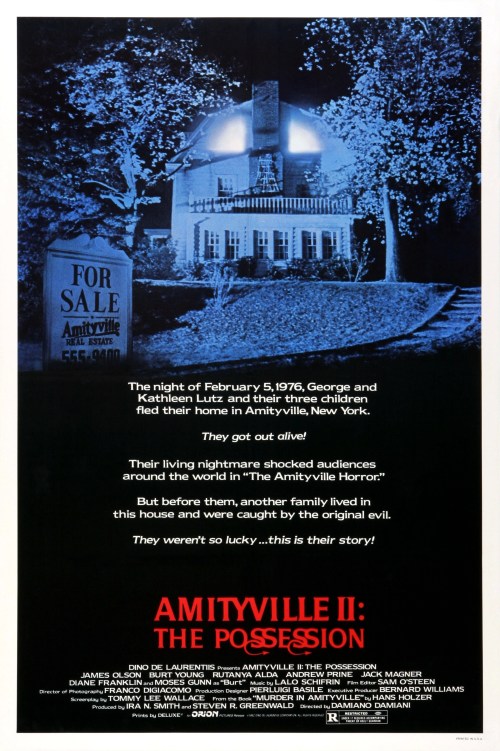
Amityville II: The Possession (1982)

By Richard Winters

My Rating: 1 out of 10

4-Word Review: Their son becomes possessed.

A family moves into the infamous home at 112 Ocean Avenue in Amityville, New York only to immediately start encountering paranormal events. Their eldest kid Sonny (Jack Magner) begins to display anti-social tendencies that eventually drive him to kill the entire family late one night. The family’s Priest Father Adamsky (James Olson) is convinced that Sonny did it because he was possessed from evil spirits that inhabit the home due to it being built on an ancient Indian burial ground and he takes it upon himself to perform an exorcism on the young man in order to free him of the demon.

The film is loosely based on the events of the DeFeo family, who lived at the residence, and was murdered by their eldest son on the night of November 13, 1974. However, the film deviates from what actually occurred including having the family just recently moved in when in reality the DeFeo’s had lived there for 9 years before they were killed. The film also portrays the family members as being awake and aware of what was going on when evidence had shown that most of them had been asleep when shot. There’s also a side-story dealing with a sexual relationship that Sonny had with his sister Patricia (Diane Franklin) that was only speculated never confirmed to have occurred with the real family.

This movie is only a slight improvement from the first one. Director Damiano Damiani manages to instill more of an atmosphere and uses fast moving tracking shots to create a point-of-view perspective of the demons. Also, James Olson plays the Priest role better than Steiger did in the first one by being less hammy and more understated, which is good.

Yet I still found the whole thing to be quite boring. The first half-hour is just a rehashing of many of the same scares that were done in the first one and we all know from the beginning how it’s all going to turn out, that the son will inevitably kill the family, so there’s no intrigue at all. The final half hour deals solely with the exorcism, which despite some decent special effects, is nothing more than a Grade B rip-off of The Exorcist.

There’s a lot of overacting too just like in the first one. Rutanya Alda, who plays the mother, is the biggest culprit in this area, which includes her death scene that deserves to be in the annals of all-time cheesiest death sequences ever put onto film. I was also confused why such an otherwise normal, well-adjust woman would want to marry a lout like Burt Young and having her show affection to him not more than a couple minutes after he had abused both her and the kids with a belt is misguided.

On the technical end the film seems to be done on a higher budget than the first, but the script is empty-headed and relies heavily on broad generalizations involving religion and ‘evil’. I also found it amusing that, like in the first installment, there’s a scene were the Priest tries to convince his church elders about the home being haunted and they scoff and insist that isn’t ‘rational’ when these same men have dedicated their lives to a profession steeped in supernatural, faith based claims.

My Rating: 1 out of 10

Released: September 24, 1982

Runtime: 1 Hour 44 Minutes

Rated R

Director: Damiano Damiani

Studio: Orion Pictures

Available: DVD, Blu-ray (Region B/2), Amazon Video

The Amityville Horror (1979)

By Richard Winters

My Rating: 1 out of 10

4-Word Review: Their house is haunted.

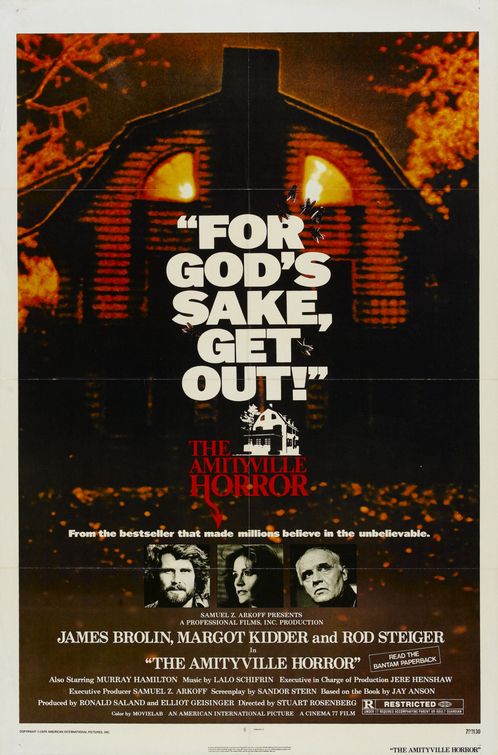
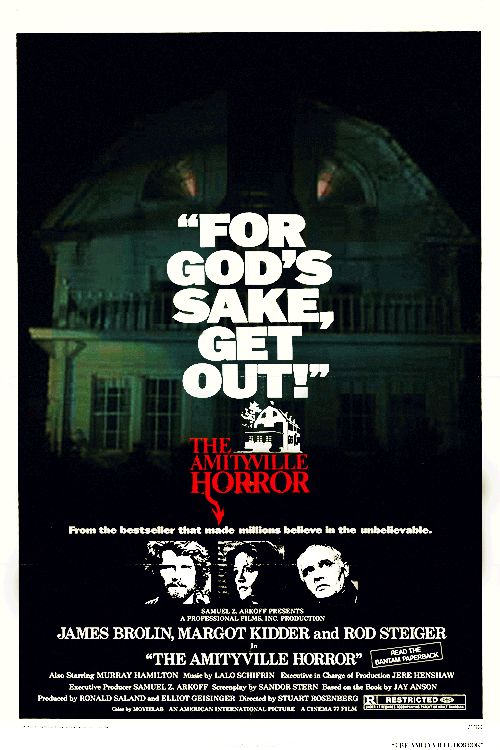
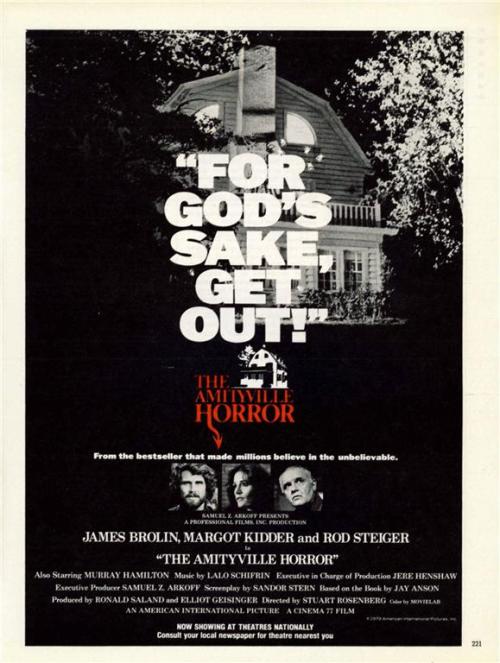
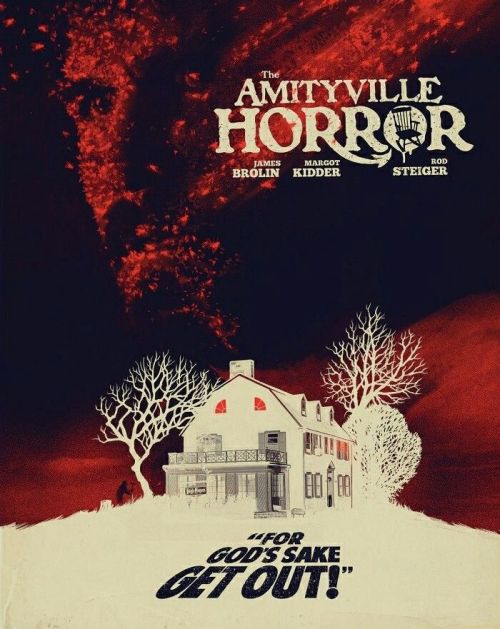
Kathy and George Lutz (Margot Kidder, James Brolin) move into a large home that just a year earlier was the place of a gruesome homicide of six people. Though the idea of living where these murders occurred is unsettling they cannot beat the home’s price, so they take the offer. Soon there are bizarre occurrences and George begins to behave like he is becoming possessed convincing the young family that the place is haunted and they need to move out before it is too late.

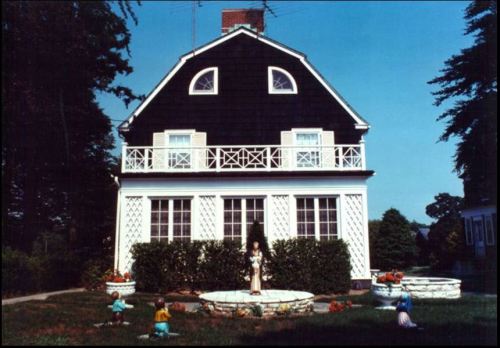
The film is based on the Jay Anson novel, which was centered on the supposedly true events of the Lutz family who moved into a home known as ‘High Hopes’ that had previously been occupied by the DeFeos who were slaughtered at the hands of their oldest son Ronald in November of 1974. The Lutzs lived in the home from December of 1975 until they ‘abandoned’ it in January of 1976. Since that time many other people have lived there and none have reported any paranormal activity. The home, which was built in 1924, had no unusual events occur in it for the 50 years previous to the DeFeo tragedy either making me and many others speculate that the Lutzs made it all up because why else would they be subjected to the hauntings and none of the others.

(The actual house as it appeared in 1974)

In either case the movie isn’t very good and at many points is quite laughable. The film would’ve worked better had it been structured as a pseudo-documentary where interviews with the characters could’ve be spliced into the reenactments, which would’ve avoided it from seeming so mechanical and coming off like a formulaic scare-a-minute like it does here. The so-called frights are over-the-top from the start and there’s such a barrage of them that by the time you get to the finale, which should be the scariest point of the film, it becomes almost anti-climactic.

The overblown facial reactions of the actors had me laughing out loud at many spots particularly Brolin’s feeble attempts to channel a Charles Manson-like persona and Amy Wright getting locked in a closet. She plays a teen babysitter who walks around wearing one of those garish dental headgears and made me believe that the spirits locked her in there simply because they felt she looked too stupid. Kiddor’s constant shocked expressions at Brolin’s increasingly edgy responses becomes tiring and the part where Brolin shouts at the evil spirts that “This is my house!” had me thinking the spirits should’ve responded with “No it isn’t, it’s the banks!”

Rod Steiger’s priest impression is the Achilles heel. I realize there was a priest in the book, but since then that same priest as disputed the events described in the story, so it should’ve gotten downplayed. I didn’t like the supernatural events occurring outside of the home like when Steiger and Don Stroud are driving in their car and having it mysteriously breakdown. The house is the centerpiece and all scares should take place there otherwise it ceases to be a haunted house film at all and instead just another pedestrian story dealing with evil spirits that can manifest anywhere.

How some could find this scary is a mystery. I first watched it 30 years ago and thought it was tacky then and consider it even more so now. Just because it has managed to spawn a lot of sequels doesn’t make it ‘a classic’ and I feel it would be better suited for rifftrax of Mystery Science Theater.

My Rating: 1 out of 10

Released: July 27, 1979

Runtime: 1 Hour 58 Minutes

Rated R

Director: Stuart Rosenberg

Studio: American International Pictures

Available: DVD, Blu-ray (Region A/1, B/2) Amazon Video, YouTube

Devil Times Five (1974)

By Richard Winters

My Rating: 4 out of 10

4-Word Review: Children terrorize the adults.

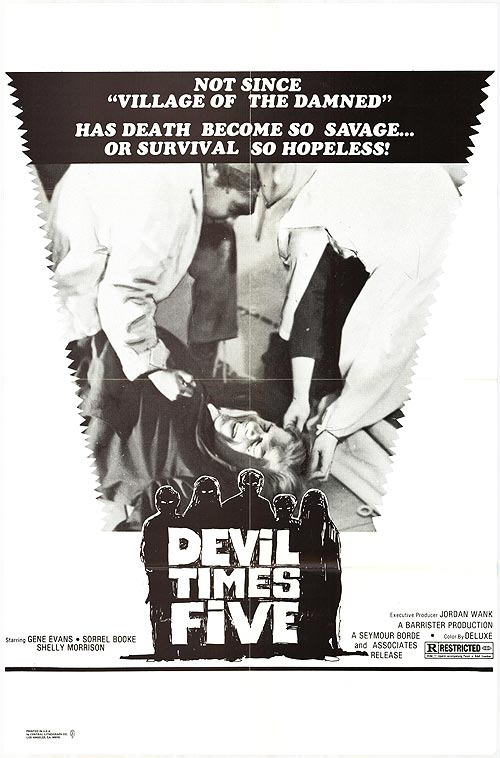
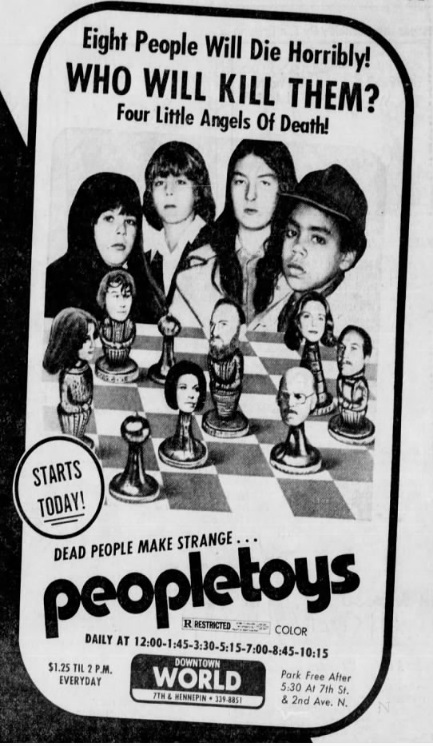
Two couples (Sorrell Booke, Shelley Morrison, Taylor Lacher, Joan McCall) visit the winter retreat ranch run by rich businessman Papa Doc (Gene Evans). They are expecting a pleasant wintry getaway, but instead find terror when a group of five children arrive (Leif Garrett, Gail Smale, Dawn Lyn, Tierre Turner, Tia Thompson). The children state that they were lost in the cold wilderness and simply there to seek refuge, but in reality they are psychotic and have escaped from a nearby asylum after the van they were riding in overturned on the icy roads. Now the adults find themselves getting mysteriously bumped off one-by-one. At first they think it’s only an accident and then realize it’s by some ‘unforeseen predator’, but fail to realize it’s actually the ‘innocent-looking-kids’ until it’s too late.

This cheaply made production has problems right away starting with the van accident. To a degree I thought it was cool seeing it overturn several times in slow-motion after it slides off the road, but I found it preposterous that none of the kids were injured and escape from the wreckage without a single scratch despite the adult driver getting badly banged up. In retrospect it would’ve worked better had this scene not been shown at all and left the viewer in the dark about what the true intentions of these kids were only to slowly unfold the truth to the audience just like it does to the adult characters.

The killings are pretty tacky as well. The scene where one of the victims gets set on fire is disturbing, but the rest doesn’t add up including when one child manages to somehow hold their adult victim underwater by using only one hand. There are also several instances where the victim dies right away when in reality they would’ve most likely only been injured including a fall through a window and another one dealing with a stabbing by a small ax. In both cases I think the person could’ve survived the initial blow and simply be writhing in extreme pain, but I presume the filmmakers felt that watching someone squirming around on the ground screaming in endless agony would be considered ‘too horrifying’ for most audiences so they went with the ‘clean-kill’ option, but unfortunately the one-blow-and-then-they’re- immediately-dead concept looks fake.

The pacing is also poor and the tension badly botched. One bit has the kids killing a man in slow motion and done through a black-and-white filter, which despite going on a bit too long is effective. Yet whatever tension gets achieved by watching that is immediately sapped when the next scene shows a drawn out session of one of the adult couples making love, which looks better suited for soft corn porn flick. The music is equally screwed-up as it sometimes sounds creepy while at other points like something heard in an elevator.

I found it interesting that it was directed by Sean MacGregor, or at least for the first three weeks of production before he got fired, as he had previously written the screenplay for Brotherhood of Satan, which had the same ‘creepy kids’-like theme. There’s also the novelty of seeing Dawn Lyn, who was 10-years-old at the time, taking part in her own mother’s murder, who plays one of the adults. Although overall it’s pretty spotty with majority of it being rather flat and forgettable.

Spoiler Alert!

I was also confused at how during the final credits it says ‘The Beginning’ instead of the usual ‘The End’. I presume this was the filmmakers attempt at being ‘clever’ by intimating that these young kids would now go on to murder many more people throughout the countryside, but since they had already killed quite a few it would’ve been more apt to say ‘The Middle’.

End of Spoiler Alert!

My Rating: 4 out of 10

Alternate Titles: Peopletoys, The Horrible House on the Hill

Released: May 31, 1974

Runtime: 1 Hour 28 Minutes

Rated R

Director: Sean MacGregor, David Sheldon (Uncredited)

Studio: Cinemation Industries

Available: DVD-R, Amazon Video

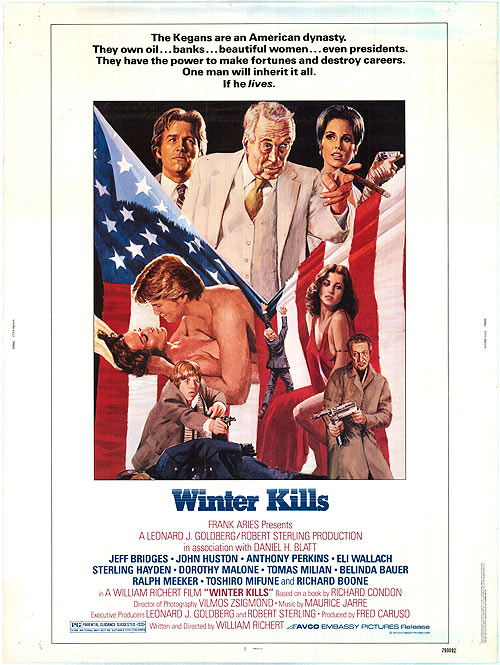
Winter Kills (1979)

By Richard Winters

My Rating: 6 out of 10

4-Word Review: Who assassinated his brother?

19 years after United States President Timothy Kegan is assassinated and an independent investigation concluded that it was the act of a lone gunman, his younger brother Nick (Jeff Bridges) gets a deathbed confession from a man (Joe Spinell) insisting he was the real killer hired by a secret underground organization. Nick goes to his rich father (John Huston) with the news and then decides to do an investigation of his own, but becomes entangled inside a web of lies and deceit that drives him further away from the truth instead of closer.

The film is based on the novel by Richard Condon and in many ways is a stunning filmmaking debut for director William Richert. The cinematography by Vilmos Zsigmond is richly textured with a colorful variety of backdrops, sets and atmosphere making it visually soar while the surreal tone helps give it an added edge.

Unfortunately the film suffered from many behind-the-scenes issues including running out of funding and forcing the cast and crew to put the production on hold while they went overseas to shoot The American Success Company in Germany and then used the proceeds from that one to finish this one. The final result is a fragmented narrative that at times gets too rushed. The story was significantly paired down from the novel, which leaves open a lot of loose ends and it should probably be remade as a miniseries.

The story is also permeated with a lot of dark humor which only makes the viewer even more confused. Some of it is genuinely funny, but it’s unclear what it’s trying to satirize. Certain absurd situations and oddball characters get thrown in for seemingly no reason and takes away from the otherwise compelling storyline while leaving the viewer baffled as to what the point of it was supposed to be and could easily explain why it bombed so badly at the box office during its initial run.

The casting is interesting. Jeff Bridges usually gets stuck in bland, transparent roles and that’s no different here, but he’s surrounded by so many eccentrics that his otherwise vanilla delivery seems refreshing and distinct. Huston is the real star in a bravura performance that steals the film and makes it memorable. There’s also a lot of recognizable supporting players that are on only briefly and if you blink you’ll miss them. This includes an uncredited appearance by Elizabeth Taylor who comes on near the end and has no lines of dialogue, but does clearly mouth the words ‘son-of-a-bitch’.

If you are looking for something that is offbeat, but still intriguing then this is well worth the effort. If it weren’t for its misguided humor this thing could’ve really had an impact although it does reveal its cards too soon and I was able to guess the twist ending long before it actually happened, but as a whole it has its moments and a potential cult following or sure.

My Rating: 6 out of 10

Released: May 11, 1979

Runtime: 1 Hour 26 Minutes

Rated R

Director: William Richert

Studio: AVCO Embassy Pictures

Available: DVD, Amazon Video

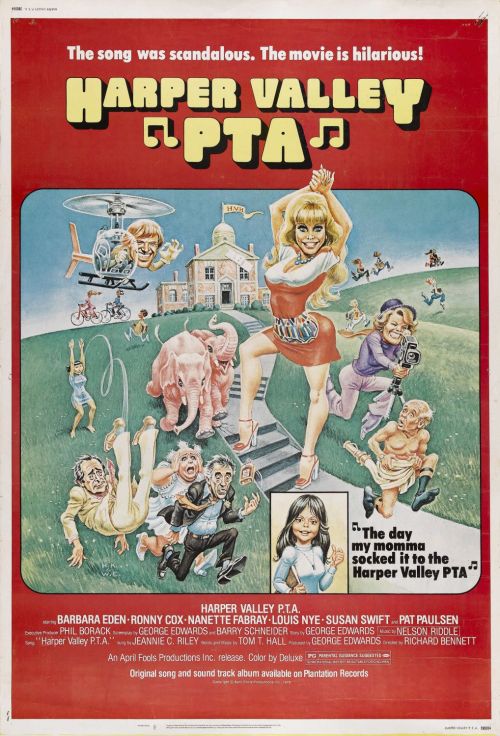
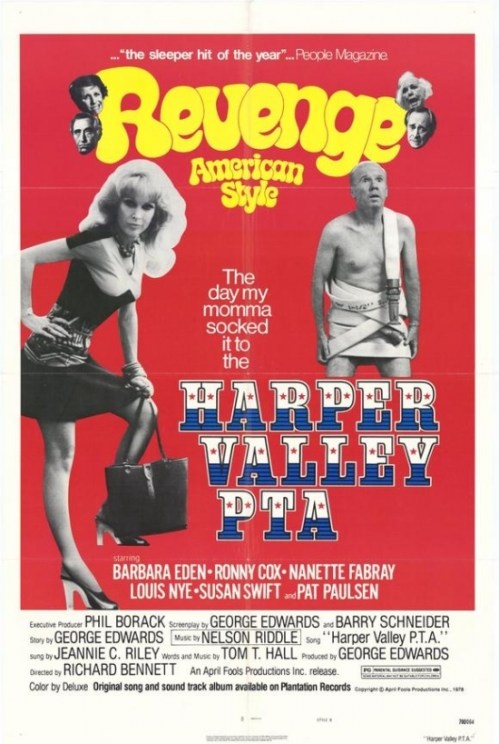
Harper Valley PTA (1978)

By Richard Winters

My Rating: 3 out of 10

4-Word Review: She gets her revenge.

Based on the hit 1968 song the story centers on Stella Johnson (Barbara Eden) whose liberated single life style and provocative way of dressing is considered ‘scandalous’ by the prudish members of her local school board. They give a letter  to her daughter Dee (Susan Swift) to be send home for Stella to read, which informs her that if she doesn’t ‘clean up her act’ they’ll have her daughter expelled. Stella then goes to the school board meeting and exposes all of their dirty secrets and then continues the harassment by playing dirty pranks on them one-by-one.

The song, which was written by Tom T. Hall and sung by Jeannie C. Riley, was a cute novelty ditty that encompassed the social rebellion of the late ‘60s through the scope of small town southern life. The film though ruins the song’s appeal by overplaying its theme and losing touch with its core issue.

The song had a very heavy country tinge to it making it seem that the setting should’ve been the Deep South, but for some reason the film takes place in Ohio instead. It also has the time period as being the present day, late ‘70s, which makes some of the lines in the song, which Stella reiterates pretty much word-for-word when she tells the board members off, seem dated and out-of-touch. Stuff like sock-it-to and ‘Peyton Place’ referred to hit TV-shows that by the late ‘70s had already been off the air for years, so the film should’ve either updated the script to make it more topical to the times, or had the time period be in the ‘60s, which like with the southern locale would’ve given the film a far stronger atmosphere.

Having Stella tell off the board members like in the song seemed sufficient, but having her continue her efforts by pulling elaborate pranks on them made it come off like overkill and in some cases borderline cruel and even criminal. The fact that other people in attendance at the board meeting clap and cheer when Stella humiliates the PTA board makes it seem that these people are on their way out and don’t have much of a hold over anything, so watching Stella continue to humiliate them further is not emotionally satisfying. They’re also so easily taken advantage of that the pranks cease to be either entertaining or funny.

The only segment that is genuinely fun is the one where a sex ed. film gets shown to the high school students. The film seems to be an actual product from the early ‘60s and features rather graphic animated illustrations. We unfortunately only get treated to a couple of minutes of it even though it was the funniest thing in the movie without ever actually trying to be.

Eden looks gorgeous and probably even hotter than she did in ‘I Dream of Jeannie’ minus the harem outfit. If you watch this for basic eye candy then you’ll be satisfied, but she speaks initially with a southern accent that she ends up losing by the second half.

John Fiedler gives good support by appearing fully nude in one segment despite not having the physique for it, so I commend his bravery. Audrey Christie shows equal regard by exposing herself with her head completely shaved, but overall the only character that I really liked was Susan Swift’s who seems the most relatable and like with the song her character should’ve been the central one and not Eden’s.

The threadbare premise gets stretched out far longer than it should. The story and the many pranks have a very redundant and mechanical quality to them that quickly becomes old. I’m not sure whose idea it was to try to turn the song into a movie, but it was one that should’ve been shot down quickly and never seen the light-of-day.

My Rating: 3 out of 10

Released: June 2, 1978

Runtime: 1 Hour 42 Minutes

Rated PG

Director: Richard C. Bennett

Studio: April Fools Productions

Available: DVD

The Swimmer (1968)

By Richard Winters

My Rating: 8 out of 10

4-Word Review: Swimming his way home.

On a hot summer afternoon Ned Merrill (Burt Lancaster) decides to something out of the ordinary. He notices that all of his neighbors have backyard pools and he could essentially ‘swim’ his way home by jogging from house to house and diving into each pool before moving onto the next one. At first it seems like a great idea and the people he meets along the way are happy to see him, but things grow increasingly darker the more pools he goes to as some of the home owners do not welcome his presence while exposing uncomfortable elements from his past. His seemingly successful, happy persona takes a beating and slowly reveals instead a lonely man who’s badly out-of-touch with those around him.

The film is based on a short story written by John Cheever and first published in The New Yorker magazine on July 18, 1964. The story amounted to only 12 pages, but screenwriter Eleanor Perry manages to expand on the idea to create a film full of nuance and interesting dialogue that reveals just enough of the characters to make it insightful without becoming heavy-handed.

Director Frank Perry does a fine job in creating atmosphere by having each residence Ned enters into completely different from each other. Some have jubilant outdoor parties going on while others have just one person there and one pool doesn’t have any water in it at all. The best scenes include a slow-motion segment where Ned and a young lady named Julie (Janet Landgard) jump over hurdles like they are at a track meet as well as the scene where Ned and a young boy named Kevin (Michael Kearney) go to the bottom of an empty pool and pretend like to swim across it like it were still filled with water.

Lancaster gives an excellent performance and it initially comes off almost like a vanity project as the viewer gets to see him practically nude the entire time and in one brief segment his buttocks gets fully exposed. What’s so impressive is the fact that he was in his mid-50s at the time, but has a muscular physique like that of an athletic 20-year-old. His deep blue eyes give a lasting impression especially when they reveal the character’s shocked realization that the bubble he had been living in has now burst.

This also marks the film debut of Joan Rivers who appears as a party goer who has a brief conversation with Ned. The scene lasts for only a few minutes, but apparently took 7-days to film because of repeated arguments between director Perry and Lancaster over how they wanted to convey her character. Perry pushed for a ‘happy girl’ who Ned rejects, while Lancaster wanted a jaded woman who ends up rejecting Ned, which is how it ultimately plays out and which I preferred.

Spoiler Alert!

The ending where Ned gets to his home only to find it empty and abandoned and he’s unable to get inside is excellent because it helps bring together everything else that came before it. My interpretation is that the pools represented memories of his life and his attempts to somehow reconcile his selfish nature with those that he had abandoned or forgotten from his past. The house symbolizes his empty soul created through years of striving for material gain while callously ignoring, or exploiting others along the way. His inability to get back inside corresponds to his failure to reconcile with himself about his behavior and the empty feeling one ultimately gets when material success ends up not being fulfilling.

End of Spoiler Alert!

The film went through a difficult production that saw many conflicts between Lancaster and Perry that ultimately got Perry fired and replaced by Sydney Pollack who reshot several scenes including the one with Janice Rule who replaced Barbara Loden whose scenes were scrapped entirely. Despite these behind-the-scenes complications the film still comes together as a fluid whole and has a nice visual style that makes it well deserving of its strong cult following.

My Rating: 8 out of 10

Released: May 15, 1968

Runtime: 1 Hour 35 Minutes

Not Rated

Director: Frank Perry, Sydney Pollack (Uncredited)

Studio: Columbia Pictures

Available: DVD, Amazon Video, YouTube