Category Archives: Movies with a Hospital setting

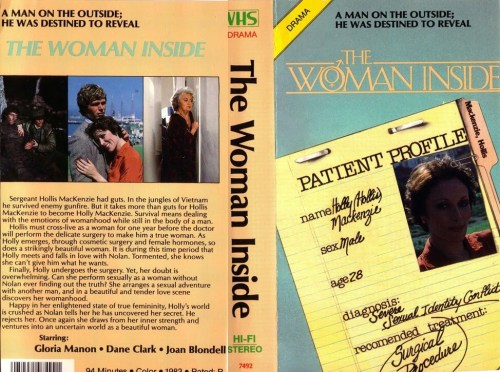
The Woman Inside (1981)

woman2

By Richard Winters

My Rating: 3 out of 10

4-Word Review: From man to woman.

Hollis (Gloria Manon) is a Vietnam Vet. whose suffers from gender dysphoria and decides to begin the process of gender transition with Dr. Rosner (Dane Clark). The first part of the procedure works perfectly as Hollis, who changes the name to Holly, resembles a woman physically and even takes voice lessons so that her voice is higher pitched. She still has a penis, but that doesn’t prevent her from beginning a relationship with Nolan (Michael Champion) though they don’t sleep together and she’s reluctant to tell him about her condition. Eventually she schedules the surgery while telling Nolan she’ll be gone for a couple of months, but when she returns they’ll be able to fully consummate their relationship. In the meantime she begins to question her decision when she joins a therapy group with other people who’ve had the procedure while also enduring verbal abuse from her Aunt (Joan Blondell) who doesn’t agree with the transition and openly mocks Holly for going ahead with it.

While on the surface this may seem like a groundbreaking film it really isn’t as two movies The Christine Jorgensen Story, which came out in 1970, and I Want What I Want, which starred Anne Heywood and released a year after the other one all preceded this movie by a good decade. It also suffers badly, much like with the Heywood film, where the protagonist doesn’t really resemble a guy even though technically that was what he was biologically born into. Instead Hollis looks much more like a woman with short hair and padded outfits and in a lot of ways kind of like Nancy Kulp the actress best known for starring in ‘The Beverly Hillbillies’ TV-show. Her attempts to speak in a lower voice doesn’t sound authentic and I felt it would’ve worked better had a biological male actor been cast in the part as the scenes with Manon trying to come-off as a guy is awkward and not believable.

The scenes where she goes back to the gas station, where she once worked when she was still a guy, and trying to get-it-on with Marco (Michael Mancini), a man she had a confrontation with earlier while she was Hollis, is ridiculous as well. Marco apparently doesn’t recognize her as the person he knew when she was a man, which I just couldn’t buy into, as Holly’s face is essentially she same as it was when she was Hollis except her hair’s is longer and she has a very distinctive facial structure, so there’s just no way someone that knew her in the past wouldn’t at the very least jog some Deja vu if ultimately connecting the two at some point and for him to go to bed with her without a single inkling is just not plausible.

Holly’s relationship with Nolan, particularly the way it begins, is highly problematic too. She works as a taxi driver and literally picks him up on a street corner at random while he’s in a drunken state, but why on earth would she suddenly fall for a guy, especially in that condition? She also comes upon him right after having a very scary and violent confrontation with another male passenger (Louis Basile) making me think she’d be so traumatized that the last thing she’d want to do is allow another male stranger into her car. Their relationship moves too quickly as they’re already talking about ‘love’ and long term commitment by only the next day. Nolan also transforms from a bum to a well-spoken respectable member of society overnight. The scene where they try to ‘outrun an approaching storm’ is stupid too as we see them madly riding their bicycles in an attempt to escape while above them is sunshine and blue skies.

Things improve a bit by the third act particularly the scenes involving the therapy group, which the movie should’ve had more of. Some commenters on YouTube, where the film is currently streaming for free, that also suffered from gender dysphoria seemed to appreciate the movie more than others, so if you personally connect to the subject matter you’ll most likely like it better, but on a technical end it’s botched.

This too marks, at least in most reference sites, as being Joan Blondell’s final film appearance though that’s not completely true. While this was the final film to be released with her presence, in fact it came out after she had already passed away, it was filmed in March, 1978 while The Glove, another movie she was in, was shot in April of that year, so technically that was her last film appearance even though it got released before this one.

My Rating: 3 out of 10

Released: September 15, 1981

Runtime: 1 Hour 34 Minutes

Rated R

Director: Joseph Van Winkle

Studio: 20th Century Fox

Available: VHS, DVD-R (J4HI.com)

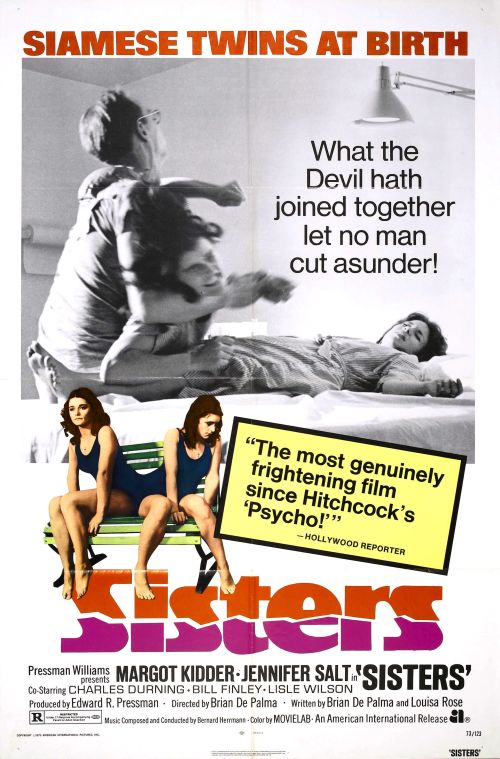
Sisters (1972)

sisters

By Richard Winters

My Rating: 7 out of 10

4-Word Review: Model has evil twin.

Danielle (Margot Kidder) is a young French-Canadian women from Quebec who aspires to be a fashion model and actress. She takes part in a TV-show styled after ‘Candid Camera’ where unsuspecting people find themselves caught up in a prank, which is where she meets Phillip (Lisle Wilson). The two go out on a date, but while at the restaurant she gets harassed by Emil (William Finley) her ex-husband. Then when they get back to her apartment Phillip overhears her arguing with another woman, which Danielle says is her twin sister Dominque. Since it is both of their birthdays Phillip decides to go out to get them a cake, but when he returns he gets viciously stabbed by the psychotic Dominque, but just before he dies he’s able to scribble the word ‘help’ onto the window with his own blood that Grace (Jennifer Salt), a journalist that resides across the street, sees. She immediately calls the police, but when they arrive into Danielle’s apartment there’s no sign of a body, or a struggle and Grace gets written-off as being a kook whose been imagining things, but she refuses to relent and begins her own investigation where she uncovers some dark details about Danielle and her sister who were once conjoined.

This was writer/director Brian De Palma’s first attempt at horror after completing many successful comedies that had gained a cult following. The story was inspired by real-life conjoined twins Masha and Dasha Krivoshlyapova who’s sad upbringing where they were taken away from their mother and had abusive medical experiments done on them at a secret hospital in the Soviet Union, and which was chronicled, much like in the movie, in a story in Life Magazine in 1966, which after reading it De Palma couldn’t get out of his head. Visually it’s excellent with great use of editing and superior score by the legendary Bernard Herrmann, who was semi-retired at the time, but enjoyed the script so much that he agreed to be the composer.

Many of De Palma’s famous directorial touches are apparent including his use of the split-screen. While it’s been used, and some may say overused, in many films from that era, it gets worked to perfection as we get to see Danielle and her ex busily cleaning-up the crime scene while Grace gets held up by the detectives and they’re not able to go into the apartment right away. My only complaint here is that with the blood splatter all over I’m just not sure they would’ve been able to wipe it all away in such a short time frame, basically about 8 to 10 minutes, which should’ve more likely taken them several hours. Not showing the clean-up and having Grace and detectives arrive to find the place spotless with no body would’ve actually added more intrigue and thus in this case the use of the split-screen, while done adequately, I don’t think was needed.

Spoiler Alert!

The script leaves open a fair amount of loopholes, for instance we see Danielle walk into a bedroom and the shadow of her head on the wall along with another one, which is supposed to represent Dominque’s, but we learn later that Dominque died years early during the surgery to separate them, so we’ve should’ve only seen one head shadow and not two. Also, Danielle is told point-blank by Grace that she’s been spying on them from across the street, so you’d think later that she and Emil would make damn sure to close the blinds on their windows when they try to remove the sofa, which has the dead body inside, but instead they continue to leave the shades wide open and allow Grace, now back in her own apartment, to continue to peer in while the couple show no awareness to the possibility and don’t even bother to look out the window to see if they can catch Grace looking in. Another head-scratcher is why there was no blood splatter on Danielle’s clothing, since she ultimately is the one that killed Phillip, when Emil walks into the apartment.

The most confusing thing though is the ending in which Grace becomes hypnotized while inside a mental hospital and begins to see herself, through a long dream sequence, as being Dominque and attached to Danielle. When I first saw this, back in the 90’s, I thought it meant that Grace was the long lost twin and that they had been separated years earlier. While Grace doesn’t look exactly like Danielle most twins don’t, and she was still around the same age, hair color, and body type, so it seemed like a legitimate explanation and I wouldn’t blame anyone else who came to this same conclusion. Apparently though that’s not the case as Grace comes back out of it only convinced, through the hypnotism, that she didn’t see the murder of Phillip, but I felt they should’ve taken it one step further by convincing her that she was Dominque, whether it was true, or not, and then brain washed to take credit for all the murders while Danielle could then get off scot-free and this would’ve then been the ultimate twist.

Granted Grace’s character is shown as having a mother (Mary Davenport), but the script could’ve been rewritten to have her taken out and Grace could’ve instead been portrayed as being an orphan, or adopted, which could’ve left open the possibility. In either case the dream segment, which is creepy and stylish done, would’ve had more of a payoff then it does had it taken this route.

My Rating: 7 out of 10

Released: November 18, 1972

Runtime: 1 Hour 33 Minutes

Rated R

Director: Brian De Palma

Studio: American International Pictures

Available: DVD, Blu-ray (Criterion Collection), Amazon Video

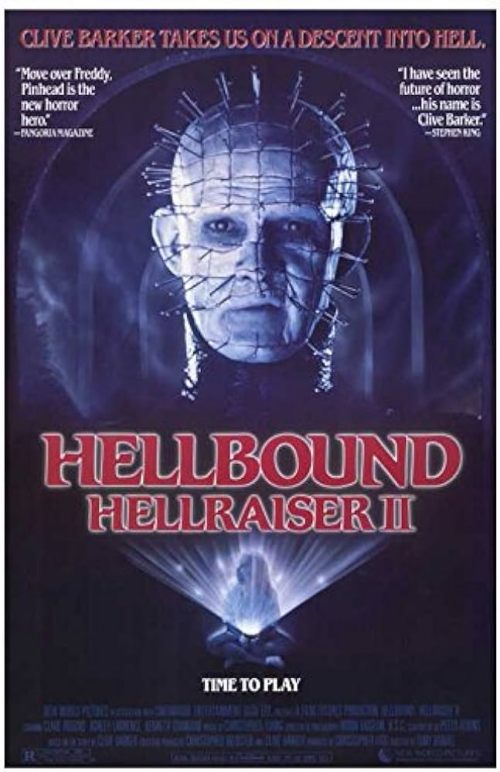
Hellbound: Hellraiser II (1988)

hellbound

By Richard Winters

My Rating: 7 out of 10

4-Word Review: The cenobites come back.

The story begins immediately where the first installment ended with Kristy (Ashley Laurence) in the hospital recovering from her injuries while she pleads with Dr. Channard (Kenneth Cranham) and his assistant Kyle (William Hope) to destroy the bloody mattress that her stepmother Julia (Clare Higgins) died on for fear that it might bring the woman back to life. Dr. Channard finds this possibility intriguing, so he brings the mattress back to his home and then has one of his mentally ill patients bleed on it, which brings Julia, minus her skin, back from the other dimension. She feeds on the patient, which gives her strength and Dr. Channard supplies her with more of them until she is able to take human form. Kristy finds out about it and travels to Channard’s home along with Tiffany (Imogen Boorman), a mental patient at the hospital whom she meets that cannot speak, but has a gift for solving puzzles. When they confront Julia and Channard all four get taken to the other dimension known as the labyrinth that houses the cenobites.

While Clive Barker wrote the script and produced he did not direct and instead handed over the reins to his friend Tony Randel. Randel wanted to turn into more of a dark fantasy and the transitions works making it visually arresting. The mazes that make up the other dimension, which are captured from a bird’s-eye view as we see tiny dots, which represent the characters running, are amazing and I enjoyed Tiffany’s brief foray into a circus like freak show that had a giant fetus with its lips sewn shut, that was creepy and I wished extended further. The scene where Julia bursts out of the mattress to attack the patient I found genuinely horrifying and a dare say one of the scarier moments in horror film history. I also liked the backstory revealing how pinhead (Doug Bradley) came into being. Supposedly this backstory was supposed to take up a major part of the runtime, but due to budget limitations it had to be scrapped and we only see a brief snippet of it through quickly edited segments, which to me was probably best.

The script though does seem a little weak in the way it sets up the premise as it’s way too convenient that the patient in the neighboring room to Kristy’s would have this fixation to solving puzzle boxes, which just makes it highly predictable where its going to go. Have her Dr. show an equal fascination with the puzzles and the cenobite world is again betting long odds and having someone with this dark obsession from outside the hospital track Kristy down would’ve been more believable. The way the mental patients are housed looks dated like we’re seeing an asylum from the 16th century though it still works, if you suspend your belief a bit, with the film’s over the top style.

I was glad that at least Andrew Robinson’s character from the first one doesn’t appear here. He was asked to reprise his role, but refused, which was good because if he had returned the script would’ve had a scene where he and Frank where together in the same body like Siamese twins, which sounded ridiculous. I also don’t like movies that have a character die-off, like Robinson’s did in the first one, and then magically come back to life later, which seems to defeat the purpose. If someone dies then they should stay dead otherwise it’s really not that horrifying seeing anyone get killed if we know that somehow they can still find a way to exist.

Spoiler Alert!

The Julia character, which was already poorly defined in the first installment, gets worse here. Supposedly, she was so madly in-love with Frank that she was willing to kill for him, which meant they must have some sort of special and perverse bond, but in this one she gleefully rips his heart out, literally. In the first one she showed signs of being conflicted over what she was doing, but here she becomes one-dimensionally evil and very boring.

The only cool thing about her is the way she sheds her skin off, but this proves problematic when Kristy puts on the skin in order to disguise herself. The women had different body types and heights, so the skin should not be able to fit her. Also, the inside of the skin was lined with blood from Julia, so putting it on should make Kristy suffocate and quite frankly gag at the grossness of having someone else’s blood seep all over her and thus not be able to wear it for more than a few seconds, or at least that’s how I would respond if I were in that situation, which makes the ending here a bit problematic.

My Rating: 7 out of 10

Release: December 23, 1988

Runtime: 1 Hour 37 Minutes

Rated R

Director: Tony Randel

Studio: New World Pictures

Available: DVD, Blu-ray, Amazon Video, Plex, Pluto, Tubi, YouTube

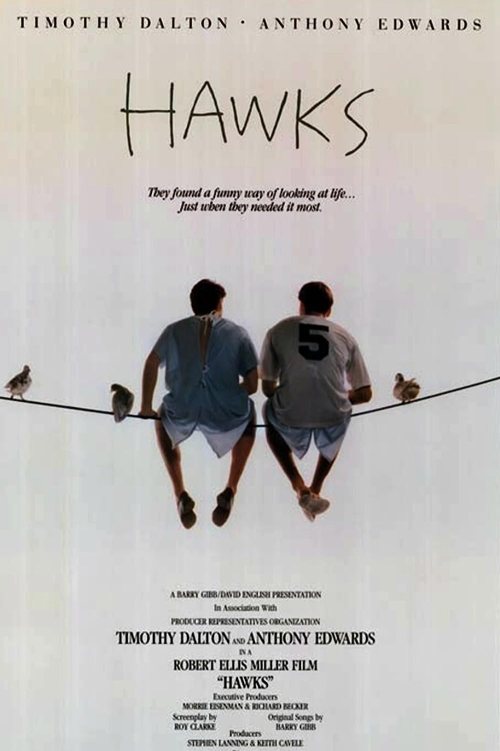
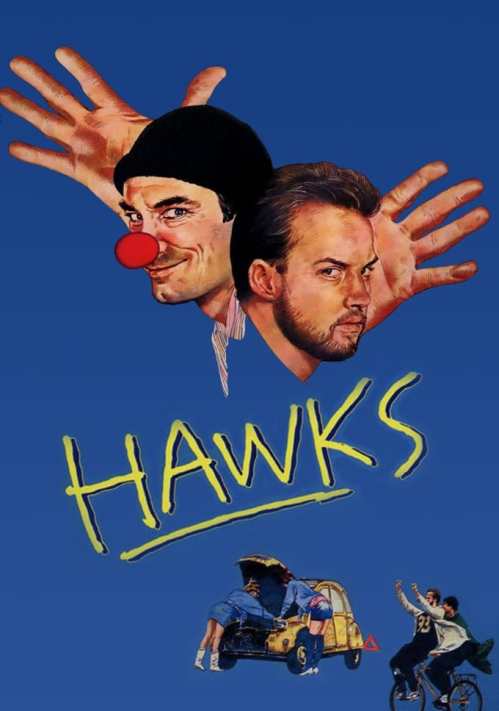
Hawks (1988)

hawks1

By Richard Winters

My Rating: 6 out of 10

4-Word Review: Patients hit the road.

Decker (Anthony Edwards) is a former football player stricken with terminal cancer. He’s put in the hospital where his roommate is Bancroft (Timothy Dalton), who’s dying from the same disease. Bancroft though still wants to have some fun and convinces Decker to sneak out of the facility and go on a road trip to Denmark, so they can have one last fling with the prostitutes in the Red Light District. Decker is nervous at first, as he’d rather commit suicide to put himself out of his misery, but eventually decides to go along where they end up meeting two lonely ladies, Maureen (Camille Coduri) and Hazel (Janet McTeer) who’s also harboring a painful secret.

Based on a short story written by Barry Gibb of The Bee Gees the plot has, despite it’s grim theme, a playful quality and comes-off more like a quirky road movie. The scenery is nice especially when they get into Holland and have an extended scene amidst the picturesque windmills, which you can hear slowly rotating in the wind as they speak. There’s also a few funny moments with the best one coming right at the start where Decker takes a frightened SAAB car salesman (Geoffrey Palmer) on a test drive at reckless speeds and right to the edge of a cliff.

The acting is great with Dalton, who did this between his two stints as Bond and used his notoriety to get it made, which he felt wouldn’t have gotten financed otherwise, being standout and putting to great use his piercing blue eyes, which become even more prominent when he’s wearing his stocking cap. Edwards is also good though he looked wimpy to have ever played football. Some may try to argue that the sickness ate away his weight, but in reality this is the body type he’s always had and the producers should’ve, for the sake of authenticity, had him bulk-up before filming began.

What I didn’t like were the unexplained caveats, like where did these two terminally ill patients manage to get the money to pay for fancy hotels and chic restaurants? It seemed like they could buy anything they wanted, so if that were the case then why couldn’t they get themselves clothes so they didn’t have to run around everywhere wearing nothing but their bathrobes? The sex angle was ridiculous too especially for Decker, who’s so weak he had to be carted around in the wheelchair. If he could barely stand then how the hell is he going to get the energy for sex?

Initially I found Hazel and her clumsiness as annoying as Bancroft did, but like with him she eventually grew on me, but I didn’t think she needed to be introduced already in the first act before she even met the two men. She has a scene on a bridge all alone and I didn’t understand what she had to do with the story, only later during the second act when she appeared again did it make sense, but again her personal troubles could’ve waited to be explained when Bancroft and Decker heard about it. I actually enjoyed more Sheila Hancock, who plays Regina, an aging 50-something hooker they meet, who shows a good propensity at fixing things like TV’s and I wished she’d been the one they had befriended long term and the two younger ladies cut out altogether.

Spoiler Alert!

The ending is touching particularly the way the plastic red clown nose comes into play. The wedding in which Bancroft marries Hazel, who’s secretly pregnant by a man who disowns the child, is cute too though I didn’t understand how Bancroft, who had been losing his hair throughout, suddenly seemed to grow it all back as he walked down the aisle. If anything he should’ve been completely bald by that time and it would’ve been more realistic had he been shown that way.

hawks2

My Rating: 6 out of 10

Released: August 5, 1988

Runtime: 1 Hour 47 Minutes

Rated R

Director: Robert Ellis Miller

Studio: Skouras Pictures

Available: VHS, DVD-R (dvdlady.com)

Phobia (1980)

phobia1

By Richard Winters

My Rating: 3 out of 10

4-Word Review: His patients are dying.

Dr. Peter Ross (Paul Michael Glaser) is a Canadian psychiatrist who has come up with a radical new therapy to help cure those who suffer from phobias. The program includes having them watch their fears played out visually on the big screen and thus forcing them to conquer those irrational thoughts and be able to go on living normal lives. Peter feels he’s making great progress with his patients only to suddenly have them start to die-off one-by-one with each perishing in ways that reflects their private phobia that they had hoped to overcome.

This is definitely one of those movies where what happened behind-the-scenes had to be far more interesting than anything that occurred in front of the camera. Having John Huston, the legendary director who helmed such classics as The Maltese Falcon and Key Largo doing this one, which is nothing more than a cheap thriller with 80’s slasher instincts, has to be the most baffling thing about it. It wasn’t like his career was on the outs either as he went on to direct several more critically acclaimed flicks in the 80’s that were well financed with big name stars and he had just 5 years earlier did the well received The Man Who Would Be King, so why he decided to take a weird foray into doing this inept thing, which just by reading the script you could tell was a mess upfront, I don’t know.

It starts out with some visual panache, but otherwise could’ve easily been directed by a no-name, two-bit director and no one would’ve known the difference. The one segment dealing with a car chase down the city streets that culminates with a man falling from a tall building had some potential though I would’ve framed the shot differently showing it from a bird’s-eye view where the viewer could see how far off the ground the victim really was versus having the camera on the ground looking up, which is less dramatic. I suppose it might’ve given away the safety net that’s clearly present as you never see him hit the ground, it cuts away while he’s still in mid-air, but in either case it’s the only mildly diverting moment of the whole film.

Everything else is run-of-the-mill including the numerous deaths, which despite the tagline don’t all have to do with their phobias either. For instance one woman fears being in big crowds, so in order to ‘cure’ her, the doctor has her go onto a crowded subway, but she panics and runs back to his place where she ultimately dies when a bomb explodes. The segment dealing with a woman who fears men gets pretty ridiculous as he has her watch a movie of a woman getting gang raped, which would appall anyone and yet when she runs out of the room in disgust and shock he’s confused. The very fact that he talks about ‘curing’ his patients is a major red flag altogether as in psychiatry you never really ‘cure’ anybody, which just shows how poorly researched and shallow the script really is.

Paul Michael Glaser, better known for his work in the TV-show ‘Starsky and Hutch’, makes for a wretched leading man and it’s no surprise that he decided to get into directing after this one and has never starred in a theatrical film since. It’s not completely his fault as his character exudes a cold demeanor, so you never really care about him, or his quandary. John Colicos, as the police detective, is far superior and helps enliven the film with the few scenes that he is in though his interrogation techniques are highly unethical and the fact that he only focuses on one angle as to who the culprit is makes his character come-off as unintentionally inept.

The film does feature a twist at the end as to who the killer really is, but it’s dumb and not worth sitting through. In fact the ultimate reveal is so bad that it ruins everything else that came before it, as it had been watchable up until that point, but the climax solidifies it as a bomb.

My Rating: 3 out of 10

Released: September 26, 1980

Runtime: 1 Hour 30 Minutes

Rated R

Director: John Huston

Studio: Paramount Pictures

Available: Blu-ray

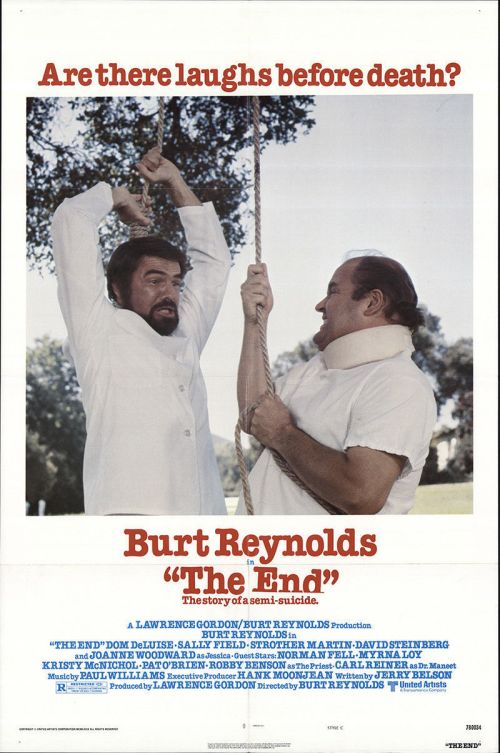
The End (1978)

end2

By Richard Winters

My Rating: 7 out of 10

4-Word Review: His days are numbered.

Sonny (Burt Reynolds) is a real estate broker known to make crooked deals. He gets diagnosed with an incurable disease and told he has only a limited time left. He says goodbye to his ex-wife (Joanne Woodward) who seems more interested in her new boyfriend, his daughter (Kristy McNichol) and his folks (Pat O’Brien, Myrna Loy) and even his live-in girlfriend (Sally Field) without actually telling them his condition. He then attempts suicide, but this gets him stuck in a mental hospital where he comes into contact with Marlon (Dom DeLuise) who agrees to help kill him, so Sonny can avoid going through the agony of the disease, but then after several aborted attempts Sonny decides he wants to live, or at least as long as he can, while Marlon continues to try and kill him and can’t seemingly be stopped.

The script was written by Jerry Belson, who also did the brilliant satire Smile and the original Fun With Dick and Jane, two of the funniest films to come out during the 70’s. This one is no exception, yet despite be written in 1971 and purchased by a studio, no one seemed to want to touch it. Many stars and producers felt the theme was too maudlin and wouldn’t be able to sell as a comedy. Reynolds though felt it was one of the funniest scripts he had read, and the character most closely identified to who he really was, and therefore jumped at the chance to direct and star in it though the studio was still reluctant and only agreed to finance it once he accepted starring in Hooper, which they felt was the sure money-maker though this one ended up doing quite well, surprising many, at the box office too.

Much of the credit goes to Reynolds who plays the part perfectly. Somehow he can create the slimiest of characters, and this one is a bit scummy with his admittedly shady real estate deals, and yet with his comic talent are still able to make him seem endearing. The studio had wanted the character’s profession to be a stock car racer, but this seemed too stereotypical, so I was happy that he kept it in the white collar realm and openly able to expose all of his personal flaws, which made him quite relatable. It’s also one of the rare times you get to see him with both a mustache and beard, or at least through the whole movie. The studio wanted to nix this too, but it helps give him a distinctive look.

Like with most actors turned director Burt allows for long takes, particularly during the first act, where the supporting cast is given ample time to play out their scenes without any interruption, which leads to many funny moments. I enjoyed Norman Fell as the doctor, and Robby Benson’s as a young priest who listens to Burt’s confession while he takes off his collar and puts it into his mouth, which creates a weird popping noise. These segments have an entertaining quality, but come-off more as vignettes and don’t help to propel the story along.

The second act, in which Burt ends up in the mental ward, are the best and his teaming with DeLuise is hilarious. I realize not all the critics enjoyed Dom’s take on a crazy man, Variety Magazine, labeled his performance as being ‘absolutely dreadful’, but there’s no denying the infectious chemistry he and Burt have, making the scene where he tries to drop Burt from a bell tower, or the segment where he tries to hang him up by a noose, quite memorable. The segment though where Burt goes swimming out into the ocean in an attempt to drown and then has a change of heart and tries getting back to shore and the voice-over prayer that he gives to the Almighty he order to help him back is laugh-out-loud and not only the top comedy moment in this movie, but quite possibly any movie ever.

Spoiler Alert!

The only problem I had was with the ending. In the original script the DeLuise character was supposed to kill Burt after he got out of the ocean, but Burt felt the movie needed some ‘hope’, so instead he has DeLuise attempting to chase Burt along the shoreline, in a sort of stop-action way that looks cartoonish. I felt there needed to be more of a resolution. If Reynolds does decide to live out the rest of his days what does he do with it? Does he try to mend his ways by paying back all those he had swindled? Or does he make amends with the people in his life including his ex and daughter? None of this gets answered, which is disappointing. A good movie needs a healthy character arch and this one doesn’t really have any. A better third act would’ve shown how the diagnosis had changed him and had the film not labored so much with the comical vignettes of the first half we might’ve gotten there and it’s just a shame that we never do.

My Rating: 7 out of 10

Released: May 10, 1978

Runtime: 1 Hour 41 Minutes

Rated R

Director: Burt Reynolds

Studio: United Artists

Available: DVD, Blu-ray, Amazon Video, YouTube

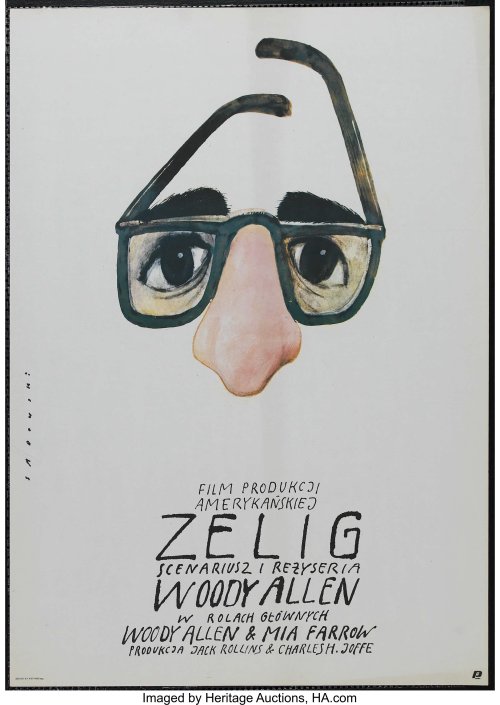
Zelig (1983)

zelig1

By Richard Winters

My Rating: 4 out of 10

4-Word Review: Wanting to fit in.

Leonard Zelig (Woody Allen) is a man living in the 1920’s and 30’s who has an uncanny ability to reflect the personalities and features of those he’s surrounded with. Even if he’s in the company of someone of a different race, or ethnicity, he can still acquire their traits, including their skin color, until he looks exactly like them. He becomes known as a the human chameleon and Dr. Eudora Fletcher (Mia Farrow) , a psychiatrist, becomes determined to find the root cause. She takes him on as a patient and under intense hypnosis comes to the realization that his deep need to be liked by others causes him to conform to the most extreme ways imaginable. Through her therapy she gets him to become more confident in expressing his own opinions, but this leads to him arguing with others over the most mundane reasons, which leads to several fights. She again puts him under hypnosis, so that he’ll become more of centrist, but this then leads to even further complications.

Allen was inspired to do this movie when his friend Dick Cavett was hosting a history series on HBO and a segment was done where Cavett’s likeness got spliced into an historical image. While the effects of using old newsreel footage and photos from long ago and inserting in cast members to make it seem like they were there when the picture was taken may not seem like that big of a deal today, but back in the 80’s it was very much talked about. I remember an entire segment of CBS Morning News hosted by Diane Sawyer going in depth about the ‘incredible’ special effects and ‘how did they do it?’ With digital filmmaking and movies like Forrest Gump we’re used to it, but back then it was state-of-the-art and got nominated for several awards. To help make it look as authentic as possible cinematographer Gordon Willis used vintage cameras and lenses from the 20’s and then stomped on the negatives of the film in his shower to help create the crinkles and scratches.

While telling the story through newsreel footage is certainly diverting and many times amusing I was fully expecting after about 20 minutes or so that it would eventually become more like a normal movie with the plot being propelled by actual characters, dialogue, and conventional scene structure, but instead it sticks with the novelty until the bitter end, which for me was a mistake as it makes the viewer too detached from the people in the movie to the point that they become distant caricatures that we really care nothing about. Much comedy is also lost as everything hinges on the voice-over narration of Patrick Horgan and how he describes what’s going on versus having it played out. A great example of this is when Allen gets into an argument with someone over whether ‘it’s a nice day, or not’, but all we see of it is some grainy, black-and-white figures in a distance that appear to be squabbling when witnessing the actual argument in real-time would’ve been so much funnier.

My favorite moment had nothing do with the special effects, but instead was the scene with Farrow and Allen where she tricks him, using reverse psychology, into admitting he really wasn’t a psychiatrist like her, and the movie needed more segments like this one. The vintage footage is nice for awhile and highly creative, but ultimately makes it come-off like a one-note joke, or an experimental film that’s misses the most basic elements of a good story, which is character development. It’s a shame too as Farrow gives a strong performance, which gets overshadowed. Usually she’s best at playing emotionally fragile types, but here is a strong woman and does quite well though I thought it was ridiculous that in color segments where here character is speaking in the modern day as an old woman another actress, Ellen Garrison, plays the part when they could’ve easily had Farrow doing it by dying her hair gray and putting on a few wrinkles. So much effort was put into the black-and-white vintage stuff that they forgot about the simplest of all special effects: stage make-up.

There’s also a host of other famous faces that have cameo bits as they talk about the fictional Zelig in the modern-day like historians discussing a past event, or famous person. Of these includes Susan Sontag, Saul Bellow, Irving Howe, and John Morton Blum, but like with the newsreel element it gets overplayed and derivative. It also brings to question what exactly was the movies’ point. Was it a satire on conformity and if so it could’ve gone much deeper, or poking fun at documentaries, which could’ve been played-up much more too. In either case it’s a misfire that’s engaging for awhile, but eventually, even with its short runtime, wears itself out.

zelig2

My Rating: 4 out of 10

Released: July 15, 1983

Runtime: 1 Hour 19 Minutes

Rated PG

Director: Woody Allen

Studio: Orion Pictures

Available: DVD, Blu-ray

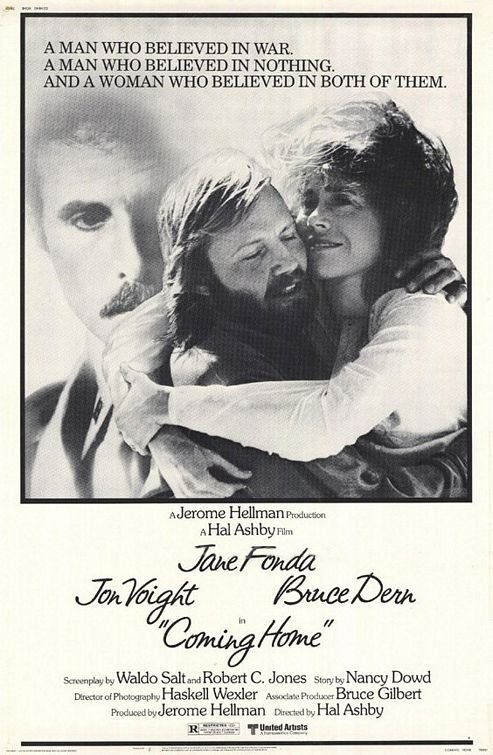
Coming Home (1978)

coming

By Richard Winters

My Rating: 10 out of 10

4-Word Review: Falling for injured vet.

Sally (Jane Fonda) is the military wife to Bob (Bruce Dern) who’s been deployed to Vietnam. Since she now has more free time she decides to volunteer at her local VA Hospital. It is there that she meets Luke (Jon Voight) a former classmate from high school who has now come back from the war a paraplegic. Luke is very embittered about his condition and he’s initially angry and confrontational with Sally. Eventually he softens and Sally invites him to her house for dinner. It’s there that their romance begins to bloom and eventually they become intimate. Bob though, having suffered a leg injury, returns to the states and while Sally and Luke agree to keep their affair a secret Bob soon finds out, which leads to an ugly confrontation between the three.

The idea for the film was inspired by Fonda’s meeting with Ron Kovic, an injured vet who had written his autobiography Born on the Fourth of July that later, in the 80’s, became a movie starring Tom Cruise. Fonda though wanted to make a film with a character that was similar to him and got together with screenwriter Nancy Dowd in 1972 to write a script, which initially focused completely on the hospital setting without the affair, or B-story dealing with the conservative military husband. After many rewrites and bringing in Oscar winner Waldo Scott to help bolster the story the script finally managed to gain interest amongst the studios though many were still cautious about producing a movie dealing with the after-effects of the war, which at that time had never been done before, up until then only films dealing with the war, or those coming back with psychological issues, but not actual physical impairments and thus making this a first in that category.

Since Fonda was instrumental in getting the project produced she was the only choice to play Sally. I think she’s a fine actress who deservedly won the Supporting Oscar for her work here, but since she was on the front lines of the war protest and in many ways even became the face of it, the transition of her character isn’t as profound. Having an actress whose name wasn’t so aligned with left politics and who could better fit-into the part of a conservative housewife would’ve then made the character’s arch more dramatic. I felt too that Sally is too understanding of Luke right-off, the history of them going to high school together should’ve been excised, and instead she should’ve feared Luke when she first encounters him as he does act out-of-control and the romance between them happens too quickly.

Also, once her character changes her hairstyle from the old-fashioned straight to curly it should’ve remained as this visually establishes her character’s changing perspective and not go back to the straight look when she visits Bob in Hong Kong. To remedy this she should’ve decided to keep the curly look even if she feared Bob might not approve, she was technically becoming more empowered with him away anyways, and this would’ve signaled to Bob that she wasn’t the same person he knew when he left, or had the hair change occur after the Hong Kong visit, but having the hair style flip-flop works against the arch, which should be linear and not zig-zagging.

Voight, who won the Best Actor Oscar, and who had to lobby hard for the role as the producers originally wanted Jack Nicholson, is outstanding and there’s not a flaw in his performance with his best moment coming at the very end when he gives a lecture to a room full of high school students about his war experiences. My only complaint, which has nothing to do with his acting and more with the script, is when he bluntly tells Sally, when he goes to her place for dinner, that he dreams of making love to her, which seemed too forward especially since they end up having an impromptu kiss later. Since movies are a visual medium it should’ve settled with the kiss exposing the underlying brewing romance without his character having to explicitly state it. I also found it interesting that the DVD features a commentary track with Voight, Dern, and cinematographer Haskell Wexler, but Fonda is conspicuously not present and I wondered if this may have been due to Voight becoming a hardened conservative as he’s aged and because of their political differences Fonda not wanting to be in the same room with him.

Dern, like the other two, is excellent. His improvisational Dernisms as I like to call them come into play particularly when he gets intense I even learned what the slang term Jody meant, which is what he calls Voight at one point. You also, at the end, get a full view of his bare ass. Now, on the celebrity male naked ass scale I still say it’s a distant third to Dabney Coleman’s in Modern Problems  and Tim Matheson’s in Impulsebut it’s not bad.

Accolades must also go to director Hal Ashby, who was not the first choice as the studio initially wanted John Schlesinger. While Schlesinger could’ve been great I felt Ashby’s use of all natural lighting is what really makes the difference and becomes the over-riding look of the film. He displays keen use of the music too at the end when the song ‘Time Has Come Today’ by the Chamber Brothers is played and the lyrics are used to expose the underlying ticking time bomb of the situation that the three characters are veering speedily into.

My Rating: 10 out of 10

Released: February 15, 1978

Runtime: 2 Hours 7 Minutes

Rated R

Director: Hal Ashby

Studio: United Artists

Available: DVD, Blu-ray

Evil Town (1987)

evil1

By Richard Winters

My Rating: 2 out of 10

4-Word Review: Old people kidnap travelers.

Chris and Julie (James Keach, Michele Marsh) along with another couple (Robert Walker Jr., Doria Cook-Nelson) are traveling through rural California from Los Angeles when they begin to have car trouble and stop-off at a rundown gas station in a small town. Earl (E.J. Andre), the old man who runs the station, inspects the vehicle and tells them it’s a water pump issue that will take at least a day to repair. Since it’s late at night he and his wife Mildred (Lurene Tuttle) offer them their spares room to sleep over in, but the couples decide they’d rather camp-out. However, they become harassed by unknown peepers, so when that car is found to have even more issues the next day and forced to spend yet another night there, they agree to stay at the elderly couple’s home. It is here that they get fed a poison that knocks them-out and they are then taken to a nearby hospital run by Dr. Schaeffer (Dean Jagger) who needs bodies of young people in order to conduct his experiments on the aging process.

This film is a great example of how funding is so crucial to a production and once it runs out there isn’t much else to do. Filming began under the working title ‘God Bless Grandma and Grandpa’ in the fall of 1973 in Mendocino, California and was directed by the talented Curtis Hanson, but money ran out before they could shoot the ending. In 1977 a different production company bought the unfinished footage and tried to market it as a movie under the title Dr. Shagetz, but with no real ending it failed to catch-on and the entire thing fell into obscurity. Then in 1984 another independent studio bought the lost footage and attempted to again redistribute it, but this time by adding in new footage, which they hoped to edit around the old footage in an effort to make it seem like a complete movie and then ultimately released to select theaters on June 2, 1987.

Unfortunately by the time they were ready to shoot the new stuff many of the elderly actors from the original were already dead, or to old at that point to perform. The four younger stars who made-up the two couples had no interest going back to finish shooting a movie the had long ago forgot about. This resulted in new actors getting hired to play both the roles of the protagonists and the bad-guys and while it’s edited in a way to make it seem like the new stars are interacting with the old ones from the lost footage it’s quite clear that they really aren’t and whole thing ultimately comes-off as two bad movies compressed into one really lousy one.

The story idea I liked and has definite similarities with Homebodies that also featured old people as the killers. There are a few good moments like having the actions scenes done in slow-motion and Keach forced to fight-off the old people who attack him by jumping on him one after the other. The scene where he gets surrounded by a group of chanting old folks while trapped in an old, nonoperational car isn’t bad either, but the pacing is slow and takes too long to get going.  The added footage is highly exploitative and basically consists of Playboy Playmate Lynda Wiesmeier running around topless in the night as she tries to avoid two killers.

Jagger, who was clearly at the tail-end of his long career, which at one point featured winning an Academy Award in 1949 for best supporting actor, gives an interesting performance. His shiny bald head along with the shaded glasses he wears gives him a creepy look and the odd speech pattern that he uses here make him seem genuinely menacing. Had the story stayed focused solely on him and had the original production been better funded and retained the first director this thing might’ve had a chance and even cult potential, but the way it is now it’s just a sad curio showing what might’ve been.

My Rating: 2 out of 10

Released: June 2, 1987

Runtime: 1 Hour 22 Minutes

Director: Curtis Hanson (70’s footage), Mardi Rustam (80’s footage)

Rated R

Studio: Trans World Entertainment

Available: Blu-ray

Mirrors (1978)

mirrors

By Richard Winters

My Rating: 4 out of 10

4-Word Review: Woman haunted by voodoo.

Marianne (Kitty Winn) and Gary ( William Paul Burns) are a newlywed couple who travel to the French Quarter of New Orleans for their honeymoon. Little do they know that a secret group of people, including the owner of the hotel that they’re staying at, have decided to possess Marianne with the spirit of a dead black woman. Soon after arriving Marianne begins having frightening dreams and the reflections of someone else when she looks in the mirror. Strange occurrences happen around her including the deaths of dogs and even her husband. Eventually she gets taken to a psychiatric hospital where Dr. Godard (Peter Donat) listens to her case and agrees to try and help her.

This was the third feature film of director Noel Black. He attained the attention of film critics with his 1965 movie short Skaterdaterwhich lead to funding for his second project Pretty Poison, which starred Anthony Perkins and Tuesday Weld and garnered a cult following. Soon after he became highly in-demand, but he made the mistake of deciding it was more important to stay busy in the business than holding out for a good script. He took on directing the notorious Cover Me Babewhich features what may be the most unlikable protagonist in film history, and a movie Black later admitted “should never have been made”. He followed this up with Jennifer on My Mindwhich met with equal disdain by both the critics and at the box office. By 1974, when this film was shot, Black was just trying to remain relevant as the studios that initially adored him were now no longer calling. This film was meant to showcase his visual talent, but he and the producers could never get on the same page as to what direction to take the story culminating in a muddled script that goes nowhere.

That’s not to say there aren’t things about this movie that I liked. The music score by Stephen Lawrence is haunting and the on-location shooting of the French Quarter offers a nice ambiance. I liked the point-of-view shots done when Marianne first gets wheeled into the hospital and the scenes inside an abandoned train station are spooky.

The story though lacks focus. The film opens right away with us seeing the notorious voodoo group in action, but it would’ve been more interesting had we not been given this information right away and instead made it more of a mystery for the viewer as to whether she was going insane, like the other characters in the movie think she is, or not. Winn’s performance is good. She’s better known for her part in a much more famous horror movie The Exorcist, where she appeared more youthful while here her hair is cut short and with make-up given a middle-aged demeanor. Her character though is poorly fleshed-out and shows no unique qualities and in that respect she’s quite boring, but as she becomes repeatedly terrorized by the group the viewer softens to her, mostly due to her good acting, and ultimately cares about her fate.

Spoiler Alert!

The story has similar themes with the cult hit Let’s Scare Jessica to Death and had it been better realized could’ve been a minor success, but the ending is too ambiguous. Winn turns to the camera in the final shot and shows a weird expression making us believe, I guess, that she’s been possessed by a spirit, but why was she chosen? There’s many people that come to New Orleans, so why does this group pick her to go through all this and not someone else? What’s the purpose, or end game of the group and what do they hope to achieve? None of this gets answered making the viewer feel afterwards that it was a big pointless waste of time. Black admitted that it didn’t work out right, but blames the fact that it was taken out of his hands and revised in a way that he didn’t approve of. All of this may be true, but in either case it’s best not to come into it with high expectations as you’ll leave gravely disappointed afterwards.

My Rating: 4 out of 10

Released: February 8, 1978 (Filmed in May of 1974)

Runtime: 1 Hour 28 Minutes

Rated PG

Director: Noel Black

Studio: First American Films

Available: DVD-R (dvdlady.com)