Tag Archives: William Finley

Phantom of the Paradise (1974)

By Richard Winters

My Rating: 7 out of 10

4-Word Review: Record producer exploits songwriter.

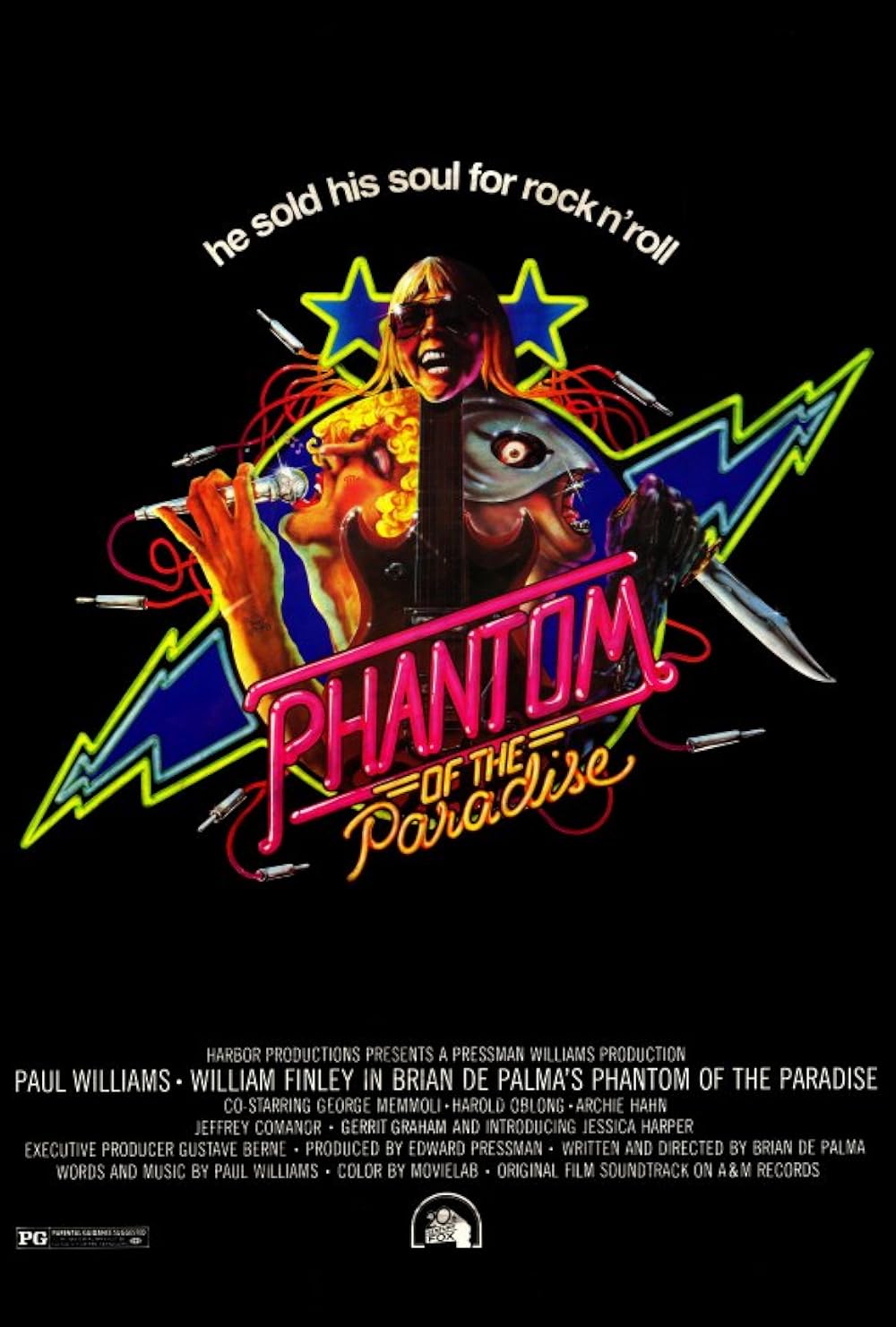
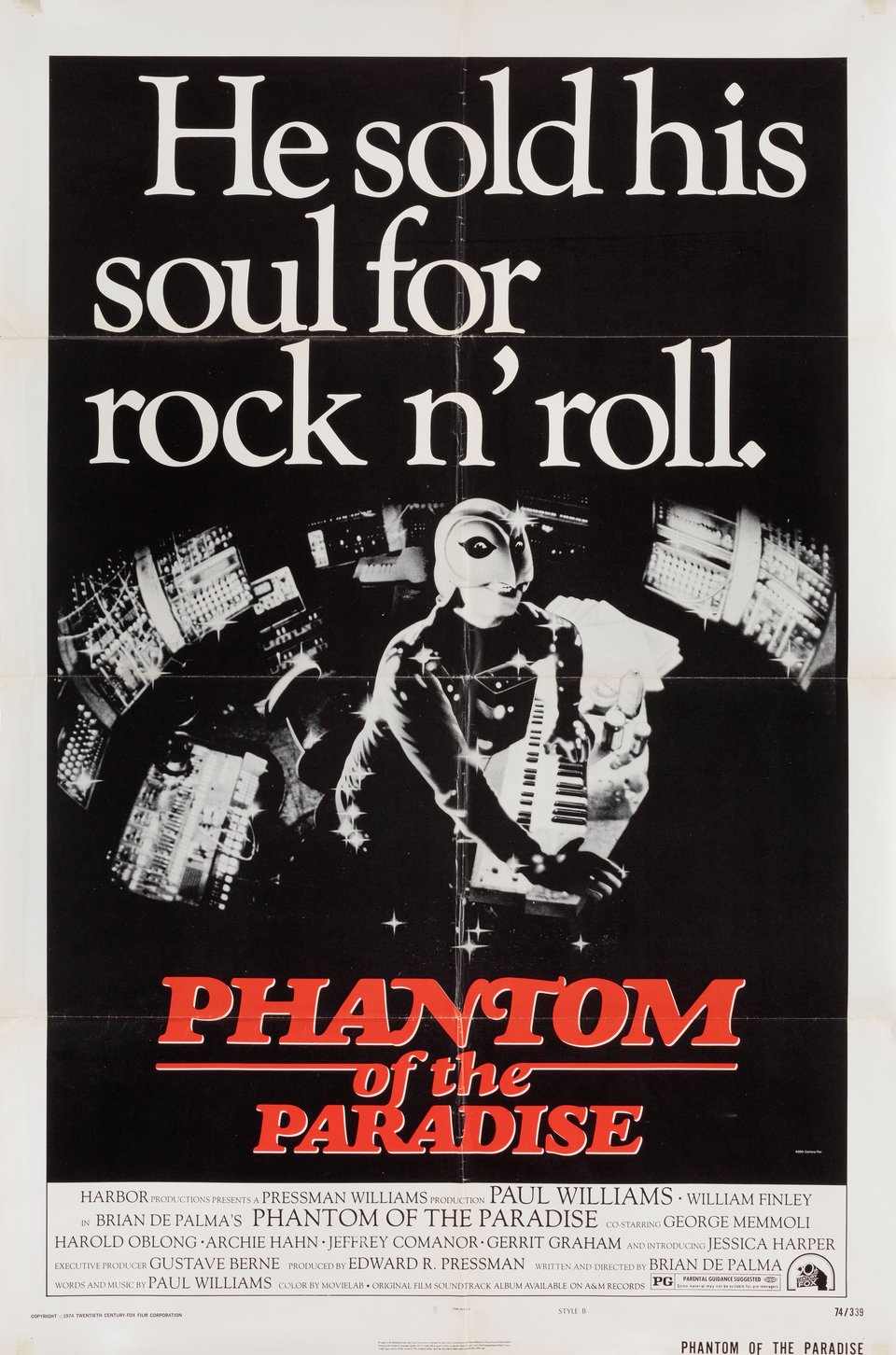
Winslow Leach (William Finley) is a talented, but unknown songwriter whose written a cantata based on the Faust legend. Famous record producer Swan (Paul Williams) overhears Winslow singing it and decides he’d like to use if for the grand opening of his new concert hall. Swan speaks with Winslow about the piece leading Winslow to believe he’s finally found his ‘big break’ but then doesn’t hear back from him for another month. Winslow then goes to Swan’s office but is kicked out when Swan refuses to see him. He then makes several other attempts to meet with him before Swan has him arrested on trumped up drug charges and sent to prison. It is there that Winslow realizes that Swan had his cantata stolen and now plans on using it to stage his own production while not giving Winslow any credit for having written it. This so enrages Winslow that he manages to escape from prison and storms the production headquarters only to accidentally fall into a record press machine that severely disfigures him. Now, while wearing a mask, Winslow continues to terrorize the place as ‘The Phantom’, which causes Swan to decide to make a deal with him. He asks Winslow to rewrite the cantata with beautiful new singer Phoenix (Jessica Harper) in mind to sing it. Since Winslow is secretly in love with her and also admires her immense talents, he agrees, but then Swan forces him to sign a contract in blood that has some very unusual clauses.

This was writer/director Brian De Palma’s attempt to mix horror with the irreverent quicky comedy of some of his earlier films from the late 60’s. The result is a mishmash of ideas with some of it mostly working. I really liked the visual style that has to be seen on the big screen, which I was fortunate enough to do at the Alamo Drafthouse recently, to fully appreciate it. I loved the over-the-top set pieces like Swan sitting in the center of his desk that’s made to look like a giant record. The outrageous costumes, garish music, quick edits, and his trademark split screens all help to make it highly entertaining on a visual scale.

Where it starts to have problems is with the humor. Like with De Palma’s earlier experimental films it has an engaging, offbeat quality that I liked and even found funny, but it gets a bit overboard and it ruins the tension. A good example of this is when Winslow goes to Swan’s office and gets kicked out, but in a very silly way that comes complete with cartoonish sound effects. This would’ve worked better had there been more of an attempt to make it a legitimate horror with only a little dark humor sneaked in versus an all-out camp feast that unfortunately hurts the story’s darker moments.

The acting though is quite engaging and does help save it even during its goofier moments. When I first saw this, years ago I felt Finley was miscast as the protagonist. With his thick glasses, bulging eyes, crooked teeth, and hair trigger temper, he actually comes off as scarier when he’s still looking ‘normal’ than after he gets disfigured, but in retrospect this helps create a more three-dimensional protagonist. A lot of people that are very talented in one area can also be quite dense in others, so the way Swan is able to con him so easily made sense. Also, if they spend a lot of time alone writing songs it would seem logical that they would be awkward socially, so his sometimes cringey behavior was a logical fit and thus the bespectled Finley, who would never be deemed a good-looking hunk like the conventional hero, was an astute casting choice.

Williams was another one that initially came off as wrong for the role. Originally De Palms wanted him to the play the part of Winslow especially since he is a real-life songwriter who wrote the entire soundtrack for this, but he wasn’t right physically for it, so asked if he could play the bad guy instead. Seeing such a short guy playing such an intimidating figure does come off as ironic, and Williams shows some surprising confidence in the role both with his terse delivery and facial expressions, but it would’ve been better had we not seen him right away. Instead, he could’ve been this voice we hear through the shadows and only had the big reveal occur during the second or third act, which then would’ve heightened the irony of his small stature even more.

Harper is fantastic in support. This gets labeled as being her official film debut and her angelic face, beautiful singing voice, and great dancing ability, solidify making her a joy to watch every time she’s on the screen. Gerrit Graham is hilarious as the bulky shock rocker Beef, who behind-the-scenes is quite effeminate, and the very rotund George Memmoli is great too as Swan’s no-nonsense henchman.

Spoiler Alert!

The way Swan makes a pact with the devil didn’t make sense and needed better elaboration. He apparently meets him while sitting in the bathtub contemplating suicide as he didn’t want to ever get old. The only question is why would the devil suddenly show up just because of that? There’re many people who contemplate killing themselves and some even do, but there’s no devil jumping in trying to make a deal with them, so why does he come into play here? A better idea would’ve had Swan, in an attempt to maintain his youthfulness, start dabbling in witchcraft and through this he would inadvertently summon the devil.
My Rating: 7 out of 10

Release: October 31, 1974

Runtime: 1 Hour 32 Minutes

Rated PG

Director: Brian De Palma

Studio: 20th Century Fox

Available: DVD, Blu-ray, Amazon Video, YouTube
Sisters (1972)

sisters

By Richard Winters

My Rating: 7 out of 10

4-Word Review: Model has evil twin.

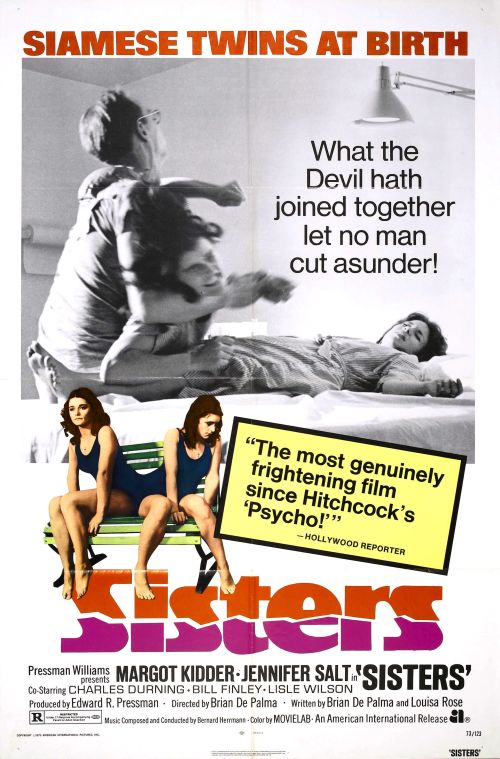
Danielle (Margot Kidder) is a young French-Canadian women from Quebec who aspires to be a fashion model and actress. She takes part in a TV-show styled after ‘Candid Camera’ where unsuspecting people find themselves caught up in a prank, which is where she meets Phillip (Lisle Wilson). The two go out on a date, but while at the restaurant she gets harassed by Emil (William Finley) her ex-husband. Then when they get back to her apartment Phillip overhears her arguing with another woman, which Danielle says is her twin sister Dominque. Since it is both of their birthdays Phillip decides to go out to get them a cake, but when he returns he gets viciously stabbed by the psychotic Dominque, but just before he dies he’s able to scribble the word ‘help’ onto the window with his own blood that Grace (Jennifer Salt), a journalist that resides across the street, sees. She immediately calls the police, but when they arrive into Danielle’s apartment there’s no sign of a body, or a struggle and Grace gets written-off as being a kook whose been imagining things, but she refuses to relent and begins her own investigation where she uncovers some dark details about Danielle and her sister who were once conjoined.

This was writer/director Brian De Palma’s first attempt at horror after completing many successful comedies that had gained a cult following. The story was inspired by real-life conjoined twins Masha and Dasha Krivoshlyapova who’s sad upbringing where they were taken away from their mother and had abusive medical experiments done on them at a secret hospital in the Soviet Union, and which was chronicled, much like in the movie, in a story in Life Magazine in 1966, which after reading it De Palma couldn’t get out of his head. Visually it’s excellent with great use of editing and superior score by the legendary Bernard Herrmann, who was semi-retired at the time, but enjoyed the script so much that he agreed to be the composer.

Many of De Palma’s famous directorial touches are apparent including his use of the split-screen. While it’s been used, and some may say overused, in many films from that era, it gets worked to perfection as we get to see Danielle and her ex busily cleaning-up the crime scene while Grace gets held up by the detectives and they’re not able to go into the apartment right away. My only complaint here is that with the blood splatter all over I’m just not sure they would’ve been able to wipe it all away in such a short time frame, basically about 8 to 10 minutes, which should’ve more likely taken them several hours. Not showing the clean-up and having Grace and detectives arrive to find the place spotless with no body would’ve actually added more intrigue and thus in this case the use of the split-screen, while done adequately, I don’t think was needed.

Spoiler Alert!

The script leaves open a fair amount of loopholes, for instance we see Danielle walk into a bedroom and the shadow of her head on the wall along with another one, which is supposed to represent Dominque’s, but we learn later that Dominque died years early during the surgery to separate them, so we’ve should’ve only seen one head shadow and not two. Also, Danielle is told point-blank by Grace that she’s been spying on them from across the street, so you’d think later that she and Emil would make damn sure to close the blinds on their windows when they try to remove the sofa, which has the dead body inside, but instead they continue to leave the shades wide open and allow Grace, now back in her own apartment, to continue to peer in while the couple show no awareness to the possibility and don’t even bother to look out the window to see if they can catch Grace looking in. Another head-scratcher is why there was no blood splatter on Danielle’s clothing, since she ultimately is the one that killed Phillip, when Emil walks into the apartment.

The most confusing thing though is the ending in which Grace becomes hypnotized while inside a mental hospital and begins to see herself, through a long dream sequence, as being Dominque and attached to Danielle. When I first saw this, back in the 90’s, I thought it meant that Grace was the long lost twin and that they had been separated years earlier. While Grace doesn’t look exactly like Danielle most twins don’t, and she was still around the same age, hair color, and body type, so it seemed like a legitimate explanation and I wouldn’t blame anyone else who came to this same conclusion. Apparently though that’s not the case as Grace comes back out of it only convinced, through the hypnotism, that she didn’t see the murder of Phillip, but I felt they should’ve taken it one step further by convincing her that she was Dominque, whether it was true, or not, and then brain washed to take credit for all the murders while Danielle could then get off scot-free and this would’ve then been the ultimate twist.

Granted Grace’s character is shown as having a mother (Mary Davenport), but the script could’ve been rewritten to have her taken out and Grace could’ve instead been portrayed as being an orphan, or adopted, which could’ve left open the possibility. In either case the dream segment, which is creepy and stylish done, would’ve had more of a payoff then it does had it taken this route.

My Rating: 7 out of 10

Released: November 18, 1972

Runtime: 1 Hour 33 Minutes

Rated R

Director: Brian De Palma

Studio: American International Pictures

Available: DVD, Blu-ray (Criterion Collection), Amazon Video

Eaten Alive (1976)

By Richard Winters

My Rating: 6 out of 10

4-Word Review: Feeding a hungry crocodile.

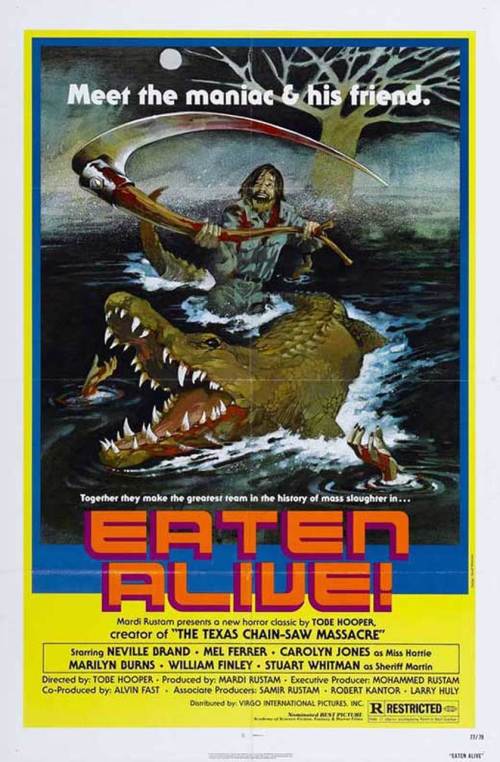
Loosely based on the exploits of serial killer Joe Ball, who owned a bar in the 1930’s in Texas that had a alligator sideshow connected to it and it was rumored that he fed some of his victims to the beast though it was never proven.  The story here centers around Judd (Neville Brand) a backwoods redneck who owns a rundown hotel in the swamp lands where he brings in unsuspecting guests that he feeds to his Nile Crocodile that he has swimming in a pond behind the building.

This film was director Tobe Hooper’s third full-length feature and the first to be financially backed by a studio after the success of The Texas Chain saw Massacre although the bigger budget doesn’t help. I didn’t like that everything gets filmed inside an indoor studio, in this case The Raleigh Studios in Los Angeles as the outdoor scenes look artificial, and the strong red glow, which I couldn’t figure out if it was supposed to be from the sun or a neon sign, gives it too much of a surreal look. Hooper stated that this is the effect he wanted, but it causes the viewer to feel that this is something that is happening in some other planet and for something to be scary one should feel that what there seeing could happen here and to them instead of in a bizarre world far removed from this one.

I had issues with the rundown Starlight Hotel too. It certainly looks spooky, but in a cliched way and that’s the problem. Nobody in their right mind would ever stay overnight there. It looks like a place that might not even have indoor plumbing or electricity. This coupled with Judd the owner, who looks creepy and acts weird, would immediately scare anyone away and the fact that the characters here aren’t bothered by any of this makes them seem too stupid to be believed.

The acting helps especially Brand. He burst onto the film scene in 1949 with many good performances including an acclaimed one in the landmark drama Riot in Cellblock 11, but his rugged appearance made it hard for him to find leading man roles relegating him to supporting parts. By the mid-70’s he admitted in interviews that  he had spent most of the money he had made and was suffering from alcoholism, which forced him to take any role that was offered including some really bad ones. This film though was an exception and a good example of how to make a killer more interesting by not having him behave in a one-dimensional threatening way, but instead show at various times some unexpected traits like fear, confusion, and even sadness.

The supporting cast is great too especially Carolyn Jones as a brothel owner. She looks light years removed from her most famous role as Morticia in ‘The Addams Family’ TV-Show as she walks around with a noticeable hunch and has make-up on her face, which gives her a very wrinkled appearance. William Finley and Marilyn Burns, who famously starred in Hooper’s earlier hit film, are intriguing too as this freaky couple who check into the place, but it’s never sufficiently explained why her character is initially seen wearing a wig, or why Finley talks about losing one of his eyeballs when he clearly hasn’t.

My favorite part though was that of Kyle Richards who plays this 6-year-old girl who manages to escape from the killer and hide underneath the property in a crawlspace. Watching her being chased through the crawlspace by Judd is intense and if the film had focused solely on her it could’ve been a winner.

Unfortunately the other characters aren’t likable and elicit no emotion from the viewer. The plot is thin and offers no unexpected twists or surprises. Hooper seems to be going too much to the same well as his chain saw flick including a foot chase sequence that gets choregraphed in the exact same way as the one between Leatherface and Marilyn Burns. Too much emphasis on atmosphere and grisly violence while an interesting plot-driven story gets forgotten, which is the reason why this production only halfway succeeds.

Alternate Titles: Death Trap, Starlight Slaughter, Legend of the Bayou, Horror Hotel

My Rating: 6 out of 10

Released: October 26, 1976

Runtime: 1 Hour 31 Minutes

Rated R

Director: Tobe Hooper

Studio: Virgo International Pictures

Available: DVD, Blu-ray, Amazon Video