Category Archives: Movies that take place in the South

‘Gator Bait (1973)

gator

By Richard Winters

My Rating: 3 out of 10

4-Word Review: Woman fights off rednecks.

Desiree (Claudia Jennings) is a peasant woman living in the swamplands of southern Louisiana. To help her bring in an income she takes part in poaching of snakes. Deputy Billy Boy (Clyde Ventura) and Ben (Ben Sebastian) are sitting in a boat in the swamp waters when they catch Desiree in the act of poaching and decide to chase her down and arrest her, or try to use it to their advantage by getting some sex out of her in return for not taking her in. Desiree though proves to be more cunning than they expected as she out races them in her boat and then when she is finally cornered she throws the bag of snakes that she has into their boat, which allows her time to escape. The deputy then must fight off the snakes by using his gun to shoot them, but in the process accidentally shoots and kills Ben. He later tells his father, Sheriff Joe Bob Thomas (Bill Thurman) that it was Desiree that shot Ben and not him. The Sheriff then goes to the boy’s father (Sam Gilman) and when given the news the father decides to chase Desiree down himself with the help of his two other sons (Douglas Dirkson, Don Baldwin) and exact a violent revenge.

This was the 7th film written and directed by Ferd Sebastian and the 4th that he did alongside his wife Beverly. It’s most likely their best known effort and came about through their friendship with Claudia Jennings. Jennings, a former Playboy model, acted in one of their other films, another B-exploitationer known as The Single Girls, and struck-up a friendship with the husband and wife filmmakers and asked them to come-up with a script in which she could star. Beverly then wrote this script seemingly overnight, I’m not sure if it was actually written in that short of time, but judging from its creativity, which is very low, it’s not that hard to believe. It was then shot in a matter of 10-days in March of 1973 at Caddo Lake, which is a state park and bayou that borders Texas and Louisiana.

The film does start out with a good speed boat chase and it captures the swamplands in vivid detail and with the exception of one scene that takes place in the town of Thibodaux, Louisiana, everything else gets done in the swamps making it seem like its own little universe. The Sebastains do wisely keep their son Tracy Sebastian, from uttering any lines of dialogue as he plays Desiree’s mute kid brother who had his tongue cut-out, which is good as he later starred-in On the Air Live with Captain Midnight and it’s just a shame he couldn’t have played a mute there as well as he gives what I consider one of the worst performances ever put on screen, but here since he can’t talk his marginal acting ability is not as apparent.

Despite the few good points the movie is otherwise a failure where the tension wanes instead of intensifying as it should. Part of the reason for this is that the story spells everything out right away and offers no surprises, or twists. The boat chases are diverting at first, but soon turn stale as they become too prevalent and almost like a loop reel where we’re just seeing the same thing done over and over again with nothing new getting thrown in. The characters, particularly the male ones, are written as being extreme southern caricatures who are too one-dimensional to being even remotely interesting and I genuinely felt sorry for actors Gilman and Thurman who had already been in the business for many decades at the time and had even been in some better financed studio films, so to have to come down to starring in this brainless dreck had to feel like a low point, but I guess a paycheck is a paycheck.

Jennings’ presence doesn’t add much as she’s seen only sporadically and most of the film time is given to the bickering male yokels. She doesn’t, despite her past of being a Playboy Playmate, appear nude as that gets left to Janit Baldwin, who plays her kid sister Julie, which will disappoint male viewers who will most likely come into this expecting the pretty Jennings to be the one who gets unclothed. When Claudia does speak it’s a trainwreck too as she sounds like someone from Europe instead of a rural southern chick. Her character is also poorly defined and doesn’t really grow, or fleshed out enough to make her seem like a real person, but instead remains more of an enigma.

Spoiler Alert!

Some on IMDb describe this as a early variation of I Spit on Your Grave, but that really isn’t accurate. In the Meir Zarchi flick the rape attack takes up the majority of the film time while here the attack isn’t even on the main character, but instead the younger sister, which is also quite brief. The female character doesn’t kill off the men one-by-one like in the other one as here the men end up killing each other for the most part, with the character’s younger brother taking care of one of them, and the final one is left to live.

Had this been more violent and explicit I might’ve forgiven the rest, but overall it’s quite tepid. It’s basically a tease of a movie that promises way more than it delivers and it’s so entrenched in stereotypes that it makes you feel like you’ve seen it, or something quite similar, a hundred times before. Sure there’s a ‘surprise twist/reveal’, but this one could see coming early on as the father of the boy who is killed and who goes after Desiree with a vengeance keeps commenting on how attractive he found her mother, which doesn’t take a genius to read into that and know most likely what he’s implying. In any case it’s not much of anything even on a B-movie level, but nonetheless got made into a sequel in 1988 though without star Jennings who died in a car accident in 1979.

My Rating: 3 out of 10

Released: October 12, 1973

Runtime: 1 Hour 28 Minutes

Rated R

Director: Ferd and Beverly Sebastian

Studio: Sebastian International Pictures

Available: DVD-R

Last of the Mobile Hot Shots (1970)

lastmobile

By Richard Winters

My Rating: 4 out of 10

4-Word Review: A game show wedding.

Myrtle (Lynn Redgrave) and Jeb (James Coburn) meet at a game show being taped in New Orleans and find themselves working together as contestants when brought up onto the stage. They end up winning some money, but are told that they cannot collect it until they’re officially married on live television, which they both agree to. After the nuptials they travel to an old mansion known as the Waverly Plantation that has been in Jeb’s family since 1840. Jeb wishes to use the money earned on the game show to fix up the place, but finds his plans being stymied by Chicken (Robert Hooks) a multi-racial half-brother that has been residing at the place and maintaining it for many years. Chicken insists that he’ll become the next owner of the place once Jeb succumbs to terminal cancer, but Jeb wants Chicken off the premises immediately and have the document stating that Chicken is the next of kin to be destroyed. He orders Myrtle to flirt with Chicken until she can get him into a compromising position so that she can steal the document. Once that is retrieved he then wants her to kill him with a hammer while Jeb waits upstairs. Though initially reluctant Myrtle decides to go through with the plan only for Chicken to turn-the-tables on them with an unexpected twist.

While playwright Tennessee Williams is celebrated for his acclaimed work like A Streetcar Named Desire and Cat on a Hot Tin Roof many people don’t realize that his biggest success came early in his career while towards the end,  especially by the mid-60’s through to his death in 1983, his output was very little and what he was able to get produced was generally not well received by either the critics, or the public. This film is based on his play The Seven Descents of Myrtle, which was originally written as a short story in 1942 and published in 1954. Williams then decided to turn it into a one-act play in 1967, but then expanded it to a full length stage production, which premiered on Broadway on March 27, 1968 with Harry Guardino as Chicken and Estelle Parsons playing Myrtle. This version though only ran for 29 performances and was generally considered a failure.

However, director Sidney Lumet saw the production and decided he wanted to take a stab at turning it into a movie. He made several changes to the story with the biggest one being that in the play the Jeb character, who was called Lot, was a closeted transvestite, which is something that the movie doesn’t bring up at all though would’ve been far more interesting had it done this. The play also doesn’t feature the game show segment, which was very surreal and makes the film seem almost like a misguided parody.

I did enjoy the way famed cinematographer James Wong Howe captured the decaying mansion, which was filmed on-location in St. Francisville, Louisiana, a famous small town known for its abundance of historic old buildings. Everything else though falls flat. The opening bit at the game show is funny, but becomes jarring with the second-half, which is more dramatic making it seem like two completely different movies with highly inconsistent tone rammed into one. The Myrtle character is not fleshed-out enough to make any sense, or even seem remotely believable and ultimately like with the rest of them comes-off as an empty composite that is not relatable in any way to real people.

The acting though by Redgrave is quite strong. Normally British actors have a hard time masking their accent, but here she’s able to speak in an authentic Southern dialect without her European voice being detectable in the slightest and she puts on a provocative striptease to boot. Hooks dominates the proceedings and ultimately outclasses Coburn who later admitted regret at doing the project and considered his appearance here to be a low point in his career. Having Williams write the screenplay might’ve helped and I’m not sure why he wasn’t asked, but Gore Vidal doing the task turns the whole thing into an absurd misfire that should never have been attempted.

My Rating: 4 out of 10

Released: January 14, 1970

Runtime: 1 Hour 40 Minutes

Rated X

Director: Sidney Lumet

Studio: Warner Brothers

Available: DVD-R (Warner Archive)

Buster and Billie (1974)

buster2

By Richard Winters

My Rating: 5 out of 10

4-Word Review: Dating a loose woman.

Buster (Jan-Michael Vincent) is a high school senior living in rural Georgia during the late 1940’s. He’s been dating Margie (Pamela Sue Martin), but finds her to be stuck-up and her unwillingness to have sex makes him frustrated. He begins seeing Billie Jo (Joan Goodfellow), who has moved into town and due to having limited social skills puts-out for the other boys by allowing them to have sex with her, one after the other, in the woods late at night. Buster at first dates her simply for the action, but eventually the two get into a serious relationship and he breaks-up with Margie. They begin going out publicly letting the whole town know that they’re a couple, but the other boys become jealous as they can no longer have easy sex like they use to and thus plot a dark revenge.

The story is based loosely on an actual event that occurred in Florence, South Carolina in 1948 that the film’s screenwriter Ron Turbeville remembered hearing about growing up. The recreation of the era though lacks style and this may be in large part due the film’s limited budget. While it gets a zero in  atmosphere I did at least like the way it doesn’t sugar coat things for nostalgic purposes. The teens behave in the same ways they do now and thus it’s gritty on that level.

The acting is good surprisingly even from Jan-Michael who in his other films tended to have a cardboard presence, but here he gives the thing most of its energy. He even appears, shockingly, fully nude and in fact this was the first mainstream American movie to show a male naked from the front, of which Jan stated in later interviews he was quite proud to expose of his well-endowed ‘equipment’. Goodfellow is also seen nude and is quite attractive though I wish she had more to say. Robert Englund, in his film debut, is the most memorable playing an albino with brown hair and his pale complexion makes him look creepier, at least I felt, than he did as Freddy Kruegar.

I didn’t understand though why Buster would risk his social standing for this ostracized girl. I got that Margie was annoying, so breaking-up with her wasn’t a stretch, and Billie was essentially ‘easy-pickings’, but why go public with it? It made more sense that they would’ve seen each other on the sly, but not wanting to risk the social scrutiny of letting everyone know about it. This would’ve clearly lost Buster’s social status not only amongst his friends, but the town as a whole including his own parents, so why add on all that needless stress? Billie too was very shy, so becoming center stage and having all eyes on her would be something she most likely would’ve wanted to avoid, which makes the second act overly idealistic.

It’s also frustrating that Billie doesn’t say much. You want to get to know this person, but never really do. The only time she’s ever given any insight is when Buster explains to his parents why she had sex with all the other guys (in order to be liked), but this is something we should’ve heard coming-out of her lips instead of his. By having Buster do almost all the talking, even when they’re alone together, makes it seem like she’s mentally handicapped, which I don’t believe was the intent and yet ultimately that’s how it comes-off and thus making their romantic moments sterile and uninteresting.

Spoiler Alert!

The final sequence though is where it really falls apart as the boys inadvertently kill Billie when they gang rape her (during a rainstorm even though the sky is still clear and sunny). Buster then tracks them down at a pool hall where he single-handily beats them up and ultimately kills two of them, but the guys just allow themselves to be beaten without attempting to throw a punch, which is not only unrealistic, but boring. Having a big brawl, where each side fights equally would’ve been far more exciting. The twist in which Buster somehow gets released from jail the day after her funeral, so that he can decorate her gravesite with all the flowers that he’s stolen from everyone else in town is far-fetched and overly forces the sentiment.

My Rating: 5 out of 10

Released: August 21, 1974

Runtime: 1 Hour 40 Minutes

Rated R

Director: Daniel Petrie

Studio: Columbia Pictures

Available: Amazon Video

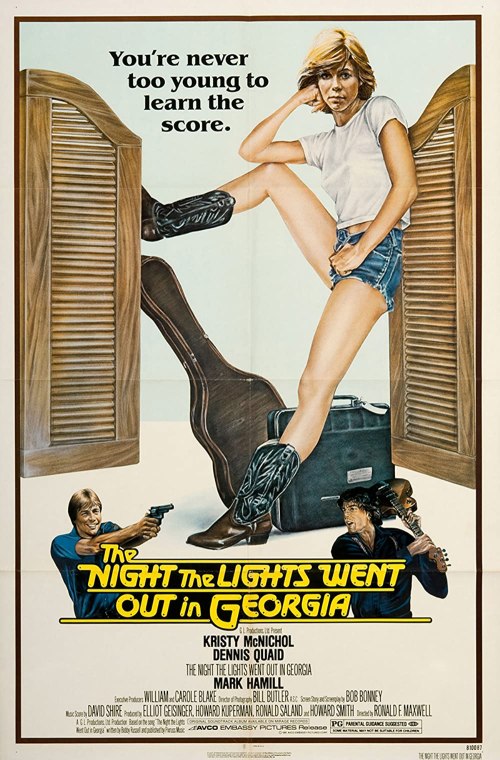
The Night the Lights Went Out in Georgia (1981)

night

By Richard Winters

My Rating: 3 out of 10

4-Word Review: Not like the song.

Travis (Dennis Quaid) is an aspiring singer with some talent, but little discipline. He’s achieved one hit song,but his drinking and partying keeps getting him in trouble. Amanda (Kristy McNichol) is his younger sister and though she’s only 16 she is more mature and responsible. She tries to manage Travis’ career by getting him to Nashville, so he can cut a record and get an agent, but his wild ways and their lack of funds, keeps preventing them from getting there. Eventually he gets arrested for public drunkenness and in order to pay the fine is forced to get a job at a local bar. It’s there that he meets Melody (Sunny Johnson) and tries to pursue a relationship, but becomes aware that Seth (Don Stroud), the deputy sheriff, has a thing for her as well and he won’t allow any other guy to talk to her as he’ll fly into a jealous rage and warns Travis of this, but Travis being reckless as always doesn’t let this phase him. As this goes on Amanda begins a romance of her own with with Conrad (Mark Hamill) who works as a state trooper.

Although in theory it’s ‘inspired’ by the song of the same name it technically doesn’t have anything to do with it. In other films that were made from songs like Convoy, Harper Valley PTAand Ode to Billy Joethe central theme was maintained and then expanded on, but here we don’t even get that. The song, with lyrics written by Bobby Russell and then sung by his then wife Vicki Lawrence, had to do with a man getting executed for killing another man who had an affair with his wife even though it was really his kid sister that did the crime. A plot like that could’ve had great potential for being an interesting movie, so why the producers didn’t just go with that original concept I don’t know, but it seems like a travesty for them to retain the song title and I’m surprised the producers of the record didn’t sue.

The plot, as it is here, is limp and uninspired. It basically feeds off of a lot of predictable shenanigans like Travis getting caught in a hotel bed with another man’s wife and then being chased around both on foot and in a vehicle until both he and Amanda are able to get away. In between we get treated to a lot of songs, which normally I’d say was nothing more than filler, which it still is, but since the rest of it is so lame, it comes off more like the best thing in it. Quaid and McNichol do all of their own singing and even wrote their own lyrics and they give energetic performances when onstage, so if you decide to see this thing then I’d suggest fast-forwarding through the rest of it and just stick with the music and you might be pleased.

The acting by Quaid is excellent and Don Stroud is great as the nemesis. McNichol is alright, at least when she’s singing, but otherwise gets pushed to the background and with her super short hair and nagging personality lacks sex appeal and at times looks almost like she could’ve been Quaid’s kid brother instead. The fact that they’re so close and do everything together would make one wonder if there’s something incestuous going on. In the more innocent times of the early 80’s maybe this wouldn’t be the first thought that would pop into people’s minds, but these days I’d suspect others would be wondering the same thing. There’s also no explanation for what happened to their parents. At one point McNichol mentions that she’s orphaned, so there really needs to be a backstory showing of what caused that.

Spoiler Alert!

The biggest gripe though is with the ending in which Travis gets shot and killed by Seth, who also dies in the gunfight. It then concludes with McNichol getting with Hamill, who quits his job as the state trooper, and the two drive-off in her rickety old truck to God knows where. Since the story was mainly about the brother/sister relationship then I felt that’s where it should’ve ended with them in Nashville either getting the record deal, or not. The Hamill character is bland and seemed to be added in with no other purpose, but to extend the already anemic plot. There’s also the fact that he was 29 at the time while McNichol plays someone who was only 16, so them getting into a relationship doesn’t exactly look kosher. Granted the age of consent in the state of Georgia is 16, so I guess in the eyes of law it’s okay, but many today will consider this kind of romance to be cringey, and I can’t help but wonder if that’s the main reason why this film has never had a proper DVD release nor any streaming option.

My Rating: 3 out of 10

Released: June 5, 1981

Runtime: 1 Hour 52 Minutes

Rated PG

Director: Ron Maxwell

Studio: AVCO Embassy Pictures

Available: DVD-R

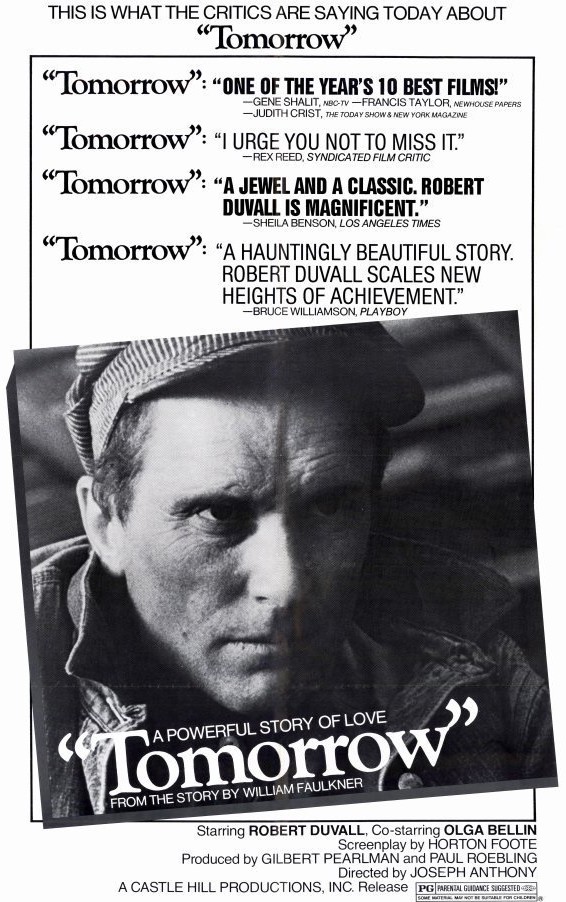
Tomorrow (1972)


tomorrow1

By Richard Winters

My Rating: 5 out of 10

4-Word Review: Aiding a pregnant woman.

Jackson Fentry (Robert Duvall) is a lonely farm-hand who has never married and lives in a tiny shack on the grounds of the farm that he’s been hired to maintain. One day he comes across a pregnant woman named Sarah Eubancks (Olga Bellin) near the property who’s been abandoned by both her husband and his family. He brings her back to his modest shed to warm her up and since she has nowhere to go he eventually agrees, with the help of a local midwife (Sudie Bond), to assist through the birth of her child. Sarah though dies soon after the baby is born, but not before Jackson agrees that he’ll raise the child. For several years Jackson is able to do just that until the brother’s of the boy’s father arrive and take the child away. Then many years later Jackson is called-in for jury duty on a trial that, known only to him, has a connection to the boy he lost contact with. 

There’s been many movies that have tried to recreate the rural 1800’s, but many for the sake of drama, or to make it more relatable to modern audiences, tend to cheat things. They may make it authentic in some areas, possibly even painstakingly so, but then compromise in others due to the entertainment factor. This though is one film that could genuinely be described as being about as minimalistic as any director could possibly make it. Filmed on a farm in rural Mississippi that was owned by the grandfather of Tammy Wynette the movie gives one an authentic taste of life back then with little to no music and no sense of any staging. The bare-bones shack that Jackson must reside in gives the viewer a stark sense of the grim, no frills existence that many dealt with back then. The slow pacing aptly reflects the slower ways of life and having the camera virtually trapped in the shed, or at most the nearby property, symbolized how people of that era had to learn to endure and expect little.

While those qualities hit-the-mark I felt that black-and-white photography detracted from it. By the 70’s most films were shot in color and only a few like The Last Picture Show, Young Frankenstein, and Eraserhead just to name some, were not, but this was more for mood, or style. Here though with everything already at an intentionally drab level the color could’ve at least brought out the beauty of the outdoor scenery of a southern winter and offered some brief striking visuals and a cinematic presence that was still needed, but missing and kind of hurts the movie. 

Surprisingly I had issues with the acting. One might say with Robert Duvall present that couldn’t be the case, but his overly affected accent, he got it from a man he met once in the foothills of the Ozarks, was from my perspective overdone and even borderline annoying. Bellin is alright though behind-the-scenes she created problems by refusing to take any advice from director Joseph Anthony. She had done mostly stage work up until then and was used to having leverage about how she approached her character once she was onstage and considered that once the camera was shooting meant the same thing. It was okay, like with a play production, for the director to give advice during rehearsals, but when the actual filming started she should have free rein over her craft and having Anthony repeatedly reshoot scenes, like in typical film production, or suggest she do things differently as the filming was going on, was all new to her and not to her liking, which caused numerous arguments not only with Anthony, but Duvall as well making them both later admit that they regretted casting her and she never performed in another movie again. Out of the entire cast it was Sudie Bond as the lady who helps with the birthing that I found to be the most memorable. 

While the story has many commendable moments it gets stretched pretty thin especially since it was based on a short story by William Faulkner and then adapted first as a play and then to the big screen by Horton Foote (the first of two collaborations that he did with Duvall with the second one being Tender Mercies 10 years later). Almost the entire third of the film gets spent on Jackson’s conversations with the woman while his relationship with the son takes-up less than 10 giving the pacing and flow a disjointed feel. It’s also a shame that, like with The Owl and the Pussycat, which came out 2 years earlier, the producers compromised on the elements of the original piece as in Faulkner’s story the pregnant woman was black, but here she gets changed to being Caucasian. Had the character remained black then what Jackson does for her would’ve been more profound as he would’ve been taking great personal risk in helping her in an era and region of the country where racism was high and by no longer being a colored woman it lessens the drama and is not as impactful as it could’ve been.

My Rating: 5 out of 10

Released: March 19, 1972

Runtime: 1 Hour 43 Minutes

Rated PG

Director: Joseph Anthony

Studio: Filmgroup Productions

Available: DVD, Blu-ray, Plex, Tubi, Amazon Video


The Prize Fighter (1979)

prize1

By Richard Winters

My Rating: 1 out of 10

4-Word Review: Boxer wins rigged fights.

Bags (Tim Conway) is a former boxer who lost all 20 matches that he was in and now helps his former trainer Shakes (Don Knotts) train new fighters, but neither of them is having much luck. Bags decides to go back into the ring during an amateur fight night and this gets the attention of local crime boss Mike (Robin Clarke). Mike is trying to build a convention center, but is stymied by Pop Morgan (David Wayne) who owns a gym on the block Mike wans to build on and he’s refusing to sell at any cost. Mike decides to rig the fights that Bags is in, unbeknownst to both Bags and Shakes, to the extent that it looks like Bags is ‘unbeatable’. He then will entice Pop to bet on the fight that Bags has with the The Butcher (Michael LaGuardia). Pops will be under the presumption it’ll be a ‘safe bet’, but this time Mike won’t rig it and presumably Bags will go down and Mike will be able to get his hands on Pop’s gym and tear it down for his new building. 

While Knotts and Conway had success with their pairing in The Apple Dumpling Gangthis foray, an attempted parody of Rocky, goes nowhere. Instead of being filled with a lot of gags and pratfalls, which is what you’d expect, it’s a slow story filled with every cringy cliche from a fight movie out there. Comedy is supposed to make fun of the cliches instead of propping them up, but unfortunately that’s the approach taken and it bombs massively.

Comedy movies should also have all the characters be funny in some way, but here most of them are not. Possibly that was for vanity reasons as Conway, who also wrote the script, didn’t want to be upstaged, but this forces the viewer to go through long periods of trite drama in every scene that he’s not in. The supporting characters are extreme caricatures of the 1930’s which the film is set in. Robin Clarke is particularly annoying (not necessarily his fault as that was just the way the part was written) as he attempts to channel Al Pacino from The Godfather while speaking like a poor man’s Marlon Brando. David Wayne is cast to resemble Burgess Mereridith who was in Rocky (ironically both men played villains in the 60’s ‘Batman’ TV-show with Meredith as the Penguin and Wayne as The Mad Hatter). Here though Wayne speaks, in an effort to sound like Meredith, in a gravely voice that makes him sound like a duck. I also found John Myhers, who co-wrote the script, put-on Irish accent to be equally irritating.  

Even Knotts gets wasted. Some enjoy the moment where he cracks a bunch of raw eggs in a glass and then tries to force Conway to drink it, but other than that he doesn’t elicit too many laughs. Yes, Conway is amusing at times, but his perpetually clueless shtick gets a bit old by the end. The only performer that had me laughing was Mary Ellen O’Neill who plays Mike’s senile old mother and who does some wildly bizarre things while in Conway and Knotts’ presence. She’s a scene stealer and should’ve been in it more and while she’s at the boxing match as she watches the fight with Mike she should’ve continued to do weird things while the fight was going on, which outside of swearing she doesn’t, and it was a missed opportunity.

I will give credit for the climatic bout, which is surprisingly well choreographed and effectively has a large crowd watching, which gives it an electric atmosphere, but everything else falls flat. The irony I suppose is that the film ended up being a money-maker and in fact was one of the most successful films released by New World Pictures, but I think this was mainly because a lot of people went to it based off the reputations of the two stars more than the movie itself being good. I remember I went with my dad and two siblings to see it at the local theater because we were fans of Conway and Knotts, but all of us, our dad included, were quite bored and went home unimpressed and it clearly hasn’t improved with age. 

My Rating: 1 out of 10

Released: November 16, 1979

Runtime: 1 Hour 39 Minutes

Rated PG

Director: Michael Preece

Studio: New World Pictures

Available: DVD


Scalpel (1977)

scalpel1

By Richard Winters

My Rating: 4 out of 10

4-Word Review: Surgeon alters patient’s face.

Dr. Phillip Reynolds (Robert Lansing) is an esteemed plastic surgeon who secretly harbors a dark side. When he sees his daughter Heather (Judith Chapman) making-love to her boyfriend he flies into a rage and kills the boy and then stages it to look like an accident. Heather runs away in terror and is not heard of for quite awhile. In the meantime Phillip’s father-in-law dies and bequeaths his entire fortune of $5 million to Heather, but since she’s nowhere to be found the money remains in escrow until she can come forward to claim it. Later, as Phillip is driving along a city street with his brother-in-law (Arlen Dean Snyder), they come upon a nightclub stripper (also played by Chapman) who has had her face crushed when a bouncer rammed it into a brick wall. Phillip decides to reconstruct the woman’s face to resemble his daughter’s, so she can claim the fortune and the two can split it. Things work smoothly as Philip trains her on all of her daughter’s traits and able to identify member’s of the extended family. Everyone comes to believe she’s the real daughter and the two are able to get their hands on the money only to have the real Heather suddenly reappear.

This movie, amongst IMDb reviewers, gets high marks with most rating it between 7 to even a 10 out of 10. I rate it lower, which I’ll go into, but they’re are things about that I did like. The performance by Lansing is excellent and perfectly conveys a character that seems nice and respectable on the outside, but could turn sinister, sometimes in unexpected ways, all of a sudden. The surgery scenes are realistic and even a bit graphic and the film has a few slick touches including the cinematography by Edward Lachman that nicely captures Georgia’s topography.

The plot has an intriguing premise and there’s no shortage of twists, but the way the stripper character gets handled I had a big problem with. There’s absolutely no backstory as to who this woman is, or why she got into the situation that she did. It doesn’t even seem like a real person, but a transparent entity that conveniently pops-in out-of-nowhere with essentially no past to her. I think the filmmakers were working-off of an old-fashioned belief that a sex workers had ‘no life’ and therefore would be more than happy to walk away from their former existence and take-on a new one without any regret, but this just isn’t true. Sex workers have friends and family and a past just like anyone else and wouldn’t necessarily want to just completely turn their backs on their old connections. The script also doesn’t bother to explain why a bouncer would shove a women’s face into a brick wall as he throws her out of the bar, or what might’ve happened to lead up to that, which to me was a plot hole.

Some may argue that maybe she lost her memory when her head hit the wall. Even if this was possibly the case (it never gets confirmed and in one instance Heather asks the woman about her past and she looks down like she does recall it, but is ashamed of it) it would most likely be temporary amnesia which can happen at times during a traumatic event or accident, but the old memories will usually come trickling back eventually. Either way it would’ve added an intriguing wrinkle to the story, if someone from her past tracked her down and became a part of the plot.

In addition I didn’t feel that Chapman’s acting was so great as she seems to be playing the same person instead of two different individuals. More contrasts needed to be made into the dual character’s personalities other than one can play the piano while the other couldn’t. I didn’t like that both spoke in an extremely distinctive twangy southern accent either. The impostor could’ve put on the affected accent when needed, but in private should’ve spoken in a way that was much different.

Spoiler Alert!

The ending in which the fake Heather takes the inheritance money after signing-off on it and then flying away on a private jet, is a letdown. Her signature would be different than the real Heather’s and during her ‘training’ on how to be like Heather that would’ve most likely been a point they’d overlook. A really cool twist would’ve had her thinking she had gotten away with it only for the jet to land and the police waiting for her as they recognized that the signatures didn’t match, or in her haste she had forgotten and wrote in her real name instead.

There’s another segment, just before the ending, where a hitman, disguised as a policeman, chases the fake Heather through a forest in an attempt to kill her, and he manages to catch-up with her and points a gun in her face, but then the film cuts away. The fake Heather then reappears in the mansion wearing the hitman’s police uniform, but no explanation for how she got away, which should’ve been played-out.

Alternate Title: False Face

Released: January 15, 1977

Runtime: 1 Hour 35 Minutes

Rated R (Reissued as PG with erotic nude scenes removed).

Director: John Grissmer

Studio: AVCO Embassy Pictures

Available: Blu-ray, Fandor, Tubi

Mirrors (1978)

mirrors

By Richard Winters

My Rating: 4 out of 10

4-Word Review: Woman haunted by voodoo.

Marianne (Kitty Winn) and Gary ( William Paul Burns) are a newlywed couple who travel to the French Quarter of New Orleans for their honeymoon. Little do they know that a secret group of people, including the owner of the hotel that they’re staying at, have decided to possess Marianne with the spirit of a dead black woman. Soon after arriving Marianne begins having frightening dreams and the reflections of someone else when she looks in the mirror. Strange occurrences happen around her including the deaths of dogs and even her husband. Eventually she gets taken to a psychiatric hospital where Dr. Godard (Peter Donat) listens to her case and agrees to try and help her.

This was the third feature film of director Noel Black. He attained the attention of film critics with his 1965 movie short Skaterdaterwhich lead to funding for his second project Pretty Poison, which starred Anthony Perkins and Tuesday Weld and garnered a cult following. Soon after he became highly in-demand, but he made the mistake of deciding it was more important to stay busy in the business than holding out for a good script. He took on directing the notorious Cover Me Babewhich features what may be the most unlikable protagonist in film history, and a movie Black later admitted “should never have been made”. He followed this up with Jennifer on My Mindwhich met with equal disdain by both the critics and at the box office. By 1974, when this film was shot, Black was just trying to remain relevant as the studios that initially adored him were now no longer calling. This film was meant to showcase his visual talent, but he and the producers could never get on the same page as to what direction to take the story culminating in a muddled script that goes nowhere.

That’s not to say there aren’t things about this movie that I liked. The music score by Stephen Lawrence is haunting and the on-location shooting of the French Quarter offers a nice ambiance. I liked the point-of-view shots done when Marianne first gets wheeled into the hospital and the scenes inside an abandoned train station are spooky.

The story though lacks focus. The film opens right away with us seeing the notorious voodoo group in action, but it would’ve been more interesting had we not been given this information right away and instead made it more of a mystery for the viewer as to whether she was going insane, like the other characters in the movie think she is, or not. Winn’s performance is good. She’s better known for her part in a much more famous horror movie The Exorcist, where she appeared more youthful while here her hair is cut short and with make-up given a middle-aged demeanor. Her character though is poorly fleshed-out and shows no unique qualities and in that respect she’s quite boring, but as she becomes repeatedly terrorized by the group the viewer softens to her, mostly due to her good acting, and ultimately cares about her fate.

Spoiler Alert!

The story has similar themes with the cult hit Let’s Scare Jessica to Death and had it been better realized could’ve been a minor success, but the ending is too ambiguous. Winn turns to the camera in the final shot and shows a weird expression making us believe, I guess, that she’s been possessed by a spirit, but why was she chosen? There’s many people that come to New Orleans, so why does this group pick her to go through all this and not someone else? What’s the purpose, or end game of the group and what do they hope to achieve? None of this gets answered making the viewer feel afterwards that it was a big pointless waste of time. Black admitted that it didn’t work out right, but blames the fact that it was taken out of his hands and revised in a way that he didn’t approve of. All of this may be true, but in either case it’s best not to come into it with high expectations as you’ll leave gravely disappointed afterwards.

My Rating: 4 out of 10

Released: February 8, 1978 (Filmed in May of 1974)

Runtime: 1 Hour 28 Minutes

Rated PG

Director: Noel Black

Studio: First American Films

Available: DVD-R (dvdlady.com)

Dark Sunday (1976)

dark1

By Richard Winters

My Rating: 6 out of 10

4-Word Review: Preacher versus drug dealers.

Reverend Lowery (Earl Owensby) works to get teens hooked-on drugs off the city streets and sober, which annoys local drug dealers who order a hit on him. When his family are on a camping trip two hit men (Ron Lampkin, Jac Cashin) shoot both of Lowery’s sons (Todd Reep, Jeff Reep) and his wife (Maggie Lauterer). When Lowery tries coming to their aid he gets shot several times, but manages to survive though with a severe limp and inability to speak. Once out of the hospital he goes on a silent mission to get revenge on those that killed his family while also stopping the dealers from selling anymore drugs and getting them off the streets once and for all.

This is third film of Earl Owensby who in 1973 decided to take a stab at filmmaking by building a studio near Shelby, North Carolina and making movies that he deemed to have ‘old-fashioned values’ and away from the sex and violence of Hollywood. While his movies didn’t have any nudity they did have its fair share of violence, which his critics considered to be hypocritical, but in any event they made money especially on the grindhouse circuit and enough of a profit that it allowed him to continue making movies up to 1991. While other regional directors like John Waters and Charles B. Pierce where able to gain enough attention with their movies to ultimately get a Hollywood contract Owensby never did. Some say it was because he labeled himself a conservative, which automatically made him an outsider with Tinseltown.

Whatever the reason this movie really wasn’t all that different from the Hollywood revenge dramas like Dirty Harry and Walking Tall and I was surprised how watchable it was. It does go on longer than it should and the opening features several jump cuts, which gives it an extreme amateur feel. There’s also way too many scenes that take place in back alleys. Granted it works with the plot, but I still got the feeling it was shot at these locations because it was less likely to get noticed by the authorities for shooting without a permit.

The film was controversial for the amount of violence and was banned from several countries. The shootings could be considered extreme when you see little kids shot directly in the chest and then violently thrown backwards. There’s also a nifty death where one of the drug dealers known as Candyman (Chuck Mines) drowns by having his face shoved into a toilet bowl though this would’ve had better effect had it been shot from above versus to the side. In either case the shootings get redundant and there should’ve been more creative deaths instead of just at the hands of a rifle.

What I did like was that the protagonist suffers lasting injuries and doesn’t just miraculously recover like heroes in a Hollywood movie do. However, with that said, the limp that he gets stuck with, which forces him to walk with a cane, completely disappears during the final foot chase where he’s able to climb ladders connected to buildings even better than the able bodied detective who’s chasing after him.

You would’ve also thought that since he was such a well-loved preacher in his community and lead a big  congregation that they would’ve come to his aid after he was injured by finding him some housing and maybe even a job instead of him becoming this lonely homeless person that no one seemed to know. If he had grown bitter and lost his faith due to what happened to his family and thus rejected their offers of help that’s fine, but a scene showing this needed to be inserted.

It might’ve worked better too had it started from the perspective of the prostitute (Monique Prouix) who takes the homeless Lowery into her apartment because she feels sorry for him and considers him harmless. Then the violent deaths of the drug dealers would force the viewer to connect the dots to Lowery and ultimately through flashback show what happened to his family at the end, which then would’ve given the film an element of mystery and more layers. I was also taken off-guard by the very downbeat ending, which I hadn’t expected and didn’t feel was necessary, but does conform to the ‘everything is terrible’ theme, which was a prevalent in most 70’s movies.

My Rating: 6 out of 10

Released: August 17, 1976

Runtime: 1 Hour 42 Minutes

Rated R

Director: Jimmy Huston

Studio: Intercontinental Releasing Corporation

Available: DVD-R (dvdlady.com)

The Farmer (1977)

farmer1

By Richard Winters

My Rating: 7 out of 10

4-Word Review: Country man seeks vengeance.

Kyle (Gary Conway) returns from fighting in WWII a decorated hero, but finds when he gets back home that trying to run a profitable farm to be tough going and risks having it foreclosed on by the bank. One night while swerving to avoid an animal on the road professional gambler Johnny (Michael Dante) gets injured in a car accident near were Kyle lives. Kyle and his friend Gumshoe (Ken Renard) nurse Johnny back to health and for repayment Johnny gives Kyle $1,500, which is enough to help his farmstead survive for a little while longer. Johnny though soon gets into trouble with racketeer Passini (George Memmoli) who permanently blinds him by dumping acid on his face. Johnny wants revenge and hires Kyle, who’s farm continues to struggle, to do it by having him use his superior shooting skills to kill-off Passini and his men while using Johnny’s inside knowledge to track them down. At first Kyle resists, even after Johnny offers him $50,000, but when one of Passini’s men (Timothy Scott) burns down Kyle’s barn, kills Gumshoe, and rapes his new girlfriend (Angel Tompkins) he then decides to go on the warpath.

This has become, especially in the past decade, known as a ‘lost film’. It had never been shown on broadcast TV nor cable and had never received a DVD release, or Blu-ray, or even VHS. It became impossible to find even a bootleg copy and many had become convinced this was the obscure of the obscure. Code Red promised 10 years ago, much to the excitement of rare film collectors, to release it on DVD, but after some promotion the deal fell through, which frustrated many and gave this film even more of a cult status. Some had come to believe that maybe the movie was simply a ‘myth’ and really didn’t exist at all. Just when everything looked bleak Scorpion Rising gave it a Blu-ray release in February of this year and the print is excellent and the film itself isn’t bad either.

It’s noted for its graphic violence, which may have been the chief reason it never got shown on TV or cable. Some of it is quite cruel, particularly the acid scene and the rape is quite intense too. This tough does effectively get the viewer emotionally riled-up making them want to see Kyle get revenge and relishing the third act when he does. The revenge scenes are just as bloody, but I was disappointed that, as graphic as the movie is, the segment where Kyle shoves one of Passini’s men out a high-story window is not shown. The camera cuts away when Kyle pushes him instead of seeing the body drop down which might’ve been hard to film since a parade was going on below, but an effort should’ve been made.

Conway’s acting is only adequate though he does at least convey a stoic quality. Angel Tompkins does better and while some of her other B-movie roles weren’t so great this one is clearly her best and proves she could act versus just looking pretty. Memmoli is memorable as the slimy villain and he should’ve been in it more, but he got injured on the set while riding in a stunt car and was cooped-up in a hospital during most of the production, which also ultimately lead to his career downfall and death. The former comic who graduated into character actor roles had always struggled with weight, but had gotten himself down to 190 pounds when he was in this movie, but when the accident occurred and he was laid-up his weight ballooned out to as high as 490 and causing him to have to turn down subsequent film parts due to his physical limitations.

The review in Maltin’s book claims that there’s a lot of ‘anachronistic errors’ in the movie and having read the review beforehand I kept my eagle-eye out looking for them, but I really didn’t see any. Again I never lived in the 40’s and technically Maltin, who was born in 1950, didn’t either, but to me I felt it came-off okay. I liked the way it approaches the era in a gritty way versus a nostalgic one and the frequent use of the hand-held camera, which was ahead-of-its-time. The surprise twist at the end isn’t bad either.

My Rating: 7 out of 10

Released: March 9, 1977

Runtime: 1 Hour 37 Minutes

Rated R

Director: David Berlatsky

Studio: Columbia Pictures

Available: Blu-ray