Category Archives: Movies that take place in Texas

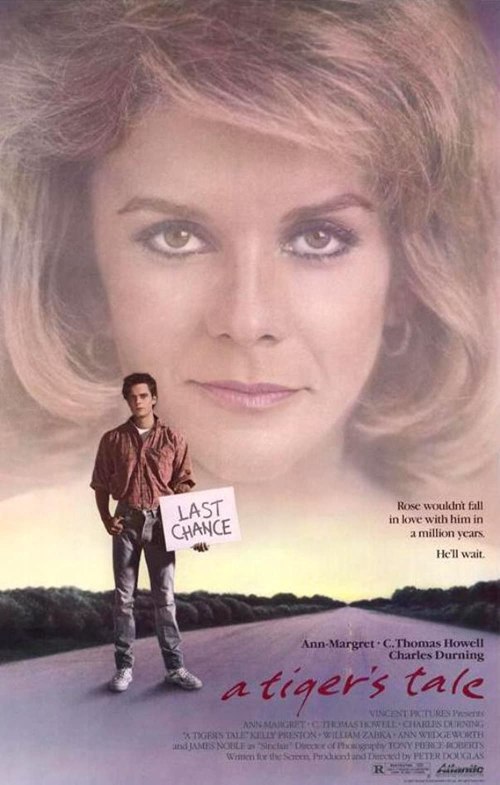
A Tiger’s Tale (1987)

tiger

By Richard Winters

My Rating: 3 out of 10

4-Word Review: Falling for girlfriend’s mother.

Bubber (C. Thomas Howell) is a high school student who’s dating Shirley (Kelly Preston) yet becomes more interested in Rose (Ann-Margaret) Shirley’s mother. The problem is Rose is an alcoholic and scared of snakes, which Bubber has as a pet and tigers, which Bubber also has as a pet. Despite all this the two slowly hit-it-off while keeping it a secret from the increasingly suspicious Shirley. Eventually she catches them in the act when she sees the two running naked at a drive-in where they tried to make love outside, but got attacked by fire ants. To get revenge Shirley pricks a hole in Rose’s diaphragm, so that she gets pregnant with Bubber’s baby. Bubber though intends to move-in with Rose to help her raise it, but Rose considers an abortion.

It’s impossible to say where this movie goes wrong mainly because it never gets going in the first place. It’s based off of the novel ‘Love and Other Natural Disasters’ by Allen Hannay III, who was paid $80,000 to have the rights to it sold to Vincent Pictures, which was owned and run by Peter Douglas, the third son of Kirk Douglas and brother of Michael. Peter then converted it into a screenplay, but without having read the book I couldn’t help but feel that something got lost in the transition. This is a big problem when novels get turned into movies as films don’t have as much depth to the story and characters as books typically do, which is why most people who enjoyed the story in book form usually end up disappointed when they see it as a movie. The elements are there for something potentially interesting, but Douglas, who also directed, doesn’t have the ability to put it altogether, which is probably a good reason why he’s never written, or directed any movie since.

I liked the setting, filmed in Waller County, Texas, but it doesn’t give the viewer enough feel of the region. Just showing the exterior of the homes and the drive-in isn’t enough. We need to see the town that they live-in in order to understand the characters and learn what makes them tick and the environments they are brought up in can have a lot to do with that, but when that environment gets captured in an ambiguous way, like here, it doesn’t help.

The story seems to want to tap into the themes of The Graduate, but that was a brilliant film and if you can’t top that, or at least equal it, then it’s best not to even try. Ann-Margaret is supposed to be an alcoholic, but we only see her with a drink in her hand at the start and then the rest of the time she seems quite sober. I also didn’t like the way she see-saws between being vampish at one moment and then a mature adult who gets real preachy with Bubber the next. It’s like someone with a split personality who isn’t fleshed-out and the same can be said for Howell’s character too.

There was potential for some funny bits like when Rose goes over to Bubber’s house and tells him she’s really frightened of snakes and then gets undressed and into bed with him. The camera then pans down to show a snake slithering under the covers and I thought this was the beginning of a really hilarious moment, but then the film cuts away. Later on Rose is shown to be comfortable in the presence of Bubber’s snake, but we never witness her transition, which was a missed opportunity for character development.  The scene where Rose and Bubber going running naked at the drive-in is dumb too because apparently only Shirley notices them even though with the screaming that the two were making it would’ve made anyone at the drive-in look-up and not just her.

Even the reliable Charles Durning gets wasted and becomes as dull as the rest. In fact the only thing that  I did enjoy was the tiger. I must commend Howell for being willing to get into a cage with it and stick his hand inside it’s mouth, but I was confused why the tiger is playful one second and then proceeds to try and attack Howell the next. Also, why would Howell want to get back into the animal’s cage later after he almost got his leg bite-off before? Even with that in mind I still felt the tiger was cool, the scene where he kills and eats a pooch of some customers that were just passing through is amusing in a dark sort of way and when he’s eventually set free is the only memorable moment in what is otherwise a misfire.

My Rating: 3 out of 10

Released: August 22, 1987

Runtime: 1 Hour 37 Minutes

Rated R

Director: Peter Douglas

Studio: Vincent Pictures

Available: DVD-R (dvdlady.com)
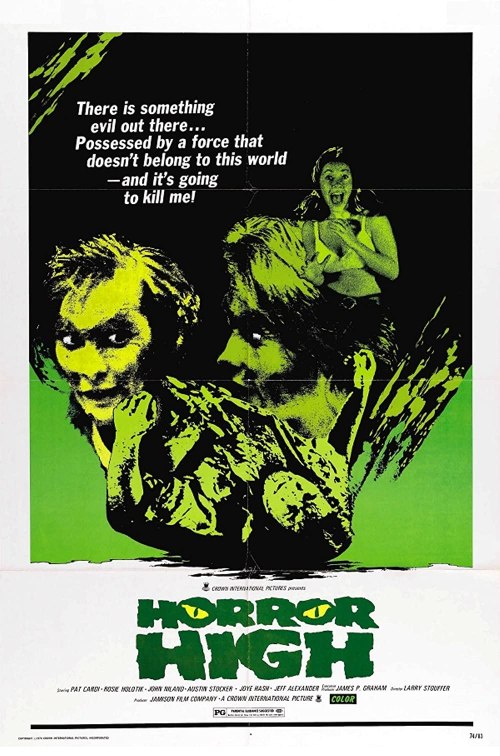
Horror High (1973)

horror1

By Richard Winters

My Rating: 7 out of 10

4-Word Review: Bullied teen gets revenge.

Vernon Potts (Pat Cardi) is a geeky teen tormented by the jocks and teachers and who’s only solace is his pet guinea pig that he keeps in a cage at his school’s science lab. However, the cat owned by the school’s janitor Mr. Griggs (Jeff Alexander) keeps trying to get its paws on the rodent and Vernon is forced to constantly have to scare it away, which annoys Griggs as he sees this as harassing his pet. One night Vernon comes to the lab to find that the cat has gotten into the cage and injured the guinea pig while also toppling over a bottle of lab formula. While Vernon is removing the cat Griggs enters and attacks Vernon for what he thinks was intentionally injuring his pet. He also forces Vernon to ingest the spilled liquid, which turns him into a homicidal monster where he then proceeds to kill all those that have wronged him.

Up front this should’ve been a movie that got a bad rating. The film stock, even after blu-ray restoration, is quite grainy and faded with the technical aspects being not much better than a home movie. The script by J.D. Fiegelson, whose best known work is the creepy TV-movie ‘Dark Night of the Scarecrow’, is awkward mix of Willard and ‘Dr. Jekyll and Mr. Hyde’ that has all the predictable cliches and adds nothing new to the mix. However, I still found myself strangely captivated and never bored even during the slow spots.

Part of why it works is that it’s reenactment of student life is quite accurate. Many movies have attempted to show the high school experience, but many either underplay, or overplay it and rarely get it just right, but this is one hits-the-bullseye. Virtually the entire thing gets filmed inside the school with only a few short scenes done outside of it. Normally I’d consider this problematic as it makes the characters one-dimensional since we only see them in one type of setting, but here it clicks. I’m not sure if the lack of variety for the settings was intentional, or because of economic restraints as this was clearly done on a shoestring, but like with Heathers, it symbolizes how with teens the high school is their entire world and what happens outside of is ignored and not considered important.

The special effects are surprisingly gory and this film initially suffered an X-rating because of it. While there are a few jump cuts particularly with Vernon’s attack on Griggs, the killings look overall realistic and quite bloody though it seemed strange to have classes continue with students attending them like everything is normal even as the murders of the faculty mount and become more grizzly. Today classes would be halted, grief counselors sent in, as students immediately removed by their panicked parents. The only thing on the effects end that isn’t impressive is when Vernon turns into the monster where we never see his face, which remains shadowy and may seem like a cop-out to some, but in some way makes it scarier because the viewer is required to use their imagination to fill-in how he may look when in the monster form.

The type of victims are unique too as it isn’t just spoiled, good-looking teens that get offed like in so many other slashers. Here, it’s older teachers as in the case of Mrs. Grindstaff, which is played by Joye Hash, who was apparently only in her early 40’s at the time, but looks much more like she was in her 60’s and even pushing 70. Muscular Dallas Cowboys great John Niland, who plays the gym coach and also another of the victims, also goes against type, as very rarely are big, tough guys a part of the body count and he gets just as frightened and just as severely hacked-up, as if he were a blonde, bikini-clad young women.

Pat Cardi, who was a famous child actor on TV-shows during the 60’s including in the classic episode of The Fugitive’ series entitled ‘In a Plain Brown Wrapper’ which was one of the first shows ever in TV history to advocate for gun safety, is excellent and looking effectively scrawny. This marked his very last acting performance to date as he left the business and went on to create MovieFone an app that lists movie information and showtimes. Austin Stoker also gives an energetic performance as the police investigator and it’s great seeing an African American playing a prominent role in what was otherwise an all white cast. The men who made-up his police staff were players from the Dallas Cowboys squad including future hall of famer Craig Morton.

While the film doesn’t offer anything new it does successfully deliver-the-goods on a horror level, which will most likely be enjoyed by gorehounds into B-slashers.

My Rating: 7 out of 10

Released: September 20, 1973

Runtime: 1 Hour 25 Minutes

Rated PG

Director: Larry N. Stouffer

Studio: Crown International Pictures

Available: DVD, Blu-ray

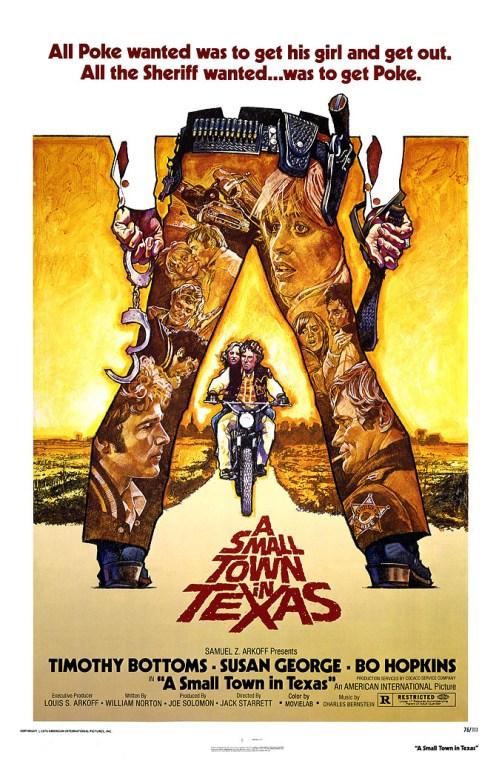
A Small Town in Texas (1976)

small1

By Richard Winters

My Rating: 4 out of 10

4-Word Review: Chased by crooked sheriff.

Poke (Timothy Bottoms) returns to his hometown in Texas after serving a 5-year sentence for marijuana procession. He finds that his girlfriend Mary Lee (Susan George), during the time he was away, has gotten into a relationship with the sheriff Duke (Bo Hopkins) who was also the man who convicted Poke that got him sent away. Poke begins harassing Duke for messing around with Mary Lee and follows him to a political event where Duke is in charge of guarding Jesus Mendez (Santos Reyes) who’s running for congress. It is here that he witnesses an assassin shooting Mendez and then watches Duke kill the shooter and take an envelope out of the killer’s pocket and put it in the trash. Poke retrieves the envelope and finds $25,000 inside. When Duke comes back to get the envelope and sees it’s gone he puts out an APB to have Poke arrested, which leads to an all-out car chase.

I couldn’t help but wonder if this was one of the career outputs that screenwriter William Norton considered ‘stupid’ as he was noted to having told his nurse on his deathbed that she ‘wasn’t dumb enough’ to have known any of the movies he had written. It’s not like it’s bad, but it isn’t particularly exciting either and takes 50-minutes before the first car chase gets going. Laying the ground work for the story is too leisurely. Instead of having Poke and Duke discuss how he had convicted him years earlier the drug bust should’ve been played-out right at the start to at least have given it a little more action.

The chases are impressive once they get going and at one point I literally winced as a car crashed into another and made me feel like I was actually in the vehicle and feeling the impact. Another has a police vehicle bursting into flames and a cop getting out screaming while flames shoot out his back, which was surprising since they must’ve blocked off the entire town center (filmed in Lockhart, Texas) to do it and most likely took an entire day to do, so there clearly was no compromising on the quality of the stunt work just because it was shot on-location versus in a closed studio lot. You also get to see a car crash through a giant block of ice, which marked a cinema first.

Bottoms though is weak creating a transparent character with no interesting arch, or personality and doesn’t even seem to be from Texas as unlike the others he has no Texan accent. Susan George at least conveyed an authentic sounding accent while masking her British one, so her presence gets strong points. Hopkins lends some interesting nuance as the bad guy and the sheriff wasn’t played-up as being an aging authoritarian, small-minded hick like in other films from this genre. Sure he was later found to be corrupt, but more like a cog in a bigger game instead of the center of it.

Spoiler Alert!

Story-wise there’s a lot of unanswered questions like why was Mendoza shot, which is later revealed to have been orchestrated by C.J. Barry (Morgan Woodward) a rich rancher who initially seemed very much behind Mendoza’s campaign, so why the double-cross? Why also would they think it would be a good idea to openly kill one of the men working for them? Who’s going to want to do a hit for them in the future if word gets out that the organization will use you as cover? Since this was a candidate for a major political party it was hard to believe that the investigation would be left solely to the small town sheriff to pursue as I’d be pretty sure federal agents would get called in.

My Rating: 4 out of 10

Released: June 2, 1976

Runtime: 1 Hour 36 Minutes

Rated R

Director: Jack Starrett

Studio: American International Pictures

Available: DVD-R (MGM Limited Edition Collection)

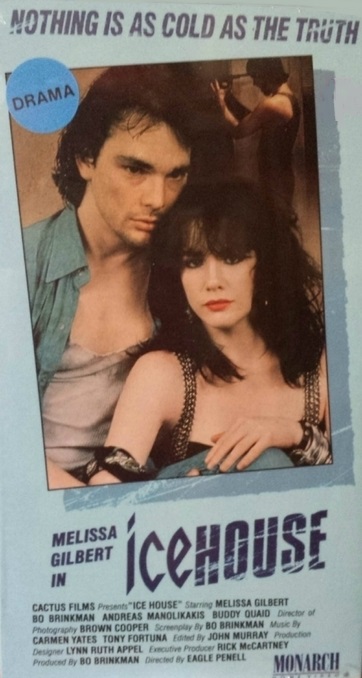
Ice House (1989)

ice1

By Richard Winters

My Rating: 4 out of 10

4-Word Review: Transient wants girlfriend back.

Pake (Bo Brinkman) and Kay (Melissa Gilbert) grew up in a small town in Texas and were high school sweethearts. Despite having a good paying job in the Texas oil fields Pake longs to pursue his dream of making it in the music industry, so he and Kay head-off to Hollywood, but Pake finds it more challenging than he thought to break into the business and be discovered. He becomes homeless and eating out of trash cans. Kay turns to prostitution and eventually meets Vassil (Andreas Manolikakis). He is a Greek immigrant looking to marry her so he can become a permanent U.S. citizen while Kay likes the fact that his family has money and feels if she marries him she’ll have a more stable life than with Pake, but just one day before the wedding Pake arrives at Kay’s cramped apartment wanting to win her back.

This was the third film directed by Eagle Pennell who shot to fame with his break-out indie flick The Whole Shootin’ Matchthat won him a Hollywood contract, which didn’t pan out, but it did at least get him enough financing to make a couple of other movies, with this one being one of the few that he did in color. Yet, the production, like in his first film, is mired in the constraints of shooting on a threadbare budget including having the entire thing take place in one tiny apartment. Some films have shot things in one setting and gotten away with it, but this location lacks any visual flair and quickly becomes static. There’s a few cutaways to flashback scenes shot back in Texas, but they aren’t particularly interesting. The most frustrating aspect is having Pake describe a surreal dream he had, but instead of having it recreated onscreen like a smart movie should we just see his sweaty face talking about it, which diminishes its impact.

Having Melissa Gilbert, better known as Laura Ingalls Wilder in ‘Little House on the Prairie’ helps a little though she’s a long way away from Walnut Grove including being dressed in a provocative 80’s style hooker outfit. I realize she wanted to prove herself as an actress by taking on more edgy fare in order to get away from her ‘goody-goody’ image and she certainly does that here where at one point she even described guys ‘cumming in her mouth’ and does a simulated sex scene with Vassil while Pake, tied-up, is forced to watch. Some may be impressed with her acting range, or shocked, but in either case, she’s effective.

Brinkman, who also wrote the script, which is based on his play ‘Ice House Heat Waves’ is excellent in his role as well, but the dialogue needed serious work. Too much of a colloquial sound including such overused phrases as ‘you can talk until you’re blue-in-the-face’ and ‘you don’t have a pot to piss in’, which gives the conversation a remedial quality and like it was thought up by a teenager. At one point the character even describes Hollywood as being ‘Hollyweird’ and he thinks he’s being clever in saying it even though that’s been a mocking phrase used by many to describe the California scene and shows how a script rewrite by a professional script doctor was needed.

Despite the flaws I still found on a modest scale for it to be strangely compelling. Maybe it’s Pennell’s way of capturing Texas showing a couple carrying on an elicit affair under the nigh sky alongside a dark oil rig that gives it a moody vibe that I liked. Pennell, who later became homeless himself, seems to understand the desperation of the characters, which helps give it some grounding and may make it worth it for viewers who are patient.

My Rating: 4 out of 10

Released: June 16, 1989

Runtime: 1 Hour 21 Minutes

Not Rated

Director: Eagle Pennell

Studio: Cactus Films

Available: None

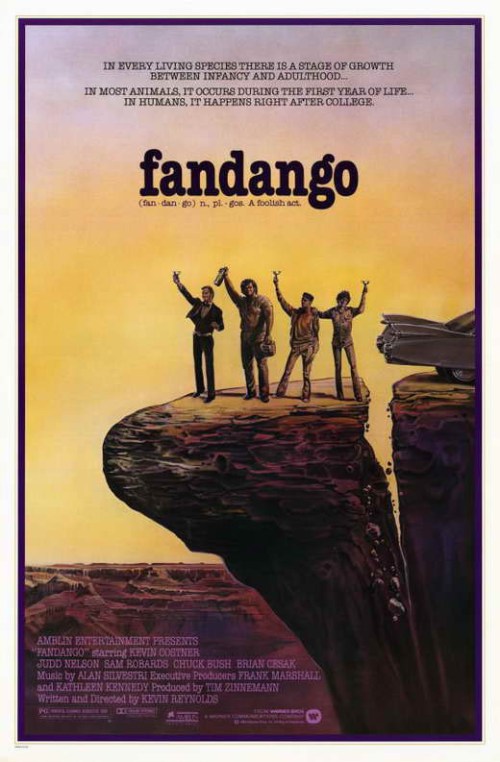
Fandango (1985)

fandango

By Richard Winters

My Rating: 6 out of 10

4-Word Review: The privileges of youth.

Gardner (Kevin Costner), Phil (Judd Nelson), Kenneth (Sam Robards), Dorman (Chuck Bush) and Lester (Brian Cesak) are five college friends from the University of Texas in 1971, who are getting ready to celebrate their impending graduations when Kenneth announces that he’s been drafted into the Vietnam War and Gardner has too. To help lighten the mood the boys decide to take an impulsive road trip where they travel to unique areas of Texas, including searching for buried treasure in the Rio Grande, sleeping under the stars at the old filming site of Giant, and even taking part in parachute jump near Pecos.

This film is based on a 24-minute film that Kevin Reynolds directed while attending the USC film school. In that movie the boys were all from Baylor University and traveled to Pecos, Texas in order to test the courage of their most frightened member and use the help of eccentric flight instructor Truman Sparks, played by Marvin J. McIntyre, who reprises his role in this one, to teach and train the young man on how to jump from a plane. The student film managed to catch the attention of Steven Spielberg, who was so impressed with it that he offered Reynolds the chance to turn it into a full-length movie. Unfortunately once it was completed Spielberg for whatever reason disliked it and had his name removed from the credits while also refusing to help distribute it forcing the film to suffer a limited engagement though in recent years its cultivated a cult following.

The movie does have many funny moments including the opening bit where Phil’s parents (Stanley Grover, Jane A. Johnston) visit his frat house during one of their raucous parties. The sky diving sequence, which gets copied shot-for-shot from the original is quite engaging as is their attempts to hook their disabled car up to a speeding train. Costner is also very amusing, he had actually auditioned for the student film, but lost out, but when he found out it was going to be remade into a feature film he re-auditioned. I’m so used to seeing him play serious roles that I didn’t realize he had such great comedic timing, but for the most part, he’s the life of the movie.

Where the film fails is that it’s too unfocused. The setting is supposedly 1971, but you’d hardly know it and very little effort is made to give it a feel of that era. Even the opening song sung by Elton John that gets played by over the credits was released 2 years after the events in the movie supposedly took place, so to keep it accurate with the time setting only songs that came out in 1971, or before should’ve been used.

The side-story involving Gardner having dated Kenneth’s fiancee, played by Suzy Amis, seems unneeded and really doesn’t go anywhere. Normally, in most real-life friendships, having a friend date and ultimately marry one’s former girlfriend could be a deal-breaker that would lead to a lot of jealousy and potential anger. I’m sure there’s a minority of friendships where the participants would be mature enough to overcome this issue, like here, though this isn’t interesting, so why bother introducing this wrinkle if its dramatic elements aren’t going to get explored?

The part where it really jumps-the-shark is during the planning of the wedding, which is too full of logic loopholes to be able to buy into even on a whimsical level. It features Gardner and Phil being able to pull off his massive wedding ceremony in the town’s square on very short notice by conning too old guys sitting on a nearby park bench into agreeing to help out, which leads to more people getting involved until the whole town, even the mayor, takes part in a wedding ceremony, and its preparation, of people they don’t even know. If anyone can show me an example in the whole history of the world of when this has ever happened in reality then I’ll take it back, but otherwise I found it ridiculous.

The ending is way too abrupt. The whole reason Phil agreed to go on the parachute jump was for Kenneth and Gardner to agree to not dodge the draft, but whether they withhold their end of the bargain is never shown. Everyone just basically wanders off like they have better things to do, which is how the viewer, despite some fun moments, ends up feeling about the movie, which would’ve had more impact had it chucked the whimsy and had a little more serious drama.

My Rating: 6 out of 10

Released: January 25, 1985

Runtime: 1 Hour 31 Minutes

Rated PG

Director: Kevin Reynolds

Studio: Warner Brothers

Available: DVD, Amazon Video, YouTube

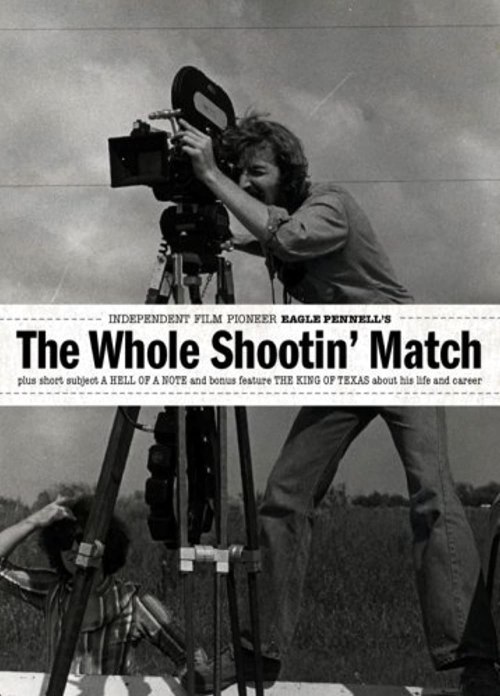
The Whole Shootin’ Match (1978)

whole1

By Richard Winters

My Rating: 7 out of 10

4-Word Review: Trying to get rich.

Frank (Sonny Carl Davis) and Lloyd (Lou Perryman) are lifelong pals who’ve never been able to get over the financial hump. Both harbor starry-eyed ideas of getting rich, but Lloyd’s inventions never attract the interest of any investors. Then one day while driving his car through the local car wash Lloyd is inspired to create a type of mop that he coins the ‘Kitchen Wizard’. They’re able to sell the rights  and make a thousand dollars with the promise that more money will be on the way, but when the patent gets stolen by an unscrupulous company it sends the normally stoic Frank over-the-edge in which he begins to ponder suicide as the only answer to his despondency.

This film, produced on a minuscule budget where the cast and crew agreed to work for free, became the forerunner of the modern-day indie film movement that not only inspired cult director Richard Linklater to get into movie-making, but also gave Robert Redford the motivation to start-up the Sundance Film Festival. Director Eagle Pennell, who was born as Glenn Irwin Pinnell, even attracted the attention of Hollywood studios after the film’s release, which lead to him getting a development deal with Universal, but when this failed to get any of his movie ideas produced he came back to the Lone Star State feeling as disillusioned as the characters in this movie. Eventually it lead to alcoholism and homelessness where he ultimately died while living on the streets of Houston at the age of 49.

This movie works much like Jim Jarmusch’s 1984 indie hit Stranger Than Paradise, which was also filmed entirely in black-and-white and featured mainly static shots of people having extended conversations. While some of the scenes are funny there are also a few dramatic ones particularly Frank’s dealings with his wife Paulette, played by Doris Hargrave. There are also some moments that don’t work at all. The one featuring Frank and Lloyd conversing while supposedly riding inside a pick-up is particularly problematic as it’s quite clear to the viewer, despite Pinnell’s attempts to camouflage it by editing in shots of traffic, that the vehicle is stationary. The dream sequence where Frank has a nightmare about going back to the company that stole their mop idea is interesting, but then ultimately gets defeated by repeating it almost exactly in real-life, which gets redundant and the music becomes intrusive as we’re unable to hear what anyone is saying as they confront each other.

The characters are not appealing especially Frank who’s quite controlling and possessive towards his wife despite cheating on her. The two lead’s personalities flip-flop near the end where Lloyd, the perpetual optimist, suddenly turns dour while Frank manifests into Mr. positive, which to me didn’t seemed earned, or believable.

For patient viewers the third act is a payoff as it takes place in the Texas Hill Country where the foliage of the forests are quite different than those in the Midwest with trees unique only to central Texas and thus giving the sequence a surreal vibe like the two have traveled off to a strange and exotic place. I also liked the fact that the phony sound effects used in most other movies are non-existent here. This comes into play when a crotchety old man, played by James N. Harrell, shoots at the two from his porch with a rifle, but instead of a loud cannon sound like in most films, it’s more of a realistic fire cracker noise. The fight inside a bar works the same way as there’s not that annoying loud smacking sound when the punches hit their target making this tussle seem more organic.

This also marked only the second movie to be filmed in Austin, Texas with the first one being Outlaw Blueswhich was released 2 years earlier. If you’re an Austinite, such as myself, living in the city now you’ll not recognize the old Austin that gets shown here. No tall buildings, or cosmopolitan look. In fact after watching it you’d be convinced Austin was just a back woods cow town without even a hint of the bustling metropolis that its become.

My Rating: 7 out of 10

Released: March 19, 1978

Runtime: 1 Hour 49 Minutes

Not Rated

Director: Eagle Pennell

Available: DVD, Fandor

Drive-In (1976)

By Richard Winters

My Rating: 5 out of 10

4-Word Review: Mayhem at the movies.

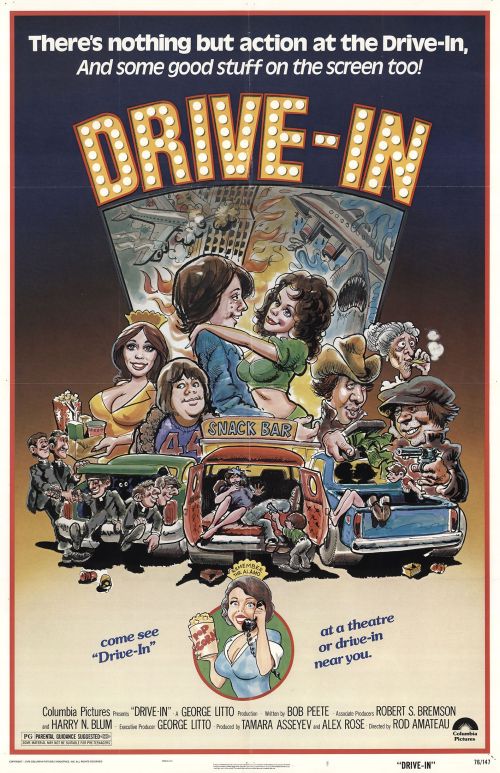
It’s just another evening at the drive-in movies in a small Texas town except this time there’s more action in the theater than in the movie being shown. As the people watch the latest action flick known as ‘Disaster ’76’ on the big-screen there’s all sorts of commotion going on around them. Gifford (Trey Wilson) and Will (Gordon Hurst) are two bumbling amateur crooks who plan on robbing the concession stand during the show. Glowie (Lisa Lemole) is the fed-up girlfriend of Enoch (Billy Milliken), who leads the local teen gang, and who desires a more clean-cut guy like Orville (Glenn Morshower), but Enoch and his obedient thugs try to prevent this potential union from happening. There’s also the paranoid African American Dr. Demars  (Bill McGhee) who frets about having to live in the middle of ‘Klan Country’, but still manages to take his wife (Gloria Shaw) to the show, but also ends up in the process having several inadvertent encounters with the volatile Enoch.

Rod Amateau’s name may not be as well known as other notoriously bad filmmaker’s like Ed Wood Jr. or Tommy Wiseau who helmed the infamously awful The Room, but he probably should be. Not only did Amateau create ‘My Mother the Car’, but he also did ‘Supertrain’, which are considered two of the worst TV-shows ever produced. He also wrote and directed The Garbage Pail Kids, which usually lands high on everyone’s terrible movie list. However, his directorial effort here isn’t bad and for awhile even engaging. My favorite part is a scene done inside a roller skating rink where we see real teenagers, that are age appropriate and with varying body-types, behaving very much like small town teens of that era would. It’s like a taking a time machine back to the simpler times and seeing how things really were, but without the pretension.

The performances are if anything quite lively including Morshower, best known as Aaron Pierce from the series ’24’, in his film debut and sporting a full, bushy head of red hair. It’s also great seeing Lisa Lemole in a prominent role as she later left acting in 1985 when she married Mehmet Oz better known as Dr. Oz. This also marks the acting debut of Trey Wilson, who went on to play many colorful supporting characters before having his career cut short by an unexpected death at the young age of only 40. Gary Lee Cavagnaro, who’s more famous for playing Engelbert in The Bad News Bears, is amusing too as Morshower’s younger brother.

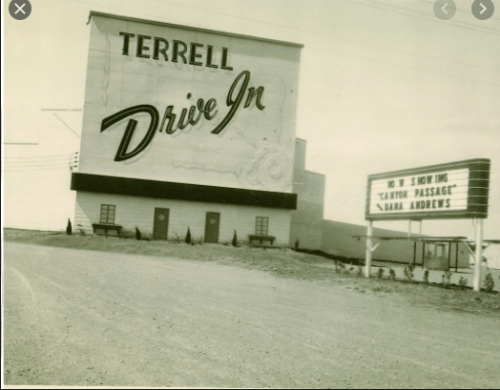
Unfortunately despite a promising start the film ultimately flounders especially during the second act as too much cartoonish silliness gets in the way of any subtle realism. At the end the cars of the customers slowly file out of the drive-in like what had occurred was no big deal and the viewer is left feeling the same way. The stakes needed to be higher and the event needed more of a long-lasting consequence. A funny idea would’ve had the mayhem cause actual destruction to the drive-in while the disaster flick played perhaps even having it burn down to a cinder. Since the theater in real-life got demolished just a few years after this was shot it might’ve been possible and thus allowed the film to leave more of lasting visual impression than it does.

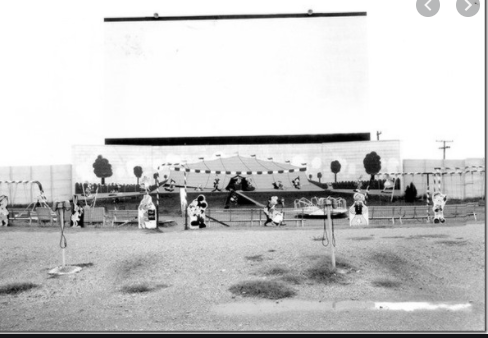
The Drive-in theater in Terrell, Texas as it looked in 1975 when the film was shot.

The same location as it looks now.

My Rating: 5 out of 10

Released: May 26, 1976

Runtime: 1 Hour 36 Minutes

Rated PG

Director: Rod Amateau

Studio: Columbia Pictures

Available: DVD-R (Sony Choice Collection)

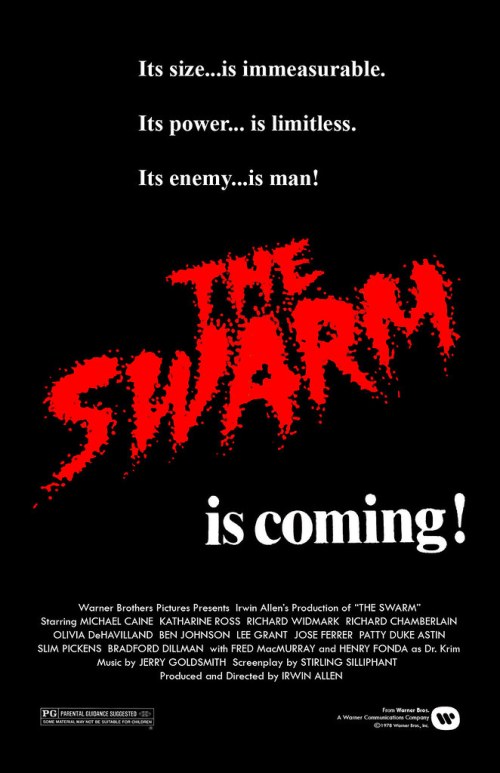
The Swarm (1978)

By Richard Winters

My Rating: 1 out of 10

4-Word Review: Killer bees invade Texas.

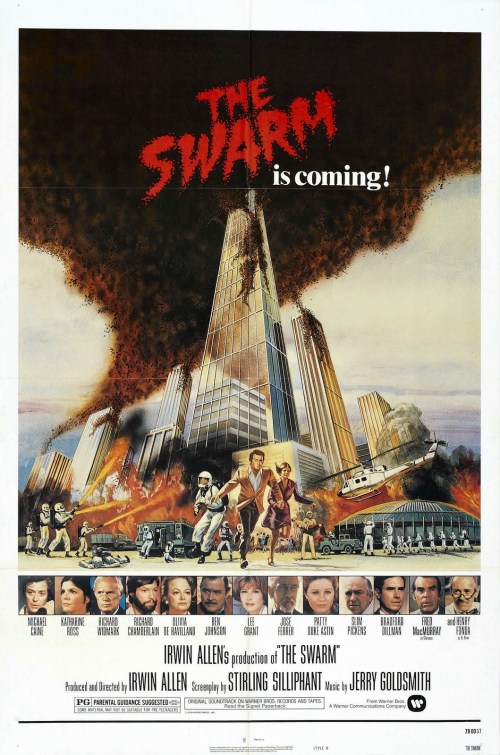
When his parents (Robert Varney, Doria Cook) are attacked by African Killer Bees while out on a picnic their young son Paul (Christian Juttner) manages to escape by jumping into their car and driving off. He then drives into the small town of Marysville, Texas where he tells the people about what happened. Scientist Bradford Crane (Michael Caine) and Army General Slater (Richard Widmark) are put in charge, but neither can agree on what strategy to use. Meanwhile Paul gets some of his friends to go back out to the park where the attack occurred to set fire to the hive, but instead of killing the bees it gets them to swarm onto the nearby town and the unsuspecting citizens.

Director/producer Irwin Allen was by the late 70’s known as the disaster master after having by that time either produced or directed 4 ( he ultimately ended up making 7) disaster flicks for both TV and the big screen many of which like The Poseidon Adventure and The Towering Inferno made a ton of money, so he was riding high coming into this one only to have it bomb monumentally at both the box office and with the critics. He took the failure of this film so personally that he refused to ever mention it and even walked out of an interview when he was asked about it.

In retrospect it’s easy to see why it failed as the special effects just aren’t interesting enough. Watching repetitive shots of swarming bees can only go so far and the victims just lay there without having their skin show any signs of swelling from the multiple stings, which you’d expect them to have. The shots from the point-of-view of the victims, which shows the bees in a giant form, is the only cool thing though, like everything else in the film, this ends up getting overdone and corny.

The script is ripe with unintentionally funny moments including having the authorities attempt to kill the bees by spraying at them with a flame thrower, which doesn’t seem to affect the bees at all and instead only sets buildings on fire as well as some of the people. The idea that the bees were set off by an alarm siren at a military base, which somehow sounded exactly like their mating call is too preposterous to believe and only makes the ‘science’ behind the film completely silly.

The film also makes the mistake of having the setting be in Texas, but not actually filming it there. Sure there’s a few shots of some famous Houston landmarks that get briefly shown, but the majority of it was clearly shot on a studio backlot in California and any true Texan will easily spot this as the topography and landscape between those two states are quite different. Had the film been made on-location it would’ve helped give it a little more character, which it is otherwise lacking.

The cast is made up of a lot of famous names, but they all get wasted. Lee Grant appears only briefly as an aggressive TV reporter that for the most part has little to do with the progression of the plot. Fred MacMurray, in his last film appearance, plays a rival to Ben Johnson who both compete for the affections of Olivia de Havilland, but all three get killed off in the second act, so what’s the use of introducing this potential story arc if it ends up not really going anywhere?

Caine makes for one of the most boring screen heroes in film history and gets seriously upstaged by Henry Fonda, who plays one of the scientists trying to create a serum to combat the deadly bee stings, even though Fonda is confined to a wheelchair the whole time. This was the first of many ‘paycheck movies’ that Caine did and in fact he admittedly never even bothered to read the script before agreeing to sign on, but still felt it was worth it as he was able to use the funds to purchase a nice mansion in Malibu unfortunately for the viewer there’s no such mansion just boredom instead.

My Rating: 1 out of 10

Released: July 14, 1978

Runtime: 2 Hours 35 Minutes

Rated PG

Director: Irwin Allen

Studio: Warner Brothers

Available: DVD, Blu-ray (Warner Archive), Amazon Video, YouTube

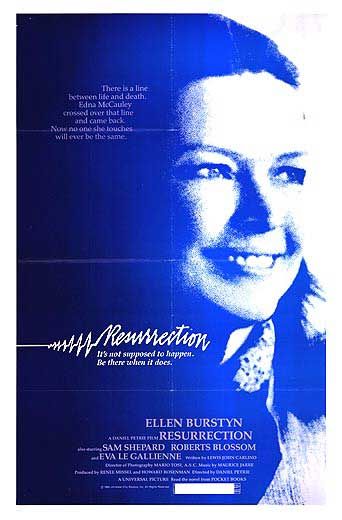
Resurrection (1980)

By Richard Winters

My Rating: 6 out of 10

4-Word Review: She can heal people.

Edna (Ellen Burstyn) manages to survive a car crash and briefly finds herself in the afterlife, but ends up coming back to this world along with an amazing power to heal sick people with the simple touch of her hands. This makes her a celebrity in the small Kansas community that she lives, but others question her ability and wonder, especially since she refuses to acknowledge religion, if it may have a satanic origin. Her newfound boyfriend Cal (Sam Shephard) thinks she may be the second coming and becomes determined to get her to admit this even if it’s through violent means.

The story is loosely based on the life of Rosalyn Bruyere a self-described clairvoyant and medical intuitive who also acted as a consultant to the film. Although initially conceived as a thriller the script by Lewis John Carlino instead takes a more spiritual route, which I found refreshing. I also enjoyed the way director Daniel Petrie captures the vast Texas landscape, which despite the setting being in Kansas, was fully shot inside the Lone Star state.

The scenes of the afterlife are interestingly captured, but I found it baffling why Edna would just write this off as being ‘weird dreams’ and not connect it to any religious connotations. Having these visions then get ‘interpreted’ by her Grandmother (Eva Le Gallienne) seemed heavy-handed as even if a person was not religious themselves they would still be able to connect-the-dots on their own without it having to be explained.

The healing scenes work off of a murky logic. Edna is told after the accident that she is paralyzed from the waist down due to a blood clot in her spine and yet after she learns of her healing ability she places her hands on her legs to help her walk again, but if the root cause of the issue is actually in the back shouldn’t that be where she places her hands instead? The scene where a woman (Madeline Sherwood) who suffers from 2 degenerative vertebrates in her back, but is able to stand-up  after she sees Edna doesn’t make sense either. Standing with missing vertebrae is liking walking without a knee or cartilage. It’s just not scientifically possible, so unless Edna’s healing can cause bone mass to grow where they isn’t any then I’m not sure how they her powers actually work.

I thought it was a bit loopy too that when Shepherd’s character gets injured in a bar fight his buddies take him to Edna’s isolated farmhouse miles away for her to stop the bleeding, but this is when Edna’s healing ability had not been fully established, before this she had only stopped the nose bleed of a young girl, which some might consider simply a fluke, so the most rational thing would’ve been to take him to a nearby hospital instead. The scene would’ve worked better had Edna been in the bar when Shepherd got injured and then jumped in to heal him after he got stabbed.

I didn’t feel Shepherd’s character had the right chemistry to make Edna want to have a relationship with him either. His beady-eyed stare made him look creepy and his father (Richard Hamilton) had accused Edna of being satanic, so why would she want anything to do with that family? He also came off too much like a nondescript redneck like all the other rednecks that made up that small town. Edna was clearly an outsider, so for her to be attracted to someone I would think that person would need to be an outsider as well.

I could never understand why Edna was so resistant to religion, or so completely confident that her powers weren’t heavenly sent. I got that her Christian zealot father (Roberts Blossom) may have turned her off from religion altogether and she didn’t want to deal with the pressures of being considered Christ-like, which is understandable, but I’m not sure Burstyn was the right choice to effectively pull off that type of character. I love Ellen and think she’s a great actress, but she’s also a very spiritual woman in real-life and it pretty much gets conveyed in her performance here whether that was the intention or not. An actress that displayed more of a cynical, snarky attitude, only to have her outlook change once these powers took hold would’ve created a more interesting and dramatic arch.

The third act has Edna going to Los Angeles where her powers are tested by researchers, but these scenes don’t have any satisfying conclusion to them, which I found frustrating. However, the scene that Edna has with her dying father I felt were strong and the best moment of the whole film.

The spiritual element gets left open to interpretation depending on one’s own perspective, which is good. It also has a really great, and to some degree, surprise ending, but I didn’t like the freeze-frame shots taken from the film shown over the closing credits, which cheapens it as this is typically something done on TV-shows and not movies.

My Rating: 6 out of 10

Released: September 26, 1980

Runtime: 1 Hour 43 Minutes

Rated PG

Director: Daniel Petrie

Studio: Universal

Available: DVD

Liar’s Moon (1980)

By Richard Winters

My Rating: 3 out of 10

4-Word Review: Couple harbors dark secret.

During the summer of 1949 in a small Texas town Jack (Matt Dillon), who has just turned 18, falls for Ginny (Cindy Fisher) who is 17. Jack is from the poor side of town and helps out his father (Hoyt Axton) on a family run farm while Ginny lives a more privileged life as the daughter of the town’s banker (Christopher Connelly) As Jack and Ginny’s relationship progresses they find stiff resistance to it from their mutual parents particularly Ginny’s father, but they don’t know why. In order to get married they go to Louisiana to elope, but Ginny’s father hires a detective (Richard Moll) to track them down and bring his daughter back no matter what the cost.

The one aspect about the movie that I did like is that it paints its small town characters in a generally positive light. Too many times movies that deal with stories that took place in a bygone era always seem to portray the characters as being more dopey than people of today, or more racist and meaner especially if it takes place in the south, but fortunately that doesn’t occur here. Instead we get shown regular, everyday people that you could easily meet today that just so happen to have lived a long time ago.

The film also has a nice leisurely pace to it and the romantic angle doesn’t seem quite as rushed, which is good, but the film also lacks finesse. The only part of the movie that has any atmosphere or cinematic flair is the opening flashback sequence, which gets done in black and white, while the rest of it pretty much flat lines. The scene where three men get royally drunk on some strong whiskey and another one where the town’s young men try to tackle a baby hog at the fair are the only times when there’s spontaneity or verve.

The story itself is too obvious and too many clues are given away, so by the time the ‘shocking’ secret get revealed you pretty much had guessed it way earlier. A few extra twists are thrown in during the final 15 minutes, but overall it becomes soap opera laden and too similar to the tragedy tinged teen romances of the 70’s that gives the whole thing a formulaic feel.

The eclectic cast is really the only interesting aspect about the film with Dillon giving a solid performance and Fisher looking quite beautiful even when she is constantly crying, which is pretty much all she does during the final third. Academy Award winning actor Broderick Crawford, whose last film this was, gets completed wasted in a pointless role that has very little screen time and the same goes for Yvonne De Carlo who speaks here in what sounds to be an Irish accent. Susan Tyrrell though is strong playing another one of her fringe characters, this time in the form of a prostitute, who comes off as cold and snarky at first, but eventually becomes surprisingly sympathetic.

Spoiler Alert!

Two different endings were filmed and distributed and which ending you saw depended on which theater you attended. One has the main character dying while the other one doesn’t, but both come-off as rather cheesy and make you feel like sitting through this thing really wasn’t worth it.

My Rating: 3 out of 10

Released: September 2, 1982

Runtime: 1 Hour 46 Minutes

Rated PG

Director: David Fisher

Studio: Crown International Pictures

Available: DVD, Amazon Video.