Category Archives: Movies Based on Songs

Every Which Way But Loose (1978)

By Richard Winters

My Rating: 4 out of 10

4-Word Review: A bare-knuckle brawler.

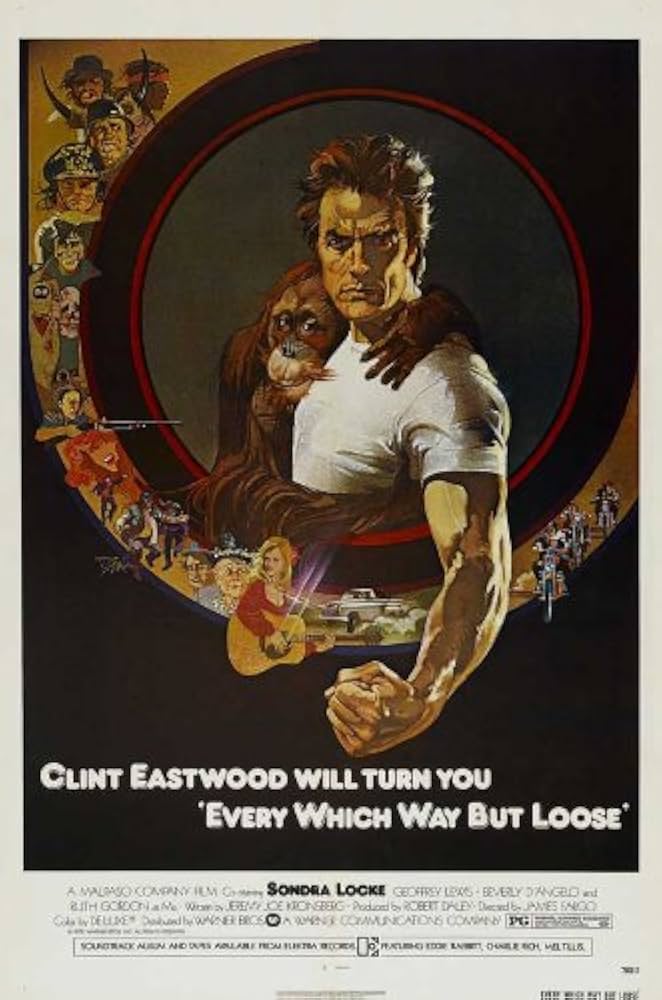
Philo (Clint Eastwood) is a truck driver still living with his mother (Ruth Gordon) and who compensates his income with bare-knuckle fights where people can make bets either on, or against him. He also travels around with an orangutan named Clyde whom he won as compensation for one of his fights. One day while waiting in his pick-up at a red light a biker gang known as The Black Widows and led by Cholla (John Quade) pull up beside them and begin harassing the ape. This creates a confrontation, and the bikers seek a vendetta on Philo determined to challenge him to a fight and begin stalking him until he agrees. Philo is also being chased by Putnam (Gregory Walcott), a cop upset at Philo over a misunderstanding that occurred while the two were in a bar. Meanwhile Philo is also trying to find Lynn (Sandra Locke) a singer he fell for who moved away to Colorado with her boyfriend, but Philo travels there in an attempt to find her and win her back, but Putnam and the Black Widows are in hot pursuit. 

The script is the product of Jeremy Joe Kronsberg, who after watching Smokey and the Banditbecame ‘inspired’ to write this one and was convinced it would make the perfect follow-up vehicle for star Burt Reynolds. However, when he shopped it around to the studios, they all rejected it, so he decided to send it off to Clint Eastwood’s secretary in the hopes that Clint, being good friends with Burt, would show him the script and convince him to do it. Instead to everyone’s surprise Clint, who was looking to broaden his appeal, decided to take on the starring duties himself and even cast Kronsberg as one of the biker gang members.

Many of those close to Clint thought it was a bad career move, and the critics savaged the film upon its initial release, but at the box office, which is what really counts, it did very well and became one of the highest grossing films of Eastwood’s career. A major reason for this is its rural appeal where everyone is essentially a redneck and white collar, college educated suburbanites just don’t exist. Instead, one’s social standing hinges on how much they down at the bar and whom they beat-up, which helps create a strong and surreal atmosphere. Initially though with this type of mentality I thought the setting should’ve been Texas and not California as when most people think of Cali they connect it with rich Hollywood stars and Malibu mansions when in reality that’s only a portion of the state and on the east end it’s much more rustic with a far more blue collar attitude and the movie does a good job of exposing this. 

It’s fun to see Eastwood not taking himself so seriously and being laid-back even smiling versus having him constantly look at everybody with his patented squinty-eyed stare. In support I though Ruth Gordon was great. Usually she plays ditzy old dames, but here she’s crusty and ornery and the segment where this ‘vulnerable old woman’ single-handedly shoots-up the biker gang when they invade her property is the movie’s highpoint. Bevery D’Angelo quite good too playing a free-spirited flower child named Echo. While she doesn’t have anything funny to say it’s nice having a character who’s quiet and subdued to help balance all the other wackiness. 

The script though is in desperate search for a story that never really transpires. Too much hinges on random events strung together by the thinnest of threads versus being connected by actual motivations and momentum. Having Eastwood, a tall and intimidating looking guy, constantly getting harassed for no reason, doesn’t make a lot of sense. The biker gang should’ve hounded him because they were hired by someone who lost to him in a fight and was bitter about it and the cop could’ve been hassling him because he lost a bet on one of his fights and thus wanted some compensation. While these may not be deep and profound motives at least they give a reason for what’s happening versus having things strung together by a lot of disconnected events that come out of nowhere. 

Spoiler Alert!

Sondra Locke though almost saves it. Her hyper and sarcastic personality makes for a nice contrast to Eastwood’s, and I liked how he pursues her as a love interest only to ultimately realize that she’s a psycho and he’d be better off without her. Most other movies have the concept that ‘lover conquers all’ and you’re better off with someone, even if they’re seriously flawed, than without, so having this movie take the alternative viewpoint is a refreshing change of pace and thus deserves some credit. 

My Rating: 4 out of 10

Released: December 20, 1978

Runtime: 1 Hour 55 Minutes

Rated PG

Director: James Fargo

Studio: Warner Brothers

Available: DVD, Blu-ray, Amazon Video, YouTube
Who’ll Stop the Rain (1978)

wholl

By Richard Winters

My Rating: 8 out of 10

4-Word Review: Drug deal gone bad.

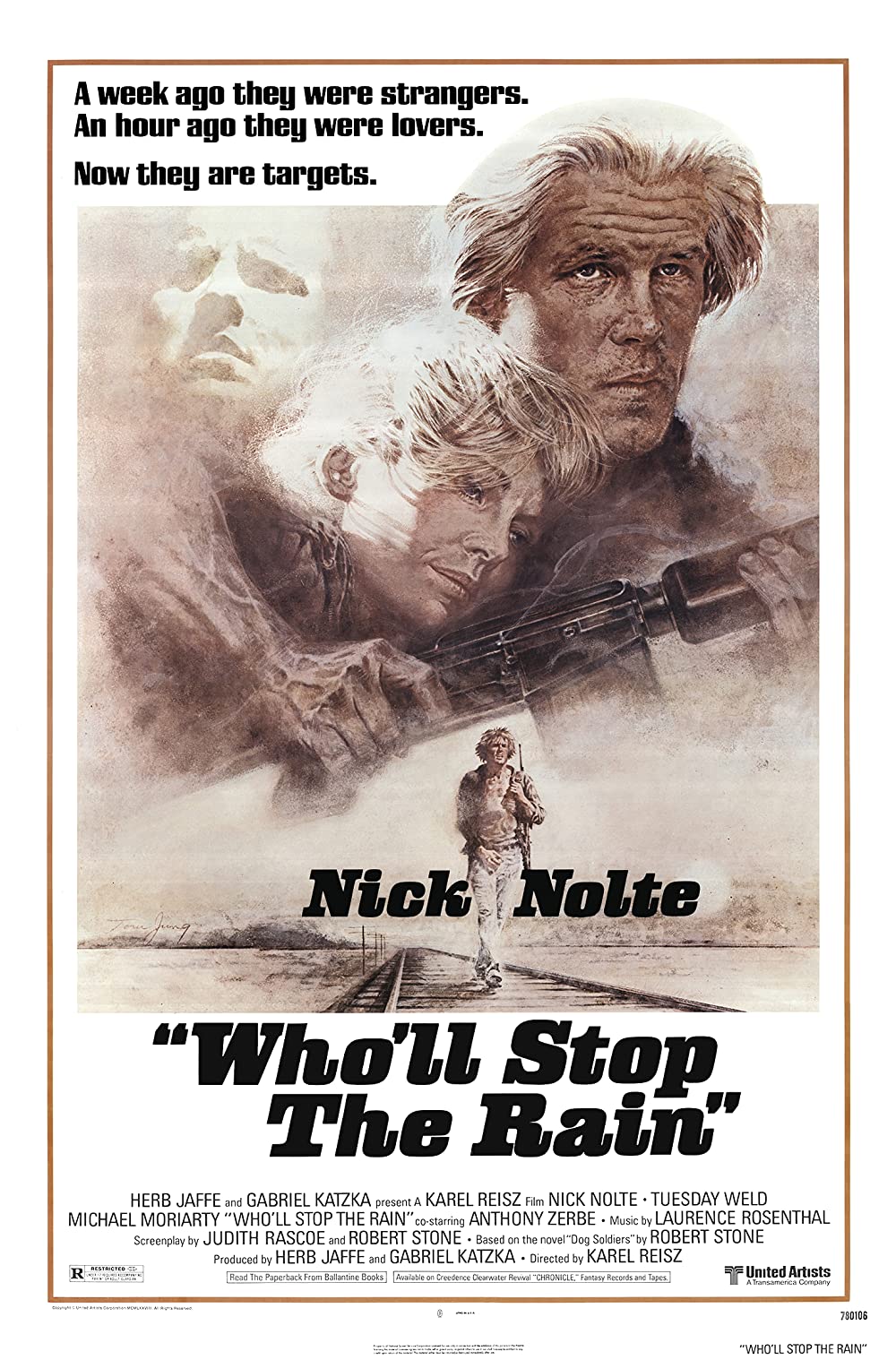
John Converse (Michael Moriarity), a war correspondent working in Saigon, approaches his friend Ray (Nick Nolte), a merchant marine, about smuggling a large bag of heroin out of the country and into the US. Ray has dealt marijuana before, but never the hard stuff and is reluctant at first, but due to his friendship with John he eventually agrees. He is told to go to San Francisco where he’ll drop-off of the drugs for payment with John’s wife Marge (Tuesday Weld). Once he gets there though he realizes he’s been followed forcing both he and Marge to go on a dangerous trip to not only elude the bad guys, but also get rid of the incriminating evidence.

The film is based on the 1974 novel ‘Dog Soldiers’ by Robert Stone, who also co-wrote the screenplay. The theme of the novel was to examine the loss of optimism and youthful ideals of the 60’s and the beginning of the age of cynicism that came during the 70’s, which for that purpose the time period should’ve been 1970 as keeping it in the present day, in this case 1978, makes it seem a bit dated and losses the context of the message. The story itself though is still quite engrossing with some of the most disturbing scenes being the ones dealing with a young, affluent suburban couple (James Granna, Timothy Blake) going to a drug party of sorts that had Ray, Marge and Ray’s friend Eddie (Charles Haid) who give them illicit substance for the first time and their immediate hallucinogenic reaction I found both frightening and impactful.

The performances are uniformly excellent especially Nolte, who was not yet an established movie star and the producers wanting instead Kris Kristofferson for the role only to finally give-in after the persistent lobbying of director Karel Reisz. Tuesday Weld is also dynamic falling into the role of a drab, middle-aged housewife with ease and completely losing the young, sexy starlet appeal that she had previously. My favorite though was Moriarty, whose glazed over eyes and emotionless demeanor perfectly reflects the apathy and soullessness of his character.

On the downside I found the character’s motivations to be confusing particularly the way Marge, who did not know Ray before this, agrees to go with him as he tries to outrun the baddies, but how would know she could trust him, or that he wasn’t in on the scheme? When she dropped her child off with some friends that’s where I felt she should’ve also gone and going back into Ray’s car, instead of calling the police, or advising her friend to do so, seemed reckless and too trusting that this stranger had her best interests at heart. In the book Ray’s intentions are not quite as noble as he decides to bring Marge along more for insurance as he think’s he’s been double-crossed by John, but presumes with Marge along he can use her as a decoy, while in the film it’s because he’s genuinely concerned for her safety. Marge too is betrayed differently as she’s not aware of the drug deal in the film, but in the book she was and I felt these nuances should’ve been brought up in the movie and the fact that they aren’t makes it less realistic and losses the whole point of the story.

John’s relationship with Danskin and Smitty (Richard Masur, Ray Sharkey), the two henchmen to corrupt FBI agent Antheil (Anthony Zerbe) gets botched too. For one thing the make-up effects are too slight as John is put through a wide array of physical tortures by the two in an attempt to get him to tell them where the heroin is and yet after it’s all over the only sign of the struggle is a slight cut on his forehead when instead his entire face should’ve been severely bruised, bloodied, and swelling. Afterwards he becomes too palsy with them even reading a book in their presence and joking around though you’d think he’d remain frightened after what they put him through and never letting down his guard in their presence because he’d know their violent side. I also didn’t like how the two start out as nasty criminals, but by the end become clueless comic foils, which hurts both the tension and grim realism.

The film though does recover especially in the final act when Ray takes Marge to an isolated cabin in New Mexico to hide-out in and then are followed by the villains culminating in a unique showdown. The isolation of the place, which sits amongst the beautiful mountains of the region is both picturesque and tranquil, and is based off of author’s Ken Kesey’s home in California where he wired the nearby trees with lights and sound effects to enhance their LSD experiences, and thus this creates an interesting battle between Ray and the thugs as he uses these same props to disorient them and it helps the movie stand-out with its memorable conclusion.

My Rating: 8 out of 10

Released: August 11, 1978

Runtime: 2 Hours 6 Minutes

Rated R

Director: Karel Reisz

Studio: United Artists

Available: DVD, Blu-ray

Take This Job and Shove It (1981)

job

By Richard Winters

My Rating: 3 out of 10

4-Word Review: Modernizing a beer factory.

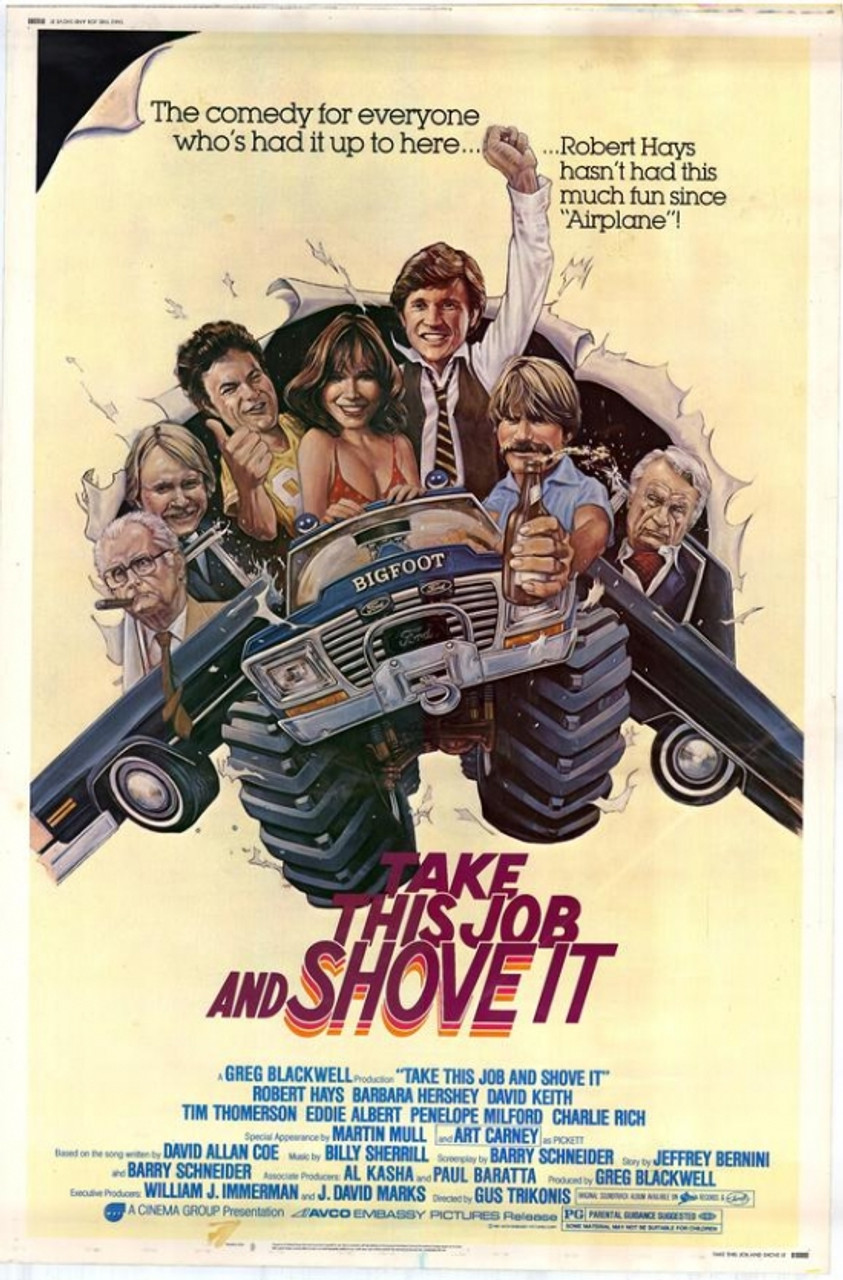
Frank (Robert Hays) is hired by a conglomerate called The Ellison Group to find ways to improve a beer factory that they own and get it in the black. Since Frank is originally from the small town where the factory is located he excitedly takes-on the task, but soon finds himself at odds with many of the workers, some of whom he was friends with in highs school, but who now look at him as a threat to their jobs. While the ideas that he implements are at first resisted the situation in the factory improves and the place begins turning a profit. Unfortunately it becomes such a success that The Ellison Group decides to sell it to a man with a background in the oil business, who doesn’t know the first thing about beer production, which gets everyone in the factory to rebel from the acquisition in very physical ways when the new owner and his cronies arrive for a visit.

The movie was filmed at an actual beer factory, The Dubuque Star Brewery, in Dubuque, Iowa, that is listed in the National Register of Historic Places and although no longer functioning as a brewery it still stands today. The history of the place is similar to the movie as it was bought by Joseph Pickett in 1971 who implemented a massive renovation when he found that it was still using equipment from the 1930’s. The story itself was inspired by the hit country song that sat on top of the country charts for 2-weeks and was performed by Johnny Paycheck and written by David Allan Coe, both of whom appear in the movie.

The production has some nice on-location shooting of not only Iowa, but also the Twin Cities and I really dug the basketball court in the mansion owned by Eddie Albert’s character. The working class issues and the gritty nature of their jobs and lifestyles is basically on-target, but the movie bills itself as a comedy, and the trailer makes it seem almost like it’s going to be a farce, but in reality it’s more of drama with very little action until the end. There’s not much that’s funny either and the thin, predictable premise gets stretched-out longer than it should ultimately making it boring and a strain to sit through.

The main defect is the Robert Hays character. While he performs the part well he’s not enough of a jerk, or nemesis and thus the confrontational drama is missing. Having him from the area originally was a mistake as he seems too different from everyone else around him and creating him as an outsider from the big city that had little to no regard for the people working under him would’ve created the necessary fireworks that this otherwise benign film lacks. It also would’ve made a more interesting character arch where he’d go from arrogant, city-slicker to a humble man who would learn to appreciate those that he initially looked down on instead of having him already a semi-part of the group to begin with. It also hopelessly wastes the talents of Barbra Hershey, who gets cast as an idealistic, pro-labor lady, a perfect part for her, and I was expecting the two to quarrel over their contrasting viewpoints, but it never gels and she’s seen far too little.

The script also suffers from logic loopholes and continuity errors. While a hotel room door may seem like a minor thing to quibble about it became a big deal for me. The scenario starts out funny enough, possibly the only amusing bit in the movie, with Fran Ryan playing the owner of the hotel touring him around the cramped, rundown room and acting like it’s a more ritzy place than it really is. Later though while Hays is asleep, his buddies from the factory rip the door off its hinges by attaching a chain to it that’s connected to a pick-up truck, but there’s no scene showing, or explaining, how the door ends up getting reattached. The door is also apparently always unlocked as both Hershey and the Martin Mull character walk into the room from the outside unheeded, but most if not all hotel room doors automatically lock when they’re closed, so why doesn’t this one? In the case of Martin Mull he walks in on Hays while he’s still asleep, but you’d think Hays definitely would’ve locked the door from the inside and put the security chain on it before going to bed, so again how is Mull able to just open it? He doesn’t even bother to knock, which is absurd too since he’s never been to that hotel before, so how would he even know for sure he had the right room and wasn’t walking in on a stranger?

My Rating: 3 out of 10

Released: April 1, 1981

Runtime: 1 Hour 41 Minutes

Rated PG

Director: Gus Trikonis

Studio: AVCO Embassy Pictures

Available: DVD-R, Blu-ray-R

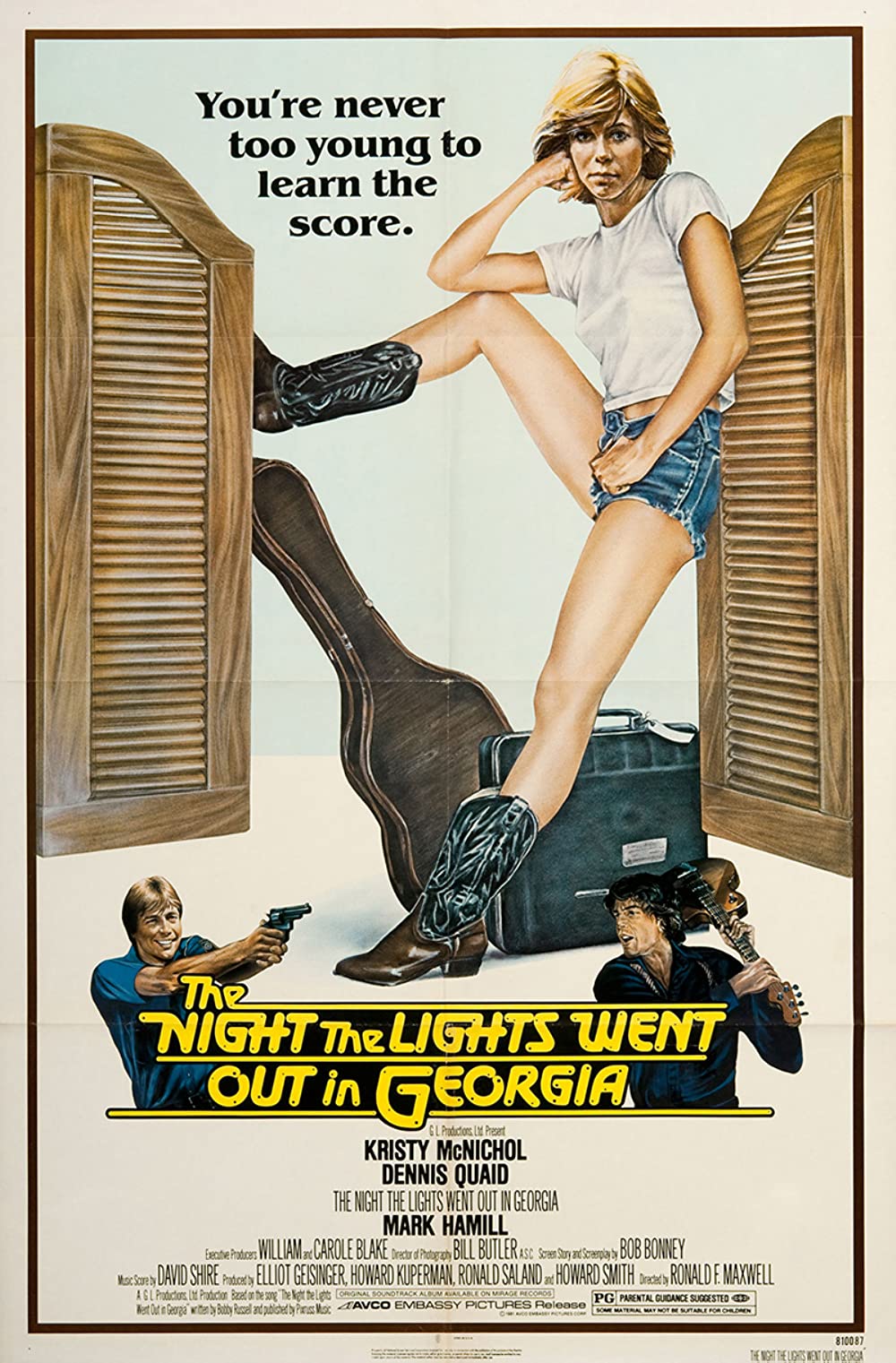
The Night the Lights Went Out in Georgia (1981)

night

By Richard Winters

My Rating: 3 out of 10

4-Word Review: Not like the song.

Travis (Dennis Quaid) is an aspiring singer with some talent, but little discipline. He’s achieved one hit song,but his drinking and partying keeps getting him in trouble. Amanda (Kristy McNichol) is his younger sister and though she’s only 16 she is more mature and responsible. She tries to manage Travis’ career by getting him to Nashville, so he can cut a record and get an agent, but his wild ways and their lack of funds, keeps preventing them from getting there. Eventually he gets arrested for public drunkenness and in order to pay the fine is forced to get a job at a local bar. It’s there that he meets Melody (Sunny Johnson) and tries to pursue a relationship, but becomes aware that Seth (Don Stroud), the deputy sheriff, has a thing for her as well and he won’t allow any other guy to talk to her as he’ll fly into a jealous rage and warns Travis of this, but Travis being reckless as always doesn’t let this phase him. As this goes on Amanda begins a romance of her own with with Conrad (Mark Hamill) who works as a state trooper.

Although in theory it’s ‘inspired’ by the song of the same name it technically doesn’t have anything to do with it. In other films that were made from songs like Convoy, Harper Valley PTAand Ode to Billy Joethe central theme was maintained and then expanded on, but here we don’t even get that. The song, with lyrics written by Bobby Russell and then sung by his then wife Vicki Lawrence, had to do with a man getting executed for killing another man who had an affair with his wife even though it was really his kid sister that did the crime. A plot like that could’ve had great potential for being an interesting movie, so why the producers didn’t just go with that original concept I don’t know, but it seems like a travesty for them to retain the song title and I’m surprised the producers of the record didn’t sue.

The plot, as it is here, is limp and uninspired. It basically feeds off of a lot of predictable shenanigans like Travis getting caught in a hotel bed with another man’s wife and then being chased around both on foot and in a vehicle until both he and Amanda are able to get away. In between we get treated to a lot of songs, which normally I’d say was nothing more than filler, which it still is, but since the rest of it is so lame, it comes off more like the best thing in it. Quaid and McNichol do all of their own singing and even wrote their own lyrics and they give energetic performances when onstage, so if you decide to see this thing then I’d suggest fast-forwarding through the rest of it and just stick with the music and you might be pleased.

The acting by Quaid is excellent and Don Stroud is great as the nemesis. McNichol is alright, at least when she’s singing, but otherwise gets pushed to the background and with her super short hair and nagging personality lacks sex appeal and at times looks almost like she could’ve been Quaid’s kid brother instead. The fact that they’re so close and do everything together would make one wonder if there’s something incestuous going on. In the more innocent times of the early 80’s maybe this wouldn’t be the first thought that would pop into people’s minds, but these days I’d suspect others would be wondering the same thing. There’s also no explanation for what happened to their parents. At one point McNichol mentions that she’s orphaned, so there really needs to be a backstory showing of what caused that.

Spoiler Alert!

The biggest gripe though is with the ending in which Travis gets shot and killed by Seth, who also dies in the gunfight. It then concludes with McNichol getting with Hamill, who quits his job as the state trooper, and the two drive-off in her rickety old truck to God knows where. Since the story was mainly about the brother/sister relationship then I felt that’s where it should’ve ended with them in Nashville either getting the record deal, or not. The Hamill character is bland and seemed to be added in with no other purpose, but to extend the already anemic plot. There’s also the fact that he was 29 at the time while McNichol plays someone who was only 16, so them getting into a relationship doesn’t exactly look kosher. Granted the age of consent in the state of Georgia is 16, so I guess in the eyes of law it’s okay, but many today will consider this kind of romance to be cringey, and I can’t help but wonder if that’s the main reason why this film has never had a proper DVD release nor any streaming option.

My Rating: 3 out of 10

Released: June 5, 1981

Runtime: 1 Hour 52 Minutes

Rated PG

Director: Ron Maxwell

Studio: AVCO Embassy Pictures

Available: DVD-R

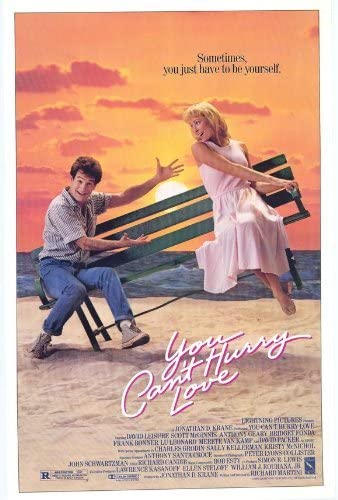
You Can’t Hurry Love (1988)

you1

By Richard Winters

My Rating: 1 out of 10

4-Word Review: From Ohio to L.A.

Eddie (David Packer) is tired of living in the Midwest and after a failed relationship decides to pack his bags and head out west looking for new opportunities. He moves in with his cousin Skip (Scott McGinnis) who already lives in Los Angeles, in order to check-out the scene, but finds everyone to be weird and wacky. He goes on several job interviews, but none of them hire him. He meets pretty Peggy (Bridget Fonda) who works at a video dating service and makes a video of his own, but his attempts to be somebody he really isn’t backfires at every turn. Can Eddie find true love and happiness and will anyone who watches this movie really care if he does or doesn’t?

One of the main problems is Packer, who strangely enough went on to star in another movie, The Runnin’ Kind, just a year later that had almost the exact same storyline. Quite frankly I was surprised he got any part at all as he came into this already with baggage, which stemmed from what occurred on October 30, 1982. On that night he was at the home of actress Dominique Dunne rehearsing a scene for the upcoming TV-miniseries ‘V’ when her ex-boyfriend John Thomas Sweeney came over and preceded to attack and kill her. Some felt that Packer should’ve/could’ve intervened and had he done so she might still be alive today. While I’ll refrain from passing judgement in that area I will say that his acting here is one of the worst I’ve ever seen in a mainstream Hollywood production. His eyes have a glazed over appearance and his face a shit-eating grin. His vocal delivery is quite monotone like someone who’s high and only half there. Fonda on the other hand (this essentially constitutes as her film debut since the 4 films she did previously were either animated, shorts, or non-speaking parts) is quite engaging despite her part being just as poorly written as his, but her superior acting ability shines through while Packer’s drags it down.

The script by Richard Martini tries too hard to recreate the surreal atmosphere from After Hours, but the cultish vibe from that one doesn’t click here. That one starred Griffin Dunne, (who was ironically Dominique’s real-life brother) who was better able to create a believable character that the viewer could identify with and emotionally connect to while Packer is a transparent guy you wish would just go away. It also overly plays-up the flaky stereotype of those living on the west coast. I resided in L.A. or 6 months and I can attest that some of the people out there are a bit eccentric, but they’re not all that way and the film should’ve brought in a few normal ones for balance.

Cameo appearances by famous actors do help a little. Charles Grodin is amusing as the blue collar-like father of one of Packer’s potential dates, who gives Packer, before they proceed on their date, some very brash and straightforward advice. Kristy McNichol is engaging too as a punk girl who harbors a man-hating streak. The funniest of them all though is Lu Leonard as the director of the video dating service that Packer joins who helps coach him on how to present himself to his potential dates. In fact the video dating aspect, of which I admit I was a part of back in the 90’s, is kind of funny and the movie should’ve centered everything around the inner-workings of a dating service franchise, which would’ve been far more interesting and insightful.

My Rating: 1 out of 10

Released: January 20, 1988

Runtime: 1 Hour 32 Minutes

Rated R

Director: Richard Martini

Studio: Lightning Pictures

Available: DVD, Amazon Video, YouTube

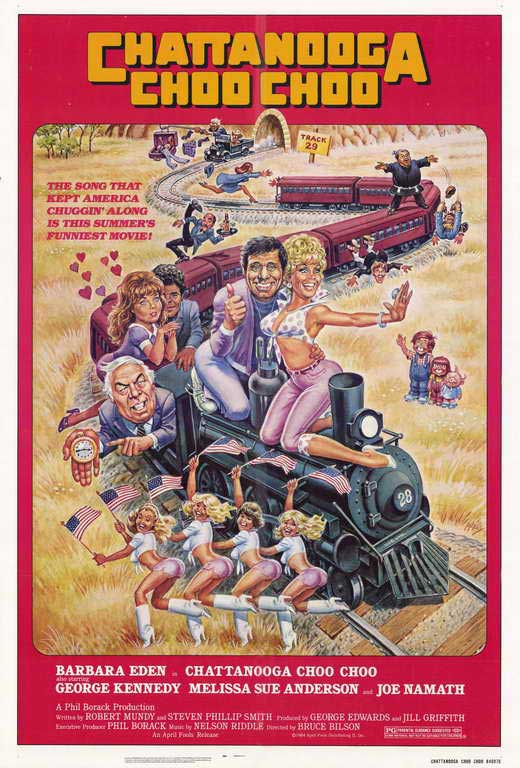
Chattanooga Choo Choo (1984)

By Richard Winters

My Rating: 1 out of 10

4-Word Review: Must arrive on time.

Bert (George Kennedy) is an unscrupulous, conniving owner of a football team who’s having an affair with the beautiful Maggie (Barbara Eden) whom he promises to marry once the father (Parley Baer) of his wife Estelle (Bridget Hanley) dies. He’s hoping to get a large chunk of the will, but finds that it comes with one big stipulation: he must restore the historic locomotive, the Chattanooga Choo Choo, and take it from New York City to Chattanooga, Tennessee within 24-hours and make sure that it arrives precisely on-schedule and if not he’ll lose out on a million dollars.

Producer George Edwards inadvertently struck gold in 1977 when he produced a film based on a hit song, Harper Valley PTA, that did marginally well, so he decided to try his luck with another one, but this time the attempt is an embarrassing failure. Part of the reason is that at least with the Tom T. Hall ditty it had a plot already in the lyrics, but this one doesn’t and the lame scenario that gets written around it is both threadbare and corny.

While Kennedy manages to be amusing he’s also unlikable and the viewer has no interest in seeing him achieve the challenge. For the story to have been more effective the character should not have already been rich, but instead poor and needing the money to help his family survive, which would’ve built more of an emotional interest at seeing him succeed.  Kennedy should’ve also driven the train himself, which would’ve created more comic scenarios instead of just seeing him basically sit back in the diner car doing nothing but nervously glance at his watch while others do the actual work.

Eden is a bore and speaks with in an annoying accent that makes her seem like a floozy from the streets. Bridget Hanley overdoes it with her caricatures of nouveau riche wife that is irritatingly cliched although it’s interesting to note that she did costar with Eden 17 years earlier in a season two episode of ‘I Dream of Jeannie’ titled: ‘My Master, the Swinging Bachelor’.  Jineane Ford, a former Miss USA winner who spent 16 years as a news reporter for KPNX-TV in Phoenix, gets exploited by being forced to play a stutterer, which the filmmakers apparently thought should be a source of amusement, but it isn’t and shouldn’t have been implemented.

Watching Parley Baer’s dead body entombed inside a large box car, which then gets lowered into a giant grave is the film’s one and only original moment. Some may also find Tony Azito as a double-jointed waiter whose never dropped a drink amusing too, but everything else falls flat. More focus needed to be spent on the train scenario, like having it run into a storm, which could’ve threatened its arrival time, or dealing with mechanical problems, instead of dwelling in silly juvenile escapades that are both unfunny and pointless even for mindless escapism.

My Rating: 1 out of 10

Released: May 25, 1984

Runtime: 1 Hour 41 Minutes

Rated PG

Director: Bruce Bilson

Studio: April Fools Productions

Available: VHS

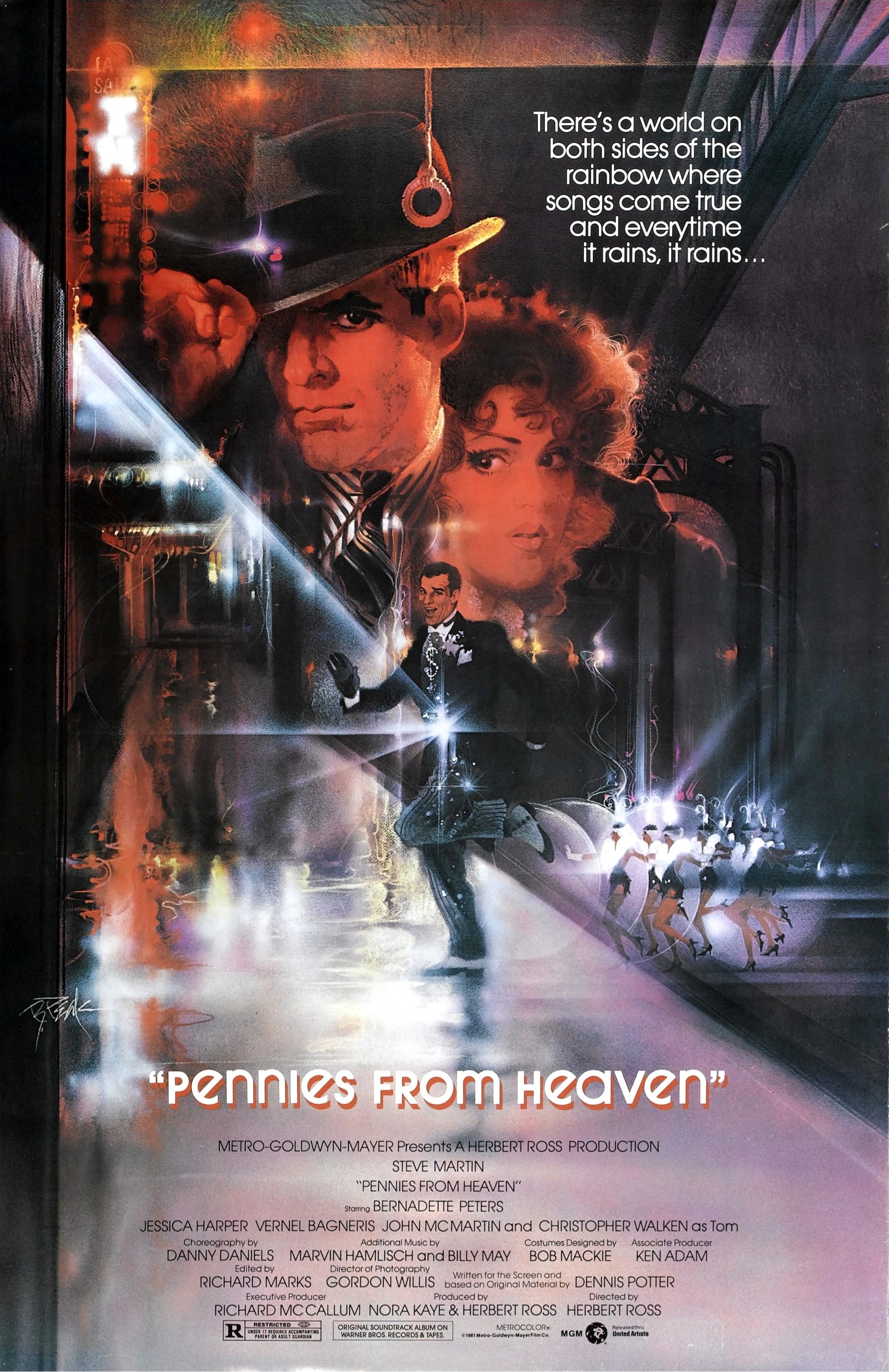
Pennies from Heaven (1981)

By Richard Winters

My Rating: 7 out of 10

4-Word Review: Escaping from the depression.

Arthur (Steve Martin) is a struggling sheet music salesmen during the depression, who’s looking to escape his dreary existence by becoming a songwriter, but finds that no one including his wife (Jessica Harper) cares about what his dreams, which leaves him feeling lost and alone. He then meets perky schoolteacher Eileen (Bernadette Peters) and the two begin an affair despite her not knowing that he is already married. When she gets pregnant and loses her job because of it Arthur is nowhere to be found and instead he gets unjustly tabbed for committing rape on a blind woman (Eliska Krupka) that he did not do.

The film is based on a 6-part miniseries that aired on the BBC in 1978 and starred Bob Hoskins. Martin saw it and was so enamored with the story that he became compelled to have it remade here and the studio even hired the same writer, Dennis Potter, to pen the script although the studio forced him to do 13 rewrites before they finally accepted it. Despite the extravagant musical numbers, which are pretty good, and positive critical reception, the filmed failed to achieve any success at the box office where it took in a paltry 2 million that barely made a dent in its 22 million budget.

A lot of the blame can be placed on the casting of Martin. While I admire him for not allowing himself to be typecast, and for dying his hair brown here, he still comes off as misplaced. You keep waiting for him to say something goofy and absurd like his character in The Jerk would and when he doesn’t you start feeling bored and frustrated. For his part he lashed out at those that didn’t like it calling them ‘ignorant scum’ while anyone who did enjoy the film he labeled ‘wise and intelligent’.

Yet his character is also a problem as he comes off as arrogant and selfish the whole way through. He constantly antagonizes his shy wife pressuring her to submit to his kinky sexual fantasies and when she doesn’t he threatens to walk out. He then lies about his marital status to Peters and is cold and ambivalent when she gets pregnant making him seem like a true jerk and not the funny kind in his earlier film.

Jessica Harper I enjoyed much more. I think she gives her finest performance here and I was genuinely surprised she wasn’t nominated for an Academy Award. Her interpretation of a shy, sheltered Midwestern wife from a more innocent era is completely on-target and I came to sympathize far more with her than Martin. The line that she utters when the police investigators come to her house, after Martin gets accused of rape, is the best moment in the movie. Peters is good too, but I felt her character got in the way and the film would’ve gelled better had it focused solely on the dysfunctional marriage.

The dance numbers are well choreographed with the best one being with Christopher Walken who does a bona fide striptease that took him over 2 months to rehearse. The bit in which Martin and Peters find themselves transported inside a film starring Fred Astaire and Ginger Rogers is quite cool too although Astaire himself tried blocking the footage from being used. He later commented that as a viewer ” I have never spent two more miserable hours in my life” and describing every scene in the film as being “cheap and vulgar.”

The story though starts out too slowly and for the first hour seems like there really isn’t any plot at all. It improves by the second half, but there needed to be more urgency at the beginning and many viewers may not be willing to stick with it.  Having the actors lip-sync the songs was a bad idea too. It gives the whole thing an amatuerish vibe making it seem like it was intended to be a campy comedy when it really wasn’t.

My Rating: 7 out of 10

Released: December 11, 1981

Runtime: 1 Hour 48 Minutes

Rated R

Director: Herbert Ross

Studio: MGM

Available: DVD, Amazon Video, YouTube

Car Wash (1976)

By Richard Winters

My Rating: 2 out of 10

4-Word Review: Having fun washing cars.

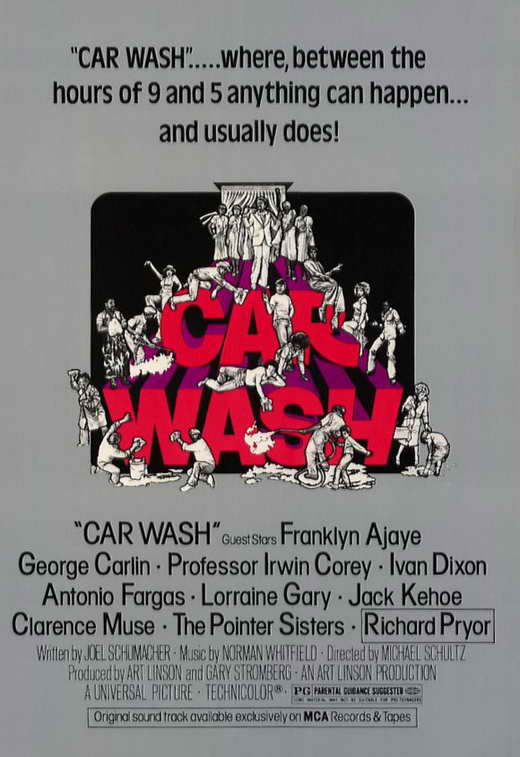
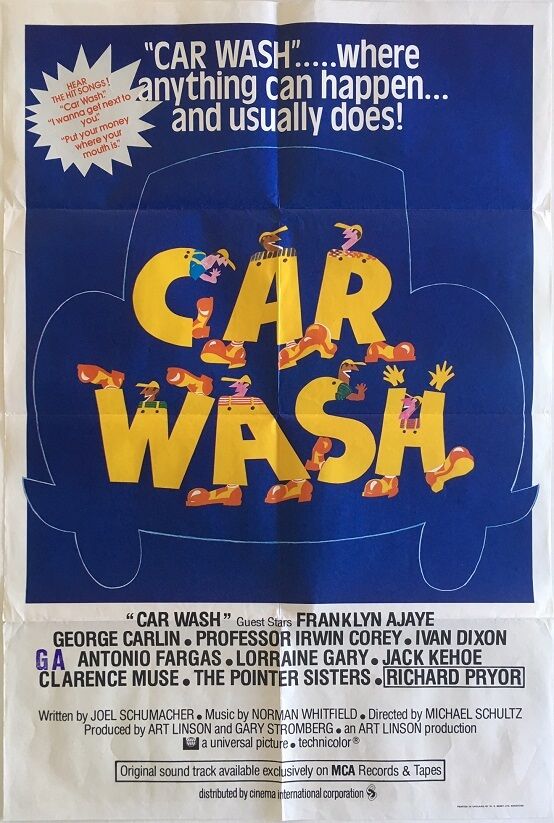
A look at the day-in-the-life of those working at a L.A. car wash. Mr. B (Sully Boyar) is the owner and frets about his employees not working hard enough, but too afraid to fire any of them for fear of retribution. Behind-the-scenes he’s having an affair with his young, but plain-looking receptionist Marsha (Melanie Mayron) who in-turn is more interested in a man with money and gets excited when a well-dressed one asks her out on a date. Lonnie (Ivan Dixon) is a recently released convict working at the car wash and raising a family, but finding it hard on the salary he’s given, which Mr. B refuses to raise. Duane (Bill Duke) is a Black Muslim revolutionary now going by the name Abdullah who preaches power to the people while Mr. B’s son Irwin (Richard Brestoff) who has just graduated from college and groomed to take over the business is more interested in being a part of the working class instead.

In many ways this could be described as a precursor to Clerks with a cinema vertite feel that captures the daily experience of working a mundane job quite well. The humor is restrained and never goes over-the-top making the dialogue between the cast and the pranks they play on each other believable and like something that could play out in just about any car wash or blue collar job across the country. The disco soundtrack, which includes the iconic title tune by Rose Royce, which is actually better than the movie itself, helps add to the 70’s ambiance as well as the fact that it was filmed on-location at an actual car wash, which has since been demolished, at 610 South Rampart Boulevard in Los Angeles.

Unfortunately there’s not enough plot, or character development to hold it all together. The loosely structured approach, which initially comes off as fresh and original, eventually grows tiring without any type of genuine drama or story line to keep it compelling. There are also too many amusing bits that could’ve been strung out longer and even enhanced, but instead end up getting dropped almost as quickly as they’re introduced.

The cast is filled with too many characters and it’s hard to keep track of them, or understanding why they’re needed. At most car washes I’ve been there’s usually only one employee, or maybe two at the most, to wax the car, or rub it down after it’s been through the wash, but here it takes literally 5 or 6 guys to work on one car, which seems ridiculous. Cutting the cast down would’ve helped and having it centered around one main person instead of doing the ensemble thing would’ve been even better.

The appearances of George Carlin and Richard Pryor add very little and their screen times are so brief I was surprised they even accepted the parts. I was also disappointed that Lorraine Gary’s part was so short too. She’s best known for playing Roy Schieder’s wife in the Jaws films. Here she plays a stuck-up Beverly Hills housewife who’s more concerned about how her car looks than in the fact that her young son is sick. Her haughty attitude creates a delightful culture clash and I really thought she could’ve added some funny friction had she stayed in it all the way through and I really thought she would especially after her son throws up in the car just as they are leaving the lot making me think she would’ve simply backed-up the car and had them clean out the vehicle’s interior, since they had just done the exterior seconds before, but instead she apparently just goes on driving, but who would do that?

There are also potentially interesting story lines that never get adequately explored. The affair between Mr. B. and Marsha was one of them, but another had to do with a ‘pop bottle bomber’ that was terrorizing the city. At one point the crew thinks it’s an old man (Irwin Corey) that comes into the place, but find that’s a false alarm, but it would’ve been exciting had they eventually come into contact with the real one, which could’ve added intriguing dynamics both with the characters and plot.

Originally this was to be a musical, but for whatever reason Universal nixed that idea and decided to turn it into a plain-old comedy instead. I’m not necessarily a fan of musicals, but in this case the songs and dance numbers would’ve helped tie everything together as the script is otherwise too unfocused to remain captivating past the first 30 minutes.

My Rating: 2 out of 10

Released: September 3, 1976

Runtime: 1 Hour 37 Minutes

Rated PG

Director: Michael Schultz

Studio: Universal

Available: DVD, Blu-ray, Amazon Video, YouTube
Stoogemania (1985)

By Richard Winters

My Rating: 0 out of 10

4-Word Review: Too much Three Stooges.

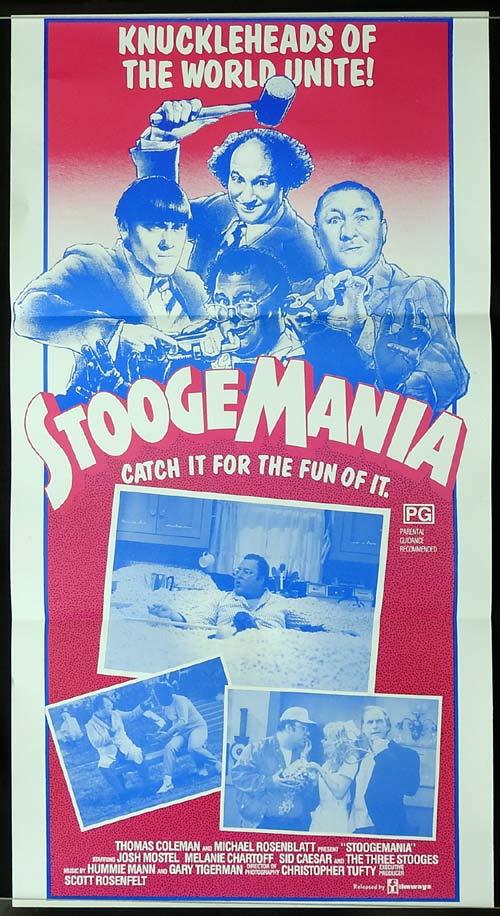
Howard F. Howard (Josh Mostel) is a man suffering from an obsession with the Three Stooges and it’s starting to affect his daily life and even is impending marriage to Beverly (Melanie Chartoff). He finds others that are having the same problem and the only way to cure it is to commit himself to Stooge Hills Sanitarium where he and others like him hope to rid themselves of their ailment through proper psychiatric care, but only if the inmates don’t overrun the asylum first.

It may seem hard to believe, but during the 80’s the Three Stooges franchise enjoyed a renaissance mainly due to its reruns being shown on TBS and the hit 1984 novelty song ‘The Curly Shuffle’. Personally I don’t get what the enjoyment is and  like with ‘Gilligan’s Island’ that somehow caught on with later generations, but in my opinion should’ve been forgotten instead. To me it’s just a lot of inane humor and predictable antics. If you’re 4 their routines might seem ‘hilarious’, but beyond that it most likely would bore anyone else and yet in the 80’s they were people out there that couldn’t get enough of the stooges including a former dentist of mine who had collected all of their film shorts.

If put in the imaginative hands of someone like Tim Burton this concept might’ve  worked, but with Chuck Workman at the helm it sinks fast. Workman has had a lot of success in directing documentaries and even won some awards for them, but his heart clearly wasn’t into this one. I almost wondered if he himself even enjoyed The Three Stooges or was just vomiting out some substandard product simply to collect a paycheck. The humor lacks even a modicum of cleverness and amounts to people acting incredibly stupid and equating this as being ‘funny’. No where is this more painfully evident then in the wedding scene that has first grade level pratfalls coupled with the dumb facial reactions from the actors and annoying cartoon-like sound effects, that are so stupid it starts to make the actual Three Stooges clips of which there are many that get shown here, seem brilliant by comparison.

Mostel is weak in the lead and had it actually been his father Zero Mostel, who had been cast here it would’ve done better. Zero had great ability to play off the camera and wonderful facial expressions and reactions that could keep even the worst of movies that he was in fun, but his son comes-off like some fat blob of a guy who got into the business simply by riding on his father’s coattails. Besides, if this is supposed to be a parody of the Three Stooges then why not have three men in the lead instead of just one?

There’s a host of other famous faces that drop in and out here including: Thom Sharp (who actually is kind of funny here), Sid Caesar, Victoria Jackson and Bill Kirchenbauer, but none of them can save this disaster that amounts to being an embarrassment even to the name of the Three Stooges and will most likely disappoint even those that enjoy them.

My Rating: 0 out of 10

Released: October 10, 1985

Runtime: 1 Hour 23 Minutes

Rated PG

Director: Chuck Workman

Studio: Atlantic Releasing Corporation

Available: VHS

If Ever I See You Again (1978)

By Richard Winters

My Rating: 1 out of 10

4-Word Review: Rekindling an old romance.

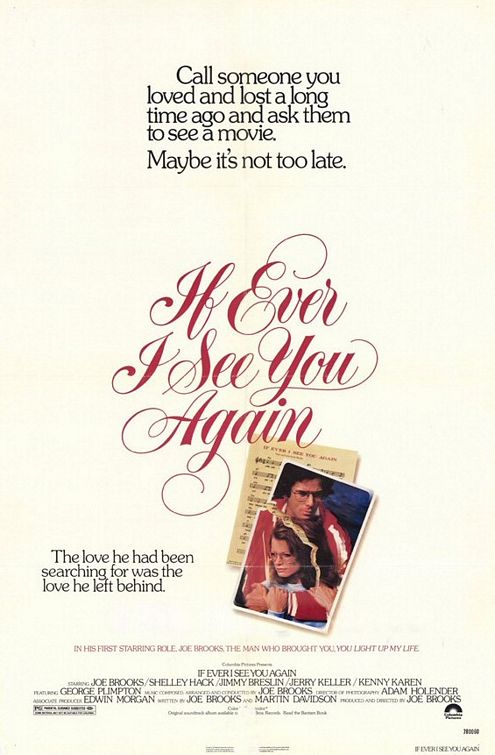
Bob Morrison (Joe Brooks) is a successful composer of commercial jingles, but despises the many compromises he is forced to make in order to please his clients. He wants to write a film score and his agent Mario (Jimmy Breslin) gets him a meeting with some movie producers in Hollywood and while there he decides to look up Jennifer (Shelley Hack) his former girlfriend while in college. He finds that she still has feelings for him and they begin dating again only to have her, like in college, back off when the relationship starts to get too serious.

Brooks was coming off great success with the box office hit You Light Up My Life that won him the Grammy for song of the year (1977) the Academy Award for best original song as well as the Golden Globe and the ASCAP award. His over-confidence though exceeded his talents as he followed it up with this trifling mess that reeks of self-indulgence and is so unrelentingly schmaltzy that it will make even the most die-hard of romantics feel like gagging.

The film starts out okay as it analyzes the rigors of the music business and its overly demanding clients. You even get to listen to some cheesy jingles that he is forced to write, which are kind of funny. Had it stayed as a behind-the-scenes look at the commercial jingle world it might’ve been passable

The romantic storyline though kills it. The idea that this beautiful woman would have no other male suitors and simply jump back into the arms of a dopey guy that she had dumped years before is ridiculous.  At least having her married or in some other relationship would’ve made it realistic and allowed for added drama, which is lacking and the love songs that are played during this segment sound worse than the goofy jingles.

Brooks had no acting experience, but casts himself in the lead anyways, which was a terrible mistake as he mumbles his lines and shows no emotion or inflection. His hair looks disheveled and with his glasses off like a beady-eyed, would-be stalker. The character is portrayed too ideally turning the production into a narcisstic foray instead of a story.

The supporting cast is filled with non-actors as well including newspaper columnist Jimmy Breslin and author George Plimpton who are just as blah and my guess is that Brooks did this to make his own bad acting seem not quite so glaring by comparison. Hack for her part is okay and at least has a beautiful face although I wished she hadn’t covered it up with her big, bulky glasses.

The most interesting aspect to the film is what occurred behind the camera as Brooks was nothing like the sentimental songs he wrote or lovable guy that he tried to play. Instead his friends labeled him an egomaniac and his daughter, actress Amanda Brooks, accused him of abusing her as a child while his son Nicholas was convicted of murder in 2013. Brooks himself was accused of raping over 13 women whom he had lured to his apartment through Craiglist ads under the disguise of being a film producer looking for fresh young talent. In 2011 while awaiting trial he killed himself, but not before becoming one of the creepiest looking guys you’ll ever see (pictured below).

Capture 282

However, the biggest irony is that in 2005 he wrote and produced a play about a woman with OCD who is brought together with a man who suffers from Tourette’s by a jingle singling God, which Playbill descried as being ‘one of the strangest shows to ever grace the Broadway stage.’ and even though it clearly sounds absurd I’d still take it over this crappy film any day.

My Rating: 1 out of 10

Released: May 24, 1978

Runtime: 1 Hour 45 Minutes

Rated PG

Director: Joe Brooks

Studio: Columbia Pictures

Available: VHS