Category Archives: Movies Based on Novels

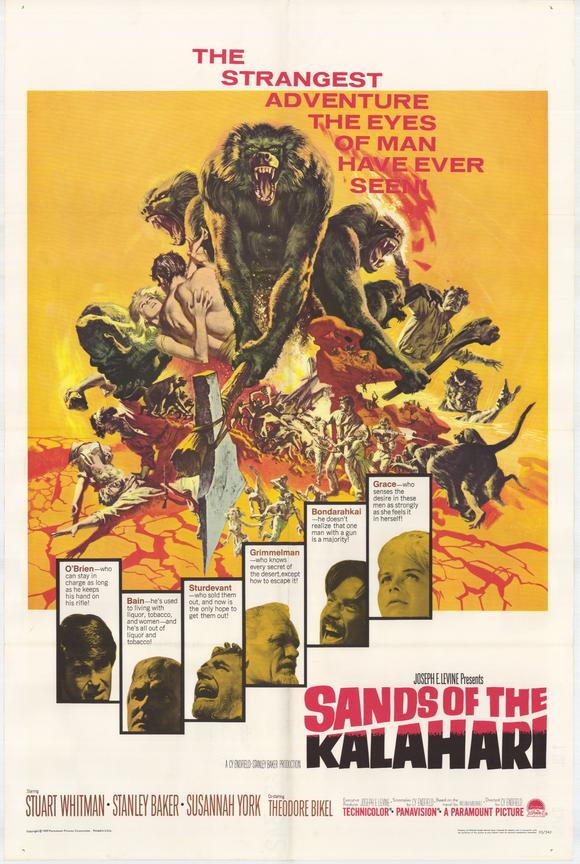
Sands of the Kalahari (1965)

sands of the kalahari

By Richard Winters

My Rating: 8 out of 10

4-Word Review: Stranded in the desert.

Based on the novel by William Mulvihill the story centers on a group of six individuals, five men and one woman, who fight to survive the blistering heat of the Kalahari Desert when their plane crashes after it’s struck by a large swath of locusts. Instead of working together as a team the group quickly disintegrates with infighting and tensions. The young and virile Brian (Stuart Whitman) who initially takes control of the situation starts to feel that his own survival would be heightened if there were less people needing food and water, so he decides to carefully eliminate them one-by-one, which leads to many interesting confrontations and a very unusual climactic finale.

Filmed on-location in Namibia the desert becomes its own character. The stunning sandy landscape is breathtaking and watching the characters walk along it under the crystal blue sky becomes almost awe-inspiring particularly during birds-eye view shots. The viewer feels like there are right there feeling the heat along with the rest of the characters. Writer/director Cy Endfield keeps things on an authentic level and stays for the most part faithful to the book with the exception of changing one of the characters who had been African American in the novel to Caucasian here. His use of actual animals is what impressed me the most particularly the baboons who become a major part of the story as well as seeing a live scorpion crawling up a man’s arm. The only real technical weakness is the cloud of locusts forming on the horizon, which looked like dust being sprayed on the plane’s windshield and when they started to splatter onto the window it looked more like scrambled eggs and not quite as impressive as I think the filmmaker’s had hoped.

I also had a bit of a problem with the Sturdevan character, which had been the plane’s pilot and is played by actor Nigel Davenport who attempts to rape Grace (Susannah York) after they had only been stranded in the desert for a day and a half. I felt this was too quick for people to so suddenly drop their civilized veneers and cave into their more animalistic urges. I could see this maybe occurring after being there for weeks or months, but I would think initially the urgency would be finding help and just plain surviving and sex being the last thing on anyone’s minds. This same issue occurs with Grace who becomes romantically attached to Brian and even professes her ‘love’ for him after only a couple of days, which again seemed too rushed. The romantic scenes make the film seem soap-opera like and gives it an unnecessary melodramatic feel that does nothing but bog down the pace.

Whitman whose career dissipated after the 60’s and was confined with less significant roles and films is memorable here. The character who comes onto the plane at the last second is initially big and brawny heroic and watching him devolve into a selfish anti-social man is interesting as are the scenes with him trapped in a hole. The segment where he throws a fire into a cave filled with baboons and then shoots the animals as they run out is quite startling. I also enjoyed York. She has always been a splendid actress, but here with her blonde hair matched against her red skin and torn dress looks genuinely sexy.

The one-on-one confrontations between the characters especially the one between Grimmelman (Harry Andrews) and Brian and then later between Brian, Grace and Mike (Stanley Baker) is what helps the film really stand-out. I would have liked it played-out a bit more, but the twist that comes at the end is indeed unexpected and leads to one of the more unusual climactic sequences you will ever see.

My Rating: 8 out of 10

Release: November 24, 1965

Runtime: 1Hour 59Minutes

Not Rated

Director: Cy Endfield

Studio: Paramount

Available: DVD, Amazon Instant Video 

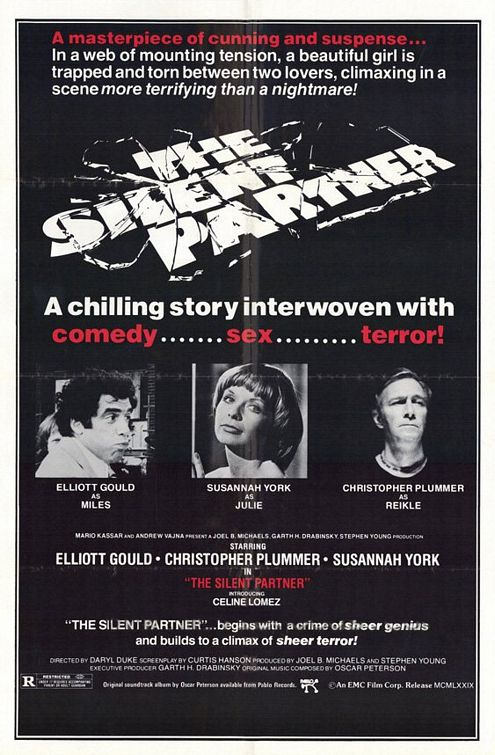
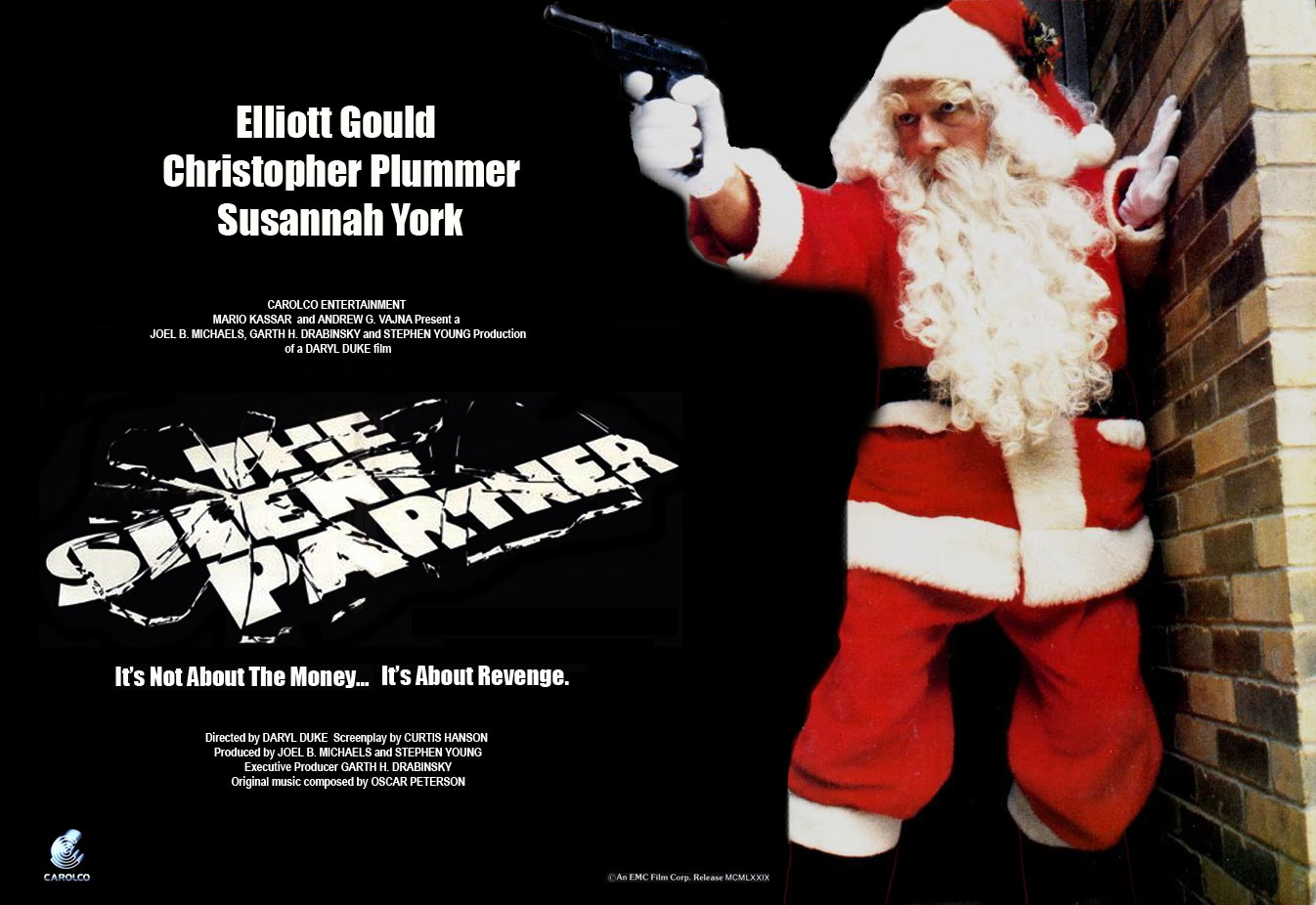
The Silent Partner (1978)

silent partner 2

By Richard Winters

My Rating: 8 out of 10

4-Word Review: Bank teller outsmarts robber.

This is an ingenious, slick, and really fun caper movie that puts a whole new spin on the old bank robbery theme. Here Elliot Gould plays a bank teller named Miles who, by sheer accident, becomes aware that a man named Harry (Christopher Plummer) is planning on robbing his bank. Miles decides to take the money from his till and put it into his lunchbox. Then when Harry robs the bank it is actually Miles the teller that gets the money while Harry goes away with very little. Yet this is only the beginning as Harry and Miles continue to play a crafty game of cat- and-mouse, which leads from one interesting twist to another.

Gould plays against type here and he does quite well. Usually he tends to be loud, argumentative, and anti-authority, but here he is quiet and unassuming. It’s the type of character you think wouldn’t have the guts to pull off what he does, which makes him all the more intriguing. In fact he just keeps surprising you all the way along, stringing the very psychotic and dangerous Harry in ways you couldn’t imagine. It is only his final move that seems to be testing the odds too much.

Plummer makes a terrific adversary. He is dashing and handsome as ever, but with an intensely sinister edge and an icy cold gaze.

Susannah York as Miles’ love interest Julie is wasted. Her character seems thrown in for good measure and at no time seems interesting. There is no chemistry between them and the whole love angle is forced and unnecessary. Celine Lomez, as Elaine the other female character, is different. She is stunningly beautiful and much cagier. She plays between both Harry and Miles and you are never sure which side she is really on. Her acting isn’t spectacular, but she is sensual and has a nice French accent. Her gory and gruesome demise though is unwarranted and works as a drawback to the movie.

There are a few other negatives about the film. One is the drab setting that takes place in Toronto and yet we hardly see any of it. Having the bank itself set inside a boring shopping mall is not too visually exciting. The same goes for Miles’s bland apartment. The supporting characters, especially the other bank employees are incredibly dull. Their lines and basic presence all seem to have been written in simply as ‘filler’. A young John Candy plays one of these co-workers and his comic talents are wasted.

Still the story is creative and has enough unique twists that it overcomes the technical shortcomings and manages to be a highly entertaining flick.

silent partner 1

My Rating: 8 out of 10

Released: September 7, 1978

Runtime: 1Hour 46Minutes

Rated R

Director: Daryl Duke

Studio: EMC

Available: VHS, DVD, Amazon Instant Video

The Running Man (1963)

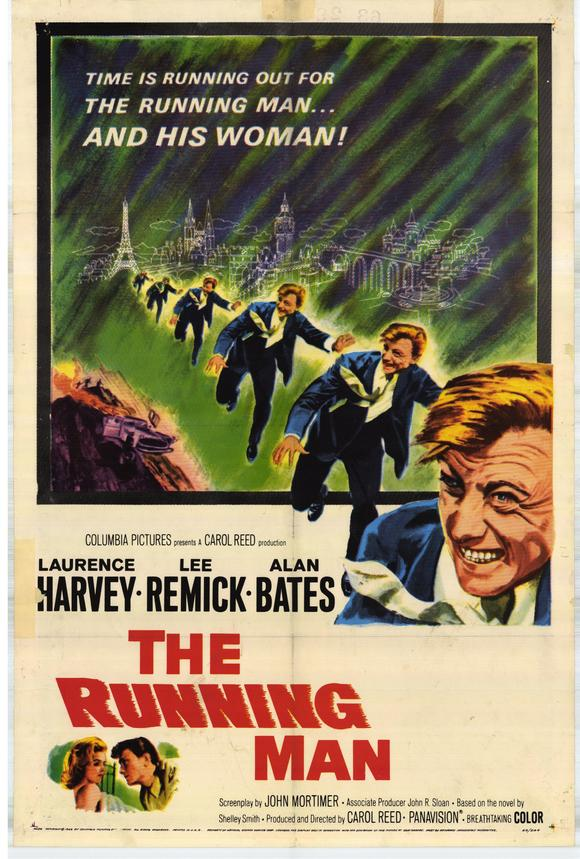
the running man 1

By Richard Winters

My Rating: 7 out of 10

4-Word Review: Couple scams insurance company.

Rex (Laurence Harvey) is a victim of a plane crash when the airplane he is piloting crashes in a forest. He survives with minor injuries, but the plane is totaled and he expects a big payout from his insurance company. However, since he was two days late with his premium payment the policy was canceled and he gets nothing. Outraged he plans a scheme to get revenge with the help of his wife Stella (Lee Remick). He purchases a glider plane and has it insured with the same company. He then intentionally crashes it into the water and before help arrives he dives into the lake and by using an underwater apparatus swims ashore undetected. He hides out on a small island during the investigation and when it is finally confirmed that he was ‘lost-at-sea’ and the insurance pays a handsome sum to Stella the two then run off to Spain, but insurance investigator Stephan (Alan Bates) still has his suspicions and follows the two while continuing to hound them with questions forcing them into a shrewd game of cat-and-mouse.

Based on the novel by Shelley Smith this is a thriller in the most classic sense. The plot is completely believable and still very timely without any of the annoying loopholes. The action particularly during the final 30 minutes, which had me literally on the edge of my seat, is very exciting. The twists are interesting and unpredictable.

What I enjoyed most though was the way the characters evolve and change as the story progresses. Stella initially comes off as carefree and callous only to end up being beleaguered, worn out, and even feeling a bit guilty. Rex seems slick and conniving at the start, but eventually turns crass, vindictive and wholly unlikable. Stephan is nosy and intrusive when it begins, but before it is over he is the most sympathetic to the viewer. Having worked in the insurance industry now for 15 years I liked how the film shows things from both side not only the rigid business-like end, but also how those that try to cheat the system even when they feel somehow ‘justified’ in doing it only ends up making it worse for everybody else. The very ironic ending hits the bullseye.

Director Carol Reed is in top form. I liked how he captures the many different exotic locales of Spain not only with the outdoor scenery and villas, but also inside an old church cathedral as well as an empty bullfighting arena. The opening credit sequence showing Harvey’s shadowing figure running in front of a colored background is good as his the variety of camera angles used particularly during Rex’s final attempt to escape by airplane. The only part that I thought was unnecessary was in when Rex finds a passport left by an Australian that he was talking to inside a bar. Rex picks it up and it is clear to the viewer that he was thinking of using it for his own change of identity, but Reed still felt the need to superimpose Rex’s head shot over the Australian’s, which seemed heavy-handed as does the booming music that is played when Stephan meets Stella for the second time while in Spain.

Remick is excellent and the stresses and strains that her character conveys are easily felt by the viewer. Harvey seems to be having a grand old time particularly when he is in the disguise of the Australian. Although there is some debate over it at IMDB I actually felt that his Aussie accent was alright. He does however look much too scrawny in his bathing suit although Remick in her bikini is delectable.

Why this exciting and polished thriller has never been released onto DVD, or Blu-ray let alone VHS is a complete mystery especially when it stars two major actors from 60’s British cinema and directed by a legend. This movie is waiting to be discovered by new fans and can be enjoyed by just about everyone.

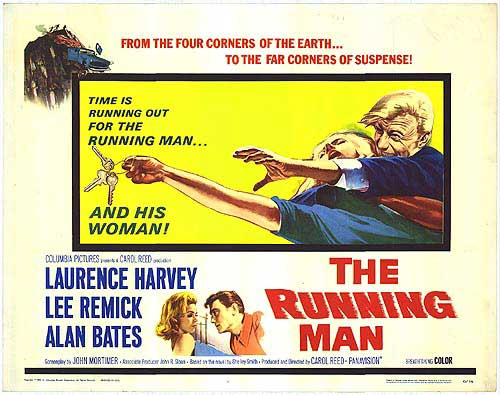
the running man 2

My Rating: 7 out of 10

Released: October 2, 1963

Runtime: 1Hour 43Minutes

Not Rated

Director: Carol Reed

Studio: Columbia Pictures

Not Available at this time.

Why Shoot the Teacher? (1977)

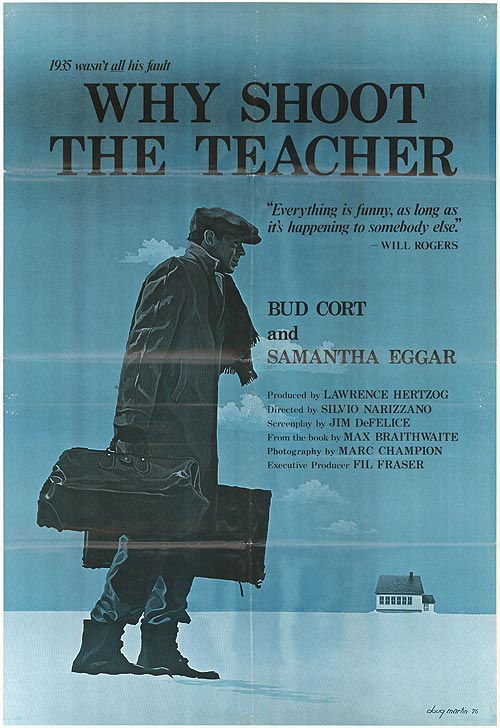
why shoot the teacher 2

By Richard Winters

My Rating: 8 out of 10

4-Word Review: Not a good job.

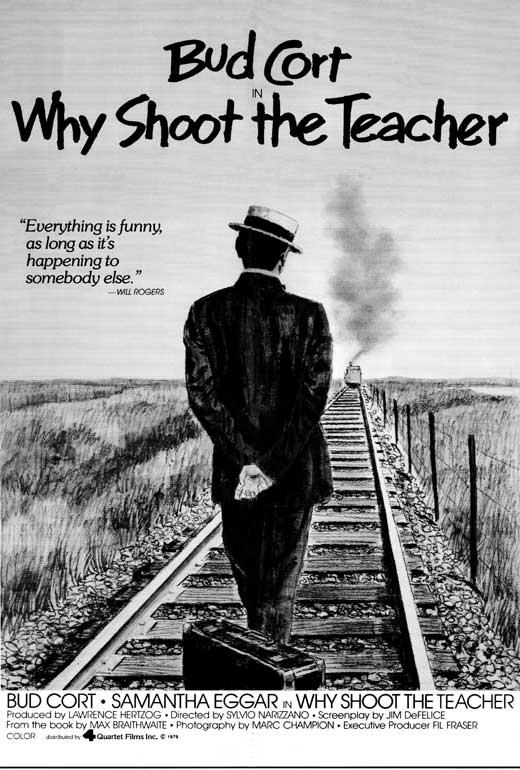
If you hate your job then watching the escapades of Max Brown (Bud Cort) dealing with his should make you feel a lot better about yours, or even lucky. The setting is 1935 and Max has traveled to an isolated farming community in Saskatchewan Canada in order to live out his dream of being a school teacher. The problem is that he must live in the dingy basement of the school that has no running water and an outhouse that gets regularly overturned by the rowdy school children, sometimes with Max in it, and he is only paid $20 dollars a month for his efforts, which even back then was a paltry amount. What is worse is that the district can’t even afford to pay him so instead gives him promissory notes and forces him to be dependent on the generosity of the townspeople for his food. Since he had to borrow money for his train ride up there he is unable to go back and forced to spend the harsh Canadian winter all alone while dealing with difficult students and indifferent parents and adults.

Cort really shines. The fact that through all his diversity he still remains civil and upbeat makes the character quite appealing even though he does evolve and at times compromises from his initial ideals. The best example of this is when he eventually, despite his initial reluctance, uses the strap on one of the older bigger students while the rest of the school children watch through the school windows. Although Cort is best known for his starring role in Harold and Maude I’d actually say this is his best all-around performance.

Samantha Eggar another under-appreciated and underused performer is terrific in support as Alice Field a woman transplanted from England who like with Max finds herself alienated and unconditioned to the harsh climate. She also has a really amusing line when she states “Canada is a nice country…sometimes…in the spring.”

Filmed on-location in the tiny town of Hanna, Alberta the sprawling wheat fields create a tremendous sense of isolation as well as a distinctive sense of natural beauty. The story is filmed during all three seasons, which makes the viewer feel like they are battling the rigorous Nordic climate right alongside Max. One of the funniest moments is when the word ‘Spring’ is flashed on the screen while a raging blizzard goes on behind it making Canada one of the few places that can make Minnesota, where I am originally from, seem like a mild climate.

The film is wonderfully vivid and creates a rich multi-textured tapestry of life on the prairie. By keeping everything on a realistic level it helps recreate what life must have been like for a lot of rural school teachers during the period, which is what makes it so fascinating. The film’s faded washed-out color and archaic low budget technical approach only helps to accentuate the look and feel of the period. There are shades of Wake in Fright here that also dealt with a man teaching school in an isolated school house while battling the elements and I found it interesting to note that Ted Kotcheff who was the director of that film was listed as a production consultant on this one.

My only complaint about the film was the misleading title. There is no shooting of any kind of the teacher, or even any talk of it. Why they came up with that title, which is based on the book with the same title is a mystery. Unfortunately it may give some people the idea that this is a violent film when nothing could be further from the truth and may turn-off potential viewers from enjoying this endearing slice-of-life comedy/drama.

why shoot the teacher 1

My Rating: 8 out of 10

Released: June 23, 1977

Runtime: 1Hour 39Minutes

Rated PG

Director: Silvio Narizzano

Studio: Lancer Productions Limited

Available: VHS, DVD, Amazon Instant Video, YouTube

A Return to Salem’s Lot (1987)

return to salems lot

By Richard Winters

My Rating: 3 out of 10

4-Word Review: Town full of vampires

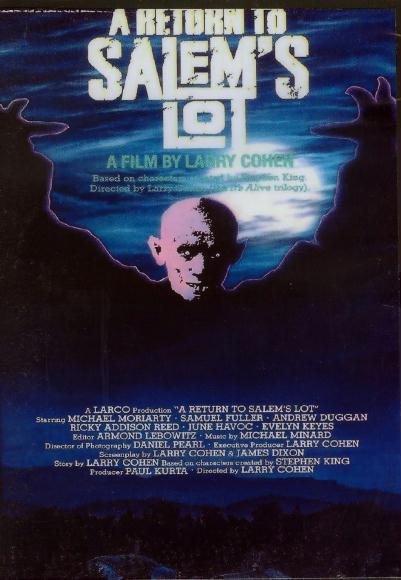
Joe Webber (Michael Moriarty) is a documentary filmmaker who is always looking to tackle the next shocking topic if it will help advance him and his film career. While vacationing in a small New England town of Jerusalem’s Lot with his teenage son Jeremy (Ricky Addison Reed) he becomes aware that the entire town is made up of a population of vampires led by elderly Judge Axel (Andrew Duggan). They are aware of Joe’s film career and give him an offer to film a documentary on them so as to give future generations a better understanding of the vampire lifestyle. Initially Joe is intrigued with the idea, but when he finds out that they want to turn his son into one of them he refuses and spends the rest of the time trying to escape and with the help of elderly but tenacious vampire hunter Van Meer (Samuel Fuller) save his son.

This flick is complete disaster from the beginning. It opens with Joe filming a documentary on a jungle cannibal tribe that looks like a real tacky rip-off of Cannibal Holocaust. The gore and special effects are abysmal and the story and characters have nothing to do with the Stephan King novel to which it is based nor the 1979 TV-Movie. Had the plot gone more with Joe filming a documentary on the populace it might have been interesting in an offbeat way, but the script brings up the idea and then never follows through with it.  There are shades of dry humor here and there and had it been more consistent with it the film could have been viewed and possibly enjoyed as a parody, but as it is it is nothing more than cheap straight-to-video fare.

The characters are poorly defined and at times even contradictory. Joe starts out as this callus man who puts his directing career first and has no concern for his son and hasn’t seen him for years, or even mentioned him to his friends. Then suddenly they get to this town and he will stop at nothing to save him. The son also does not like the father when he first sees him and yet magically and quickly bonds with him the minute they get to town. He is also described to be deeply troubled psychologically, but shows no sign of it during the course of the movie.

There is also the issue of Van Meer shooting Judge Axel in the head twice with a gun, but even as bullet holes spew out blood from his forehead he still goes on walking and talking like nothing happened. Supposedly this is to signify that the only way to kill a vampire is to stick a wooden stake through their heart and if you try to kill them any other way it won’t work, but this still doesn’t make sense. For instance if you break a vampires kneecap wouldn’t that effect the way they walk? If so then the same logic should hold true if you put two bullet holes into their brain. It would more than likely turn them into a complete vegetable a vegetable that may go on living forever until you drive a wooden stake through its heart, but a vegetable nonetheless.

Moriarty gives another great performance that completely exceeds the quality of the material. This one is even more impressive because he actually plays a normal person here and does so effectively, which is interesting given the nature of his sometimes offbeat behavior off-camera. The person though that really steals it is famed film director Fuller as the elderly vampire hunter. The guy shows an amazing amount of charisma and energy and plays up the character to an amazingly amusing degree and helps save what is otherwise a disaster.

Veteran actresses June Havoc and Evelyn Keyes appear as two of the elderly women vampires. Keyes really plays-it-up and the way she sucks the blood from one of the victims off her fingers looks down right erotic. The scene where Havoc, Keyes and writer/director Larry Cohen’s then real-life wife Janelle Webb chew on the dead body of Cohen’s real-life daughter Jill Gatsby gets a few points for audaciousness. This is also a great chance to see Tara Reid in her film debut as one of the vampire children.

The final thirty minutes is an improvement namely because of Fuller’s presence, but it does nothing to hide the film’s many other flaws, which is a perfect example of bad 80’s horror.

My Rating: 3 out of 10

Released: May 18, 1987

Runtime: 1Hour 41Minutes

Rated R

Director: Larry Cohen

Studio: Warner Brothers

Available: VHS, DVD (Warner Archive), Amazon Instant Video

The Fool Killer (1965)

fool killer

By Richard Winters

My Rating: 6 out of 10

4-Word Review: Kid roams the countryside.

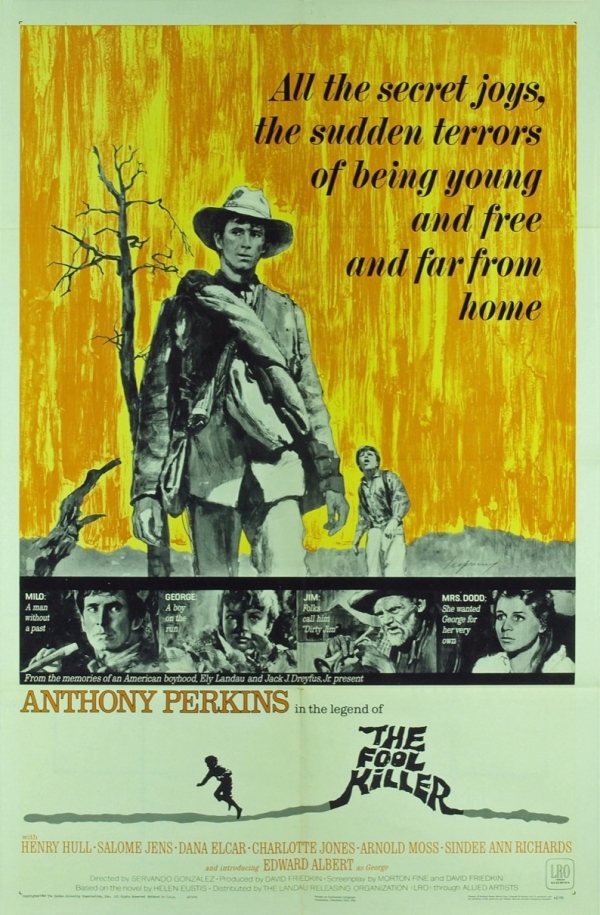
George Mellish (Edward Albert) is a 12-year-old boy who runs away from home after a particularly harsh beating at the hands of his foster parents. As he roams the Tennessee countryside he meets Dirty Jim (Henry Hull) an old man who takes him into his rundown home and fills his head with all sorts of stories about an eight foot ax-wielding man who kills people he deems to be foolish. After a bout of illness George runs away from Jim and late one night meets Milo (Anthony Perkins) a loner who carries an ax and acts strangely. Initially George thinks that he is ‘the fool killer’ Jim described, but the two soon become friends even though strange ax murders begin to occur everywhere they go.

Servando Gonzalez’s direction is excellent and the one thing that keeps this otherwise thin story intriguing. This was his only English language film and he uses a variety of different camera angles and editing styles to create a sort of hypnotic effect. The on-location shooting is vivid and their ability to recreate the look and feel of the late 1800’s is solid including having the characters occasionally speak with poor grammar, which helps with the authenticity.

The only thing about Gonzalez’s direction that I did not like is where they have a nighttime scene that was clearly filmed in the daytime, but done with a darkened lens to ‘fool’ the viewer into thinking it is night. This process has been done many times in the past, but it never works. Even with the dark lens the sky is too bright and you are unable to see any stars. I remember this done a few times on the old ‘Brady Bunch’ TV-show and I always found it disconcerting. The reason is usually because by law child performers are not allowed to work past a certain late hour, so if the script calls for a nighttime scene they try to compensate using this trick, but it always looks tacky. My solution would be to get the parent’s permission to allow the young performer to work late for one night or alter the script to have the scene done in the daytime.

Despite some good production values and an interesting narrative the story itself, based on a novel by Helen Eustis, is limp and doesn’t have enough action. The middle section, which features a lot of conversations between Milo and George, gets boring and the pace comes to a screeching halt. The George character also gets a bit annoying. I realize he is a young and the story takes place in a more innocent era, but the kid falls too easily for anything and everything he is told and seems to have no center, which eventually becomes off-putting.

For what it is worth Albert is good in the lead in what was his film debut and so is Perkins although with this he was risking getting typecast. I thought Henry Hull in one of his last roles was highly engaging and I also really liked Arnold Moss as a bombastic preacher giving a fiery sermon under a tent during a religious revival. Since the movie otherwise does not have much happening this scene tends to be pretty electrifying and vivid particularly the looks on the people’s faces as he preaches to them.

There is a sort-of surprise ending, but it is not that big of a deal and most viewers will probably see it coming long before it happens and they might also say to themselves ‘I sat through two hours of this just for that!’ as well. If the story had been a little richer with more twists or a subplot this might have been memorable, but as it is the final result is empty.

My Rating: 6 out of 10

Released: April 28, 1965

Runtime: 1Hour 39Minutes

Not Rated

Director: Servando Gonzalez

Studio: Allied Artists Pictures

Available: VHS

Going Places (1974)

going places

By Richard Winters

My Rating: 9 out of 10

4-Word Review: Guys with no morals.

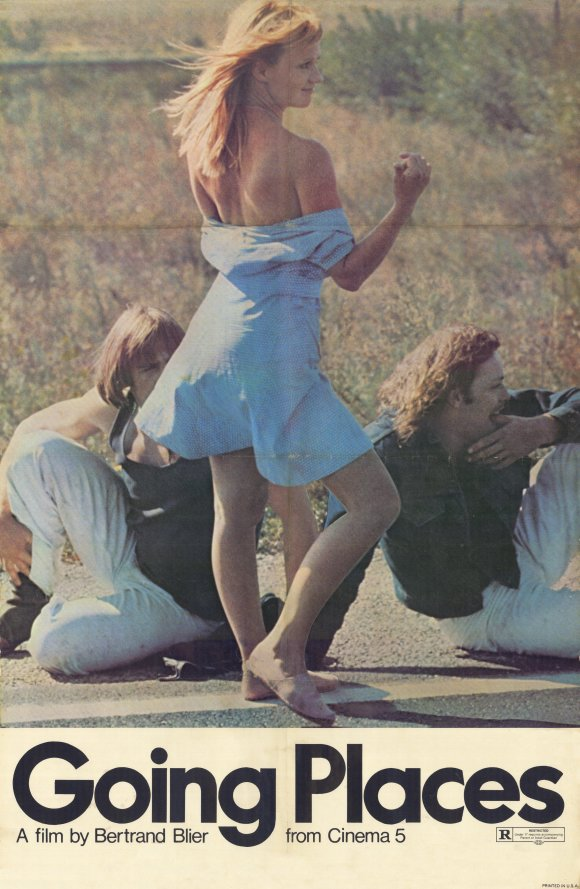
Two small time hoods (Gerard Depardieu, Patrick Dewaere) spend their days roaming the streets, robbing stores, and molesting women. In some ways this is truly an amazing film in what it is able to get away with. The two main characters are immoral, ignorant, insensitive, and brutal and the women are demeaned and degraded. The overall content is vulgar and perverse and yet somehow this thing comes off as a lyrical, offbeat delight that is pure entertainment.

It’s a definite original with every scene being an ingenious comic set-up. The scenario structure and use of locations is perfect. The pacing is fluid and director Bertrand Blier’s eye for detail near brilliant. The two hours move along like a breeze. It never gets boring and I actually almost wished it could have been longer.

The comic threads are hilarious and they get funnier and funnier as they go along. The guys’ constant, futile and very explicit attempts at getting a frigid woman (Miou-Miou) excited are a particular standout.

This is the type of black comedy that should be used as an example for all others. It’s consistently unique and manages to balance the ugly elements with the lighthearted without going overboard on either. It even throws in a surreal angle without a hitch.

Veteran French actress Jeanne Moreau has one of her finest latter career roles playing a lonely lady in desperate need of male attention. Her scene is well played out and even has a shocking conclusion. Depardieus ‘friendly’ conversation with a shopping mall security guard is another standout. The ultimate joke though may be in the film’s title as these guys are truly going nowhere.

My Rating: 9 out of 10

Released: March 20, 1974

Runtime: 1Hour 57Minutes

Rated R

Director: Bertrand Blier

Studio: Universal Pictures France

Available: VHS, DVD (Region 1 & 2), Amazon Instant Video

Where’s Poppa? (1970)

wheres poppa 2

By Richard Winters

My Rating: 9 out of 10

4-Word Review: Mother has to go.

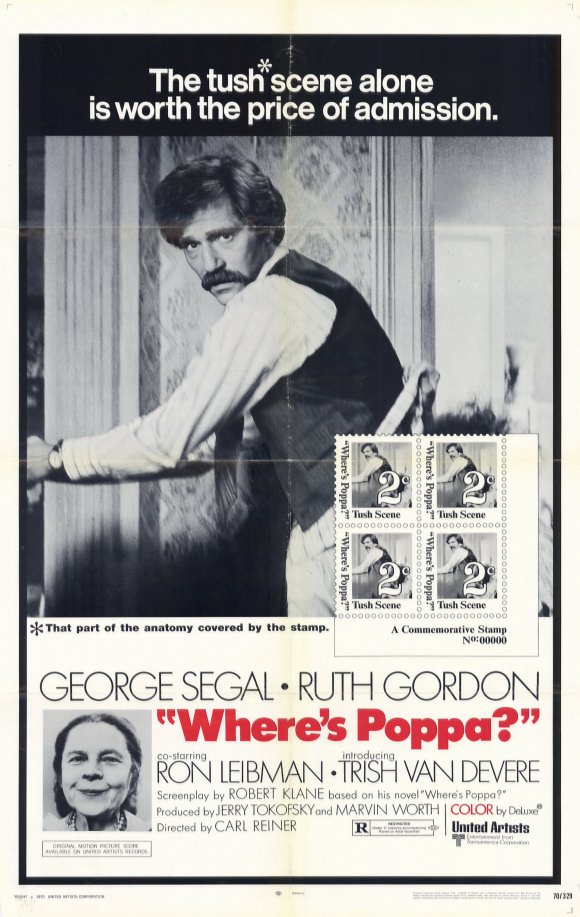
A beleaguered Gordon (George Segal) is a man who must take care of his invalid mother (Ruth Gordon). Despite being a handsome young lawyer he has literally become trapped by this very difficult woman. The majority of the film takes place in a 1940’s styled apartment. It’s gray, dusty bleakness permeates every shot and shows just how lodged Gordon is in his mother’s world. He is a normal man that is slowly being sucked into madness. He is becoming mad because the world he lives in and life in general is driving him to it. The wall between what he really wants to do in life and his obligations have become so thick that going crazy may be the only real answer.

In fact madness maybe pretty much is what this film is really about. It seems to be saying that there is a certain functioning normality to it and at times even a necessity for it. Everyone in this film conveys their own unique form of madness. There’s the overzealous war general (hilariously played by Barnard Hughes) There’s also the henpecked brother/husband Sidney (Ron Leibman) who goes to almost absurd lengths to make sure everyone is happy. Even innocent, conservative Louise (Trish Van Devere) opens into the crazy world when explaining her rather unique honeymoon experience. The film delves so deeply and consistently into the world of the absurd that at times the senile Mother really doesn’t seem so nutty.

This is the film’s genius. It takes everything we have always accepted and turns it inside out. It takes some of life’s most depressing things and then makes it into an inspired and creative masterpiece. A trip to the old folk’s home has never been considered by many to be funny or memorable, yet a trip to Paul Sorvino’s old folk’s home is. In fact it maybe one of the funniest scenes you’ll ever see.

Writer Robert Klane and director Carl Reiner show an amazing grasp of their material, which is crucial for its success. Everything is fluid and consistent in tone. It shows how you can indeed have an offbeat idea, do it in an offbeat way, and still succeed without compromising.

My Rating: 9 out of 10

Released: July 9, 1970

Runtime: 1Hour 22minutes

Rated R

Director: Carl Reiner

Studio: United Artists

Available: VHS, DVD
The Great Escape (1963)

the great escape 3

By Richard Winters

My Rating: 8 out of 10

4-Word Review: Tom, Dick and Harry

Based on a true story involving POW’s in an ‘escape proof’ German Prison camp who devise a way to get out by digging three tunnels, which will go under the barbed wire fence and allow them to get out under the cover of a nearby forest. They decide to build three tunnels and call them Tom, Dick and Harry, so if the German guards discover one of the tunnels they can simply continue to work on the other two.

The producers built a complete replica of Stalag Luft III were the actual events took place and used Wally Floody who was a prisoner of the camp and took part in the escape as an advisor. The movie moves at a polished pace grabbing in you immediately and keeping you involved all the way through. The characters share a great camaraderie and it’s a terrific testament to teamwork and how by everybody playing a little role can help make great things happen. Their resolve and ‘can-do’ spirit is infectious and one of the major reasons the film is so compelling. The bouncy, upbeat patriotic music is good although it gets played a lot and most viewers will most likely hear it playing in their head long after it is over.

I did feel that the depiction of the camp seemed a bit too cozy. The men are allowed to freely walk around and congregate in large meetings where they make their plans and it seemed to me that a heavily fortified prison camp wouldn’t allow for that, or at least be more on top of things. I wouldn’t say the German’s are portrayed on a ‘Hogan’s Heroes’ dumb level, but at times it gets close. For instance when the James Garner character lifts the wallet out of the pocket of one of the guards he does not become aware that it is missing for what seems like several days and then when he does he doesn’t suspect the Garner character and instead goes back to him and naively asks for his help in finding it. When the Germans find one of the tunnels there are no reprisals even though I and some of the others in my movie group who watched it with me felt that there should have been. Also, when the Steve McQueen character attacks one of the German guards when they shoot his friend who is trying to escape he is not sent to the cooler even though he had previously been sent there for far less infractions.

On the acting side it is all top-notch. McQueen is as cool as ever. I love his detached manner and rugged willing to take risks personality. His escape by motorcycle, which was added into the story by his request, is exciting and one of the most memorable moments in the film. Charles Bronson is good as one of the characters who are most instrumental at digging the tunnels however I felt that it seemed a bit far-fetched and like tacky Hollywood melodrama that he had spent so much time working inside the tunnels only to suddenly get claustrophobic about them just as they are trying to escape. David McCallum has very few words, but gets gunned down in exciting style at a train station. I normally love James Coburn and his character is appealing, but his attempt at an Australian accent is atrocious.

Spoiler Alert!

Despite its title the film really doesn’t seem like all that great of an escape. For one thing out of the predicted 250 that were supposed to escape through the tunnel only 76 made it out before the Germans caught onto it and closed it off. Of those 76 there are 50 who get caught, rounded up and shot at point blank range. 12 get returned to the camp and only 3 actually make it to safety. When the Steve McQueen character gets sent back to the cooler in the film’s final scene I felt a bit frustrated and depressed and that the big ballyhooed escape had really lead nowhere.

My Rating: 8 out of 10

Released: July 4, 1963

Runtime: 2Hours 52Minutes

Not Rated

Director: John Sturges

Studio: United Artists

Available: VHS, DVD, Blu-ray, Amazon Instant Video

King of the Gypsies (1978)

king of the gypsies

By Richard Winters

My Rating: 5 out of 10

4-Word Review: Daddy is a psycho

Dave (Eric Roberts) is the rebellious son of Groffo (Jud Hirsch) who no longer wants to be a part of the gypsy clan that he was raised in and instead a part of the American dream. However, when Dave’s grandfather Zharko (Sterling Hayden) lies dying in his hospital bed he gives the coveted medallion to Dave making him the new king of the gypsies. This sends Groffo into a jealous rage and orders two men to go out and kill Dave who now must elude them while trying to get his life together and help get his younger sister Tita (Brooke Shields) out of the clan as well.

Although far from being a complete success the film does manage to have a few unique and even memorable moments. The best is when a young Dave is used as a decoy in an attempt to rob a jewelry store. His mother Rose (Susan Sarandon) pretends to be a customer looking over some diamonds. When Dave creates a ruckus she tries to calm him down by having him drink a glass of water while also having him swallow a diamond that she has discreetly lifted from the display table. They are then able to walk out of the store when the merchants are unable to prove that they stole it only to have Rose later retrieve the jewel when Dave poops it out. Having Groffo put a 10-year-old Dave behind a wheel of a car and drive it down a busy Brooklyn Street is about as nerve-wracking as any car chase I’ve seen. The scene where Groffo tries to physically force Dave to have sex with his own mother is also incredibly startling.

However, despite these few interesting moments the film overall never really gels. The first half showing how the gypsy people live seems a bit clichéd and the way they openly cheat other people in order to make a living makes them unlikable and uninteresting. The only time it ever gets half way compelling is when it shows Dave struggling to survive on the mean streets of New York after he runs away from his psychotic father. Unfortunately this gets ruined when it constantly brings his family and past coming back to haunt him. The cat and mouse game that he plays with his father is not original and Hirsch makes for a very boring villain. He is unable to convey a menacing quality and thus there is never any real tension. The violin soundtrack compliments the gypsy tradition, but eventually becomes annoying.

Roberts is solid in his film debut. His voice-over narration coupled with his raw delivery is effective. Had the film focused solely on him and left out the silly gypsy sub-plot it would have worked much better.

Sarandon gives it some energy and she has the most effective accent. Shields is pretty much wasted and appears in only a handful of scenes. The biggest irony here is that the two played a mother and daughter before in Pretty Baby, which came out just 7 months before this one.

Hayden really seems to be having fun as the bombastic self-proclaimed King Gypsy. Watching him feud at the beginning with Michael V. Gazzo who plays the head of another gypsy clan is somewhat diverting. It is also interesting to see Shelly Winters in a part that has less than three speaking lines. This woman never seemed to ever want to shut up both on-screen and in interviews, so seeing her in a part that allows for so little dialogue is quite a novelty, but she still succeeds with it particularly in the part where she grieves over her dead family members.

It is fun to see a young Danielle Brisebois as well as Matthew Labyoreaux who later went on to play Albert in ‘Little House on the Prairie’. Annie Potts is good in a brief part and Patti LuPone makes her film debut in an uncredited bit.

My Rating: 5 out of 10

Released: December 20, 1978

Runtime: 1Hour 52Minutes

Rated R

Director: Frank Pierson

Studio: Paramount

Available: VHS, DVD, Amazon Instant Video