Category Archives: Movies Based on Novels

Kes (1969)

kes 1

By Richard Winters

My Rating: 6 out of 10

4-Word Review: Boy trains a kestrel.

Billy (David Bradly) is a poor working class youth living in Yorkshire who finds his existence to be bleak and pointless. He is bullied constantly by his older brother Jeb (Freddie Fletcher) and ignored by his burdened mother (Lynne Perrie) while also being picked on at school. As means of some solace he finds a nest of baby kestrels inside an abandoned building. He takes one of them and keeps it in his backyard shed where he trains it, which in return gives him a sense of purpose.

The film is based on the novel by Barry Hines who also wrote the screenplay and although the plot is basically the same it does vary in two major ways. The first one being that in the book everything takes place in one day and with a lot of use of flashbacks to explain the backstory, which I liked better, but here it’s given a linear narrative. The book also explains a bit more about the otherwise absentee father and even has one scene involving him while here the character is non-existent and never even mentioned.

On a purely cinematic level it is well made and nicely exposes Billy’s hopeless working class world without ever being heavy-handed. The drama is fresh and natural with each scene and character ringing true. The segments involving the training of the bird is the most engaging and I wished had been extended.

The children are fantastic without being too cute or precocious and respond to things in ways that are honest to their nature. The adult cast is good as well although not as likable. The teachers and school administrators, with their very old fashioned approach to discipline, come off as genuine jerks. At one point one of them even raps the open palms of the children’s hands with a cane, which makes their eyes well up with tears and is unpleasant to watch.

The worst is the segment involves Billy’s physical ed. teacher Mr. Sugden, which is played by Brian Glover who was an actual high school instructor at the time as well as a former wrestling. Here he plays a coach who brutally bullies his students in a scene that makes its point and then goes on too long with it. I also didn’t like that director Kenneth Loach superimposes the score of the soccer (football) game that the students are playing onto the screen, which wasn’t necessary as who wins the game was not important at all and hurt the film’s realism by distracting the viewer and taking them out of the story.

Some have complained about the thick dialect of the characters, which makes it hard at times to understand what they are saying. Certain American versions have been dubbed to make the lines uttered clearer although the version I watched, which was from the Criterion Collection, seemed to have the original accents intact, which I preferred as it kept it more authentic and for the most part I didn’t have any problem with it.

Spoiler Alert!

The only real issue that I had with the film is its downbeat ending. I realize that it is the same as the one in the book, but felt a bit frustrated that every time there is a movie dealing with a child taking care of an animal it always for some reason has to end in tragedy, which made it a bit formulaic. The kid never gets a break and having the falcon get killed at the end was like rubbing salt into the wound. The bird that actor Bradly buries apparently died of ‘natural causes’ but at the time he was under the belief that it had been killed simply to suit the purposes of the film and the angry reaction that you see on his face was very real.

End of Spoiler Alert!

kes 2

My Rating: 6 out of 10

Released: November 16, 1969

Runtime: 1Hour 50Minutes

Rated GP

Director: Kenneth Loach

Available: DVD, Blu-ray, Amazon Instant Video

Creator (1985)

creator

By Richard Winters

My Rating: 2 out of 10

4-Word Review: Cloning his dead wife.

Harry Wolper (Peter O’Toole) is an eccentric college professor obsessed with the idea of cloning his dead wife. With the help of an undergraduate assistant named Boris (Vincent Spano) he sets up a makeshift shed in his backyard and uses the university equipment for his experiments. He employs the services of Meli (Mariel Hemingway) a 19-year-old in desperate need of funds whose egg he uses as part of the cloning process. After a while she starts to fall in love with him and as the fetus of his dead wife takes shape she becomes jealous and feeling that he should be more concerned with the living than the dead.

O’Toole is engaging as ever in the type of role that most suits his talents. Had the film stayed centered on him it would have been a joy to watch, but unfortunately it enters in the generic Spano who looks like he was pulled straight off of the cover of a men’s modeling magazine. I presume this was because the studio felt a movie centered on a man over 50 wouldn’t attract the all-important 16-30 year-old demographic, but despite being an obvious chick-magnet he adds little and there was period in the middle where he isn’t seen for a long time to the point where I forgot about him and didn’t miss him at all.

Hemingway adds quirky energy as the free-spirit and her kooky romance with O’Toole adds genuine spark, but the film regresses by spending too more time focusing on Spano’s relationship with fellow coed Barbara (Virginia Madsen). This romance is very formulaic and makes the film seem like two movies in one while sucking all of its offbeat potential right out. If anything Spano should’ve fallen for his robot that is by far funniest thing in the movie.

Spoiler Alert!

David Ogden Stiers makes for a good antagonist and John Dehner, in his last theatrical film appearance, is solid as O’Toole’s loyal colleague, but the film’s biggest problem is when it shift gears and destroys the whole cloning angle completely. It then centers on a mysterious illness that befalls the Barbara character that like in Love Story never gets explained and comes out of nowhere. She goes into an immediate coma and is put on life support where her parents (Rance Howard, Ellen Geer) agrees much too quickly and without bothering to even get a second opinion to take her off of it and allow her to die. This then forces Spano to talk to her endlessly until just as the she is about to be disconnected she ‘miraculously’ comes back to life, which is too implausible, too contrived and too cute for even the most hopeless of romantics and helps ruin the engaging performances of its two lead stars, which is the only good thing about it.

End of Spoiler Alert!

My Rating: 2 out of 10

Released: September 20, 1985

Runtime: 1Hour 47Minutes

Rated R

Director: Ivan Passer

Studio: Universal

Available: VHS, DVD, Amazon Instant Video

The Strawberry Statement (1970)

strawberry statement 4

By Richard Winters

My Rating: 5 out of 10

4-Word Review: Students go on strike.

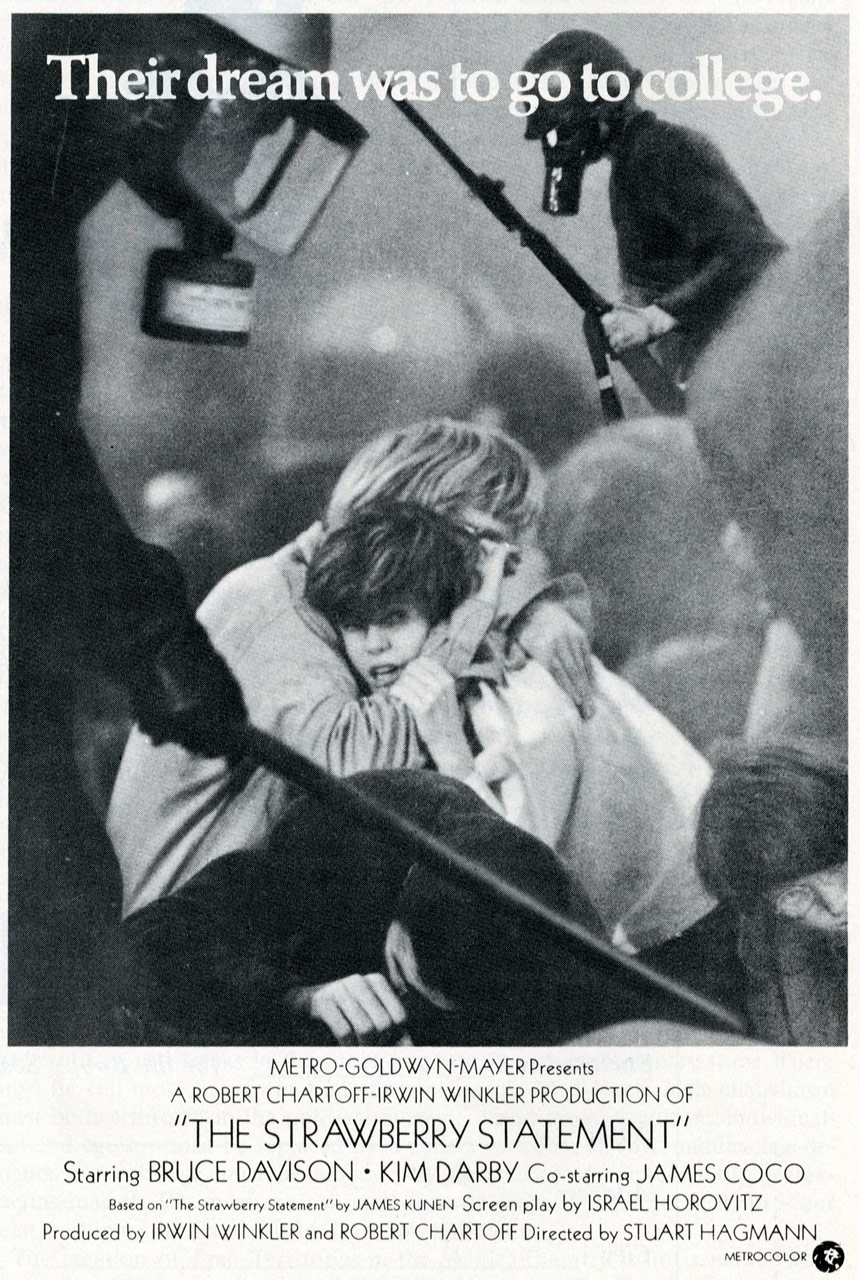
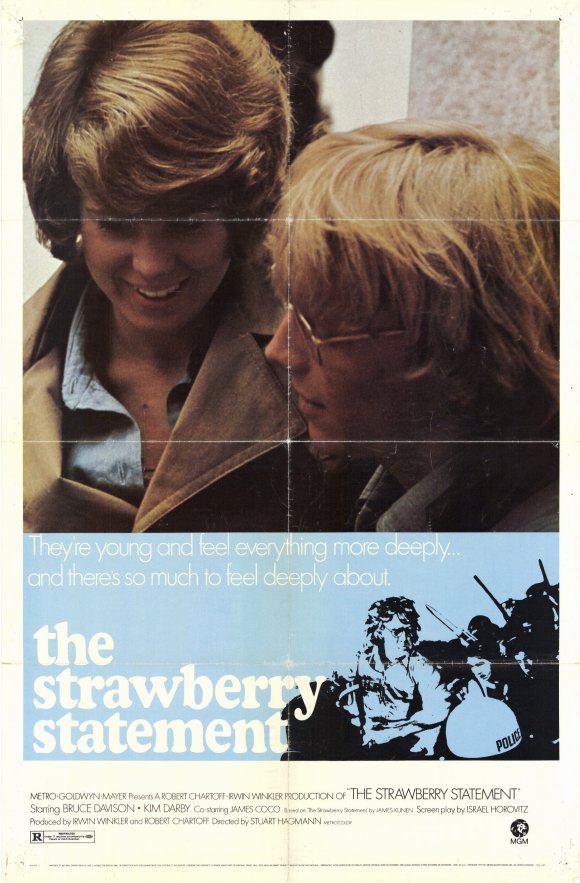
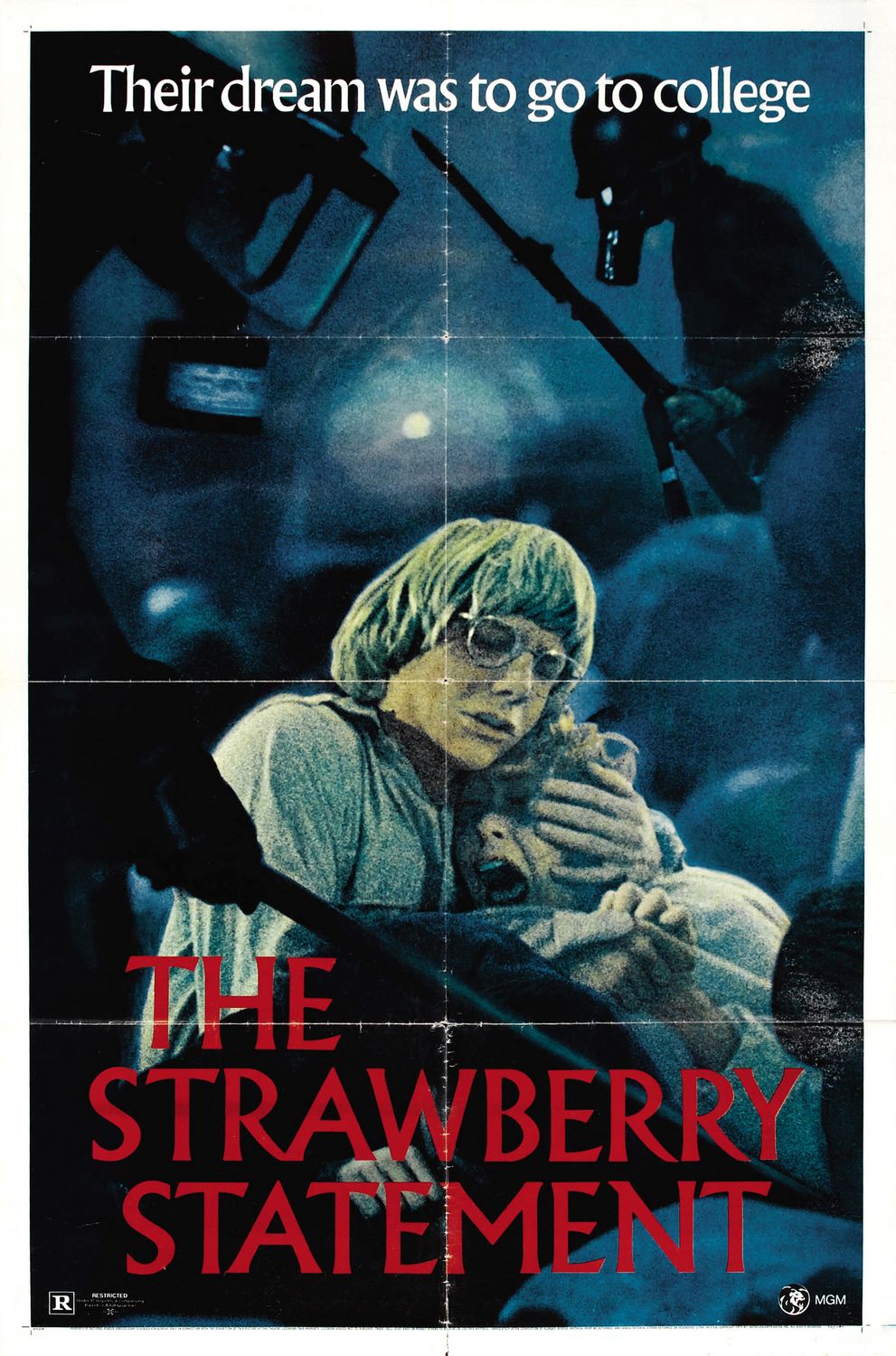
Simon (Bruce Davison) is a young college student attending a university simply as a means to get an education and find himself a good job. He has no real interest in the student revolt going on, but as a lark and a way to meet girls, he decides to passively get involved with students who have taken over the administrator’s building in protest of the school’s plan of building a gymnasium in an African American neighborhood. Slowly Simon finds himself taking up more of their cause and embracing their stance especially after meeting Linda (Kim Darby) who is much more of a student radical, but the two are ill-prepared for the brutal outcome when exasperated school officials have the police violently storm the building and haul the students out.

The film is based on the book ‘The Strawberry Statement: Notes of a College Revolutionary’ by James Kunen, which in turn is based on his experiences of being involved in a student sit-in that took place at Columbia University in April of 1968. The book’s narrative had more of an engagingly detached manner as it looked at the contradictions and hypocrisies of both sides while the screenplay by Israel Horovitz is nothing more than a commercialized effort to cash in on the counter-culture emotions of the time while glossing over or ignoring some of the book’s more perceptive points. The plot is too loosely structured and relies heavily on artsy camerawork and moody music to propel it until you get an hour into it and realize that nothing much has really happened. The whole thing would’ve been better focused had it been done with a voice-over narration by the main character.

strawberry statement 3

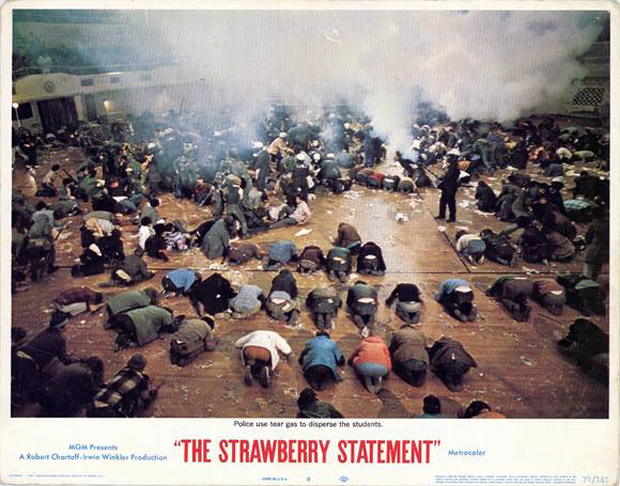
Although at times it borders on being pretentious I still found director Stuart Hagmann’s camerawork to be intoxicating especially the bird’s eye view of the students forming into several large circles as a way to block the police from entering and taking them out. Some of the scenes involving the demonstrations look staged and phony especially when compared to similar scenes of actual protests that were captured in Medium Cool that came out around the same time. However, the scene where the students grab a police officer, strip off his pants and force him down the slide and onto the swings at a children’s playground is downright amusing. The climatic sequence where the students are violently herded out of the building while sprayed with tear gas is well captured and by far the most startling and memorable thing about the movie.

Davison gives a solid performance and creates a middle-of-the-road character that is engaging enough to hold the thing together. It’s also great seeing Bud Cort playing an atypical role of an amorous girl-crazy coed who’s constantly looking to get laid. This film also marks the film debuts of David Dukes, Jeannie Berlin, Paul Willson, Andrew Parks, Kristina Holland and soap actress Jess Walton. You can also spot Horovitz and Kunen in brief cameo parts as well as character actor James Coco as a deli owner who’s all too willing to have his placed robbed simply so he can collect the insurance money.

Although they wanted to shoot the movie at Columbia where the incident actually occurred they were unable to get permission and were forced instead to do it at Berkeley, which in some ways helped it as the liberal, free-spirited look and mood of the region helped match the tone of the story. Ultimately though the film fails to ever really gel and comes off as being too placid and generic while failing to distinguish itself from the myriad of other student protest movies from that era.

strawberry statement 2

strawberry statement 1

My Rating: 5 out of 10

Released: June 15, 1970

Runtime: 1Hour 49Minutes

Rated R

Director: Stuart Hagmann

Studio: MGM

Available: DVD (Warner Archive), Amazon Instant Video

Private Lessons (1981)

private lessons

By Richard Winters

My Rating: 4 out of 10

4-Word Review: Housekeeper seduces a minor.

Mallow (Sylvia Kristel) is an English nanny working for a rich client named Fillmore (Ron Foster) who gets involved in a scheme with the family’s chauffer Lester (Howard Hesseman) to seduce Fillmore’s 15-year-old son Philly (Eric Brown). The idea is for her to fake having a heart attack during their lovemaking and convince Philly that he has killed her and then Lester will blackmail him to take $10,000 out of the family’s safe and give it to him has hush money for not reporting it to the police, but Philly is smarter than they think and not only catches onto their scheme, but has a double-cross in store for them as well.

The idea of having an adult making love to a minor most likely wouldn’t have gotten the green light today. To me it reeked of being a major double-standard. If the genders had been reversed and it had been a 15-year-old girl seduced by an older man this thing would’ve been considered obscene and banned, but because it involves a teen boy with ‘raging hormones’ instead that somehow makes it ‘okay’ and is approached as being nothing more than an innocuous sexual ‘coming-of-age’ flick, which I found to be both annoying and aggravating.

The scene involving the young Brown getting naked and hopping into the tub with the equally naked Kristel where they then fondle and kiss each other seemed like child erotica and will most likely make viewers today who are now much more sensitive on this topic feel uncomfortable to watch. The ending in which the two go to bed together in a very drawn-out sensual segment that is done under a romantic context is downright smarmy. Viewers wanting to watch this simply to catch Kristel naked will be disappointed to know that most of her nude scenes were done using a body double named Judy Helden.

The script was written by Dan Greenburg, who also appears briefly as a seedy hotel owner and based on his 1969 novel ‘Philly’. He is a noted humorist who eight years earlier wrote the script to the film with the quirky title of I Could Never Have Sex with any Man Who has Such Little Respect for My Husband. For the most part this film is rather bland, but manages to pick up a bit during the second half when the story twist kicks in that at the very least makes it better than most other teen sex comedies, which are usually devoid of any discernable plot at all.

The script though is full of holes. For one thing it is highly doubtful that a rich parent would give their child a combination to a safe that has tons of money in it and there is never any explanation of what was put into the body bag that is hoisted into the ground and buried when Lester was still tricking Philly into believing it was the dead Mallow. Obviously it wasn’t her, so what was used to make it seem like a dead body? The film never says, but should’ve. Also, I found it hard to believe that Mallow and Philly could go out to a fancy restaurant and make out with each other openly in a booth and not have it create a stir and distraction with the other patrons especially when it was clearly involving an adult and a minor.

Brown whose only other claim to fame was playing Ken Berry’s son in the first two seasons of ‘Mama’s Family’ gives an engaging performance, but I couldn’t help but wonder what his parents where feeling and thinking during the love scenes. It’s also interesting to see Hesseman who wears a wig and has his mustache dyed brown in a rare turn as a heavy. Begley Jr. gets a few kudos in his attempt to play a ‘tough guy’ cop and Dan Barrows makes the most of his small role as the family’s gardener.

The film has a surprisingly great soundtrack that feature a lot of hits from the day which include: ‘Hot Legs’, ‘Tonight’s the Night’ and ‘You’re in My Heart’ by Rod Stewart as well as ‘Just When I Needed You the Most’ by Randy Van Warmer, ‘I Need a Lover’ by John Cougar, ‘Fantasy’ by Earth, Wind and Fire, ‘Next Time You See Her’ by Eric Clapton and ‘Lost in Love’ by Air Supply. How such a low budget movie was able to pay for the rights to these songs is a mystery, but it definitely adds pizazz and helps give the film an extra point.

My Rating: 4 out of 10

Released: August 28, 1981

Runtime: 1Hour 27Minutes

Rated R

Director: Alan Myerson

Studio: Jensen Farley Pictures

Available: VHS, DVD, Amazon Instant Video, Hulu

Slapstick (Of Another Kind) (1982)

slapstick

By Richard Winters

My Rating: 2 out of 10

4-Word Review: These twins are extraterrestrials.

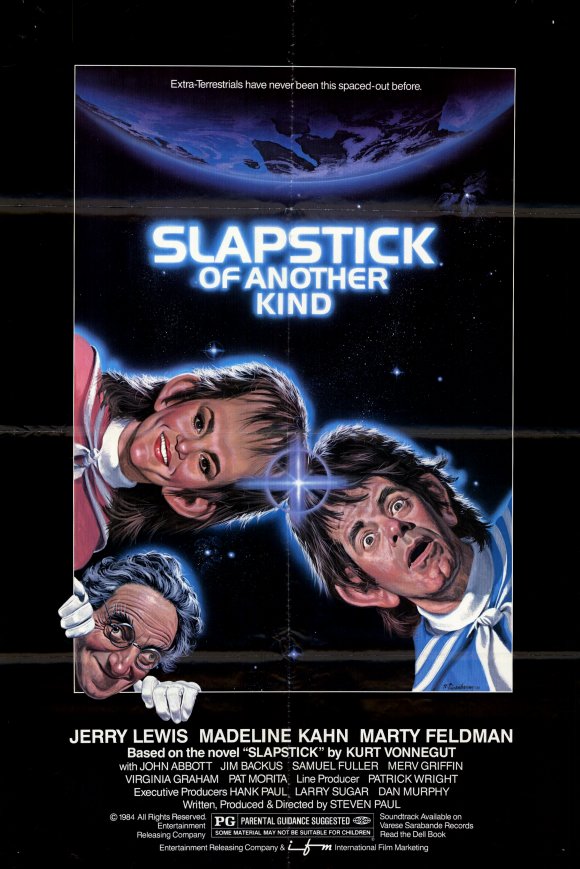
Based on the Kurt Vonnegut novel ‘Slapstick’ the story centers on a Caleb and Lutetia (Jerry Lewis, Madeline Kahn)  who are a rich and famous couple that give birth to deformed and ugly twins named Wilbur and Eliza (also played by Lewis and Kahn). The couple immediately disowns the children and has them put away into a home run by Sylvester (Marty Feldman) who acts as the children’s caretaker. Unbeknownst to anyone is the fact that twins are actually aliens implanted inside Lutetia by a race of super intelligent beings from a faraway planet as a way to help earthlings solve all of their problems. When the twins put their cone sized heads together they are super smart, but when they are separated they are dumb making everyone believe that they are mentally deficient and of no use to anyone.

The biggest problem with this disastrous attempt at a movie is the approach. Director Steven Paul who ironically made his acting debut in Happy Birthday, Wanda June, which was another Vonnegut book adaptation brought to the screen seems to have no idea what type of audience he is aiming for. The humor shifts wildly between child-like farce to satirical jabs with nothing in-between, which will alienate both adults and children alike. The grownups will find it incoherent and silly while the children will be frightened by the ugly visuals as well as the cold, callous nature of the characters and plot. There is also a strange side story that make no sense and deals with miniaturized Chinese men who are the size of a human thumb and fly around in a spaceship resembling an eggroll while trying to make contact with the twins in order for them the help make a deal on the sale of gravity?!!!!

Lewis and Kahn are relatively amusing as the snotty couple, but as the twins they are downright embarrassing. The scene where they have a food fight while yammering incessant baby talk is a degrading sight and a career low for both performers. I know Lewis has the reputation of doing some really silly, inane stuff, but even this should’ve been beneath him.

The eclectic supporting cast helps a little and the only reason that I’m giving it 2 points. Feldman is genuinely amusing and it’s great seeing Jim Backus in one of his last acting roles playing the President of the United States and hearing this predominantly kid-friendly performer utter the word shit…twice!

I have never read the novel from which this is based, but have heard that it is far superior, which isn’t a surprise. I’d be interested to know what Vonnegut, who apparently wrote the lyrics to a song sung by Kahn in the film, but then later cut, thought of this catastrophe. Some bad films are fun because you can make jokes about as it goes along, but this thing is so utterly bizarre from beginning to end that instead you sit in a stupor throughout and it becomes a surreal experience instead.

My Rating: 2 out of 10

Released: December 1, 1982

Runtime: 1Hour 22Minutes

Rated PG

Studio: International Film Marketing

Director: Steven Paul

Available: VHS, Amazon Instant Video

The Mean Season (1985)

mean season

By Richard Winters

My Rating: 4 out of 10

4-Word Review: Killer taunts newspaper reporter.

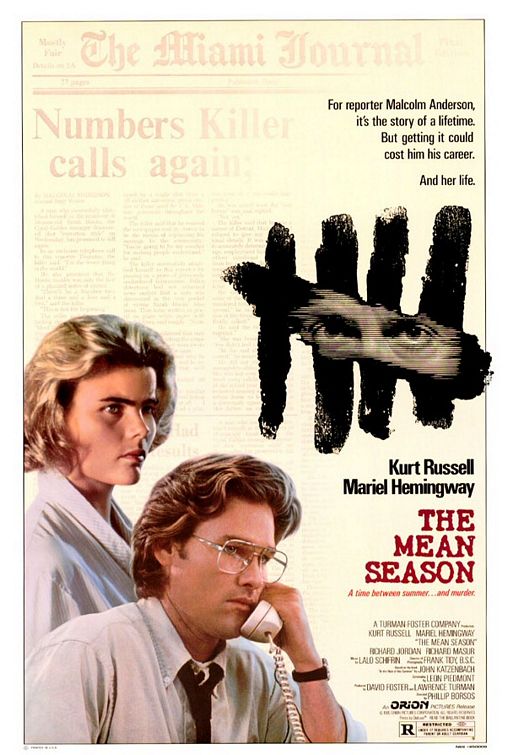
Feeling burned out from years of reporting on the local crime scene journalist Malcolm (Kurt Russell) has promised his girlfriend Christine (Mariel Hemingway) that he wants to get out of the business and move away to somewhere quiet and less hectic. Just as he’s ready to quit he gets a call from Alan Delour (Richard Jordan) the man who has been committing the recent killings that Malcolm has been covering in his newspaper. Malcolm sees this as a goldmine of information and thus delays his resignation. The two then begin a weird cat-and-mouse relationship until Malcolm becomes more of the story than the killer.

The movie starts out promisingly with a realistic look of the inner-workings of a big city newspaper. The film was shot during the overnight hours in the actual newsroom of The Miami Herald with Herald reporters used both as extras and consultants. Richard Masur makes for the perfect composite of a newsroom editor and I liked how the film shows the behind-the-scenes politics and the thin line reporters’ tow between reporting the news and becoming it.

I loved the on-location shooting done throughout Florida that helps bring out the varied topography of the state. Masur’s view out of his office window is dazzling and the climatic chase through the Everglades is exciting as is the speedboat ride in the swamps. The shot of a distant storm on the edge of an open field nicely juxtaposes the tension and dark story elements. The phrase Mean Season is actually a term used to describe a South Florida summer and gets mentioned in an early scene by a radio announcer as he is giving the weather report.

Russell is solid in the lead and it’s great and a bit unusual to see a protagonist who is not playing the nerd type wearing glasses. The segment where he jumps across a bridge as it’s going up and then watching him tumble down when he reaches the other side is well shot. Jordan makes for a good villain that manages to convey both a sinister side and a vulnerable one. Richard Bradford also deserves mention playing a tough cop that is at times quite abrasive, but also sensitive particularly in a couple of scenes where he comes into contact with scared children, which are two of the best moments in the movie.

The provocative concept has potential, but the film doesn’t go far enough with it. Instead of becoming this searing expose on journalism and the media it timidly steps back and turns into just another run-of-the-mill, by-the-numbers-thriller that becomes predictable, formulaic, and just plain boring during the second half and helps make this movie a big letdown.

My Rating: 4 out of 10

Released: February 15, 1985

Runtime: 1Hour 43Minutes

Rated R

Director: David Borsos

Studio: Orion Pictures

Available: VHS, DVD, Blu-ray, Amazon Instant Video, YouTube

The Intruder (1977)

Capture 52

By Richard Winters

My Rating: 4 out of 10

4-Word Review: Terror on the road.

Based on a story by Dean R. Koontz and filmed in France under the title Les Passagers the plot centers on Alex (Jean-Louis Trintignant) who picks up his 11-year-old stepson Marc (Richard Constantini) from school and sets off to drive him across France and into Italy where they are to meet his mother Nicole (Mireille Darc). Along the way they become menaced by a strange man (Bernard Fresson) driving a black van that begins following them. At first Alex thinks nothing of it, but when the van tries driving them off the road they go to the police who prove to be unhelpful, which forces Alex to take things into his own hands in order to save both himself and the boy.

The film starts off well with definite hints to Steven Spielberg’s classic Duel. I enjoyed how initially everything is from Alex’s and Marc’s point-of-view where we do not know the identity of the driver in the black van, which is only seen through the perspective of their rear window that gives the vehicle a creepy presence. The banter between the boy and step father is engaging and the fact that the kid is smart and shows a keen awareness of things and not just there to be cute is great. I also liked the bawdy tune they sing together and the shot of the boy driving the car while the father leans out the passenger side window.

There is an exciting moment where the van tries pushing their car off the highway while they’re on a winding mountaintop road that is well photographed and realistic. The two are subsequently forced to ride the rest of the way in a tattered vehicle that has no windshield and looks almost as beat-up as the automobile in Planes, Trains and Automobiles.

I did not like however that fifteen minutes into the movie we are shown the face of the other driver, which takes away from the intriguing mystery angle that is what made Duel so interesting. The bad guy isn’t frightening and comes off as clumsy and careless, which makes him less threatening. The fact that he does not carry any type of weapon and must resort to grabbing a nearby fire ax in order to attack Trintignant’s character when the two confront each other didn’t make much sense.

Spoiler Alert!

The film’s biggest transgression though is that its twist ending isn’t surprising at all as the mystery man turns out to be the wife’s psycho ex-boyfriend, which is something I had guessed early on and most other viewers probably will too. It also leaves open a tremendous amount of loopholes like why Alex wouldn’t have been made aware of this boyfriend earlier as I’m sure he would’ve been stalking them long before she got remarried and why the boy wouldn’t have guessed that the stranger chasing them was this man as well as most likely he would’ve known about him too. The police investigation, which gets worked in as a sort of side story proves pointless to the plot and the fact that they end up being quite incompetent makes them seem similar to the ‘comic relief’ cops from Last House on the Left, which hurts the tension.

End of Spoiler Alert!

This film has managed to acquire a small cult following and it has good set-up, but it would’ve worked better had it been done solely from the point-of-view of the father and stepson and only revealed the face and identity of the bad guy at the very end.

My Rating: 4 out of 10

Alternate Title: Les Passagers

Released: March 9, 1977

Runtime: 1Hour 36Minutes

Not Rated

Director: Serge Leroy

Studio: Warner Brothers

Available: None at this time.

The Flight of the Phoenix (1965)

flight of the phoenix 1

By Richard Winters

My Rating: 8 out of 10

4-Word Review:  Fighting the desert elements.

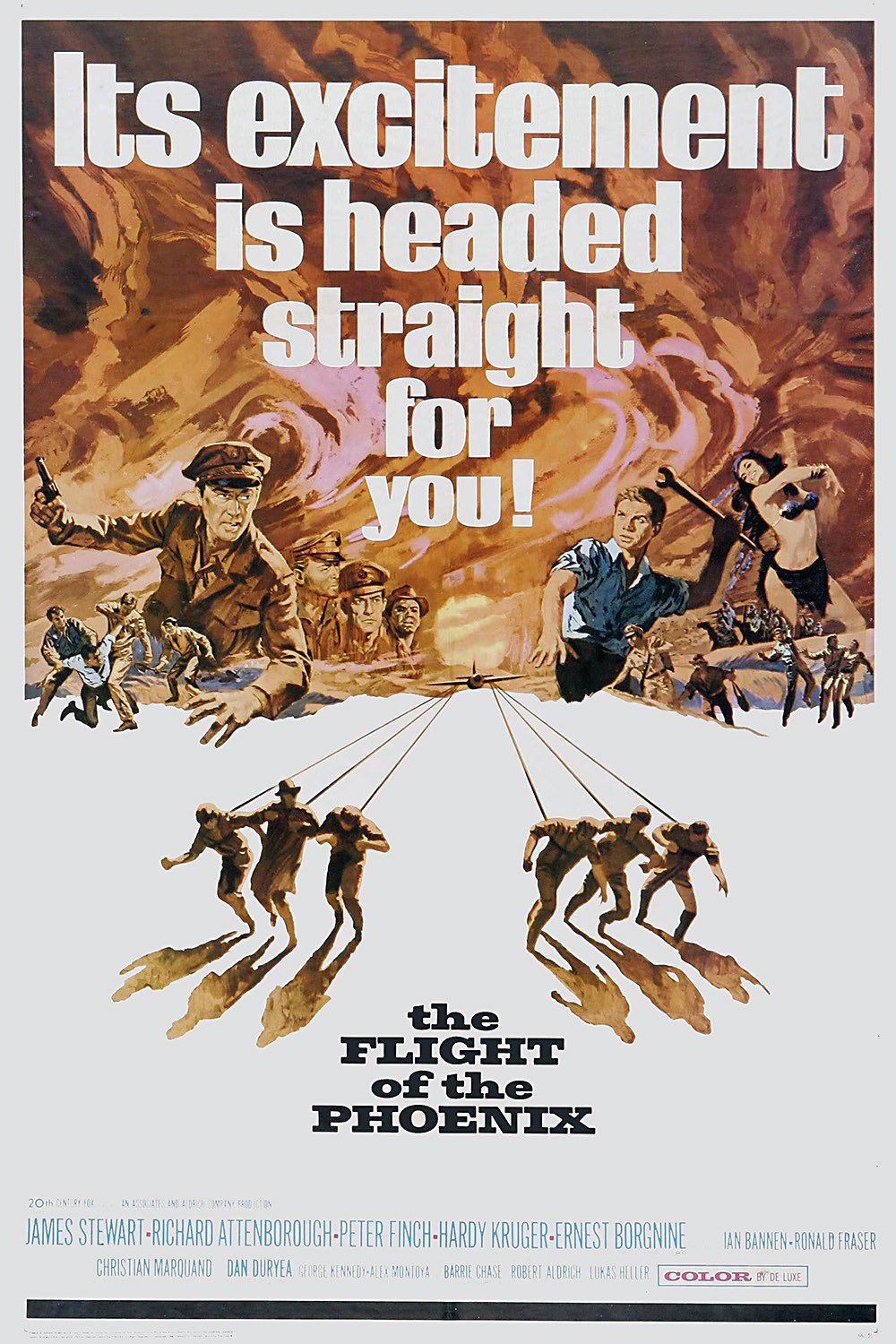
A cargo plane flying to Benghazi and piloted by Frank Towns (James Stewart) is forced to make a crash landing in the middle of the Sahara desert when a freak sand storm shuts down the plane’s engines. Of the 14 men on board two are killed instantly when several oil drums break loose during the crash which also injures a third. The rest of the men find themselves stranded in the searing heat with only dates as their food and a 2 week supply of water. The radio communication was destroyed during the crash and they are too far off their main route for anyone to find them. One of the passengers, Heinrich Dorfmann (Hardy Kruger) who works as a plane designer believes he has a way to take what’s left of the wreckage and build it into a new plane, which will then be able to fly the men out of there. Initially everyone else is skeptical, but eventually they begin working during the night to put it together while continuing to fight the elements and themselves in the process.

What makes this film stand out from the rest of the epic adventures is the fact that there is no good guy versus bad guy here. Every one of the individuals has their own unique character flaws and must learn to overcome them and their egos in order to work together as a team. The characterizations are realistic and multi-faceted making their conflicts believable from start to finish and helping to create a story that is gripping on both an adventure level and a psychological one.

Stewart is outstanding in the lead and I enjoyed seeing him play a part that is cynical and savvy and with less of the humble, country boy charm that he is known for. Kruger is solid in support and watching his confrontations with Stewart and then their eventual respect for each is the film’s main highlight. Richard Attenborough is also good as the sort-of moderator between the two and I also enjoyed Peter Finch as the brave and honorable Captain as well as Ronald Fraser as his sergeant who doesn’t quite share his same courage or sense of duty.

I was disappointed to some extent that it wasn’t filmed on-location in the Sahara and instead in Arizona and California although the desert locales look authentic enough even though eventually after two hours it becomes monotonous visually. Director Robert Aldrich keeps things believable including having the men visibly slow down physically as the days wear on as well as growing beards, which is something that sometimes gets overlooked in other stranded dramas although I was still confused why the Finch character formed a goatee instead of a full beard.

The climactic sequence is both nerve-wracking and exhilarating particularly the scene where Stewart tries to start the plane with only 7 cartridges remaining and with each one failing. Whether the logistics of this could actually occur is a big question, but it still remains grand entertainment.

flight of the phoenix 2

My Rating: 8 out of 10

Released: December 15, 1965

Runtime: 2Hours 22Minutes

Not Rated

Director: Robert Aldrich

Studio: 20th Century Fox

Available: VHS, DVD

Lisa, Bright and Dark (1973)

lisa bright and dark 1

By Richard Winters

My Rating: 4 out of 10

4-Word Review: Teen has mental illness.

Based on the acclaimed novel by John Neufeld the story centers on Lisa (Kay Lenz) a teenage girl who begins behaving in strange ways. She feels that she is suffering from some sort of mental illness and asks her parents (John Forsythe, Anne Baxter) if she can see a psychiatrist, but they refuse as they were raised in an era where mental illness was considered a ‘character flaw’ that didn’t occur to ‘respectable’ people and psychiatry was still thought of as a ‘new-age’ type of practice. Her friends (Debralee Scott, Jamie Smith-Jackson, and Anne Lockhart) think differently and try to get her the help that she needs, but when that fails they then read up on psychotherapy themselves and try to help Lisa with their own brand of therapy.

This film, which aired on NBC in November of 1973 as a Hallmark Hall of Fame presentation, was critically acclaimed at the time, but it has not aged well. I applaud the effort at trying to destigmatize the myth of psychiatry, but the drama often times comes off as strained and unintentionally funny. The sappy songs by Rod McKuen are abysmal and enough to drive the viewer as batty as the main character.

I found it strange how enlightened Lisa’s teen friends were about mental illness and wasn’t quite sure that I bought into it. I would think they would be just as confused and frightened of Lisa’s behavior as the adults and maybe try to stay away from her completely. Seeing how sympathetic Lisa’s classmates are to her condition is nice, but not realistic. At that age I would imagine some of the teens would ostracize and mock Lisa while considering her some sort of ‘freak’ and the film would’ve been better balanced had at least shown briefly some of that, which it doesn’t. The idea that these girls could read a few books by Sigmund Freud and then be able to perform psychotherapy is laughable and the whole thing would’ve been better served had it taken place in a college setting as the students all look college-aged anyways and the plot would’ve been more believable because it could’ve had her working with students or interns that were majoring in psychiatry.

The film never bothers to give any type of explanation for Lisa’s issues nor any inkling as to whether she was able to find some sort of adjustment through medication or therapy. It all seems like an excuse to promote the acceptance of psychiatry to the mainstream and not about the main character at all, which makes it come off as a thinly veiled ‘message movie’ and nothing more.

Lenz, who for a time was married to singer/actor David Cassidy, does well in the title role, but I didn’t care much of her toothy smile. It is fun seeing Anson Williams and Erin Moran in supporting roles as they both later became cast members to the long running TV-show ‘Happy Days’. Richard Stahl also appears as the father of one of the girls, but has his voice dubbed for some reason, which was quite strange.

My Rating: 4 out of 10

Released: November 28, 1973

Runtime: 1Hour 15Minutes

Director: Jeannot Szwarc

Studio: Hallmark Hall of Fame Productions

Available: DVD (Out-of-print)

Why Would I Lie? (1980)

why would i lie 2

By Richard Winters

My Rating: 3 out of 10

4-Word Review: He’s a compulsive liar.

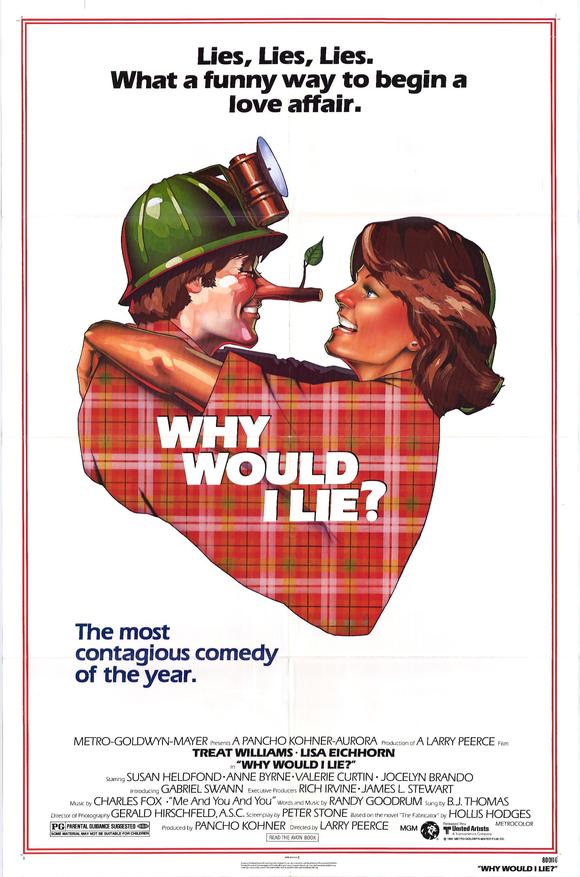
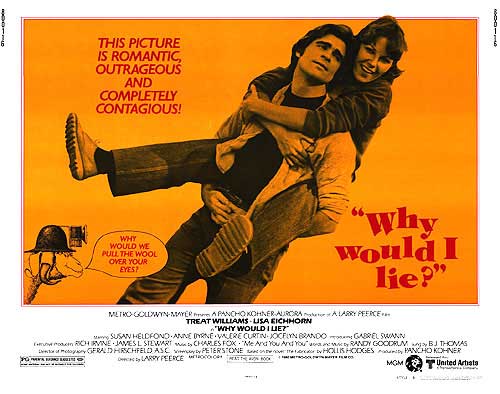
Cletus (Treat Williams) is a compulsive liar although he says they are simply ‘fabrications’ and tells them because it is his sincere belief that people don’t want to hear the truth and the lies are much more interesting. He gets a job at a welfare agency and gets involved with a young boy named Jeorge (Gabriel Macht) and trying to return him to his mother. The task turns into an uphill battle as the mother is nowhere to be found and relies heavily on Cletus’ lies to get him out of jam after jam. Whenever he does gets caught in one of his ‘fabrications’ he will always say ‘why would I ever lie about a thing like that?’ which quickly becomes the film’s catchphrase.

This goofy movie, which has never been released on DVD or VHS and had only a limited run during its initial release in August of 1980, seems unable to figure out what it wants to be. It starts out as a weird character study before moving into a quirky comedy and then ultimately devolving into a sudsy soap opera.  It’s unique for being filmed on-location in Spokane, Washington and even opens with a roaming, bird’s eye view of the city’s skyline, which has to be both a first and last.

The supporting female cast is the film’s biggest weakness as the characters are poorly written and defined. Valerie Curtain, who plays Cletus’ boss, decides to hire him for the job despite the fact that he clearly says some outrageous lies during the interview. When she becomes aware that he may be doing something improper in regards to the adoption process, she threatens him with legal action, so then Cletus pretends to romance her, which is so corny that it is an insult to any woman that the female character here could ever fall for it. He then meets Kay (Lisa Eichhorn) who after only knowing him for a few minutes invites him back to her place for sex, which even for the swinging ‘70’s seems outrageously forward and reckless. Then later when she no longer wants to go out with him because she’s not into any type of serious relationship Cletus advises her that he is ‘in love’ with her even though he’s only known her for a few days and like a hypnotist snapping his fingers this tacky line is somehow enough to get her to make a 180 degree turn and agree to move in with him.

The film also suffers from some very shallow logic. For instance Cletus is told that the boy’s mother may be in either Boston or Philadelphia, so using that little information he decides to take a trip to both cities in order to ‘search’ for her, which makes me wonder  how was he planning to do that. Will he knock on every door in each metropolis until someone with her name finally answers? I also thought that having the woman he is dating turn out to magically be the mother he is searching for and that she was simply living under a different name was too much of a cutesy coincidence and put this whole thing in the category  of a fluffy TV-movie if even that.

Williams manages to play the title role well enough that he keeps it watchable and even somewhat likable. The real scene stealer though is Macht in his film debut who goes by the name Gabriel Swann here. The kid is really adorable and his scenes with Williams are the best moments in the film.

The supporting cast is interesting, but essentially wasted although Jocelyn Brand (Marlon’s sister) has an amusing moment at the end. Severn Darden is good too as Cletus’ psychiatrist who does crossword puzzles while listening to his patients and then panics when he thinks one of them has jumped out the window. There is also a moment in the film where B.J. Thomas sings a song called ‘Me, You and You’, but unlike ‘Raindrops Keep Falling on My Head’, which was famously done in Butch Cassidy and the Sundance Kid this song is not memorable and does not help the film at all.

why would i lie 1

My Rating: 3 out of 10

Released: August 8, 1980

Runtime: 1Hour 45Minutes

Rated PG

Director: Larry Peerce

Studio: MGM

Available: None at this time.