Category Archives: Movies Based on Novels

The Don is Dead (1973)

By Richard Winters

My Rating: 3 out of 10

4-Word Review: Two Mafia leaders feud.

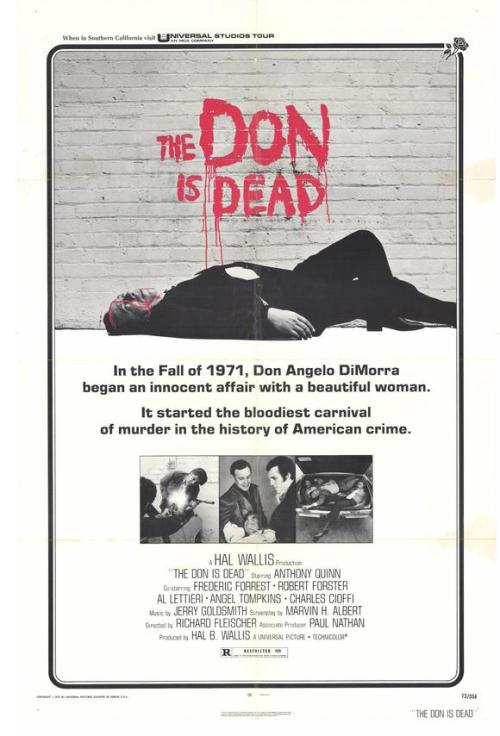
After the death of his mob boss father, Frank (Robert Forster) finds himself embroiled in the middle of a feud between two rival crime families. Don Angelo (Anthony Quinn) comes to Frank’s aid and agrees to take over the family business and then once he dies everything will go to Frank. Luigi (Charles Cioffi) and his greedy lover Marie (Jo Anne Meredith) are not happy with this arrangement and in an attempt to weaken the alliance they arrange for Don to meet up with Frank’s girlfriend Ruby (Angel Tompkins) while Frank is away in Rome on business. The two immediately hit-it-off and begin a hot-and-heavy affair. When Frank returns and finds out about this he flies into a rage by first beating his girlfriend and then swearing further vengeance onto Don. Don in turn puts out a hit on Frank, which escalates an endless bloody mob war.

During the early ‘70s with the success of The Godfather studios were churning out mob themed films about as fast as they could be produced. Many of them were vastly inferior to Francis Ford Coppola’s masterpiece, but this one may be the worst. The biggest problem is the nauseating violence that takes up the entire second-half. In The Godfather the killings had a lyrical quality that became a cinematic achievement and indelible on the viewer’s memory, but here the shootings are quite mechanical. Instead of being shocking they’re monotonous and impede the film from becoming anything more than just a cheap, uninspired Hollywood rip-off.

The film also lacks a likable character, which creates no emotional bond from the viewer to anyone onscreen nor any concern for who gets shot and who doesn’t. Tony (Frederic Forrest) is the only one with any type of arch as he wants out of the business at the start, but by the end is a hardened crime boss, which is too similar to Al Pacino’s quandary in The Godfather and only further cements this as being a poor man’s version of that one.

Forster is good despite displaying a rather affected accent. Quinn is also okay, but his character has little to do particularly by the second-half when he becomes almost comatose after suffering a stroke. What annoyed me most though was that there was never any final confrontation between the two. The whole thing revolved around a misunderstanding that they had, so a meeting at the end between them seemed almost mandatory, but it doesn’t occur making an already flawed film even more unsatisfying.

Marvin Albert, who was famous for writing the Tony Rome detective novels, penned this script, which is based off of his own novel, but the results are slight. The conflicts between the characters are not riveting and everyone comes off as being quite stupid for allowing themselves to be so easily mislead making the bloodshed that results from it even more grotesque. Maybe that’s the film’s point, but there have been so many better movies on this same subject that there really was no need for this one and whatever message it attempts to convey dies with the rest of the carnage on the screen.

My Rating: 3 out of 10

Released: November 14, 1973

Runtime: 1Hour 55Minutes

Rated R

Director: Richard Fleischer

Studio: Universal

Available: DVD, Blu-ray (Region B/2), Amazon Video, YouTube
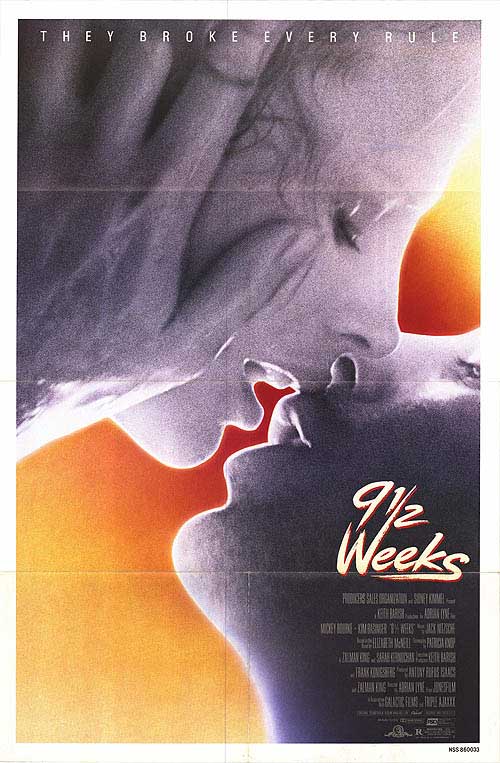
9 1/2 Weeks (1986)

By Richard Winters

My Rating: 3 out of 10

4-Word Review: A sexually charged relationship.

Elizabeth (Kim Basinger), a curator at a New York art gallery and recently divorced, meets John (Mickey Rorke) one day while shopping at a seafood place. Elizabeth is turned-on by John’s mysterious aura and they commence into having a torrid sexual affair that turns kinky, but eventually she becomes burnt-out by it and finds that besides the sex there is very little that they have in common.

The film is based on the novel of the same name written by Ingeborg Day under the pseudonym of Elizabeth MacNeil, which in turn was based on actual events that occurred to her when she was kept a virtual prisoner in her lover’s home for a period of two and a half months. The movie tones down the prisoner aspect and concentrates more on the erotic one, but the result is a confusing story that meanders without saying much of anything. The film was shelved for over two years because it kept getting bad responses from test audiences and constantly sent back to the studio for re-editing. When it was finally released it bombed badly at the box office.

The sexual aspect is tame and in these jaded times may even be considered laughable. The kink relies mainly on the use of blind folds and food items with the sex done from a feminine viewpoint that might arouse women, but unlikely to do the same for a man. The sexual games, as tepid as they are, get portrayed as being empowering to Elizabeth and something that allows her to release her ‘inner freak’, but I kept wondering what was John supposed to be getting out of all of this while she cavorts around naked or sucks provocatively on various food items. Maybe he was a voyeur that simply enjoyed watching and if so then it should’ve been made clearer because he comes off as nothing more than a transparent bystander otherwise.

We learn nothing about Elizabeth as the film progresses and her constantly giggly, screechy behavior makes her seem more like an immature schoolgirl and not a sophisticated, educated Manhattanite in her mid-30’s. She’s also too passive and easily manipulated without any reason given for why this is. Basinger’s performance is dull with a stunt double used during most of the sex scenes. Margaret Whitton who plays her best friend would’ve been far better in Basinger’s role because at least she shows some spunk and seemed genuinely human while Basinger is more like a zombie.

For a film with such strong erotic overtones there is surprisingly very little of it to see. The sex scenes show up in bits and pieces and then last for only a few minutes. In-between there’s long meandering segments that has nothing to do with the central theme and isn’t particularly interesting. The most memorable moment involves a conversation between Rourke and a bedding saleswoman (Justine Johnston) and even here things get botched because in one shot Rourke inadvertently knocks a vase off of a back shelf when he hops onto a bed in a showroom and then in the very next shot that same vase has magically gotten placed back.

I enjoyed the way director Adrian Lyne frames his shots as well as his color compositions and the provocative concept has a tantalizing quality, but Lyne seems confused about exactly what kind of message he wants to make with it and I think he was hoping that it would somehow manifest itself as the film progressed, but it never does. Bitter Moon, a film that came out 6 years later and had roughly the same idea, is far more impactful and worth your time in seeking out.

My Rating: 3 out of 10

Released: February 21, 1986

Runtime: 1Hour 57Minutes (Director’s Cut)

Rated R

Director: Adrian Lyne

Studio: MGM

Available: DVD, Amazon Video, YouTube

Black Eye (1974)

By Richard Winters

My Rating: 5 out of 10

4-Word Review: Find the walking cane.

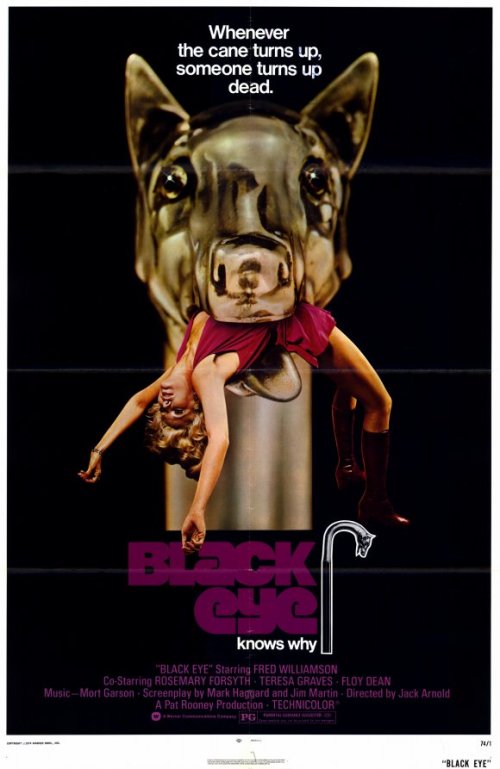
An old walking cane with a distinctive silver handle that had been used as a prop in many old Hollywood movies is stolen by a prostitute named Vera (Nancy Fisher) after it is laid on top of a casket of deceased actor at his funeral. Later Vera is murdered inside her apartment by a man named Chess (Frank Ashmore) who retrieves the cane, but not before coming into a violent confrontation with Shep (Fred Williamson) a black private eye who lives across the hall from her. Chess manages to escape, but Shep decides to track him down in an effort to find out why everyone is after the cane and what secret it might hold.

The film is an okay blend of action and mystery that tends to show its cards to soon. The revelation for why the cane is so much in demand is quite predictable and makes the viewer feel like they wasted an hour and a half of their time watching a pedestrian plot that leads nowhere. Director Jack Arnold dresses the story up by inserting offbeat scenes and eccentric characters that only adds a mild diversion to the proceedings, but still culminates with a flat finish.

Former pro football player Fred Williamson who played for the Kansas City Chiefs during the ‘60s is the best thing about the movie. Other athletes who turned to film acting after their sports careers were over were not as adept in front of the camera. Jim Brown for instance was great on the gridiron, but lacked an ability to play anything more than a hardened tough guy whose facial expression never changed. Williamson has more of an appeal because he doesn’t take himself or his role too seriously while also showing an ability to play either comedy or drama.

His female co-stars though are wasted and really didn’t need to be in it at all. Theresa Graves looks beautiful, but her character has no integral link to the story the lesbian angle dealing with the relationship that she has with her white girlfriend (played by Rosemary Forsyth) seems to be thrown in simply to give the film a certain perceived ‘kinky’ edge. Forsyth for her part has her voice dubbed and for what reason I don’t know, but it’s distracting and unnecessary.

88 year-old Cyril Delevanti, in his final film appearance, is quite amusing as an elderly man who’ll stop at nothing to get his cane back, but character actor Richard Anderson is a detriment. He plays a father who hires Shep to find his missing runaway daughter (Susan Arnold). At the end Williamson and Anderson get into a fistfight with Anderson doing his own stunts, which looks fake. A shot capturing him lowering his foot towards the camera in a dramatic attempt to show him stomping on Williamson (with the camera working as being Williamson’s P.O.V.) doesn’t work because it is clear that he is restraining his foot so it doesn’t actually hit the camera and break it. If you’re going to do a shot from this angel then have the foot actually pounce onto the camera even if it means damaging it because that would make it appear more authentic, or otherwise don’t do it at all.

For those that enjoy blaxploitation flicks from the ‘70s you may give this one, which is based on the novel ‘Murder on the Wild Side’ by Jeff Jacks, a slightly higher rating than I did. Some of the action is good especially a scene where Williamson escapes out of a immobile elevator and shimmies his way down the elevator shaft, but overall there’s nothing else about it that is distinctive to raise it above all the other black action films that are out there.

My Rating: 5 out of 10

Released: May 17, 1974

Runtime: 1Hour 37Minutes

Rated PG

Director: Jack Arnold

Studio: Warner Brothers

Available: DVD-R (Warner Archive), Amazon Video

The Right Stuff (1983)


By Richard Winters

My Rating: 6 out of 10

4-Word Review: The American space program.

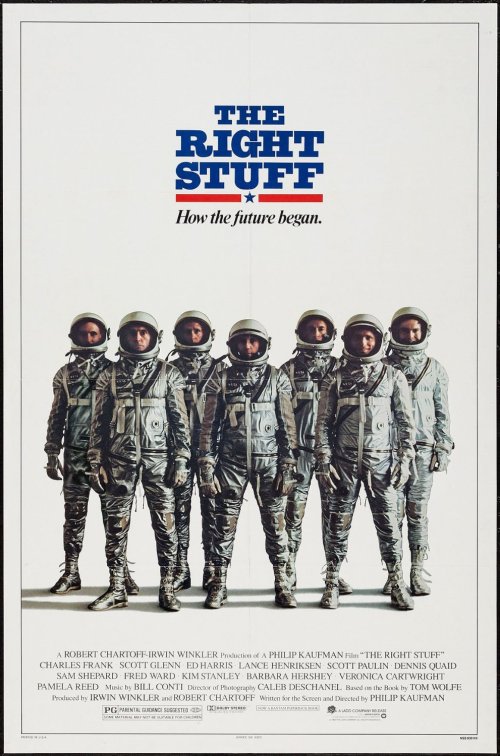
Based on the 1979 best-selling novel by Tom Wolfe, the film explores the history of the American space program starting in 1947 when test pilot Chuck Yeager (Sam Shepherd) successfully broke the sound barrier and then moving into the selection and training of the men who would lead the exploration into space culminating with John Glenn’s historic orbiting flight of the earth on February 20, 1962.

The film was a darling of the critics, but did poorly at the box office and I suspect this is due mainly to over reliance on comedy that eventually becomes off-putting. When doing a film dealing with historical events I don’t mind some comedy as real-life can always have its fair share of funny moments, but writer/director Philip Kaufman becomes obsessed with squeezing every ounce of humor that he can from each and every scene, sometimes even going off on tangents with it, until it seems like that’s more of the film’s focus. At the start there’s an okay blend, but then it gets out-of-control wacky, which creates a surreal world that seems to mock the events instead of tell them. The viewer also has to question whether the filmmaker’s, in their zeal to get a laugh in any way that they can, are really showing us something that is accurate or whether that was even a concern.

There’s also too many characters and they all possess the same clichéd all-American-fearless-good-ole’-boy charm that makes them indistinguishable from the other. The film should’ve had only one central character that the rest of the story revolved around. Supposedly the Chuck Yeager character (the actual Chuck Yeager appears briefly as a bartender) was supposed to do this by having him reappear throughout, but he is gone for so much of the time that you essentially forget about him.

This also becomes a problem when dealing with the story thread of Gus Grissom (Fred Ward) who supposedly ‘panics’ when his spacecraft splashes down. Because we never really get to know any of these characters on any deep level we have no clue why he behaves the way that he does. The scene where he supposedly explodes the hatch’s bolts, which in turn sinks the craft is disputed in its accuracy anyways, but it hurts the film’s pace either way. Spending virtually three hours being comical and then throwing in a highly dramatic element almost out of nowhere is jarring and then just as frustratingly it drops it without any suitable conclusion or exploration as to what might’ve really happened or why.

The production values are excellent, which is why I couldn’t hate it, but the movie also has tendency to one-up itself with each and every progressing scene and thus making John Glenn’s orbiting flight, which should’ve been the film’s highpoint, get lost in the shuffle. There’s also too much of a flag-waiving mentality that almost resembles a government produced propaganda film and helps give the movie an overblown, overreaching feeling when it’s over.

My Rating: 6 out of 10

Released: October 21, 1983

Runtime: 3Hours 13Minutes

Rated PG

Director: Philip Kaufman

Studio: Warner Brothers

Available: DVD, Blu-ray, Amazon Video, YouTube

Ironweed (1987)

By Richard Winters

My Rating: 8 out of 10

4-Word Review: Life on the streets.

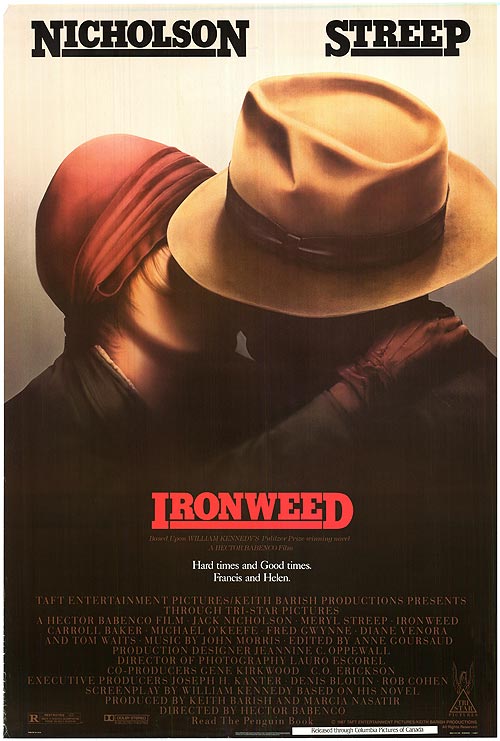
It’s the 1930’s and Francis Phelan (Jack Nicholson) has been living on the streets for over two decades. At one time he was a promising baseball player with a bright future, but then he accidently dropped his infant son and killed him. Dealing with the guilt and shame of it turned him into an alcoholic who roams the cold streets of Albany, New York looking for odds jobs and handouts when he can. He seeks out his lover Helen (Meryl Streep) for companionship and the two share a bottle of booze and their bitterness at the world that is ambivalent to their desperate situation.

The film is based on the novel of the same name by William Kennedy, who also wrote the screenplay and is directed by Hector Babenco who received wide claim for directing Pixote a film that dealt with homelessness in Brazil. This film is without question one of the best to tackle the lives of street people. Most films tend to treat the subject rather timidly and only analyze the topic from a distance (i.e. having a side character who is homeless, or maybe a main character who is temporarily on the streets), but this film engrosses the viewer completely into the homeless lifestyle while supplying absolutely no letup to their bleak existence. The result is a fascinating and revealing journey that shows how complex and multi-dimensional these people actually are while exposing every facet of the homeless experience including the indignities and dehumanization that they must face on a daily basis.

The casting is interesting particularly for the fact that both Nicholson and Streep had just starred together in Heartburn a year earlier playing a couple on the completely opposite side of the socio-economic scale. I commend Nicholson for tackling a challenging role that goes completely against his persona as normally he plays flamboyant types with over-the-top personalities, so it’s great seeing him take on a humble one who feels and acts like a complete miniscule to the world around him. However, the scenes where he interacts with the ghostly visions of people he has murdered in the past does not come off as successfully as it could’ve. The imagery is interesting, but the fact that he had played a character already that dealt with similar types of ghostly visions in The Shining causes the viewer to think back too much to that film and takes them out of this one.

Streep is outstanding and her constant ability to completely submerse herself into her characters and take on different accents with an amazing authenticity never ceases to amaze me. She really looks the part too by not only wearing no make-up, but having her teeth stained and darkened to effectively give off that decayed look. I’m genuinely floored at how many times most films neglect to do this. Actors portraying characters in destitute environments, or from the old west, may convey the down-and-out or rugged look physically, but their teeth still always look great when in reality they should’ve been in as bad of shape or worse as the rest of their bodies.

The supporting cast is good but they have little to do, which includes Fred Gwynne who appears briefly as a bartender. Carroll Baker though is excellent as Nicholson’s ex-wife. She was a blonde beauty that burst onto the scene in the ‘50s and was billed as the next Marilyn Monroe, but her acting ability quickly became suspect and by the ‘60s she was relegated to low budget B-movies and European productions, but in the ‘80s she made a Hollywood comeback in supporting roles and her appearance here was clearly her best performance and proves that she really could act. Margaret Whitton is also a standout as she takes part in one of the film’s few lighthearted moments as an eccentric woman who is prone to histrionic fainting spells and walking outside without any clothes.

The film though does suffer from a few too many dramatic peaks, which includes having two of Nicholson’s homeless friends die almost simultaneously, which only helps to lessen the effect by squeezing out more drama than it needs to, but overall this is a top notch effort where every scene and utterance rings true.

My Rating: 8 out of 10

Released: December 18, 1987

Runtime: 2Hours 23Minutes

Rated R

Director: Hector Babenco

Studio: TriStar Pictures

Available: DVD, Blu-ray, Amazon Video, YouTube

The Running Man (1987)

By Richard Winters

My Rating: 5 out of 10

4-Word Review: A deadly game show.

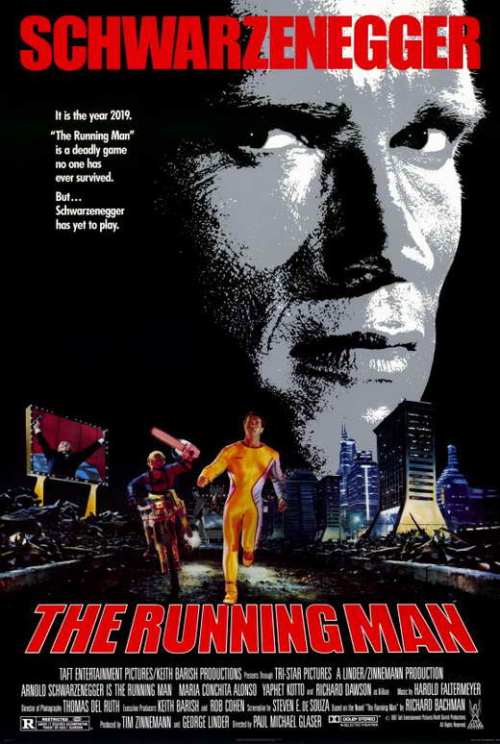
The year is 2019 and the United States has turned into a militarized police state. In an effort to keep people’s minds off of their bleak existence the government broadcasts game shows in which the contestants are convicted felons who fight for their lives against well-trained and well-equipped assassins called ‘stalkers’. When Ben Richards (Arnold Schwarzenegger) gets convicted of a crime he didn’t commit he is put onto one of these shows called ‘The Running Man’ as a contestant, which is hosted by Damion Killian (Richard Dawson). They then try everything they can to kill Ben, but to their surprise Ben proves to be far more resilient than they ever expected.

The film is based on a novel of the same name written by Stephen King under the pseudonym of Richard Bachman. However, the novel is far different than the movie, which had the main character traveling to different towns in the northeast while here the game show action gets confined to a dark, dingy studio. The main character was also thin and meek-looking, which would’ve been more interesting had he been that way in the movie as it would’ve made him seem even more like an underdog.

The film’s comic book look is fun for a while and the shots showing the audiences stunned reactions as Ben continually takes down these supposedly unbeatable stalkers is funny. It also makes some good points regarding media manipulation and the hypnotic power of television although it’s too generalized and could’ve gone further with it.

The casting though is particularly good including Ricard Dawson as the egotistical game show host. He did some acting during the ‘60s, but was mainly known for his work as a panelist on ‘Match Game’ and hosting ‘Family Feud’ and yet here he falls into his role with complete ease and easily steals the film. It’s also fun seeing Jesse Ventura, who later became the governor of Minnesota wearing a tacky looking wig. Former football player Jim Brown gets one of the best roles of his film career as a stalker whose punk hairdo resembles that of a skunks and Barbara Lux is amusing as an old lady who swears liberally.

While the dark humor is engaging the story does get quite derivative. Watching Ben defeat the stalkers one-by-one becomes mechanical and redundant. The film also fails to display any type of futuristic vision as the characters use phones that are still connected by a cord, have computers with big, clunky keyboards, and watch TVs that are still of the boxy variety.

Spoiler Alert!

The most disappointing element though is the ending, which differs greatly from the one in the book and is far too neat and tidy. The idea that one determined individual can single-handedly take down a deeply corrupt system is the stuff of romanticized fiction. Having the brain-washed masses suddenly become ‘de-converted’ by showing them actual news coverage wouldn’t really work. If people have been feed a lie for so long they’re not necessarily going to know what the truth is when it hits them and may actually just consider it to be a ‘lie’. Throwing in a ‘feel-good’ ending diminishes the dystopian theme and dark humor that came before it making the film nothing more than a marketing gimmick with no real bite.

End of Spoiler Alert!

My Rating: 5 out of 10

Released: November 13, 1987

Runtime: 1Hour 41Minutes

Rated R

Director: Paul Michael Glaser

Studio: Tri-Star Pictures

Available: DVD, Blu-ray, Amazon Video, YouTube

Airport (1970)

By Richard Winters

My Rating: 8 out of 10

4-Word Review: Terror in the skies.

During a major snowstorm at Chicago’s Lincoln International Airport manager Al Bakersfield (Burt Lancaster) must scramble to keep the place open while trying to get a disabled jet plane that is stuck in the snow off the runway. Meanwhile on a flight headed for Italy there’s the mentally unhinged Guerrero (Van Heflin) sitting with a bomb in his briefcase set to go off and explode the airplane and killing everyone inside, so that his family back home can collect on the insurance money.

The film is based on the best-selling novel by Arthur Hailey and despite some critics, like Pauline Kael, hating it for its soap opera-like dramatics I still came away feeling it was perfect crackerjack entertainment. The characters on the plane are quite diverse with unique problems and personalities making them seem like real people that the viewer becomes genuinely concerned for. The special effects, particularly those done inside the plane, are effective and the film has a nice dramedy balance.

The only drawback, and I hesitate to bring this up as I think they did the best they could’ve done under the circumstances, are the special effects dealing with the snow storm. It was shot at the Minneapolis/St. Paul airport during the winter of 1969, but unfortunately the whole time the film crew was there the weather remained sunny forcing them to eventually have plastic snow shown falling while the in the background the sky remains crystal clear and sunny. The snow shown falling during the nighttime scenes is equally problematic. I resided for many years in the North Country and I know that when it snows at night the sky gives off a bright white glow and it’s never pitch black like it is here.

The film was considered innovative at the time for its use of the split-screen particularly when it would show people talking on the phone to each other. Director George Seaton wisely doesn’t overplay this and uses the device sparingly for the most part however the segment where Lancaster is shown in one square talking to his wife, who is in another square along with their two daughters who each pop-up in their own individual squares it starts to resemble the opening to ‘The Brady Bunch’.

The acting by the female performers is quite strong. I was really impressed with Jean Seberg, her career started back in 1958 when she beat out 18,000 other applicants to get the starring role in Otto Preminger’s Saint Joan despite her lack of acting experience and although her performance in that film was lambasted by the critics I felt here she was solid and she could’ve easily carried the film during the scenes at the airport without Lancaster’s presence, who plays her boss, being needed at all.

Jaqueline Bisset is equally good as the stewardess who knows how to think on her feet.  I liked how this role didn’t take advantage of her looks or sexiness and instead kept it focused solely on her dramatic acting ability and I loved her shoulder length hair cut here as opposed to her really long hair style that she usually sports. Helen Hayes is hammy as the old lady stowaway, which netted her an Oscar, but Maureen Stapleton, who was also nominated for best supporting actress, is quite good too. Her talents lie more in her expressive face particularly the moment when she looks out the airport window and witnesses the plane carrying her husband, who she knows has a bomb, take off.

Dean Martin is excellent on the male end. Typically he comes off as tipsy and laid-back, but here he surprisingly takes the reins and helps propel the picture. George Kennedy is also surprisingly strong. Most of the time his presence amounts to nothing more than token supporting parts, but here he plays the gruff, brash airline mechanic to great effect and could help explain why his character was the only one to appear in all four airport movies.

The film does come off like it was released in the ‘50s instead of the 70s by having a cast that was mostly past their prime, but it’s by far the best disaster flick from the ‘70s, and there were a lot of them, as well as better than any of the three sequels that followed it.

My Rating: 8 out of 10

Released: March 5, 1970

Runtime: 2Hours 17Minutes

Rated G

Director: George Seaton

Studio: Universal

Available: DVD, Blu-ray, Amazon Video

The Eagle Has Landed (1976)

By Richard Winters

My Rating: 7 out of 10

4-Word Review: Plotting to kidnap Churchill.

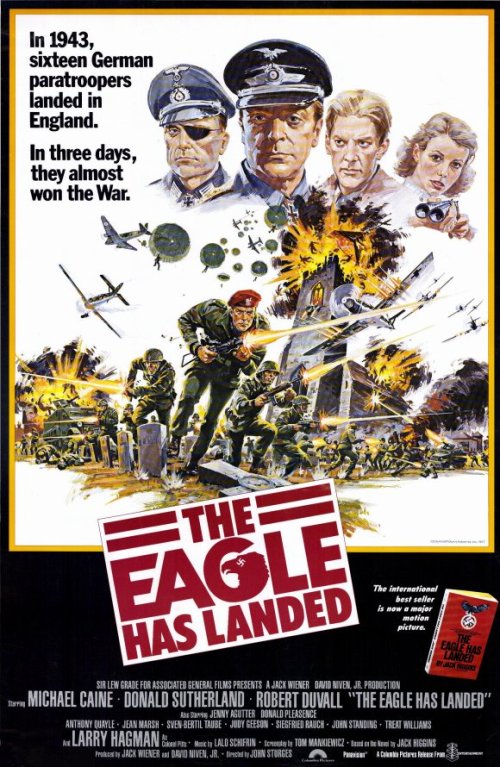
During World War II Nazi Colonel Radl (Robert Duvall) is hired to study the feasibility of kidnapping British Prime Minister Winston Churchill and bringing him back to Germany. At first he considers it an impossible task, but then learns that Churchill is set to visit an airfield in an English village where one of their German sleeper agents resides. He then hires paratrooper Kurt Steiner (Michael Caine) to lead the mission inside the village, but the plan quickly unravels forcing the soldiers to make a daring escape before the allied troops arrive.

This marks the final film directed by John Sturges who was noted for helming his share of action flicks and westerns. The film’s handsome production offers plush scenery, on-location shooting and some wonderful bird’s-eye-views. One could enjoy the movie on this level alone as well as its ability to focus more the actual planning of the mission than the fighting. It has a sort of behind-the-scenes approach to all of the thought and effort that goes into the strategy of war as opposed to the physical on the ground aspect. The film also takes a surprisingly humanistic approach to the Nazis portraying them more as regular human beings who just so happen to be fighting on the wrong side as opposed to the robotic, demonic persona that they’re given in most other war films.

The film’s faults lies in that it’s too leisurely paced. The planning stage allows for some interesting insight, but could’ve been trimmed while the action is sudden and jarring and only popping up near the end when it should’ve been introduced earlier. There is never any real danger to Churhill as the plan goes awry long before he arrives. Since the whole thing was fictional anyways then why not have the soldiers surround whatever building Churchill was in and thus making it seem at least that he might really get captured before having their plan unravel. The way it gets done here the viewer’s energy is strangely geared at seeing the bad guys escape capture, which is off-putting as is the gimmicky ending that makes everything that is shown previously seem insignificant.

The cast is impressive, but mostly underused. Duvall, who speaks with a dubious German accent, takes up most of the screen-time during the first half and then pretty much disappears altogether during the second part. Caine, who doesn’t speak with a German accent, or at least any that is detectable, seems stiff and uncomfortable in an uninteresting role that does not take advantage of his talents. Apparently he was originally offered the role of Liam Devlin who was a member of the IRA, but Caine refused it due to his personal political beliefs and was thus given the Steiner role on the rebound.

Larry Hagman, mostly known for his TV work, gets an amusingly showy bit as the inept Colonel Potts who tries to lead the US Army Rangers on a mission to rescue the village’s town folk who are held hostage by the soldiers. While the part takes full advantage of Hagman’s comic ability to play a hyper, emotionally frazzled character it seems out of place in this type of movie and almost turns the film dangerously close to becoming an ill-advised comedy.

Donald Sutherland ends up becoming the scene stealer as Liam Devlin who with his hair dyed red really looks Irish and speaks with an authentic sounding Irish accent. The character also has an unusual ability to whistle and then move his finger in a way that subdues an aggressive dog by seemingly putting it under a sort-of hypnotic spell. Whether anyone could really do this, or is there is some truth in what the character does here I don’t know, but it would be interesting to find out.

My Rating: 7 out of 10

Release: December 25, 1976

Runtime: 2Hours 3Minutes

Rated PG

Director: John Sturges

Studio: Columbia Pictures

Available: DVD, Blu-ray, Amazon Video, YouTube

Death Wish II (1982)

By Richard Winters

My Rating: 4 out of 10

4-Word Review: Architect becomes vigilante again.

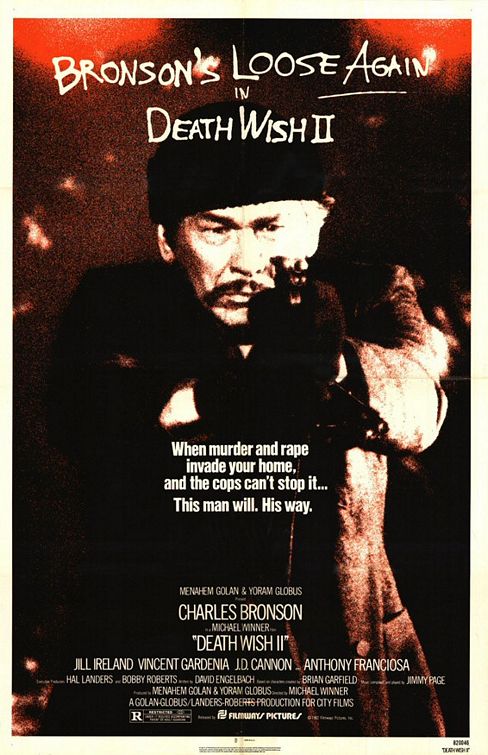
Paul Kersey (Charles Bronson) has recovered from his traumatic loss of his family from 8 years earlier and is now living in L.A. where he continues his work as a successful architect. One day while taking his new girlfriend Geri (Jill Ireland) and cationic daughter Carol (Robin Sherwood) to a fairground he gets robbed of his wallet by a gang of 5 thugs (Thomas F. Duffy, E. Lamont Johnson, Kevin Major Howard, Laurence Fishburne, Stuart K. Robinson). They use the address on Paul’s driver license to find his home and invade it while he is away. There they rape and kill his maid (Silvana Gallardo) and then when Paul returns they knock him out while kidnapping his daughter who they take back to their ‘hideout’. While there they attempt to gang rape her and in her effort to escape she’s impaled on a fence and dies. This sets in motion for Paul to return as a vigilante this time prowling the underground neighborhoods of L.A. where he’s motivated to shoot each of the 5 gang members who participated in the crime.

The film is less like a sequel and more just a slight variation from the original. Having to go through yet another home invasion/rape sequence, which is almost shot-for-shot the exact same as in the first installment (if even more exploitive) is mechanical to the extreme and an insult to the viewer. It’s like a TV-station promising their audience a new episode of their favorite series only to end up showing them a rerun instead. The story should’ve evolved more perhaps having Paul now becoming a ‘professional vigilante’ and being hired by people to track down the killers of their loved ones or at least something that would’ve taken the theme in a slightly different angle.

There continues to be the issue, like in the first film, of why does Chuck constantly get marked by these hoodlums for harassment anyways. For instance at the fairground there’s many other people milling  around and yet for some reason it’s Bronson, this very nondescript middle-aged man, that becomes their target.

The recasting of the daughter role is another problem. In the first film she was played by Kathleen Tolan and portrayed as being an adult married woman. Here though the character has regressed back to being a teenager and looking to be no older than 18 if even that.

To some degree on a sleazy B-level it actually hits-the-spot the soundtrack is done by former Led Zeppelin guitarist Jimmy Page and it is perfect especially the strained, loud electric guitar chords that effectively reflect the film’s dark, grimy mood. Most of the locales were filmed in actual buildings that were abandoned and in crime-ridden areas forcing the cast to require 20 off-duty police guards for protection. There’s even a scene featuring large squealing rats roaming around at the character’s feet as they say their lines.

The fact that Paul hunts down the actual perpetrators of the crime is on an emotional level satisfying, but it also becomes a logistical problem as it’s just not believable that he’d be able to find them all at random times, one-by-one simply by going to the city’s ‘bad areas’. I was also flabbergasted that in a later scene when Paul returns home from shopping and after dealing with his home being invaded now twice by crooks he doesn’t bother to lock the door once he gets inside, which you would think would be the first thing done each and every time!

The one interesting aspect that could’ve helped the film stand-out was the reintroducing of Vincent Gardenia who played the NYC police chief Frank Ochoa who tracked down Kersey in the first film and does the same here, but not to  arrest him, but instead to kill him. This could’ve created more tension had it been played out effectively as Kersey would constantly have to watch his back for an attack while simultaneously attacking the thugs when he came upon them. Unfortunately this side-story dies before it gets going when Ochoa gets kill just as he decides to help Kersey, which in itself could’ve been an intriguing odd couple-like pairing.

The ending  jumps-the-shark by having Kersey disguise himself as a doctor so that he can infiltrate a mental hospital in order to kill the last of the thugs who now resides there. This segment though becomes more like a scene from one those cheap horror movies with an asylum setting and not like an action flick at all.

The credibility gets seriously strained too by having Kersey constantly coming into contact with regular citizens who always conveniently side with him when it is most needed and thus helping him escape the clutches of the authorities. Sure this might happen every once in a while, but eventually he would confront someone who sees things differently, which all helps to make this film too dumb to take seriously, but slick enough to appease those looking for nothing more than simple-minded action.

My Rating: 4 out of 10

Released: February 19, 1982

Runtime: 1Hour 28Minutes

Rated R

Director: Michael Winner

Studio: Filmways

Available: DVD, Blu-ray, Amazon Video, YouTube

Death Wish (1974)

By Richard Winters

My Rating: 7 out of 10

4-Word Review: Architect becomes a vigilante.

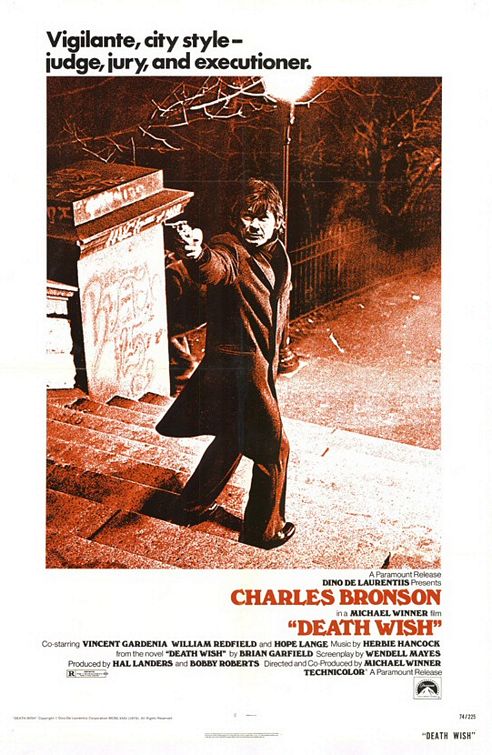
In connection with the Eli Roth/Bruce Willis reboot that is set to be released to theaters this Friday I thought now would be a good time to go back and take a look at the original. The story centers on Paul Kersey (Charles Bronson) who works as an architect and lives a comfortable life with his wife Joanna (Hope Lange) and adult daughter Carol (Kathleen Tolan). One day while he is at work his New York apartment gets invaded by three thugs (Jeff Goldblum, Christopher Logan, Gregory Rozakis) who kill his wife and rape his daughter. Paul becomes outraged that the police can’t seem to make any headway on the case and decides to take matters into his own hands by becoming a self-styled vigilante shooting random thugs on the street late at night, which in turn has him becoming a cult hero to the many residents of the crime ridden city.

The film is based on the novel of the same name by Brian Garfield. Garfield was inspired to write the story after his car got vandalized. He initially fantasized about tracking down the criminals and killing them before eventually speculating what would happen if someone actually went through with these feelings and decided to take the law into their own hands. The main difference between the novel and film is that in the book the vigilantism becomes more of the problem while in the movie it’s considered the solution.

Many critics at the time gave the film unfavorable reviews as they felt it advocated violence, but I found the movie to have a certain uplifting quality. While the message is certainly simplistic and one-sided it still nicely conveys the idea that ordinary citizens can make a difference and it is up to us, the American public, to foster change and not to simply leave it up to someone else. The film doesn’t completely promote violence as the solution either as there is one scene where an old lady (Helen Martin) scares off her attacker simply by using her hat pin.

The problem that I had with it was why does Bronson constantly get harassed by these thugs in the first place? Whether he is at a restaurant or on the subway the bad guys constantly hone in on him for no apparent reason even when there’s plenty of other people around. In the book it made more sense because the title character would intentionally set traps for the thugs like abandoning his car and putting an ‘out of gas’ sign on it, so the criminals would try to rob the vehicle and then when they did he’d shoot them. Of course this would make the character’s motives more questionable, which the film wanted to avoid, but in the process it becomes less believable.

While this has become Bronson’s signature role it still would’ve worked better had a less brawny actor played the part. In the book the character is a meek accountant and someone like Jack Lemmon, who was originally considered for the role, would’ve been a more authentic fit. Bronson’s image is so entrenched as a ‘tough guy’ that his presence here seems like just another of his action themed vehicles. Chuck should’ve also not known how to use a gun right away either and maybe even been initially clumsy with it as it would’ve made the character arch from peaceful novice to sharp shooting vigilante stronger.

I liked Michael Winner’s directing particularly the way he shot the interiors of the apartments and his grimy portrayal of the urban New York setting that perfectly played-up the city’s crime ridden paranoia at the time. This is also a great chance to see some young performers before they were famous including Christopher Guest as a patrolman. I also found it amusing that Paul Dooley and Vincent Gardenia share a brief scene together as they both went on to play the dad character in Breaking Away. Dooley portrayed him in the movie version while Gardenia played the part in the short live TV-series.

My Rating: 7 out of 10

Released: July 24, 1974

Runtime: 1Hour 33Minutes

Rated R

Director: Michael Winner

Studio: Paramount

Available: DVD, Blu-ray, Amazon Video, YouTube