Category Archives: Movies Based on Novels

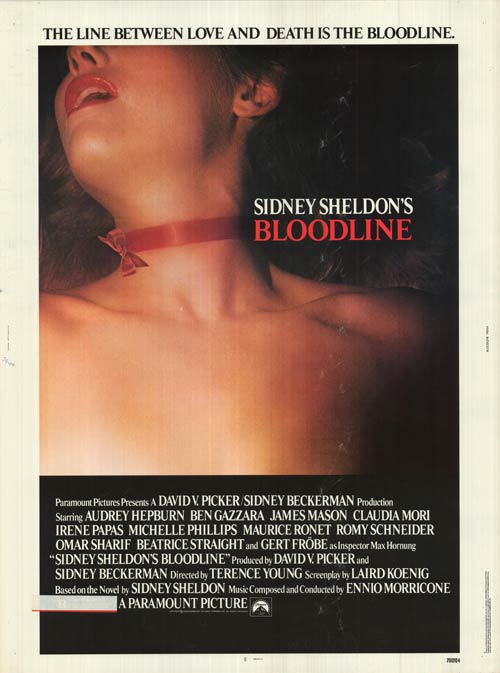
Bloodline (1979)

By Richard Winters

My Rating: 2 out of 10

4-Word Review: Killer stalks rich heiress.

When her father dies under mysterious circumstances Elizabeth (Audrey Hepburn) is given full control of the company he founded, Roffe Pharmaceuticals, a billion dollar empire. Elizabeth soon learns that there’s a power struggle going on amongst the board members and when she refuses to allow the company’s stock to go public she finds that her life is now the target of a mysterious killer who stages ‘accidents’ to occur where ever she goes.

This film marked Hepburn’s last starring vehicle in a theatrical feature and if it weren’t for her presence this thing really wouldn’t be worth seeking out and barely is anyways. The story is based on the best-selling novel by Sidney Sheldon, but comes off more like a hackneyed whodunnit featuring many derivative elements that you’ve seen hundreds of times before in other mystery films that were better done.

Some of the more annoying aspects include the loud, overplayed orchestral score that would be better suited for a sappy romance. There are also segments dealing with Gert Frobe, who plays the lead investigator on Elizabeth’s father’s case, who does most of his detective work sitting in a lab and interacting with a computer whose over-the-top robotic voice turns the whole thing into unintentional camp. I also thought it was dumb that Elizabeth listens to a audio tape recorded by her father just before he died in which he states that he thinks he knows which board member is trying to kill him, but then doesn’t reveal his name, but wouldn’t it have been wise to state that on the tape, so if he ended up getting killed there would be recorded evidence to help the investigators nab the right person? The film also features a recreation of the backstory showing how the father founded the company, which is corny as hell as well as a kinky subplot dealing with snuff movies, something that was added into the script after production had already begun, but wasn’t needed.

The accidents, which should’ve been the film’s highlight become boring throwaways instead. Hepburn’s car crash, which occurs when the killer fiddles with the brakes, is poorly edited and the injuries that she sustains are too superficial, a few bruises and scratches on the side of her face that immediately go away the next day. Her close call in a rigged elevator gets equally botched. We see a split second visual of an elevator speeding down a shaft and only later told that it killed her best friend (Beatrice Straight) who was inside it, but Hepburn decided at the last minute to step out of it to get something that she forgot inside the office, but this is something that the viewers should’ve seen as movies are a visual art and not just explained by Hepburn afterwards.

The variety of exotic locations, which was shot throughout Europe, adds some zest and the eclectic cast is interesting although most are wasted. With that said I still found Romy Schneider, who plays a female race car driver, to own every scene she is in, which proves what a great actress she was as she’s able to make her part flashy despite the weak material. Omar Sharif is also fun as a henpecked husband who finds himself not only dominated by his demanding wife (Irene Papas) but his lady lover as well.

Ultimately though it’s too hokey to take seriously and offers no intrigue. Even Hepburn becomes a problem by playing a character who doesn’t make any sense. She tries to get Ben Gazzara to marry her by admitting it’s for convenience only and that he’d still have his ‘freedoms’ to do ‘other things’ on the side and she’d agree to look the other way. Then when they finally do get married and he meets some of his other lovers at a restaurant she becomes enraged and runs out. This causes him to call her a ‘neurotic bitch’ which given the circumstances I would have to agree with.

Alternate Title: Sidney Sheldon’s Bloodline

My Rating: 2 out of 10

Released: June 29, 1979

Runtime: 1 Hour 57 Minutes

Rated R

Director: Terence Young

Studio: Paramount

Available: VHS, Amazon Video, YouTube
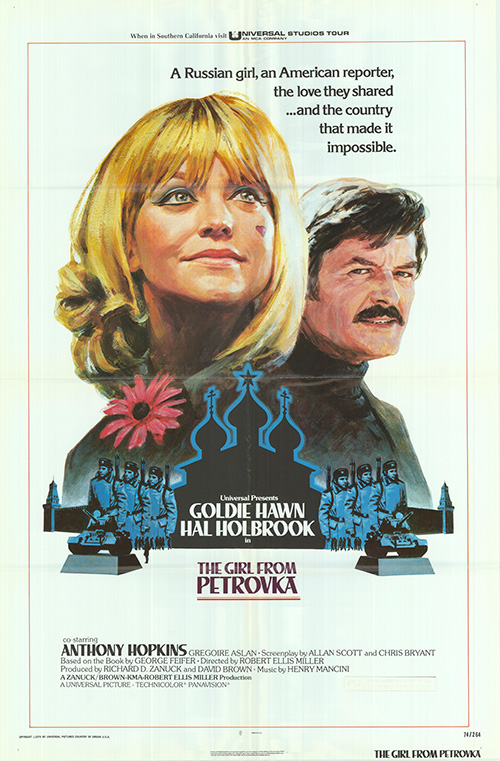
The Girl from Petrovka (1974)

By Richard Winters

My Rating: 2 out of 10

4-Word Review: An American/Russian romance.

Oktabrina (Goldie Hawn) is a young Russian ballet dancer living in the country without proper documentation. Joe (Hal Holbrook) is an American journalist staying in Moscow as a foreign correspondent for the Chicago Herald. Joe becomes attracted to her youthful beauty while she likes the fact that compared to her impoverished lifestyle he has a lot of money and lives in an apartment that seems ‘like a palace’. The two begin going out, which attracts the attention of the KGB who raid her apartment while she’s not there. This forces her to stay at Joe’s for awhile and allows their relationship to blossom only to have a misunderstanding cause her to move out. Joe then tries desperately to win her back, but finds it may be too late as the authorities close in.

The film has a nice casual pace to it that’s more like a European movie and the on-location shooting, which was originally intended to be shot in Yugoslavia, but eventually done in Austria, nicely brings out the gray, dismal life in the Soviet Union at the time. I even enjoyed the snowy late night scene where Joe and a friend are seen walking outside with a visual of the Red Square matted in the backdrop.

Unfortunately the film’s romantic angle becomes its weakest point, which ultimately pulls the production down to a painfully boring level. I just couldn’t understand why these two fell in love so fast. I got the fact that Joe found her attractive, any man would, but that’s lust not love and Oktyabrina’s interest centered mainly on the fact that he had money, which is equally shallow and nothing that would create this deep emotional bond after only two days together. There’s also a huge age difference between the two, a full 19 years, which makes the romance come off looking even more absurd.

Hawn’s a great actress, and she does okay here even though I found the heart shaped tattoo that she has underneath her left eye to be annoying, but it still would’ve worked better had the part been played by an actual Russian woman who could’ve given the character more authenticity. Holbrook has proven to be a fine actor in many other productions, but here comes off as too detached and glib and adds very little life or emotion to the proceedings. Anthony Hopkins as Oktyabrina’s Russian friend shows more energy, and speaks with an excellent Russian accent to boot, and would’ve been a far better choice for the lead.

In typical 70’s fashion the ending is a downer, which was completely different from the one in the film’s source novel of the same name that was written by George Feifer, and only helps to cement this as a complete waste of efforts by all those involved. This was just one of the many bad movie choices that Goldie made during the 70’s that put her career on life support that managed to be revived in 1980 when she did Private Benjamin.

My Rating: 2 out of 10

Released: August 22, 1974

Runtime: 1 Hour 43 Minutes

Rated PG

Director: Robert Ellis Miller

Studio: Universal

Available: DVD-R (Universal Vault Series), Amazon Video

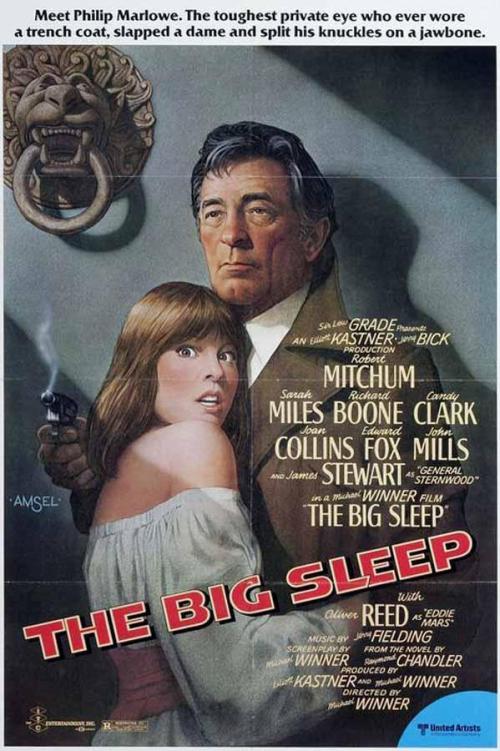
The Big Sleep (1978)

By Richard Winters

My Rating: 4 out of 10

4-Word Review: Hired to find blackmailer.

Philip Marlowe (Robert Mitchum) is an American detective living in London who gets hired by a aging, retired general named Sternwood (James Stewart) to locate the person who has been blackmailing him for money. He thinks it may have something to do with his colorful daughters: the gambling addicted Charlotte (Sarah Miles) and the promiscuous Camilla (Candy Clark) who enjoys posing for nude photographs.

The film is based on the 1939 novel of the same name by Raymond Chandler and a remake of the 1946 film that starred Humphrey Bogart. Here though the setting has been updated from the 1940’s to the 1970’s and the venue changed from New York to London. The movie was also able to tackle many of the more kinkier aspects of the story that the 40’s version was only able to allude to.

Personally I felt the changes worked and made the premise more interesting. Why an American detective would be working in England is never properly answered, but the new setting does allow for some interesting on-location shooting like having the Knebworth House used as the Sternwood Mansion, which is breathtaking to look at both inside and out. The erotic undertones get used to their full potential especially with Candy Clark’s nude scenes who looks fabulous naked and she plays the part with such spunk that every scene she is in is highly amusing and the whole film could’ve easily been built around her alone.

Mitchum’s presence isn’t as distracting as it was in Farewell, My Lovely where he played the same part, but in a 1940’s setting. Having it upgraded to the modern-day actually makes him come-off as younger and a lot of the reason could be the snazzy suits he wears as opposed to the drab hat and trench coat. He also isn’t forced to get into any physical confrontations with anyone, which would make him look foolish as he’d be too old to kick any young guy’s ass, nor is there any romantic overtures with a younger woman, only Camilla who immediately throws herself at him the second she meets him, but since she does that with every man it doesn’t matter, which all helps to make his advanced age, which was 60 at the time and far older than the intended character, a non-issue.

The main problem is the story, which I found to be just too damn confusing. I like mysteries, but more in the Agatha Christie realm where we have actual clues to follow and an interesting array of suspects as opposed to something with a dizzying pace where every line of dialogue creates a new twist and potential suspects popping up out of nowhere only to quickly get killed off or just disappear completely. It’s possible in the novel, which I never read, this all got laid out better, but here it became convoluted to the extent that after the first 30 minutes I became lost and didn’t care what happened next, or for that matter who got killed and who didn’t.

Having a side-story thrown-in like Marlowe taking up some sort of quirky hobby that had nothing to do with the mystery that the film could cut back to every once in awhile in order to allow the viewer to catch their breath would’ve helped. The film still manages to be watchable mainly from the high production values and the eclectic cast. I also enjoyed the beginning and end segments where the camera takes the driver’s point-of-view as we see the car drive through the winding roads as it enters the Sternwood Mansion property and then at the end while it leaves the property as the credits roll past.

My Rating: 4 out of 10

Released: March 13, 1978

Runtime: 1 Hour 40 Minutes

Rated R

Director: Michael Winner

Studio: United Artists

Available: DVD, Amazon Video, YouTube

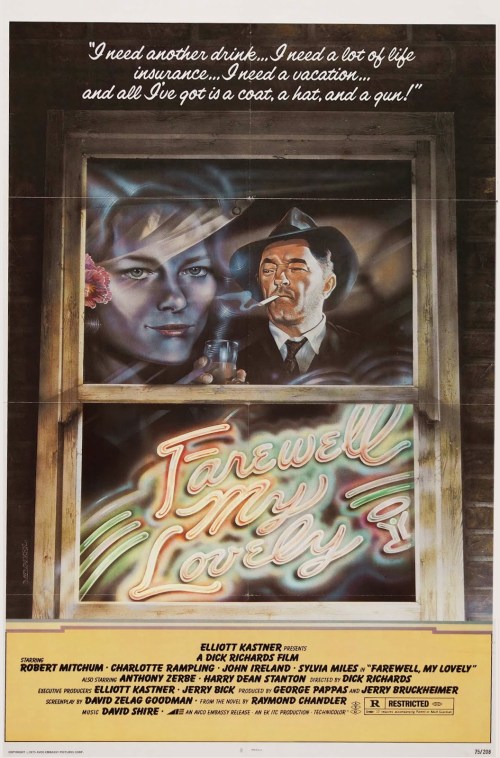
Farewell, My Lovely (1975)

By Richard Winters

My Rating: 4 out of 10

4-Word Review: Searching for missing lady.

Based on the Raymond Chandler novel of the same name the story centers on private eye Phillip Marlowe who meets Moose Malloy (Jack O’Halloran) a recently released convict that asks Phillip to find his girlfriend Velma who worked as a dancer at a nightclub, but who has now gone missing. Marlowe decides to take the case, but finds a wide array of strange clues that leads him on a bizarre trail that has many twists.

The novel was filmed before in 1944 as Murder, My Sweet that starred Dick Powell, which has become a classic. This remake was noted for being able to stay closer to the source novel by retaining aspects of the story that was considered too provocative for 1940’s standards, but the edition of these elements really doesn’t make the mystery any more interesting. The direction doesn’t convey any feel for the material and despite the intricate plot everything plods along at a rather mundane pace. I also never really felt that the setting effectively reflected the 40’s as much as it could’ve.

The biggest issue though is Mitchum. The guy is certainly a legendary actor and his performance here isn’t bad I actually thought his timing with the way he conveys his lines was on-target, but he’s just way too old for the role. In the novel Marlowe was described as being in his 30’s, but Mitchum was 57 and looking more like 67. The guy comes-off as washed-up with no charisma, or ability to win a fight even though he does get into a few altercations anyways, which doesn’t seem believable.

The eclectic supporting cast is the only thing that makes it mildly interesting. Sylvia Miles got nominated for supporting actress Oscar as a lonely alcoholic lady with a secret, but I actually enjoyed Charlotte Rampling as a beautiful, but cold and conniving gold digger much better. It’s also great to see Kate Murtagh as this overweight woman who runs a whorehouse. Fat woman are usually never given prominent roles in most Hollywood films, but here she plays an intriguing part that culminates with a surreal, nightmarish segment that helps give the film a little extra verve that’s otherwise missing.

The film also has a couple of great cameos. One features Sylvester Stallone in a non-speaking role as a thug, which was just before he broke it big with Rocky. I found the cameo though by author Jim Thompson, who’s best known for writing such novels as ‘The Getaway’ and ‘Pop. 1280’ to be far more interesting. He plays the elderly husband to Rampling and the scene where he opens up a door to find her kissing Mitchum on a couch and all he does his just shut the door back-up and leave to be the funniest moment in the movie.

The budget should’ve been bigger as it’s not stylish. If you’re going to redo a classic you’ve got to go all-out, but the effort here is half-hearted. Yet despite this the producers forged ahead with another Marlowe film that had Mitchum again playing the part. That one was called The Big Sleep and will be reviewed later this month.

My Rating: 4 out of 10

Released: August 8, 1975

Runtime: 1 Hour 35 Minutes

Rated R

Director: Dick Richards

Studio: Embassy Pictures

Available: DVD, Amazon Video, YouTube

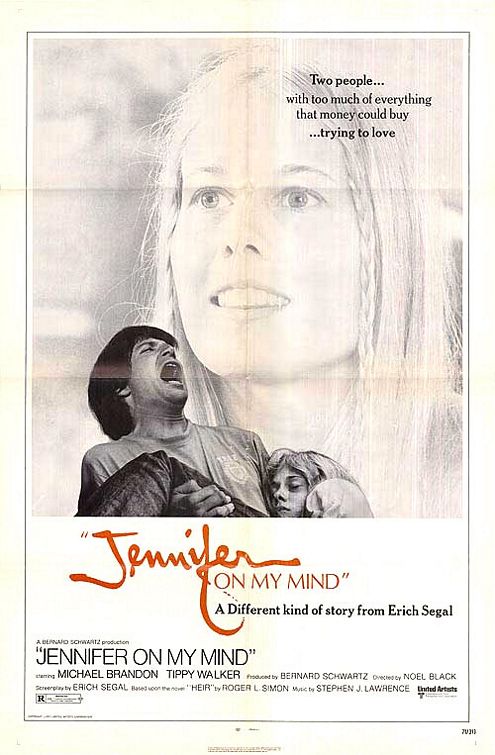
Jennifer on My Mind (1971)

By Richard Winters

My Rating: 3 out of 10

4-Word Review: Girlfriend becomes heroin addict.

While vacationing in Venice Marcus (Michael Brandon) meets up with Jennifer (Tippy Walker) a young free-spirit whose beauty and carefree ways immediately smitten him and the two begin a relationship, but Jennifer’s impulsive ways doesn’t allow it to last. He later learns that she’s a heroin addict and tries to help her overcome it, but to no avail. After she disappears for several months she then suddenly shows up at his doorstep wanting to rekindle old-times. At first he’s happy to see her, but then learns that her addiction has grown worse and after reluctantly giving her an injection that turns out to being fatal he then goes into a panic and tries to get rid of the dead body as he fears he’ll be implicated for her death otherwise.

After the success of Love Story screenwriter Erich Segal was a hot commodity and given free-reign to write any concoction he wanted and this script, which is based on the Robert L. Simon novel ‘Heir’ is the result.  The story though is poorly structured and seems to focus more on Marcus and his efforts to get rid of the body than on giving any meaningful insight to the drug addiction experience. There’s also severe shifts in tone where it’s dramatic one minute and then has weird dream-like humorous segues where Marcus sees visions of his dead grandfather (Lou Gilbert) who cracks corny jokes.

Director Noel Black, whose career looked bright after doing the critically acclaimed cult hit Pretty Poison, manages to infuse some nice on-location scenery, particularly that of Venice,  but technically botches many other moments. The worst comes when Jennifer tries to jump off the roof of her house, but she goes from being in her backyard to on the rooftop in a matter of seconds, which isn’t realistic. She then jumps off it even though it’s a 2-story building with another rooftop of a different section of the home beneath her, which is where she should’ve landed, but instead the film in a poorly edited bit that doesn’t even show the actual jump has her landing in a flower bed.

The Marcus character, who has inherited his grandfather’s fortune and therefore doesn’t have to work for a living, is too smug to be likable and most viewers will find his privileged situation off-putting. He also doesn’t seem, despite his insistence, to be all that ‘in-love’ with Jennifer especially with the callous ways he tries to get rid of her body and in one really creepy moment even professes to the corpse that he feels closer to her now than when she was alive. I also couldn’t understand why this non-descript guy would be constantly attracting the attention of violent bikers and hippies. One instance occurs when he is doing nothing more than standing at a pier of a lake and within seconds finds himself surrounded by three bikers who come out of nowhere and then later on as he’s driving down a busy highway some hippies decide to harass him at random but no one else.

Jennifer character is equally annoying as the viewer learns little about what makes her tick. Walker’s acting career ended after this film as she left Hollywood disillusioned with the business after having an affair with George Roy Hill when she was only 16 and he was 42 while filming The World of Henry Orient. Her life, like the character in the film, then  took a strong downward spiral as she opened up an art gallery in New Haven, Connecticut which eventually closed. In a 2015 interview published in the New Haven Register she was living in a cramped 1-bedroom apartment that was infested with cockroaches after having spent several years being homeless and surviving off of social security and what little monthly money her brother in Texas sent her.

The film’s  only saving grace are the performances of its supporting cast . I enjoyed Peter Bonerz as a psychiatrist who barrages into Marcus’ home and tries to give him an impromptu therapy session. Chuck McCann is amusing too as a motorist who tries to help Marcus change a flat, Barry Bostwick and Jeff Conaway enliven things as two antagonistic minstrels and Robert De Niro is great as a gypsy cab driver. Otherwise this thing is a complete mess that like a bad car accident is garish enough to keep you watching, but offers nothing in return.

My Rating: 3 out of 10

Released: November 10, 1971

Runtime: 1 Hour 30 Minutes

Rated R

Director: Noel Black

Studio: United Artists

Available: DVD-R (MGM Limited Edition Collection), Amazon Video

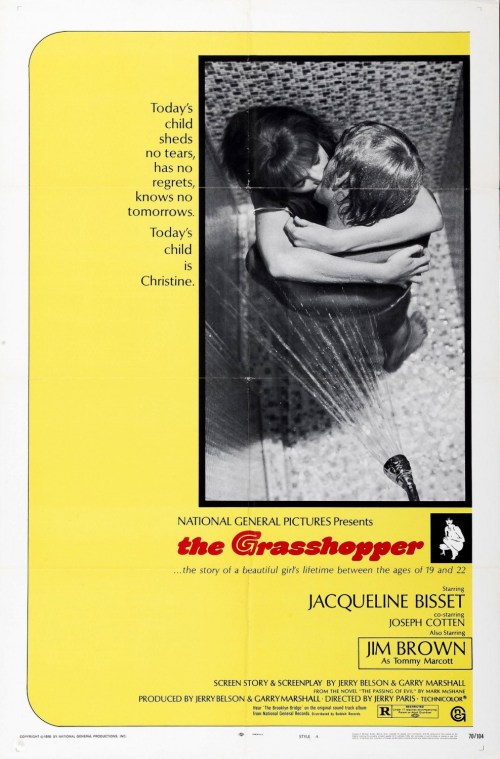
The Grasshopper (1970)

By Richard Winters

My Rating: 6 out of 10

4-Word Review: Runaway becomes  a showgirl.

Christine (Jacqueline Bisset) is a 19-year-old who’s bored with her life living in rural British Columbia and decides one morning to run away from home and meet up with her fiance Eddie (Tim O’Kelly). He gets her a job as a bank teller, but she finds this boring too, so she runs away from him and moves in with a Vegas comedian (Corbett Monica) who gets her work as a showgirl, but Christine’s inability to ever settle down and her impulsiveness leads her to spiral downhill until she’s eventually forced into prostitution.

Initially I was leery about this one as it was directed by Jerry Paris an actor-turned-director who mainly directed episodes from TV-shows as well as the infamous sequels to the Police Academy franchise and for awhile this thing did not look much better than those, but just when I thought it would be nothing more than a sanitized TV sitcom-like foray into the runaway scene it improved. The second-half has some genuinely gritty moments and the behind-the-scenes look of the showgirl lifestyle is well handled and realistic.

Bisset is excellent and her performance pretty much makes the movie, but she’s not completely right for the part either. For one thing she doesn’t look anything like 19 and was in fact 25 when she did this. She also wears too much make-up. I had no problem with this when she became a showgirl as it’s expected, but initially she should’ve had more of a plain look, which would’ve made her transition into the jaded world more visually striking.

On the flip-side I enjoyed her character and found it refreshing that she wasn’t portrayed as being so completely innocent, but in many ways her own worst enemy. The scenes where she goes out on the Vegas runway with her teeth painted black shocking some in the audience as well as handing a bank customer a note pretending that the place is being robbed reveals some intriguing self-destructive tendencies. It also makes her seem very much like a grasshopper, which was a far better title than ‘The Passing of Evil” that was used for the Mark McShane novel that the film is based on.

Jim Brown, who traditionally plays intimidating characters comes off as surprisingly gentile and sympathetic one here and the inter-racial marriage that he has with Bisset was way ahead-of-its-time. Ramon Bieri gets a great role in his film debut as a rich, arrogant tough who always expects to get his way and watching him chow down on his food is memorable. This also marks the film debut of Ed Flanders, who wears a wig here and looks far older than he did in the ‘St. Elsewhere’ TV-show that he starred in 12 years later.

The ending in which Bisset talks a airplane pilot (William Callaway) into writing ‘Fuck It’ in the sky, is funny, but the film’s overall impact is light. Adding in scenes of Bisset’s home-life growing up and during more innocent times might’ve made her transition stronger, but overall despite a few good moments it never quite comes together as a fluid whole.

My Rating: 6 out of 10

Released: May 27, 1970

Runtime: 1 Hour 36 Minutes

Rated R

Director: Jerry Paris

Studio: National General Pictures

Available: DVD-R, Amazon Video, YouTube

Oh, God! (1977)

By Richard Winters

My Rating: 7 out of 10

4-Word Review: An atheist meets God.

Jerry Landers (John Denver) is a married man with two kids (Moosie Drier, Rachel Longaker) who works as an assistant manager at a local grocery store. He doesn’t consider himself to be religious nor does he attend church (he most likely could be called an atheist, but I assume that term was considered ‘too toxic’ of a label to put on a protagonist that mainstream audiences of the day were expected to like, so he’s just given the much softer description of being a non-believer.) One day he receives a letter in the mail stating that God would like to interview him at a certain location, but Jerry considers this to be a practical joke and throws it away, but when the letter keeps popping up at the most unlikely places he finally decides to take it seriously. He goes to the location and meets God (George Burns) who at first he does not see, but only hears, but eventually the almighty takes the form of an old man. He tells Jerry to spread the word that he exists, which Jerry does only to have it all snowball against him when everyone thinks he’s crazy and even his own family becomes embarrassed to be seen with him.

The film is based on the 1971 Avery Corman novel of the same name though the book had more of a satirical tone and the protagonist was a journalist. The film though manages to retain the same jaded sensibilities of the modern-day public, which is what makes it so amusing and for the most part quite on-target. Denver, who was known more as a singer and did very little acting both before or after this, is quite good here, but only if you can get past his bowl haircut. Burns is excellent as well and I always felt this is the performance he should’ve won the Academy Award for instead of the one in The Sunshine Boys as it easily became his signature role.

The script though by Larry Gelbart is full of incongruities. For instance the God here claims to be a non-interventionist who sets the process in motion and then lets things happen without getting involved. Everyone is given free will and he doesn’t intervene to stop suffering or ‘bad things’ from occurring because that would upset the ‘natural balance’, but then turns around and admits that he had a hand in such superficial things as helping the 1969 New York Mets win the pennant. He is also forced to become a ‘side show magician’ by performing what amounts to being magic acts, like doing a tacky card trick in front of a judge, in order to prove to Jerry and others that he really is the almighty. Yet he then becomes shocked to find that Jerry’s simple word-of-mouth as well as having Jerry pass out God’s ‘calling card’, which is nothing more than a white card with the word God on it, as not being enough to somehow convince others of the same thing.

There’s also a weird conversation, which I found loopy even as a child, where God tries to prove a point by explaining to Jerry that people only dream in black-and-white, which apparently was an accepted belief a long time ago. This idea has later been found to be incorrect, which is good as I’ve always dreamed in color, but it’s still off-kilter to have this supposedly all-knowing God argue a talking point from a debunked myth.

The performances by the supporting cast help  and in fact I consider this to be Teri Garr’s best role as I found her character arch to be more interesting than Denver’s. The aging Ralph Bellamy is good as an aggressive defense attorney and I also like Barnard Hughes as the overwhelmed judge. William Daniels is amusing as Denver’s snippy boss and a type of authoritative character he’d put to perfection years later in the TV-show ‘St. Elsewhere’. Paul Sorvino gets a few laughs too in a send-up of an over-the-top TV evangelist.

The only one that I had a problem with was Donald Pleasance who gets fourth billing, but only 2 lines of dialogue. With such a versatile talent as his you don’t want to waste it by giving him such a small role and unless a lot of his work here ended up on the cutting room floor I’m genuinely surprised why he even took it.

The film is mildly entertaining, but ultimately quite benign and nowhere near as ‘profound’ as some considered it. Nonetheless it was a big hit and even knocked Star Wars out of the top spot for 1-week. It also spawned 2 sequels as well as a TV-movie called ‘Human Feelings’ where Nancy Walker plays a female God set to destroy Las Vegas with a flood unless Billy Crystal, who plays an angel, can find 6 virtuous people that live there.

My Rating: 7 out of 10

Released: October 7, 1977

Runtime: 1 Hour 38 Minutes

Rated PG

Director: Carl Reiner

Studio: Warner Brothers

Available: DVD, Amazon Video, YouTube

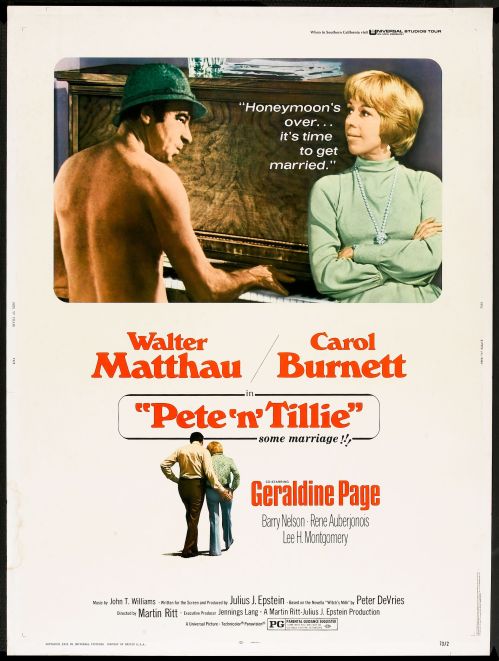
Pete ‘n’ Tillie (1972)

By Richard Winters

My Rating: 6 out of 10

4-Word Review: Marriage and then tragedy.

Tillie (Carol Burnett) is a 33-year-old secretary still looking for ‘Mr. Right’. Her friend Gertrude (Geraldine Page) sets her up with Pete (Walter Matthau) a lifelong bachelor. The two don’t hit-it-off initially, but the other prospects are so dim they decide to make a go of it, so they get married and have a kid (Lee H. Montgomery) only to then be faced with terrible news.

On the onset this may seem like a misfire. The viewer expects, especially with these two stars, a very broad comedy of which this is not. Instead the script, which is based on the novel ‘Witches’ Milk’ by Pete De Vries, relies heavily on dry wit particularly through the dialogue, which on a low key level is quite funny. The attempt to create a sort-of unromantic romance that goes completely against what we’ve come to expect in most other romantic films is commendable and for the first hour or so it kind of works.

Matthau again shines by managing to make an unlikable character likable and even downright engaging while Montgomery is fun as the kid by playing a child that seems far more mature and sensible than his two parents. Burnett’s performance though doesn’t work as well. She’s known for her hammy performances from her TV-show and yet here plays a more serious part that barely has much comedy to it at all. The scene where she  screams up to the sky in a fit of rage over her son’s death is her best moment, but overall her appearance here is largely forgettable.

Her character’s motivations are confusing as well particularly with the way she jumps into marriage with a man she really doesn’t like and who would repel most other women and then she decides to stay with him even as it becomes painfully clear that he’s cheating on her. It just seemed that a reasonably attractive woman such as herself should have other male suitors to choose from, so why she sells-out for this one and sticks with him when others would run is not clear and the movie should’ve done a better job at answering this.

Geraldine Page’s character seems completely out-of-sync with the proceedings. She’s personally one of my favorite actresses and even though she was nominated for an Academy Award for her performance here I didn’t see what her presence added to the story. Having her pass out at a courthouse simply because she doesn’t want to reveal her age gets rather exaggerated. The physical altercation that she has with Burnett afterwards does not fit the tone of the rest of the film, which tried to be low-key while this bit becomes over-the-top slapstick and completely out of place.

Had the film focused entirely on the courtship phase this thing could’ve been a winner as it has a nice dry offbeat touch. Even the melodrama of the second act I could handle, but the crazy antics of the third act don’t work at all and the ending leaves no impact at all making this an interesting experiment that ultimately fails.

My Rating: 6 out of 10

Released: December 17, 1972

Runtime: 1 Hour 40 Minutes

Rated PG

Director: Martin Ritt

Studio: Universal

Available: DVD-R (Universal Vault Series)

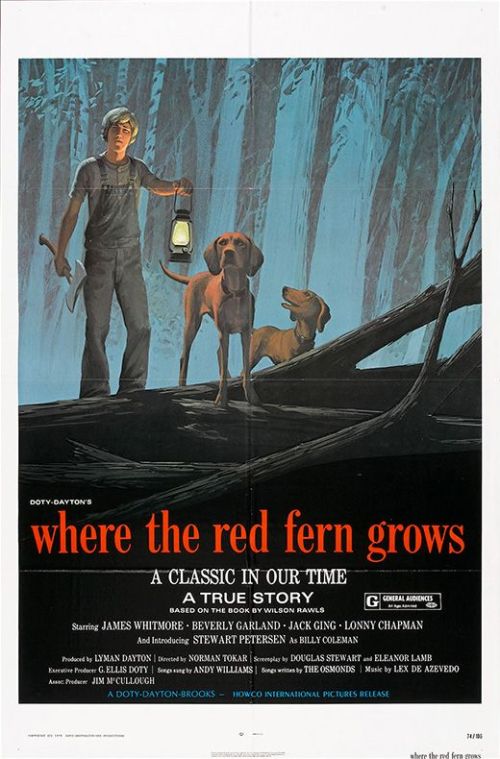
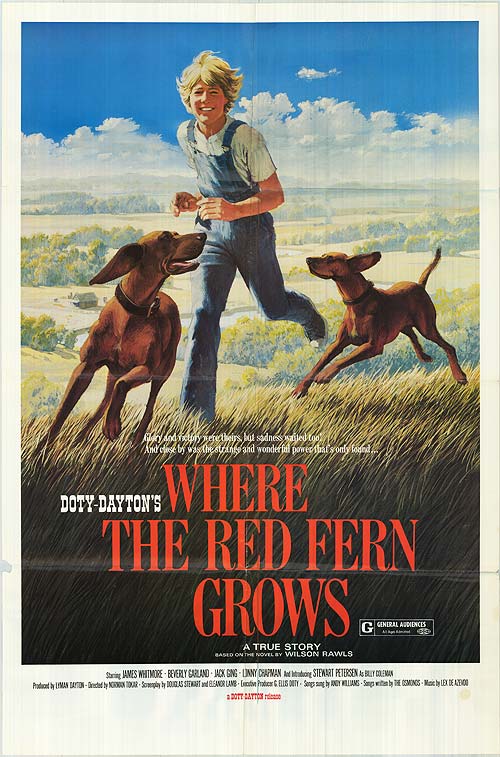
Where the Red Fern Grows (1974)

By Richard Winters

My Rating: 6 out of 10

4-Word Review: Kid raises two hounds.

Billy Colman (Stewart Petersen) is a 12-year-old boy living on a farm in rural Oklahoma during the depression. He becomes obsessed with owning a coon hound which he can train to hunt raccoons. His family is too poor to buy him one, so he spends his summer doing a number of odd jobs until he’s finally able to buy two Redbone Coonhound puppies, which he raises and trains into becoming championship hunting dogs.

The film is based on the 1961 novel by Wilson Rawls, who provides the opening voice-over narration and the script here closely follows the action of the book. It was directed by Norman Tokar, who seemed to specialize in stories of young boys bonding with their pets as he also directed the film versions of Big Red and Rascal. The production was clearly done on the low budget side, which is distracting at first, but eventually meshes with the stark, rural, and economically challenged setting quite nicely.

While the story seems believable enough and may open some viewer’s eyes, such as my own, to the sport of coon hunting, which still thrives today in certain parts of the country, I found certain elements of it to be hard to believe.  For instance Billy decides to walk all the way from his lonely farmhouse to the town of Tahlequah, which is 30 miles away and apparently able to do it in one day. I was also not sure how he would be able to find the town since he did not travel along any type of highway or road, but instead trudged through open fields and without the benefit of either a map or a compass.

The scene where Billy intentionally trips a nasty boy by the name of Rubin (Rex Corley) which causes the kid to fall on the ax that he is carrying and dies seemed questionable from a modern day viewpoint simply because everybody believes the story that Billy tells them and no charges were made. The film and book, which I remember reading in the 6th grade and in fact this is the only part of the story that I remembered, portray this as being an unintentional accident, which it was. However, these days the kid could potentially be put on trial for manslaughter charges especially since there was clearly bad blood between the two, but maybe it is a testament of simpler times that everyone, including seemingly the victim’s parents, believe the story he tells them without question, but in any other era that might not have been the case.

I found it interesting to see Beverly Garland, whom I first became aware of when she played Fred MacMurray’s second wife in the TV-show ‘My Three Sons’ and who looked quite middle-aged then, but for some reasons gets cast here as a young housewife and manages to somehow pull it off despite nearing 50 at the time. Petersen though, who got cast after a long auditioning process of over 500 candidates, is only adequate, but doesn’t quite hit the mark especially with his inability to convey anything other than one facial expression. I also thought the coonskin cap that he ends up wearing made him come off looking like a Davy Crockett or Daniel Boone Jr. although maybe back in the day that was considered ‘cool’.

Certain animal right’s activists of today may not take kindly to what was once considered just a ‘charming’ coming-of-age tale. Although no actual killing of any animal is ever shown it is certainly heavily implied. It got to the point where I started to feel sorry for the raccoons particularly during the hunting competition where night after night different hunters would go out into the forest to see how any many they could catch and then come back with the numerous pelts that they skinned from them making me wonder if there could possible be any raccoons left to kill.

Spoiler Alert!

The film though does manage to end on a strong note although even here this gets botched because as the family goes to the dog’s grave to see this magical red fern growing on top of it we also see a big boom microphone hanging down from the top of the screen , which completely sucks all the magic right out of the scene. This same story was remade in 2003 and in 2018 a 45-minute documentary was released showing behind-the-scenes footage/stills of the movie as it was being made and also featuring interviews with the actors.

My Rating: 6 out of 10

Released: June 21, 1974

Runtime: 1 Hour 37 Minutes

Rated G

Director: Norman Tokar

Studio: Doty-Dayton Releasing

Available: DVD, Amazon Video, YouTube

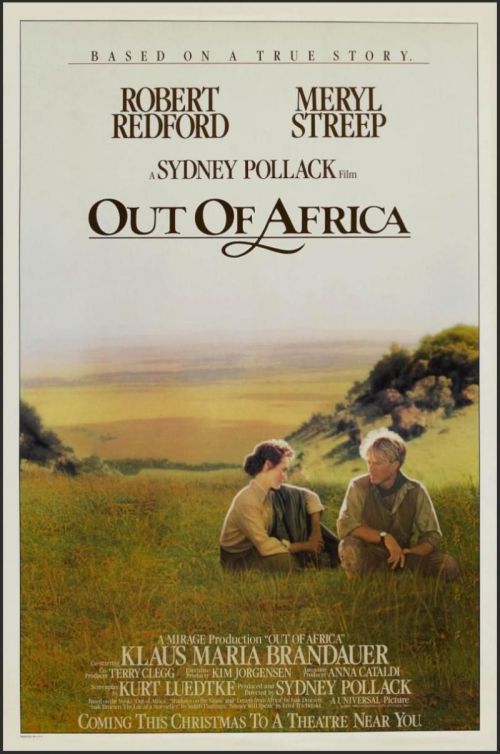
Out of Africa (1985)

By Richard Winters

My Rating: 9 out of 10

4-Word Review: An illicit love affair.

In 1913 a wealthy Danish woman named Karen Dinesen (Meryl Streep) gets spurned by the man she is in love with, so on the rebound she decides to accept the marriage proposal of the man’s brother, Baron Bror Blixen (Klaus Maria Brandauer) Despite the fact that neither she nor he are in love with the other, but decide to make it a marriage of convenience. They move together to Kenya where they plan to at first start a cattle farm, but it soon turns into a coffee plantation. Through the years Karen’s marriage to Bror begins to sour as he continues to have affairs with countless other women, so Karen turns her attention to the dashing big-game hunter named Denys (Robert Redford) and the two share a passionate and adventurous love affair, but when Karen tries to turn their relationship into a committed one he refuses.

The film, especially the first hour, comes off more like a broad sketch than a fluid story, or a highlight reel taken from a wide outline. I could never really get any type of handle of who this Karen person really was. I never understood why she would want to leave Denmark for Africa, or why she’d be so quick to settle down with a man that she didn’t love. So what if she got spurned by one guy there’s still other fish in the proverbial sea. Why not wait around for someone she could truly be excited about instead of just jumping in with someone that she really wasn’t?

To some degree I did find the marriage-of-convenience idea an interesting one. It’s rare that both parties admit that neither has the hots for the other, but still decide to make a go of it, which seemed like highly modernistic behavior especially for the time period and I was hoping this whole scenario would be explored more, but the film treats this mainly as a side-story that pretty much fades away after the first hour.

The introduction of the Denys character gets a bit botched too as he keeps popping in and out at the most convenient times out of literally nowhere, like when Karen finds herself ready to be attacked by a lion, and then just as quickly disappearing again almost like he were a magical genie.  The fact that Streep puts in so much effort into her Scandinavian accent, but Redford puts none into conveying an English one is off-putting. Supposedly Redford did initially try to speak with a light accent, but director Pollack apparently found it ‘distracting’ and advised him to speak without it, but in the process it makes the acting seem uneven.

It’s during the second-half where the film really comes together as it focuses solely on the affair though in real-life there was only a two year difference between Karen and Denys, but here there’s a 12 year difference between the actors playing the part and it shows, but despite that discretion this segment really works. I loved watching the different things that the couple did like playing a phonograph record to some monkeys and seeing how they responded to it and watching Karen taking an airplane ride for the first time and all the majestic scenery that she takes in.

The cinematography is indeed sumptuous and one of the things that holds it altogether even when the script jumps precariously and sometimes jarringly from one point in Karen’s life to another. The film would’ve worked better had it focused on only one area, like her relationship with Denys, which could’ve helped create a stronger, more immediate emotional impact with the viewer while also cutting down on the excessively long runtime.

My Rating: 9 out of 10

Released: December 10, 1985

Runtime: 2 Hours 41 Minutes

Rated PG

Director: Sydney Pollack

Studio: Universal

Available: DVD, Blu-ray, Amazon Video, YouTube