Category Archives: Movies Based on Novels

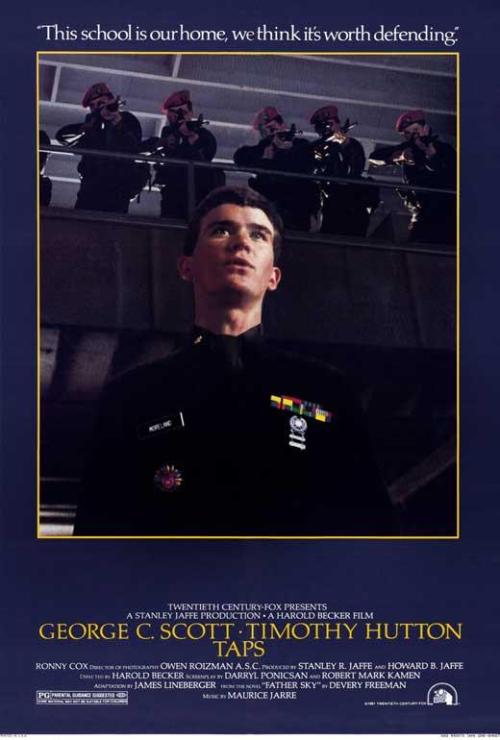
Taps (1981)

By Richard Winters

My Rating: 3 out of 10

4-Word Review: Cadets take over academy.

At the conclusion of another school year at Bunker Hill Military Academy, General Harlan Bache (George C. Scott) announces, to his shocked cadets during the commencement proceedings, that their school has been sold to real estate developers and will be closed in 1 year. Then that evening tragedy strikes forcing the board of trustees to close the school immediately. The students lead by Brian Moreland (Timothy Hutton) who had just been promoted to Cadet Major decide to take matters into their own hands by taking over the school with force and refusing to leave it unless guarantees are made to keep it open.

The film is based on the novel ‘Father Sky’ by Devery Freeman and the first half has excellent potential. The drama is intense and on-target and brings up a myriad of interesting conundrums dealing with the thin line between loyalty versus rebellion and how at different times both can be good and bad. It also deftly examines how bad things can come from the best of intentions.

Unfortunately all the action takes place in the first hour leaving the second half woefully undernourished with nothing happening. Everyone stands around expounding until all the tension that had been so nicely built-up at the beginning gets sapped away leaving boredom in its wake. The film also tries too hard to make its point becoming overwrought and preachy in the process. The dialogue between the characters loses its conversational quality and instead starts to sound like mini speeches.

The acting by the soon-to-be-stars is good and includes Sean Penn in his film debut as well as Tom Cruise in a breakout role that originally he rejected because he was only hired to be a background character, but his presence during rehearsals so impressed director Harold Becker that he decided to give him a bigger part and he  leaves a lasting impression particularly at the very end. Hutton, who was just coming off his Academy Award winning work from Ordinary People is effective too despite his thin frame and the scene he has where he discusses the situation with the cadets’ distressed parents are his best moment.

Scott on the other hand comes off as old and tired, granted that was the type of character he was playing, but it still isn’t a showy role for an otherwise famous actor and in fact he only appears in the film’s first act. The scene dealing with him trying to break up a ruckus between a group of students and cadets is poorly edited. One shot has his gun being taken out of its holster by another student only to magically reappear in Scott’s hands in a later shot, which comes off looking like a jump cut.

From a simply logical perspective it becomes abundantly evident right from the beginning that these kids have gotten in way over their heads with no endgame and nothing is worse than seating through a plodding plot that you know won’t end well.

My Rating: 3 out of 10

Released: December 9, 1981

Runtime: 2 Hours 6 Minutes

Rated PG

Director: Harold Becker

Studio: 20th Century Fox

Available: DVD, Blu-ray, Amazon Video, YouTube

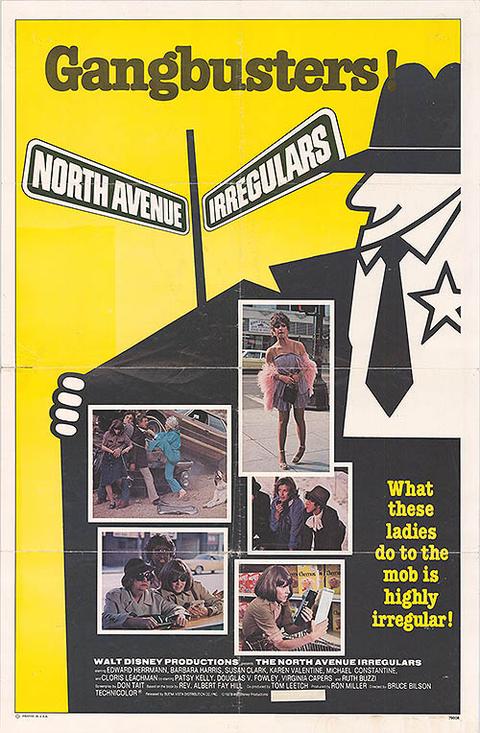
North Avenue Irregulars (1979)

By Richard Winters

My Rating: 7 out of 10

4-Word Review: Church ladies battle mobsters.

Reverend Michael Hill (Edward Herrmann) becomes the new pastor at the North Avenue Presbyterian Church, but right away things get off to a rocky start when the church’s funds get gambled away on a horse race. When Hill tries to retrieve the money he finds out that it is an illegal gambling joint run behind a dry cleaning business, who are always able to skillfully remove their presence before the police arrive. Hill goes on TV to lambaste organized crime in their town, which catches the attention of two treasury agents (Michael Constantine, Steve Franken) who want Hill to help them close down the gambling joints by having him hire men from his church to place bets at the parlors, but all of the men refuse. Hill then asks for the help of the church women who agree to do it and after some initial setbacks begin to make headway in taking down the area mobsters.

Usually I always say it’s important for films that are aimed for a young audience to have children playing the protagonist, but in this case the children characters have only small supporting roles and yet the film still manages to deliver the laughs. The main reason is the talented female cast who have distinctive personalities and convey comic form in different ways. Cloris Leachman is amusing as the middle-aged cougar with long finger nails, Virginia Capers is quite funny too as a heavy-set woman who doesn’t allow her big build to stop her from running several blocks in order to tail the bad guys and the variety of vehicles she drives with funny phrases painted on their windshields, which are all from her husband’s used car dealership, are humorous too. Barbara Harris as a suburban mother who chases the mobsters while driving in a station wagon packed full of kids in it is great too.

What may be surprising to many is that it’s all based on true events that occurred to Revenrend Albert Fay Hill when he took over as the minister at the North Avenue Presbyterian Church in New Rochelle, NY in 1961. It was there that he became a crusader against organized crime after the murder of a young man for not repaying his gambling debts. Like in the movie his fight gained the attention of US Treasury agents who wanted him to get his male parishioners to place bets with the mobsters, but the men all refused so he recruited their wives whose efforts managed to shut down several gambling houses, which lead to a front page write-up in The New York Times as well as Look magazine.

Of course the movie exaggerates things for comic effect, but it’s forgiven because the stunts are quite funny, which culminates in a massive car pile-up consisting of the demolition of 14 cars at the cost of $155,000. The scene involving the church getting blown up is amusing too because behind-the-scenes when it was first done the cinematographer forgot to put film in the camera forcing the crew to painstakingly rebuild the church just so they could try to do it all over again.

The film’s only weak element is Herrmann whose performance is certainly sincere and likable, but he’s never funny while Constantine is hilarious as the exasperated agent who has a virtual nervous breakdown dealing with the women and for that reason the film would’ve been more engaging had he been the lead character. I was also confused why the Reverend was  a single parent as there’s no explanation I could remember for what happened to the wife. In the book that this film is based, and in the true-life incident, the minster was married, so why was it decided that he should be single here? I got the idea it was because they wanted to create a romance between he and his secretary played by Susan Clark, but since nothing much comes from that it seemed unnecessary.

My Rating: 7 out of 10

Released: February 9, 1979

Runtime: 1 Hour 40 Minutes

Rated G

Director: Bruce Bilson

Studio: Buena Vista

Available: DVD, Amazon Video, YouTube

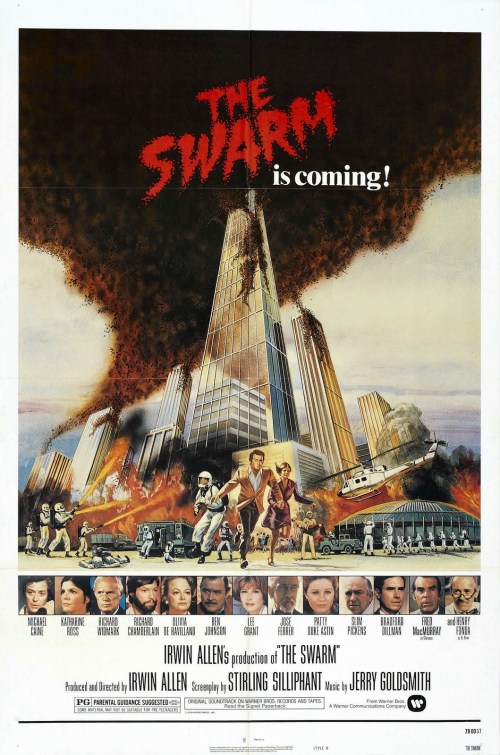
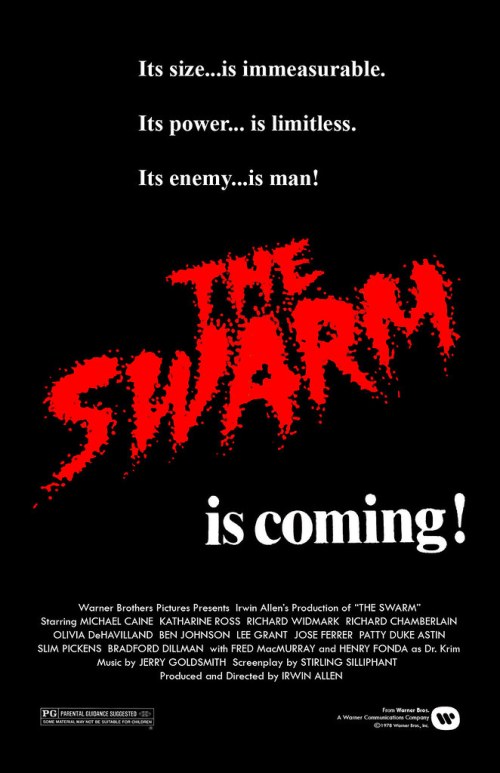
The Swarm (1978)

By Richard Winters

My Rating: 1 out of 10

4-Word Review: Killer bees invade Texas.

When his parents (Robert Varney, Doria Cook) are attacked by African Killer Bees while out on a picnic their young son Paul (Christian Juttner) manages to escape by jumping into their car and driving off. He then drives into the small town of Marysville, Texas where he tells the people about what happened. Scientist Bradford Crane (Michael Caine) and Army General Slater (Richard Widmark) are put in charge, but neither can agree on what strategy to use. Meanwhile Paul gets some of his friends to go back out to the park where the attack occurred to set fire to the hive, but instead of killing the bees it gets them to swarm onto the nearby town and the unsuspecting citizens.

Director/producer Irwin Allen was by the late 70’s known as the disaster master after having by that time either produced or directed 4 ( he ultimately ended up making 7) disaster flicks for both TV and the big screen many of which like The Poseidon Adventure and The Towering Inferno made a ton of money, so he was riding high coming into this one only to have it bomb monumentally at both the box office and with the critics. He took the failure of this film so personally that he refused to ever mention it and even walked out of an interview when he was asked about it.

In retrospect it’s easy to see why it failed as the special effects just aren’t interesting enough. Watching repetitive shots of swarming bees can only go so far and the victims just lay there without having their skin show any signs of swelling from the multiple stings, which you’d expect them to have. The shots from the point-of-view of the victims, which shows the bees in a giant form, is the only cool thing though, like everything else in the film, this ends up getting overdone and corny.

The script is ripe with unintentionally funny moments including having the authorities attempt to kill the bees by spraying at them with a flame thrower, which doesn’t seem to affect the bees at all and instead only sets buildings on fire as well as some of the people. The idea that the bees were set off by an alarm siren at a military base, which somehow sounded exactly like their mating call is too preposterous to believe and only makes the ‘science’ behind the film completely silly.

The film also makes the mistake of having the setting be in Texas, but not actually filming it there. Sure there’s a few shots of some famous Houston landmarks that get briefly shown, but the majority of it was clearly shot on a studio backlot in California and any true Texan will easily spot this as the topography and landscape between those two states are quite different. Had the film been made on-location it would’ve helped give it a little more character, which it is otherwise lacking.

The cast is made up of a lot of famous names, but they all get wasted. Lee Grant appears only briefly as an aggressive TV reporter that for the most part has little to do with the progression of the plot. Fred MacMurray, in his last film appearance, plays a rival to Ben Johnson who both compete for the affections of Olivia de Havilland, but all three get killed off in the second act, so what’s the use of introducing this potential story arc if it ends up not really going anywhere?

Caine makes for one of the most boring screen heroes in film history and gets seriously upstaged by Henry Fonda, who plays one of the scientists trying to create a serum to combat the deadly bee stings, even though Fonda is confined to a wheelchair the whole time. This was the first of many ‘paycheck movies’ that Caine did and in fact he admittedly never even bothered to read the script before agreeing to sign on, but still felt it was worth it as he was able to use the funds to purchase a nice mansion in Malibu unfortunately for the viewer there’s no such mansion just boredom instead.

My Rating: 1 out of 10

Released: July 14, 1978

Runtime: 2 Hours 35 Minutes

Rated PG

Director: Irwin Allen

Studio: Warner Brothers

Available: DVD, Blu-ray (Warner Archive), Amazon Video, YouTube

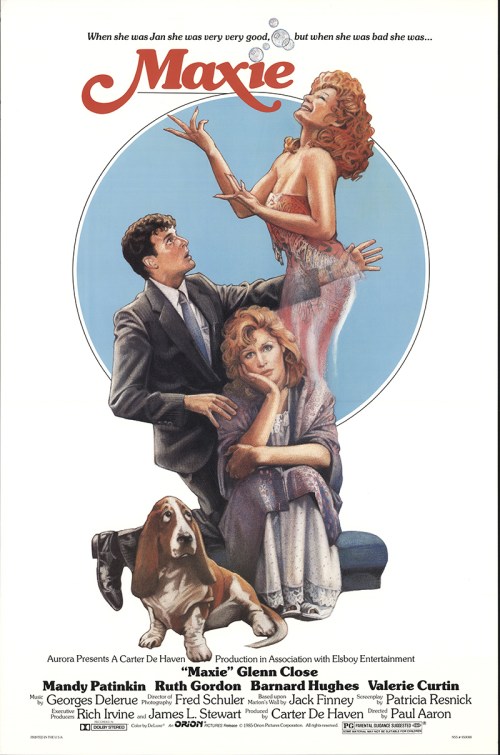
Maxie (1985)

By Richard Winters

My Rating: 0 out of 10

4-Word Review: Silent film star resurrects.

Nick (Mandy Patinkin) and his wife Jan (Glenn Close) move into a San Francisco home that was once lived in by Maxie Malone (also played by Close) a 1920’s flapper that died in a car crash the night before her big audition and who now haunts the place. She eventually inhabits Jan’s body and with the help of Nick tries to get the big Hollywood break in the 80’s that she missed out on in the 20’s.

The biggest problem is the title character that’s supposed to be amusingly ‘eccentric’, but comes off as obnoxious instead. Her belief that she should be the ‘life of the party’ no matter where she goes and her obsession with becoming a famous star makes her narcissistic and self-centered. She also shows no awareness of social propriety that every other functioning human being does as she throws herself quite literally at every attractive man she sees including married ones, which would be considered outrageous behavior by today’s standards and even more so from the era from which she came. Instead of being a person transported from a different time period she’s more like a cartoonish entity from a completely different universe.

Her affected Jersey-like accent is extremely annoying and why she’d even be speaking in one had me confused. Maxie’s spirit is taking over the body of Jan who does not have an accent. The spirit is using Jan’s legs, arms, eyes, mouth and ears, so then wouldn’t it be logical that the spirit would then use Jan’s voice as well?

Patinkin is equally irritating like the way he puts up with his boss (Valerie Curtain) openly and aggressively coming-on to him at work and for all to see and he doesn’t have her reported for harassment. What’s worse is when she threatens to fire him he begs her for his job even though she should be the one looking for work and not him.

The third makes this dumb script, which is based on believe it or not a novel by Jack Finney who also wrote ‘Invasion of the Body Snatchers’, even dumber by having Maxie get a part in a commercial, but without the benefit of having any resume, head-shot or agent, which casting directors insist is a must to even be considered.  From that she then gets asked to do a screen test for the starring role of a big budget remake of ‘Cleopatra’, but all she did in the commercial was play this lady victim tied to some railroad tracks, so what from that brief performance made the producers of ‘Cleopatra’ think she’d be ‘perfect’ for a starring role in their big Hollywood project?

I realize Close most likely took the part because she wanted the fun of playing two different characters, but Jan is so buttoned-down and shy that she becomes completely transparent making Maxie the only one you remember.

My Rating: 0 out of 10

Released: September 8, 1985

Runtime: 1 Hour 38 Minutes

Rated PG

Director: Paul Aaron

Studio: Orion Pictures

Available: DVD

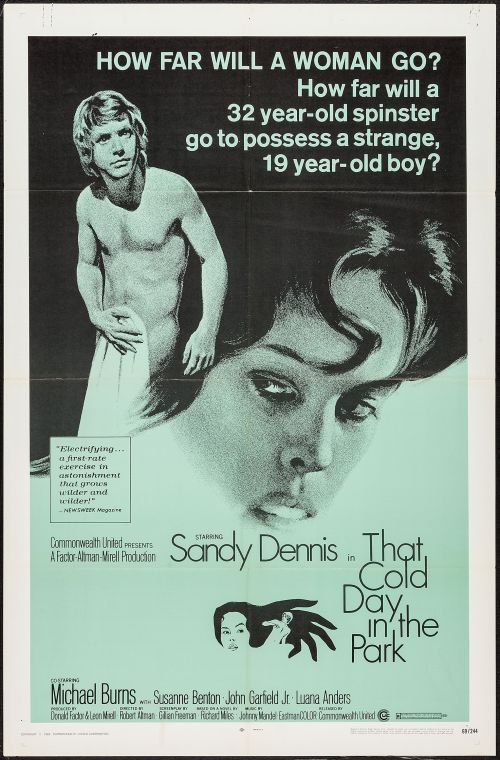
That Cold Day in the Park (1969)

By Richard Winters

My Rating: 4 out of 10

4-Word Review: Spinster takes in boy.

Frances (Sandy Dennis) is a rich, but lonely woman living a reclusive life inside her luxury Vancouver apartment with only her service staff to keep her company. One day she spots a teen boy (Michael Burns) sitting all alone on a park bench while it’s raining. She decides to invite him up to her apartment where she gives him food and a shower and becomes very attached to him despite the fact that he does not speak. Unbeknownst to her he has a whole other life with friends and family, but decides to exploit Frances’ generosity for his own gain only to learn that Frances has her own devious plans in mind.

The film’s only interesting aspect is Robert Altman’s direction, which is far different from the later movies that he did in the ’70’s, which emphasized conversations going on by secondary characters who weren’t always even in the scene, which here occurs only once when Frances goes to a doctor’s office, but is otherwise non-existent. Instead Altman successfully captures Frances’ isolated condition including the quiet apartment atmosphere where the viewer feels as trapped inside the four walls of the place as the character’s and the idea that there was an actual film crew on the set with the actors seems almost hard to believe. I also enjoyed the way the boy’s family life is shown by having the camera remaining outside and peering into the house’s windows to capture the action and dialogue going on inside.

The film fails though to be compelling as there is no reason given for why Frances feels so compelled to bring in this boy, or why this otherwise pretty, able-bodied woman should be so alone in the first place. One scene even has another middle-aged suitor propositioning her with a relationship, which she coldly refuses, but why? Is she more into teen boys and if so this needs to get explained and the reason given for it.

Dennis is an interesting actress, but isn’t up to playing characters with a sinister side and she’s a bit too young for the role. An older woman such as Ingrid Bergman would’ve been far better able to convey the age disparity between the two characters, but she unfortunately refused the part when offered. Burns is only adequate and the fact that he doesn’t initially speak makes the dynamics between the two interesting and the film should’ve delayed the fact that he could talk until the end, instead of revealing this in the middle part, which takes away any potential for mystery and intrigue.

Spoiler Alert!

The ending, which consists of Dennis trapping Burns inside her apartment makes no sense. The fact that she nails the windows shut is ridiculous as he would only need to pry the nails out of the wood, which he successfully does to a few of them anyways, in order to open the windows back up and get out. He is also physically stronger than her and the fact that she uses no weapon means he could overpower her if he wanted. Besides his family already knew where he was as his sister (Susanne Benton) came to visit him and would most likely come looking for him when he didn’t come home, so having it end by portraying him as a helpless hostage with no way of escaping is quite weak and unsatisfying.

My Rating: 4 out of 10

Released: June 8, 1969

Runtime: 1 Hour 46 Minutes

Rated R

Director: Robert Altman

Studio: Commonwealth United Entertainment

Available: DVD, Blu-ray (Region B/2), Amazon Video

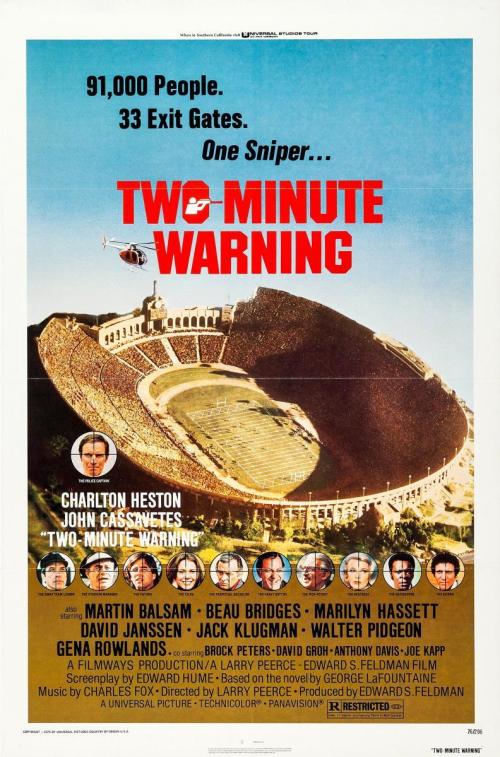
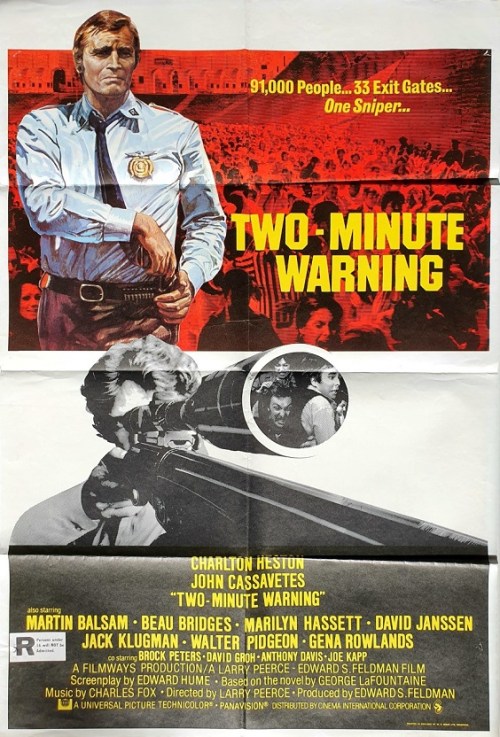
Two-Minute Warning (1976)

By Richard Winters

My Rating: 6 out of 10

4-Word Review: Sniper at football game.

Based on the novel of the same name by George LaFountaine the story centers on a lone gunman (Warren Miller) who for reasons that are not clear decides to massacre spectators at a football game with his high powered rifle by sneaking into the clock tower of the L.A. Coliseum during a championship game. Eventually he gets spotted by a TV crew and the police and S.W.A.T. team are brought in to stop him before he creates any carnage.

While it may sound like I’m going off on a tangent by complaining about the unimaginative uniforms used by the football teams since the game itself is only a minor subplot it still hits-home how every little aspect of a film is important and if one part of it is sub-par it drags down the rest. Since the NFL refused to give permission that would’ve allowed them to use logos of actual football teams they were forced to make-up their own, but what they come up with is quite bland including having fans in the stands waving flags for the Los Angeles team, which are colored black and yellow while the colors of the uniforms of the team on the field are maroon and gold. The fan atmosphere isn’t authentic either as the spectators come-off looking more like people going to church with none of them immersed in their team’s insignia, which would include body and face paint that you usually see at most ballgames. Even the name of the game is boring since they weren’t able to use the Superbowl title so it gets called a very uninspiring ‘Championship 10’ instead.

The cast is made up too many people looking well over 50, almost like this was a movie made by aging old farts for aging old farts, and at least one of the three leads should’ve been a young person in order to give it balance. While I liked John Cassavetes as the S.W.A.T. team captain as he gives the film a unique intensity, I felt Charlton Heston as the police chief, who always comes off as a stiff who conveys his lines like he’s orating a lecture, could’ve been replaced by Beau Bridges, one of the few cast member who was in his 20’s and who gets wasted as a dopey unemployed father who doesn’t have all that much to do with the plot.

The rest of the supporting players are made up of actors that include David Janssen and Gena Rowlands as a benign bickering couple and an aging Walter Pidgeon, in his second-to-last film, as a pickpocket. Jack Klugman is somewhat interesting as a desperate gambler, who doesn’t appear here wearing his usual wig and I kind of enjoyed seeing David Groh hitting on Marilyn Hassett, who at the time was married to the film’s director, while her jealous boyfriend (Jon Korkes) is unable to do anything about it.

Spoiler Alert!

The plot is mildly interesting, but it takes too long, a full hour, just to construct the basic set-up. The second half is spent watching how the authorities plot to stop the sniper without panicking everybody in the stands, which might’ve been more riveting had they not, despite all of their best efforts, failed at it. This also creates an unintentionally funny moment where one of the S.W.A.T. team members gets shot by the sniper and his body dangles by a rope from the stadium lights, but the crowd is so into the game they fail to notice the bloody, bullet-riddled body hanging just above their heads.

The most frustrating aspect though is the fact that we learn nothing about the killer or what motivated him. I don’t mind it being a mystery initially, but at some point the viewers deserves some answers. There’s just too many questions that demand explaining like how did the killer know where to go to get into the the stadium tower and how did he know to bring along raw meat in order to quiet the guard dogs? It almost seemed like he might’ve been a former employee of the stadium, which is a backstory that eventually needed telling.

End of Spoiler Alert!

The part of the film that actually does work are the scenes dealing with the panicked crowd that becomes an out-of-control mob once the shooting starts. Many films have tried to recreate the mob atmosphere and have failed, which isn’t surprising since you’re forced to work with a lot of extras who have no acting training, but here director Larry Peerce somehow manages to pull it off making these moments quite intense and memorable and helps to overshadow its other faults.

My Rating: 6 out of 10

Released: November 12, 1976

Runtime: 1 Hour 56 Minutes (Theatrical Version)

Rated R

Director: Larry Peerce

Studio: Universal

Available: DVD, Blu-ray, Amazon Video, YouTube

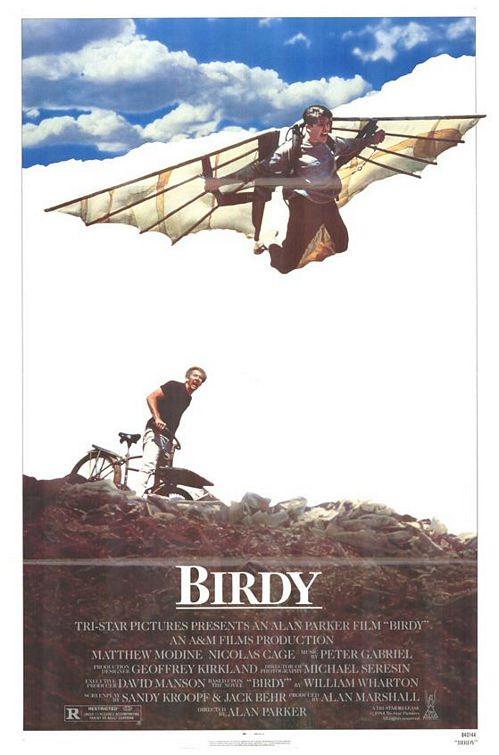
Birdy (1984)

By Richard Winters

My Rating: 7 out of 10

4-Word Review: Fly like a bird.

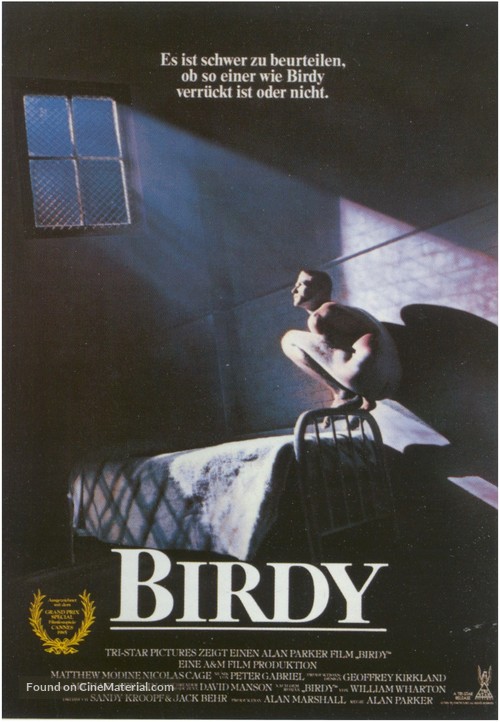
Al (Nicholas Cage) becomes friends with an introverted neighborhood boy (Mathew Modine) nicknamed Birdy due to his fascination with birds. Al begins to follow Birdy around as he collects pigeons and stores them inside an aviary that he has built in his backyard. The two share a strong bond, which is broken when they both get drafted and have to go off to war. Al returns from battle with facial injuries, but Birdy is sent to a mental hospital because after missing in action for a month, he refuses to speak. Al spends time with Birdy trying to get him to talk again, but finds it futile and fears that if he can’t get him to talk the Dr’s will confine Birdy permanently.

The film is based on the William Wharton novel of the same name that was initially rejected by director Alan Parker as a possible movie because he considered the story to be ‘uncinematic’, but after the screenplay was commissioned to writers Sandy Kroopf and Jack Behr who were able to restructure the thoughts of the main character from the novel into dialogue and action Parker was then willing to sign on. The result is a interesting drama that manages to have some touching, quirky moments, but it’s also quite reminiscent of Brewster McCloud and comes complete with the same winged flying contraption which Birdy uses to fly briefly over a junkyard that Bud Cort also used to fly around the Astrdome in that film.

While both Cage and Modine give excellent performances I found the friendship between the two to be confusing. They had very little in common and why Cage would want to follow Modine around all the time as he collected pigeons, which he himself thought to be kind of ‘weird’, did not make much sense. Had they both had an interest in birds then it would’ve worked, but they don’t, so what’s the bond that keeps them together? Having them portrayed as being gay would’ve been the solution and at times it seems that is what Birdy is since he shows no interest in women at all and in one amusing scene watches in boredom while Cage has sex with another women on a beach. Cage could’ve been portrayed as being bi-sexual, or not fully aware of his secret attraction to Birdy, but could later eventually come out and that could help explain why he’d stick with someone that he otherwise found ‘kooky’.

Despite the film’s length  and having some definite slow parts including Cage’s ‘conversations’ with Birdy when he’s inside the mental hospital, which are quite static and should’ve been trimmed, there’s still some memorable moments including a scene showing baby canaries hatching out of their eggs. I also like the tracking shot where Birdy imagines himself flying and done from the point-of-view of a bird, which gives one a very authentic feeling/experience of what it would be like and it was shot with a Skycam, at least partially, which is the first time that had ever been used in a movie.

I also enjoyed how the film examines the different dynamics of both Cage’s and Birdy’s family life and the contrasting personalities of the parents where in Cage’s family the father, played by Sandy Baron, was the dominant force while with Birdy it was his mother (Dolores Sage). My only complaint in this area is that there’s a running subplot dealing with the fact that Birdy’s mother would take all the baseballs that the neighborhood kids would accidentally hit into her backyard and keep them, but no one knew where she hid them. Cage then, years later, asks the Dr’s at the hospital to convince the mother to send the hidden balls to Birdy in an effort to get him to talk again and the mother complies, but the scene showing her retrieving the balls is never shown. So much time is spent talking about where she hid the balls that the film should’ve revealed the hiding place while also showing a tender side to the mother who otherwise came off as being quite cold, so not having this scene at all really hurts the film.

Spoiler Alert!

There’s also complaints by some viewers and critics about the ending, which some, like critic Leonard Maltin, refer to as a ‘gag’ ending. For me this wasn’t an issue as it offered some much needed levity in what is otherwise a very dramatically heavy film, but I was frustrated that there’s no conclusion given to what ultimately happens to the two characters. They’re shown trying to escape from the hospital, but never whether they were able to break-free permanently. After spending two hours following these two around the viewer deserves more concrete answers as to their ultimate fate and keeping it so wide-open is a bit of a cop-out/letdown.


My Rating: 7 out of 10

Released: December 21, 1984

Runtime: 2 Hours

Rated R

Director: Alan Parker

Studio: TriStar Pictures

Available: DVD, Blu-ray, Amazon Video, YouTube

What Ever Happened to Aunt Alice? (1969)

By Richard Winters

My Rating: 8 out of 10

4-Word Review: Old lady kills housekeepers.

After the death of her husband, Claire (Geraldine Page) is shocked to learn that there is no money in his will. Fearing a life of destitution she plots to hire old lady housekeepers who she’ll manipulate to give her their life savings in which she’ll invest into stocks through her broker (Peter Brandon). Once these stocks start making money she’ll murder the housekeeper and keep all the profits for herself. After killing off her fourth housekeeper, Miss Tinsley (Mildred Dunnock) and burying her dead body in her backyard, she hires Alice (Ruth Gordon). Alice though has a secret, she was at one time the former employer for Miss Tinsley, who wants to investigate what happened to her and is suspicious that Claire may hold the secret. Claire though becomes aware of Alice’s scheme and decides to try and make Alice her fifth victim.

This marked the third of Robert Altman’s trilogy featuring old lady killers with the first two being What Ever Happened to Baby Jane? and Hush…Hush, Sweet Charlotte. This was the first one to be filmed in color and the harsh dry desert landscape setting works as a great metaphor to Claire’s barren, evil soul. I also enjoyed the winding plot, which is based on the 1961 novel ‘The Forbidden Garden’ by Ursula Curtiss that has many offbeat twists including a memorable scene featuring the two old ladies rolling around on the floor during a furious fight that you’ll most likely never see in any other movie.

Page’s performance is the main reason why the film is so entertaining. Watching all the various characteristics that she gives to her haughty character is fascinating and she helps make Claire, as nasty as she is, quite memorable. I especially liked the part where after she kills one of her victims she displays for a split second a shocked expression like even she can’t believe what she has just done and this helps to make her character multi-dimensional, like there’s still some semblance of a tortured conscious somewhere within her and she isn’t just a robotic, evil person.

Gordon is okay in support, but I felt her character should’ve had some backup plan that she would use in defense when things got ugly. She keeps assuring her nephew (Robert Fuller) that she can handle things, but when Claire turns on her she becomes almost like a deer-in-headlights. I also didn’t like the wig that she wears and have to agree with one critic who said it makes her look like a giant, walking-talking peanut. I realize that the wig does eventually come into play as part of the plot, but I felt in the brief segments where she’s shown not wearing it she could’ve been seen with her real hair and not just in another wig, which looked just as dumb.

Honorable mention should also go to Spike who plays a stray dog named Chloe. Spike was a well trained animal who was in many films and TV-shows between 1956 and 1971 and the parts where he bares his teeth and growls at Claire every time he sees her, as she attempts to harm him, are amusing.

Spoiler Alert!

The script by Theodore Apstein, fortunately avoids a lot of loopholes, but I did feel at the end they should’ve shown or explained how the characters played by Rosemary Forsythe and Micheal Barbera were able to escape from their burning house. I also found it hard to fathom why Robert Fuller’s character, upon learning that his Aunt had been killed in a suspicious car accident didn’t immediately accuse Claire of doing it. He had pretended not to have any connection to Alice during the majority of the story as that was part of their scheme, but once she was dead I didn’t see why he still needed to pretend. I would think he’d be so emotionally distraught at that point that he would let out his true emotions without even thinking and possibly even tried to attack Claire while having to be restrained by the others.

End of Spoiler Alert!

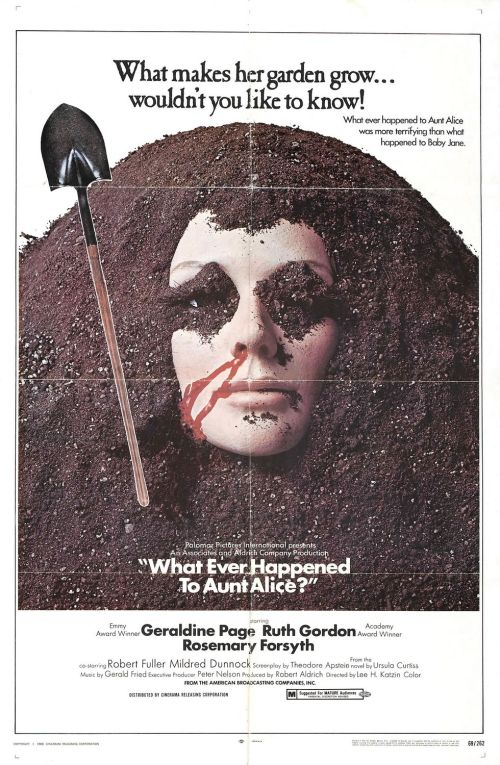
The film’s promotional poster, as seen above, is a bit problematic as it features a young model looking like she’s been buried, but in the movie it was only old ladies that were killed and buried. Showing a beautiful lady may have been more visually appealing, but it’s not authentic to the film that it’s trying to promote.

My Rating: 8 out of 10

Released: July 23, 1969

Runtime: 1 Hour 41 Minutes

Rated M

Director: Lee H. Katzin (Bernard Girard for the first 4-weeks of filming)

Studio: Cinerama Releasing Corporation

Available: DVD, Blu-ray

The Little Drummer Girl (1984)

By Richard Winters

My Rating: 5 out of 10

4-Word Review: Actress infiltrates terrorist organization.

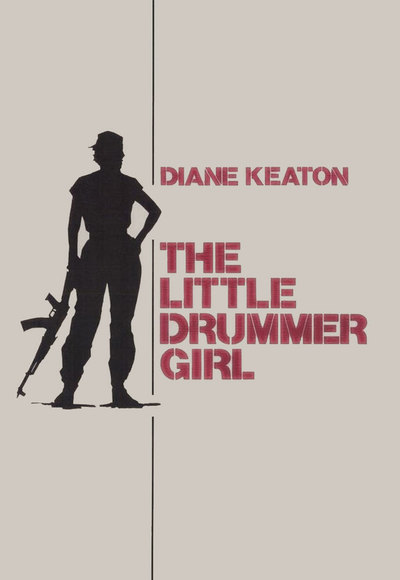
Charlie (Diane Keaton) is a stage actress with pro-Palestinian leanings who’s living in Israel. After a Palestinian bomber kills a Israeli diplomat and his family she gets recruited by a pro-Israeli spy organization to pretend to be the bomber’s brother’s girlfriend. At first she resists, but eventually she puts her acting skills to work until she gets deeper and deeper into the quagmire and begins to question what she really stands for.

The story, which is based on the novel of the same name by John Le Carre, who appears briefly in the film as a police chief, has a lot of exciting moments and a few unexpected ones. For the most part I found the plot intriguing and the twists and turns to be interesting although if the viewer doesn’t pay close attention they could easily become lost.

Klaus Kinski’s performance makes it worth seeing. He suffered from mental illness in his personal life and due to that as well as his unique facial features usually stymied him in roles of madmen, or troubled individuals, but here he plays someone who is actually normal and does a convincing job of it. His presence definitely enlivens the proceedings to the point that he should’ve been the sole face of the Israeli organization and not crowded out by a throng of assistant players who are not interesting and become clutter to both the story and visuals.

Keaton is great here too and one of the main reasons that the film remains as interesting as it does. Her emotional confusion comes off as sincere and the fish-out-of-water concept where she gets thrown into a world that she is not used to and must use her wits and acting talent to get by is at first riveting.

Unfortunately the second half goes too far to the extreme where Charlie no longer resembles the same person that we met at the beginning. Some may argue that this is her character arch, but she still needs to have a consistent foundation and not morph into something completely different with no roots to what she was before. She starts out as someone only going along with the charade because she’s forced into it. She’s very clumsy at first, but then by the second half is able to put a gun together while blindfolded and seamlessly detonate a bomb without a sweat like a seasoned spy with years of experience.

She’s given an opportunity to get out and yet she decides to proceed even as things get more dangerous, which makes little sense since she didn’t conform at all with the political sentiments of the organization that recruited her. Any regular person would have a mental/emotional breakdown at seeing someone killed before their very eyes, or required to go to bed with a stranger that she barely knew, and the fact that she doesn’t reveals how the filmmakers had a very poor grasp on the character.

All of this could’ve been avoided had they modeled her after the one in the book. For the film the producers decided to portray Charlie as being similar to Vanessa Redgrave, but in the book the character was inspired after Janet Lee Stevens who was an American journalist, human rights activist, and Arabic literature scholar who traveled to the Middle East as an interpreter and had no connection to acting. Having the film focus on a young activist whose extreme idealism ends up getting her in-over-her-head would’ve been more compelling and believable. Throwing in the acting angle just doesn’t work and ends up becoming its biggest liability.

My Rating: 5 out of 10

Released: October 19, 1984

Runtime: 2 Hours 10 Minutes

Rated R

Director: George Roy Hill

Studio: Warner Brothers

Available: DVD (Warner Archive), Amazon Video, YouTube

The Believers (1987)

By Richard Winters

My Rating: 6 out of 10

4-Word Review: Cult requires child sacrifice.

After the death of his wife (Janet-Laine Green) Cal (Martin Sheen) decides to move with his young son Chris (Harley Cross) from Minneapolis to New York City where he gets a job as a police psychologist. It is there that he councils officer Tom Lopez (Jimmy Smits) who worked undercover to infiltrate a cult that performed child sacrifices and is now paranoid that these same cult members are after him when it’s really Cal’s son that they want.

On the directing end I found this to be mildly engrossing and I enjoyed the way John Schlesinger vividly captured both surburbia as well as the inner city. Working into the false sense of security that the suburbanites have making them believe that they’re ‘immune’ to what goes on in the poorer areas, but here it shows how evil can seep into even the most affluent of areas and revealing just how vulnerable everyone is.

However, if you focus solely on the script, which is based on the Nicholas Conde novel ‘The Religion’, then there are a myriad amount of problems. The biggest one being the opening sequence that features the mother getting electrocuted in a freakish accident, which doesn’t really have all that much to do with the rest of the story. Some may argue that this was the catalyst to get Cal and Chris to move from Minneapolis to New York where the real meat of the plot begins, but why not just have them already in New York to begin with?

Having Helen Shaver enter in as Cal’s love interest is equally pointless. Their relationship happens too quickly and comes off as forced while Chris’ dismay at having a new mother figure in his life seems like an issue for an entirely different type of movie. I admit having a tumor grow on her face that eventually spawns spiders is my favorite part of the movie, but why not just have this occur to the mother instead of killing her off so quickly at the beginning?

Richard Masur’ character, who appears during the first act only to then disappear until the end is problematic as well. A good script has important characters appear throughout the story and not just vanishing until you’ve completely forgotten about them, which I did, and then conveniently reappearing and suddenly becoming an integral part of the plot.

Cal’s character arc is too extreme too. He’s portrayed as being a rationalist who does not believe in superstition, but then later on is shown taking part in a ritual requiring him to squeeze out blood of a decapitated chicken, which is too Jekyll and Hyde-like. Sure people can sometimes change their opinions on things, but not so quickly or so severely. Portraying him as initially being superstitious, instead of so adamantly against it, might’ve made this scene a little less jarring.

There are only an estimated 22,000 people who practice the Santeria religion in the United States, which has a population of 327 million, so the odds that a person such as Cal would come into contact with not only a police officer that dealt with the religion, but also relatives is astronomically low and hurts the plausibility. It’s equally hard to believe that a large group of educated, upwardly mobile yuppies would get caught up into a cult that required child sacrifice and that they would all be able to keep it a secret without any of them getting a guilty conscience and going to the police. This is a religion that’s prevalent in the Spanish-speaking parts of the Caribbean, so why a large group of white people would suddenly get so into it is never explained.

Spoiler Alert!

The twist at the end in which Helen Shaver’s character creates a shrine to the spirits composed of dead animals inside her barn makes no sense as there is never any hint earlier that she had a propensity for the ritual, so why all of sudden did she start embracing it? I’m not an animal expert either, but I don’t think a dog would behave so aggressively as he’s shown doing by jumping up and down and barking loudly at the barn door where the shrine of the dead animal is. I would think for him to act that way it would have to be the smell of a live creature and he’d know the difference, but again that’s just speculation.

End of Spoiler Alert!

A lot of these problems could’ve been avoided had the producers went with their original idea of portraying it as a satanic religion feeding off the hysteria of the satanic ritual abuse that was a prevalent headline catching conspiracy theory during the 80’s. Having some outcast teens and desperate poor people immersing themselves in a fringe ritual because they had nowhere else to turn would’ve made a heck of a lot more sense than a bunch of yuppies gleefully standing around and watching the killing of someone else’s child simply because they felt it would give them ‘good luck’ in their quest up the corporate ladder.

My Rating: 6 out of 10

Released: June 10, 1987

Runtime: 1 Hour 54 Minutes

Rated R

Director: John Schlesinger

Studio: Orion Pictures

Available: DVD, Blu-ray, Amazon Video