Category Archives: Movies Based on Novels

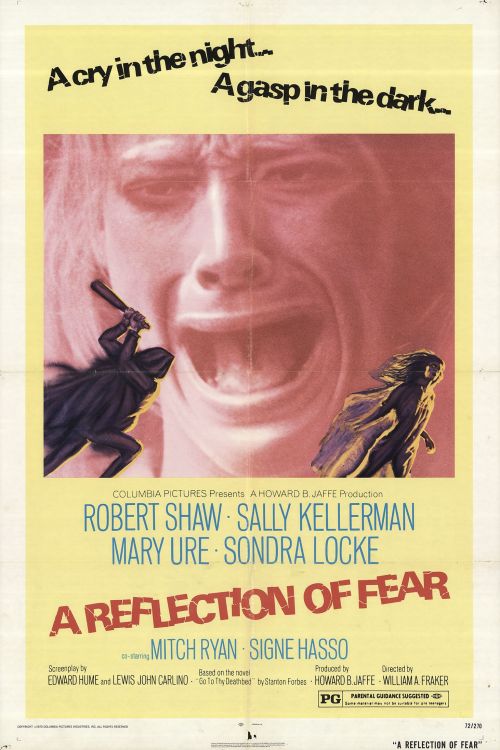
A Reflection of Fear (1972)

reflection

By Richard Winters

My Rating: 4 out of 10

4-Word Review: His daughter is disturbed.

Marguerite (Sondra Locke) is a lonely teen girl living with her mother Katherine (Mary Ure) and grandmother Julia (Signe Hasso). Through her alienation she creates an imaginary world with her dolls including one named Aron who she routinely has conversations with, but who also argues with her from time-to-time. Marguerite’s estranged father (Robert Shaw) comes to visit in order to ask Katherine for a divorce, so that he may marry Ann (Sally Kellerman). He also starts to rekindle things with Marguerite though Ann feels the two are getting much too close and fears they may be forming an incestuous relationship. Soon after both Katherine and Julia turn-up dead having been bludgeoned to death by a mysterious intruder, but who did the dirty deed? Was it an angry Marguerite, or her father, or was it the doll named Aron, who Marguerite insisted spoke to her even though no one else believed her.

The only reason to catch this obscurity is for the performance of Locke who’s absolutely brilliant. Despite being 27 at the time, she still looked like a teen and her attempt at speaking in an English accent is effective and I almost thought it had been dubbed, but it wasn’t. Her presence completely dominates the film making the supporting players seem almost non-existent and it convinced me that her relationship with Clint Eastwood, in which he according to her autobiography wouldn’t allow her to do any other projects that he wasn’t involved in, was a big mistake as she was clearly, as evidenced here, a highly gifted actress that never got her full due.

With that said I was kind of surprised to see Shaw in a film that didn’t allow him to shine and forced him to take a backseat. I can only imagine the reason that he did it was so he could work with his wife Ure, whose alcoholism had relegated her to only supporting parts toward the end of her career and in fact this was her last film before she was discovered dead in her dressing room at the young age of 42 from an accidental drug overdose. The two, for what it’s worth, do work well together. The hateful looks that she gives Shaw here seem authentic and you’d never know the two were a couple in real-life.

The story, with a screenplay co-written by Lewis John Carlino and based on the book ‘Go to Thy Deathbed’ by Stanton Forbes, has potential, but never gels. The scenario seems like it would’ve been better for a half-hour episode of the ‘The Twilight Zone’ and stretching it to a 90-minute length offered in too many slow spots where nothing much seemed to happen. The only time there’s any action is during the murder sequences, which could’ve been played-up more, otherwise it’s a lot of talk that fails to build-up the suspense or mystery in any interesting way.

Spoiler Alert!

The main problem that I had was that it was obvious to me that the doll was just a projection of Marguerite’s repressed anger, so the big reveal where she’s found to be the killer was not a surprise at all and in a lot of ways just a letdown. Had the filmmaker’s made an attempt to show the doll actually speaking instead of only been glimpsed in a shadowy way, which made it clear that he was just a figment of her imagination, then maybe there would’ve been more suspense because the viewer might actually have been made to believe that he was real, but the way it gets done here is not intriguing.

Having Shaw find out at the end that his daughter was actually a boy just made things even more confusing. Some have lauded this has being the first film with a transgender theme and a precursor to Sleepaway Camp, which is great, but what’s it all supposed to mean? Was Marguerite’s transgender issues the reason for her anger and why she lashed out into murder? Was this also the reason why her mother and grandmother kept her locked away and cut-off from potential friends, or was this instead Marguerite’s choice? None of this gets answered, which ultimately makes the film a pointless excursion.

My Rating: 4 out of 10

Released: November 15, 1972

Runtime: 1 Hour 29 Minutes

Rated PG

Director: William A. Fraker

Studio: Columbia Pictures

Available: DVD-R, Blu-ray

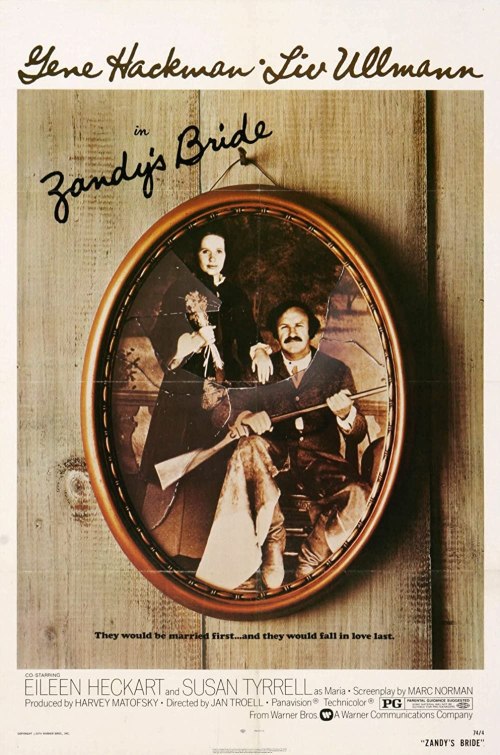
Zandy’s Bride (1974)

zandy1

By Richard Winters

My Rating: 7 out of 10

4-Word Review: A mail-order bride.

Based on the novel ‘The Stranger’ by Lillian Bos Ross the story centers on Zandy Allan (Gene Hackman) a rancher living in the remote frontier of the American west during the late 1800’s. He finds living alone while maintaining a ranch to be an arduous challenge and thus puts an ad in the newspaper for a bride. The inquiry catches the eye of Hannah (Liv Ullmann), a Swedish woman living outside of Minneapolis. She arrives in Zandy’s hometown, but Zandy is initially not pleased as she’s 32 instead of 25 and he feels she’ll be too old to bear him a son. Begrudgingly he takes her on the long horse ride back to his ranch while informing her there’ll be ‘no turning back’. Their relationship starts out rocky as Zandy expects to be able to order her around and have sex with her at will and is routinely abusive, but complains to his mother (Eileen Heckart) that he cannot understand why she doesn’t like him. Eventually the two, after many years and many fights, form a tenuous bond.

The film was directed by Jan Troell a Swedish director and cinematographer whose films The Emmigrants and The New Land gained international acclaim and won him a contract to direct a Hollywood film. Despite the presence of Ullmann, who had also starred in Troell’s other two films, and having the same frontier setting this one did not do as well either with the critics or the box office and culminated in making Troell’s foray into Hollywood filmmaking, which he said he didn’t like since union rules didn’t allow him to man his own camera like he had always done while making movies in his homeland, a short one.

A lot of the reason for this could be that it starts-off with a brutal rape scene, though not as graphic as in some other films, is still quite unpleasant particularly with Ullmann’s pleading blue-eyes and Hackman callously shouting that he ‘has a right’ as he violently strips off her clothes. While one can appreciate the film’s stark reality, as I’m sure in the remote frontier this sort-of thing could’ve easily happened, it still leaves a bad vibe since Hannah softens to Zandy despite his continually arrogant behavior too quickly. Most women would hate a man forever after that, so for the film to take the approach that love could still blossom is a bit hard to fathom. It should’ve at least taken the entire duration for this to occur instead of entering it in already by the second act.

Hackman is fantastic particularly for taking on such a unlikable role. Most other actors who’ve gained leading man status will rarely do this as they’ll feel it will affect their image, so it’s great to see an actor willing to stretch his range no matter the results. Ullmann is quite good too and it’s almost surreal hearing her speak English when I’ve seen so many films of her speaking in her native tongue. Her character though needed better fleshing-out. With Zandy we can see why he behaves the way he does when he visits his parents (Frank Cady, Eileen Heckart) and witnesses the poor way his father treats his mother, which clearly gives him the mindset that treating women that way is ‘normal’, but we get no such backstory with Hannah. Why did she choose to be a mail-order-bride when she’s so beautiful and you’d expect she’d find many suitors back where she lived? There’s no hint of her family history, or why she ended up in the situation that she does. I also felt she was too assertive too quickly and would’ve liked more of an arc where she starts out shy, but after going through the rigors that she does gains an assertiveness that she didn’t think she initially had.

Spoiler Alert!

The film ends on a hopeful note. Whether one feels this has been earned, or deserved is up to one’s subjective perspective though I was happy to see some redeeming qualities from Zandy as sitting through it watching him behave badly and never learning anything from it would’ve been too unbearable otherwise. I couldn’t help though but wonder during the many times that Zandy abandons her for months on end that one of the men from town wouldn’t have proposed to her in the process. In either case this ends up becoming the first and quite possibly only movie that could be categorized as a love story without any romance.

My Rating: 7 out of 10

Released: May 19, 1974

Runtime: 1 Hour 37 Minutes

Rated PG

Director: Jan Troell

Studio: Warner Brothers

Available: DVD-R (Warner Archive), Amazon Video

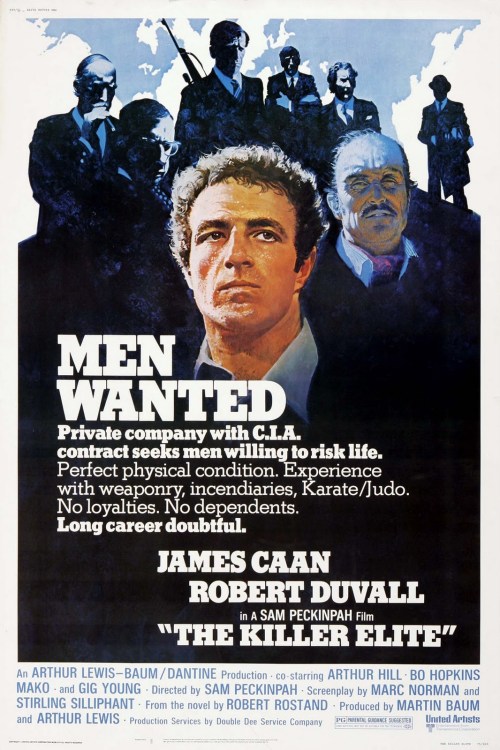
The Killer Elite (1975)

killer1

By Richard Winters

My Rating: 3 out of 10

4-Word Review: Betrayed by a friend.

Mike Locken (James Caan) and George Hansen (Robert Duvall) are two longtime friends and hit men working for a private agency affiliated with the CIA to carry-out covert missions. During their latest assignment Mike is shocked to see George turn on him by shooting him in the knee and elbow. While Mike is able to survive the incident he is forced to go through a long and painful rehabilitation and due to the injuries is no longer considered employable as a hit man. Mike though refuses to concede and goes through martial arts training were he learns to use a cane both for protection and offensive action. He assembles his old team while vowing to get revenge on George, but fails to realize that there’s someone else behind the scenes who’s pulling-the-strings and far more dangerous.

By the mid-70’s director Sam Peckinpah had achieved a strong following of admirers with his ground breaking action films that took violence and the way it was portrayed in films to a whole new level. While he had his share of critics his movies did well at the box office, which should’ve been enough to get him any assignment he wanted, but his notoriously cantankerous behavior on the set and alcoholism made him virtually unemployable. Mike Medavoy, the head of United Artists, decided to give him a reprieve by hiring him on to direct his next project, but it was under strict conditions that allowed the studio to have final say over all aspects, which in turn made Peckinpah’s presence virtually null and void. The film lacks the edginess of his other more well known pictures. The action really never gets going and much of it was intentionally toned down in order to get a PG-rating. The tension is also lacking and great majority of it is quite boring. There’s even brief moments of humor, which only undermines the story and makes it even more of a misfire.

I liked the casting of Caan, who has disowned the film, which he gives a 0 out of 10, and Duvall, this marked their 5th film together, but the script doesn’t play-up their relationship enough. I was hoping for more of a psychological angle like why would a loyal friend suddenly turn on his partner, which doesn’t really get examined. Duvall has much less screen time and there’s no ultimate confrontation between the two, which with a story like this should’ve been a must. The drama also shifts in the third act to Caan taking on Arthur Hill, who plays a undercover double-agent, which isn’t as interesting or impactful.

Caan’s shooting gets badly botched. I will give Peckinpah credit as the surgery scenes including the removal of the bullet is quite graphic, but how Caan is able to find help after he is shot is never shown. The assault occurs in a remote location, so technically he could’ve died without anyone knowing, so how he was able to find his way out and get the attention of a medical staff needed to be played-out and not just glossed-over like it is.

The introduction of Ninja warriors was another mistake. This was courtesy of Stirling Silliphant who had been hired to rewrite the script and wanted this element put-in since he and his girlfriend Tiana Alexander had studied martial arts under Bruce Lee and felt this would offer some excitement. The result is campy though a one critic, Pauline Kael, like it as she considered it a ‘self-aware satire’ though I was groaning more than laughing.

Some felt that Peckinpah had sold-out and this movie really made it seem like he had. Nothing gels or is inspired though I will at least credit him with the building explosion at the beginning, which was an actual implosion of an old fire house that he became aware was going to happen and quickly revised the shooting schedule, so he’d be able to capture it from across the street and then use it in the film, which does help though everything after it falls flat.

My Rating: 3 out of 10

Released: December 17, 1975

Runtime: 2 Hours 3 Minutes

Rated PG

Director: Sam Peckinpah

Studio: United Artists

Available: DVD, Blu-ray (Region B/2), Tubi, Amazon Video, YouTube

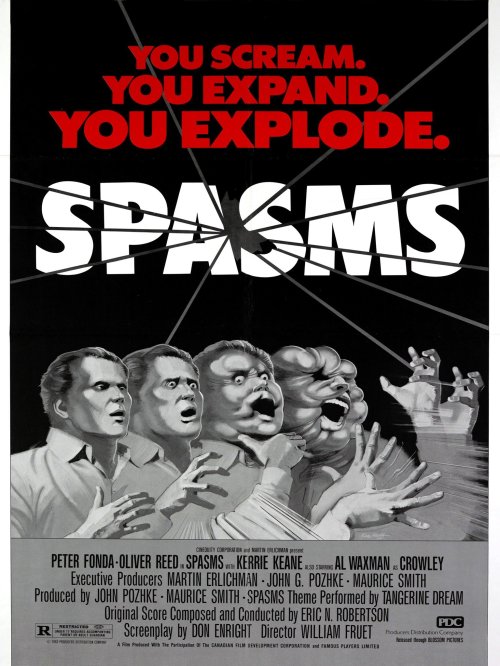
Spasms (1983)

spasms3

By Richard Winters

My Rating: 3 out of 10

4-Word Review: Giant snake uses telepathy.

Years earlier millionaire philanthropist Jason Kincaid (Oliver Reed) got attacked by a giant serpent snake while on a trip in Micronesia. His brother, who went with him, died from the attack, but Jason survived and in the process began acquiring a telepathic connection to the snake. He pays some poachers to capture it and have it brought to his mansion. He also tries to use the services of Dr. Brasilian (Peter Fonda) who specializes in ESP research to help end the ongoing communication that the snake has with him.While Kincaid’s private lab is being constructed the snake is kept at the university lab run by Brasilian, but the reptile escapes and begins killing anyone it sees.

The film is based on the novel ‘Death Bite’ by Michael Marky and Brent Monahan, who wrote it in hopes of cashing in on the Jaws craze and having it made into a movie. The two were excited when a Canadian production company decided to produce it, but quickly became disillusioned with all the production delays and rewrites. When the original studio went bankrupt and the new one insisted on adding in a supernatural element the two writers to walk-off the set and disown the project.

Despite the film’s checkered history I found the production values to be quite impressive especially for a horror movie. The on-location shooting is varied and authentic, particularly the island setting and the main character played by Reed is less cardboard than in most other scary movies. Unfortunately the pacing is slow and not enough happens. I was expecting more scares and blood, but there really isn’t much of it.

The film’s biggest downfall is that you never get to see the snake. Initially during the attacks everything gets shown from the snake’s point-of-view by having a blue filter put over the camera lens, which doesn’t work because it’s done via a tracking shot making it look like the snake glides through the air instead of slithering like a real one would. Outside of a few seconds of seeing its head pop-up, which looks like a hand puppet, we’re never shown the beast in its entirety. Originally the idea was to use live snakes, which would’ve been great, and a 14-foot Indian Python was brought in, but this was found to be too costly and time-consuming, so it got scrapped. They then tried to use animatronics, but director William Fruet didn’t like the way it looked onscreen, so this was shelved too essentially making this a snake movie, but without any snake.

Despite being reportedly drunk most of the time during the production Reed adds a nice intensity though it made no sense at the end when he begins walking around without a cane even though he had being using one the whole time earlier. The special effects showing the victim’s arms and faces ballooning out after they’re bitten is pretty cool, but the ending is a letdown. It was supposed to feature a violent showdown between Reed and the snake, including having his arm swallowed by the beast, but director Fruet didn’t like the look of the special effects, so these scenes were cut and flashbacks showing things that had happened earlier got thrown-in simply to pad the runtime.

The big lesson here is that if you’re going to make a movie about a giant, monstrous snake then you need to at some point show it. Even if it means spending big on computer effects, or bringing in a real one, the effort has to be made. Trying to do one without actually showing the snake, as the snake here is probably seen a combined 10 seconds and never its full body, and expecting the audience to still go home satisfied afterwards is pretty absurd.

My Rating: 3 out of 10

Released: October 28, 1983

Runtime: 1 Hour 30 Minutes

Rated R

Director: William Fruet

Studio: Pan-Canadian Film Distributors

Available: VHS

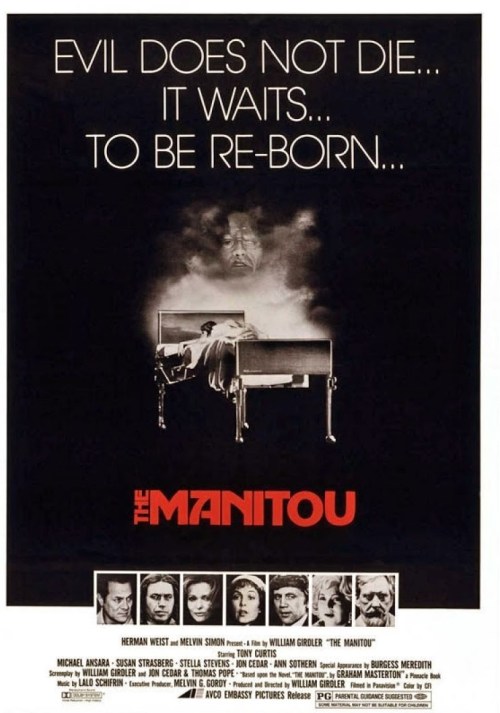
The Manitou (1978)

manitou

By Richard Winters

My Rating: 0 out of 10

4-Word Review: Tumor on her neck.

Karen (Susan Strasberg) is a middle-aged woman living in San Francisco who begins noticing a lump on the back of her neck that grows at an accelerated rate. She goes to the hospital to have it checked and the doctors there, after analyzing the X-rays, believe it to be a fetus growing within the tumor. Karen’s boyfriend Harry (Tony Curtis) does some research and discovers that the growth is an Indian shaman reincarnated from a past life who’s brought back to take revenge on the white man for driving his people off of their land. When the surgery to remove the tumor goes wrong, Harry summons the help of a modern-day shaman, John Singing Rock (Michael Ansara) to help him get the fetus removed. While John has a strong connection to the spirit world he realizes that the ones he can summon are weak compared to what the spirit who inhabits the growth on Karen’s neck can bring to life.

I’ll give writer-director William Girdler credit, during his brief life and career he directed a lot of movies, 9 of them while still in his 20’s, but the quality of the output was minimal. He did achieve a few cult hits like Sheba, Baby and Abby as well as a couple that did well at the box office, Grizzlybut this one, which came in with a high budget, could be considered his worst. The cast is interesting, though they’re well past their prime, but the plot, which is based on the best-selling novel of the same name by Graham Masterton, is too silly to be taken seriously.

Girdler shows more interest in capturing the San Francisco skyline, of which he does well, and some of the city’s more exotic locales, then spotting continuity errors. One of the most glaring ones is when the surgeon, played by Jon Cedar, who co-wrote the script, severely cuts his hand during the surgery, but then later he’s in a scene where his hands look fine and there’s no bandages on them. There’s also several moments where I was literally laughing-out-loud, like when an old lady, played by Lurene Tuttle, becomes possessed by the Indian spirit and begins dancing around the room and speaking in a deep voice, which looks as silly as it sounds. The seance is laughable too and since these have been parodied so much it’s best not even putting them into any horror movie that hopes to take itself seriously as it’ll just have the viewers-rolling-their eyes from the very beginning.

The main characters are a mess mainly because they don’t have much to do. Curtis plays this phony psychic who does nothing but stand around and watch Ansara do all the work to the extent that Ansara should’ve been the star and Curtis, who’s looking haggard and washed-up here, could’ve been cut-out completely and not missed. Strasberg is boring as the victim. She has this giant growth on her neck that’s expanding rapidly and yet she takes it in a ho-hum, laid-back fashion when anyone else would be stressing-out and going crazy with anxiety. There also should’ve been a specific reason why she got targeted with the tumor instead of just writing it off as a ‘random occurrence’.

The third act picks-up slightly and the birth of the Indian spirit where you see him claw his way out of the womb while still on Strasberg’s neck, is visually impressive from a special effects perspective, but once outside he looks too much like a dwarf in an Indian get-up. Having the entire floor of the hospital turn into a frozen polar zone is cool until you start looking at the ice blocks too closely and realize they’re just styrofoam. The climactic sequence in which a now topless Strasberg battles the Indian spirit using telekinetic powers while seemingly floating in outer space is too stupid for words and cements this as a complete embarrassment for all those involved.

My Rating: 0 out of 10

Released: April 28, 1978

Runtime: 1 Hour 43 Minutes

Rated PG

Director: William Girdler

Studio: AVCO Embassy Pictures

Available: DVD, Blu-ray, Amazon Video, YouTube

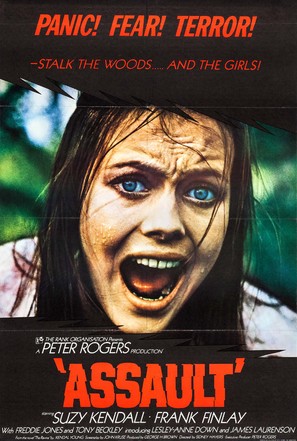
Assault (1971)

assault1

By Richard Winters

My Rating: 5 out of 10

4-Word Review: Schoolgirls attacked by rapist.

One day after school Tessa (Lesley Ann-Down), a teen who attends a local British high school in rural England, decides to cut through the nearby woods as a shortcut on her way home. As she treks through the forest an unseen assailant attacks her, which leaves her in a catatonic state. A few days later, despite the warnings, another female student goes into the woods and is later found murdered. The police inspectors (Frank Finley, James Cosmo) have idea who it could be and are unable to come-up with any leads, which frustrates the local teacher Julie West (Suzy Kendall). She decides it’s up to her to nab the culprit, so she uses herself and some of her students as bait to lure the killer out. She drives into the woods in a station wagon, but then the car gets stuck. While she tries to back it out she gets a glimpse of the perpetrator’s face as he deposits another of his victims, but when she describes to everybody what he looks like, saying he has the face of the devil, everyone thinks she’s gone mad.

This is another one of those British thrillers where in an attempt to gain more interest in the film the studio would release it under different titles. In the US the film was known as ‘In the Devil’s Garden’ to take advantage of the possession craze that was occurring after the release of The Exorcist and then a few years later it got re-released under the title ‘Satan’s Playthings’ and billed as a provocative story with erotic overtones. In either case the plot, which is based on the novel ‘The Ravine’ by Kendal Young, comes-off more like a cop drama/mystery than a horror flick.

That’s not to say it’s bad as director Sidney Hayers throws in some good touches. The attack on the girl is well handled using a hand-held camera that makes it seem unrehearsed and sudden. For a British thriller it’s even kind of racy. Normally films from England are quite timid about showing nudity, blood, or violence, but this thing does push-the-envelope a bit, far more than I was expecting, while still remaining ‘tasteful’ enough not to come under the ire of the British censors. The pounding music score helps create an urgent mood and grabs your attention at the start though it gets overplayed by the end and resembles a score heard on a cop TV-show.

The acting is good, but seeing Down looking so young and appearing much different from what we’re used to seeing her now kinda threw me off as you’d almost think she’s a completely different person. Kendall, who became a British scream queen for all the horror movies and thrillers that she was in, is quite appealing and I loved seeing her in glasses, which gives her a certain sexy look. The male actors are okay, but there’s more of them than are necessary and I think this was only done to create more suspects to choose from though their 70’s haircuts complete with long sideburns gives the film a very dated quality.

I was able to guess who the culprit was with about 20-minutes to go. It’s not that hard to figure out and the film gives-off a few too many clues to the point that it would be hard for someone not to know who it is. The story itself is standard. Not much thrills or chills though the electrocution via a cable that the victim touches while climbing up an electrical tower is admirably realistic and probably the most impressive part of the movie.

My Rating: 5 out of 10

Released: February 11, 1971

Runtime: 1 Hour 31 Minutes

Rated R

Director: Sidney Hayers

Studio: J. Arthur Rank Film Distributors

Available: DVD, Blu-ray

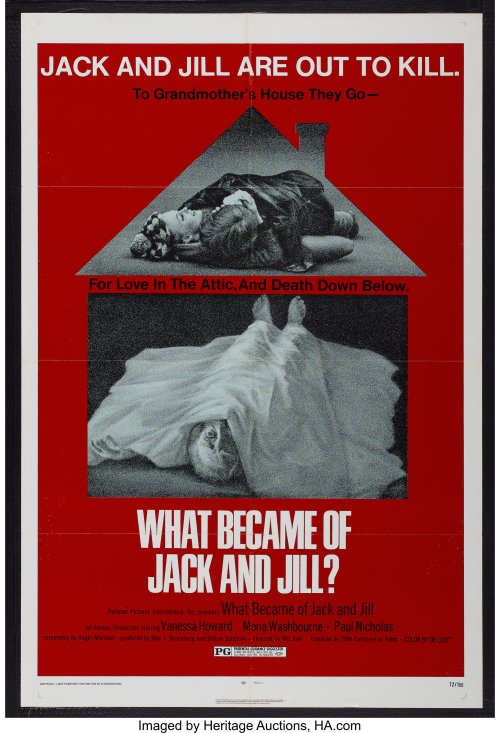
What Became of Jack and Jill? (1972)

jack2

By Richard Winters

My Rating: 7 out of 10

4-Word Review: Greedy couple learns lesson.

Johnnie (Paul Nicholas) lives with his elderly grandmother Alice (Mona Washbourne). He has no motivation to get a job and hopes that by staying in her good graces he can inherit her small fortune and house when she passes away. Johnnie’s girlfriend Jill (Vanessa Howard) becomes impatient waiting for the old lady to die and hopes to hasten it by hatching a plan with Johnnie where Alice will think that a youth movement has occurred where those under 30 rebel against the older generation, particularly those over 75, by taking them away to prison camps, or killing them outright. Johnnie manipulates Alice into believing that this movement has pegged her as their next victim and even stages a protest outside her home to convince her that they’re coming for her. Succumbed with fear Alice drops over with a heart attack, and the couple believe they now can get their hands on her money, but at the reading of her will they find that Alice has placed a stipulation that they weren’t expecting.

The filmed was produced by Amicus Productions, which was a British film studio that specialized in horror movies, mainly those of the Gothic variety. To keep up with changing tastes they decided to dabble in the grindhouse genre and picked this story, which was based on a novel called ‘The Ruthless Ones’ by Laurence Moody, as their first venture. They were so impressed with Vanessa Howard’s creepy performance in Mumsy, Nanny, Sonny and Girly that they signed her on as the star hoping to make her their next ‘scream queen’. Howard, who was upset at how the previous film she was in fell into obscurity, that she was happy to take on a new project that would be financed by a well know studio, which she felt would guarantee that the picture would receive strong box office appeal. Unfortunately, once the project was finished Amicus studio heads were aghast at the dark subject matter and decided not to release it causing this movie to become as obscure as Howard’s other one, which in-turn disillusioned her wit the business and causing her to retire.

The story does have its share of faults. There’s no explanation for what happened to Johnnie’s parents, or what their take is on his living situation. His ability to fool the grandmother into believing such an outrageous conspiracy theory happens too easily and is hard to believe, but the dark story elements, despite the slow pace, still holds adequate intrigue. A lot of credit goes to the performances. Howard is quite nasty, but in a different way than she was in her other movie where she behaved like she was in a trance, but here is knowingly devious while also shockingly callous. Washbourne is also terrific causing you to gain sympathy for her character and what she goes through.

The twist is good, but not a complete surprise and it takes too long to get there. My biggest gripe is that once the story shifts it doesn’t explore enough of the wrinkles that it creates. There’s a whole array of different plot threads it could’ve taken, but instead settles for the most obvious one culminating in a climax that peters itself out instead of inviting in even more twists and characters to it.

Spoiler Alert!

The stabbing scene is problematic in that the victim clothes get stained with blood, but there’s no rip in the clothing to represent where the knife was able to get through. A person can’t bleed unless a sharp object touches their skin and for that to happen it needs to be able to cut through the fabric on top of it, so to have a shot where the victim is ‘bleeding’ into their clothing, but clothing itself  isn’t ripped is illogical. Also, having the police continue to stand outside the home and politely knock on the door to be let in, after they become aware of what Johnnie has done, while he remains inside refusing to open it, got overdone. At some point the police are going to have to break down the door if the suspect refuses to come out and this should’ve been shown.

End of Spoiler Alert!

Overall I still enjoyed it especially the music played over the opening and closing credits and during the club scenes. I don’t know what the name of the band was, but it has a great punk band-like sound that’s distinct and hard edged. If the movie itself won’t get the proper Blu-ray release that it deserves then the soundtrack at least should.

My Rating: 7 out of 10

Released: June 16, 1972

Runtime: 1 Hour 33 Minutes

Rated PG

Director: Bill Bain

Studio: 20th Century Fox

Available: None

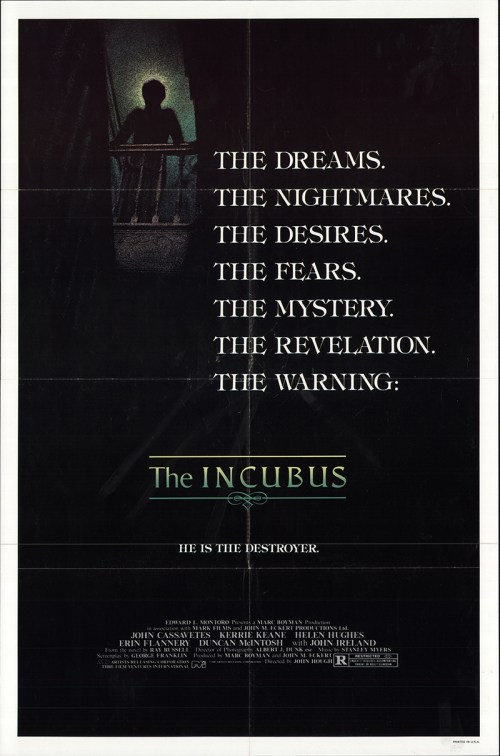
Incubus (1982)

incubus1

By Richard Winters

My Rating: 5 out of 10

4-Word Review: Demon being rapes women.

In a small Wisconsin town known as Galen the women are being sexually assaulted by a mysterious being with super human strength. When the victims are taken to the hospital they are seen by Dr. Sam Cordell (John Cassavetes) who notices an extraordinary amount of semen deposited that is reddish in color and doesn’t seem left by a human. Sam argues with the local sheriff Hank (John Ireland) about whether it’s a gang of men doing these crimes, or just one person. The two team-up with Laura (Kerrie Keane), a local reporter who has just moved into town and shares a striking resemblance to Sam’s former girlfriend who’s now deceased, to find the culprit. They begin to think it may be Tim (Duncan McIntosh) a young man who’s still living with his adopted mother (Helen Hughes) and has been dating Sam’s daughter Jenny (Erin Noble). Tim complains about having weird, vivid dreams and every time he wakes up a new crime has been reported, which makes Sam fear that Jenny may be the next victim.

This film approaches things differently from the conventional horror, especially those done in the 70’s, where there’s no character build-up and just jumps right into the attacks, but this doesn’t work because we have no idea who these people are nor care what happens to them making the viewer sit through the whole first half in a rather apathetic manner to what’s going on. The film also makes the mistake of not showing, with the exception of a brief second where we do see the creature’s hairy arm, of who this entity is until the very end though it should’ve been done sooner. Having some mystery is good, but a film has to keep upping the ante otherwise it will get tedious and seeing the attacks get done over and over in virtually the same manner without any new information or twists added soon becomes quite boring.

Listening to Sam and Hank perpetually argue who the culprit is for almost the entire film without much  clues being added in becomes tiresome too. The film though is helped immensely by John Hough’s direction who adds a lot of visual style including a cool tracking shot done from underneath a wheelchair.

I was unhappy though that it wasn’t actually filmed in Wisconsin, but instead Guelph, Ontario, which has homes and buildings that resemble more of a colonial style that you would find in the northeast versus the Midwest. Having movies filmed on-location that’s specific to the story can help give it an added ambiance and sometimes even work as a third character, but since this movie cheats on this we don’t get that here.

Casting Cassavetes, who is better known for directing groundbreaking, independent movies, in the lead was a novel move. His hawk-like facial features I always felt would’ve made him a good bad guy, but his unique acting approach does at least keep his scenes interesting though his relationship with his daughter does border on cringey. One shot has him viewing his naked daughter, who is 17, through a  mirror as she gets out of the shower, which seems to imply, though it never gets played-out, that he may have a perverse sexual interest in her. There’s another scene where he introduces her to Laura as simply being ‘a woman I live with’, which is a very weird way for a father to describe a daughter.

The supporting characters aren’t captivating at all. Laura, who’s supposed to be an aggressive journalist type, breaks down too easily after receiving minor blow back from the sheriff over her reporting, which made her seem too sensitive. If she’s truly the ‘fearless reporter’ as portrayed then she’d have to have a thicker skin and even expect some criticism when it comes. The Tim character is also a bore as we see him in only one emotional state, perplexed and confused, which makes him too one-dimensional.

Spoiler Alert!

The ending is where things get messed-up. For one thing it tries to squeeze an elaborate explanation for what’s going-on into the final three minutes, which is too short of a time period for the viewer to digest it all, or have it make sense. What really got me though is that we find out that the incubus was actually Laura, and the film ends with Sam seeing her kill his daughter, but we never see how Sam responds, or if he’s able to defeat her, which is frustrating. So much time gets spent on the boring investigation only to then abruptly end once we finally get a pay-off.

By having Laura be the ultimate villain also goes against the film’s title. According to mythology an incubus is a male demon that tries to have sex with a female human, but a succubus is a female demon, so hence the title of the movie, the way I see it, should’ve been, when given the way it turns out, Succubus.

My Rating: 5 out of 10

Released: August 27, 1982

Runtime: 1 Hour 33 Minutes

Rated R

Director: John Hough

Studio: Kings Road Entertainment

Available: DVD, Blu-ray, Pluto TV, Plex, Tubi, YouTube

Diary of the Dead (1976)

diary2

By Richard Winters

My Rating: 5 out of 10

4-Word Review: Two dead old ladies.

Stan (Hector Elizondo) is married to Vera (Salome Jens) while living in a house that’s owned by Vera’s mother Maud (Geraldine Fitzgerald). Maud and Stan do not get along and she uses the fact that Stan can’t find regular employment as a means to belittle him.  She also tries to convince Vera to leave him. Stan is aware of this, but can’t seem to do much about it. Then one day Maud’s friend Ethel (Kate Wilkinson) comes for a visit. She arrives while Maud is upstairs taking a nap, and is greeted by Stan, but since she had to walk all the way from the bus station to the house and suffers from high blood pressure, she promptly collapses once she gets inside. Stand decides to use this as an opportunity to get rid of Maud by claiming to the attending physician (Austin Pendleton) that the dead body is his mother-in-law, so when Ethel is taken away for cremation everyone thinks it’s Maud instead. Stan then buries Maud’s body, who he has killed on his own, in his backyard, but this catches the eye of his nosy neighbor Walter (Joseph Maher) who had always gotten along well with Maud and feels Stan’s explanation of what happened doesn’t add-up.

The story is based on the 1971 novel ‘One Across, Two Down’ by Ruth Rendell and while the plot has a sufficient amount of twists the direction, by first timer Arvin Brown, is lacking. It’s not liked it’s bad direction, but it has no finesse and seems meant of TV.  It’s no surprise that Brown ended up doing projects exclusively for TV after this one as nothing here is cinematic and approached in such a sterile way visually that it actually detracts from the proceedings.

Elizondo gives a feisty performance that perfectly captures a bitter man going through life with a chip-on-his-shoulder. His arguments and confrontations with Maud lend for some colorful dialogue, but a meddling, cantankerous mother-in-law is nothing new and if anything seems cliched making the material come-off as second-rate and formulaic.

The crime itself isn’t elaborate. In the ‘Columbo’ TV mysteries we’d see the bad-guy pull-off the murder in a way that was carefully thought-out, so the viewer becomes intrigued trying to figure out what flaw the killer overlooked that Columbo will jump on, but here it works in reverse. The crime is spur-of-the moment with a bunch of things that could easily go wrong that will instantly get Stan caught, which isn’t as interesting. Stan is also not a pleasant person, so the viewer is not emotionally invested in him escaping the clutches of the authorities,  If anything you remain ambivalent to what happens, which are ingredients that don’t make the movie interesting.

The film does feature a twist ending, but it’s not something one couldn’t have seen coming as it goes overboard telegraphing it. As an episode of ‘Alfred Hitchcock Presents’ it would’ve worked better, but it gets stretched too thin for feature length. The should also not be confused with the George A. Romero film of the same name that came out 30 yeas later.

My Rating: 5 out of 10

Released: July 20, 1976

Runtime: 1 Hour 33 Minutes

Rated PG

Director: Arvin Brown

Studio: B.S. Moss Enterprises

Available: None

Telefon (1977)

telefon1

By Richard Winters

My Rating: 6 out of 10

4-Word Review: Spies hypnotized to kill.

Grigori (Charles Bronson) is a KGB agent ordered to investigate a rash of terrorist activities being done inside the US. All of the crimes are being committed by Russian sleeper agents who are hypnotized to carry-out acts via a call on a telephone where they are read a line from a Robert Frost poem, which  triggers them to act upon preordained instructions. The calls are made by a rogue agent named Nickolai Dalchimsky (Donald Pleasence) and it’s up to Grigori to stop him before it becomes an international incident. While in the US Grigori works with lady agent named Barbara (Lee Remick), who Grigori thinks is on his side, but she’s a double-agent ordered to kill Grigori once the mission is completed.

While Leonard Maltin in his review describes the plot, which is based on the novel of the same name by Walter Wager, as being ‘ingenious’ many others felt it was far-fetched. There actually has been one case in the history of crime, which occurred on March 29, 1951 in Copenhagen,  Denmark, where a man by the name of Palle Hardrup was apparently hypnotized by Schouw Nielsen to carry-out a bank robbery and this lead to two people getting killed. Both men were later convicted and the story was made into a 2018 movie called Murderous Trance. Since then though there has been no other cases on record of this type of thing occurring and many experts in the hypnotic field insist that it couldn’t making what transpires here highly speculative at best.

The issue of Grigori having a photographic memory and able to memorize the names and personal details of all the sleeper agents is questionable too. Many researchers say that this type of phenomenon is only temporary and cannot be retained over a long period. There are others that say the photographic memory is a myth altogether and like with the hypnosis angle, forces the viewer to complete shut off their skeptical side right from the get-go in order to have even a chance of enjoying the movie at all.

The only interesting aspect is Lee Remick and Bronson learning to deal with each other’s contrasting personalities, which makes great use of Chuck’s gruff and brash manner, but I felt Remick as an agent wasn’t believable. When she’s ordered to kill one of the sleeper agents inside a hospital by injecting him with a drug she gets quite nervous, but if she’s killed before, then I’d think it would be like second-nature to her and she’d be cool and calm under pressure. I also felt the film should’ve showed her fully carrying-out the killing instead of cutting away without ever seeing the actual injection.

I didn’t get why she would’ve fallen in love with Bronson as the two had nothing in common and really didn’t get along. The film seems to act off the theory that putting a man and woman together will automatically elicit romance and sexual tensions, but members of the opposite sex work together on jobs sometimes for many years where sex and romance never occurs, so having these two end up getting the hots for each other seemed forced and mechanical. Also, the fact that Remick is a double-agent and Bronson becomes aware of this would make me believe that he, being a professional spy, would never trust her enough to let down his guard to expose his softer side to begin with.

I was disappointed too that several scenes are supposed to take place in Texas, including the city of Houston, and yet ultimately all of  these get shot in either California, at the Hyatt Regency Hotel in San Francisco, which was the same one used in High Anxiety, or on a studio sound stage. Yet there are plenty of other scenes that were shot on-location like New Mexico , Montana, and even Finland, so if they could make it to those places then why not to Texas too?

The climactic sequence, which takes place in a backwoods bar and features a humorous performance by Helen Page Camp, as the wife of the bar owner, gets wrapped-up in too tidy of a way and doesn’t take full advantage of Pleasence, who has been very creepy in his other villainous roles, but here doesn’t make much of an impression. While the film is entertaining on a non-think level it compares poorly to other movies in the spy genre and certainly does not come close to matching many of the better ones.

My Rating: 6 out of 10

Released: December 16, 1977

Runtime: 1 Hour 42 Minutes

Rated PG

Director: Don Siegel

Studio: MGM

Available: DVD-R (Warner Archive)