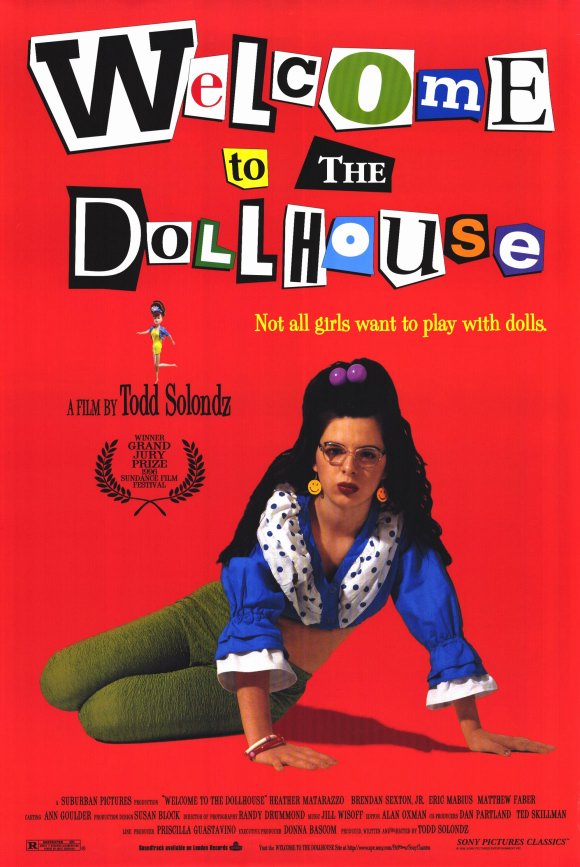
Another flick about the trials and tribulations of high school life. There is the shy, sensitive, and alienated girl, the bitchy cheerleaders, the bullies, the name calling, the not being able to find a seat at lunchtime, the stupid teachers, the too busy to listen parents, the bratty siblings, and yes even the spitballs. This is a very accurate and concise portrait of Junior High. It will make you soooooooo glad that you are past that age and will never have to go back to it.
It’s the pinpoint accuracy that makes this film stand out the most. Every scene and segment ring true. Even the little stuff from the way the little sister answers the phone to the way our protagonist Dawn Wiener (Heather Matarazzo) always seems to get blamed even when it really isn’t her fault.
Although the film displays many of the ugly elements of that age it doesn’t wallow or sensationalize them. In fact this film has a nicely balanced perspective. It shows scenes from both Dawn’s high school life and family life. It weaves a nice tapestry and observes how interconnected everything really is. The family life scenes are probably more interesting and in many ways just as difficult.
The film has a good ability at bringing out all the confusion that permeates that age. It is interesting how it shows that everyone is a bit alienated and lost. A big fish can simply get eaten up by an even bigger one. For example there is Steve a good looking kid with a nice singing voice. He is ‘cool’ and when in school everything goes his way. Yet when he drops out so as to ‘make it big’ in New York he suddenly realizes how stacked the odds are against him. There is also Brandon the class bully. He is a composite of all those other bullies. At first you really dislike him, but then you witness his very sad home life. You learn to understand not only why he acts the way he does, but also begin to feel sorry for him.
The film also scores by not letting the adults off the hook either. They are in many ways very much of the problem. They suffer from their own type of confusion and have their own type of code. They lack the ability to really communicate as much as the kids do. Junior high may be a mean, ugly, and crazy place, but that is only because it is a byproduct of very mean, ugly, and crazy world.
If the film has a weak point it is with the ending that fails to give any type of closure. Of course it doesn’t have to, but it would have given it more of an impact and made it come more full circle. Yet even if it doesn’t show it we still know that Dawn will make it. There are many scenes that show her to be very resourceful and strong willed when she needs to be. She is, like a lot of us, a survivor.
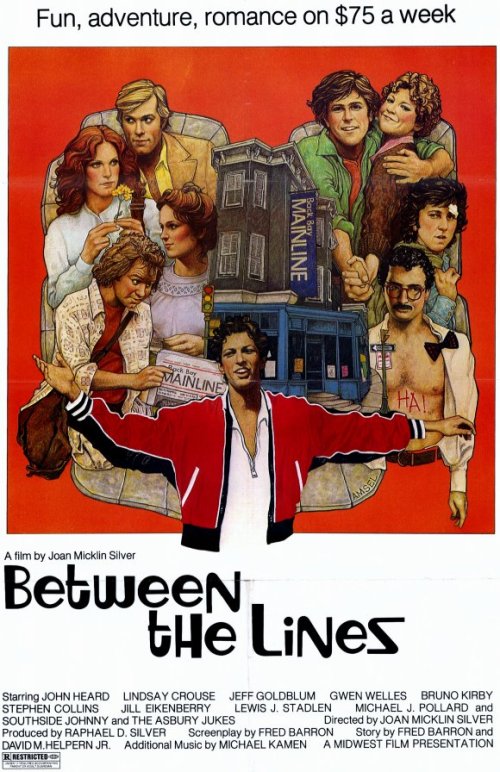
This is a look at an underground/counter-culture newspaper staff and the conflicts and concerns that they have at being taken over by a no-nonsense corporate owner (Lane Smith).
The film almost immediately takes you back to the bygone era of the late 70’s. The attitudes and conversations are realistic for that period and anyone who lived through it will most assuredly feel nostalgic .John Heard, Jeff Goldblum, and Bruno Kirby are engaging in their respective parts as is most of the cast. Stephen Collins is good also, but in an unusual role for him as he usually plays nice sensitive types, but here is a more driven, intense, and confrontational. This also works as a good unofficial statement to the death of the counter-culture movement and the eventual rise of materialism.
The story starts out well as it looks at the inside workings of an underground newspaper, but then spends too much of the middle part focusing on the relationships of some of the characters. Only at the end when the new owner takes over does it get back to the newspaper angle. Unfortunately it concludes just as things are getting interesting and we never get to see how the characters survive and adjust to the takeover. The film would have been much stronger and original had it stuck to scenarios involving the newspaper business and scrapped the relationship stuff, which tended to be derivative. Jon Korkes and Michael J. Pollard’s characters are seen too little and needed more screen time.
Also, when the film deals with the relationships there seems to be too much of a feminist bias as the men are always shown to be the ones at fault due to their ‘insensitive and selfish natures’ while the women come off the ones who are ‘reasonable and unfairly neglected’. This could be a product of the fact that it was directed by a woman as well as the era where men were somehow supposed to feel guilty simply because they were men.
This is fun as a time capsule as well as a great chance to see young stars in the making. However, the story does not take advantage enough of its original concept and ends up dealing with a lot of the same old scenarios and story lines that we’ve all seen before. Director Joan Micklin Silver and John Heard teamed up again two years later for Chilly Scenes of Winter, which I felt was better.
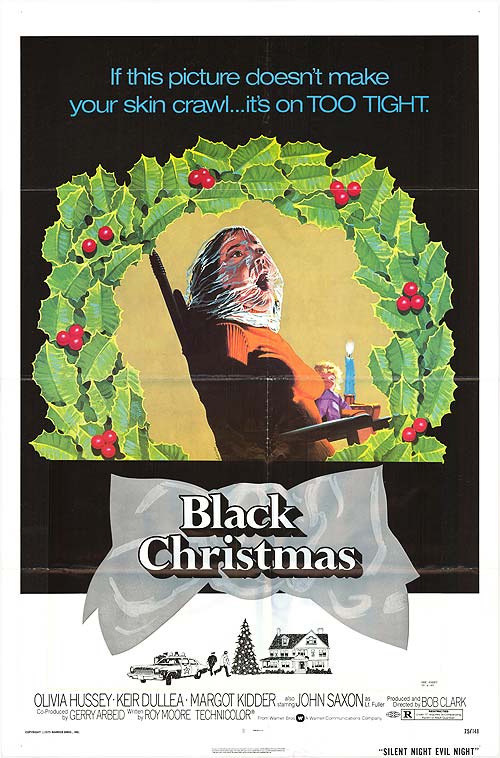
It’s Christmas time at the sorority house, but as the girls celebrate the season they continue to get harassing phone calls from a strange man who speaks in different and frightening voices. Unbeknownst to them the man has snuck into the attic of their house and the calls are coming in from another room. As the night progresses the girls begin to disappear forcing the lone survivor to fight off the killer by herself.
I have not seen the remake of this film and due to negative response that I have heard I don’t think I want to either. This review pertains to the original only. If you have seen the remake and disliked it you should still give this film a try. Despite its low budget it is quite effective and it slowly builds up the tension in a nice compact style with a great twist ending.
Of course one of the things that make this movie so good is the humor. I loved Marian Waldman as the alcoholic house mother Mrs. McHenry who stashes bottles of whiskey in all sorts of goofy places. The vulgar Santa who swears even as the kids are sitting on his lap is a hoot and a nice precursor to Bad Santa, but my favorite is the poster of a sweet old lady giving the finger.
One of the best moments on the terror end is the part where the killer’s eyeball can be seen looking through a small crack in the doorway, which is memorable. The scene where the camera pans from each girl’s nervous and frightened face as they listen to the weird voices emanating from the phone receiver is very well done although it would have been even stronger had the Christmas music not have been playing in the background.
The performances are top rate and I liked the fact that the girls all have distinct personalities from one another. Margot Kidder as the vulgar and obnoxious sorority sister Barb is a scene stealer and I’d say this is the best performance of her career. I loved when she calls one of the more conservative members of the group a ‘professional virgin’, or has the audacity to call her own mother a ‘gold-plated whore’. The part where she gets a young kid drunk and even swears in front of him is also funny as is her conversation about a species of turtle that can have sex for three straight days without stopping. Yet through all of her outrageousness director Bob Clark still manages to create a three-dimensional character by showing her as also being lonely, moody, and suffering from asthma, which is good.
Olivia Hussey as Jess is terrific. She is poised, confident, intelligent, and sweet and the type of character the viewer can immediately connect with and care about. Her face has a wonderful fragility about it as well a natural beauty. The look of terror coming from her eyes seems genuine and the horror is made more effective because she responds to it in a believable and relatable way.
Keir Dullea is good as Jess’s high strung boyfriend Peter. I had to chuckle a bit seeing him here as it brought back memories of what playwright Noel Coward once said about him “Keir Dullea gone tomorrow”, which seemed to have some credence since he was starring in the masterpiece 2001: A Space Odyssey just a few years earlier and now delegated to a supporting role in a low budget horror film. I always felt that his reserved and emotionless delivery can work when given the right role and for the most part it clicks here despite the fact that he was pushing 40 at the time and not quite looking college age.
I read one review where the critic complained that he did not feel it was believable for a killer to be hiding in an attic and no one else in the house aware of it, but the house was a big old building and for me it seemed possible especially since it was only for a short period of time. Overall I felt this was a very plausible premise that is handled in a realistic fashion without all the glaring loopholes, which is one reason I continue to enjoy it no matter how many times I’ve seen it.
However, there are a few quibbles. One is the policeman who gets his throat slashed while sitting in an unmarked police car just outside of the sorority home. I would think a seasoned office would be able to spot someone sinking up on him while he is inside a car especially since it was otherwise not a busy street and since it was wintertime I think it would be highly doubtful that he would be sitting there with the driver’s side window rolled down. I also had to roll my eyes at the scene where Jess is trying to get out of the house as she is being chased by the killer and yet for some inexplicable reason the front door conveniently jams even though no had a problem with it before.
Bob Clark shows what a talented director he is and it is too bad his career and life was cut short in a car accident in 2007. It is one thing to have a big budget and access to all the state-of-the-art special effects, but it is another to make a memorable movie on a shoestring. Despite its low budget it doesn’t seem hampered by many of the limitations that other similar films suffer.
Some may prefer lots of gore, which this one has very little of, and a bigger-than-life monster or bad guy, but the reason this is a classic is because they go with the philosophy that less is more. Any self-respecting horror fan should see this film and most likely appreciate it.
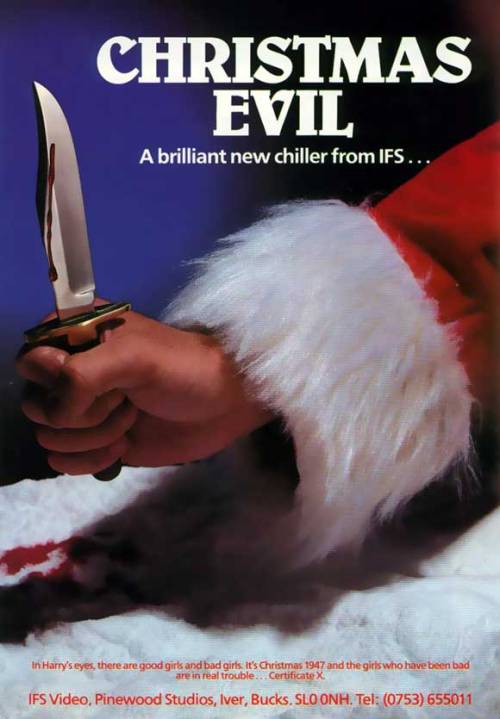
As a young boy Harry Stadling (Brandon Maggart) witnessed his mother being groped by Santa Claus, which was apparently his father in the disguise, but it nonetheless created a disturbing image in his mind that shattered the ideal he had for the mythical man. Years later as an adult working a thankless job at a toy factory Harry starts to believe he is Santa Claus and even spies on the neighborhood children to see which ones have been naughty or nice and keeps meticulous records on each. Then on Christmas Eve he dresses up as Santa and delivers presents to some needy kids at a hospital, but also comes into contact with a group of condescending people outside of a church who he then kills. This sends out a police alert where everyone in the city including the regular townspeople is on the hunt for him and Harry tries to avoid them while continuing to deliver his gifts.
For some reason this film never created the controversy of portraying Santa Claus as a killer like Silent Night Deadly Night did even though this film came out 4 years earlier. Critic Leonard Maltin came down hard on that one in his book, but seemed to like this one, which is the whole reason I gave this one a chance 25 years ago, but I remember disliking it. Since this film has managed to inspire a small cult following I decided to give it another chance, but I didn’t like it any better.
Part of the problem is that it is very slow and plodding with the majority of the film focusing on Harry as he goes through the daily routines of his pointless and lonely life. Nothing that he does is compelling and sometimes it is even confusing. It is hard to call this a horror film even though that is what it is considered because there are really no scares at all and the gore is at an extreme minimum. Maggart gives a solid performance in the lead, but as my acting teacher in school once said a good actor cannot save a weak script, or as he put it ‘you can’t shine shit.’
There are only two killings and neither of them is effective. The killing done outside a church is captured in a choppy editing style with bloody special effects that look fake and it is carried out by Harry while using a toy ax, which seemed ludicrous. I also didn’t think it made a lot of sense for the victims to have such a snarky and sarcastic behavior especially when they were just coming out of a church service. What is worse is that when the victims are killed no one comes to their aid to see if they can save them they just stand on the church steps and stare at their lifeless bodies. An APB is also put out which is broadcast on the TV news stating that the killer escaped in a white van with Christmas sled painted on its side, which is distinct enough that somebody somewhere would have spotted it and yet Harry continues to drive around unheeded.
SPOILER ALERT!
The ending is the weakest part. For one thing some townspeople recognize Harry as being the killer Santa and chase him down through the neighborhood streets while carrying torches, but just where in this modern day and age are people going to find torches? Some fans of the film insist that this is homage to the film Frankenstein, but to be clever it still has to make sense and this doesn’t. There is also the issue of when Harry drives his van off a bridge instead of going into the river below it instead flies off into the sky like Santa on his sled. Now, since the majority of the film was done from Harry’s perspective this might simply be his last delusional moment before he dies, but the film needed to confirm this and doesn’t, which makes it more annoying than anything.
Writer/director Lewis Jackson has stated in later interviews that he got the idea for this movie while smoking a joint and I think he was still smoking them when he made this thing. The majority of people come away from this thing feeling the same way about it that I did, but I know there are a few that insist it is ‘brilliant’ and if you are one them feel free to leave your comments below and let me know what it is you think I am missing because after two viewings I just don’t see it.
My Rating: 1 out of 10
Released: November 10, 1980
Runtime: 1Hour 40Minutes
Alternate Title: Christmas Evil
Rated R
Director: Lewis Jackson
Studio: Edward R. Pressman Productions
Available: VHS, DVD (Special Edition and in 3D), Amazon Instant Video
This is a variation of the film Three in the Attic and for a time was called Three in the Cellar to try and capitalize off of the success of that one. Ironically both films starred Judy Pace. In this one Colin Slade (Wes Stern) is a nerdy college student who loses his scholarship to a computer glitch. When he can’t get college president Maurice Chamber (Larry Hagman) to help him, he decides to get revenge by seducing both his wife (Joan Collins) and daughter (Catlin Adams).
The production proudly proclaims to be filmed on location in New Mexico, which is obvious from the start and nothing to really boast about since it hurts the film as a whole. Shot in wintertime it’s dusty, desolate landscape leaves the viewer with a cold, lonely feeling, which configures poorly with a story that is supposed to be lighthearted and whimsical. The big, modern cement buildings used as the campus looks like they would be better suited for a corporation than a student body. The students themselves, or what little you see of them, look all suspiciously over the age of 24.
Director Theodore J. Flicker nicely camouflages the fact that this is a very low budget production. His script is compact and well-paced. He frames and cuts his shots so you don’t notice how lacking in personality or energy it really is. Yet he also shows little connection to the student uprisings that dominated the campuses of that era and seems to view it as a sort of silly amusement. He keeps the film at this tone the whole time and thus makes it as silly and forgettable as the characters and situations he tries to satirize
Hagman comes off best. He plays it with a fun mixture of traits from two of his best known characters. He has J.R. Ewing’s arrogance coupled with Major Nelson’s frantic anxiety.
The film also has two fun and unique scenes. One has Hagman climbing up an actual radio tower to save Stern who is threatening to jump off. The second one has a pornographic movie shown to a group of unsuspecting and shocked senior citizens
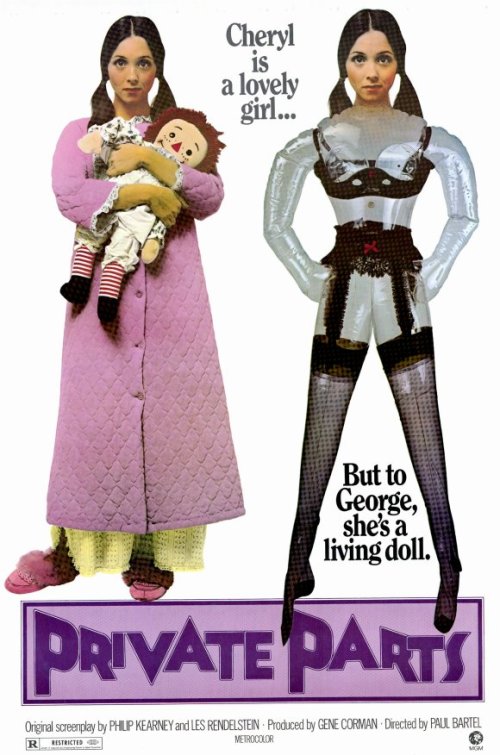
Cheryl (Ayn Ruymen) is a teen who cannot get along with her sister and boyfriend and decides to move out of their apartment and into a seedy hotel run by Martha (Lucille Benson) a very strange old lady. Here she lives next to voyeuristic photographer George (John Ventantonio) who has a big sex doll fetish. Cheryl secretly spies on George having sex with his doll and starts to get off on it. George becomes aware of Cheryl spying on him and likes it, which causes them to form an odd relationship and that is when things really get weird.
The film’s intrigue comes from the way it see-saws between being a perverted character study, horror film, and dark comedy. Director Paul Bartel makes great use of lighting, setting, and camera angles. There is also one truly odd and memorable sequence involving Ventantonio filling up his sex doll with water and then pumping it full of his own blood. The story is subtle enough to keep you involved and guessing and may even take a couple of viewings before you truly ‘get it’.
Much like with his later and better known film Eating RaoulBartel examines the psychological complexities that make up people’s sexual nature and how perversions and fetishes are a normal part of it. The mindset is that everyone probably has a weird fetish of some kind and the open minded approach is what ultimately makes it refreshing and intriguing.
Although the film teases you with some sex and violence it never really goes all out. By dancing the line between being a horror film and a sex flick it fails to make a lasting impression despite a few good moments.
This is an interesting curio for sure and for its time was really pushing the envelope, but suffers from a low budget and isn’t scary or gory enough. However, George’s sex doll is unforgettable and watching it fill up with his blood is one of the damnedest looking sights ever put on film.
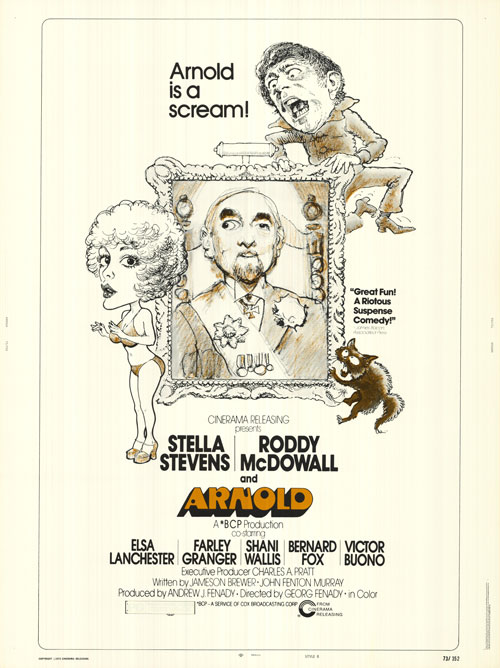
Arnold (Norman Stuart) is a dead corpse who at his funeral marries the ravishing Karen (Stella Stevens). She gets all of his wealth and to live in his mansion as long as she never leaves the side of his coffin and takes it everywhere she goes. His other greedy relatives aren’t happy with this arrangement, but they all end up being killed off in weird and mysterious ways, which makes Karen feel that Arnold may not actually be dead and that she may be his next victim.
Although this is an obscure film it has managed develop a small cult following, but I was not impressed with it. It has too much of the contrived old-fashioned horror movie elements without adding anything new to it. Even done in the spirit of parody it is too clichéd. The sets are unimaginative and cheap. All the outdoor scenes where clearly done inside on a soundstage, which is always annoying. The humor is sparse and relies mainly on corny one-liners. The story is devoid of any scares, gore, or special effects. The plot is cheesy and the whole thing looks like it would be better suited for a 70’s TV-sitcom than the movie screen. It was filmed simultaneously by the same director and writer as Terror in the Wax Museum and the whole thing has a very rushed and sloppy quality about it.
There are a plethora of B-actors making up the cast many of whom look to be phoning in their parts simply to collect a quick paycheck. Jamie Farr, in a heavy disguise, never even utters a word of dialogue, which is actually for the best. The only performance I liked was Bernard Fox as the incompetent police inspector. Some of his lines are amusing especially his last one and he is the one thing that saves this from being otherwise a complete waste of time.
I did like the theme song sung by Shani Wallis who also appears as Arnold’s widow Jocelyn. It has a certain toe-tapping quality to it and Shani gives it energy and verve. The complete rendition is sung over the closing credits.
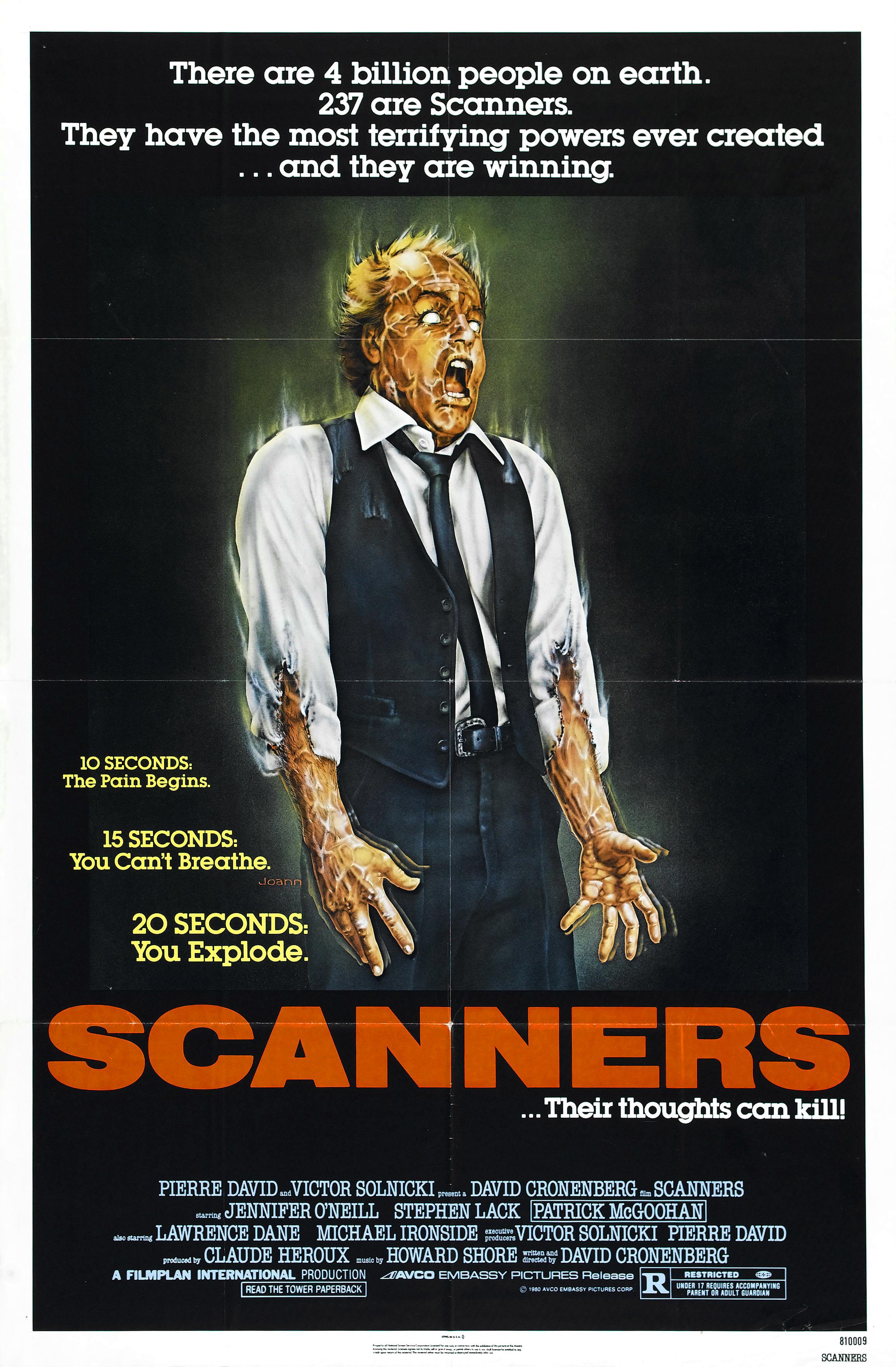
Scanners are people with strange psychic powers that can not only read other people’s minds, but also kill them and even move objects with their brainwaves. A corrupt group of scanners lead by Darryl Revok (Michael Ironside) threatens world domination. Dr. Paul Ruth (Patrick McGoohan) who works for a company that is trying to stop these dangerous people finds a scanner named Cameron (Stephan Lack) that Darryl’s groups is seeking, but has not yet located. Ruth trains Cameron on how to hone in his scanning powers and then track down Darryl’s group and destroy it.
Director David Cronenberg is still in my estimation one of the premiere cult/horror directors around. It is one thing to make a great horror movie when you have a big budget and state of the art special effects, but it is another to make an effective movie when you have little to work with and yet Cronenberg has continually shown that a creative imagination can triumph over all else. He has also shown a refreshingly daring vision throughout his career and seems to have no hesitation in tackling taboo subjects.
This film proves no exception. The story is quite creative and there are continually new and surprising twists thrown in. The special effects are excellent and imaginative. I loved the protruding, blood spurting veins coming out of the arms and heads of Cameron and Darryl during their intense scanner showdown at the end. The melting telephone receiver isn’t bad and off course the exploding head is memorable and deserves its place in the annals of gross cinema history.
With that said I still felt the film could have done a better job at setting up the story. It starts right away with a lot of action before anything is explained and makes things confusing. Some sort of prolog in this case would have been appropriate. Everything also seems rushed. This is a great plot with interesting scenarios and I as a viewer wanted a little more time to soak it all in, but wasn’t given any. The sets and backdrops are redundantly dark and grimy and lack visual design. Overall the film has a seriously dated look and although there are way too many films being remade these days and some that are not necessary this is one movie were I would advocate it especially if done with a high budget and a competent director.
Stephan Lack makes for incredibly weak leading man. He is better known in the art world as a renowned painter and his film career was quite brief. After watching his performance here it is not hard to see why. He has very much of a ‘deer-in-headlights’ look and a voice tone that shown no infliction, or emotion. His lack of charisma or stature seriously weakens the film’s overall effect and why he was chosen for the part is a mystery.
Jennifer O’Neill is gorgeous as Kim a female scanner who works with Cameron in his quest to find Darryl. The woman, who was a former model, has a face that is so beautiful it is mesmerizing no matter what angle she is shown at or emotion that she is conveying. My only complaint is the small streak of gray that was put into her hair, which I found unnecessary especially since she was portraying someone who was Cameron’s same age, which was the early 30’s.
On the villainous side Ironside certainly has the chiseled threatening features of a bad guy. However, I actually thought that Canadian character actor Lawrence Dane who plays one of Darryl’s spies was actually more effective.
The artwork done by the Benjamin Pierce character (Robert A. Silverman) visualizing giant heads and the thoughts inside people’s heads was really cool and avant-garde.
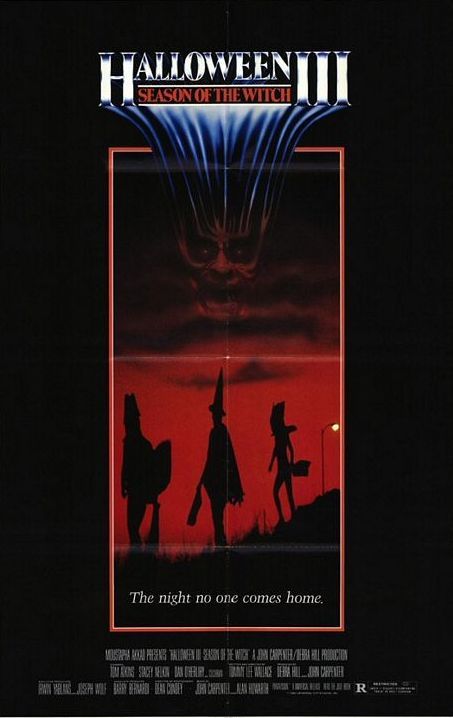
Dr. Dan Challis (Tom Atkins) is an emergency room physician treating a patient (Al Berry) who arrives in the facility clutching a Halloween mask and stating that someone is out to kill him. When the man does end up being killed Dan becomes suspicious that it may have something to do with the mask. He teams up with the victim’s daughter Ellie (Stacey Nelkin) and the two find that the trouble began when her father visited the Silver Shamrock factory. It is here that they meet the company owner Conal Cochran (Dan O’Herlihy) who turns out to be a maniacal man who has created Halloween masks that have a computer chip implanted in them that will kill the children wearing them.
Although listed as the third part of the Halloween franchise there is no Michael Meyers here, nor any of the other familiar characters. The idea was to continue the series by having creepy stories with some connection to the Halloween holiday released each year, but this film did so poorly at the box office that the idea was dropped. The original script by Nigel Kneale was meant to be a dark comedy, but producer Dino De Laurentis wanted to play it as a straight horror film and striped the screenplay of the humor. Had it been kept in the humorous vein it might have worked, but the idea is too ludicrous to be taken seriously with glaring plot holes that defy all logic.
One of the biggest ones is the fact that Cochran plans on killing the children by having them all watch an advertisement his company has created and will be broadcast on all the channels at 9:00 Halloween night. Supposedly there is some sort of signal in the ad that will set of the computer chips in the masks, which the children are all supposed to be wearing while they watch the ad that will kill them instantly while also creating deadly snakes and spiders in the process. How a computer chip could create live creatures is ridiculous enough, but the fact that somehow Cochran does this by using pieces of a Stonehenge rock that he has stolen is even more absurd. There is also the fact that if the commercial airs at 9:00 eastern time it would only be 6:00 on the west coast. Therefore the commercial would be delayed by four hours, which would be enough time for the authorities to figure out what was going on and pull the ad before it ever even aired in California and probably have Cochran under arrest by then.
There also the fact that Cochran seems to have no plan B here. The reason for why he is doing this is murky at best, but what he hopes to gain from it is even more elusive. There is also the question of how he plans to escape once it becomes obvious to everyone what happened. None of this of course is ever explained and these are just a few of a myriad of implausibilities that the story spits out. There are so many of them that they aren’t even worth explaining, but clearly any film that expects the viewer to overlook so many glaring loopholes is not good. The film is like a flimsy outline to an idea that no one bothered to think through with the details.
I was also unimpressed with the masks themselves and couldn’t understand why all the children would be so excited to have them. They looked like something one could pick-up at a cheap dime store and had nothing unique or distinctive about them except that they could supposedly glow in the dark. The factory where the masks where is made is equally unimpressive looking like an old, rundown, non-descript building that had no visual presence. I was expecting the building especially from a company that could create such a nefarious technology as these masks to be sleek, modern, and imposing, which would have helped create a more foreboding feeling. The commercial used to advertise the masks is unimaginative and cheap looking. The jingle used in the ad, which was set to the melody of ‘London Bridges’ because apparently that was under public domain at the time, becomes irritating to listen to and gets overplayed.
One of the few things that I liked about the movie was the fact that the protagonist was a middle-aged man instead of teenagers. The gruesome special effects are okay and veteran actor O’Herlihy shows enough sinister mugs to the camera to be fun. I also liked at the end how Ellie for some unexplained reason turns into a robot and keeps on attacking Dan even as he vigorously dismantles it.
Segments from the original Halloween can be seen in this one. The first time it is shown while Dan is watching TV at a bar it is a clever in-joke, but when it gets shown again near the end it becomes a mistake because it reminds the viewer how much better that movie is compared to this one.
My Rating: 2 out of 10
Released: October 22, 1982
Runtime: 1Hour 39Minutes
Rated R
Director: Tommy Lee Wallace
Studio: Universal
Available: VHS, DVD, Blu-ray, Amazon Instant Video
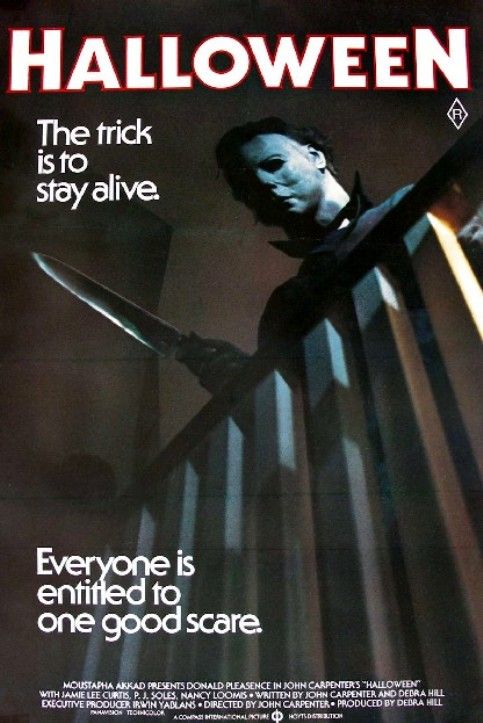
On Halloween night in 1963 6 year old Michael Myers stabs to death his older sister Judith. He is taken away to a mental institution, but fifteen years later he escapes and comes back to his hometown of Haddonfield to stalk three teenage women (Jamie Lee Curtis, Nancy Loomis, P.J. Soles) on Halloween night.
I first saw this film 25 years ago when I was in College and thought it was cool, but now on my second viewing I’m not quite as impressed. There are still some good things about it, but also in my opinion some glaring loopholes. I’ll start with the things I liked.
Cinematically it is a well mounted thriller. The lighting is perfect. The dark shadowy interiors create the feeling of menace and the little light that is shown has a bluish tone and resembles authentic moonlight. The music by director John Carpenter is distinct and has an effective up-tempo beat almost like a warning siren. The editing and pacing is great. It builds the tension nicely and has some creepy imagery.
One of the scenes I always found to be the creepiest is when Tommy, the young boy that the Curtis character is babysitting, sees from across the street Michael carrying one of his dead victims from the car to the house. In fact all the long shots showing Michael are the most effective. Somehow it was a combination not only of the way the actor walked in the costume, but his mask as well, which was apparently a William Shatner Captain Kirk mask that was painted all white.
The fact that there is never any reason given for why Michael became the way he did is also good. There are many similar true-life crimes where even after the murderer is interviewed by the psychiatrists they still can’t always come up with a satisfying explanation. Movies that try to show the reason behind why the bad guy becomes murderous usually end up being contrived and clichéd.
The three actresses looked too old for teenagers and in the case of both Loomis and Soles where already in their late twenties. Loomis though is kind of funny in her part especially with the way she interacts with Lindsey (Kyle Richards) the young girl that she is babysitting. Curtis is good and although I respect her right to going natural with the gray hair that she now sports I still felt she was at her most attractive when she had the long red hair like she has here.
On the negative side there seemed to be too many story elements that didn’t make sense. For instance Michael is institutionalized when he is six and then escapes fifteen years later and is able to miraculously drive a car even though he was never trained. The book version of the movie explains this anomaly by stating that when Dr. Loomis (Donald Pleasance) would take Michael to sanity hearings over the years that Michael would watch very closely how Loomis operated the vehicle and thus ‘learned’ how to drive, but that still doesn’t make sense because watching how something is done and then finally doing it yourself are two completely different things. Besides if watching how somebody drives where enough then every child who watched his parents drive could learn it and there would be no need for driving schools. Also, Michael escapes from the asylum without any explanation, which seemed way too convenient.
When Dr. Loomis shows up in town and tells the sheriff (Charles Cyphers) that there may be an escaped mental patient in the vicinity the sheriff comes up with the logical step of warning everybody about it, but Loomis disagrees and his reasoning is ridiculous. Also, when Laurie (Curtis) gets a call from Lynda (Soles) that sounds like she is being murdered Laurie doesn’t do the most sensible thing and that is to call the police and let them investigate it. Instead she decides to go over to the home in the middle of the night and investigate it herself, which not only needlessly puts her in a dangerous position, but also leaves the two kids that she is supposed to be watching home alone in bed, which is something a good babysitter should never do.
I also had some problems with the setting itself. Now of course the town of Haddonfield is fictitious, but the state of Illinois isn’t. It is situated right in the middle of the Midwest and there are no palm trees anywhere within its borders and yet I spotted a few lining the streets especially near the beginning when Laurie is seen walking home from school. I didn’t buy into the idea that the Meyers house would stand vacant for 15 years either. There are a lot of homes that have murders committed in them that do not remain abandoned, or considered ‘haunted’. In some cases the original house is torn down and a new one is built in its place such as the infamous John Wayne Gacy house in Des Plaines, Illinois, which is now being occupied by a new family. The neighborhood in the film looks nice and well-kept. The other homeowners wouldn’t stand for a building being abandoned for that long as it brings down the property values.
When I first saw this movie I got a real kick out of the part where Michael kills a man and then hangs him by a knife on a wall and stares at the corpse in a child-like way. However, on second viewing I don’t think the blade of the knife would have been long enough, or strong enough to go through a man’s body as well as a wooden door.
The opening sequence where we see Michael killing his sister from his perspective didn’t completely work with me either. I liked the idea of seeing the action through the two eye holes of the mask that Michael was wearing, but I think if someone is stabbing someone else that they would be looking at what they are doing, but instead the eye holes remain fixated on the sister’s face during the stabbing that is being done on the lower parts of her body, which looked stilted and unrealistic.
Now, I know this movie has a large legion of fans and some may take umbrage to my negative points, but hey, I take my film criticism seriously and feel I need to say it the way I see it. That is not to say that I ‘hated’ the movie either. I still liked it overall, but when given the issues that I described above I can only give it 6 points.