Category Archives: Horror

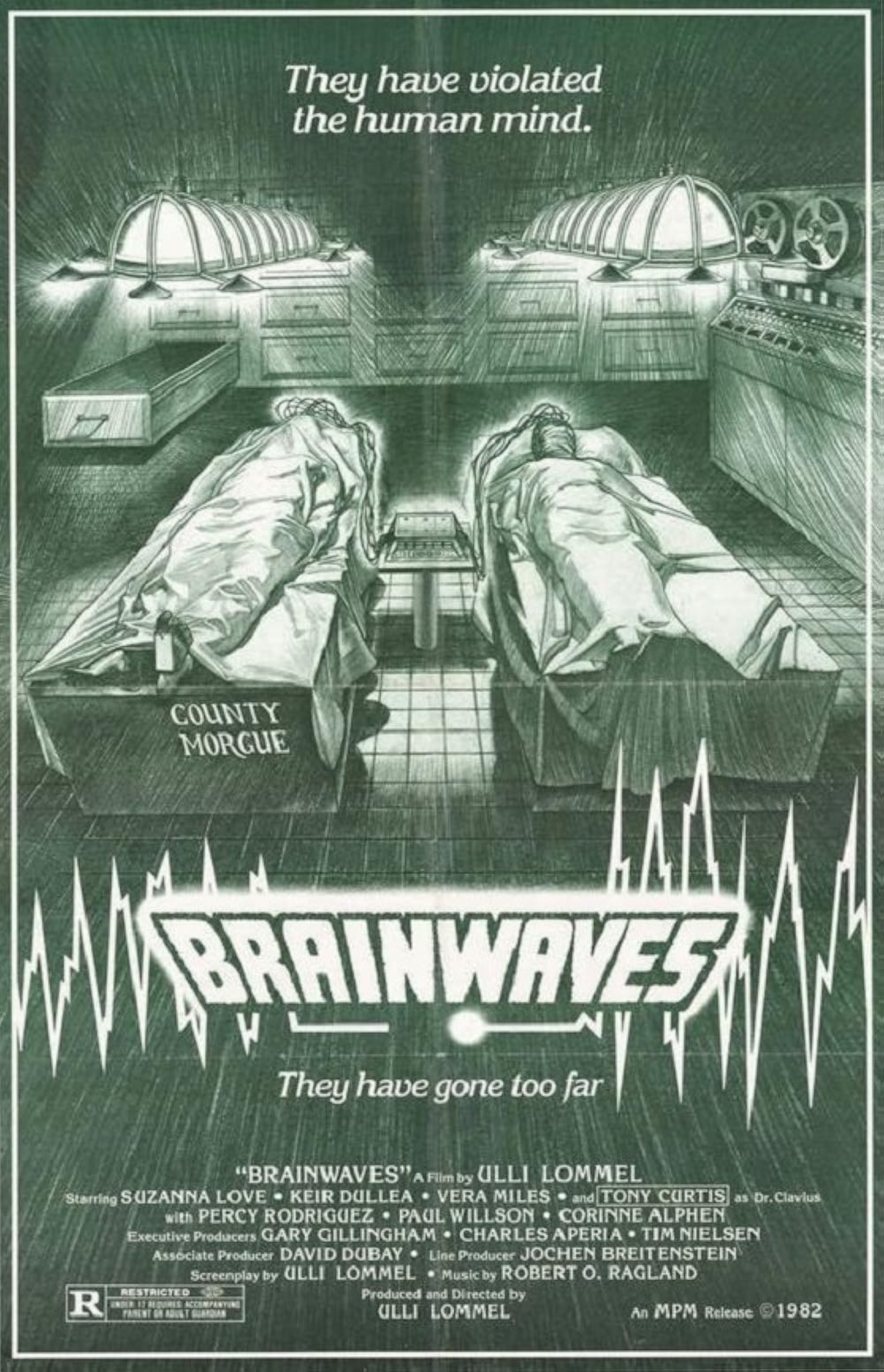
Brainwaves (1982)

brainwaves

By Richard Winters

My Rating: 3 out of 10

4-Word Review: Transferred brainwaves cause nightmares.

Kaylie (Suzanna Love) is a married mother of a young child living in San Francisco. One day while running out to the grocery store she gets the heel of her shoe caught in a trolley car track and this causes her to get hit by a car and suffer severe brain damage. Dr. Clavius (Tony Curtis) is heading experimental surgery that can transfer brainwaves from one victim to another. Kaylie’s husband Julian (Kier Dullea) agrees to the procedure in an effort to bring his wife back to her former state. Unbeknownst to him the other victim was a woman named Leila (Corinne Wahl) who was murdered in her bathtub by an unknown assailant. When Kaylie receives the brain transfer she begins having nightmares about the murderous incident. They then go on a search to try and unravel the mystery, but inadvertently get the attention of the killer who now begins stalking Kaylie in order to silence her before anymore oppressed memories come to light, which could identify him.

The film was directed by Ulli Lommel with a script that he had co-written with Love, who was also his real-life wife. The two had success a couple of years earlier with The Boogeyman and thus it inspired them to attempt another horror film. The concept is great and could’ve created an excellent plot, but the second-half labors too much in the recovery phase inside the hospital, which losses all the tension. The killer, whom we only see from the back, disappears from the story completely during the middle-half to the point you forget about him only to have him finally return by the third act, but by then it’s too late.

Dullea, as the concerned husband, is excellent even though acting here was a major comedown as he was getting leading man roles in major studio productions back in the 60’s, but now was relegated to low budget horror films though with that said he still makes the most of it. The same unfortunately can’t be stated for Tony Curtis, who only got the role because John Huston, who was the original choice, was too ill. Curtis had been a leading man in the 50’s and 60’s, so having to accept a part in such a minor production where he wasn’t even the star was certainly taxing on his ego and it shows as he appears grouchy and irritable throughout and seems like he wanted to be anywhere else, but in this movie.

Spoiler Alert!

The opening murder is okay though you know once she walks into the bathroom and turns on a portable radio that it’s most likely going to end up in an electrocution, so when it does finally occur it’s no surprise. The trolly car incident is nicely shot as well, but the ‘big reveal’ of who the killer is, which turns out to be non other than the victim’s boyfriend, which is the first person you would’ve suspected and thus is a complete letdown. The film should’ve had a wider array of suspects to choose from and played this part out more. The climactic sequence, done near the Golden Gate Bridge, gets shot in slow motion, which gives the proceedings a really tacky look.

The final twist features the dead body of the killer being wheeled into the doctor’s lab where it will apparently be used as a brain donor to another crash victim is cool, but the film then ends when it should’ve continued on with the psycho now chasing after Kaylie inside whatever body his brainwaves got transferred to. By having writer/director Lommel not take full advantage of the myriad plot twists as it could’ve is what really hurts it making it no wonder that it’s box office proceeds was a disastrous $3,111 out of a budget that had been $2.5 million.

My Rating: 3 out of 10

Released: November 19. 1982

Runtime: 1 Hour 20 Minutes

Rated R

Director: Ulli Lommel

Studio: Motion Picture Marketing

Available: VHS, DVD-R (out-of-print)
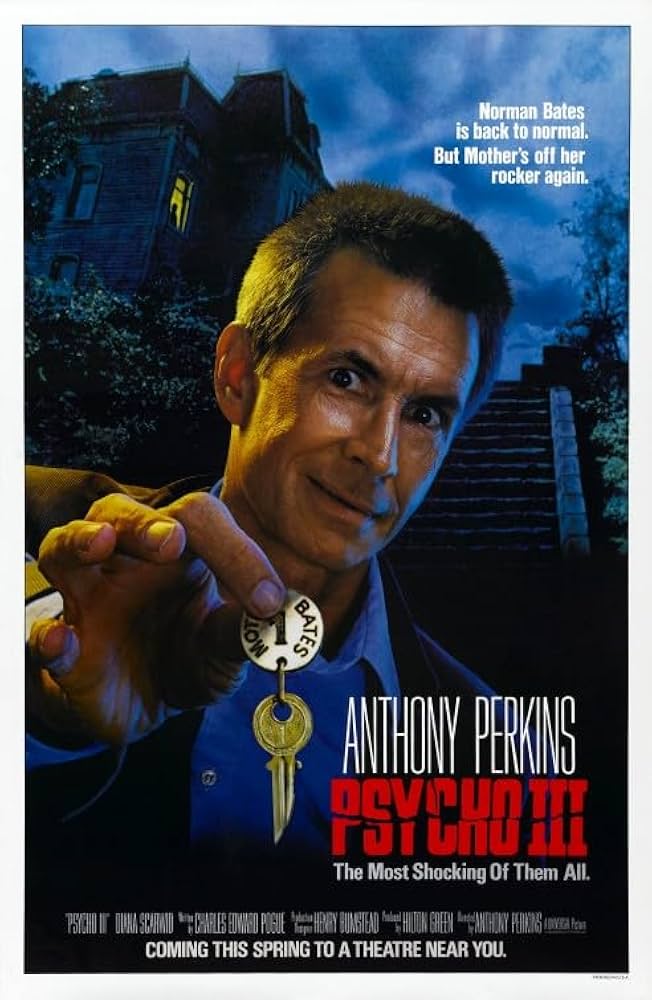
Psycho III (1986)

psycho3

By Richard Winters

My Rating: 3 out of 10

4-Word Review: Norman gets a girlfriend.

The story begins a month after the one in the second installment ended with police searching for the whereabouts of Emma Spool (Claudia Bryar) whom Norman (Anthony Perkins) killed and now keeps her preserved body in his home and yet curiously the police don’t suspect him. Meanwhile a roving journalist named Tracy Venable (Roberta Maxell) does and she keeps trying to get interviews with Norman in an effort to weed-out the truth while also snooping around his property any chance she gets. Maureen (Diana Scarwid) is a nun who’s lost her faith and thus left the convent and rents a room at the Bates Hotel. She closely resembles Marion Crane, one of Norman’s earlier victims, which sets off his desire to kill again, but when he goes into her room in an attempt to stab her he finds that she’s already slit her wrists and bleeding profusely, which sets off his emotional senses to help her and thus he takes her to the nearest hospital, which in-turn gets her to fall for him and the two begin a romantic relationship once she gets out. Norman also hires a wanna-be music artist named Duane (Jeff Fahey) to help out around the hotel as an assistant manager, but Duane becomes aware of Norman’s mother fixation and tries to use it against him just as an assortment of strange murders reoccur on the premises.

The third installment of the franchise is by far the weakest and it’s no surprise that it didn’t do as well at the box office and pretty much nixed anymore sequels getting released with the Part IV one, which came out 4 years later, being made as a TV-movie instead of a theatrical one. Perkins, who made his directorial debut here, starts things off with some intriguing segues and a good death scene of showing a nun falling off of a high ledge, but the storyline itself is getting quite old. Watching the ‘mother’ committing murders is no longer scary, interesting, or even remotely shocking. The script offers no new intriguing angles and things become quite predictable and boring very quickly.

Perkins gives another fun performance, which is pretty much the only entertaining element of the film, and Scarwid is compelling as a young emotionally fragile woman trying to find her way in a cold, cruel world. Maxwell though as the snooping reporter is unlikable and thus if she is meant to be the protagonist it doesn’t work. Fahey’s character is also a turn-off as his sleazebag persona is too much of a caricature and having him predictable do sleazy things as you’d expect from the start is not interesting at all.

The whole mystery angle has very little teeth and the way the reporter figures out her the clues comes way too easily. For instance she goes to Spool’s old apartment and sees a phone number scrawled out several times on a magazine cover sitting on the coffee table, so she calls it and finds out it’s for the Bates Motel and thus connects that Norman most likely had something to do with her disappearance, but wouldn’t you think the police would’ve searched the apartment before and seen that same number and made the same connection much earlier? Also, what kind of landlord would leave a place intact months later after the former tenant fails to ever come back? Most landlords are in the business to make money and would’ve had the place cleaned-out long ago and rented it to someone new.

The fact that the police don’t ever suspect Norman particularly the town’s sheriff, played by Hugh Gillin, is equally absurd. Cops by their very nature suspect everybody sometimes even when the person is innocent. It’s just part of their job to be suspicious and constantly prepare for the worst, so having a sheriff not even get an inkling that these disappearances could have something to do with Norman, a man with a very hefty and well known homicidal past, is too goofy to make any sense and starts to turn the whole thing especially the scene where a dead corpse sits right in front of him in a ice machine, but he doesn’t spot it, into a misguided campiness that doesn’t work at all.

I didn’t like the whole ‘party scene’ that takes place at the hotel, which occurs when a bunch of drunken football fans decide to stay there. I get that in an effort to be realistic there needed to be some other customers that would stay there for the place to remain open, though you’d think with the hotel’s well-known history most people would be too afraid to. Either way the constant noise, running around and racket that these people put-on takes away from the creepiness and starts to make the thing resemble more of a wild frat party than a horror movie.

Spoiler Alert!

The death by drowning scene is pretty cool, but everything else falls unfortunately flat. The final twist where it’s explained that Spool really wasn’t his mother after all sets the whole narrative back and makes the storyline look like it’s just going in circles and not moving forward with any revealing new information making this third installment feel pointless and like it shouldn’t have even been made. Screenwriter’s Charles Edward Pogue’s original script had Duane being the real killer while the Maureen character would be a psychologist who would come to visit Norman and who would be played by Janet Leigh, who had played Marion Crane in the first film. Her uncanny resemblance to one his earlier victims would then set Norman’s shaky mental state to go spiraling out-of-control, which all seemed like a really cool concept, certainly far better than what we eventually got here, but of course the studio execs considered this idea to be ‘too far out’ and insisted he should reel it back in with a more conventional storyline, which is a real shame.

My Rating: 3 out of 10

Released: July 2, 1986

Runtime: 1 Hour 33 Minutes

Rated R

Director: Anthony Perkins

Studio: Universal

Available: DVD, Blu-ray, Amazon Video, YouTube

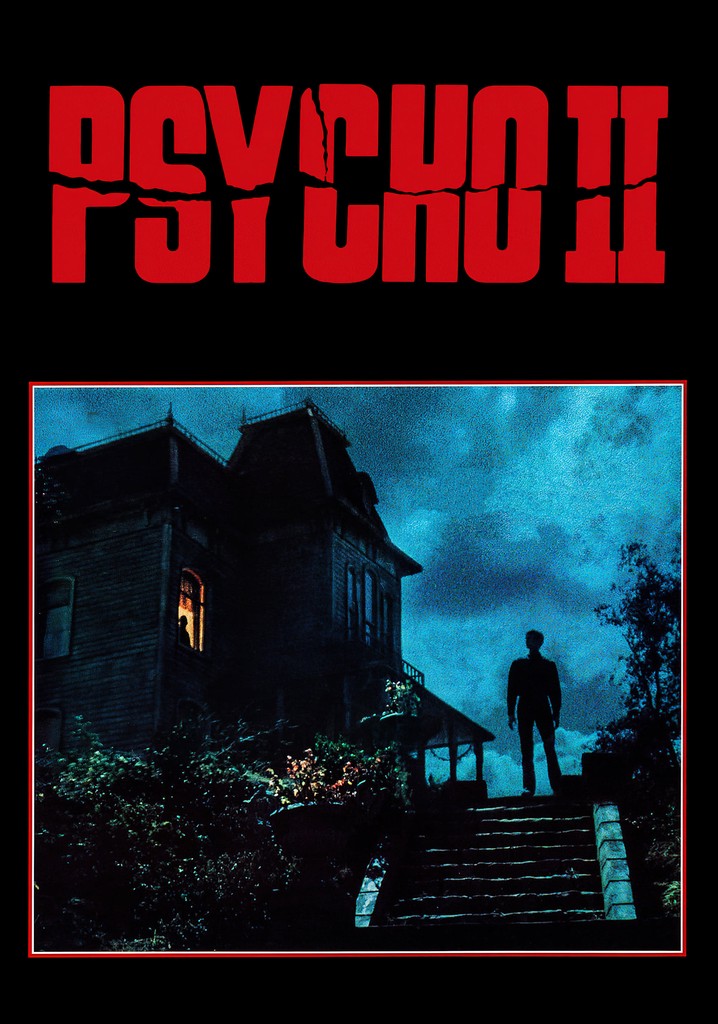
Psycho II (1983)

psycho2

By Richard Winters

My Rating: 7 out of 10

4-Word Review: Norman Bates comes home.

After 22 years of being confined to a mental institution over the murders of 5 people Norman Bates (Anthony Perkins) is now deemed to be no longer a menace to society much to the protest of Lila Crane (Vera Miles) whose sister Marion was one of his victims. With nowhere else to go Norman returns to the old house that he shared with his mother and tries to restart his hotel business that had been run while he was incarcerated by Warren (Dennis Franz) who had allowed the place to be turned into a flophouse for drug users and is immediately fired. To help bring in an income he gets a job at a nearby cafe as a cook where he meets Mary (Meg Tilly) who works there as a waitress. The two quickly start-up a friendship and when Norman learns that she’s broken-up with her boyfriend and no place to stay he offers a bedroom in his house for her to sleepover, but soon Norman starts receiving notes and even phone calls from someone perpetuating to be his mother and then murders begin occurring by someone dressed as an old lady. Has Norman gone back to his old homicidal ways, or is it someone else trying to make it look like it’s him, so that he’ll be rearrested and sent back to prison?

The attempt to make a sequel to the Hitchcock classic had been discussed for years and apparently even the master himself had considered it, but the studios generally nixed the idea figuring there was just no way to upstage the first one. Then Robert Bloch, who written the novel that the first one was based on, came out with a second installment also called ‘Psycho II’ that was published in 1982 that helped spark new interest in the franchise. However, the book’s plot was far different than this one. In the novel version Norman escapes from the mental institution while dressed in a nun’s outfit and then hitches a ride with another nun whom he kills and then rapes. After absconding with her van he then picks up a males hitch-hiker whom he plans to kill and then use his body to fake his own death. Police later find the burning van and charred remains, but are unable to identify who it is. Meanwhile across town a movie is being made about Norman’s life and Norman’s psychiatrist fears that Norman is going to go there to kill everyone in the production, so he decides to become a ‘technical advisor’ to the film to help watch out for the crew, but while there he starts to become more worried about the film’s director who’s a spitting image of Norman from 20 years earlier and he reveals an unhealthy infatuation with the actress playing Marion Crane.

While I found the book to be highly creative the studio execs disliked its satirical elements regarding the movie business and discarded it while hiring Tom Holland, who had some success with the 1978 horror TV-Movie ‘The Initiation of Sarah’ and also the screen adaptation of The Beast Within to write a script with a more conventional storyline. While this story isn’t bad, I personally liked the Bloch version better, this one does have some logic holes mainly around releasing someone who’s killed several people from well published crimes and clearly suffering from a severe mentally ill state and yet somehow convincing the parole board and public at-large that he’s now ‘cured’, which really pushes the plausibility meter. The film also portrays Norman as being a likable guy just trying to find his way, which is awkward since the viewer is technically supposed to be fearing him, but half the time ends up sympathizing with him instead and this dueling dichotomy doesn’t work.

The acting though is terrific especially Perkins who makes his portrayal of Norman into an almost art form and the most enjoyable element of the movie though he initially was reluctant to recreate the role complaining that it hurt his career playing the part in the first one and it had caused him to become typecast, but when he found out that they were planning to cast Christopher Walken in the part if he rejected it he then decided to come-on board. Dennis Franz is also a delight as nobody can play a brash, blue-collar out-of-shape ‘tough guy’ quite like him and his taunting, loud-mouth ways help bring an element of dark humor to the proceedings.

Spoiler Alert!

My favorite though was Meg Tilly who helps tie all the of the craziness around her together by being the one normal person of the whole bunch. Reportedly she and Perkins did not get along and she refused to attend the film’s premiere though the frostiness of their relationship doesn’t show on the screen and the two end-up working well together. The only thing that I didn’t like was the misguided twist of her turning out to being the daughter of the Vera Miles character and in cahoots with her in her attempt to drive Norman crazy. For one thing if this were true then it should’ve been Meg instigating the idea of her moving into the house with him versus Norman coming up with the idea and her seeming reluctant.

The film has some good creepy camera angles of the home, which seems even more frightening here especially with the way it’s isolated desert setting gets played-up. There’s also a couple of gory killings, which I liked, but the second-half does drag and the movie could’ve been shortened by a good 20-minutes. However, the film’s conclusion where Norman learns the his mother’s sister, played by Claudia Bryar, is actually his real mother and she was behind the recent murders was a perfect ironic angle that took me by surprise and I loved it. Why he would then proceed to kill her with a shovel I didn’t really get as it seemed they could’ve started-up some weird bond and became a homicidal couple, which would’ve been more frightening, but still it’s a cool twist either way and helps make this a decent sequel.

My Rating: 7 out of 10

Released: June 3, 1983

Runtime: 1 Hour 53 Minutes

Rated R

Director: Richard Franklin

Studio: Universal

Available: DVD, Blu-ray, Amazon Video, YouTube

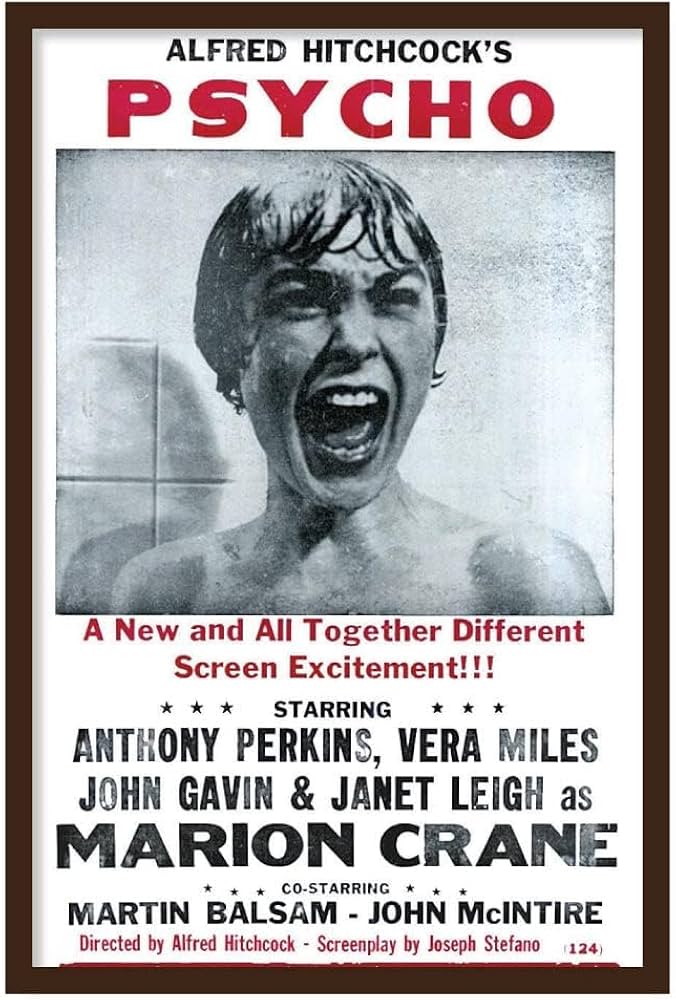
Psycho (1960)

psycho

By Richard Winters

My Rating: 9 out of 10

4-Word Review: Don’t take a shower.

Marion Crane (Janet Leigh), who works as a secretary at a real estate firm, steals $40,000 in cash from her boss (Vaughn Taylor), who trusted her to take the money to the bank, in order to help her boyfriend Sam (John Gavin) pay off his debts. As she’s traveling to where he lives she encounters a rainstorm causing her to take the nearest exit. There she drives into the lot of a isolated lodge called Bates Motel, run by a young man named Norman (Anthony Perkins) who’s still living with his mother in an old rundown house that sits ominously on a hill behind the hotel rooms.  Norman becomes immediately smitten to the woman, who signs the hotel ledger under an assumed name, and invites her to have dinner with him in the hotel office. Marion, who sees him as a awkward, but otherwise harmless guy who’s still dominated by his mother, agrees. After they eat she departs back to her room and takes a shower when what appears to be his mother, who considers all women to be ‘whores’, stabs and kills her. Norman then cleans-up the evidence by submerging the dead body and her car in a nearby swamp. Soon a private detective named Arbogast (Martin Balsam) begins investigating the case and what he finds out leads Marion’s boyfriend Sam and her sister Lila (Vera Miles) to the property where they’ll unravel a shocking secret.

The film, which at the time was considered ‘too tawdry and salacious’ to be made into a movie and thus the studio refused to give director Alfred Hitchcock the required funding and forcing him to use his own funds and crew to produce it, was based on the novel of the same name by Robert Bloch. Bloch began writing it in 1957 when coincidentally in the neighboring town not more than 35 miles from his came to the light the criminal activities of Ed Gein who killed two people while also digging up dead bodies and then skinning them in an effort to create a ‘woman suit’ he could wear so he’d ‘become his dead mother’ who had dominated him for the majority of his life. Rumors were that Gein’s crimes had inspired the book, but Bloch insisted that he had almost finished with the manuscript before he became aware of the real-life case and then became shocked with how closely it resided with his story.

While the film follows the book pretty closely there are a few differences. In the book the Marion character dies from decapitation while in the movie it’s from stab wounds. The Norman character is described as an overweight man in his 40’s while in the movie he’s thin and in his 20’s, which I felt was an improvement as it made more sense why Marion would feel less guarded around him and put herself in a more vulnerable position than she might otherwise as she still viewed him as a ‘wet-behind-the-ears’ kid. It also helps explain why Norman blunders his interview with the detective and virtually incriminates himself because he was too sheltered and not worldly-wise enough to handle pressure situations.

The film is full of a lot of firsts. It was the first to show a toilet or use the word transvestite, but what I really liked though is that it takes a different spin on the character of the victim. Typically, even today, victims are portrayed as being virginal and angelic beings particularly women, but here it works against that. Right away with the opening scene in the hotel room we see she’s definitely no virgin and what’s more she’s having sex outside of wedlock in an era where ‘good girls saved themselves for marriage’. Having her then be susceptible to corruption by stealing from her employer, or not feel frightened initially by Norman and even superior to him further works against the grain of the ‘sweet, fragile damsel in distress’ cliche and makes her seem more human since she’s not perfect and vulnerable to the same vices as everyone else, which in-turn gives the more an added darker dimension.

The film’s hallmark though is its memorable camera work from a close-up of the victim’s unblinking eye, still not sure how Leigh could’ve kept her eyes open for as long as she does, to the interesting way the house gets captured from the ground looking upward on a hill towards the sky with the creepy night clouds floating behind it.  My favorite one though is the tracking shot showing Norman walking into his mother’s room and then having the camera stop right at the top of the door frame and then spin around towards the hallway as he then leaves the room and carries his mother down the stairs. The only shot that I didn’t care for is when the Martin Balsam character gets stabbed at the top of the stairs, but instead of immediately falling over backwards and then rolling down the stairs, which is what would happen 99% of the time, he instead somehow ‘glides’ down an entire flight of stairs backwards while remaining upright and only finally falling to the floor once he hits the bottom, which goes against the basic laws of physics and to me looks fake and goofy, but other than that it’s a classic and still holds-up amongst the best horror movies made.

My Rating: 9 out of 10

Released: June 16, 1960

Runtime: 1 Hour 49 Minutes

Director: Alfred Hitchcock

Studio: Paramount

Available: DVD, Blu-ray, Amazon Video, YouTube

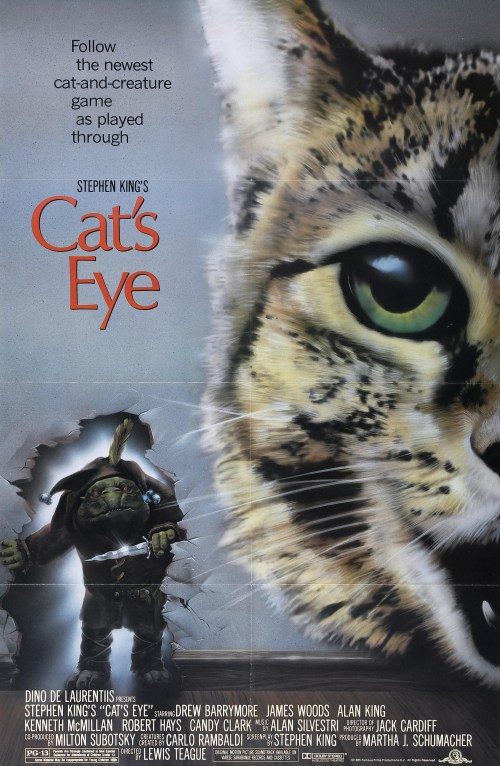
Cat’s Eye (1985)

cats

By Richard Winters

My Rating: 4 out of 10

4-Word Review: Three stories involving feline.

With a screenplay written by Stephen King the film is made up of three of his short stories with two of them taken from his 1978 novel ‘Night Shift’ while the third one was penned directly for the screen. The only connecting thread is a stray cat and actress Drew Barrymore who appear in all three tales though only have major parts in the third one.

The first segment is called ‘Quitters, Inc.’ and involves James Wood playing the part of a man named Dick Morrison who is trying to quit smoking and enters an agency that boasts a high success rate of getting their clients to stop. It’s run by Vinny (Alan King) who tells Dick that if he doesn’t stop smoking instantly that they’ll kidnap his wife (Mary D’Arcy) and put her into a room where she’ll receive electrical shocks. To prove his point he puts the cat in the cage and then through a glass partition Dick witnesses the feline getting shocked, which is enough to scare him into quitting on the spot. Yet as the days progress Dick finds himself constantly getting the urge to light-up, but Vinny warns him that he has people who’ll be watching him and if he does dare to backtrack they’ll immediately grab his wife and bring her into the cage. Eventually though the compulsion to have a cigarette gets to be too much and he sneaks a puff only to then face the dire consequences.

This segment tries for black comedy, but doesn’t go far enough with it. While Woods, who usually excels as the twisted types, is quite good as the straight man, I couldn’t understand why he didn’t go the police when his wife gets taken, or why any of the other clients didn’t either, which should’ve gotten the business quickly shut down and the owners prosecuted for running an unethical operation. Famously brash comedian Alan King isn’t given enough leeway to allow his cantankerous persona to go full throttle though watching him wearing a white leisure suit and lip synch the words to the song ‘Every Breath You Take’ makes it almost worth it. It’s interesting seeing James Rebhorn in a bit part as a drunken business man at a party as he later had a prominent role in the movie The Game, which had a very similar storyline to this one involving a business that overtakes their client’s lives and is constantly watching them.

The second segment called ‘The Ledge’ involves a man named Johnny (Robert Hays) who must walk across a thin, outdoor ledge along a penthouse wall many feet above a busy street. If he succeeds then the penthouse owner, Cressner (Kenneth McMillan), will grant his wife a divorce and allow her to marry Johnny whom she’s been dating.

This story is the best one mainly because it has McMillan who is one of the finest character actors of all time and supplies his role with an amazing amount of energy and dark campiness. The scenes of watching Hays trying to maneuver his way on the ledge while being simultaneously attacked by a pigeon and at times McMillan who throws things at him out his window, is really terrifying. You feel like you’re on the ledge with him and I cringed all the way through this one, but in a good way as I really got swept up in it though the twist ending is a letdown.

The third and final segment called ‘The General’ involves a young girl living in North Carolina, named Amanda (Drew Barrymore) who takes in a stray cat much to her nagging mother’s (Candy  Clark) chagrin as she feels the animal may attack Amanda’s pet bird named Polly whom she keeps in a cage in her room. Amanda though likes the cat, whom she’s named General, because he scares away the evil troll, who’s the size of a rat and sneaks into her bedroom at night through a small opening in the wall to steal away her breath while also attacking Polly.

This segment has some interesting special effects, but it’s hard to tell if this is intended to be scary, or comical. It’s probably supposed to be a mixture of both, but I wished it went more for the scares since the movie, which gets billed as being a ‘horror’ doesn’t really have much of them otherwise. This segment also doesn’t really have any twist to it other than the parents finally believing that a troll really does exist in their daughter’s bedroom, but then telling her not to tell anyone about it, but why? It seems like if there’s one of them there could be others and the whole home should be inspected and fumigated and if I were the homeowner I wouldn’t want to spend another minute in there until it was, so having this family just forget about it and go back to normal didn’t seem like a normal response. The troll is also too reminiscent of the devil doll in Trilogy of Terror, which was far more frightening.

My Rating: 4 out of 10

Released: April 12, 1985

Runtime: 1 Hour 34 Minutes

Rated PG-13

Director: Lewis Teague

Studio: MGM/UA

Available: DVD, Blu-ray, Amazon Video, YouTube

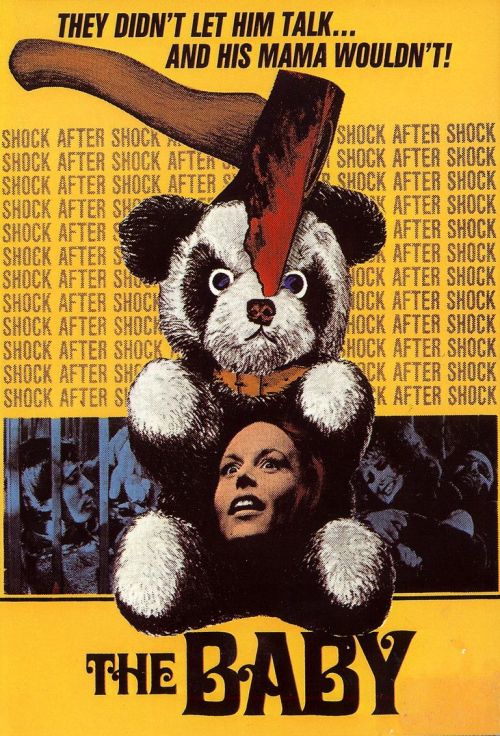
The Baby (1973)

baby1

By Richard Winters

My Rating: 7 out of 10

4-Word Review: Family harbors man-baby.

Ann (Anjanette Comer) is a social worker who, still tormented by the car accident that has left her husband severely brain damaged, decides to throw herself into her work by focusing on a bizarre case in which a mother (Ruth Roman) and her two daughters (Marianna Hill, Susanne Zenor) take care of a third sibling (David Mooney, but billed as David Manzy) that is a grown man, but permanently trapped in an infant state. As Ann meets with the family she becomes convinced that ‘the baby’ has potential for intellectual capacity and it’s only because of the abuse that he receives from his embittered mother, who harbors a grudge for men after her husband walked out on her and is now taking out that anger on her son, that is holding him back. She devises a plan to kidnap the son, so that she can take him out of that toxic environment in order to help him, but when she does the mother and her two daughters plot a violent revenge in order to take him back.

It took many years for screenwriter Abe Polsky to get his friend Ted Post, who appears onscreen during the party scene, to agree to film his script as he insisted that it was, in his words, ‘too negative’. His ambivalence for the material shows as visually it’s given the TV-movie treatment that lacks atmosphere, or a visually provocative approach the would help accentuate the darkly quirky elements of the story. While this has still attained a cult following it’s mainly because of the offbeat story and might’ve gotten more fans and attention had the direction been equally offbeat instead of so basic.

The acting on the other hand is a stand-out. Ruth Roman, a one time leading lady during Hollywood’s Golden Age, but by the 70’s was relegated to low budget horror, is terrific with her raspy voice and chain smoking making her like a snarly version of Suzanne Pleshette. The caustic confrontations between her and Comer, who initially seems like the angelic, law abiding one, helps accentuate their contrasting personalities. Comer of course is quite good too. She’s played many offbeat characters, but here comes-off as the noble, straight one and does so convincingly, which is detrimental for pulling off the stories plot point. Hill, as Roman’s twisted amoral daughter, is interesting as well though there was no need for two daughters as they both shared seemingly the same personality and could easily have been merged into one and since Hill gives her part a little better nuance she should’ve been cast while Zenor cut out completely.

Mooney as the man-child though is the scene stealer. He got into his part by observing special needs children and his infant mannerisms is on-target to the extent it’s creepy. Having him put into a crib though that he supposedly couldn’t get out despite being a grown man physically doesn’t really gel as even toddlers can ultimately figure out a way to get out of one. Putting him into a big cage that would sit in the middle of the ‘nursery’ would’ve been more sinister visually as well as realistic. The source of his infantile state, that he’s seemingly been abused by a cattle prod all these years to not grow up, or to even learn to talk, or walk, is equally ridiculous. Explaining that his condition was caused by being in a car accident when he was an actual baby, which then trapped him in that state forever due to brain damage would’ve been far more easier to swallow while also tying it in to Comer’s husband’s condition that eventually becomes a key element.

The scene with the young babysitter, played by Erin O’Reilly, didn’t make sense either. She’s portrayed as being just this average teen taking care of the baby like she would a real one for extra money, but there’s no way any teen would be comfortable changing the diaper of a grown man, as it’s still a man’s body no matter how he behaves, and not come away feeling sick and perverse. by doing it Thus the part should’ve been played by some kooky older woman, perhaps a friend or cousin to the mother, who was lonely and liked taking care of the ‘baby’ due to sharing the same man-hating instincts, or had a secret quirk where she enjoyed having a male in a subservient condition.

Spoiler Alert!

The third act had holes in it as well as Comer kidnaps the ‘baby’ and brings him home with her, but the mother and sisters don’t call the police to get him back. Supposedly this is because the mother is afraid the years of abuse, that Comer has become aware of, would come to light, but it would still be her word against theirs and I felt they should’ve responded more aggressively maybe even hiring a lawyer to take the case to court and then becoming impatient with the slow legal process and then finally deciding to take matters into their own hands, but just having them sit around the house for several days/weeks waiting to see what Comer does next doesn’t really jive.

The ultimately twist though I did like and took me by surprise. I’m usually able to guess where movies are going and can get it right most of the time, but this one is novel and for that gets high marks despite its other issues.

baby2

My Rating: 7 out of 10

Released: March 4, 1973

Runtime: 1 Hour 24 Minutes

Rated PG

Director: Ted Post

Studio: Scotia International

Available: DVD, Blu-ray, Fandor, Tubi, Amazon Video, YouTube

Who can Kill a Child? (1976)

who3

By Richard Winters

My Rating: 6 out of 10

4-Word Review: Children kill the adults.

Tom (Lewis Fiander) and Evelyn (Prunella Ransome), who is pregnant, travel to an island off the coast of Spain in order to find some peace and quiet while on vacation. Once they arrive they find the place conspicuously devoid of any adults with many of the shops and bars looking like they’ve been abandoned. The only people around are children who behave strangely and will not talk to Tom, or Evelyn even when spoken to directly. They then come upon an adult survivor named Padre (Antonio Iranzo) who describes to them how the night before the children suddenly went crazy and began killing all the adults on the island without any provocation. Can Tom and Evelyn escape, or will they become yet another victim?

While there’s been other movies detailing children, or even groups of kids, who murder the adults around them this one is considered the granddaddy of all of them and, though not ever verified, the possible inspiration to Stephen King’s Children of the Corn. The film’s creepiness comes not so much with scares, as there’s very little of that, but more through its quiet atmosphere and isolation that grows increasingly more ominous as it goes. Violence-wise it’s scarce with only the minimum of gore though the sequence done over the opening credits, which has grisly real-life footage of victims of the Holocaust as well as both the Korean and Vietnam Wars is not for the squeamish and may be too explicit and grim for some to sit through.

The script was written in only a matter of 4 short days and it shows with character motivations that aren’t particularly well thought out. For instance I didn’t understand why Tom wouldn’t tell Evelyn about what he saw, in regards to the child beating up and eventually killing an old man, and wanted to somehow play down and even lie about what was going on. This is a pregnant woman who has a right to know about the dangers lurking about. Shielding her from the horrifying realities isn’t going to help her be alert and put up her defenses and if anything just make her more vulnerable to be taken advantage of by the kids. What kind of husband lies to his wife about such urgent matters? Does he think because she’s female she won’t be ‘strong enough’ to handle the truth? If so it makes him sexist and not particularly likable because of it.

Tom also is too slow to respond to things. Even after witnessing first hand the children’s atrocities he doesn’t immediately try to arm himself, get off the island, or board him and his wife off in some sort of safe room with a fortified door. Instead they remain pretty much out in the open in an abandoned hotel with both the entrances and exits wide open for anyone to come into. At one point he even gives his wife a sedative and tells her to take a nap inside one of the hotel rooms while leaving the door open as he goes downstairs to speak to the male survivor, but how does he know a kid won’t sneak into the room while he’s gone?

It’s strange too how the children kill a Dutch woman and even strip off her clothes, but when Tom walks in they all scurry away. If they’ve already killed a vast number of adults why would they fear Tom when he comes in and instead not just attack him too? For that matter why does Tom feel so emboldened to walk in on these kids to begin with? He’s seen what terrible things they can do, so why does he risk exposing himself to them? These clearly aren’t normal kids, so he should remain at a safe distance and view what they’re doing from a hiding spot.

While there’s creepy moments and imagery it all mainly comes during the third act and some more scares and action earlier could’ve helped. The special effects aren’t too great either with the shot of the bloodied old man, whose supposedly just been killed, clearly still breathing as his chest heaves up and down, though Tom carries him away like he’s now nothing more than a corpse. Having Padre describe the violent attacks of the children onto the adults from the previous night was disappointing as this should’ve been played out visually, even if through flashback, as it would be much scarier to see this instead of just being told about it.

Spoiler Alert!

The ending has its fair share of suspenseful moments, but again more logic loopholes. When Tom and Prunella are trapped in a room behind a wooden door a small child crawls through the window space and tries to shoot at them, but Tom manages to hit the kid with a bullet first with a rifle he’s found. The other kids then quit trying to break the door down the couple are in once they hear the shot and all go filing away. Tom says this is because none of the other adults responded with aggression and violence towards them like he did. Once they realized, by hearing the gunshot, that Tom meant business they all backed off knowing that he might kill them as well. However, the kids could not see through the door, the tiny window on it was too high up for them to look through, so for all they knew the gunshot was the sound of the small kid shooting the couple with his gun and therefore they should’ve continued the attack and not immediately stopped.

The children are also able to somehow brainwash their peers into doing their evil bidding by simply looking into their eyes, which somehow puts them under a spell. They even use this power to get the fetus inside Evelyn’s womb to attack her, but where do they get this power from? What kind of entity is behind all of this? Nothing gets answered, which leaves too many questions open and thus not as effective as it could’ve been.

My Rating: 6 out of 10

Released: April 26, 1976

Runtime: 1 Hour 53 Minutes

Rated R

Director: Narciso Ibanez Serrador

Studio: Penta Films

Available: DVD (Region 0), Blu-ray (Region B/2)

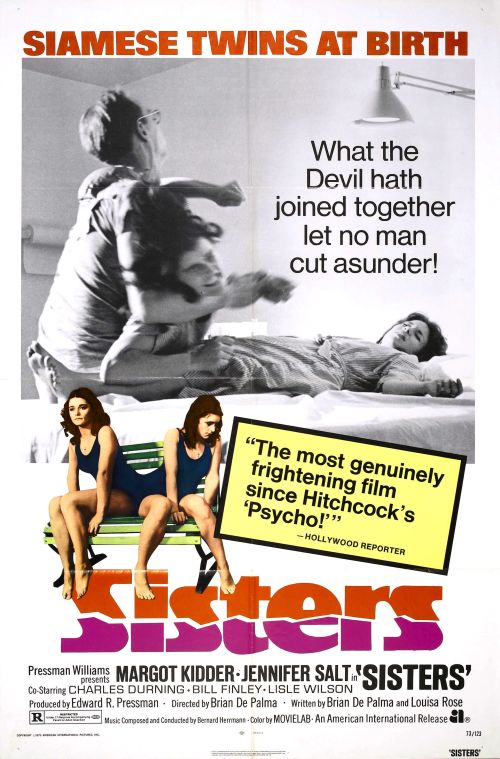
Sisters (1972)

sisters

By Richard Winters

My Rating: 7 out of 10

4-Word Review: Model has evil twin.

Danielle (Margot Kidder) is a young French-Canadian women from Quebec who aspires to be a fashion model and actress. She takes part in a TV-show styled after ‘Candid Camera’ where unsuspecting people find themselves caught up in a prank, which is where she meets Phillip (Lisle Wilson). The two go out on a date, but while at the restaurant she gets harassed by Emil (William Finley) her ex-husband. Then when they get back to her apartment Phillip overhears her arguing with another woman, which Danielle says is her twin sister Dominque. Since it is both of their birthdays Phillip decides to go out to get them a cake, but when he returns he gets viciously stabbed by the psychotic Dominque, but just before he dies he’s able to scribble the word ‘help’ onto the window with his own blood that Grace (Jennifer Salt), a journalist that resides across the street, sees. She immediately calls the police, but when they arrive into Danielle’s apartment there’s no sign of a body, or a struggle and Grace gets written-off as being a kook whose been imagining things, but she refuses to relent and begins her own investigation where she uncovers some dark details about Danielle and her sister who were once conjoined.

This was writer/director Brian De Palma’s first attempt at horror after completing many successful comedies that had gained a cult following. The story was inspired by real-life conjoined twins Masha and Dasha Krivoshlyapova who’s sad upbringing where they were taken away from their mother and had abusive medical experiments done on them at a secret hospital in the Soviet Union, and which was chronicled, much like in the movie, in a story in Life Magazine in 1966, which after reading it De Palma couldn’t get out of his head. Visually it’s excellent with great use of editing and superior score by the legendary Bernard Herrmann, who was semi-retired at the time, but enjoyed the script so much that he agreed to be the composer.

Many of De Palma’s famous directorial touches are apparent including his use of the split-screen. While it’s been used, and some may say overused, in many films from that era, it gets worked to perfection as we get to see Danielle and her ex busily cleaning-up the crime scene while Grace gets held up by the detectives and they’re not able to go into the apartment right away. My only complaint here is that with the blood splatter all over I’m just not sure they would’ve been able to wipe it all away in such a short time frame, basically about 8 to 10 minutes, which should’ve more likely taken them several hours. Not showing the clean-up and having Grace and detectives arrive to find the place spotless with no body would’ve actually added more intrigue and thus in this case the use of the split-screen, while done adequately, I don’t think was needed.

Spoiler Alert!

The script leaves open a fair amount of loopholes, for instance we see Danielle walk into a bedroom and the shadow of her head on the wall along with another one, which is supposed to represent Dominque’s, but we learn later that Dominque died years early during the surgery to separate them, so we’ve should’ve only seen one head shadow and not two. Also, Danielle is told point-blank by Grace that she’s been spying on them from across the street, so you’d think later that she and Emil would make damn sure to close the blinds on their windows when they try to remove the sofa, which has the dead body inside, but instead they continue to leave the shades wide open and allow Grace, now back in her own apartment, to continue to peer in while the couple show no awareness to the possibility and don’t even bother to look out the window to see if they can catch Grace looking in. Another head-scratcher is why there was no blood splatter on Danielle’s clothing, since she ultimately is the one that killed Phillip, when Emil walks into the apartment.

The most confusing thing though is the ending in which Grace becomes hypnotized while inside a mental hospital and begins to see herself, through a long dream sequence, as being Dominque and attached to Danielle. When I first saw this, back in the 90’s, I thought it meant that Grace was the long lost twin and that they had been separated years earlier. While Grace doesn’t look exactly like Danielle most twins don’t, and she was still around the same age, hair color, and body type, so it seemed like a legitimate explanation and I wouldn’t blame anyone else who came to this same conclusion. Apparently though that’s not the case as Grace comes back out of it only convinced, through the hypnotism, that she didn’t see the murder of Phillip, but I felt they should’ve taken it one step further by convincing her that she was Dominque, whether it was true, or not, and then brain washed to take credit for all the murders while Danielle could then get off scot-free and this would’ve then been the ultimate twist.

Granted Grace’s character is shown as having a mother (Mary Davenport), but the script could’ve been rewritten to have her taken out and Grace could’ve instead been portrayed as being an orphan, or adopted, which could’ve left open the possibility. In either case the dream segment, which is creepy and stylish done, would’ve had more of a payoff then it does had it taken this route.

My Rating: 7 out of 10

Released: November 18, 1972

Runtime: 1 Hour 33 Minutes

Rated R

Director: Brian De Palma

Studio: American International Pictures

Available: DVD, Blu-ray (Criterion Collection), Amazon Video

Sleepaway Camp III: Teenage Wasteland (1989)

sleepaway3

By Richard Winters

My Rating: 3 out of 10

4-Word Review: Angela commits more murders.

When Maria (Kashina Kessler), who has the words ‘milk’ and ‘shake’ tattooed to her breasts, goes off to camp, she is impeded by a truck driven by Angela (Pamela Springsteen) that runs her over and allows Angela to take on her identity. Angela then returns to the same campsite where she committed her atrocities from the last film, but which is now run by husband and wife Herman (Michael J. Pollard) and Lilly (Sandra Dorsey), who have turned it into a place to help reform teens with a criminal record and renamed Camp New Horizons. It doesn’t take long though for Angela to revert to her old ways and soon both campers and counselors begin disappearing with a frightening regularity.

While Part II was filming producer Jerry Silva was so impressed with what he was seeing that he immediately authorized another sequel with a script for this one being written while that one was still being shot and then only one weekend for pre-production. This also pushed the filming date back into October where not only were the leaves already changing, but in one segment you can see the breaths of the actors when they speak, which certainly does not give the viewer a summery feel.

The second installment had an okay balance between the black comedy and horror, but this one goes overboard into silly season. The initial killing is especially problematic as it has the victim chased down by a big truck in broad daylight. Yes, she eventually gets run over when she runs into a back alley, but the semi starts barreling down on her when she’s walking on an busy road with other cars, so other people would’ve witnessed what was happening and reported it making the odds of Angela getting away with it quite slim. Also, where does a woman, who was 13 when she got locked up into a mental hospital and been there most of the time until her recent release, find the time and money to learn how to drive a big rig and how was she able to steal one?

While Springsteen’s performance was slightly tolerable in the second installment I felt it got plain annoying here. She isn’t scary and even though this is meant as a dark comedy the villain should still have some frightening presence and she has none making for no suspense at all. She also has her hair dyed blonde, in order to resemble Maria, which has her looking even less like Felissa Rose who played the character in the first one and further way from the original concept making this seem like its own little movie with name-only connections to the other two.

The murders though are an improvement and the only thing that saves it. Part II put no creativity or imagination into the killings, but here we get a couple of memorable ones including Angela roasting marshmallows on a fire that’s burning two of her victims. Killing one of the campers via tying them up to a flagpole and then allowing them to drop many feet to the hard cement below was my favorite though the death by lawnmower, which apparently made some of the women members on the MPAA board, who were hired to give the movie its rating, physically sick, deserves honorable mention. Even here though there’s problems like when Angela stands over the body of a man and swings an ax on him, but then returns to the campsite wearing the same clothes she had, which would’ve been highly doubtful as they would’ve most assuredly been covered with blood splatter.

The only element I found interesting was the appearance of Michael J. Pollard who was at one time starring in Hollywood classics like Bonnie and Clyde and was even given a couple of leading man roles in  studio produced films, but here relegated to low budget direct-to-video fare. He isn’t even in it all that much as his character is one of the first to be killed though he does at least get to make-out with a hot young chick (Stacie Lambert), which may have made it worth it.

My Rating: 3 out of 10

Released: August 4, 1989

Runtime: 1 Hour 20 Minutes

Rated R

Director: Michael A. Simpson

Studio: Double Helix Films

Available: DVD, Blu-ray, Freevee, Pluto TV, Tubi, Amazon Video

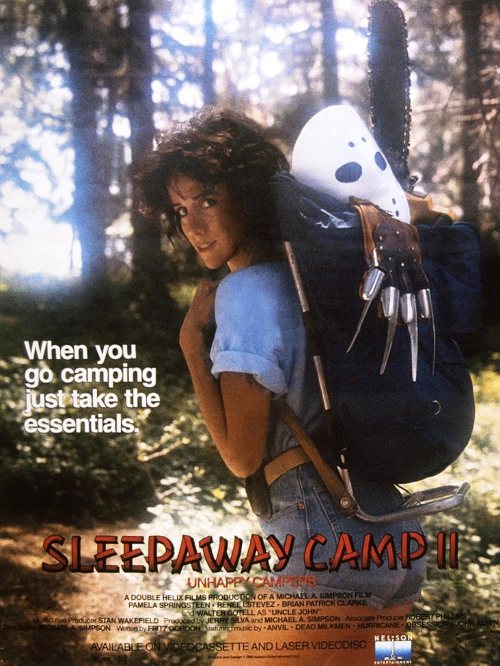
Sleepaway Camp II: Unhappy Campers (1988)

sleepaway2

By Richard Winters

My Rating: 3 out of 10

4-Word Review: Angela returns to camp.

Angela (Pamela Springsteen), the teen killer in the first film, has now been ‘reformed’ after going through years of shock therapy and sexual reassignment surgery. She gets a job as a counselor at a camp named Rolling Hills, which is 60 miles away from Camp Arawak, the site where she had previously killed all those people. The campers and other counselors have no idea about her past and have a hard time getting along with her and she’s quite strict with no tolerance for anyone who breaks the rules. If someone does draw her ire she quickly dispenses with them by reverting to her old habits and after they’re offed she goes and tells the camp leader, Uncle John (Walter Gotell), that she ‘sent them home’, but when she starts doing this to too many kids everyone’s suspicions begin to rise.

While on the technical end the production is decent the storyline is ridiculous even when taken into context of a black comedy, which is what the filmmakers were hoping for, it doesn’t work. The idea that Angela would be let out of a mental hospital in such a short period of time, just 5 years, after killing so many people is absolutely absurd and would create a national, media uproar. Since the murders were all deliberate and plotted out she most likely would be considered sane and stood trial and sent to a regular prison anyways. Why would any campsite hire her? Don’t these people do background checks? A way to have resolved this would’ve been to shown her at the beginning escaping from the mental hospital, and possibly killing a few orderlies along the way, which would’ve helped the story make more sense and also been an excuse to show blood and guts, which is what audiences for these types of films pretty just want anyways.

While Pamela Springsteen, who’s the younger sister of Bruce Springsteen, may be a quality actress in her other films she does not play the role here in a convincing way. What made Angela so memorable in the first was her penetrating stare, which we don’t see any of. Angela’s inner angst came from her gender issue and not that she was some old-fashioned prude, like in this one, that kills people who don’t live up to her high moral standard. It’s like a completely different person who’s connection to the other one is in name only. Apparently Felissa Rose, who played the role in the original, auditioned for the part, but because she couldn’t convey the one-liners in a humorous way that they wanted they decided to go with Pamela. Personally I feel they shouldn’t have even bothered to make it if Felissa couldn’t have recreated the role, which I felt she had earned the right to.

The killings are not as creative either and in fact look downright pathetic. I’ll give some credit to the death in the outhouse where a victim is shoved into the hole were people relieve themselves and then she struggles several times to come up, with more and more waste appearing on her as she does, but otherwise it’s tacky fare especially the end where they come into an abandoned home featuring all the dead victims that looks too obvious as being mannequins with red paint.  I also didn’t care for the nightmare segment, apparently done to help pad the runtime, that rehashes the killing scenes we’ve already seen and is highly redundant.

Fans of the film say it’s the humor that sells it. Yes, some of it is kind of funny like when the male counselor (Brian Patrick Clarke) smells underneath his arm pits after Angela walks away thinking that the reason she was so cold to him wasn’t because she’s a psycho, but more because of his possibly bad body odor. My favorite though is when Ally (Valerie Hartman) has sex with a man and then only after it’s over does she bother to ask him if he has ‘AIDS’. Yet outside of this it’s a letdown. As sequels go it’s not the worst of its kind, but I would’ve preferred more of a straight horror approach that tried to stay faithful to the first one, both in tone and with the cast.

My Rating: 3 out of 10

Released: February 28, 1988

Runtime: 1 Hour 20 Minutes

Rated R

Director: Michael A. Simpson

Studio: Double Helix Films

Available: DVD, Blu-ray, Amazon Video, Pluto, Tubi, YouTube