Category Archives: Drama

The Trip to Bountiful (1985)

the trip to bountiful 1

By Richard Winters

My Rating: 7 out of 10

4-Word Review: Old lady goes home.

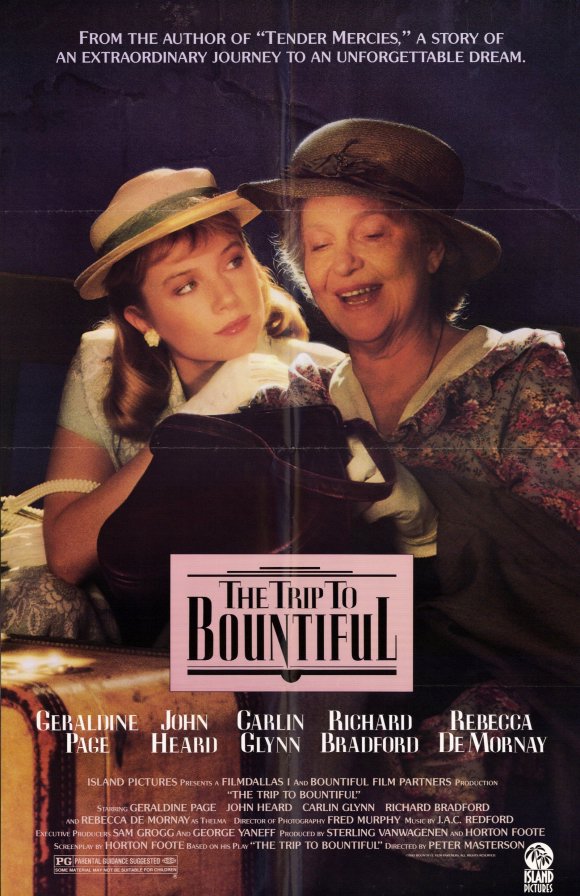
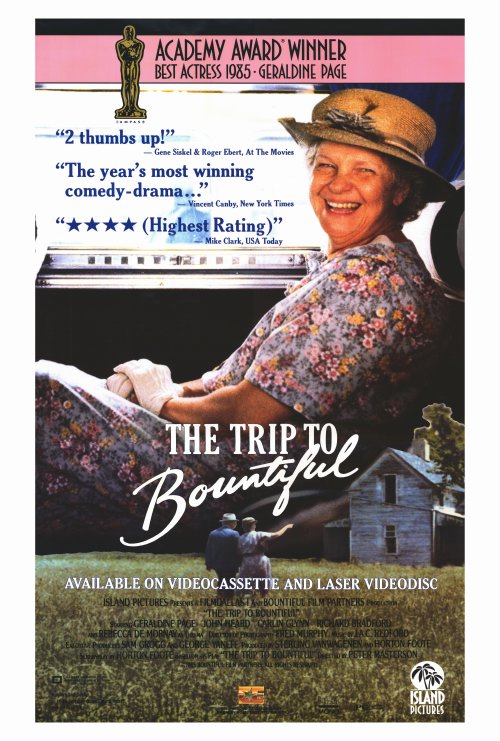
Carrie Watts (Geraldine Page) is an elderly woman living inside a cramped apartment with her grown son Ludie (John Heard) and his wife Jessie Mae (Carline Glynn) in Houston, Texas during the 1940’s. Carrie dreams of one day returning to her childhood home in the small town of Bountiful and ‘escaping’ from Jessie Mae who is overbearing and treats her like a child, but she lacks the transportation or funds. She secretly hides her government checks with the hopes of saving enough to take a train. When she finally makes it to the train station she finds there is no longer any stops to her old town, which is now essentially abandoned, but with the help of the local sheriff (Richard Bradford) he takes her there while Ludie and Jessie follow close behind determined to drag her back with them.

Peter Masterson’s directorial debut shows a great appreciation for Horton Foote’s script as it manages to stay true to the period and tone. I especially liked the part where Carrie describes the quietness of her childhood home while the camera slowly pans the yard and allows the viewer to essentially experience what she is talking about. The recreation of the ‘40s is on-target making you feel like you are living there yourself. Having some tunes of the era playing on a phonograph in the background is a great touch and it’s nice to hear a soundtrack that isn’t from the preverbal classic rock period.

Page shines in her Academy Award winning performance. She has played evil characters with such a relish for most of her career that it is nice seeing her portray a sweet old lady for once and do it so well. Her presence adds to every scene she is in and helps make them more interesting particularly with her conversation on the train with Thelma (Rebecca De Mornay) and the way she holds up everyone in line at the train station specifically two men standing behind her who in real life where her twin sons. She also manages to cry effectively with tears actually coming out of her eyes as opposed to De Mornay whose tearless attempts at it where so pathetic it seemed almost embarrassing.

Carlin is quite good in the snippy adversarial role and I was surprised she didn’t at least get a nomination for her efforts. Heard is solid as a sort of mediator and De Mornay is perfect for the part simply because her fresh youthful face makes a great contrast to Page’s worn one.

The on-location shooting adds a lot of flavor and helps to make this superior over its original stage version. The story itself is slow moving, but a wonderful character study on aging that at times manages to be dryly humorous, honest and sad, but never maudlin.

the trip to bountiful 2

My Rating: 7 out of 10

Released: December 20, 1985

Runtime: 1Hour 48Minutes

Rated PG

Director: Peter Masterson

Studio: Island Pictures

Available: VHS, DVD

Our Time (1974)

our time 2

By Richard Winters

My Rating: 6 out of 10

4-Word Review: She gets an abortion.

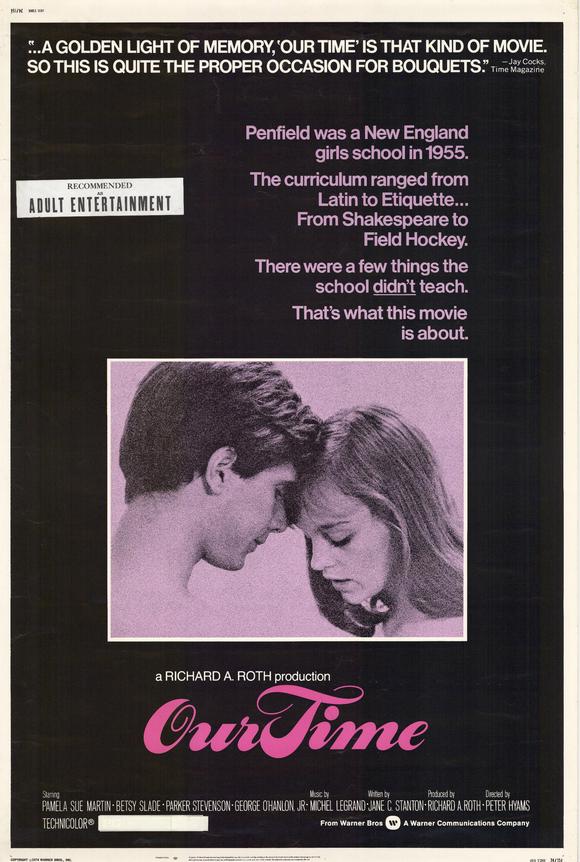
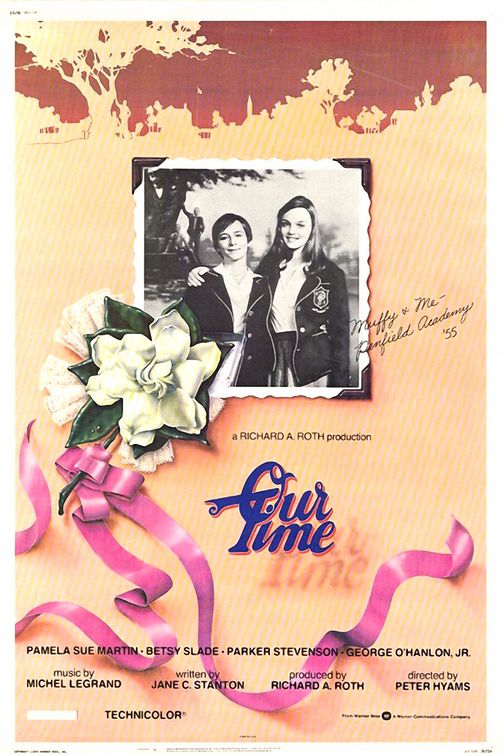
Abby (Pamela Sue Martin) and Muffy (Betsy Slade) are two teen girls and the best of friends that are attending a New England all-girls school during the 50’s. Abby is in love with Michael (Parker Stevenson) and the two sneak off one weekend and consummate their relationship, which makes Muffy jealous. She is not as pretty as Abby and has a hard time getting boyfriends, but decides one night during a Christmas party to have sex with Malcolm (George O’Hanlon Jr.) in the backseat of a car simply to feel what it is like. Their experience isn’t as enjoyable, but Muffy becomes pregnant anyways and the four then spend the rest of the time looking for an underground abortionist to terminate her pregnancy.

On the technical end the film is slick. I particularly liked the opening tracking shot that takes place in a church. The camera starts at the front of the church showing a close-up of the headmaster singing with the choir and then pulls back down the side aisle to show Abby sneaking in late and then goes back up the middle aisle as she looks for a seat. In fact just about every scene features some form of a tracking shot, which may get a little overdone, but helps give the film a certain visual liveliness. Unlike Leonard Maltin who in his book described the color photography as being ‘bad’, I found it to be quite vivid with a nice soft focus lens that gives it a nostalgic-like appeal.

The story itself is predictable, but I enjoyed the sometimes humorous takes of the sexual repressive, stifling attitude of the era and how the students were made to feel like they were being watched and monitored at every second. Abby’s and Michael’s sexual encounter inside a hotel room is quite amusing, but the one done later on between Muffy and Malcolm is painful to watch and not very realistic, looking more like two clothed bodies on top of each other without much effort to simulate the sexual motions.

Martin is excellent in the lead and ironically starred just two years earlier in a similar film about a young unwed woman looking for an abortionist entitled To Find a Man. Stevenson, who later co-starred with Martin in ‘The Hardy Boys/Nancy Drew Mysteries’ TV-show looks like he is barely past puberty. Jerry Hardin, Cliff Emmich, Robert Walden and Debralee Scott can all be seen in brief bits. This is also the only other film appearance of Karen Balkin, who played the bratty student in The Children’s Hour and plays a similar type of character here.

The only issue I had with the film is with the abortion segment. Overall, from a purely dramatic level I felt these scenes were compelling and the best moments in the movie, but it seemed unrealistic especially from a 1950’s perspective that none of the four would try to convince Muffy to keep the baby. It almost comes off like these are 70’s teens with more modern sensibilities that were transplanted into a different time period than actual characters from a bygone era. The plot also becomes more like a political statement than a story and seems to lean too heavily on a liberal point-of-view.

our time 3

My Rating: 6 out of 10

Released: April 10, 1974

Runtime: 1Hour 30Minutes

Rated PG

Director: Peter Hyams

Studio: Warner Brothers

Available: DVD (Warner Archive)

The Children’s Hour (1961)

childrens hour

By Richard Winters

My Rating: 4 out of 10

4-Word Review: Ruined by a lie.

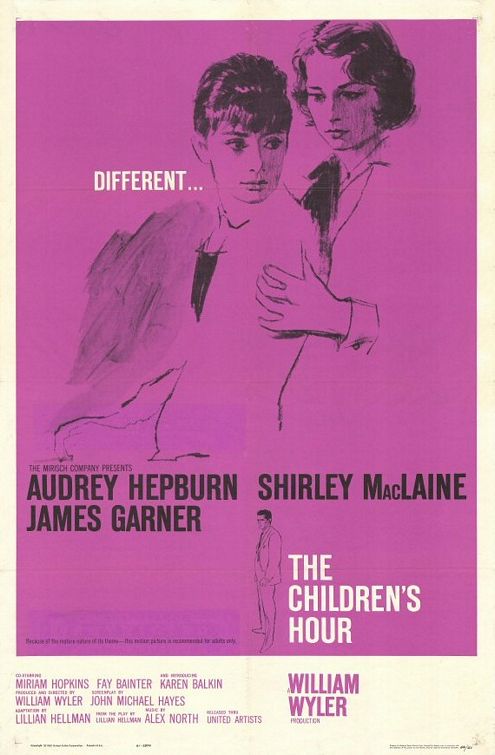
Martha and Karen (Shirley Maclaine, Audrey Hepburn) are two single young women running an all-girl’s school. They have the respect of the community and the parents, but that suddenly changes when one of the students named Mary (Karen Balkin) decides to spread a rumor that Martha and Karen are lovers. This sends everything into an uproar. All the students are moved out and the two women find themselves fighting desperately for their reputations and livelihoods. Karen’s boyfriend Joe (James Garner) remains their staunch supporter, but eventually even he begins to have his suspicions.

The film is based on the landmark play written by Lillian Hellman which ran for 691 performances in 1934 and was based on a true incident that happened in Scotland in 1810. The original film version of the play was made in 1936 and entitled These Three that was also directed by William Wyler and starred Miriam Hopkins as Martha who in this film plays Martha’s Aunt Lily. That film was heavily watered down with the lesbian element completely taken out and instead has the rumor revolve around the two teachers being in love with the same man.

This second film version was supposed to be more like the play, but hardly seems worth the effort. Although Wyler makes some attempts to make it seem more cinematic it still comes off very much like a filmed stage play and a static one at that. Lots and lots of talk with a narrative that is quite plodding and predictable. Having the story work more in a fragmented style might have helped, but either way it is never very engrossing or compelling. It also completely skips over the libel trial, which I thought could’ve given some added drama and it never completely explains why the Aunt Lily character avoided testifying. She comes up with the lame excuse that she was touring with her show, but I felt it was more because she secretly knew Martha was a closet lesbian and didn’t want to have to confront that and the film should’ve made this more clear.

It is also unintentionally funny at times especially the part where actress Fay Bainter’s eyes get bigger and bigger as Mary whispers her ‘shocking’ secret into her ear. Balkin also overdoes the facial expressions, which was probably due to too much coaching on the part of Wyler, but with that said her presence in the film is fun and gives the proceedings a liveliness that is otherwise stagnant.

The film really isn’t all that groundbreaking either and handles the delicate issue in too much of a timid way. For instance there is a scene where Martha admits to her homosexual feelings and states that she feels ‘ashamed’ for having them and Karen counsels her by stating that ‘you did nothing wrong’ because ‘nothing happened’, but what if it had then would it have been wrong? I tend to lean towards the latter making the production seem as stale and prejudicial as the public at the time. I was also confused as to how the two women could remain living at the school when all the students had moved out and they no longer had any income, or how they were still able to have groceries delivered to them.

My Rating: 4 out of 10

Released: December 19, 1961

Runtime: 1Hour 47Minutes

Not Rated

Director: William Wyler

Studio: United Artists

Available: DVD, Blu-ray, Amazon Instant Video

Heat and Dust (1983)

heat and dust

By Richard Winters

My Rating: 5 out of 10

4-Word Review: Illicit love in India.

Anne (Julie Christie) has acquired a great fascination with her long-lost Aunt Olivia (Greta Sachi) who was involved in scandal while living in India during the 1920’s. After doing some extensive interviews with Harry (Nickolas Grace) a man who knew Olivia and was friends with her during the period, Anne decides to make a trek to the region herself.  Although several decades removed Anne still manages to find some interesting things about her Aunt including her illicit affair with a local ruler named Nawab (Shashi Kapoor) which caused great scandal at the time and forced her to go into hiding.

The film has a unique structure in that it weaves back and forth between the ‘60s when Anne travels to the region and the ‘20s when Olivia was there. Initially this is slightly off-putting as it cuts back and forth quite suddenly and without warning, but eventually I adjusted to it and amazingly it comes off quite seamlessly most of the way. The film spends more time on Olivia, but by the end it’s cutting between the two every couple of minutes and it one cool moment even have the two come together in a surreal type of way. The only real problem I had with this is when Anne meets a young American man who has ‘purified’ himself from the capitalistic culture of the west, but then still seems to fall back on his old ways at times creating a tumultuous relationship with Anne that I found rather interesting and was upset when the film suddenly cut back to Olivia and then stayed with her for too long a time before going back.

I enjoyed the on-location shooting of India, which makes you feel almost like you’ve traveled there yourself. The film not only analyzes the crowded squalor of the big cities, but also the rocky beauty of its rugged terrain. The film immerses the viewer in the culture looking at both the positive aspects of it as well as the negative, which gives you an overall balanced viewpoint. However, I would have liked more an expansive look of the area with greater use of a wide angle lens and a few bird’s-eye shots of the city, but this was most likely limited because of budget restraints.

I enjoyed the wide-eyed idealism of the Olivia character and Sacchi captures it just right. Christie is also solid, but in the end a bit wasted. The film itself is interesting enough to hold your attention, but some of the scenes go on longer than necessary and could have easily been trimmed. The story seemed rather simple and predictable and has no action at all making the runtime excessive especially with a final payoff that is not too exciting and leaves more than a few loose ends open.

My Rating: 5 out of 10

Released: September 15, 1983

Runtime: 2Hours 13Minutes

Rated R

Director: James Ivory

Studio: Merchant Ivory Productions

Available: VHS, DVD

The Last Woman (1976)

the last woman 1

By Richard Winters

My Rating: 2 out of 10

4-Word Review: He ends his manhood.

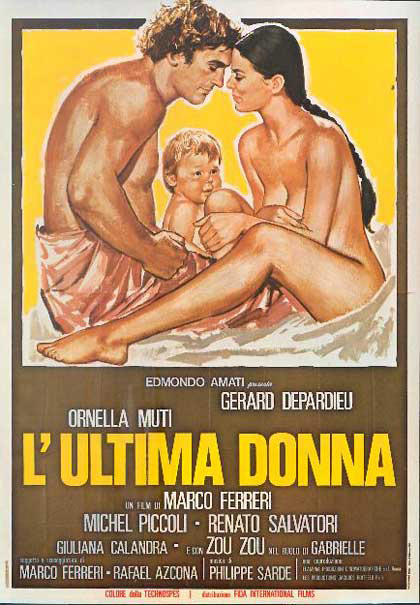
Gerard (Gerard Depardieu) is a single father of an infant son whose wife has left him due to his controlling ways. By chance he meets Valerie (Ornella Muti) who is just getting over a tumultuous relationship with her boyfriend Michel (Michel Piccoli). She loves Gerard’s little boy and it is enough for her to move in with them almost immediately. The two have a passionate affair, but then Gerard becomes as possessive with her as he was with his ex-wife. Valerie tries to stick with it due to her feelings for the child, but Gerard’s abrasive personality and his inability to see her as anything more than a sexual object eventually becomes too much.

The film, which was directed by the notorious Marco Ferreri who was known to push-the-envelope in just about all the movies he made, is laced with a streaming sexuality that makes it almost pornographic. The sex is raw and explicit even showing Depardieu with a full erection. The characters take their clothes off and prance around naked in front of the child and even have sex with him in the room, which many American viewers will most likely find quite shocking and offensive making it easy to see why this film has never been released onto VHS, DVD or Blu-ray. The sex also seems more real and not the simulated kind one finds in most Hollywood films. There is an animalistic quality to it like it is being done unrehearsed and on-the-spot.

Unfortunately Ferreri relies too heavily on the sensual aspect to carry the film while ignoring the storyline, which is too wide-open and badly in need of more structure and editing. The sex becomes redundant and the conversations between the two characters are endless and pointless. The production plays like it has one of those scripts that gives the actors a generalized understanding of their characters and then allows them to improvise their lines, which unfortunately fails to elicit anything interesting. Ferreri’s direction lacks visual appeal by focusing in on an apartment building, which is where most of the story takes place that is too ordinary and dull.

Muti is certainly beautiful, but her acting is too restrained although it is interesting to some extent at seeing her subdued performance playing off of Depardieu’s hyper one.

Depardieu is solid as expected, but having to spend ninety percent of the time looking at his out-of-shape, chubby nude frame gets a bit trying and even gross. His character is also obnoxious and the callous way he treats Valerie eventually becomes a turn-off

Spoiler Warning!

The film’s biggest claim to fame though is the ending where without warning the Depardieu character takes an electrical meat cutter and slices off his own penis, which is done in such a graphic way that it will make any viewer wince and turn away. Having him then hold up the bloody thing and shove it into the faces of both his shocked and crying girlfriend and child is genuinely disturbing. However, the film as a whole is so boring that this horrific moment does not make it worth sitting through and in many ways just makes it even worse.

End of Spoiler Warning!

Released: April 21, 1976

Runtime: 1Hour 52Minutes

Rated X

Director: Marco Ferreri

Studio: Columbia Pictures

Available: None at this time.

Hellfighters (1968)

hellfighters

By Richard Winters

My Rating: 3 out of 10

4-Word Review: Put out the fire.

Chance Buckman (John Wayne) runs a company specializing in putting out oil well fires. His loyal assistant is the young and dashing Greg Parker (Jim Hutton) who on his off-hours is known to be quite the ladies’ man. When Chance is injured during a freak accident and sent to the hospital Greg call’s Chance’s estranged daughter Tish (Katherine Ross) to come visit him. When Tish arrives her and Greg fall in love and get married even though there is no initial chemistry and after only knowing each other for five days. The rest of the film deals with Chance and Greg quarreling over having his daughter, or any woman for that matter, on-site watching them put out fires as he feels it’s ‘not the proper place for a woman to be’.

If this were a documentary on the real Red Adair, which is who the Chance Buckman character is modeled after, this would have been an exciting and fascinating film. Unfortunately the drama in-between the fire scenes is lame and hooky. The characters and situations are generic and boring and the 2-hour runtime becomes almost interminable to have to sit through.

Politics aside I have always enjoyed Wayne as an actor. Yes he can basically only play one type of part, but he does it well. He knows how to have an onscreen presence, can usually own every scene he is in and can sometimes surprisingly show a good self-depreciating sense of humor as well. However, here he looks old, tired and washed-up. He goes through his scenes like he is sleepwalking and as bored with the threadbare material as the viewer. The silly barroom fight that he and his pals get into becomes ridiculous when you realize that it is old geezers in their 60’s and 70’s that are throwing the punches. The only good scene he has is during a humorous throwaway where he sits on a committee and much to his annoyed reluctance must decide what color to paint the company’s 1,400 nationwide bathrooms.

Despite the fact that she later told reporters that this film was “The biggest piece of crap I’ve ever done!” it is Ross who is the most engaging and quite beautiful in her bob haircut. I enjoyed the way her character stands up to Wayne and apparently behind the scenes the two did not get along and had quite a few arguments. Vera Miles as Wayne’s wife is badly miscast as she was 23-years younger than him and looks more like Ross’s older sister than her mother.

The opening 20 minutes where you see step-by-step how the men put an actual oil rig fire out is quite compelling and even educational, but it goes completely downhill from there and never recovers. By the end the whole thing becomes redundant and having the climatic finale takes place in South America where the men risk being shot at by guerrilla snipers adds little tension or interest making me conclude that the one thing that should’ve been set on fire was the script, but unfortunately it wasn’t.

My Rating: 3 out of 10

Released: November 27, 1968

Runtime: 2 Hours 2 Minutes

Rated G

Director: Andrew V. McLaglen

Studio: Universal

Available: VHS, DVD, Blu-ray (Region B)

Cabaret (1972)

cabaret 1

By Richard Winters

My Rating: 6 out of 10

4-Word Review: Life in pre-war Germany.

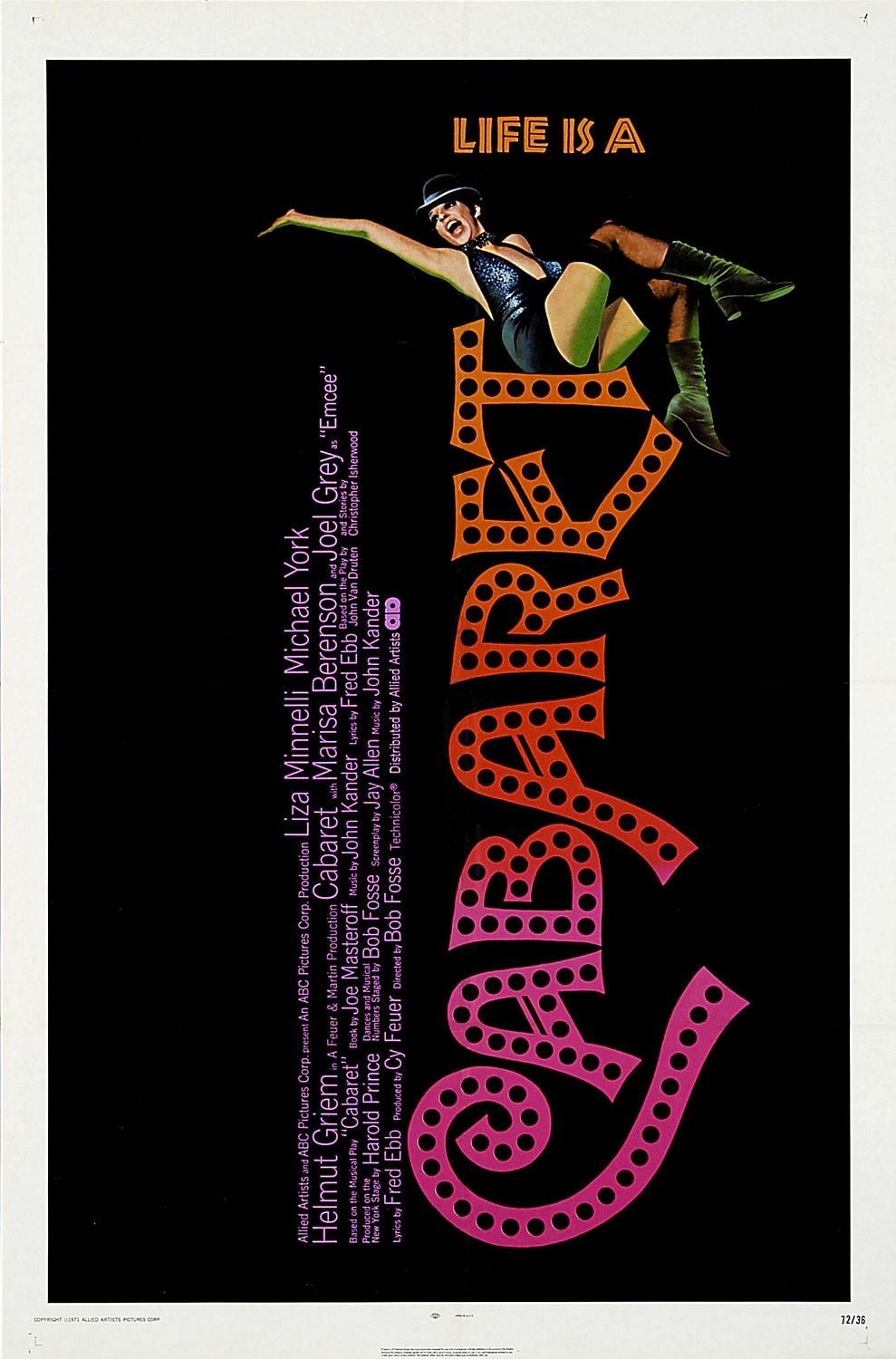
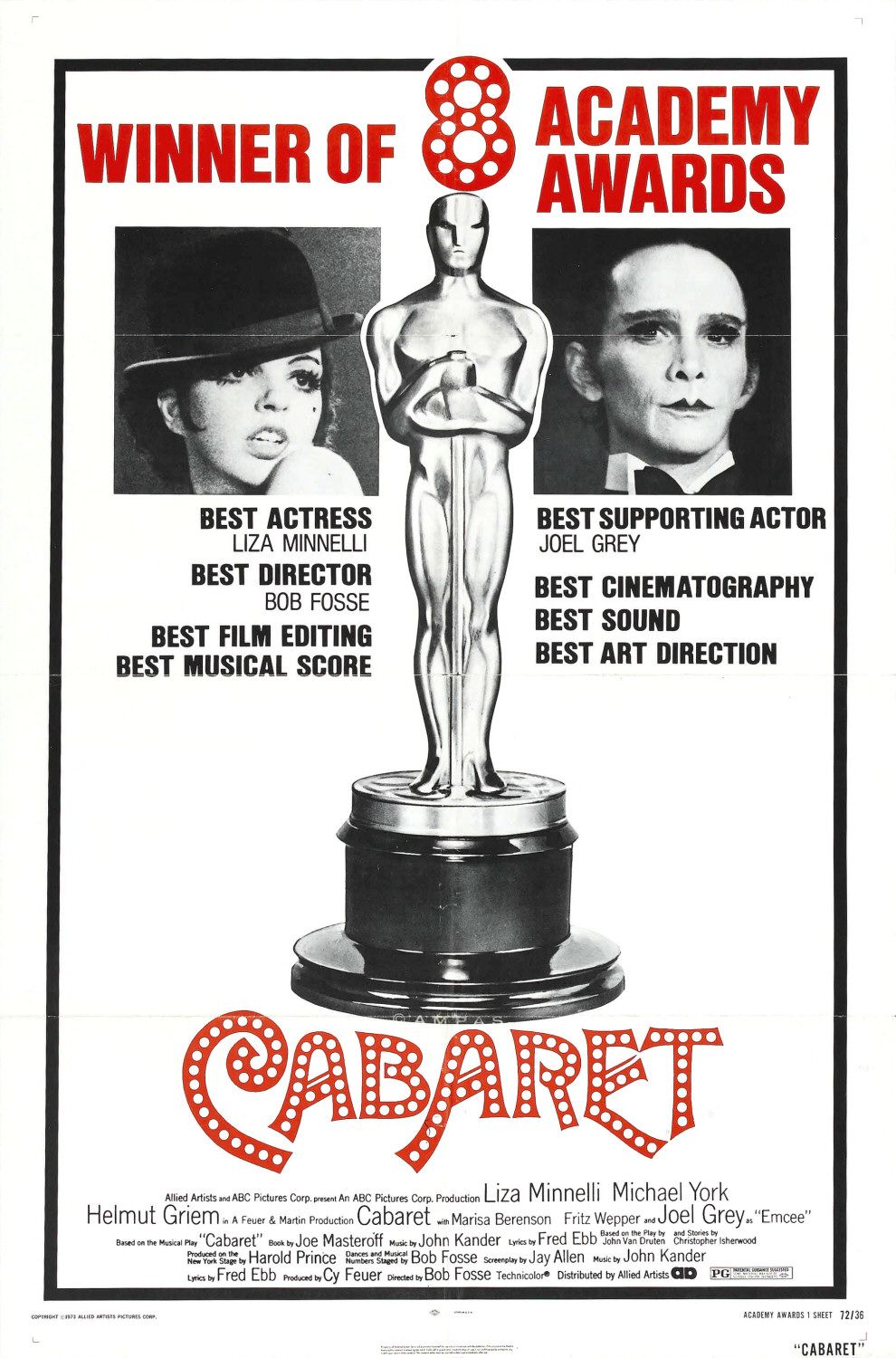
Sally Bowles (Liza Minnelli) is a singer at a seedy Berlin nightclub called the Kit Kat Klub in pre-war Germany. She meets and falls in love with Brian (Michael York) who is a bi-sexual. The two begin a relationship only to have Max (Helmut Griem) enter who seduces them both and gets Sally pregnant.

This is a very stylish look at the pre-war years of Germany when it was still under the rule of the Weimer Republic and not yet succumbed to Nazi authority. The dramatic storylines are spliced in-between musical numbers done at the club, which are visually fun and have just the right amount of sensuality and theatrics. In many ways this looks like an obvious inspiration to the later hit Chicago and netted Bob Fosse the Academy Award for best director.

Joel Grey is amazing as the club’s emcee. He has no speaking lines and yet gives a one-of-a-kind performance that also got him the Academy Award for best supporting actor. His distinguished presence gives the film its unique flavor and personality and has to be seen to be fully appreciated.

Unfortunately the stories between the songs seem awfully trite. There is nothing really profound or interesting about them and they tend to bog the whole thing down while making Germans look uniformly dopey.

cabaret 2

Minnelli won the Academy Award for best actress, but it is hard to see why. Yes she certainly does command the stage when she is singing and dancing, but seems misplaced otherwise. For the most part she seemed to be continuing the insecure, kooky character that she already created in The Sterile Cuckoo without adding any new spin to it. One really can’t sympathize with her nor really wants to and I felt the character became overdone and pushed the viewer’s patience.

Pairing her with refined English teacher York helps…a little yet their romance seemed hard to believe. Having this educated, good looking guy become jealous every time she talks to another man seemed unnatural given the circumstances.

Technically it is sound with a good eye for detail, but falters dramatically and isn’t strong enough to be anything more than a slight diversion. The only interesting scene to me was when a young clean-cut teen wearing a Nazi uniform gets up and sings an impassioned pro-German song as it perfectly illustrated visually all the rampant nationalism and brain washing that went on and is both creepy and sad at the same time.

cabaret 3

My Rating: 6 out of 10

Released: February 13, 1972

Runtime: 2Hours 4Minutes

Rated PG

Director; Bob Fosse

Studio: Allied Artists Pictures

Available: VHS, DVD, Blu-ray, Amazon Instant Video, YouTube

Splendor in the Grass (1961)

splendor in the grass 1

By Richard Winters

My Rating: 7 out of 10

4-Word Review: Learning to move on.

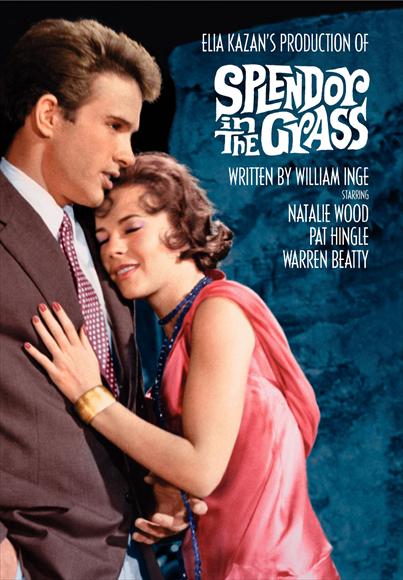
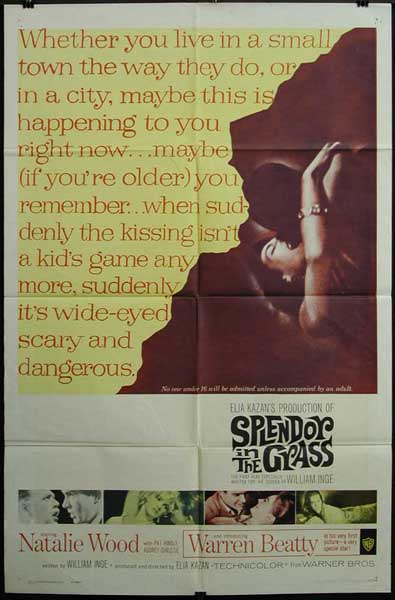
The year is 1928 and Wilma (Natalie Wood) is a high school girl living in a small Kansas town and madly in love with Bud (Warren Beatty). The two share a strong even obsessive relationship and Bud wants to marry her, but his domineering father (Pat Hingle) wants him to wait and go to college for 4 years first. Because Wilma is a ‘nice girl’ he cannot have intimate relations with her before marriage, so in order to alleviate his sexual tensions his father advises that he have sex with a ‘loose woman’ and thus has a fling with Juanita (Jan Norris) who is also one of Wilma’s classmates. When Wilma finds out about this she is devastated and it sends her into a mental breakdown and eventually committed to a psychiatric hospital.

Despite being set in a bygone period the film is hardly dated at all. The characters are real and going through much of the same dilemmas people today have including dealing with parents who push their children to go into fields of study that they aren’t interested in. The film is amazingly frank for its era and director Elia Kazan wisely pulls back by having long takes which allows his eclectic cast to propel the film forward with their performances alone.

Although the setting is Kansas it unfortunately wasn’t filmed there and thus fails to capture the majestic beauty of the plains like Picnic did which was based on another William Inge story. The intention was to shoot it there, but due to a drought it was instead done in northern New York near the Catskills, which has a far different climate and topography. The only exterior shot of the town is that of Wilma’s house, which doesn’t allow the viewer to get any idea of the town’s layout or atmosphere.

All around there are some great performances, but Hingle is a standout in what is quite possibly the best role of his career as he owns every scene that he is in. The only unfortunate thing is that it is never explained what caused the character’s very obvious limp.

Barbara Loden who later went on to marry Kazan in real-life is a scene-stealer as well playing Hingle’s rebellious, flapper daughter Ginny. Her meltdown at a New Year’s Eve party is memorable, but the character then disappears midway through and is never seen again. There is an eventual brief explanation of her whereabouts, but I felt a scene with her at the end was definitely needed.

Wood looks quite possibly at her most beautiful here both with long hair during the first half and then with a short cut during the second part. Beatty makes an outstanding film debut. Usually he is best playing detached characters, but here he plays an emotional one and does it surprisingly well.

The film features a high amount of first time performances from actors who all look very, very young. Phyllis Diller can be seen briefly as a nightclub comedienne. Ivor Francis makes his film debut as Wood’s psychiatrist and Sandy Dennis can be spotted as Wood’s classmate while Martine Bartlett makes her debut as an exasperated English teacher. There is also Zohra Lampert as a waitress explaining to Beatty what pizza is while he tells her about Kansas and you can very briefly spot Eugene Roche and even Godfrey Cambridge.

The film makes some great statements about learning to adjust to life’s twists and turns and living in situations that are not the most fulfilling. Inge, who based many of these characters on people he knew growing up, shows a keen understanding for human nature and his script won a much deserved Oscar.

splendor in the grass 2

My Rating: 7 out of 10

Released: October 10, 1961

Runtime: 2Hours 4Minutes

Not Rated

Director: Elia Kazan

Studio: Warner Brothers

Available: DVD, Amazon Instant Video, YouTube

The Stunt Man (1980)

the stunt man

By Richard Winters

My Rating: 7 out of 10

4-Word Review: Convict becomes a stuntman.

Cameron (Steve Railsback) is on the run from the cops who unknowingly comes onto a movie set and inadvertently causes the death of one of the stuntmen. Eli Cross (Peter O’Toole) the film’s God-like director takes a liking to Cameron and decides to hire him on as the replacement stuntman. Cameron is initially reluctant as he has no experience, but decides it would make a good cover from the police who are still after him. He starts an affair with the film’s leading lady Nina (Barbara Hershey), but finds that it may be Cross that he should be the most afraid of and who may be planning to film Cameron’s death during a difficult underwater stunt in order to add realism.

This is another one of those film-within-a-film type movies with this one faring a bit better than the others. One of the best ingredients it has is showing the behind-the-scenes politics that go on during any film production as well as hitting-the-nail-on-the-head with its caricatures.

Railsback is fun in a rare leading role. The way he can get intense as well as convey the rugged, ragged personality of a war-weary veteran on the run and just trying to survive is completely on-target. His best moments are simply his frightened and confused facial expressions that he has while going through many of Eli’s elaborate stunt routines and not sure if he will be coming out of it alive or not.

O’Toole is in peak form and was nominated for the Academy Award playing an egotistical director, which he modeled after David Lean. Having a director make a film advocating the horrors of war and violence, but then beat-up or threaten numerous crew members any time they make a mistake is perfect irony. My favorite moment of his is when they are showing rushes of Nina’s scenes from that day to her parents and then to their shock he throws in a few scenes showing Nina naked and in bed with another man. Then the next day he informs Nina about it simply to upset her and get the needed reaction that he wanted for the scene.

Hershey is splendid as a Hollywood actress who at times is quite jaded while at other moments is very naïve, child-like and emotionally fragile. Allen Garfield as the film’s exasperated and beleaguered screenwriter is also quite good. I also liked Chuck Bail who essentially plays himself as a stunt coordinator who tries to teach Cameron the fundamentals of the business.

Dominic Frontiere’s booming orchestral score is quite distinctive and at times even stirring particularly during the chase sequence. There is an abundance of ironies and twists that keep things interesting throughout and at points a bit surreal, but it’s missing that one final delicious twist or payoff and has an ending that seems a bit like a copout.

My Rating: 7 out of 10

Released: June 27, 1980

Runtime: 2Hours 11Minutes

Rated R

Director: Richard Rush

Studio: 20th Century Fox

Available: VHS, DVD, Blu-ray, Amazon Instant Video

Rollover (1981)

rollover 1

By Richard Winters

My Rating: 3 out of 10

4-Word Review: What’s in account 21214?

Hubbell Smith (Kris Kristofferson) is the newly appointed president of Borough National a bank that is in desperate need of money. He meets Lee Winters (Jane Fonda) the recent widow of the former chairman of Winterchem Enterprises who is looking to obtain a loan in order to purchase a Spanish processing plant. Hubbell broker’s the $500 million deal with some Arab investors and uses the finder’s fee portion to keep his bank solvent, but suspicions are raised when the money goes into a secret account named 21214 that no one knows anything about and can’t access. When Hubbell does some investigating he finds troubling answers that could lead to economic world collapse.

Director Alan J. Pakula approaches this thing like it is another Klute using not only the same star as that one, but similar type of music. Some of the camera work is dazzling and artsy, but I wondered if this was done to help enhance the script, or simply camouflage all of its holes. The story itself is too talky with a heavy reliance of financial business dealings that could become confusing for the average viewer. The two main characters are rather generic and their passionate making-out is tedious instead of sexy. The action is minimal, which includes a scene where Fonda gets trapped in a limo that is driven by a bad guy that had the potential for being exciting, but unfortunately gets underplayed.

Kristofferson with his Texas drawl is an awfully odd casting choice for a hot shot Wall Street businessman. He grows on you as the movie progresses particularly with the way he remains cool and detached even as his business dealings go horribly awry, but I still felt there were a hundred other actors that would have been better suited for the role.

Fonda is excellent and in many ways badly outplays her costar. Her character though doesn’t make a lot of sense as she is supposedly this famous and highly respected actress, much like Fonda herself and yet wants to be chairwoman of this chemical company instead of just selling her share of the stock after the death of husband and go back to acting, which to me would seem a lot more fun.

In an effort to keep the plot moving the film takes a few liberties with the plausibility. One of the major ones is when Hubbell wants to find out about the secret account and does so by breaking into the office of his superior where he finds in his desk drawer a notebook that lists the computer passcode, which seemed too convenient. In reality I would think a programmer would have to be hired in order to hack the system, which would have taken longer to play out, but also if done right heighten the tension as well as the believability.

Spoiler Warning!!

The film’s biggest transgression is the ending itself, which has the Arabs pulling the money out of the secret fund, which causes mass worldwide economic turmoil and chaos. Not only does this seem to create a whole new movie, but it also minimizes the two main characters and everything that we watched them do for the past two hours. A much better ending would have had the characters come up with some way to avert the collapse instead of the gloomy pessimistic way that it does take, which seems overblown and hard to believe.

End of Spoiler Warning!

My Rating: 3 out of 10

Released: December 11, 1981

Runtime: 1Hour 56Minutes

Rated R

Director: Alan J. Pakula

Studio: Warner Brothers

Available: VHS, DVD, YouTube, Amazon Instant Video