Category Archives: Drama

The Stunt Man (1980)

the stunt man

By Richard Winters

My Rating: 7 out of 10

4-Word Review: Convict becomes a stuntman.

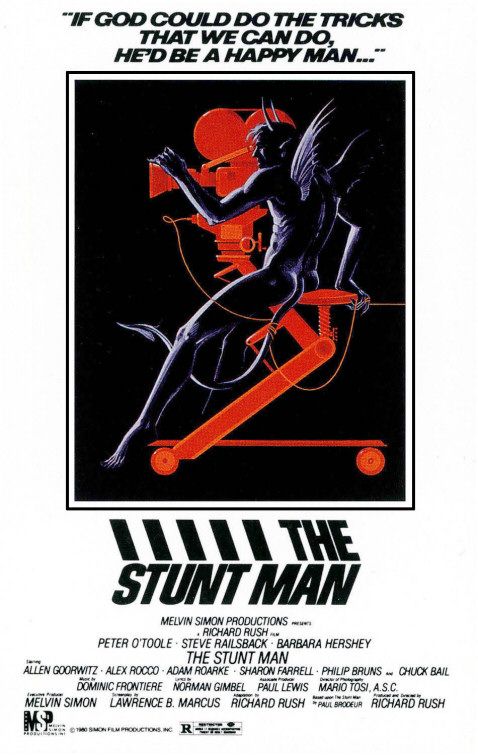
Cameron (Steve Railsback) is on the run from the cops who unknowingly comes onto a movie set and inadvertently causes the death of one of the stuntmen. Eli Cross (Peter O’Toole) the film’s God-like director takes a liking to Cameron and decides to hire him on as the replacement stuntman. Cameron is initially reluctant as he has no experience, but decides it would make a good cover from the police who are still after him. He starts an affair with the film’s leading lady Nina (Barbara Hershey), but finds that it may be Cross that he should be the most afraid of and who may be planning to film Cameron’s death during a difficult underwater stunt in order to add realism.

This is another one of those film-within-a-film type movies with this one faring a bit better than the others. One of the best ingredients it has is showing the behind-the-scenes politics that go on during any film production as well as hitting-the-nail-on-the-head with its caricatures.

Railsback is fun in a rare leading role. The way he can get intense as well as convey the rugged, ragged personality of a war-weary veteran on the run and just trying to survive is completely on-target. His best moments are simply his frightened and confused facial expressions that he has while going through many of Eli’s elaborate stunt routines and not sure if he will be coming out of it alive or not.

O’Toole is in peak form and was nominated for the Academy Award playing an egotistical director, which he modeled after David Lean. Having a director make a film advocating the horrors of war and violence, but then beat-up or threaten numerous crew members any time they make a mistake is perfect irony. My favorite moment of his is when they are showing rushes of Nina’s scenes from that day to her parents and then to their shock he throws in a few scenes showing Nina naked and in bed with another man. Then the next day he informs Nina about it simply to upset her and get the needed reaction that he wanted for the scene.

Hershey is splendid as a Hollywood actress who at times is quite jaded while at other moments is very naïve, child-like and emotionally fragile. Allen Garfield as the film’s exasperated and beleaguered screenwriter is also quite good. I also liked Chuck Bail who essentially plays himself as a stunt coordinator who tries to teach Cameron the fundamentals of the business.

Dominic Frontiere’s booming orchestral score is quite distinctive and at times even stirring particularly during the chase sequence. There is an abundance of ironies and twists that keep things interesting throughout and at points a bit surreal, but it’s missing that one final delicious twist or payoff and has an ending that seems a bit like a copout.

My Rating: 7 out of 10

Released: June 27, 1980

Runtime: 2Hours 11Minutes

Rated R

Director: Richard Rush

Studio: 20th Century Fox

Available: VHS, DVD, Blu-ray, Amazon Instant Video
Rollover (1981)

rollover 1

By Richard Winters

My Rating: 3 out of 10

4-Word Review: What’s in account 21214?

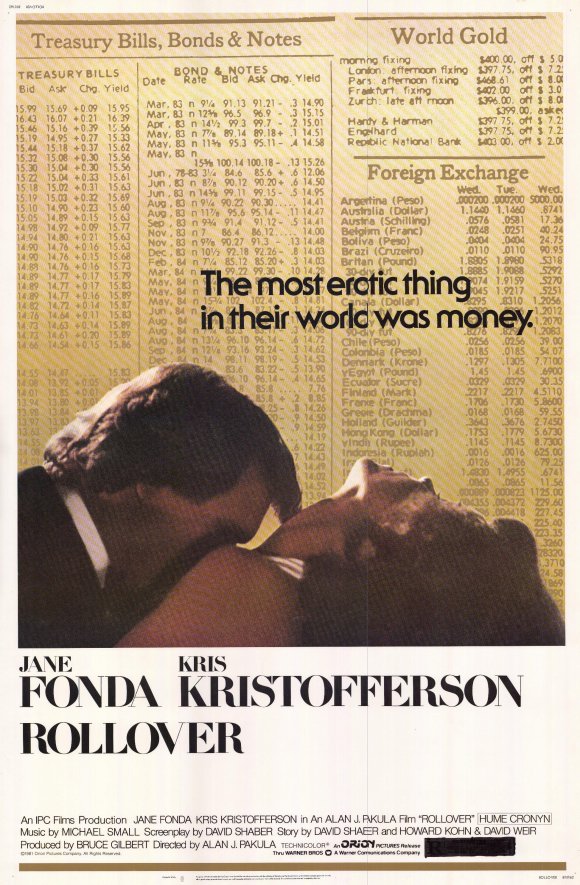
Hubbell Smith (Kris Kristofferson) is the newly appointed president of Borough National a bank that is in desperate need of money. He meets Lee Winters (Jane Fonda) the recent widow of the former chairman of Winterchem Enterprises who is looking to obtain a loan in order to purchase a Spanish processing plant. Hubbell broker’s the $500 million deal with some Arab investors and uses the finder’s fee portion to keep his bank solvent, but suspicions are raised when the money goes into a secret account named 21214 that no one knows anything about and can’t access. When Hubbell does some investigating he finds troubling answers that could lead to economic world collapse.

Director Alan J. Pakula approaches this thing like it is another Klute using not only the same star as that one, but similar type of music. Some of the camera work is dazzling and artsy, but I wondered if this was done to help enhance the script, or simply camouflage all of its holes. The story itself is too talky with a heavy reliance of financial business dealings that could become confusing for the average viewer. The two main characters are rather generic and their passionate making-out is tedious instead of sexy. The action is minimal, which includes a scene where Fonda gets trapped in a limo that is driven by a bad guy that had the potential for being exciting, but unfortunately gets underplayed.

Kristofferson with his Texas drawl is an awfully odd casting choice for a hot shot Wall Street businessman. He grows on you as the movie progresses particularly with the way he remains cool and detached even as his business dealings go horribly awry, but I still felt there were a hundred other actors that would have been better suited for the role.

Fonda is excellent and in many ways badly outplays her costar. Her character though doesn’t make a lot of sense as she is supposedly this famous and highly respected actress, much like Fonda herself and yet wants to be chairwoman of this chemical company instead of just selling her share of the stock after the death of husband and go back to acting, which to me would seem a lot more fun.

In an effort to keep the plot moving the film takes a few liberties with the plausibility. One of the major ones is when Hubbell wants to find out about the secret account and does so by breaking into the office of his superior where he finds in his desk drawer a notebook that lists the computer passcode, which seemed too convenient. In reality I would think a programmer would have to be hired in order to hack the system, which would have taken longer to play out, but also if done right heighten the tension as well as the believability.

Spoiler Warning!!

The film’s biggest transgression is the ending itself, which has the Arabs pulling the money out of the secret fund, which causes mass worldwide economic turmoil and chaos. Not only does this seem to create a whole new movie, but it also minimizes the two main characters and everything that we watched them do for the past two hours. A much better ending would have had the characters come up with some way to avert the collapse instead of the gloomy pessimistic way that it does take, which seems overblown and hard to believe.

End of Spoiler Warning!

My Rating: 3 out of 10

Released: December 11, 1981

Runtime: 1Hour 56Minutes

Rated R

Director: Alan J. Pakula

Studio: Warner Brothers

Available: VHS, DVD, YouTube, Amazon Instant Video

Runaway, Runaway (1971)

runaway runaway 1

By Richard Winters

My Rating: 4 out of 10

4-Word Review: Teen girl runs away.

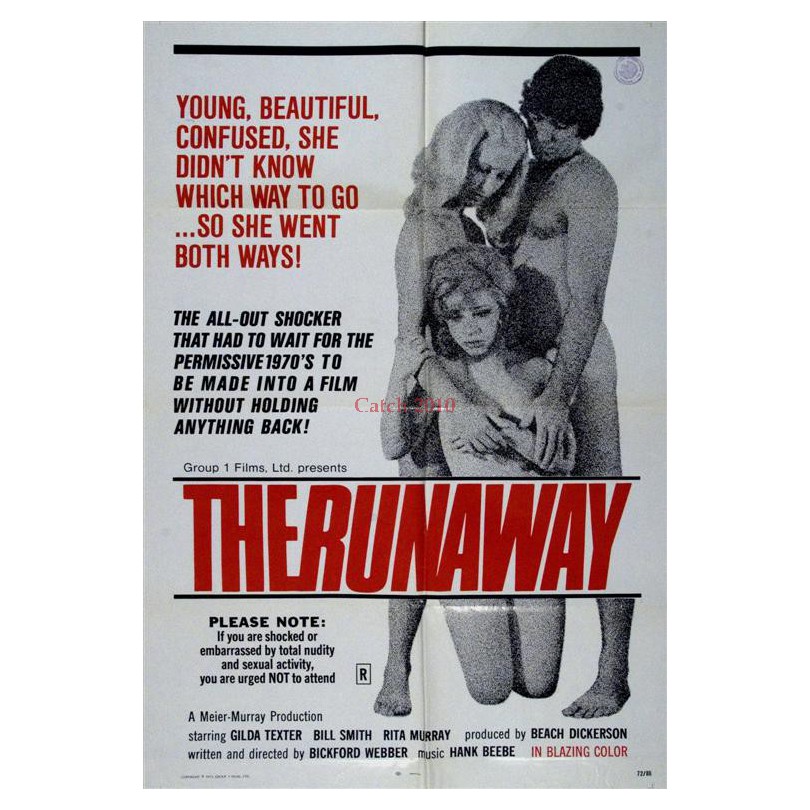
Ricki (Gilda Texter) is a teen girl who has had enough of her unhappy home life and decides to run away and meet up with a guy in California who she has strong feelings for but knows little about. Along the way she takes a ride from Frank (William Smith) whose job is finding young runaways and returning them to their parents. He tries to help Ricki, but she rejects it even though they remain on friendly terms. She then meets up with Lorri (Rita Murray) who works as a prostitute, but is also a closet lesbian. She gives Ricki a place to stay and then makes sexual advances towards her. Although Ricki at first resists she eventually gives in, but remains conflicted about her feelings towards Lorri and unhappy with her situation that seems no better for her than the one she ran away from.

Texter rose to fame after playing the nude blonde riding on a motorcycle in the film Vanishing Point. Her scene lasted for only a couple of minutes, but most male viewers came away remembering her part more than anything else and producers were quick to pick up on it. She was soon given a starring role here, which was hoped to jettison her into a full-time acting career, which never happened and eventually she settled down into the role of costume designer for films, which she did through 2006.

gilda texter 2

Either way she does quite well and shows more flair and ability than most young beauties that get acting jobs with only limited experience or training. She speaks her lines with a nice inflection and has some good facial expressions especially during the scene where she is attacked.

Smith who has made a career playing bulky tough guys is quite good in the sympathetic role as an older father figure. However, in these more cynical times his over concern for her welfare could seem more like a dirty old man with deep seated sexual desires. The fact that they do end up going to bed together seemed quite creepy and unnatural and I didn’t care for it and felt she would have been better off had she stayed with Lorri and formed a more lasting relationship with her.

Hank Beebe’s music score is distinctive and bucked the trend of the time by not having a psychedelic or rock sound, but instead it’s more on the jazz side. The bouncing vibrant song done over the opening credits is especially good and I would love to credit the lady who sings it, but none is given.

The opening sequence features a scene where Ricki gets attacked by a man at an isolated location of an abandoned dessert building that is played by Ron Gans, who later went on to be a famous voice-over narrator for movie trailers, and it is exciting. Another part that I found interesting is when Ricki goes to a party and gets drugged, which makes good use of the fish-eye camera lens, but overall this thing gets too talky and eventually becomes quite boring.

The Ricki character seems a bit too naïve as well. Most runaways I would presume would be practical enough to have some money in their pocket, but she has absolutely none. She barely knows this guy that she has ‘fallen in-love’ with and has no idea where he lives or even his phone number, but somehow expects to magically meet up with him anyways. She also makes no attempt to find a job once she gets to her new location even though that is the first thing most people, even movie characters will do in order to help them get back on their feet and give them some independence.

The story is derivative and predictable and gives us no new insight or slant into the runaway issue. The ending offers no real conclusion and despite some good attempts at realism and well-written dialogue the film is overall sterile and forgettable.

My Rating: 4 out of 10

Released: June 13, 1971

Runtime: 1Hour 30Minutes

Rated R

Director: Bickford Otis Webber

Studio: Meier-Mayer Productions

Available: None at this time

WUSA (1970)

wusa

By Richard Winters

My Rating: 1 out of 10

4-Word Review:  Liberal working for conservatives.

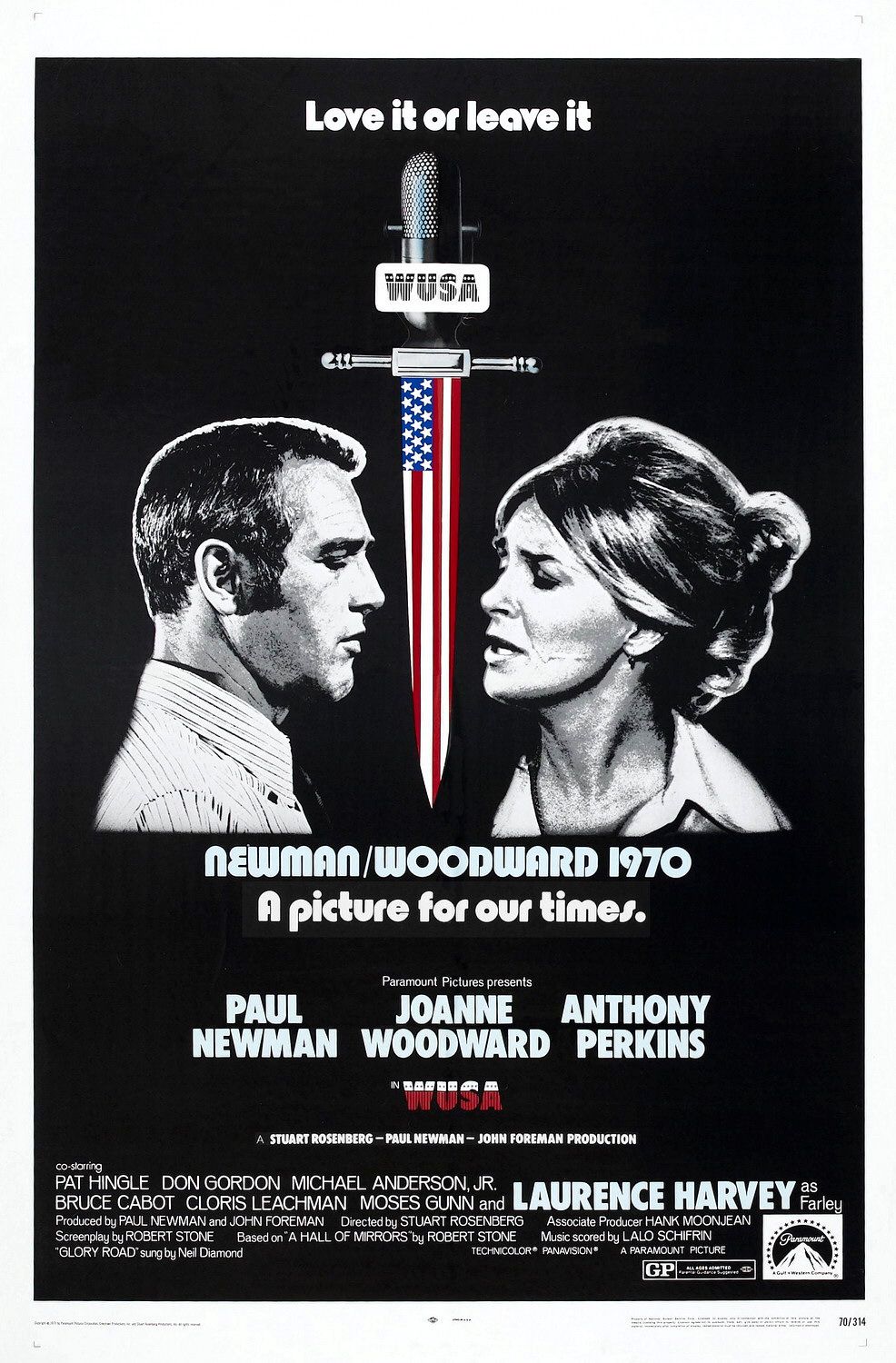
A drifter (Paul Newman) travels to Louisiana and gets a job as a DJ at an ultra-conservative radio station. Despite being a professed liberal he decides to go along with the right-wing rhetoric because he has grown apathetic with things and now just wants to ‘blend-in’.

The idea has a lot of potential, but it is never able to take off. Part of the problem is that instead of trying to play it like satire in the Network vein it instead approaches it with pinpoint seriousness and saturates the viewer with a gloom and doom message. The long and winding stream of social complexities makes the viewer, as with the main character, grow apathetic. The ‘powerful’ statements are redundant and too engulfed with the politics of its day to give anything that is broadly insightful.

It is easy to see why this is probably Newman’s most forgettable film. There is nothing unique or even slightly diverting about it and it meanders badly with no action whatsoever. The ‘exciting’ mob scene at the end looks staged and unconvincing.

The film has leanings as a character study, but even they are weak. Newman’s angry loner role is simply a less intense version of his Hud character. Joanne Woodward as the prostitute with a ‘heart of gold’ is clichéd and dull. Anthony Perkins is the only one that comes off as interesting, but it’s not enough to save it.

This is a truly limp and lifeless picture and I would be amazed if there was anyone out there who would like it.

My Rating: 1 out of 10

Released: August 19, 1970

Runtime: 1Hour 55Minutes

Rated PG

Director: Stuart Rosenberg

Studio: Paramount

Available: DVD, Blu-ray 

Your Three Minutes Are Up (1973)

your three minutes are up 2

By Richard Winters

My Rating: 6 out of 10

4-Word Review: Road trip goes bad.

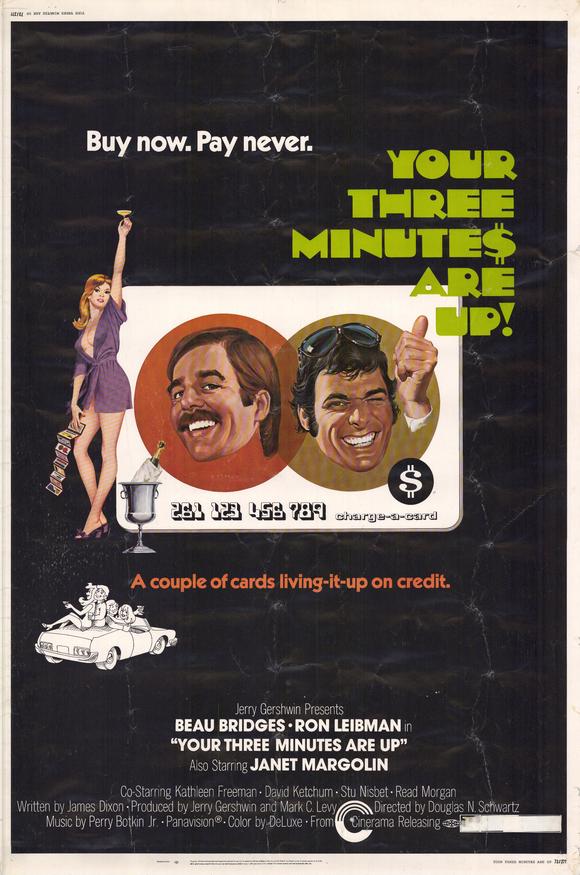
Charlie (Beau Bridges) is unhappy with his life. He is stuck in a dull job and engaged to Betty (Janet Margolin) who is constantly nagging him. He longs for a more carefree existence that is friend Mike (Ron Liebman) enjoys. Mike does not work a job and spends most of his time trying to cheat what he feels is a cold and impersonal system, but also has to deal with constant calls from bill collectors and the stress of trying to make ends meet with very little money. The two decide on a whim to take a little road trip, but during the course of their journey things begin to unravel as both men realize there are limits to everything and once you cross it you must pay the consequences.

The film like the characters spans the entire critical spectrum. The script, which was written by James Dixon who appears as the character Howard is incisive and taps into something every individual on the planet must deal with, which is learning how to balance individuals desires with societal demands. Other films have lightly touched on it, but few delve into it quite this deeply. I especially enjoyed the Charlie character who starts out as an obedient schmuck that gets ordered around by everyone, but also harbors a pent up anger that comes out slowly until it finally erupts into volcanic proportions that shocks even him.

Unfortunately the direction by Douglas Schwartz is dull and unimaginative. The budget was clearly low, which gives the movie a cheap TV-Movie look and feel. The framing and camera work is uninspired and could have used more close-ups, tighter editing and better lighting. The film also contains four generic sounding songs all sung by Mark Lindsey the former lead singer from Paul Revere and the Raiders that lack distinction and give the movie a dated quality.

I also didn’t care for the Margolin character. She is a beautiful woman physically, but the character is too much of a one-dimensional nag. Why she would continue to call Charlie and beg him to come back when he clearly lied to her while also openly telling her that she annoyed him didn’t make much sense. The scene where she walks in on him in bed with two naked women and instead of just ending the relationship immediately she stays and tries to ‘reason’ with him, which came off as pathetic and unrealistic.

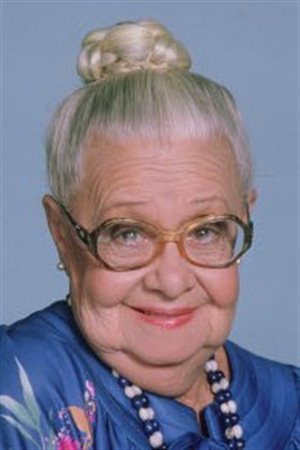
This also marks the film debut of Nedra Volz a late bloomer into acting who at age 65 started a two decade career playing old lady roles in various TV-shows and movies. She can be briefly spotted at the 31-minute mark playing an old lady sitting on a bench at a bus stop and accepting a free newspaper only to become shocked and embarrassed at its provocative headline.

nedra volz

June Fairchild who appears as a woman who stuffs her face with food at a fancy restaurant thinking that she is being treated to dinner only to end up getting stiffed with the bill ironically had her real-life paralleling the lead character’s quandary in the movie. She was in a string of films during the 70’s, but when the offers dried up she became a homeless alcoholic living on skid row and the subject of a February, 2001 article in The Los Angeles Times. Friends came to her rescue and she managed to get back on her feet and now judging by some recent pics is looking happy and still quite attractive.

june fairchild 1

My Rating: 6 out of 10

Released: August 7, 1973

Runtime: 1Hour 27Minutes

Rated R

Director: Douglas N. Schwartz

Studio: Cinerama Releasing Corporation

Available: YouTube

Road Movie (1974)

road movie 3

By Richard Winters

My Rating: 8 out of 10

4-Word Review: Trucker and prostitute clash.

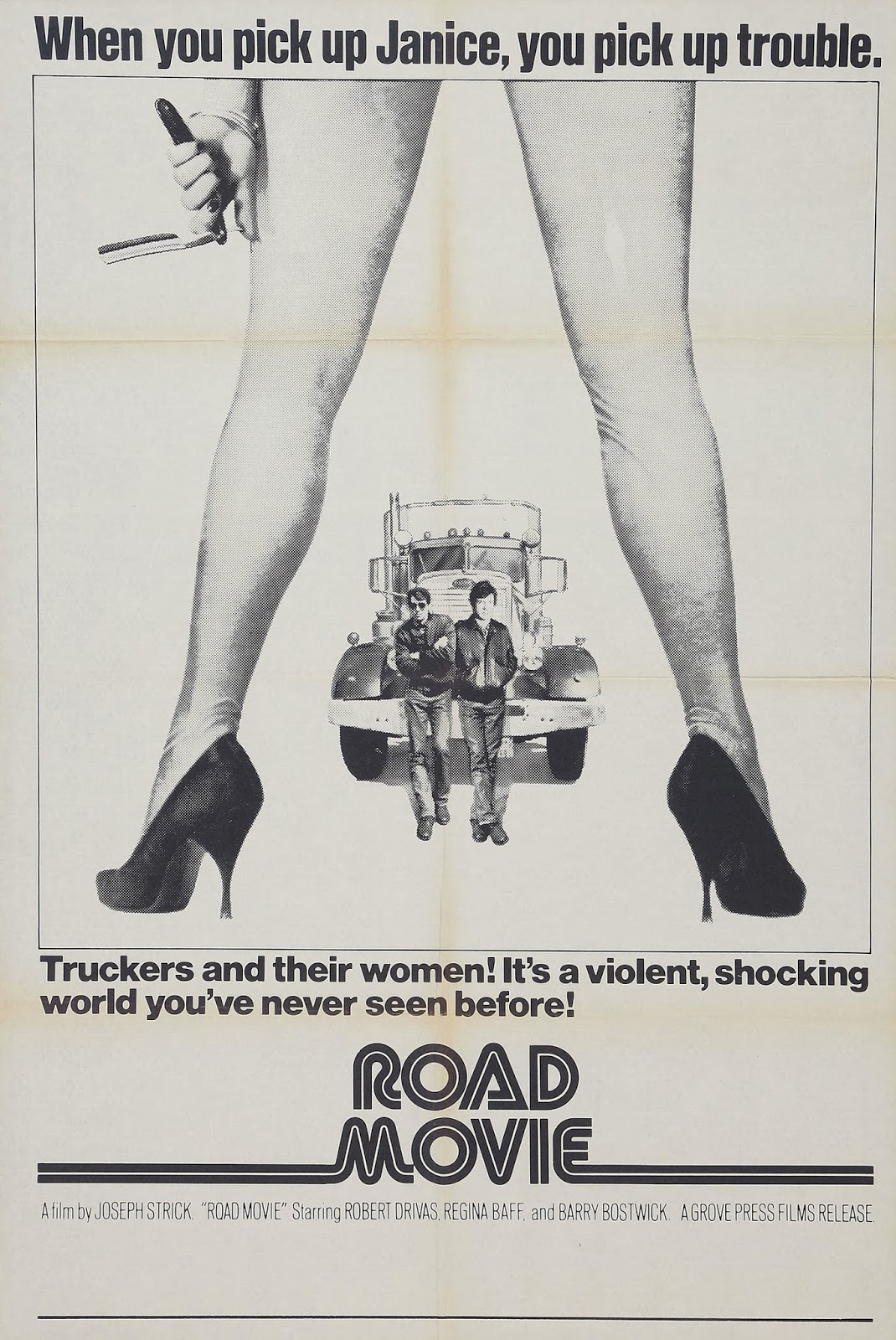
This is a captivating and interesting independent drama filmed on a shoestring budget and loosely based on director Joseph Strick’s own experiences while working one summer as a long haul driver. The story centers on Gil (Robert Drivas) and Hank (Barry Bostwick) a two-man truck driving team that pick up a prostitute named Janice (Regina Baff) who brings out unforeseen tensions and emotions.

The film is compact with characters and situations that are distinct and believable. It also gives the viewer a well-rounded look at the truck driving business and the tough, demanding job that it is.

Baff is convincing as a prostitute who isn’t pretty or educated, but sensible and street smart At times you feel sorry for her, but she proves to be quite a manipulative and shrewd when she has to.

Drivas, as the lead driver, is hardened, caustic, and controlling. He abuses the prostitute the way he feels life has abused him and thinks he can get away with it only to have her constantly outsmart him.

Unlike other road movies the scenery shown along their travels is neither exotic nor beautiful. Instead we are treated to farm fields, factories, and small towns. It’s all the sights and sounds of a working class world as this is really more about the deceptive American dream than anything else. It craftily brings out what an elusive ideal that really is and how no one is ever as independent as they would like to be and ‘moving up’ in the world can be much more difficult than at first perceived.

Strick takes full advantage of his low budget limitations by infusing a type of grittiness that Hollywood rarely touches. The interactions between the characters are interesting and the ending leaves a strong impression. For fans of obscure 70’s movies this one is worth seeking out.

road movie 2

My Rating: 8 out of 10

Released: February 3, 1974

Runtime: 1Hour 28Minutes

Rated R

Director: Joseph Strick

Studio: Laser Film Corporation

Available: DVD, Amazon Instant Video

The Runner Stumbles (1979)

the runner stumbles 1

By Richard Winters

My Rating: 2 out of 10

4-Word Review: Priest accused of murder.

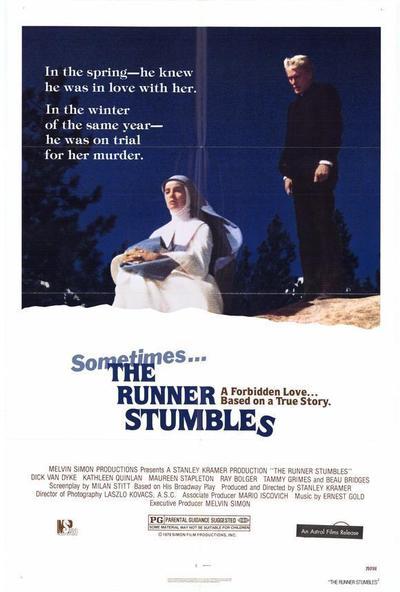
Based on actual events the setting is 1911 in a northern Michigan town where Father Brian Rivard (Dick Van Dyke) presides over a small Catholic parish. He feels frustrated at being stuck in such a depressed town where many of the residents are out of work. In comes Sister Rita (Kathleen Quinlan) to help run the school and the Father immediately takes a liking to her youthful enthusiasm and fresh ideas, but gossip and rumors soon abound when it is found that they are spending too much time together and possibly becoming intimate. When the Sister is found murdered it is the Father who is accused and must fight for his life while straddled with an attorney (Beau Bridges) who seems glib and detached.

One of the biggest problems with the film is the miscasting of Van Dyke in the lead. His performance is stiff, wooden and affected. The chemistry between the two stars is non-existent making the romantic angle seem completely unbelievable. The film would have been better served had a younger man that was more Quinlan’s age and trained in method acting been cast in the part.

Quinlan is excellent in her role, but her efforts become lost as they bounce off Van Dyke’s almost corpse-like presence. Maureen Stapleton adds some excellent support and it’s great to see Ray Bolger in his final film role as the intrusive Monsignor. Bridges is also great as the lawyer and the one thing that livens the film up a little. Had his court scenes been more extended it would have helped the picture immensely.

Director Stanley Kramer, whose last film this was, seems to have lost touch with the modern movie goer. The presentation is stagy and the overly melodic soundtrack does not fit the mood and gets overplayed almost like a radio going on in the background that somebody forgot to turn off. The conversations revolving around the predictably stifling atmosphere of the era add little interest and go on too long as do the debates between giving in to human desires versus religious commitments. The surprise ending hardly makes up for a film that is slow and boring and ultimately making it as stale and stagnant as the small town it tries to portray.

My Rating: 2 out of 10

Released: November 16, 1979

Runtime: 1Hour 49Minutes

Rated PG

Director: Stanley Kramer

Studio: 20th Century Fox

Available: VHS

The People Next Door (1970)

the people next door 1

By Richard Winters

My Rating: 7 out of 10

4-Word Review: Daughter is on drugs.

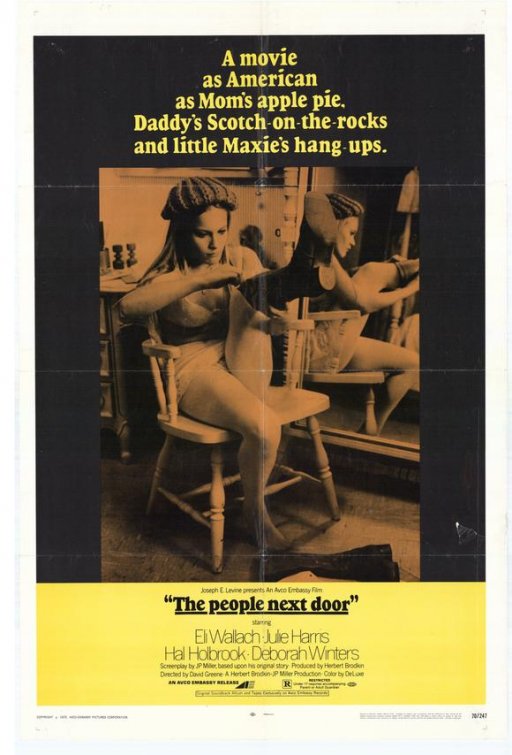
Arthur and Gerrie Mason (Eli Wallach, Julie Harris) are a middle-aged couple living the comfortable suburban existence, which comes tumbling apart in a matter of only a few short weeks. It starts when their daughter Maxie (Deborah Winters) dabbles in acid and is sent to a mental institution. Acrimony and in-fighting commence and even with family counseling nothing helps. As both Maxie’s and Gerrie’s mental condition deteriorates it seems like their family unit is doomed while their neighbors David and Tina Hoffman (Hal Holbrook, Cloris Leachman) have issues of their own including the shock at finding out that their son Sandy (Don Scardino) is a drug dealer and was the one that gave Maxie the acid that sent things spiraling out-of-control.

There were many movies about the drug culture made during the 60’s and 70’s and many of them weren’t very good, but this one I have always liked. It is not that it doesn’t have its share of flaws like the others although not as many, but it is the performance by Winters (no relation) that knocks this to a whole new level.  Although only 17 at the time she exudes an amazing amount of composure and tackles some difficult scenes with ease and naturalism. Her blue eyes penetrate the screen, which director David Greene takes full advantage of especially during her acid trips, which get pretty freaky.

Two scenes of hers in particular really stand out and are worth catching. One is where she takes some acid and then strips off all of her clothes and goes running outside in the nude through the snow banks of their suburban neighborhood while singing and dancing to some strange song. Another is when she runs away from home and Wallach tracks her down living in squalor in a seedy, rundown apartment building with her boyfriend. When Wallach finds her she hops out of bed stark naked and walks over to him and plants him a deep kiss, which makes him violently slap her to the ground.

There are a few other interesting moments including one that takes place during a group counseling session where a young man of 20 named Wally (played by Matthew Cowles who later went on to marry actress Christine Baranski) berates in front of everyone his elderly parents who had him at a late age and he now finds them to be too old and embarrassing. The scene where David and Tina confront their son late at night about his drug dealing is also compelling.

The script by J.P. Miller has some emotionally high moments and hits on the issues of family strife head-on in a way that I felt is still impactful and relevant. Some critics argued that because Miller and director Greene were already 50 at the time that they were ‘out-of-touch’ with the youth generation, which to some extent may be valid, but the drama itself is strong and in the end that is what counts.

The only weak link is that of Wallach and Harris two very good actors who become wasted here. Both are locked in caricatures that are too broad and rigid and at times turn the thing into a heavy-handed soap opera. The correlation to the fact that while the daughter takes drugs they continue to smoke and drink becomes a bit too obvious and overplayed.

The story was originally made as a TV-movie that was broadcast on October 15, 1968 on CBS. Winters, Scardino as well as Nehemiah Persoff who plays the doctor at the institution play the same roles on that one that they do here. Lloyd Bridges and Kim Hunter played Winters’ parents and Fritz Weaver and Phyllis Newman were the Hoffman’s.

the people next door 2

My Rating: 7 out of 10

Released: August 26, 1970

Runtime: 1Hour 33Minutes

Rated R

Director: David Greene

Studio: AVCO Embassy Pictures

Available: None at this time.

Hotel (1967)

hotel 2

By Richard Winters

My Rating: 6 out of 10

4-Word Review: Drama at the hotel.

Warren Trent (Melvyn Douglas) has been the owner of a large, luxurious New Orleans hotel for years, but finds that his old fashioned business ideas no longer mesh with the modern consumer. The place is losing money and he turns to Peter (Rod Taylor) the hotel manager and loyal employee to help find a suitable buyer.  Curtis O’Keefe (Kevin McCarthy) wants to purchase the place, but his plans call for too many changes that Peter doesn’t like. However, Curtis’s beautiful girlfriend Jeanne (Catherine Spaak) takes an interest in Peter that makes Curtis uneasy. There is also the Duke of Lanbourne (Michael Rennie) staying as a guest with his wife Caroline (Merle Oberon) who inadvertently kills a child during a hit-and-run accident that the two try desperately to cover up. On top of this is Keycase (Karl Malden) a small-time crook who has made copies of all the room keys and uses them to break into the rooms of the guests and steal their money while they sleep.

I loved the locale, but the film fails to capitalize on it. We never see a bird’s eye view of the city despite numerous references to its distinct landmarks and although there are a few outdoor scenes done in its crowded neighborhoods there wasn’t enough of them and the viewer fails to take in the full unique flavor of the region. None of the characters have southern accents or characteristics and in a lot of ways the setting could just as easily have been downtown Manhattan.

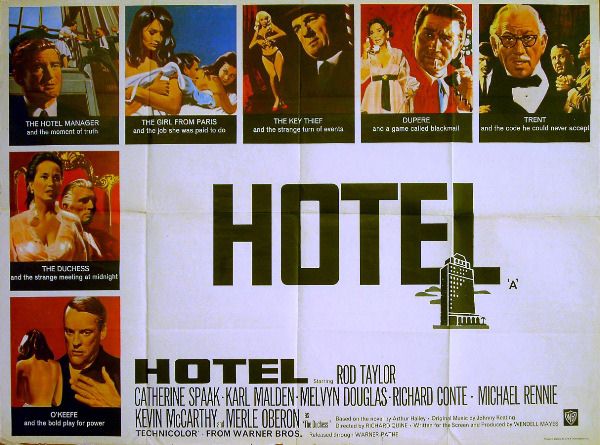
I was also disappointed that we never see an actual shot of the building. There are a few exterior shots of the entrance way, but nothing of the building as a whole despite a drawing of one on the movie poster, which then fails to give the viewer a complete sense of the hotel’s presumed immensity. The interior background has the expected gaudiness, but it is rather unimaginative and I actually felt the interior of Peter’s small, loft apartment was more visually creative and interesting.

Johnny Keating’s music score is yet another issue. It is distinctive and melodic at the beginning particularly over the opening credit sequence that features a colorful drawing of the hotel that I liked, but during the second half it becomes too jazzy, loud and obnoxious.

Catherine Spaak with her delicate beauty is a major asset. Not only is she drop-dead gorgeous, but she can act as well. McCarthy gets a good latter career role as the spiritual, but crafty businessman who will stop at almost nothing to get his way. It is also great to see Merle Oberon in her second-to-last film as the perpetually conniving Duchess.

Based on the Arthur Hailey novel it is inevitable to compare this to the classic Grand Hotel, which was far superior. However, the drama is intriguing enough to keep it interesting on a passive level. The scene involving a jammed elevator and the desperate attempts to save the occupants is exciting and well photographed and worth catching simply for that.

My Rating: 6 out of 10

Released: January 19, 1967

Runtime: 2Hours 4Minutes

Not Rated

Director: Richard Quine

Studio: Warner Brothers

Available: VHS, DVD (Warner Archive)

The V.I.P.s (1963)

the vips2

By Richard Winters

My Rating: 3 out of 10

4-Word Review: Drama at the airport.

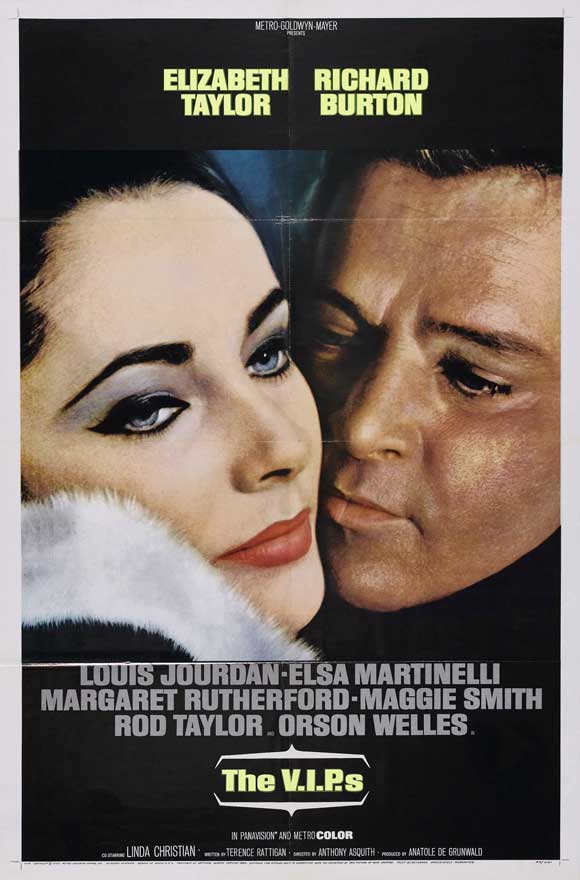
Several diverse characters come together at London’s Heathrow Airport. All have urgent needs that require them to board a certain flight that they hope will take off as soon as possible. Frances (Elizabeth Taylor) is the wife of rich tycoon Paul (Richard Burton) and is secretly having an affair with gambler/playboy Marc (Louis Jourdan). She has left him a ‘dear John’ letter at home and hopes to be well on her way to New York before he reads it. Les (Rod Taylor) is a businessman who also hopes to get to the Big Apple quickly to avoid the hostile takeover of his company. Max (Orson Welles) is a famous movie director traveling with his vapid starlet Gloria (Elsa Martinelli) and hoping to leave England before he is forced to pay an enormous tax penalty. Unfortunately for them a fog rolls in, which delays the flight and sends everyone’s plans into disarray.

The drama has some potential at the beginning, but the 2-hour runtime is much too long for this type of material. Whatever compelling elements the threads may have had when it started become lodged in endless talk and boredom. The scene where Burton smashes Liz’s hand against a mirror is the only time there is any action and Terence Rattigan’s soap opera script is too clichéd. Director Anthony Asquith’s direction shows no visual flair and fails to capture the airport in any type of interesting way. The background sets look like they were built on a soundstage and the fog effects are quite tacky.

Margaret Rutherford won the supporting Oscar for her portrayal of an aging Duchess. She adds some much needed humor particularly in the segment where she has difficulty getting her hat box into the plane’s luggage compartment. However, like with the story thread concerning the Orson Welles character she is seen to briefly and their scenes are spread so far apart that you almost forget all about them.

Spoiler Warning!

There is also another segment where a complete stranger played by actress Maggie Smith approaches the Burton character and asks him for a hundred and fifty three thousand pounds and he gives it to her in the form of a blank check, which had me floored. Men like him don’t become rich by handing out a lot of money to anyone who asks especially people they don’t know. Some may argue that because the character was considering suicide that he didn’t care anymore, but it still seemed too much of a stretch and for me sent this already stale drama into the realm of the absurd and ridiculous.

End of Spoiler Warning

Every story thread gets a nice, convenient happy ending that gives the whole thing a TV-sitcom quality and barely worth the effort to sit through. The production has some glossy aspects and certainly big-name stars, but ends up being a buildup to nothing.

the vips1

My Rating: 3 out of 10

Released: September 19, 1963

Runtime: 1Hour 59Minutes

Not Rated

Director: Anthony Asquith

Studio: MGM

Available: DVD, Amazon Instant Video