Category Archives: Drama

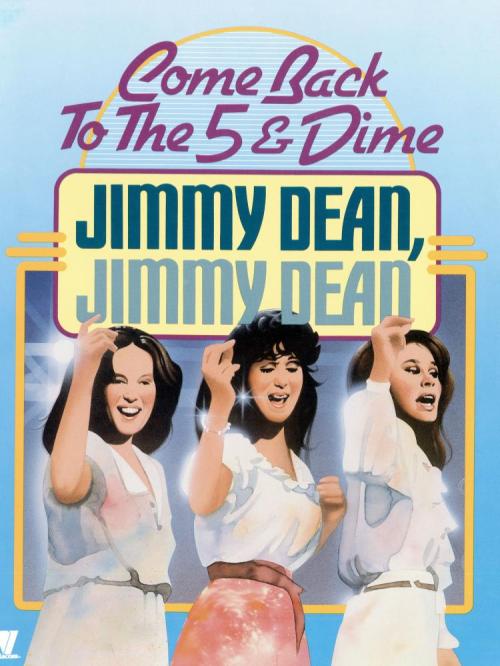
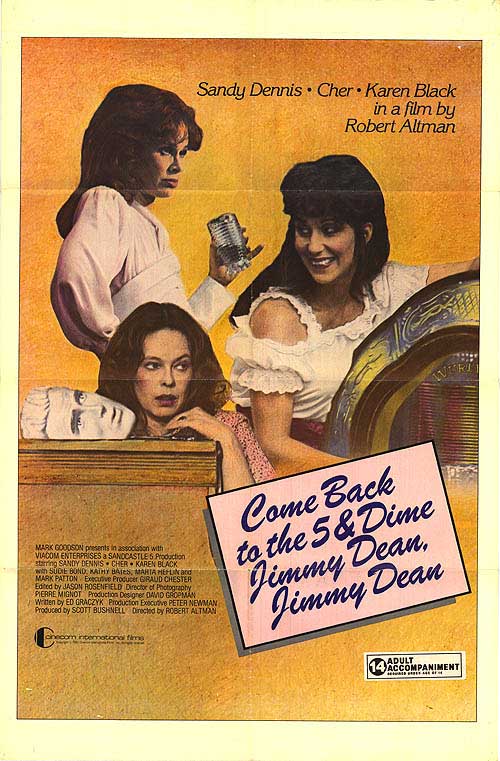
Come Back to the 5 & Dime Jimmy Dean, Jimmy Dean (1982)

COME BACK TO THE FIVE & DIME, JIMMY DEAN, JIMMY DEAN, Sandy Dennis, Cher, Karen Black, 1982, (c) Cinecom Pictures

COME BACK TO THE FIVE & DIME, JIMMY DEAN, JIMMY DEAN, Sandy Dennis, Cher, Karen Black, 1982, (c) Cinecom Pictures

By Richard Winters

My Rating: 3 out of 10

4-Word Review: Disciples of James Dean.

Twenty years after his untimely death five women (Cher, Sandy Dennis, Karen Black, Kathy Bates, Marta Heflin), who were big fans of James Dean and called themselves his disciples, decide to hold a reunion at a thrift shop in a small town not far from Marfa, Texas where the film Giant was made. However, the reunion is not a happy one as old wounds and secrets come to light that forces the women to analyze themselves and their lives in uncomfortable and unpleasant ways.

One of the things that really annoyed me about this movie and at times just downright confused me is that the characters show no signs of aging at all as it shifts between 1955 and the present day of 1975. Twenty years is a significant period of time and most everyone will show some signs of age, or at least changes to their hairstyle and outfits and yet with the exception of the Joe character there is no distinguishable differences between the others from one period to the next. The Cher character was particularly perplexing as her hair remains jet black for two decades and even the same exact style. One could argue that maybe she dyed it, okay, but she also manages to somehow retain her same girlish figure, which is even less likely.

I also found it hard to believe that she could afford to make a living by working at little thrift store for 20 years, or that she would even be needed as the place was small enough for one person to run and through the course of the entire movie never once does a single customer even enter the place. Her character was attractive enough to find a man, get married and run off to another town or place that had more potential. We learn through the course of the movie that she was married at one point, but then dumped, however I would think she would’ve been able to find someone else in a 20 year time span especially since she was still quite good looking.

Keeping all of the action inside the thrift store makes the film seem almost claustrophobic. I realize this was based on a stage play, but most plays that get transferred to film will have certain scenes, or cutaways added in to avoid this feeling. Even having some outdoor shots done over the opening credits would’ve given it a little more of a visual variety.

The performances are the best thing about the movie and probably the only reason to see it. All three leads recreate their parts from the stage version. Cher is sensational and in my opinion gives the best performance. Dennis is solid doing her patented fragile caricature and who displays some interesting emotional eruptions at completely unexpected times. Black is excellent as well. Usually she plays flaky types, but here is more reserved and steely. Bates is good as a loud and abrasive woman and Sudie Bond lends fine support as the shop’s overtly religious owner.

The script is passable, but the revelations that come out are stuff you’d find on a second-rate soap opera. I also found it hard to believe that these women would get together after 20 years and not have other things to talk about. Usually when people meet after not seeing each other for an extended period of time there’s always a lot of ‘catching up’ to do where they talk about all the things that have happened to them since, but here there’s none of that. Instead they come off like people frozen in time clinging to bygone issues that just about anyone else would’ve moved on from long ago.

The film ends with several shots of the store shown in an abandoned and rundown state, but with no explanation of what time period it was taken in. At first I thought this meant that maybe the reunion had never occurred. That maybe it had just been imagined, which is a concept that I liked and would also have filled in some of the gaping plot holes that I’ve described above, but then I saw the reunion banner still hanging in a tattered state from the ceiling. Others on IMDb have debated that it may represent the reunion that they had planned for 1995 that never came about, which is a good guess, but with business being as slow as it  was at that place I think it would’ve been abandoned long before 1975 let alone 1995.
come back 1

My Rating: 3 out of 10

Released: November 12, 1982

Runtime: 1Hour 50Minutes

Rated PG

Director: Robert Altman

Studio: Cinecom Pictures

Available: DVD

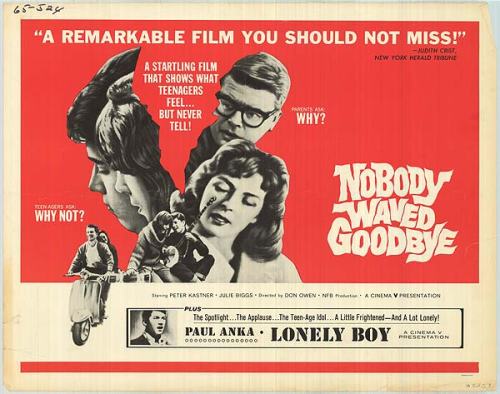
Nobody Waved Goodbye (1964)

nobody waved goodbye 1

By Richard Winters

My Rating: 8 out of 10

4-Word Review: Teen learns hard lesson.

Peter (Peter Kastner) is 18 and looking to spread-his-wings, but doesn’t like what he sees in the adult world. Everyone seems trapped by their dull jobs and mundane routines, which is something he doesn’t want to fall into. He has big dreams. He wants to run away with his girlfriend Julie (Julie Biggs) and live a life based completely on his own whims while never becoming a slave-to-the-system like everyone else. Then he gets in a fight with his parents and they kick him out and after struggling to find work without even a high school diploma his attitude quickly changes.

If you can get past the wretched opening song, which is sung by Kastner and played over the credits, then this film really hits-the-mark. I was impressed with the camera work especially during the dinner time conversations amongst the family members where director Don Owen shoots it with a hand-held camera and zooms in and out on the person’s face as they are speaking. This is something that is quite common today especially on TV-shows, but back then was rarely if ever used, which makes this well ahead-of-its-time and even groundbreaking. I also enjoyed the conversational quality of the dialogue and having two conversations going on at the same time, which again didn’t come into vogue until years later when Robert Altman did it in M*A*S*H.

The film also clearly allows for ad-libbing amongst its actors. There is a scene in which Peter and Julie go paddle boating and come upon a large sofa submerged in the water and then comment on it. Clearly the filmmakers didn’t put the sofa into the lake simply to film the short scene that has nothing to do with the rest of the story, but it still helps set the tone for keeping things fresh and real.

Kastner is great and it’s refreshing to have a protagonist in a film that you like at some points and feel like wringing-his-neck at other times. Too many movies today, especially Hollywood ones, create lead characters that are politically correct caricatures while this movie instead has real human beings that are not tailored made to conform to the likings of any particular demographic.

It’s a shame to say that a movie that came out over 50 years ago is still considered cutting-edge, but compared to the tired, formulaic glop coming out today it really is. The script is uncompromised and holds-no-punches while keeping things gritty and stark and making profound, universal points along the way. I also found it fun that the main character here, who was clearly a baby boomer, displays the same anti-establishment, anti-work attitude that now gets placed squarely onto the ‘dreaded millennials’ and yet it seems the boomers were just as reluctant to get into the rat race as all the generations that have followed them and therefore shouldn’t be waiving their finger at anyone.

nobody waved goodbye 2

My Rating: 8 out of 10

Released: August 13, 1964

Runtime: 1Hour 20Minutes

Not Rated

Director: Don Owen

Studio: National Film Board of Canada

Available: None at this time.

The Honkers (1972)

honkers 3

By Richard Winters

My Rating: 5 out of 10

4-Word Review: Rodeo star is selfish.

Lew Lathrop (James Coburn) is an aging rodeo star who returns to his hometown after an extended absence, which stirs up resentment and trouble wherever he goes. His wife Linda (Lois Nettleton) still has feelings for him despite her anger at him leaving her and never being able to stay faithful. It seems that the only true friend that he has and one that remains loyal to him even through his many shortcomings is rodeo clown Clete (Slim Pickens), but even this gets put to the test when Lew decides to jeopardize is family life once again when he decides to go after local hottie Deborah (Anne Archer) a young woman just past the age of consent who enjoys flirting with older men and shows no reluctance in having her way with them.

The film was directed by actor Steve Ihnat who never saw the final product put on the big screen as he died from a sudden heart attack at the young age of 37 five days before the film’s release. Much like with Junior Bonner and JW Coop, which came out at the same time, this has an authentic feel with the necessary level of grittiness and good rodeo footage,  but the scenes go on too long and the pace is too laid back. One shot has Coburn walking down the city sidewalk for a full several minutes with nothing else happening. Extended shots of a downtown parade and broncos bucking off cowboys in the rodeo ring are all nice, but fail to propel the plot, which seems pretty thin anyways and almost makes this come off like a documentary than a feature film.

Coburn is his usual engaging self, but seems genuinely uncomfortable getting on the broncos and even a bit out-of-place in the role. Pickens is outstanding in support it what may be the best film role of his career. Usually, especially with his country accent, he would get subjugated to hillbilly parts, but here he gets to show his dramatic side by playing a rodeo clown, which is what he did for many years in real-life before becoming an actor. Archer, in only her second film role is quite seductive and possibly at her most beautiful though the many shots showing her wearing headbands start to make her resemble Pocahontas.

Filmed entirely on-location in Carlsbad, New Mexico director Ihnat manages to take full advantage of the rustic western landscape and brilliant blue sky of the region, which is a major plus. The ending has a nice surreal quality and the story does manage to pick up a bit during the second half, but it still could’ve been better trimmed and more compact.

My Rating: 5 out of 10

Released: May 17, 1972

Runtime: 1Hour 42Minutes

Rated PG

Director: Steve Ihnat

Studio: United Artists

Available: None at this time.

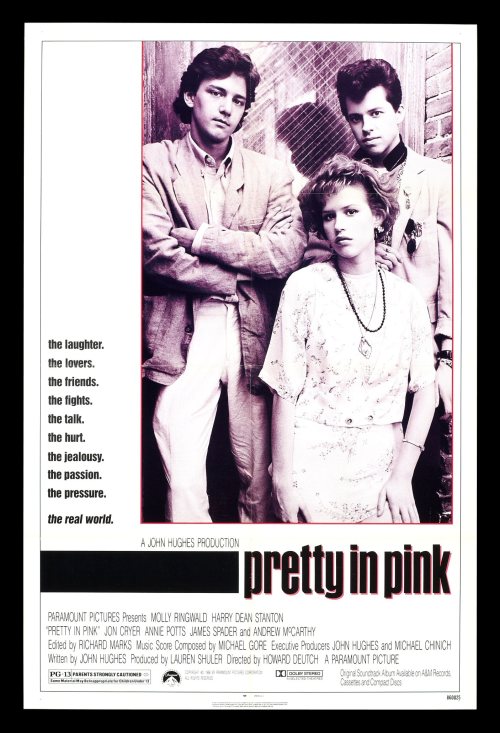
Pretty in Pink (1986)

pretty in pink

By Richard Winters

My Rating: 5 out of 10

4-Word Review: Poor girl dates preppy.

Andie (Molly Ringwald) is a teen girl from the poor side of town who one day while working at a record store meets Blaine (Andrew McCarthy) a rich, handsome, preppy kid that she immediately takes an interest in. A few days later he asks her out much to the dismay of her geeky friend Duckie (Jon Cryer) who has a secret crush on her. Blaine’s friend Steff (James Spader) is also angered about it because he had asked Andie out earlier and been rejected and these two factors cause a strain on their relationship and forces both of them to consider ending it.

One of the problems that I had right away with the film is the fact that with the exception of Ringwald, the majority of the cast who are playing these so-called teenagers were in reality way past adolescence and looking too mature. Kate Vernon, who plays a snotty girl named Benny, actually looks older than her female instructors. McCarthy and Cryer were also in their 20’s and manage to pull it off, but Spader who was 25 at the time doesn’t. He gives a great performance nonetheless, but I kept wondering with so many star struck teens out there dying to get into the business that the producers couldn’t have gotten performers that were more at the actual age of the characters.

Ringwald is fantastic in a vehicle tailored made for her and one that she really cruises with. I particularly liked her facial expressions while she attended a frat party and the moment where she decides to go to the prom despite not having a date simply to show them that they can’t ‘break her’ is fantastic. However, I wasn’t so crazy about the inferred idea that she was dating Blaine simply because he was from a rich family and could help her escape from her otherwise poor/ humble surroundings as it toys with the concept of ‘marrying-into-wealth’ which is too old fashioned. A young lady today should feel that she can work her way up the social/economic ladder on her own and not be dependent on some guy to do it for her.

I had equally mixed feelings involving Duckie. Cryer certainly gives an engaging performance, but the character’s excessive and constant need for attention-seeking humor gets overdone and I wished it had been toned down and the character made to be a little less geeky. The part where he has an instant meltdown when he finds out that Andie is dating someone else is also too extreme as it makes him seem dangerously possessive especially since he and Andie were just friends. Later when he is rude to Blaine at a nightclub only helps to make him look even more emotionally unstable.

I had this same issue with Steff who gets aggressively angry at Blaine for dating Andie and even threatens to end their friendship because of it, which to me was a complete overreaction. Sure he might be upset about it, but in real-life I think he would’ve expressed his displeasure in more subtle ways,or even just gotten over it since he was apparently sleeping with Benny who was a lot hotter looking than Ringwald anyways. In reality people generally want to hide their hurt feelings and not respond so overtly when things don’t go their way because they are usually smart enough to realize it will just make them look like a sore loser otherwise.

The Blaine character has problems too although different from the other two. The first issue is when he is at the record store and hands Andie an album cover showing Steve Lawrence, a famous crooner from the early ‘60s and frequent guest star on the old ‘Carol Burnet Show’ and asks Andie if he’s ‘hot’ or ‘trendy’. Now, I was teenager myself during the ‘80s and was in no way ever affiliated with the ‘hip crowd’, but even I and my nerdy friends where savvy enough to know that Steve Lawrence would never be considered an idol with ‘80s teens nor humiliate ourselves by asking anyone if he was. The fact that he does ask makes him seem almost mentally ill or someone who’d been living in a cave, which would be enough for most young women not to want to date him because they would think he was ‘weird’ or strangely disconnected.

The scene that takes place in the school’s library where he sends her a message via the school’s compute and even somehow manages to upload a picture of her is also dumb. Remember this was BEFORE the internet and sending emails and communications via a computer weren’t common or likely especially when they weren’t even their own, but public ones instead. In a later conversation this gets described as a ‘computer trick’ that he knows, which I guess suffices as being screenwriter John Hughes’ feeble attempt at ‘explaining it’.

In a lot ways this seems like just a basic reworking of the formula that was already used with much better success in Sixteen Candles with Cryer playing an off-shoot of Anthony Michael Hall’s character and Harry Dean Stanton as Ringwald’s sensitive father substituting for the one played by Paul Dooley in the first film. I was also disappointed that we never even briefly get to see Andi’s mother who was divorced from her father but gets discussed quite a bit and there’s even a picture of her sitting on Andie’s bedside table, which to me should’ve been enough to justify some sort of appearance by her at some point.

I liked the scene, at least on an emotional level, where Duckie physically attacks Steff after he makes a disparaging remark about Andie, but on the logical end it’s off-kilter. For one thing Andie wasn’t aware of the remark and for Duckie to take on some guy who was clearly much bigger than him it would’ve made more sense for her to have heard it and been hurt by it in order for him to come so aggressively to her defense. A later scene that takes place at the prom where a super-hot girl turns around and out-of-nowhere shows an immediate interest in Duckie who’s just standing there seemed too dream-like and fanciful.

I never saw this film when it first came out and only reviewed it now at the suggestion of some female friends in order to commemorate the 30th anniversary of its release and I have to be honest I was expecting something a lot better especially since it has attained such a strong cult following. Maybe it’s the nostalgic value that gives it its allure, but on a purely cinematic level it’s average at best with a screenplay that only touches the surface of the teenage experience while relying too heavily on age-old and very obvious dramatic devices to help propel it.

My Rating: 5 out of 10

Released: February 28, 1986

Runtime: 1Hour 36Minutes

Rated PG-13

Director: Howard Deutch

Studio: Paramount

Available: DVD, Amazon Instant Video, YouTube

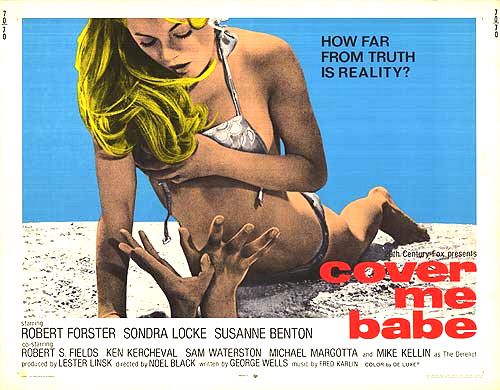
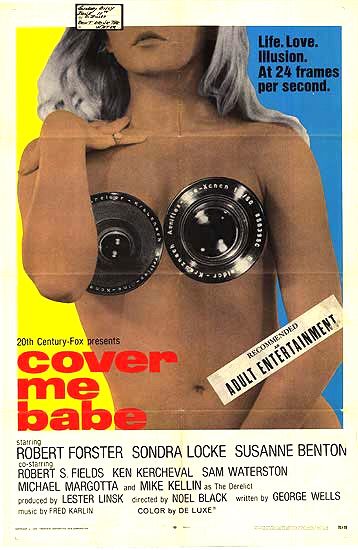
Cover Me Babe (1970)

cover me babe 3

By Richard Winters

My Rating: 3 out of 10

4-Word Review: Student filmmaker alienates everyone.

Tony Hall (Robert Forster) is a student filmmaker who feels he is a great director in the making and not afraid to let everyone know it. He becomes obsessed with capturing reality as it is and people’s emotional responses. He goads those around him including his own girlfriend (Sondra Locke) into doing things they are uncomfortable with simply so he can capture that uneasiness and the facial expressions that come with it. Some feel he is going too far, but the more they try to reel him in the more boundaries he pushes.

I’ve attended a film school in Chicago back in the early ‘90s, so for me I found this plot to be intriguing. In a lot of ways, at least at the beginning, I thought they captured the arrogance of these young would-be student directors who are convinced they are the next Kubrick or Scorsese in-the-making quite well. Their elitist attitude and willingness to compromise good taste and common sense simply to attain a shock effect to get attention are all very real.

Unfortunately the film goes overboard especially with the lead character who quickly becomes unlikable. I don’t mind a certain bit of cockiness or a say-it-like-it-is persona, but this guy is downright rude, smug, abrasive and even cruel. You spend the whole time hoping someone will punch him in his face, but it never happens and I believe this is the sole reason why this film failed at the box office as no one wants to sit through an entire movie watching a person whose behavior they can’t stand.

His excessively rude attitude towards a studio head (Jeff Corey) who wants to offer him an opportunity make a feature film is particularly confounding. It’s similar to Troy Duffy the real-life subject of Overnight and the director of The Boondock Saints who became quite arrogant to everyone once he got himself a Hollywood contract, but at least in Duffy’s case he had gotten his proverbial foot-in-the-door and therefore felt it was ‘safe’ to let his obnoxious side out, but the Forster character here doesn’t yet have one and you’re compelled to feel that the guy must be mentally ill to think he ever will by behaving in the outrageous way that he does.

Forster gives a solid performance, but the character seems too similar to one he just got done doing in Medium Cool and bordered almost on type casting. Locke is okay as the girlfriend and can be seen fully nude at the beginning, but why she would want to stick with such a jerk is hard to understand and makes her character annoying because of it. I realize some gals have the ‘bad-boy syndrome’, but it goes overboard with it here.

The film lacks a cinematic touch and its best part comes at the beginning where we watch a student film with a dream-like sequence in a Federico Fellini style that is actually pretty good. Another memorable bit comes near the end where Forster broadcasts to a group of students his own film, which features a scene showing a man jumping off a ledge and then panning over to reveal the shocked expressions of the people on the ground who witnessed it as well as the students watching it on film.

cover me babe 2

My Rating: 3 out of 10

Released: October 1, 1970

Runtime: 1Hour 25Minutes

Rated R

Director: Noel Black

Studio: 20th Century Fox

Available: None at this time.

Running (1979)

running 1

By Richard Winters

My Rating: 5 out of 10

4-Word Review: Life of a runner.

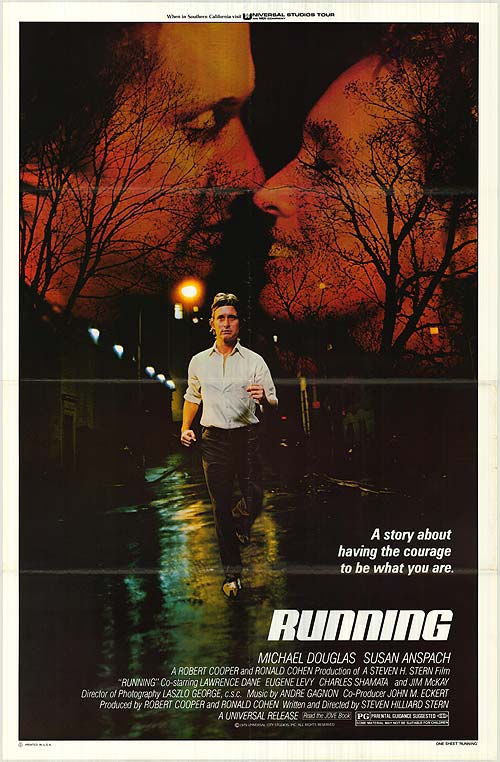
Michael (Michael Douglas) is suffering, at the age of 32, a midlife malaise. He goes from one dead end job to another and his marriage is crumbling. He runs to relieve the stress and finds that he has a major passion for it. When he qualifies for the Olympics he is initially excited, but it’s short lived because his former coach (Lawrence Dane) is on hand to constantly remind him how he has a tendency to ‘choke’ at the last minute and can never win a race when the pressure is on, which begins to wear on him psychologically.

The theme of a middle aged man having a passion for something that isn’t exactly ‘practical’ and resisting the pressures from the rest of world that tries to get him to conform to something that is, is highly relatable. I also liked the side-story dealing with the psychological element, which plays a far stronger factor in sports and amongst athletes than one might think. However, the majority of the screen time is spent with Michael trying to reconcile with his wife Janet (Susan Anspach) making it seem more like a romance and seemingly added in as ‘filler’ because the filmmakers believed that the running theme wouldn’t be enough to  carry it.

I also had a hard time understanding why the kids at high school, or at least his daughter’s friends, which gets played by Lesleh Donaldson in her film debut, would make fun of Michael simply because he was frequently seen around town running. I see joggers and runners every day and saw a lot of them back in the ‘70s too, so I don’t get why that would be a source of mockery and it seems like it was yet another manufactured dramatic element put in to give it more conflict. What’s even worse is when Michael finally qualifies for the Olympics then the kids do a full 180 degree turn and get excited about it and even run with him down the city streets, which gets corny to say the least.

Halfway in you realize this is just another variation of the Rocky formula and normally I would’ve found it annoying, but for some reason I actually got into it. I even liked the scene where he spots a giant cross standing on a hill and decides to run up the incline to reach it much like Rocky climbing the steps of the Philadelphia Museum of Art and to some degree it’s invigorating although it would’ve been nice had it shown him standing next to the cross once the climb was achieved. The final segment that takes place during the climactic Olympic race even has a twist to it that I didn’t see coming and to a degree it’s interesting though pushing plausibility. I won’t give it away I’ll just say that he doesn’t win the race, but he doesn’t exactly lose it either.

Douglas did all of his own running and to prepare for the role he would run many miles a day; IMDB states that he ran 50 to 60 miles a day, which I found hard to believe, so we’ll just say it was ‘many’. Anspach is good as the sympathetic wife particularly when the character has a conflict of emotions and breaks out in tears. Eugene Levy appears with a full afro in a rare serious turn as Michael’s attorney. Lawrence Dane is okay as the hardened coach who dispenses a lot of ‘tough love’, but little else.

My Rating: 5 out of 10

Released: November 2, 1979

Runtime: 1Hour 42Minutes

Rated PG

Director: Steven Hilliard Stern

Studio: Universal

Available: DVD (Italian Import Region 0)

The Happiness Cage (1972)

mind snatchers

By Richard Winters

My Rating: 5 out of 10

4-Word Review: They control his mind.

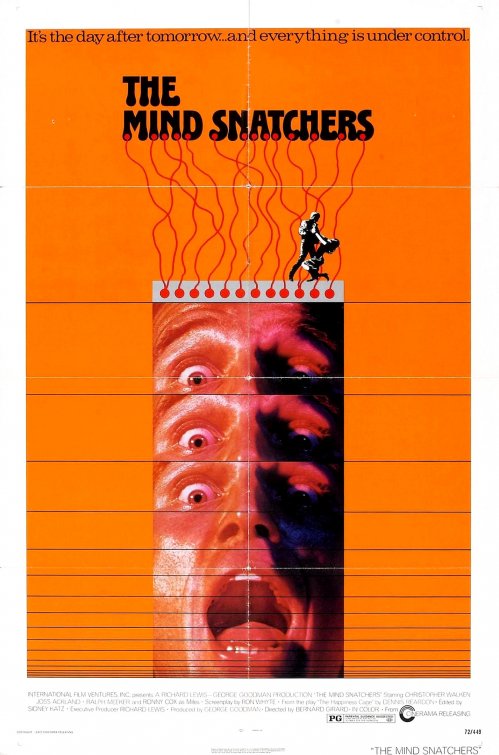
Christopher Walken plays James Reese a veteran of the Vietnam War who has issues with aggression. After numerous arrests he gets shipped off to a hospital in Europe run by Dr. Frederick (Joss Ackland) and overseen by a U.S. General (Ralph Meeker). There they do tests on the patients by implanting special devices into their brains that connects to their pleasure centers and can quell their aggressive behavior by having them feel a pleasurable sensation every time a button is pressed from a remote.

Walken’s performance is outstanding and Ronny Cox as his fellow patient is also quite good especially the part where he has the device implanted into his own brain, which turns him into a sad, pathetic, child-like state. Bette Henritze gives an interesting performance as well as a naïve, middle-aged nurse hired to make the patient’s stay more ‘happy’ by supplying them with books and board games only to be attacked and raped by Cox and then forced to play a game of checkers with him afterwards.

The story, which was based on a play by Dennis Reardon, certainly has its moments. In fact I was surprised how caught up into I got since the production values are close to appalling. The film was shot in Denmark in a building that looks like it was formerly a rundown mansion converted into a makeshift hospital for the sake of the movie. It all looks embarrassingly cheap and the idea of having a big hospital with a full-time staff and even a barbed wire fence and guard dogs, but only three patients is quite hard to believe.

Had the budget been bigger it might’ve been able to reach a broader audience. Bernard Girard’s direction is okay for the limitations that he was given, but the film’s faded, grainy stock and overall amateurish look becomes a turn off from the beginning and something that it cannot overcome. The plot itself is interesting, but the concept has been filmed before and with better results.

Alternate Title: The Mind Snatchers

My Rating: 5 out of 10

Released: June 28, 1972

Runtime: 1Hour 32Minutes

Rated PG

Director: Bernard Girard

Studio: Cinerama Releasing Corporation

Available: DVD, Amazon Instant Video

The Mafu Cage (1978)

Capture 66

By Richard Winters

My Rating: 3 out of 10

4-Word Review: Her sister is psycho.

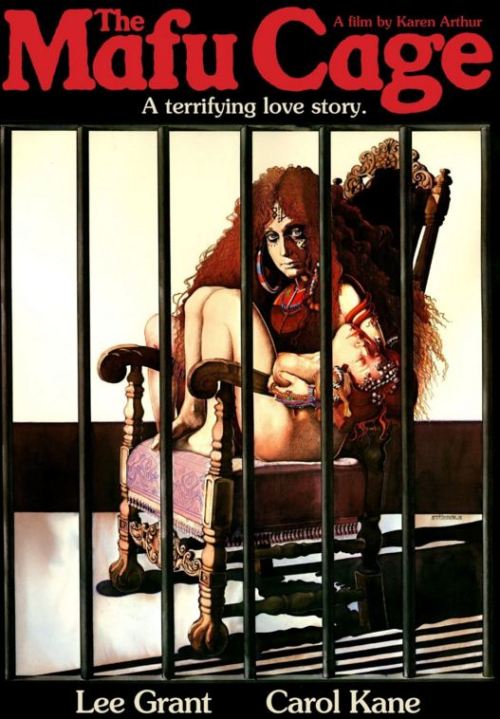
Ellen and Cissy (Lee Grant, Carol Kane) are two sisters living together in a dilapidated mansion, where they keep a pet ape named Mafu locked in a cage that sits in their living room. One day Ellen finds that Mafu has died so at the insistence of Cissy, who says she will kill herself unless they get another one, she goes to a local zoologist (Will Geer) and buys another. Things go well at first, but Cissy’s behavior becomes increasingly more erratic and she takes her frustrations and anger out on the new ape in abusive ways.

The film was directed by actress-turned-director Karen Arthur by a script written by Don Chastian who was another actor and based on a play by Eric Wesphal. I really wasn’t sure what these characters or this bizarre story was supposed to mean. I thought being the ‘70s and a female director that it would have symbolic connections to feminism or even lesbianism, which does get alluded to briefly, but overall the message is confusing and unfocused. The pacing is poor and about 10 minutes in I was already quite bored with it.

The only real saving grace is Kane’s presence who gives a startling performance as a psychotic woman. I had always admired her talent, but became even more impressed with her after seeing this. Her most amazing/bizarre moment is when she dresses up as an African warrior complete with red body paint and then later soaks in a tub filled with blood red water while carrying on an impromptu phone conversion with herself.

I had mixed feelings in regards to Grant whose age difference between Kane is 25 years making her look more like a mother figure than a sister. It was also hard to sympathize with her character as she refuses to have Cissy institutionalized or even examined by a mental health professional even though her behavior is dangerously erratic and only a completely irrational person would choose to ignore it or think that it will somehow ‘magically’ improve, which of course it doesn’t

The ape was the one performer that I enjoyed the most and fortunately a real one was used. The way the chimp responds to things and interacts with Kane are genuinely fascinating to watch and makes him a natural scene stealer without even trying. However, the part where she beats him with a metal chain is quite disturbing supposedly he was never actually hit and the credits do list an animal agency was present during filming and monitored it, but it’s difficult to watch nonetheless.

Patient viewers may find certain segments and imagery to be interesting and the film does improve a bit as it progresses, but overall it’s a weird curio that will leave most people indifferent and confused.

Alternate Title: Don’t Ring the Doorbell

My Rating: 3 out of 10

Released: December 1, 1978

Runtime: 1Hour 42Minutes

Rated R

Director: Karen Arthur

Studio: Clouds

Available: VHS, DVD


J. W. Coop (1971)

jw 2

By Richard Winters

My Rating: 8 out of 10

4-Word Review: Rodeo star makes comeback.

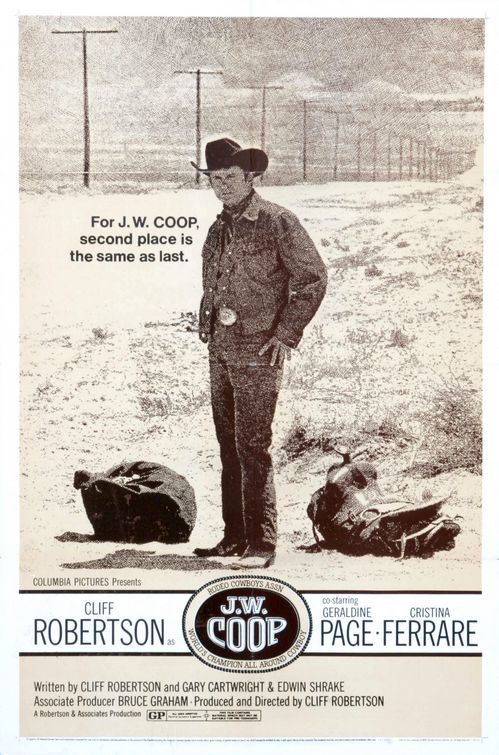
J.W. Coop (Cliff Robertson) has just spent 9 years in prison. After finally being released he finds that the world has changed quite a bit. He’s no longer the big rodeo star that he once was and younger, more educated men have now taken his place. There’s also the new hippie movement that he isn’t quite sure what to make of. With his mother (Geraldine Page) growing senile and no other friends to turn to he decides to take one last stab at the rodeo circuit and determined to beat the odds and become the champion because for him second place is the same last.

The film has a wonderfully gritty quality to it that fully immerses the viewer into the western rodeo landscape and lifestyle. The rugged characters and conversations seem authentic without ever being condescending. The film reveals a lot about the inner toughness needed to survive in that environment as well as the competiveness and eventual loneliness.

Robertson’s stab at directing is flawless and convinced me that he should’ve done more movies behind the camera. He uses several techniques that make the rodeo experience vivid for the viewer including filming a point-of-view shot from on top of the bronco as well as even more impressively showing one taken from underneath a horse as it is running. I also liked the shot where the screen gets split into four squares with each of them showing some of the many hotels that he stays at during his travels on the circuit, which visually hits home how exhausting life on the road can be. There’s also a haunting segment shot late at night at a lonely oil rig that is brief, but quite memorable.

Former model Cristina Ferrare, who is probably best known as being the ex-wife of automaker John DeLorean as well as host of ‘Home and Family’ gets a rare turn at acting playing a hippie who falls in love with Coop.  Her performance is solid even though I found it hard to believe why such a young woman would fall for a man who is so much older, less educated and having not much more money than she does. Their relationship goes on far longer than I realistically would expect, but I still liked the idea of how two people from two very different backgrounds and generations can still manage to connect. Robertson’s performance is equally good and the film also has the novelty of casting Page as his mother even though in real-life she was actually one year younger than he was.

The segment where a throne of teen girls jump out of a trailer and beg for Coop’s autograph as well as the ending in which Coop, with his leg in a cast, attempts to ride a bull are the only two times that it overreaches in a film that is otherwise quite honest and uncompromising and particular good at mixing subtle comedy with stark drama.

My Rating: 8 out of 10

Released: October 3, 1971

Runtime: 1Hour 52Minutes

Rated PG

Director: Cliff Robertson

Studio: Columbia Pictures

Available: DVD, Amazon Instant Video

Chu Chu and the Philly Flash (1981)

chu chu 4

By Richard Winters

My Rating: 3 out of 10

4-Word Review: Goofy couple steals briefcase.

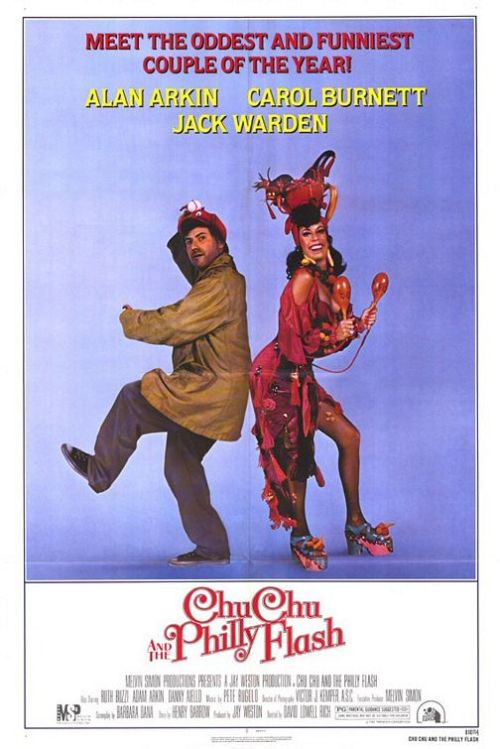
Flash (Alan Arkin) is a former big league pitcher who is washed up while living on the city streets selling stolen watches that don’t work. Emily (Carol Burnett) is a former dance instructor who is equally down-and-out and now makes a meager living doing dance routines on the streets while wearing a Carmen Miranda outfit. The two inadvertently meet one day while coming into contact with a briefcase that has stolen government documents. They agree to give it back to the men who are demanding it, but only for a price, which only helps to get them into more and more trouble.

This offbeat comedy, which was written by Barbara Dana who at the time was married to Arkin, has a few funny, dry humored moments at the beginning that makes it somewhat passable, but it’s unable to sustain any type of momentum and does not have enough action or comedy to keep it engaging. The middle half is slow and boring and the ending, which takes place at an amusement park, is too full of forced humor and sloppy slapstick to be considered either funny or entertaining. The film also never explains what specifically these secret plans are, or who these men are that are chasing after it, which only proves how poorly thought out and threadbare the plot really is.

The relationship between the two main characters doesn’t work either. They seem to let their guards down too easily for people that have been living alone and on the skids for so long and having them share more of a bickering and distrustful chemistry would’ve made it more realistic and edgy. The whole middle half is spent hearing them telling each other about their woeful pasts, which is neither compelling nor insightful and only bogs the film’s already slow pace down even further. These are the type of wacky character who can only be effective if put into comically frantic scenarios of which there needed to be much more of.

Arkin manages to give a pretty good performance playing a surprisingly subdued character that does not go off on hyper rants like the characters in some of his other film roles do, which is a good thing. However, Burnett is completely wasted despite seeing her in a Carmen Miranda outfit, which is a definite hoot. The only one who is genuinely funny is Danny Aiello as the exasperated bad guy.

Danny Glover can also be spotted in an early role as a homeless person trying to spy on Burnet and Arkin to see what they’re up to, but his part is one of the corniest ones in the movie and should’ve been dropped completely. The San Francisco setting may remind one of the classic comedy What’s Up Doc?, which also took place in that city and had a similar storyline dealing with a misplaced briefcase, but that film was far more consistently funny and took more advantage of the bay area locales while this one only focuses on the rundown areas of the city.

My Rating: 3 out of 10

Released: August 28, 1981

Runtime: 1Hour 32Minutes

Rated PG

Director: David Lowell Rich

Studio: 20th Century Fox

Available: VHS