Category Archives: Drama

Heatwave (1982)

heatwave 1

By Richard Winters

My Rating: 8 out of 10

4-Word Review: Fighting to save homes.

Stephen (Richard Moir) is an English architect employed by Robert (Bill Hunter) to construct a massive high-rise building in downtown Sydney that will be financed by Peter (Chris Haywood). However, the construction will require the demolition of several row houses and the eviction of those living in them. Kate (Judy Davis) takes up the cause by protesting the development and along with Mary Ford (Carole Skinner) are able to get a temporary block on the building project by getting the local builder’s union to instill a green ban. Stephen tries to fight this by attending the group’s meetings and airing out his side of the issue, but in the process finds himself more and more sympathetic to the residence especially when he finds out that Peter isn’t a completely honorable businessman and has no plans to use Stephen’s building design at all. When Mary mysteriously disappears he joins forces with Kate to try and find her only to unearth even more troubling and dark revelations along the way.

This film is based on a true-life incident and one of two movies made about it with the other one being The Killing of Angel Street, which will be reviewed here next month. The real-life event centers on Juanita Nielsen (1937-1975) who took up the anti-development cause when it was found that her home was pegged to be demolished in order to make way for three high-rise buildings in the Victoria Street neighborhood of Sydney. Her efforts managed to delay the project for three years, but the developer eventually became impatient and hired men to harass the residents who were trying to stop it and in the process kidnapped Nielsen even though her body has never been found and no one has ever been convicted of her murder.

The film here depicts Nielsen through the fictional character of Mary Ford, but what surprised me was that Ford is not the central person. Instead we only see her briefly at the beginning before she disappears and is generally forgotten while writer/director Phillip Noyce adds other fictional characters and story lines around her, which wasn’t as interesting as the actual case and I’m not sure why they didn’t just stick with the facts.

However, this still a highly intriguing thoroughly riveting plot that keeps you on the edge of your seat from the beginning. Part of what I liked about it is the way it shows things from the different perspective of the various characters while bringing out the myriad of complexities where nothing is black-and-white and no one is completely right or completely wrong. The viewer gets torn about whose side to be on, but fascinated with each new rapid-fire twist that comes about.

There are definite shades of L’Avventura here where a main character disappears and is essentially forgotten until it seems almost like she had never existed in the first place. The script offers no easy answers and instead shows in vivid and almost brutal detail how taxing and frustrating fighting for social change can be and the hopelessness one feels when they realize that all of their efforts may have made little or no difference.

My Rating: 8 out of 10

Released: March 8, 1982

Runtime: 1Hour 32Minutes

Rated R

Director: Phillip Noyce

Studio: Roadshow Film Distributors

Available: VHS, DVD (PAL, Region 0)
Le Mans (1971)

le mans 1

By Richard Winters

My Rating: 6 out of 10

4-Word Review: Car race of endurance.

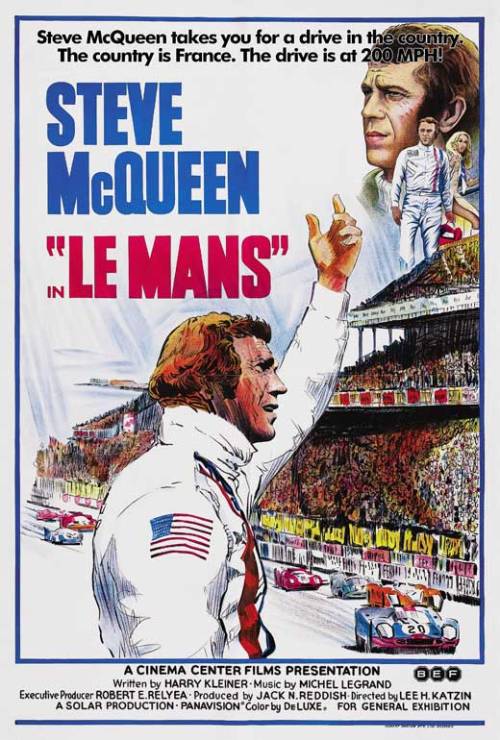
Le Mans is a car race held annually in France in which the test is to show not only how fast the vehicle is, but also its reliability as cars are forced to drive for 24 straight hours with a minimum of pit stops. Michael Delaney (Steve McQueen) is the driver who represents the American team and who is under a great deal of duress because of the fact that he caused an accident that killed another driver just a year before.

The film’s first thirty minutes may be its most captivating and has been described by many fans as being their favorite part of the movie. I loved seeing the empty stands fill up with people as it gives the viewer an authentic race day feeling. Every little facet of the race gets captured almost like it is a documentary with the emphasis more on ambience and the adrenaline it creates instead of a story and in fact no one utters a single line of dialogue until almost 40 minutes in. Watching the cars whizz by with the camera set directly on the pavement just inches away was enough to make me flinch and the wipeouts are particularly graphic and up close.

The film has very little of a backstory to the characters and one gets propelled into the race without much distinction between the various drivers, or even any emotional stake for who wins. Normally I’d say this is a good thing because the dramatic elements in these types of films can get overly drawn out and soap opera-like, but it also makes it a rather detached experience like watching a football game with no concern for either team, or the outcome. The drama that does get played out is boring with dialogue that is only on a conversational level. It also gets confusing as to which driver is in the lead and the constant shots of loud cars speeding by eventually becomes tedious.

Things manage to recover by the end with an exciting finish between three of the race’s drivers that even features a very dramatic tire blow-out. Unfortunately the middle half bogs it down so much that by the time it gets there you feel pretty worn out already. It also wastes the acting talents of McQueen. Granted I was impressed that he did his own driving, but the script doesn’t give him enough to do outside of that.

The film was known for its troubled production in which John Sturges the film’s original director left after being unable to deal with McQueen’s constant meddling and replaced with Lee H. Katzin. Katzin was mainly known for doing TV-Movies and I honestly don’t think had the skill to create the movie’s impressive visual style. I believe it was McQueen’s presence that forged that and I almost feel he should’ve been credited ultimately as the being the director, or at least co-director. The irony is that McQueen ended up not receiving any salary for his work here, or even a percentage of the profits and in fact refused to even attend the film’s premiere.

My Rating: 6 out of 10

Released: June 23, 1971

Runtime: 1Hour 46Minutes

Rated G

Director: Lee H. Katzin

Studio: National General Pictures

Available: DVD, Blu-ray

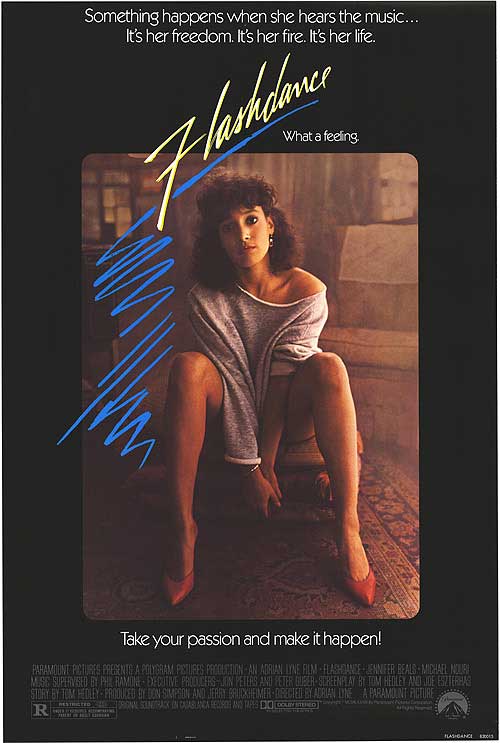
Flashdance (1983)

flashdance 2

By Richard Winters

My Rating: 6 out of 10

4-Word Review: Dancing is her passion.

Alex Owens (Jennifer Beals) is a young lady of 19 who works as a welder during the day, but moonlights as an exotic dancer by night. She dreams of one day joining the dance institute and train to work in the professional ballet, but when she goes to their admissions desk they demand that she show some proof of prior training, which she doesn’t have and this is enough to intimidate her from applying at all.  She eventually starts up a relationship with Nick (Michael Nouri) who is the owner of the factory where she works. He uses his money and influence to pull-some-strings at the dance conservatory so that she’ll be able to get an audition, but she resents his help and threatens to not only pull out of their relationship because of it, but her audition as well.

The film is loosely based on the real-life story of Maureen Marder and the plot is relatable to anyone who dreams of one day rising above their humble beginnings, which is what makes the film interesting. Beals does well in the title role and has a very appealing face, but I was surprised how little dancing there actually was. Out of the whole runtime there are only three dance routines that the Beal character does, which was a shame as the routines are well staged, have a lot of energy and creativity and the most unique part about the film while its contrived romantic angle is  a complete bore.

The Alex character has issues as well as she comes off as too much of a mish-mash of different extremes making her more like a caricature than a real person. I realize human beings can be a bag of contradictions, but this character takes it too far. The biggest one is when she goes every week to confession even though she doesn’t behave at all like she is a religious person in any other way. I would think a devoutly Catholic individual wouldn’t feel as relaxed about getting on stage and gyrating her body let alone stripping off her clothes the minute she brings her new boyfriend back to her place, going to bed with him on their first date and even aggressively flirting with him at a restaurant.  In either case the confession scene was unnecessary because all it does is have the character verbally explain what the viewer has already been able to pick-up on visually.

The character is also highly volatile in ways that could easily get her pegged as being a borderline psycho these days. First she throws a rock through her boyfriend’s window when she thinks he is seeing another woman, then she jumps out of a moving car in the middle of a tunnel that could’ve caused a major traffic accident and then tops it all off by rushing onstage to drag her friend Jeanie (Sunny Johnson) off at a strip club and then callously throwing the dollars that Jeanie had earned into a puddle of water all because she consider herself to be a ‘good friend’, which brings up another point; why does this character consider stripping to be so ‘sleazy’ while being an exotic dancer is ‘respectable’? Granted she doesn’t take her clothes off as an exotic dancer, but the outfits she wears are quite revealing and the dance numbers are so sexually tinged that in my opinion there wasn’t that much of a difference.

I was also surprised how the male characters at her factory job seemed to treat her as being ‘just-one-of-the-guys’ as this was a highly attractive single woman making me believe that a lot of the guys would be hitting on her besides just the owner. I would also expect that she would be sexually harassed at the work place by some of them since she spends her evenings playing into their fantasies with her sexy dancing and the fact that the film fails to tackle this subject even briefly makes it poorly thought-out.

Overall though I found it to be an enjoyable watch and I think this was mainly due to Adrian Lyne’s direction and his use of lighting that made each shot seem like a visual design and his ability to photograph the grimy, steel mill setting in a way that made it seem artsy and evocative as well as the film’s rousing dance number at the end that despite its cheesy nature is still inspiring and fun.

My Rating: 6 out of 10

Released: April 15, 1983

Runtime: 1Hour 34Minutes

Rated R

Director: Adrian Lyne

Studio: Paramount

Available: DVD, Blu-ray, Amazon Instant Video, YouTube

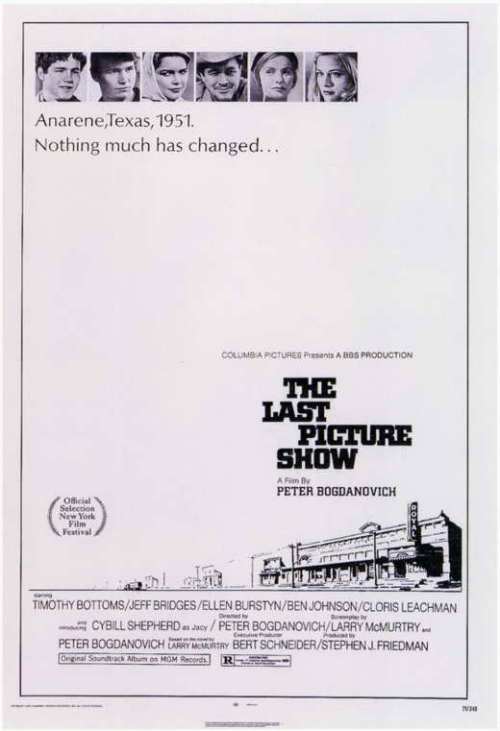
The Last Picture Show (1971)

last picture show 1

By Richard Winters

My Rating: 9 out of 10

4-Word Review: A Texas sized drama.

Based on the Larry McMurtry novel, who also co-wrote the screenplay, the story deals with the inter-workings and relationships of a people living in a small Texas town known as Anarene during the years of 1951 and 1952.  There’s Duane (Jeff Bridges) and Sonny (Timothy Bottoms) two high school seniors who are also best friends. Duane dates the highly attractive Jacey (Cybill Shepherd) who seems more geared to playing the field with every guy in town and even makes a play for Sonny, which seriously affects his relationship with Duane. There’s also Ruth (Cloris Leachman) the lonely coach’s wife who begins a brief affair with Sonny until he decides to bail-out for the more attractive Jacey. Sam (Ben Johnson) makes up part of the older generation still stuck in the dusty town and trying to make ends meet by running the local movie theater and pool hall both of which come to a halt when he dies suddenly.

I saw this film just recently outside on the big screen as part of the Texas Film Heritage and Preservation Society here in Austin. Although I had seen it before I was hit with how much more impressive and visually sumptuous it is on the big screen. Robert Surtees’ black and white cinematography is top-notch and the main ingredient to what makes it so spellbinding, so much meticulous attention is taken into each and every shot that one could almost watch this with the sound down and still find it thoroughly compelling.

Director Peter Bogdanovich takes great care to make sure that all of the elements are there and spins them together like a well-crafted machine so the viewer learns bit and pieces about these characters and their attitudes through each shot and camera angle that comes along. Filming it on-location in Archer City where McMurtry grew up helps accentuate the authenticity as does playing the country music from the period although I could’ve done with a little less of that and more of the sound of the wind and dust crackling across the barren region instead.

What surprised me most was how interesting and varied the love making scenes where and how instrumental they became to the film as a whole. One of the most memorable ones is when Sonny first tries to make love to Ruth, but is quite awkward about it. We see the pained expressions on both of their faces, hear the rusty springs of the mattress, and then finally witness Ruth’s attempts to shield her crying and frustration from Sonny. Duane’s futile attempt at sex with Jacey later on is also good particularly the fiery look of anger spewing from Jacey’s eyes when he is unable to perform. The scene involving a mentally challenged young man pushed into attempting sex with an obese and caustic prostitute inside the backseat of a cramped car is both darkly funny and sad, but the most provocative love making moment comes near the end when Jacey has sex with her mother’s boyfriend (Clu Gulager) on top of a pool table inside a dark and lonely pool hall while bracing the table’s side pockets with her hands for leverage.

The performances are all-around outstanding and both Leachman and Johnson won the Academy Award for their work here, but I still came away feeling, just like I did twenty years ago when I first saw this film, that Shepherd does the best job and leaves the most lasting impression. I love how her character slips between being insecure and indecisive to cunning and conniving and Shepherd’s facial expressions are completely on-target all the way. Her striptease done on top of a diving board is still pretty hot and my only complaint about the character is the way she elopes with Sonny and then completely bails on him the next day. I realize she didn’t love the guy and she’s just used him like she did others, but I didn’t understand what her motivation was in this instance as she seemed to get little if anything out of it.

I was also a bit disappointed that the Coach Popper character played by Bill Thurman didn’t have a bigger role in the story. The way he berates his players during practice is amusing and would most likely get coaches in today’s more sensitive world in hot water. I also found his constant spitting of tobacco juice into a cup that he carries around with him to be grotesquely amusing, but my biggest beef is the fact that we have a main character screwing his wife and the whole town knows about it, but never any reaction from the man himself. Maybe he was aware and didn’t care, but the movie should’ve made an attempt to show this, or at least some interaction between Sonny and the Coach since Sonny was at one time one of his players, which would have to make things quite awkward whenever they would bump into each other and in a small town that would most likely happen on more than a few occasions.

Overall though this is a great movie and I was surprised at how frank and explicit it was despite its 1950’s setting. Some may argue that it was done with too much of a revisionist mindset and things weren’t quite this wild, but others, like myself, will insist that it probably was, but just not talked about as much.

My Rating: 9 out of 10

Released: October 22, 1971

Runtime: 2Hours 6Minutes (Director’s Cut)

Rated R

Director: Peter Bogdanovich

Studio: Columbia Pictures

Available: DVD, Blu-ray, Amazon Instant Video

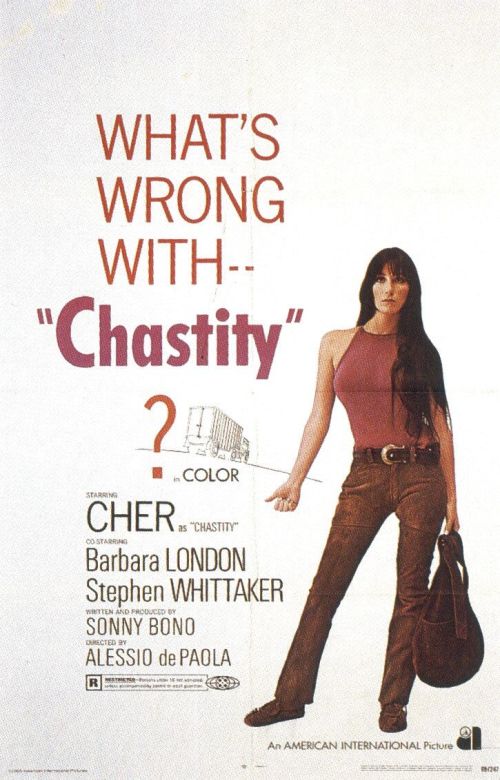
Chastity (1969)

chasity 1

By Richard Winters

My Rating: 6 out of 10

4-Word Review: Hardships of a runaway.

Chastity (Cher), in an attempt to escape her troubled past, runs away from home. She initially hitches a ride with a truck driver (Elmer Valentine) who seems to have only one thing on his mind, so she leaves him and meets up with a younger man named Eddie (Steve Whittaker) who she takes a liking to. He brings her back to his place and she spends the night there, but then worries that things may be moving too fast, so she leaves him. She then treks down to Mexico where she gets a job at a whorehouse. The woman (Barbara London) who runs the place becomes sexually attracted to Chastity and makes an attempt to start a lesbian relationship with her, but Chastity is uncomfortable with this and runs away again. She then meets back up with Eddie hoping to restart their relationship, but her demons from the past catch up with her and make that impossible.

The film was written and directed by Sonny Bono and I got to admit I was surprised at how genuinely riveting this was. The dialogue is sharp with a definite cinema vertite feel. There’s little or no action, but like with a Jim Jarmusch film you still find yourself glued to it and interested in picking up any little nuance that happens. The subject matter is frank and uncompromised and there’s even a little bit of nudity as we see Cher naked from both the top and backside.

The plot is unstructured and works more as a portrait to the tough situations most runaways fall into than in actually telling any type of story with a beginning, middle and end. However, it flows pretty well and has some memorable scenes including Chastity’s attempts to change the oil in a stranger’s car, her visit to a church and most especially her stay at the whorehouse and the way she successfully fleeces money out of a shy and unsuspecting teenage boy customer (Tom Nolan).

Cher is outstanding and the main reason to why this thing is so compelling. Apparently she was unhappy with her performance and refused to do another film until 13 years after this one, which is a shame as she shows definite signs of being a star-in-the-making and she looks so young that she seems almost like a different person than the one we’ve become so accustomed to seeing.

My only quibble is the fact that we get very little insight to the character’s past or why she’s running away. At the very end we do start to hear some voices, which are apparently going on inside her head and that of her parents, but it was too late to bring that up and should’ve been introduced earlier. The ending is vague and leaves the viewer in-the-dark as to what the ultimate fate of the character is, which is frustrating.

My Rating: 6 out of 10

Released: June 24, 1969

Runtime: 1Hour 25Minutes

Director: Alessio de Paola (Sonny Bono)

Rated R

Studio: American International Pictures

Available: DVD

Wanda (1970)

wanda 1

By Richard Winters

My Rating: 8 out of 10

4-Word Review:  How the poor survive.

There is a scene near the beginning that shows our main character played by Barbara Loden from a distance walking through mounds of coal to get to her father so that she can ask him for some money. The shot stays on her for what seems like several minutes with the camera slowly panning forward as she progresses. Some may say this is boring or the work of an amateur that doesn’t know when to cut. Yet this shot becomes the essence to the plight of the character and what this film is all about. In life she is constantly moving unable to fully grasp the true dissolution of her existence she searches for something, anything while becoming a victim to life’s cruel riddle that has no answer.

This may be one of the saddest movies you will ever see because Wanda’s condition is not unique and makes up more of what the working poor go through than we care to think. It helps clarify the desperation that people in these circumstances feel while also explaining why they get into bad situations and at times make such misguided choices.

Here drifter Wanda meets up with a two-bit crook named Norman Dennis (Michael Higgins). The two create an odd relationship, which proves to be beneficial for both. She brings out his long dormant tenderness, while he, in one truly touching moment, actually gives her some confidence. Of course it doesn’t last, but it is an inspiring scene and shows that even the most pathetic of people in the bleakest of situations can still transcend themselves.

This is a powerful film with a stark, home movie-like look that is actually an asset. No stylized interpretations here. The dingy bars, restaurants, homes, hotels, and factories are all very real and the viewer feels as trapped in the grayness as the characters in a film that is far more emotionally taxing than one might initially expect.

My Rating: 8 out of 10

Released: September 2, 1970

Runtime: 1Hour 42Minutes

Rated GP

Director: Barbara Loden

Studio: Bardene International

Available: DVD

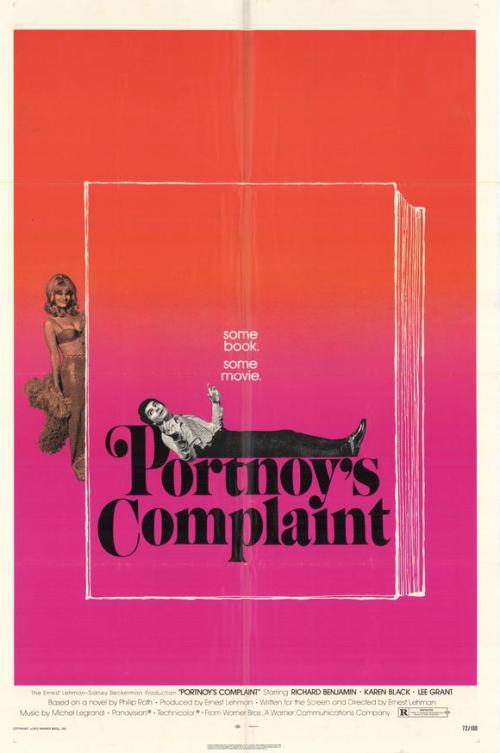
Portnoy’s Complaint (1972)

portnoys complaint 1

By Richard Winters

My Rating: 4 out of 10

4-Word Review: Jewish man digs prostitute.

Alexander Portnoy (Richard Benjamin) is a man who no longer believes in a God or any of the other conventional ways of life taught to him by his old-fashioned Jewish parents (Jack Somack, Lee Grant). He enjoys the ‘art’ of masturbation and will routinely find excuses to go do it when his parents aren’t looking. As he grows older he finds that his sexual appetite broadens in a way that regular women won’t be able to fulfill. Then he meets Mary Jane (Karen Black). She’s a prostitute nicknamed ‘The Monkey’ due to all the wild positions that she can get her body into during sex. The two enjoy a lot of kinky times, but then she ends up falling in love with him and wanting to get married, but Portnoy resists as he considers her to be intellectually inferior and fears she’ll become an embarrassment to him with his other friends.

Philip Roth’s landmark and controversial novel comes to the big screen with only lukewarm results although it does start out funny. I laughed-out-loud at the scene where Portnoy pretends to have a bout of diarrhea just so he can sneak into the bathroom to get-off and his parents misinterpret his moans of ecstasy as being that of gaseous agony. The dream segment where Portnoy finds that his penis has fallen off and onto the kitchen floor while his parents come into to inspect it is pretty good as is the bit where Jeannie Berlin tries to give Portnoy a hand-job.

Unfortunately the film shifts too much in tone. It starts out as this quirky, dark-humored, sex-laden comedy only to end up being a brooding drama. The novel was written as a continuous monologue spoken by Portnoy while talking to his therapist, which doesn’t effectively come off here. We see a few scenes in his therapist’s office, but they are brief and I didn’t like the fact that his therapist never speaks a word of dialogue, which seemed weird and unnatural.

Screenwriter Ernest Lehman, in his one and only foray behind the camera, implements too much of a slow pace to the proceedings. Many scenes go on far longer than they should and at certain points the camera gets nailed to the ground giving it a static presence. He also hired Michel Legrand to do the film score, which is beautiful and majestic, but the lush tones are better suited for a romantic flick, which this definitely isn’t.

Karen Black gives an outstanding performance as ‘The Monkey’, but her character is too one-dimensionally dumb almost to the point that she seems mentally handicapped, which I don’t think was the intention. Either way it is never funny, touching, or even real while bordering into the stereotype that all prostitutes ‘must be really stupid’.

One of the most annoying elements of the film is that it keeps cutting back to a matted image of Black jumping from a skyscraper and towards the viewer while she screams. The image looks very hooky while giving the film a real amateurish feel. I also didn’t like how at the very end we spot Black walking amongst a crowd of people from a bird’s eye perspective. The supposed demise of the character was meant to be murky as she threatens to jump from a building and Portnoy leaves her without ever knowing if she ended up doing it or not, which then causes him a major source of guilt afterwards. By having her suddenly appear at the very end ruins the mystery and brings up far more questions than answers.

Roth’s novel was very much ahead-of-its-time and deserved a film that could match it, but Lehman’s staid approach doesn’t do it justice.

My Rating: 4 out of 10

Released: June 19, 1972

Runtime: 1Hour 41Minutes

Rated R

Director: Ernest Lehman

Studio: Warner Brothers

Available: DVD (Warner Archive), YouTube

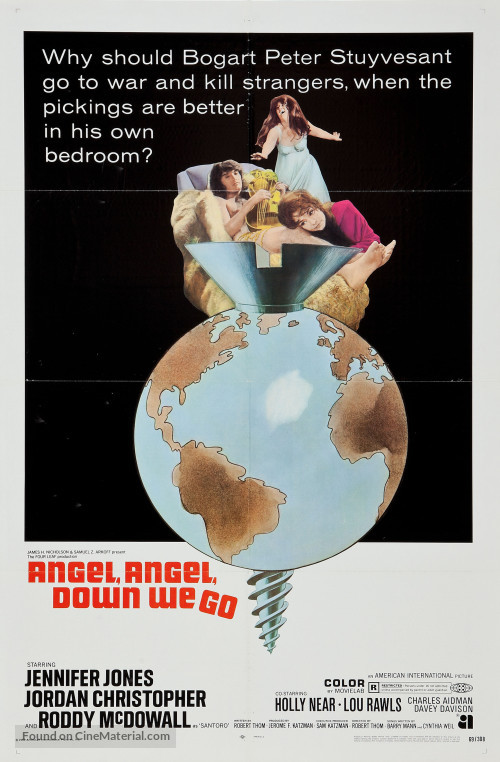
Angel, Angel, Down We Go (1969)

angel angel 1

By Richard Winters

My Rating: 4 out of 10

4-Word Review: Singer manipulates rich family.

Tara (Holly Near) is an overweight teen who feels like a social outcast. Her family is rich, but empty on love. Her mother (Jennifer Jones) is a former star of stag films and boozes it up on the bottle, but still manages to look quite attractive, even better than her daughter, which she constantly reminds her of. Her father (Charles Aidman) is a closet homosexual who routinely brings in male lovers for entertainment. When a rock group with a dashing lead singer (Jordan Christopher) arrives at her sprawling family home to help host a party Tara doesn’t hesitate to fall into his open arms. At first he seems to be the answer to her loneliness, but after a while she realizes he has a plan of his own as he not only seduces the mother, but her father as well before manipulating his way into the family fortune.

The main reason to watch this film, if not the only one, is for the performance of Jones in this her second-to-last cinematic appearance. She gives an incredibly strong, multi-faceted portrayal of a middle-aged woman on the emotional edge who realizes she’s being used, but allows it to happen simply so she can still feel desirable. Her presence lifts the sleazy material to watchable heights and comes just a year after she herself tried to commit suicide after hearing of the death of a close friend in real-life.

Near, who has later become a well-known folk singer, gives an effectively sensitive portrayal of a troubled teen, which allows her to be the one character that the viewer has any sympathy for. The rest of the cast though, which includes Roddy McDowall and Lou Rawls as Christopher’s band mates, are essentially wasted although you will get a full view of McDowall’s bare bottom for those few who are interested.

The garishly colorful collages done by Shirley Kaplan are visually alluring, but writer/director Robert Thom goes back to them too often. The aerial skydiving footage is excellent, even breathtaking, but the script as a whole, despite its lurid and even groundbreaking subject matter, falls flat. A lot of the reason for this is the fact that it’s poorly paced with too much time given to Christopher who sings a total of five songs, which does nothing but slow the proceedings down to a screeching halt. The ending is vague and aloof, which only helps to cements this as a misfire and good only as a curio.

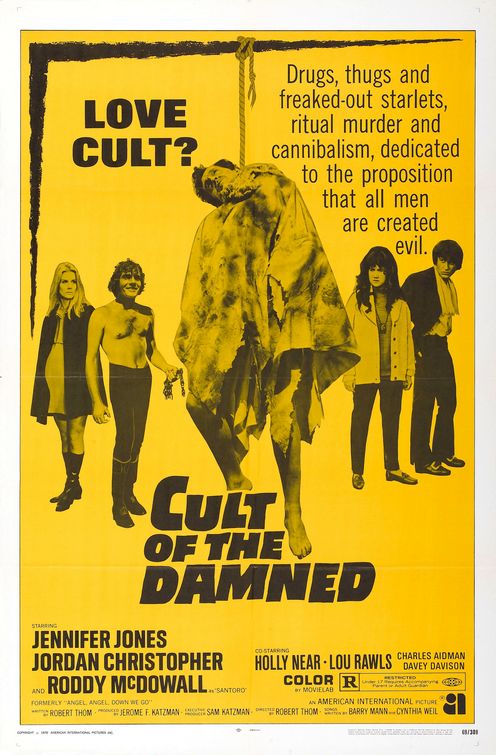
The film did quite poorly upon its initial release, so it was reissued under another a title called Cult of the Damned in hopes that it could cash in on the hysteria of the Manson murders that had occurred around the same time, even though the story doesn’t have anything to do with a religious cult and the movie still fared no better at the box office.

angel angel 2

Alternate Title: Cult of the Damned

My Rating: 4 out of 10

Released: August 19, 1969

Runtime: 1Hour 29Minutes

Rated R

Director: Robert Thom

Studio: American International Pictures

Available: DVD, Blu-ray, Amazon Instant Video

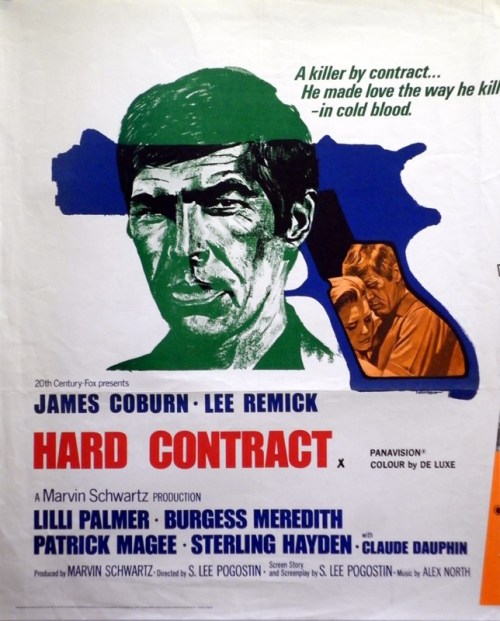
Hard Contract (1969)

hard contract

By Richard Winters

My Rating: 3 out of 10

4-Word Review: Hit man becomes humanized.

John Cunningham (James Coburn) is a professional hit man hired by Ramsey Williams (Burgess Meredith) to do one last ‘big score’ by rubbing out Michael (Sterling Hayden) of which Ramsey suffers a large financial debt to. John has done many of these jobs before and travels to Europe with the expectation that this one will be as routine as the others, but then he has an encounter with call-girl Sheila (Lee Remick) who plagues him with self-doubt and forces him to question his purpose in life.

This film was written and directed by S. Lee Pogostin a long time TV writer who finally at the age of 55 got his big break to do an actual feature film. Unfortunately for him his script is excessively heavy with dialogue and little to no action. There is only one brief segment where we see John actually doing his job and offing someone and it comes in the form of watching him drop a large trunk with a dead body inside of it out of an airplane, which is kind of a cool visually, but that is about it and the rest of the film consists of nothing but talk and long winded, flowing conversations dealing with theories and philosophies that regular people, particularly those in the crime and prostitution business, just don’t have.

Coburn and Remick are both excellent, but the scenario that their characters are placed in is ludicrous. The idea that a high paid prostitute would suddenly fall for one of her clients is quite doubtful. Had the Coburn character been somehow kind or gentle towards her then maybe, but instead he is cold and distant and treats her more like an animal than a person, so why, especially after all of the other men she has already presumably slept with, would she get so worked up over this guy? It just makes no sense and the same thing goes for the Coburn character. He’s slept with hundreds of prostitutes before and even brags about it, so why would this one stand out?

The conversation that Coburn has with Hayden, amidst a large wheat field and while sitting on a tractor, is pretty good and the most engrossing moment in the film. The scene where he drives a car speedily down a winding road, which gets the other passengers quite nervous, isn’t bad either. The European locations are scenic and the supporting cast all give strong performances especially Karen Black as a talkative hooker arguing with Coburn over political candidates. However, the script tries too hard to make a statement and comes off more like a protracted concept than a story with a pretentious flair that just doesn’t work.

hard contract 2

My Rating: 3 out of 10

Released: April 30, 1969

Runtime: 1Hour 47Minutes

Rated R

Director: S. Lee Pogostin

Studio: 20th Century Fox

Available: None at this time.

The Clan of the Cave Bear (1986)

clan of the cave bear

By Richard Winters

My Rating: 5 out of 10

4-Word Review: Girl gets new tribe.

After her mother is killed in an earthquake and escaping from the clutches of a hungry lion a very young Ayala (Daryl Hannah) gets taken in by a tribe of Neanderthals. Her addition causes strife amongst the other members particularly Broud (Thomas G. Waites) who feels she doesn’t conform enough to the subservient female role. When it is found that she has taught herself to hunt by using weapons that the women were forbidden to touch she is kicked out of the tribe and forced to survive on her own.

I realize that this film has been almost universally lambasted by movie goers and critics alike, but overall I found it to be watchable. The biggest issue in many ways were the action sequences. The opening earthquake bit as well as the lion attack comes off as stagy and phony and even border on being unintentionally funny. Later on when Ayala saves a young child from a wolf the movie reverts to slow motion, which gives it too much of an over-the-top Hollywood feel. There is also another segment where the cavemen torment a grizzly bear as part of an ancient tribal ceremony. Some of the men get torn up and killed by the bear, which to me was just fine as they should’ve left him alone in the first place!

Hannah is the perfect choice for this type of role, but for whatever reason her performance seemed a bit off and not as effective as it could’ve been. She was also probably too tall for the part as people back then was much shorter than they are now.

The movie has a little too much melodrama and eventually resembles just another cheesy Hollywood drama. The authenticity is questionable and the grittiness from the more popular Quest for Fire is definitely missing. I also wasn’t too crazy about the outdoor shots, which includes the opening one, that shows sunlight filtering through the tree leaves in a haze-like fog that gives it too much of a fairy tale-like look.

The part where Ayala is forced to survive on her own goes by too quickly and hardly seems as brutal as it should’ve been and I was also confused about how she was able to come upon this fur shawl to wear that protected her from the cold because when the tribe kicked her out she left with nothing but the flimsy outfit that she had on.

Yet despite all this I still found it to be reasonably compelling. Maybe it’s just the idea of seeing an individual learn to survive on her own, standing up to unjust authority and learning to find independence that manages to connect us no matter what the time period, but in either case it’s an okay time filler if you don’t think about it too much.

My Rating: 5 out of 10

Released: January 17, 1986

Runtime: 1Hour 38Minutes

Rated R

Director: Michael Chapman

Studio: Warner Brothers

Available: DVD (Warner Archive), Amazon Instant Video, YouTube