Category Archives: Drama

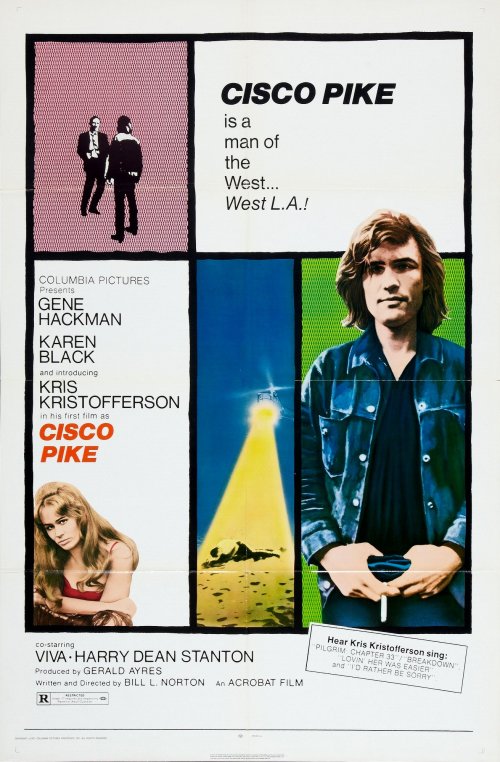
Cisco Pike (1971)

By Richard Winters

My Rating: 8 out of 10

4-Word Review: Blackmailed into dealing drugs.

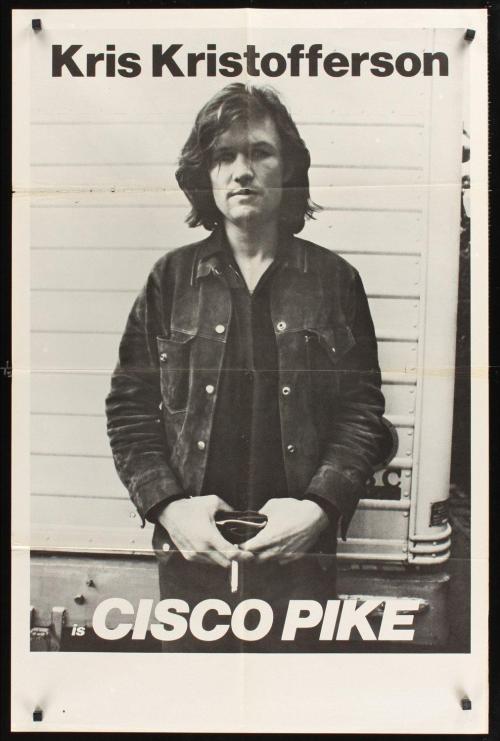
Cisco Pike (Kris Kristofferson) is a down-on-his-luck singer who once was playing to sell-out crowds, but finds his popularity declining and resorting to selling drugs to maintain a living, but under pressure from his girlfriend Sue (Karen Black) has stopped. Leo Holland (Gene Hackman) is a police detective looking to retire and needing enough money to do so. He steals a sizeable quantity of high-grade marijuana from a gang leader and then tells Cisco he must sell it within 59 hours while giving Leo $10,000 of the profits and Cisco can keep anything that he makes beyond that. At first Cisco resists knowing it will interfere with his relationship with Sue, but eventually gives in when Leo threatens to kill him unless he complies.

While this film has achieved a cult status in recent years critics at the time of its release were not kind. Many felt it promoted drug use just as the nation was starting its war on drugs, which caused the film to get a limited release and eventually bombed at the box office. Personally I found it to be a riveting look at the drug dealing culture and a fabulous directorial/screenwriting debut for Bill L. Norton the son of William W. Norton who was also a successful screenwriter.

What I liked most was the cinema vertite style that made it seem almost like a documentary. I enjoyed the camera following Cisco around in a non-stagy way and revealing the variety of people that he sold to with not all of them being hippies either, but also middle-aged suburbanites and even business executives. The film nicely shows how some of the encounters would be non-eventful while others could ended up being a trap and eventual police chase. The unpredictable quality of the transactions replicated the anxiety the dealers would face and how hyper observant they needed to be to the immediate environment around them.

Many films try to recreate things that the filmmakers themselves haven’t gone through, but here I got the feeling that the director and much of the cast had experienced the same situations as the characters which in-turn makes the viewer feel, when it’s over, that they’ve lived it too. The dialogue is excellent as well with a conversational style that doesn’t overexplain things and allows the viewer to read in a bit to what the characters are saying.

Kristofferson, who had been a singer up to that point, makes an outstanding acting debut and all the more impressive when you realize that he had no acting training before he was given the part. Many of his friends advised him not to take the role fearing his lack of experience would hurt the movie and cause him not to be given any more roles, but after reading the script he felt he could relate to the character by simply being honest with his emotions, which he does splendidly and it’s nice too seeing him in a rare appearance without any beard or mustache.

Hackman is excellent as well playing a character that was not in the original treatment, but added in later by Robert Towne when he wrote the revision. It’s unusual seeing him in such a relatively small part with large chunks of time, especially during the second act, where he’s not seen at all, but when he is onscreen he’s effective. It was fortunate that this was filmed just before he won the Academy Award for The French Connection as that turned him into leading man material and it’s unlikely that he would’ve accepted this part had it been produced any later.

Black is interesting, she usually always is, despite, like with Hackman, not having all that much screen time, but she makes the most of what she has particularly her physical reactions to Hackman when he invites himself into her apartment late at night and begins rambling on about his heart condition. Honorable mention too needs to go to Joy Bang, an attractive supporting actress during the early 70’s who later retired from show business to get into nursing. Her toothy smile always looks sexy, at least to me, and I loved when she gives her female companion, played by Viva, an open-mouth kiss while riding in a car and then turns around and gives Kristofferson, who is sitting on her other side, the same treatment.

Harry Dean Stanton, as an aging musician, doesn’t appear until near the end, but has some of the movie’s most profound moments particularly his exchange with Kristofferson were he laments about no longer being sexy enough for the stage while Kristofferson reminds him that it’s not his body that the music business wants, but his soul instead.
My Rating: 8 out of 10

Released: November 2, 1971

Runtime: 1 Hour 35 Minutes

Rated R

Director: Bill L. Norton

Studio: Columbia Pictures

Available: DVD
Petersen (1974)

petersen1

By Richard Winters

My Rating: 7 out of 10

4-Word Review: Going back to school.

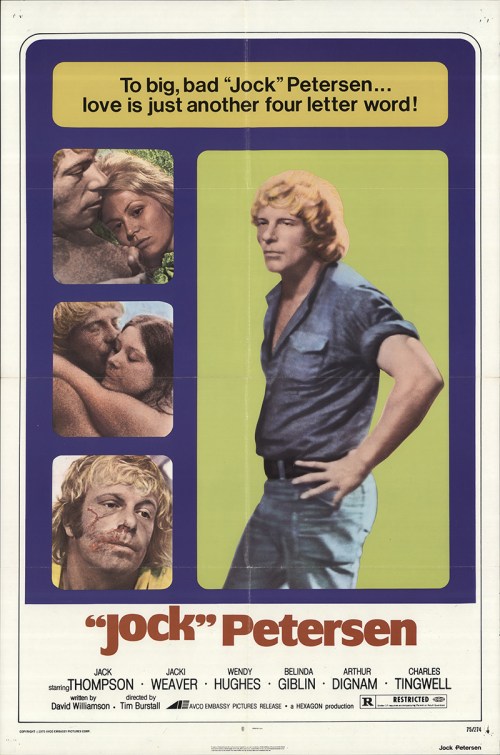
Tony Petersen (Jack Thompson) is an electrician who decides to go back to school and major in English. He feels people look down on him because he works a blue collar job and hope that by returning to college to get a degree that will change, but instead he finds he’s still not getting the respect that he desires particularly from his stuffy professor (Arthur Dingnam), so he ends up having an affair with the man’s wife (Wendy Hughes),  but things don’t stop there. He has sex with the coeds too including right out in the open on the campus grounds for public display while hundreds of onlookers surround them.

The screenplay was written by acclaimed Australian playwright David Williamson, who’s best known for having penned the cult hit Don’s Party However, this film lacks the fluidity of that one and seems more like a selection of vignettes than a story. The leader character isn’t likable either and comes off as selfish while in Don’s Party we were able to understand the protagonists frustration with his marriage here the domestic situation doesn’t seem as bad and therefore watching him mess around isn’t cute, funny, or sexy and instead just tiring and off-putting.

The biggest problem though is that the film starts right away at the halfway point where Petersen has already been attending school and neck-deep in an affair instead of going back to where it all began. Showing Petersen’s frustrations with his job and income, instead of just being told about it through dialogue, would’ve helped the viewer empathize more with his situation and emotionally invested with his quandary instead of feeling lost and ambivalent in the jumbled narrative.

There are a few good scenes here-and-there including a very ugly moment where a group of obnoxious bikers crash an upscale party and make things quite tense for the guests who are seemingly unable to do anything about it. Later there’s a poignant segment involving a discussion that Petersen has with his father (Charles Tingwell), who works as a reverend at a church despite professing to having lost his faith. Petersen’s public sex act has great potential too and even though it does contain full frontal male nudity, which at the time was still considered shocking to see in a mainstream film, it doesn’t get played-up enough to really being as funny or irreverent as it should’ve been.

Spoiler Alert!

There’s also several moments though that needed more context, which is frustratingly lacking. One includes Petersen getting caught making-out with his friend’s wife by his own spouse (Jacki Weaver) who looks very disappointed in him, but we never get any follow-up almost  like the whole situation just gets forgotten by the next day. There’s another scene where Petersen rapes his lover inside her own office, but without showing any aftermath. Such a violent, disturbing act deserves some denouncement and not treated like a throwaway bit such as it is.

End of Spoiler Alert!

Overall if you stick with it the characters do have a way of growing on you, but the story needed to be more developed. Too much emphasis on being edgy and provocative, but filled with characters in desperate need of depth and better connecting pieces between scenes.

My Rating: 7 out of 10

Released: October 25, 1974

Runtime: 1 Hour 43 Minutes

Rated R

Director: Tim Burstall

Studio: Hexagon Productions

Available: DVD (Import Region 2)

High Tide (1987)

By Richard Winters

My Rating: 8 out of 10

4-Word Review: Mother meets estranged daughter.

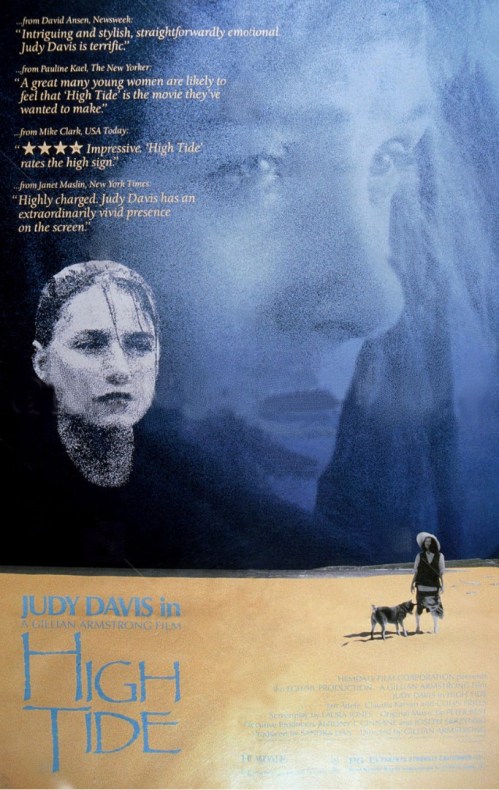
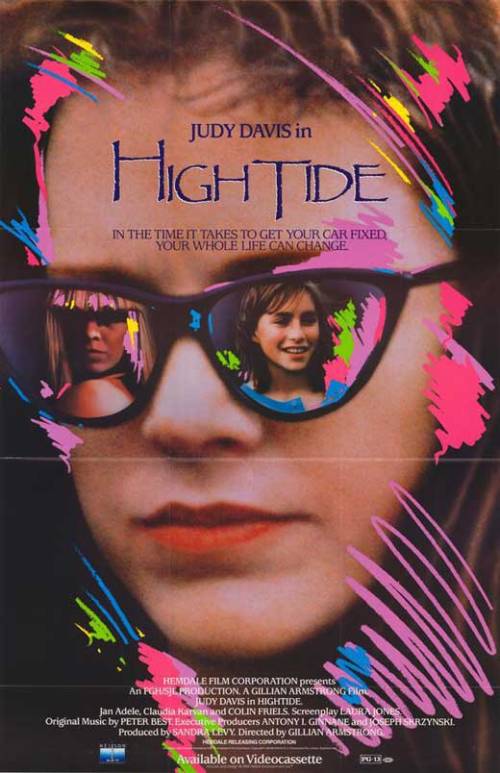
Lillie (Judy Davis) is living on the very edge of show business life working as a backup singer to an Elvis impersonator (Frankie J. Holden). Her lackluster behavior gets her fired and she finds herself without money or shelter. She moves to a trailer home park and begins drinking heavily and it is here while in a drunken state in the public bathroom that she meets Ally (Claudia Karvan). Ally is a 13-year-old girl living with Bet (Jan Adele) who is the mother of Ally’s father who died when she was just an infant. At first Lillie doesn’t know that Ally is actually her daughter, which she gave up at birth. When Bet realizes that Lillie is in the area she warns her not to go near Ally, but Ally and Lillie manage to find ways to get together anyways and form a rapport, but without Ally knowing the deep, dark secret between them. Once she does find out the two must learn to fight through the awkward and emotional state that the tumultuous new awareness creates.

Originally the script called for Lille’s character to be a man meeting up with his lost teen daughter that he had abandoned years earlier, but director Gillian Armstrong felt this had been done before and at her husband’s suggestion changed the lead into a female. In many ways this was a better idea as women are better able to reveal their emotions creating some very strong, heartfelt scenes between them that ultimately makes for a very powerful film.

Many reviewers have expounded on Davis’ performance and she does give a strong one particularly the way her character is put through some very demeaning situations, but still managing to come through them holding her head high and keeping the viewer empathetic to her. Karvan though is quite good too with a beautiful photogenic face that can display an array of emotions with very little effort and who’s likable enough that you’re able to bond with her immediately.

The story progresses casually and at first you have no idea what links these three women as the film intercuts between them in separate situations with no idea where the connecting point is, which to some extent doesn’t grab the viewer in. I did though like the way it captured the nightclub atmosphere showing how for many it temporarily opened the door for their lost and fleeting dreams by having Bet get onstage and sing to a captive audience at a talent contest during the evening only to cutaway showing her back on her drudgery job of driving an ice cream truck the following day.

Once the secret becomes clear the story gets more interesting with the dialogue between the mother and daughter quite compelling. There is however, a long lull during the second act where Lilly intentionally stays away from Ally, which I found frustrating. The main interest of the film is seeing the two working things out together and getting through the guilt and bitterness of the past and at times there’s not enough of that.

Spoiler Alert!

The third act features Ally deciding to go out on the road with Lillie, but to me this thing seemed too precipitous since the two had only begun to get to know each other, why would a young teen, even if she was unhappy in her current situation, want to start living with someone she really didn’t know if she could get along with? This situation also opens up a whole variety of new tangents: like how are the two going to survive with Lillie’s limited job skills and where would they live? I felt this situation should’ve been introduced in the second act and explored much more. Personally I don’t think things would’ve worked out and at the very least brought on, despite their best intentions, a lot of stress and disagreement before it might’ve gotten better. This is something the viewer needed to see though there’s still plenty of nice rewards nonetheless.

My Rating: 8 out of 10

Released: July 30, 1987

Runtime: 1 Hour 41 Minutes

Rated PG-13

Director: Gillian Armstrong

Studio: Filmpac Distribution

Available: VHS

The Rain People (1969)

By Richard Winters

My Rating: 8 out of 10

4-Word Review: Needing to find herself.

Natalie (Shirley Knight) wakes up one day and decides to simply get in her car and drive off with no particular destination in mind. She has just found out that she is pregnant and not sure if she can or wants to handle the responsibilities that come with it. She leaves a note to her husband (Robert Modica) telling him she needs time away from him to think things through. During her travels she meets Jimmy (James Caan), otherwise known as ‘Killer’, he was a former football player straddled with a brain injury that has now left him mentally handicapped. She also meets Gordon (Robert Duvall) a traffic cop who pulls her over for a speeding ticket. The two eventually start to date, but the more Natalie tries to find herself the more lost she becomes.

The film was for the most part considered an ‘experimental’ one as the subject matter was years ahead of its time. While many road pictures of the day like Easy Rider took the male perspective this one dared to tap into the feminist viewpoint, which up to that point hadn’t been explored as much if at all. I enjoyed how the film questions the whole wife/mother idea, once considered ‘the ultimate destination’ for any woman, but here brings out the complex issues that come with it and how not every woman may want to be trapped by it, or even find contentment in that situation.

What’s even more interesting is that Natalie never really seems to go anywhere. Yes, she does get in a car and starts driving and passes by many picturesque places of rural America along the way, but trying to escape the clutches that she feels holds her back never goes away. Everyone she meets, including Gordon who’s stuck raising a young daughter (Marya Zimmet) that he wasn’t totally prepared for, seem to be in the same predicament as her making it feel like the further she drives away the closer she gets to where she started.

Francis Ford Coppola makes wonderful use of the rain and there are many shots of it particularly in the first half as we see it creating puddles on the road and even streaming down the car windows in close-up. The cloudy, murky weather acted as a nice motif to Natalie’s inner emotional state and the confusion that she was going through. The film’s promotional poster seen above is excellent too and brings out the moodiness of the movie with one perfect shot although seeing the couple kissing in the backdrop is a bit misleading as that’s one thing you definitely don’t see here despite Natalie’s efforts to try and find it. The two people should’ve, in order to be consistent with the theme of the film it was promoting, been seen standing side-by-side instead of hugging.

I also really loved Coppola’s use of flashbacks here, which gets sprinkled in throughout. I liked the scenes showing the couple in happier times during their wedding as it illustrates how relationships that go bad or don’t work out still had their good moments even if they were brief. The flashbacks dealing with Duvall trying to save his family from a burning house are quite revealing too as what he describes verbally through voice-over is quite different from what we see.

Leonard Maltin, in his review of the film, called the script ‘weak’, which I completely disagree with. Yes, not a lot happens, the random situations that Natalie goes through perfectly reflect what could happen to anyone on a trip, which I liked because the plausibility here is never compromised. She ends her journey feeling as lost as she did when she started, but I felt that was the whole point, so in my opinion the script is strong.

George Lucas, who worked as an aide on this production, filmed a 32-minute documentary of this movie as it was being made called Filmmaker, which is accessible on YouTube although the sound quality is poor. This film has several revealing moments including conflicts that director Coppola had with Knight, but what I found most interesting is that when the crew traveled down to Chattanooga they all cut their hair and shaved their beards,which included Coppola himself, as they felt the locales wouldn’t work with them unless they appeared clean-cut. Seeing Coppola with a rare non-beard look alone makes this short film vignette worth catching.

My Rating: 8 out of 10

Released: August 27, 1968

Runtime: 1 Hour 41 Minutes

Rated R

Director: Francis Ford Coppola

Studio: Warner Brothers

Available: DVD-R (Warner Archive), Amazon Video, YouTube

A Star is Born (1976)

By Richard Winters

My Rating: 4 out of 10

4-Word Review: His career goes downhill.

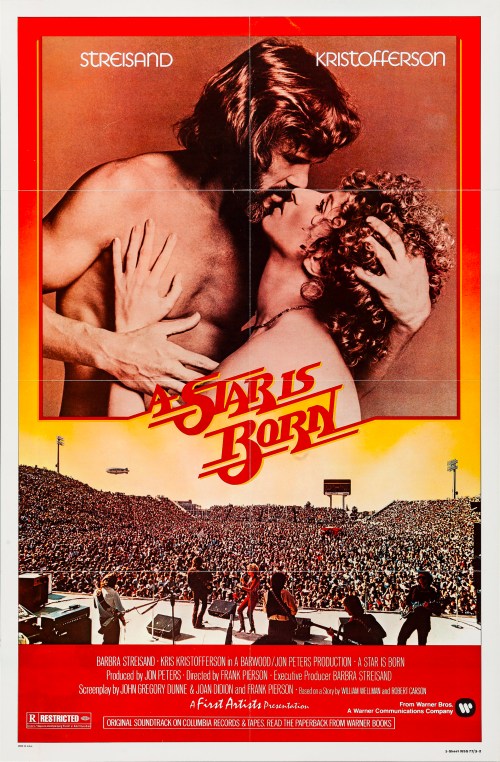
John Norman Howard (Kris Kristofferson) is a famous rock singer who’s found that his career on the road has taken its toll. He’s become jaded by the money and fame and now bored with it while spending his days and nights committing self-destructive acts that alienate the rest of his crew. One night after walking off the stage of his own concert after singing only a few songs he goes to a bar where he sees Esther (Barbra Streisand) singing on stage. He becomes impressed by her talent and uses his resources to make her a star. The two eventually get married, but as her career continues to rise his goes in decline.

This is the third remake of the story that was originally written by William A. Wellman and Robert Carson. The first version came out in 1937 and starred Frederic March and Janet Gaynor while the second one was released in 1954 and starred James Mason and Judy Garland. This version differs from the other two in that the setting was the music scene instead of the movie business, but overall the efforts here to revitalize the tired formula are trite and predictable.

A lot of the blame can go to Streisand who acted as both the star and producer to the project. For one thing she was too old for the part as she was already in her mid-30’s when this was filmed and wearing a tacky afro hairstyle to boot. It would’ve been more effective had a truly young person, like a woman who was 19, which is a typical age for someone to have dreams of breaking into the rock scene, was cast. Possibly having the character start out as one of Kristofferson’s groupies, instead of doing it like it’s done here where he just meets her at random at a bar, which is awkward and forced, and then through their time together he learns of her aspirations and talents and works to help her meet her potential.

It also would’ve helped had the young starlet had the same singing style as Kristofferson, which would’ve made the concert scene where he walks off stage and brings Esther onto it more believable. Kristofferson’s music, or what little we hear of it, has clearly a more hard rock edge while Streisand sings mellow love songs. In the movie we’re supposed to believe that all these fans who paid good money to see Kristofferson sing are suddenly without warning given Streisand instead and are so taken aback by her talent that they all clap and cheer when in reality I think they would’ve been upset and demanding their money back as they came to hear hard rock and not the lite stuff.

I enjoyed Kristofferson’s performance and his impulsive self-destructive acts give the film energy and edge. However, the chemistry between the two is non-existent and he later said that working with Streisand was “an experience which may of cured me of the movies.” His decline gets handled in a rushed, heavy-handed way. Music careers are by their very nature cyclical. Rock stars get replaced with every generation as teens prefer their own singing idols and not those of their parents. For him to become so quickly devastated when his record sales begin to plummet is unrealistic as nobody stays on top forever. He should have enough money to wade out the career lulls and simply held on to when his fans grew up and became nostalgic and then hit the retro tour circuit like many of the pop/rock icons from the past do.

Streisand’s character is flat, one-dimensional, and just plain too-good-to-be-true. She’s well known in real-life for her notorious ego, in fact director Frank Pierson described her as being egocentric, manipulative, and controlling and refused to ever work with her again, so having her then portray someone who is gracious and humble seems very phony and not something that she’s effectively able to convey. The original concept was to have the character be like Janis Joplin and go through a self-destructive decline of her own, but Streisand nixed this idea, which is unfortunate as it would’ve given the film some needed nuance.

The footage of the massive crowds at the concerts is the one element that I found impressive and the segment showing the vast stretch of land that Kristofferson owned in the middle of the Arizona desert was pretty cool too. Everything else though in this otherwise overlong film is boring. Fans of Streisand’s singing may take to it better, but there’s too much of it, making it seem like this was just one big vanity project for her and nothing more.

My Rating: 4 out of 10

Released: December 17, 1976

Runtime: 2 Hours 20 Minutes

Rated R

Director: Frank Pierson

Studio: Warner Brothers

Available: DVD-R (Warner Archive),  Blu-ray, Amazon Video, YouTube

Outrageous! (1977)

By Richard Winters

My Rating: 7 out of 10

4-Word Review: Female impersonator befriends schizophrenic.

Robin (Craig Russell) works as a gay hairstylist during the day, but longs to be up on stage as a female impersonator.  Liza (Hollis McLaren) is a schizophrenic who leaves the hospital she was confine in and moves in with Robin her longtime friend. Both find ways to help each other with their problems, which allows Robin the confidence to finally get on stage in drag as Tallulah Bankhead, which makes him an instant hit and gets him a paid gig in New York City. However, when he moves away Liza’s condition worsens forcing Robin to decide what’s more important: his budding career, or his friendship.

The film is based on the shorty story ‘Making It’ by Margaret Gibson, which in turn was based on her experiences dealing with mental illness and her real-life friendship with Craig Russell whom she roomed with in 1971. The story nicely tackles the challenges of dealing with mental illness and how Robin’s support helps Liza overcome her demons that the other professional Dr’s and counselors that she sees don’t because they only view her as just another patient instead of a person.

The grainy, low budget quality works to the film’s advantage as it brings out the fringe, economically disadvantaged lifestyle that the two lived in while McLaren’s performance shies away from the cliches of mentally illness causing the viewer to see her as a regular everyday person, not just some ‘crazy’, valiantly fighting a nasty illness that she can’t always control.

The segments dealing with Russell’s onstage act are quite entertaining as well though when I first saw this film decades ago I found these moments to be off-putting as they turned it more into a documentary, or a comedy special that took the focus away from the actual essence of the story, which was the friendship. However, upon second viewing I liked the way it captures the gay club scene that was unique to that time period. Russell’s impersonations where he does Barbra Striesand, Judy Garland, Mae West and Bette Midler just to name a few are outstanding. I’ve seen some female impersonator acts before, but Russell’s far outshines any of the others I’ve ever watched as he gets the body language, voice, and facial expressions of the people he’s playing just right to the point that he completely disappears into the women characters until you can’t tell the difference.

While the film does have many touching moments I felt it should’ve shown how Robin and Liza first met instead of having it start with them already knowing each other when she moves in with him. Since they are such an odd pair capturing how and where this unique relationship all started and what element brought them together seemed crucial, but we never see it nor does it even get addressed in conversation. Having this backstory could’ve helped the film stay a little more centered on the relationship as well and prevented the over reliance on Russell’s stage routine, which while quite good, still takes up a bit more of the runtime than it should’ve.

My Rating: 7 out of 10

Released: July 31, 1977

Runtime: 1 Hour 36 Minutes

Rated R

Director: Richard Benner

Studio: Canadian Film Development Corporation

Available: DVD, Amazon Video

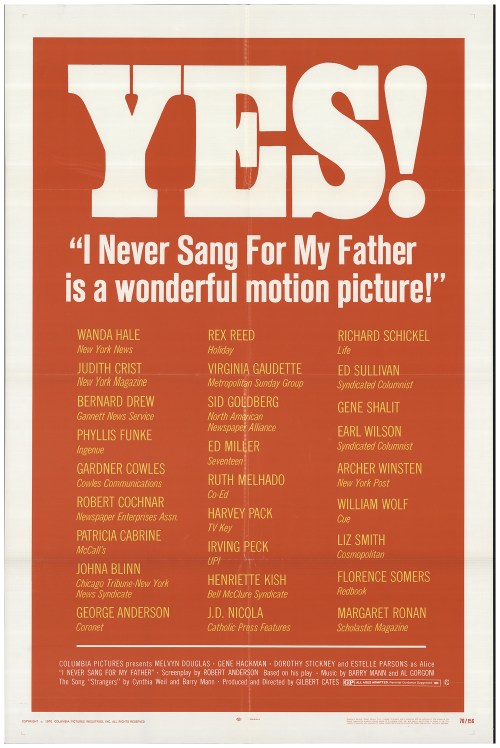
I Never Sang for My Father (1970)

By Richard Winters

My Rating: 8 out of 10

4-Word Review: Father and son clash.

Based on the Broadway play of the same name written by Robert Anderson, who also wrote the screenplay, the story centers on college professor Gene (Gene Hackman) who tries to mend his relationship with his father Tom (Melvyn Douglas) a very bull-headed man who can’t seem to get along with anyone. When Gene’s mother (Dorothy Stickney) passes away suddenly it becomes a concern what to do with the father who is showing early signs of dementia and other health issues. Gene, who has recently been widowed himself, wants to remarry and move off to California, but his father prefers him to stay close by in New York. When Gene offers to move his father to California the old man refuses leading to a bitter feud between the two that also opens up old wounds.

To show just how good this movie is one only needs to compare it to Dad, which was an 80’s film starring Ted Danson and Jack Lemmon, which had a similar subject matter, but that film conveniently glossed over the many negative aspects of taking care of an elderly parent while this one tackles the downside head-on. Hearing the arguments that Gene has with his sister Alice (Estelle Parsons) and how neither one of them want to be straddled with the responsibility of being a round-the-clock caretaker I found to be refreshingly honest. Too many modern movies, in their attempt to make the lead character likable, never address these very real concerns. Also in the movie Dad the Ted Danson character flies across the country to help his father with no explanation for how this affected his job or finances while this one does touch on the economic realities. It also shows how elderly people aren’t always that lovable and can at times be genuinely nasty.

Douglas is outstanding as he manages to bring out different sides to his character. While the viewer finds him exasperating I still enjoyed the shots showing him kneeling at his bedside in prayer, which gave him, even as old and crotchety as he was, a child-like dimension. The conversations that he has about his own father and the poor relationship he had with him are quite revealing as it shows how the same issues can go across many generations with Douglas inadvertently treating his own son in the same shoddy way his old man treated him and not even realizing it.

With Douglas’ powerhouse performance Hackman gets overshadowed. He has fleeting moments where he displays his trademark anger and pent-up frustrations, but it doesn’t come-off as quite as genuine as it does in some of his other roles. It also would’ve been nice had there been some flashback scenes showing past altercations between the two, which would’ve helped the viewer emotionally connect to what he was feeling instead of having their differences just briefly touched on through dialogue. In many ways Parsons comes-off better and the reasons for her anger at her father is more clearly and eloquently explained.

The only complaint that I had with the film is when Hackman goes touring the assisted senior living homes. While the film had approached the material in a straight forward dramatic manner, which stays quiet true to the play, it suddenly shifts during this segment to becoming more artsy and cinematic by blocking out the dialogue and instead playing loud, moody score with a more subjective, hand-held camera. While this is all right I still felt it wasn’t needed and goes against the tone of the rest of the film, which had been very minimalist up until the then. The sudden pounding music doesn’t make the visuals showing the bleak living conditions of those places anymore shocking or disturbing and if anything becomes unnecessarily jarring and in-the-way.

These scenes also feature a very early appearance of James Karen as one of the directors of the senior facilities that Hackman tours. However, with the dark curly hair that he has here and the thick horn-rimmed glasses that he wears, you most likely won’t recognize him unless you look closely and even then you still might not think it’s him. With the decision by director Gilbert Cates to play music over these scenes we unfortunately never get to hear hear what he was saying or how he was trying to sell the dismal looking place to the potential customer, which could’ve been interesting.

My Rating: 8 out of 10

Released: October 18, 1970

Runtime: 1 Hour 32 Minutes

Rated GP

Director: Gilbert Cates

Studio: Columbia Pictures

Available: DVD, Amazon Video, YouTube

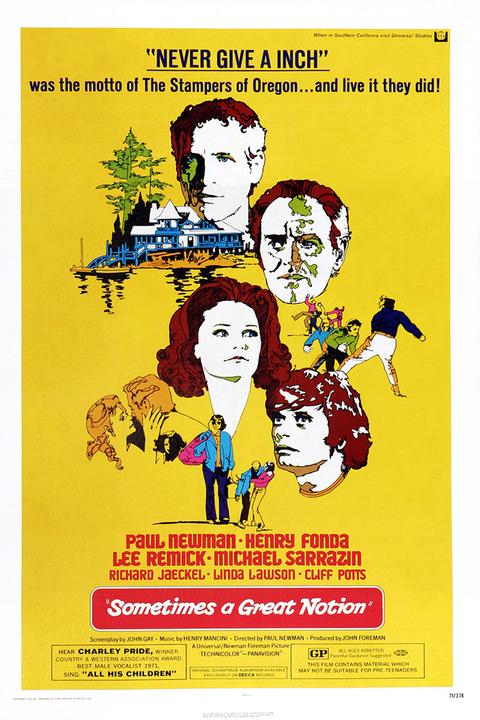
Sometimes a Great Notion (1971)

By Richard Winters

My Rating: 6 out of 10

4-Word Review: Never give a inch.

The Stampers are a proud logging family who’ve run their business out of the small Oregon town of Wakonda for years, but now find that may be in jeopardy when the local union strikes against a large lumber conglomerate. The Stampers, headed by their stubborn, bull-headed father (Henry Fonda) refuse to go along with the other loggers and continue to run their business. The rest of the townspeople consider them to be traitors and get their revenge by burning their equipment and doing whatever they can to make their business fail, but despite all the obstacles and setbacks the Stampers prove to be a resilient bunch.

The story is based on the Ken Kesey novel and while the book spawned many accolades the movie pretty much fizzled and today is only remembered as being the first film ever shown on HBO when it began broadcasting on November 8, 1972. However, that doesn’t mean it doesn’t have its share of good points as I really did enjoy the vivid way it captures the logging business showing first-hand what it takes to cut down the large trees and move the timber. Everything is captured with an in-your-face style that makes you feel like you’re right there working alongside the others and all the stages of tree cutting are explored including the many potentially dangerous accidents that can occur within the blink-of-an-eye.

The film also features a few memorable scenes including a bird’s-eye view of a large barge of logs being tugged down the river, which is an impressive sight. There’s also the infamous drowning scene unique because I’m not quite sure how they were able to pull it off without the actor drowning.

The characters though are quite boring, don’t display any type of arc and instead convey a very one-dimensional cantankerous attitude all the way through, which isn’t fun. Lee Remick is the only one who shows a softer, more introspective side, but she’s not in it enough. The scene involving her in bed with Michael Sarrazin, who plays the younger brother to Paul Newman, could’ve given things a much needed spark and should not have been left on the cutting room floor.

Fonda though is an exception. I’m always amazed at how in his later years he had to take small roles in films that weren’t always A-list material, but would still steal the film away from the leading actors anyways and his answer as to why the family continues to work while clearly causing tension with the rest of the town is a gem.

The plot though gets presented in a sporadic way. So much attention gets put into the aesthetics that the story becomes largely forgotten and only trickles through at certain intervals. The perspective is a bit odd for a Hollywood film too especially for that time period where the idea was always a David vs. Goliath formula that would take it to the establishment and yet here instead of punching up it punches down. As a viewer I felt sympathy for the townspeople and their need to create a strong union to make life better for themselves, so watching this family arrogantly ignore their needs and forge on with their business seemed to be me selfish and not something that was noble or interesting.

Spoiler Alert!

The film’s final shot, which features Newman tying his dead father’s severed arm on top of his tugboat, with the hand of the arm giving the finger to the town’s people on shore, is quite ghoulish. There’s no explanation for how he obtained the arm, but I’d imagine it would’ve required him digging up his father’s grave and cutting the limb off, which is pretty sick and twisted and thus loses the humorous quality that was intended and becomes just plain repulsive instead.

Alternate Title: Never Give A Inch

My Rating: 6 out of 10

Released: December 17, 1971

Runtime: 1 Hour 54 Minutes

Rated PG

Director: Paul Newman (Replaced Richard A. Colla)

Studio: Universal

Available: DVD (Universal Vault Series)

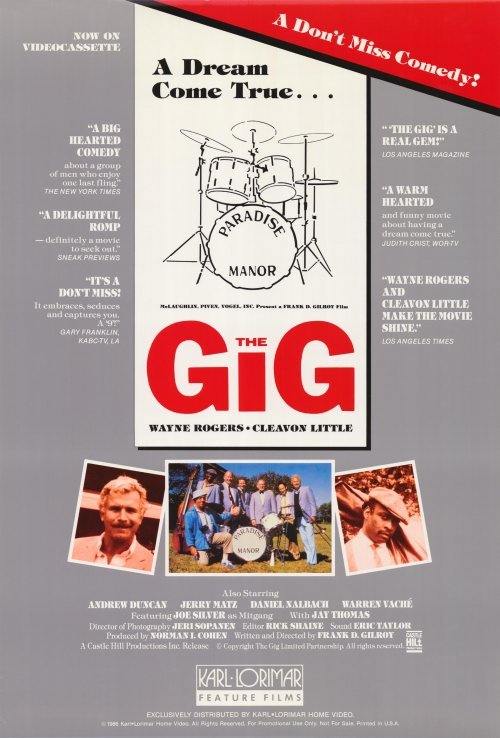
The Gig (1985)

By Richard Winters

My Rating: 5 out of 10

4-Word Review: Band’s first paid engagement.

Marty (Warren Rogers) works as a used car salesman during the day, but in the evening he gets together with 5 other middle-aged male friends and takes part in a Dixie style jazz band. For 15 years they’ve been doing this until they get an offer with pay to play at the Catskills for two weeks. Marty is initially quite excited, but the others have family and job obligations and aren’t sure if they can do it. He’s finally able to get 4 of them to agree, but with one bowing out due to surgery is forced to add in a professional bass player named Marshall (Cleavon Little) who is talented, but also arrogant and opinionated. Once they finally arrive at the location they find their living quarters to be small and cramped and the resort owner (Joe Silver) to be overbearing making them wish they hadn’t come and  leads to the group’s unraveling.

The film, which was written and directed by Frank D. Gilroy, takes a realistic view of middle-aged life. Most films have the perspective that middle-aged people in the affluent suburbs are in control of their lives and do things on a whim if they so please while here it’s the exact opposite. In fact the whole first act, which I found to be the most entertaining, is spent showing how each member frets about whether they’ll be able to get time off from their jobs and permission from their wives to go, which perfectly illustrates how even doing something on a lark can have potentially far reaching consequences.

Unfortunately the second half stagnates as certain potentially interesting conflicts get introduced, but then all end up getting resolved in pat and uninteresting ways a few minutes later making it feel like the story isn’t really going anywhere, or leading to anything. A few of the characters become a bit too strained even for henpecked suburbanites especially Arthur, played by Daniel Nalbach, who is in his 50’s, but still a mama’s boy who becomes guilt ridden when he’s away from his mother for even a couple of days, which gets a bit pathetic. There’s also the issue of Rogers speaking in a sort of slick-salesman type dialect, which I found annoying.

The third act offers some spark with arrival of an obnoxious singer, wonderfully played by Jay Thomas, whose over-sized ego outweighs his talents and who openly clashes with the band, which promises to lead to potential fireworks. Yet the film doesn’t play this part up enough having the band leave before the brewing anger can come to a full peak.

Those that have played gigs in amateur bands may take to this better as I’m sure they’ll relate a lot to what goes on here and I really did love the final shot showing the band playing a moving tribute along the roadside of a busy highway, but everything that come in-between is trite. The drama is too contained making it feel, especially when coupled with its dull, low budget cinematic look, more like a one-hour TV dramedy than a theatrical feature.

It also would’ve been nice had more of a backstory been done of the group and their many years of playing together instead of starting right away with them getting the gig offer. Showing them during the good times where they got along would’ve then made the scenes where they eventually unravel more compelling.

My Rating: 5 out of 10

Released: November 26, 1985

Runtime: 1 Hour 32 Minutes

Rated PG

Director: Frank D. Gilroy

Studio: Manson International

Available: VHS

Harry & Son (1984)

By Richard Winters

My Rating: 7 out of 10

4-Word Review: Looking for a job.

Harry (Paul Newman) is a construction worker who starts to have seizures involving headaches and blackouts that causes him to lose his job. He asks his son Howard (Robby Benson), who lives with him, to help out by finding a full-time job of his own, but Howard, who has graduated from college, seems content with his part-time car washing gig and no aspirations for anything other than one day becoming a famous writer. Harry feels Howard is not being practical and prods him to take working life more seriously or risk getting thrown out of the house.

Although this wasn’t a critical darling when it was released it still has a nice slice-of-life feel to it dealing with believable people going through some very real everyday problems, which keeps it compelling. Newman does well as a director and co-scripwriter, but his performance is one-dimensional. Normally he’s a terrific actor, and one of my favorites, but Harry remains too grouchy and bitter, almost like he’s channeling his character from Hud, and only near the end shows a different side to him, which is too late.

Benson’s scenes prove to be more interesting although as an actor he’s just as one-dimensional in the other way as he continually shows a deer-in-headlights expression all the way through like that’s the only type of emotion he can convey and it’s no wonder that his career in movies eventually faded. There is one moment though where he shows intense anger and gets in his father’s face to the point that I thought a fist-fight would break out, which would’ve been cool, but ultimately it doesn’t happen.

What I did like about his scenes was when he goes to work at a ‘real job’, which features a wonderful performance by Morgan Freeman as his supervisor, and he’s unable to keep up with the demands of  it, which perfectly illustrates how kids getting out of college can be highly educated but woefully underskilled to everyday work demands. His scenes with Ossie Davis, where he tries to steal his car as a re-possessor, are quite memorable as well.

What I didn’t like about his character was that he gets back into a relationship with a girl, played by Ellen Barkin, who had cheated on him previously by sleeping around with a lot of different guys. If a person is prone to cheat on you once they’re apt to do it again, so why put yourself through heartache a second time? She’s also carrying a baby, which is not is, in fact she isn’t sure whose it is, so why agree to take on all the bills, responsibility, and stress of a kid if you don’t actually have to?

The female roles here are not needed and tend to just make the movie longer than it needs to be. The title of the film promises to examine the relationship between a father and son, but it does not delve into it as much as it should. Having Harry’s daughter, played by Katharine Borowitz, enter into the story does nothing but add needless drama that goes nowhere. Judith Ivey’s character is not necessary either as she plays a nympho who sleeps with both father and son at different times and the two men then talk and joke about it afterwards even though in real-life I’d think most fathers and sons would feel very awkward talking about their mutual sexual conquests making this scene insincere.

Spoiler Alert!

The film’s ending goes against the entire grain of the flick by having Howard receive $1,500 check after he sends out a story submission to a publisher, but most publishers like to work through an agent and I don’t think they’d blindly send out money to an unproven writer without first coming up with some sort of contract. Since the film starts with a blue collar theme that’s where it should’ve ended by having Howard adjust to jobs requiring manual labor instead of inserting the Hollywood pipe dream.

Howard’s reaction to Harry’s death is odd too. He runs into his dad’s bedroom only to find his father lying on the floor motionless and then proceeds to just sit there and cry  even though the more normal thing would be to call 9-1-1 or attempt to resuscitate him. It’s also annoying that we never find out exactly what Harry’s ailment was making it like one of those cliched, generic mystery illness that befalls movie characters for no other reason than to keep the drama going.

My Rating: 7 out of 10

Released: March 2, 1984

Runtime: 1 Hour 57 Minutes

Rated PG

Director: Paul Newman

Studio: Orion Pictures

Available: DVD, Blu-ray, Amazon Video