Category Archives: Comedy

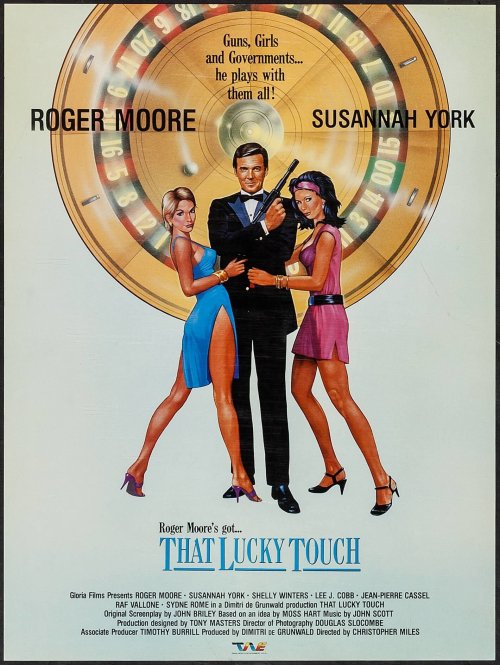
That Lucky Touch (1975)

lucky

By Richard Winters

My Rating: 4 out of 10

4-Word Review: Journalist and arms dealer.

Michael (Roger Moore) is an arms dealer who travels the globe looking for state-of-the-art weapons that he can sell. Julia (Susannah York) is a journalist who writes articles that abhors men who are into guns. The two reside in the same building, but have never met. One night Julia holds a party and while she is seeing her guests out her front door accidentally closes causing her to become locked-out of her apartment. Michael, who is on the outs with his ditzy, live-in girlfriend Sophie (Sydne Rome), decides to use this opportunity to put the moves on Julia. He invites her into his place, so she can call the landlord, but then unplugs the phone, so she’ll think it’s out-of-order and be forced to spend the night. Julia though turns-the-tables by ordering him out on the ledge and into the rainy night while demanding he get into her apartment through an open window. This then begins their love-hate cycle where every time they start to bond one of them finds out something about the other that they hate and thus begin to fight.

While the premise has potential the scenario is poorly plotted and hard to get into though the middle part does have some funny moments. The scene where Lee J. Cobb, who plays an army general, thinks he’s getting an important call from the President, as his red phone is blinking, but instead it’s from his scatterbrained wife, delightfully played by Shelley Winters, is hilarious. The segment dealing with Moore and York trying to get into her apartment is quite good too, but doesn’t get played-out enough as they take a trip to her landlord’s to get the key, but this part is never shown. However, so much time is spent with them trying to find every other way to get inside that I felt we should’ve included this part instead of suddenly cutting away and only implying what happened later.

What I didn’t like was the beginning where the scenes cut back-and-forth between Moore testing out some guns and York typing away without having any idea what they were doing, or why. It’s not until 15-minutes in that it gets revealed that these two live across from each other, which should’ve been established right away. The ending gets botched too as the second-half is spent on the couple, but ends by focusing solely on the secondary characters in an ill-advised screwball finale.

Moore’s acting helps. The glib way that he conveys his acerbic lines are amusing and I came away thinking he was much better in comedy and missed his calling by not doing more of them. York though seems miscast. She’s great in drama, but her comic timing is missing and she’s too hostile to the extent that you start to wonder why Moore’s character would have any interest in her at all. The part was originally intended for Sophia Loren, who would’ve been better and more age appropriate since there was only a few years difference between her and Moore versus the over 10-year gap that he had with York.

The supporting cast is solid especially Winters and Rome, but Cobb is the surprise as he spent his whole career doing dramas, but manages to be the funniest one here and it’s just a shame that this marked his final film appearance, he actually suffered a heart attack during the production. The soundtrack is pleasing too, but the flat script needed better fleshing-out.

My Rating: 4 out of 10

Released: August 7, 1975

Runtime: 1 Hour 33 Minutes

Rated PG

Director: Christopher Miles

Studio: Allied Artists Pictures

Available: DVD (Region 2 Import) DVD-R (dvdlady)
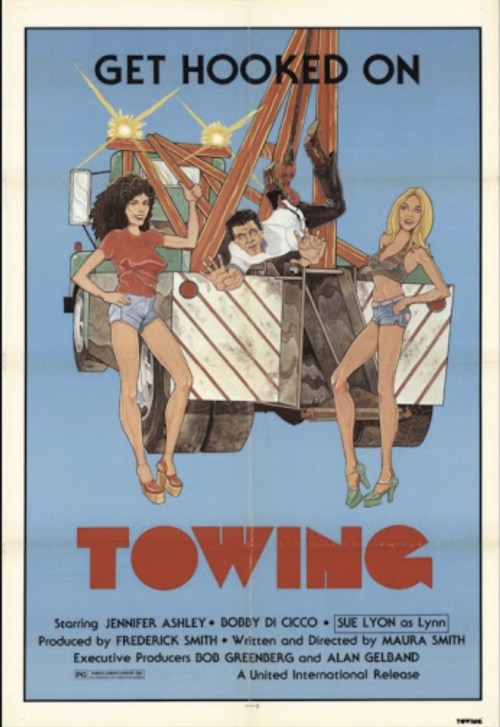
Towing (1978)

towing

By Richard Winters

My Rating: 2 out of 10

4-Word Review: Fighting a corrupt company.

Lynn (Sue Lyon) and Jean (Jennifer Ashley) are two friends who work at a bar and become increasingly aware of a corrupt towing company in town run by Butch (J.J. Johnston) that tows away cars for questionable reasons and then demands hefty fees for the owners to get them back. Many people in the city of Chicago have been affected and are considering starting-up protests, but when Jean gets fired from her job when a customer has his car towed that she parked is when things really get going. She then gets a job at a gas station across the street from where the towing company is located. She and Lynn as well as Lynn’s new lawyer boyfriend Chris (Joe Mantegna) trick Butch into towing away the Mayor’s daughter’s car, which soon gets him in on notice with the mayor himself.

Although she’s worked on several documentaries, for feature films this was a one-and-done project for writer/director Maura Smith as she hasn’t done another one since. The film looks cheap right from the start and initially I feared this was going to be rock-bottom fare, but it does improve enough to have a slight amiable quality. The story though is too threadbare to hold much interest and in attempt to ‘go for something deeper’ incorporates a side-story dealing with the challenges of being a single woman and going through a lot of empty, dead-end dates, but these segments don’t mesh with the frivolity and overall silliness of the rest and ultimately give the film an amateurish feel.

This obscurity’s biggest claim-to-fame is that it marks both the beginning and end of two careers. For Joe Mantegna this was his film debut and he does have one funny moment, probably the only funny moment of the whole film, where he tries to connect the chains of a tow truck to a car, but being a lawyer he doesn’t really know how to do it. For Sue Lyon this was her final starring role as her brief appearance in Alligatorwhich she did 2 years later was basically just a walk-on. This was also the final time she wore her patented long blonde hair as it was after this that she became a brunette and then ultimately raven-haired. For the most part she seems to be having fun while sporting an engaging smile and amused laugh throughout. She even at one point puts on a wig and pretends to be a hooker and in another part disguises her voice to sound like an old woman, but the production was about as low budget as you can get and I can see why she felt staying in the business wasn’t going to be worth it if this was all the better she was going to be offered.

Jennifer Ashley lends unique support as the flirtatious one who exudes a sensual energy and Johnston, who was at one time an amateur boxer who has written 4 books on the subject, is solid as the heavy and even, despite the script being written by a woman, allowed say to the C-word. My favorite though was Steven Kampmann, probably best known for playing Kirk Devane in the first two seasons of ‘Newhart’ before turning his energies full-time to screenwriting, who plays an angry citizen who helps the two women get back at the towing company though having him break-off to commit hi-jinks of his own along with his girlfriend (played by Audrie Neennan) takes away too much from the central lead characters and dilutes the plot.

The on-location shooting done in Chicago is nice especially with the way it focuses on the working class neighborhoods though I was surprised that even though it was filmed in October and November the scenery already looked quite cold and the actors appear to be shivering as they say their lines. The cool soundtrack has a funky beat and fun lyrics. Had the music been sold separately it would’ve attained a lot of fans and helps give the film some much needed personality and distinction that it otherwise lacks.

Alternate Title: Who Stole My Wheels?

My Rating: 2 out of 10

Released: May 5, 1978

Runtime: 1 Hour 16 Minutes

Rated PG

Director: Maura Smith

Studio: United International

Available: Amazon Video

Caddyshack (1980)

caddyshack1

By Richard Winters

My Rating: 7 out of 10

4-Word Review: Blow-up the gopher.

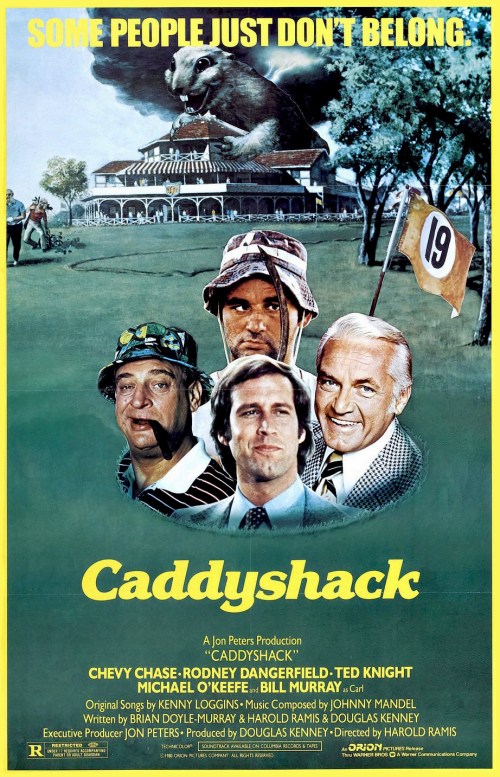
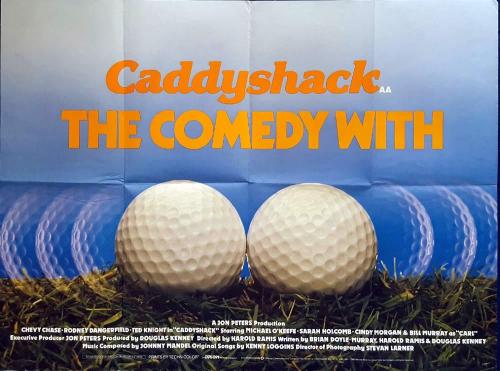
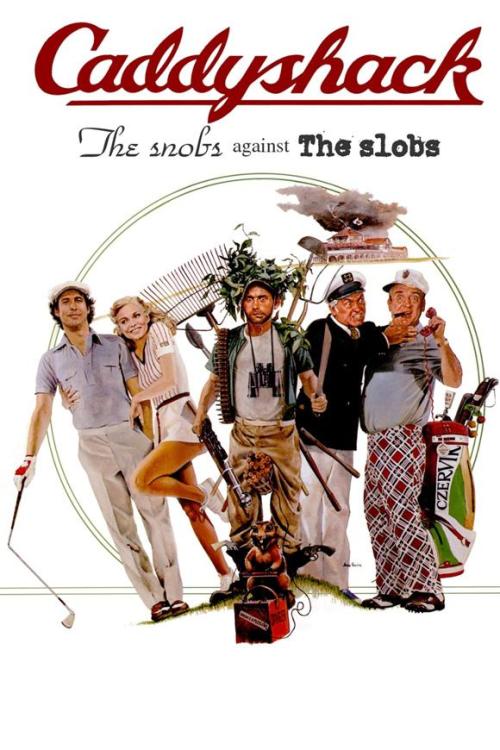
Trying to work his way through college, Danny (Michael O’Keefe) gets a job as a caddie at an exclusive golf course. He becomes friends with Ty (Chevy Chase) who is the son of the club’s co-founder. He also begins caddying for Judge Smails (Ted Knight) in hopes to get on his good side since the Judge is also in charge of the caddie scholarship program, which Danny hopes to win in order to help pay for his education. The Judge and Danny form a hot-and-cold relationship with the Judge usually more annoyed with Danny than not though he does warm-up to him after the Judge accidentally hits an elderly woman with a golf club that he recklessly threw, but gets off-the-hook for taking the responsibility when Danny comes forward and takes the blame. The man though that really causes the Judge’s ire is Al (Rodney Dangerfield) a wealthy real-estate tycoon, who begins golfing at the club and constantly makes fun of the judge at every turn. Al considers the judge to be an uptight elitist snob, while the judge sees Al as being uncouth and lacking in social graces. The two men ultimately square off in a high stakes golf match just as the club’s dim-witted groundskeeper Carl (Bill Murray) rigs the course up with tons of dynamite in an attempt to get rid of a pesky gopher that’s been destroying the grounds.

This was another film that upon its initial release, like with The Shining and  Blade Runnerwas given a lukewarm response by the critics, but has since then become a classic by the vast portion of the movie going public. Part of the reason this one didn’t gel well with the critics is because of what was considered ‘sloppy’ comedy that had very little story and relied too heavily on gags to keep it going. The script, written by Brian Doyle-Murray, brother of Bill, and Douglas Keeney, was supposed to emphasize the caddy’s more and be a coming-of-age comedy, but the producers, much to the writer’s dismay,  decided to throw-in more colorful characters including a gopher who chews up the course and constantly avoids capture, which was an idea that co-writer Douglas Kenney really hated. The result made the story come-off as being too loosely structured and more concerned with creating comical bits than making any type of statement.

I admit when I first saw this movie over 20-some odd years ago that’s how I came away feeling too, but this time I approached it more as a day-in-the-life saga between society’s have-and-have-nots with the caddies portraying the working class while the course’s nouveau riche clientele made up the establishment. When taken in this vein the film works really well and I especially liked the way the Danny and the Judge’s relationship evolves throughout with the judge ultimately much more dependent on Danny than you might’ve originally thought possible.

Of course it’s the comedy that makes it all come together and there’s truly some side-splitting moments including the infamous Babe Ruth candy bar in the pool bit that was the one thing about the movie that I had remembered when I first saw over 2-decades ago and now upon viewing it a second time had me rolling over in laughter even more especially when you realize that it apparently is based on a real-life incident that occurred to writer Doyle-Murray while he worked at a golf club in Winnetka, Illinois. I also really enjoyed the moment where we see Bill Murray’s incredibly makeshift living quarters inside the course’s utility shed that features a reunion between he and fellow SNL alum Chevy Chase. The two had gotten into a well publicized fist-fight behind-the-scenes while working on that show a couple years before, but both managed to work together in this scene, which had been written-in at the last minute by director Harold Ramis for exactly that purpose, without a hitch.

Rodney Dangerfield’s star-making turn as the crass, but wealthy patron is a riot too and I particularly enjoyed his over-sized, multi-purpose golf bag and his nervous fidgeting especially his twitchy legs when he stands, which was all genuine and anxiety driven. Knight quite good too in a perfect caricature of a pompous jerk though he reportedly was vocally upset during the production at the excessive partying and hijinks that went on amongst the rest of the cast members, including a lot of drug use, which he felt was unprofessional. I even liked Cindy Morgan as the Judge’s niece and resident ‘hot babe’ who despite being a blonde was fortunately not portrayed in the stereotype of being dumb, but instead as savvy and observant. Followed 8 years later by a sequel, which will be reviewed next.

caddyshack2

caddyshack3

My Rating: 7 out of 10

Released: July 25, 1980

Runtime: 1 Hour 38 Minutes

Rated R

Director: Harold Ramis

Studio: Warner Brothers

Available: DVD, Blu-ray, HD-DVD, Amazon Video, Hulu, YouTube

Little Miss Marker (1980)

little1

By Richard Winters

My Rating: 3 out of 10

4-Word Review: Kid used for collateral.

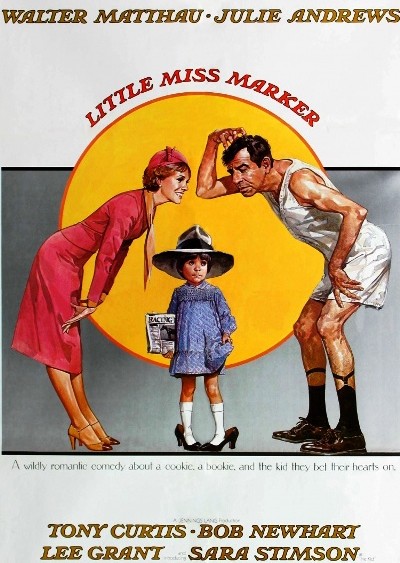
Sorrowful Jones (Walter Matthau) is a no-nonsense bookie running a gambling operation during the 30’s. When one of his clients named Carter (Andrew Rubin) cannot pay back his $10 debt he puts up his 6-year-old daughter (Sara Stimson), who is simply known as ‘the Kid’, as collateral. Sorrowful tells his assistant named Regret (Bob Newhart) to look after her, but Regret does not like kids, so he drops the young girl off at Sorrowful’s doorstep one night and then promptly leaves forcing Sorrowful to begrudgingly become her surrogate father figure. Eventually the two grow fond of each other and become inseparable, as does Amanda (Julie Andrews) who’s the girlfriend to a crime boss named Blackie (Tony Curtis). Blackie does not like that Sorrowful is showing an interest in Amanda, or her in him and  proceeds to try and throw a monkey-wrench into their potential affair while also coercing Sorrowful to partner with him in a fixed horse race.

This film was the fourth remake of the story that originally came out in 1934 and starred Adolphe Menjou as Sorrowful and Shirley Temple as the Kid. In 1949 it got remade with Bob Hope playing Sorrowful and Mary Jane Saunders as the child. Then is 1962 a variation of the story was was done called 40 Pounds of Trouble that was shot on-location in Disneyland and starred Tony Curtis in the Sorrowful role, though the character name was changed to Steve, and Claire Wilcox portraying the child, whose name in the film was Penny. While I have not seen any of those versions I still came away feeling this one had to be the weakest. A lot of the problem is that the script relies too heavily on the cuteness factor of the child, who is certainly adorable, but has no discernable personality. It’s also hard to imagine that a child who has just been abandoned by her father, and had also gone through the trauma of the death of her mother, would be so well-behaved and in reality would probably be showing some serious adjustment issues.

I’m not sure why Matthau, who also produced, thought this project would be a good idea, but appearing in it did not bolster his career. Didn’t he ever hear of the old adage never share the screen with animals or cute kids as they’ll just steal away all the attention? It’s not like Stimson, whose only movie role this was and who now works as a pediatrician in Arizona,  didn’t have to do anything special for that to happen as her big blue eyes are enough to capture the heartstrings of just about any viewer. I also had a hard time understanding his character particularly the fact that he was this brash, tough talking bookie yet doesn’t carry a gun nor have any fighting skills as proven by the fistfight he attempts to have with Curtis where even though Curtis was shorter Matthau he’s is still frightened of him and constantly backing away whenever Curtis got in his face. You’d think a streetwise person would have some ability to defend himself if needed and not just slink away the second someone else, particularly one who was smaller, suddenly got aggressive.

Bob Newhart gets completely wasted in a role that’s so small and insignificant I’m surprised why he even took it. I also didn’t think this was the right movie for Julie Andrews either. Sure, she has an engaging quality, but for a woman dating a crime boss she seemed way too pure and innocent almost like she was completely oblivious to his underhanded nature. In reality the people one hangs out with will inevitably rub off on that person and a more realistic portrayal would’ve had her being a bit corrupt, which would’ve actually been more interesting as it would’ve created a two-dimensional character who was cold and conniving most of the time, but then when the kid comes along a softer side gets exposed.

In contrast both Curtis and Brian Dennehy, who plays his henchmen, are a delight and needed more screen time. It’s interesting too seeing Lee Grant appear near the end playing a judge and almost unrecognizable in a gray wig, but the story as a whole flounders chiefly because, outside of the scenes showing a fixed horserace, there’s no action at all, which makes it absurd to call this a ‘family movie’. If I, as an adult, was bored I can only imagine a kid being even more so. In fact I’d say this movie really wasn’t made for kids at all, but instead little old ladies who enjoy cutesy kids the way they like cutesy puppy dogs and want children only shown as being adorable even though kids, like with everyone else, can have their bad side, which conveniently gets left out here.

My Rating: 3 out of 10

Released: March 21, 1980

Runtime: 1 Hour 43 Minutes

Rated PG

Director: Walter Bernstein

Studio: Universal

Available: DVD, Blu-ray

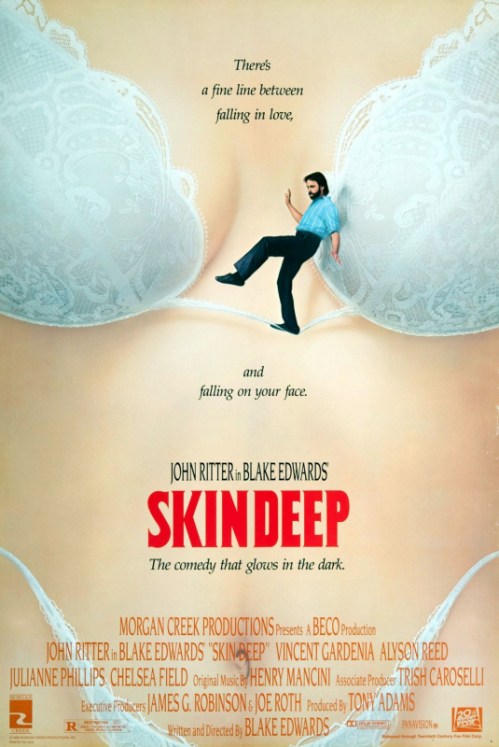
Skin Deep (1989)

skin3

By Richard Winters

My Rating: 3 out of 10

4-Word Review: Womanizer tries to rehabilitate.

Zach (John Ritter) is a successful, best-selling author, but hasn’t written a novel in quite awhile and his constant philandering has gotten his wife Alex (Alyson Reed) to leave him. Depressed about his circumstances he becomes an alcoholic, but uses the advice of his kindly bartender (Vincent Gardenia) to try and win her back, but finds fighting his hedonistic urges to be challenging.

This marked Blake Edwards fourth film dealing with the mid-life crisis issue that started with 10 in 1979 and was followed up with S.O.Bin 1981 and then That’s Life in 1986. All four had a similar setting (Malibu/Hollywood) and involved middle-aged men at a crossroads in their career/marriages. When 10 came out it was considered ‘fresh’, but by 1989 the storyline was becoming quite redundant and came-off looking like Blake’s creative well had run dry. Edwards also exposes himself as being too entrenched in the Hollywood scene and out-of-touch with the middle-class lifestyle as Zach is never in any type of financial distress despite a career lull and having his mansion burn down (he wasn’t able to collect on the insurance money due to it being caused by arson) and yet still able to stay at posh beach houses and luxury hotels. In the end his only concern is his insatiable appetite for hot women, which ultimately comes-off as plastic problems for plastic people.

The women look too much alike, including Chelsea Field, who plays Amy and Jean Marie McKee who is Rebecca. Both of these women were brunettes, the same age, and with similar hairstyles and when seeing them from behind I thought they were the same person. Zach also states that he loves ‘all women’, but only beds the hot ones. The film tries to make-up for this by having him have a sexual encounter with a female bodybuilder (Raye Hollitt), but overall they still end up looking too much like the caricature of a Hollywood Hooker.

Even Ritter, as engaging as he usually is, flops here. A lot of it has to do with his beard, which I hated. I suppose they wanted him to look different from his more famous Jack Tripper character, but turning him into an image resembling the guy on the packages of Brawny paper towels wasn’t it. Since his character does go through a transition they should’ve had him start-out clean-shaven and then as his life goes into turmoil gotten the beard only to shave it off once things returned to normal.

Zach’s incessant whining at trying to win his wife back is what really got on my nerves the most. She was right to walk out on him and he didn’t deserve a ‘do-over’. Besides not everyone is going to find happiness in a committed relationship and, even though this might’ve been ahead-of-its-time for 80’s audiences, an alternative lifestyle would’ve been a better fit like having him get into polyamory, or sex workers. As mentioned the women all looked like hookers anyways and since he seemed to have a boundless cache of cash he could’ve easily afforded them.

I did like the glow-in-the-dark condom scene, which is the film’s only funny moment and happens at the 50-minute mark. Gardenia as the intuitive bartender is amusing too and I didn’t think there was any need for Zach to see an actual therapist as the bartender’s advice was just as good and much less costly.

There are a few bits that have not aged well including Zach’s penchant for kissing a bar maids without her consent and with him sitting on a small dog and seemingly killing it. Overall, I found it superficial and trite and the only successful thing about it is that it lives up to its title.

My Rating: 3 out of 10

Release: February 28, 1989

Runtime: 1 Hour 41 Minutes

Rated R

Director: Blake Edwards

Studio: 20th Century Fox

Available: DVD, Blu-ray, Amazon Video, YouTube

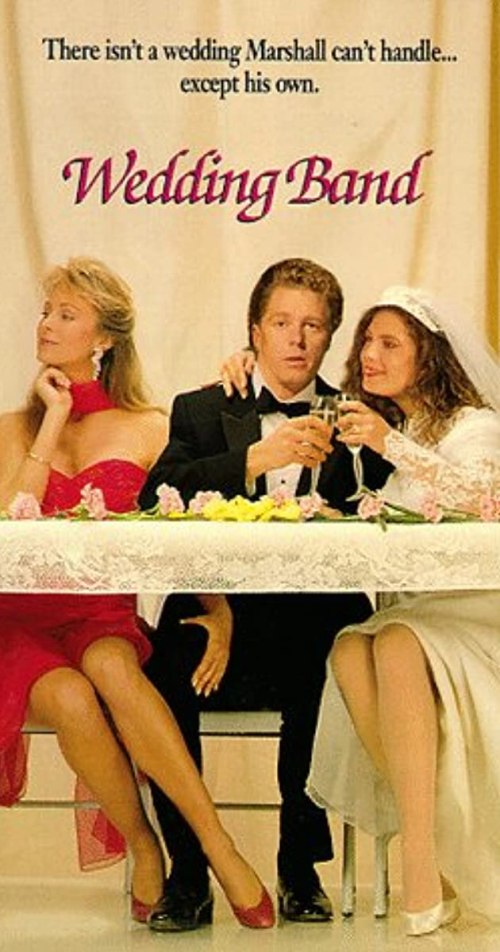
Wedding Band (1989)

By Richard Winters

My Rating: 1 out of 10

4-Word Review: He loves his job.

Marshall (William Katt) is the lead singer for a band that plays at weddings. Karla (Joyce Hyser) is a wedding planner, who has been dating Marshall for 5 years. The two finally get engaged, but now Karla wants Marshall to ‘become responsible’ by getting a ‘real job’, but Marshall loves his band so much that he doesn’t want to give it up even if it doesn’t pay that well.

Misfire comedy, written by Tino Insana who also plays the character of Hugh Bowmont, that tries hard to be a rom-com while also mixing in a playfully surreal element, but it doesn’t gel.  The problem lies with a storyline that is too basic and offers no insight or nuance. I worked as a DJ for weddings back in the 90’s and none of the experiences I or my friends went through gets examined here. In real-life there’s always concerns about getting paid, or tipped, or how much of a tip you’ll get. Or there’s the issues of dealing with a Bridezilla, or Groomzilla for that matter that insist everything must be perfect and if even one thing isn’t they refuse to pay, or demand a refund. Faulty equipment and obnoxious, drunk party guests are other headaches that just about every wedding DJ, singer, or photographer will have horror stories about and yet none of these things gets touched upon here. It’s almost like the filmmakers never worked as a wedding singer themselves, had no idea what it was really like, and just made up goofy scenarios that have no bearing in reality whatsoever.

The relationship angle comes off as quite sterile as the two don’t seem to have anything in common and you wonder what attracted them to each other in the first place. I couldn’t understand why Karla would be surprised that Marshall didn’t want to quit his job and do something that he didn’t enjoy. She was supposedly ‘really into him’, so she should’ve known about his passion for his job and if she got into a relationship with him that most likely the job would come with it. It’s clear to the viewer right away that he enjoys being a wedding singer, so after dating him for 5 years why is it not clear for her?

There are a few quirky moments like the segment dealing with a bug exterminator, but this has nothing to do with the main story and doesn’t even have either of the main characters in it. If they wanted to show part-time work that Marshall needed to do on the side to help supplement his income then great, but having a lot of drawn-out scenes dealing with what his bandmates do in their private time does not work because it’s the main characters that the viewer should be into not the minor supporting ones.

Some familiar faces who were not yet famous pop-up in bit parts. Some of these include Robert Wuhl as a waiter, David Rashe as a man who loves his DeLorean car above all else, Eddie Deezen as a would-be professional clown, and Pauly Shore as a a guy who does band rehearsals in his garage that annoy his neighbors. Cult film director Penelope Spheeris also appears as Shore’s defensive mother, but she delivers her lines in such a poor way that it’s clear she’s best behind the camera. My favorite actor out of all of them was Fran Drescher, who plays Karla’s friend and is so good, without having to try all that hard, that she should’ve played the main character as both Hyser and Katt are deadly dull, which is another reason why this already botched film doesn’t work.

My Rating: 1 out of 10

Released: October 28, 1989

Runtime: 1 Hour 22 Minutes

Rated R

Director: Daniel Raskov

Studio: IRS Media

Available: VHS

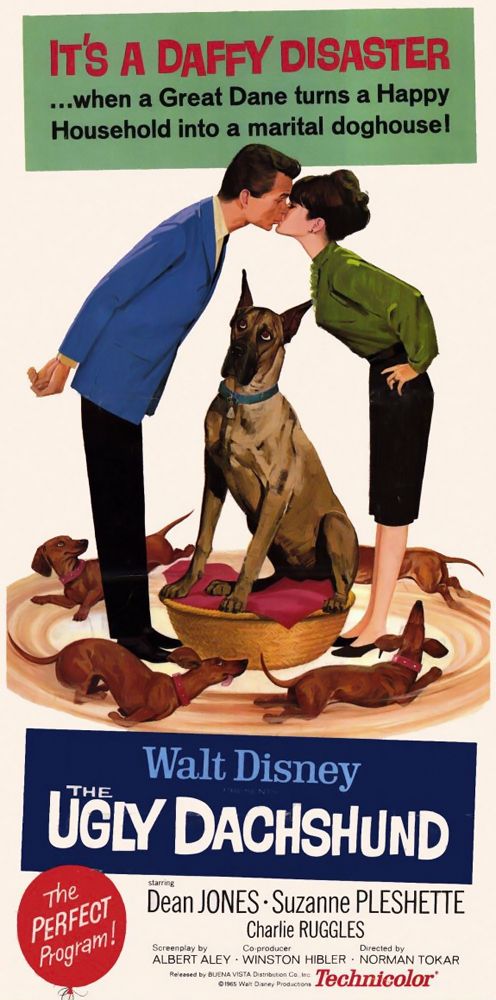
The Ugly Dachshund (1966)

By Richard Winters

My Rating: 7 out of 10

4-Word Review: Dog has identity crisis.

Fran (Suzanne Pleshette) and Mark (Dean Jones) are a married couple who are proud owners of a dachshund named Danke. When they take her to the pet hospital to give birth to her liter the veterinarian (Charlie Ruggles) mentions to Mark that he has a Great Dane on hand that has also given birth, but pushed away one of  her puppies due to having a lack of milk for him. Mark decides to take the pup home and pretend that he’s one of the liter, but it soon becomes apparent to Fran that he isn’t. The dog, who Mark names Brutus, starts to think that he’s a dachshund like the others and even tries to walk like them, but his large size causes many problems for the homeowners as he inadvertently destroys much of the home, which is usually at the instigation of the other dogs who never get blamed. Fran pressures Mark to get rid of the dog, but he continually refuses, which eventually puts a strain on their marriage.

For a Disney movie this one, which is based on the 1938 novel of the same name by Gladys Bronwyn Brown, isn’t too bad and has much better character development than many of the others that the studio produced. The distinction between their personalities is clear as is the dynamics of the marriage where each learns, like in any real union, to begrudgingly give-and-take in order to make the other partner happy. The film though comes off as quite dated in the fact that they sleep in separate beds, I guess seeing them in the same bed would’ve been considered by some in that era as ‘racy’, but what’s the use of getting married if you still end up having to sleep alone?

The comedy starts out a bit slow and young children may get bored with it at the beginning, but it does redeem itself once the dogs proceed to destroy everything in sight. It’s refreshing change to see animals causing the chaos instead of goofy people like in the other Disney flicks and they’re a lot funnier at it too, but the adult side of me had to cringe a bit knowing all the money it was costing the homeowners seeing their place and everything in it turned to shreds. It also hurts the humor that Brutus is always constantly getting blamed for the mess when it’s really the bratty dachshund’s that cause it, but are never adequately punished. Certain modern viewers may also be uncomfortable with the Japanese themed party that the couple hold at their home, which also gets destroyed by the dogs, as it features a lot of cultural appropriation, which in this era has become a big no-no.

The three acts serve as three distinctly different stories. The first one deals with the couple feuding over the dog, the second one has a cat burglar on the prowl, and the third centers on Mark training Brutus for a dog show. While the cat burglar thread does feature a funny scene where Brutus forces a policeman, played by Kelly Thordsen, up a tree and traps him there the entire night, we never get to see the actual burglar. The story would’ve been stronger had the dog caught the real bad guy instead of just scaring an innocent man due to mistaken identity. The third story is weak too as Brutus had very little training before he enters the contest, which seemed rushed and unrealistic.

The only real complaint that I had with the movie, which I overall found to be kind of cute,  was that the two main characters should’ve been children instead of adults. This is a kids movie and kids relate better to protagonists who are their same age. Having a sister into her dachshunds and a brother in love with a Great Dane would’ve entered in some interesting variables though Jones and Pleshette play their parts well and they reteamed 10 years later as another married couple in the The Shaggy D.A. 

My Rating: 7 out of 10

Released: February 4, 1966

Runtime: 1 Hour 33 Minutes

Not Rated

Director: Norman Tokar

Studio: Buena Vista

Available: DVD, Amazon Video, YouTube

Nickel Queen (1971)

By Richard Winters

My Rating: 4 out of 10

4-Word Review: Bar owner gets rich.

Meg Blake (Googie Withers) is a widow who owns a pub in a small desert town that has only 10 people living in it. She finds it hard to make ends meet until she hears about a nickel discovery in the outback and decides to be the first one to stake her claim to the land. Little does she know that corrupt executive Ed Benson (Alfred Sandor) fabricated the rumor of a nickel discovery simply so he could sell shares to gullible investors and Meg’s stake of land is actually worth nothing, but because Ed wants other people to also buy shares he pretends that Meg has already gotten rich through her investment and gives her $100,000 up front and parades her around the media while calling her the Nickel Queen. Meg laps up the publicity and spends her newfound fortune lavishly only to ultimately learn, once all her money is gone, that it was a hoax, which causes her and the other angry investors to go after Ed for revenge.

The story was inspired by the real-life event known as the Poseidon Bubble, which occurred in Australia in 1969, where shares in mining soared upon the discovery of a nickel deposit in September of that year only to quickly crash by early 1970 once it was found that the nickel was of a lower quality than initially thought causing many investors to loose a lot of money. Had the film stuck more to the true life event it might’ve had potential, but the way it gets played-out here is rather tepid.

It starts off alright and Withers, acting in front of the camera for the first time in 13 years, creates an engaging character who doesn’t back down to anyone and never hesitates to speak-her-mind. Unfortunately her tenacious personality does not get played-up enough. Once she becomes a media darling her wisecracks no longer have any zing and she falls into Ed’s trap too easily.  During the second half her presence is rather minor as she becomes this naïve person who must depend on her old friend Harry (Ed Devereaux) to get her out of her jam and exposing the corrupt Ed instead of she being the one to do that on her own.

The supporting cast is equally wasted. Initially the hippie guru character of Claude (played by John Laws who was and still is a famous Australian radio personality) seemed interesting as his values and outlook on things, particularly his refusal to work, contrasted greatly with Meg’s making it seem like the two would be sharing some wildly over-the-top confrontations. Instead Claude takes an extreme pivot midway through by showing up as a clean-shaven man willing to sell-out for money and even ends up becoming Meg’s lover, but what’s the point of him starting out one way if he’s just going to end up being the polar opposite? The transition is not revealing or introspective and shows how the filmmakers, who were all over 50, had no understanding of the counter-culture movement at all.

Doreen Warburton, who plays Ed’s gluttonous wife, is equally problematic.  The running joke of seeing her constantly stuffing her face with food gets pretty old, pretty fast to the point that it starts to get kind of disgusting to look at. Not having her utter a single word of dialogue is weird too making it seem like she’s not even human, but simply an unfunny and highly stereotyped caricature.

I liked how the first half was shot in an actual ghost town known as Broad Arrow and having the action take place in some of the town’s abandoned buildings gave the film an added visual flair, but this gets completely lost during the second-half when everything moves to the big city of Perth. The music is yet another issue as it sounds like something from the 40’s or 50’s and completely out-of-touch with the times. A lot of the cast is made up of hippies, so the soundtrack should’ve reflected more of their tastes.

Ultimately the film suffers from being too much of a family project. Writer/director John McCallum was star Googie’s husband and there’s even a part for their daughter Joanna McCallum, who plays Meg’s hippie daughter. While this may have been a fun project to work on from their perspective it offers little in the way that is satisfying to the viewer. The plot is poorly constructed and the wrap-up too tidy making it seem like material better suited for a TV-sitcom than the big screen.

My Rating: 4 out of 10

Released: April 1, 1971

Runtime: 1 Hour 27 Minutes

Director: John McCallum

Studio: British Empire Films Australia

Available: None

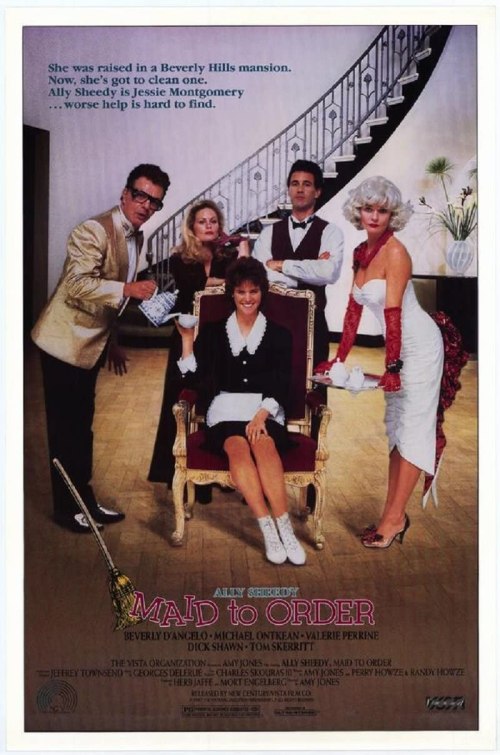
Maid to Order (1987)

By Richard Winters

My Rating: 3 out of 10

4-Word Review: Rich girl becomes servant.

Jessie (Ally Sheedy) is a spoiled rich girl still living at home with her philanthropist father (Tom Skerrit). Even though she’s in her mid-20’s she has never worked a job due to her father’s fortunes and she takes everything for granted seemingly unaware of her privileged lifestyle and how it affects others. Her father becomes frustrated with her cavalier attitude and one day speaks out loud that he wished he never had a daughter, which summons a fairy godmother named Stella (Beverly D’Angelo) to come to earth and erase all memory of Jessie from him. Now Jessie must learn to survive on her own, but without any job skills. She finds work from a rich Malibu couple (Dick Shawn, Valerie Perrine) who are practicing ‘reverse affirmative action’ by hiring white woman in the role of the household maid instead of a Hispanic or Black one. Jessie, now desperate for money, readily accepts the offer, but her inability to do even basic household chores causes her employment to be in almost constant jeopardy.

The main character is what really hurts this one and it’s not so much that she’s unlikable either, which she isn’t,, but more because her personality is too watered down. This is the type of role that needed a real bitchy lady that exuded snobbery at every turn like Alison Arngrim who played Nellie Oleson the brat in the old TV-show ‘Little House on the Prairie’ or maybe even Shannen Doherty from ‘Beverly Hills, 90210’ fame. Sheedy is just plain unable to play-up the bitchiness enough coming-off more like someone who lacks self-awareness instead of an elitist snob, which then makes her transition to humbleness not as interesting, dramatic, or funny. I’ve liked Sheedy in some of her other films and I realize she was trying to broaden her acting resume her by playing against-type, but she lacks the necessary charisma to keep it engaging.

The limp plot doesn’t help things either. It’s way too obvious where it’s headed and the viewer can easily predict the plot points before they even happen. There needed to be more confrontation from the contrasting personalities and more comedy from the quirky situation instead of the annoying life lessons that makes it seem almost like some afterschool special. Everything is aimed too much at the pre-teen audience, which leaves very little for a discernable adult tp enjoy.

The fairy godmother concept is a bit batty too. Why does a fairy answer this father’s wish, but no one else’s? Many people make wishes all the time, but no fairy godmother ever gets summoned, so what makes this situation so special? The script should’ve implemented some sort of side-story involving the father, or maybe even Jessie, getting involved in mysticism, which could’ve helped explain why this otherwise unusual incident then occurs.

I did however, really enjoy Dick Shawn in a very funny portrayal of the nouveau riche and he along with Beverly D’Angelo as the wise-cracking fairy godmother needed far more screen time. I was especially perplexed how underwritten D’Angelo’s part was as she plays a role that is quite fundamental to the story, but not in it half as much as you’d expect though her snarky remarks give this otherwise vapid material some much needed energy for the few minutes that she has.

Valerie Perrine, as Shawn’s wife, isn’t as amusing though her variety of gaudy outfits, and hairstyles, does at least lend visual flair. Skeritt though is completely deadening and it’s amazing how this guy has been acting on the screen since 1962 and yet the vast majority of his work is highly forgettable despite some of the movies he’s been in being memorable in other ways. Same for Michael Ontkean as Jessie’s romantic interest, he’s got the perfect pretty-boy face and hunky body, but seemingly no actual personality.

My Rating: 3 out of 10

Released: July 31, 1987

Runtime: 1 Hour 33 Minutes

Rated PG

Director: Amy Holden Jones

Studio: New Century Vista Film Company

Available: DVD

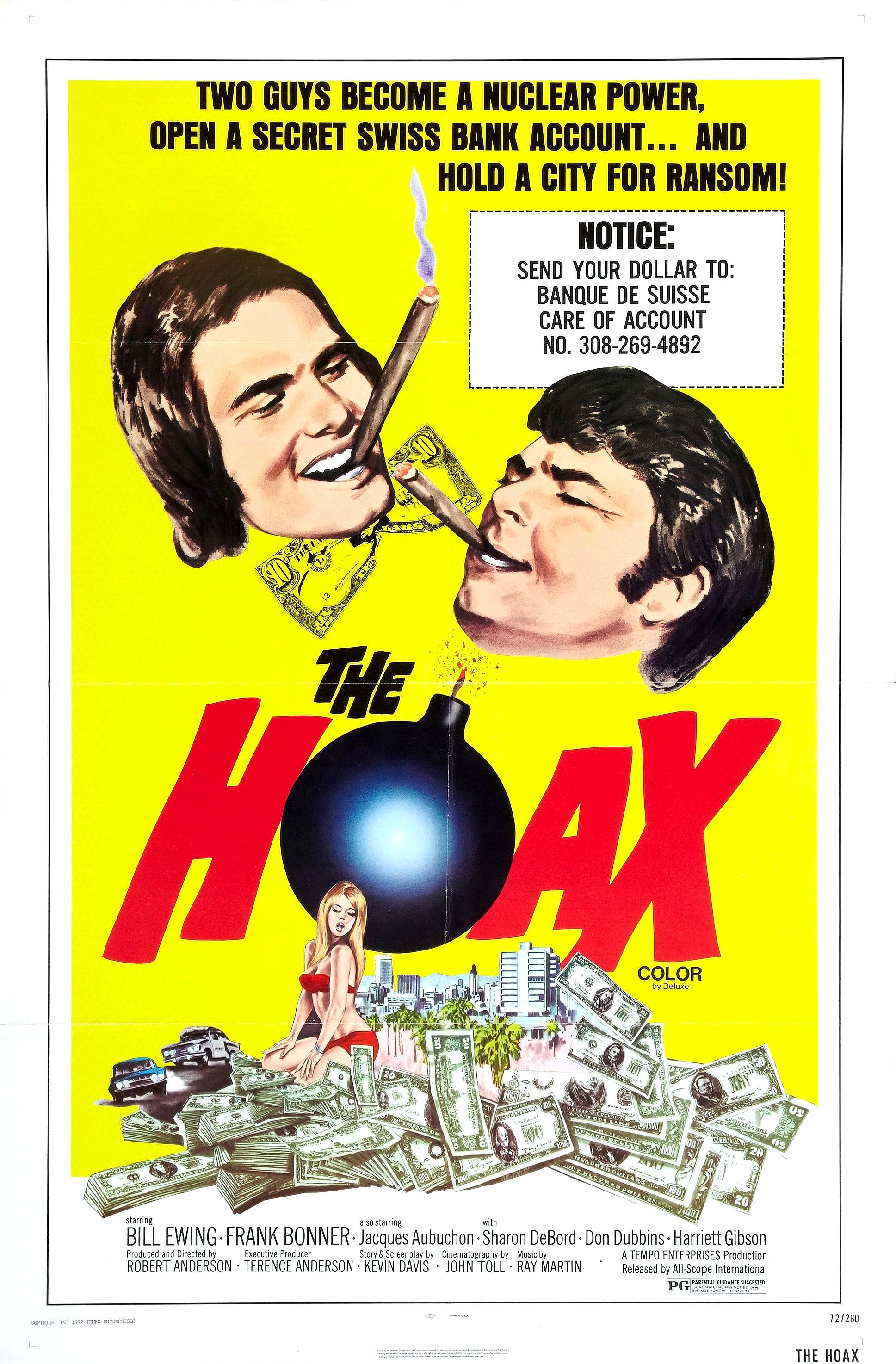
The Hoax (1972)

hoax2

By Richard Winters

My Rating: 3 out of 10

4-word Review: Hiding H-bomb for ransom.

Cy (Bill Ewing) and Clete (Frank Bonner) are two friends who enjoy scuba diving. One day while at the beach they come upon a missing H-bomb hidden in some shallow water. Cy comes up with the idea of holding it for ransom by sending a letter to the press stating that they have the bomb, which has been reported missing by the military, and will detonate it unless each citizen of Los Angeles sends them one dollar to a specific bank account that they’ve opened in Switzerland. Things go smoothly at first until the police chief (Jacques Aubuchon) figures out who they are and begins tracking them down.

The only reasons that this film is worth catching is to see Frank Bonner, who later became famous for playing Herb Tarlek in the TV-show ‘WKRP in Cincinnati’, in an early role. In WKRP he played a character who wore loud suits and was obnoxious, but here that’s what his buddy does while he is more like a geek. Seeing him play an opposite type of character is amusing, but besides that there’s not much else that’s interesting.

For one thing the viewer should’ve actually seen the bomb, which we never do. We see its sharp metal edge that sticks up above the waterline, but not the bomb itself and since movies are a visual medium it’s important to use that as much as possible. The two also never remove the bomb from where they find it, which seemed dumb because anyone else could come along and take it away and then their scheme would be ruined. It made more sense to move it to a place where it could be hidden and this then would open the door for a lot of comical antics dealing with their difficulties carrying it around and keeping it undercover, but the film doesn’t take this route and becomes quite stagnant in the process.

The two friends share no comical banter either and are also in too much agreement, so there’s never any underlying tension. Sometimes onscreen realtionships/friendships are more compelling when there’s discord. It also seemed odd why they even felt the need to hatch such a scheme in the first place as both were doing okay financially. Cy was living with his girlfriend (Sharon DeBord), who had money, in a nice pad on the beach while Clete had a good job. In order for these otherwise law abiding citizens to suddenly go to criminal extremes there should’ve been a more desperate reason like having them homeless, which would’ve garnered more sympathetic from the viewer instead of just being two doofuses doing something nutty on a lark.

Turning the cops into buffoonish clowns was a mistake too as the humor becomes forced and their ineptness offers no intrigue. The running joke involving a vagabond drunk gets ridiculous as he’s always inadvertently showings up wherever the two men are making it seem like he might’ve been an undercover cop, which would’ve made more sense, but instead his occasional appearances have no bearing to the story at all and just gets thrown in for cheap laughs.

The final five minutes do offer a few unexpected twists, but by then it’s too late. I felt the script had gotten written with the ending as the starting point since that was the only inspired part of the movie, but this just proves that having a novel finish will do you no good if everything that comes before it is a bore.

My Rating: 3 out of 10

Released: April 19, 1972

Runtime: 1 Hour 23 Minutes

Rated PG

Director: Robert Anderson

Studio: All-Scope International

Available: None at this time.