Category Archives: Black Comedy

Poltergeist (1982)

poltergeist2

By Richard Winters

My Rating: 7 out of 10

4-Word Review: Ghosts terrorize a family.

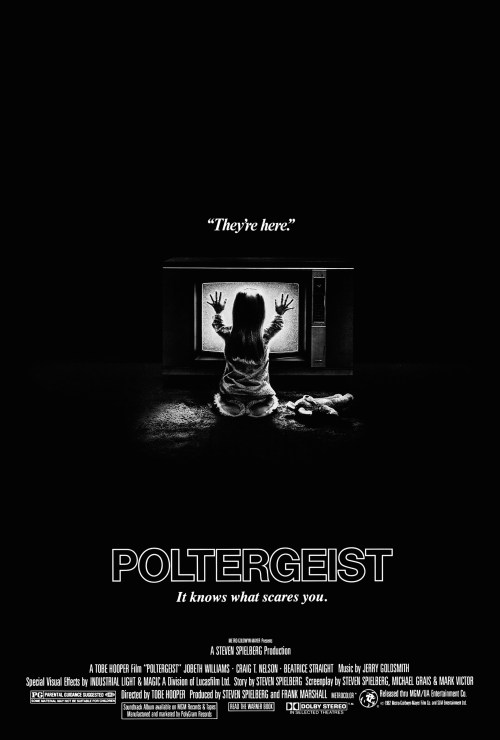
A suburbanite family of five find their idyllic existence suddenly turn frightening when odd, unexplained events begin occurring inside their house. First it’s voices that can be heard coming from their television that only their 6-year-old daughter Carol Ann (Heather O’Rourke) can seem to make out. Then it’s the movement of the kitchen chairs that can glide across the floor without any help. There’s even the shaking of their entire house that they initially attribute to being an earthquake. Things though grow more serious when Carol Ann goes missing after a violent thunderstorm where her voice can only be heard coming through the television. Parapsychologist Martha (Beatrice Straight) and her team of two men (Richard Lawson, Martin Casella) get called in, but they find the conditions too extreme even for them, so instead a short statured spiritual medium named Tangina (Zelda Rubenstein) is hired. She determines that the home is being haunted by spirits who are ‘not at rest’ and may have something to do with the place being built on top of what used to be a cemetery.

The film, which was based on an idea by Steven Spielberg, who also produced, is known more for its behind-the-scenes drama, including the violent and untimely deaths of some of the cast members, which has gotten the production labeled as ‘cursed’, and for supposedly the in-fighting that occurred between Spielberg and Tobe Hooper who was brought in to direct when Steven was contractually unable to due to also directing E.T. From my perspective I can see it going both ways. It certainly has the strong atmosphere of a Hooper flick, but also done in a way so that even children could watch it and still not be too traumatized. Spielberg, who did all the casting and also storyboarded each and every scene, was known to want to make movies that the whole family could see and always wanted to keep his films, even his thrillers, at a PG rated level.

For what it’s worth I found it gripping, despite the slow start, from beginning to end and refreshing that an old fashioned ghost story was being brought back into the mainstream as too many horror movies of that period were slasher flicks, which was hurting the genre. This film emphasizes story and uses both imaginative effects and plot twists to keep it fun and surprising throughout.

Intentional or not the female characters were some of the movie’s stronger elements. O’Rourke of course, who’s become the face of the franchise, is adorable and with her bright blue eyes and blonde hair a certain angelic quality amidst the dark undertones. Rubenstein is a delight as both her height, voice and glasses, which seem to envelope her entire face, makes her presence quite memorable. Straight though is effective too as an elderly woman who at times seems ready to take on the ghostly presence and at other moments quite shaken up by them. Jobeth Williams though I found surprisingly fun as the sort of hip wife/mother who smokes pot and initially finds the weird events that go on more fun than scary. Only the presence of Dominique Dunne seemed unnecessary as she’s not in it all that much and goes off to either her friend’s house, or boyfriend’s through most of it only to conveniently reappear right at the end. Her jet black hair clashes with O’Rourke’s bright blonde, which makes for an odd gene anomaly to have sisters with such contrasting looks though this later gets explained in the book version as Dunne being the father’s daughter from his first marriage.

The special effects are a letdown. The ghostly hand reaching out of the TV-set looked too much like animation as did the very fake looking tornado, which appeared almost like it had been drawn in via black magic marker directly onto the film negative. The flying toys in the children’s room had a bit of an animated quality and the scary tree that sat outside the boy’s window looked too odd and not like any typical tree I’ve ever seen. It’s also disappointing that we never see this other dimension that Carol Ann gets trapped in we observe objects going in and out of it, returning with some sort of weird red substance that resembled raspberry jello, but the viewer really should’ve experienced this unique other world with the characters that go through it.

The TV stations signing off for the night while playing the National Anthem is something today’s audiences won’t understand as everything is 24-hours, but in the old days stations only broadcast during the day, but even here it’s a bit questionable. I was around in the early 80’s where most stations, especially in the big cities, were already running programs 24 hours a day making the sign-off angle, which is very prominently featured, dated even for then. Also, when stations did sign-off as I remember it would be a black screen that you’d see and not just static like it gets portrayed here. There was also such thing as cable back then making the prospect of static even less likely and you’d think a family that could afford a nice house like that would also have enough for a cable box.

Spoiler Alert!

The ending is a bit problematic as it has the two young kids returning to sleep in the bedroom that was once haunted. This is because Tangia states that the home has been ‘cleaned’ of the ghosts, but turns out not to be true. In either event I can’t imagine an adult let alone a kid being able to relax, or even step one foot in a room that had so many freaky things happen in it. I’d think the parents would be too nervous to even let them go in, so seeing the kids back in there like what occurred before was ‘no big deal’ proves unrealistic to say the least.

My Rating: 7 out of 10

Released: June 4, 1982

Runtime: 1 Hour 54 Minutes

Rated PG

Director: Tobe Hooper

Studio: MGM

Available: DVD, Blu-ray, Amazon Video, YouTube
Haunted Honeymoon (1986)

haunted

By Richard Winters

My Rating: 1 out of 10

4-Word Review: Boyhood home is haunted.

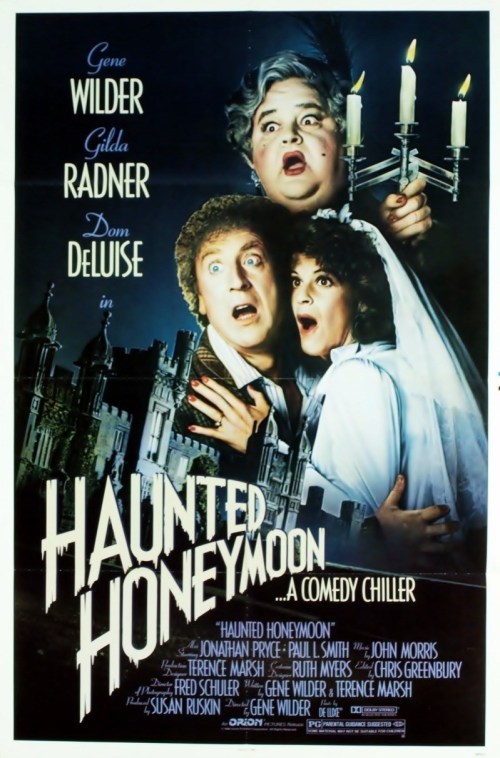
Larry (Gene Wilder) and Vickie (Gilda Radner) are performers on a popular radio show who are also engaged to be married. Ever since the wedding date has been set Larry has been going through a variety of odd behaviors including flubbing his lines and even making incoherent statements during the production that go over the air. Vickie thinks it’s just his nerves about getting married, but Dr. Paul Abbott (Paul L. Smith), who also happens to be Larry’s uncle, thinks it’s much more than that. He feels the only way to cure him will be shock therapy, or in this case to ‘scare him to death’. Since Larry plans on having his wedding at his boyhood home, which is an old rural castle, the doctor feels this will be the perfect spot to engage with the frights. Everyone on the premises is in on the plan, eventually even including Vickie, but as the make believe haunting commences it soon becomes obvious that there’s some real scares too that frightens everyone.

Gene grew up as a child reportedly scared of horror movies and tried to avoid them, but did enjoy what he called ‘comedy chillers’, which were movies that had some scares, but also balanced with laughs and sought out to create one of his own. He started writing the script while he was starring in Silver Streak, but then lost interest and put it away. While he was filming Hanky Pankyin which he met Radner whom he later married, he got interested in continuing with the script especially at her insistence as she felt it would make a great vehicle for the two.

The problem with it is that he created something completely out of touch with the times. Haunted houses, werewolves and other elements from 1930’s movies had all been parodied for decades to the point it had almost become a cliche in itself. This film adds nothing fresh to the mix and feeds off of gags and stunts that had been done hundreds of times making it lame right from the start. Had it been more updated to add in elements from modern day horror movies, or changed the setting so it wasn’t just the predictable rural castle complete with thunder and lightning outside, then maybe it might’ve had a chance, or at least piqued people’s interests, but as it is here the stuff is routine and lacking in originality.

The biggest shock is that you have Dom DeLuise in full drag and yet he isn’t funny at all. Wilder got the idea to use him for the part when he saw him impersonate Ethel Barrymore years earlier at a dinner theater he attended, but the mistake was that Gene wanted him to literally play it straight, but why put a guy in full female get-up if you’re not going to give it any type of payoff? It’s a shame too because I’ve found Dom to sometimes be quite hilarious and even be the scene stealer in some of his other films. Jonathan Pryce, who was also in the movie, stated how the entire cast and crew would sit around and let Dom entertain them between takes, but whatever he said and did off camera was missing onscreen and even the duet that he sings with Gilda fails to elicit even a chuckle.

The story creates this big set-up and then goes nowhere with it. Gene gives himself a few amusing bits and I suppose Bryan Pringle, who plays the aging butler named Pfister, and even Ann Way with her distinctive hawk-like facial features, have a couple of funny moments, but everything else falls flat including Radner who isn’t funny at all and overall given a very thankless part by no less than her own husband.

The film lost money at the box office and despite a month of promotions and ads it only managed to remain in theaters for week before it was pulled. It polled poorly amongst critics and audiences alike, which is probably the only real funny thing is what occurred behind-the-scense as the studio, Orion Pictures, refused to screen it for critics before giving it a general release. Usually when this happens it’s a sign that the studio heads know they have a stinker on their hands, but they denied this saying they were ‘very comfortable’ with the movie and ‘behind it 100 percent’ and only avoided the advance screening because there had been a ‘tendency lately by critics to be quite vicious about films’ in general and they didn’t want to ‘cater’ to that, but you’d think if they really knew they had a great movie their fear of ‘vicious reviews’ wouldn’t have been a factor.

My Rating: 1 out of 10

Released: July 25, 1986

Runtime: 1 Hour 22 Minutes

Rated PG

Director: Gene Wilder

Studio: Orion Pictures

Available: DVD, Blu-ray

Stardust Memories (1980)

stardust2

By Richard Winters

My Rating: 5 out of 10

4-Word Review: Director unhappy with career.

Sandy Bates (Woody Allen) is going through a lull in his career. While he’s had success in the past at making comedies he’d like to now move into more serious material that’s dramatic in nature though his many fans and studio heads insist he should stick with what made him famous and what the public wants. While attending a film retrospective of his movies at the Stardust Hotel he ponders about his life. He remembers a fling that he had with a beautiful actress named Dorrie (Charlotte Rampling) that didn’t work out due to her insecurities about herself and her career. He also meets up with a young woman named Daisy (Jessica Harper) whom he’s attracted to and openly flirts with even as his current lover Isobel (Marie-Christine Barrault) flies into town and announces that she’s left her husband and wishes to commence with a committed relationship with Sandy whom she expects will also help with raising her two children. As Sandy ponders what to do next he finds out that the studio has reshot a different ending to his latest movie, which further sours him on the business.

Many critics at the time gave this negative reviews feeling it was too self-indulgent and more like a personal diary than a movie. I did though like the black and white photography by Gordon Willis, which is so pristine that just watching the characters walking into an empty room with sunlight pouring through the windows looks dazzling. Allen’s comments on the film business are honest and relatable and it’s interesting to see that even when one becomes a proven commodity he can still be pressured by producers to change his films into something he’s not happy with simply for the sake of having more of a commercial appeal, which proves no matter how successful, or ‘big-name’ you get that’s one obstacle that seemingly will hamper everyone. Allen’s constant run-ins with his fans, which becomes the film’s running joke, and their odd requests as they pander to him in hopes of making it big in the business themselves are quite funny and true to form.

The story though is structured in such a fragmented way that it’s hard to get into. Sandy’s relationship with Dorrie is especially confusing. For one thing he comes onto her while she’s on a film set by telling her how beautiful she is, which seem to be the oldest and corniest come-on lines in the book and yet she’s fully taken aback with his compliments and this immediately turns into a relationship though in reality most women would likely give the guy the eye-roll and a quick rebuff. This though may be part of the joke by showing that because Sandy is a well-known director he’s able to get away with the corny lines that other guys wouldn’t, but even so these scenes are strained and annoying.

I felt Sandy’s conversations with Daisy was far more interesting and his budding relationship with her should’ve been explored much more, but isn’t, which wastes away a fabulous performance by Harper who plays the one character in the movie that I found relatable. Barrault is engaging as well particularly the scene where she does her facial exercises and having the story focus on his on-going relationship with her while also seeing Daisy on the side would’ve created the intriguing juxtaposition that was needed, but otherwise missing. Dorrie on the other hand comes-off like a caricature of just about every Hollywood starlet out there making her moments contrived and unnecessary.

While there are a few funny moments with the best one being Sandy’s close encounter with a group of space aliens it’s never enough to carry the picture. Having a more conventional storyline instead of the dream-like tone would’ve allowed the viewer to get more into what was going on emotionally versus sitting through what seems like an experimental movie that never quite catches its stride. Having Allen play somebody that wasn’t so much like himself would’ve helped too as it’s almost a joke to think he’s playing anyone else and should’ve just called himself Woody and made it more like a pseudo-documentary, which is what it ultimately is anyways.

I was though struck by the one part where Dorrie comes home furious with Woody for staring at her 13-year-old cousin the whole night they were at dinner and implying that he may have unhealthy feelings for her and thus essentially at least mentally ‘cheating on her’. Woody doesn’t really put up much of a defense, which I found even more amusing since 30 years later in real-life he got accused of improper behavior. Now, I wasn’t there and don’t know what happened and don’t want to make it sound like I’m trying to make conclusions, or taking sides. In the eyes of the law he’s innocent until proven guilty in a court of law, but I still couldn’t help seeing the irony. Maybe it was just a coincidence, or maybe he was subconsciously revealing through the Sandy character something he may harbor. Hard to say, but given the hindsight it’s difficult to walk away and not have that moment stand out.

My Rating: 5 out of 10

Released: September 26, 1980

Runtime: 1 Hour 28 Minutes

Rated PG

Director: Woody Allen

Studio: United Artists

Available: DVD, Blu-ray, Amazon Video

Last of the Mobile Hot Shots (1970)

lastmobile

By Richard Winters

My Rating: 4 out of 10

4-Word Review: A game show wedding.

Myrtle (Lynn Redgrave) and Jeb (James Coburn) meet at a game show being taped in New Orleans and find themselves working together as contestants when brought up onto the stage. They end up winning some money, but are told that they cannot collect it until they’re officially married on live television, which they both agree to. After the nuptials they travel to an old mansion known as the Waverly Plantation that has been in Jeb’s family since 1840. Jeb wishes to use the money earned on the game show to fix up the place, but finds his plans being stymied by Chicken (Robert Hooks) a multi-racial half-brother that has been residing at the place and maintaining it for many years. Chicken insists that he’ll become the next owner of the place once Jeb succumbs to terminal cancer, but Jeb wants Chicken off the premises immediately and have the document stating that Chicken is the next of kin to be destroyed. He orders Myrtle to flirt with Chicken until she can get him into a compromising position so that she can steal the document. Once that is retrieved he then wants her to kill him with a hammer while Jeb waits upstairs. Though initially reluctant Myrtle decides to go through with the plan only for Chicken to turn-the-tables on them with an unexpected twist.

While playwright Tennessee Williams is celebrated for his acclaimed work like A Streetcar Named Desire and Cat on a Hot Tin Roof many people don’t realize that his biggest success came early in his career while towards the end,  especially by the mid-60’s through to his death in 1983, his output was very little and what he was able to get produced was generally not well received by either the critics, or the public. This film is based on his play The Seven Descents of Myrtle, which was originally written as a short story in 1942 and published in 1954. Williams then decided to turn it into a one-act play in 1967, but then expanded it to a full length stage production, which premiered on Broadway on March 27, 1968 with Harry Guardino as Chicken and Estelle Parsons playing Myrtle. This version though only ran for 29 performances and was generally considered a failure.

However, director Sidney Lumet saw the production and decided he wanted to take a stab at turning it into a movie. He made several changes to the story with the biggest one being that in the play the Jeb character, who was called Lot, was a closeted transvestite, which is something that the movie doesn’t bring up at all though would’ve been far more interesting had it done this. The play also doesn’t feature the game show segment, which was very surreal and makes the film seem almost like a misguided parody.

I did enjoy the way famed cinematographer James Wong Howe captured the decaying mansion, which was filmed on-location in St. Francisville, Louisiana, a famous small town known for its abundance of historic old buildings. Everything else though falls flat. The opening bit at the game show is funny, but becomes jarring with the second-half, which is more dramatic making it seem like two completely different movies with highly inconsistent tone rammed into one. The Myrtle character is not fleshed-out enough to make any sense, or even seem remotely believable and ultimately like with the rest of them comes-off as an empty composite that is not relatable in any way to real people.

The acting though by Redgrave is quite strong. Normally British actors have a hard time masking their accent, but here she’s able to speak in an authentic Southern dialect without her European voice being detectable in the slightest and she puts on a provocative striptease to boot. Hooks dominates the proceedings and ultimately outclasses Coburn who later admitted regret at doing the project and considered his appearance here to be a low point in his career. Having Williams write the screenplay might’ve helped and I’m not sure why he wasn’t asked, but Gore Vidal doing the task turns the whole thing into an absurd misfire that should never have been attempted.

My Rating: 4 out of 10

Released: January 14, 1970

Runtime: 1 Hour 40 Minutes

Rated X

Director: Sidney Lumet

Studio: Warner Brothers

Available: DVD-R (Warner Archive)

The Twelve Chairs (1970)

twelve

By Richard Winters

My Rating: 7 out of 10

4-Word Review: Which chair has fortune?

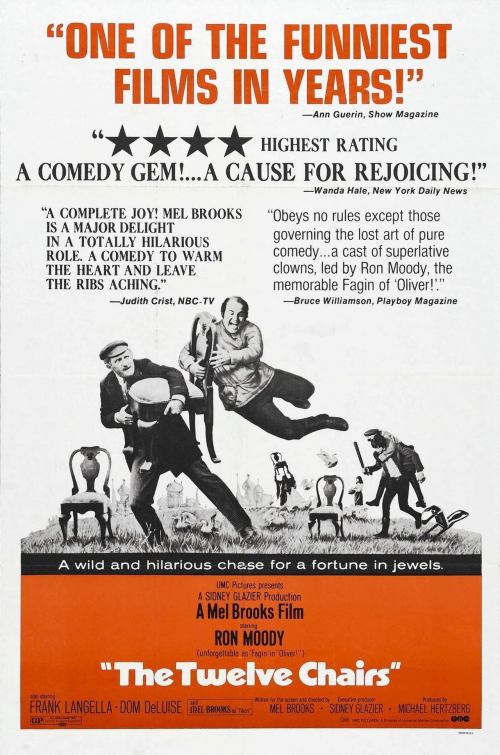
Vorobyaninov (Ron Moody), an poor man living in 1920’s Russia, is summoned to the deathbed of his mother-in-law. She confides in him that there’s a stash of priceless jewels sewn into the seat cushions of one of the twelve chairs from the family’s dinning room set. Unfortunately the newly formed Russian state has appropriated all private property and it’s up to Vorobyaninov to track them down. He teams up with Ostop (Frank Langella) a local con-man to help him, but they have competition. Father Fyodor (Dom DeLuise), a priest, also becomes aware of the jewels when he goes to the mother-in-law’s home to give her the last rites. All three go on a mad dash to retrieve the jewels, but the more chairs they manage to find the more frustrated they become.

The film is based on the 1928 Russian novel of the same name by Ilf and Petrov a famous duo who were quite popular during the early soviet period and wrote not only many satirical novels, including this one and its sequel ‘A Little Golden Calf’, but also several short stories, articles, theatrical plays, and even screenplays. The Twelve Chairs novel though was their most popular and has been made into a movie 18 different times. It had already been done 6 times before Mel Brooks did his with the first version being in 1933 and the most recent rendition of it done in 2013 in Italy.

This version is the most popular and a bit of stretch from Brooks’ other films, which relied on a lot of gags and slapstick. This one has its fair share of those though the first act is quite talky and not too much going on. Brooks himself appears as a character, but he can’t really enliven it. It’s not until the men finally come upon the chairs and start tearing them up one-by-one that it really starts to get funny. The chair thing could’ve gotten redundant as the men rip open the seat cushions in pretty much the same quick way, but Brooks manages to approach each of these scenes in a creative way, so instead of becoming monotonous it remains fresh and comical. My favorite of these is when Ron Moody and Frank Langella chase Dom, who has one of the chairs, through an open field that’s done in stop-action.

The film’s detraction though is the casting of the two main characters. Langella is a terrific actor, but not in comedy. He did appear in the dark comedy Diary of a Mad Housewife, where he was very good, but that took advantage of his glib demeanor and pouty expression and his character there was meant to be unlikable. Here though he has nothing amusing to say and remains a complete jerk the whole way. There is one point where he and Moody are in a row boat and Moody states that he’s cold and Langella gives him a jacket to wear, which I guess was Brooks’ attempt to make him likable, but it’s not enough and the movie is really hurt by spending so much time focused on a guy who’s one-dimensionally cold and responds to antics around him in the same sneering way. He was recommended to Brooks by his wife Anne Bancroft who had performed with Langella in a Broadway play that had a short run, but I felt this is one time when he shouldn’t have listened to her.

Ron Moody, a talented actor as well, has the same issue. The character is meant to be dim-witted, but it doesn’t come-off in a natural way. His banter with Langella is flat and annoying with the bickering doing nothing but slowing up the pacing. Without question DeLuise is the funniest. He’s just as conniving and greedy as the other two, but for whatever reason it doesn’t seem as ingratiating. His character’s ineptness had me laughing and he should’ve been the star while Langella and Moody could’ve been shown only sporadically as the occasional nemesis.

Spoiler Alert!

The ending is much different than the one in the book. In the novel version Vorobyaninov kills Ostap by slitting his throat with a razor in order to keep the loot for himself only to find that it’s not there, so he then goes insane. In the movie Vorobyaninov and Ostap team up to become beggars on the street by pretending Vorobyaninov has an epileptic condition and requesting people throw money at him to help him. Wikipedia, in a line that has since been deleted, stated that this was a ‘happier’ ending though trying to make a living being a street beggar all day can’t be all that fun.

What amused me though is that in both versions the jewels are never recovered by the two men. In the movie the jewels were found first by someone else who used it to build a clubhouse for pompous old men making it seem like greed was inevitable. In the book though the money gets used to build a recreational center that can be used by the entire community and thus giving it more of a pro-communist bent.

My Rating: 7 out of 10

Released: October 28, 1970

Runtime: 1 Hour 33 Minutes

Rated G

Director: Mel Brooks

Studio: UMC Pictures

Available: DVD

The Squeeze (1987)

squeeze

By Richard Winters

My Rating: 4 out of 10

4-Word Review: They rig the lottery.

When struggling artist and conman Harry (Michael Keaton) goes back to his ex-wife’s apartment to retrieve a mysterious package she had forgotten he finds a dead body and immediately becomes entangled in a complex mystery as well as a target of a secret organization. He enlists the help of private investigator Rachel (Rae Dawn Chong) and together they come to realize that the package that everyone is after is a large magnet that can be used to rig the lottery as it can manipulate the ping pong balls that display the winning numbers since those numbers are painted using a metallic substance. They proceed to try and stop the live broadcast of the lottery, which is being held onboard a naval ship and being hosted by the secretly nefarious Honest Tom T. Murray (John Davidson).

The film has come to have a notorious reputation on many levels. Not only did it sink at the box office where it managed to recoup a paltry $2 million from its $22 million budget, but the film’s promotional poster has star Keaton being squeezed between the World Trade Center buildings, which ultimately went down on 9-11. Even worse is that behind-the-scenes stunt driver Victor Magnotta, the movie is dedicated in his memory, died when the car he was driving went into the Hudson river on its side instead of flat, which trapped him inside the vehicle and unable to get out before he drowned though the stunt itself is left in.

While many critics and even commenters on IMDb have very little to say that’s nice about it I kind of felt that the movie was misunderstood as I saw it more as a parody of spy espionage stories and in that vein I think it works well, but since American audiences aren’t all that adept to satire and many times don’t get it, or take it seriously when they shouldn’t, it’s easy to see why this thing fell through the cracks. It does though have a few memorable moments including an unusual car chase where instead of having the hero speeding away from the bad guys they instead play a game of chicken where they intentionally crash their vehicles into the other one until both cars are left almost inoperable. I also thought the giant sized bull that Keaton created inside his apartment and made-up of a bunch of television sets was pretty cool too.

Keaton is certainly quite likable and without him the movie would’ve done far worse than it does. His engaging ability to make a joke, or even an insult, to someone, but always able to get away with it, by displaying his boyish trademark smile, is what makes his screentime entertaining though I felt the running conversation involving the old TV-show ‘Bonanza’ was a mistake. Young people of today won’t even know what that show was and even back then during the 80’s many teens would have only a vague idea of the series was as it had already been off the air since 1972 and didn’t do well in syndication and thus making the humor and inside jokes about it as out-of-touch and dated even for its own time period.

Chong is miscast, the part was intended for Mariel Hemingway who unfortunately got fired early on. While Chong can be great playing strong minded, outspoken characters she’s not as adept as a romantic lead and I failed to see much chemistry between the two. She falls-in-love with the guy a bit too quickly especially since they don’t get off to a good start. Having her come back to Keaton’s place and become outraged at seeing him in bed with another woman was out of place as no relationship had been established at that point. If anything she would’ve masked the feelings she had for him when seeing him with another lady and played it cool in order to avoid embarrassing herself when it became painfully obvious, at least at that point, that she was more into him than he was in her.

Ronald Guttman as the chief villain is a total bore and with his greased back hair looks more like a model for an Italian chick flick romance than a bad guy and his collection of shrunken heads doesn’t get played-up enough to be interesting. Meat Loaf though as his henchman is great. He has no lines of dialogue until he gets killed, via the pointy needle of a giant sized replica of the Empire State Building, which is pretty cool, though what he does say is very funny.

The film does at least give one a vivid feeling of what living in New York is like as it captures all the different levels of the city from its skyline, to the river, to its neighborhood shops and even the skid row area. Even this though does get botched as there are segments done late at night where there appears to be no other cars on the street, or pedestrians giving it a surreal look that isn’t realistic as New York is known as the city that never sleeps and thus portraying it as being virtually empty just because the action takes place in the wee hours of the morning isn’t authentic.

My Rating: 4 out of 10

Released: July 10, 1987

Runtime: 1 Hour 41 Minutes

Rated PG-13

Director: Roger Young

Studio: TriStar Pictures

Available: Blu-ray, Amazon Video, YouTube

Hawks (1988)

hawks1

By Richard Winters

My Rating: 6 out of 10

4-Word Review: Patients hit the road.

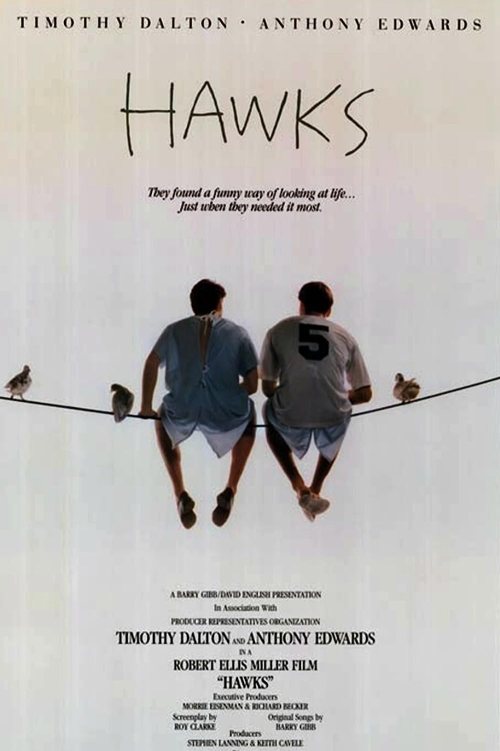
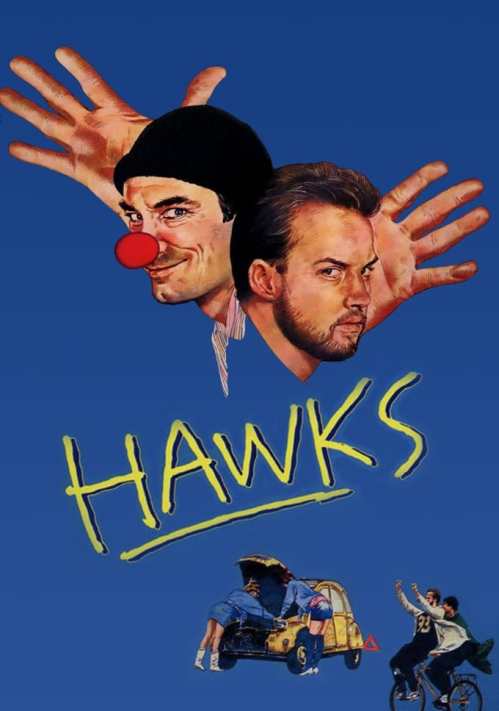
Decker (Anthony Edwards) is a former football player stricken with terminal cancer. He’s put in the hospital where his roommate is Bancroft (Timothy Dalton), who’s dying from the same disease. Bancroft though still wants to have some fun and convinces Decker to sneak out of the facility and go on a road trip to Denmark, so they can have one last fling with the prostitutes in the Red Light District. Decker is nervous at first, as he’d rather commit suicide to put himself out of his misery, but eventually decides to go along where they end up meeting two lonely ladies, Maureen (Camille Coduri) and Hazel (Janet McTeer) who’s also harboring a painful secret.

Based on a short story written by Barry Gibb of The Bee Gees the plot has, despite it’s grim theme, a playful quality and comes-off more like a quirky road movie. The scenery is nice especially when they get into Holland and have an extended scene amidst the picturesque windmills, which you can hear slowly rotating in the wind as they speak. There’s also a few funny moments with the best one coming right at the start where Decker takes a frightened SAAB car salesman (Geoffrey Palmer) on a test drive at reckless speeds and right to the edge of a cliff.

The acting is great with Dalton, who did this between his two stints as Bond and used his notoriety to get it made, which he felt wouldn’t have gotten financed otherwise, being standout and putting to great use his piercing blue eyes, which become even more prominent when he’s wearing his stocking cap. Edwards is also good though he looked wimpy to have ever played football. Some may try to argue that the sickness ate away his weight, but in reality this is the body type he’s always had and the producers should’ve, for the sake of authenticity, had him bulk-up before filming began.

What I didn’t like were the unexplained caveats, like where did these two terminally ill patients manage to get the money to pay for fancy hotels and chic restaurants? It seemed like they could buy anything they wanted, so if that were the case then why couldn’t they get themselves clothes so they didn’t have to run around everywhere wearing nothing but their bathrobes? The sex angle was ridiculous too especially for Decker, who’s so weak he had to be carted around in the wheelchair. If he could barely stand then how the hell is he going to get the energy for sex?

Initially I found Hazel and her clumsiness as annoying as Bancroft did, but like with him she eventually grew on me, but I didn’t think she needed to be introduced already in the first act before she even met the two men. She has a scene on a bridge all alone and I didn’t understand what she had to do with the story, only later during the second act when she appeared again did it make sense, but again her personal troubles could’ve waited to be explained when Bancroft and Decker heard about it. I actually enjoyed more Sheila Hancock, who plays Regina, an aging 50-something hooker they meet, who shows a good propensity at fixing things like TV’s and I wished she’d been the one they had befriended long term and the two younger ladies cut out altogether.

Spoiler Alert!

The ending is touching particularly the way the plastic red clown nose comes into play. The wedding in which Bancroft marries Hazel, who’s secretly pregnant by a man who disowns the child, is cute too though I didn’t understand how Bancroft, who had been losing his hair throughout, suddenly seemed to grow it all back as he walked down the aisle. If anything he should’ve been completely bald by that time and it would’ve been more realistic had he been shown that way.

hawks2

My Rating: 6 out of 10

Released: August 5, 1988

Runtime: 1 Hour 47 Minutes

Rated R

Director: Robert Ellis Miller

Studio: Skouras Pictures

Available: VHS, DVD-R (dvdlady.com)

The End (1978)

end2

By Richard Winters

My Rating: 7 out of 10

4-Word Review: His days are numbered.

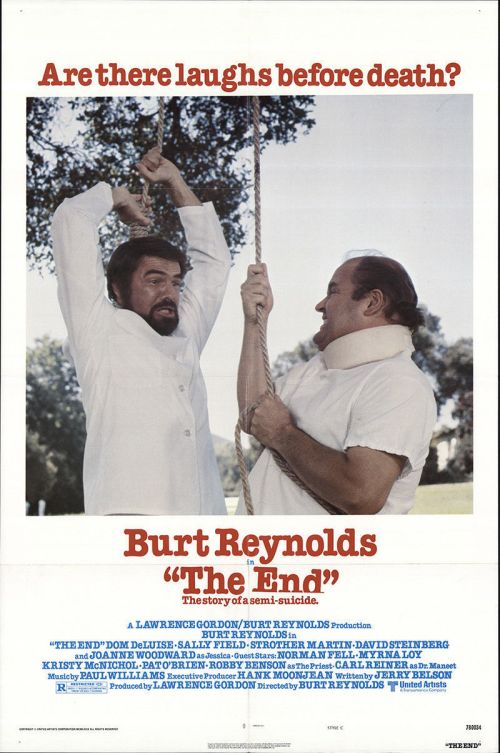
Sonny (Burt Reynolds) is a real estate broker known to make crooked deals. He gets diagnosed with an incurable disease and told he has only a limited time left. He says goodbye to his ex-wife (Joanne Woodward) who seems more interested in her new boyfriend, his daughter (Kristy McNichol) and his folks (Pat O’Brien, Myrna Loy) and even his live-in girlfriend (Sally Field) without actually telling them his condition. He then attempts suicide, but this gets him stuck in a mental hospital where he comes into contact with Marlon (Dom DeLuise) who agrees to help kill him, so Sonny can avoid going through the agony of the disease, but then after several aborted attempts Sonny decides he wants to live, or at least as long as he can, while Marlon continues to try and kill him and can’t seemingly be stopped.

The script was written by Jerry Belson, who also did the brilliant satire Smile and the original Fun With Dick and Jane, two of the funniest films to come out during the 70’s. This one is no exception, yet despite be written in 1971 and purchased by a studio, no one seemed to want to touch it. Many stars and producers felt the theme was too maudlin and wouldn’t be able to sell as a comedy. Reynolds though felt it was one of the funniest scripts he had read, and the character most closely identified to who he really was, and therefore jumped at the chance to direct and star in it though the studio was still reluctant and only agreed to finance it once he accepted starring in Hooper, which they felt was the sure money-maker though this one ended up doing quite well, surprising many, at the box office too.

Much of the credit goes to Reynolds who plays the part perfectly. Somehow he can create the slimiest of characters, and this one is a bit scummy with his admittedly shady real estate deals, and yet with his comic talent are still able to make him seem endearing. The studio had wanted the character’s profession to be a stock car racer, but this seemed too stereotypical, so I was happy that he kept it in the white collar realm and openly able to expose all of his personal flaws, which made him quite relatable. It’s also one of the rare times you get to see him with both a mustache and beard, or at least through the whole movie. The studio wanted to nix this too, but it helps give him a distinctive look.

Like with most actors turned director Burt allows for long takes, particularly during the first act, where the supporting cast is given ample time to play out their scenes without any interruption, which leads to many funny moments. I enjoyed Norman Fell as the doctor, and Robby Benson’s as a young priest who listens to Burt’s confession while he takes off his collar and puts it into his mouth, which creates a weird popping noise. These segments have an entertaining quality, but come-off more as vignettes and don’t help to propel the story along.

The second act, in which Burt ends up in the mental ward, are the best and his teaming with DeLuise is hilarious. I realize not all the critics enjoyed Dom’s take on a crazy man, Variety Magazine, labeled his performance as being ‘absolutely dreadful’, but there’s no denying the infectious chemistry he and Burt have, making the scene where he tries to drop Burt from a bell tower, or the segment where he tries to hang him up by a noose, quite memorable. The segment though where Burt goes swimming out into the ocean in an attempt to drown and then has a change of heart and tries getting back to shore and the voice-over prayer that he gives to the Almighty he order to help him back is laugh-out-loud and not only the top comedy moment in this movie, but quite possibly any movie ever.

Spoiler Alert!

The only problem I had was with the ending. In the original script the DeLuise character was supposed to kill Burt after he got out of the ocean, but Burt felt the movie needed some ‘hope’, so instead he has DeLuise attempting to chase Burt along the shoreline, in a sort of stop-action way that looks cartoonish. I felt there needed to be more of a resolution. If Reynolds does decide to live out the rest of his days what does he do with it? Does he try to mend his ways by paying back all those he had swindled? Or does he make amends with the people in his life including his ex and daughter? None of this gets answered, which is disappointing. A good movie needs a healthy character arch and this one doesn’t really have any. A better third act would’ve shown how the diagnosis had changed him and had the film not labored so much with the comical vignettes of the first half we might’ve gotten there and it’s just a shame that we never do.

My Rating: 7 out of 10

Released: May 10, 1978

Runtime: 1 Hour 41 Minutes

Rated R

Director: Burt Reynolds

Studio: United Artists

Available: DVD, Blu-ray, Amazon Video, YouTube

Fools’ Parade (1971)

fools

By Richard Winters

My Rating: 5 out of 10

4-Word Review: Can’t cash his check.

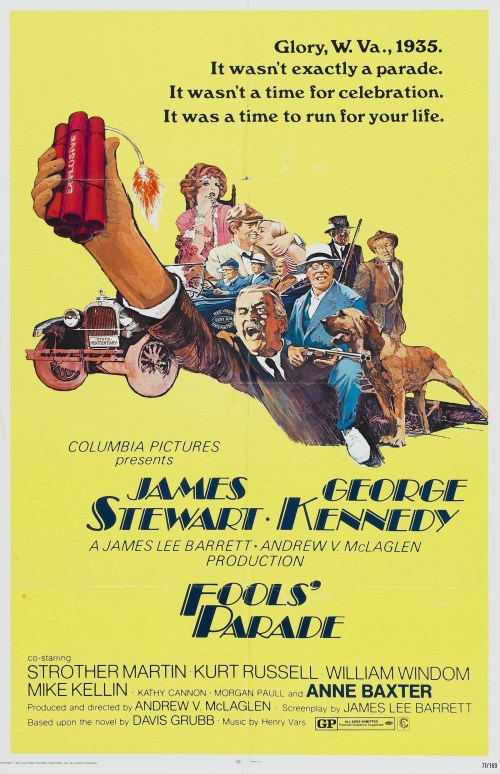
Mattie Appleyard (James Stewart), who lost one of his eyes during a fight years earlier and now wears a glass one, finally gets released from prison after spending 40 years behind bars. Along with him there’s bank robber Lee Cotrill (Strother Martin) and a young convict named Johnny (Kurt Russell) who both get released on the same day. Mattie’s also given a check in the amount of $25,452,32 as payment for his years of prison work. Mattie, Lee, and Johnny plan to use the money to start-up their own grocery store, but since the year is 1935 and many are poor due to the Great Depression they realize they must guard the check carefully and not cash it until it’s fully safe to. During their train ride out of town they become aware after reading the fine print that the check can only be cashed in person at the bank in the town that they’ve just left, so they take another train ride back. Unfortunately for them they don’t know that Mattie’s former prison guard Doc (George Kennedy) has already hatched a plan with the bank manager (David Huddleston) to make sure that the check is never cashed. In-fact the manager has given Doc an advance on the money to have Mattie and his friends wiped-out. Doc has hired a ‘Christian’ hit man  named Junior (Morgan Paull) to do the dirty deed, which Junior agrees to as long as it’s confirmed that people he kills are atheists, which Doc insists they are.

The film is based on the 1969 novel of the same name by Davis Grubb, who is better known for having written Night of the Hunter. It was shot on-location in Moundsville, West Virginia where Grubb was born and raised and it’s the setting that helps give the movie added character. The scenario though is rather odd and seems to want attain a certain quirky tone that it can’t quite reach. Leonard Maltin, in his review, complained about it being ‘unintentionally funny too many times to be taken seriously’. While I’ll agree the tension is lacking I do feel that this was meant to be humorous and some of it is slightly amusing, but it never gels and overall isn’t intriguing. I also felt the Russell character wasn’t needed. Maybe the producers wanted a youthful character added to attract younger members of the viewing public, but he doesn’t say, or do anything that’s funny, or helps move the story along. His romance with Chanty (Katherine Cannon in her film debut) who plays a 16 year-old who’s virginity is up for sale for a price of $100, is too forced, not believable, and adds nothing to the main plot.

There’s also several directorial errors including the first time Stewart takes out his glass eye, which was apparently so painful to wear that shooting could only last for 20-minutes at a time. In the shot we see Stewart put his hand over his eye and then it cuts to Russell’s shocked expression and then back to Stewart where the eye ball is in his hand, but we can see on Stewart’s face, just as he turns that he still has a blue eye in the socket where the glass used to be. When he removes the eye later he keeps the left eye closed in order to represent an empty socket, but the first time he doesn’t.

There’s also issues with Kennedy’s teeth. Initially I thought he was wearing braces, but then during close-ups it looks like there just supposed to be dirty, or rotting, but realistically it’s not done right. If they were truly bad teeth then some of them should’ve fallen out, or broken off instead of looking like they have been covered with black specks. There’s also a scene where he’s sitting in a car putting on his white shoes and his teeth are all white only to have in a later scene going back to them appearing dirty.

The performances are certainly a plus with Stewart’s being especially good and I admire the way he was willing to go out of his comfort zone by playing a type of kooky character he had never done before. Kennedy is also a scene-stealer in quite possibly the funniest thing he ever did. Huddleston is also solid as the corrupt bank manager and the segment where he nervously watches Stewart attempt to light a stick of dynamite inside the bank office is probably the film’s best moment. Kudos though must ultimately go to Anne Baxter who’s quite impressive as an aging, embittered prostitute who runs a whorehouse on a houseboat. I remember being blown away by her performance in The Ten Commandments and then later for her Oscar winning work in All About Eve, but her she’s almost unrecognizable in a role that is both darkly funny and sadly poignant at the same time.

My Rating: 5 out of 10

Released: June 17, 1971

Runtime: 1 Hour 38 Minutes

Rated GP

Director: Andrew V. McLaglen

Studio: Columbia Pictures

Available: DVD-R, Tubi

The Sidelong Glances of a Pigeon Kicker (1970)

pigeon

By Richard Winters

My Rating: 5 out of 10

4-Word Review: Cab driver dislikes pigeons.

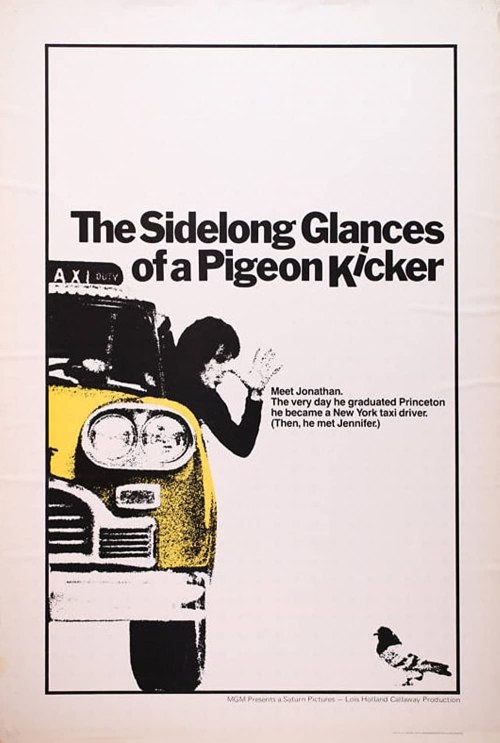
Based on the novel of the same name by David Boyer, the story centers on Jonathan (Jordan Christopher) a Princeton graduate who spends his days working as a New York cab driver with no ambition to climb up the corporate ladder. Jonathan detests the establishment, but is too old to be a part of the hippie movement, so he rebels from society in other ways by being flippant with his customers and kicking at pigeons in Central Park. His friend Winslow (Robert Walden) has problems of his own as he’s 24, but still a virgin. Jonathan takes Winslow to a party in an effort to find him a woman, but Winslow is so socially awkward that they all turn him down. Back at his apartment Jonathan meets-up with Jennifer (Jill O’Hara) who’s busy trying to ‘find herself’ while living off of her parent’s money. Initially Jonathan resists her advances, but since they’re both lonely he eventually agrees to a relationship with her as long as there are no strings attached. He even brings her to visit his mother (Kate Reid), but then at a holiday party Jennifer makes the mistake of  saying she wants to get married and have kids, which scares Jonathan away and the two break-up only for Jennifer to then sleep with Winslow, which causes Jonathan to become jealous.

This was one of an assortment of youth pictures from the early 70’s trying to analyze the alienation of the love generation and their resistance to conformity and middle class values. These films tended to be much less structured and in certain cases downright experimental, but the subject matter was still considered topical enough that the studio heads at MGM decided to pick it up for distribution only to then quickly drop it when previews of it scored low with test audiences. It was then handed over to a fledgling film company known as Plaza Pictures that re-edited it down to 90 minutes while cutting-out much of the second act in the process and then re-naming it as Pigeons, but this version did no better and the film sat in obscurity for many decades before finally getting a DVD release in 2014.

While I do like offbeat movies I did find the way this one began hard to get into as the lackadaisical pace makes it seem like there isn’t any plot and just a lot of throwaway segments dealing with the angst of big city living. It does improve and manages to even have a few keen moments. John Dexter’s direction, he was better known for his work in the theater as well as his rude behavior towards women, helps a lot. In fact it’s the directing that keeps the thing watchable and despite the modest budget it’s quite polished with the most impressive moment, outside of a taxi car driving off the dock and into the water, is when Jonathan goes under his kitchen cabinet in an attempt to exterminate hundreds of ants. This isn’t as easy as it sounds to get a camera and lighting into such a small space, nor finding all the ants, and I suspect the cabinet was specially made for the production, but still on a small scale it’s impressively done.

The film also features a great supporting cast including Walden in his film debut who is both believable and amusing as Jonathan’s shy and apprehensive friend. O’Hara is equally engaging, she looks exactly like her more famous sister Jenny O’Hara and for awhile I thought it was the same woman. Kate Reid is a scene-stealer as the meddling, oppressive mother and William Redfield has a great moment near the end playing the stepfather who openly has a one-night-stand with a lady he meets at a Christmas party and then comes home late at night to talk to Jonathan about it.

The film’s Achilles heal is the casting of Christopher. He rose to fame as the singer of The Wild Ones, which got him cast as a rock singer for the cult hit Angel, Angel Down We Gowhich generated enough notice that producers decided to take a chance on him in a lead role, but it doesn’t work. His character is unlikable and he lacks a dynamic presence let alone his disheveled mop-head hair-do that resembles a bird’s nest. Having the film begin by showing him kicking at pigeons in Central Park, fortunately his foot doesn’t seem to actually hit any of them, makes the viewer despise him right from the start and things never improve.

Spoiler Alert!

The cop-out ending is a disappointment as it features Jonathan riding off on a train headed to Des Moines, Iowa, but I’ve rarely found anyone who’s been born and raised in New York to move to the farmlands of the Midwest. Sure many New Yorkers have gripes about where they live, most anyone is never completely happy with their home city, but ultimately they remain because it’s what they’re used to. Instead of ending it with him riding away it should’ve made this a part of the movie showing his adapting to a completely new and alien place, which could’ve given the movie some interesting insight and made a stronger impression than it otherwise does.

Alternate Title: Pigeons

My Rating: 5 out of 10

Released: October 28, 1970

Runtime: 1 Hour 46 Minutes (DVD version runs 1 Hour 30 Minutes)

Rated R

Director: John Dexter

Studio: Plaza Pictures

Available: DVD