Category Archives: Black Comedy

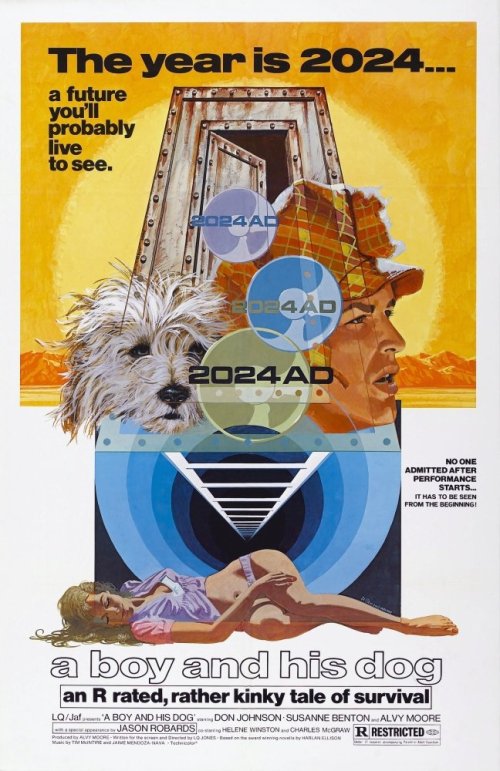
A Boy and His Dog (1975)

Version 1.0.0

Version 1.0.0

By Richard Winters

My Rating: 7 out of 10

4-Word Review: Surviving after nuclear holocaust.

The year is 2024 and the landscape of the U.S. has been turned into a wasteland due the after effects of a nuclear war that occurred in 2007. Vic (Don Johnson) is an 18-year-old that wanders around with his telepathic dog named Blood (voice of Tim McIntire). Blood helps Vic find women to rape while Vic scavenges for food for their survival. One night while watching an X-rated movie at a makeshift theater Blood is able to gain the scent of a woman nearby named Quilla (Susanne Benton). Quilla and Vic eventually have sex, but then she disappears to the underground society that survives inside a biosphere. Vic decides to follow her there while Blood remains above ground waiting for Vic’s return. Once Vic arrives he finds everyone there to be in whiteface and dressed like people living on the farm during the turn-of-the-century. He meets Lou (Jason Robards) along with Dr. Moore (Alvy Moore) and Mez (Helene Winstone) who all three run things. They convince Vic to stay there as he has a ‘purpose’ of becoming a stud and impregnating the young women since the men there can no longer do so. At first Vic is excited about his newfound ‘job’ as he is always quite horny, but after he finds out the details of what he must do he relinquishes his duty, but realizes it may be too late.

The story is based on the novella of the same name by Harlan Ellison who wrote the original screenplay that was later finished by director L.Q. Jones who used his own money to help get the film financed. While the movie does have some intriguing and memorable visuals, logic-wise there are some holes. One of the biggest ones is that, at least hypothetically, there would most likely have been a nuclear winter, which is what would be created after a nuclear war due to so much soot being blown into the atmosphere that it would block out most of the sunlight for several decades and create a night time effect and for this reason the outdoor scenes should’ve been filmed at night in order to replicate the ongoing darkness.

Vic’s conversations with his dog, which all gets done telepathically, is odd too and never sufficiently explained. How does this dog attain this ‘gift’ and why is it only him and not other mutts that can do it too? It would’ve been better had it been explained that some modern invention had been created that would allow communication between owners and their pets, but even this fails to explain how the dog manages to be so incredibly smart. Don’t get me wrong the voice-over work by McIntire is delightful, but how did the animal get so well-read that he even knows the Latin origin of words? Is there a dog college that teaches them this?

Vic’s extreme urges to have sex all the time seemed out-of-place too. Granted he’s a young guy with raging hormones, but psychologically when a person is in a desperate situation, in this case simply trying to survive in a hostile environment with very little food, then a person’s most basic needs come first and it’s all they’ll think about. Finding something to eat, they’re forced to go out each day and hunt for something, and acquiring shelter for sleep, would be their pressing needs and what would occupy their minds most day-in and day-out while the sex need would become secondary and only have his focus once the other needs were met, but in this story the sex urges seem to take precedent, which doesn’t make sense from a human behavioral perspective, nor where he’d get the energy to do it since he’s pretty malnourished to begin with.

The X-rated movie that they watch at a ‘theater’ is goofy too as it amounts to nothing more than a grainy black-and-white stag film from the 50’s even though technically by 2007, which is when the bombs dropped, there was porn on the internet and explicit DVD’s some of which would’ve probably survived the blast and thus they’d be watching those instead of something found in grandpa’s ancient collection. Though this is what makes the movie entertaining not so much for what it gets accurate in their predictions, which isn’t much, but more what it gets wrong.

The one thing though that really stands-out, at least for me, and makes the movie memorable, though this apparently wasn’t the case with the film’s initial test audience who called these scenes ‘slow’ and ‘boring’, are the moments that take place in the underground society. The look of everyone walking around like robots and resembling farmers from a bygone era has a kitschy flair like something out of a Federico Fellini movie. Hal Baylor, as one of the main menacing robots that can’t seem to ever go down even when being directly shot at, steals every scene he is in and helps create some definite tension. I also got a kick out of everyone wearing white face, which I thought was to explain their pale complexions due to not be out in the sun, but it seems to be instead obviously painted on, so I’m not sure what that was meant to represent.

The twist ending is terrific and the film’s final line, which Ellison detested and tried having taken out, is a keeper. While its attained a cult following there are still the detractors who feel its ‘misogynistic’ though I don’t really see it.  Sure Vic sees women as sex objects and ‘conquests’, but there’s guys out there that are like that. Quilla is conniving and duplicitous, but some women are like that too. The movie isn’t saying that all men and women are like this, but in environments that are as desperate as this one it will tend to bring out the worst in human nature, which was all the film was trying to convey from my standpoint.

My Rating: 7 out of 10

Released: May 15, 1975

Runtime: 1 Hour 31 Minutes

Rated R

Director: L.Q. Jones

Studio: LQ/Jaf Productions

Available: DVD, Blu-ray, Amazon Video, Pluto, Roku, Tubi, YouTube

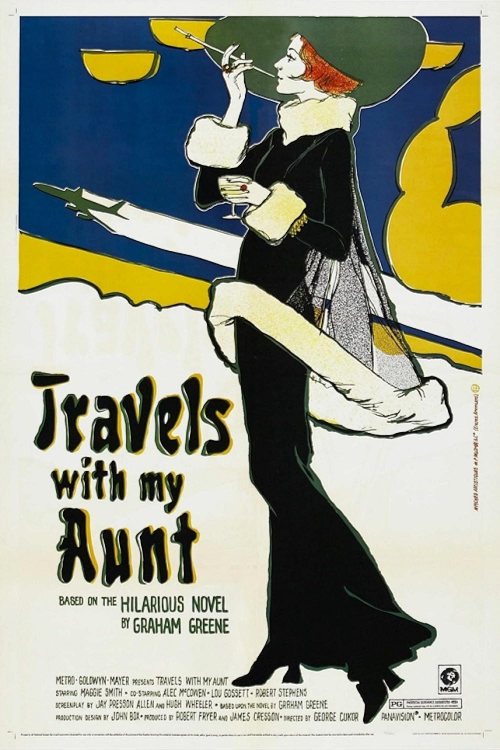
Travels With My aunt (1972)

travels1

By Richard Winters

My Rating: 4 out of 10

4-Word Review: Kooky lady cons nephew.

Henry (Alec McCowen) is a middle-aged bank manager who attends his mother’s cremation where he meets his kooky Aunt Augusta (Maggie Smith). She invites him over to her residence where he finds that she’s living with a black man named Wadsworth (Louis Gossett Jr.) who works as a fortune teller. It is here that she receives a package holding the severed finger of her longtime lover Visconti (Robert Stephens) and told that she must deliver $100,000 in ransom in order to see the rest of him alive. She convinces Henry to go with her to Paris to meet the kidnappers demands and in the process the two go on a wild jaunt across the globe that ends with them in North Africa.

The film is based on the novel of the same name by Graham Greene that was originally intended for Katherine Hepburn in the lead. Director George Cukor, whose career was winding down at this point, had worked with Kate in several projects from decades earlier and felt this role would be the right fit though she disagreed, but then decided that if she could rewrite the script, she’d consider doing it. Jay Presson Allen, who had done the original adaptation, which Hepburn didn’t like, gave full control over to her to rewrite it anyway she’d like, but ultimately the studio felt she was too old for the part especially since she was expected to play a younger version of the character during flashback sequences and they didn’t feel she at her advanced age could come effectively as someone in their early 20’s, so the part went to Smith instead.

Maggie to her credit is quite good and although she was only in her late 30’s really seems quite old during the sequences where the aunt is portrayed in the present. There’s even realistic wrinkles on her face especially around the cheekbones that gives the character the look of someone in their 70’s and 80’s. In the flashbacks she comes-off equally effective as a youthful free-spirit. Unfortunately her daffy character was for me a turn-off as she’s too much of an eccentric caricature that’s more obnoxious than amusing and building a whole film around her doesn’t work.

Henry is equally perplexing as I couldn’t understand why he’d believe this nutty lady when she tells him the mother he had always known wasn’t his biological one. For all he knew she was a goofball that shouldn’t be taken seriously unless she can supply more evidence, which she doesn’t. Most rational people would’ve kept her at an arm’s length instead of galivanting across the continent with her especially whom he had just met. In the book Henry is portrayed as being bored with his life and longing for adventure, but the film doesn’t make this clear, so his motivations and personality become muddled. Also in the book he was in early retirement, which would help explain why he had so much free time to go traveling, but the movie doesn’t bring this up either, so you wonder what he told his employer that would allow him to be off of work for so long and not get fired.

Having the Aunt and Henry bicker about, as their personalities were quite opposite, could’ve been fun, but this doesn’t get played-up. Too much time gets spent on this outlandish James Bond adventure that gets more ridiculous and unbelievable. The flashbacks bog down the pace and weren’t really needed and everything should’ve remained in the present day. The coin flip ending, in which Henry can’t decide what he wants to do moving forward, go back to his old life or continue on with his aunt, is a cop-out and only done because they couldn’t figure out how else to end it, so they do a freeze-frame of the coin in the air and the  let the viewer feel-in-the-blanks, which was far different than the novel. There Henry becomes a changed man who enjoys the excitement of getting involved in illegal activities, but because the film was not centered around him, which it should’ve been, we don’t witness any type of character arch making the whole thing quite trite and saved only by the brief appearance of Cindy Williams who plays a free-spirited hippie that he meets on a train.

My Rating: 4 out of 10

Released: December 17, 1972

Runtime: 1 Hour 49 Mintutes

Rated PG

Director: George Cukor

Studio: MGM

Available: DVD-R (Warner Archive)

Something for Everyone (1970)

something1

By Richard Winters

My Rating: 7 out of 10

4-Word Review: Charming his way up.

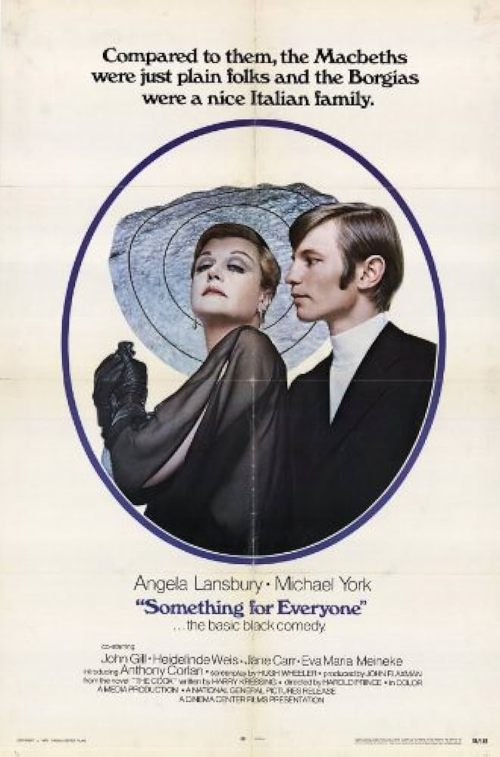
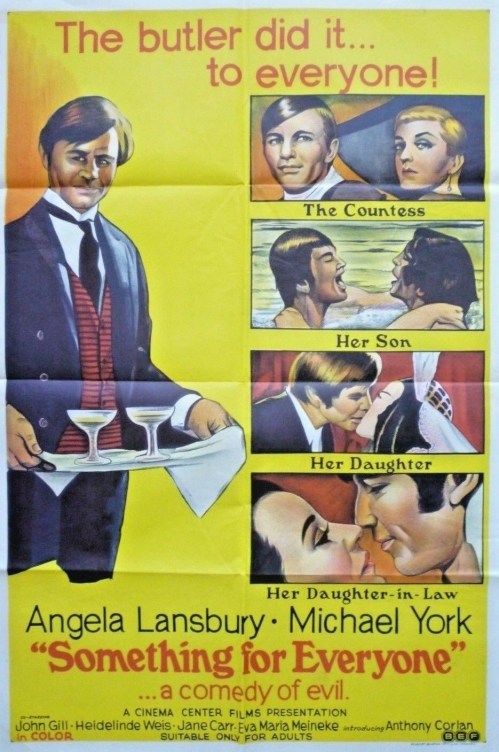
Konrad (Michael York) is a young man with no money, or status, who dreams of one day owning the large Bavarian castle that he spots in the outskirts of a town that he’s passing through. He learns that it’s the property of the widow Countess Herthe (Angela Lansbury), who’s unable to live in it due to lack of finances. He schemes to become one of her servants by getting her regular butler, Rudolph (Klaus Havenstein) run over by a train. He then gets into a romantic relationship with Anneliese (Heidelinde Weis) whose parents (John Gill, Eva Maria Meineke) are quite wealthy while he also becomes lovers with the Countess’ son Helmuth (Anthony Higgins). Konrad hopes that Anneliese’s wealthy parents can use their money to reopen the castle and convinces Annelise to get into a fake romance with Helmuth that will lead to a marriage and then this will hopefully have her parent’s money flowing into the castle to get it reopened. He assures both Anneliese and Helmuth that he’ll remain their lover on the sly, but without each one knowing that they’re having sex with the same man. The elaborate plan though comes to a crashing halt when Anneliese accidentally walks in on Konrad and Helmuth and sees them kissing.

This super black comedy may be one of the darkest every made as it has no let up and absolutely everyone of the characters is a schemer and no better than the others. It’s based loosely on the novel ‘The Cook’ by Harry Kressing, but the story here is much different. In that one the main character is Conrad who spells his name with a ‘C’ instead of a ‘K’ and portrayed as a gaunt man who’s over seven feet tall and dresses in an all black unlike here where Konrad is young and handsome. In the book Conrad uses his cooking skills to get everyone to be ‘eating out of his hand’ with his delectable dishes while in the movie Konrad shows no such talent. The book had a much creepier tone while the film plays it all up for dark laughs and keeps the horror elements completely out.

I’m not exactly sure why there was such big changes made from its source material as keeping it truer to the novel had the potential of making this into a ‘food porn’ movie, which could’ve been visually sumptuous. However, the way it’s done here is still enjoyable with the majority of props going to York’s splendid performance whose boyish smile and dashing looks keeps it all quite engaging no matter what dastardly thing his character does. Reviled by the critics at the time for its ‘glorification of homosexuality’ it’s pretty amazing in retrospect how daring it was as this was filmed in 1969 and quite possibly the first film to ever show two men kissing. I remember in 1982 it was considered still quite shocking when Michael Caine and Christopher Reeve did it in Deathtrapso much so there was a report about it on CBS Evening News under the theme of movies ‘going too far’ while this movie had already been showing it, in a rather gleeful way, 13 years earlier, but maybe that’s all because this was done in Europe and not stuffy old America.

On the flip side I didn’t feel Lansbury had much of a presence. A talented actress for sure, but she doesn’t have a lot to do until well into the second act and even then isn’t real funny, and seems upstaged by the supporting cast who come-off as more colorful. It’s also frustrating that we spend the whole runtime seeing this gorgeous castle in the distance, in this case the famous Neuschwanstein Castle in Germany, but never able to go inside it. The few scenes that were supposedly its interior were instead very obviously shot on a soundstage.

Spoiler Alert!

While the script is full of many crafty twists and witnessing each nefarious character go down in a unique way is quite fun I did feel the way Konrad kills Anneliese and her parents by acting as their chauffer who crashes the vehicle down an embankment didn’t work. For one thing the killing of a wealthy family would’ve lead to a major investigation and since Konrad was driving the car, which he ‘miraculously’ jumps out of before it crashes, but he would still have to come up with a reason for why the car spun out of control. Since he doesn’t have one he would come under suspicion of the authorities instead of getting off scot-free like here.

Having Herthe’s nerdy daughter Lotte (Jane Carr) suddenly become instrumental in the whole thing by exposing the fact, at the end, that she’d been spying on Konrad the whole time and using what she knew to force him to marry her, leaved even further plot holes. The viewer should’ve been tipped off about what she was doing, even subtly, during the story as having her just turn up with all this new information makes it seem like it was tacked-on as a convenience without having it thought through with the rest of the plot. Not sure why Herthe, who was expecting to marry Konrad herself, would’ve gone along with Lotte marrying him instead, or what explanation was given to her in order for her to accept, which again just leaves open even more questions that in a truly well-crafted script should’ve been answered.

something2

My Rating: 7 out of 10

Released: July 22, 1970

Runtime: 1 Hour 52 Minutes

Rated R

Director: Harold Prince

Studio: National General Pictures

Available: DVD-R, Blu-ray

Silver Streak (1976)

silver

By Richard Winters

My Rating: 8 out of 10

4-Word Review: Murder on a train.

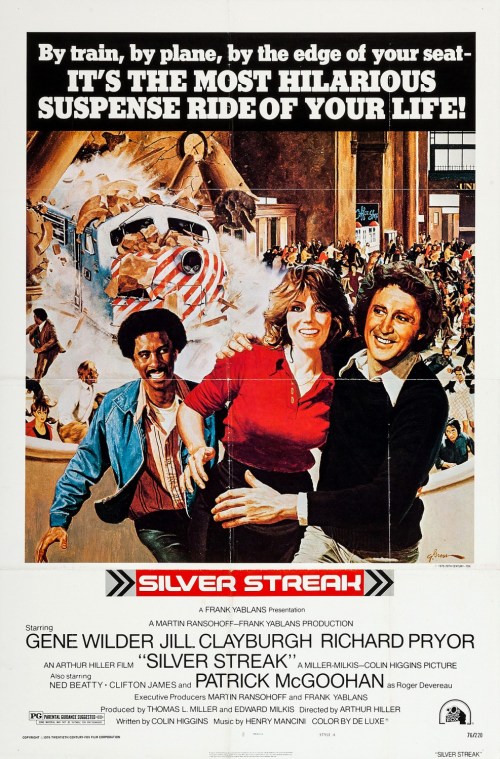
George (Gene Wilder) is a book editor taking a train ride from Los Angeles to Chicago. Along the way he gets into a relationship with Hilly (Jill Clayburgh) who is staying in the neighboring compartment. After a night of drinks they go back to her bed and begin making-out only for George to see a murdered body of a professor, whom Hilly works for as his secretary, get thrown off the train. Nobody else sees it except for him and everyone, including Hilly, believe it was a figment of his imagination, but George persists by doing the investigating himself. He goes to the compartment that the professor was staying in to see if he’s there, but instead he meets two men (Ray Walston, Richard Kiel) who throw him off the train. George then must find a way, in the middle of the empty desert, to get back on the train, so as to warn Hilly, whom he fears may be their next victim.

The script was written by Colin Higgins who up to that time was best known for having done Harold and Maude. He said he had always fantasized about meeting a beautiful blonde on a train and when it never panned-out in real-life he decided to write it into a story. Initially he was expecting an uphill battle to get it sold, but to his amazement it instead set-off a bidding war between Paramount and 20th Century Fox who both wanted to purchase the rights and it ended up selling for a then record $400,000. Originally Amtrak was going to be used as the setting for the Silver Streak, but the company became panicked that the film could cause bad publicity for them and ultimately refused to allow the studio to use any of their trains, so the film crew was forced to go north of the border and use the Canadian Rail System in its place while still pretending that it all takes place in the US when really all exteriors are Alberta, Canada and the skyline that gets seen in the distance that’s supposed to be Kansas City is really Calgary.

The reason the film works so well is that the comedy is on-target the whole way, but also manages to deftly blend it in with some nerve wracking action making the viewer let out belly laughs while also sitting-on-the-edge-of-their-seat at the same time. The pace is brisk with some amazing and very realistic stunt work that not only shows the train crashing through the wall of Chicago’s Central station, but also a few scenes with the character’s dueling it out on the roof of the locomotive as it’s going at high speeds. In fact the only slow spot in the entire movie is when Gene and Jilly make-out in the train car, which goes on too long and may make some people, including my conservative parents who watched the film with me when I first saw it on Showtime in 1982, as thinking this might be more a soft core porn flick than an action thriller and about ready to turn-if-off before it finally gets going with the plot.

Wilder, who was not Higgins’ first choice for the role as he intended it to be played by George Segal, is quite engaging and this was the first of several pairings that he did with Richard Pryor, who doesn’t appear until an hour in, but manages to take over quite nicely and makes a strong, memorable impression. Patrick McGoohan is sinister as the villain and one of the rare instances where in an otherwise comedy the bad guy isn’t funny and instead nasty, usually in comedies it’s considered mandatory that all the characters, even the bad guy, have some amusing moments, or lines, but McGoohan is just mean, which enhances the suspense element. Scatman Crothers, who initially seems to be playing an insignificant roles as the train’s porter, but in the end becomes quite crucial in getting everyone saved. Richard Kiel is good, though he speaks no dialogue, as one of McGoohan’s henchmen, in a role quite similar to the Jaws character that he played in two James Bond films that came out a year later, he even walks around with the same mangled up dental work in his mouth.

Spoiler Alert!

While the film works for the most part quite flawlessly I did find a few tidbits to quibble about. One is the scene where Gene accidentally bursts open the patrician door that divides his room from Jill’s who is busy dressing and doesn’t act startled when he suddenly breaks into her room, which I would think anyone, especially in a state of undress, would’ve responded with a scream and a look of shock, which would’ve made the segment funnier if she had.

Later on a police chief, played by Len Birman in a very bad impression of Mike Connors from ‘Mannix’, tells Gene that they know he’s innocent and have simply been putting-up manhunt posters with his picture on it for his own safety, so they could catch him and get him away from the evil McGoohan and his cronies who want to kill him. However, after he explains this he then hands Gene a gun and some bullets and tells him to come along with his men to help nab McGoohan who is still on the train, but how would this police chief know that Gene could handle a gun and was trained on how to shoot it, let alone even need him since his own men were well armed with rifles and could easily shoot down the bad guy themselves? There’s also another moment where the police chief shoots into a large crowd in an effort to hit McGoohan, which sends everyone into a panic and would be considered a major act of negligence for a cop to do.

Another scene has McGoohan explaining to Jill, Gene, and Richard about how he and his men never meant to really kill the professor, or at least not upfront, but when he did die that’s when they had to immediately ‘get’ a lookalike as an imposter to give everyone the idea that the professor was still alive. However, how exactly where they going to be able to find someone who looked so similar to the professor in such a quick, speedy way and then get him on the non-stop, fast-moving train?

The biggest exaggeration for me though is when Gene unhooks the back part of the train from the engine, while standing on a thin ledge and holding on for dear-life via a small metal rail and then able to successfully hop onto the train car that he had just decoupled from the other one. With them both going at high speeds I don’t think he’d be able to do it. Of course in the movie it gets done by a professional stunt man, who was able to time it, and rehearse it, to make it look easy, but in reality the average person would’ve either slipped, or missed grabbing the rail and thus fallen to the side of the tracks. This though could’ve actually been funny as we would then see Gene’s body roll on the ground and initially make it seem like he was hurt, or injured and then have him look up in aggravation and go: ‘Damn, I got thrown off the train for a fourth time!”

My Rating: 8 out of 10

Released: December 8, 1976

Runtime: 1 Hour 54 Minutes

Rated PG

Director: Arthur Hiller

Studio: 20th Century Fox

Available: DVD, Blu-ray, Amazon Video, YouTube

I Love My…Wife (1970)

ilove

By Richard Winters

My Rating: 6 out of 10

4-Word Review: He’s bored with marriage.

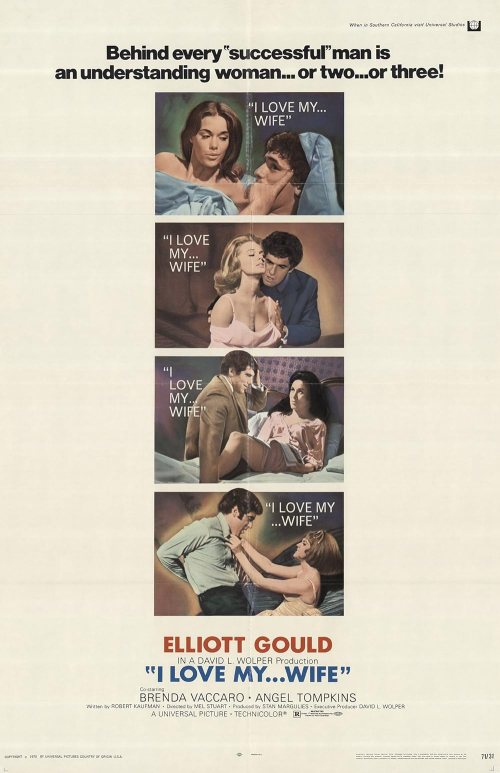
Richard (Elliot Gould) is a medical student when he meets Jody (Brenda Vaccaro) and the two quickly fall-in-love and get married. She then gets pregnant while he’s still in school and they don’t believe they have enough money to financially support a child, so they initially consider an abortion, but at the last minute Richard changes his mind and feels they should have the child. Jody though gains a lot of weight during the pregnancy, which Richard finds unattractive. Once the baby is born she’s unable to burn-off the excessive pounds causing their sex life to go even further into the tank. He has a few flings with some of the nurses before finally setting his sights on Helene (Angel Tompkins) a beautiful model who’s married to a baseball star (Dabney Coleman). At first she resists his advances, but the two eventually bed and then fall-in-love. She insists that Richard leave his wife, so that they can be together and no longer have to meet-on-the-sly. Richard tries to break-up with Jody, but because they have two kids finds that he can’t and instead begins lying to Helene as he plays both women at the same time, which soon turns into a losing situation.

The odd way this thing opens really hurts it and although it does improve a bit as it goes along some viewers may not be patient enough to stick with it. Having the opening credits deal with Richard’s relationship with his mother (Helen Westcott) and the sheltered way that she raised him isn’t funny and because the mother never appears again in the movie it wasn’t worth introducing her at all. Since the wife is the main focus I felt the opening scenes should’ve dealt with their dating period, which the movie breezes over too quickly. The clips from old movies, which get spliced in from time-to-time, add nothing and make it seem too much like Myra Breckenridge, which came out around the same time and best left forgotten. At least in that movie the clips came at predictable intervals, but here it’s sporadic making it seem, when they do get shown, as jarring and out-of-place.

Gould certainly excels at this type of role and he’s quite possibly the only actor who could play a shallow person and still manage to make it come-off as semi-likable. Vaccaro though is the real surprise as she’s usually best at drama and initially I felt she was miscast, but she comes through in making her character complex and even amusing as she goes through her tirades, some of it justified, at Gould. This is also the first movie to ever explore the issue of women who gain weight during their pregnancy, but can’t lose it afterwards and how this could affect their sex life, which I felt deserved kudos for being ground-breaking. The film makes the mistake though of showing too much from her point-of-view to the extent that we start to sympathize with her over the main character and almost start to dislike him in the process.

The introduction of Helene really does help as it’s her presence that gives the story a unique angle. Before this it comes-off more like your typical run-of-the-mill flick about a cad of a husband who can’t stay faithful, which has been done a lot and this movie doesn’t add anything insightful in that vein. However, the affair itself is interesting. For one thing she plays hard-to-get and doesn’t just jump immediately into the bed sheets at Gould’s beck-and-call, which is good as too much of the time, especially in 70’s movies, the women seem way too easy in a way that isn’t realistic. What I liked even more though is that the affair really doesn’t solve anything. Sure he finds her hot and sexy and they do get along, but she also has demands of her own and Gould finds himself in the same quandary as with his wife showing how extra marital flings really aren’t the ‘escape’ that they’re intended, but instead more of a problem.

Spoiler Alert!

The script by Robert Kaufman brings out many harsh truths about marriage and doesn’t insult us with any placid answers. Yet when the movie should go hard it goes soft instead. I liked how Vaccaro, who spent the whole time trying to win him back, finally gives up and starts seeing someone else, but Gould though upset and rebuffed, doesn’t learn anything from it. He goes back to the bar and tries picking-up an attractive stewardess he meets like he’s now making some sort of ‘fresh start’ when the film spent its entire running time exposing how this ‘cruising for chicks’ is a vicious cycle that just leads to more emptiness. Seeing Gould’s character change, or learn from his mistakes and display some regret would’ve been a far better way to have ended it.

My Rating: 6 out of 10

Released: December 21, 1970

Runtime: 1 Hour 38 Minutes

Rated R

Director: Mel Stuart

Studio: Universal

Available: DVD-R (dvdlady.com, modcinema.com)

Cold Turkey (1971)

coldturkey

By Richard Winters

My Rating: 7 out of 10

4-Word Review: Small town quits smoking.

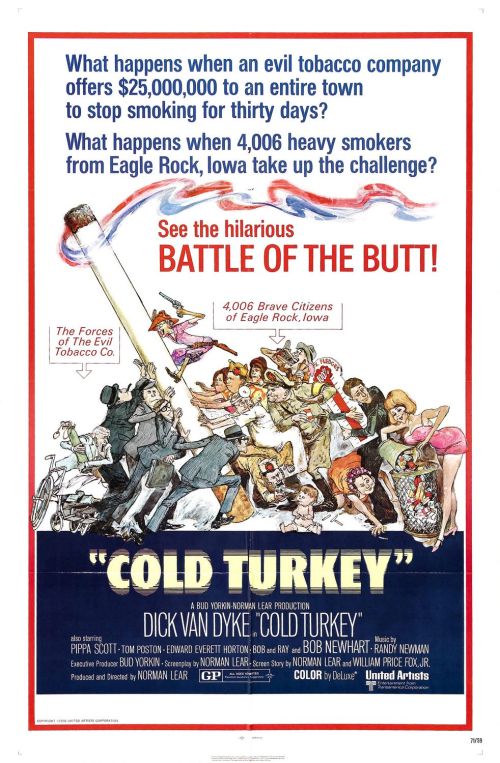
To commemorate the passing of Norman Lear last week at the ripe old age of 101 we decided to review the one film that he directed and was shelved for two years by the studio who didn’t think it would be a hit with any audience and only decided to eventually release it once Lear had success with the classic ‘All in the Family’ sitcom. The story revolves around a small town in Iowa named Eagle Rock. The Reverend Clayton Moore would like a bigger congregation in a more prestigious area as he feels trapped in what he considers a ‘dying’ town with limited employment opportunities. He then hears about a contest that a giant tobacco company is sponsoring where they try to see if there’s a town in America that will make a pledge to agree to quit smoking for 30-days and if they succeed will be awarded $25 million. Merwin Wren (Bob Newhart), who works for a tobacco company, bets that there isn’t a place that would be able to make this pledge, but Clayton, figuring this may be his ticket out and onto greater things, pushes the citizens to sign the pledge, which will then put Eagle Rock on the map.

The location of the film shoot was Greenfield, Iowa, which I traveled to in 2009 and was amazed how similar it still looked after 40 years. The opening sequence showing the town from the south end still had many of the same buildings and the courthouse along with the gazebo in which the reverend makes his fiery speech are all still there and looking almost untouched.

The town itself is really the main star. Lear does a terrific job of showing the people who live there as they really are versus in some idealistic, or romanticized way. Too many other Hollywood productions seem to suffer from the Mayberry effect where the citizens are portrayed as simple and content ‘God Fearing’ folk who are devoid of any complex personality. Here they are frustrated individuals who secretly dream of moving away, or ‘hitting it big’ in some way, but because they don’t have the means to achieve this ultimately find themselves stuck and just trying to make the best of it. The people are no more immune from temptation, or corruption, than the ones living in a big city and if anything are even more susceptible since they haven’t been put in that situation much, but when they are, as evidenced when the place gets spoken about all over the media and everyone from all over descends on it including Lottie (Gloria Leroy) a prostitute under the guise of being a masseuse who services all married men.

Beyond the on-target satire the film also scores with its fabulous ensemble of character actors, many of whom would later star, or guest star, in many of Lear’s TV-shows. Each actor plays a distinct personality from Barnard Hughes the fidgety and nervous doctor who resorts to lollipop sucking, or Graham Jarvis the head of a far-right organization, who preaches about the evils of ‘big government’, but then readily accepts for his group, which is mainly made up of senior citizens, to become a voluntary gestapo-like militia that arrests those who are caught smoking and forcibly search all in-coming vehicles. Pippa Scott though, as Clayton’s much put-upon wife, was my favorite. She encompasses what I think a lot of small town people can feel especially those that weren’t originally from the area, who are stuck in a dead-end marriage and perennially forced to ‘put on a happy face’. Her primal scream, which happens during a dream-like segment on the rooftop of one of the houses while neighbors stand around watching I felt was one of the film’s defining moments.

In the lead roles Dick Van Dyke is terrific mainly because he plays against type. Part of what I felt killed his movie career was that he took too many roles that were just an extension of his Rob Petrie persona in his famous TV-show. Here though he’s the opposite playing an egotistical, narcissists who cares about nothing other than his own career ascension, but manages to do it in a way that’s quite amusing. Newhart plays an unusual role for him as well. Typically he’s a buttoned down, strait-laced guy commenting on the insanity around him, but here he is the nutty one and does a trick with his eyes that gives him a psycho appearance.

Spoiler Alert!

The one flaw is the ending in which all three leads (Van Dyke, Newhart, Hughes) get shot in the middle of a crowd of people standing in the town center. The shootings look fake as they show no bullet hole in their clothing, or blood even just a little bit for authenticity. One shot shows people in the crowd holding the heads of the victims as they lay there in an effort to comfort them, but then in the next shot has the three lying all alone as the crowd essentially abandoned them, which seemed unrealistic that absolutely no one would care. Having an ambulance driver trying to drive-in through the mob, but then maybe stopping to run out and grab the cigarettes that rain down on the town from a helicopter, would’ve been amusing and better explanation for why the three didn’t get the help that they needed.

There’s also one shot showing Newhart sitting up and laughing, but what is he laughing about and why would he be doing this when he’s been injured with a bullet? There’s no answer to this, which makes it come-off as a cop-out ending and like Lear had written himself into a hole that he couldn’t get out of.

My Rating: 7 out of 10

Released: January 20, 1971

Runtime: 1 Hour 41 Minutes

Rated GP

Director: Norman Lear

Studio: United Artists

Available: DVD, Blu-ray, Amazon Video, Tubi

Made for Each Other (1971)

made

By Richard Winters

My Rating: 7 out of 10

4-Word Review: Couple argues a lot.

Pandora (Renee Taylor) is an out-of-work actress still clinging to her dreams that she’ll one day become famous something she has hoped for since she was a child. Gig (Joseph Bologna) suffers from not being able to find a stable relationship and guilt-ridden over sending the last one into attempted suicide. Both Pandora and Gig attend a group therapy session and this is where they meet. Initially though things are rocky. Gig does not like Pandora’s stand-up act, something she’s been working on for years, and openly tells her it’s awful. They then break-up, but Pandora eventually returns telling him that he was right and she’s worked out the ‘kinks’ from her act, so it’s now improved. To celebrate Gig takes her to his parents (Paul Sorvino, Olympia Dukakis) for Thanksgiving. The parents though don’t approve of Pandora since she’s Jewish and they’re Catholic and they eventually drive her out of their apartment. Gig and Pandora continue to argue once they’re back in the car, but find, strangely, that no matter how the other one annoys them they still like each other’s company.

After the runaway success of Lovers and Other Strangerswhich Bologna and Taylor wrote initially as a play, but then turned it into a movie, Hollywood studios were interested in them trying another script and gave them upfront money to do so. The first film had been based on their real-life experiences of dealing with all of their in-laws during their wedding, which occurred in 1965, and so they decided to base this one on their lives as well, namely what brought them together. Like with their first project the script is quite broad and focuses in on many different people including the parents of each character who have quite a bit of screentime, particularly Sorvino and Dukakis, and who are quite funny. The film also shows the leads when they were infants and many of their childhood experiences, which gets shot in black-and-white, that is also both insightful and amusing.

Unlike with most movies the scenes are quite extended and seemed better primed for a stageplay. The elusive Robert B. Bean gets credited as director, but he never did anything else, which seems a bit curious and there’s been rumors that he was just a pseudonym for Bologna who took over as the actual director. The long takes though are effective and enhance the comedy. The scene inside Gig’s parents house where the tension builds when they slowly realize that Pandora is ‘not their kind’ is quite good and not unlike what could happen in many families homes of that era who closely identified with their particularly religions and not privy to having their kids marry outside of it. Gig’s inability to appreciate Pandora’s stage act and his blunt assessment of it while at a late night cafe is comically on-targe too as any fledgling artist will tell you sometimes family members, friends, and even those really close to them won’t always connect with their artistic endeavors and regrettably become their biggest critics.

Sorvino scores as the abrasive no-nonsense father though ironically he was actually 5-years younger than Bologna who plays his son and for that reason his hair should’ve been made more gray. Dukakis is equally on-target as the super religious mother whose strong faith amounts to a lot of rituals and ends up inadvertently harming her child psychologically like when she catches him masturbating and informs him that if he continues his ‘little thing will fall off’. Helen Verbit as Pandora’s mother is equally amusing playing the over-protective type who wants so hard to shield her daughter from harsh reality that she tells her that her stage act is ‘brilliant’ when it really isn’t and that because she’s her mother that somehow makes her opinion ‘objective’.

The film’s one drawback is the yelling, which there is a lot of. Sometimes confrontational comedy can be quite amusing and this one works most of the way, but how much the viewer will enjoy is up to each individual. Bologna’s shouting is particularly loud and abrasive. It’s meant to funny and done only out of aggravation, but it does tend to get extended especially by the end. Had Taylor shouted back then it would’ve seemed like a ‘fair fight’, but having her run away and cry takes humor out of it and may ultimately ingrate on the audience. The intent is for there to be an offbeat charm, but not everyone may see it that way and thus this thing won’t be for all tastes.

My Rating: 7 out of 10

Released: December 12, 1971

Runtime: 1 Hour 41 Minutes

Rated GP

Director: Robert B. Bean

Studio: 20th Century Fox

Available: DVD-R (Fox Cinema Archives)

The Big Bus (1976)

bigbus1

By Richard Winters

My Rating: 6 out of 10

4-Word Review: Bomb planted on bus.

Cyclops is the new revolutionary designed double-decker bus that because it’s powered by nuclear fuel will allow it to travel non-stop between New York and Denver. Just before it’s set to make its maiden voyage a bomb goes off within the facility it’s been housed in, which seriously injures the bus’s designer Professor Baxter (Harold Gould). The vehicle itself remains unscathed, so the Professor’s daughter, Kitty (Stockard Channing), takes control of the project and hires a new driver named Dan (Joseph Bologna) whom she had a relationship with in the past. Dan though is still fighting-off the stigma of having crashed another bus into the mountains, and after being stranded for many days ended up reverting to cannibalism by eating all the rest of the passengers. The trip faces further obstacles when unscrupulous billionaire Iron Lung (Joes Ferrer), who resides inside a iron lung due to having polio as a child, orders his henchmen Alex (Stuart Margolin) to plant a bomb on the bus, so that it will be destroyed and prevent nuclear fuel from overtaking gasoline of which he owns much stock. Will Dan be able to overcome both his past and personal problems to both find and prevent the bomb from going off, or will this become yet another disaster on his already checkered past?

While Airplane! is widely thought-of as being the original parody of 70’s disaster flicks it’s really this one that came out a full 4 years earlier that deserves the credit. While it didn’t do well at the box office, which essentially pushed it off into obscurity it still upon second look has a lot of funny moments and deserves much more attention than it has gotten.  Not every gag works and some do fizzle, but the script by writing team Fred Freeman and Lawrence J. Cohen has far more hits than misses. Some of the best bits are the indoor swimming pool on the bus as well as the bowling alley and disco and the radiation suit to put on in times of emergency including the reaction of the passengers when it gets hung down from the ceiling compartment during the flight instructions. The attempt to treat the bus like it’s a metaphor for an airplane, which was the mode of transportation used in most disaster flicks, is quite funny especially the scene where crews in a small town try to halt the bus, or essentially ‘force it to land’ by spraying the main street with foam in order to slow the vehicle down.

The acting is in top form with many familiar faces from both television and the big screen. Stockard was probably my favorite she pretty much plays her part straight, but still manages to be quite amusing especially during the segment when she gets stuck inside a room that fills up with soda, which she stated in later interviews she almost drowned in.  Richard Mulligan and Sally Kellerman are equally amusing as a soon-to-be-divorced couple who share a rather unusual love-hate relationship. Larry Hagman as a dubious doctor, Ned Beatty as a moody technician and Murphy Dunne as a caustic pianist all help to top-it-off. Even Bologna, whose normally brash persona doesn’t make him a likely hero, scores comedic points though John Beck as his co-driver with a tendency to pass-out the second he gets nervous steals away most of the scenes they share.

Spoiler Alert!

The actual disaster, where the bus precariously balances over a cliff, is nicely photographed in a way that makes it seem real with some good stunt work, but I was disappointed that this ends up being the only real exciting moment. I didn’t like either that at the very end, just before the final credits begin to roll, the bus splits apart, which creates screams from the passengers. This was the type of movie where despite their oddball nature I had grown kind of fond of the daffy bunch and wanted to see them arrive safely, which with the ending here doesn’t occur. Instead the viewer is left (no pun intended) hanging, which is a giant cop-out. Just about every disaster flick made offers a conclusion where we see if the people ultimately make it out alive, or not and doing it the way they do here makes the viewer feel like they’ve seen only half a movie, which could explain why this did poorly at the box office.

A  good way to have prevented this would’ve been to chop up the beginning, which has a lot of unnecessary back-story. The bombing of the facility wasn’t needed as all of the calamity should’ve been saved for the bus ride itself. Dan’s visit to a bar in which the patrons harass him about his notorious past gets cheesy, particularly the cartoonish barroom brawl. This should’ve been cut- out too. The rumors of Dan’s supposed cannibalism could’ve been brought up at the press conference announcing the bus’s initial trip and seeing Dan’s uncomfortable response would’ve been enough to make the audience realize he had personal demons to overcome. The rest of the time could then be spent on the various problems that the bus runs into as it travels on road, which would’ve allowed for more excitement versus having the disaster portion seem like a side-story to the barrage of jokes that don’t always work.

My Rating: 6 out of 10

Released: July 23, 1976

Runtime: 1 Hour 28 Minutes

Rated PG

Director: William Frawley

Studio: Paramount

Available: DVD, Blu-ray, Amazon Video, YouTube

The Garden of Delights (1970)

garden2

By Richard Winters

My Rating: 6 out of 10

4-Word Review: He’s unable to speak.

Antonio (Jose Luis Lopez Vazquez) is a wealthy owner of a construction business that he took over from his father (Francisco Pierra) years earlier. Unfortunately just as he’s ready to reap his profits he gets into a car accident, which confines him to wheel chair and unable to speak, or write, or even remember anything. His greedy family becomes determined to get him his memory back even if it means drastic shock therapy as Antonio holds all the business secrets including the combination to the safe and the Swiss bank accounts. The family’s brazen attempts seem to be working though not enough to get him to speak, but while this is going on, inside Antonio’s head, he begins experiencing surreal events that seem almost real and are both fascinating and frightening.

The film’s director Carlos Saura started out his career in the 50’s as a director of documentaries and shorts, which eventually lead to him getting the offer to direct his first feature length film in 1966 with The Hunt, a film about three middle-aged male friends who go on a rabbit hunt that starts out pleasant enough, but ends in brutal violence for all three. That film won him many accolades and gave him the opportunity to direct this one, which plays out more as a metaphor. His home country of Spain was at the time under the authoritarian rule of Francisco Franco who did not allow for free speech and often punished those who spoke out against him. To get around this Saura uses many allegories to convey his anger at the oppressive government, but in a way that didn’t make it obvious enough for him to be arrested.

The main character of Antonio is meant to be a metaphor of the Spanish people with his mute condition being similar to their inability to speak out against their country’s leader. Unfortunately many of today’s viewers aren’t going to get this either because they haven’t bothered to study up about it, or just don’t care. Because of this many viewers will miss the symbolism and leave at the end, if they managed to stay with that long, shaking their heads. Since few people of today were around when it occurred and most Americans don’t have a good grasp of Spainish history it will all be unrelatable for most.

The lead role is well played and Vasquez has a very expressive face, which helps add nuance to a character that otherwise has no other way of expressing himself. I did find it frustrating that we don’t learn much about him. The scenes where he looks around his empty warehouse that he once ran does convey the quandary of someone who once felt powerful, but now only a shell of what he once was. The viewer though is unable to completely identify with him as not enough of his backstory is given. We do eventually during the third act see him in a flashback moment where he speaks with his father and aggressively takes over the company, we also eventually witness the car accident that put him into this condition as it had only been referred to before as ‘an accident’ with no details given, but I felt both of these things should’ve been shown and introduced a lot earlier.

Spoiler Alert!

Pierra as the father gives a thoroughly delightful performance and some of the surreal moments including Antonio’s vision of being pushed into his backyard pond and the recreation of a religious ceremony being two of the best. Yet there are other moments that miss the mark including having a live pig brought into the home and then trapping Antonio inside a room with it in order to jog his memory from a painful past event, but his confrontation with the animal is never shown, which is a letdown. The family members are confusing as it’s never clear whether they have bad intent, or are just acting the way they are due to being put in a desperate situation. The ending in which all the characters become bound to a wheelchair and unable to speak just like Antonio was trying to show how all of the Spanish citizens where being oppressed beyond just him, but emotionally it isn’t compelling and a potentially good story and character study get lost with Saura’s obsession to put political symbolism first and foremost.

My Rating: 6 out of 10

Released: November 5, 1970

Runtime: 1 Hour 30 Minutes

Rated GP

Director: Carlos Saura

Studio: Video Mercury Films

Available: DVD-R (dvdlady.com)

Cat’s Eye (1985)

cats

By Richard Winters

My Rating: 4 out of 10

4-Word Review: Three stories involving feline.

With a screenplay written by Stephen King the film is made up of three of his short stories with two of them taken from his 1978 novel ‘Night Shift’ while the third one was penned directly for the screen. The only connecting thread is a stray cat and actress Drew Barrymore who appear in all three tales though only have major parts in the third one.

The first segment is called ‘Quitters, Inc.’ and involves James Wood playing the part of a man named Dick Morrison who is trying to quit smoking and enters an agency that boasts a high success rate of getting their clients to stop. It’s run by Vinny (Alan King) who tells Dick that if he doesn’t stop smoking instantly that they’ll kidnap his wife (Mary D’Arcy) and put her into a room where she’ll receive electrical shocks. To prove his point he puts the cat in the cage and then through a glass partition Dick witnesses the feline getting shocked, which is enough to scare him into quitting on the spot. Yet as the days progress Dick finds himself constantly getting the urge to light-up, but Vinny warns him that he has people who’ll be watching him and if he does dare to backtrack they’ll immediately grab his wife and bring her into the cage. Eventually though the compulsion to have a cigarette gets to be too much and he sneaks a puff only to then face the dire consequences.

This segment tries for black comedy, but doesn’t go far enough with it. While Woods, who usually excels as the twisted types, is quite good as the straight man, I couldn’t understand why he didn’t go the police when his wife gets taken, or why any of the other clients didn’t either, which should’ve gotten the business quickly shut down and the owners prosecuted for running an unethical operation. Famously brash comedian Alan King isn’t given enough leeway to allow his cantankerous persona to go full throttle though watching him wearing a white leisure suit and lip synch the words to the song ‘Every Breath You Take’ makes it almost worth it. It’s interesting seeing James Rebhorn in a bit part as a drunken business man at a party as he later had a prominent role in the movie The Game, which had a very similar storyline to this one involving a business that overtakes their client’s lives and is constantly watching them.

The second segment called ‘The Ledge’ involves a man named Johnny (Robert Hays) who must walk across a thin, outdoor ledge along a penthouse wall many feet above a busy street. If he succeeds then the penthouse owner, Cressner (Kenneth McMillan), will grant his wife a divorce and allow her to marry Johnny whom she’s been dating.

This story is the best one mainly because it has McMillan who is one of the finest character actors of all time and supplies his role with an amazing amount of energy and dark campiness. The scenes of watching Hays trying to maneuver his way on the ledge while being simultaneously attacked by a pigeon and at times McMillan who throws things at him out his window, is really terrifying. You feel like you’re on the ledge with him and I cringed all the way through this one, but in a good way as I really got swept up in it though the twist ending is a letdown.

The third and final segment called ‘The General’ involves a young girl living in North Carolina, named Amanda (Drew Barrymore) who takes in a stray cat much to her nagging mother’s (Candy  Clark) chagrin as she feels the animal may attack Amanda’s pet bird named Polly whom she keeps in a cage in her room. Amanda though likes the cat, whom she’s named General, because he scares away the evil troll, who’s the size of a rat and sneaks into her bedroom at night through a small opening in the wall to steal away her breath while also attacking Polly.

This segment has some interesting special effects, but it’s hard to tell if this is intended to be scary, or comical. It’s probably supposed to be a mixture of both, but I wished it went more for the scares since the movie, which gets billed as being a ‘horror’ doesn’t really have much of them otherwise. This segment also doesn’t really have any twist to it other than the parents finally believing that a troll really does exist in their daughter’s bedroom, but then telling her not to tell anyone about it, but why? It seems like if there’s one of them there could be others and the whole home should be inspected and fumigated and if I were the homeowner I wouldn’t want to spend another minute in there until it was, so having this family just forget about it and go back to normal didn’t seem like a normal response. The troll is also too reminiscent of the devil doll in Trilogy of Terror, which was far more frightening.

My Rating: 4 out of 10

Released: April 12, 1985

Runtime: 1 Hour 34 Minutes

Rated PG-13

Director: Lewis Teague

Studio: MGM/UA

Available: DVD, Blu-ray, Amazon Video, YouTube