Category Archives: Black Comedy

The Squeeze (1987)

squeeze

By Richard Winters

My Rating: 4 out of 10

4-Word Review: They rig the lottery.

When struggling artist and conman Harry (Michael Keaton) goes back to his ex-wife’s apartment to retrieve a mysterious package she had forgotten he finds a dead body and immediately becomes entangled in a complex mystery as well as a target of a secret organization. He enlists the help of private investigator Rachel (Rae Dawn Chong) and together they come to realize that the package that everyone is after is a large magnet that can be used to rig the lottery as it can manipulate the ping pong balls that display the winning numbers since those numbers are painted using a metallic substance. They proceed to try and stop the live broadcast of the lottery, which is being held onboard a naval ship and being hosted by the secretly nefarious Honest Tom T. Murray (John Davidson).

The film has come to have a notorious reputation on many levels. Not only did it sink at the box office where it managed to recoup a paltry $2 million from its $22 million budget, but the film’s promotional poster has star Keaton being squeezed between the World Trade Center buildings, which ultimately went down on 9-11. Even worse is that behind-the-scenes stunt driver Victor Magnotta, the movie is dedicated in his memory, died when the car he was driving went into the Hudson river on its side instead of flat, which trapped him inside the vehicle and unable to get out before he drowned though the stunt itself is left in.

While many critics and even commenters on IMDb have very little to say that’s nice about it I kind of felt that the movie was misunderstood as I saw it more as a parody of spy espionage stories and in that vein I think it works well, but since American audiences aren’t all that adept to satire and many times don’t get it, or take it seriously when they shouldn’t, it’s easy to see why this thing fell through the cracks. It does though have a few memorable moments including an unusual car chase where instead of having the hero speeding away from the bad guys they instead play a game of chicken where they intentionally crash their vehicles into the other one until both cars are left almost inoperable. I also thought the giant sized bull that Keaton created inside his apartment and made-up of a bunch of television sets was pretty cool too.

Keaton is certainly quite likable and without him the movie would’ve done far worse than it does. His engaging ability to make a joke, or even an insult, to someone, but always able to get away with it, by displaying his boyish trademark smile, is what makes his screentime entertaining though I felt the running conversation involving the old TV-show ‘Bonanza’ was a mistake. Young people of today won’t even know what that show was and even back then during the 80’s many teens would have only a vague idea of the series was as it had already been off the air since 1972 and didn’t do well in syndication and thus making the humor and inside jokes about it as out-of-touch and dated even for its own time period.

Chong is miscast, the part was intended for Mariel Hemingway who unfortunately got fired early on. While Chong can be great playing strong minded, outspoken characters she’s not as adept as a romantic lead and I failed to see much chemistry between the two. She falls-in-love with the guy a bit too quickly especially since they don’t get off to a good start. Having her come back to Keaton’s place and become outraged at seeing him in bed with another woman was out of place as no relationship had been established at that point. If anything she would’ve masked the feelings she had for him when seeing him with another lady and played it cool in order to avoid embarrassing herself when it became painfully obvious, at least at that point, that she was more into him than he was in her.

Ronald Guttman as the chief villain is a total bore and with his greased back hair looks more like a model for an Italian chick flick romance than a bad guy and his collection of shrunken heads doesn’t get played-up enough to be interesting. Meat Loaf though as his henchman is great. He has no lines of dialogue until he gets killed, via the pointy needle of a giant sized replica of the Empire State Building, which is pretty cool, though what he does say is very funny.

The film does at least give one a vivid feeling of what living in New York is like as it captures all the different levels of the city from its skyline, to the river, to its neighborhood shops and even the skid row area. Even this though does get botched as there are segments done late at night where there appears to be no other cars on the street, or pedestrians giving it a surreal look that isn’t realistic as New York is known as the city that never sleeps and thus portraying it as being virtually empty just because the action takes place in the wee hours of the morning isn’t authentic.

My Rating: 4 out of 10

Released: July 10, 1987

Runtime: 1 Hour 41 Minutes

Rated PG-13

Director: Roger Young

Studio: TriStar Pictures

Available: Blu-ray, Amazon Video, YouTube

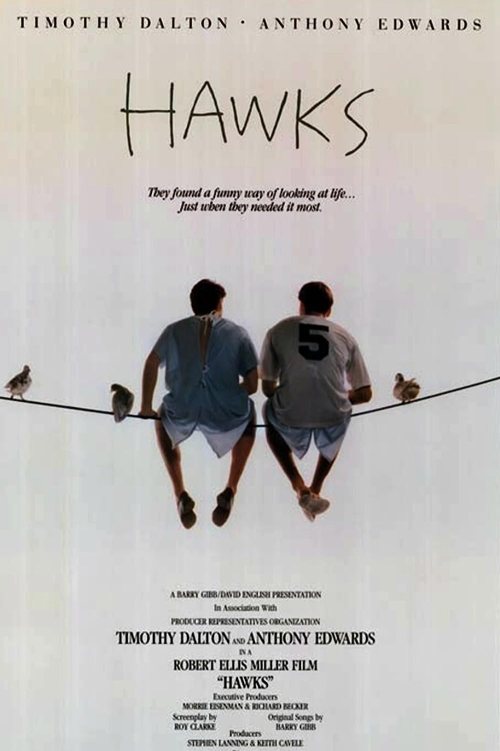
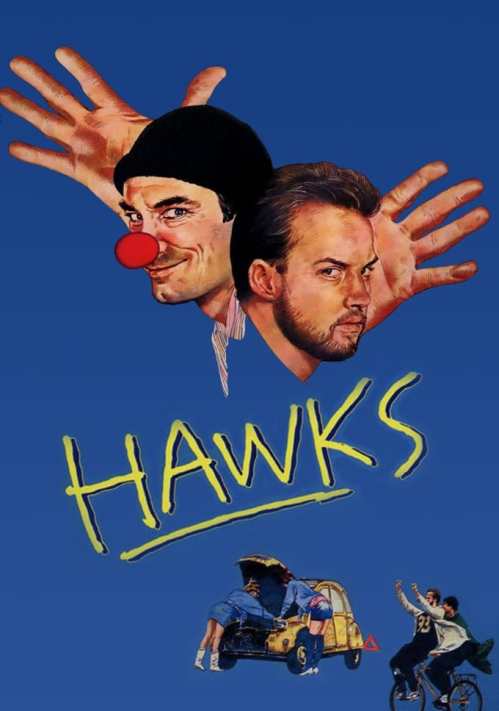
Hawks (1988)

hawks1

By Richard Winters

My Rating: 6 out of 10

4-Word Review: Patients hit the road.

Decker (Anthony Edwards) is a former football player stricken with terminal cancer. He’s put in the hospital where his roommate is Bancroft (Timothy Dalton), who’s dying from the same disease. Bancroft though still wants to have some fun and convinces Decker to sneak out of the facility and go on a road trip to Denmark, so they can have one last fling with the prostitutes in the Red Light District. Decker is nervous at first, as he’d rather commit suicide to put himself out of his misery, but eventually decides to go along where they end up meeting two lonely ladies, Maureen (Camille Coduri) and Hazel (Janet McTeer) who’s also harboring a painful secret.

Based on a short story written by Barry Gibb of The Bee Gees the plot has, despite it’s grim theme, a playful quality and comes-off more like a quirky road movie. The scenery is nice especially when they get into Holland and have an extended scene amidst the picturesque windmills, which you can hear slowly rotating in the wind as they speak. There’s also a few funny moments with the best one coming right at the start where Decker takes a frightened SAAB car salesman (Geoffrey Palmer) on a test drive at reckless speeds and right to the edge of a cliff.

The acting is great with Dalton, who did this between his two stints as Bond and used his notoriety to get it made, which he felt wouldn’t have gotten financed otherwise, being standout and putting to great use his piercing blue eyes, which become even more prominent when he’s wearing his stocking cap. Edwards is also good though he looked wimpy to have ever played football. Some may try to argue that the sickness ate away his weight, but in reality this is the body type he’s always had and the producers should’ve, for the sake of authenticity, had him bulk-up before filming began.

What I didn’t like were the unexplained caveats, like where did these two terminally ill patients manage to get the money to pay for fancy hotels and chic restaurants? It seemed like they could buy anything they wanted, so if that were the case then why couldn’t they get themselves clothes so they didn’t have to run around everywhere wearing nothing but their bathrobes? The sex angle was ridiculous too especially for Decker, who’s so weak he had to be carted around in the wheelchair. If he could barely stand then how the hell is he going to get the energy for sex?

Initially I found Hazel and her clumsiness as annoying as Bancroft did, but like with him she eventually grew on me, but I didn’t think she needed to be introduced already in the first act before she even met the two men. She has a scene on a bridge all alone and I didn’t understand what she had to do with the story, only later during the second act when she appeared again did it make sense, but again her personal troubles could’ve waited to be explained when Bancroft and Decker heard about it. I actually enjoyed more Sheila Hancock, who plays Regina, an aging 50-something hooker they meet, who shows a good propensity at fixing things like TV’s and I wished she’d been the one they had befriended long term and the two younger ladies cut out altogether.

Spoiler Alert!

The ending is touching particularly the way the plastic red clown nose comes into play. The wedding in which Bancroft marries Hazel, who’s secretly pregnant by a man who disowns the child, is cute too though I didn’t understand how Bancroft, who had been losing his hair throughout, suddenly seemed to grow it all back as he walked down the aisle. If anything he should’ve been completely bald by that time and it would’ve been more realistic had he been shown that way.

hawks2

My Rating: 6 out of 10

Released: August 5, 1988

Runtime: 1 Hour 47 Minutes

Rated R

Director: Robert Ellis Miller

Studio: Skouras Pictures

Available: VHS, DVD-R (dvdlady.com)

The End (1978)

end2

By Richard Winters

My Rating: 7 out of 10

4-Word Review: His days are numbered.

Sonny (Burt Reynolds) is a real estate broker known to make crooked deals. He gets diagnosed with an incurable disease and told he has only a limited time left. He says goodbye to his ex-wife (Joanne Woodward) who seems more interested in her new boyfriend, his daughter (Kristy McNichol) and his folks (Pat O’Brien, Myrna Loy) and even his live-in girlfriend (Sally Field) without actually telling them his condition. He then attempts suicide, but this gets him stuck in a mental hospital where he comes into contact with Marlon (Dom DeLuise) who agrees to help kill him, so Sonny can avoid going through the agony of the disease, but then after several aborted attempts Sonny decides he wants to live, or at least as long as he can, while Marlon continues to try and kill him and can’t seemingly be stopped.

The script was written by Jerry Belson, who also did the brilliant satire Smile and the original Fun With Dick and Jane, two of the funniest films to come out during the 70’s. This one is no exception, yet despite be written in 1971 and purchased by a studio, no one seemed to want to touch it. Many stars and producers felt the theme was too maudlin and wouldn’t be able to sell as a comedy. Reynolds though felt it was one of the funniest scripts he had read, and the character most closely identified to who he really was, and therefore jumped at the chance to direct and star in it though the studio was still reluctant and only agreed to finance it once he accepted starring in Hooper, which they felt was the sure money-maker though this one ended up doing quite well, surprising many, at the box office too.

Much of the credit goes to Reynolds who plays the part perfectly. Somehow he can create the slimiest of characters, and this one is a bit scummy with his admittedly shady real estate deals, and yet with his comic talent are still able to make him seem endearing. The studio had wanted the character’s profession to be a stock car racer, but this seemed too stereotypical, so I was happy that he kept it in the white collar realm and openly able to expose all of his personal flaws, which made him quite relatable. It’s also one of the rare times you get to see him with both a mustache and beard, or at least through the whole movie. The studio wanted to nix this too, but it helps give him a distinctive look.

Like with most actors turned director Burt allows for long takes, particularly during the first act, where the supporting cast is given ample time to play out their scenes without any interruption, which leads to many funny moments. I enjoyed Norman Fell as the doctor, and Robby Benson’s as a young priest who listens to Burt’s confession while he takes off his collar and puts it into his mouth, which creates a weird popping noise. These segments have an entertaining quality, but come-off more as vignettes and don’t help to propel the story along.

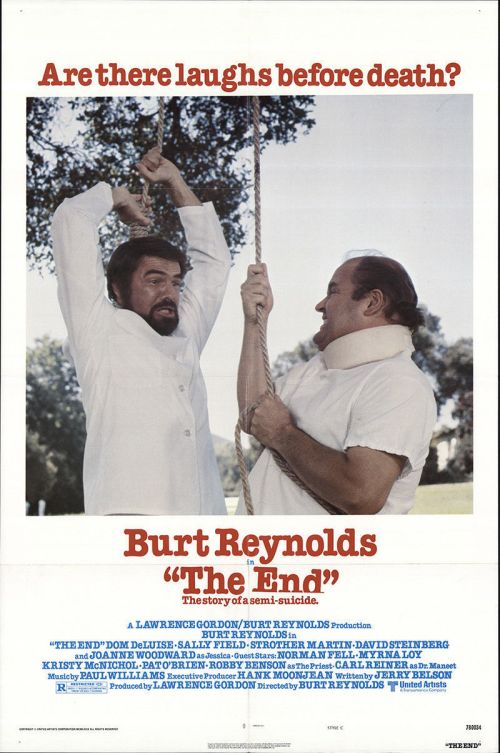
The second act, in which Burt ends up in the mental ward, are the best and his teaming with DeLuise is hilarious. I realize not all the critics enjoyed Dom’s take on a crazy man, Variety Magazine, labeled his performance as being ‘absolutely dreadful’, but there’s no denying the infectious chemistry he and Burt have, making the scene where he tries to drop Burt from a bell tower, or the segment where he tries to hang him up by a noose, quite memorable. The segment though where Burt goes swimming out into the ocean in an attempt to drown and then has a change of heart and tries getting back to shore and the voice-over prayer that he gives to the Almighty he order to help him back is laugh-out-loud and not only the top comedy moment in this movie, but quite possibly any movie ever.

Spoiler Alert!

The only problem I had was with the ending. In the original script the DeLuise character was supposed to kill Burt after he got out of the ocean, but Burt felt the movie needed some ‘hope’, so instead he has DeLuise attempting to chase Burt along the shoreline, in a sort of stop-action way that looks cartoonish. I felt there needed to be more of a resolution. If Reynolds does decide to live out the rest of his days what does he do with it? Does he try to mend his ways by paying back all those he had swindled? Or does he make amends with the people in his life including his ex and daughter? None of this gets answered, which is disappointing. A good movie needs a healthy character arch and this one doesn’t really have any. A better third act would’ve shown how the diagnosis had changed him and had the film not labored so much with the comical vignettes of the first half we might’ve gotten there and it’s just a shame that we never do.

My Rating: 7 out of 10

Released: May 10, 1978

Runtime: 1 Hour 41 Minutes

Rated R

Director: Burt Reynolds

Studio: United Artists

Available: DVD, Blu-ray, Amazon Video, YouTube

Fools’ Parade (1971)

fools

By Richard Winters

My Rating: 5 out of 10

4-Word Review: Can’t cash his check.

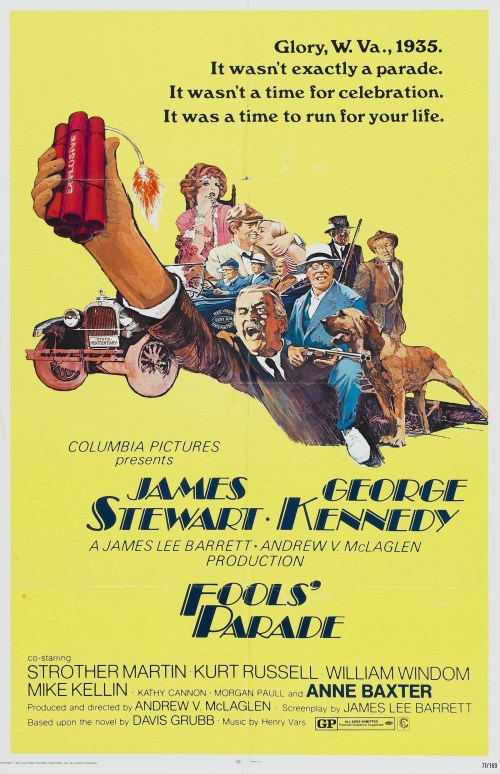
Mattie Appleyard (James Stewart), who lost one of his eyes during a fight years earlier and now wears a glass one, finally gets released from prison after spending 40 years behind bars. Along with him there’s bank robber Lee Cotrill (Strother Martin) and a young convict named Johnny (Kurt Russell) who both get released on the same day. Mattie’s also given a check in the amount of $25,452,32 as payment for his years of prison work. Mattie, Lee, and Johnny plan to use the money to start-up their own grocery store, but since the year is 1935 and many are poor due to the Great Depression they realize they must guard the check carefully and not cash it until it’s fully safe to. During their train ride out of town they become aware after reading the fine print that the check can only be cashed in person at the bank in the town that they’ve just left, so they take another train ride back. Unfortunately for them they don’t know that Mattie’s former prison guard Doc (George Kennedy) has already hatched a plan with the bank manager (David Huddleston) to make sure that the check is never cashed. In-fact the manager has given Doc an advance on the money to have Mattie and his friends wiped-out. Doc has hired a ‘Christian’ hit man  named Junior (Morgan Paull) to do the dirty deed, which Junior agrees to as long as it’s confirmed that people he kills are atheists, which Doc insists they are.

The film is based on the 1969 novel of the same name by Davis Grubb, who is better known for having written Night of the Hunter. It was shot on-location in Moundsville, West Virginia where Grubb was born and raised and it’s the setting that helps give the movie added character. The scenario though is rather odd and seems to want attain a certain quirky tone that it can’t quite reach. Leonard Maltin, in his review, complained about it being ‘unintentionally funny too many times to be taken seriously’. While I’ll agree the tension is lacking I do feel that this was meant to be humorous and some of it is slightly amusing, but it never gels and overall isn’t intriguing. I also felt the Russell character wasn’t needed. Maybe the producers wanted a youthful character added to attract younger members of the viewing public, but he doesn’t say, or do anything that’s funny, or helps move the story along. His romance with Chanty (Katherine Cannon in her film debut) who plays a 16 year-old who’s virginity is up for sale for a price of $100, is too forced, not believable, and adds nothing to the main plot.

There’s also several directorial errors including the first time Stewart takes out his glass eye, which was apparently so painful to wear that shooting could only last for 20-minutes at a time. In the shot we see Stewart put his hand over his eye and then it cuts to Russell’s shocked expression and then back to Stewart where the eye ball is in his hand, but we can see on Stewart’s face, just as he turns that he still has a blue eye in the socket where the glass used to be. When he removes the eye later he keeps the left eye closed in order to represent an empty socket, but the first time he doesn’t.

There’s also issues with Kennedy’s teeth. Initially I thought he was wearing braces, but then during close-ups it looks like there just supposed to be dirty, or rotting, but realistically it’s not done right. If they were truly bad teeth then some of them should’ve fallen out, or broken off instead of looking like they have been covered with black specks. There’s also a scene where he’s sitting in a car putting on his white shoes and his teeth are all white only to have in a later scene going back to them appearing dirty.

The performances are certainly a plus with Stewart’s being especially good and I admire the way he was willing to go out of his comfort zone by playing a type of kooky character he had never done before. Kennedy is also a scene-stealer in quite possibly the funniest thing he ever did. Huddleston is also solid as the corrupt bank manager and the segment where he nervously watches Stewart attempt to light a stick of dynamite inside the bank office is probably the film’s best moment. Kudos though must ultimately go to Anne Baxter who’s quite impressive as an aging, embittered prostitute who runs a whorehouse on a houseboat. I remember being blown away by her performance in The Ten Commandments and then later for her Oscar winning work in All About Eve, but her she’s almost unrecognizable in a role that is both darkly funny and sadly poignant at the same time.

My Rating: 5 out of 10

Released: June 17, 1971

Runtime: 1 Hour 38 Minutes

Rated GP

Director: Andrew V. McLaglen

Studio: Columbia Pictures

Available: DVD-R, Tubi

The Sidelong Glances of a Pigeon Kicker (1970)

pigeon

By Richard Winters

My Rating: 5 out of 10

4-Word Review: Cab driver dislikes pigeons.

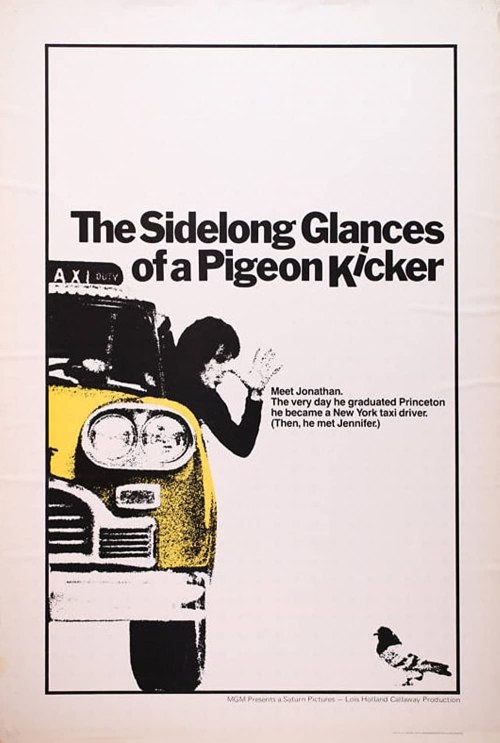
Based on the novel of the same name by David Boyer, the story centers on Jonathan (Jordan Christopher) a Princeton graduate who spends his days working as a New York cab driver with no ambition to climb up the corporate ladder. Jonathan detests the establishment, but is too old to be a part of the hippie movement, so he rebels from society in other ways by being flippant with his customers and kicking at pigeons in Central Park. His friend Winslow (Robert Walden) has problems of his own as he’s 24, but still a virgin. Jonathan takes Winslow to a party in an effort to find him a woman, but Winslow is so socially awkward that they all turn him down. Back at his apartment Jonathan meets-up with Jennifer (Jill O’Hara) who’s busy trying to ‘find herself’ while living off of her parent’s money. Initially Jonathan resists her advances, but since they’re both lonely he eventually agrees to a relationship with her as long as there are no strings attached. He even brings her to visit his mother (Kate Reid), but then at a holiday party Jennifer makes the mistake of  saying she wants to get married and have kids, which scares Jonathan away and the two break-up only for Jennifer to then sleep with Winslow, which causes Jonathan to become jealous.

This was one of an assortment of youth pictures from the early 70’s trying to analyze the alienation of the love generation and their resistance to conformity and middle class values. These films tended to be much less structured and in certain cases downright experimental, but the subject matter was still considered topical enough that the studio heads at MGM decided to pick it up for distribution only to then quickly drop it when previews of it scored low with test audiences. It was then handed over to a fledgling film company known as Plaza Pictures that re-edited it down to 90 minutes while cutting-out much of the second act in the process and then re-naming it as Pigeons, but this version did no better and the film sat in obscurity for many decades before finally getting a DVD release in 2014.

While I do like offbeat movies I did find the way this one began hard to get into as the lackadaisical pace makes it seem like there isn’t any plot and just a lot of throwaway segments dealing with the angst of big city living. It does improve and manages to even have a few keen moments. John Dexter’s direction, he was better known for his work in the theater as well as his rude behavior towards women, helps a lot. In fact it’s the directing that keeps the thing watchable and despite the modest budget it’s quite polished with the most impressive moment, outside of a taxi car driving off the dock and into the water, is when Jonathan goes under his kitchen cabinet in an attempt to exterminate hundreds of ants. This isn’t as easy as it sounds to get a camera and lighting into such a small space, nor finding all the ants, and I suspect the cabinet was specially made for the production, but still on a small scale it’s impressively done.

The film also features a great supporting cast including Walden in his film debut who is both believable and amusing as Jonathan’s shy and apprehensive friend. O’Hara is equally engaging, she looks exactly like her more famous sister Jenny O’Hara and for awhile I thought it was the same woman. Kate Reid is a scene-stealer as the meddling, oppressive mother and William Redfield has a great moment near the end playing the stepfather who openly has a one-night-stand with a lady he meets at a Christmas party and then comes home late at night to talk to Jonathan about it.

The film’s Achilles heal is the casting of Christopher. He rose to fame as the singer of The Wild Ones, which got him cast as a rock singer for the cult hit Angel, Angel Down We Gowhich generated enough notice that producers decided to take a chance on him in a lead role, but it doesn’t work. His character is unlikable and he lacks a dynamic presence let alone his disheveled mop-head hair-do that resembles a bird’s nest. Having the film begin by showing him kicking at pigeons in Central Park, fortunately his foot doesn’t seem to actually hit any of them, makes the viewer despise him right from the start and things never improve.

Spoiler Alert!

The cop-out ending is a disappointment as it features Jonathan riding off on a train headed to Des Moines, Iowa, but I’ve rarely found anyone who’s been born and raised in New York to move to the farmlands of the Midwest. Sure many New Yorkers have gripes about where they live, most anyone is never completely happy with their home city, but ultimately they remain because it’s what they’re used to. Instead of ending it with him riding away it should’ve made this a part of the movie showing his adapting to a completely new and alien place, which could’ve given the movie some interesting insight and made a stronger impression than it otherwise does.

Alternate Title: Pigeons

My Rating: 5 out of 10

Released: October 28, 1970

Runtime: 1 Hour 46 Minutes (DVD version runs 1 Hour 30 Minutes)

Rated R

Director: John Dexter

Studio: Plaza Pictures

Available: DVD

The Boys in Company C (1978)

boys1

By Richard Winters

My Rating: 7 out of 10

4-Word Review: Going through boot camp.

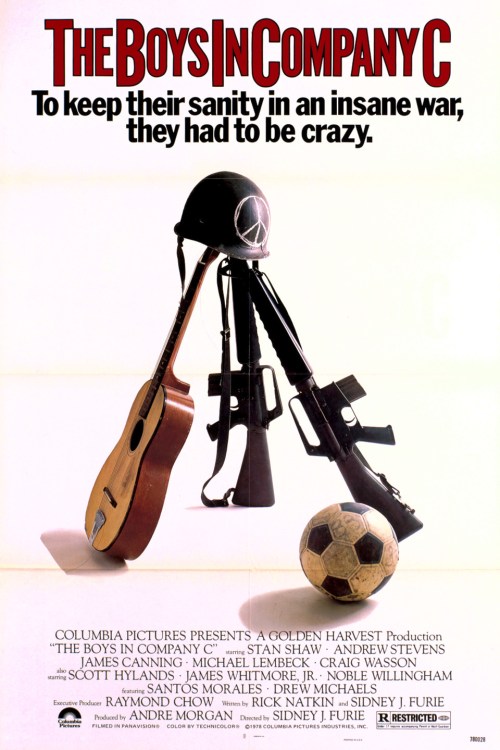
Tyrone (Stan Shaw), Billy Ray (Andrew Stevens), Alvin (James Canning), Vinnie (Michael Lembeck), and Dave (Craig Wasson) are five young men from varying backgrounds and wildly different temperaments who get drafted into the army in August of 1967. Their experiences in boot camp, which is harshly run by the demanding Sergent Loyce (R. Lee Ermey) and the equally stern Sergeant Aquilla (Santos Morales) prove challenging both physically and psychological, but the real test comes when they’re put out onto the battlefield and their personalities begin to disintegrate.

While the film acts like everything that goes on is based on fact and even includes specific dates for each event and at the end small bios of what occurred to the characters after they returned to civilian life it’s actually all fictional and based on a screenplay written by Rick Natkin in 1972 while attending a film class at Yale and then later expanded. It’s noted as being the first film in the 70’s to deal with the Vietnam War on the field of battle as well as the film debut of R. Lee Ermey playing a similar role to the more famous one that he did in Full Metal Jacket. Here though he’s thinner and while the things he says are certainly still aggressive it’s not in quite the over-the-top way as in the Stanley Kubrick film. In fact I sympathized with him here and the challenges he faced in trying to get the rag-tag group conditioned and how he supported the Tyrone character and the racism he had to deal with. Morales also plays the same type of drill sergeant and found it ironic that both men had some missing front teeth in the same areas of their mouths and wondered what the story was behind that.

Shot in the Philippines where its similar type of topography to Vietnam lends an authentic look and the viewer is given a vivid feeling for what wartime life was like where things could be calm and peaceful one moment and then bombs going off the next. While I’ve had my issues with Wasson, Stevens, and Lembeck in some of their other films where I considered their acting to be weak here their performances are solid and the transitions their characters go through during the course of the movie are compelling though without question Shaw is the standout.

While the first half shows the realities of war the second part becomes mired in the darkly comical absurdities. This was clearly inspired by the era where such films as M*A*S*H took the Korean conflict and turned it into a surreal comedy, but mixing the grittiness with moments of levity cheapens the reality. Scott Hylands’ character is particularly off-putting. He plays a captain who makes one insane blunder after another until he becomes more of a caricature. I’m sure it’s quite possible for high-ranking officials to make the occasional misjudgment, but this guy becomes clownish to the top degree making it almost farcical in the process. The climactic soccer game has the same issue where the soldiers can get out of fighting on the front line if they just agree to lose the game, but this scenario never actually occurred to any veteran I’ve ever known and it’s jarring to go from action on the battlefield to kicking a ball around like a war movie that suddenly turns into a sport’s one.

It’s still well enough directed to keep it engaging and there are some strong even profound moments despite the severe shifts in tone, but it would’ve been better had it maintained the realism from the beginning and not thrown-in stuff that would’ve been better suited for satire.

My Rating: 7 out of 10

Released: February 8, 1978

Runtime: 2 Hours 5 Minutes

Rated R

Director: Sidney J. Furie

Studio: Columbia Pictures

Available: DVD, Blu-ray, Amazon Video

A Wedding (1978)

wedding2

By Richard Winters

My Rating: 7 out of 10

4-Word Review: Guests at wedding party.

Muffin (Amy Stryker) marries Dino (Desi Arnaz Jr.) at a wedding ceremony that is non-eventful. However, during the reception afterwards, held at the mansion of Dino’s family, the Correllis, everything begins to go wrong including having the family’s elderly matriarch, Nettie (Lillian Gish) promptly die just as the guests arrive. Snooks (Paul Dooley) and Tulip (Carol Burnett) are the parents of the bride, while Buffy (Mia Farrow) is Muffin’s jealous older sister. During the party Buffy lets Dino know that she’s pregnant with his baby, which sends the family into an uproar once word gets out. Meanwhile Mack (Pat McCormick), the cousin of the groom, makes it known that he’s ‘madly in-love’ with Tulip and wishes to have an affair with her. Tulip at first resists, but then devises a scheme where the two can meet in 2-weeks, at a location in Tallahassee, Florida under the ruse that Tulip will be going to visit her sister who lives there.

While director Robert Altman made some great movies and revolutionized movie-making with his over-lapping conversations technique, he did also produce a few duds. Most of them came during the 70’s when he was given too much free rein to make whatever he wanted in however way he wanted to do it, which culminated in a lot of over-indulgence. This one though, which came right in the middle of his down cycle, is one of his better efforts The idea came as an accident as he was tired of being hounded by a reporter asking, while he was still working on finishing up on 3 Women, what his next project would-be and he joked that he was set to ‘film a wedding’, which at the time had come into vogue for people to shoot the weddings of their family members in a home movie style. Later that night, after speaking with the reporter, he partook in a drinking session with the crew of 3 Women, where they discussed the possibilities of making a movie about a wedding where ‘everything would go wrong’ and by the end of the night he had already come-up with an outline for his script.

This film though, like with all of Altman’s movies, does come with its share of detractors. Gene Siskel in particular did not like the characters, who I admit are a cliche of the nouveau riche and too easy a satirical target. He also complained that there was no one likable, which is true, though films where one person in a large group somehow manages to rise-above-the-fray and being morally virtuous when all the rest aren’t, is unrealistic and having an amoral climate such as here where everyone gets dragged down to the same level as everyone else makes more sense.

The edginess of the comedy is dated as well as what was considered ‘pushing-the-envelope’ at the time, like introducing the characters who are secretly gay, smoke marijuana on the sly, have had multiple sex partners, or (gasp) had sex outside of marriage, is no longer even remotely the scandal, even amongst the most conservative, as it once was, so to enjoy the film one must put themselves in that time period to totally appreciate it. With that said, it still works beautifully. It’s amazing, when considering the massive amount of characters and intersecting story-lines, how well it flows and it’s never confusing, nor do you ever lose track of any of the characters, or their issues, even if they’ve not been shown for a while. The humor gets exaggerated just enough for comic effect, but always within the realms of reality, which is what I really enjoyed about it, is that this could easily remind people of their own real-life weddings, and wedding parties, that they’ve been through.

The cast is splendid and perfectly game to the script’s demands with many of them allowed to freely ad-lib. Howard Duff probably gets the most laughs as the chain-drinking doctor of a dubious quality and Viveca Lindfors as a caterer who becomes ill, takes a pill, and then breaks-out into a loud song during the reception. Burnett is superb as a middle-aged housewife looking for more excitement in her life while also juggling the difficulties of raising a promiscuous daughter and Paul Dooley is quite enjoyable as her brash, and never shy to speak-his-mind husband. I also got a kick out of Amy Stryker, who was cast on-the-spot simply because she wore braces and resembles a young Burnett in many ways and was therefore perfect to play her daughter. Though the ultimate scene stealer is Mia Farrow, who although well into her 30’s at the time, looks amazingly still adolescent-like and pulls off the part of a young daughter quite convincingly. She utters very few words, but makes up for it with her shocking topless scene (she looks great) and the bit where she openly tries to count everyone she has slept with to the stunned silence of the others, including her parents, in the room.

wedding3

My Rating: 7 out of 10

Released: September 12, 1978

Runtime: 2 Hours 5 Minutes

Rated PG

Director: Robert Altman

Studio: 20th Century Fox

Available: DVD

Deadly Games (1989)

game1

By Richard Winters

My Rating: 7 out of 10

4-Word Review: Kid versus Santa Claus.

Thomas (Alain Lalanne) is a 10-year-old who’s a wiz with computers and technology. Not only has he set various booby traps throughout the large mansion that he lives in with his mother (Brigitte Fossey), but he can fix cars and even drive them. Despite being super smart he still believes in Santa Claus while his friend Pilou (Stephane Legros) tries to convince him that he isn’t real. Thomas goes on the computer in an attempt to communicate with Santa, but instead gets a vagrant (Patrick Floersheim) on the other end pretending to be the jolly red fellow. He gets Thomas to give out his address and also reveal that his mother is a rich corporate CEO. The vagrant goes to his mother’s company and gets a job as a Santa, but is soon fired by her when he slaps a child. In revenge the vagrant, still in his Santa costume, goes to Thomas’ house where he plans to kill him, but Thomas uses his technical ingenuity to set a trap.

The film is an unusual hybrid between playful children’s comedy, a holiday film, and a slasher horror, which only could’ve been made in France where filmmakers aren’t under a repressive studio system that forces all scripts to conform to a cookie-cutter formula and here allows them to deviate between genres. Many have labeled this the original Home Alone and in-fact writer/director Rene Manzor threatened to sue John Hughes, who had directed the other one, insisting that he had essentially remade his film without permission. There are though quite a few differences between the movies to the extent that I didn’t think it was an unauthorized remake at all. If anything it reminded me more of another French classic Le Joutabout a rich kid living in a big place with a wide assortment of toys. This is also the best of the killer Santa movies as You Better Watch Out and Silent Night, Deadly Night took themselves too seriously while this one has a playful edge that manages to be both amusing and tense.

The kid certainly has an engaging quality and his love for his elderly grandfather (Louis Ducreux) is quite endearing, but he’s also just a bit too smart. I was okay with him being keen on the gadgetry, but having him get underneath a car and able to not only fix it, but also drive it was going too far. I wasn’t sure that a 10-year-old could reach the pedals with his feet and still be able to see over the dashboard. Part of what makes horror movies intense is having a victim appear vulnerable, but right away with the kid being so incredibly ingenious it makes the odds stacked against the killer and thus their cat-and-mouse game not as intriguing. I also really couldn’t stand the kid’s mullet haircut.

The home is over-the-top as well. It gets referred to as a mansion, but really seems more like a castle that’s bigger than anything I’ve seen anyone else, even the billionaires and celebrities, reside in. It doesn’t even seem like a real place, but instead, in certain shots, a miniature model and at other points a painting. All the secret rooms gets a bit dizzying including the hidden one that can be entered via an old refrigerator (are they really expecting us to believe that a 10-year-old kid, no matter how smart he is, could build that?). Another moment has Thomas getting trapped inside a life sized maze, but who the hell would take the time and effort to build a maze in their very own home, which again ends up getting too creative for its own good and negates the tension instead of enhancing it.

The Santa character is a boring. Usually horror movies make an effort to give the psycho, whether it’s through flashback or dialogue, some sort-of backstory, but here this guy pops-up without any idea of who he is, where he’s from, or why he’s so crazy. There’s also a few segments where he gets caught in a trap, like when he falls through a trap door and stuck in a net, but no shot showing how he got out of the predicament. Seeing how he gets himself out should’ve been shown each time (it’s shown in a few scenarios, but not all) in order to make the plot seem more reality based and less cartoonish.

Overall, despite the over-direction, it’s still a fun, wild ride that could be enjoyed by the whole family. It does get a bit intense at times, but the quick-thinking kid always seems to be pretty much in-control. Outside of the pet dog getting stabbed none of the other killings are seen and only the feet of the dead bodies are captured on camera to represent their demise, which should make it palatable for most kids to sit through without having nightmares afterwards.

Alternate Titles: 36.15 code Pere Noel, Game Over

My Rating: 7 out of 10

Released: March 18, 1989

Runtime: 1 Hour 32 Minutes

Not Rated

Director: Rene Manzor

Studio: Deal

Available: DVD-R (dvdlady.com)

The Meateater (1979)

meateater1

By Richard Winters

My Rating: 1 out of 10

4-Word Review: A haunted movie theater.

Mitford (Peter Spitzer) is a middle-aged father of two who decides he’s had enough of being a shoe salesman. Much to the reluctance of his wife Jan (Dianne Davis) he buys an old movie theater and decides to reopen it. The theater had remained closed since the previous owner showed the movie Carnal Knowledge, which was considered too racy for the conservative citizens of the town, but Mitford promises to schedule only G-rated fare. While opening night is a sell-out it proves fatal when the projectionist (Richard Nathan) gets electrocuted and dies. Then from behind the screen it’s revealed that someone from years ago had hanged himself. No one knows for sure who it is, particularly the vulgar police detective (Joe Marmo), but the new owners begin to suspect that the weird, stuttering man (Arch Joboulian) who lives nearby and always appears in the theater at odd times may know more about what’s going on than he’s letting-on.

Regional filmmaker David Burton Morris, who has shot the majority of his films in the Twin Cities area where he’s from, has had some acclaim with his dramas, but his foray into horror is a disaster. The only redeeming quality are the quirky characters. Raymond, as a hyper nervous, geeky projectionist is funny and I hated seeing him go. The crass investigator is good for a few chuckles too and in some ways probably not all that different from a gruff policemen of that era.

The film’s downfall is the fact that there aren’t any scares. It starts out creepy enough, but that vibe soon gets lost and the soundtrack plays like something better suited for a comedy. The extraneous conversations really bog it down. Discussions about Jimmy Dean sausages and having the family singing the Oscar Meyer wiener song as they drive home has no place in this story, or any other for that matter. It also suffers from poor framing where the husband and wife are sitting on a porch to one side and the detective on the opposite end, but despite all three being involved in a conversation only the couple are seen while all we see from the detective are his legs.

Spoiler Alert!

The third act is where it really goes south as the brother of the crazy stuttering man (both played by Joboulian) kidnaps the couple’s teen daughter (Emily Spindler) because she reminds him of Jean Harlow his favorite movie star. However, the teen girl wasn’t in much of the movie up until then, so the viewer has no emotional connection with her and therefore no care whether she gets away, or not. Since the mother had taken up most of the screentime it really should’ve been her as the kidnap victim. Either way it’s not very tense and Jobulian, who comes-off as a cross between Angus Scrimm in Phantasm and Richard O’Brien from The Rocky Horror Picture Show, is not a good enough actor to make the villain role even remotely interesting. The attempt to borrow from the ‘Hunchback of Notre Dame’ theme where this deformed being falls for a young beauty is both stale and contrived.

The story also has no connection with the title. We do see a man biting down on a rat at the beginning and the theater does show some documentaries of animals attacking other animals, of which we see a few snippets of, but the title leads one to believe this will be about cannibalism and there’s none. The film’s promotional poster seen above is misleading as well and far scarier than anything you’ll witness in the movie.

My Rating: 1 out of 10

Released: November 16, 1979

Runtime: 1 Hour 25 Minutes

Not Rated

Director: David Burton Morris

Studio: Hollyco

Available: DVD-R (dvdlady.com)

Sunday Lovers (1980)

sunday1

By Richard Winters

My Rating: 4 out of 10

4-Word Review: Stories about illicit sex.

International production has 4 stories taking place in a different country with a famous male movie star and director native to that region. The stories central theme revolves around love-making, or attempts thereof, and all outside of marriage. The concept sounds like it should’ve been a creative experiment especially with all the big-name talent, but the results are flat and forgettable.

The first story, ‘An Englishman’s Home’, stars Roger Moore as Harry Lindon, a rich man who owns a villa that Winston Churchill once resided in. He meets by chance a beautiful young blonde named Donna (Priscilla Barnes), who’s an airline stewardess in London on layover and who becomes impressed with Harry’s home and goes with him to visit it. It’s there that Harry plots with his loyal butler (Denholm Elliot) to get her to go to bed with him, but his plans are disrupted when his lady friend Lavina (Lynn Redgrave) comes for a unexpected visit. He and his butler spend the evening trying to avoid having the two meet by creating a scheme where Harry will be ‘forced’ to leave the dinner table with one to answer a phantom phone call, which allows him to then visit the other one before being informed by his butler of yet another ‘phone call’.

Moore is funny with his glib and sarcastic delivery and Barnes is amusing playing-up the ditzy blonde persona. The plot though is neither original, or entertaining and becomes boring quite quickly. The ending has a novel twist, but this is where I felt the story should’ve begun, which would’ve been more interesting.

The second segment, ‘The French Method’ was written by the prolific Francis Veber and deals with Francois (Lino Ventura), a French businessman, trying to close a deal with an American businessman named Henry (Robert Webber) The problem is that Henry is a middle-aged lech who’s got the hots for Francois’ attractive receptionist Christine (Catherine Salviet). Henry insists that before any deal is made he must have dinner with both Francois and Catherine. Francois is reluctant to ask Catherine to come along, but he’s so desperate for the deal to go through he becomes willing to do almost anything. Christine agrees despite disliking Henry. Once the dinner engagement commences Henry makes clear that he wants Francois to come-up with a polite excuse to leave, so the two can be alone together. Francois does as he’s asked, but then returns to have a confrontation with Henry, which leads to unexpected results.

This segment is expertly played by the three leads particularly Ventura and the characters are fleshed-out enough to keep it intriguing. The final twist is fun making this easily the best of the four.

The third segment, ‘Skippy’, was written and directed by Gene Wilder who also stars in the lead. It’s about a suicidal patient who’s allowed a weekend pass out of a mental hospital. He then meets-up with a younger woman (Kathleen Quinlan) at a disco. They hit-it-off especially after finding that each of them are ‘nutcases’. They go back to her place and share a passionate night of lovemaking only for him to have his heart broken the next day when she confides in him a surprising revelation.

This story is helped greatly by Quinlan who is young and beautiful and you even get to see her topless though you also have to put up with Gene’s bare bum too. Either way she gives a sprightly performance, but the story is odd and takes too long to play out. I was expecting it to go in a different direction than it does and the ending offers no pay-off.

The final segment, ‘Armando’s Notebook’, stars Ugo Tognazzi as a married man whose wife goes off on a trip to visit her sick mother. Armando uses this as an excuse to hook-up with old girlfriends from the 60’s by using his little black book that still lists their addresses and phone numbers. Unfortunately when he meets them he finds that things have changed quite a bit and not for the better. Many have aged to the point that they’re no longer attractive, or have become ‘liberated’ through feminism and won’t allow him to take advantage of them like they used to. One turns-up dead while yet another has become a high class prostitute who even accepts credit cards.

While this story is watchable it’s also too jokey and features a weird bit where one of the women, played by Sylva Koscina, has acquired the ability to suck in a massive amount of air and then blows it out with hurricane force, which has a strange supernatural vibe that doesn’t fit with the rest of the material.

My Rating: 4 out of 10

Released: October 31, 1980

Runtime: 2 Hours 5 Minutes

Rated R

Directors: Bryan Forbes, Edouard Molinaro, Dino Risi, Gene Wilder

Studio: Viaduk Productions

Avaliable: None