Category Archives: Black Comedy

I Love My…Wife (1970)

ilove

By Richard Winters

My Rating: 6 out of 10

4-Word Review: He’s bored with marriage.

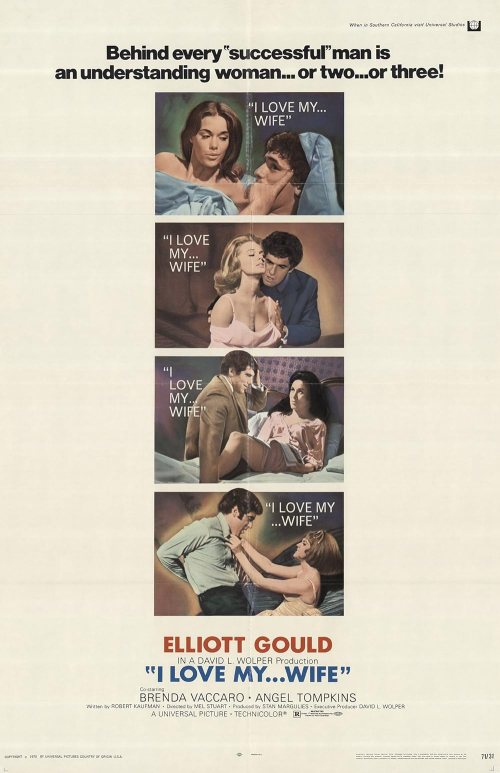
Richard (Elliot Gould) is a medical student when he meets Jody (Brenda Vaccaro) and the two quickly fall-in-love and get married. She then gets pregnant while he’s still in school and they don’t believe they have enough money to financially support a child, so they initially consider an abortion, but at the last minute Richard changes his mind and feels they should have the child. Jody though gains a lot of weight during the pregnancy, which Richard finds unattractive. Once the baby is born she’s unable to burn-off the excessive pounds causing their sex life to go even further into the tank. He has a few flings with some of the nurses before finally setting his sights on Helene (Angel Tompkins) a beautiful model who’s married to a baseball star (Dabney Coleman). At first she resists his advances, but the two eventually bed and then fall-in-love. She insists that Richard leave his wife, so that they can be together and no longer have to meet-on-the-sly. Richard tries to break-up with Jody, but because they have two kids finds that he can’t and instead begins lying to Helene as he plays both women at the same time, which soon turns into a losing situation.

The odd way this thing opens really hurts it and although it does improve a bit as it goes along some viewers may not be patient enough to stick with it. Having the opening credits deal with Richard’s relationship with his mother (Helen Westcott) and the sheltered way that she raised him isn’t funny and because the mother never appears again in the movie it wasn’t worth introducing her at all. Since the wife is the main focus I felt the opening scenes should’ve dealt with their dating period, which the movie breezes over too quickly. The clips from old movies, which get spliced in from time-to-time, add nothing and make it seem too much like Myra Breckenridge, which came out around the same time and best left forgotten. At least in that movie the clips came at predictable intervals, but here it’s sporadic making it seem, when they do get shown, as jarring and out-of-place.

Gould certainly excels at this type of role and he’s quite possibly the only actor who could play a shallow person and still manage to make it come-off as semi-likable. Vaccaro though is the real surprise as she’s usually best at drama and initially I felt she was miscast, but she comes through in making her character complex and even amusing as she goes through her tirades, some of it justified, at Gould. This is also the first movie to ever explore the issue of women who gain weight during their pregnancy, but can’t lose it afterwards and how this could affect their sex life, which I felt deserved kudos for being ground-breaking. The film makes the mistake though of showing too much from her point-of-view to the extent that we start to sympathize with her over the main character and almost start to dislike him in the process.

The introduction of Helene really does help as it’s her presence that gives the story a unique angle. Before this it comes-off more like your typical run-of-the-mill flick about a cad of a husband who can’t stay faithful, which has been done a lot and this movie doesn’t add anything insightful in that vein. However, the affair itself is interesting. For one thing she plays hard-to-get and doesn’t just jump immediately into the bed sheets at Gould’s beck-and-call, which is good as too much of the time, especially in 70’s movies, the women seem way too easy in a way that isn’t realistic. What I liked even more though is that the affair really doesn’t solve anything. Sure he finds her hot and sexy and they do get along, but she also has demands of her own and Gould finds himself in the same quandary as with his wife showing how extra marital flings really aren’t the ‘escape’ that they’re intended, but instead more of a problem.

Spoiler Alert!

The script by Robert Kaufman brings out many harsh truths about marriage and doesn’t insult us with any placid answers. Yet when the movie should go hard it goes soft instead. I liked how Vaccaro, who spent the whole time trying to win him back, finally gives up and starts seeing someone else, but Gould though upset and rebuffed, doesn’t learn anything from it. He goes back to the bar and tries picking-up an attractive stewardess he meets like he’s now making some sort of ‘fresh start’ when the film spent its entire running time exposing how this ‘cruising for chicks’ is a vicious cycle that just leads to more emptiness. Seeing Gould’s character change, or learn from his mistakes and display some regret would’ve been a far better way to have ended it.

My Rating: 6 out of 10

Released: December 21, 1970

Runtime: 1 Hour 38 Minutes

Rated R

Director: Mel Stuart

Studio: Universal

Available: DVD-R (dvdlady.com, modcinema.com)

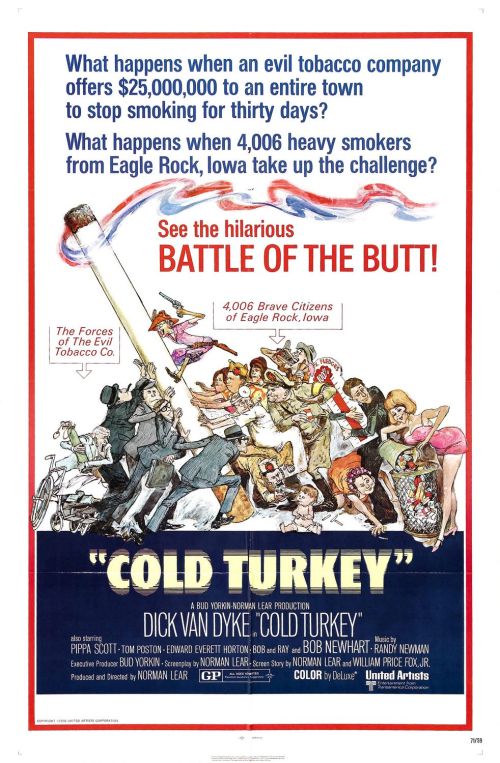
Cold Turkey (1971)

coldturkey

By Richard Winters

My Rating: 7 out of 10

4-Word Review: Small town quits smoking.

To commemorate the passing of Norman Lear last week at the ripe old age of 101 we decided to review the one film that he directed and was shelved for two years by the studio who didn’t think it would be a hit with any audience and only decided to eventually release it once Lear had success with the classic ‘All in the Family’ sitcom. The story revolves around a small town in Iowa named Eagle Rock. The Reverend Clayton Moore would like a bigger congregation in a more prestigious area as he feels trapped in what he considers a ‘dying’ town with limited employment opportunities. He then hears about a contest that a giant tobacco company is sponsoring where they try to see if there’s a town in America that will make a pledge to agree to quit smoking for 30-days and if they succeed will be awarded $25 million. Merwin Wren (Bob Newhart), who works for a tobacco company, bets that there isn’t a place that would be able to make this pledge, but Clayton, figuring this may be his ticket out and onto greater things, pushes the citizens to sign the pledge, which will then put Eagle Rock on the map.

The location of the film shoot was Greenfield, Iowa, which I traveled to in 2009 and was amazed how similar it still looked after 40 years. The opening sequence showing the town from the south end still had many of the same buildings and the courthouse along with the gazebo in which the reverend makes his fiery speech are all still there and looking almost untouched.

The town itself is really the main star. Lear does a terrific job of showing the people who live there as they really are versus in some idealistic, or romanticized way. Too many other Hollywood productions seem to suffer from the Mayberry effect where the citizens are portrayed as simple and content ‘God Fearing’ folk who are devoid of any complex personality. Here they are frustrated individuals who secretly dream of moving away, or ‘hitting it big’ in some way, but because they don’t have the means to achieve this ultimately find themselves stuck and just trying to make the best of it. The people are no more immune from temptation, or corruption, than the ones living in a big city and if anything are even more susceptible since they haven’t been put in that situation much, but when they are, as evidenced when the place gets spoken about all over the media and everyone from all over descends on it including Lottie (Gloria Leroy) a prostitute under the guise of being a masseuse who services all married men.

Beyond the on-target satire the film also scores with its fabulous ensemble of character actors, many of whom would later star, or guest star, in many of Lear’s TV-shows. Each actor plays a distinct personality from Barnard Hughes the fidgety and nervous doctor who resorts to lollipop sucking, or Graham Jarvis the head of a far-right organization, who preaches about the evils of ‘big government’, but then readily accepts for his group, which is mainly made up of senior citizens, to become a voluntary gestapo-like militia that arrests those who are caught smoking and forcibly search all in-coming vehicles. Pippa Scott though, as Clayton’s much put-upon wife, was my favorite. She encompasses what I think a lot of small town people can feel especially those that weren’t originally from the area, who are stuck in a dead-end marriage and perennially forced to ‘put on a happy face’. Her primal scream, which happens during a dream-like segment on the rooftop of one of the houses while neighbors stand around watching I felt was one of the film’s defining moments.

In the lead roles Dick Van Dyke is terrific mainly because he plays against type. Part of what I felt killed his movie career was that he took too many roles that were just an extension of his Rob Petrie persona in his famous TV-show. Here though he’s the opposite playing an egotistical, narcissists who cares about nothing other than his own career ascension, but manages to do it in a way that’s quite amusing. Newhart plays an unusual role for him as well. Typically he’s a buttoned down, strait-laced guy commenting on the insanity around him, but here he is the nutty one and does a trick with his eyes that gives him a psycho appearance.

Spoiler Alert!

The one flaw is the ending in which all three leads (Van Dyke, Newhart, Hughes) get shot in the middle of a crowd of people standing in the town center. The shootings look fake as they show no bullet hole in their clothing, or blood even just a little bit for authenticity. One shot shows people in the crowd holding the heads of the victims as they lay there in an effort to comfort them, but then in the next shot has the three lying all alone as the crowd essentially abandoned them, which seemed unrealistic that absolutely no one would care. Having an ambulance driver trying to drive-in through the mob, but then maybe stopping to run out and grab the cigarettes that rain down on the town from a helicopter, would’ve been amusing and better explanation for why the three didn’t get the help that they needed.

There’s also one shot showing Newhart sitting up and laughing, but what is he laughing about and why would he be doing this when he’s been injured with a bullet? There’s no answer to this, which makes it come-off as a cop-out ending and like Lear had written himself into a hole that he couldn’t get out of.

My Rating: 7 out of 10

Released: January 20, 1971

Runtime: 1 Hour 41 Minutes

Rated GP

Director: Norman Lear

Studio: United Artists

Available: DVD, Blu-ray, Amazon Video, Tubi

Made for Each Other (1971)

made

By Richard Winters

My Rating: 7 out of 10

4-Word Review: Couple argues a lot.

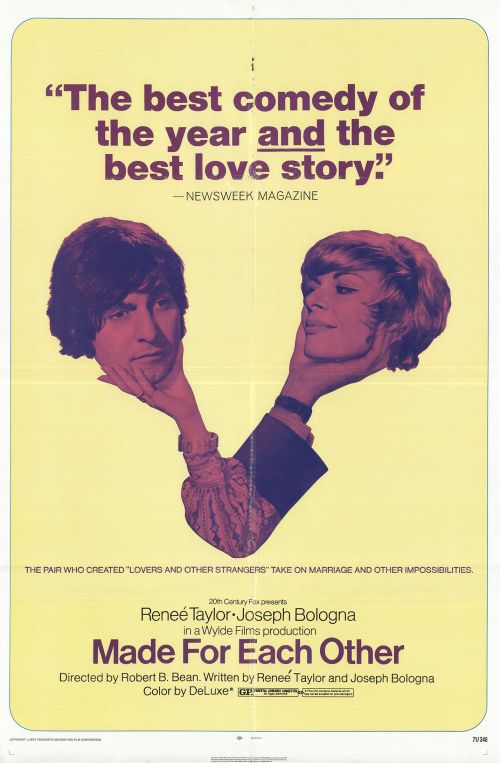
Pandora (Renee Taylor) is an out-of-work actress still clinging to her dreams that she’ll one day become famous something she has hoped for since she was a child. Gig (Joseph Bologna) suffers from not being able to find a stable relationship and guilt-ridden over sending the last one into attempted suicide. Both Pandora and Gig attend a group therapy session and this is where they meet. Initially though things are rocky. Gig does not like Pandora’s stand-up act, something she’s been working on for years, and openly tells her it’s awful. They then break-up, but Pandora eventually returns telling him that he was right and she’s worked out the ‘kinks’ from her act, so it’s now improved. To celebrate Gig takes her to his parents (Paul Sorvino, Olympia Dukakis) for Thanksgiving. The parents though don’t approve of Pandora since she’s Jewish and they’re Catholic and they eventually drive her out of their apartment. Gig and Pandora continue to argue once they’re back in the car, but find, strangely, that no matter how the other one annoys them they still like each other’s company.

After the runaway success of Lovers and Other Strangerswhich Bologna and Taylor wrote initially as a play, but then turned it into a movie, Hollywood studios were interested in them trying another script and gave them upfront money to do so. The first film had been based on their real-life experiences of dealing with all of their in-laws during their wedding, which occurred in 1965, and so they decided to base this one on their lives as well, namely what brought them together. Like with their first project the script is quite broad and focuses in on many different people including the parents of each character who have quite a bit of screentime, particularly Sorvino and Dukakis, and who are quite funny. The film also shows the leads when they were infants and many of their childhood experiences, which gets shot in black-and-white, that is also both insightful and amusing.

Unlike with most movies the scenes are quite extended and seemed better primed for a stageplay. The elusive Robert B. Bean gets credited as director, but he never did anything else, which seems a bit curious and there’s been rumors that he was just a pseudonym for Bologna who took over as the actual director. The long takes though are effective and enhance the comedy. The scene inside Gig’s parents house where the tension builds when they slowly realize that Pandora is ‘not their kind’ is quite good and not unlike what could happen in many families homes of that era who closely identified with their particularly religions and not privy to having their kids marry outside of it. Gig’s inability to appreciate Pandora’s stage act and his blunt assessment of it while at a late night cafe is comically on-targe too as any fledgling artist will tell you sometimes family members, friends, and even those really close to them won’t always connect with their artistic endeavors and regrettably become their biggest critics.

Sorvino scores as the abrasive no-nonsense father though ironically he was actually 5-years younger than Bologna who plays his son and for that reason his hair should’ve been made more gray. Dukakis is equally on-target as the super religious mother whose strong faith amounts to a lot of rituals and ends up inadvertently harming her child psychologically like when she catches him masturbating and informs him that if he continues his ‘little thing will fall off’. Helen Verbit as Pandora’s mother is equally amusing playing the over-protective type who wants so hard to shield her daughter from harsh reality that she tells her that her stage act is ‘brilliant’ when it really isn’t and that because she’s her mother that somehow makes her opinion ‘objective’.

The film’s one drawback is the yelling, which there is a lot of. Sometimes confrontational comedy can be quite amusing and this one works most of the way, but how much the viewer will enjoy is up to each individual. Bologna’s shouting is particularly loud and abrasive. It’s meant to funny and done only out of aggravation, but it does tend to get extended especially by the end. Had Taylor shouted back then it would’ve seemed like a ‘fair fight’, but having her run away and cry takes humor out of it and may ultimately ingrate on the audience. The intent is for there to be an offbeat charm, but not everyone may see it that way and thus this thing won’t be for all tastes.

My Rating: 7 out of 10

Released: December 12, 1971

Runtime: 1 Hour 41 Minutes

Rated GP

Director: Robert B. Bean

Studio: 20th Century Fox

Available: DVD-R (Fox Cinema Archives)

The Big Bus (1976)

bigbus1

By Richard Winters

My Rating: 6 out of 10

4-Word Review: Bomb planted on bus.

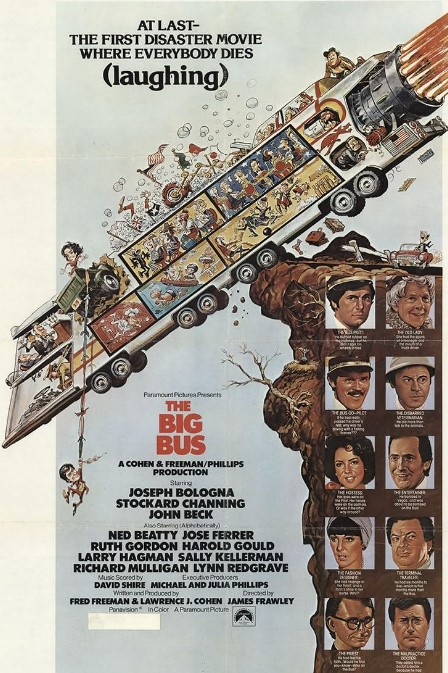
Cyclops is the new revolutionary designed double-decker bus that because it’s powered by nuclear fuel will allow it to travel non-stop between New York and Denver. Just before it’s set to make its maiden voyage a bomb goes off within the facility it’s been housed in, which seriously injures the bus’s designer Professor Baxter (Harold Gould). The vehicle itself remains unscathed, so the Professor’s daughter, Kitty (Stockard Channing), takes control of the project and hires a new driver named Dan (Joseph Bologna) whom she had a relationship with in the past. Dan though is still fighting-off the stigma of having crashed another bus into the mountains, and after being stranded for many days ended up reverting to cannibalism by eating all the rest of the passengers. The trip faces further obstacles when unscrupulous billionaire Iron Lung (Joes Ferrer), who resides inside a iron lung due to having polio as a child, orders his henchmen Alex (Stuart Margolin) to plant a bomb on the bus, so that it will be destroyed and prevent nuclear fuel from overtaking gasoline of which he owns much stock. Will Dan be able to overcome both his past and personal problems to both find and prevent the bomb from going off, or will this become yet another disaster on his already checkered past?

While Airplane! is widely thought-of as being the original parody of 70’s disaster flicks it’s really this one that came out a full 4 years earlier that deserves the credit. While it didn’t do well at the box office, which essentially pushed it off into obscurity it still upon second look has a lot of funny moments and deserves much more attention than it has gotten.  Not every gag works and some do fizzle, but the script by writing team Fred Freeman and Lawrence J. Cohen has far more hits than misses. Some of the best bits are the indoor swimming pool on the bus as well as the bowling alley and disco and the radiation suit to put on in times of emergency including the reaction of the passengers when it gets hung down from the ceiling compartment during the flight instructions. The attempt to treat the bus like it’s a metaphor for an airplane, which was the mode of transportation used in most disaster flicks, is quite funny especially the scene where crews in a small town try to halt the bus, or essentially ‘force it to land’ by spraying the main street with foam in order to slow the vehicle down.

The acting is in top form with many familiar faces from both television and the big screen. Stockard was probably my favorite she pretty much plays her part straight, but still manages to be quite amusing especially during the segment when she gets stuck inside a room that fills up with soda, which she stated in later interviews she almost drowned in.  Richard Mulligan and Sally Kellerman are equally amusing as a soon-to-be-divorced couple who share a rather unusual love-hate relationship. Larry Hagman as a dubious doctor, Ned Beatty as a moody technician and Murphy Dunne as a caustic pianist all help to top-it-off. Even Bologna, whose normally brash persona doesn’t make him a likely hero, scores comedic points though John Beck as his co-driver with a tendency to pass-out the second he gets nervous steals away most of the scenes they share.

Spoiler Alert!

The actual disaster, where the bus precariously balances over a cliff, is nicely photographed in a way that makes it seem real with some good stunt work, but I was disappointed that this ends up being the only real exciting moment. I didn’t like either that at the very end, just before the final credits begin to roll, the bus splits apart, which creates screams from the passengers. This was the type of movie where despite their oddball nature I had grown kind of fond of the daffy bunch and wanted to see them arrive safely, which with the ending here doesn’t occur. Instead the viewer is left (no pun intended) hanging, which is a giant cop-out. Just about every disaster flick made offers a conclusion where we see if the people ultimately make it out alive, or not and doing it the way they do here makes the viewer feel like they’ve seen only half a movie, which could explain why this did poorly at the box office.

A  good way to have prevented this would’ve been to chop up the beginning, which has a lot of unnecessary back-story. The bombing of the facility wasn’t needed as all of the calamity should’ve been saved for the bus ride itself. Dan’s visit to a bar in which the patrons harass him about his notorious past gets cheesy, particularly the cartoonish barroom brawl. This should’ve been cut- out too. The rumors of Dan’s supposed cannibalism could’ve been brought up at the press conference announcing the bus’s initial trip and seeing Dan’s uncomfortable response would’ve been enough to make the audience realize he had personal demons to overcome. The rest of the time could then be spent on the various problems that the bus runs into as it travels on road, which would’ve allowed for more excitement versus having the disaster portion seem like a side-story to the barrage of jokes that don’t always work.

My Rating: 6 out of 10

Released: July 23, 1976

Runtime: 1 Hour 28 Minutes

Rated PG

Director: William Frawley

Studio: Paramount

Available: DVD, Blu-ray, Amazon Video, YouTube
The Garden of Delights (1970)

garden2

By Richard Winters

My Rating: 6 out of 10

4-Word Review: He’s unable to speak.

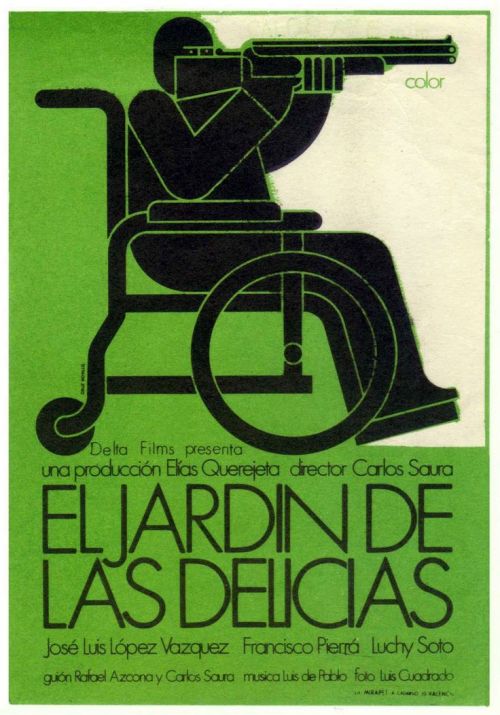
Antonio (Jose Luis Lopez Vazquez) is a wealthy owner of a construction business that he took over from his father (Francisco Pierra) years earlier. Unfortunately just as he’s ready to reap his profits he gets into a car accident, which confines him to wheel chair and unable to speak, or write, or even remember anything. His greedy family becomes determined to get him his memory back even if it means drastic shock therapy as Antonio holds all the business secrets including the combination to the safe and the Swiss bank accounts. The family’s brazen attempts seem to be working though not enough to get him to speak, but while this is going on, inside Antonio’s head, he begins experiencing surreal events that seem almost real and are both fascinating and frightening.

The film’s director Carlos Saura started out his career in the 50’s as a director of documentaries and shorts, which eventually lead to him getting the offer to direct his first feature length film in 1966 with The Hunt, a film about three middle-aged male friends who go on a rabbit hunt that starts out pleasant enough, but ends in brutal violence for all three. That film won him many accolades and gave him the opportunity to direct this one, which plays out more as a metaphor. His home country of Spain was at the time under the authoritarian rule of Francisco Franco who did not allow for free speech and often punished those who spoke out against him. To get around this Saura uses many allegories to convey his anger at the oppressive government, but in a way that didn’t make it obvious enough for him to be arrested.

The main character of Antonio is meant to be a metaphor of the Spanish people with his mute condition being similar to their inability to speak out against their country’s leader. Unfortunately many of today’s viewers aren’t going to get this either because they haven’t bothered to study up about it, or just don’t care. Because of this many viewers will miss the symbolism and leave at the end, if they managed to stay with that long, shaking their heads. Since few people of today were around when it occurred and most Americans don’t have a good grasp of Spainish history it will all be unrelatable for most.

The lead role is well played and Vasquez has a very expressive face, which helps add nuance to a character that otherwise has no other way of expressing himself. I did find it frustrating that we don’t learn much about him. The scenes where he looks around his empty warehouse that he once ran does convey the quandary of someone who once felt powerful, but now only a shell of what he once was. The viewer though is unable to completely identify with him as not enough of his backstory is given. We do eventually during the third act see him in a flashback moment where he speaks with his father and aggressively takes over the company, we also eventually witness the car accident that put him into this condition as it had only been referred to before as ‘an accident’ with no details given, but I felt both of these things should’ve been shown and introduced a lot earlier.

Spoiler Alert!

Pierra as the father gives a thoroughly delightful performance and some of the surreal moments including Antonio’s vision of being pushed into his backyard pond and the recreation of a religious ceremony being two of the best. Yet there are other moments that miss the mark including having a live pig brought into the home and then trapping Antonio inside a room with it in order to jog his memory from a painful past event, but his confrontation with the animal is never shown, which is a letdown. The family members are confusing as it’s never clear whether they have bad intent, or are just acting the way they are due to being put in a desperate situation. The ending in which all the characters become bound to a wheelchair and unable to speak just like Antonio was trying to show how all of the Spanish citizens where being oppressed beyond just him, but emotionally it isn’t compelling and a potentially good story and character study get lost with Saura’s obsession to put political symbolism first and foremost.

My Rating: 6 out of 10

Released: November 5, 1970

Runtime: 1 Hour 30 Minutes

Rated GP

Director: Carlos Saura

Studio: Video Mercury Films

Available: DVD-R (dvdlady.com)

Cat’s Eye (1985)

cats

By Richard Winters

My Rating: 4 out of 10

4-Word Review: Three stories involving feline.

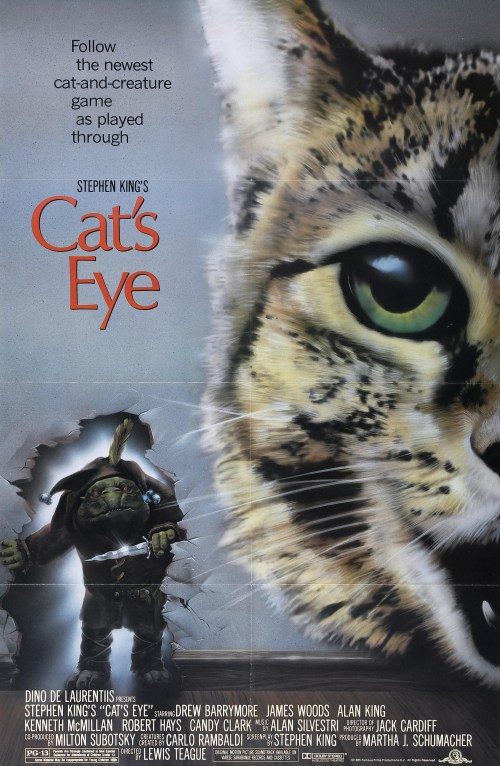
With a screenplay written by Stephen King the film is made up of three of his short stories with two of them taken from his 1978 novel ‘Night Shift’ while the third one was penned directly for the screen. The only connecting thread is a stray cat and actress Drew Barrymore who appear in all three tales though only have major parts in the third one.

The first segment is called ‘Quitters, Inc.’ and involves James Wood playing the part of a man named Dick Morrison who is trying to quit smoking and enters an agency that boasts a high success rate of getting their clients to stop. It’s run by Vinny (Alan King) who tells Dick that if he doesn’t stop smoking instantly that they’ll kidnap his wife (Mary D’Arcy) and put her into a room where she’ll receive electrical shocks. To prove his point he puts the cat in the cage and then through a glass partition Dick witnesses the feline getting shocked, which is enough to scare him into quitting on the spot. Yet as the days progress Dick finds himself constantly getting the urge to light-up, but Vinny warns him that he has people who’ll be watching him and if he does dare to backtrack they’ll immediately grab his wife and bring her into the cage. Eventually though the compulsion to have a cigarette gets to be too much and he sneaks a puff only to then face the dire consequences.

This segment tries for black comedy, but doesn’t go far enough with it. While Woods, who usually excels as the twisted types, is quite good as the straight man, I couldn’t understand why he didn’t go the police when his wife gets taken, or why any of the other clients didn’t either, which should’ve gotten the business quickly shut down and the owners prosecuted for running an unethical operation. Famously brash comedian Alan King isn’t given enough leeway to allow his cantankerous persona to go full throttle though watching him wearing a white leisure suit and lip synch the words to the song ‘Every Breath You Take’ makes it almost worth it. It’s interesting seeing James Rebhorn in a bit part as a drunken business man at a party as he later had a prominent role in the movie The Game, which had a very similar storyline to this one involving a business that overtakes their client’s lives and is constantly watching them.

The second segment called ‘The Ledge’ involves a man named Johnny (Robert Hays) who must walk across a thin, outdoor ledge along a penthouse wall many feet above a busy street. If he succeeds then the penthouse owner, Cressner (Kenneth McMillan), will grant his wife a divorce and allow her to marry Johnny whom she’s been dating.

This story is the best one mainly because it has McMillan who is one of the finest character actors of all time and supplies his role with an amazing amount of energy and dark campiness. The scenes of watching Hays trying to maneuver his way on the ledge while being simultaneously attacked by a pigeon and at times McMillan who throws things at him out his window, is really terrifying. You feel like you’re on the ledge with him and I cringed all the way through this one, but in a good way as I really got swept up in it though the twist ending is a letdown.

The third and final segment called ‘The General’ involves a young girl living in North Carolina, named Amanda (Drew Barrymore) who takes in a stray cat much to her nagging mother’s (Candy  Clark) chagrin as she feels the animal may attack Amanda’s pet bird named Polly whom she keeps in a cage in her room. Amanda though likes the cat, whom she’s named General, because he scares away the evil troll, who’s the size of a rat and sneaks into her bedroom at night through a small opening in the wall to steal away her breath while also attacking Polly.

This segment has some interesting special effects, but it’s hard to tell if this is intended to be scary, or comical. It’s probably supposed to be a mixture of both, but I wished it went more for the scares since the movie, which gets billed as being a ‘horror’ doesn’t really have much of them otherwise. This segment also doesn’t really have any twist to it other than the parents finally believing that a troll really does exist in their daughter’s bedroom, but then telling her not to tell anyone about it, but why? It seems like if there’s one of them there could be others and the whole home should be inspected and fumigated and if I were the homeowner I wouldn’t want to spend another minute in there until it was, so having this family just forget about it and go back to normal didn’t seem like a normal response. The troll is also too reminiscent of the devil doll in Trilogy of Terror, which was far more frightening.

My Rating: 4 out of 10

Released: April 12, 1985

Runtime: 1 Hour 34 Minutes

Rated PG-13

Director: Lewis Teague

Studio: MGM/UA

Available: DVD, Blu-ray, Amazon Video, YouTube
Sisters (1972)

sisters

By Richard Winters

My Rating: 7 out of 10

4-Word Review: Model has evil twin.

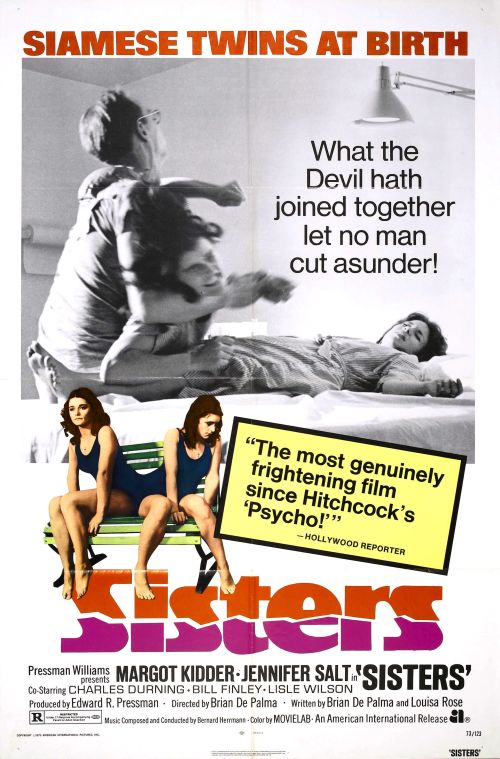
Danielle (Margot Kidder) is a young French-Canadian women from Quebec who aspires to be a fashion model and actress. She takes part in a TV-show styled after ‘Candid Camera’ where unsuspecting people find themselves caught up in a prank, which is where she meets Phillip (Lisle Wilson). The two go out on a date, but while at the restaurant she gets harassed by Emil (William Finley) her ex-husband. Then when they get back to her apartment Phillip overhears her arguing with another woman, which Danielle says is her twin sister Dominque. Since it is both of their birthdays Phillip decides to go out to get them a cake, but when he returns he gets viciously stabbed by the psychotic Dominque, but just before he dies he’s able to scribble the word ‘help’ onto the window with his own blood that Grace (Jennifer Salt), a journalist that resides across the street, sees. She immediately calls the police, but when they arrive into Danielle’s apartment there’s no sign of a body, or a struggle and Grace gets written-off as being a kook whose been imagining things, but she refuses to relent and begins her own investigation where she uncovers some dark details about Danielle and her sister who were once conjoined.

This was writer/director Brian De Palma’s first attempt at horror after completing many successful comedies that had gained a cult following. The story was inspired by real-life conjoined twins Masha and Dasha Krivoshlyapova who’s sad upbringing where they were taken away from their mother and had abusive medical experiments done on them at a secret hospital in the Soviet Union, and which was chronicled, much like in the movie, in a story in Life Magazine in 1966, which after reading it De Palma couldn’t get out of his head. Visually it’s excellent with great use of editing and superior score by the legendary Bernard Herrmann, who was semi-retired at the time, but enjoyed the script so much that he agreed to be the composer.

Many of De Palma’s famous directorial touches are apparent including his use of the split-screen. While it’s been used, and some may say overused, in many films from that era, it gets worked to perfection as we get to see Danielle and her ex busily cleaning-up the crime scene while Grace gets held up by the detectives and they’re not able to go into the apartment right away. My only complaint here is that with the blood splatter all over I’m just not sure they would’ve been able to wipe it all away in such a short time frame, basically about 8 to 10 minutes, which should’ve more likely taken them several hours. Not showing the clean-up and having Grace and detectives arrive to find the place spotless with no body would’ve actually added more intrigue and thus in this case the use of the split-screen, while done adequately, I don’t think was needed.

Spoiler Alert!

The script leaves open a fair amount of loopholes, for instance we see Danielle walk into a bedroom and the shadow of her head on the wall along with another one, which is supposed to represent Dominque’s, but we learn later that Dominque died years early during the surgery to separate them, so we’ve should’ve only seen one head shadow and not two. Also, Danielle is told point-blank by Grace that she’s been spying on them from across the street, so you’d think later that she and Emil would make damn sure to close the blinds on their windows when they try to remove the sofa, which has the dead body inside, but instead they continue to leave the shades wide open and allow Grace, now back in her own apartment, to continue to peer in while the couple show no awareness to the possibility and don’t even bother to look out the window to see if they can catch Grace looking in. Another head-scratcher is why there was no blood splatter on Danielle’s clothing, since she ultimately is the one that killed Phillip, when Emil walks into the apartment.

The most confusing thing though is the ending in which Grace becomes hypnotized while inside a mental hospital and begins to see herself, through a long dream sequence, as being Dominque and attached to Danielle. When I first saw this, back in the 90’s, I thought it meant that Grace was the long lost twin and that they had been separated years earlier. While Grace doesn’t look exactly like Danielle most twins don’t, and she was still around the same age, hair color, and body type, so it seemed like a legitimate explanation and I wouldn’t blame anyone else who came to this same conclusion. Apparently though that’s not the case as Grace comes back out of it only convinced, through the hypnotism, that she didn’t see the murder of Phillip, but I felt they should’ve taken it one step further by convincing her that she was Dominque, whether it was true, or not, and then brain washed to take credit for all the murders while Danielle could then get off scot-free and this would’ve then been the ultimate twist.

Granted Grace’s character is shown as having a mother (Mary Davenport), but the script could’ve been rewritten to have her taken out and Grace could’ve instead been portrayed as being an orphan, or adopted, which could’ve left open the possibility. In either case the dream segment, which is creepy and stylish done, would’ve had more of a payoff then it does had it taken this route.

My Rating: 7 out of 10

Released: November 18, 1972

Runtime: 1 Hour 33 Minutes

Rated R

Director: Brian De Palma

Studio: American International Pictures

Available: DVD, Blu-ray (Criterion Collection), Amazon Video

Sleepaway Camp III: Teenage Wasteland (1989)

sleepaway3

By Richard Winters

My Rating: 3 out of 10

4-Word Review: Angela commits more murders.

When Maria (Kashina Kessler), who has the words ‘milk’ and ‘shake’ tattooed to her breasts, goes off to camp, she is impeded by a truck driven by Angela (Pamela Springsteen) that runs her over and allows Angela to take on her identity. Angela then returns to the same campsite where she committed her atrocities from the last film, but which is now run by husband and wife Herman (Michael J. Pollard) and Lilly (Sandra Dorsey), who have turned it into a place to help reform teens with a criminal record and renamed Camp New Horizons. It doesn’t take long though for Angela to revert to her old ways and soon both campers and counselors begin disappearing with a frightening regularity.

While Part II was filming producer Jerry Silva was so impressed with what he was seeing that he immediately authorized another sequel with a script for this one being written while that one was still being shot and then only one weekend for pre-production. This also pushed the filming date back into October where not only were the leaves already changing, but in one segment you can see the breaths of the actors when they speak, which certainly does not give the viewer a summery feel.

The second installment had an okay balance between the black comedy and horror, but this one goes overboard into silly season. The initial killing is especially problematic as it has the victim chased down by a big truck in broad daylight. Yes, she eventually gets run over when she runs into a back alley, but the semi starts barreling down on her when she’s walking on an busy road with other cars, so other people would’ve witnessed what was happening and reported it making the odds of Angela getting away with it quite slim. Also, where does a woman, who was 13 when she got locked up into a mental hospital and been there most of the time until her recent release, find the time and money to learn how to drive a big rig and how was she able to steal one?

While Springsteen’s performance was slightly tolerable in the second installment I felt it got plain annoying here. She isn’t scary and even though this is meant as a dark comedy the villain should still have some frightening presence and she has none making for no suspense at all. She also has her hair dyed blonde, in order to resemble Maria, which has her looking even less like Felissa Rose who played the character in the first one and further way from the original concept making this seem like its own little movie with name-only connections to the other two.

The murders though are an improvement and the only thing that saves it. Part II put no creativity or imagination into the killings, but here we get a couple of memorable ones including Angela roasting marshmallows on a fire that’s burning two of her victims. Killing one of the campers via tying them up to a flagpole and then allowing them to drop many feet to the hard cement below was my favorite though the death by lawnmower, which apparently made some of the women members on the MPAA board, who were hired to give the movie its rating, physically sick, deserves honorable mention. Even here though there’s problems like when Angela stands over the body of a man and swings an ax on him, but then returns to the campsite wearing the same clothes she had, which would’ve been highly doubtful as they would’ve most assuredly been covered with blood splatter.

The only element I found interesting was the appearance of Michael J. Pollard who was at one time starring in Hollywood classics like Bonnie and Clyde and was even given a couple of leading man roles in  studio produced films, but here relegated to low budget direct-to-video fare. He isn’t even in it all that much as his character is one of the first to be killed though he does at least get to make-out with a hot young chick (Stacie Lambert), which may have made it worth it.

My Rating: 3 out of 10

Released: August 4, 1989

Runtime: 1 Hour 20 Minutes

Rated R

Director: Michael A. Simpson

Studio: Double Helix Films

Available: DVD, Blu-ray, Freevee, Pluto TV, Tubi, Amazon Video

Sleepaway Camp II: Unhappy Campers (1988)

sleepaway2

By Richard Winters

My Rating: 3 out of 10

4-Word Review: Angela returns to camp.

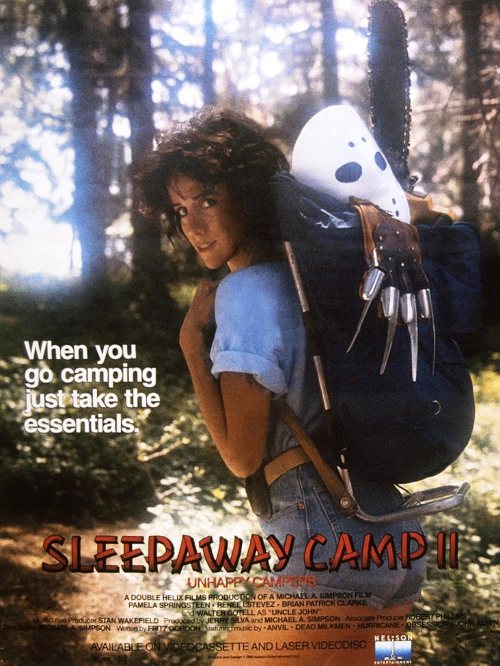
Angela (Pamela Springsteen), the teen killer in the first film, has now been ‘reformed’ after going through years of shock therapy and sexual reassignment surgery. She gets a job as a counselor at a camp named Rolling Hills, which is 60 miles away from Camp Arawak, the site where she had previously killed all those people. The campers and other counselors have no idea about her past and have a hard time getting along with her and she’s quite strict with no tolerance for anyone who breaks the rules. If someone does draw her ire she quickly dispenses with them by reverting to her old habits and after they’re offed she goes and tells the camp leader, Uncle John (Walter Gotell), that she ‘sent them home’, but when she starts doing this to too many kids everyone’s suspicions begin to rise.

While on the technical end the production is decent the storyline is ridiculous even when taken into context of a black comedy, which is what the filmmakers were hoping for, it doesn’t work. The idea that Angela would be let out of a mental hospital in such a short period of time, just 5 years, after killing so many people is absolutely absurd and would create a national, media uproar. Since the murders were all deliberate and plotted out she most likely would be considered sane and stood trial and sent to a regular prison anyways. Why would any campsite hire her? Don’t these people do background checks? A way to have resolved this would’ve been to shown her at the beginning escaping from the mental hospital, and possibly killing a few orderlies along the way, which would’ve helped the story make more sense and also been an excuse to show blood and guts, which is what audiences for these types of films pretty just want anyways.

While Pamela Springsteen, who’s the younger sister of Bruce Springsteen, may be a quality actress in her other films she does not play the role here in a convincing way. What made Angela so memorable in the first was her penetrating stare, which we don’t see any of. Angela’s inner angst came from her gender issue and not that she was some old-fashioned prude, like in this one, that kills people who don’t live up to her high moral standard. It’s like a completely different person who’s connection to the other one is in name only. Apparently Felissa Rose, who played the role in the original, auditioned for the part, but because she couldn’t convey the one-liners in a humorous way that they wanted they decided to go with Pamela. Personally I feel they shouldn’t have even bothered to make it if Felissa couldn’t have recreated the role, which I felt she had earned the right to.

The killings are not as creative either and in fact look downright pathetic. I’ll give some credit to the death in the outhouse where a victim is shoved into the hole were people relieve themselves and then she struggles several times to come up, with more and more waste appearing on her as she does, but otherwise it’s tacky fare especially the end where they come into an abandoned home featuring all the dead victims that looks too obvious as being mannequins with red paint.  I also didn’t care for the nightmare segment, apparently done to help pad the runtime, that rehashes the killing scenes we’ve already seen and is highly redundant.

Fans of the film say it’s the humor that sells it. Yes, some of it is kind of funny like when the male counselor (Brian Patrick Clarke) smells underneath his arm pits after Angela walks away thinking that the reason she was so cold to him wasn’t because she’s a psycho, but more because of his possibly bad body odor. My favorite though is when Ally (Valerie Hartman) has sex with a man and then only after it’s over does she bother to ask him if he has ‘AIDS’. Yet outside of this it’s a letdown. As sequels go it’s not the worst of its kind, but I would’ve preferred more of a straight horror approach that tried to stay faithful to the first one, both in tone and with the cast.

My Rating: 3 out of 10

Released: February 28, 1988

Runtime: 1 Hour 20 Minutes

Rated R

Director: Michael A. Simpson

Studio: Double Helix Films

Available: DVD, Blu-ray, Amazon Video, Pluto, Tubi, YouTube

Terror at Red Wolf Inn (1972)

terror1

By Richard Winters

My Rating: 4 out of 10

4-Word Review: An appetite for humans.

Regina (Linda Gillen) is a shy college student living in a dorm by herself who doesn’t have enough money to go to Spring break with the rest of her friends, so she’s forced to stay on the campus all alone while the others go. Then she receives a letter telling her that she’s won a free trip to a bed and breakfast resort called the Red Wolf Inn. She’s offered a private plane ride to get there and once she arrives she’s greeted by a kindly elderly couple (Arthur Space, Mary Jackson) who own the place and two other women, Pamela (Janet Wood) and Edwina (Margaret Avery), who are also staying there, as well as the couple’s adult grandson Baby John (John Neilson). While things start out well Regina soon grows uncomfortable and convinced that the couple has ulterior motives. When both Pamela and Edwina disappear Regina fears she’ll be next, but her efforts to escape are thwarted trapping her in the home to become the next meal item unless she can convince Baby John, who has fallen for her, to help her find a way out.

This very odd piece of 70’s horror that seems to want to combine a grisly theme with offbeat humor definitely has a few keen moments. My favorite was the way Regina finds out that she’s ‘won something’ and excitedly shouts it out to her otherwise empty dorm building. Some may consider this exaggerated as most people today would be highly cynical of such a letter, but back in the 70’s, (and I was around then), the teens were more trusting and had a propensity to be experimental and act as if life was just one big adventure, so in that respect the movie gets it right and this became for me one of the funnier moments The only caveat is how did the couple find out about Regina to send her the letter? Why was she chosen and how often and how many of these letters did they mail and how many of them got answered, which never gets addressed, but should’ve.

On the horror end its not very scarry and only borderline creepy. There is a dream sequence that had the potential of being cool, but doesn’t go on long enough. Regina’s attempt at escape I did like, but it does leave open plenty of loopholes like why was a motorboat, that wasn’t tied to any dock, conveniently left out in the bay for her to swim to? Initially I though it was an intended trap and she’d get into it and see dead bodies lying there, but that’s not the case as she uses it to get over to a neighbor’s house, but no ones inside and all the other buildings in the area are eerily empty, but why? The dinner scene in which everyone chomps at their food like pigs could’ve been considered revolting and upsetting had it been confirmed that it was people they were eating, but this wasn’t yet established, so the shock effect is lost.

Some have labeled this as a comedy-horror and one of the first films to use this sub-genre, but outside of the opening bit there really isn’t anything all that amusing. There are some moments of extreme awkwardness like when Baby John smashes the head of a baby shark repeatedly against a rock while a shocked Regina looks on in horror before he turns to her and confesses how much he loves her, which is darkly humorous in a distorted type of way, but outside of that the chuckles are as infrequent as the scares.

Spoiler Alert!

I did enjoy Mary Jackson’s performance who goes from nice old lady to threatening matron effectively, but the wrap-up leaves much to be desired. Initially it’s sort-of exciting as Regina and Baby John make a daring run for it only to be chased down by the older couple’s dog and then viciously attacked by both the pet and the old man. The film then cuts to show Regina and Baby John back inside the kitchen of the grandparent’s home having supposedly gotten the upper hand, but this is a struggle that needed to be played-out, the film lacks action anyways and this would’ve offered much needed excitement and tension. Showing the old couple’s decapitated heads inside the freezer had a gory appeal, but then having the old guy look up and wink ruins it and turns the whole movie into one big stupid joke.

Some viewers insist that the 77 minute version, which is what’s available on DVD despite the cover saying it’s 90 minutes, is the edited version with certain scenes of ‘horror’, or other ‘dark’ moments left out and this is based mainly on the fact that IMDb lists the original runtime as 90 minutes and Leonard Maltin’s review book says it’s 98 minutes, but I’m not so sure. As short as the 77 minute runtime is it still came off as draggy. This was also made in an era where implying the violence and gore was considered shocking enough making me believe that the DVD cut is pretty much the whole thing. Even if a longer version may exist it’s doubtful that it would be filled with more carnage as it’s clear that the filmmakers were going for a soft tongue-and-cheek approach making me believe the supposed lost scenes would’ve amounted to being talky bits that wouldn’t have added much.

terror2

Alternate Title: Terror House

My Rating: 4 out of 10

Released: September 27, 1972

Runtime: 1 Hour 17 Minutes

Rated R

Director: Bud Townsend

Studio: Red Wolf Productions

Available: DVD