Category Archives: Black Comedy

Quick Change (1990)

quick1

By Richard Winters

My Rating: 7 out of 10

4-Word Review: Clown robs a bank.

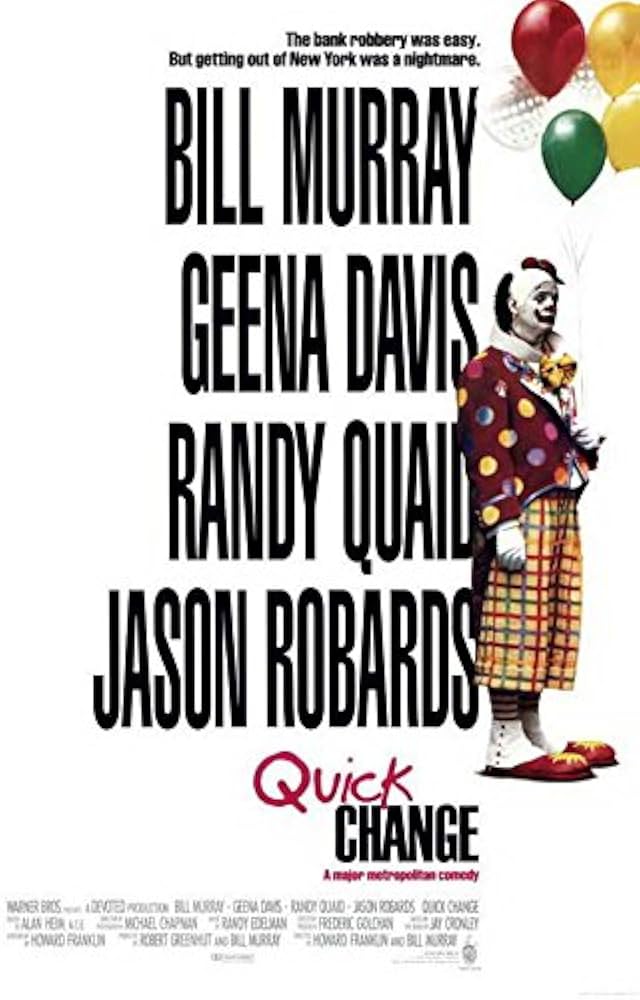
Grimm (Bill Murray) has had it with New York City. He wants to get out of there and move somewhere tropical as soon as possible and conspires to rob a bank in order to get the money to do it. He dresses as a clown and then has his girlfriend Phyllis (Geena Davis) and friend Loomis (Randy Quaid) pretend to be customers at the bank, so that when he releases the ‘hostages’ they can be two of them. The robbery goes smoothly as they’re able to get $1 million out of the bank, but trying to get out of the city itself proves trying as they get lost on their way to the airport and then their getaway car gets demolished. Police Chief Walt Rotzinger (Jason Robards) is hot-on-their-tale and relentless in his quest to haul them in as he proves to be just one slight step behind them where ever they go and moving in closer with every waking second.

This is the second version of the story that was adapted from a 1981 novel of the same name written by Jay Cronley, a humorist who resided in Tulsa, Oklahoma, who two other novels, Funny Farm and Let It Ride that were also made into movies as well as Hold-Up that was a French film shot in Canada that was the first rendition of this plot. This adaptation proves to be the better one as it takes place, like in the novel, in New York City and takes full advantage of the city’s ambience making it feel almost like it’s a third character.

This is the perfect role for Murray and some critics felt this was his best acting performance of his career he also doubles not only as the producer, but also the co-director as he took over the reins in order to save the project when the originally directing choice Jonathan Demme decided to bow-out at the last minute. The snarky, glib personality of the character is played to the hilt by Bill who has the magical ability to be the world’s biggest smart ass and still have a unique charm about it. Great supporting work by Davis, though the two apparently didn’t get along behind-the-scenes and years later she accused him of sexually harassing her during the production. Good work too by Robards who doesn’t fall into the cliche of a stupid egotistical cop and instead proves to be pretty savvy, which helps accentuate the tension as he’s constantly on their heels and only a beat behind them no matter where they go.

The three acts are better tied together by placing the main nemesis as the city itself and creating a surreal After Hours vibe. Some of the potshots are subtle like watching all the hot dog vendors race over to where the robbery is taking place so that they can take advantage of the situation by selling food to all the onlookers. It also illuminates the ethnic, cultural mix of the Big Apple by featuring a jousting match between two Latinos on bicycles as well as the headaches of trying to find your way around the city and the confusing road signs and constant construction though some of this humor may not resonate with today’s viewers since with the advent of GPS many of these ‘asking for directions’ situations have now become a thing of the past.  The music score by Randy Edelman with its pounding, hard edge quality perfectly matches the city’s gritty, urban attitude.

While the robbery is slick I did find a few loopholes. The first is where does Murray get his other clothes when he changes out of his clown costume and disguises himself as one of the hostages to get away? He is not seen carrying a bag of any kind nor is Davis or Quaid, so not sure where the other suit came from. Some may argue that he was wearing it underneath his clown costume, but this doesn’t work since it was a shirt that came up to his neck that he’s seen coming out of the bank with and when he’s the clown he’s shown with a V-neck T-shirt that exposes the top of his chest. It also doesn’t explain where he gets the glasses, other wig, and shoes that he also has on when he walks out as the fake hostage.

The characterizations are a bit off too as both Davis and Quaid become easily rattled during the second half when they’re trying to get to the airport and become increasingly shaken that they’re going to be caught, but if they have a propensity to being that worried you wonder what gave them the nerve to go through with the robbery in the first place? During that segment they’re very cool and calm and even a bit ballsy, so why the sudden shift to overly panic the moment they get out? A way to have solved this would’ve had the Davis character with a penchant for risks, or enjoy living on the edge and taking chances, so every time they would get into a jam during their escape she’d see it as a certain thrill and not allow it to overtly alarm her.

Spoiler Alert!

The biggest beef though is with the ending in which Robards suddenly realizes, as he’s standing on the ground watching the jet fly overhead that has the three robbers onboard. The film acts like it’s now ‘too late’ and there’s nothing he can do about it, but there really is. All he has to do is go back to the airport and ask where the destination is of the plane that just took off, as I remember it was Paris, France. Since both the U.S. and France are members of Interpol he could easily contact the authorities there asking them to detain the three once the plane had landed. They could then be brought in for interrogation where a simply body search would expose all the money that they had taped to their bodies underneath their clothes, and in Quaid’s case in his duffel bag. This would be more than enough evidence to prove that they were the robbers and thus extradited back to the U.S. for prosecution.

My Rating: 7 out of 10

Released: July 13, 1990

Runtime: 1 Hour 29 Minutes

Rated R

Director: Howard Franklin, Bill Murray

Studio: Warner Brothers

Available: DVD, Blu-ray, Amazon Video, Tubi

Jinxed! (1982)

Version 1.0.0

Version 1.0.0

By Richard Winters

My Rating: 3 out of 10

4-Word Review: Blackjack dealer is cursed.

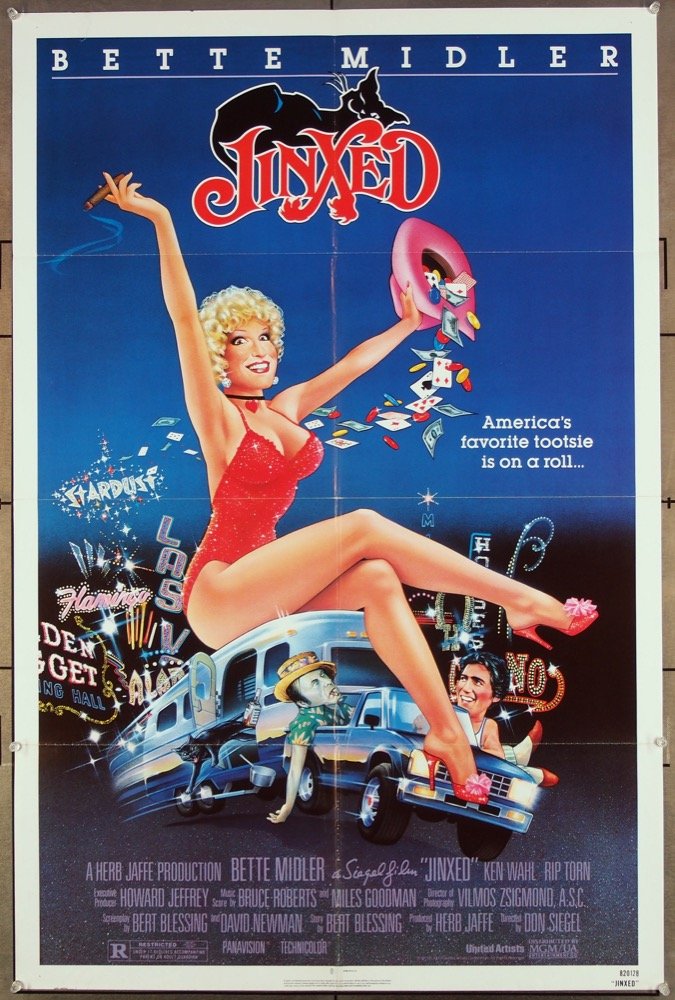
Harold (Rip Torn) is a gambler who can never seem to lose whenever he goes up against one Vegas blackjack dealer in particular, Willie (Ken Wahl). In fact Harold’s winning streak versus Willie becomes so extended that it gets him fired and he’s forced to find a similar job in Reno. Harold follows him up there and Willie’s losing ways start all over again. His supervisor (Val Avery) doesn’t think Harold is doing anything unethical and instead becomes convinced that he’s put some sort of jinx on Willie and for Willie to end it he needs to get something of Harold’s. He drives out to Harold’s isolated trailer where he resides and realizes he has a wife named Bonita (Bette Midler) who also happens to be a lounge singer. She’s sick of dealing with Harold’s abusive ways and makes a deal with Willie that they kill him and then spend the proceeds of his life insurance payout afterwards.

The movie is appropriately titled not so much for what occurs onscreen, but more with what happened behind it. The story was based on the Frank D. Gilroy novel ‘The Edge’, which was published in 1980 and then had the screen rights sold for $300,000. While Gilroy wrote the first draft it was then handed over to David Newman who did a second rewrite and from there passed onto Jeremy Blatt who did a third version before director Don Siegal and Bette Midler began doing further revisions until Gilroy finally asked for his name to be taken off the credits as the plot no longer resembled anything from the book.

The real issue though started with Siegel who was at odds with the leading lady and then eventually became stricken with a heart attack where he ceded directing reins to Sam Peckinpah who completed many of the remaining scenes uncredited. Star Wahl also found getting along with Midler to be difficult and the two feuded throughout making no secret of their disdain for each other even after the shooting was long completed.

From my standpoint the biggest problem was the casting. Midler can be a funny lady, but not in this type of role. She’s known for her snarky, brash, and outgoing personality, but here plays someone who’s shy and pensive something that just doesn’t connect with who she is at all. Maybe she wanted to step out of her comfort zone and that’s why she took the role, but she doesn’t play it convincingly and thus it’s hard to get into. Wahl isn’t up to the demands of being a leading man and it’s no wonder he retired from the business in 1996. His delivery is flat and nothing that he says, or does is engaging. He has a few amusing lines here and there, but overall seems to be phoning it in and the romantic moments between him and Midler come-off as clearly awkward and out-of-place.

There were a few elements that I did like. It captures the rustic side of Nevada quite nicely and not just Vegas, but also Reno and the rural portion of the state. You also get to see an actual, in fact there’s two of them, $10,000 bill, which the fed no longer prints making it the coolest moment in the whole movie. Torn also gives a energetic performance and could’ve put on a clinic for the other two if they had paid attention. Though during his character’s death scene he does blink his eyes and make some brief facial gestures when Midler kneels beside him and slaps him making it seem like he really wasn’t dead even though technically he was. There’s also a few too many shots of his hairy butt crack, which I didn’t particularly care for. A funny scene done inside an adult bookstore, where director Siegel gives himself a cameo as the porn shop clerk, which I found to be a highlight.

Spoiler Alert!

Unfortunately the third act veers off in a weird way where Midler goes on a scavenger hunt using cryptic letters that her deceased husband wrote her before he died, which as critic Roger Ebert describes in his review of the film, ‘paralyzes’ the movie. If anything Wahl should’ve gone along with her as they follow the clues, which might’ve strengthened their chemistry and made them seem more like real couple who could work together to solve things instead of these two individuals doing things mostly on their own.

There’s also no explanation for what exactly was causing the whole jinx thing. Supposedly the luck as it were was coming from the cigars that Torn was smoking, and which Midler later does as well, but why would these cigars bring good luck? Normally smoking cigars can’t help one win at blackjack, so what secret cosmic power did they possess, so that it made a difference in this case? There’s no answer either as to who Torn was calling on his pay phone outside of the trailer he lived in after he lost to Wahl and was now broke. It made it seem like he was conspiring, or in connection with someone else, or maybe some sort of behind-the-scenes organization, criminal or otherwise, and the film should’ve made it clear what this was about, but ultimately doesn’t.

My Rating: 3 out of 10

Released: October 22, 1982

Runtime: 1 Hour 43 Minutes

Rated R

Director: Don Siegel

Studio: United Artists

Available: DVD, Blu-ray, Amazon Video

Checking Out (1989)

checking2

By Richard Winters

My Rating: 4 out of 10

4-Word Review: Man becomes a hypochondriac.

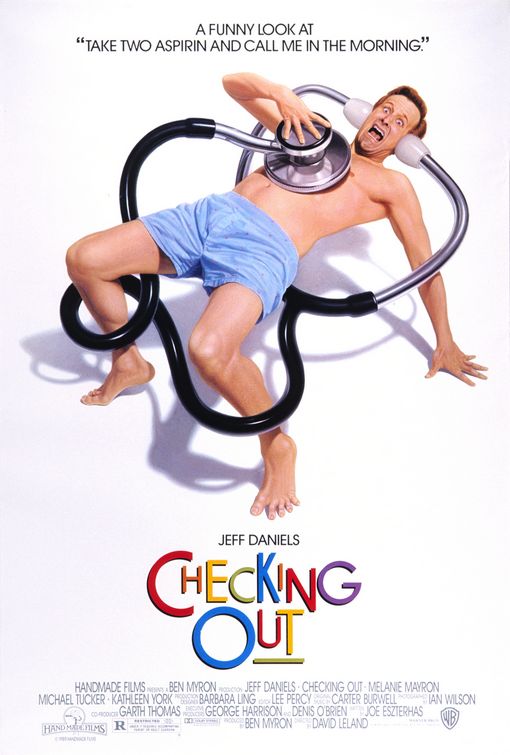
Ray (Jeff Daniels) is a middle-aged father who suddenly experiences deep concerns about his health when his boss (Allan Havey), who’s the same age as he is, drops over dead from a heart attack while at a backyard BBQ. His increasing paranoia about being sick, or potentially dying soon puts a strain on his marriage and his whole life gets essentially put on-hold as he constantly goes in and out of doctor visits over any perceived malady that comes-up.

The film certainly had big-name talent behind it as it was directed by David Leland, who got critical acclaim just a year before in his directorial debut with Wishing You Were Here while the screenplay was written by Joe Eszterhas who wrote such hits as Flashdance and Basic Instinct. However, while the film show flashes of interesting potential, even visually creative moments where Daniels, in a dream segment sees himself getting buried in a grave inside his children’s bedroom while the kids look down on him as the dirt gets shoveled over him, it never fully comes together as a whole. The tone shifts from satirical to sitcom and the concept becomes like a one-joke that gets stretched too far. Leland had promised Eszterhas that he wouldn’t change a thing from his script, but then added in several subplots, which angered Eszterhas to the point that he threatened to have his name removed from the credits, so Leland took out the extra sequences, but I’m almost wishing he had kept them in as it might’ve made the movie more interesting.

The one element that really sinks it is the overreaction by Daniels to his boss dying. For one thing the boss was a total jerk that did nothing but spew out corny jokes, so having him suddenly collapse dead, while saying yet another one of his eye-rolling quips, should’ve been a source of celebration and not dread, which might’ve actually been funny. What’s more is that Daniels immediately starts worrying about his own health, which seemed too rash. If his other friends were also dying suddenly then maybe, but just one guy dropping-over didn’t merit such a panic. Maybe the boss had some underlying heart defect that went undetected and that was the cause of his collapse, but either way it shouldn’t have caused such a drastic change in Daniels’ personality. Only if Daniels had already had some concern about his well-being previously, which he doesn’t, and then this incident brought those deep-seated fears to light would it have made sense. Even if it just meant paying better attention to his diet, but going to such extremes so quickly makes him seem like a completely different person.

The humor is too subtle and there’s long, boring segments in-between where nothing funny even happens only to answer it with a light one-liner. The running gag where Daniels becomes obsessed to find out what the answer is to why Italians can’t have barbeques, which was the joke his boss was saying when he suddenly died, gets overdone. The character arch is handled awkwardly as Daniels gets super hyper about his perceived maladies only to by the second act forget about it and then suddenly go back to being a hypochondriac again when his therapist dies, which makes the story seem like it’s not working in a linear fashion by ping-ponging the character from one goofy personality to the next.

Daniels is excellent and the one thing that keeps the movie watchable. I also enjoyed seeing Melanie Mayron, who up to this time had only played young adult women, getting her first stab at portraying a  middle-aged housewife, she even sports a suburban hair-style, and veteran character actor Allan Rich is quite good too as Daniel’s exasperated doctor. Elderly actor Ian Wolfe, who’s second-to-last movie this was, has a few key moments as an old undertaker who Daniels keeps bumping into at indiscriminate moments.

Spoiler Alert!

However, as interesting as the eclectic cast is they can’t overcome the otherwise mish-mash of the shallow script. Even the twist ending, which features Daniels dreaming that he is dying and going to heaven is forgettable as there have been too may other movies that have featured the afterlife in a more interesting and humorous way.

Watching Daniels then wake-up out of his dream and speed out of the hospital in his wheelchair ready now to take-on life again doesn’t really make it seem like the character grew, or learned anything, but more like a bland family man who went crazy for awhile until he finally snapped out of it. A much better way to have ended it would’ve had Daniels wheeling himself out the hospital door only to then get hit by an ambulance. This would’ve conformed better with the film’s otherwise darkish undertone and been a better payoff. It might’ve even made sitting through the rest of it seem worth it.

My Rating: 4 out of 10

Released: April 21, 1989

Runtime: 1 Hour 36 Minutes

Rated R

Director: David Leland

Studio: Warner Brothers

Available: DVD

The Frisco Kid (1979)

friscokid

By Richard Winters

My Rating: 4 out of 10

4-Word Review: Rabbi travels across America.

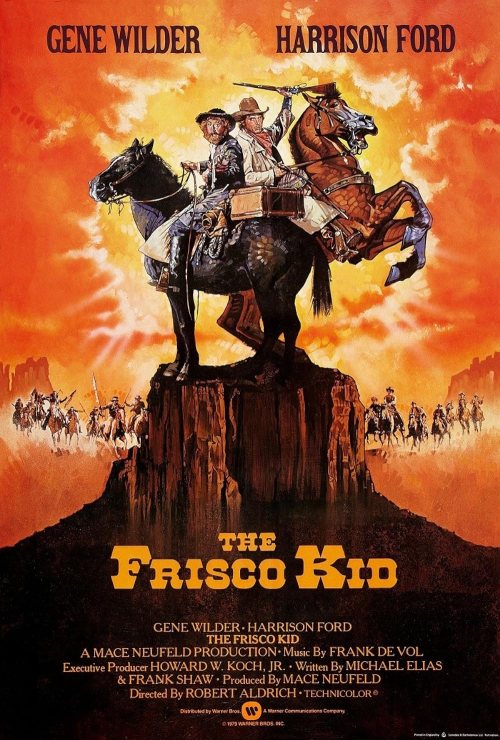
Avram (Gene Wilder) is a Polish rabbi traveling across the U.S. from Philadelphia to the west coast where he plans to head a congregation in San Francisco. He has all of his money taken from him by three unscrupulous men (George Di Cenzo, William Smith, Ramon Bieri) who initially befriend him only to eventually leave him stranded in the middle of nowhere. Avram is then offered some help by a local Amish community and even gets a job for awhile as part of a crew laying down train tracks. He’s eventually earns enough to buy himself a horse, so he can continue his travels. It is then that he meets up with Tommy (Harrison Ford), who unbeknownst to Avram is a robber. When Tommy steals money from one of the banks in a town that they pass through both he and Avram must go on-the-run in an effort to avoid getting caught.

The script was originally written in 1971 under the title ‘No Knife’ in reference to Avram who traveled with no weapon of any kind for protection. Originally John Wayne was considered for the role of Tommy, who was interested, but the studio could not meet his fee requirements so along with his declining health, he bowed-out. Dick Richards, who won praise for helming another western The Culpepper Cattle Companywas originally tabbed to direct this one, but during the pre-production phase he left the project, so it was given to Robert Aldrich, who, as Roger Ebert explained in his review, treated it like a routine assignment and didn’t put in a lot of heart into it.

The  shoddy effects are noticeable and really hurts the production. The interiors have a stage play quality and all of the outdoor scenes look like they were shot on a studio backlot. Certain long shots show steel silos in the background, which wouldn’t have existed during the turn-of-the-century time period that the story takes place while other shots are clearly just a matted photograph edited in. For a western to be fully effective it has to have some grit and atmosphere and this film unfortunately has neither. The first hour works more like darkly humored comical vignettes and while they succeed at being slightly amusing aren’t really all that captivating.

Wilder is excellent and probably the sole reason to see it, but I was more surprised by the presence of Ford who had just came-off starring in the landmark Star Wars, but here accepts second billing and isn’t even seen until 22-minutes in. I was more baffled by the motivations of his character and didn’t understand why he’d take-on the mission of helping Avram, a virtual stranger, through the perilous journey. This was a man who was quite self-sufficient and excellent with a gun and easily getting away with robbing people, so befriending a rabbi was just going to hold him back. A backstory was needed showing why he might seek-out a partner, even an awkward one like Avram. Possible  showing Tommy being a part of a larger gang who kick him out of the group and thus in a desperate need for companionship he befriends Avram, or maybe Avram gets Tommy out of some sort of jam and thus Tommy decides to help the rabbi on his travels in an effort to show his gratitude, but just having Tommy show up out of nowhere and become Avram’s instant buddy doesn’t really work. I would’ve liked to have seen a wider relationship arch too where Tommy would take much longer to warm-up to and understand Avram’s unique personality than he does.

Spoiler Alert!

The scene where Avram befriends an Indian Chief, played by Val Bisoglio, and teaches the Indian tribe how to do a Jewish dance is fun and the climactic duel between Wilder and Smith merits a few point as well. The scene though where Avram shoots a man gets botched. He had never used a gun before, so I would’ve expected him to miss his target especially since he was nervous and his hands shaking. The fact that he’s able to shoot the guy right through his heart the very first time he’s ever pulled a trigger is beating astronomical odds and not the least bit believable.

My Rating: 4 out of 10

Released: July 13, 1979

Runtime: 1 Hour 59 Minutes

Rated PG

Director: Robert Aldrich

Studio: Warner Brothers

Available: DVD, Blu-ray, Amazon Video, YouTube

The Island (1980)

island

By Richard Winters

My Rating: 0 out of 10

4-Word Review: Journalist investigates pirate hideout.

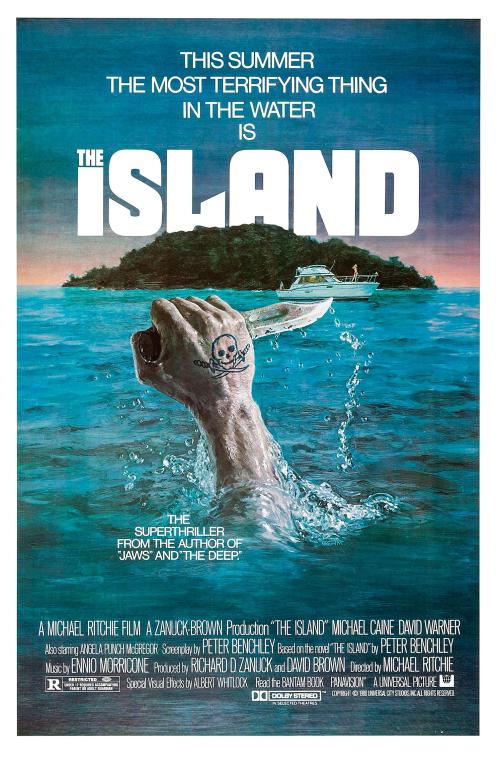
Blair (Michael Caine) is a newspaper reporter who becomes intrigued about the reports of missing boats in the Caribbean. He gets the permission from his editor to travel down there to investigate and he takes along his 12-year-old son Justin (Jeffrey Frank). The trip proves dangerous right from the beginning when the plane they’re traveling in crashes on one of the islands when the wheels of the craft fail to operate as its trying to land. They then go on a fishing trip only to be attacked by some pirates living on an uncharted island. Justin is brainwashed by the head of the group, Nau (David Warner), to become heir while Blair is put to the task of being the resident scribe and in the process becomes the source of romantic affection to Beth (Angela Punch McGregor) whose husband he killed earlier during the attack on their fishing boat. While Blair desperately searches for an escape he becomes even more worried about his son who no longer shows any loyalty to his father and instead considers himself a descendant of the pirates.

This was another one of Caine’s ‘paycheck projects’ where he’d do the film simply on the basis of the monetary offer regardless of the script quality. He has since regretted this decision and refuses to talk about it in any of his interviews while privately labeling it the worst film of his career. The script was written by Peter Benchley and based off of his novel of the same name. Since Benchley also wrote Jaws he was for awhile deemed a hot commodity in Hollywood, but after this movie tanked his status diminished completely and he was never offered another script deal again though his 1991 novel ‘Beast’ did get adapted into a TV-movie.

The main problem is the disjointed tone that comes off at times as a thriller and at other moments a comedy. The scenes of violence, which start out right away, are completely botched. The first one has what’s clearly a mannequin put in place as the victim and thus makes the stabbing sequence unintentionally laughable. The second violent episode where the pirates raid another boat has the victims not making a single sound as they’re being hacked and thus allowing their daughter to sleep through it, but I feel men and women will definitely yell out in terror as their fighting for their lives. The third raid features one of the victims trying to take on the pirates, one-by-one, karate style, but this turns the thing into a farce and makes the pirates engaging in a weird sort of way, which saps away all the suspense.

The concept that this pirate community would be inhabiting an uncharted island for centuries and not found out is unbelievable to the extreme. They come-off like people lost in a time warp who are confused and baffled by modern technology, but they’re clearly able to get off the island whenever they want, so why wouldn’t they travel to other islands, or even the mainland where they would come into contact with the modern day civilization? Even if the whole group didn’t go there would most likely be a few who’d be curious enough to want to explore what else was out there. Having the pirates get into a time machine from the 1600’s to the modern day, or be the ghosts of pirates from long ago, as wacky as those concepts may be, would still be better than doing it the way it gets done here.

The Caine character is boring and the way he gets put on this assignment is ridiculous as his boss just tells him ‘to go’, without putting up any provisions like how long he’ll be staying, where exactly will he be traveling to, how many articles would he be writing and when would they be due, or even whether the newspaper would even be compensating him for the cost. With terms this loose a person could frolic away on some tropical vacation and his employers wouldn’t have known the difference. He’s also never shown writing anything on a notepad, or typewriter, or dictating into a tape recorder, so it barely seems like he’s a journalist at all. The idea that Caine would be the only person on the planet intrigued by these disappearances is absurd too as relatives of the victims would be demanding answers and there would be other news reporters wanting to travel there in an effort to be the first to get the ‘big scoop’.

It’s also odd that a father would choose to take his son on such a dangerous mission knowing full well that others who have traveled to this area have disappeared without a trace making it seem like he’s an  irresponsible parent. The kid also gets ‘brainwashed’ too quickly, literally overnight, making it seem like he might have some sort of mental disorder if he’s able to change personalities and allegiance that fast. The idea of putting match sticks in his eye sockets and thus not allowing him to sleep would most likely dry his eyes out and blind him instead of getting him to come onto their side and like them. The pirates are also able to do the same ‘brainwashing’ with another young girl they kidnap, but how is this primitive group so adept at child psychology in ways that modern man isn’t?

Spoiler Alert!

The ending, which features Caine annihilating the entire group via a M2 machine gun is cool though it should’ve been done in slow motion to fully accentuate the violent depravity. The subsequent chase through the dark bowels of the ship between Caine and his son and Nau where you hear the creepy splashing of the sea water hitting against the ship’s bottom isn’t bad either. Unfortunately everything that comes before is a wretched mess making it by all accounts one of the worst and most inane films I’ve ever seen.

My Rating: 0 out of 10

Released: June 13, 1980

Runtime: 1 Hour 54 Minutes

Rated R

Director: Michael Ritchie

Studio: Universal

Available: DVD-R, Amazon Video, YouTube

The American Success Company (1979)

americansuccess

By Richard Winters

My Rating: 7 out of 10

4-Word Review: Taking on different personality.

Harry (Jeff Bridges) is a highly passive man that gets routinely dominated by both his boss (Ned Beatty) and wife (Belinda Bauer), who also happens to be his boss’ daughter. Determined to change his ways he decides to emulate the personality of a local tough-guy, who always seems to get his way and most importantly get the women. He works with a local prostitute (Bianca Jagger) to improve his bedroom skills and then finally ‘introduces’ himself to both his wife and boss. Surprisingly the ‘new Harry’ works to perfection as his domineering father-in-law learns to back-off and no longer humiliates him. His wife too likes the change, but he plays the part so well she refuses to believe it’s the same person. When he tries to go back to his old self she rejects him wanting only to be with the tough guy who she insists must be a totally different person and she can only be happy if she’s with him and no one else.

Back in 1978 while filming Winter Killswhich also starred Bridges and Bauer, the funding for the project, which was through AVCO Embassy Pictures, was pulled leaving the shooting of the film only half completed. Director William Richert then decided to do this film in-between, using much of the same cast, in order to bring in the extra money he needed to complete the other one. The script was written in 1974 by Larry Cohen who intended it to be a vehicle of Peter Sellers, but at the time Sellers was in a career lull having starred in a lot of box office duds, so investors didn’t want to take a chance on it and Cohen was eventually forced to sell the script, which remained in turn-over until Richert finally decided to take it on. While the film failed to turn a profit and was barely released, Cohen often stated that the changes Richert did to the script helped ‘ruin’ it, he was still able to make enough through the selling of the distribution rights to resume the shooting of Winter Kills and get it completed.

On the whole there’s enough directorial touches to keep it engaging and Richert, who has a small role as one of the employees of the firm whose constant leering grin is great, clearly knows how to make it entertaining enough despite the story’s absurdities. The setting though of Munich, this was apparently one of the stipulations he had to agree to in order to get it made, is off-putting especially when the plot revolves around corporate America and is a satire on the American mindset. The heavy use of a white color makes the office interiors seem almost like a hospital and Ned Beatty, who was only 41 at the time, but with his hair dyed a tacky white color to come-off as an overbearing elderly man in his 70’s, doesn’t work at all. Since John Huston was also in Winter Kills and they were using the same cast from that one to do this one then he should’ve been cast in the part especially since he was really old and better at playing dominating characters.

Bridges is fun as he plays against his good-guy image. Some critics have considered him a bland actor whose characters are at times ‘too good to be true’, so having him turn around and be overly passive and downright wimpy who jumps in terror at his neighbor lady’s pet poodle is definitely amusing. However, the transition to the brazen alter ego is too quick and seamless. If he’s truly timid at heart then that trait should trickle through even when he’s pretending to be someone else, which doesn’t happen here, but should’ve. No explanation about how he gets this big colorful tattoo on his chest, which he wears while being the tough guy, nor how he’s able to remove so quickly when he goes back to being himself.

The biggest plus is Bauer, who started her career in Australia where she studied ballet and competed in beauty contests before coming to the US. Here she becomes the sole reason to watch the film as she’s not only gorgeous, but displays a delightful way of morphing from a spoiled rich girl persona, to demanding wife, and then back to submissive woman. Her accent helps enhance her character and plays off of Bridges well. The only issue is if she couldn’t stand her husband why did she marry him in the first place? This is a highly attractive women born into money, so there was no need to settle, so what was it about his original personality that she liked in order to get hitched? If she craved a more domineering man then why not go after that type of guy in the first place? The film fails to explain this crucial point and thus ultimately makes it shallow and empty-headed.

My Rating: 7 out of 10

Released: September 28, 1979 (Test Screening)

Runtime: 1 Hour 31 Minutes

Rated PG

Director: William Richert

Studio: Columbia Pictures

Available: DVD, Amazon Video

A Boy and His Dog (1975)

Version 1.0.0

Version 1.0.0

By Richard Winters

My Rating: 7 out of 10

4-Word Review: Surviving after nuclear holocaust.

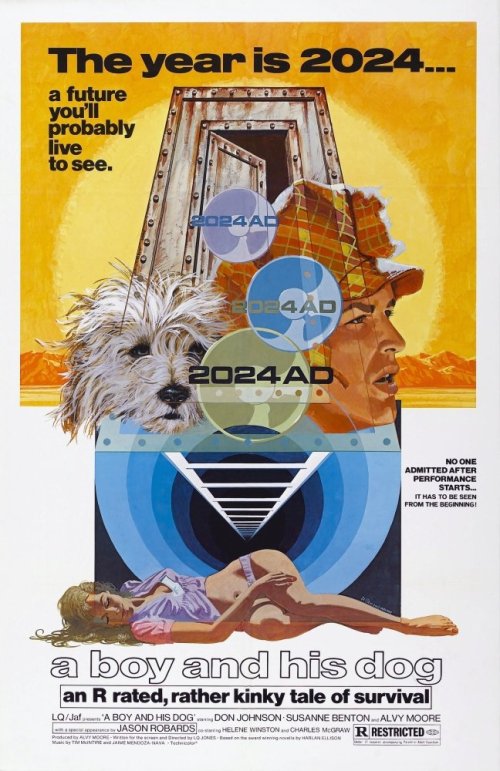
The year is 2024 and the landscape of the U.S. has been turned into a wasteland due the after effects of a nuclear war that occurred in 2007. Vic (Don Johnson) is an 18-year-old that wanders around with his telepathic dog named Blood (voice of Tim McIntire). Blood helps Vic find women to rape while Vic scavenges for food for their survival. One night while watching an X-rated movie at a makeshift theater Blood is able to gain the scent of a woman nearby named Quilla (Susanne Benton). Quilla and Vic eventually have sex, but then she disappears to the underground society that survives inside a biosphere. Vic decides to follow her there while Blood remains above ground waiting for Vic’s return. Once Vic arrives he finds everyone there to be in whiteface and dressed like people living on the farm during the turn-of-the-century. He meets Lou (Jason Robards) along with Dr. Moore (Alvy Moore) and Mez (Helene Winstone) who all three run things. They convince Vic to stay there as he has a ‘purpose’ of becoming a stud and impregnating the young women since the men there can no longer do so. At first Vic is excited about his newfound ‘job’ as he is always quite horny, but after he finds out the details of what he must do he relinquishes his duty, but realizes it may be too late.

The story is based on the novella of the same name by Harlan Ellison who wrote the original screenplay that was later finished by director L.Q. Jones who used his own money to help get the film financed. While the movie does have some intriguing and memorable visuals, logic-wise there are some holes. One of the biggest ones is that, at least hypothetically, there would most likely have been a nuclear winter, which is what would be created after a nuclear war due to so much soot being blown into the atmosphere that it would block out most of the sunlight for several decades and create a night time effect and for this reason the outdoor scenes should’ve been filmed at night in order to replicate the ongoing darkness.

Vic’s conversations with his dog, which all gets done telepathically, is odd too and never sufficiently explained. How does this dog attain this ‘gift’ and why is it only him and not other mutts that can do it too? It would’ve been better had it been explained that some modern invention had been created that would allow communication between owners and their pets, but even this fails to explain how the dog manages to be so incredibly smart. Don’t get me wrong the voice-over work by McIntire is delightful, but how did the animal get so well-read that he even knows the Latin origin of words? Is there a dog college that teaches them this?

Vic’s extreme urges to have sex all the time seemed out-of-place too. Granted he’s a young guy with raging hormones, but psychologically when a person is in a desperate situation, in this case simply trying to survive in a hostile environment with very little food, then a person’s most basic needs come first and it’s all they’ll think about. Finding something to eat, they’re forced to go out each day and hunt for something, and acquiring shelter for sleep, would be their pressing needs and what would occupy their minds most day-in and day-out while the sex need would become secondary and only have his focus once the other needs were met, but in this story the sex urges seem to take precedent, which doesn’t make sense from a human behavioral perspective, nor where he’d get the energy to do it since he’s pretty malnourished to begin with.

The X-rated movie that they watch at a ‘theater’ is goofy too as it amounts to nothing more than a grainy black-and-white stag film from the 50’s even though technically by 2007, which is when the bombs dropped, there was porn on the internet and explicit DVD’s some of which would’ve probably survived the blast and thus they’d be watching those instead of something found in grandpa’s ancient collection. Though this is what makes the movie entertaining not so much for what it gets accurate in their predictions, which isn’t much, but more what it gets wrong.

The one thing though that really stands-out, at least for me, and makes the movie memorable, though this apparently wasn’t the case with the film’s initial test audience who called these scenes ‘slow’ and ‘boring’, are the moments that take place in the underground society. The look of everyone walking around like robots and resembling farmers from a bygone era has a kitschy flair like something out of a Federico Fellini movie. Hal Baylor, as one of the main menacing robots that can’t seem to ever go down even when being directly shot at, steals every scene he is in and helps create some definite tension. I also got a kick out of everyone wearing white face, which I thought was to explain their pale complexions due to not be out in the sun, but it seems to be instead obviously painted on, so I’m not sure what that was meant to represent.

The twist ending is terrific and the film’s final line, which Ellison detested and tried having taken out, is a keeper. While its attained a cult following there are still the detractors who feel its ‘misogynistic’ though I don’t really see it.  Sure Vic sees women as sex objects and ‘conquests’, but there’s guys out there that are like that. Quilla is conniving and duplicitous, but some women are like that too. The movie isn’t saying that all men and women are like this, but in environments that are as desperate as this one it will tend to bring out the worst in human nature, which was all the film was trying to convey from my standpoint.

My Rating: 7 out of 10

Released: May 15, 1975

Runtime: 1 Hour 31 Minutes

Rated R

Director: L.Q. Jones

Studio: LQ/Jaf Productions

Available: DVD, Blu-ray, Amazon Video, Pluto, Roku, Tubi, YouTube

Travels With My aunt (1972)

travels1

By Richard Winters

My Rating: 4 out of 10

4-Word Review: Kooky lady cons nephew.

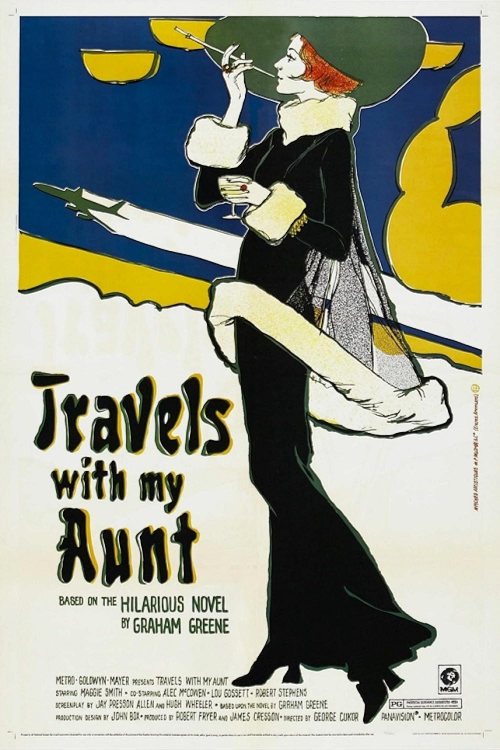
Henry (Alec McCowen) is a middle-aged bank manager who attends his mother’s cremation where he meets his kooky Aunt Augusta (Maggie Smith). She invites him over to her residence where he finds that she’s living with a black man named Wadsworth (Louis Gossett Jr.) who works as a fortune teller. It is here that she receives a package holding the severed finger of her longtime lover Visconti (Robert Stephens) and told that she must deliver $100,000 in ransom in order to see the rest of him alive. She convinces Henry to go with her to Paris to meet the kidnappers demands and in the process the two go on a wild jaunt across the globe that ends with them in North Africa.

The film is based on the novel of the same name by Graham Greene that was originally intended for Katherine Hepburn in the lead. Director George Cukor, whose career was winding down at this point, had worked with Kate in several projects from decades earlier and felt this role would be the right fit though she disagreed, but then decided that if she could rewrite the script, she’d consider doing it. Jay Presson Allen, who had done the original adaptation, which Hepburn didn’t like, gave full control over to her to rewrite it anyway she’d like, but ultimately the studio felt she was too old for the part especially since she was expected to play a younger version of the character during flashback sequences and they didn’t feel she at her advanced age could come effectively as someone in their early 20’s, so the part went to Smith instead.

Maggie to her credit is quite good and although she was only in her late 30’s really seems quite old during the sequences where the aunt is portrayed in the present. There’s even realistic wrinkles on her face especially around the cheekbones that gives the character the look of someone in their 70’s and 80’s. In the flashbacks she comes-off equally effective as a youthful free-spirit. Unfortunately her daffy character was for me a turn-off as she’s too much of an eccentric caricature that’s more obnoxious than amusing and building a whole film around her doesn’t work.

Henry is equally perplexing as I couldn’t understand why he’d believe this nutty lady when she tells him the mother he had always known wasn’t his biological one. For all he knew she was a goofball that shouldn’t be taken seriously unless she can supply more evidence, which she doesn’t. Most rational people would’ve kept her at an arm’s length instead of galivanting across the continent with her especially whom he had just met. In the book Henry is portrayed as being bored with his life and longing for adventure, but the film doesn’t make this clear, so his motivations and personality become muddled. Also in the book he was in early retirement, which would help explain why he had so much free time to go traveling, but the movie doesn’t bring this up either, so you wonder what he told his employer that would allow him to be off of work for so long and not get fired.

Having the Aunt and Henry bicker about, as their personalities were quite opposite, could’ve been fun, but this doesn’t get played-up. Too much time gets spent on this outlandish James Bond adventure that gets more ridiculous and unbelievable. The flashbacks bog down the pace and weren’t really needed and everything should’ve remained in the present day. The coin flip ending, in which Henry can’t decide what he wants to do moving forward, go back to his old life or continue on with his aunt, is a cop-out and only done because they couldn’t figure out how else to end it, so they do a freeze-frame of the coin in the air and the  let the viewer feel-in-the-blanks, which was far different than the novel. There Henry becomes a changed man who enjoys the excitement of getting involved in illegal activities, but because the film was not centered around him, which it should’ve been, we don’t witness any type of character arch making the whole thing quite trite and saved only by the brief appearance of Cindy Williams who plays a free-spirited hippie that he meets on a train.

My Rating: 4 out of 10

Released: December 17, 1972

Runtime: 1 Hour 49 Mintutes

Rated PG

Director: George Cukor

Studio: MGM

Available: DVD-R (Warner Archive)

Something for Everyone (1970)

something1

By Richard Winters

My Rating: 7 out of 10

4-Word Review: Charming his way up.

Konrad (Michael York) is a young man with no money, or status, who dreams of one day owning the large Bavarian castle that he spots in the outskirts of a town that he’s passing through. He learns that it’s the property of the widow Countess Herthe (Angela Lansbury), who’s unable to live in it due to lack of finances. He schemes to become one of her servants by getting her regular butler, Rudolph (Klaus Havenstein) run over by a train. He then gets into a romantic relationship with Anneliese (Heidelinde Weis) whose parents (John Gill, Eva Maria Meineke) are quite wealthy while he also becomes lovers with the Countess’ son Helmuth (Anthony Higgins). Konrad hopes that Anneliese’s wealthy parents can use their money to reopen the castle and convinces Annelise to get into a fake romance with Helmuth that will lead to a marriage and then this will hopefully have her parent’s money flowing into the castle to get it reopened. He assures both Anneliese and Helmuth that he’ll remain their lover on the sly, but without each one knowing that they’re having sex with the same man. The elaborate plan though comes to a crashing halt when Anneliese accidentally walks in on Konrad and Helmuth and sees them kissing.

This super black comedy may be one of the darkest every made as it has no let up and absolutely everyone of the characters is a schemer and no better than the others. It’s based loosely on the novel ‘The Cook’ by Harry Kressing, but the story here is much different. In that one the main character is Conrad who spells his name with a ‘C’ instead of a ‘K’ and portrayed as a gaunt man who’s over seven feet tall and dresses in an all black unlike here where Konrad is young and handsome. In the book Conrad uses his cooking skills to get everyone to be ‘eating out of his hand’ with his delectable dishes while in the movie Konrad shows no such talent. The book had a much creepier tone while the film plays it all up for dark laughs and keeps the horror elements completely out.

I’m not exactly sure why there was such big changes made from its source material as keeping it truer to the novel had the potential of making this into a ‘food porn’ movie, which could’ve been visually sumptuous. However, the way it’s done here is still enjoyable with the majority of props going to York’s splendid performance whose boyish smile and dashing looks keeps it all quite engaging no matter what dastardly thing his character does. Reviled by the critics at the time for its ‘glorification of homosexuality’ it’s pretty amazing in retrospect how daring it was as this was filmed in 1969 and quite possibly the first film to ever show two men kissing. I remember in 1982 it was considered still quite shocking when Michael Caine and Christopher Reeve did it in Deathtrapso much so there was a report about it on CBS Evening News under the theme of movies ‘going too far’ while this movie had already been showing it, in a rather gleeful way, 13 years earlier, but maybe that’s all because this was done in Europe and not stuffy old America.

On the flip side I didn’t feel Lansbury had much of a presence. A talented actress for sure, but she doesn’t have a lot to do until well into the second act and even then isn’t real funny, and seems upstaged by the supporting cast who come-off as more colorful. It’s also frustrating that we spend the whole runtime seeing this gorgeous castle in the distance, in this case the famous Neuschwanstein Castle in Germany, but never able to go inside it. The few scenes that were supposedly its interior were instead very obviously shot on a soundstage.

Spoiler Alert!

While the script is full of many crafty twists and witnessing each nefarious character go down in a unique way is quite fun I did feel the way Konrad kills Anneliese and her parents by acting as their chauffer who crashes the vehicle down an embankment didn’t work. For one thing the killing of a wealthy family would’ve lead to a major investigation and since Konrad was driving the car, which he ‘miraculously’ jumps out of before it crashes, but he would still have to come up with a reason for why the car spun out of control. Since he doesn’t have one he would come under suspicion of the authorities instead of getting off scot-free like here.

Having Herthe’s nerdy daughter Lotte (Jane Carr) suddenly become instrumental in the whole thing by exposing the fact, at the end, that she’d been spying on Konrad the whole time and using what she knew to force him to marry her, leaved even further plot holes. The viewer should’ve been tipped off about what she was doing, even subtly, during the story as having her just turn up with all this new information makes it seem like it was tacked-on as a convenience without having it thought through with the rest of the plot. Not sure why Herthe, who was expecting to marry Konrad herself, would’ve gone along with Lotte marrying him instead, or what explanation was given to her in order for her to accept, which again just leaves open even more questions that in a truly well-crafted script should’ve been answered.

something2

My Rating: 7 out of 10

Released: July 22, 1970

Runtime: 1 Hour 52 Minutes

Rated R

Director: Harold Prince

Studio: National General Pictures

Available: DVD-R, Blu-ray

Silver Streak (1976)

silver

By Richard Winters

My Rating: 8 out of 10

4-Word Review: Murder on a train.

George (Gene Wilder) is a book editor taking a train ride from Los Angeles to Chicago. Along the way he gets into a relationship with Hilly (Jill Clayburgh) who is staying in the neighboring compartment. After a night of drinks they go back to her bed and begin making-out only for George to see a murdered body of a professor, whom Hilly works for as his secretary, get thrown off the train. Nobody else sees it except for him and everyone, including Hilly, believe it was a figment of his imagination, but George persists by doing the investigating himself. He goes to the compartment that the professor was staying in to see if he’s there, but instead he meets two men (Ray Walston, Richard Kiel) who throw him off the train. George then must find a way, in the middle of the empty desert, to get back on the train, so as to warn Hilly, whom he fears may be their next victim.

The script was written by Colin Higgins who up to that time was best known for having done Harold and Maude. He said he had always fantasized about meeting a beautiful blonde on a train and when it never panned-out in real-life he decided to write it into a story. Initially he was expecting an uphill battle to get it sold, but to his amazement it instead set-off a bidding war between Paramount and 20th Century Fox who both wanted to purchase the rights and it ended up selling for a then record $400,000. Originally Amtrak was going to be used as the setting for the Silver Streak, but the company became panicked that the film could cause bad publicity for them and ultimately refused to allow the studio to use any of their trains, so the film crew was forced to go north of the border and use the Canadian Rail System in its place while still pretending that it all takes place in the US when really all exteriors are Alberta, Canada and the skyline that gets seen in the distance that’s supposed to be Kansas City is really Calgary.

The reason the film works so well is that the comedy is on-target the whole way, but also manages to deftly blend it in with some nerve wracking action making the viewer let out belly laughs while also sitting-on-the-edge-of-their-seat at the same time. The pace is brisk with some amazing and very realistic stunt work that not only shows the train crashing through the wall of Chicago’s Central station, but also a few scenes with the character’s dueling it out on the roof of the locomotive as it’s going at high speeds. In fact the only slow spot in the entire movie is when Gene and Jilly make-out in the train car, which goes on too long and may make some people, including my conservative parents who watched the film with me when I first saw it on Showtime in 1982, as thinking this might be more a soft core porn flick than an action thriller and about ready to turn-if-off before it finally gets going with the plot.

Wilder, who was not Higgins’ first choice for the role as he intended it to be played by George Segal, is quite engaging and this was the first of several pairings that he did with Richard Pryor, who doesn’t appear until an hour in, but manages to take over quite nicely and makes a strong, memorable impression. Patrick McGoohan is sinister as the villain and one of the rare instances where in an otherwise comedy the bad guy isn’t funny and instead nasty, usually in comedies it’s considered mandatory that all the characters, even the bad guy, have some amusing moments, or lines, but McGoohan is just mean, which enhances the suspense element. Scatman Crothers, who initially seems to be playing an insignificant roles as the train’s porter, but in the end becomes quite crucial in getting everyone saved. Richard Kiel is good, though he speaks no dialogue, as one of McGoohan’s henchmen, in a role quite similar to the Jaws character that he played in two James Bond films that came out a year later, he even walks around with the same mangled up dental work in his mouth.

Spoiler Alert!

While the film works for the most part quite flawlessly I did find a few tidbits to quibble about. One is the scene where Gene accidentally bursts open the patrician door that divides his room from Jill’s who is busy dressing and doesn’t act startled when he suddenly breaks into her room, which I would think anyone, especially in a state of undress, would’ve responded with a scream and a look of shock, which would’ve made the segment funnier if she had.

Later on a police chief, played by Len Birman in a very bad impression of Mike Connors from ‘Mannix’, tells Gene that they know he’s innocent and have simply been putting-up manhunt posters with his picture on it for his own safety, so they could catch him and get him away from the evil McGoohan and his cronies who want to kill him. However, after he explains this he then hands Gene a gun and some bullets and tells him to come along with his men to help nab McGoohan who is still on the train, but how would this police chief know that Gene could handle a gun and was trained on how to shoot it, let alone even need him since his own men were well armed with rifles and could easily shoot down the bad guy themselves? There’s also another moment where the police chief shoots into a large crowd in an effort to hit McGoohan, which sends everyone into a panic and would be considered a major act of negligence for a cop to do.

Another scene has McGoohan explaining to Jill, Gene, and Richard about how he and his men never meant to really kill the professor, or at least not upfront, but when he did die that’s when they had to immediately ‘get’ a lookalike as an imposter to give everyone the idea that the professor was still alive. However, how exactly where they going to be able to find someone who looked so similar to the professor in such a quick, speedy way and then get him on the non-stop, fast-moving train?

The biggest exaggeration for me though is when Gene unhooks the back part of the train from the engine, while standing on a thin ledge and holding on for dear-life via a small metal rail and then able to successfully hop onto the train car that he had just decoupled from the other one. With them both going at high speeds I don’t think he’d be able to do it. Of course in the movie it gets done by a professional stunt man, who was able to time it, and rehearse it, to make it look easy, but in reality the average person would’ve either slipped, or missed grabbing the rail and thus fallen to the side of the tracks. This though could’ve actually been funny as we would then see Gene’s body roll on the ground and initially make it seem like he was hurt, or injured and then have him look up in aggravation and go: ‘Damn, I got thrown off the train for a fourth time!”

My Rating: 8 out of 10

Released: December 8, 1976

Runtime: 1 Hour 54 Minutes

Rated PG

Director: Arthur Hiller

Studio: 20th Century Fox

Available: DVD, Blu-ray, Amazon Video, YouTube