Category Archives: Black Comedy

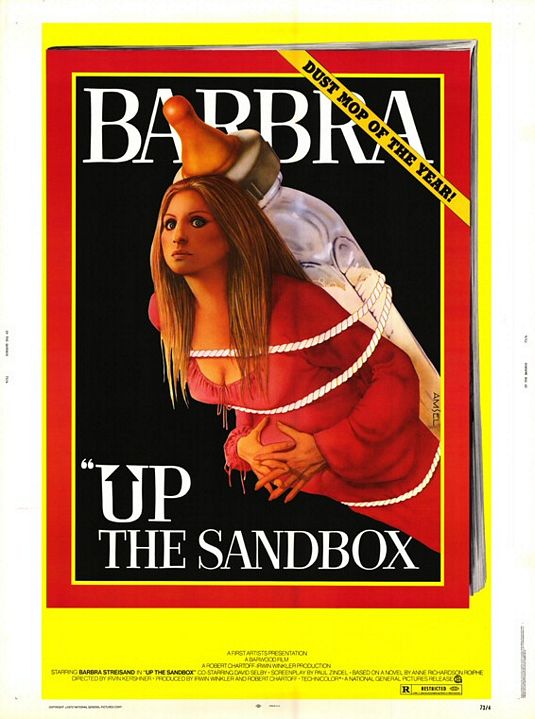
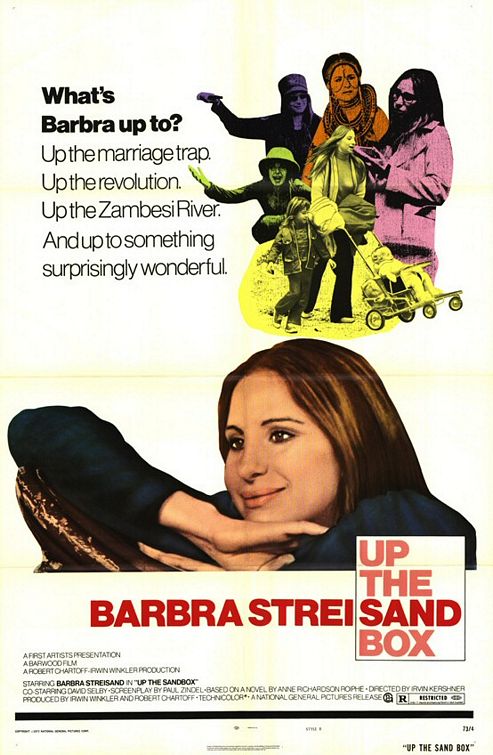
Up the Sandbox (1972)

up the sandbox 2

By Richard Winters

My Rating: 7 out of 10

4-Word Review: Housewife has secret fantasies.

Margaret (Barbra Streisand) is a neglected housewife taking care of her two children while her husband Paul (David Selby) busily works on his novel and thesis. She lives in a rundown New York apartment that seems to have bugs crawling from everywhere. Her nagging mother (Jane Hoffman) pressures her to move back with them to the suburbs, but she enjoys the excitement and independence of city life over lily white suburbia, so she resists. Now she finds that she is pregnant with her third child and this along with the other stresses causes her to slip into secret fantasies that become more and more outlandish.

This film didn’t do well upon its initial release and is a bit forgotten, but deserves a look simply for its unique and memorable fantasy segments. The scene where she joins a black militant group that gets inside the Statue of Liberty and wires it with explosives is pretty good as is the part at a party where her stomach suddenly balloons out as if she is pregnant and when she pushes it in it makes her breasts larger. The scene where she meets a Fidel Castro-like dictator who takes off his shirt to expose that he has female breasts is funny and the finale that takes place inside an abortion clinic is interesting. The best though is when she is captured by an African tribe of topless women. The shot of their grossly overweight leader whose gigantic, sagging breasts seem to overlap her entire body ends up being the film’s most lasting image.

Hoffman is hilarious and a perfect caricature of a meddling mother of adult children. The part where Margaret fantasies about stuffing her mother’s face into an anniversary cake and then the two roll around on the floor where Margaret then punches her in the face had me laughing-out-loud.

Paul Zindel’s script nicely balances the fantasy with the gritty reality of urban living. It also envelopes the feminist issues with the social upheaval of the times and the speech that Margaret gives about women needing to be less like men and more like themselves is excellent.

Director Irvin Kerschner makes fine use of the New York locales giving the viewer an eclectic taste of its crowded neighborhoods and street culture as well as its epic skyline. I loved the cinema vertite style that has a sophisticated and trendy feel.

Streisand herself seems to be having a lot of fun and purportedly this is her favorite out of all the films that she has done. This was just before she went through her frizzy hair phase and the long straight style that she has here I feel makes her look sexy.

The pace is unusual especially for a comedy in that it isn’t frantic and does not have any quick edits. Instead the set-ups are quite slow and seem at times to be almost dramatic before throwing in a surprise punchline. Personally I liked this approach, but the unconventional style might have proved confusing to certain audience members who didn’t know what genre to place it in and may have been the reason for the poor box office returns, which is shame as the production overall is excellent and intriguing.

up the sandbox 1

My Rating: 7 out of 10

Released: December 21, 1972

Runtime: 1Hour 37Minutes

Rated R

Director: Irvin Kerschner

Studio: National General Pictures

Available: VHS, DVD

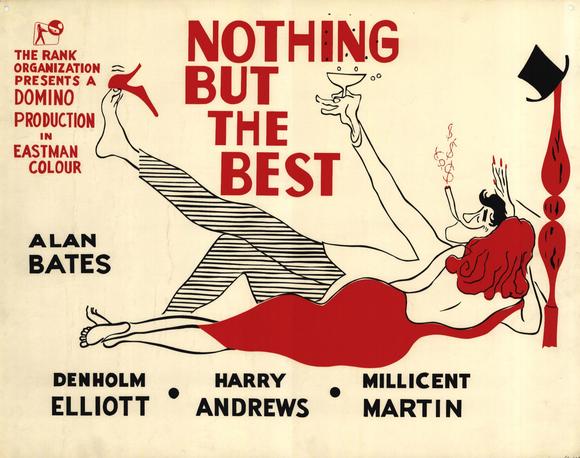
Nothing But the Best (1964)

nothing but the best 2

By Richard Winters

My Rating: 6 out of 10

4-Word Review: Maybe crime does pay.

James Brewster (Alan Bates) is a young ambitious man who will do anything to not only climb the corporate ladder, but raise his social standing as well. He works at a large company and finds things tough. Everyone else is competing for the same thing and James finds himself being boxed out and unable to get the attention and recognition he feels he deserves. Then he meets Charles (Denholm Elliot) a master con-man and forger and he realizes the only way to move up is by doing it the criminal way. The two move in together where Charles teaches James all the tricks of the trade. James becomes so good at it that he realizes he no longer needs Charles so he murders him and stuffs his body inside a large trunk, which he has hidden. Then he becomes engaged to the beautiful Ann Horton (Milicent Martin), but her extended family has connections he is not aware of, which could put a kink to his otherwise lofty plans.

The screenplay was written by Frederic Raphael who has had a distinguished career in screenwriting including penning the script to Stanley Kubrick’s last film Eyes Wide Shut. Although there really isn’t any one particularly funny moment and some of the criminal activity is a bit complex and hard-to-follow the dialogue is still snappy and the less than honorable characters surprisingly engaging. Clive Donner’s direction gives the proceedings a breezy pace and the characterizations of the upper British crust are on-target and fun.

Elliot, who is one of the best character actors ever and had a long and distinguished career playing a wide variety of them, is terrific. Somehow this guy has always had an ability to make conniving, immoral people engaging, funny and even somewhat likable and his part here is no exception. His presence is a major plus and helps give the film its drive and it’s a shame he couldn’t have remained through the whole duration. I also enjoyed Pauline Delaney as James’s landlady Mrs. March who becomes aware of his illegal activity and extorts sex out of him in order to keep quiet.

There are a couple of twists at the end that are interesting, but not what you expect. James never really gets the comeuppance that you think he should, which to some degree is disappointing, but on the other hand kind of refreshing. We are so used to seeing films have a moral theme of some kind where bad guys are eventually punished and justice prevails that having one pretty much get away with it is intriguing simply for its novelty.

The color on the print I watched was horribly faded making it look almost like a cheap computer colorized attempt even though it really wasn’t. This film, which was widely hailed by critics and audiences alike, deserves a Criterion release and a thorough restoration and I am shocked that it hasn’t already.

My Rating: 6 out of 10

Released: March 10, 1964

Runtime: 1Hour 39Minutes

Not Rated

Director: Clive Donner

Studio: Royal Films International

Available: None at this time.

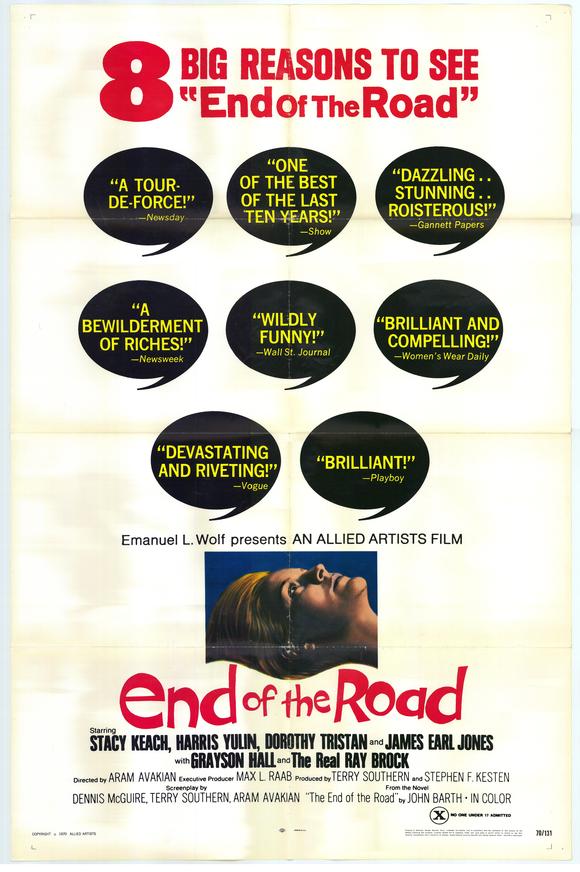
End of the Road (1970)

end of the road

By Richard Winters

My Rating: 6 out of 10

4-Word Review:  Too weird for words.

A bizarre adaptation of John Barth’s already bizarre novel detailing the story of a man (Stacy Keach) who goes into a catatonic state at a train station and is then sent to a strange mental hospital run by a weirdo named Doctor D (James Earl Jones). After he is considered to be ‘cured’ he takes a job as a college professor and proceeds to have an affair with the wife (Dorothy Tristan) of one of his colleagues (Harris Yulin).

It has been noted that author Barth disliked this film version of his novel and it is easy to see why. It gives only a basic outline of the story while leaving out all of the deeper meanings. It also tried to tie the story to the chaos and rebellion of the 60’s even though the book was written in 1955. The final result is a confusing mess that never comes together. The characters behave strangely and with no understanding to their motivations it becomes impossible to relate to them or anything else that goes on. Most viewers, especially those that are not familiar with the book, will easily become confused after the first five minutes if not sooner.

On the positive end the filmmaking style is refreshingly audacious in a way that is rarely seen anymore. Everything is thrown out there no matter how outrageous with little regard to mainstream acceptance. The kinetic imagery and music has a certain hypnotic effect that keeps you connected to it even if you don’t understand what is going on. The film culminates with a very intense, grizzly, and tasteless abortion sequence that will not be soon forgotten by anyone who sees it. Jones gives one of the most bizarre and over-the-top performances that you will ever see anywhere and anyone who is a fan of his or has an interest in acting MUST see him in this film.

It’s a misfired experiment that manages to be enough of a period artifact to make it interesting as a curio. It definitely has the ability to stay with you after it is over.

My Rating: 6 out of 10

Released: February 10, 1970

Runtime: 1Hour 50Minutes

Rated X

Director: Aram Avakian

Studio: Allie Artists Pictures

Available: DVD 

Parents (1989)

parents

By Richard Winters

My Rating: 5 out of 10

4-Word Review:  Are his parents killers?

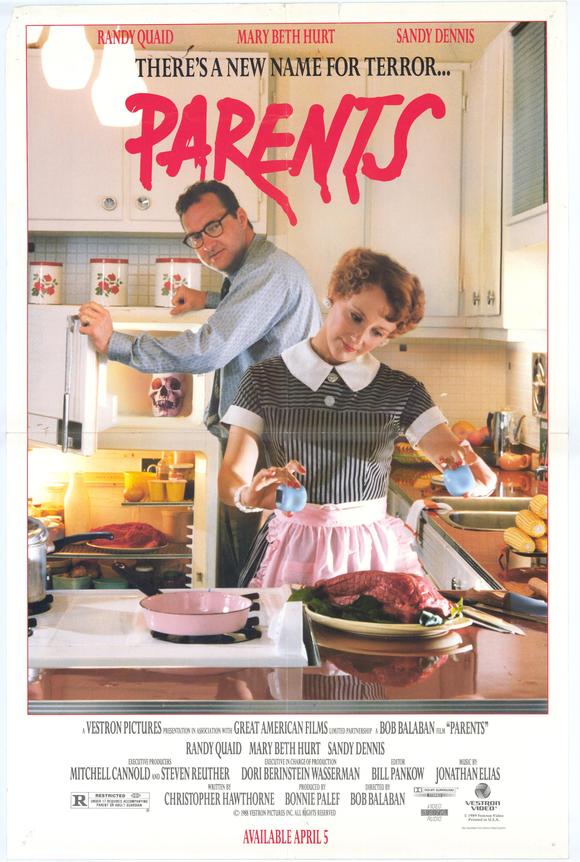
Young 10-year-old Michael (Brian Madorsky) begins to think that his ‘perfect’ and wholesome parents (Randy Quaid, Mary Beth Hurt) are psychotic murderers and that the meat they are cooking on their backyard grill may actually be human.

Unlike some of the other silly B-horror films from the 80’s era this one doesn’t just play it for laughs. There are some genuinely creepy undertones including a scene where the boy imagines himself falling into a giant pool of blood. The killings are also all done in slow motion, which is pretty cool and the film photographs food in such a way that it will make you hungry.  The movie also keeps the viewer guessing as to whether the parents are really killers or it is all a part of the boy’s already overactive imagination.

Sandy Dennis is given a supporting role that is much too undistinguished for an actress of her caliber and yet she is still able to make the most of it. She has a real nice stylishly short and curly haircut and she looks probably better here than she ever did. It is almost hard to fathom that just three years later she would be dead and this would be her second-to-last movie.

The kid is the one who actually ends up being creepier than any of the adults and it is no surprise that he never acted in anything else. He has a real big gloomy pair of eyes and blurts out strange things and mumbles them in a way that makes him hard to understand.

I felt for the most part that actor Bob Balaban’s directorial debut was imaginative and interesting, but there are certain elements that could have been played up more. The most infuriating thing though is the fact that it never makes it clear whether the parents really were killers or it was just made up.

On the whole the film has a little bit more going for it than most B-horror films from the 80’s and it does manage to keep you guessing. However, the nebulous ending is frustrating and the child actor playing the part of the kid is not a very good performer and at times even annoying.

My Rating: 5 out of 10

Released: January 27, 1989

Runtime: 1Hour 21Minutes

Rated R

Director: Bob Balaban

Studio: Vestron Pictures

Available: VHS, DVD, Amazon Instant Video

The Fourth Man (1983)

the fourth man 2

By Richard Winters

My Rating: 7 out of 10

4-Word Review: She kills her husbands.

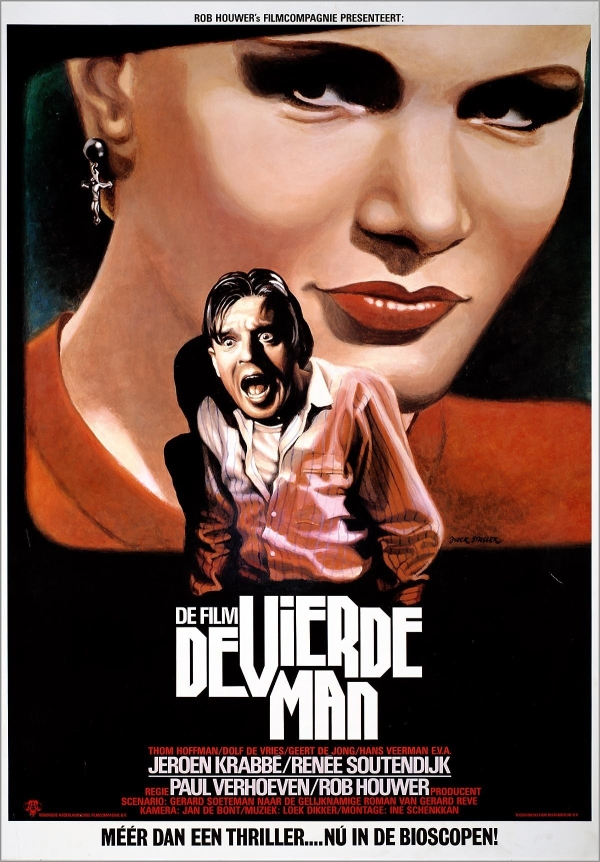
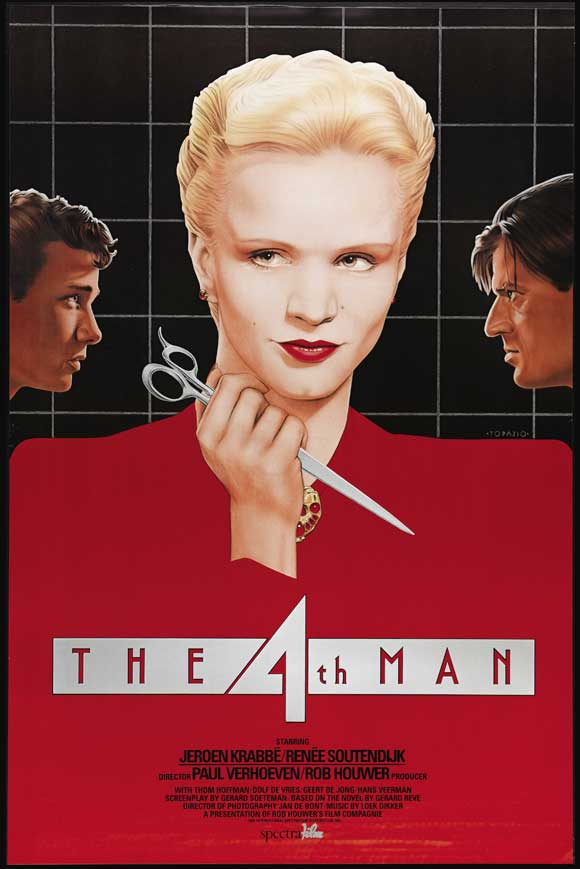
This movie is just about the ultimate in the femme fatale genre as it deals with a temptress (Renee Soutendijk) who marries men who all end up dying in freak accidents. Now she has seduced a fourth one, will he be next?

It is rare to say that you know it is going to be a good movie from the very moment it starts, but that is the case here. The film’s opening could very well be one of the most impressive of all-time as it begins with a startling view of a close-up of an actual spider trapping a fly on its web and then devouring it to the sound of a pounding electronic score that becomes the best part of the whole movie.

The rest of the film works pretty much on the same level with scenes that are provocatively lit and designed as well as a running sensuality that at times is both erotic and perverse. The flowing narrative jumps between reality and dreamy imagery that eventually blend into one and has an underlying subversive nature that keeps you riveted.

The characters are interesting because they work against their gender stereotypes and have a certain ongoing duel with each other. The woman has short hair and a square face and almost comes off looking like a man. She knows how to use her seductive powers and is always in complete control without ever showing any vulnerability. The man is weak and helpless while trying to mask it with an arrogant intellectual veneer.

The ending is the film’s only big letdown as it is too low-key and doesn’t match the energy of the rest of the film while also wrapping things up a little too nicely. A big showdown between the two main characters would have been much more satisfying.

The special effects are weak and help to expose the film’s low budget, but the film is still fun with a snazzy art house flair that became a breakout picture for director Paul Verhoeven.

The movie also contains a shocking scene involving a life-sized crucifix that some may consider blasphemous even though in the end the film’s message is actually spiritually affirming.

the fourth man

My Rating: 7 out of 10

Released: March 24, 1983

Runtime: 1Hour 42Minutes

Rated NC-17

Director: Paul Verhoeven

Studio: International Spectrafilms

Available: VHS, DVD

Homer and Eddie (1989)

homer and eddie

By Richard Winters

My Rating: 5 out of 10

4-Word Review: Losers go road-trippin’

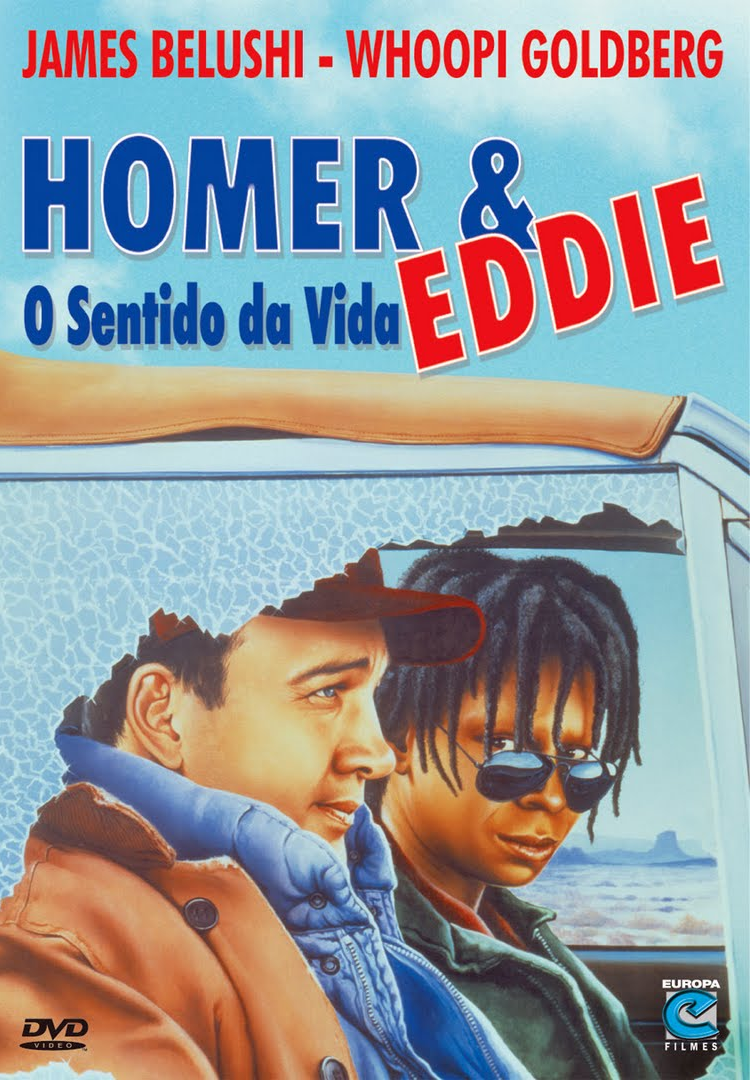
Homer (James Belushi) is a mentally challenged man suffering brain damage from being hit in the head by a baseball when he was a kid. He decides to go on a road trip to visit his sick father, but along the way he gets robbed and has to sleep in an abandoned car. It is there that he meets Eddie (Whoopi Goldberg) an embittered, volatile women who is supposedly suffering from a brain tumor. The two trek off in her car to Oregon to meet up with Homer’s parents and also try to track down the men who robbed him.

I was impressed with the acting range shown here by Goldberg. Usually she is so likable, but here she is quite edgy and does it in an effective way. I applaud her attempts to work outside of her comfort zone although her fits of anger make the viewer uncomfortable and her crying does not sound authentic.

Belushi is good in atypical role and for the most part he is the best thing about the movie. His lines are consistently amusing, but the film walks an uncomfortable line between making him a sympathetic character to also making fun of him. Despite the fact that these two already worked together in Jumpin’ Jack Flash the chemistry between them doesn’t work.

The supporting cast is interesting in cameo roles. Casting 70-year-old 200 pound Ernestine McClendon as a prostitute gets points simply for its novelty, but seeing her in her grossly oversized panties is a bit much. Karen Black as her pimp has such a small, meaningless role that I was surprised that she even took it. Nancy Parsons has an interesting part as a cold and aloof woman who becomes sympathetic, which is a rarity for her. Director John Waters appears briefly as a robber and I kind of got a kick out of Don Hanmer as a very nervous cashier. Belushi’s real-life second wife Marjorie Bransfield can be spotted in the character of Betsy and this also marked the final film appearance for both Fritz Feld and Anne Ramsey.

The film features a wide-array of musical styles, which works against it. I liked Richie Havens rendition of ‘Home’, which had the nice laid-back beat and folk tinged sound that you expect for a road movie. Some of the more hard rock, heavy metal stuff became too loud and obnoxious and takes the viewer out of the picture instead of wrapping them in.

I liked the scenery and there are a few interesting moments, but trying to mix the surreal with the gritty is misguided. The comical bits get drowned out by the scenes of violence and a very maudlin theme. The result is an uneven film that pales in comparison to the classic road movies.

My Rating: 4 out of 10

Released: December 1, 1989

Runtime: 1Hour 40Minutes

Rated R

Director: Andrei Konchalovskiy

Studio: Skouras Pictures

Available: VHS, DVD, Amazon Instant Video, Hulu

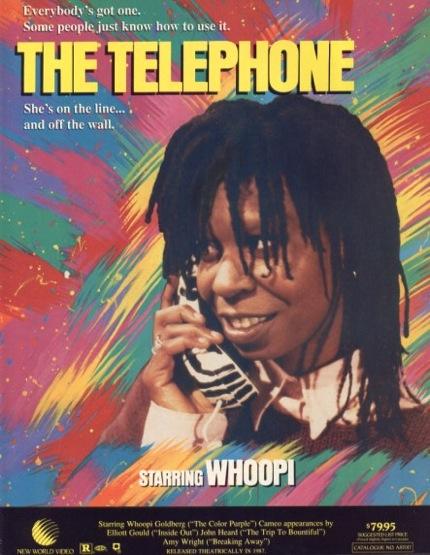
The Telephone (1988)

the telephone 2

By Richard Winters

My Rating: 1 out of 10

4-Word Review: I liked the owl.

Vashti Blue (Whoopi Goldberg) is an out-of-work actress sitting inside her dreary small apartment and having conversations with people over the phone. She also argues through a locked door that she shares with the women next door while waiting for a call from an agent for a job opportunity that never comes.

I am all for experimental cinema, which is the best way to describe this misguided project, but to work it still needs an artistic design and focus and this has none. It pretty much comes off as somebody’s cheap home video where a camera is turned on and then someone is allowed to rant and rave without pause for eighty minutes. Some could blame Rip Torn who is an actor turned first-time director here, but in subsequent interviews he has complained that Whoopi wouldn’t listen to any advice or direction that he gave and pretty much made his presence insignificant.  You could also blame the screenplay, which was written by the very odd pairing of Terry Southern and Harry Nilsson. Southern is best known for penning the screenplay for Dr. Strangelove while Nilsson is a famous singer/songwriter whose best work was doing the song ‘Everybody’s Talking’ that was the theme for the classic film Midnight Cowboy. However, Whoopi took great liberties with the material and ad-libbed a lot, so what was originally put down on paper and what is left on the screen could be minimal.

The conversations that Whoopi has over the phone ranges from lame to ridiculous. One includes calling the police and trying to get them to arrest a video store owner because he rented her a tape of Christmas in July with a scene excised is too absurd to be even remotely amusing. The Whoopi character also incorrectly stated that Frank Capra was the director of the film when it reality it was Preston Sturges.  Goldberg puts on a variety of accents including British, Japanese, Indian, and Southern as well as a few others, but her Irish one is suspect and her impression of John Wayne is terrible.

The apartment set is dull and bleak. The viewer feels trapped and with such little visual design their eyes and thoughts are apt to wander. Cutaways are sorely needed, but there are none. An infuriating moment is when there is a sound of a loud car pile-up outside, but despite this being a visual medium the camera never cuts away to show any of it. This was probably due to budget constraints, but what is even more perplexing is that there are sounds of people screaming, police sirens and even rioting and then a half minute later it all suddenly stops for no explained reason.

The supporting cast is eclectic but wasted. Noted character actor Severn Darden, in his last film role, appears in a brief bland bit as Whoopi’s neighbor. Elliot Gould gets a few minutes as Whoopi’s former agent and seems to be seriously slumming as he was a headline star during the seventies and now sadly stuck in this. John Heard is the only one who comes off best as a caustic, brash telephone repairman.

Whoopi’s two pets upstage the human cast by a mile. Her pet owl is very cute and I dug the goldfish particularly when he gets sucked down the drain of her bathtub and she must use a plunger to save him, which is the only time there is any action in the entire movie.

My Rating: 1 out of 10

Released: January 22, 1988

Runtime: 1Hour 20Minutes (The DVD cover states it’s 1Hour 36Minutes, but it is wrong.)

Rated R

Director: Rip Torn

Studio: New World Pictures

Available: VHS, DVD

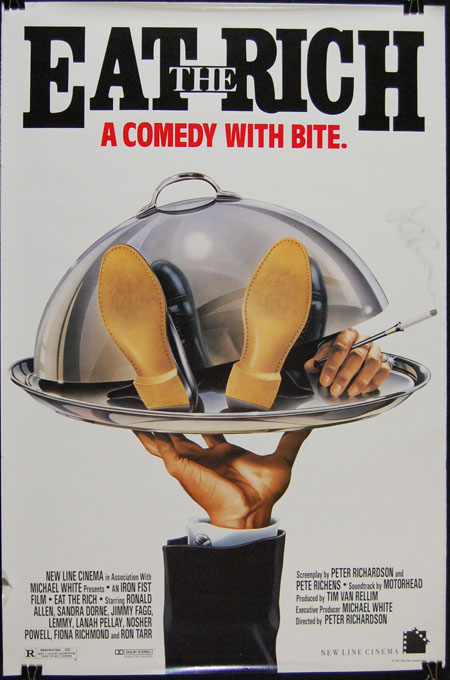
Eat the Rich (1988)

eat the rich

By Richard Winters

My Rating: 5 out of 10

4-Word Review: Rich feed the poor.

This is an extremely garish mixture of loud music, ugly visuals, and shock comedy. The story is about a waiter, a gay man with a real fun bitchy attitude, who gets fired when he refuses to suck up to the arrogant clientele. He gets revenge by banding together other misfits who return and kill everybody and then feed the dead bodies to new unsuspecting patrons.

Sounds gross and tasteless, but it really isn’t. There’s no nudity or sex and no graphic violence or gore. A little bit more of these things would have actually helped. At least it would have solidified it as the underground shock comedy it seems to be striving to be. Instead it’s cluttered with no real objective or foundation. At times it plays like biting social commentary and at other times nothing more than a silly gross out teen flick

By the time you get to the way off-base ending it becomes obvious that the filmmakers were trying to be outrageous simply as a way to get noticed. There is no real insight to the have and have-nots of society. They simply came upon the idea because they felt it would appeal to the type of audience they were looking for.

This is too bad because had it been a little more polished it might have been a stronger film. Believe it or not there are some clever bits. The jabs at the Queen are a riot. The scene involving terrorism and the Middle East crisis is a true original. The rich characters are so over-the-top obnoxious you have to laugh-out-loud.

The true scene stealer though is Nosher Powell. He is a former stunt man/ stunt coordinator who worked on many of the stunts in the early James Bond movies. Here he plays a sort of Teddy Roosevelt times ten a ‘working class’ politician who bullies everyone and everything. The actor has a rather rough, amateurish delivery which only adds to the saltiness of the character.

My Rating: 5 out of 10

Released: April 22, 1988

Runtime: 1Hour 30Minutes

Rated R

Director: Peter Richardson

Studio: Recorded Releasing

Available: VHS, DVD, Amazon Instant Video

Death Race 2000 (1975)

death race 2000

By Richard Winters

My Rating: 5 out of 10

4-Word Review: New meaning to roadkill.

Based on the novel ‘The Racer’ by Ib Melchior the year is 2000 and a highly rated cross-country race takes place on television between many colorful individuals. There is Frankenstein (David Carradine) who has lost an arm and a leg in past races and must wear a leather mask to cover up his facial scarring. Then there is his chief rival Machine Gun Joe Viterbo (Sylvester Stallone) and also Calamity Jane (Mary Woronov) Nero the Hero (Martin Kove) and Matilda the Hun (Roberta Collins). Of course this is no ordinary race as crossing the finish line isn’t really as important as how many innocent bystanders they can kill along the way.

The idea is outrageous and for the most part director Paul Bartel manages to pull it off especially within the limitations of the budget. There are real kick-ass car explosions here and none of that computerized crap, which in itself gives it a few extra points. I liked the scene were an actual car is seen dropping down a steep cliff and how they were able to block off long sections of highways in order to be the only cars on the road. Some of the dark humor is funny although more so in the beginning. The best moment is when a group of doctors and nurses wheel up some elderly patients onto the middle of the roadway in order to be slaughtered by the racers as part of the their annual ‘euthanasia day’.

Sly is really funny. I know some critics have gotten on him over the years about his acting, but here he steals it from his costars and the film wouldn’t have been as effective without him. Carradine is pretty good in his part and his more subdued acting style makes a nice contrast to Stallone’s flamboyant one. The two even end up in a nice fist fight. However, I liked the idea of having the Carradine character being this walking gimp of a man so intoxicated with winning that he continues to drive and compete even as his body falls apart. Having him take of his mask and look completely normal and making that all a sham was disappointing and took away the unique gritty mystic of the character.

The initial treatment of the script was written by producer Roger Corman and then Bartel was hired in to put a more humorous spin on it. Although I like the idea of having some comedy I still wanted more gore and grittiness. Instead it becomes too campy and cartoonish and losing the potential edge that it has at the beginning. There also needed to be more of a focus on the race itself. As it is it goes too fast with pit stop segments that bogged the whole thing down. They manage to get from New York to St. Louis in one day, which if going on I-70 would be 953 miles and doesn’t seem possible even at high speeds. There is also a question of the speed of these cars. Supposedly they are ‘real fast’, but there is one segment where Joe tries to run down a kindly fisherman and the guy is able to out run the car for quite a distance before he is hit, so they can’t be all that fast.

There is also a secondary storyline involving an underground group called the People’s army that is trying to sabotage the race and put an end to it. Initially I felt this thread would allow for more intrigue, but instead it makes the whole thing too over-the-top. The short running time doesn’t allow for such a convoluted plot and the whole thing would have been better served had they stuck to the race and racers personalities itself. The sappy ‘feel-good’ twist ending is terrible and ruins whatever potential edge the film had.

My Rating: 5 out of 10

Released: April 27, 1975

Runtime: 1Hour 20Minutes

Rated R

Director: Paul Bartel

Studio: New World Pictures

Available: VHS, DVD, Blu-ray, Amazon Instant Video

Going Places (1974)

going places

By Richard Winters

My Rating: 9 out of 10

4-Word Review: Guys with no morals.

Two small time hoods (Gerard Depardieu, Patrick Dewaere) spend their days roaming the streets, robbing stores, and molesting women. In some ways this is truly an amazing film in what it is able to get away with. The two main characters are immoral, ignorant, insensitive, and brutal and the women are demeaned and degraded. The overall content is vulgar and perverse and yet somehow this thing comes off as a lyrical, offbeat delight that is pure entertainment.

It’s a definite original with every scene being an ingenious comic set-up. The scenario structure and use of locations is perfect. The pacing is fluid and director Bertrand Blier’s eye for detail near brilliant. The two hours move along like a breeze. It never gets boring and I actually almost wished it could have been longer.

The comic threads are hilarious and they get funnier and funnier as they go along. The guys’ constant, futile and very explicit attempts at getting a frigid woman (Miou-Miou) excited are a particular standout.

This is the type of black comedy that should be used as an example for all others. It’s consistently unique and manages to balance the ugly elements with the lighthearted without going overboard on either. It even throws in a surreal angle without a hitch.

Veteran French actress Jeanne Moreau has one of her finest latter career roles playing a lonely lady in desperate need of male attention. Her scene is well played out and even has a shocking conclusion. Depardieus ‘friendly’ conversation with a shopping mall security guard is another standout. The ultimate joke though may be in the film’s title as these guys are truly going nowhere.

My Rating: 9 out of 10

Released: March 20, 1974

Runtime: 1Hour 57Minutes

Rated R

Director: Bertrand Blier

Studio: Universal Pictures France

Available: VHS, DVD (Region 1 & 2), Amazon Instant Video