Category Archives: 80’s Movies

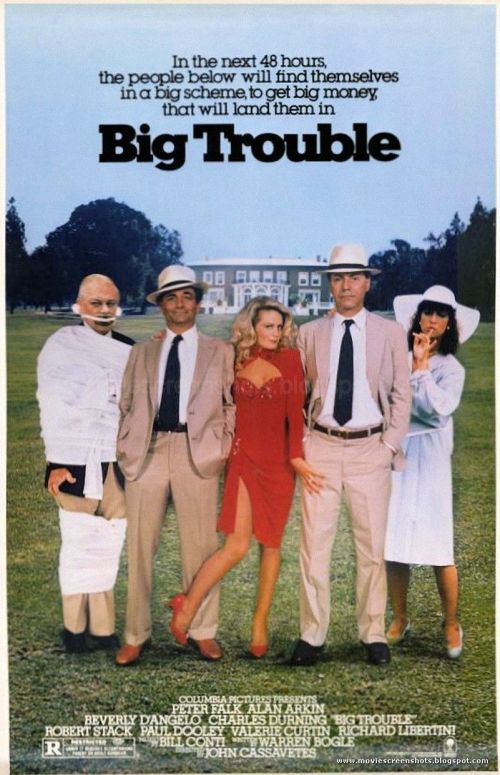
Big Trouble (1986)

By Richard Winters

My Rating: 3 out of 10

4-Word Review: Insurance agent commits fraud.

Leonard (Alan Arkin) is an insurance agent who does not have enough funds to put his three sons through Yale, which causes him a lot of stress. During a random sales call he meets Blanche (Beverly D’Angelo) who has a sick husband named Ricky (Peter Falk) who has only a week to leave. They hatch a scheme to write-up a life insurance policy that has a double indemnity clause that offers a big payout if Ricky dies by falling off a moving train. The plan starts out fine only to ultimately backfire when Leonard realizes he’s been double-crossed.

At the outset one might assume that this is a sequel to The In-Laws since it has the two stars from that film as well as the same screenwriter, though done under the pseudonym of Warren Bogle, but that’s not the case because Andrew Bergmen got the bright idea of trying to do a parody of Double Indemnity instead. This became a complete disaster for its studio Columbia Pictures because after the script was completed it was deemed a remake of the original film, which Universal Studios still held the rights to, forcing Columbia to give up the rights to Back to the Future and given to Universal as compensation who made a ton of money off of it while this film flopped badly.

A lot of the problem is that unlike in The In-Laws the two stars don’t play off of each other enough and in fact for most of the film they seem to be adversaries. The tone is also inconsistent seeming at times that it wants to be a parody/farce while at other moments it comes off more like a surreal comedy. It doesn’t help matters that John Cassavetes took over directing the production when Bergmen dropped out and his forte was more in drama with a cinema vertite approach causing many of the scenes here to go on longer than necessary while lacking a good comic pace. I also thought it was ridiculous that the plot features many twists, but then ends up telegraphing to the viewer well ahead of time that they’re coming, which takes away any surprise.

Arkin’s character is particularly problematic. Part of why he was so funny in The In-Laws is because he played this sane man thrown into an insane situation, but here he allows himself to get swept up into the nuttiness too easily until he seems almost as crazy as the rest. There’s also no way that a seasoned insurance agent, such as the one he played, would be dumb enough to think he could pull off such a poorly thought out scheme. Being an agent he would know that an autopsy would be done on the dead body and they would find that the victim had been strangled well before he fell off the train and the fact that this all occurs less than 24-hours after the policy was signed would send off massive red flags to anyone working in the industry.

While there are a few funny moments which includes Arkin trying to disguise himself as Falk and even speak in his voice as well as Arkin’s reaction when he takes a sip of Falk’s very exotic liqueur, the rest of it falls depressingly flat. The worst of it is the ending, which throws in a wild coincidence that has no bearing to the main plot nor any forewarning or connection to anything else that came before it, which helps to cement this as a big mistake that should’ve never have been given the green light.

My Rating: 3 out of 10

Released: May 30, 1986

Runtime: 1 Hour 33 Minutes

Rated R

Director: John Cassavetes

Studio: Columbia Pictures

Available: DVD, Amazon Video, YouTube

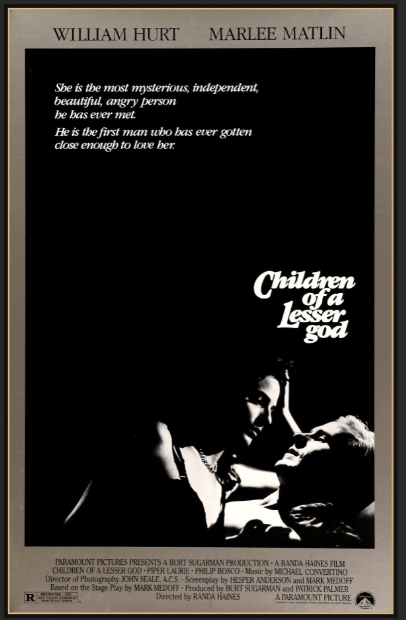
Children of a Lesser God (1986)

By Richard Winters

My Rating: 6 out of 10

4-Word Review: Romance with deaf woman.

James (William Hurt) gets a job as an instructor at a school for the deaf. He’s brought in to try and teach the students to become less reliant on sign language and to speak more. It is there that he becomes infatuated with Sarah (Marlee Matlin) a 23-year old janitor who used to be a student there. She refuses to speak despite James’ efforts to get her to. Eventually they get into a relationship where James still insists that she must learn to speak, which creates a wedge between the two that could eventually drive them apart.

The film is based on the play of the same name by Mark Medoff, which in turn was based on the real-life experiences of deaf actress Phyllis Frelich  and her relationship with her husband Robert Steinberg. The play was quite successful and ran for 887 performances, but when it transitioned to film several changes were made most notably that in the play the Sarah character was a former student to James, but here that’s not the case, which to me didn’t make a lot of sense. It almost seemed like James became more obsessed with a janitor than his own students even though they suffered from the same fears of speaking as she did and the story could’ve been just as riveting had it stuck to his dealings with them, who otherwise end up getting seen only intermittently.

The whole romance angle comes off as forced especially since James blurts out the ‘I love you’ line before any relationship had even been established as they had  previously gone out to dinner as friends and not as a date. In many real-life situations when one partner says the ‘love’ statement too soon it can drive the other person away instead of bringing them closer and with Sarah being as defensive as she was that’s exactly what I think would’ve happened in this case.

It would’ve been better, especially since film is a visual medium, had we seen the relationship go the next level through actions and not words perhaps by having James impulsively jump into the pool that Sarah is swimming in and then have the two playfully splash each other before ending up with a passionate embrace and kiss, which would’ve hit-home the same point to the viewer, but without the melodramatic dialogue.

The constant use of the sign language that the two used to communicate with each other I liked, but got annoyed with the way James had to not only verbally repeat everything he said with his hands, but everything Sarah communicates with her hands as well. I would presume that a conversation done with sign language should be in silence, much like at the party that Sarah goes to with her deaf friends where everyone speaks with their hands while saying nothing with their mouths. I realize that it’s to the viewer’s benefit that James verbally ‘narrates’ what’s being said, but it comes-off as unrealistic and using subtitles during these segments would’ve been better.

Matlin’s Academy Award winning performance is excellent and proves that great acting isn’t just about conveying lines, which she, sans one sentence, doesn’t have, but also about facial expression which she does brilliantly. The scene where she goes swimming in an indoor pool and the viewer hears nothing but silence is excellent as well and helps us get inside the head of a deaf person and sense what their world is like. The story though goes on a bit too long and never really confirms if their relationship permanently works out long term, or not and for having to sit through so many of the couple’s ups-and-downs that’s one question that should’ve gotten answered.

My Rating: 6 out of 10

Released: October 31, 1986

Runtime: 1 Hour 59 Minutes

Rated R

Director: Randa Haines

Studio: Paramount

Available: DVD, Amazon Video, YouTube

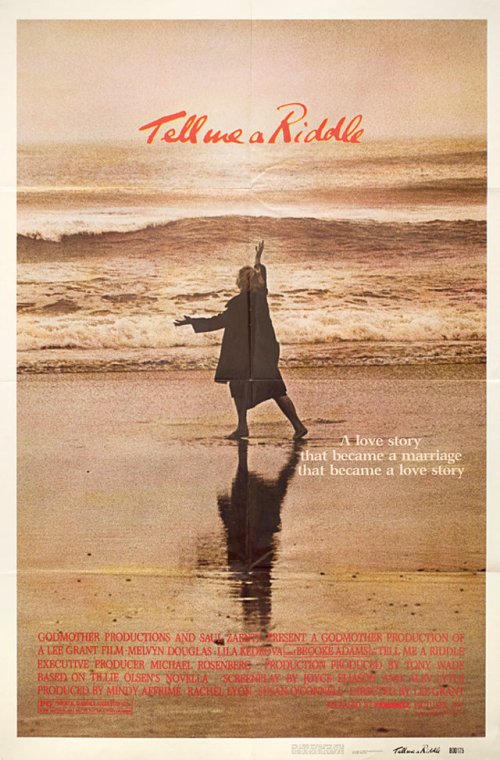
Tell Me a Riddle (1980)

By Richard Winters

My Rating: 3 out of 10

4-Word Review: Adjusting to old age.

Eva (Lila Kedrova) is an elderly woman who has been diagnosed with cancer, but her husband David (Melvyn Douglas) does not tell her of the terminal disease and instead takes her on a cross country journey to visit their grandchildren in San Francisco. Eva though begins to feel homesick and wants to return to the place that she is used to only to learn that David sold the home without her knowledge and forged her signature on the papers, which creates a rift between the two just as she enters her final days of life.

This modest low budget film was notable as the first feature film in America to be written, directed, and produced by women. It is based on the 1961 short story by Tillie Olsen and the first feature directed by actress Lee Grant, who felt that after she won the Academy Award for best supporting actress in 1975 that her days on the screen were numbered due to her age and the only way to stay busy in the business was to go behind the camera. She choose this script because it tackled two topics most important to her: feminism and her fear of aging.

For the most part, at least at the beginning, the slow pace works as it helps replicate the elderly lifestyle. The flashbacks showing the couple when they were young, which features a then unknown Peter Coyote as the younger David, help to make the two main characters more multi-dimensional. The different locations that they go to and live-in on their trip, which includes sleeping in their daughter Jeannie’s (Brooke Adams) cramped apartment while she sleeps with her boyfriend across the hall as well as visiting an elderly friend, Mrs. Mays (Lili Valenty), who lives in a place no bigger than a small bedroom and forced to walk-up several flights of stairs just to get to it, helps to give the film an indie vibe.

Unfortunately the second half stagnates as the couple’s journey ends at Jennie’s apartment, which cuts off the visual variety that gave the movie energy during its slow spots. The cross country journey should’ve been played-up much more, like with Harry and Tonto, where the trip becomes the main focus by having the couple travel by car instead of by plane while still keeping the main crux of the story intact.

Douglas gives an impeccable performance and speaks in an authentic Eastern European accent and Adams does quite well in support. However, Kedrova barely says much of anything making her character seem like she’s suffering from a personality disorder and having Douglas do the majority of the talking comes off too much like he’s the ‘narrator’ and it doesn’t help. I also didn’t like the hearing aid cord dangling out of her ear either, which seemed overdone. My grandmother, who lived at the same time this movie was made, wore a hearing aid too, but it was much more inconspicuous and didn’t require any cords.

The film also suffers from an unrelentingly downbeat perspective making old age seem like it’s just one depressing thing after another. I liked the way this same subject matter was approached in Harry and Tonto  where it examined the elderly years from different angles showing how there could be some downsides to it (like with any age), but also some positive ones too. Instead of approaching it as an end-of-life scenario it presented it as a transition that was still full of possibilities and new adventures, which is what I wished this film had been better able to convey.

My Rating: 3 out of 10

Released: December 15, 1980

Runtime: 1 Hour 33 Minutes

Rated PG

Director: Lee Grant

Studio: Filmways Productions

Available: DVD, Amazon Video, YouTube

American Gigolo (1980)

By Richard Winters

My Rating: 5 out of 10

4-Word Review: Male escort gets framed.

Julian (Richard Gere) works as a male escort in the Los Angeles area servicing affluent female clients, which allows him to drive expensive cars and live in a luxury apartment. He even gets into a relationship with Michelle (Lauren Hutton) a senator’s wife, but just as everything seems to be going his way it comes crashing down when he gets accused of murder, which he didn’t commit. His only alibi is Michelle who he was in bed with that night, but she is reluctant to come forward fearing it will tarnish both her reputation and that of her politically ambitious husband (Brian Davies).

The film’s chief asset is Gere’s performance who puts a gritty edge in a film that is otherwise quite shallow. His character though is blah as we learn little about him, which I found frustrating. Male prostitution is not a profession most men get into, so why does Julian? Having a backstory dealing with his upbringing and showing his relationship with his family could’ve helped us better understand his motivations, but none is ever shown leaving us with a character that may look sexy, but is otherwise an empty shell that is neither interesting nor memorable.

The film offers no insights into the sex profession either. I kept wondering how he was always able to ‘get-up for the occasion’ with all of his clients especially when a lot of them were older women who were not all that attractive. Many male actors working in the adult film business will admit to taking Viagra or some other drug to guarantee an erection on cue. They also have women working behind-the-scenes as ‘fluffers’ who will give male performers a hand-job/oral sex, so when it’s time for his scene he’s erect, but Julian doesn’t have any of these things, so what’s his secret? The film makes it look like he can get-it-up on demand, which in reality I don’t think would always be the case.

I was also disappointed when Julian is told by the husband (Tom Stewart) of one of his clients to get rough with her by slapping her and Julian turns around with a shocked expression, but then the scene immediately cuts away without seeing what happened. I felt this was a crucial moment that needed to be played-out and it would’ve helped us understand Julian better by seeing how he responds to demands that he’s uncomfortable with. The film most likely cutaway because seeing him slap a woman would’ve made him unlikable to the viewer, but if he’s the type of person who will compromise his ethics to make money then we need to know this, or if he returns the money and walks away we need to see this as well.

Julian’s relationship with Michelle is ridiculous and unbelievable. Why would a guy who’s been to bed with hundreds of different women suddenly decide to fall-in-love with this one and why would a woman, who’s otherwise living a comfortable lifestyle, allow herself to fall for a man whose profession won’t allow him to be faithful to her? It doesn’t help either that Hutton gives a horribly wooden performance and it would’ve been far better had Julie Christie, who was the original choice for the role, played the part

The mystery angle is somewhat intriguing, but the wrap-up gets botched by suddenly instituting long pauses between scenes in which the screen goes completely black and silent for several seconds, which is jarring since this was not done at any earlier time and only helps to cement how over-the-top Paul Schrader’s directing is. Had more effort been put into character development instead of flashy lighting/camera angles we would’ve had a more interesting movie.

My Rating: 5 out of 10

Released: February 1, 1980

Runtime: 1 Hour 57 Minutes

Rated R

Director: Paul Schrader

Studio: Paramount

Available: DVD, Blu-ray, Amazon Video, YouTube

The Gods Must Be Crazy II (1989)

By Richard Winters

My Rating: 7 out of 10

4-Word Review: Misadventures in the desert.

Xiri (Eiros) and Xisa (Nadies) are the two children of Xixo (N!xau) and a part of a nomadic desert tribe of the Kalahari who go roaming off into the wilderness and encounter a truck driven by two elephant poachers (Lourens Swanepoel, Pierre van Pletzen). Having had no previous contact with modern technology the children become fascinated with the vehicle and climb into its water tank just as it drives off taking them many miles away from their home. When the children fail to return their father goes out looking for them and in the process comes into contact with a lawyer (Lena Farugia) and a zoologist (Hans Strydom) who are stranded after their small engine plane crashes as well as two soldiers (Erick Bowen, Treasure Tshabalala) fighting from opposite sides of the war and each precariously trying to get the upper hand on the other.

This follow-up to the run away hit was filmed in October, 1985, but took over 4 years to find a distributor and suffered many setbacks during its production, which frustrated writer/director Jamie Uys so much that he retired from directing after completing this one and never worked on another film. On the whole though it’s not too bad, but like with the first one it does start out a bit clumsily.

My biggest complaint had to do with the scenes dealing with the lady lawyer named Ann and her interactions with the macho pilot/zoologist Hans who takes her up in the plane, which to me became too sexist and too similar to the scenario played-out in the first film where a lady-in-distress being rescued by a male character more acclimated to the environment. However, in the first film this was funny because the male was so clumsy and inept it made him seem more like a lovable clod, but here the guy character resembles the male image, especially with his mustache, of the Marlboro man and his constant aggravation at this ‘ditzy lady’ isn’t amusing while her inability to understand technology played too much into the feminine stereotype that women can’t comprehend machinery must have a man come to their rescue.

I did find the small engine plane that they rode in, which was a modified Lazair Ultralight, fascinating as I found it interesting at how something so small and flimsy could carry two people and still get off the ground, but was disappointed to learn later that this was only because it got attached to a crane and in reality wouldn’t have flown. Although the filmmakers achieve this illusion pretty well the scene where the two fly above the clouds is clearly fake as you can tell the backdrop of the sky is a painting and in that regards the whole plane scene, especially since it really couldn’t fly anyways, should’ve been discarded and some other plot line created that would’ve brought the two together.

The two runaway children though are quite cute especially the frightened but resourceful little boy who grabs a nearby piece of wood to put on top of his head to fool the hyena that has been stalking him into thinking that he is taller than he really is, which actually ends up working. I was also most impressed with the scenes dealing the Honey Badger, which is known for its ferocious defensive abilities and lives up to its reputation here when he grabs a hold of Hans boot with his teeth and refuses to let go no matter how far Hans walks.

The last half-hour when all the various characters from the four divergent story lines eventually merge is when the film finally manages to hit its stride and it’s a shame this couldn’t have occurred sooner, but ultimately as a sequel it’s surprisingly funny and manages to retain much of the same charm from the first one.

My Rating: 7 out of 10

Released: October 13, 1989

Runtime: 1 Hour 38 Minutes

Rated PG

Director: Jamie Uys

Studio: 20th Century Fox

Available: DVD, YouTube

The Gods Must Be Crazy (1980)

By Richard Winters

My Rating: 8 out of 10

4-Word Review: Coke bottle causes problems.

One day while flying over the Kalahari desert a airplane pilot inadvertently throws a coke bottle out of his cockpit window, which falls to earth and is found by Xi (N!xau) and he brings it back to his nomadic tribe. At first everyone is intrigued with the object as they are an isolated people unaware of modern technology. They think it’s a ‘gift from the gods’ and make use of the bottle in different and creative ways, but eventually the bottle causes friction from within the tribe because there is only one and no one wants to share it. Xi decides to ‘give the bottle back to the gods’ by traveling to the end of the earth and throwing it off. During his journey he meets a clumsy biologist named Andrew Steyn (Marius Weyers) and a pretty school teacher named Kate (Sandra Prinsloo) while also saving school children who are kidnapped by a group of terrorists led by Sam (Louw Verwey).

This film became the biggest box office success in South African history and when released abroad became the most successful foreign film in the U.S., but the film initially comes off like a nature documentary complete with monotone voice-over narration by Paddy O’Byrne only to then shift uneasily into a flick dealing with political revolutionaries who systematically massacre the heads of state via machine gun. It’s not until about 30 minutes in that the gentle comical flow of the story gets going, but even then there’s a lot of sped up stop action photography, dubbed voices, and a cartoonish sounding musical score that gives it a choppy amateurish feel throughout.

Yet despite all this the concept is quite original and filled with genuinely funny moments. Writer/director Jamie Uys, who appears briefly as a Reverend, shows an amazing ability to squeeze laughs out of virtually any scene and sometimes in the most amazing of ways. Some of my favorite moments was when the jeep hangs upside down in a tree, or the scene showing the same disabled jeep getting tugged along by another vehicle and because the desert was so flat and barren the man driving the vehicle is able to get out of it and it simply drives itself with no fear it would run into anything. The shot where N!xau arrives at what he thinks is the end of the earth, but in reality is a place known as God’s Window is quite memorable and picturesque as well.

Of course the film does come with its fair share of controversy and accused of being racist with two countries, Trinidad and Tobago, banning the movie from being shown there because of it. The main complaint centers around the bushmen tribe that N!xau comes from being shown as completely cut-off from the modern world and unsophisticated when in reality this is not true. The 2004 Columia TriStar DVD edition has a wonderful documentary called ‘Journey to Nyae Nyae’ on its bonus section where a filmmaker travels to the real-life desert bushmen tribe that actor/star N!xau resided and found that although the people were quite poor they were far from ignorant and in fact excitedly embraced technology like a computer when it was shown to them. There’s even a really cute segment where the children get shown this film and laugh along at all the same antics just like American audiences.

This same documentary also has a very sad edge to it as it shows the impoverished life N!xau had even after the film became a worldwide hit. While the movie grossed over 200 million N!xau was only paid $2,000 for his work and the other actors who played the bushmen got paid nothing. Director Uys tried to rectify this by paying N!xau many years later an additional $20,000 and a monthly stipend, but by then he had already become sick with tuberculosis and ended up dying from it in 2003.

My Rating: 8 out of 10

Released: September 10, 1980

Runtime: 1 Hour 49 Minutes

Rated PG

Director: Jamie Uys

Studio: 20th Century Fox

Available: DVD, Amazon Video, YouTube

Birdy (1984)

By Richard Winters

My Rating: 7 out of 10

4-Word Review: Fly like a bird.

Al (Nicholas Cage) becomes friends with an introverted neighborhood boy (Mathew Modine) nicknamed Birdy due to his fascination with birds. Al begins to follow Birdy around as he collects pigeons and stores them inside an aviary that he has built in his backyard. The two share a strong bond, which is broken when they both get drafted and have to go off to war. Al returns from battle with facial injuries, but Birdy is sent to a mental hospital because after missing in action for a month, he refuses to speak. Al spends time with Birdy trying to get him to talk again, but finds it futile and fears that if he can’t get him to talk the Dr’s will confine Birdy permanently.

The film is based on the William Wharton novel of the same name that was initially rejected by director Alan Parker as a possible movie because he considered the story to be ‘uncinematic’, but after the screenplay was commissioned to writers Sandy Kroopf and Jack Behr who were able to restructure the thoughts of the main character from the novel into dialogue and action Parker was then willing to sign on. The result is a interesting drama that manages to have some touching, quirky moments, but it’s also quite reminiscent of Brewster McCloud and comes complete with the same winged flying contraption which Birdy uses to fly briefly over a junkyard that Bud Cort also used to fly around the Astrdome in that film.

While both Cage and Modine give excellent performances I found the friendship between the two to be confusing. They had very little in common and why Cage would want to follow Modine around all the time as he collected pigeons, which he himself thought to be kind of ‘weird’, did not make much sense. Had they both had an interest in birds then it would’ve worked, but they don’t, so what’s the bond that keeps them together? Having them portrayed as being gay would’ve been the solution and at times it seems that is what Birdy is since he shows no interest in women at all and in one amusing scene watches in boredom while Cage has sex with another women on a beach. Cage could’ve been portrayed as being bi-sexual, or not fully aware of his secret attraction to Birdy, but could later eventually come out and that could help explain why he’d stick with someone that he otherwise found ‘kooky’.

Despite the film’s length  and having some definite slow parts including Cage’s ‘conversations’ with Birdy when he’s inside the mental hospital, which are quite static and should’ve been trimmed, there’s still some memorable moments including a scene showing baby canaries hatching out of their eggs. I also like the tracking shot where Birdy imagines himself flying and done from the point-of-view of a bird, which gives one a very authentic feeling/experience of what it would be like and it was shot with a Skycam, at least partially, which is the first time that had ever been used in a movie.

I also enjoyed how the film examines the different dynamics of both Cage’s and Birdy’s family life and the contrasting personalities of the parents where in Cage’s family the father, played by Sandy Baron, was the dominant force while with Birdy it was his mother (Dolores Sage). My only complaint in this area is that there’s a running subplot dealing with the fact that Birdy’s mother would take all the baseballs that the neighborhood kids would accidentally hit into her backyard and keep them, but no one knew where she hid them. Cage then, years later, asks the Dr’s at the hospital to convince the mother to send the hidden balls to Birdy in an effort to get him to talk again and the mother complies, but the scene showing her retrieving the balls is never shown. So much time is spent talking about where she hid the balls that the film should’ve revealed the hiding place while also showing a tender side to the mother who otherwise came off as being quite cold, so not having this scene at all really hurts the film.

Spoiler Alert!

There’s also complaints by some viewers and critics about the ending, which some, like critic Leonard Maltin, refer to as a ‘gag’ ending. For me this wasn’t an issue as it offered some much needed levity in what is otherwise a very dramatically heavy film, but I was frustrated that there’s no conclusion given to what ultimately happens to the two characters. They’re shown trying to escape from the hospital, but never whether they were able to break-free permanently. After spending two hours following these two around the viewer deserves more concrete answers as to their ultimate fate and keeping it so wide-open is a bit of a cop-out/letdown.


My Rating: 7 out of 10

Released: December 21, 1984

Runtime: 2 Hours

Rated R

Director: Alan Parker

Studio: TriStar Pictures

Available: DVD, Blu-ray, Amazon Video, YouTube

Spies Like Us (1985)

By Richard Winters

My Rating: 2 out of 10

4-Word Review: Losers inadvertently become decoys.

Austin (Dan Aykroyd) and Emmett (Chevy Chase) are two bumbling government agents who get hired by the department of defense to carry out a secret mission inside the Soviet Union. In reality, and unbeknownst to them, they are decoys used to call attention away from the actual agents who were sent to seize a ballistic missile launcher yet things don’t work out as planned. Instead of the decoys getting killed off it’s the actual agents forcing Austin and Emmett to carry out the rest of the plan that the others couldn’t.

A lot of the problem with this film is that it no longer has that National Lampoon’s edge, which when it started out was all about satire and parody and making fun of the establishment. Yet this film has no message, or point of view. Had it had more of a focus like ridiculing the government, war, politics, or even the spy genre then it might of been more meaningful, but instead all we get are a barrage of generic gags and no real story.

The humor mainly falls flat with the writers making up the rules as they go, so there’s no tension or intrigue. For instance the two disguise themselves as Dr’s and are forced to perform an appendectomy on a patient even though they know nothing about medical surgery and yet just as Aykroyd is ready to make the incision the patient for no explicable reason dies, which gets them two off-the-hook, but is really more of a cop-out by the writers. Why not force the characters to earn their way out of their predicament by requiring them to come up with some clever escape instead of conveniently throwing in an act of God that doesn’t really make any sense?

Today’s audiences will find the scene where Chase grabs Donna Dixon’s breasts, a woman who he has just met and without asking permission, quite offensive. She doesn’t respond in shock or anger either and is portrayed as apparently being ‘too stupid’ to know what’s going on, I don’t know about you, but if someone touched one of my body parts I’d feel it. In real-life Dixon is Aykroyd’s wife, and Aykroyd was also one of the scriptwriters, and I thought it was crazy that a guy would come-up with a gag that would allow his co-star to squeeze his wife’s breasts, he actually ends up squeezing both of them, simply for the sake of trying to get a cheap laugh from the audience.

Aykroyd and Chase are an odd pairing as well. Chase has such a glib, sarcastic personality that it’s hard to imagine why anyone would want to be his friend to begin with. Aykroyd’s super smart persona in which he’s an expert on virtually everything is boring and has been played-out before. Supposedly this was meant to be a take-off on the Bob Hope/Bing Crosby road movies and Hope even has a cameo here and despite his advancing age he’s still funnier than either Akroyd or Chase and should’ve been made the star instead of them.

Spoiler Alert!

The film’s original ending had a nuclear bomb blowing up the planet and if they had kept that in then I’d at least give them some credit for being daring and original. Of course after test audiences disliked this (surprise, surprise) the filmmakers ultimately chickened-out and went for a ‘happy ending’ where Aykroyd devises a way (because of course he knows EVERYTHING) to divert the bomb’s route so it explodes in space instead of on earth, but wouldn’t the radioactive fallout of the explosion still rain back down and affect the population anyways?

End of the Spoiler Alert!

The opening bit where an agent is locked inside a cramped closet because he’s not authorized to view the information inside the briefcase that is chained to his wrist I did find amusing although the film could’ve played this up more by having everyone, after they’ve reviewed the information, leave the room with the guy still stuck in the closet and begging to be let out. I also loved the top secret spy headquarters built underneath an abandoned drive-in movie theater. Director John Landis also continues his trend of casting other movie directors in minor roles, but since they’re only seen briefly other viewers may not find this element to be all that interesting.

My Rating: 2 out of 10

Released: December 6, 1985

Runtime: 1 Hour 42 Minutes

Rated PG

Director: John Landis

Studio: Paramount

Available: DVD, Amazon Video, YouTube

Charlie Chan and the Curse of the Dragon Queen (1981)

By Richard Winters

My Rating: 3 out of 10

4-Word Review: Asian detective solves case.

Police Chief Baxter (Brian Kieth) summons the retired Charlie Chan (Peter Ustinov) back to duty in order to help him solve a series of bizarre murders. Chan is also reluctantly assisted by his inept grandson Lee Chan Jr. (Richard Hatch) who shows no ability at solving anything and only causes chaos where ever he goes. As the case unfold Chan is at first convinced that his old nemesis Dragon Lady (Angie Dickinson) is the culprit, but he slowly turns his suspicions onto someone else who no one else suspects.

This is a perfect example of a movie that could never be made today as it features a white actor playing the part of an Asian American although the film did meet with strong resistance even back then. Many Chinese Americans protested by picketing locations were it was being shot and then later demonstrated at theaters that played it. Their complaints hinged around the Chan character being a racist stereotype particularly his ‘Chop-Suey pidgin English and fortune cookie-like proverbs’ all of which were very valid points.

What’s even worse is that the Chan character is not funny at all and the film would’ve been better had he not been in it. Ustinov acts like he’s just walking through the role with no energy or pizzazz and his singing over the opening credits, which I guess is meant to be intentionally bad in an effort to be ‘funny’, comes off as pathetically lame instead and could be enough to make most people want to turn off the film before it’s barely begun. Keith as the exasperated chief is far funnier and enlivens every scene he is in to the point that he should’ve been made the star.

Hatch as the doofus grandson is almost as bad as Ustinov, but even more annoying as he creates all sorts of disasters were ever he goes, but is completely oblivious to the pain and destruction that he causes others, which makes him come-off to being too stupid to be even remotely believable. On the rare occasions when he does realize that his blundering has caused issues to others like when he inadvertently knocks a bunch of TV reporters into a lake, he makes no attempt to help them out of the water, or even apologize for what he did, making him seem deserving of a big punch in his otherwise blank-eyed face. I was also confused as to why, if he’s Chan’s grandson, he wasn’t Asian.

The female actors perform better here. I enjoyed Lee Grant’s rare foray into comedy. Her acting skills are more tuned to drama, but the scenes where she talks to her dead husband’s ashes inside an urn are pretty good. Rachel Roberts, in her last theatrical film before her untimely and tragic death, is diverting as a super paranoid maid. Michelle Pfeiffer is quite engaging too as Hatch’s fiance. Her character is just as doopey as his, but she has enough acting skill to make it interesting and far outshines him, despite having less screen time.

The comedy is flat and has no focus to it as it alternates between slapstick and parody while haphazardly throwing in all sorts of uninspired gags that have little or nothing to do with the main plot and that includes a drawn out car chase in the middle that isn’t funny at all. It also features an ending similar to the one in Blazing Saddles where it becomes a-movie-within-a-movie as the characters run into a theater where a Charlie Chan movie is playing. However, this scene isn’t too well thought-out as it features Ustinov playing Chan on the black-and-white film that the theatergoers are watching, which makes no sense. For one thing the film being shown is an older one, so Chan should look younger on it, but he doesn’t. Also, why would Chan be playing himself in a movie? Isn’t he supposed to be just a detective, or are we to assume he’s also an actor starring in films when he’s not out solving cases? It would’ve been more amusing had Chan walked into the theater and saw another actor playing him on the screen and then started bitching about how he wasn’t doing it right.

Spoiler Alert!

There is one really inspired moment that is so cute it almost makes sitting through the rest of it worth it. I features Pfeiffer and Hatch tied up and being held hostage by a vicious dog who is tied to a rope with a candle flame burning throw it, which will then release the hound to attack the couple. In an effort to stop the flame from burning through they sing ‘Happy Birthday’ to the dog, which then gets the dog to blow-out the flame like a person would blow out candles on a birthday cake.

My Rating: 3 out of 10

Release: February 4, 1981

Runtime: 1 Hour 35 Minutes

Rated PG

Director: Clive Donner

Studio: American Cinema Releasing

Available: DVD, Blu-ray

The Little Drummer Girl (1984)

By Richard Winters

My Rating: 5 out of 10

4-Word Review: Actress infiltrates terrorist organization.

Charlie (Diane Keaton) is a stage actress with pro-Palestinian leanings who’s living in Israel. After a Palestinian bomber kills a Israeli diplomat and his family she gets recruited by a pro-Israeli spy organization to pretend to be the bomber’s brother’s girlfriend. At first she resists, but eventually she puts her acting skills to work until she gets deeper and deeper into the quagmire and begins to question what she really stands for.

The story, which is based on the novel of the same name by John Le Carre, who appears briefly in the film as a police chief, has a lot of exciting moments and a few unexpected ones. For the most part I found the plot intriguing and the twists and turns to be interesting although if the viewer doesn’t pay close attention they could easily become lost.

Klaus Kinski’s performance makes it worth seeing. He suffered from mental illness in his personal life and due to that as well as his unique facial features usually stymied him in roles of madmen, or troubled individuals, but here he plays someone who is actually normal and does a convincing job of it. His presence definitely enlivens the proceedings to the point that he should’ve been the sole face of the Israeli organization and not crowded out by a throng of assistant players who are not interesting and become clutter to both the story and visuals.

Keaton is great here too and one of the main reasons that the film remains as interesting as it does. Her emotional confusion comes off as sincere and the fish-out-of-water concept where she gets thrown into a world that she is not used to and must use her wits and acting talent to get by is at first riveting.

Unfortunately the second half goes too far to the extreme where Charlie no longer resembles the same person that we met at the beginning. Some may argue that this is her character arch, but she still needs to have a consistent foundation and not morph into something completely different with no roots to what she was before. She starts out as someone only going along with the charade because she’s forced into it. She’s very clumsy at first, but then by the second half is able to put a gun together while blindfolded and seamlessly detonate a bomb without a sweat like a seasoned spy with years of experience.

She’s given an opportunity to get out and yet she decides to proceed even as things get more dangerous, which makes little sense since she didn’t conform at all with the political sentiments of the organization that recruited her. Any regular person would have a mental/emotional breakdown at seeing someone killed before their very eyes, or required to go to bed with a stranger that she barely knew, and the fact that she doesn’t reveals how the filmmakers had a very poor grasp on the character.

All of this could’ve been avoided had they modeled her after the one in the book. For the film the producers decided to portray Charlie as being similar to Vanessa Redgrave, but in the book the character was inspired after Janet Lee Stevens who was an American journalist, human rights activist, and Arabic literature scholar who traveled to the Middle East as an interpreter and had no connection to acting. Having the film focus on a young activist whose extreme idealism ends up getting her in-over-her-head would’ve been more compelling and believable. Throwing in the acting angle just doesn’t work and ends up becoming its biggest liability.

My Rating: 5 out of 10

Released: October 19, 1984

Runtime: 2 Hours 10 Minutes

Rated R

Director: George Roy Hill

Studio: Warner Brothers

Available: DVD (Warner Archive), Amazon Video, YouTube