Category Archives: 80’s Movies

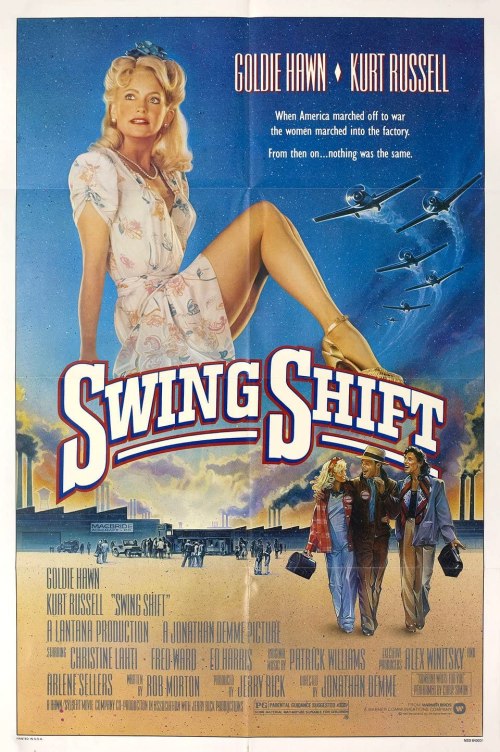
Swing Shift (1984)

swing1

By Richard Winters

My Rating: 3 out of 10

4-Word Review: Women help build aircrafts.

Kay (Goldie Hawn) lives with her husband Jack (Ed Harris) in a housing complex in Los Angeles and have a happy marriage until December 7, 1941 when the Japanese bomb Pearl Harbor, which causes Jack to immediately enlist into the Navy and go off to war. Kay now must learn to manage for herself and with the shortage of men many companies begin recruiting area housewives to apply to help fill-in. Kay, along with the other women in her neighborhood, get a job at a factory that builds aircrafts. It’s here that she becomes friends with Hazel (Christine Lahti) who lived next door to her, but she never got to know since her husband considered Hazel to be ‘white trash’. She also meets a fellow co-worker named Lucky (Kurt Russell) who was not drafted due to a heart condition. Lucky takes an immediate liking to her and asks her out even though he knows that she’s married. Kay at first resists his advances, but eventually gives in and starts an affair with him just as Jack returns home.

The film does a good job of recreating the 40’s period atmosphere and there’s an opening catchy tune sung by Carly Simon, but everything else is dull and boring. Many people blame this on Hawn who did not get along with director Jonathan Demme and insisted on many scenes being reshot with another director. Demme was so incensed about the changes that he tried to have his name removed from the credits, but was talked out of it while Nancy Dowd, who had written the screenplay, got listed under the pseudonym of Rob Morton. Hawn’s defense for going against the objections of the director was that she was simply trying to ‘make the movie work’, but in 2017 the magazine Sight and Sound compared Demme’s director’s cut to Hawn’s version and the article’s authors felt that Demme’s was far superior.

This is also where Russell and Hawn first met and precipitated their long relationship that they’re still in today, which is great, but Russell’s character was one of the biggest problems. He continually pesters Kay for a date even after she makes clear several times that she’s married and isn’t interested, which makes him come-off like a potential stalker. I also didn’t understand why he was so obsessed with her, sure she was good-looking, but so was he and he moonlight as a trumpeter at a dance club where he was the center of attention and could easily attract other women, so why get so hyper-focused with Kay when he could easily find many other pretty ladies to date in her place? I also didn’t like that Kay eventually goes to bed with him, which ends up rewarding his bad behavior.

Kay’s relationship with Hazel doesn’t work either. Initially they come-off as having wildly divergent personalities and lifestyles, Hazel is even quite snarky with Kay at the start, but then overnight they become best chums, which isn’t interesting, or authentic. The odd couple-like love/hate approach would’ve offered more zing in a movie that’s too tranquil to begin with. Much of this may be blamed on Hawn as well, as she felt Lahti had become too much of a ‘scene stealer’ and had many of her scenes either rewritten or cut-out completely.

It would’ve worked better had it focused more on the job and women trying to make-it in what was at the time a predominantly man’s world. There are some moments of sexism shown particularly with the character played by Charles Napier, but it gets quickly resolved, which is too convenient and misses out on being a character building drama that this movie was in desperate need of.

My Rating: 3 out of 10

Released: April 13, 1984

Runtime: 1 Hour 40 Minutes

Rated PG

Director: Jonathan Demme

Studio: Warner Brothers

Available: DVD-R (Warner Archive), Amazon Video, YouTube

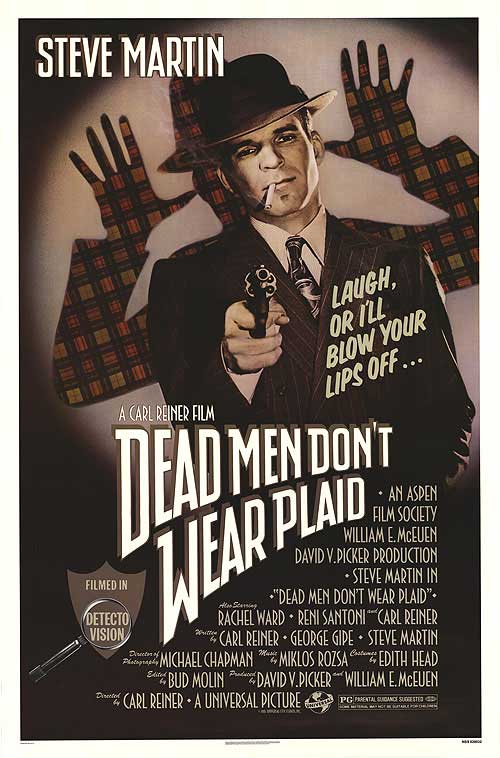
Dead Men Don’t Wear Plaid (1982)

dead1

By Richard Winters

My Rating: 3 out of 10

4-Word Review: Don’t say ‘cleaning woman’.

It’s the 1940’s and private investigator Rigby Reardon (Steve Martin) gets a visit from Juliet Forrest (Rachel Ward) who wants him to investigate the mysterious death of her father, which she believes to have been murder. Rigby’s investigation turns up two lists both showing names of people who were either friends or enemies of a person named Carlotta. As Rigby continues his research he becomes menaced by a man who shoots him and steals the lists forcing Rigby to interview a wide array of different people in order to get to the truth.

In the spring of 1980 Martin got together with Carl Reiner and screenwriter George Gipe to go over his next movie project idea. He had just gotten done starring in Pennies from Heavena 1930’s period musical, and wanted to do another film from that era, a comedy that was entitled ‘Depression’. While going over the plot he mentioned using a clip from an old movie and splicing it into his film and making it a part of the story. This gave Reiner the idea of doing an entire movie centered around old movie clips ultimately leading to them using footage from 19 vintage films from Hollywood’s golden era with most of them being dramas that were meant to be taken seriously, but with Martin’s character responding to the lines mentioned by the actors in the clips in such a way that it becomes funny.

Incorporating a plot completely around old movies is certainly an inspired idea, but the result is only so-so. On the technical end you can clearly tell when an old film is spliced into the scene because it’s footage is much grainier than when it shows Martin or Ward. Having it all filmed in black-and-white helps a little but the new footage is too pristine and intentional scratches should’ve been added to make it better match the old stuff.

As for the story, well, it works for awhile, but then starts to get downright boring by the third act. There are definitely some laugh-out-loud moments, but the concept wears itself out. Some have called this a one-joke movie, but I would describe it more as a joke that gets told over-and-over again until it’s predictable and redundant. Having old film clips put in during a certain part of the movie, but then focusing on other comedy angles during the rest of it would’ve worked better. Had it spliced-in only 1 or 2 other movies and with a smaller character count would’ve created less of a diluted effect as ultimately there’s just too many people to keep track of and the plot itself is too fabricated to hold much interest.

Martin is excellent and the fact that he didn’t watch any movies from the 40’s in order to prepare for the role as most other actors would’ve done, was a wise decision as he ends up creating his own style instead of coming-off like he’s imitating somebody else. Ward is good too and while she isn’t particularly funny she does make for a excellent straight-man, which is what a solid comedy needs by having a normal person play-off the other wackiness around them. Carl Reiner is engaging in a send-up of Erich Von Stroheim and it’s interesting seeing Reni Santoni appear here as he played a young Reiner 15 years earlier in the movie Enter LaughingThe characters though are flat and never evolve, which like with the other issues described above, make this movie a novelty experiment that never fully gels.

My Rating: 3 out of 10

Released: May 12, 1982

Runtime: 1 Hour 28 Minutes

Rated PG

Director: Carl Reiner

Studio: Universal

Available: DVD, Blu-ray, Amazon Video, YouTube

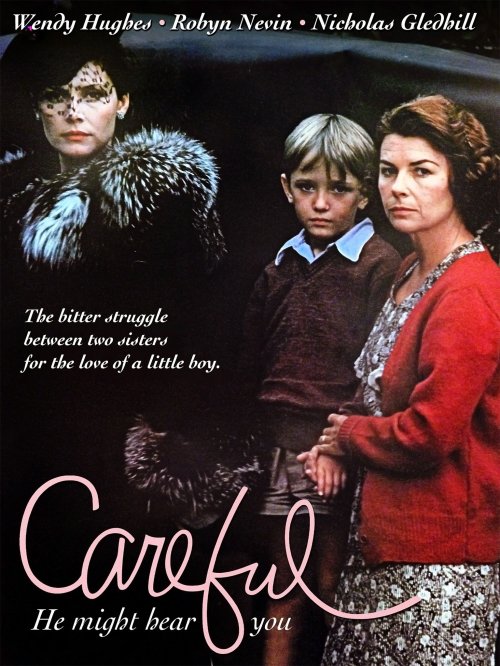
Careful, He Might Hear You (1983)

careful2

By Richard Winters

My Rating: 8 out of 10

4-Word Review: Custody battle between sisters.

When his mother dies just a few days after his birth PS (Nicholas Gledhill) moves in with his Aunt Lila (Robyn Nevin) and Uncle George (Peter Whitford). There he has a happy childhood growing up in a working-class neighborhood. Then Lila’s wealthy sister Vanessa (Wendy Hughes) arrives stating she wants custody of the child on weekdays since she has more money and because PS’s absentee father (John Hargreaves) named her as co-guardian. PS doesn’t like going to Vanessa’s as she’s much more rigid and authoritarian forcing him to go to a private school filled with snotty kids and doing other things like taking piano lessons, which he doesn’t like. Vanessa also suffers from a fear of thunderstorms while Lila and George are unemployed making it hard for the judge to decide who the better guardian should be once the battle goes to court.

The film is based on the 1963 novel of the same name written by Sumner Locke Elliot who in turn based it on events of his own life after his mother died just one day after his birth. The film succeeds mainly from the sincere performance of its child star who is quite cute, at times maybe a little too cute, but then surprises the viewer in one completely unexpected moment of nastiness near the end. I also liked the way director Carl Schultz frames of the point-of-view shots where we see things from the child’s height making the adults appear foreboding and like he’s being swallowed up into their world, which is pretty much what happens.

While the film is billed as being this big court battle between two women it really comes-off like a character study of Vanessa, who gets much more screen time and a more of in-depth personality. This is good because Nevin’s character is a bit too basic and offers no real surprises though she does have an unexpected asthma attack while testifying in court, which I felt was a bit over-the-top since this was something that should’ve been introduced earlier if it was going to come into play during a pivotal moment. Hughes though is excellent. She had been only in supporting roles up to this point, mainly that of youthful girlfriend types to the main character, but here she successfully carries the film in an atypical part of a frigid woman.

Spoiler Alert!

The film’s crowning achievement though is the way it takes a character, in this case Vanessa, who you really don’t like for most of the movie, and then turns her into someone you sympathize with and even feel sorry for by the end. A lot of movies don’t do this, especially the Hollywood ones where the good guys and bad guys must work within a rigid formula, so it’s refreshing seeing a film do something differently and it really works. I found myself thinking about this one long after it was over and feeling emotionally conflicted by it and it’s all because of Hughes’ ability to create a three dimensional person that doesn’t fit into any stereotype even though you initially think she can be. A highly recommended film for those who understand how difficult it can be to deal and communicate effectively with children and how one’s best efforts can sometimes backfire badly.

My Rating: 8 out of 10

Released: September 22, 1983

Runtime: 1 Hour 49 Minutes

Rated PG

Director: Carl Schultz

Studio: Hoyts Distribution

Available: DVD, Amazon Video, YouTube

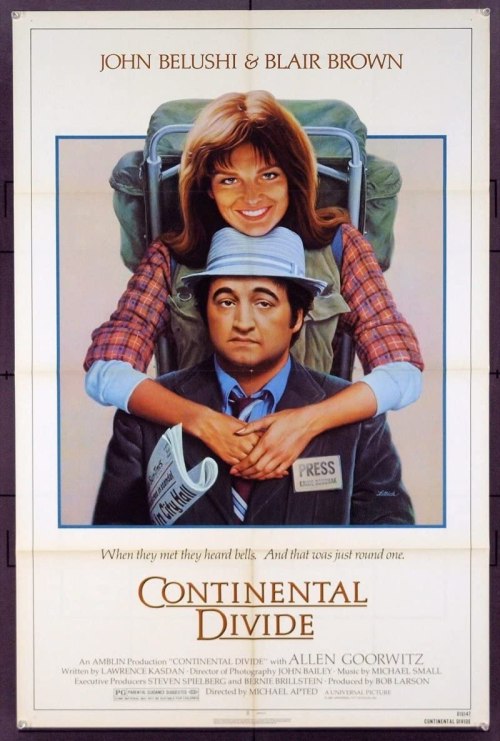
Continental Divide (1981)

continental1

By Richard Winters

My Rating: 2 out of 10

4-Word Review: Reporter falls for naturalist.

Ernie Souchack (John Belushi) is a newspaper reporter for the Chicago Sun-Times who routinely covers the criminal activity of the local mob, but when his reporting gets a little too close to the action the mob boss (Val Avery) has Ernie beaten-up by a couple of corrupt cops. Howard (Allen Garfield), Ernie’s editor, decides to send him to Colorado for his own protection where he’s assigned to do an interview with the eccentric outdoor enthusiast Nell (Blair Brown). Nell, who spends her days researching eagles, lives alone in a tiny cabin high-up in the Rockies and normally does not take a liking to any reporters. Ernie though moves into her place for 2-weeks and while their initial reactions to one another is frosty they eventually end-up in a romantic relationship.

Hard to imagine that Lawrence Kasdan, who has written and directed so many great movies in his career (Body Heat, The Big Chill), was the screenwriter for this one, but this clearly isn’t his best work. The story is obvious and the set-up too forced. Nothing is worse than watching a movie where you know exactly how it’s going to end right from the start. Part of the problem is that Brown’s character is not played-up enough and she’s nowhere near as feisty as she billed as being. I found it unnerving too that she’d let a strange man burst into her cabin out of nowhere and sleep inside her place in the same room with her without any real protection to stop him from getting frisky if he wanted to. That wooden stick she used wasn’t going to help her especially if he attacked her while she was asleep. For all she knew this guy could’ve been an escaped killer, so what was going to prevent him from assaulting her in the middle of the night?

The main issue though is that these two had absolutely nothing in common, so the odds that a relationship could ever actually form between them is virtually nil. I know that there’s that age-old adage ‘opposites attract’, but there still needs to be a few things that the two have in common, despite the other differences, for that to work. The story’s logic is that spending 2-weeks with someone will be enough to create that romantic feeling, but if that were the case then every teen would automatically fall for their fellow campers each year during summer camp.

I could understand from Belshi’s perspective how Brown would attract him sexually, but what this tubby, out-shape, smoker offered her to make her go so ga-ga over him, I didn’t see. A far more believable romantic partner for her was Max Birnbaum (Tony Ganios) who is a muscular former NFL player who dropped out of society and lived as a hermit in the wilderness. The two share a couple of trysts, but then he conveniently disappears even though he gave the story some potential dramatic conflict and should’ve stayed.

Some people like this movie because it gives you a chance to see Belushi in a wider acting range, but he’s not very funny and doesn’t have anything to say that is either witty or clever. Having the second half of the film shift back to Chicago where Brown comes to visit might’ve been interesting had her character been better defined and we could see her difficulties in adjusting, but since her eccentricities never gets played-up enough these scenes add little.

Spoiler Alert!

I’ll agree with Leonard Maltin in his review where he stated that Kasdan clearly couldn’t come up with a finish and that’s the truth. Having the two go through a quickie, makeshift wedding only to then return to their separate ways and continue to live far apart made no sense and didn’t really ‘resolve’ anything. What’s the use of getting married if you’re never going to see the other person? The script needed more fleshing-out and seems like a broad outline in desperate need of character development and a more creative scenario.

My Rating: 2 out of 10

Release: September 18, 1981

Runtime: 1 Hour 43 Minutes

Rated PG

Director: Michael Apted

Studio: Universal Pictures

Available: DVD, Blu-ray, Amazon Video, YouTube

Under the Rainbow (1981)

under1

By Richard Winters

My Rating: 1 out of 10

4-Word Review: Drunk dwarfs vandalize hotel.

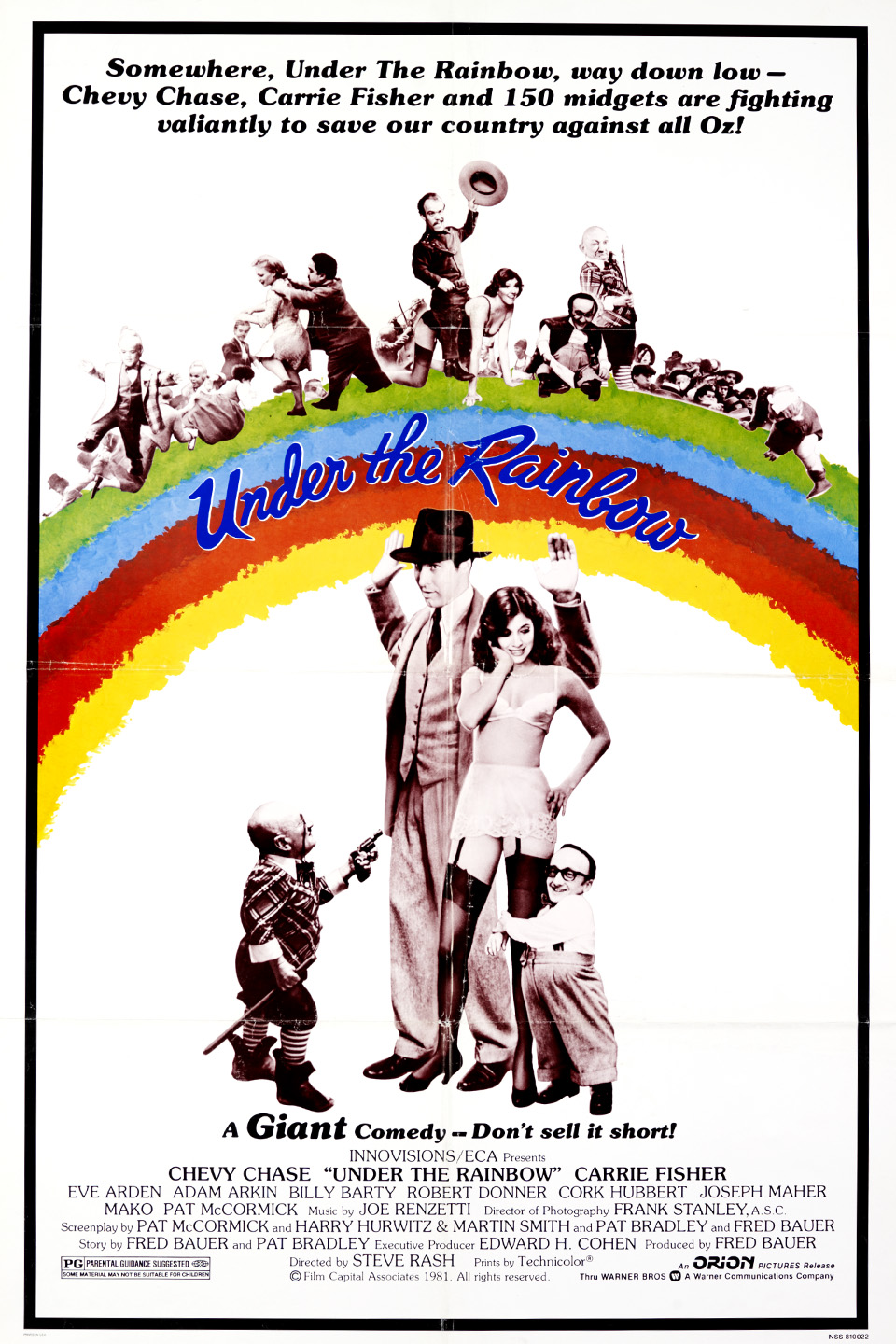
In 1938 an audition is held at the Culver Hotel in Hollywood for Little People to play the part of Munchkins for the upcoming movie The Wizard of Oz. Studio assistant Annie (Carrie Fisher) is put in charge of casting 150 dwarfs for the part. Meanwhile German secret agent Otto (Billy Barty), who is also a dwarf, has been sent by Hitler to California to seek out a Japanese spy who will supply him with top secret maps of American defense systems. Also coming to the hotel is secret service agent Bruce (Chevy Chase) who has been assigned to protect an Austrian Royal Duke (Joseph Maher) and his wife (Eve Arden) from assassination and when all these different forces come together in the same place massive calamity ensues especially as the dwarfs get drunk and proceed to tear the place up.

Director Steve Rash and screenwriter Fred Bauer gained a lot of critical success with The Buddy Holly Story and it got them a contract with Orion Pictures where they signed on to direct a movie that would star Chevy Chase. Inspired by a long-running rumor that dealt with dwarfs getting drunk and rowdy while auditioning for the Munchkin roles at the Culver Hotel, where this film was actually shot, and they decided this would make a funny idea for their next project. The concept might’ve worked had they centered it around the dwarfs, but instead they’re treated as secondary players with no discernable personalities, who behave more like children instead of adults with a physical growth handicap.

Throwing in Chase was a bad idea. He had just signed a three picture deal with the studio, so was obligated to take the part when it was given, but he has later described this as ‘one of the worst movies ever made’ and in interviews, most notably on ‘The Tonight Show’, so has Carrie Fisher. I didn’t understand why the three different story threads were needed as it dilutes the plot, but apparently director Rash didn’t think people would come to see a movie that starred dwarfs, so Chase was added in to compel audiences to the theater, but he’s aloof and not funny and looking genuinely uncomfortable the whole way through.

The spy/espionage angle needed to be thrown out and instead everything centered around Fisher and her struggles in maintaining order throughout the audition. The dwarfs needed more of a dramatic presence too with some serious undertones put in showing the challenges of being a small person, which would’ve given the movie some depth that is otherwise missing. I did enjoy Billy Barty, but everything else is a shambles, which justifiably caused it to do poorly with both the critics and box office.

My Rating: 1 out of 10

Released: July 31, 1981

Runtime: 1 Hour 38 Minutes

Rated PG

Director: Steve Rash

Studio: Orion Pictures

Available: DVD-R (Warner Archive), Amazon Video, YouTube

Lookin’ to Get Out (1982)

looking1

By Richard Winters

My Rating: 5 out of 10

4-Word Review: Hiding out in Vegas.

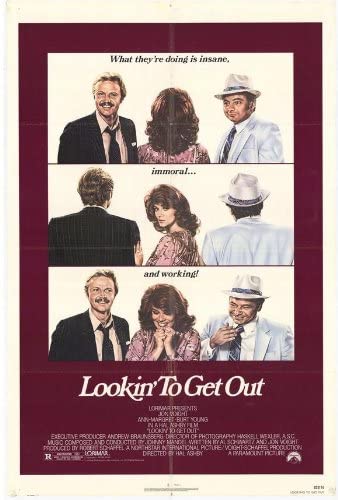
Alex (Jon Voight) is a high stakes gambler in debt for $10,000. Joey and Harry (Allen Keller, Jude Farese) work with the syndicate and when they come around to collect their debt from Alex he escapes out of the city with his pal Jerry Feldmen (Burt Young) where they go to Las Vegas in hopes of recouping the money by playing blackjack. Alex employs the services of Smitty (Bert Remsen), an expert card counter, to help him at the dealer table, but just as he and Jerry think they’ve got their situation solved Joey and Harry reappear and chase the two through the hotel demanding that the debt be repaid immediately.

The script was written by Al Schwartz who based it on some of his own life experiences as he struggled to make it in the entertainment world. While working as the business manager to singer/songwriter Chip Taylor he showed him the script to get his opinion and Chip suggested that Al send it to Jon Voight, Chip’s brother, and when Jon read it he purportedly ‘fell in love with it’ within the first 30 pages. The story is a bit different as the situations itself aren’t necessarily funny, but instead it relies on the desperate nature of the characters and the way they interact with each other for its humor.

It was filmed at the MGM Grand Hotel, which at 6,852 rooms is the largest single hotel in the United States and third largest in the world. The ambience of the place is well captured and reminded me of the atmosphere of a lot of casinos I’ve stayed at where everyone is looking to ‘get lucky’ while in the process living very much on the edge. Having the plot that place over only a two-day period nicely reflects how gamblers live for the moment without any concern for either the past or future. It’s all just about the risk and excitement of beating the odds, which on that level, the film captures admirably well.

The acting helps, particularly from Voight who gives a souped-up rendition of his more famous Joe Buck character from Midnight Cowboy, playing a clueless schmuck who believes he can con his way out of anything and it’s also great seeing him share a scene with his real-life daughter Angelina Jolie, who at age 4 makes her film debut, appearing briefly as Alex’s daughter near the end and to date has been the only project that the two have done together. Young is also quite good as his more sensible friend and to an extent that he becomes the person the audience connects with. Remsen has a few key moments too playing a character that initially seems insignificant to the story, but slowly begins to have a much more meaningful presence by the end. As a buddy formula it works, but throwing in Ann-Margaret as Alex’s former girlfriend who comes back into his life, doesn’t gel and she should’ve been left out.

The foot chase where Alex and Jerry try to outrun Joey and Harry by dashing throughout the hotel is the film’s single best moment and I was impressed with how unlike other movie chases scenes there were no jump cuts and you can visually follow the action even as it shifts between different rooms. The other segments though get overly drawn-out. While his trademark was a slower, more subtle pace, which worked in his previous movies, director Hal Ashby would’ve been wise to have paired this one down. The plot isn’t intricate enough to justify the long runtime and a 90-minute version would’ve been ideal. The original theatrical cut was 105 minutes, which had issues too, but the longer director’s edition isn’t perfect either and in this instance less definitely would’ve been more.

My Rating: 5 out of 10

Released: October 8, 1982

Runtime: 2 Hours (Director’s Cut)

Rated R

Director: Hal Ashby

Studio: Paramount

Available: DVD, Amazon Video

You Can’t Hurry Love (1988)

you1

By Richard Winters

My Rating: 1 out of 10

4-Word Review: From Ohio to L.A.

Eddie (David Packer) is tired of living in the Midwest and after a failed relationship decides to pack his bags and head out west looking for new opportunities. He moves in with his cousin Skip (Scott McGinnis) who already lives in Los Angeles, in order to check-out the scene, but finds everyone to be weird and wacky. He goes on several job interviews, but none of them hire him. He meets pretty Peggy (Bridget Fonda) who works at a video dating service and makes a video of his own, but his attempts to be somebody he really isn’t backfires at every turn. Can Eddie find true love and happiness and will anyone who watches this movie really care if he does or doesn’t?

One of the main problems is Packer, who strangely enough went on to star in another movie, The Runnin’ Kind, just a year later that had almost the exact same storyline. Quite frankly I was surprised he got any part at all as he came into this already with baggage, which stemmed from what occurred on October 30, 1982. On that night he was at the home of actress Dominique Dunne rehearsing a scene for the upcoming TV-miniseries ‘V’ when her ex-boyfriend John Thomas Sweeney came over and preceded to attack and kill her. Some felt that Packer should’ve/could’ve intervened and had he done so she might still be alive today. While I’ll refrain from passing judgement in that area I will say that his acting here is one of the worst I’ve ever seen in a mainstream Hollywood production. His eyes have a glazed over appearance and his face a shit-eating grin. His vocal delivery is quite monotone like someone who’s high and only half there. Fonda on the other hand (this essentially constitutes as her film debut since the 4 films she did previously were either animated, shorts, or non-speaking parts) is quite engaging despite her part being just as poorly written as his, but her superior acting ability shines through while Packer’s drags it down.

The script by Richard Martini tries too hard to recreate the surreal atmosphere from After Hours, but the cultish vibe from that one doesn’t click here. That one starred Griffin Dunne, (who was ironically Dominique’s real-life brother) who was better able to create a believable character that the viewer could identify with and emotionally connect to while Packer is a transparent guy you wish would just go away. It also overly plays-up the flaky stereotype of those living on the west coast. I resided in L.A. or 6 months and I can attest that some of the people out there are a bit eccentric, but they’re not all that way and the film should’ve brought in a few normal ones for balance.

Cameo appearances by famous actors do help a little. Charles Grodin is amusing as the blue collar-like father of one of Packer’s potential dates, who gives Packer, before they proceed on their date, some very brash and straightforward advice. Kristy McNichol is engaging too as a punk girl who harbors a man-hating streak. The funniest of them all though is Lu Leonard as the director of the video dating service that Packer joins who helps coach him on how to present himself to his potential dates. In fact the video dating aspect, of which I admit I was a part of back in the 90’s, is kind of funny and the movie should’ve centered everything around the inner-workings of a dating service franchise, which would’ve been far more interesting and insightful.

My Rating: 1 out of 10

Released: January 20, 1988

Runtime: 1 Hour 32 Minutes

Rated R

Director: Richard Martini

Studio: Lightning Pictures

Available: DVD, Amazon Video, YouTube

The Chain Reaction (1980)

chain1

By Richard Winters

My Rating: 7 out of 10

4-Word Review: Nuclear leak contaminates water.

A nuclear waste site in rural Australia becomes affected by an earthquake, which causes a leak that could contaminate the ground water for hundreds of miles. Heinrich (Ross Thompson), an engineer at the facility who was contaminated by the accident and has only 3-days to live, feels it’s his duty to warn others about what happened, but the company wants the matter to kept a secret. Heinrich manages to escape from the lab, but gets into an accident during a rainstorm on a lonely country road. It is here that he’s rescued by Larry (Steve Bisley) and his wife Carmel (Arna Maria Winchester) who live nearby and take him to their isolated home. Since Carmel has a nursing background she tries to take care of Heinrich at their house even though he now suffers from amnesia and cannot remember anything past 1957. The company though has already sent out a search party looking for him and proceed to terrorize all three once they find them.

The film is a slickly shot sci-fi epic that in many ways seems similar to Mad Maxand in fact both films shared many of the same crew members and this even has a cameo by Mel Gibson who appears briefly as a bearded auto mechanic. The camera captures things in a vivid way and the sharp editing keeps the story moving at a fast pace.

While the plot gets smartly handled and I did find the two main characters to be a bit out-of-place particularly Larry whose outfits and hairstyle look almost campy. The two also don’t have an every day quality about them. Thrillers like these are more exciting when the hero is just a regular person with no special skills and yet still forced to beat insurmountable odds, which is unlike Larry who has expert driving skills and owns a trendy sports car with a souped-up engine.

The way the couple rescue the victim, who they don’t know, by taking him back to their place instead of to a hospital was odd too. Carmel has nursing experience, but not the medicines or equipment that you’d find in a medical facility. They also seem unusually trusting by allowing the man to sleep in one of their bedrooms while they sleep in an adjacent one, but don’t bother to lock their door with the wife lying openly nude for the stranger to just walk-in and attack, or gawk at since there’s a window in the hallway to the room, without any restraint.

The film is noted for its car chases, but they only make up a small fraction of the runtime. One occurs for a few minutes during the second act and then there’s another one at the very end. Both are quite exciting and had me sitting on the edge of my seat with the camera showing things from the driver’s point-of-view and many times through the cracked glass of the windshield making you feel like you’re in the car as it happens. However, I was disappointed that they’re weren’t more of them and both chases take place on the same road and essentially go through the same stunts both times.

Spoiler Alert!

The wrap-up is a bit too quick. For such a nifty, well designed and well crafter set-up I was expecting things to get played-out further. There is though the irony of having a helicopter appear with a news crew that captures the chase when it’s over with the idea that now that the news media is on top of it the truth will get out and everything will be resolved. This though is a far cry from the way things are here in this day-and-age where the media is not trusted by many and having them report on something, even a big story such as this, could only make things worse instead of better.

My Rating: 7 out of 10

Released: September 25, 1980

Runtime: 1 Hour 32 Minutes

Not Rated

Director: Ian Barry

Studio: Palm Beach Pictures

Available: DVD (Region 0)

Return to Oz (1985)

returnoz2

By Richard Winters

My Rating: 5 out of 10

4-Word Review: Nobody believes Dorothy Gale.

Dorothy Gale (Fairuza Balk) has returned to Kansas and the home of Auntie Em (Piper Laurie) and Uncle Henry (Matt Clark), but she continues to talk about her adventures in the Land of Oz and can’t get any sleep. Both her aunt and uncle think she’s become delusional and decide to send her to a doctor (Nicol Williamson) who practices electro shock therapy. It’s there that she’s left under the care of Nurse Wilson (Jean Marsh) while also hooked-up to one of their machines only to be saved when a lightning storm knocks the power out. Dorothy then escapes out of the hospital and runs into a river where she climbs aboard a floating raft and makes friends with a talking chicken. She then gets whisked back to Oz, but this time finds everything in ruins including the citizens of the Emerald City who’ve been turned to stone.

The plot is loosely based on two of L. Frank Baum’s other novels: ‘The Marvelous Land of Oz’ and ‘Ozma of Oz’. The rights to the story had been purchased way back in 1954 by Walt Disney with plans to turn it into a film that would’ve starred Annette Funicello. It was to be a live action movie called Rainbow Road to Oz, but while filming had started and even preview segments aired on TV it was never completed as producers ultimately feared it would be compared unfavorably to the highly popular Wizard of Oz, so the production got scrapped. Then in 1980 film editor Walter Murch convinced Disney executives to give the idea another shot and since they were ready to lose the story rights anyways decided to green light the project with Murch acting as the director. Things though did not go smoothly as Murch had no directing experience and fell behind in the shooting schedule, which got him fired 5-weeks in only to be reinstated when his good friend George Lucas (the two had worked together on THX-1138) convinced Disney to give him another chance by promising that he personally would step-in to direct if Murch was unable to complete.

As a whole, at least in the beginning, I really liked the gothic look of the set design and while some critics complained about the dark tone I actually felt this made it more appealing. Despite being a children’s book the story does have, when you think about it, some very creepy aspects to it, so approaching it in a darker way made sense and the imagery especially during the first half is pretty cool. I particularly liked when Auntie Em takes Dorothy to the doctors via a horse carriage, in which you see a longshot of the carriage traveling across the flat brown prairie, which really brought the desolate quality of Kansas to life, (far better than the original film did, which was shot on an indoor soundstage) with the only irony being that was filmed in Salisbury Plain in the U.K., but the lay out of the land of the Sunflower State, of which I’ve been to many times, still gets replicated authentically.

Initially I liked the way the Land of Oz gets captured as well including the Wheelers, who come off like a punk street gang who have wheels in place of hands and feet. Unfortunately so much has changed here from the original that this ultimately doesn’t seem like a sequel, but a completely different movie instead. There’s no yellow brick road (only shown briefly in a decrepit state, no wicked witch or flying monkeys either.) There is the tin man, lion, and scarecrow, but their look has changed significantly including having the scarecrow appear more like a wide-eyed ventriloquist dummy and not the friendly, amusing character that we’re used to.

The story as it gets played-out is not as interesting. There’s no sense of plot progression, but instead just a constant flow of dangers that Dorothy and her newfound friends get into that are too loosely connected and become more redundant than tense. Dorothy never gets overly upset about anything, which impedes the viewer from becoming emotionally wrapped-up into her peril. After all if she’s taking the whole thing in stride, no matter how dangerous things may initially seem, then why should we. Jean Marsh creates a colorful villain, I enjoyed her closet full of different heads and how she can take one off and put on another one, but she ultimately gets too easily taken down.

The film received only a lukewarm reception and despite working off of a $28 million budget managed to recoup only $11 million. Many felt that director Murch, while showing great eye for visual detail, failed to match it with a riveting story and despite some good elements it’s a misfire.

My Rating: 5 out of 10

Released: June 21, 1985

Runtime: 1 Hour 53 Minutes

Rated PG

Director: Walter Murch

Studio: Buena Vista Pictures

Available: DVD, Blu-ray, Amazon Video, 

Movie Madness (1982)

moviemadness2

By Richard Winters

My Rating: 1 out of 10

4-Word Review: Three very unfunny stories.

If you’re ever needing to show someone why drugs aren’t a good idea there’s no reason to go back to that old TV ad with an egg frying in a pan that said ‘This is your brain on drugs’ instead you could simply show them this movie. Not that it pertains to drugs, or even mentions them, but it was done by people heavily on cocaine, the top drug of choice in Hollywood at that time, who were apparently so coked-up that they thought this movie was ‘hilarious’ even though no one else that saw it thought so.

With the success of Animal House National Lampoon’s was considered the big comic venue, so much so that United Artists gave them top-dollar, a whopping $15 million, to make another feature. In response National Lampoon brought together 5 writers, all of whom had written for their humor magazine, but had no screenplay experience, to compose the movie. The idea was to create 10 short vignettes that would make fun of a different movie genre, but this was ultimately too difficult, so it got pared down to just 4, with only three of them ultimately making it to the big screen. What’s perplexing is that the production values are good (I actually liked the opening song sung by Dr. John and the opening animation), there’s even some big name stars, but the material itself is unbelievably lame to the extent that it purportedly caused a test audience in Rhode Island to tear up their theater seats to show their disgust.

The first story, which is entitled ‘Growing Yourself’ stars Peter Riegert as a suburban father/husband who packs up his wife’s (Candy Clark) bags and tells her to leave so he can ‘grow’ as a person. Though confused with the reasoning she immediately obliges, but ultimately the husband finds raising the kids and finding a new more interesting career to be far more of a challenge then he expected.

The problem with this story, like with the other two, is that the characters and their motivations are unrelatable to real everyday people. For a story to work, even as satire, there still needs to be a connection to reality and this thing is too daffy. Even on a surreal level it goes nowhere and becomes simply a glimpse to weird individuals saying and doing stupid things with no intrinsic point at to it at all.

The second segment, entitled ‘Success Wanters’, suffers the same fate. It has to do with recent college grad Dominique (Ann Dusenberry) getting a job as a stripper, which almost immediately leads to her becoming heiress to a massive fortune of a margarine company when the owner (Robert Culp), who she was fooling around with, dies. This then leads to more affairs, and more money and ultimately even a relationship with the President of the United States (Fred Willard).

Again nothing that happens here has any bearing in reality, never in the history of the world has this happened to any college grad out there, especially in only a few days time. To be funny it still needs to make sense, but like with the first story you’re left scratching your head wondering what the point of it was although Dusenberry does look fabulous naked, both topless and bottomless, making catching it for that reason almost worth it.

The third and final segment, entitled ‘Municipalians’ has rookie cop Brent (Robby Benson) paired with jaded, crabby veteran Stan (Richard Widmark) as they go out to find a bizarre serial killer (Christopher Lloyd). Supposedly this was meant as a parody of the cop buddy movies, but too silly and over-the-top to be even slightly amusing. I will admit it’s fun seeing veteran star Widmark in such an odd project and his cantankerous ways is slightly engaging, including one moment when he’s caught reading Hustler magazine, but the story structure is faulty. It might’ve gotten a few more points from me had the scene where Benson and Lloyd start singing a duet of ‘Feelings’ and then had Widmark barge in to form a trio, but since that doesn’t happen this one like the other two fails miserably. It also ends with the camera focusing on Benson struggling to get up after he’s been shot several times, which comes-off as cruel like it’s making fun of someone who’s in pain, which I found disturbing.

There was a fourth segment entitled ‘The Bomb’ that starred Kenneth Mars and Marcia Strassman and was a parody of disaster movies, but when screened United Artists’ vice president of production found this segment to be ‘of an awfulness that made the whole picture look unreleasable’. so it got taken out. However, he did also find the first three stories to be ‘good, funny segments with high commercial promise’ making you wonder if he was coked-up on the white stuff too.

Alternate Title: National Lampoon’s Goes to the Movies

My Rating: 1 out of 10

Released: April 23, 1982

Runtime: 1 Hour 29 Minutes

Rated R

Directors: Bob Giraldi, Henry Jaglom

Studio: MGM/UA

Available: DVD-R (MGM Limited Edition Collection), Amazon Video, Tubi