Category Archives: 70’s Movies

Revenge of the Pink Panther (1978)

By Richard Winters

My Rating: 6 out of 10

4-Word Review: Out to get Clouseau.

Philippe (Robert Webber) is a successful businessman who’s secretly the head of the French criminal underground. Some though are questioning his leadership considering him to be too weak to remain in that position. In order to squash the impending threat, he decides to make a bold move by having Inspector Clouseau (Peter Sellers) killed. Clouseau was considered a master detective by the outside world and only known to be an incompetent by those who worked with him, so by having him out of the way the drug dealers would feel relieved and thus Philippe would remain in power. However, things don’t get as planned as Clouseau manages to miraculously evade all attempts on his life. The media though mistakenly announces that he has died, which allows Clouseau to go undercover along with his manservant Cato (Burt Kwouk) to find out who’s after him.

This marked the fifth entry in the series and is probably the funniest. Initially director Blake Edwards had wanted to reuse footage that had been cut from the previous entry and then film new scenes around those, but star Sellers insisted he wanted an all-new story and that was probably for the best. Sellers by far gets the most laughs whereas in the one that came before this, The Pink Panther Strikes Againit was Herbert Lom as the unhinged Dreyfus, that was the most memorable, but here his part becomes much more benign, though he still gets one good scene where he tries not to breakout laughing while giving a eulogy at Clouseau’s funeral. Sellers though comes out on top here especially in his disguises like when he pretends to be a sea captain with an inflatable parrot on his shoulder, or in a hilarious send-up as a Mafia Don.

It’s great to see Kwouk, who was usually relegated to the ‘fight’ scene between him and his boss Clouseau, become more involved in the story, as the two go to Hong Kong in disguise to track down the bad guys. Dyan Cannon is a refreshing change of pace. Usually, the women in these films were young models whose sole purpose was to allude sex appeal, but here she’s middle-aged, but still attractive, and shows much more of a feisty personality. She helps build a strong secondary character and is better interwoven into the plot versus simply appearing as a potential romantic interest.

Webber though as the main villain is a detriment. I have no doubt that the notoriously insecure Sellers didn’t like the way Lom stole the film as the nemesis in their last outing and wanted to make sure that didn’t happen again. Not only is the Dreyfuss character far more neutered, but so is Webber making him seem like he’s almost sleepwalking through his role. It would’ve been more interesting had his character has some personal vendetta against Clouseau, possibly because it was Clouseau who had sent him, or one of his men to jail, and now he wanted revenge. Just having him out to get Clousau because it might bolster his own image didn’t seem to be enough of an incentive and the two, outside of one comic moment where Clouseau’s is in one of disguises, never have any ultimate confrontation. Watching him get chased around his desk and cower from Dyan Cannon may have been intended as funny, but it just further erodes his villainy making him seem even more impotent than he already is. Even a comedy still needs a bad guy that can elicit some tension and this one doesn’t.

The implementation of Mr. Chong, played by martial arts instructor Ed Parker, has potential. Supposedly he’s an ‘invincible’ fighter that can beat-up anyone and not be stopped as proven when he takes down several other men while in Webber’s office but then he gets comically defeated once he comes into contact with Clouseau. While watching him go through the floor/ceiling of several apartments below as he crash lands is visually funny it would’ve been more engaging if he had come back at some point and continued his relentless attack on Clouseau albeit with injuries in order to reclaim his reputation that he couldn’t be defeated, but in the process just became more hurt and ineffective.

Spoiler Alert!

The climactic sequence that occurs in Hong Kong is a cop-out and comes-off like they’d run out of ideas, so they tried to save it with a calamity filled chase that plays more like a cartoon, or something better suited for a live action Disney movie. Introducing yet another Mafia boss, this one played by Paul Stewart, makes things too cluttered and there should’ve been just one main bad guy that was the boss of everyone. The finale inside a firecracker factory should’ve proven dangerous and in fact we do see the entire place explode from a distance and yet everyone comes out of it unscathed, which doesn’t exactly make a lot of sense.

My Rating: 6 out of 10

Released: July 20, 1978

Runtime: 1 Hour 39 Minutes

Rated PG

Director: Blake Edwards

Studio: United Artists

Available: DVD, Amazon Video, YouTube

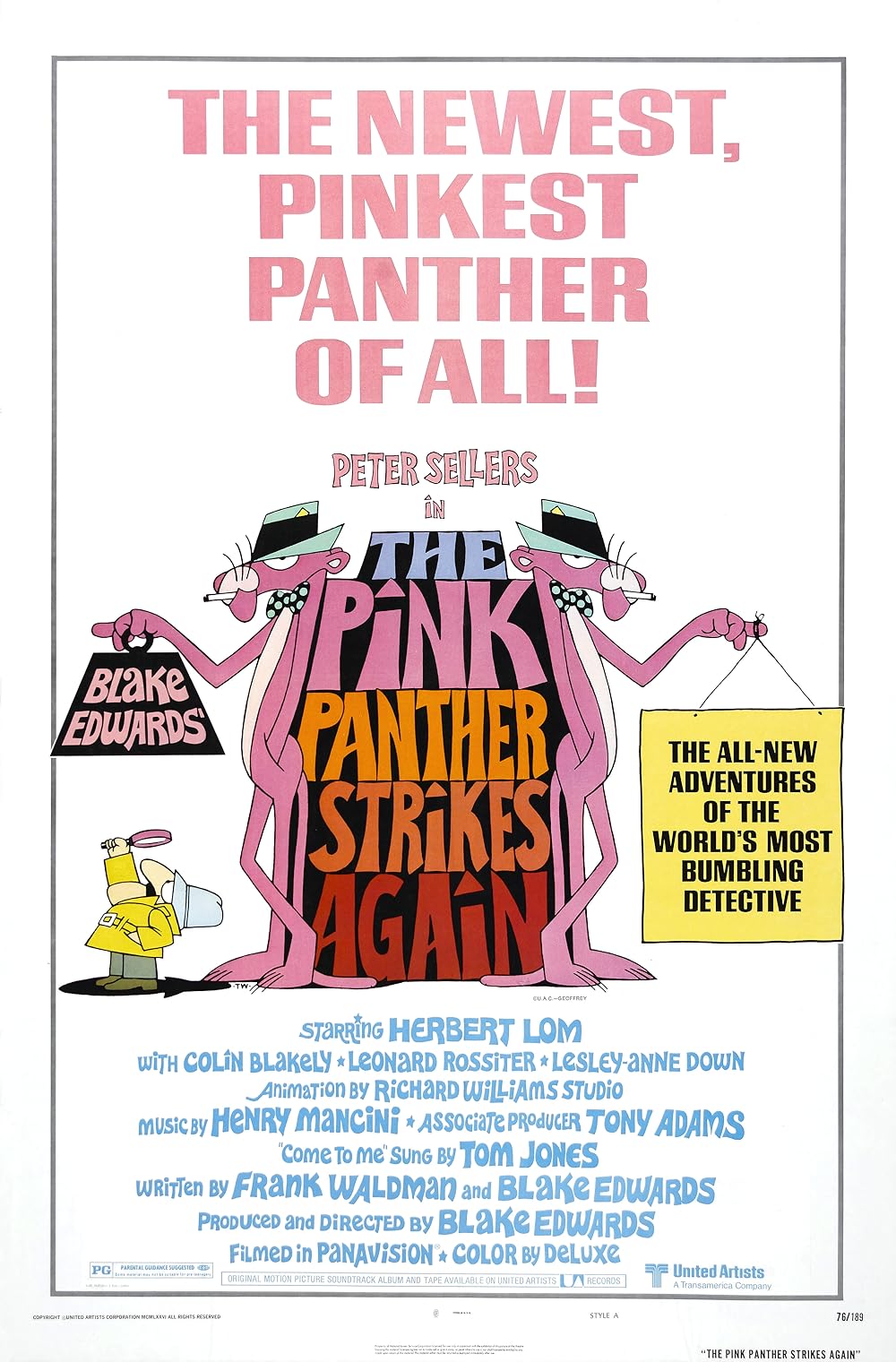
The Pink Panther Strikes Again (1976)

By Richard Winters

My Rating: 7 out of 10

4-Word Review: Clouseau battles doomsday weapon.

Dreyfuss (Herbert Lom) has been informed by his psychiatrist (Geoffrey Bayldon) that he has been cured of his obsession with Clouseau (Peter Sellers) and now deemed sane. He’ll be recommending his release from the mental institution he’s been in later that day at the sanity board of which Dreyfuss is elated. However, Clouseau shows up unannounced planning on speaking to the sanity board on behalf of Dreyfuss, but when he gets there the two meet and after several mishaps, all inadvertently caused by Clouseau, occur it sends Dreyfuss spiraling back into insanity. He then though is able to escape and goes on a mission to kill Clouseau, first on his own and then with the help of several worldwide assassins. When this doesn’t go as planned, he kidnaps a nuclear physicist (Richard Vernon) and blackmails him to create a doomsday weapon that can take out entire buildings with its laser beam and which Dreyfuss has no problem using against the world unless he’s given Clouseau in return.

After the unexpected success of The Return of the Pink Panther, director Blake Edwards was given an immediate green light to write and direct a follow-up. Since he had originally intended for this to be a TV-series he used one of the scripts he had written for that one and expanded it for feature film length. The original cut came out to 126 minutes, but the studio insisted it be trimmed to 95-minute runtime with the excised scenes being used as material for the Curse of the Pink Panther, which released 6 years later after the passing of star Sellers.

Despite constant behind-the-scenes struggles between Edwards and Sellers this film is widely considered their best output second only to The Party, which they collaborated on 8 years earlier. A lot of the reason why it works is the excellent pacing with an almost rapid-fire collage of jokes and mishaps, the scenic European locations and the pleasing yet still bouncy Henry Mancini score.

The humor hits the target in almost all cases, unlike most comedies where there’s usually a few misses, with some of the best moments coming from the supporting players like stuntman Dick Crokett who plays a perfect parody of then President Gerald Ford and Lesley Ann-Down, who replaced Maude Adams who was originally cast, but then fired after she refused to appear nude, as a Russian spy whose attempts to get Clouseau in bed with her proves quite funny. The ongoing confrontations between Lom and Sellers though are still the highlights and the two really work well together with Lom’s angry abrasiveness a nice contrast to Seller’s benign ineptness and in fact this is a rare instance where Sellers gets upstaged as it’s Lom’s performance with his over-the-top villainy that you come away remembering the most after it’s over.

Yet with all of its successes the script is still full of logical loopholes and missing key moments. For instance, Dreyfuss escapes from the mental hospital, but it’s never shown, which I felt since it’s so integral to the storyline needed to be seen and explaining how he was able to do it. What he did to gain access to the apartment downstairs from Clouseau’s should’ve been inserted as well and some sort of answers for how he was able to avoid injury from the bomb going off as it destroyed Clouseau’s apartment and the fallout from it would’ve most assuredly affected the apartment beneath it as well. Clouseau’s ongoing physical confrontations with his house servant Kato (Burt Kwouk) becomes problematic too as they’re constantly damaging the furniture during their fights and if this happens every time he comes home then the furniture should already be in disarray from their last battle as there wouldn’t have been time to have cleaned it up and replaced it with new stuff.

Spoiler Alert!

While the film does at least have Dreyfuss masterminding a major bank heist, which helps to explain how he got funding to build the giant laser and purchase the castle that he and his crew move into, it still makes it seem that they’re able to build the elaborate weapon and all the computers that go along with it, almost overnight, which of course isn’t believable. It also at one point has the laser beam striking Lom making his legs disappear, but he’s still able to somehow walk around anyways as well as maintain his same height, making it seem that his legs are still there and simply invisible.

There’s also the issue of Dreyfuss disappearing at the end, due to the effects of the laser, but in the following installment, Revenge of the Pink Panther, he’s fully intact and no mention of his previous madness to destroy the world. Fans of the series say this is because this whole film was meant to be a dream that Dreyfuss had, which would’ve made a lot of sense. He was already obsessed with Clouseau, so having nightmares about things one is constantly focused on would be logical and the film should’ve had at the very end Dryefuss waking up and still in a strait-jacket, but it doesn’t making it an oversight and not properly thought through.

My Rating: 7 out of 10

Released: December 15, 1976

Runtime: 1 Hour 43 Minutes

Rated PG

Director: Blake Edwards

Studio: United Artists

Available: DVD, Amazon Video, YouTube

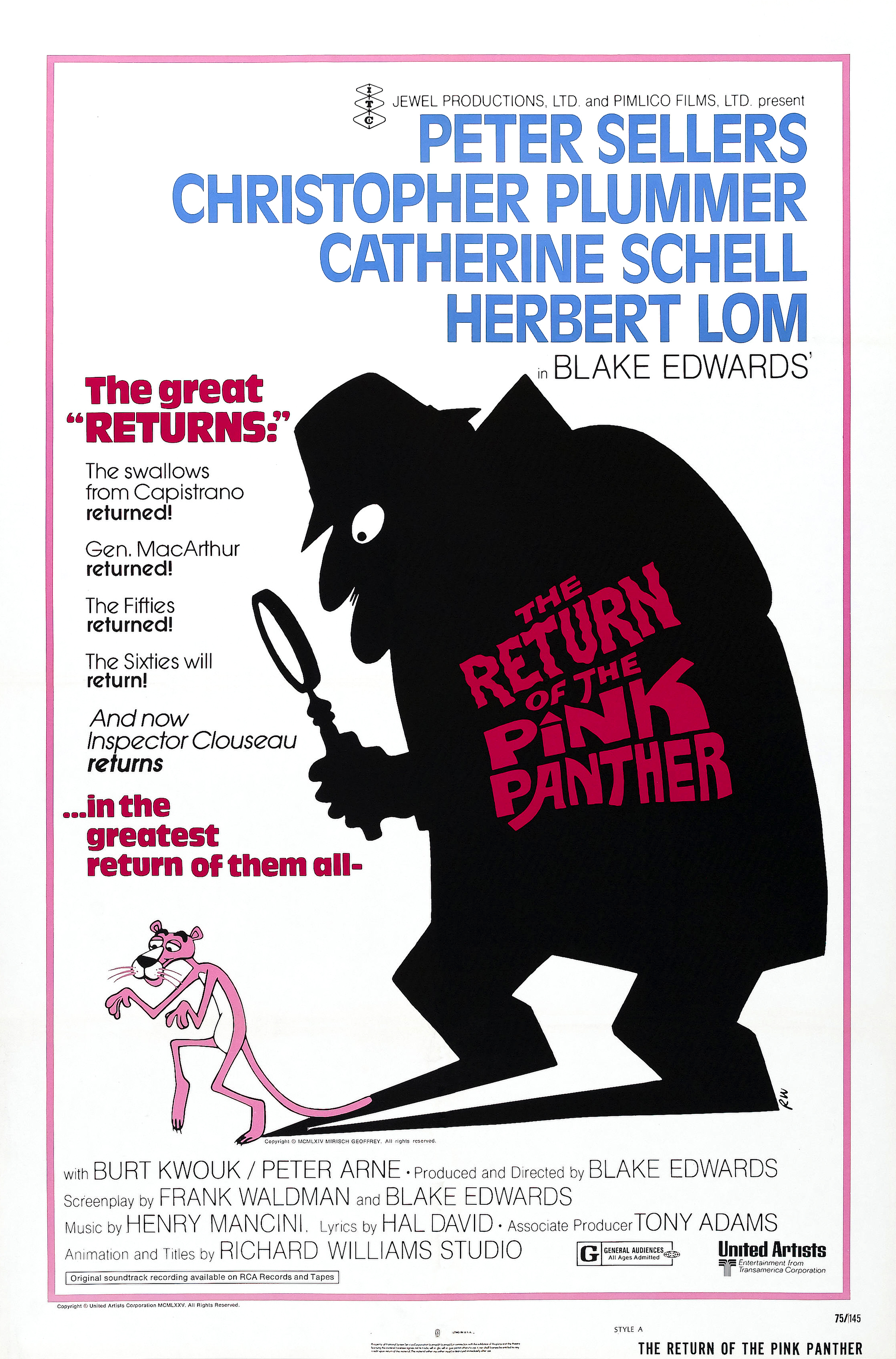
The Return of the Pink Panther (1975)

By Richard Winters

My Rating: 7 out of 10

4-Word Review: Tracking down stolen diamond.

Inspector Clouseau (Peter Sellers) has been demoted to street cop by Chief Inspector Dreyfuss (Herbert Lom) due to Clouseau’s continual incompetence, which is starting to drive Dreyfuss completely mad. However, inside the country of Lugash a prized diamond known as the Pink Panther is stolen and since Clouseau had success retrieving it the first time it went missing during a heist he is put on the case to find it again much to Dreyfuss annoyance. Clouseau suspects that the culprit is Charles Litton (Christopher Plummer), who is a notorious thief. Clouseau attempts to use several different disguises in order to infiltrate Litton’s home that he shares with his wife Claudine (Catherin Schell) in order to find incriminating evidence against Litton so that he can turn him in, but his attempts to try and a take Litton down prove to be comically inept. 

This marked the fourth installment of the Pink Panther series and the first in 10-years that reunited writer/director Blake Edwards with Sellers. Both had said after doing the second film A Shot in the Dark, that they never wanted to work with the other again due to much infighting during the production, but both had since then fallen on hard times. Edwards was by the early 70’s considered box office poison after the colossal failure of Darling Lilli which managed to recoup a measly $3 million from a $25 million budget and his other films from that era Wild Rovers and The Carey Treatment hadn’t done much better. Since Pink Panther had been his last success, he was interested in reviving it and even wrote up a 14-page treatment but found no takers amongst the major studios. Then producer Lew Grade agreed to finance it in exchange for Edward’s wife Julie Andrews agreeing to star in a British TV-special that he wanted to produce. Since Sellers career had also bottomed out, he came onboard to most everyone’s surprise without much hassle.

The film was shot in many scenic locations including Morrocco giving the optics an exotic flair and the proceedings a sophisticated European vibe making it seem like a step-up from just a silly comedy. In the first two installments all the characters were written to be funny and goofy particularly the second film, which had been based on a stage play. Here though the comedy is wisely given over to Sellers while the couple he’s after remain savvy, which makes it more intriguing as you want to see how this inept idiot takes them down, or is able to trip them up at their own game. I also liked how funny bits are interspliced with some legitimate action, especially the opening scene that features the heist, which could’ve easily fit into a realistic film dealing with a robbery. These moments help add a bit of relief from all the laughs, a sort of chance to catch your breath, while making the plot seem like it’s not just all about being a farce.

Lom adds terrific support as Clouseau’s exasperated supervisor, and his assertive acting style works nicely off of Sellers clownish one making the interplay between the two a highlight. It’s good too that Plummer replaced David Niven, who played the character in the first one, but wasn’t able to do it here due to scheduling conflicts, as Niven would’ve been too old and not plausible to have outrun the bad guys like Plummer does. 

My only issue is that Claudine is shown attempting to hold in her laughter at Clouseau right from the start like she knows he’s an idiot before she even met him, but this goes against the premise. Clouseau is considered an accomplished detective by the outside world hence why he was selected to head the case and it’s only the people that work with him and know him who are aware of his ineptness. This is the whole reason why Dreyfuss gets driven mad by him because the rest of the world celebrates the man that he knows is really a fool, so Claudine should’ve initially thought of him as being sharp and only came to the conclusion he was incompetent by the end after having dealt with him. It actually would’ve been funnier had she and Charles feared Clouseau upfront having believed his celebrated reputation and misreading his bumbling as being ‘genius’ ploys and remained that way throughout. In either case seeing her covering her mouth and shielding her giggles makes almost seem like she’s falling out of character and a blooper, similar to how Harvey Korman would unintentionally crack-up during Tim Conway’s antics on the ‘The Carol Burnett Show’ and for that reason it should’ve been avoided. 

My Rating: 7 out of 10

Released: May 21, 1975

Runtime: 1 Hour 54 Minutes

Rated PG

Director: Blake Edwards

Studio: United Artists

Available: DVD, Blu-ray, Amazon Video, YouTube
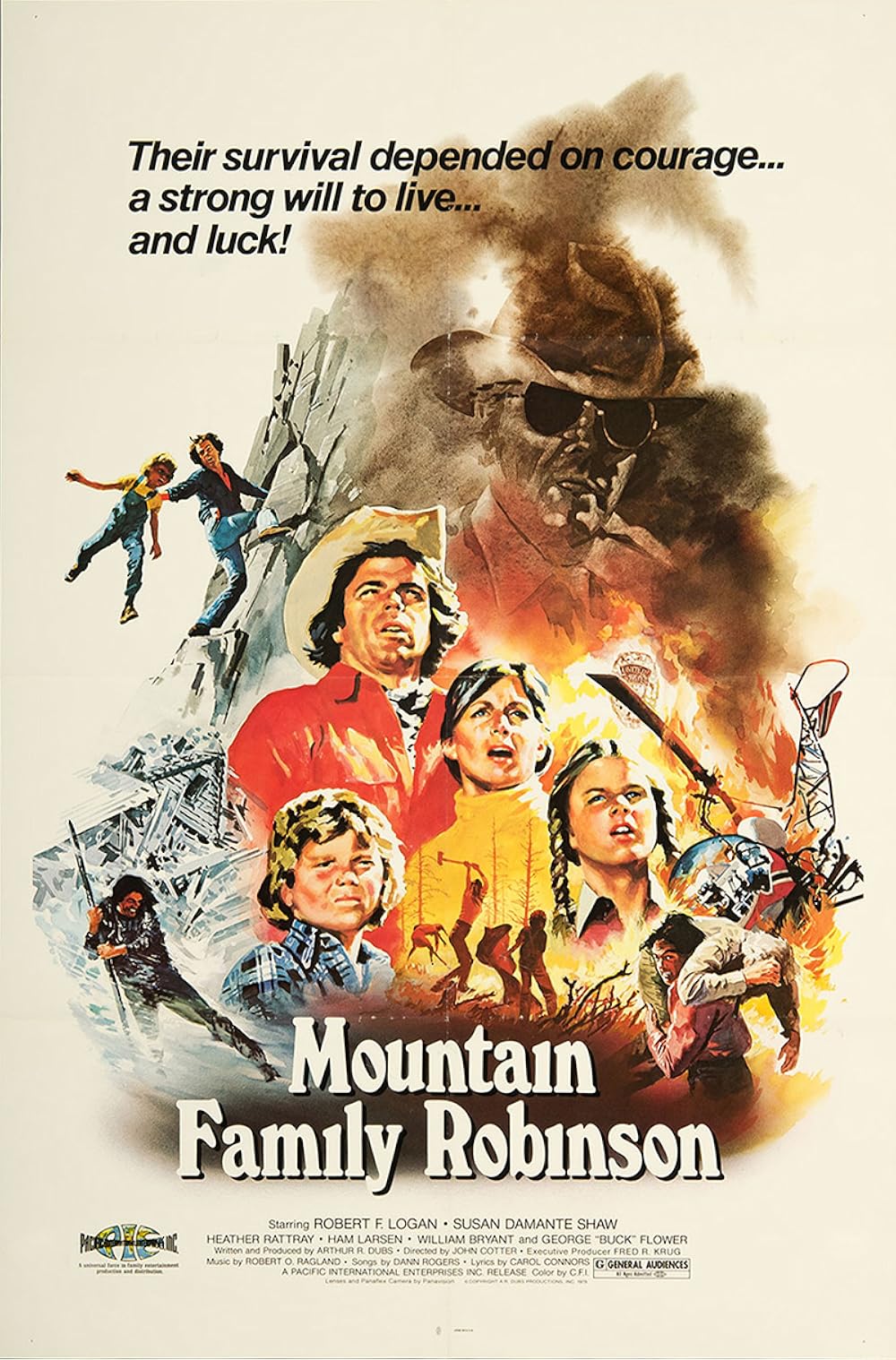
Adventures of the Wilderness Family 3 (1979)

By Richard Winters

My Rating: 1 out of 10

4-Word Review: Government threatens their home.

After surviving their first harsh mountain winter the Robinson family (Robert Logan, Susan Damante Shaw, Heather Rattray, Ham Larsen) are happy to go outdoors and enjoy the warmer weather of Spring, but there’s an unexpected problem. While doing a survey of the area a Forest Ranger (William Bryant) has surmised that the family doesn’t have rights to the property that they’re on. They must prove it’s a legitimate mining claim or move out.

I’ll give this film some credit, at least initially, that they made an attempt, albeit a feeble one, to mix things up. I was fully expecting more animal attacks, the formula had one occurring every 15-minutes in the first two installments, but with the exception of one minor one that happens to the boy when he runs away from home, there really isn’t any, at least to the family members. There is however, a confrontation between some mountain lions and the family’s pet dog, but the dog is able to fight them off, though I started to wonder how many times he could keep doing this. In the first two films the dog was also instrumental in scaring the other wildlife away, but you would think a domesticated pet would be at a disadvantage to one that had been living in the wild all their lives and were bigger in size. The fact that the dog constantly survives these battles and never even gets injured starts to raise the implausibility meter.

The two kids also feud a bit, which I found refreshing. Even the Brady Bunch had some conflicts between the siblings, as most any normal family does, so seeing everyone here be peachy towards each other the majority of the time is not only boring, but unrealistic. However, their disagreement, which amounts to nothing more than the two not talking to each other, which we don’t even see, but have described by the two parents, doesn’t last for more than a few minutes and then it’s all back to ‘happy family’. 

The mom finally does go back to L.A., something she had lightly threatened to do in the first two films but just like with the kids fighting it doesn’t add up to much as she comes back and says she’ll never leave again. Why then even add these elements if by the end it makes no difference to the story?

On a lesser note, are the bear cubs residing in the family’s cabin who never seem to grow and if anything, appear to have gotten smaller than when they were in Part 2. The Boomer character played by George ‘Buck’ Flower is also an issue as he’s a mountain man but never carries a gun making you wonder how he survives without one. For instance, how does he protect himself as animal attacks happen a lot, at least with the family, and what does he use to hunt for food? Maybe he lives completely off of berries and fish, but by the looks of his protruding belly it appears he’s eating something more.

Out of everything it’s the music that’s the worst. Because the story is so thin there are several segments featuring the family frolicking around while this sappy chorus by studio musicians get played that’s so sugary it’ll give you diabetes just by listening to it. It also has a dated sound from the 1940’s. The 70’s though was a period of many interesting music genres like rock, disco, soul, and even southern rock and media aimed at kids was trying to replicate it like ‘Sesame Street’ that had the Pointer Sisters singing a song that teaches children to count, but with a funky beat. Even religious people got into the times by introducing Christian Rock, so why does this movie have a soundtrack that’s so grossly out-of-step?

Spoiler Alert!

The third act in which the family openly refuses to leave their home after the Forest Ranger insists proves to be a letdown too as there’s no tense confrontation. Instead, the Ranger’s helicopter mysteriously crashes for no reason as the weather was sunny and when the family nurses him back to health he agrees to no longer push them out. However, all it would take is another government official to come along and the conflict would start all over making the tidy wrap-up/resolution unconvincing. The only positive thing to say is this was thankfully the final film of the series.

My Rating: 1 out of 10

Released: November 21, 1979

Runtime: 1 Hour 40 Minutes

Rated G

Director: Jack Couffer

Studio: Pacific International Enterprises

Available: DVD, Amazon Video, Roku

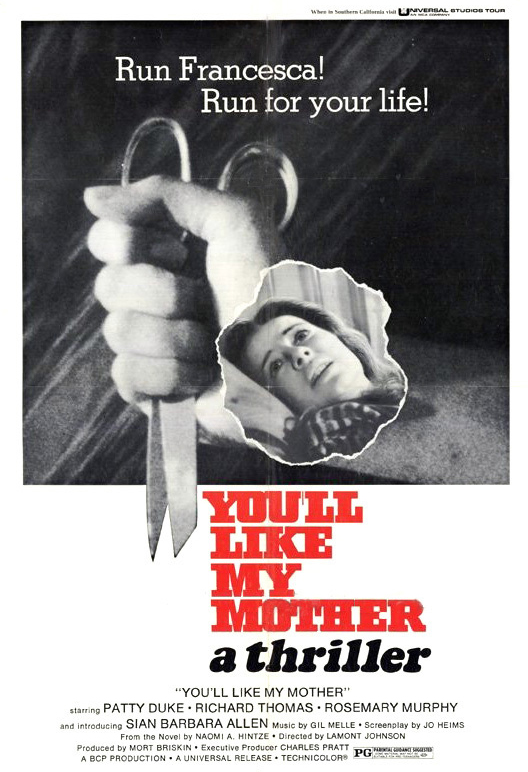
You’ll Like My Mother (1972)

By Richard Winters

My Rating: 3 out of 10

4-Word Review: Pregnant woman held captive.

Francesca (Patty Duke) travels by bus to Duluth, Minnesota in order to meet her mother-in-law (Rosemary Murphy) after her husband dies in a plane crash in Vietnam leaving her alone and pregnant. When she arrives, she finds the woman to be cold and indifferent unlike how her husband had described her where he always insisted that ‘you’ll like my mother’. Francesca also finds out that he apparently had a sister, a mute girl named Kathleen (Sian Barbara Allen) that he had never mentioned. A snowstorm blocks her from leaving forcing her to stay in an upstairs bedroom where more troubling secrets come out including the fact that a young man named Kenny (Richard Thomas) is secretly residing in the home and has been accused in the past of being a serial rapist.

Blah thriller based on the 1969 novel of the same name by Naomi A. Hintze. The only interesting aspect about the film is that it was shot on-location at the Glensheen Historic Estate, which 5 years later became the site of a real-life crime when the mansion’s owner, Elisabeth Congdon and her nurse, were murdered by her son-in-law. The movie also marks the debut of Sian Barbara Allen, who died just recently and was quite active in TV and movies during the 70’s before retiring in 1990 in order to focus full-time on being an activist. She was, particularly in her prime, a great beauty with the most mesmerizing pair of blue eyes you’ll ever see. Unfortunately, her role doesn’t have her saying much outside of a few words she manages to mumble out and her character seems to be put in simply to help the protagonist figure out the mystery.

The story unfolds slowly and because the majority of it takes place in one building it becomes visually static. Since it was filmed in Minnesota during the winter the white stuff on the ground is real, which helps with the authenticity, but because it didn’t actually snow when it was being shot the crew was forced to use fake falling flakes in a feeble attempt to replicate a snowstorm, which they’re not able to pull off. Anyone who’s ever experience a real blizzard will see how tacky this one looks and thus the premise that ‘nobody can get through this storm’ is lost.

Patty Duke is good, but her character doesn’t do much outside of staying cooped up in room while Allen does most of the leg work. Her insistence that she didn’t need any help financially makes you wonder then why did she come at all? If it was just for a visit, she could’ve done that in the summer when Minnesota weather is more hospitable and after the baby was born. In many ways having her in need of money would’ve made more sense and heightened the dramatic tension since that would make her desperate with nowhere else to turn.

Murphy is a weak villain as half the time she’s more nervous than Duke and easily fooled making it seem that anyone could outfox her and get away. It doesn’t help that she stupidly gives away who she really is and why she’s there when she has a conversation with Thomas that gets overheard by Duke, which ruins the mystery when the film is only halfway through and thus killing what moderate intrigue there had been.

The foot chase through the snow at the end does offer some tension but waiting all the way until the finale for any action was a mistake and Duke should’ve tried to escape earlier. The plot twists aren’t enough to make sitting through worth it. It’s not adequate material for a 90-minute feature length film as there’s 30-minute episodes of the old ‘Alfred Hitchcock Presents’ with more plot wrinkles than what you get here.

My Rating: 3 out of 10

Released: October 13, 1972

Runtime: 1 Hour 33 Minutes

Rated PG

Director: Lamont Johnson

Studio: Universal Pictures

Available: DVD (Warner Archive)

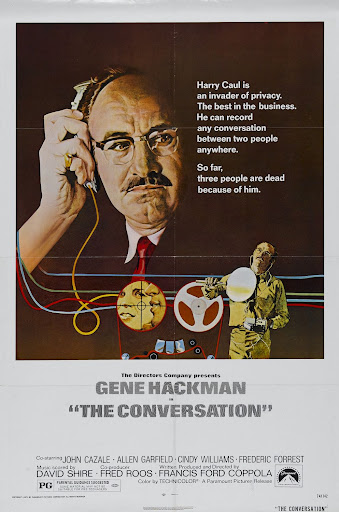
The Conversation (1974)

By Richard Winters

My Rating: 10 out of 10

4-Word Review: Someone is listening in.

Harry Caul (Gene Hackman) is a surveillance expert who specializes in listening into people’s private conversations and has a reputation of being quite good at it. Many wealthy clients hire him to record things from their enemies that they might not be able to attain otherwise. However, one of these assignments led to the death of three people and Harry, being a highly religious man, has felt guilty about it ever since. He begins to have the same concerns with his new assignment when he overhears a couple (Fredric Forrest, Cindy Williams) who he’s recording mention that ‘he’d kill us if he got the chance’. Harry is unsure if he wants to give the tapes up to his client as he’s frightened the same scenario as before will occur. Martin (Harrison Ford) the man representing the client becomes aggressive in getting the tapes and warns Harry that they’ll get their hands on them one way or the other. Harry, a private man, soon realizes that this client is just as sophisticated in surveillance technology as he and maybe even more so as he becomes aware that his phone and even his apartment is bugged.

Inspired by real-life surveillance expert Martin Kaiser, who was a technical consultant on the production, the film deftly explores how today’s modern technology has easily evaded our private lives and how no one is safe from prying eyes and ears a concern that has become even more pronounced in the decades following its release. Many presumed that it was a testament about the Watergate break-in, which occurred a year before the movie came-out and uses much of the same sound equipment used the by criminals in the real-life event, but in actuality the script, by Francis Ford Coppola, was already complete in 1965, but was unable to get any financial backing until his success with The Godfather. 

The film scores on just about all levels especially with the way it captures San Francisco. I loved the bird’s eye-opening shot of Union Square as well as the terrific use of the fog that gets used to great effect during a memorable dream sequence. The soundtrack by David Shire is quite unique as it’s made to replicate sound waves changing frequency. I liked too that quite a bit of time is spent showing Harry inside his editing studio where he puts together the tape he’s recorded from different sources into a cohesive whole and watching him do it, even if it’s from equipment that would be deemed dated now, is impressive and makes you appreciate the expertise of the character.

Acting wise this may be Hackman’s best, and he stated in later interviews that he considers this to be his finest work, though at the time he felt it was an extreme challenge playing such an introverted person when he himself was highly extroverted, but the payoff is rewarding as he displays characteristics unlike any other role he’s played. What impressed me most was his body posture, which is hunched over, and he walks with a pensive gait, which reveals to the viewer the character’s inner angst without it ever having to be verbally explained. It’s interesting too how he’s mostly shy and stand offish during the majority of it making him seem like a wallflower, but when the subject of his sound expertise comes into discussion, he’s suddenly bragging about his state-of-the-art machinery showing how even the most unassuming of people can still have a big ego and helping to create a protagonist who’s three-dimensional.

There’s also great support from a young Harrison Ford, who appears with a scar on his chin, who despite presenting himself in a composed manner and speaking in a controlled tone of voice is quite menacing. Terri Garr is excellent as a prostitute that Harry frequents and acts as Harry’s only social outlet as well as Allen Garfield playing a huckster whose also Harry’s rival and clearly has a way about him that gets under his skin. Great work too by John Cazale who works as Harry’s assistant and their relationship runs hot-and-cold and there’s even Robert Duvall in a small, but pivotal part.

Spoiler Alert!

While the film is expertly crafted, I did find the scene where Harry’s landlady leaves him a birthday gift inside his apartment to be problematic. We see that Harry has three different locks on his door, which keenly reveals what a private person he is and how paranoid he is to protect it, and yet when he opens up his door there’s an item sitting on the floor left by his landlord. Through a subsequent phone conversation, he has with her we learn that she was able to get in by using her master key, but it’s highly unlikely that she would have three different keys for each lock.

Another issue happens at the end when Harry tears his apartment apart in desperate attempt to find the covert listening device that’s been planted by the client and is able to listen and record everything he says and does. He isn’t able to locate it despite a thorough and exhaustive search and then spends the rest of the time playing his saxophone as it’s the only thing he has left, which is where it finally dawned on me that was probably where they implanted the bug and the movie should’ve had him dismantle that too and then if he was unable to find it there, after destroying everything else, he could be seen lying in the barren, darkened room in a fetal position and completely defeated, which might’ve left an even more lasting and riveting final image.

My Rating: 10 out of 10

Released: April 7, 1974

Runtime: 1 Hour 53 Minutes

Rated PG

Director: Francis Ford Coppola

Studio: Paramount Pictures

Available: DVD, Blu-ray, Amazon Video, YouTube
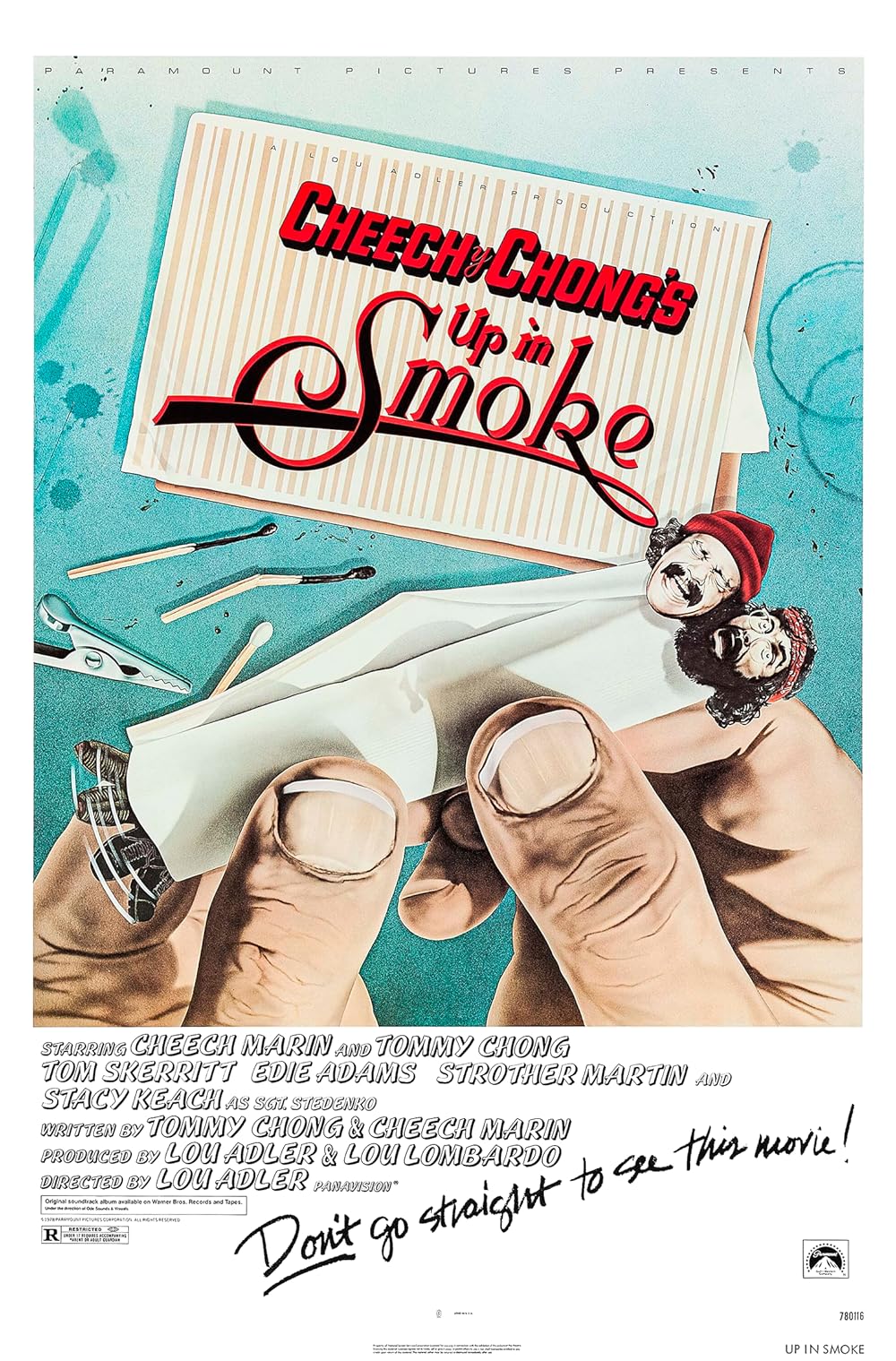
Up In Smoke (1978)

By Richard Winters

My Rating: 5 out of 10

4-Word Review: Two stoners become friends.

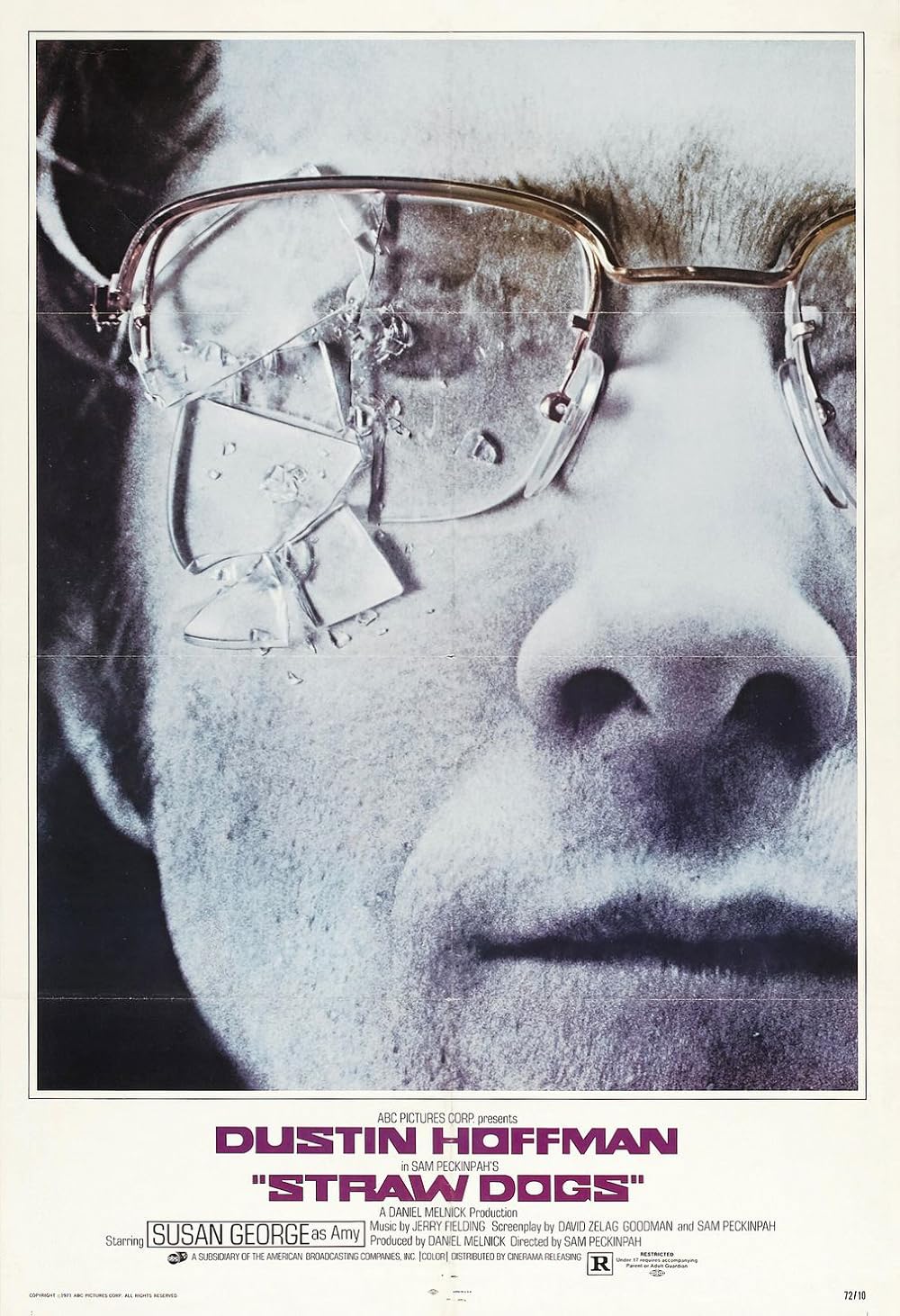
Anthony (Thomas Chong) is told by his father (Strother Martin) that he must find a job, or he’ll be kicked out of the house. Anthony then hitches a ride with Pedro (Cheech Marin) and the two quickly become friends based on their mutual interest of getting high on drugs. Soon they’re involved in many adventures including being shipped off to Tijuanna. In order to get back into the country they agree to drive a van that unbeknownst to them, is made completely of hardened marijuana, which gets them quickly put on the radar of Seargent Stelko (Stacy Keach) who along with his crack team of incompetents chases the two relentlessly in order to haul them into jail and make the country’s streets safe again. 

Cheech Marin was trying to avoid the draft when he went to Canada in 1969, which is where he met Thomas Chong, already a Canadian citizen who was starting up his own improv called ‘City Works’ after seeing Second City improv in Chicago while touring as a musician. The two became a comedy team who would come out to warm up audiences before concerts, but in many cases were more popular than the bands they were introducing. This then caught the attention of producer Lou Adler, who signed them to a contract to create record albums, which were so profitable that they graduated into making a movie, which Adler directed, that recreated many of the same skits they had used during their stage routines.

The movie upon its initial release with its open drug use was considered quite controversial and lead to many critics at the time to condemn it but nonetheless proved to be a big money-maker grossing $104 million on a $2 million budget.  Today the film is seen in a much softer light and in 2024 was elected for preservation by the National Film Registry by the Library of Congress.

I remember watching this when it came out and laughing at much of it particularly the car scene where the two smoke a giant marijuana cigarette and then get pulled over by the police. The film also does a terrific job of showing the East L.A. vibe possibly better than any other movie out there. You feel immersed in the culture and get a vivid feel of the era and setting especially at the end when the two go onstage and take part in the Battle of the Bands at the Roxy Theater. The film also has a leisurely pace, much like a French film, where it doesn’t feel the need to have a highly structured plot like in most American films and putting the emphasis more on atmosphere, which is a refreshing change of pace. Some of the supporting players, including Strother Martin who refers to his son as the ‘anti-Christ’ and Stacy Keach as the hardnosed police detective as well as his loyal, but bumbling deputy, played by Mills Watson, but without his patented mustache, who later went on to play the same type of role in the TV-show ‘The Misadventures of Sheriff Lobo’, are all perfect and help add to the fun.

On the negative end the two leads and their interactions, are poor. Cheech never even bothers to learn his buddies name and just continues to refer to him as ‘man’ for the duration of the pic, which might be the intended comedy, but offers no character development. They never grow or change and instead are paralyzed in a permanent caricature. Marin is funny, and in fact the only source of the humor, but Chong is underdeveloped. He spends most of the time strung out on drugs, or going through a bad trip, to the point that he seems catatonic and allowing all the energy to go to Marin, which is fine as he makes the most of it, but it barely seems like a buddy pic when it’s only one guy getting all the laughs. 

Without sounding like somebody’s old-fashioned parent I must agree with the initial sentiment that found this movie to be glorifying drug use and thus toxic to the day’s youth. The film acts like using drugs is just harmless fun. The scene involving actress June Fairchild, who later became homeless due to her own real-life addictions, where she sniffs some Ajax by mistake thinking it’s cocaine, but has no bad reaction to it and instead gets just as an enjoyable high is a problem. Granted I realize it’s supposed to be ‘funny’, but I could see a parent being concerned that it’s sending the wrong message to impressionable teens. 

My Rating: 5 out of 10

Released: September 15, 1978

Runtime: 1 Hour 26 Minutes

Rated R

Director: Lou Adler

Studio: Paramount Pictures

Available: DVD, Blu-ray, Amazon Video, YouTube
Diversion (1979)

By Richard Winters

My Rating: 5 out of 10

4-Word Review: Sex fling becomes problematic.

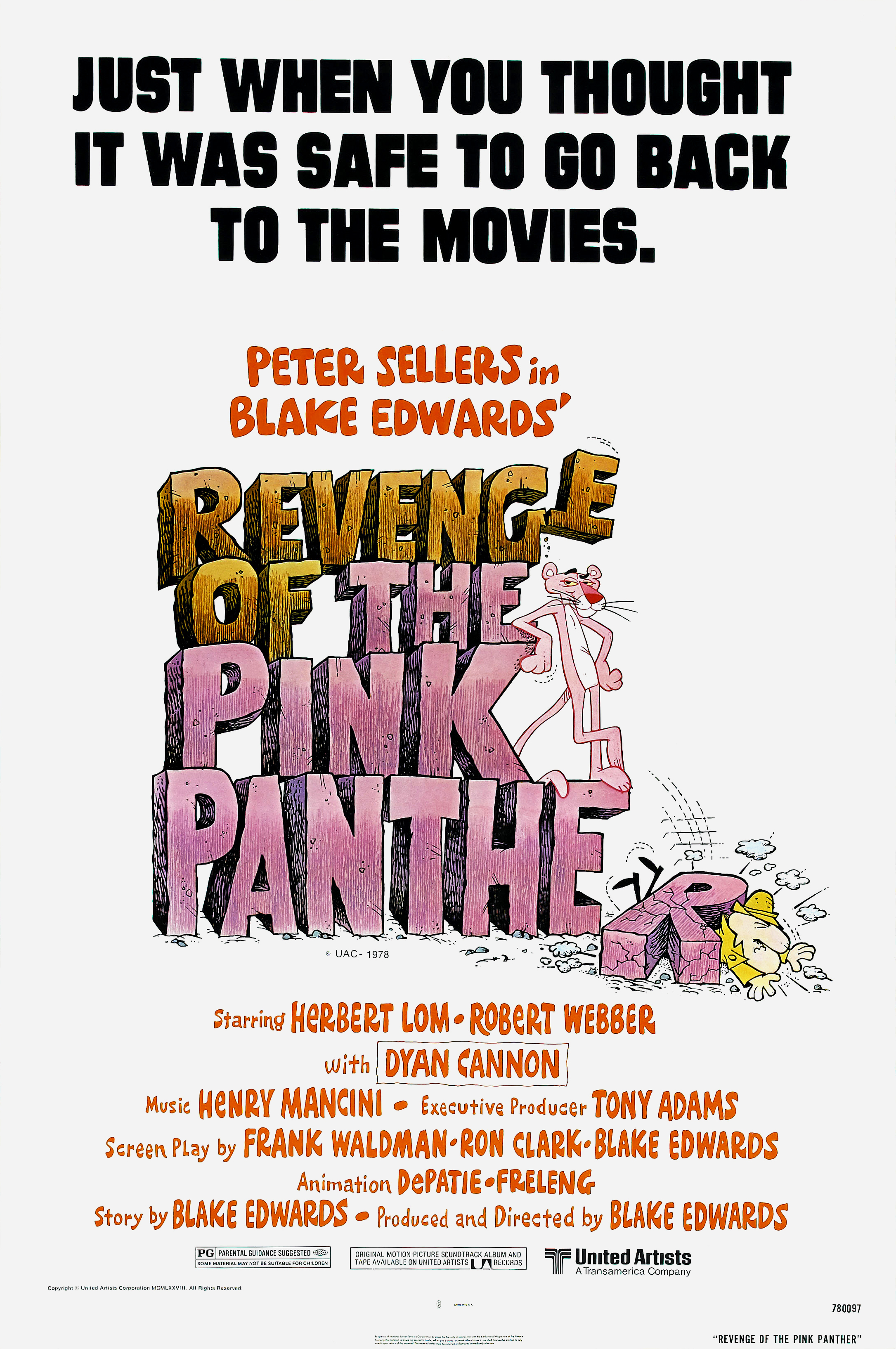
Guy (Stephan Moore) is a writer who is happily married to Annie (Morag Hood) with a toddler son named Charlie (Dickon Horsey). Annie decides to take a trip with Charlie to visit her parents and Guy stays home to work on a writing assignment. While he’s typing away, he remembers meeting Erica (Cherie Lunghi) at a party some months earlier where she gave him her phone number. Now with the wife gone he concludes this would be a good time to give her a call. Erica is excited to hear from him and they go on a mini date before ultimately ending up in her bed. The next morning, he tries to leave but she won’t let him go easily and insists that she’s not a one-night-stand material and instead wants to have a relationship with him. Guy reminds her that he’s married, but she says he can divorce her, which Guy is reluctant to do as he still considers himself content in his marriage and simply had sex with another woman as a diversion. Erica continues to call him, and his phone is constantly ringing even after Annie returns. Guy tells her it’s a wrong number, but Annie becomes suspicious and the next time Erica calls she decides to pick-up. 

If this synopsis sounds familiar it’s because it was the basis for Fatal Attraction. Producer Stanley R. Jaffee became aware of this short film and was convinced it could be expanded into a feature length movie. He even hired James Dearden, the writer-director of this one, to write the script. However, Paramount, the studio that agreed to finance the film, ordered all existing copies of this one to be destroyed, but fortunately a few survived including a bootleg version that was recorded straight off of an A&E broadcast from several decades back. 

I’m a big fan of Fatal Attraction and didn’t feel this version was as good. Too much time is spent at the beginning of Guy taking his wife and child to the airport, which I didn’t think was necessary. The party scene where Erica gives Guy her phone number should’ve been shown in flashback and the Guy character comes off like a geek that probably would only be able to fantasize about having sex with a hot woman like Erica, but not brazen enough to follow through nor would a woman like Erica want to go to bed with him as she could’ve found a better looking guy just about anywhere. In Fatal Attraction, both participants were equally attractive and working at the same firm, so their fling was more organic and made far better sense. 

Fortunately, in this one we don’t see any of the wild sex, which I felt was good as I thought that got in the way in the remake and became a distraction from the main story. Much of the dialogue though between Erica and Guy is almost word-for-word from what gets said between Glen Close and Michael Douglas though here Erica is portrayed as being this cold psychotic while in the other one Close played the role more as a desperately lonely woman, which humanized the character and helped the story be three-dimensional. 

Spoiler Alert!

My biggest grievance is that it leaves open too many loose ends. There is one scene where Guy calls Annie, while she’s still on her trip and supposedly knows nothing about what is going on, to touch base, but Annie is strangely aloof, and Guy doesn’t know why. She had always been very peppy before, which made it seem like Erica had called Annie and informed her of the affair, at least that’s what I thought, but this never gets confirmed and Annie arrives home later back to her perky self, so why did she behave differently during that one call?

The ending works like a gimmick as it has Annie answer the phone, which may or may not be Erica, while Guy stands nervously by. However, once Annie picks-up the receiver the film cuts to the closing credits, so we never know what happens next, which to me was a cop-out. 

My Rating: 5 out of 10

Runtime: 40 Minutes

Not Rated

Director: James Dearden

Studio: Dearfilm

Available: None at this time. 

The Further Adventures of the Wilderness Family (1978)

By Richard Winters

My Rating: 1 out of 10

4-Word Review: Family battles the winter.

The Robinson family (Robert Logan, Susan Damante Shaw, Heather Rattray, Ham Larsen), who moved from Los Angeles to the wild of Colorado during the summer, now must contend with their initial winter there. The first snowfall they find beautiful and enjoy sledding down the hill, but once the holiday season has passed, they face the coldest month and excessive snow. This brings out a hungry pack of wolves lead by ‘Scarface’, which is a black wolf with a disfigured appearance. The wolves are so desperate for food they try breaking into the cabin while the father is away forcing the young boy of only 8 to try to shoot them with his rifle while his sister and sick mother take cover.

At this point it’s hard to believe that the family ever even lived in a city as they seem so well-adjusted to the wild it’s like they must’ve been born there. In fact they’re more able to rough-it than Boomer (George ‘Buck’ Flower) an old-timer who has been living in the mountains his whole life and yet when he sleeps alone as a guest in their back cabin and he becomes scared at seeing bear cubs and raccoons come in during the middle-of-the-night it’s actually the family that is shocked why that should bother anyone even though you’d think them originally being from an urban area it would be the reverse. The father also displays an uncanny knowledge like knowing that when a wolverine sprays a scent onto some meat that they had stored they can no longer eat it, but how the hell does somebody who had lived in Los Angeles his whole life prior be aware of that fact? It’s like he has a direct line to Wikipedia before cellphones, internet, or wi-fi was even a thing.

Like in the first there are more animal attacks though this time it all comes from roaming pack of wolves. However, since they had been through some hair-raising attacks before you’d think they wouldn’t venture back outside unless everyone was armed with a rifle. Yet they foolishly go out in the snow with no guns and then become frozen in terror when the wolves move in, but how many times does this same thing need to happen before they learn to come prepared? The previous attacks from the first movie had been so traumatic I was surprised they weren’t looking over their shoulders at every second versus frolicking around in the open without a care in the world until of course it’s too late.

The mother continues to be the only one who has any misgivings about the move, but then all the father needs to do is remind her of the traffic jams of the city and she immediately backs-off. However, those aren’t the only choices. They could just move to a small town, which wouldn’t have traffic congestion either, but still have running water, electricity, neighbors, and no wild animals breaking into their home in the middle of the night, so why not consider that option?

Spoiler Alert!

The climactic sequence is quite similar to the first one where the two kids and the mother are left fighting off animals’ intent on getting inside though here the anti is upped a bit by having the mom bedridden with illness and a raccoon accidentally setting fire to the place, which just makes it more contrived and isn’t gripping, or exciting. What’s worse is that a doctor flies in afterwards via a helicopter to take a look at the ailing mom and announces she is suffering from pneumonia, but then instead of taking her to a hospital he just leaves her there in the cabin with a big gaping hole in the roof with snow and cold pouring in, which will only make her condition worse.

End of Spoiler Alert!

I’ll give some credit to the picturesque wintertime scenery, but the corny song segments, sung by Barry Williams better known for having played Greg on the ‘Brady Bunch’ TV-show, act as nothing more than filler, which bogs an already anemic story down even further. Young children may be a little more forgiving, but adults should find it flat and one-dimensional. What’s worse is that they actually went on to make a third installment, which will be reviewed next.

My Rating: 1 out of 10

Released: November 15, 1978

Runtime: 1 Hour 45 Minutes

Rated G

Director: Frank Zuniga

Studio: Pacific International Enterprises

Available: DVD, Amazon Video, Tubi, Freevee, YouTube

The Adventures of the Wilderness family (1975)

By Richard Winters

My Rating: 3 out of 10

4-Word Review: Living off the land.

Skip (Robert Logan) is a married father of two who finds his job as a construction worker a thankless routine. The smog of Los Angeles, which is where he and his family reside, is affecting his daughter Jenny (Hollye Holmes) who’s having breathing issues and nothing her doctor has prescribed is helping. He’s also tired of the traffic, which is why one day he tells his wife Pat (Susan Damante-Shaw) that he wants to get out of the city and move to the countryside. After some brief thought she agrees. The family then takes residence in an isolated Colorado cabin that’s rundown and filled with rodents. They’re able though to build a new cabin and move in but then must learn to fight the elements including mountain lions, wolves, and even grizzly bears.

Loosely based on the true-life story of a family that moved from Los Angeles to the remote regions of the Pacific Northwest that was written about in a 1974 New York Times article the film takes too much of a glossy approach to what should’ve been a deeper, more complex drama. The family makes their decision to move too quickly, literally on a ride home while in their pick-up. No scenes showing them having to say goodbye to their friends, selling off all of their belongings, or how they come about choosing the piece of open land that they eventually settle on. I felt for satisfactory emotional impact; to be able to fully appreciate the changes this family was going through those scenes should’ve been shown.

There’s also too much agreement amongst them. They’re all cool with leaving the city and don’t show even a fleeting second thought about it. As a kid that would mean giving up all their friends and playmates, TV-shows, and music and all the other conveniences of suburban living that I’m just don’t believe most children would roll with like here. It would’ve been much more of an interesting story had at least one of the kids been opposed to the move or put up a big fuss only to then maybe soften to the idea once they got out there. It could be done in reverse too with a child really excited to only to change their mind once they came face-to-face with the harsh reality of being in a wilderness long term. Going on a vacation to the woods is one thing but permanently leaving the only life you know to relocate to the middle of nowhere would certainly bring I would argue a lot of tears and adjustment and yet absolutely none of that occurs here making it vapid and lacking any type of character arch. 

What had me even more flabbergasted was that these kids get attacked by wolves and even bears and still don’t want to go back to the city. Yes, there would be smog, but I might be willing to begrudgingly accept that if it meant no more wild animal attacks. I was a kid once too, growing up in that time period, and if I got uprooted like that and went through all the hardships they did, I’d be screaming to go back home making the kids here seem unrelatable. The mother does to some extent put up a meek argument about wanting to go back, but it’s done in a light and gentle manner, and she immediately backs down when the others don’t agree, which makes for non-compelling interactions. 

The scenery is pleasant, filmed at the state park near Gunnison, Colorado, but it becomes like a nature propaganda movie where the only accepted opinion is that living in the country is great, even with the challenges, and no other point-of-view is allowed. Having a debate about the pros and cons of both would’ve added more subtext and made it less one-dimensional. The sappy songs done over the action is nothing but a time filler and proves how overall threadbare it is.

Sure there are a few intense moments including the climactic bear attack with the mother and children trapped in a cabin trying valiantly to fight him off, but whole thing works in a loop where every 10-minutes or so there’s some sort of confrontation with a wild animal, the family then considers giving up on the whole wilderness thing, only to agree to stay and then it starts all over again. Eventually by the third act it becomes quite uncompelling.  

My Rating: 3 out of 10

Released: December 19, 1975

Runtime: 1 Hour 39 Minutes

Rated G

Director: Steward Raffill

Studio: Pacific International Enterprises

Available: DVD, Amazon Video, Tubi, Freevee, Plex, Roku, YouTube