Category Archives: 70’s Movies

The Corruption of Chris Miller (1973)

corruption

By Richard Winters

My Rating: 8 out of 10

4-Word Review: Is he the killer?

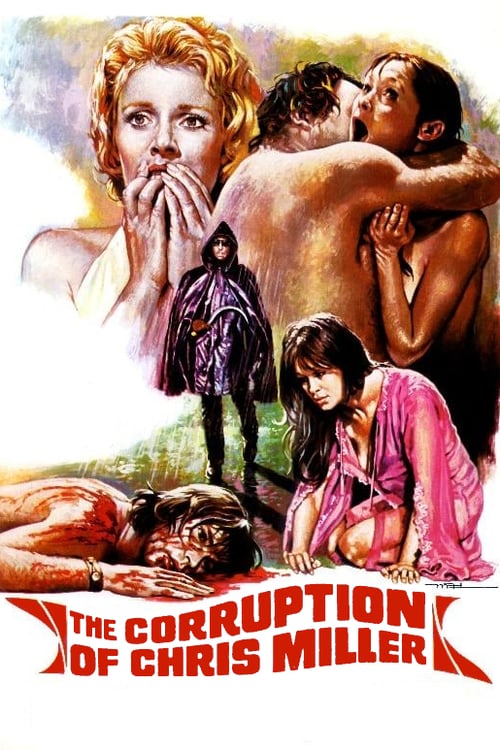
Ruth (Jean Seberg) has been abandoned by her husband leaving her alone in his large isolated estate with only his daughter Chris (Marisol) to keep her company. Chris has issues of her own as she was raped years earlier as a teen while in the girl’s shower at her school by a weightlifter and whenever it rains the sound of  falling water brings back the horrible memories, which cause her to lash out with a sharp object, as if defending herself, to anyone who comes near. Ruth has learned how to talk her down from these episodes, but she’s getting tired of dealing with it as well as the hateful comments that Chris gives her as she blames Ruth for her father leaving them. Barney (Barry Stokes) is the drifter who comes into their lives. Initially it was just for the night, but as he gets to know the two and their inner-dynamics he becomes intrigued as well as sexually attracted to Chris. He and Chris begin a romance, much to the displeasure of Ruth, who wants Barney to herself. Meanwhile there’s a rash of killings that are going-on in the nearby town and Ruth and Chris begin to believe that Barney may be the culprit. 

The film was helmed by renown Spanish director Juan Antonio Bardem and while differing some from the giallos released in Italy this is still considered in high regard by fans of the genre. Bardem’s use of mood and atmosphere are the main selling points. The house, both the one that Ruth and Chris reside in as well as the stately country manor that gets featured during the opening murder, are given strong foreboding presences and the non-stop pounding rain adds an eerie element. 

The gore isn’t quite up to the level of Italian horrors. There’s lots of blood, but the onscreen violence is minimal. There’s also a lot of soft-focused shots of horses galloping and of the beautiful Marisol riding on one until it almost seems like a non-horror film, but there’s enough underlying intrigue to keep it interesting through the slow spots. The climactic stabbing more than makes up for it as it features shots of the blade going directly into the naked flesh of the victim versus done over clothing where the prop knife can more easily be concealed. It also gets done in slow-motion, which makes it look even more horrifying, but in a visually striking sort of way. 

The acting is excellent and includes Seeberg, who was once the darling of the French New Wave during the early 60’s, but by this time had gracefully grown into middle-aged roles, of which she does well though her facial expressions are a bit overdone. Marisol, whose career began as a child singer, is terrific too and in some ways she upstages her co-star with her distinct eyes, which have an hypnotic effect that focuses your attention on her in every scene that she’s in.

Spoiler Alert! 

The twist ending is original though questionable. The reveal of the killer, played by Rudy Gaebel, is a bit mechanical as no explanation is given for what lead police to him, we just see him carted away in hand-cuffs, where having a smoking-gun reason that the viewer could understand would’ve been more satisfying. Having the townspeople celebrate his arrest seemed a bit precipitous as sometimes murderers can still have mistrials, or be deemed not guilty by a jury, so just having some guy nabbed by the authorities doesn’t end things it’s just the beginning especially since police can be known to sometimes arrest the wrong person.

Having pea sprouts grow through the cracks in the tar of the roadway, which causes the road crew to dig up that portion of the highway where they then discover the dead body of Barney, which Ruth and Chris buried there, is a problematic too. First I’m not sure pea sprouts would be a strong enough plant to create such cracks and it would take many years for that to happen. The police wouldn’t necessarily know who buried him as Chris was only seen in public with Barney once by a family that eventually got murdered, so there’s otherwise no direct link between him and the women. Therefore the discovery of  the corpse would not immediately lead to the women’s arrest, as the movie seems to want to imply, if ever. 

My Rating: 8 out of 10

Released: May 17, 1973

Runtime: 1 Hour 52 Minutes

Rated R

Director: Juan Antonio Bardem

Studio: Ibercine S.A.

Available: DVD, Blu-ray, Tubi 
The Manitou (1978)

manitou

By Richard Winters

My Rating: 0 out of 10

4-Word Review: Tumor on her neck.

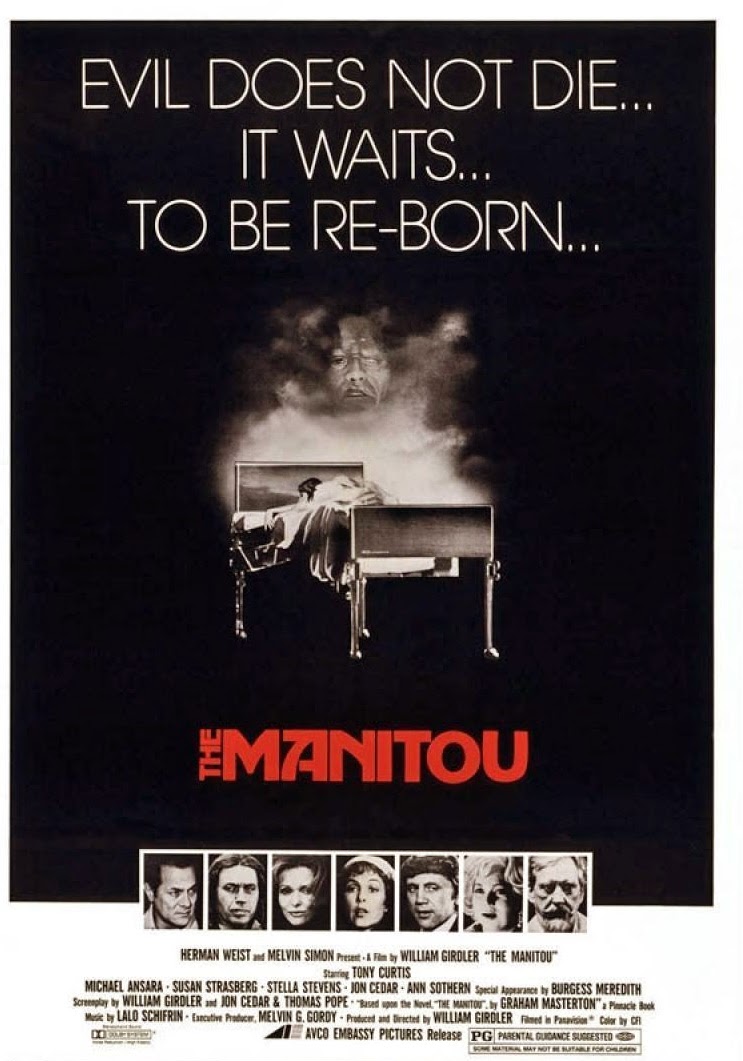
Karen (Susan Strasberg) is a middle-aged woman living in San Francisco who begins noticing a lump on the back of her neck that grows at an accelerated rate. She goes to the hospital to have it checked and the doctors there, after analyzing the X-rays, believe it to be a fetus growing within the tumor. Karen’s boyfriend Harry (Tony Curtis) does some research and discovers that the growth is an Indian shaman reincarnated from a past life who’s brought back to take revenge on the white man for driving his people off of their land. When the surgery to remove the tumor goes wrong, Harry summons the help of a modern-day shaman, John Singing Rock (Michael Ansara) to help him get the fetus removed. While John has a strong connection to the spirit world he realizes that the ones he can summon are weak compared to what the spirit who inhabits the growth on Karen’s neck can bring to life.

I’ll give writer-director William Girdler credit, during his brief life and career he directed a lot of movies, 9 of them while still in his 20’s, but the quality of the output was minimal. He did achieve a few cult hits like Sheba, Baby and Abby as well as a couple that did well at the box office, Grizzlybut this one, which came in with a high budget, could be considered his worst. The cast is interesting, though they’re well past their prime, but the plot, which is based on the best-selling novel of the same name by Graham Masterton, is too silly to be taken seriously.

Girdler shows more interest in capturing the San Francisco skyline, of which he does well, and some of the city’s more exotic locales, then spotting continuity errors. One of the most glaring ones is when the surgeon, played by Jon Cedar, who co-wrote the script, severely cuts his hand during the surgery, but then later he’s in a scene where his hands look fine and there’s no bandages on them. There’s also several moments where I was literally laughing-out-loud, like when an old lady, played by Lurene Tuttle, becomes possessed by the Indian spirit and begins dancing around the room and speaking in a deep voice, which looks as silly as it sounds. The seance is laughable too and since these have been parodied so much it’s best not even putting them into any horror movie that hopes to take itself seriously as it’ll just have the viewers-rolling-their eyes from the very beginning.

The main characters are a mess mainly because they don’t have much to do. Curtis plays this phony psychic who does nothing but stand around and watch Ansara do all the work to the extent that Ansara should’ve been the star and Curtis, who’s looking haggard and washed-up here, could’ve been cut-out completely and not missed. Strasberg is boring as the victim. She has this giant growth on her neck that’s expanding rapidly and yet she takes it in a ho-hum, laid-back fashion when anyone else would be stressing-out and going crazy with anxiety. There also should’ve been a specific reason why she got targeted with the tumor instead of just writing it off as a ‘random occurrence’.

The third act picks-up slightly and the birth of the Indian spirit where you see him claw his way out of the womb while still on Strasberg’s neck, is visually impressive from a special effects perspective, but once outside he looks too much like a dwarf in an Indian get-up. Having the entire floor of the hospital turn into a frozen polar zone is cool until you start looking at the ice blocks too closely and realize they’re just styrofoam. The climactic sequence in which a now topless Strasberg battles the Indian spirit using telekinetic powers while seemingly floating in outer space is too stupid for words and cements this as a complete embarrassment for all those involved.

My Rating: 0 out of 10

Released: April 28, 1978

Runtime: 1 Hour 43 Minutes

Rated PG

Director: William Girdler

Studio: AVCO Embassy Pictures

Available: DVD, Blu-ray, Amazon Video, YouTube

Assault (1971)

assault1

By Richard Winters

My Rating: 5 out of 10

4-Word Review: Schoolgirls attacked by rapist.

One day after school Tessa (Lesley Ann-Down), a teen who attends a local British high school in rural England, decides to cut through the nearby woods as a shortcut on her way home. As she treks through the forest an unseen assailant attacks her, which leaves her in a catatonic state. A few days later, despite the warnings, another female student goes into the woods and is later found murdered. The police inspectors (Frank Finley, James Cosmo) have idea who it could be and are unable to come-up with any leads, which frustrates the local teacher Julie West (Suzy Kendall). She decides it’s up to her to nab the culprit, so she uses herself and some of her students as bait to lure the killer out. She drives into the woods in a station wagon, but then the car gets stuck. While she tries to back it out she gets a glimpse of the perpetrator’s face as he deposits another of his victims, but when she describes to everybody what he looks like, saying he has the face of the devil, everyone thinks she’s gone mad.

This is another one of those British thrillers where in an attempt to gain more interest in the film the studio would release it under different titles. In the US the film was known as ‘In the Devil’s Garden’ to take advantage of the possession craze that was occurring after the release of The Exorcist and then a few years later it got re-released under the title ‘Satan’s Playthings’ and billed as a provocative story with erotic overtones. In either case the plot, which is based on the novel ‘The Ravine’ by Kendal Young, comes-off more like a cop drama/mystery than a horror flick.

That’s not to say it’s bad as director Sidney Hayers throws in some good touches. The attack on the girl is well handled using a hand-held camera that makes it seem unrehearsed and sudden. For a British thriller it’s even kind of racy. Normally films from England are quite timid about showing nudity, blood, or violence, but this thing does push-the-envelope a bit, far more than I was expecting, while still remaining ‘tasteful’ enough not to come under the ire of the British censors. The pounding music score helps create an urgent mood and grabs your attention at the start though it gets overplayed by the end and resembles a score heard on a cop TV-show.

The acting is good, but seeing Down looking so young and appearing much different from what we’re used to seeing her now kinda threw me off as you’d almost think she’s a completely different person. Kendall, who became a British scream queen for all the horror movies and thrillers that she was in, is quite appealing and I loved seeing her in glasses, which gives her a certain sexy look. The male actors are okay, but there’s more of them than are necessary and I think this was only done to create more suspects to choose from though their 70’s haircuts complete with long sideburns gives the film a very dated quality.

I was able to guess who the culprit was with about 20-minutes to go. It’s not that hard to figure out and the film gives-off a few too many clues to the point that it would be hard for someone not to know who it is. The story itself is standard. Not much thrills or chills though the electrocution via a cable that the victim touches while climbing up an electrical tower is admirably realistic and probably the most impressive part of the movie.

My Rating: 5 out of 10

Released: February 11, 1971

Runtime: 1 Hour 31 Minutes

Rated R

Director: Sidney Hayers

Studio: J. Arthur Rank Film Distributors

Available: DVD, Blu-ray

What Became of Jack and Jill? (1972)

jack2

By Richard Winters

My Rating: 7 out of 10

4-Word Review: Greedy couple learns lesson.

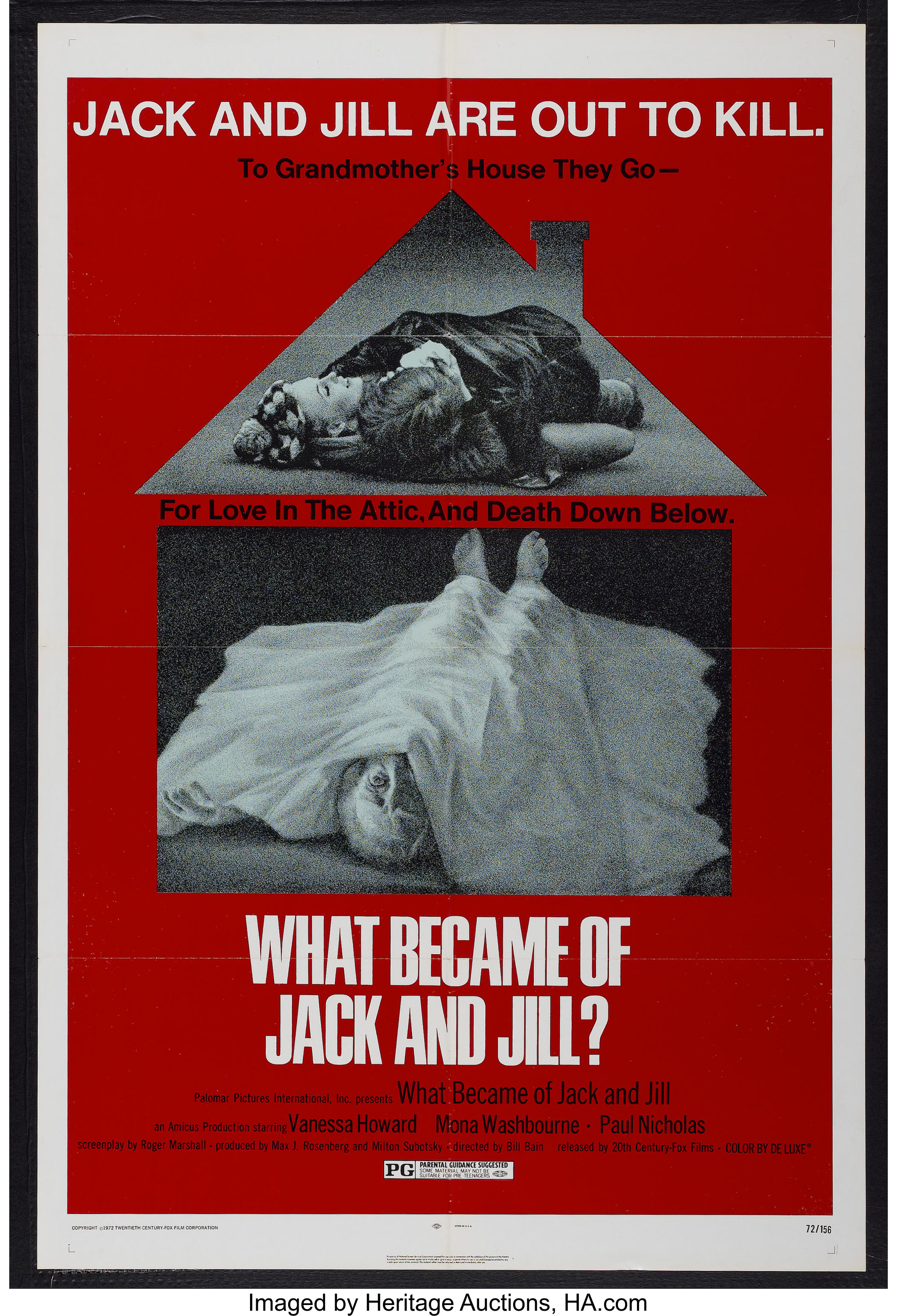
Johnnie (Paul Nicholas) lives with his elderly grandmother Alice (Mona Washbourne). He has no motivation to get a job and hopes that by staying in her good graces he can inherit her small fortune and house when she passes away. Johnnie’s girlfriend Jill (Vanessa Howard) becomes impatient waiting for the old lady to die and hopes to hasten it by hatching a plan with Johnnie where Alice will think that a youth movement has occurred where those under 30 rebel against the older generation, particularly those over 75, by taking them away to prison camps, or killing them outright. Johnnie manipulates Alice into believing that this movement has pegged her as their next victim and even stages a protest outside her home to convince her that they’re coming for her. Succumbed with fear Alice drops over with a heart attack, and the couple believe they now can get their hands on her money, but at the reading of her will they find that Alice has placed a stipulation that they weren’t expecting.

The filmed was produced by Amicus Productions, which was a British film studio that specialized in horror movies, mainly those of the Gothic variety. To keep up with changing tastes they decided to dabble in the grindhouse genre and picked this story, which was based on a novel called ‘The Ruthless Ones’ by Laurence Moody, as their first venture. They were so impressed with Vanessa Howard’s creepy performance in Mumsy, Nanny, Sonny and Girly that they signed her on as the star hoping to make her their next ‘scream queen’. Howard, who was upset at how the previous film she was in fell into obscurity, that she was happy to take on a new project that would be financed by a well know studio, which she felt would guarantee that the picture would receive strong box office appeal. Unfortunately, once the project was finished Amicus studio heads were aghast at the dark subject matter and decided not to release it causing this movie to become as obscure as Howard’s other one, which in-turn disillusioned her wit the business and causing her to retire.

The story does have its share of faults. There’s no explanation for what happened to Johnnie’s parents, or what their take is on his living situation. His ability to fool the grandmother into believing such an outrageous conspiracy theory happens too easily and is hard to believe, but the dark story elements, despite the slow pace, still holds adequate intrigue. A lot of credit goes to the performances. Howard is quite nasty, but in a different way than she was in her other movie where she behaved like she was in a trance, but here is knowingly devious while also shockingly callous. Washbourne is also terrific causing you to gain sympathy for her character and what she goes through.

The twist is good, but not a complete surprise and it takes too long to get there. My biggest gripe is that once the story shifts it doesn’t explore enough of the wrinkles that it creates. There’s a whole array of different plot threads it could’ve taken, but instead settles for the most obvious one culminating in a climax that peters itself out instead of inviting in even more twists and characters to it.

Spoiler Alert!

The stabbing scene is problematic in that the victim clothes get stained with blood, but there’s no rip in the clothing to represent where the knife was able to get through. A person can’t bleed unless a sharp object touches their skin and for that to happen it needs to be able to cut through the fabric on top of it, so to have a shot where the victim is ‘bleeding’ into their clothing, but clothing itself  isn’t ripped is illogical. Also, having the police continue to stand outside the home and politely knock on the door to be let in, after they become aware of what Johnnie has done, while he remains inside refusing to open it, got overdone. At some point the police are going to have to break down the door if the suspect refuses to come out and this should’ve been shown.

End of Spoiler Alert!

Overall I still enjoyed it especially the music played over the opening and closing credits and during the club scenes. I don’t know what the name of the band was, but it has a great punk band-like sound that’s distinct and hard edged. If the movie itself won’t get the proper Blu-ray release that it deserves then the soundtrack at least should.

My Rating: 7 out of 10

Released: June 16, 1972

Runtime: 1 Hour 33 Minutes

Rated PG

Director: Bill Bain

Studio: 20th Century Fox

Available: None

Mumsy, Nanny, Sonny & Girly (1970)

girly1

By Richard Winters

My Rating: 3 out of 10

4-Word Review: Family plays weird games.

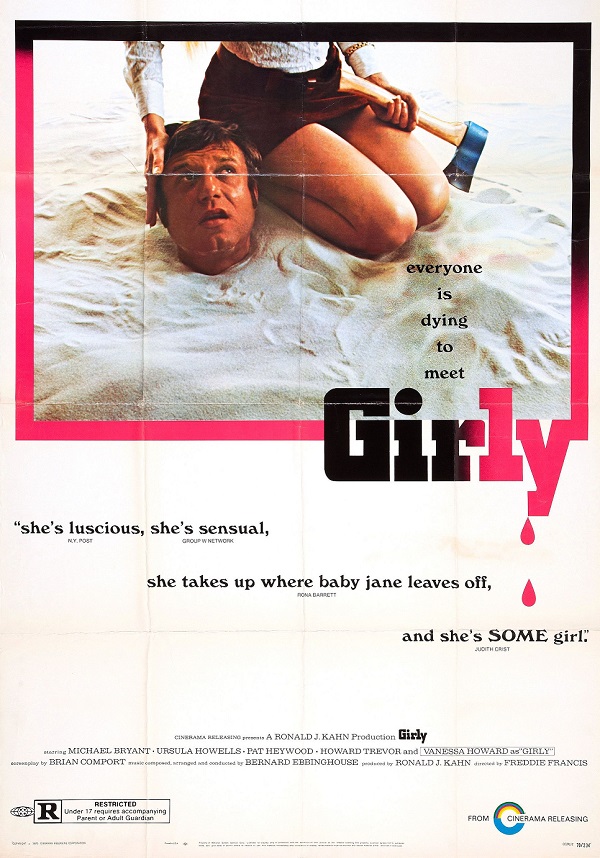
Sonny (Howard Trevor) and Girly (Vanessa Howard) are brother and sister who live with their mother (Ursala Howells) and nanny (Pat Heywood) in a large stately mansion in rural England. Despite both being adolescents they still sleep in cribs and behave as if they’re only 5. They enjoy playing what they call ‘The Game’, which is bringing home strangers, usually homeless men that they’ve met at a park, and forcing them to dress in a schoolboy’s outfit and compelled to behave like a child. If they refuse they are then ‘sent to the angels’.

The film was a product of famed British cinematographer Freddie Francis who wanted to make a movie inside the Oakley Court, which is a castle built in 1859 that overlooks the River Thames. He commissioned his friend Brian Comport to write the screenplay with the only condition being that the action had to take place on the Oakley Court property. Comport decided to revolve the plot around a play called ‘Happy Family’ written by Maisie Mosco, which dealt with a family that got involved with role playing games. Both Francis and Comport disliked the play, but were intrigued with the concept and decided to turn it into the genesis for a horror movie.

The film can best be described as experimental and has an intriguing quality to it, which holds your interest for the first 30-minutes, or so. One of the best elements is the alluring performance of Vanessa Howard, who’s able to mix her beauty with that of an evil mischievous nature. In fact the entire cast does an exceptionally fine job despite the material not offering much in the way of characterizations. The cast gives off an energetic zeal that keeps you compelled even as very little else happens. I kept thinking how sad it was that these actors put so much effort into a movie that fell into obscurity almost right away and this it turns out was the very reason why Howard left the profession just a few years later.

Outside of the acting there’s little else to recommend as the flimsy plot gets stretched far more than it should. There’s also no normal character that the viewer can relate to. Initially I thought it would be Michael Bryant, who plays a middle-aged male prostitute that they bring back to their place as one of their ‘new friends’, but he ends up behaving almost as weirdly as the rest. There should’ve been some outside force that intervened like a police inspector that would come to the castle to investigate the disappearance of one of the prostitute’s female clients, played by Imogen Hassall, that he and the two teens kill when they push her off a slide, which could’ve added tension and nuance that is otherwise lacking.

The film is also too skittish with the shocks. It’s supposed to be a horror movie, but there’s barely anything in it that’s all that disturbing. Sure, it does imply some dark things, but it doesn’t show any of it. The victims die too easily to the point that the death scenes aren’t any fun to watch. The part where a woman falls from a children’s slide at a playground and dies instantly is ridiculous as it wasn’t a high enough for the fall to have been fatal.  Another scene is the discovery of a severed head inside a boiling pot of water, but it never  gets shown, which comes-off as a total cop-out. I realize this was made in the 60’s in England where the culture was quite prudish to gore and violence, hence the creation of the infamous ‘video nasties’, which was a list of banned horror movies that came out about a decade later, but if you’re going to create a story that is dark and edgy, such as this one, then you should have the balls to push-the-envelope in order to give it a payoff, which this thing is ultimately devoid of.

Alternate Title: Girly

Released: February 12, 1970

Runtime: 1 Hour 47 Minutes

Rated R

Director: Freddie Francis

Studio: Cinerama Releasing Corporations

Available: DVD, Amazon Video

The Toolbox Murders (1978)

toolbox

By Richard Winters

My Rating: 5 out of 10

4-Word Review: Handyman targets female tenants.

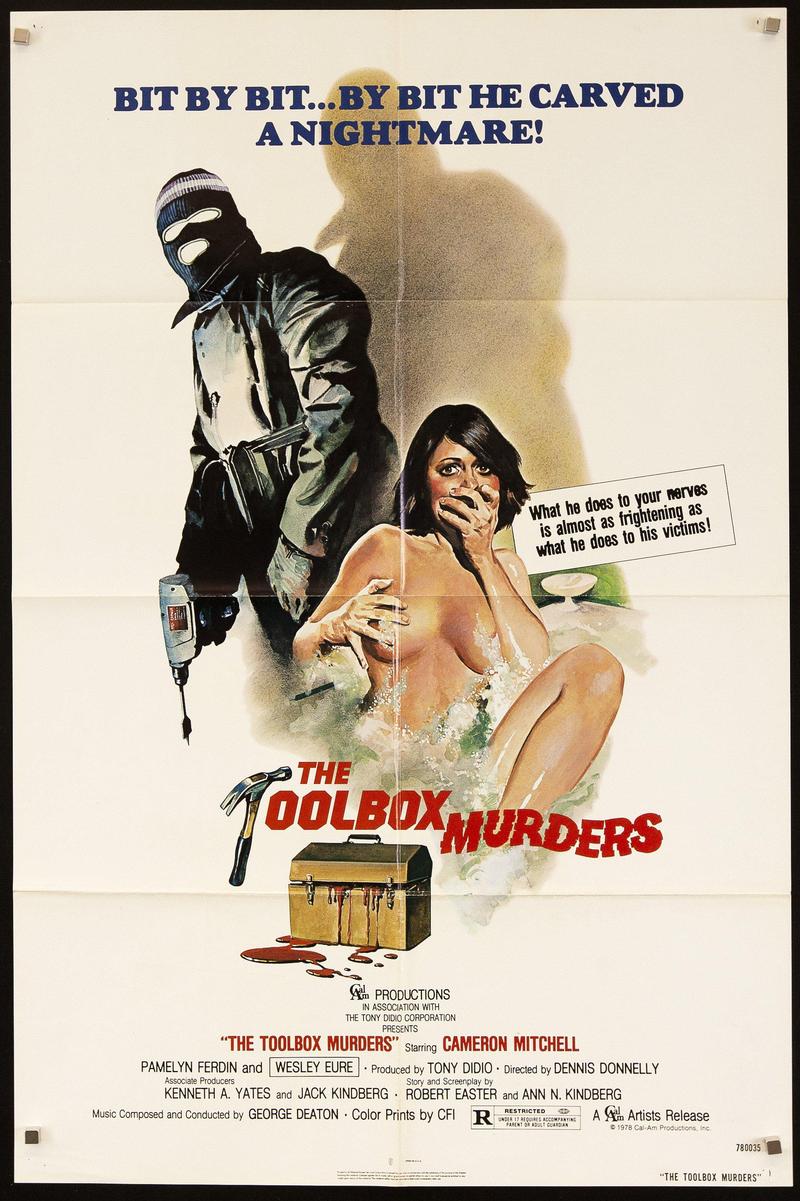
A man, haunted by memories of the death of his young daughter in a car accident years earlier, begins systematically killing-off women residing in an apartment complex who he believes are living sinful lifestyles. Laurie (Pamelyn Ferdin) is a teen who lives in the same complex just a few doors down from where the murders occurred. One evening while alone the killer sneaks into her place and kidnaps her. Since she resembles his deceased daughter he does not kill her, but instead ties her up to a bed where he talks to her as if she’s his daughter come back to life. As she remains imprisoned her brother Joey (Nicolas Beauvy), unhappy with the sloppy job done by the police, decides to do the investigating of his own with the help of Kent (Wesley Eure) who’s he nephew of Vance (Cameron Mitchell) who owns the building where the murders have been happening. Joey unearths clues, which leads him to believe he knows who’s responsible, but finds opposition in Kent, who wants to block him from finding out who the culprit is.

This film was just about the final word in graphic exploitation fare that permeated the era where every horror film competes to see how they could be gorier and more explicit than the others. This one is unusual in that it starts out right away with the killings, but then during the second and third act it slows way down and becomes a talk-feast with very little gore at all. I did though find it interesting where instead of intense, creepy music that usually gets played when a killer stalks his victim we instead hear laid-back country songs, which would’ve been even more inspired had they not all been by the same artist.

The identity of the killer is given away early, which is also different from other slashers that try to keep it a secret until the end. In a lot ways this makes it less intriguing though Mitchell’s performance still keeps it interesting. What I didn’t like was the stupid police inspector, which is poorly played by Tim Donnelly who was the brother of the film’s director, and his inept ability to figure out who the killer might be even though the viewer and other characters catch-on very quickly. I know some policemen aren’t always the smartest, but even the dumbest would’ve been able to pick up on the obvious clues that this one unbelievably overlooks.

The fact that none of the women scream, at least not during the first act, was rather bizarre especially when one of them (Evelyn Guerrero) walks into the crime scene sees her friend (Marciee Drake) lies in a bloody mess, but she doesn’t respond in a shocked way and just stares as if gazing at a picture on the wall. Having the police interview the neighbors directly over the nude, dead bodies of the victims, was a bit ridiculous too as the victims in most any other crime scene would’ve been covered in a blanket and taken away to a coroner and the scene secured before anyone else could be let in that could potentially tamper with the evidence.

The biggest thing that bugged me was that it’s never shown how the killer is able to so easily get into the apartments. I realize it’s because he has a master key, but that actually needs to be shown with a shot of a key going into the lock. The film though never does this, so instead we just see the door knob turning like these people have been dumb enough to leave their doors unlocked even as a killer lurks about.

The performances are the one thing that holds it together. I especially liked Ferdin and the genuine look of fright in her eyes and tears rolling down her face as she’s been held hostage. Her sincere expression of terror connects with the viewer and makes them even more concerned for her welfare. I’m also friends with her on Facebook and she’s posted about the final scene where she’s wandering around a parking lot barefoot and in her nighty, which was apparently shot in cold temperatures, so having her dressed like that in such freezing conditions and remain professional is commendable too. It’s also entertaining seeing Wesley Eure, best known for his work in the TV-show ‘Land of the Lost’, playing a psycho, of which he’s surprisingly effective.

While the denouncement states that this was based on actual events it really wasn’t. It was loosely inspired by some cases of serial killers using tools to kill their victims, but the characters and overall scenario was largely made-up. The story was remade in 2004, but much of the violence and explicitness of this one was taken-out and toned down while also making major changes to the plot.

My Rating: 5 out of 10

Released: March 3, 1978

Runtime: 1 Hour 34 Minutes

Rated R

Director: Dennis Donnelly

Studio: Cal-Am Productions

Available: DVD, Blu-ray, Amazon Video, Tubi, YouTube

Crash! (1976)

crash

By Richard Winters

My Rating: 4 out of 10

4-Word Review: Wife has occult powers.

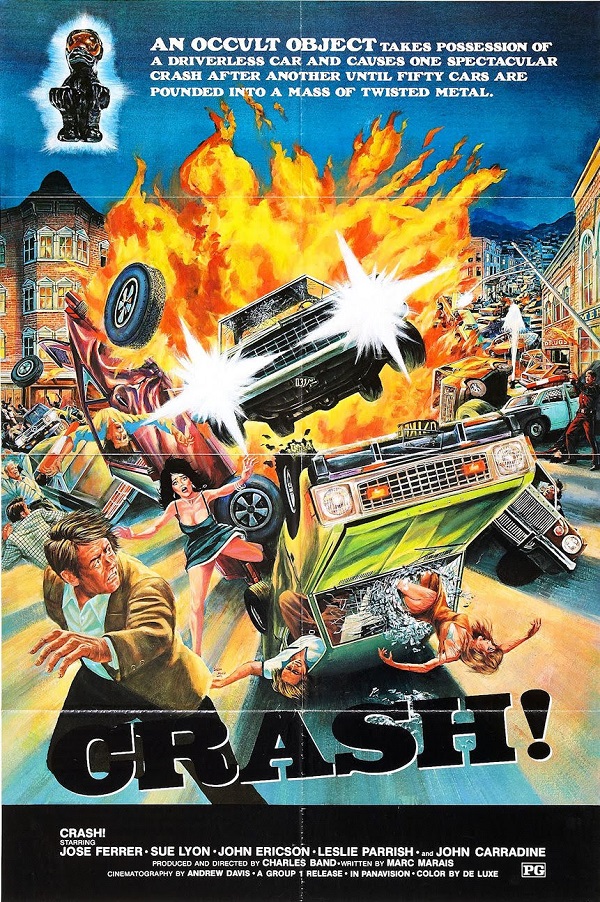
Kim (Sue Lyon) and Marc (Jose Ferrer) are a married couple with a 30-year age difference between them. Initially they were a happy twosome, but then Marc got into a car accident that left him bound to a wheelchair and the passion between them lessened. Now Marc resents the fact that Kim no longer seems to love him and worries that his attractive and much younger wife will go off and find another suitor. He plots to have her killed by having his trained doberman jump into her car as she’s driving and attack her. While the dog does injure her it’s not enough to kill her. As she lies in her hospital bed Marc sneaks in and disconnects her from her intravenous tube, which he hopes will be enough to end her life, but he fails to notice that she’s clutching in her hand an artifact that she had bought earlier at a flea market, which gives her special psychic abilities. These powers allow her to terrorize Marc even when she’s not there by making inanimate objects, including both her car and his wheelchair, come to life and begin attacking him. 

This was the first feature length film directed by Charles Band, who has gone on to have a long career both producing and directing B-horror films some of which have been successful. This one reveals his producer mentality by keeping the flimsy plot moving by adding in a lot of action, in this case tons of car stunt footage, to the mask the fact that the story itself doesn’t have much going for it. To a degree the car crashes are well choreographed, but there’s too many shots of police cars getting destroyed, which is reminiscent of the car chase action comedies making this seem more like a silly comedy than a would-be horror film.

The most impressive thing is the driver-less car. This is similar to the concept used in cult flick The Car, but that automobile had a roof over it and darkened windows, so you presumed that a stunt driver was inside controlling it, but here this vehicle is a convertible and there’s no one sitting in it even as it careens down the road. How they were able to pull this off I don’t know, but this fact alone makes it far more interesting to see than the other one even though that one, for whatever reason, received more attention and fanfare despite both coming-out at around the same time.

I was willing to give this 6-points, but then Band makes the misguided mistake of repeating near the end the car crash explosions we’ve seen before making it seem like a ‘highlight reel’. I’m not sure for the reason other than alluding to the mysterious occult power communicating to  Kim about what has gone on while she was in the hospital bed, but it was unnecessary and comes-off like amateurish film-making to the extreme.

The eclectic cast of familiar faces who were once A-list stars, but now forced to accept B-grade material in order to stay busy, is interesting and helps save it a little. I was particularly impressed with Ferrer who gives a convincing performance and doesn’t just ‘phone-it-in’ despite the otherwise subpar quality of the script.

Lyon’s appearance here is intriguing as well as she shot to fame back in 1964 as the beautiful teen Lolita in the Stanley Kubrick film of the same name and was considered one of the most stunning stars of the decade, but here she plays a part that ends-up making her look quite ugly. Not only is her face bandaged up through most of it, but when they do finally come-off she is shown to be full of garish scars. There’s also scenes where her eyes are blazing red and resembling that of a demon. I’m not sure if she took this role to play against her beauty stereotype, which she reportedly was not a fan of anyways, or she just accepted the offer because she needed the work, but the things she does here is about as far removed from Lolita as one could possibly get, so watching this simply for that reason may make it worth it to some.

My Rating: 4 out of 10

Released: December 24, 1976

Runtime: 1 Hour 28 Minutes

Rated PG

Director: Charles Band

Studio: Group 1 International Distribution

Available: DVD, Blu-ray, Tubi, Amazon Video

The Redeemer (1978)

redeemer2

By Richard Winters

My Rating: 6 out of 10

4-Word Review: Murdered for their sins.

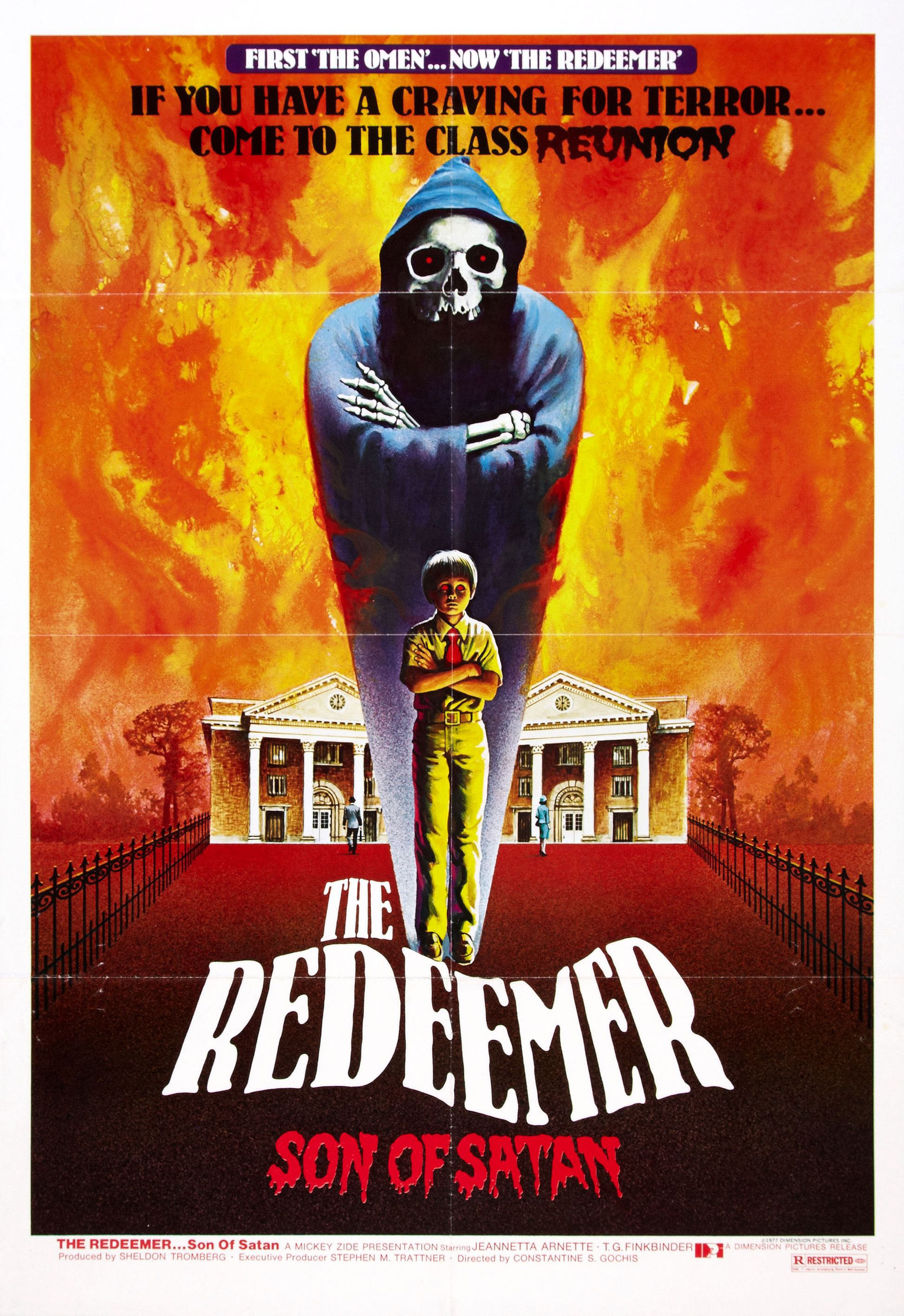
Six people, who attended the same high school and graduated from the class of 1967, get invited to a reunion. When they arrive they find that the school has been shut down and the building abandoned, but are let in by a kindly janitor. Inside is a room set-up for a party including an array of delicious food and drinks. They partake in the meal, but still wonder why they were the only ones from the class that got invited. They then begin getting killed-off in violent ways and when the remaining survivors try to leave they realize they’ve been trapped inside, but none of them knows who’s committing the killings, or why?

This yet another proto-slasher made long before the release of Halloweenwhich has become the standard. Like with Savage Weekendwhich was reviewed here last October, this movie goes on its own tangents, unlike 80’s slashers, with deviations that make for a fun watch and are filled with a lot of weird twists and imagery.

The entire production was filmed on-location in the town of Staunton, Virginia in the summer of 1976. The Staunton Military Academy was the building used for the setting of the abandoned school. It was loaned out to the producers for one month by Layne Loeffler, who appears briefly near the beginning. He was hoping that by allowing the movie to film there that it would generate enough interest to allow the academy  to open back-up, but the movie didn’t gain as much attention as they thought causing it to eventually be torn down just a few years later.

As with most low budget films it has the expected trappings of an independent feature produced and directed by a bunch of first-timers including a grainy film stock, which detractors of the film used as an excuse to hate it. I felt though that the faded look worked in its favor as it made it seem more like viewing lost footage dug up from years in storage and thus witnessing carnage captured by a hidden camera.

Despite the majority of the cast never doing another movie after this one, which includes both the director and writer, I came away more impressed than disappointed. There are indeed some genuinely scary moments and the killings are surprisingly vivid. In fact they look more realistic than many of the ones done in bigger budgeted movies that came-out later. The pacing is handled much better too and doesn’t have the slow, awkward drama segments like in other horrors. Even the characterizations showing people’s need to impress others while simultaneously putting up facades to hide what they feel others will judge them harshly on, a common occurrence in most high school reunions, is well brought out.

Spoiler Alert!

Many only complaint is the ending that doesn’t offer any final twist. I was fully expecting that the character of the Redeemer, played by T.G. Finkbinder, would ultimately be exposed as a fraud since he did the killings over what he felt were various perceived sins committed by the others and yet the film acts like these brutal murders were somehow justified and the victims ‘deserved’ what they got, which is pretty warped. However, outside of its weird messaging, it’s still an interesting obscurity particularly for slasher film collectors.

Alternate Titles: The Redeemer…Son of Satan!, Class Reunion Massacre

Released: October 25, 1978

Runtime: 1 Hour 24 Minutes

Rated R

Director: Constantine S. Gochis

Studio: Dimension Pictures

Available: Blu-ray, Tubi, Amazon Video

Diary of the Dead (1976)

diary2

By Richard Winters

My Rating: 5 out of 10

4-Word Review: Two dead old ladies.

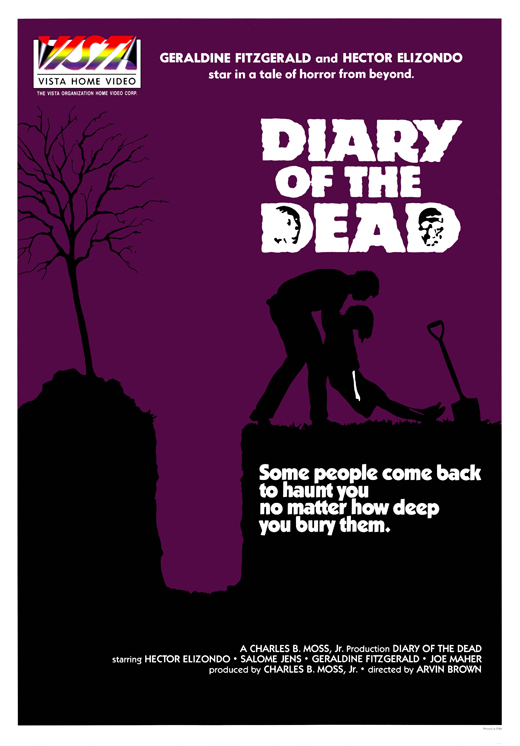
Stan (Hector Elizondo) is married to Vera (Salome Jens) while living in a house that’s owned by Vera’s mother Maud (Geraldine Fitzgerald). Maud and Stan do not get along and she uses the fact that Stan can’t find regular employment as a means to belittle him.  She also tries to convince Vera to leave him. Stan is aware of this, but can’t seem to do much about it. Then one day Maud’s friend Ethel (Kate Wilkinson) comes for a visit. She arrives while Maud is upstairs taking a nap, and is greeted by Stan, but since she had to walk all the way from the bus station to the house and suffers from high blood pressure, she promptly collapses once she gets inside. Stand decides to use this as an opportunity to get rid of Maud by claiming to the attending physician (Austin Pendleton) that the dead body is his mother-in-law, so when Ethel is taken away for cremation everyone thinks it’s Maud instead. Stan then buries Maud’s body, who he has killed on his own, in his backyard, but this catches the eye of his nosy neighbor Walter (Joseph Maher) who had always gotten along well with Maud and feels Stan’s explanation of what happened doesn’t add-up.

The story is based on the 1971 novel ‘One Across, Two Down’ by Ruth Rendell and while the plot has a sufficient amount of twists the direction, by first timer Arvin Brown, is lacking. It’s not liked it’s bad direction, but it has no finesse and seems meant of TV.  It’s no surprise that Brown ended up doing projects exclusively for TV after this one as nothing here is cinematic and approached in such a sterile way visually that it actually detracts from the proceedings.

Elizondo gives a feisty performance that perfectly captures a bitter man going through life with a chip-on-his-shoulder. His arguments and confrontations with Maud lend for some colorful dialogue, but a meddling, cantankerous mother-in-law is nothing new and if anything seems cliched making the material come-off as second-rate and formulaic.

The crime itself isn’t elaborate. In the ‘Columbo’ TV mysteries we’d see the bad-guy pull-off the murder in a way that was carefully thought-out, so the viewer becomes intrigued trying to figure out what flaw the killer overlooked that Columbo will jump on, but here it works in reverse. The crime is spur-of-the moment with a bunch of things that could easily go wrong that will instantly get Stan caught, which isn’t as interesting. Stan is also not a pleasant person, so the viewer is not emotionally invested in him escaping the clutches of the authorities,  If anything you remain ambivalent to what happens, which are ingredients that don’t make the movie interesting.

The film does feature a twist ending, but it’s not something one couldn’t have seen coming as it goes overboard telegraphing it. As an episode of ‘Alfred Hitchcock Presents’ it would’ve worked better, but it gets stretched too thin for feature length. The should also not be confused with the George A. Romero film of the same name that came out 30 yeas later.

My Rating: 5 out of 10

Released: July 20, 1976

Runtime: 1 Hour 33 Minutes

Rated PG

Director: Arvin Brown

Studio: B.S. Moss Enterprises

Available: None

Telefon (1977)

telefon1

By Richard Winters

My Rating: 6 out of 10

4-Word Review: Spies hypnotized to kill.

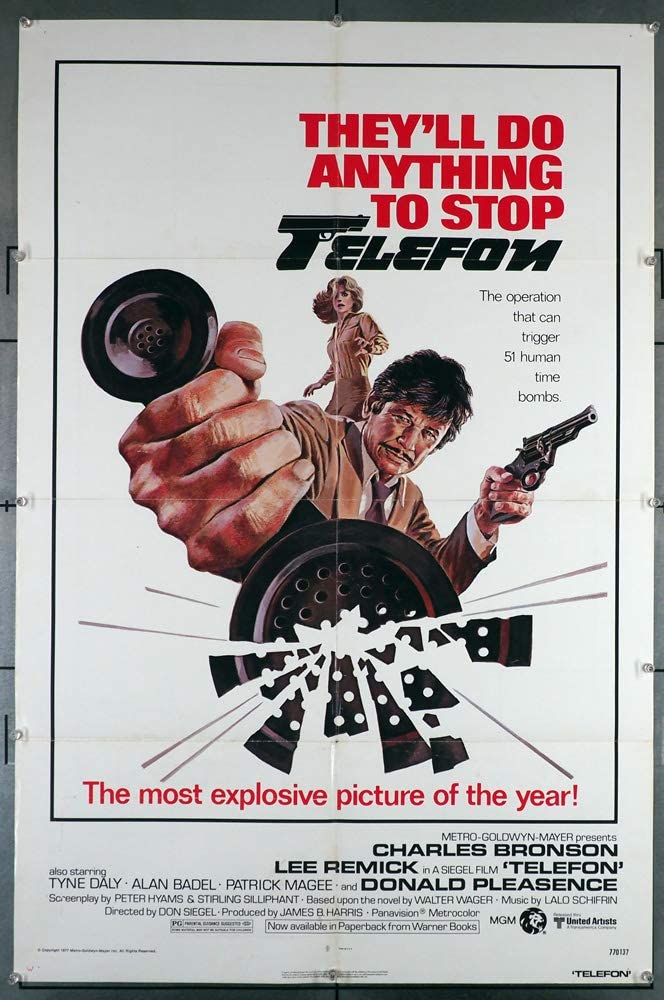
Grigori (Charles Bronson) is a KGB agent ordered to investigate a rash of terrorist activities being done inside the US. All of the crimes are being committed by Russian sleeper agents who are hypnotized to carry-out acts via a call on a telephone where they are read a line from a Robert Frost poem, which  triggers them to act upon preordained instructions. The calls are made by a rogue agent named Nickolai Dalchimsky (Donald Pleasence) and it’s up to Grigori to stop him before it becomes an international incident. While in the US Grigori works with lady agent named Barbara (Lee Remick), who Grigori thinks is on his side, but she’s a double-agent ordered to kill Grigori once the mission is completed.

While Leonard Maltin in his review describes the plot, which is based on the novel of the same name by Walter Wager, as being ‘ingenious’ many others felt it was far-fetched. There actually has been one case in the history of crime, which occurred on March 29, 1951 in Copenhagen,  Denmark, where a man by the name of Palle Hardrup was apparently hypnotized by Schouw Nielsen to carry-out a bank robbery and this lead to two people getting killed. Both men were later convicted and the story was made into a 2018 movie called Murderous Trance. Since then though there has been no other cases on record of this type of thing occurring and many experts in the hypnotic field insist that it couldn’t making what transpires here highly speculative at best.

The issue of Grigori having a photographic memory and able to memorize the names and personal details of all the sleeper agents is questionable too. Many researchers say that this type of phenomenon is only temporary and cannot be retained over a long period. There are others that say the photographic memory is a myth altogether and like with the hypnosis angle, forces the viewer to complete shut off their skeptical side right from the get-go in order to have even a chance of enjoying the movie at all.

The only interesting aspect is Lee Remick and Bronson learning to deal with each other’s contrasting personalities, which makes great use of Chuck’s gruff and brash manner, but I felt Remick as an agent wasn’t believable. When she’s ordered to kill one of the sleeper agents inside a hospital by injecting him with a drug she gets quite nervous, but if she’s killed before, then I’d think it would be like second-nature to her and she’d be cool and calm under pressure. I also felt the film should’ve showed her fully carrying-out the killing instead of cutting away without ever seeing the actual injection.

I didn’t get why she would’ve fallen in love with Bronson as the two had nothing in common and really didn’t get along. The film seems to act off the theory that putting a man and woman together will automatically elicit romance and sexual tensions, but members of the opposite sex work together on jobs sometimes for many years where sex and romance never occurs, so having these two end up getting the hots for each other seemed forced and mechanical. Also, the fact that Remick is a double-agent and Bronson becomes aware of this would make me believe that he, being a professional spy, would never trust her enough to let down his guard to expose his softer side to begin with.

I was disappointed too that several scenes are supposed to take place in Texas, including the city of Houston, and yet ultimately all of  these get shot in either California, at the Hyatt Regency Hotel in San Francisco, which was the same one used in High Anxiety, or on a studio sound stage. Yet there are plenty of other scenes that were shot on-location like New Mexico , Montana, and even Finland, so if they could make it to those places then why not to Texas too?

The climactic sequence, which takes place in a backwoods bar and features a humorous performance by Helen Page Camp, as the wife of the bar owner, gets wrapped-up in too tidy of a way and doesn’t take full advantage of Pleasence, who has been very creepy in his other villainous roles, but here doesn’t make much of an impression. While the film is entertaining on a non-think level it compares poorly to other movies in the spy genre and certainly does not come close to matching many of the better ones.

My Rating: 6 out of 10

Released: December 16, 1977

Runtime: 1 Hour 42 Minutes

Rated PG

Director: Don Siegel

Studio: MGM

Available: DVD-R (Warner Archive)