Category Archives: 60’s Movies

This Property is Condemned (1966)

this property

By Richard Winters

My Rating: 8 out of 10

4-Word Review: Mother pimps her daughter.

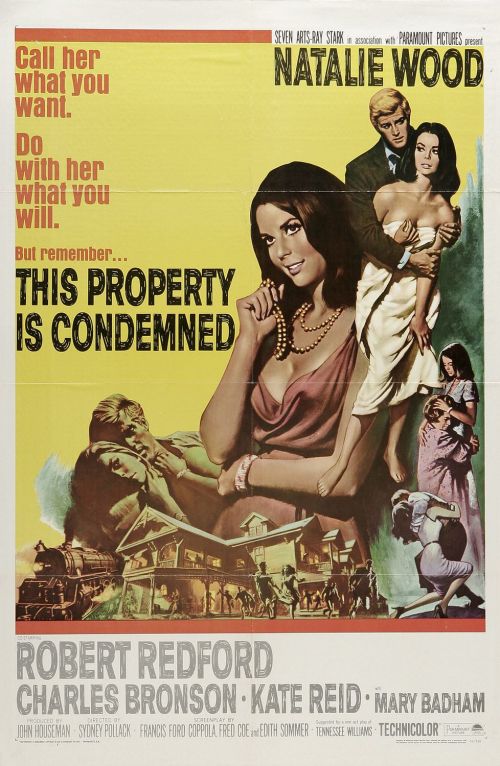
Owen Legate (Robert Redford) arrives in the small town of Dodson, Mississippi in the 1930’s to carry out an unpleasant task. He’s been assigned by his employer to layoff many of the railway workers in the area due to the economic depression. Many in town are not pleased with his presence and want him to go while even threatening him with violence. Alva (Natalie Wood) is the only one who takes a liking to him despite the fact that he consistently gives her the-cold-shoulder in return. She’s been forced by her mother (Kate Reid) to ‘entertain’ the male guests that stay at their boarding house and Owen wants none of it as he finds her dreamy, child-like personality to be off-putting and even an illness. Yet the longer he stays the more entranced with her he becomes, but he wonders if he’ll ever be able to get her away from the clutches of her domineering Mother.

This film was considered by critics at the time to be ‘trash’ and that was most likely due to its provocative subject matter that was clearly years-ahead-of-its-time, but with a script written by Francis Ford Coppola and Fred Coe, produced by John Houseman and directed by Sydney Pollack in a story based on a Tennessee Williams play couldn’t be all that bad and this clearly isn’t and in fact it’s excellent and should be considered a classic instead. The recreation of The Deep South from the ‘30s is spot-on and the on-location shooting done in the small town of Bay St. Louis, Mississippi lends some terrific atmosphere. The dialogue is sharp and the well-paced script leads to emotionally charged scenes of high drama.

Redford’s cool and detached persona is put to great use and I liked seeing a scenario where it’s the girl chasing after the guy for a change. Mary Badham is equally good in her first film after doing To Kill a Mockingbird, but here she is much more attractive with long hair and sans the Tomboy look. There is also solid support from both Charles Bronson and a baby-faced Robert Blake who just three years later reteamed with Redford in Tell Them Willie Boy is Here.

Wood gives an excellent performance as well, but I had a hard time understanding her character as her perpetual flights of fancy didn’t make much sense. The script seems to say that this is her ‘defense’ and escape from her harsh life, but any woman whose been forced into prostitution by her mother and pawed at by literally every man who comes along would most likely become hardened and bitter and learn to distrust and dislike any man who came near her.

Kate Reid as the mother also posed some initial problems as she looks too young for the part and in reality was only 8 years older than Wood who played her daughter. However, there is a birthday celebration where she is given a cake full of candles to blow out, but she refuses as she feels that 43 is getting ‘too old’, which made me realize that back then people had kids earlier even before they were 18 and therefore her still youthful look by our standards could be forgiven and even understood.

The final half is where this thing really comes together and includes a great confrontational moment between a drunken Wood, who really did get drunk in order to get into the scene, as well as her picturesque journey to New Orleans. Like in most movies the odds of her suddenly bumping into Owen after a couple of short days in the city seemed pretty slim, but I could forgive it as the rest of the film is so strong that any minor flaw with it is hardly worth discussing.

My Rating: 8 out of 10

Released: August 3, 1966

Runtime: 1Hour 50Minutes

Not Rated

Director: Sydney Pollack

Studio: Paramount

Available: DVD, Amazon Instant Video, YouTube

Petulia (1968)

petulia 2

By Richard Winters

My Rating: 9 out of 10

4-Word Review: A very brief affair.

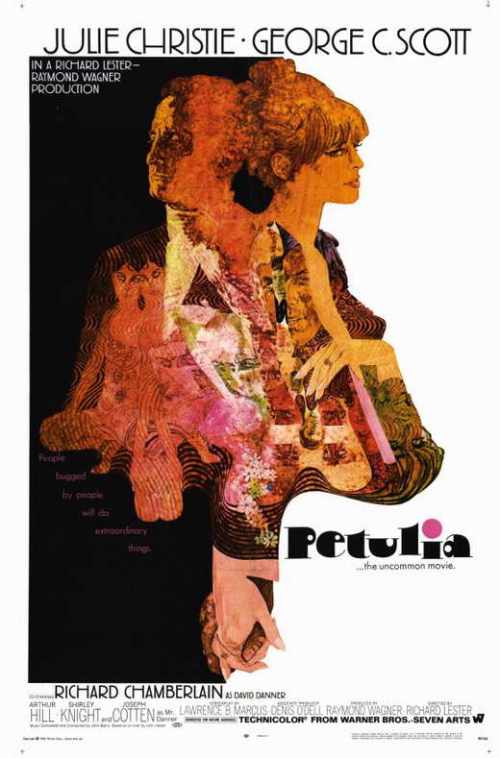
While attending a medical fundraiser Petulia (Julie Christie) who is a married rich socialite, decides to come-on to Archie (George C. Scott), a doctor who performed a life-saving surgery on a young Hispanic boy (Vincent Arias) that she brought to him a few months earlier. Archie is still hurting from his recent divorce to his wife Polo (Shirley Knight) and not sure he wants to jump into another relationship so quickly especially with a woman that behaves in such an eccentric way. However, her kooky personality and good-looks get the better of him and the two spend the night together. In the days that follow Archie learns of her abusive relationship with her husband David (Richard Chamberlain), but when he makes an attempt to help her get out of it she resists, which causes him a great deal of frustration as he is unable to get a good grasp on why she behaves the way that she does.

The film is based on the novel ‘Me and My Arch Kook Petulia’, which was written by John Haase who worked as a dentist and wrote his stories between his appointments. What makes this plot stand out from the rest of the romances is that it focuses on the chance meeting between two people who share an immediate attraction, but are unable due to various extraneous circumstances to ever get it into a relationship stage. They become like two-ships-passing-in-the-night and go on with their lives and even other relationships while quietly longing for ‘the-one-that-got-away’. Most movies portray romances where everything falls into line and works out while blithely ignoring the ones that get shown in this film even though these are much more common.

Director Richard Lester, who is better known for his slapstick comedies, shows an astute eye for detail and his fragmented narrative works seamlessly. I enjoyed the quick edits and color detail as well as the subliminal symbolism including showing the David and Petulia characters wearing all-white to display their sterile marriage as well as capturing David’s father (Joseph Cotton) sitting in front of a giant window that looked like a cobweb to help illustrate how he had entangled Petulia into his own personal web. The film, which was shot on-location in San Francisco, features great shots of the Golden Gate Bridge and the world famous cable cars as well as an interesting scene at the Jack Tar Motel, which has now been demolished but was famous for its ability to check customers into their rooms without the use of a live clerk, but instead through close circuit TV and a room key that would light up when the person passed by their assigned room.

The two leads give strong performances particularly Scott who for a change doesn’t play a character with a forceful personality, but instead someone who inadvertently gets bowled over by a woman who has an even stronger one than he. Even Chamberlain does well. Normally I find him to be quite bland, but here he is surprisingly effective.

This movie also marks the film debuts of many performers who are seen in brief, but quirky bits including: Richard Dysart as a virtual hotel clerk, Howard Hesseman as a hippie, Rene Auberjonois as a seat cushion salesman and Austin Pendleton as a hospital orderly. Members of the Grateful Dead get some funny moments while inside a grocery store and Janis Joplin can be seen onstage singing during the opening party sequence.

Romance fans will like this, but so will those living in the Bay area during the ‘60s as the city gets captured well. However, fans of that decade will also like it as it expertly exudes the vibe from the period and making it seem very real to the viewer even if they weren’t alive during the time it was made. Also, John Barry’s haunting theme nicely reflects the character’s mood and evasive film style.

petulia 1

My Rating: 9 out of 10

Released: June 10, 1968

Runtime: 1Hour 45Minutes

Rated R

Director: Richard Lester

Studio: Warner Brothers

Available: DVD, Amazon Instant Video, YouTube
Laughter in the Dark (1969)

laughter in the dark

By Richard Winters

My Rating: 6 out of 10

4-Word Review: Man obsesses over teen.

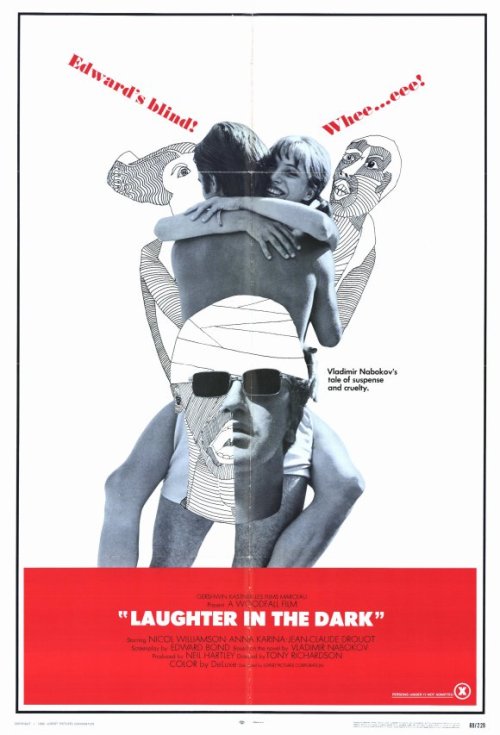
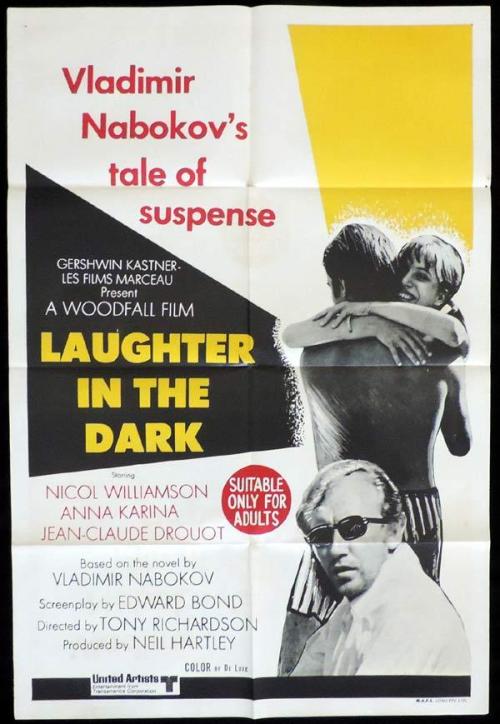
This film is based on an early novel by Vladimir Nabokov, who is more famous for writing Lolita and the story here has a similar theme to that one. The plot revolves around Edward (Nicol Williamson) who is a successful middle-aged art curator, but bored with his marriage and looking for an escape. While watching a film inside a theater one day he spots the beautiful Margot (Anna Karina). While she is only 18 he becomes madly obsessed with her and tries to start-up a relationship. She initially resists, but then realizes that he has a lot of money and decides to play-him. On the side she has a passionate relationship with Herve (Jean-Claude Drouot) who begins to work for Edward as his assistant. Initially Edward has no clue that Herve and Margot are cavorting around behind his back, but eventually he catches on and plots a dark revenge only to find himself as the victim.

While the story has its share of intriguing moments it suffers from featuring a main character that is not relatable.  Fantasizing about having sex with a beautiful, younger woman is fine, but he shouldn’t expect her to automatically reciprocate those same feelings and even if she does he should be concerned that it is only because of his money, which are thoughts that he never once seems to consider. He also spouts out right from the beginning of how much he ‘loves’ her like a lovesick 14-year-old, but a man his age would normally be wise enough to realize that there is a big difference between that and sexual attraction, which is all that this really is.

It also takes way too long for Edward to catch on to the affair occurring between Herve and Margot even though anyone else would’ve seen the red flags a mile-away. It is for these reasons and the way he gets taken advantage of time and again that makes the character come off as suffering from some serious mental defect that is not in any way a normal for even a halfway intelligent person.

It all would’ve worked much better had Richard Burton remained on as the film’s star. He was the original choice for the part and even filmed a few scenes before being kicked off the project due to repeatedly showing up drunk. Williamson is a fine actor and has an impressive resume, but he’s rather benign here while Burton would’ve been able to bring in an extra dimension and because he was older would’ve made the contrasting age difference between him and Margot even stronger.

Karina on the other hand is stunning and an absolute beauty to behold. She was much older than what the part called for, but her wicked, conniving performance more than makes up for it as she eats up every scene that she is in and everyone else in it.

It was filmed on the island of Majorca, which allows from some exotic Mediterranean scenery and Raymond Leppard’s harpsicord soundtrack is pleasing. I also, for the most part, enjoyed the story, which manages to remain intriguing all the way up until its unsatisfying conclusion. The drama though, particularly at the beginning, is clumsy and the whole thing ultimately comes off as a good director’s weakest work.

laughter in the dark 2

My Rating: 6 out of 10

Released: May 11, 1969

Runtime: 1Hour 44Minutes

Rated X

Director: Tony Richardson

Studio: Lopert Pictures Corporation

Available: None at this time.

Quick, Before it Melts (1964)

quick 1

By Richard Winters

My Rating: 2 out of 10

4-Word Review: Stuck in the cold.

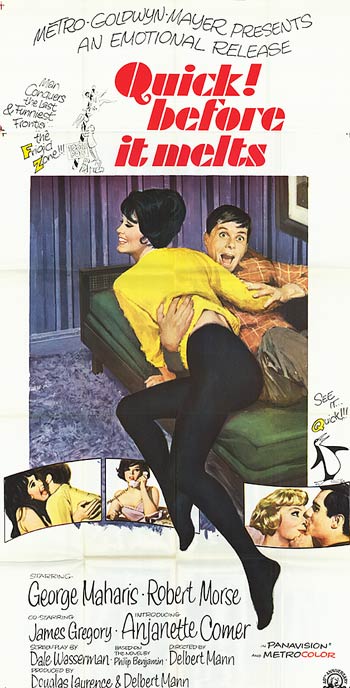
Oliver Cannon (Robert Morse) is a lowly newspaper reporter who gets sent to the Antarctica by his boss Mr. Sweigert (Howard St. John). Sweigert not only dislikes Oliver, but also wants to keep him away from his daughter Sharon (Yvonne Craig) who intends on marrying him. To his surprise Oliver accepts the assignment feeling that the South Pole is the ‘last great frontier’ and wanting to expose the harsh environment of the region to his readers who may not otherwise realize quite what it is like. Yet once he arrives he quickly wishes to leave, but can’t. He then concocts a plan with Peter (George Maharis), who is  another  American stranded  there, to fly in a planeload of beautiful women, so at least their time there can be enjoyable and sexy.

The script is virtually plotless and amounts to nothing more than broadly written, flatly comical scenarios loosely tied into the Antarctica theme. It’s basically just another contrived, generic ‘60s sex comedy that lacks bite or imagination. The only mildly amusing part about it is the real-life penguin that acts as a carrier pigeon by delivering mail and messages to the various residents.

I was surprised that Maharis chose to be in this as he was a strong, highly underrated dramatic actor who was one of the main reasons for the success of the acclaimed TV-series ‘Route 66’. In fact he left that show before the end of its run mainly to take advantage of all the movie offers that were coming in, but choosing to do this silly thing as his first one especially when he isn’t even the star of it is baffling. His career ultimately was ruined when he was caught having sex with a gay hairdresser inside the men’s bathroom of a gas station during the mid-‘70s, but appearing in fluff like this certainly didn’t help it.

Morse on the other-hand seems well suited for the material and performs admirably. This film also has, in her film debut, Anjanette Comer who later had roles in many interesting cult films. In fact both Morse and she later reteamed to star in The Loved One just a year after doing this one. That film is far superior and a movie you should definitely see while avoiding this one at all costs.

My Rating: 2 out of 10

Released: October 5, 1964

Runtime: 1Hour 38Minutes

Not Rated

Director: Delbert Mann

Studio: MGM

Available: DVD (Warner Archive)

Chastity (1969)

chasity 1

By Richard Winters

My Rating: 6 out of 10

4-Word Review: Hardships of a runaway.

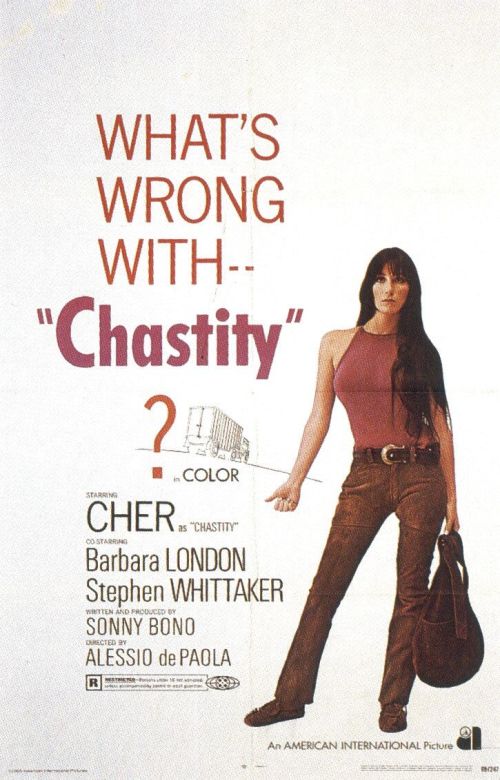
Chastity (Cher), in an attempt to escape her troubled past, runs away from home. She initially hitches a ride with a truck driver (Elmer Valentine) who seems to have only one thing on his mind, so she leaves him and meets up with a younger man named Eddie (Steve Whittaker) who she takes a liking to. He brings her back to his place and she spends the night there, but then worries that things may be moving too fast, so she leaves him. She then treks down to Mexico where she gets a job at a whorehouse. The woman (Barbara London) who runs the place becomes sexually attracted to Chastity and makes an attempt to start a lesbian relationship with her, but Chastity is uncomfortable with this and runs away again. She then meets back up with Eddie hoping to restart their relationship, but her demons from the past catch up with her and make that impossible.

The film was written and directed by Sonny Bono and I got to admit I was surprised at how genuinely riveting this was. The dialogue is sharp with a definite cinema vertite feel. There’s little or no action, but like with a Jim Jarmusch film you still find yourself glued to it and interested in picking up any little nuance that happens. The subject matter is frank and uncompromised and there’s even a little bit of nudity as we see Cher naked from both the top and backside.

The plot is unstructured and works more as a portrait to the tough situations most runaways fall into than in actually telling any type of story with a beginning, middle and end. However, it flows pretty well and has some memorable scenes including Chastity’s attempts to change the oil in a stranger’s car, her visit to a church and most especially her stay at the whorehouse and the way she successfully fleeces money out of a shy and unsuspecting teenage boy customer (Tom Nolan).

Cher is outstanding and the main reason to why this thing is so compelling. Apparently she was unhappy with her performance and refused to do another film until 13 years after this one, which is a shame as she shows definite signs of being a star-in-the-making and she looks so young that she seems almost like a different person than the one we’ve become so accustomed to seeing.

My only quibble is the fact that we get very little insight to the character’s past or why she’s running away. At the very end we do start to hear some voices, which are apparently going on inside her head and that of her parents, but it was too late to bring that up and should’ve been introduced earlier. The ending is vague and leaves the viewer in-the-dark as to what the ultimate fate of the character is, which is frustrating.

My Rating: 6 out of 10

Released: June 24, 1969

Runtime: 1Hour 25Minutes

Director: Alessio de Paola (Sonny Bono)

Rated R

Studio: American International Pictures

Available: DVD

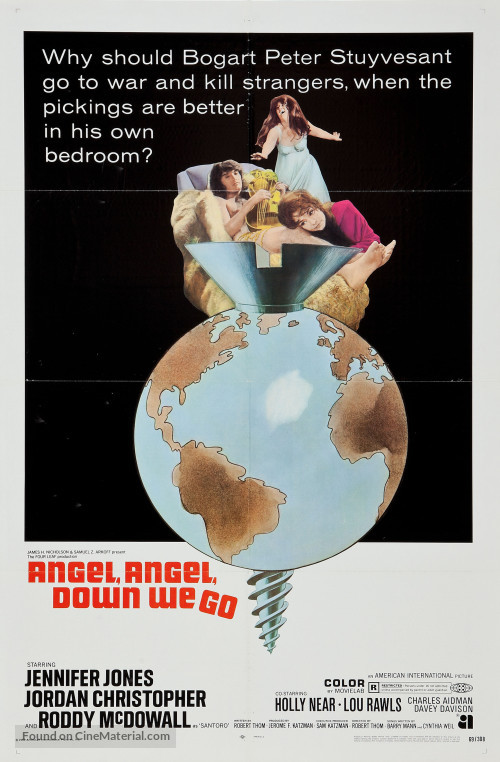
Angel, Angel, Down We Go (1969)

angel angel 1

By Richard Winters

My Rating: 4 out of 10

4-Word Review: Singer manipulates rich family.

Tara (Holly Near) is an overweight teen who feels like a social outcast. Her family is rich, but empty on love. Her mother (Jennifer Jones) is a former star of stag films and boozes it up on the bottle, but still manages to look quite attractive, even better than her daughter, which she constantly reminds her of. Her father (Charles Aidman) is a closet homosexual who routinely brings in male lovers for entertainment. When a rock group with a dashing lead singer (Jordan Christopher) arrives at her sprawling family home to help host a party Tara doesn’t hesitate to fall into his open arms. At first he seems to be the answer to her loneliness, but after a while she realizes he has a plan of his own as he not only seduces the mother, but her father as well before manipulating his way into the family fortune.

The main reason to watch this film, if not the only one, is for the performance of Jones in this her second-to-last cinematic appearance. She gives an incredibly strong, multi-faceted portrayal of a middle-aged woman on the emotional edge who realizes she’s being used, but allows it to happen simply so she can still feel desirable. Her presence lifts the sleazy material to watchable heights and comes just a year after she herself tried to commit suicide after hearing of the death of a close friend in real-life.

Near, who has later become a well-known folk singer, gives an effectively sensitive portrayal of a troubled teen, which allows her to be the one character that the viewer has any sympathy for. The rest of the cast though, which includes Roddy McDowall and Lou Rawls as Christopher’s band mates, are essentially wasted although you will get a full view of McDowall’s bare bottom for those few who are interested.

The garishly colorful collages done by Shirley Kaplan are visually alluring, but writer/director Robert Thom goes back to them too often. The aerial skydiving footage is excellent, even breathtaking, but the script as a whole, despite its lurid and even groundbreaking subject matter, falls flat. A lot of the reason for this is the fact that it’s poorly paced with too much time given to Christopher who sings a total of five songs, which does nothing but slow the proceedings down to a screeching halt. The ending is vague and aloof, which only helps to cements this as a misfire and good only as a curio.

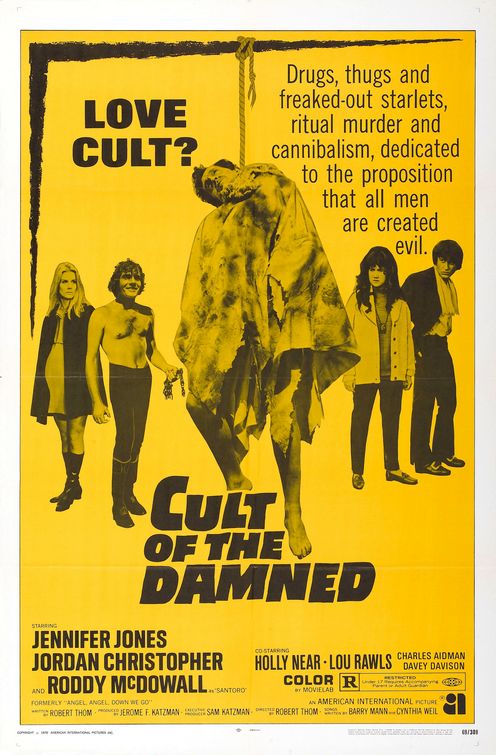
The film did quite poorly upon its initial release, so it was reissued under another a title called Cult of the Damned in hopes that it could cash in on the hysteria of the Manson murders that had occurred around the same time, even though the story doesn’t have anything to do with a religious cult and the movie still fared no better at the box office.

angel angel 2

Alternate Title: Cult of the Damned

My Rating: 4 out of 10

Released: August 19, 1969

Runtime: 1Hour 29Minutes

Rated R

Director: Robert Thom

Studio: American International Pictures

Available: DVD, Blu-ray, Amazon Instant Video

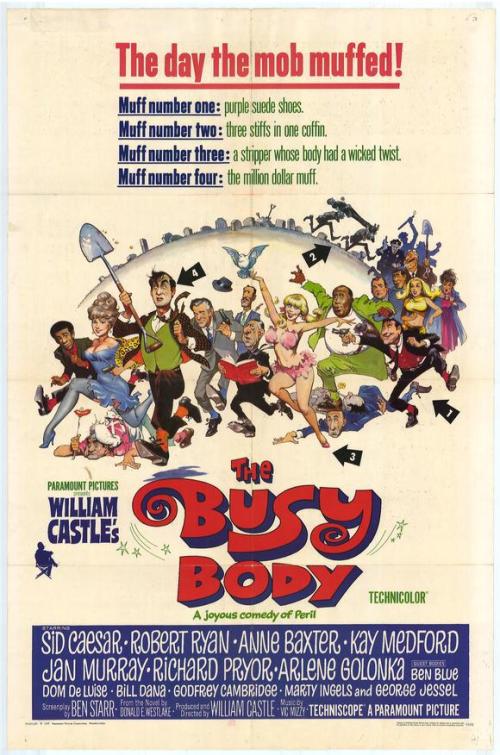
The Busy Body (1967)

busy body

By Richard Winters

My Rating: 3 out of 10

4-Word Review: Find the dead body.

George Norton (Sid Caesar) is a nebbish mama’s boy who, for whatever reason, gets taken in by Charley (Robert Ryan) a Chicago mob boss. Charley even gives George a seat on his board of governors. When a fellow crime boss (Bill Dana) gets killed in a freak accident it is George who selects a blue suit for the corpse to wear at the funeral. Unfortunately that blue suit was lined with a million dollars and Charley demands that George dig up the body and retrieve the money, but when he does he finds that the body is gone and thus begins a long, winding, ‘madcap’ search for the missing body and money.

Noted horror director/producer William Castle decided late in his career to give comedy a stab and this is the result. The beginning is mildly amusing, but the humor gets terribly strained and a 100 minute runtime is just too long for such trite material. Everything gets suppressed into silliness with an overplayed music score that has too much of a playful quality to it making the whole thing thoroughly ingrained on the kiddie level from start-to-finish.

Dom DeLuise has an amusing bit as a mortician that would really rather be a hairdresser and Kay Medford is quite funny as George’s doting mother, but the rest of the supporting cast is wasted, which includes Richard Pryor, in his film debut, playing in a role that does not take advantage of his comic skill. Caesar is just not leading man material and his vaudeville-like shtick is quite passé and predictable. His co-star Ryan is far funnier and without having to try half as hard.

The plot goes off on wild tangents until it becomes impossible to follow and quite pointless. The whole production is horribly dated and will not appeal to kids or adults. In fact the film’s intended audience has long ago passed away making this thing a silly relic of its time and nothing more.

My Rating: 3 out of 10

Released: March 12, 1967

Runtime: 1Hour 40Minutes

Not Rated

Director: William Castle

Studio: Paramount

Available: DVD, Amazon Instant Video

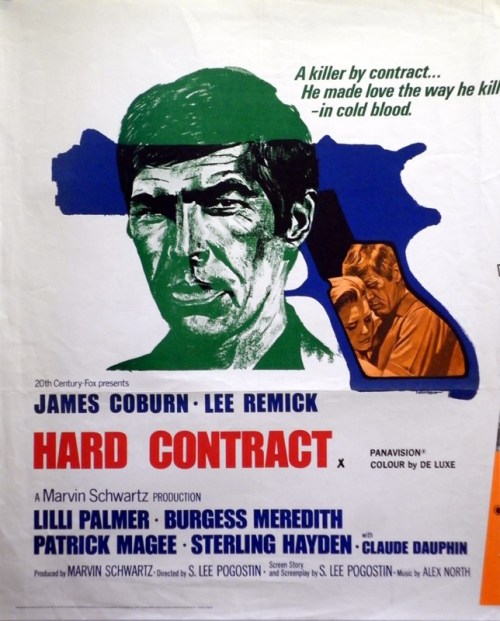
Hard Contract (1969)

hard contract

By Richard Winters

My Rating: 3 out of 10

4-Word Review: Hit man becomes humanized.

John Cunningham (James Coburn) is a professional hit man hired by Ramsey Williams (Burgess Meredith) to do one last ‘big score’ by rubbing out Michael (Sterling Hayden) of which Ramsey suffers a large financial debt to. John has done many of these jobs before and travels to Europe with the expectation that this one will be as routine as the others, but then he has an encounter with call-girl Sheila (Lee Remick) who plagues him with self-doubt and forces him to question his purpose in life.

This film was written and directed by S. Lee Pogostin a long time TV writer who finally at the age of 55 got his big break to do an actual feature film. Unfortunately for him his script is excessively heavy with dialogue and little to no action. There is only one brief segment where we see John actually doing his job and offing someone and it comes in the form of watching him drop a large trunk with a dead body inside of it out of an airplane, which is kind of a cool visually, but that is about it and the rest of the film consists of nothing but talk and long winded, flowing conversations dealing with theories and philosophies that regular people, particularly those in the crime and prostitution business, just don’t have.

Coburn and Remick are both excellent, but the scenario that their characters are placed in is ludicrous. The idea that a high paid prostitute would suddenly fall for one of her clients is quite doubtful. Had the Coburn character been somehow kind or gentle towards her then maybe, but instead he is cold and distant and treats her more like an animal than a person, so why, especially after all of the other men she has already presumably slept with, would she get so worked up over this guy? It just makes no sense and the same thing goes for the Coburn character. He’s slept with hundreds of prostitutes before and even brags about it, so why would this one stand out?

The conversation that Coburn has with Hayden, amidst a large wheat field and while sitting on a tractor, is pretty good and the most engrossing moment in the film. The scene where he drives a car speedily down a winding road, which gets the other passengers quite nervous, isn’t bad either. The European locations are scenic and the supporting cast all give strong performances especially Karen Black as a talkative hooker arguing with Coburn over political candidates. However, the script tries too hard to make a statement and comes off more like a protracted concept than a story with a pretentious flair that just doesn’t work.

hard contract 2

My Rating: 3 out of 10

Released: April 30, 1969

Runtime: 1Hour 47Minutes

Rated R

Director: S. Lee Pogostin

Studio: 20th Century Fox

Available: None at this time.

Enter Laughing (1967)

enter laughing

By Richard Winters

My Rating: 2 out of 10

4-Word Review: Acting is his dream.

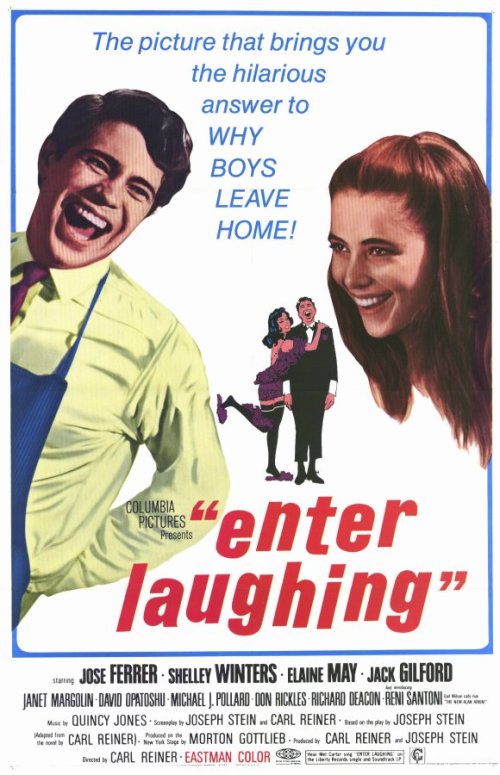
Loosely based on writer/director Carl Reiner’s experiences as a fledgling actor trying to work his way up into the business circa 1938. The story centers on David Kolowitz (Reni Santoni) who works as an apprentice at a machine repair shop, but dreams of one day making a living as a stage actor. He gets his break when he auditions for a part in a low budget stage production run by an aging, alcoholic actor named Harrison Marlowe (Jose Ferrer). Marlowe is not impressed with David’s acting ability, which is marginal at best, but at the insistence of his daughter Angela (Elaine May), who thinks David is ‘cute’, he decides to give him a try under the condition that David must pay them to perform in it and also must come up with his own costume.

Although this was a big success on Broadway as a film is has not aged well and is quite bland. The story is better suited as an episode for a sitcom and stretching out such a thin one-dimensional plot to an almost two-hour runtime becomes quite boring particularly with its plodding pace and direction. The only time it ever gets even mildly funny is during David’s audition scene, but even this ultimately falls flat particularly with the idea that David would be dumb enough to think that words in a script that are in parenthesis would be part of the dialogue and not a stage direction. You would think someone who has spent his entire life dreaming of being ‘the next Ronald Coleman’, who was a big movie star during the ‘30s, would know how a basic script is constructed and therefore this attempt at humor fails.

Santoni, in his first major film role, is terrific and despite being of Hispanic heritage, which Reiner is not, still manages to resemble Carl quite well during Reiner’s younger years. However, the character is too painfully naïve and dumb as he clumsily walks himself into messy situations long after the viewer, or anyone else with some common sense, would clearly see the obvious red flags.

Janet Margolin is beautiful playing David’s girlfriend Wanda and her presence gets an ‘A’ simply for her attractive face alone, but the romantic scenes do nothing but bog this already slow moving film down even further. Also, having David be so oblivious to her insecurities about him working with an attractive leading lady onstage makes him seem insensitive and not funny as intended.

Elaine May is good and so is Jack Gilford as David’s boss at the repair shop. It’s also fun seeing Carl’s real-life son, Rob Reiner, who later became famous for playing Mike Stivic on ‘All in the Family, making his film debut as a nerdy, would-be actor, but overall the film is dated and contrived.

My Rating: 2 out of 10

Released: February 25, 1967

Runtime: 1Hour 52Minutes

Not Rated

Director: Carl Reiner

Studio: Columbia Pictures

Available: VHS

One Way Pendulum (1965)

one way pendulum 1

By Richard Winters

My Rating: 4 out of 10

4-Word Review: An absurd little movie.

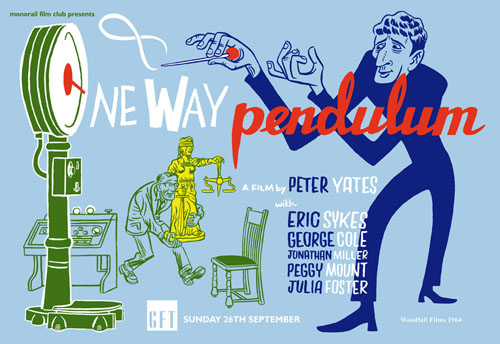
The Groomkirby family is one really absurd bunch. The father (Eric Sykes) wants to build a replica of the Old Baily courtroom in his living room and then have a trial, involving his son Kirby (Jonathan Miller) as the accused, reenacted. His daughter Sylvia (Julia Foster) wishes that she were an ape so that her arms would be longer and discusses this at length with her mother (Alison Leggatt). Kirby steals weight machines, which voices the person’s body weight, off the city streets and brings them back to the family’s attic were he then converts them into machines that sing. There’s also Aunt Mildred (Mona Washbourne) who thinks she’s waiting for a train that never comes as well as Mrs. Gantry (Peggy Mount) who’s paid to come over and eat the family’s unwanted leftovers.

The film is based on the stage play of the same name written by N.F. Simpson and was labeled as being ‘A farce in a new dimension’. John Cleese is purportedly a big fan of the movie and credits it as inspiring many of the absurd ideas that they used in their later Monty Python sketches. It was also directed by Peter Yates who went on to direct such quintessential hits as Bullitt, Breaking Away, and Year of the Comet.

The film certainly does have its share of funny and highly original moments. One of my favorite scenes is where the father carts the props that he needs to build his courtroom down a busy street of London using nothing but a wheel barrow and holding up traffic while he does it. Kirby’s ability to make the weight machines sing and sound like a genuine chorus is fun also as well as the climactic courtroom segment in which a myriad of comically absurd arguments, testimony, motions and reasoning is used until it becomes almost mind bending.

Unfortunately it all gets just a little too weird. Normally I’m a fan of the offbeat, but there still needs to be something to anchor it down and this film lacks it. The dialogue, characters and storyline are so progressively strange that it becomes downright nonsensical. The court case loses its edge as well because the father is somehow able to recreate it and the people in it in some magical way using a machine where kidnapping a magistrate and lawyers and forcing them perform in their makeshift court of law would’ve been funnier.

The movie will certainly satisfy those with inkling for the offbeat and the film seems intent to push the absurdity as far as it possibly can with a cast primed to pull it off, but it ends up being too weird for its own good and parts of it are confusing and hard to get into.

My Rating: 4 out of 10

Released: March 2, 1965

Runtime: 1Hour 20Minutes

Not Rated

Director: Peter Yates

Studio: United Artists

Available: None at this time