Tag Archives: Review

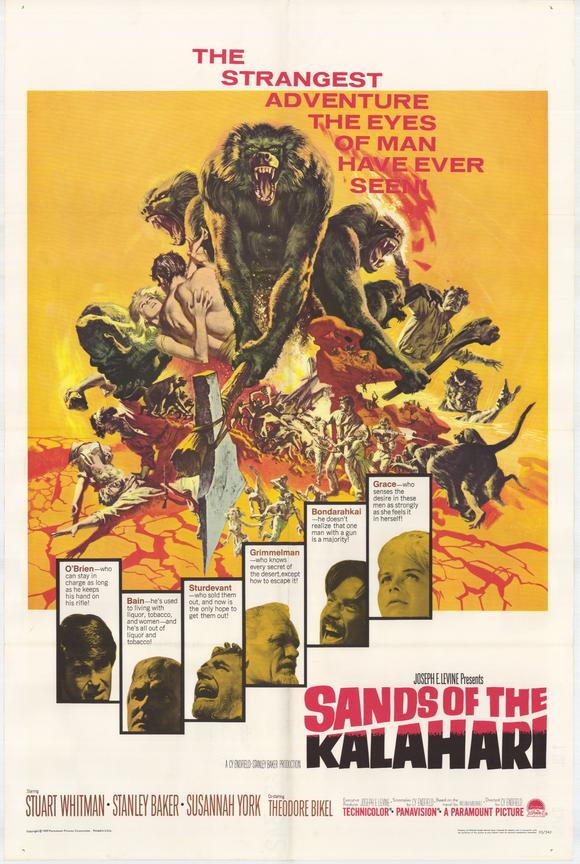
Sands of the Kalahari (1965)

sands of the kalahari

By Richard Winters

My Rating: 8 out of 10

4-Word Review: Stranded in the desert.

Based on the novel by William Mulvihill the story centers on a group of six individuals, five men and one woman, who fight to survive the blistering heat of the Kalahari Desert when their plane crashes after it’s struck by a large swath of locusts. Instead of working together as a team the group quickly disintegrates with infighting and tensions. The young and virile Brian (Stuart Whitman) who initially takes control of the situation starts to feel that his own survival would be heightened if there were less people needing food and water, so he decides to carefully eliminate them one-by-one, which leads to many interesting confrontations and a very unusual climactic finale.

Filmed on-location in Namibia the desert becomes its own character. The stunning sandy landscape is breathtaking and watching the characters walk along it under the crystal blue sky becomes almost awe-inspiring particularly during birds-eye view shots. The viewer feels like there are right there feeling the heat along with the rest of the characters. Writer/director Cy Endfield keeps things on an authentic level and stays for the most part faithful to the book with the exception of changing one of the characters who had been African American in the novel to Caucasian here. His use of actual animals is what impressed me the most particularly the baboons who become a major part of the story as well as seeing a live scorpion crawling up a man’s arm. The only real technical weakness is the cloud of locusts forming on the horizon, which looked like dust being sprayed on the plane’s windshield and when they started to splatter onto the window it looked more like scrambled eggs and not quite as impressive as I think the filmmaker’s had hoped.

I also had a bit of a problem with the Sturdevan character, which had been the plane’s pilot and is played by actor Nigel Davenport who attempts to rape Grace (Susannah York) after they had only been stranded in the desert for a day and a half. I felt this was too quick for people to so suddenly drop their civilized veneers and cave into their more animalistic urges. I could see this maybe occurring after being there for weeks or months, but I would think initially the urgency would be finding help and just plain surviving and sex being the last thing on anyone’s minds. This same issue occurs with Grace who becomes romantically attached to Brian and even professes her ‘love’ for him after only a couple of days, which again seemed too rushed. The romantic scenes make the film seem soap-opera like and gives it an unnecessary melodramatic feel that does nothing but bog down the pace.

Whitman whose career dissipated after the 60’s and was confined with less significant roles and films is memorable here. The character who comes onto the plane at the last second is initially big and brawny heroic and watching him devolve into a selfish anti-social man is interesting as are the scenes with him trapped in a hole. The segment where he throws a fire into a cave filled with baboons and then shoots the animals as they run out is quite startling. I also enjoyed York. She has always been a splendid actress, but here with her blonde hair matched against her red skin and torn dress looks genuinely sexy.

The one-on-one confrontations between the characters especially the one between Grimmelman (Harry Andrews) and Brian and then later between Brian, Grace and Mike (Stanley Baker) is what helps the film really stand-out. I would have liked it played-out a bit more, but the twist that comes at the end is indeed unexpected and leads to one of the more unusual climactic sequences you will ever see.

My Rating: 8 out of 10

Release: November 24, 1965

Runtime: 1Hour 59Minutes

Not Rated

Director: Cy Endfield

Studio: Paramount

Available: DVD, Amazon Instant Video 
Wedding in White (1972)

wedding in white 1

By Richard Winters

My Rating: 8 out of 10

4-Word Review: Ending is a kicker.

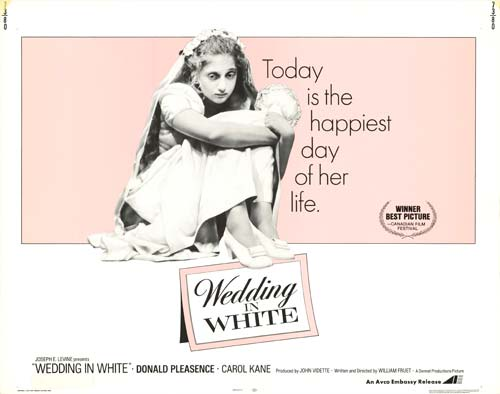
Jeannie (Carol Kane) is a shy 16-year-old girl living in a small, bleak Canadian town just after the war who is raped by her older brother’s army buddy. Her parents (Donald Pleasance, Doris Petrie) respond as if it is her fault and resort to some extreme even shocking measures in order to ‘save the family honor’.

This is a solid little drama with good scene construction. The pacing is deliberate and an ending that really packs a wallop. The sets and location look authentic for the period and the characters are believable. Jeannie’s friend Sara (Christine Thomas) seems like a very typical teenager no matter what time period and her interactions with Jeannie show the realities of teenage friendships and makes for an interesting sidelight from the main story.

Kane is impressive acting in a style I’ve never seen from her before. Pleasance is solid as usual and his Canadian accent sounds almost authentic, but it is a bit overdone. Petrie is also quite good as the mother. She really brings to surface a character that is so cloistered she is unable to make any clear decision for herself.

The story itself is the real strong point. It is convincing, insightful, and well-crafted and brings out a sort of darkness and ‘evil’ that can come from ‘wholesome small towns’ and ‘God fearing people’. It shows how having a rigid morality can sometimes create a sort of immorality and also brings to light the lies people wish to live by and how at times it can cloud their better judgment, but most of all it’s a study at  how easily sensitive, fragile people can get sucked away and how sadly common it is.

This is a film designed to leave you feeling shocked, angered, saddened, and maybe even a little repulsed. This is quality viewing that deserves more attention.

My Rating: 8 out of 10

Released: October 20, 1972

Runtime: 1Hour 43Minutes

Rated R

Director: William Fruet

Studio: Cinepix

Available: DVD

The Handyman (1980)

the handyman

By Richard Winters

My Rating: 6 out of 10

4-Word Review: He’s unlucky in love.

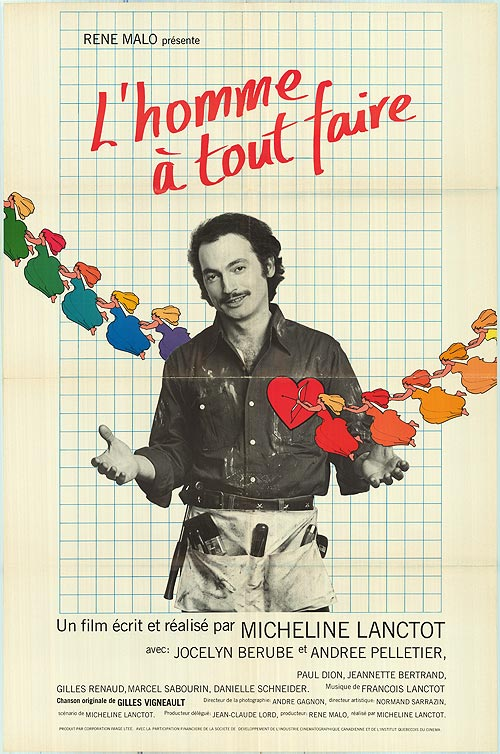
Armand (Jocelyn Berube) is a chump of the first order. Everything he plans or does never seems to work out. He writes a letter to his mother describing how he has finally gotten himself married and how ‘he won’t die a bachelor’ only to have her walk out on him after only a few months. He tells his best friend the secret place where he hides all of his money and then the next day the friend steals the money. He brings in a new roommate only to have that man listen in to his private phone calls and when he does meet an attractive woman who he thinks is interested he gets her a romantic gift only to have her and her friends laugh at him behind his back. “The world is made up of two types of people,” he states “Those that take and those that are taken and I tend to be the latter.”

Things seem to improve for him when he gets a job fixing up the house for bored and attractive housewife Therese (Andree Pelletier). She is unhappy with her marriage to Bernard (Gilles Renaud) who is indifferent to her feelings and more interested in his golf game than her. She considers Armand’s unpretentiousness refreshing and Armand of course becomes immediately smitten. The two make an attempt at an affair, but as usual Armand gets in over-his-head.

One of the things that really stands out in this movie is the way Armand and Therese’s relationship unfolds. In most movies it always seems like love at first sight and both people get animalistic urges that they can’t contain and impulsively jump into the sack, but here it is much different. For one thing their attraction for one another progresses at a much slower and more realistic pace and does not come to a head until after several months. Both parties are shown contemplating their next move and their desire for one another is constantly being balanced by their reluctance at knowing how much trouble and guilt they will have if they do go through with it. How they respond to each other after they have sex is equally revealing and the quirky relationship that Armand later has with Therese’s husband is also quite interesting.

Although I felt that actor Berube’s bushy mustache and 70’s hairstyle seemed a little overdone I still found the character to be highly amiable. You tend to feel for the guy even after he makes one blunder after another. Actress Pelletier is certainly attractive, but her thick Nordic accent was a bit of a turn-off although probably realistic for the region.

My only complaint from this otherwise widely hailed low budget obscurity is the fact that the Armand character doesn’t grow or evolve at all. This is a man that knows he has a weakness for being taken advantage of, but doesn’t do anything about it. Watching him perpetually self-destruct to the point that he finds himself living out of his car and even contemplating jumping off a bridge is frustrating and depressing. Showing him having just one defining uncharacteristic moment where he somehow manages to transcend himself would have been much more satisfying and in some ways more realistic.

My Rating: 6 out of 10

Released: March 14, 1980

Runtime: 1Hour 39Minutes

Rated PG

Director: Micheline Lanctot

Studio: Les Films Reno Malo

Not Available at this Time.

Dark August (1976)

dark august

By Richard Winters

My Rating: 3 out of 10

4-Word Review: Plagued by a curse.

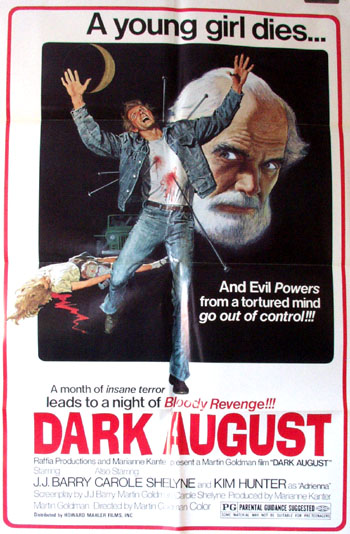
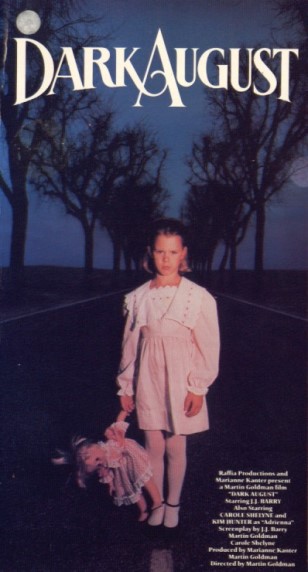
            Sal DeVito (J.J. Barry) moves from New York City to a peaceful small town in Vermont in order to further his career as an illustrator and escape the stresses of big city life. Unfortunately he hits and kills a young girl (Karen Lewis) with his car when she runs out onto the street. Although he ends up being exonerated the girl’s grandfather (William Robertson) still holds him accountable and places a curse on him. The curse makes Sal see a strange hooded figure in the distance as well as suffering from mysterious blackouts. To help rid him of it he goes to see a popular psychic in town named Adrianna (Kim Hunter), but her services prove to not be the solution he thought.

Like with most low-budget 70’s horror films this one has a lot of slow parts and extended scenes with extraneous dialogue that goes nowhere. The scares are at a minimum and the few that it does have aren’t real frightening. The hooded figure that Sal keeps seeing in the distance has a creepy quality to it, but the film should have done more with it. There needed to be more action, more confrontations, and just plain more horror. Even a child could watch this and not be upset by it. There are no special effects and although the production is technically competent despite its low budget I found it hard even calling it a thriller or horror film since the suspense is light.

I loved the on-location shooting done in Stowe, Vermont. The woodsy landscapes and green countryside is gorgeous and I liked the scenery better than anything else in the picture, which is another problem. Filming scenes in the bright sunny daytime doesn’t help create a spooky feeling and there needed to be more done at nighttime. There is a very dark ominous cloud overhead during the scene involving the accident, but that is about it.

Barry whose acting career was brief and minor plays a stressed-out character effectively, but I could have done without seeing him lying nude in bed. There is also an extended scene showing the couple sleeping in bed from different angles, which seemed inane and unnecessary. Kim Hunter appears very late in the picture and really can’t do much to save it.

This is a film that deserves its place in obscurity and unfortunately has nothing to distinguish it or make it worth seeking out.

dark august 2

My Rating: 3 out of 10

Released: August 8, 1976

Runtime: 1Hour 27Minutes

Rated PG

Director: Martin Goldman

Studio: Howard Mahler Films

Available: VHS

Casual Sex? (1988)

casual sex

By Richard Winters

My Rating: 3 out of 10

4-Word Review: Sex in the 80’s

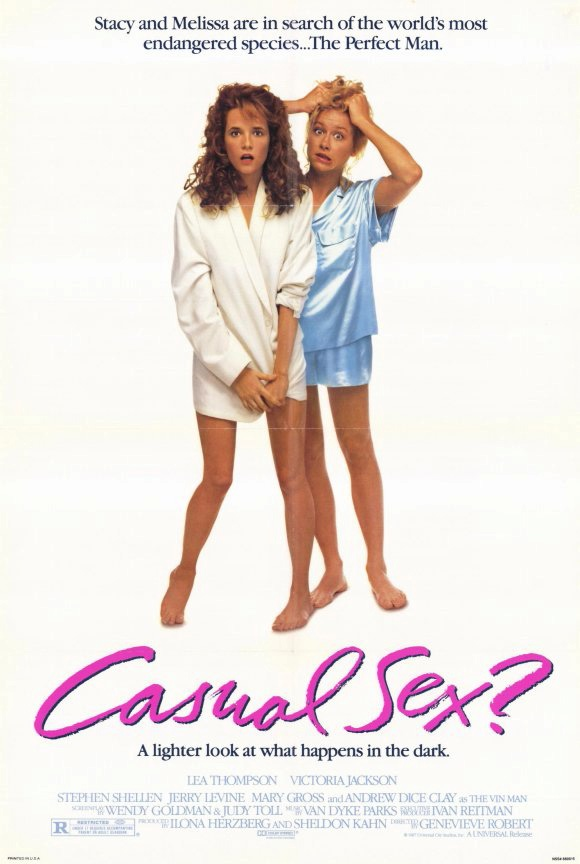
Stacy (Lea Thompson) and Melissa (Victoria Jackson) are lifelong friends with very different sexual pasts. Stacy has slept with a lot of guys including some one-night-stands while Melissa has had sex with only a few and never achieved an orgasm at least ‘not when someone else was in the room’.  Because of the AIDS epidemic they decide to reanalyze their sexual mores and join a singles resort where they hope to meet their Mr. Right and settle down.

The film is based on the stage play that was originally produced for The Groundlings Theater in Los Angeles. You can tell this right away at the start where the two women stand on an empty stage and talk about some of their past sexual encounters. This proves to be the funniest part of the film with a lot of keen observations on human behavior. Unfortunately after the first five minutes of this the film digresses into a more conventional narrative by having the girls go to a single’s resort and the attempts at satire get either over-played or not played up enough. What is even worse is that it throws in a romance angle by having Stacy fall for an irritatingly perfect looking heartthrob named Nick (Stephen Shellen) who is an aspiring rock star. The two quickly move in together and then all of sudden he becomes completely clueless and harbors a lot of annoying habits that leads to a drawn-out, boring break-up session.

There are still a few funny moments including an amusing dream sequence where Stacy imagines making love to Nick while her boyfriends from the past start to pop up all around her, but overall the film fails to gain any traction, is filled with clumsy characterizations and falls flat. A much better approach would have been to structure it around a collection of vignettes with a sexual theme much like Woody Allen’s Everything You Always Wanted to Know about Sex, but Were Afraid to Ask, which is far more original and funnier than anything you will see here.

Lea is really cute and gives a good performance. Normally ditzy blondes get on my nerves, but somehow I have always found Victoria’s cute-as-a-button face and squeaky voice appealing. Her acting skills aren’t up to Lea’s level, but her more natural delivery makes for a nice contrast. Skin hounds will be happy to know that both women appear nude from the backside.

However, it’s Andrew ‘Dice’ Clay who steals the film with an engaging performance as the proverbial lounge lizard. Every scene he is in is funny and he tells a lot of lame jokes, but the way he says them is hilarious ‘they can’t all be golden’. In his attempt to get more connected to women he reads a book entitled ‘How to Pretend Your Sensitive’, which is amusing as well. My only complaint is that in the end Lea marries him and he becomes more ‘normal’, which takes away from the goofy caricature.

My Rating: 3 out of 10

Released: April 22, 1988

Runtime: 1Hour 37Minutes

Rated R

Director: Genevieve Robert

Studio: Universal

Available: VHS, DVD, Amazon Instant Video

Repulsion (1965)

repulsion 1

By Richard Winters

My Rating: 8 out of 10

4-Word Review: She loses her mind.

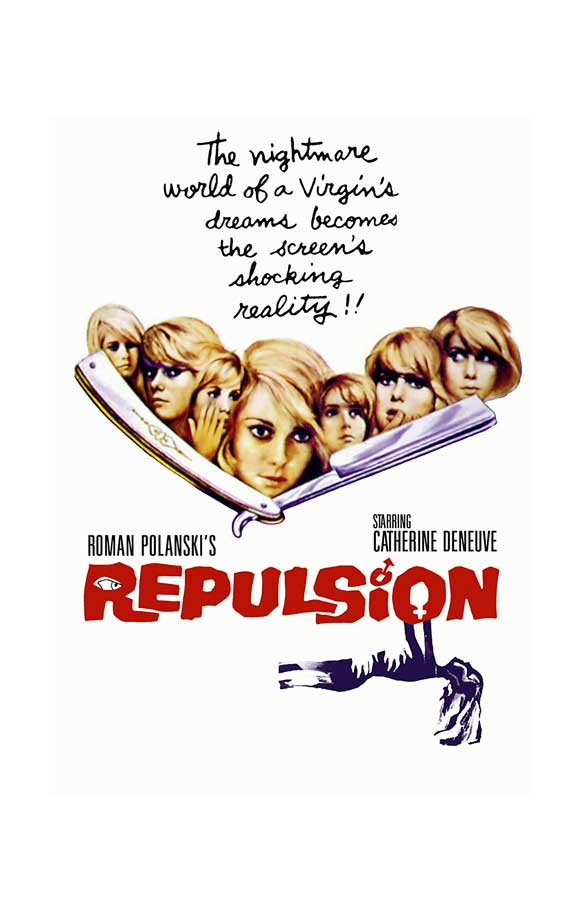
Love or loathe him one thing is for sure the controversial Roman Polanski has made some great movies and since today marks his 80th birthday I thought it would be good to review one of his films this being his first English language one. The story, which was written by Polanski and Gerard Brach centers on Carol (Catherine Deneuve) a beautiful but lonely young woman living in an apartment with her older sister Helen (Yvonne Furneaux) and Helen’s boyfriend Michael (Ian Hendry). Carol seems detached and troubled and when Helen and Michael go off for the weekend Carol begins to suffer hallucinations while inside the apartment that becomes increasingly more frightening and eventually leads to murder.

The film works at a slow and deliberate pace that some viewers may feel put-off by. Personally I felt it was effective and made it more realistic although things really don’t start to get intense until the final hour. For me it was the little things that made it intriguing for instance the way Carol becomes fascinated with the distorted reflection of herself in a teapot, or a rolling bottle of nail polish. Nothing is over-the-top, but instead subtle and restrained. This is one of the few films that seem to understand the thought process of the mentally ill and makes you feel like you are really inside their head and seeing things as they do, which is what makes it so unnerving. The low-key approach works because like with an actual person having a breakdown it starts with little things that slowly morph into bigger ones.

Polanski shows incredible control over the material. The stark black-and-white cinematography helps to heighten the ugliness of the situation. The variety of camera angles and movements creates an almost hypnotic effect. I loved the way, as Carol gets further into her demented state, that the dimensions of the apartment begins to change, or the hands coming out of the walls. My only complaint is I wished some of these effects had been played up even more. The rape sequences are quite effective and surprisingly explicit for its time period. Yet instead of hearing Carol’s screams during these moments we instead hear the ticking of a clock, which somehow makes it even more disturbing.

Deneuve gives one of her best performances and she was at the peak of youthful beauty here. The blank almost zombie-like look in her eyes is penetrating. You get the feeling that she not only truly understands the madness of her character, but actually is the character. Patrick Wymark is also memorable as the landlord who goes from being bombastic and demanding to kind and cuddling and eventually sexually deviant in a matter of only 10 minutes.

Normally I always like a background to the characters and when they are missing or vague I find it a weakness to the script while here it is strangely a strength. We can surmise that she was most likely abused sexually when she was younger, but the who, when, and why is never made clear. This though somehow makes the character and the situation more compelling and reflects back to how psychologically fragile the human condition can be and how these things can happen to anyone. The final tracking shot, which stops on a picture of Carol as a child showing an angry look on her face is great.

The imagery and psychological approach to this thing is still one-of-a-kind. The movie viewing experience on this one remains potent and aptly deserves its classic status.

repulsion 2

My Rating: 8 out of 10

Released: October 2, 1965

Runtime: 1Hour 45Minutes

Not Rated

Director: Roman Polanski

Studio: Compton Films

Available: VHS, DVD, Blu-ray, Amazon Instant Video

Death Weekend (1976)

death weekend

By Richard Winters

My Rating: 3 out of 10

4-Word Review: She can defend herself.

This Canadian thriller, which is loosely based on actual events deals with a rich playboy named Harry (Chuck Shamata) who invites Diane (Brenda Vaccaro) who is also a model to spend the weekend with him at his isolated lakeside cabin that is miles from anywhere. On their way there they run into a biker gang whose leader (played by Don Stroud) takes an intense disliking to Harry. The gang tracks the two down at their cabin where they proceed to terrorize them before eventually killing Harry and forcing Diane to defend herself alone, which she does valiantly.

In a way this is a poor man’s version of I Spit on Your Grave or Straw Dogs, but not nearly as effective. For one the violent scenes aren’t very intense. This is due mainly to the fact that writer/director William Fruet keeps the camera too removed from the action and never once uses a hand held. There is also no gore as Fruet always cuts away just before anything happens and what little you do see looks tacky. Of course a film doesn’t have to be gory to be scary or intense, but if it is going to have this type of violent theme then it should at least equal it in style. The tension also ebbs and flows and the four hoodlums are too dumb and seem like cardboard cutout caricatures that possess no human qualities whatsoever.
The Harry character does allow for some added dimension, which helps and hurts. I liked the way he sees himself as this ‘refined’ gentlemen and yet views women in the same Neanderthal way as the thugs. He brags of having money and power, but when that gets stripped away from him he becomes amazingly spineless. This makes for a good commentary of the rich and successful, but unfortunately also turns him into being too much of a jerk and when the bad guys proceed to tear his place apart we are not ‘horrified’ at all, but instead enjoy seeing it.

There are actually a few good elements one of which is the music score, which effectively creates an ominous feeling. It was also filmed in Ontario Canada during the autumn and the desolate, bleak landscape helps match the bleakness of the situation and characters. I also loved the morning mist captured during the final chase sequence that gives things a very eerie look. There is also a well-staged car chase at the beginning that was done at high speeds and features some great stunt driving.

The film is saved somewhat by Vaccaro’s interesting performance as a victim. She is independent and self-sufficient and refuses to allow herself to be seen or used as a sex object. This goes along with the film’s overall theme which seems to run on the emergence of the woman in a man’s world and the basic redefining of the female role in society. Yet I felt it would have worked better had the character harbored the old female traits at the beginning and then had these new traits come out as the film progressed.

death weekend

My Rating: 3 out of 10

Alternate Title: House by the Lake

Released: September 17, 1976

Runtime: 1Hour 27Minutes

Rated R

Director: William Fruet

Studio: American International Pictures

Available: VHS

Flirting with Disaster (1996)

flirting with disaster

By Richard Winters

My Rating: 5 out of 10

4-Word Review: Biological versus adoptive parents.

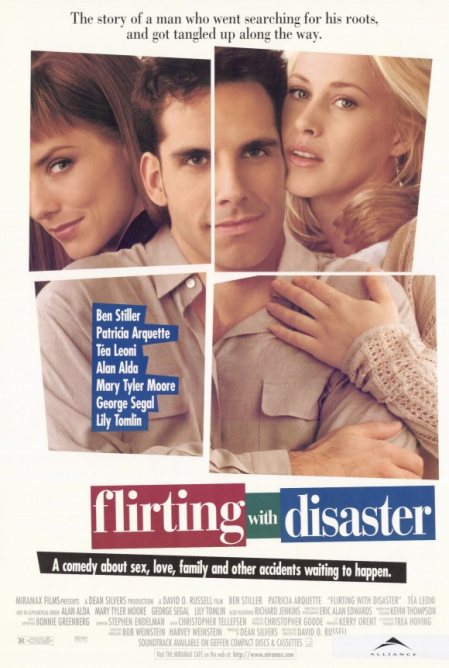
Mel Coplin (Ben Stiller) is a middle-aged man on a mission. He wants to find out who his biological parents are and is willing to travel the country to find them. His wife Nancy (Patricia Arquette) isn’t too happy about being dragged along and his adoptive parents Ed and Pearl (George Segal, Mary Tyler Moore) find his journey to be an insult to them. He uses the aid of part-time adoption agent Tina (Tea Leoni) to try and locate them, but her help only proves to lead him to a lot dead ends.

With the exception of Leoni the three female leads are good. Lily Tomlin has a funny moment as she tries to talk down the Richard Jenkins character from a LSD trip. Moore is fantastic playing a takeoff of her rigid mother role from Ordinary People. Every scene that she is in is hilarious and had she been in a few more she could have easily stolen the film. She wears a short reddish haircut and at times looks amazingly like Carol Burnett. Although she is not all that amusing Arquette is also quite good simply because she is the most believable of all the characters. Jenkins and James Brolin also have their moments as a bickering gay couple and Brolin’s arm pit fetish is great. It is also nice to see Stiller actually doing some acting instead of just playing a dull, average guy that simply reacts to all the zaniness around him, which is what he seems to pretty much do in most of his other films.

However, the movie seems more focused on being offbeat than it does in actually being funny. There is a great deal more misses than hits and the ones that do hit aren’t exactly uproarious. Leoni’s character adds little to the proceedings and her propensity at constantly leading Mel to the wrong people gets old pretty fast. There is also a glaring goof where Segal and Moore end up driving off with Tomlin and Alan Alda’s car since both couples drive the same make and model vehicle. Yet somehow they are able to use their OWN keys to start up the other car and even get into the other car’s trunk, which would not be possible.

This film could best be summed up as being the ‘sophomore jinx’ for writer/director David O. Russell since his first feature Spanking the Monkey was quite original as was his third one I (Heart) Huckabees. This film though tends to be over-the-top absurd without having any message or point to it.

My Rating: 5 out of 10

Released: March 22, 1996

Runtime: 1Hour 32Minutes

Rated R

Director: David O. Russell

Studio: Miramax

Available: VHS, DVD, Amazon Instant Video

A Little Sex (1982)

a little sex 1

By Richard Winters

My Rating: 2 out of 10

4-Word Review: He can’t stay faithful.

Michael (Tim Matheson) gets married to Katherine (Kate Capshaw) after living with her for a year. He had a habit of sleeping around and having a lot of one-night-stands, but makes a pledge to change. However, the temptations are too strong and he ends up cheating on her and getting caught and then spends the rest of the film trying desperately to win her back.

Bruce Paltrow, who was the father of Gwenyth and the husband of Blythe Danner directs this very minor production that is generic and predictable throughout. The story and production values seem better suited for television and this doesn’t even seem like an 80’s movie, but more a remnant from the touchy, feely 70’s. The plot is empty and fails to gain any momentum with dialogue that is stale and boring.

Although billed as a comedy there really isn’t much that is funny and few moments that become heavy-handed and melodramatic. One scene has the couple pretending to make love while under the covers of a bed that is in the middle of a storeroom with the other customers and a very nervous saleslady looking on that had potential, but doesn’t go on long enough. Another segment has some first grade school girls that Katherine teaches intently listening to a video tape of Michael telling them a story. I was amazed at how enraptured the children were because I found the tale to be dull and vapid, but then having all the girls become teary-eyed at the end of it goes overboard.

Capshaw, who has been married to Steven Spielberg for over twenty years and has five children with him, is vivacious in her film debut. She looks beautiful and far better looking than any of the other women that Michael fools around with. Matheson is liable enough, but his character is bland and no ability to carry the film.

The supporting cast comes off better although John Glover and Wallace Shawn are essentially wasted. Edward Herrmann is a delight as Michael’s friend Tommy and has the best lines in the whole movie. Joan Copland is amusing as Katherine’s mother especially when she compares marriage to death in one conversation and then later compares it to war. It is also great to see Wendie Malick playing a sultry clarinetist who is now starring in the ‘Hot in Cleveland’ TV-show and looks like she hasn’t aged a day since appearing in this.

I am a big fan of Melissa Manchester and she has done a lot of great songs, but her opening song here ‘Your Place or Mine’ has to be one of her worst although I did like the extreme close-up of a cigarette being lit and then watching it slowly burn, which is the film’s one and only interesting cinematic moment.

My Rating: 2 out of 10

Released: April 2, 1982

Runtime: 1Hour 35Minutes

Rated R

Director: Bruce Paltrow

Studio: Universal

Available: DVD, Amazon Instant Video, Netflix streaming

Medium Cool (1969)

medium cool 1

By Richard Winters

My Rating: 9 out of 10

4-Word Review: The 60’s up close.

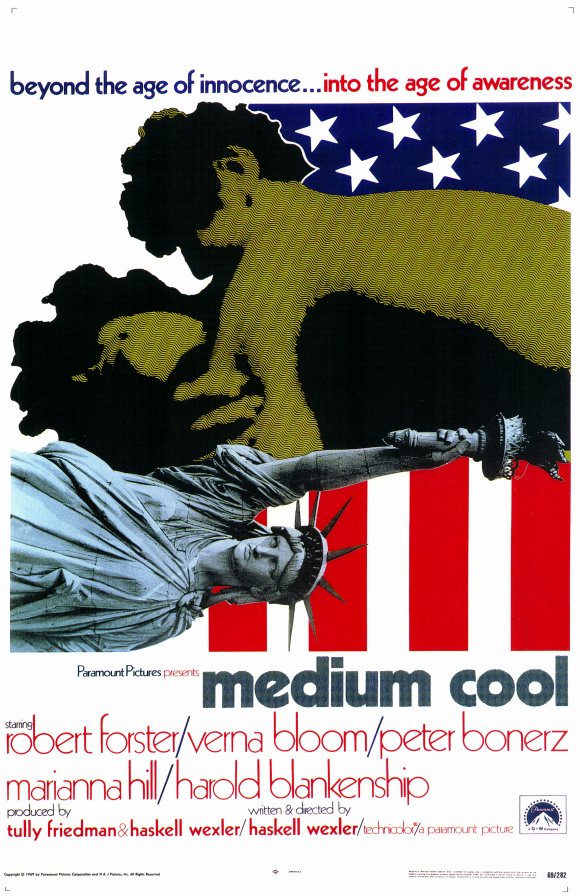
If you ever wanted to travel back in time and take part in the events of the tumultuous 60’s this film comes about as close to that as you can get. Watching this isn’t like viewing a movie, but more like an experience in itself. Acclaimed cinematographer Haskell Wexler who had previously worked in the documentary field heard that demonstrators were going to march at the 1968 Democratic convention in Chicago so he decided to hire a few actors and throw them into the fray while building a thin plot around it and creating a pseudo-reality effect. The story deals with news cameraman John Cassellis (Robert Forster) who meets and starts to date Eileen (Verna Bloom) who has just moved to Chicago from West Virginia with her 11-year-old son Harold (Harold Blankenship). As the convention and protests begin and John begins to cover it Harold runs away from home and Eileen goes into all the chaos to find him.

The scenes from the riots leave a major impact and even though I had already seen this film several times before I was amazed at how compelling it still was. Everything still seemed fresh with a clarity that makes you feel you are right there and a vividness that seems like it was filmed just yesterday. Watching the National Guard with their rifles raised marching down the streets of Chicago threatening crowds of people is incredible as is the sight of army tanks rolling down Michigan Avenue.  The people in the crowds are not actors and you see them getting clubbed by the police only a few feet from the camera. Watching them take the park benches in Grant Park and use them to build a shield from the police is exciting as are actual sound bites of reporters describing the action and at certain points being roughed up by the patrol as well. The look of fear and confusion on Bloom’s face at what she finds herself in the middle of it is authentic and helps build the tension.

Of course these scenes only make up the final fifteen minutes of the film, but the movie is filled with a variety of other unique moments that are all captured with the same vivid style and are equally memorable. The part where John and Eileen go to a roller derby and watch actual female players beat each other up with some even using their fists gets quite vicious. The scene showing hundreds of caged pigeons being set free and flying off in a giant flock that fills the sky is eloquent. There is even some effective erotica as a naked John chases his naked girlfriend Ruth (Marianna Hill) around his apartment before lifting her up by her legs and spinning her around in a circle.

The film also takes a great critical look at television news and the people who cover it. It shows how reporters and cameramen are very detached from the events and people that they are covering and how their need to capture that ‘great’ image or sound bite supersedes the human element.

Forster is perfect for the lead role. I loved his aggressive, blue collar, tough-guy attitude that perfectly reflects the Windy City. Peter Bonerz who plays Gus his sound man is great, but in the opposite way. His character is much more timid and wants to avoid confrontation at every turn and finds it difficult dealing with some black people who make him feel uncomfortable when he visits their apartment and even some young children when they start to climb on his car.

The only negative is that the song ‘Merry-Go-Round’ by Wild Man Fischer is not included in the most recent Criterion Collection DVD/Blu-ray release. The song was in the original release shown in theaters as well as the film’s first VHS version, which I saw. Unfortunately the song’s copyright holders sued Paramount stating that a VHS/DVD release is not the same as a theatrical/television broadcast, which they were under contract for to use and therefore could not include it in any later reissues, which is a real shame. The song has to be one of the strangest things you will ever hear and done by an eccentric one-of-a-kind artist. It has a weird alluring quality to it that gives personality and an extra edge to the film and in later versions gets replaced with ‘Sweet Georgia Brown’ better known as the theme for The Harlem Globetrotters, which is just not as effective.

My Rating: 9 out of 10

Released: August 27, 1969

Runtime: 1Hour 11Minutes

Rated R

Director: Haskell Wexler

Studio: Paramount

Available: VHS, DVD, Blu-ray (The Criterion Collection)