Tag Archives: Review

Boeing, Boeing (1965)

boeing boeing

By Richard Winters

My Rating: 2 out of 10

4-Word Review: Fooling around with stewardesses.

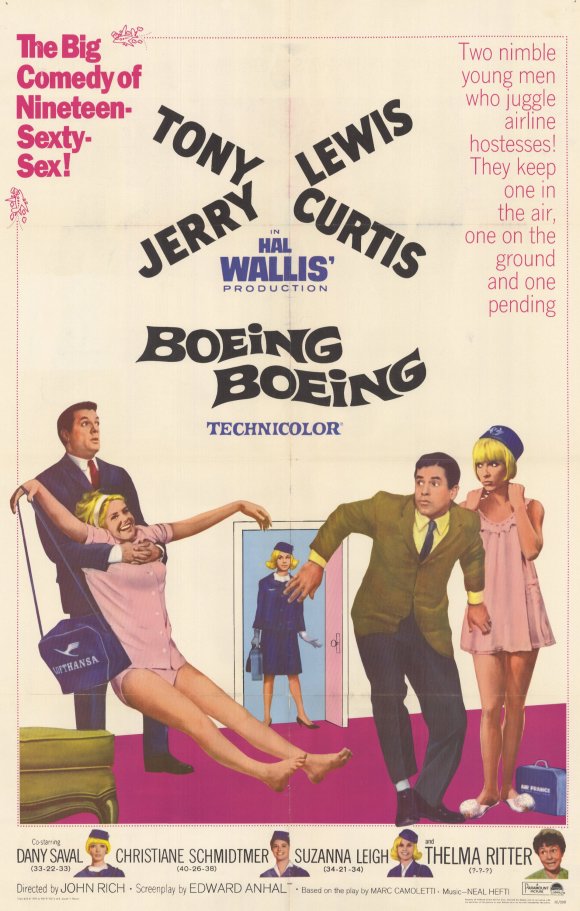
Bernard (Tony Curtis) thinks he’s come up with the perfect plan where as a confirmed bachelor he can enjoy the ‘benefits’ of a relationship without ever having to take the ultimate plunge. Using the timetables of all the airlines he has devised a way where he can date three different stewardesses (Dany Saval, Christiane Schmidtmer, Suzanna Leigh) simultaneously without any of them knowing of the other ones. When one of them is on layover from their flights they come over to his pad for romance and passion and then promptly leave for their jobs only to have another one arrive from another layover. It works for a while before the expected complications ensue. Things get even worse when Bernard’s out-of-town friend Robert (Jerry Lewis) arrives and wants to get in on the action while Bertha (Thelma Ritter) Bernard’s long suffering maid feels that she’s had enough and wants to quit.

The flimsy premise kills itself from the beginning by having a main character that is unlikable. I’m as open-minded as the next person, but if one wants to enjoy the swinger’s lifestyle then they must be open and honest with their partner(s) for it to work. This guy lies to them at every turn, manipulates with their emotions and views them solely as sexual playthings for his own pleasure, which is about as callous and self-centered as they come. His scheme is full of potential holes and any halfway intelligent person would’ve known it wouldn’t work and avoided even attempting it from the start.

The women are portrayed as being painfully naïve and stupid and falling for every pathetic lie and story that the men tell them. I was hoping at some point they would wise up and turn-the-tables, which would’ve been really funny, but that never happens. Instead the viewer gets treated to one ‘madcap’ scheme after another as they try desperately to keep their ridiculous ploy going, which becomes tiring and annoyingly redundant.

The three actresses at least have some acting ability and aren’t just the usual wide-eyed models mouthing their lines, which helps a little. Ritter certainly makes for a good anchor, but even she becomes stifled by the story’s derivative theme. Lewis surprisingly is the best thing about the film and this is mainly due to the fact that he is much more restrained and not allowed to fall into his over-the-top shtick.

Based on the stage play by Marc Camoletti this thing might’ve at one time been considered a fresh and funny bedroom farce, but by today’s standards it is tame and dated and not good for even a few chuckles.

boeing boeing 2

My Rating: 2 out of 10

Released: December 22, 1965

Runtime: 1Hour 42Minutes

Not Rated

Director: John Rich

Studio: Paramount

Available: DVD, Amazon Instant Video, YouTube

Lovin’ Molly (1974)

lovin molly

By Richard Winters

My Rating: 4 out of 10

4-Word Review: Two men one woman.

Molly (Blythe Danner) is a free-spirited woman living in a small Texas town during the 1920’s. Gid (Anthony Perkins) and Johnny (Beau Bridges) are best friends who also both like her. Molly likes them as well, but can’t seem to decide which of the two she loves better, so to solve things she gets married to Eddie (Conard Fowkes). This doesn’t go over well with the other two, but as time goes by she continues to see them and even has children from both of them, which causes a stir in her small community. Not only does she become the product of the local gossip, but virtually ostracized as well. However, Molly is undeterred about what everyone else thinks and sticks to her independent ways.

Based on the Larry McMurtry novel the film was directed by the legendary Sidney Lumet, but you would hardly know it. The production looks cheap and rushed and lacks atmosphere or period detail. The scenes are flatly shot with very little visual design or imagination. The whole thing comes off as something that did not get any major studio backing and was forced to look to private investors for funding, which unfortunately was just not enough.

Filming it on location in Bastrop, Texas which is also the setting of the story helps a little as the town has many historical buildings, which heightens to some extent the period atmosphere, but I would’ve liked to have seen more of it. The dry Texas landscape is also nicely captured and makes the viewer feel like they are living in the state themselves with each and every shot. The one thing though that really impressed me was how realistically the characters aged as the story, which spans 40 years, progresses. In most films the actors are forced to wear a ton of makeup, which gets overdone, but here very little of it was used and it looked far better.

Danner, who these days is best known as the mother of Gwyneth Paltrow, is excellent in a rare turn as a leading lady and even appears fully nude from the front and back. Perkins is solid in support and I enjoyed seeing Bridges with a bowl haircut. The star though that really steals it is Edward Binns as Perkins’ father whose caustic and to-the-point remarks are gems.

Fred Hellerman’s flavorful bluegrass score is pleasing, but the film itself fails to elicit much emotion. The only times that it does become mildly interesting is when the characters do a voice-over narration by reading off of passages lifted directly from its source material making me believe that this should never have been filmed in the first place and left simply in its novel format.

My Rating: 4 out of 10

Released: April 14, 1974

Runtime: 1Hour 38Minutes

Rated R

Director: Sidney Lumet

Studio: Columbia Pictures

Available: DVD (Region 2), Amazon Instant Video

Hello Again (1987)

hello again 4

By Richard Winters

My Rating: 3 out of 10

4-Word Review: Her life after death.

Lucy (Shelley Long) is married to Jason (Corbin Bernsen) a well-off plastic surgeon, but finds that she doesn’t fit in with his snobby clientele and feels out-of-place whenever she tries to hang out with them at dinner parties. She turns to her wacky friend Zelda (Judith Ivey) who dabbles in the occult, but her spells and magic do little until Lucy chokes on a chicken ball and Zelda is able to magically bring her back to life one year later. Now Lucy finds a new lease on things. Jason has gotten remarried to her former friend Kim (Sela Ward) and she uses this news to find a new love of her own and she’ll have to do it quickly because if she doesn’t find true love by the next full moon she’ll go right back to being dead again.

This is the second collaboration between director Frank Perry and writer Susan Isaacs and while their first effort Compromising Positions was just barely passable this one doesn’t even make it to that level. The script is unable to settle on any type of genre as it dabbles in drama, romance, comedy, social satire and fantasy, but ends up being only shallow nonsense in the end. A few of the tangents that it takes has potential to be interesting, but then it doesn’t go far enough with it. The comedy is light and inconsistent with the funniest moment being the one that was shown in its trailer where Lucy comes back to life and finds her shocked husband and friend in bed together and after that there’s very little else that’s even mildly amusing.

The fantasy elements are poorly thought out and leave a lot of unanswered questions. The climactic showdown between Lucy and Kim is flat and the caricatures of the rich and snobby crowd are clichéd to the extreme. I also didn’t find the scene where she chokes on a chicken ball to be a laughing matter as according to government statistics over 3,000 people in this country choke to death each year and if they really wanted to create some sort of goofy death it should’ve been something much more over-the-top.

Long isn’t leading lady material. Her image is so ingrained with the uppity and prim Diane Chambers persona from ‘Cheers’ that having her portray someone who is kind and humble comes off as insincere and phony and her attempts at being a comical klutz is annoying and completely unfunny.

This was Perry’s final directorial effort. He burst onto the film scene in the ‘60s and showed flashes of brilliance and new age vision, but his career declined markedly once he divorced from his screenwriter wife Eleanor and the stuff he did afterwards was barely even worth a look. He eventually was diagnosed with cancer and spent the last years of his life battling the disease and in 1995 even made a documentary about his fight called On the Bridge, which was far more compelling than this tripe.

My Rating: 3 out of 10

Released: November 6, 1987

Runtime: 1Hour 36Minutes

Rated PG

Director: Frank Perry

Studio: Buena Vista Pictures

Available: VHS, DVD, Amazon Instant Video, YouTube
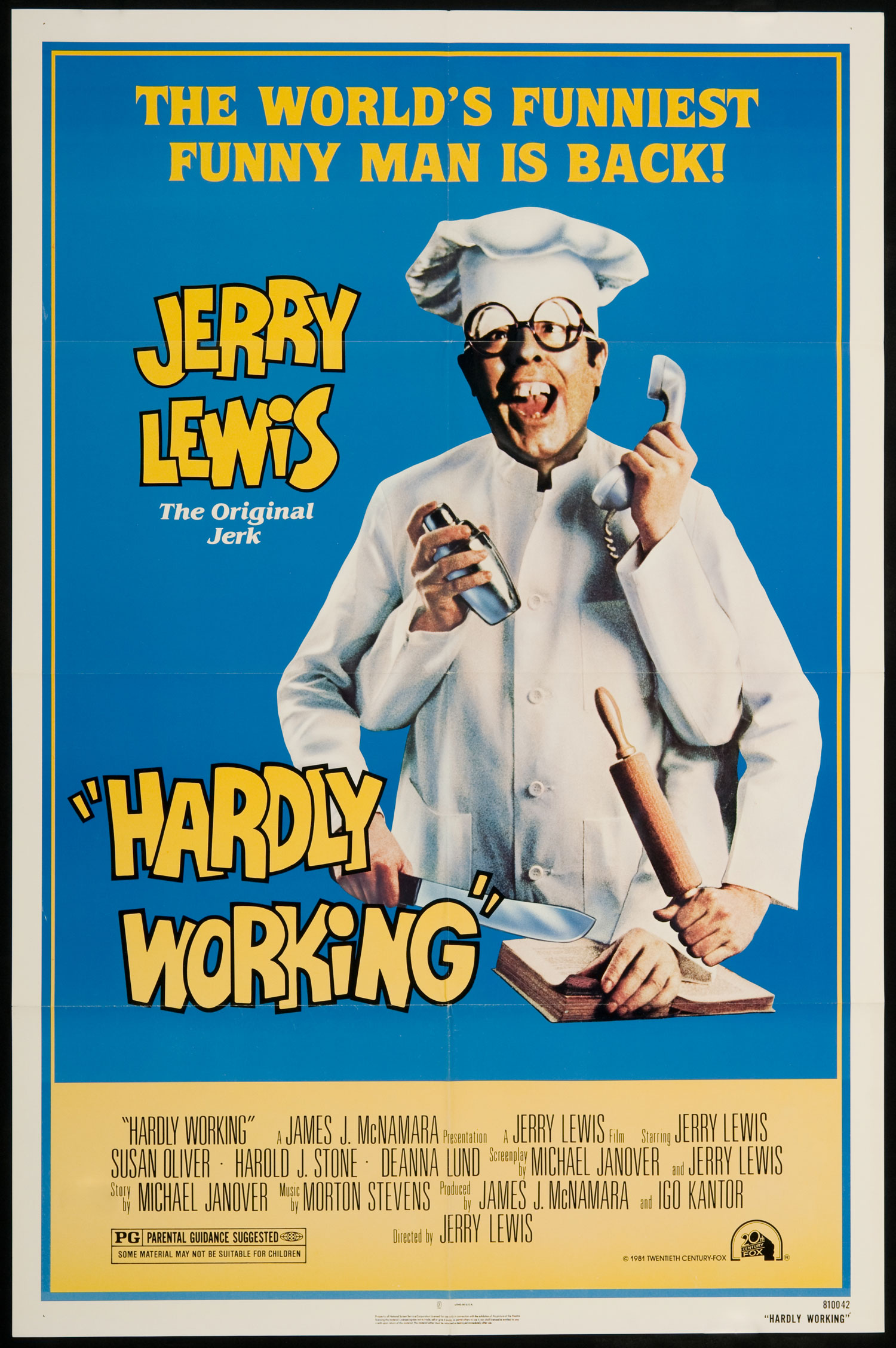
Hardly Working (1981)

hardly working

By Richard Winters

My Rating: 2 out of 10

4-Word Review: Klutz can’t find work.

Bo Hooper (Jerry Lewis) is a circus clown who finds himself out of a job. His sister Claire (Susan Oliver) and her belligerent husband Robert (Roger C. Carmel) agree to take him in and help him find a new source of income. Things aren’t easy as Bo proves to be a major klutz at everything and gets fired from most of his jobs on his very first day. He finally gets hired as a mailman that after a rough start begins to go semi-smoothly, but will his secret relationship with Millie (Deanna Lund) who is his boss’s daughter help ruin it?

I admit I’ve never been much of a Lewis fan. His routine seems too much like that of a 5-year-old desperate for attention and willing to do any inane thing for a cheap laugh. Peter Sellers and Don Knotts have played similar klutzy characters, but they at least came off as semi-believable adults albeit not very bright ones. Lewis though is this middle-aged man who for no warning or reason will suddenly revert to the behavior of a 6-year-old, which isn’t funny, but creepy, weird and pathetic instead. You start to wonder how this character was able to make it in the adult world as long as he had without being sent away somewhere instead of whether he will get a job or not.

His shtick amounts to nothing more than accidently knocking something over and spilling contents onto the floor, which is about as simplistic and basic as you can get. In many cases he doesn’t even offer to pick it up, which forces others to do it instead. In one instance he knocks over some materials that were lying on top of his boss’s file cabinet and then just lets them remain on the floor only to have the stuff three minutes later magically reappear on the top of the cabinet anyways.

The empty logic of this already threadbare concept is another issue. Why must this circus clown resort to doing jobs he has no experience in? Aren’t there other circuses out there that he could work for? And wouldn’t a man who has spent years working in that industry have built up a network of contacts that he could go to in time of need?

His foray working as a sushi chef where he pretends to be Japanese will be deemed offensive and racist by today’s standards, but the film’s worst scene is the one involving a blimp. He decides on a whim to pilot one despite being on-the-clock as a postman. Since the character is unable to flip even a light switch without causing a catastrophe one would expect his blimp drive to have dire consequences, but instead he pulls it off without a hitch and then somehow doesn’t lose his job or get arrested afterwards.

Filmed in 1979 the production was forced to go on hiatus for 6 months when it lost funding, which may be why Oliver and Carmel, who appear predominantly during the first half, disappear completely without explanation during the second part. In either event Lewis’ ‘big comeback’ after a 10-year absence from the big screen is a complete misfire. His material hasn’t evolved at all and he relies on the most infantile jokes and insipid scenarios imaginable that wouldn’t entertain a bored child let alone an adult.

My Rating: 2 out of 10

Released: April 3, 1981

Runtime: 1Hour 29Minutes

Rated PG

Director: Jerry Lewis

Studio: 20th Century Fox

Available: VHS

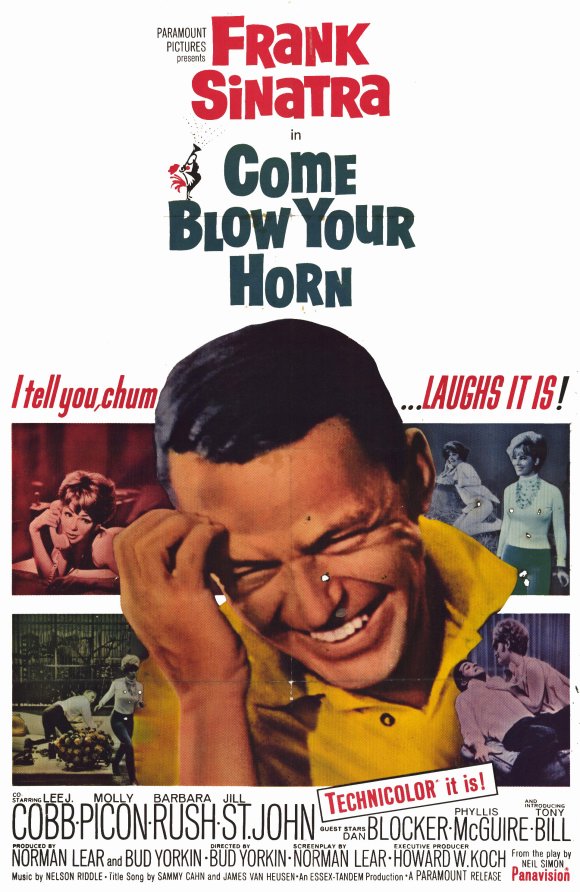
Come Blow Your Horn (1963)

come blow your horn

By Richard Winters

My Rating: 5 out of 10

4-Word Review: Kid brother moves in.

Buddy Baker (Tony Bill) has just turned 21 and is looking to get out into the world by moving in with his older brother Alan. Alan (Frank Sinatra) is living the bachelor’s dream by residing in a luxurious apartment in the heart of Manhattan while entertaining wild parties and a wide array of lovely ladies. Their parents (Lee J. Cobb, Molly Picon) do not feel that Alan and his lifestyle will be a good influence on Buddy and forbid him from doing it, but he does it anyways, which drives the father to disown his sons and cut out all communications with them.

This was the first Neil Simon play to be turned into a movie and it was loosely based on Neil’s relationship with his older brother Danny. For the most part it is talky and stagy while lacking Simon’s patented one-liners and humorous exchanges. It also has for some bizarre reason a musical number that comes out of nowhere at the 40-minute mark where Sinatra sings the film’s title tune and then just as quickly it goes back to being a straight comedy, which came off as jarring, out-of-place and misguided.

I did enjoy the film’s set design, which got nominated for an Academy Award, especially the interiors of Alan’s swanky apartment. However, I was confused why Buddy had to sleep in the same room as Alan as I would think such a large and fancy place would have more than just one bedroom. The movie also strongly implies that Alan is having sexual trysts with his lady friends, which would then imply that he must have a king sized bed somewhere, so why are only twin beds shown? He also has five telephones in the living room, which seemed beyond absurd and made me feel that if he had purchased a few less phones then he might’ve been able to afford a double bed.

Sinatra’s presence is the film’s weakest link as this type of comedy doesn’t mesh well with his otherwise caustic personality. He was too old for the part as he was not only pushing 50, but also only 4 years younger than Cobb who plays his father. I didn’t like Jill St. John’s ditzy character either as she was too dumb to be believable, which was not only painfully unfunny, but stereotypical and insulting to women.

I did like Tony Bill in his film debut and his nicely understated performance helps keep the film balanced. Dan Blocker is also great as a jealous husband and Molly Picon is a scene stealer as the mother. You can even spot Dean Martin as a wino in an uncredited cameo.

The fact that Alan doesn’t want to give up his swinging lifestyle despite the pressures from his girlfriend Connie (Barbara Rush) is the story’s one and only redeeming quality. I could never understand why a single man, who’s enjoying the bachelorhood at its most ideal, such as it is portrayed here, would want to suddenly throw it all for the married life. Most of the of films from that era with a similar theme would portray it as simply being the ‘magic of love’, but here the character is much, much more resistant to the idea and doesn’t change his ways until having a life altering event where he sees things from a different perspective, which made more sense.

Sinatra fans may want to check this out, but it is far from his best stuff and although the material is agreeable it is only slightly engaging and barely worth the time.

My Rating: 5 out of 10

Released: June 5, 1963

Runtime: 1Hour 52Minutes

Not Rated

Director: Bud Yorkin

Studio: Paramount

Available: VHS, DVD, Blu-ray, Amazon Instant Video

Firstborn (1984)

first born 2

By Richard Winters

My Rating: 4 out of 10

4-Word Review: Mom’s shitty new boyfriend.

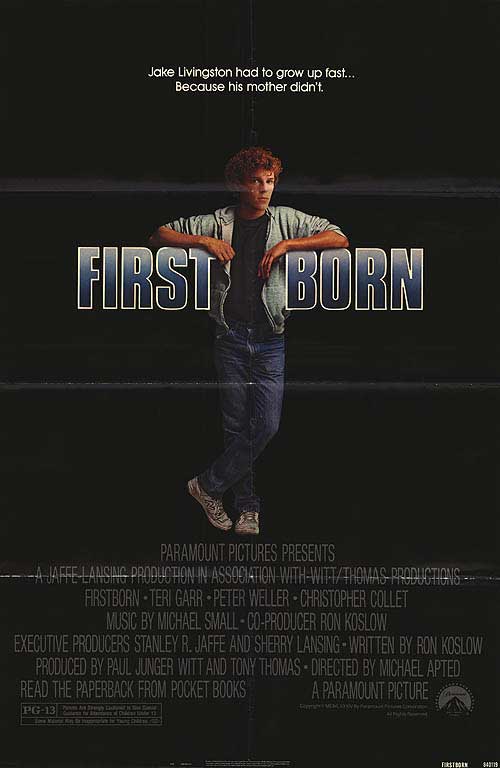
Wendy (Teri Garr) is a divorced mother living with her two teenaged sons Jake (Christopher Collet) and Brian (Corey Haim in his film debut). She begins to feel lonely and insecure when her ex Alan (Richard Brandon) finds another woman and gets remarried. On the rebound she latches onto Sam (Peter Weller) a drifter who can’t seem to hold down a job and deals drugs on the side. He moves in and begins an antagonistic relationship with older son Jake that spirals out-of-control and turns the once peaceful household into a war zone.

I liked the realism particularly the way the anger and animosity come to a head slowly. The characters and dialogue are believable and the film portrays teenagers far more accurately than most other ‘80s flicks. The violent confrontation at the end is exciting, but in some ways I found the way Jake locks horns with his equally bullying English teacher Mr.  Rader (James Harper) as being just as compelling if not more.

On the negative end the plot is by-the-numbers and does not offer any twist or interesting added angle. The characters don’t grow or change and the film lacks a much needed denouncement where we could’ve seen how the ordeal helped them evolve as a family.

Garr is perfectly cast as a vulnerable character and the idea of a lonely divorcee finding someone on the rebound while conveniently ignoring the red flags until it is too late happens quite a lot. Collet is tolerable, but gets out shined by his younger costars including Sarah Jessica Parker as his girlfriend and Robert Downey Jr. as his school chum as well as Haim who clearly display more on-camera charisma and show why they all ended up with the longer, more memorable careers.

corey haim

sarah jessica 2

Weller is convincing as the heavy, but the film is one-dimensional and fails to offer any insight. If you want to catch this simply to see the young stars before they were famous then it will be a fun flick despite the subject matter, but overall it’s nothing special and has an atrocious music score.

My Rating: 4 out of 10

Released: October 26, 1984

Runtime: 1Hour 40Minutes

Rated: PG-13

Director: Michael Apted

Studio: Paramount

Available: VHS, DVD, Blu-ray

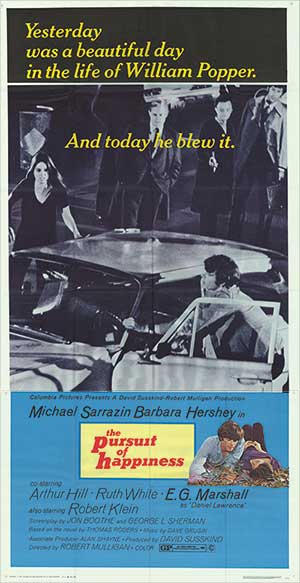
The Pursuit of Happiness (1971)


pursuit of happiness 2

By Richard Winters

My Rating: 5 out of 10

4-Word Review: Justice isn’t always fair.

Everything seems to be going William Popper’s (Michael Sarrazin) way. He is a young college student with a great looking girlfriend (Barbara Hershey) and from a rich family. One night he takes a trip to the grocery store. It is raining and he accidently hits and kills a woman who walks out onto the street between two parked cars. Since William has several unpaid traffic tickets, is part of the anti-establishment movement and seems to have a generally belligerent manner he gets arrested for her death. His rich father (Arthur Hill) hires a successful lawyer (E.G. Marshall), but William is a major idealist who doesn’t want to compromise on anything and the more he fights for his ideals the deeper it gets him into trouble.

The film, which is based on a novel by Thomas Rogers, certainly makes some great points about our modern day American justice system where everything seems more based on the image that the defendant tries to present than the actual facts. Unfortunately most viewers today are already quite jaded by this and the message comes off as old and redundant.

The biggest problem is with Sarrazin. He has always had a bit of a transparent quality and I’ve defended him in some of his other roles, but here he helps to bring the whole thing down. He conveys no anger or emotion of any kind even though it’s supposedly his passion for the truth that causes him to behave the way he does. His comes off as limp and lifeless making me wonder how such a bland guy could attract a girlfriend at all let alone a really beautiful one. His character is also a bit too stubborn and strangely naïve to the point that the viewer isn’t completely empathetic with his cause as it becomes painfully obvious that he is only hurting himself by refusing to back down at all while most rational people would’ve likely buckled under just enough to get themselves out of the jam.

The script unfortunately is more intent on making a statement than telling a story as we are given no conclusion to the character’s plight. He escapes from jail and takes a flight to Mexico, but then it just ends leaving open a wide array of unanswered questions and making the viewer feel like they’ve seen only half a movie.

Ruth White, in her last film appearance, gives a strong performance as Walter’s Archie Bunker-like grandmother. It’s also great to see Marshall playing a more hard-lined version of the defense attorney role that he was famous for from ‘The Defenders’ TV-show. Robert Klein is engaging as Walter ‘60s radical college friend and David Doyle is good as Walter’s cellmate. Charles Durning, Ralph Waite and Rue McClanahan can be seen in small roles and this also marks William Devane’s film debut.

pursuit of happiness 3

My Rating: 5 out of 10

Released: February 23, 1971

Runtime: 1Hour 33Minutes

Rated GP

Director: Robert Mulligan

Studio: Columbia Pictures

Available: DVD, Amazon Instant Video

Kes (1969)

kes 1

By Richard Winters

My Rating: 6 out of 10

4-Word Review: Boy trains a kestrel.

Billy (David Bradly) is a poor working class youth living in Yorkshire who finds his existence to be bleak and pointless. He is bullied constantly by his older brother Jeb (Freddie Fletcher) and ignored by his burdened mother (Lynne Perrie) while also being picked on at school. As means of some solace he finds a nest of baby kestrels inside an abandoned building. He takes one of them and keeps it in his backyard shed where he trains it, which in return gives him a sense of purpose.

The film is based on the novel by Barry Hines who also wrote the screenplay and although the plot is basically the same it does vary in two major ways. The first one being that in the book everything takes place in one day and with a lot of use of flashbacks to explain the backstory, which I liked better, but here it’s given a linear narrative. The book also explains a bit more about the otherwise absentee father and even has one scene involving him while here the character is non-existent and never even mentioned.

On a purely cinematic level it is well made and nicely exposes Billy’s hopeless working class world without ever being heavy-handed. The drama is fresh and natural with each scene and character ringing true. The segments involving the training of the bird is the most engaging and I wished had been extended.

The children are fantastic without being too cute or precocious and respond to things in ways that are honest to their nature. The adult cast is good as well although not as likable. The teachers and school administrators, with their very old fashioned approach to discipline, come off as genuine jerks. At one point one of them even raps the open palms of the children’s hands with a cane, which makes their eyes well up with tears and is unpleasant to watch.

The worst is the segment involves Billy’s physical ed. teacher Mr. Sugden, which is played by Brian Glover who was an actual high school instructor at the time as well as a former wrestling. Here he plays a coach who brutally bullies his students in a scene that makes its point and then goes on too long with it. I also didn’t like that director Kenneth Loach superimposes the score of the soccer (football) game that the students are playing onto the screen, which wasn’t necessary as who wins the game was not important at all and hurt the film’s realism by distracting the viewer and taking them out of the story.

Some have complained about the thick dialect of the characters, which makes it hard at times to understand what they are saying. Certain American versions have been dubbed to make the lines uttered clearer although the version I watched, which was from the Criterion Collection, seemed to have the original accents intact, which I preferred as it kept it more authentic and for the most part I didn’t have any problem with it.

Spoiler Alert!

The only real issue that I had with the film is its downbeat ending. I realize that it is the same as the one in the book, but felt a bit frustrated that every time there is a movie dealing with a child taking care of an animal it always for some reason has to end in tragedy, which made it a bit formulaic. The kid never gets a break and having the falcon get killed at the end was like rubbing salt into the wound. The bird that actor Bradly buries apparently died of ‘natural causes’ but at the time he was under the belief that it had been killed simply to suit the purposes of the film and the angry reaction that you see on his face was very real.

End of Spoiler Alert!

kes 2

My Rating: 6 out of 10

Released: November 16, 1969

Runtime: 1Hour 50Minutes

Rated GP

Director: Kenneth Loach

Available: DVD, Blu-ray, Amazon Instant Video

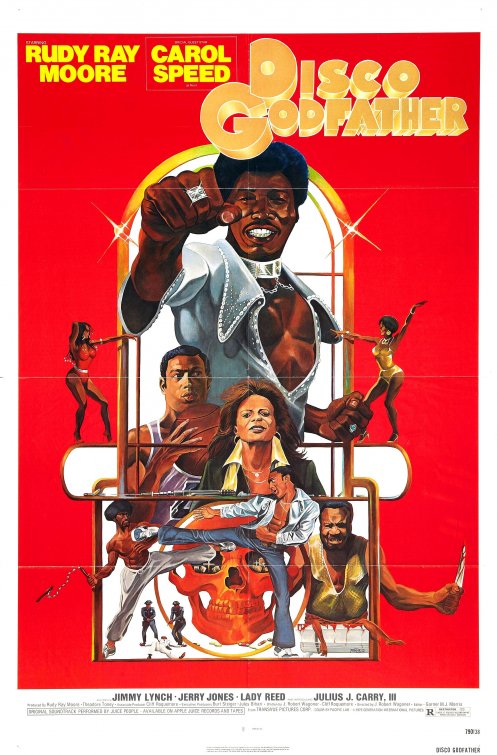
Disco Godfather (1979)

disco godfather

By Richard Winters

My Rating: 2 out of 10

4-Word Review: Don’t try angel dust.

Tucker (Rudy Ray Moore) is the DJ at a local discotic known as Blueberry Hill who becomes concerned when his nephew takes a new drug called angel dust that causes him to have weird hallucinations and forces him into the hospital. Since Tucker is also a former cop he decides to use his connections with the police force to take down the drug dealers and clean up the streets before they can corrupt any more of the youth, but the dealers have other ideas including kidnapping Tucker and forcing him to ingest the drug via a gas mask.

This was the fifth feature for Moore and the last one where he was credited as the star. The former comedian created a character for his stage act called Dolemite that proved so popular that in 1975 it was turned into a movie and Moore became a star at the age of 48. Yet by this time the act was starting to get old. He still had the energy, but seeing a man who was clearly in his 50’s somehow able to beat up guys who were much younger and bigger than him didn’t make a lot of sense.

The story itself is run-of-the-mill and splicing in disco dance numbers where the camera conspicuously focuses in on the scantily-clad gyrating bodies of the females doesn’t help and if anything makes it even more boring. The fight sequences looked quite staged and it’s obvious that the actors are pulling their punches and kicks.

The only thing that makes this otherwise uninspired low budget mess slightly diverting are the drug sequences in which the characters start tripping out on all sorts of weird hallucinations as well as a segment dealing with a religious group trying to ‘cure’ one of the victims through an exorcism. The final segment in which Moore sees his mother turning into a devil is goofy enough to give this thing 2 points and had this movie cut out the derivative drama and emphasized more of a surreal quality it would’ve done better.

My Rating: 2 out of 10

Released: September 3, 1979

Runtime: 1Hour 33Minutes

Rated R

Director: J. Robert Wagoner

Studio: Transvue Pictures Corporation

Available: DVD

Creator (1985)

creator

By Richard Winters

My Rating: 2 out of 10

4-Word Review: Cloning his dead wife.

Harry Wolper (Peter O’Toole) is an eccentric college professor obsessed with the idea of cloning his dead wife. With the help of an undergraduate assistant named Boris (Vincent Spano) he sets up a makeshift shed in his backyard and uses the university equipment for his experiments. He employs the services of Meli (Mariel Hemingway) a 19-year-old in desperate need of funds whose egg he uses as part of the cloning process. After a while she starts to fall in love with him and as the fetus of his dead wife takes shape she becomes jealous and feeling that he should be more concerned with the living than the dead.

O’Toole is engaging as ever in the type of role that most suits his talents. Had the film stayed centered on him it would have been a joy to watch, but unfortunately it enters in the generic Spano who looks like he was pulled straight off of the cover of a men’s modeling magazine. I presume this was because the studio felt a movie centered on a man over 50 wouldn’t attract the all-important 16-30 year-old demographic, but despite being an obvious chick-magnet he adds little and there was period in the middle where he isn’t seen for a long time to the point where I forgot about him and didn’t miss him at all.

Hemingway adds quirky energy as the free-spirit and her kooky romance with O’Toole adds genuine spark, but the film regresses by spending too more time focusing on Spano’s relationship with fellow coed Barbara (Virginia Madsen). This romance is very formulaic and makes the film seem like two movies in one while sucking all of its offbeat potential right out. If anything Spano should’ve fallen for his robot that is by far funniest thing in the movie.

Spoiler Alert!

David Ogden Stiers makes for a good antagonist and John Dehner, in his last theatrical film appearance, is solid as O’Toole’s loyal colleague, but the film’s biggest problem is when it shift gears and destroys the whole cloning angle completely. It then centers on a mysterious illness that befalls the Barbara character that like in Love Story never gets explained and comes out of nowhere. She goes into an immediate coma and is put on life support where her parents (Rance Howard, Ellen Geer) agrees much too quickly and without bothering to even get a second opinion to take her off of it and allow her to die. This then forces Spano to talk to her endlessly until just as the she is about to be disconnected she ‘miraculously’ comes back to life, which is too implausible, too contrived and too cute for even the most hopeless of romantics and helps ruin the engaging performances of its two lead stars, which is the only good thing about it.

End of Spoiler Alert!

My Rating: 2 out of 10

Released: September 20, 1985

Runtime: 1Hour 47Minutes

Rated R

Director: Ivan Passer

Studio: Universal

Available: VHS, DVD, Amazon Instant Video