Tag Archives: Paul Sorvino

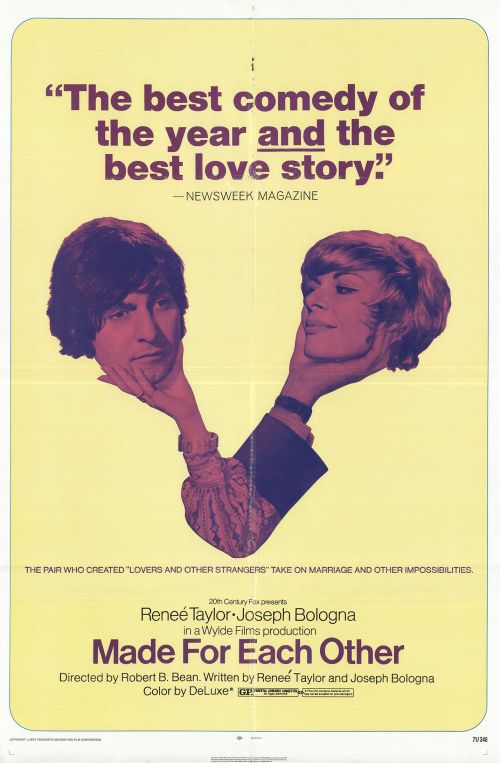
Made for Each Other (1971)

made

By Richard Winters

My Rating: 7 out of 10

4-Word Review: Couple argues a lot.

Pandora (Renee Taylor) is an out-of-work actress still clinging to her dreams that she’ll one day become famous something she has hoped for since she was a child. Gig (Joseph Bologna) suffers from not being able to find a stable relationship and guilt-ridden over sending the last one into attempted suicide. Both Pandora and Gig attend a group therapy session and this is where they meet. Initially though things are rocky. Gig does not like Pandora’s stand-up act, something she’s been working on for years, and openly tells her it’s awful. They then break-up, but Pandora eventually returns telling him that he was right and she’s worked out the ‘kinks’ from her act, so it’s now improved. To celebrate Gig takes her to his parents (Paul Sorvino, Olympia Dukakis) for Thanksgiving. The parents though don’t approve of Pandora since she’s Jewish and they’re Catholic and they eventually drive her out of their apartment. Gig and Pandora continue to argue once they’re back in the car, but find, strangely, that no matter how the other one annoys them they still like each other’s company.

After the runaway success of Lovers and Other Strangerswhich Bologna and Taylor wrote initially as a play, but then turned it into a movie, Hollywood studios were interested in them trying another script and gave them upfront money to do so. The first film had been based on their real-life experiences of dealing with all of their in-laws during their wedding, which occurred in 1965, and so they decided to base this one on their lives as well, namely what brought them together. Like with their first project the script is quite broad and focuses in on many different people including the parents of each character who have quite a bit of screentime, particularly Sorvino and Dukakis, and who are quite funny. The film also shows the leads when they were infants and many of their childhood experiences, which gets shot in black-and-white, that is also both insightful and amusing.

Unlike with most movies the scenes are quite extended and seemed better primed for a stageplay. The elusive Robert B. Bean gets credited as director, but he never did anything else, which seems a bit curious and there’s been rumors that he was just a pseudonym for Bologna who took over as the actual director. The long takes though are effective and enhance the comedy. The scene inside Gig’s parents house where the tension builds when they slowly realize that Pandora is ‘not their kind’ is quite good and not unlike what could happen in many families homes of that era who closely identified with their particularly religions and not privy to having their kids marry outside of it. Gig’s inability to appreciate Pandora’s stage act and his blunt assessment of it while at a late night cafe is comically on-targe too as any fledgling artist will tell you sometimes family members, friends, and even those really close to them won’t always connect with their artistic endeavors and regrettably become their biggest critics.

Sorvino scores as the abrasive no-nonsense father though ironically he was actually 5-years younger than Bologna who plays his son and for that reason his hair should’ve been made more gray. Dukakis is equally on-target as the super religious mother whose strong faith amounts to a lot of rituals and ends up inadvertently harming her child psychologically like when she catches him masturbating and informs him that if he continues his ‘little thing will fall off’. Helen Verbit as Pandora’s mother is equally amusing playing the over-protective type who wants so hard to shield her daughter from harsh reality that she tells her that her stage act is ‘brilliant’ when it really isn’t and that because she’s her mother that somehow makes her opinion ‘objective’.

The film’s one drawback is the yelling, which there is a lot of. Sometimes confrontational comedy can be quite amusing and this one works most of the way, but how much the viewer will enjoy is up to each individual. Bologna’s shouting is particularly loud and abrasive. It’s meant to funny and done only out of aggravation, but it does tend to get extended especially by the end. Had Taylor shouted back then it would’ve seemed like a ‘fair fight’, but having her run away and cry takes humor out of it and may ultimately ingrate on the audience. The intent is for there to be an offbeat charm, but not everyone may see it that way and thus this thing won’t be for all tastes.

My Rating: 7 out of 10

Released: December 12, 1971

Runtime: 1 Hour 41 Minutes

Rated GP

Director: Robert B. Bean

Studio: 20th Century Fox

Available: DVD-R (Fox Cinema Archives)

The Day of the Dolphin (1973)

dolphin2

By Richard Winters

My Rating: 3 out of 10

4-Word Review: Training dolphins to talk.

Jake Terrell (George C. Scott) along with his wife Maggie (Trish Van Devere) run a remote island research station where, along with a small team of researchers, try to teach dolphins to communicate with humans. They’re prime subject, which they’ve been working with for 4 years, is Alpha whom they’ve successfully trained to speak some English words, but when they team him up with another dolphin named Beta he goes back to his old ways of communicating and no longer speaks with Jake, or his team. Things become further hampered when Curtis (Paul Sorvino) arrives on the island supposedly under the guise of being a journalist, but in reality he’s a spy there to infiltrate what Jake has been doing with the dolphins and report back to a secret government organization who want to then use the dolphins for their own nefarious means.

With the early success of director Mike Nichols and screenwriter Buck Henry, especially The Graduate, it seemed like these two could do no wrong and they both became a much sought after Hollywood commodity and given many top project offers. This production though came crashing down horribly and stymied Nichols career, which had previously been skyrocketing, for the rest of the decade as he helmed only one other film after this during the 70’s before finally getting his reputation back in order with the critically acclaimed Silkwood.

This thing comes-off as a misfire almost immediately and the biggest problem are the dolphins. There’s just so much they can do, liking mainly jumping in and out of water, until it becomes really boring. The long dream-like segment of watching Jake swim around in the tank with the dolphin adds nothing and got so prolonged that it practically put me to sleep. The only part where the dolphins did hold my attention was when Jake decides to split the two up where Beta is put in a pool on one side and Alpha the other and a steel partition between them. This then causes the dolphins much stress as Alpha angrily smashes his tail repeatedly against the partition in anger, but to no avail. While I did find this moment to be rather intense it does backfire in a way in that it makes Jake and the other researchers seem cruel and you start to not like them, which I don’t think was the filmmaker’s intent.

Having them learn to talk was misguided and makes it seem like a silly flick for kids with no barring in reality. Initially I was okay with them learning a few words as it came-off like they were parrots repeating sounds that they had heard, so it was borderline plausible, but then having it graduate to the point that he and others can have ongoing conversations with them and even ask them questions is when it starts to get too absurd for its own good.  In fact the only moment in the film that’s truly fascinating to see is when a mother dolphin gives birth using actual footage, which made me believe this would’ve been better off had it been done as a documentary and the fictional story left out completely.

Sorvino does add some energy with his scenes and pretty much outclasses Scott, who with his $750,000 salary, which would equate to $5,484,886 in today’s dollars, is quite dull and he manages to get completely upstaged by even the dolphins themselves. All of the main characters are quite one-dimensional, especially Van Devere who seems to agree with Scott on everything and echoes whatever point-of-view he has making her presence completely unneccesary as she’s simply him in a female form.

Having one of the research crew members turn out to being a spy doesn’t work either as the viewer is given no forewarning about this. We’re just informed later that this individual had betrayed them, but a good movie should offer hints upfront that a traitor may be in their midst and thus allow the audience to become more of an active participant as they try and figure out which of them it is. The secret government organization thing gets equally botched. A better scenario would’ve had a former friend, or associate to Jake turn on him and seek revenge by trying to destroy the research facility and all of their findings. He would be constantly lurking about, which would’ve added more ongoing tension that is otherwise lacking and given the bad guy more of a personality versus the bland government agents that are too generic to be either frightening, or memorable.

My Rating: 3 out of 10

Released: December 19, 1973

Runtime: 1 Hour 44 Minutes

Rated PG

Director: Mike Nichols

Studio: AVCO Embassy Pictures

Available: DVD, Blu-ray

Vasectomy: A Delicate Matter (1986)

vasectomy1

By Richard Winters

My Rating: 0 out of 10

4-Word Review: Father considers male sterilization.

Gino (Paul Sorvino) is a proud Italian man who has fathered eight children, but now his wife Anna (Cassandra Edwards) doesn’t want anymore kids and pressures him to get a vasectomy. Gino fears the procedure, but eventually agrees only to have an angry confrontation with the doctor (William Marshall), which sends him running away from the operating room. Anna insists that he still must go through with it, or he won’t be allowed back into bed with her until he does. Meanwhile Gino must also worry about his greedy relatives, who’ve concocted an elaborate plan to steal money from the bank he works at and put it out of business.

I don’t know if I’ve ever seen a movie quite this bad. It’s not so much for any technical miscues. No shaky camera, boom mikes getting into the screen, atrocious lighting, schlocky sets, or bad acting. In fact all of those things are okay. What really reeks is the bland script that is poorly paced and not funny. The film starts out really slow and never gains traction. For a comedy there needs to be a lively plot and quick edits, but this thing dies out before it even has a chance to get started. 18-minutes in and I was still waiting for the first laugh and became genuinely confused whether this was meant to be a comedy at all. 

The main plotline is so weak that the inane crooked loan scheme is added jut to pad the runtime. The living situation of the family is rather unrealistic as well. Of course since it was the 80’s, the height of capitalism, the question of whether a family could actually afford 8 kids is never addressed, but most people, even those working at a bank, might find that situation financially challenging. The home looks too well maintained for having all those kids too who would most likely be running around and disorganizing everything. The mother is never shown having to deal with them either. In fact she comes-off as an affluent suburbanite who’s fully in-control of her life and able to out with her lady friends without the typical struggles of having to juggle her personal life with child rearing demands. All 8 kids end up being boys, but what are the odds of that? They’re also all around the same age like she popped them all out simultaneously and all of them get crammed into the same bedroom even though the house they resided in looked big enough that that shouldn’t have been necessary.

Paul Sorvino manages to be solid even though with his rotund belly he does look a bit pathetic during the scenes where he wears a baseball uniform. He does though sing the national anthem surprisingly well, apparently he sang opera to the crew between takes, and the segment where he goes in to the operation and babbles incessantly, is actually kind of amusing. I was not impressed though with Edwards as she looked too young to be his wife like she was still in her 20’s while he was already in his late 40’s. 

While I’m not a violent person I would consider, if I ever met the director of this, Robert Burge, to punching him as I honestly felt like he maliciously stole 90-minutes of my life and I don’t understand what the purpose was for it. 33,000 scripts get submitted yearly, but only 1 percent of those ever gets sold or produced, so how the hell did this one sneak through? Even a crew member from the film stated in his IMDb review that he’d give this a negative rating if he could. Maybe the director was a guy that had enough funds he was able to produce it himself and therefore didn’t feel the need to answer to anybody. If that were the case then this would’ve been an instance where having never made a movie would be better than living with the embarrassment of your name being attached to this mess for all those unfortunate enough to see it.

My Rating: 0 out of 10

Released: September 26, 1986

Runtime: 1 Hour 30 Minutes

Rated PG-13

Director: Robert Burge

Studio: Vandom International Pictures

Available: VHS, DVD-R (dvdlady.com)


Shoot It Black, Shoot It Blue (1974)

shoot1

By Richard Winters

My Rating: 3 out of 10

4-Word Review: Killing caught on film.

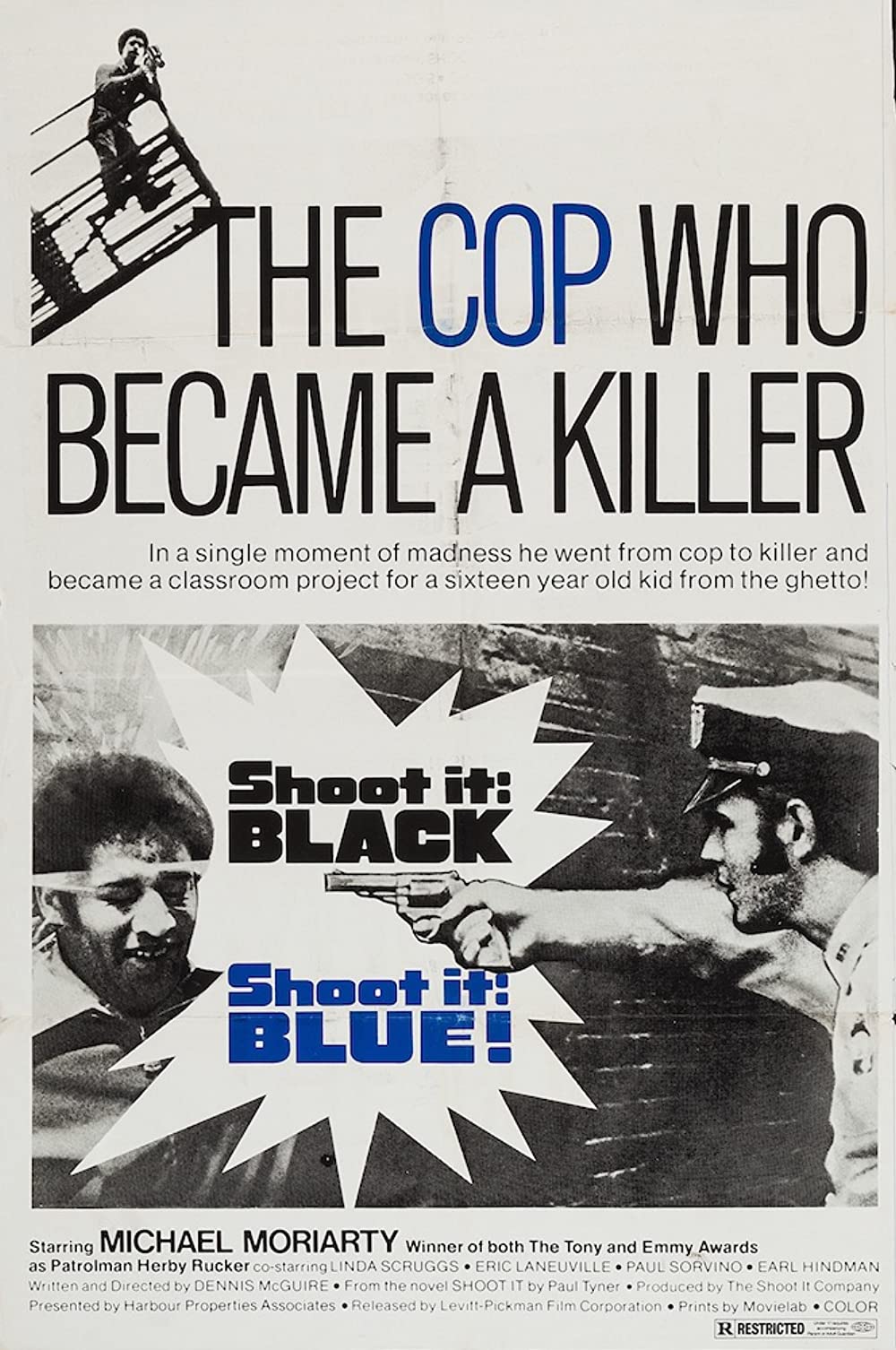
Herbert G. Rucker (Michael Moriarty) is a cop with a chip on his shoulder. Having been recently demoted due to a infractions violation he angrily goes about his foot patrol shift on the streets of Kansas City quietly brooding over his feelings of being unfairly wronged. He then chases after a black man who’s stolen a lady’s purse. When he catches up with him in a lonely, back alley he decides to shoot the man despite the fact that he didn’t resist. Unbeknownst to him Lamont (Eric Laneuville), a high school student and amateur filmmaker, caught it on his camera through the back window of his apartment’s fire escape, which was several stories up. While Herbert thinks there are no witnesses and thus will not be caught he instead learns that he’s being charged for murder, but Lamont’s identity is being kept a secret for his own protection until the trial begins. In the meantime Herbert goes hunting for him even though he’s not sure who it is while Lamont continues to follow Herbert secretly recording, both with his camera and tape recorder, everything Herbert does, which leads to him uncovering even more crimes that he admits to.

This film is very similar to Deadly Herowhich came out a year after this one and had the same theme of a cop abusing his authority and inexplicably killing a black man while hoping, even expecting, to get away with it. While that film wasn’t perfect it still fared better than this one. Both films worked off of the public’s growing mistrust of the police departments and some of the inner racism that was on the force. That movie though had much better tension that consistently built-up while this one has long, boring segments that doesn’t feel like it’s propelling the plot. I liked the idea of showing the antagonist in a non-stereotype way where he wasn’t just this one-dimensional sociopath, but instead portrayed as someone with a very low self-esteem who doesn’t feel like he makes much of a difference and kills the other man simply as a way to have empowerment over someone else. The approach though is too leisurely with too many scenes filled with extraneous dialogue and scenery, like having Herbert attend a wedding and even visit a zoo, which aren’t compelling.

I initially thought that the casting of Moriarty was a good thing as his erratic and sometimes bizarre behavior behind-the-scenes on many of the productions that he’s worked on, both for film, television, and stage, that has essentially gotten him blacklisted and deemed too difficult to work with. I was hoping he would channel this inner craziness into his character, but instead he gives a flat performance. We see Herbert’s beaten down side, but never the hidden anger making his time in front of the camera dull and not riveting.

Sorvino as the prosecuting attorney and Earl Hindman as Herbert’s partying friend convey a lot more energy and therefore more fun to watch. Laneuville though fares best as his scenes help move the plot along while Moriarty’s moments make it feel like it’s stagnating. I was disappointed too that there’s no ultimate confrontation between them and Lamont’s ability to follow Herbert around without getting detected seemed dubious as most cops acquire a keen sense of awareness with their immediate surroundings through the dangerous nature of their job and thus I’d think he’d pick up on the fact that he was being followed/monitored much sooner than he does.

Spoiler Alert!

The twist at the end has the victim’s brother shooting the tires of a car that Herbert’s driving, all from a tip given to him from Lamont, which sends Herbert’s car careening out-of-control and eventually killing him. This was ‘street justice’ due to their belief that Herbert would never have been convicted. This though needed to be shown and not just presumed. Seeing a judge or jury acquit Herbert despite the ample evidence would’ve been more impactful. The added trial scenes would’ve also made the script more compact with the boring moments trimmed down. If the killer was indeed going to be acquitted anyways because the jury system is rigged and so he later on gets shot at while driving, is fine, but a court room battle was needed either way.

My Rating: 3 out of 10

Released: August 4, 1974

Runtime: 1 Hour 33 Minutes

Rated R

Director: Dennis McGuire

Studio: Levitt-Pickman

Available: VHS, DVD-R

Slow Dancing in the Big City (1978)

slow1

By Richard Winters

My Rating: 2 out of 10

4-Word Review: Journalist falls for dancer.

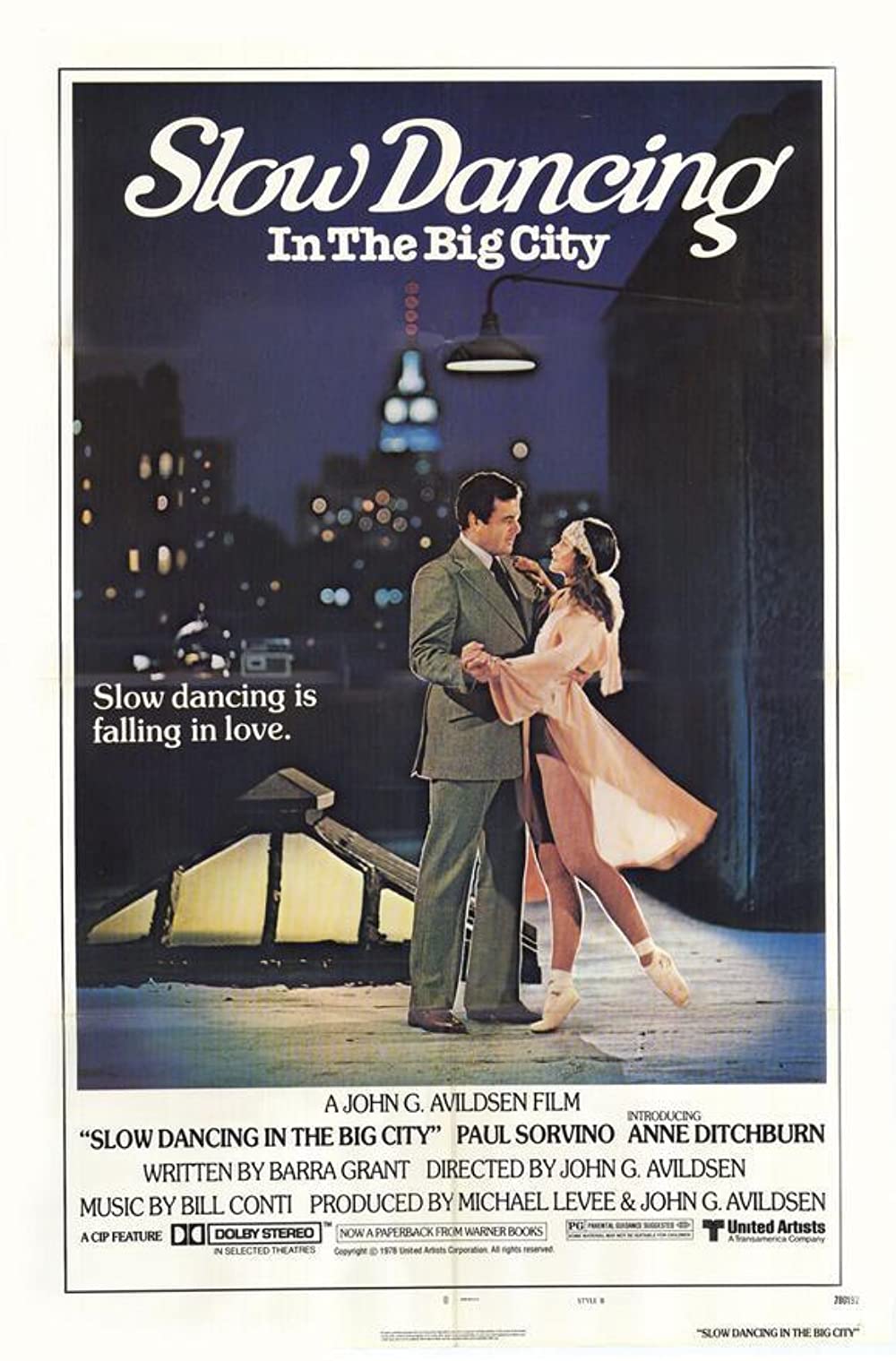
Lou (Paul Sorvino) is a successful columnist for a major New York newspaper and is known throughout the city where ever he goes. He’s been in a casual sexual relationship with Franny (Anita Dangler), an early version of what’s now called ‘friends with benefits’, for quite awhile, but he’s ready to move-on. He then meets Sarah (Anne Ditchburn) a professional dancer who’s moved into an apartment next to his. She’s getting ready to star in a big ballet production, but is finding that during rehearsals she’s having a lot of difficulty doing her routines. She visits a doctor and learns that she has a degenerative condition that will make her continued dancing impossible. If she tries to dance for even a little while more it could mean she’ll lose her ability to walk. She wants to perform one last time in the premiere of her play, but will Lou, whose just learned of her condition, be able to talk her out of it?

This was director John G. Avildsen’s follow-up to his mega-hit Rocky and many in the film going public, both fans and critics alike, were excited in anticipation at seeing his next big project. Some promos even described this as a ‘female Rocky’, but after it premiered no one was impressed. It ultimately died at the box office and tainted Avildsen, who had struggled for many years before Rocky, with a lot of low budget independent stuff that was never seen by a wide audience, as being a ‘one hit wonder’. Of course it didn’t help that he went on to direct the wretchedly bad Neighbors, but in either case this was the start of his career downfall that was somewhat saved with The Karate Kid, but not completely.

One of the things that I did like were the two stars. Ditchburn, whose only other starring role in a feature film was in the Canadian slasher Curtains, I felt was super. She was a professional dancer and initially I thought she had been the inspiration for the story, but apparently that wasn’t the case as Avildsen had already auditioned over 400 other people for the part before he settled on her, which came after he saw a picture of her and her beauty so mesmerized him he couldn’t get her image out of his head. While her acting during her audition was by her own admission ‘a disaster’ Avildsen was determined to make it work and they went through long and exhausting acting lessons until it improved. Some critics labeled her performance as ‘wooden’, but her initial frosty reaction to Sorvino, who came-off like a middle-aged poon-hound, seemed reasonable and what most other women would’ve done. The many headbands that she wears throughout was an attempt to cover-up a bad haircut that she had gotten just before filming began and in my opinion they had a sexy appeal.

Sorvino is genuinely engaging playing a prototype of famous New York columnist Jimmy Breslin and while others have played a similar type of role, including Breslin himself, I felt Sorvino did it best and his presence helps keep the film watchable. I did though question why his character, who writes for a major newspaper and known seemingly throughout the city and occasionally even gets spotted as if he were a celebrity, would still have to be living in a rundown, two-bit apartment building like he does.

The empty-headed script by actress-turned-screenwriter Barra Grant is the biggest culprit.  There’s simply no rational, logical reason for why these two complete opposites, with a drastic age separation, would suddenly go ga-ga for each other at virtually first sight. For Sorvino I could see why an out-of-shape middle-aged man would lust after a cute young thing who’s moved in next door and hope if he heaps enough attention on her he might get lucky, but I didn’t understand why Sarah would fall for a guy who was so much older. She was previously in a relationship with another older man, played by Nicholas Coaster, but no explanation for why she liked guys who could’ve been her father, even though in an effort to make her motives more understandable, there should’ve been one.

To make the concept believable the two should’ve been put into some situation where they had to rely on each other to succeed and in the process fell-in-love. It could’ve been helping each other out of some disaster like an apartment fire, or car accident. Or working together on a long-term project. Having the female protagonist then get afflicted with some ‘disease-of-the-week’ just makes it even more corny.

Spoiler Alert!

The ending in which we get to see the musical Sarah’s been preparing for is actually the best part as the stage production allows for some visual creativity, which had been otherwise lacking, but I didn’t like the tension of whether she was going to be able to make it through her illness without collapsing. The fact that she’s able to perform and only collapses the second the play is over is incredibly hokey. It also ends too abruptly with Sorvino carrying the crippled Sarah onstage where she gets a standing ovation by the audience, but no denouement showing what happened afterwards. Does she get the operation, which would allow her to walk again, or does she become permanently confined to a wheel chair and if so does that affect their budding relationship? These are questions that should’ve been answered, but aren’t.

My Rating: 2 out of 10

Released: November 8, 1978

Runtime: 1 Hour 44 Minutes

Rated PG

Director: John G. Avildsen

Studio: United Artists

Available: DVD, Blu-ray

Oh, God! (1977)

By Richard Winters

My Rating: 7 out of 10

4-Word Review: An atheist meets God.

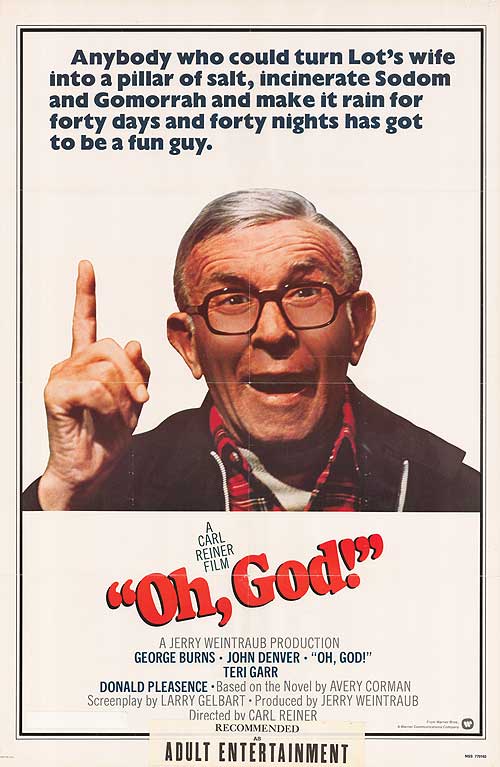
Jerry Landers (John Denver) is a married man with two kids (Moosie Drier, Rachel Longaker) who works as an assistant manager at a local grocery store. He doesn’t consider himself to be religious nor does he attend church (he most likely could be called an atheist, but I assume that term was considered ‘too toxic’ of a label to put on a protagonist that mainstream audiences of the day were expected to like, so he’s just given the much softer description of being a non-believer.) One day he receives a letter in the mail stating that God would like to interview him at a certain location, but Jerry considers this to be a practical joke and throws it away, but when the letter keeps popping up at the most unlikely places he finally decides to take it seriously. He goes to the location and meets God (George Burns) who at first he does not see, but only hears, but eventually the almighty takes the form of an old man. He tells Jerry to spread the word that he exists, which Jerry does only to have it all snowball against him when everyone thinks he’s crazy and even his own family becomes embarrassed to be seen with him.

The film is based on the 1971 Avery Corman novel of the same name though the book had more of a satirical tone and the protagonist was a journalist. The film though manages to retain the same jaded sensibilities of the modern-day public, which is what makes it so amusing and for the most part quite on-target. Denver, who was known more as a singer and did very little acting both before or after this, is quite good here, but only if you can get past his bowl haircut. Burns is excellent as well and I always felt this is the performance he should’ve won the Academy Award for instead of the one in The Sunshine Boys as it easily became his signature role.

The script though by Larry Gelbart is full of incongruities. For instance the God here claims to be a non-interventionist who sets the process in motion and then lets things happen without getting involved. Everyone is given free will and he doesn’t intervene to stop suffering or ‘bad things’ from occurring because that would upset the ‘natural balance’, but then turns around and admits that he had a hand in such superficial things as helping the 1969 New York Mets win the pennant. He is also forced to become a ‘side show magician’ by performing what amounts to being magic acts, like doing a tacky card trick in front of a judge, in order to prove to Jerry and others that he really is the almighty. Yet he then becomes shocked to find that Jerry’s simple word-of-mouth as well as having Jerry pass out God’s ‘calling card’, which is nothing more than a white card with the word God on it, as not being enough to somehow convince others of the same thing.

There’s also a weird conversation, which I found loopy even as a child, where God tries to prove a point by explaining to Jerry that people only dream in black-and-white, which apparently was an accepted belief a long time ago. This idea has later been found to be incorrect, which is good as I’ve always dreamed in color, but it’s still off-kilter to have this supposedly all-knowing God argue a talking point from a debunked myth.

The performances by the supporting cast help  and in fact I consider this to be Teri Garr’s best role as I found her character arch to be more interesting than Denver’s. The aging Ralph Bellamy is good as an aggressive defense attorney and I also like Barnard Hughes as the overwhelmed judge. William Daniels is amusing as Denver’s snippy boss and a type of authoritative character he’d put to perfection years later in the TV-show ‘St. Elsewhere’. Paul Sorvino gets a few laughs too in a send-up of an over-the-top TV evangelist.

The only one that I had a problem with was Donald Pleasance who gets fourth billing, but only 2 lines of dialogue. With such a versatile talent as his you don’t want to waste it by giving him such a small role and unless a lot of his work here ended up on the cutting room floor I’m genuinely surprised why he even took it.

The film is mildly entertaining, but ultimately quite benign and nowhere near as ‘profound’ as some considered it. Nonetheless it was a big hit and even knocked Star Wars out of the top spot for 1-week. It also spawned 2 sequels as well as a TV-movie called ‘Human Feelings’ where Nancy Walker plays a female God set to destroy Las Vegas with a flood unless Billy Crystal, who plays an angel, can find 6 virtuous people that live there.

My Rating: 7 out of 10

Released: October 7, 1977

Runtime: 1 Hour 38 Minutes

Rated PG

Director: Carl Reiner

Studio: Warner Brothers

Available: DVD, Amazon Video, YouTube

Lost and Found (1979)

By Richard Winters

My Rating: 2 out of 10

4-Word Review: Fighting keeps couple together.

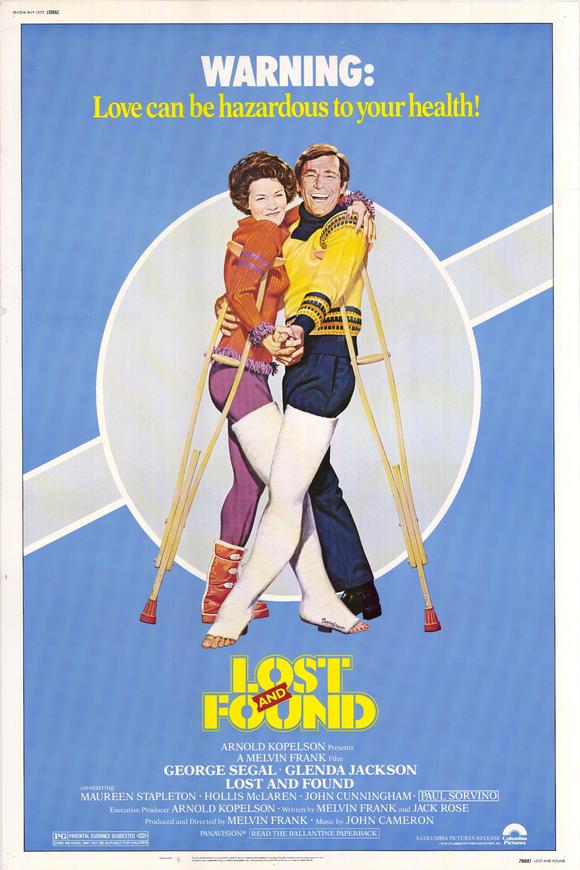
Adam (George Segal) is a college professor vacationing in France whose car collides with that of British divorcee Tricia (Glenda Jackson). He tries to get her to write a letter admitting that she was at fault, but she instead writes the exact opposite while doing it in French, so he wouldn’t know. When he finally catches on to this he tracks her down at the ski resort and again collides with her this time on skis. Eventually they find a way to reconcile and even fall in love before finally marrying yet when they return to the states they start fighting again over just about anything until it seems that is all that they do.

Sloppy, poorly structured romance should’ve never been given the green light. The characters are bland and one-dimensional and the humor cartoonish while the couple’s relationship is strained to the extreme. The story has no momentum and the inane fighting seems put in simply to give it some comical conflict that leads nowhere and eventually becomes tiring.

The main problem is that the two reconcile too quickly. Viewers who watch these types of films enjoy wondering whether ultimately the couple will get past their differences and tie-the-knot, which is what compels them to keep watching, but here any suspense of that is ruined when they get married within the first half-hour and thus the arguments that they have afterwards is anti-climactic. The film would’ve worked better had the two remained antagonistic. The conflict could’ve started in the French Alps and then continued onto the college campus by having the Jackson character work as a prof in the same department as Segal and had their animosity only slowly melt away when they’re forced to work on some project together with the wedding bells then coming in only at the very end.

What makes this movie odd is that it reteams Jackson and Segal as well as the writer/director team of Melvin Frank and Jack Rose who all did A Touch of Class together just 6 years earlier. One would presume that this would be a sequel to that one with Segal and Jackson playing the same characters that they did before, but that’s not the case. In retrospect that’s how it should’ve been played and it would’ve then avoided having to show the dumb, over-the-top way that the two meet here, which is so forced and corny that it cements this has being a bad movie before its even barely begun.

The supporting cast manages to add some life. I got a kick out of Maureen Stapleton as Segal’s free-spirited, hippie-like mother, but she was only 52 at the time and didn’t even have any gray hair making her look much too young to have given birth to a middle-aged man in his 40’s and was in fact only 9 years older than Segal in real-life. Paul Sorvino is amiable as a talkative cabbie and the segment where he and Jackson try to resuscitate Segal after a failed suicide attempt is the only mildly amusing bit in the film.

The ski resort scenery is picturesque although it was actually filmed at Lake Louise in Alberta, Canada and not in the French Alps like the movie suggests. You also get to see John Candy in a brief bit and Martin Short in his film debut, but everything else falls painfully flat and I couldn’t help but feel that the entertainment world had passed both director Melvin Frank and Jack Rose by. They had written and directed many successful comedies during the 40’s, but what passed off for funny back then now seemed seriously dated and it should be no surprise that they both only did one more movie after this one.

My Rating: 2 out of 10

Released: July 13, 1979

Runtime: 1Hour 46Minutes

Rated PG

Director: Melvin Frank

Studio: Columbia Pictures

Available: DVD-R, Amazon Video

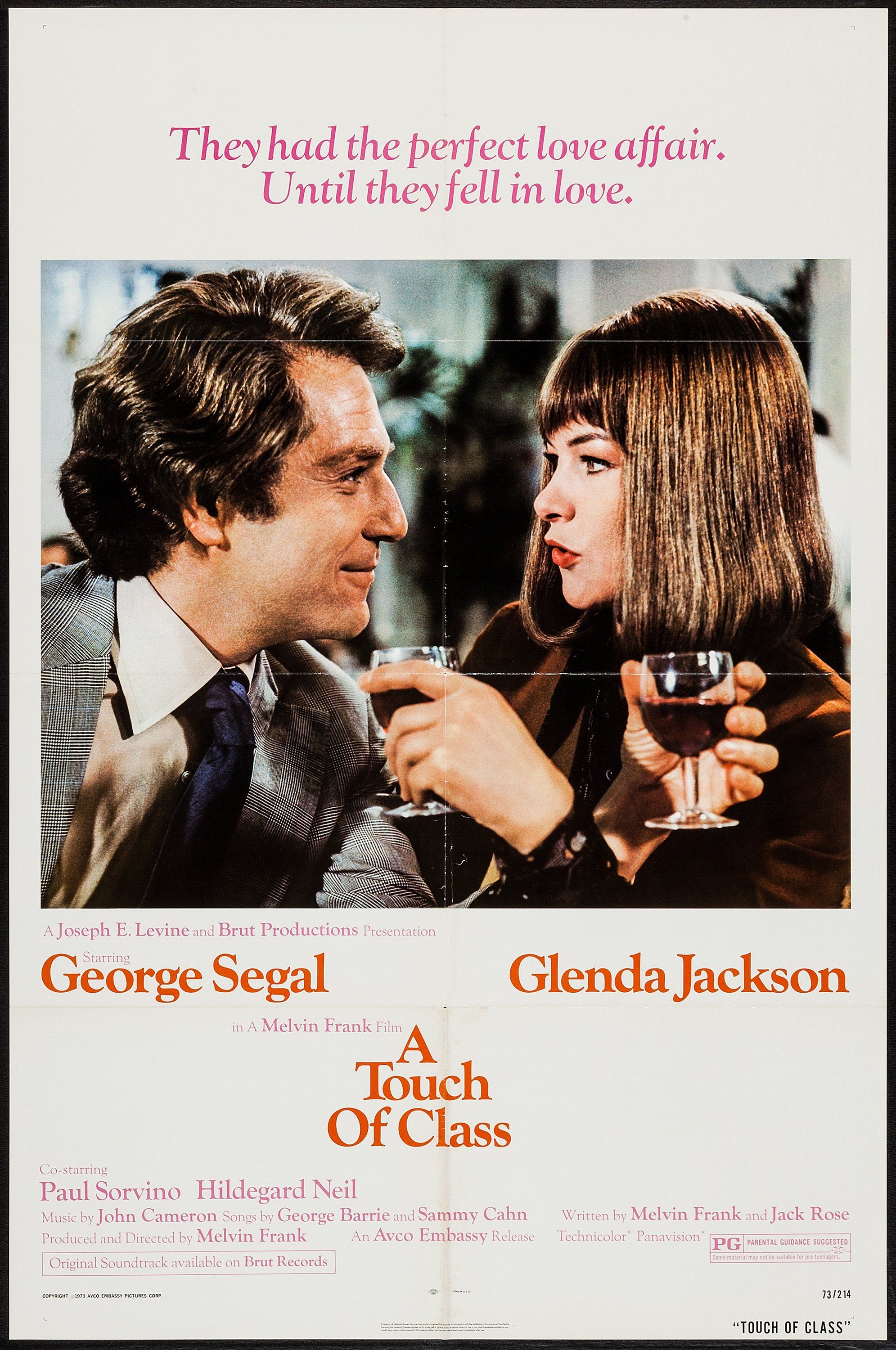
A Touch of Class (1973)

By Richard Winters

My Rating: 5 out of 10

4-Word Review: Sexual liaison turns romantic.

Steve (George Segal) is an American businessman working in London who meets Vickie (Glenda Jackson) a divorced mother of three. Despite being married he immediately takes a liking to Vickie after sharing a cab ride with her and makes no secret that he’d like to have a ‘no-strings-attached’ sexual affair. Vickie approves of the idea, but wants a more romantic setting, so Steve whisks her off to Malaga, but things get complicated when Steve’s friend Walter (Paul Sorvino) shows up on the same trip and constantly gets in the way.

Surprisingly this limp comedy got nominated for Best Picture, which is really hard to believe since there isn’t anything all that funny or original about it. In fact it seems very similar to another picture that writer/director Melvin Frank did in the ‘60s called The Facts of Life, which starred Lucille Ball and Bob Hope and had almost the exact same plot.

The biggest problem is that it doesn’t take enough advantage of its comical potential. Having Steve’s wife Gloria (Hildegard Neil) show up with the kids unexpectedly and want to go on the trip with Steve should’ve been played out much more as it was ripe with comic potential, but instead the film nixes this idea after introducing it and nothing is more annoying than a movie, which sets-up an interesting idea only to then backtrack on it.

Paul Sorvino’s character is equally wasted and his presence could’ve created far more complications that never transpire. In return the movie falls back to a lot of lame situations that seem thrown in for cheap laughs like Steven suddenly going through back spasms, or challenging a 13-year-old kid to a golf game that has nothing much to do with the main plot and basically comes off as forced and lame. The arguments or ‘spats’ that couple have are equally inane and this culminates with the two throwing furniture and clothing at each while in the hotel room, which sends this supposedly ‘sophisticated’ adult comedy dangerously close to becoming benign slapstick instead.

The third act in which the two rent out a flat and continue to have the affair even after they return to London doesn’t improve things. Jackson is supposedly this single mother and yet after she moves into the flat she seems to essentially abandon the kids who disappear from the movie altogether. It also seems hard to believe that Steve’s wife wouldn’t at some point start to catch on to the fact that something was going on as these things eventually will catch up with a person and there’s just so many close calls one can have before finally getting caught and yet here that never happens.

The fact that Steve is very open about his marriage to Vickie and even confides in having previous affairs makes Vickie seem really stupid for wanting to get involved with him in the first place. Supposedly she just wants casual sex as much as he does, but then refers to their trip as a ‘romantic’ one making it seem like she has the idea that this will turn into a relationship. When things do finally sour one doesn’t feel sorry for her as she was old enough to know better and anyone with an IQ over 2 would’ve seen the red flags from the start, so why didn’t she?

The only interesting aspect about the movie is that Jackson won her second Oscar for it, which was highly unusual since she had just won her first one 2 years earlier and quite unexpected making many people consider a recount was necessary as they were convinced it had to have been a mistake. It’s not that Jackson gives a bad performance because it is actually quite good, but Marsha Mason, who was the predicted front-runner, gave a superior one in Cinderella Liberty and she should’ve won it.

For years many people wondered what it was about Jackson’s acting in this film, which is a very ordinary fluffy movie at best, that made her stand out to the Academy judges and beat such long odds. A few years back I read somewhere, and I can’t remember where it was at this point, that the reason she won it was for one particular moment where Segal tells her that the relationship is over, but instead of her breaking down and crying like the script asked for she puts her head into her hands and remains silent for several seconds. Director Frank argued with her about doing this, but she insisted she wasn’t the type of woman who cries easily and therefore doing it the other way seemed more natural to her and in turn this impressed the judges when they watched the movie because her character responded to something in a completely unexpected way, which apparently was enough for her performance to stand out.

My Rating: 5 out of 10

Released: June 20, 1973

Runtime: 1Hour 46Minutes

Rated PG

Director: Melvin Frank

Studio: AVCO Embassy Pictures

Available: DVD, Amazon Video

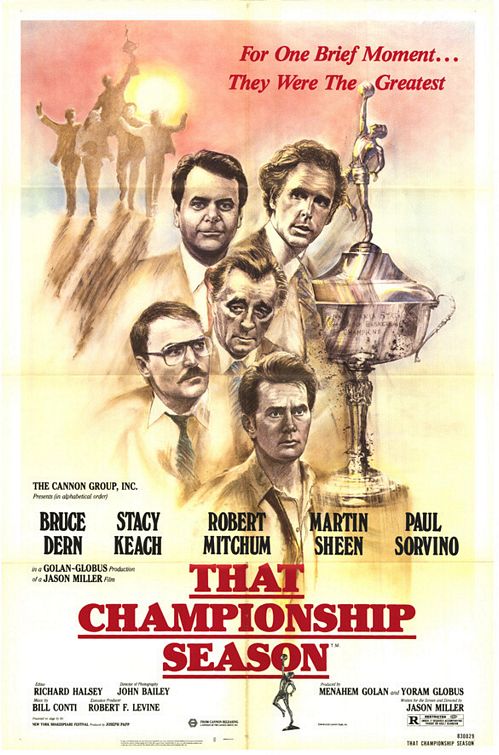
That Championship Season (1982)

By Richard Winters

My Rating: 2 out of 10

4-Word Review: Their reunion turns sour.

On the 25th anniversary of when they won the state high school basketball championship four members of the team get together with their coach (Robert Mitchum) to celebrate. George (Bruce Dern) who made the winning shot is now the town’s mayor and up for reelection. James (Stacy Keach) is a high school principal while his younger brother Tom (Martin Sheen) has become a vagabond alcoholic. Phil (Paul Sorvino) is the most successful of the group even though his business methods aren’t always ethical. It’s his revelation that he has had an affair with George’s wife that sends the gathering into a freefall where long dormant secrets from all the members slowly come to the surface.

The film was written and directed by Jason Miller, best known for playing Father Karras in The Exorcist, and the play version, which he also wrote won him the Pulitzer Prize. Despite the rave reviews of the play I was genuinely shocked how lifeless and boring the film is. It takes 35 minutes before any real conflict is introduced and once it does it’s all very contrived. The opening half-hour is nice as it was filmed on-location in Scranton, Pennsylvania, which was Miller’s hometown, but the second half is done completely inside one home, which makes it very stagey. Flashback sequences were done to help make it more cinematic, but unwisely cut by the film’s producer.

The plot thread dealing with Sorvino’s character having an affair with Dern’s wife seemed so utterly contrived that I literally had to roll my eyes when it gets brought up. It’s almost like they had to throw in something to keep it interesting so why not just make it the oldest, most clichéd soap opera-like thing they could think of. What’s worse is we never see this woman in question despite her being the catalyst for all the drama nor any explanation of where she is or what she is doing.

The acting is good for the most part, which is the only reason I’m giving this thing even 2 points, but at times the performers have trouble rising above the melodramatic material including the scene where Keach tries to put on a cry while describing his mistreatment by his father, which sounds very fake and unintentionally laughable.

Sorvino walks around with jet black hair except for a big white patch on the back of his head, which is distracting and gets shown a lot, but never mentioned by any of the other characters. I’ve never seen anyone with that condition, except for someone who intentionally highlighted it like that and even so I don’t think that was the case here. The producers should’ve had that spot dyed black like the rest of his hair to avoid the distraction, or had one of the other characters joke about it in passing, so the viewer didn’t have to keep wondering why they are the only ones seeing it and nobody else was.

The final scene where the men listen to a tape of when their team scored the winning shot, which brings tears to their eyes, is the only segment that rings true and hits home how high school for some people can be the highlights of their whole lives and everything afterwards is all downhill. The rest of the movie though is an exercise in boredom and filled with sterile characters dealing with generic issues.

My Rating: 2 out of 10

Released: December 9, 1982

Runtime: 1Hour 50 Minutes

Rated R

Director: Jason Miller

Studio: Cannon Film Distributors

Available: DVD

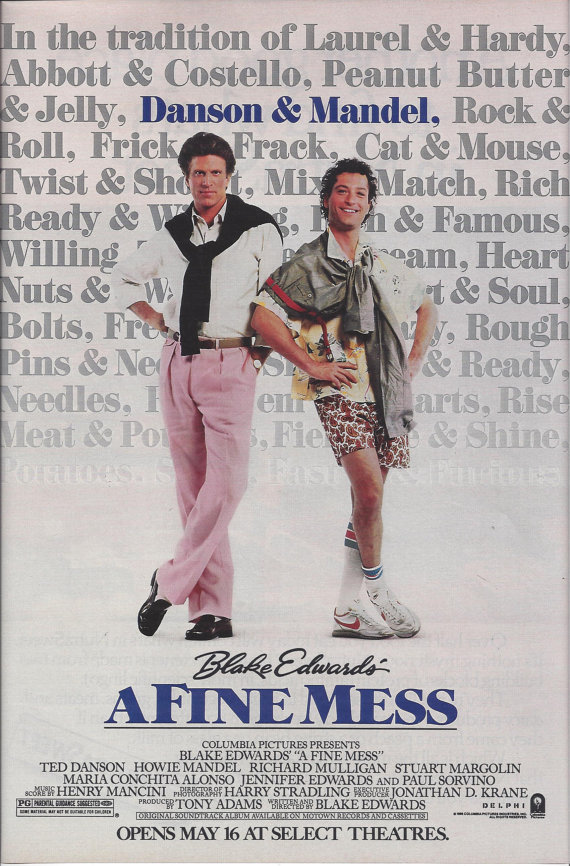
A Fine Mess (1986)

fine-mess-2

By Richard Winters

My Rating: 4 out of 10

4-Word Review: They buy a piano.

Spence (Ted Danson) works as an actor and during a break in shooting, which is being done at a local horse track, decides to take a rest in a nearby horse stall. While he is there he overhears a conversation between two men (Stuart Margolin, Richard Mulligan) in the next stall discussing how they are going to inject a horse with a drug that will cause him to run faster and therefore make him a ‘sure thing’ in the his next scheduled race. Spence decides to use this information to bet on the horse and make a killing at the track with the help of his friend Dennis (Howie Mandel), but the bad guys realize that they’ve been found out and try to nab Spence and Dennis before they are able to place the bet. Spence and Dennis try to hide from their pursuers by attending an auction where they inadvertently purchase a piano, which they must later deliver to a rich customer (Maria Conchita Alonso) who is dating a mobster (Paul Sorvino).

I was genuinely shocked at how limp and threadbare this script was and how it routinely resorted to some of the most empty-headed humor I’ve ever seen. Much of it consists of long and extended chase sequences that aren’t particularly exciting or imaginative and rely on gags that we’ve all seen a million times before.

The casting is also off. Margolin can be a great character actor, but not in this type of role and Mulligan’s dumb guy routine and facial muggings is to me the epitome of lame. Danson doesn’t seem particularly adept at physical humor and shows no real chemistry with his co-star. Sorvino, who walks around with a limp, gets a few chuckles, but believe it or not I came away liking Mandel the best and actually found him to my surprise to be the most normal person in the movie.

The intention was to make this a completely improvisational exercise, which would give the actors free rein to come up with lines and scenarios as they went while relying on the broadest of story blue prints as their foundation, but the studio wanted more of an actual script and forced director Blake Edwards, who later disowned this project, to approach the thing in a more conventional way. The result is a mish-mash of nonsense that doesn’t go anywhere and makes the viewer feel like they’ve done nothing but waste their time in watching it.

All could’ve been forgiven had they at least played up the piano moving bit, which is what I was fully expecting. The inspiration was to make this a remake of the classic Laurel and Hardy short The Music Box with a scene, like in that one, where the two stars must somehow move an upright piano up a long flight of stairs. However, instead of showing this it cuts away to the next scene where the two have somehow without any moving experience gotten the piano up the stairs with apparently no hassle, but what’s the use of introducing a potentially funny comic bit if you’re not going to take advantage of it?

I still came away somewhat impressed with the way that it managed on a very placid level to at least hold my interest. I suppose in this era where scripts with a plethora of winding twists tend to be the norm one could almost deem this a ‘refreshing’ change-of-pace in its simplicity. Those that set their entertainment bar very low may enjoy it more.

My Rating: 4 out of 10

Released: August 8, 1986

Runtime: 1Hour 30Minutes

Rated PG

Director: Blake Edwards

Studio: Columbia Pictures

Available: DVD, Amazon Video