Tag Archives: Neil Simon

The Out-Of-Towners (1970)

outoftowners

By Richard Winters

My Rating: 6 out of 10

4-Word Review: Travel plans go awry. 

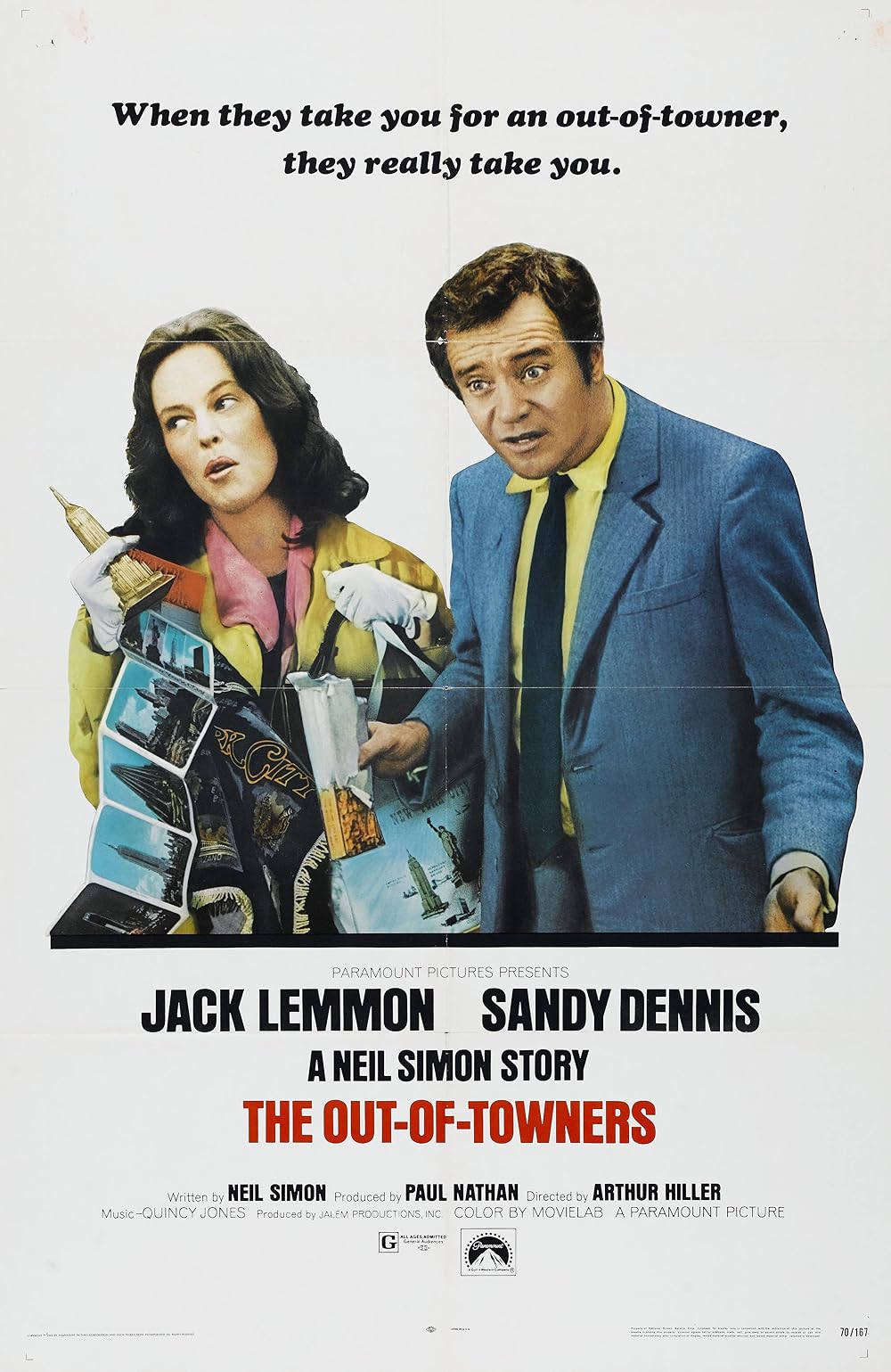
George (Jack Lemmon) is set to have an interview in New York City for a possible job promotion with his company. He brings along his wife Gwen (Sandy Dennis) for what he hopes will be a fun-filled trip in which they can explore the new city they hope to eventually relocate in, but things don’t go as planned. Their flight is forced to circle JFK Airport for hours before it’s diverted to the Logan Airport in Boston and then requiring them to take a train ride back to the Big Apple causing them to arrive there very late. Once they do make it, they find their hotel reservations expired since they hadn’t thought to call or wire, to tell them to hold it. They’re then mugged, and while being escorted by police to a local armory, where they plan on spending the night, they become involved with two liquor store robbers who hijack the squad car they’re in and force them out into Central Park in the middle of the night. This then leads to several more calamities, but despite everything George manages to somehow make it to his interview on time, but when offered the position he’s now not so sure he wants to accept it. 

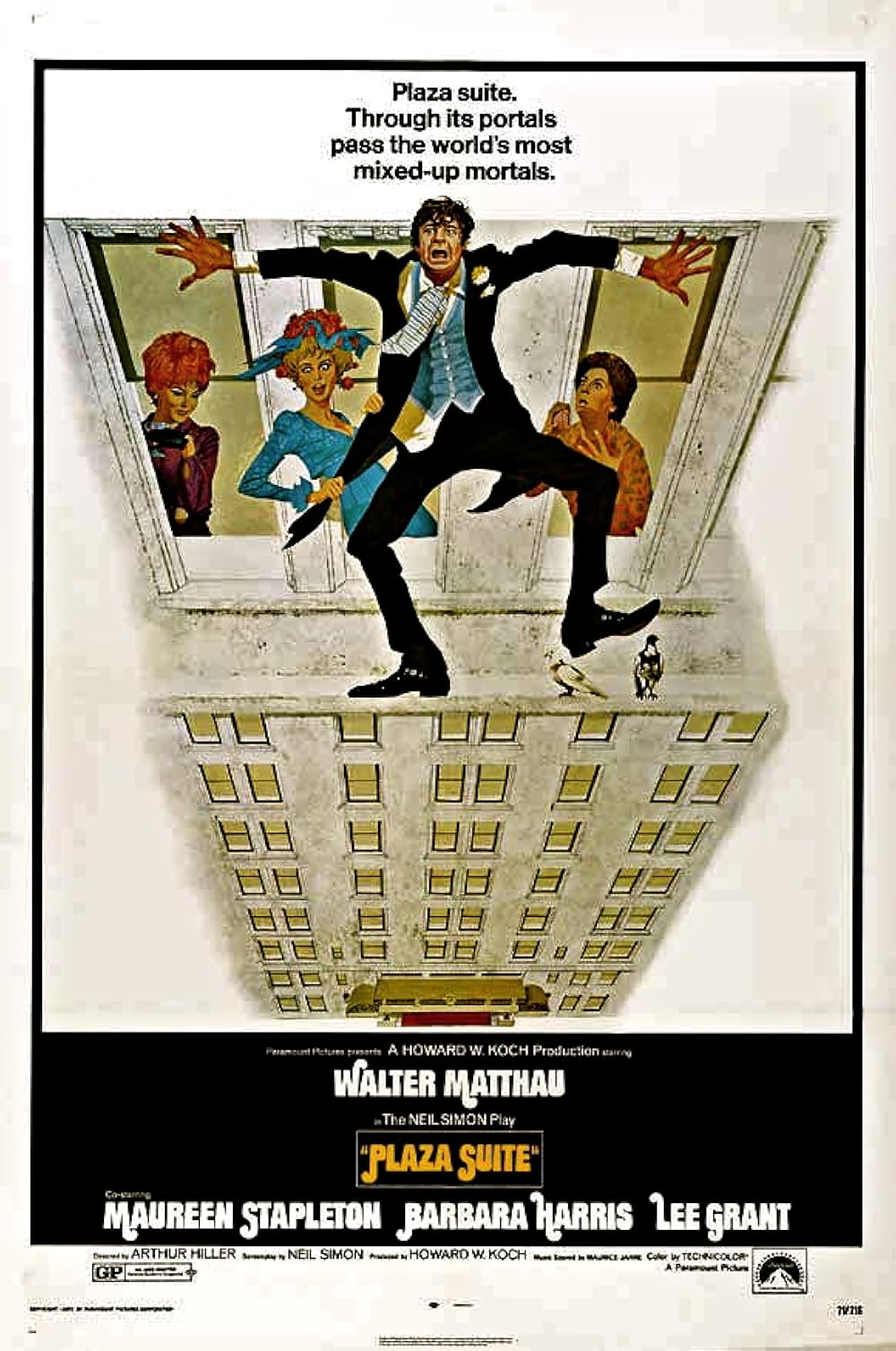
Originally writer Neil Simon was planning on using this concept as a segment to his 1968 play Plaza Suite, but since that play was already divided up into three other segments it was deemed too many and thus this one got thrown out. He then tried making it into its own stage play but realized it would require too many different set pieces and ultimately came to the conclusion it would work better as a movie. Unlike his other works this one does not rely on dialogue for its primary humor as instead the intended laughs come from the situations, but it’s more like a dumb comedy in that what occurs isn’t all that clever, or original and relies solely on the exasperated reactions of the characters. 

Some of it goes overboard particularly an underground gas explosion that blows a manhole cover that George is standing on into the air and temporarily causes him to lose his hearing, which I found quite disturbing. What’s worse is that the cover comes crashing down just inches from George’s head, which could’ve been fatal and was apparently a mistake as it was intended to go up only a few feet and thus it could’ve really killed him had it hit him, but being the trooper that Lemmon was he remained in character despite the issue. However, exploding gas lines don’t happen that often giving the film an unintended surreal quality, or a piling-on effect and for that reason I would’ve excised that segment completely from the movie. 

The characters aren’t that lovable especially George who comes-off as what would be called today as a female Karen, or ‘Kevin’ as he complains about everything right from the start making him obnoxious and annoying. Had the character shown a laid-back Midwestern mentality, since that’s where he’s from, and been more congenial about things, only to finally get exasperated at the very end as it built up, would’ve worked better as by that time the audience could’ve forgiven him after what they’ve been through, but having him be so quick tempered already at the beginning doesn’t allow for any character arch and having him constantly threaten to sue everyone who has wronged him quickly becomes redundant. Sandy Dennis is better as she takes things in more of a strident fashion and makes a healthy contrast to George. The small bit parts made-up of a recognizable B-list actors are fun though they should’ve been given more amusing things to say. 

Spoiler Alert!

The overall point of the story is muddled. Supposedly it’s a harsh assessment on New York, but the couple’s problems aren’t exclusive to the city as they have issues when they go to Boston and even on their plane ride back when it gets hijacked to Cuba making it seem more like a cursed trip versus a nightmare place. Taking potshots at NYC isn’t hard either as most people have complaints about it even those that have lived there for their whole lives making the premise too obvious. A much more original idea that could’ve given it a fresher perspective would’ve had the couple already living in New York, but tired of the crime and rundown urban conditions, so they decide to move to a small Midwestern town but find unexpected problems at every turn and thus return to the city where they conclude that despite the less-than-ideal elements they’re still better off. 

My Rating: 6 out of 10

Released: May 28, 1970

Runtime: 1 Hour 37 Minutes

Rated G

Director: Arthur Hiller

Studio: Paramount

Available: DVD, Blu-ray (Reg. B/2), Amazon Video, YouTube

The Prisoner of Second Avenue (1975)

prisoner

By Richard Winters

My Rating: 4 out of 10

4-Word Review: Out of a job.

Mel (Jack Lemmon) has just lost his job that he’s had for 22-years and fears that at age 48 it will be hard for him to find another one. Edna (Anne Bancroft) goes out to find employment of her own in order to pay for the bills and while she’s initially sympathetic to Mel’s problems she becomes annoyed at the way he doesn’t do anything about it besides just complain about everything. Having their place get robbed in broad daylight, a garbage collector’s strike, noisy neighbors, and a massive New York heatwave all lead to Mel having a mental breakdown where he begins to believe all sorts of conspiracy theories. He also gets into loud verbal sparring with one of his upstairs neighbors. His brother Harry (Gene Saks) tries to get his two sisters, Pauline (Elizabeth Wilson) and Pearl (Florence Stanley) to chip-in to help pay for Mel’s therapy, but they’re reluctant making Edna feel like she’s in this all on her own while becoming openly frightened at Mel’s deteriorating state.  

The film is based on Neil Simon’s Broadway play of the same name that premiered on November 11, 1971, that starred Peter Falk and Lee Grant. The script was written by Simon but doesn’t do enough to differentiate it from a stage play with a boring visual design that falls flat and barely ever seems to get out of the apartment and when it does the moments are equally uninteresting. The ongoing potshots at New York City living have been done before and nothing that gets said here that is ground-breaking, or even mildly amusing. The plot and humor meanders and are too unfocused to be either riveting, or captivating. 

Lemmon gives a good performance, but he’s played this type of character before and his perpetual complaining about everything and anything quickly becomes tiring. I actually sided with the upstairs neighbor who throws cold water on him when he stands outside bellowing into the night air about his problems, which would annoy anyone. Bancroft’s Brooklyn accent is too affected and her wide-eyed responses to Lemmon’s constant shouting lends no spark making her character come off as transparent. Watching her fight-back a little or even get into a sparring match with Lemmon could’ve added some much-needed comic spark, but for the most part the scenes between them are dull and one-dimensional. 

It’s hard to feel sorry for a guy who makes no effort to help himself. Instead of him being shown moping constantly around the apartment each day in his bathrobe we should’ve seen him going out to job interviews, or even sprucing-up his resume and I was genuinely shocked why none of this happened. How does he really know the job market is so ‘tough’ if he doesn’t venture to go out and test it? Since his wife is able to get a job rather quickly it starts to seem like it’s not so hard to find one making the protagonist and his inactions all the more infuriating. 

Spoiler Alert!

What’s even more confounding is he’s able to somehow ‘snap out of’ his sorry state without actually finding another job. It’s not clear either what event gets him to change his thought patterns he just starts telling everyone that he’s ‘over it’ and back to being his old productive self, but in a good movie this should be seen by the viewer without the character having to explain it. Since he’s still not gainfully employed what’s to say he couldn’t easily fall back into the doldrums and therefore seeing him working at someplace new would’ve been a more complete ending. 

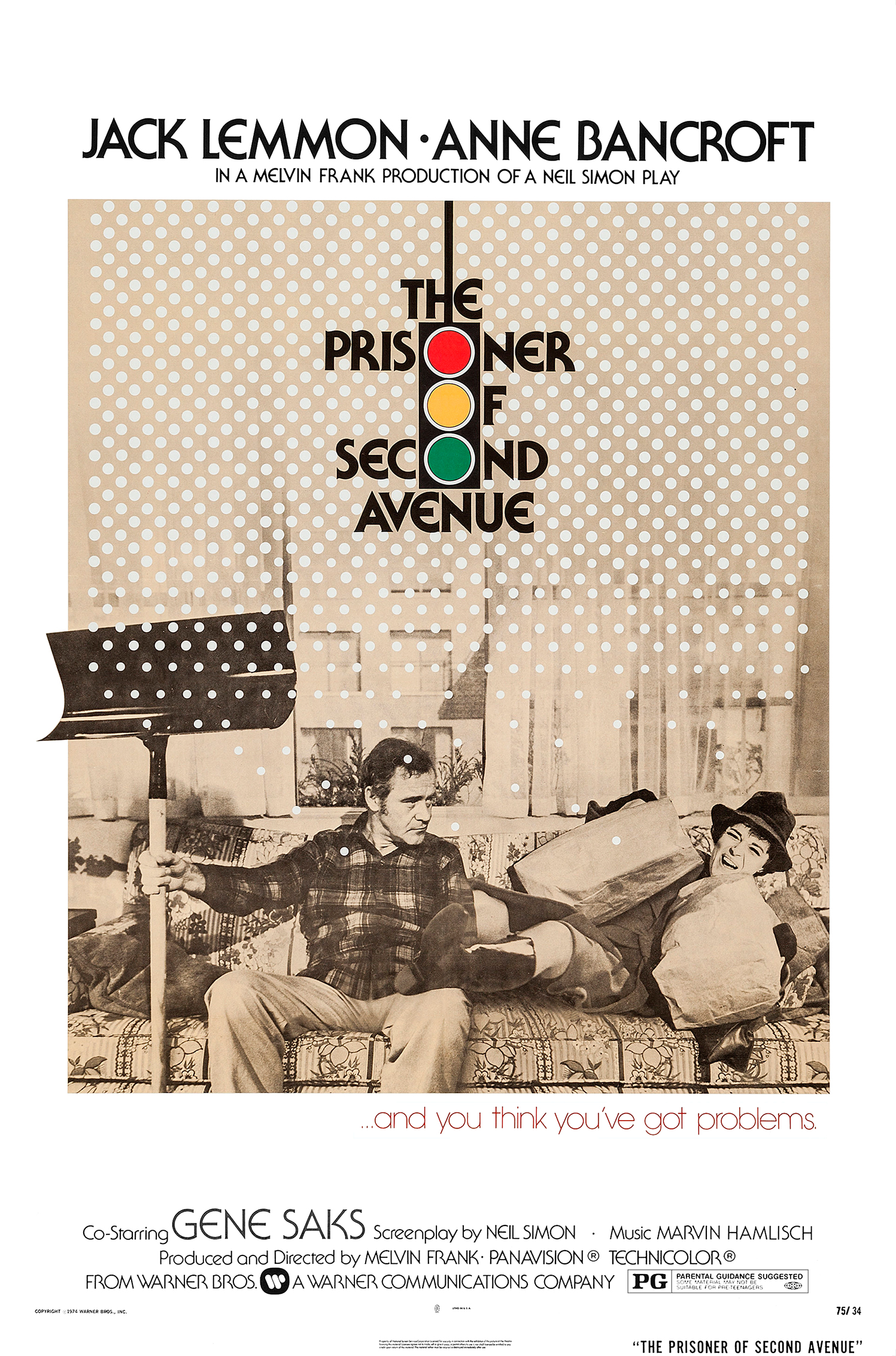
The side-story dealing with him buying a giant snow shovel in order to get back at his neighbor for throwing water on him, isn’t satisfying either. For one thing if money is so tight why waste it on something he really doesn’t need? His revenge plan is a bit confusing too. The idea, I guess, is that he’ll wait for the first big snowfall then climb up on the apartment roof and shovel the white stuff down on the neighbor’s balcony, but this is yet another thing that should’ve been put into action in front of the camera as him just alluding to what he’s going to do isn’t as satisfying. 

My Rating: 4 out of 10

Released: March 14, 1975

Runtime: 1 Hour 38 Minutes

Rated PG

Director: Melvin Frank

Studio: Warner Brothers

Available: DVD, Blu-ray, Amazon Video, YouTube
Max Dugan Returns (1983)

max1

By Richard Winters

My Rating: 4 out of 10

4-Word Review: Estranged father comes back.

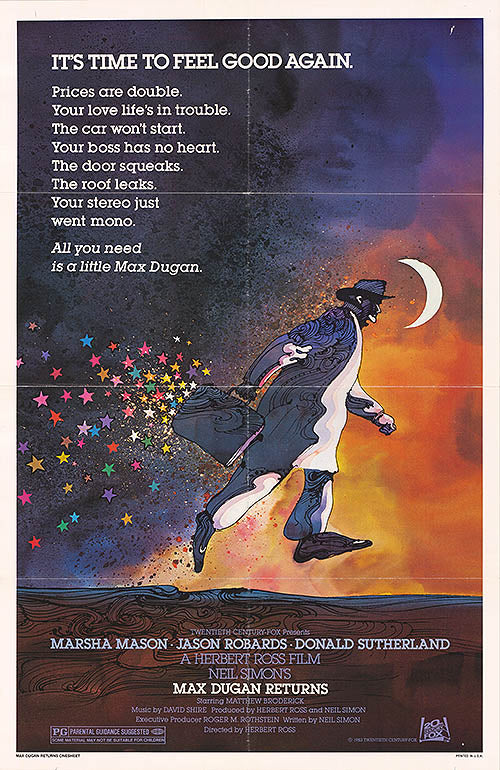
Nora (Marsha Mason) is a single mother living with her 15-year-old son Michael (Matthew Broderick) who’s struggling to make ends meet as a High School English Teacher. Things become particularly desperate when her beat-up 1964 Volvo car gets stolen and she no longer has any transportation to get to work nor the money to afford buying a new car, or even a used one. Fortunately, the officer working on the case, Brian (Donald Sutherland) takes a liking to her and offers her to use his motorbike even though she needs training on how to drive it. Once she goes through the crash course and begins using it she still has other financial concerns to worry about until one night she receives a mysterious visitor, which turns-out to be her estranged father Max Dugan (Jason Robards) who ran-out on his family 29 years earlier. Now he has returned with a briefcase full of $687,000, which he skimmed from a crooked casino that he used to work at. He tells her he has only 6-months to live and advises her to take the money, so that she and her son can live stress-free, but Nora isn’t so sure she wants to accept it, so Max goes about buying her stuff anyways including a fancy new car.

This has to be one of Neil Simon’s least imaginative efforts and the concept seems so contrived it’s like he thought it up for the 10-minutes that he was sitting on the john. I’ll admit when I was a teen and watched it when it first came out, I enjoyed it. I especially remembered the scenes dealing with Charley Lau, who regrettably died less than a year after the film’s release, where he plays himself the hitting coach for the Chicago White Sox baseball team, who Max hires to help Michael become a better hitter and these teaching scenes I found to be engaging. Unfortunately, the foundational premise has a lot of holes.

The idea that a father would suddenly want to see his daughter after 29 years of being away didn’t seem authentic. If he longed to reconnect then why not reach out earlier? Granted he was in jail for 6 of those years, but what about the other 23? If family was so important to him then why run out on them in the first place? Why doesn’t he at least make some attempts in-between those years to communicate like sending letters of phone calls before just showing up and expecting to be welcomed with open arms? The idea of throwing her and his grandson a lot of money comes-off in bad taste like he’s simply trying to buy their love and if anything seems quite shallow. During those 29 years away you’d think he would’ve met other people he’d become friends with, or other women he dated that he might’ve wanted to give the money to instead, or are we to presume that for 3-decades he lived in a cave and made no contact with anyone else?

I didn’t get why Nora didn’t recognize her father when he called. Yes, it had been awhile since she had last heard or seen him, it’s stated that she was 9 when he left, but he has a distinctive voice, so I’d think it would set something off in the back of her brain that she knows who this is, but can’t quite place it, versus having her immediately call the police in panic after getting a call from some ‘strange man’. He also tells her at one point that he may not actually be Max Dugan, but again she wasn’t a month-old infant when she last saw him, but instead someone entering the fourth grade, which should’ve given her a solid enough memory of what he looked like and thus know if this was her real father, or not.

To help solve all of this Nora should’ve been made a divorcee instead of a widow. The husband/father could’ve been the one who went to jail and then returned a 6 years later with stolen money hoping to use it to win back his wife’s and son’s favor. It would’ve made more sense because less time would’ve passed, and he’d have a more vested emotional interest in bonding with his son since he was directly his versus an elusive grandfather who didn’t even know the kid existed until being ‘tipped off’ that Nora had one by some secondary source.

Matthew Broderick’s character is problematic too. He seems just too obedient and goody-goody to be a believable teen as he promptly makes his bed every morning, even his mother’s, asks to be excused from the dinner table, and even lets his mother kiss him while in full view of his friends. Yes, there’s one brief moment where he tries to sneak a smoke, but otherwise I didn’t detect the typical rebellion to authority that most teens that age have, and it would’ve been improved had the kid been 9 or 10 where still being compliant with their parents’ wishes is a little more understandable.

Sutherland’s character was off as well as he seems way too aggressive about asking out a woman that he had just met while on-duty and actively investigating her case making it ethically questionable whether he should even be doing it. If a guy does come-on to a woman so quickly, simply because she’s attractive and single, as he knew nothing else about her, you’d presume he’s done this to other available women as well and thus should have a throng of casual girlfriends and Nora would just be one of many. The film should’ve just had him already her boyfriend from the start and thus avoided this otherwise awkward and rushed relationship. I also thought it was dumb that Kiefer Sutherland, who appears early on in a brief non-speaking role as one of Broderick’s friends, wasn’t cast as Donald’s son in the climactic baseball sequence at the end and instead the part was given to another young actor.

Spoiler Alert!

The money issue becomes yet another problem as Max spends it on so many lavish gifts that I started to wonder if there would be any left to put into savings. The idea that he could’ve had workers refurbish the house in just one day while Nora and son where in school is ridiculous as something that massive would take weeks if not months. He even ends up driving away with the car he had bought her leaving her again without a vehicle. Yes, he does open-up a bank account in her name and puts in $400,000, but her cop boyfriend was already aware of this and made clear he put his duty to uphold the law over his personal relationships making it very probable that she’d be forced to give it all back. Worse she might be considered an accomplice forcing her to hire an attorney, which would’ve sent her into even more debt making it seem like she’d be better off had the whole thing not even happened to begin with.

My Rating: 4 out of 10

Released: March 25, 1983

Runtime: 1 Hour 38 Minutes

Rated PG

Director: Herbert Ross

Studio: 20th Century Fox

Available: DVD, Amazon Video, YouTube

Seems Like Old Times (1980)

seems

By Richard Winters

My Rating: 7 out of 10

4-Word Review: Ex on-the-run.

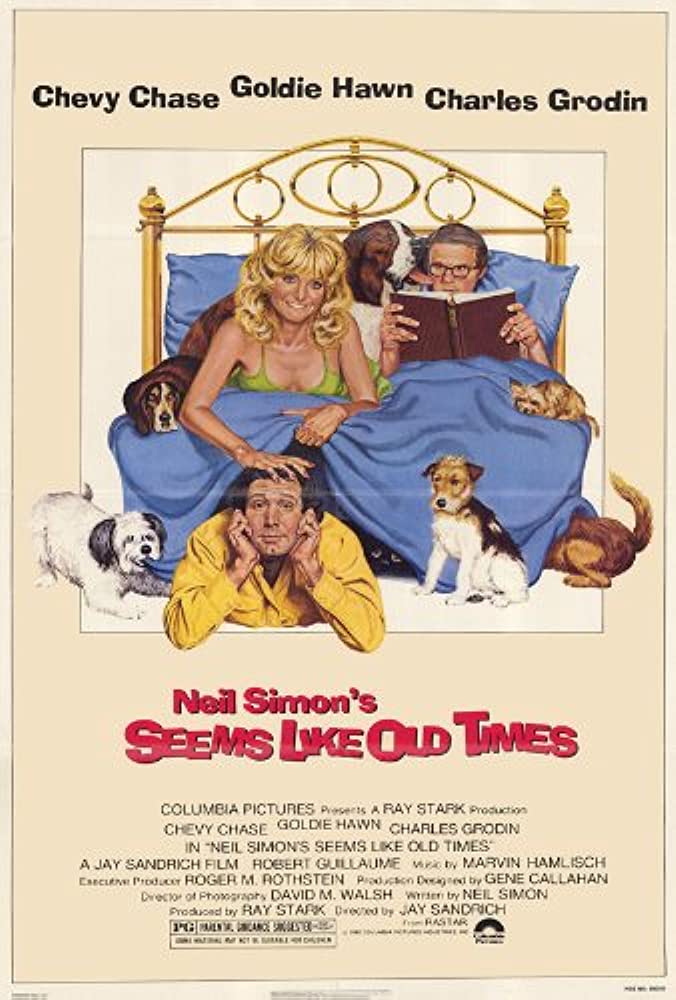
Nick (Chevy Chase) is a lonely writer working on his novel at a remote seaside cabin, which he hopes will give him the isolation that he needs to allow his creative juices to flow. Unfortunately for him two bank robbers (Judd Omen, Marc Alaimo) stake-out the place and kidnap him and then force him at gunpoint to rob a nearby bank. Nick gets seen on the security camera and a warrant for his arrest is issued. He seeks help from his ex-wife Glenda (Goldie Hawn) a public defender who has remarried to Ira (Charles Grodin) who’s running for attorney general and fears that the notoriety of having his wife’s ex-husband on-the-run from the law could hurt his chances of getting elected. Glenda decides to help Nick by letting him stay in an unused bedroom above their garage while trying to keep him hidden, so Ira won’t find out. This scheme leads to many close calls and misunderstandings while also reigniting Glenda’s feelings for Nick, which she thought she had gotten over a long time ago.

While it may seem hard to believe now screenwriter Neil Simon was at the time, having just come-off his success with the hit The Goodbye Girl , considered chic with young adults particularly on the romance end and this film was the peak of that period as after this his material became increasingly more nostalgic. This works mostly because it remains focused on Simon’s patented one-liners and funny conversational quality, which is quite amusing though it would’ve been nice had it attempted to branch out into other forms of comedy like when Chase and Grodin have a physical fight that is never shown and instead we just hear the noise of it from inside the kitchen while the camera stays stationary in the other room. The visual gags and pratfalls from a funny fight could’ve helped add another dimension to the humor and thus I found this moment to be a missed opportunity.

The acting is uniformly wonderful particularly Chase in a role that takes full advantage of his glib, sardonic delivery probably better than any other film role he’s been in and this most likely was a result of Simon doing a 2-week rehearsal period where he observed the stars interacting with each other and made changes to the script based on the personalities of the performers. It’s good to see Hawn in a more mature role. Before this she played spacey-blondes who were young and on the fringe of society, but here she falls comfortably into a middle-aged setting of a career woman maintaining both a job, home, and marriage and showing the juggling act that this type of lifestyle requires. She’s also not the sole source of humor, but instead reacts to the zaniness around her with funny facial reactions. The supporting cast such as Yvonne Wilder as the heavy-accented Latina maid and T.K. Carter as the wise-cracking chauffeur who hasn’t fully gotten rid of his old ex-con ways are quite amusing too as are the pack of dogs that Hawn owns and proceed to run all over the house at all times.

Grodin was the only character that doesn’t really fit. I found it strange why someone who doesn’t like dogs and can’t stand the way they sleep on the bed that he shares with Hawn would want to marry a woman who was so into them. Outside of the fact that they were both lawyers I didn’t see what else connected them and it seemed like a mismatched marriage. On the other-hand I found it interesting he wasn’t portrayed as a jerk. In most romances were the old partner comes back into the picture the new guy is played-up in a way that makes the viewer dislike them and where you want to see the woman going back to her old flame instead of staying with the cad, but here that’s not the case, which works to some degree, but also hurts it.

Spoiler Alert!

The issue with the second husband really comes into play at the very end when it becomes painfully obvious that Simon couldn’t think up a way to resolve the dilemma and comes-up with one of the dumbest finales imaginable where Hawn and Grodin go driving into the wilderness during a rain storm, have a car accident in which Grodin gets injured and she treks off into the woods only to find an isolated cabin with Chase inside. The movie stops with a freeze-frame of Hawn’s face revealing a broad smile once she sees Chase opening the door making it seem like the two spent a cozy, romantic night in the cabin while Grodin remained suffering inside his stranded car, which wasn’t exactly humane.

Personally if I had written the script I would’ve done it differently, which I realize might’ve been considered ‘too edgy’ for 1980. However, since Chase’s character had been in a Mexican prison for awhile I would’ve had the experience bring out the dormant gay side of him. This could’ve helped explained why the two criminals came to his place to force him into a bank robbery was because they were guys he knew, or former lovers, from jail and they figured out where he lived and hence tracked him down to be a part of their scheme. This would help explain the opening as having them stake out such an extremely isolated place, which didn’t seem to even have any roads leading into it, just to find a willing victim never really made much sense otherwise. The Grodin character could also have some dormant gay desires, which would explain why his sex life with Hawn wasn’t so great. Chase could then take-up permanent residence in the room above the garage where he could, at different times, ‘service’ both Hawn and Grodin and the three could share a happy alternative lifestyle, which being that the story takes place in coastal California wouldn’t have been all that outrageous or unusual.

Another possibility would be to have Grodin played-up as being more into his political career than his marriage and thus pushing Hawn away, or he could just become sick and tired of all the dogs in the bed at night and decide to leave her, which would be understandable as I wouldn’t like sleeping with dogs either. In either case Hawn would be free to run back to Chase and the audience wouldn’t have had any problem with it.

The worse scenario though is how it ends here with Hawn selfishly getting it on with Chase, or at least implying this, while the man she’s married to remains stuck in pain inside a cold, damp car for who knows how long. At some point she’s going to have to decide which guy she wants more, or if she’ll just remain hopping between the two, but some finality needed to be given instead what amounts to a pathetic cop-out by a writer who clearly didn’t want the challenge of having to figure it out.

If anything I would’ve had her with a different facial expression. During the movie she was constantly hyperventilating with this shocked look every time she’d see Chase drop-in and that’s what we should’ve seen as the film’s final image.

My Rating: 7 out of 10

Released: December 19, 1980

Runtime: 1 Hour 40 Minutes

Rated PG

Director: Jay Sandrich

Studio: Columbia Pictures

Available: DVD, Amazon Video

I Ought to Be in Pictures (1982)

i1

By Richard Winters

My Rating: 4 out of 10

4-Word Review: Daughter reunited with father.

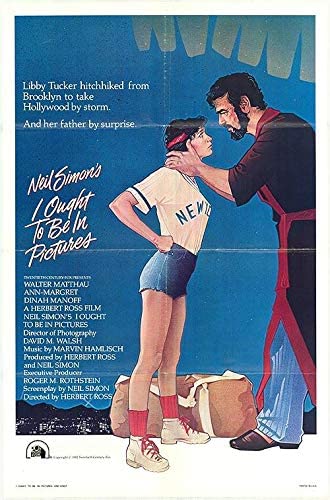
Libby Tucker (Dinah Manoff) is a 19-year-old who decides one day she wants to go off to Hollywood to be an actress. While still living in New York she manages to take a bus to Denver and then hitch-hikes the rest of the way. Libby’s father, Herb (Walter Matthau) is a successful screenwriter living in Hollywood and she hopes to use his connections to get her big break, but unbeknownst to her Herb is at a low point in his career. He hasn’t been able to churn out any scripts lately and avoids making pitches to producers altogether. He lives in a ramshackle place with his on-again-off-again girlfriend Steffy (Annn-Margaret), but overall he’s lost his confidence and can’t seem to find it. He also hasn’t seen Libby in 16 years after he left her mother when she was only 3 years old. Libby realizes their first meeting will be awkward especially since he doesn’t even know she’s coming, but she hopes to make a bond with him as she feels it’s the one thing emotionally that’s missing in her life.

The film is based on the Broadway play of the same name written by Neil Simon that first premiered in Los Angeles at the Ahmanson Theater with Tony Curtis playing Herb, Joyce Van Patten as Steffy and Manhoff in the role of Libby. While the play received so-so reviews the feedback for the film was overall negative with Siskel and Ebert even selecting it as one of the worst movies of 1982.

One of the biggest problems is Libby who seems too naive for her age. Being a 6-year-old with wide-eyed dreams of becoming a movie star is one thing, but Libby is 19, a legal adult, with absolutely no experience in acting, a thick Brooklyn accent, and less than stellar looks and yet somehow expects to make it big almost overnight. Dreamers are okay, but they still have to have at least one foot in reality and this gal acts like she’s from a different planet. She also uses a flash camera and tries to take pictures into the dark night through the window of her bus, which any halfwit will tell you won’t turn out, and yet she’s gleefully unaware of this making it seem like she just popped out of the womb yesterday and lacking not even a smidgen of common sense.

Herb is another problem. He literally abandoned the family over a decade ago and has made no attempt to communicate with the kids since then. Most adult children who’ve been through that have no interest in meeting the absentee parent who was never around. If they do it’s only to learn a little about them, but not necessarily expecting them to be a part of their lives, or to have an emotional bonding and yet Libby does expect this, which again just makes her too goofy to be believable.

I was confused why Herb would even want Libby back in his life. This was a man who presumably could’ve cared less what she was doing for the past 16 years and yet now after she moves-in he becomes a nervous parent worrying when she stays out too late, but if he didn’t worry about her staying out late before when she was in New York then why now? I’d think if a father hasn’t seen his children in that long a time then they just don’t care and don’t want to be bothered. In reality this ‘reunion’, where only one member wants it to happen, should’ve been a far colder experience. Having the dad then turn his bachelor life upside down to accommodate her seemed forced and didn’t help to explain why Herb behaved the way he did for the past decade and a half, if at heart, he really was just a caring, swell guy.

Ann-Margaret is good playing the one character that seemed half-way relatable and helps balance things, but she’s not in it enough. The script has Simon’s sharp dialogue, which helps, but the plot is built on such a superficial foundation, and written by someone who clearly never experienced child abandonment himself nor cared to do any research on it and was simply using it as an excuse to create cheap, sentimental drama, that it’s hard to take seriously, or find compelling in any meaningful way.

My Rating: 4 out of 10

Released: March 26 1982

Runtime: 1 Hour 48 Minutes

Rated PG

Director: Herbert Ross

Studio: 20th Century Fox

Available: DVD

Last of the Red Hot Lovers (1972)

last1

By Richard Winters

My Rating: 4 out of 10

4-Word Review: Married man wants fling.

Barney (Alan Arkin) is a middle-aged man, who after 22-years of marriage, has decided he’d like to fool-around for the first time. He doesn’t want an actual affair, just a quickie sex fling with indiscriminate women while inside his elderly mother’s apartment, which he has access to during the day while she’s away. The problem is that while he’s able to get attractive women into the place he can’t quite get any action leaving him feeling more sexually frustrated than when it began.

The film is based on the Neil Simon play that opened on Broadway in 1969 and ran for 706 performances. The play starred James Coco in the pivotal role who I felt was much better suited for the part than Arkin. Arkin is okay, but his comedic style can be quite frantic in tone that can sometimes border on creepy. He also had a full head of hair at the time even though the role called for a balding man, so he shaved the top of his head to appear semi-bald, but it looks tacky. Coco on the other-hand had a lovable loser quality that made you want to like him even when he did naughty things and he was naturally bald, so his appearance wouldn’t have looked as fake as Arkin’s. I can only presume that because Arkin was at the time an established film star and Coco was still just considered a fledgling character actor that’s why he got the offer while Coco didn’t, but it’s one of the main reasons the story doesn’t translate as well on film as it did onstage.

The directing by Gene Saks isn’t bad particularly the opening sequence where we things entirely from the point-of-view of Barney as he wakes-up and gets out of bed and starts his daily routine, which I found rather inventive cinematically. In fact it’s these moments where we hear the thoughts going on inside Barney’s head as he tries to get the nerve to break-the-ice with other women that he meets, which are the funniest. Unfortunately the scenes done inside the apartment don’t work as well as the place is too cramped and appearing more like a jail cell, which becomes visually static.

The three rendezvous that Barney has with three different women aren’t as clever or creative as they could’ve been. The first segment has Sally Kellermen, who is excellent, playing an Italian women, who comes up to his place, but then just proceeds to argue with him before leaving. My main problem with this scene was the motivation as she spots Barney working inside his restaurant, which precipitates the meet-up, but why would this incredibly hot woman get turned-on by this dopey looking guy to the point that she’d want to have casual sex with him? There were plenty of other men in the place, so why does Barney excite her over the others? The conversation that the two have inside the restaurant is never shown, which I found to be a cop-out and hurt the character development. Had she been portrayed as being a prostitute then it would’ve made more sense, but this is never confirmed, which makes this whole first segment quite weak.

The second segment deals with Paula Prentis as a struggling actress who Barney meets in a park. She borrows some money from him and then agrees to pay him back later at the apartment. However, when she arrives she seems like a completely different person. At the park she came-off as quiet and shy, but at the apartment she’s a babbling idiot that seems to be on acid. The dialogue during this sequence in which the characters basically talk-over each other the whole time quickly becomes annoying. The scene fades-out with the two getting high off of marijuana, but it never shows her leaving the place, so we don’t know for sure if they ended-up having sex or not.

The third and final segment has Renee Taylor playing a middle-aged woman, who is also married, coming-up to Barney’s mother’s place, but immediately getting cold-feet, which kills the intrigue as we know right from the start how it’s going to go. This scene also has a rapey vibe to it as Barney, now feeling frustrated at having struck out twice before, behaves in a much more aggressive manner by blocking her from leaving and then while half-naked jumping on top of her and pinning her to the bed while she yells for him to get off, which is cringy and not funny.

Having a film deal with all the strike-outs a person may face when it comes to having sex with others is an interesting idea. Too many other movies just show the ones that work-out, but in reality, especially with average looking people, there can be more misses than hits, so I appreciated the story in that regard. However, random sex with strangers where the women goes to a strange man’s place without worry or concern has become a thing of the past in this day and age of stalkers and self-protection making the theme here quite dated and out-of-touch.

My Rating: 4 out of 10

Released: August 17, 1972

Runtime: 1 Hour 38 Minutes

Rated PG

Director: Gene Saks

Studio: Paramount

Available: DVD, Amazon Video, PlutoTV, YouTube

Only When I Laugh (1981)

By Richard Winters

My Rating: 7 out of 10

4-Word Review: Actress is an alcoholic.

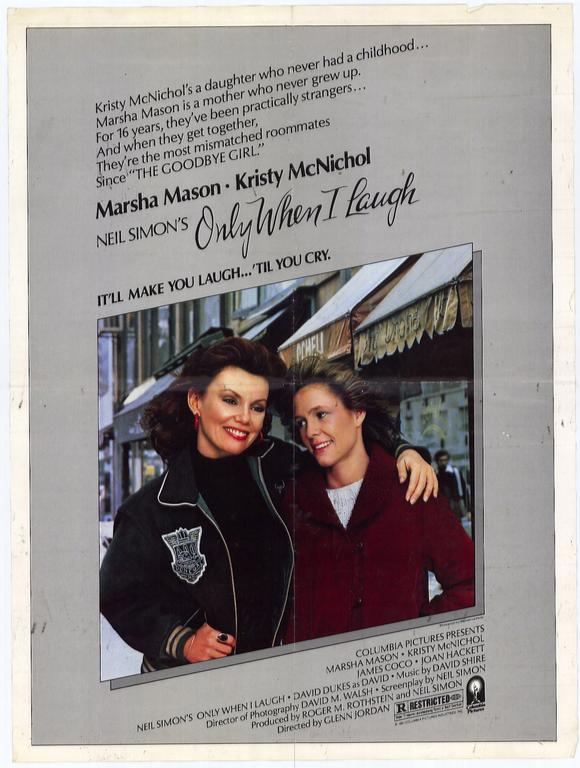
Georgia Hines (Marsha Mason) has just been released from a 12-week alcohol rehab program and returns to her Manhattan apartment looking to readjust to civilian life with the help of her two friends; Jimmy (James Coco) a gay unemployed actor and Toby (Joan Hackett) a woman unhappy at turning middle-aged. To Georgia’s surprise Polly (Kristy McNichol) her 17 year-old-daughter shows up wanting to move in with her and ‘patch things up’ from their tumultuous past. Georgia isn’t sure she’s emotionally ready, but forges ahead and things start out okay, but then the demons from the past rear their ugly head forcing mother and daughter to face some harsh realities both about themselves and each other.

The film is based on Neil Simon’s Broadway play ‘The Gingerbread Lady’ that starred Maureen Stapleton and ran for 193 performances. It was not considered a success and when adapted to a film Simon made changes to the story, but to me it all seemed like every other Neil Simon dramedy that he’s done before. Both this film and The Goodbye Girl that also starred Mason featured male characters that were struggling to become professional actors. Both this film and Chapter Two, which again starred Mason, had characters who were playwrights going through writer’s block. His films always take place in New York and have characters who see analysts, and can apparently make enough to afford them. I realize there’s the old adage ‘write what you know’ and that’s exactly what Simon is doing, but it would be nice if he’d get a little bit out of his comfort zone as nothing that gets shown here seems fresh or original.

The first hour is way too serene and I would’ve expected much more of a frosty relationship between mother and daughter, but instead for the most part they get along great, at least initially. There are some passing references to previous drama, but I felt this should’ve been shown and not just talked about. The second half improves significantly with some strong scenes, but I’m afraid that with such a lifeless beginning most viewers will have fallen asleep before it even gets there.

McNichol is excellent and every bit Mason’s equal, but this exposes another of Simon’s weaknesses, which is that although he’s good at writing character parts for adults he seems unable to do so for anyone younger. In The Goodbye Girl the Quinn Cummings character seemed too infantile for a 10-year-old and here McNichol is more like a 20-something and the intended mother-daughter drama more like just two girlfriends rooming together.

Coco and Hackett are excellent and help hold things together and the movie does manage to deliver, at least in the second-half, but I couldn’t help but feel that Simon had gone to this well too often and was starting to lose his edge. You can also spot young Kevin Bacon as a college dude trying to pick and Mason and McNichol as they eat at a café.

My Rating: 7 out of 10

Released: September 25, 1981

Runtime: 2Hours

Rated R

Director: Glenn Jordan

Studio: Columbia Pictures

Available:  DVD-R, Amazon Video, YouTube

Star Spangled Girl (1971)

By Richard Winters

My Rating: 1 out of 10

4-Word Review: Norman obsesses over Amy.

This film is based on a Neil Simon play, which despite his tremendous success on Broadway became his only critical and commercial failure and was inspired by a political conversation/debate he overhead at a bar between writer Paddy Chayefsky and a very conservative housewife. The plot here deals with Amy (Sandy Duncan) a very old-fashioned young lady from rural America who moves to the big city of L.A. and meets up with two young men named Andy and Norman (Tony Roberts, Todd Susman) who publish an underground newspaper expounding radical/liberal ideas. Norman immediately falls for Amy and becomes so obsessed with her that he can no longer concentrate on writing for the paper. In order to allow the paper to meet its deadline Andy convinces Amy to come work for them to act as a muse for Norman, but Amy resists as she not only doesn’t agree with the paper’s politics, but she can’t stand Norman either.

The film’s biggest downfall is that it never touches on the political element. Had there been some substance, it might’ve worked, but the political issues are completely glossed over in the broadest way imaginable. The film really isn’t aimed for young adults anyways, but instead romantic diehards in need of an old-fashioned sugary romance where love somehow solves all problems, even when the two sides are at complete opposite ends of the political spectrum, making this thing severely contrived and dated even for its own era.

Roberts, who was already over 30 at the time, was too old for the role as the college kids of the day, who were the true radicals, felt anyone over 30 was the ‘enemy’ and a part of the ‘establishment’. The two men should’ve had long hair, beards, love beads and joints. Outside of one hanging picture showing the peace sign, their home decorations don’t look much different from a family home in Kansas and true radical guys from that era would’ve had posters on their walls of rock groups, naked women, Woodstock and maybe even Timothy Leary.

The Norman character is quite annoying and the way he obsesses over Amy by going through her garbage each day and following her around would get him pegged as a stalker and in serious trouble these days. What’s intended as a humorous take on a ‘love smitten guy’ is done so broadly that it gets dumb quick and eventually comes off like a mentally ill looney in serious need of some meds.

Sandy Duncan, who resembles an elf with a high pitched-voice, isn’t exactly the kind of gal that a guy suddenly goes ga-ga over anyways and it would’ve made more sense had Ali MacGraw or Cybill Shepherd been cast instead as they were more the conventional type of beauty that guys would normally get excited about. Unfortunately they both declined the role after being offered it. Having Norman get so excessively aroused over Amy simply because of the way she ‘smelled’ is pretty pathetic and equates love/romance to mindless urges controlled by animalistic scents similar to that of rodents attracted to the odor of rotted food in a dumpster.

Saying this film would’ve been better suited for an episode of ‘Love American Style’ which was a weekly anthology series that aired during the early ‘70s and focused on cute, comical love stories is not that far off-the-mark since the film was co-written by Arnold Margolin who was that show’s producer. The film even has a similar garishly colorful opening with background vocals sung by Davy Jones.

Overall it’s an embarrassing waste of celluloid with no bearing in reality whatsoever. Elizabeth Allen can be spotted briefly as the landlady wearing an ill-advised blond wig with ponytails that makes her look like the blonde lady seen on the Swiss Miss cocoa products. She never says a single word and is basically just on-hand to force the two men do go with her on all sorts of daring stunts, like parachuting, in order to help pay the rent since they lack the necessary monetary funds otherwise, which like everything else in the movie is just forced humor at its worst.

My Rating: 1 out of 10

Released: December 22, 1971

Runtime: 1 Hour 33 Minutes

Director: Jerry Paris

Rated G

Studio: Paramount

Available: DVD, Amazon Video, YouTube

Chapter Two (1979)

By Richard Winters

My Rating: 7 out of 10

4-Word Review: Trying to start over.

George (James Caan) is a famous author who has just lost his first wife. His brother Leo (Joseph Bologna) gives him the phone number to Jennie (Marsha Mason) who has recently gone through a divorce. After an initially awkward first encounter the two form an attachment and quickly decide to get married. Then on their honeymoon the memories of George’s recently deceased wife comes back to haunt him, which jeopardizes his new marriage.

The film, which is based on the hit Broadway play that ran for 857 performances and was written by Neil Simon, is largely inspired by the events of his own life as he lost his first wife, Joan Baim, on July 17, 1973 and then quickly married actress Marsha Mason on October 25th of that same year. Mason is essentially playing herself and her performance here is one of the movie’s stronger points.

An aspect of the film though that I found even more interesting is the fact that it reteams Mason and Caan just 6 years after they had starred in Cinderella Liberty. The romantic angle here though is much more realistic as both people are on a more equal footing as a relationship cannot work if one person is too severely dependent on the other. I also enjoyed seeing how Mason, a highly underrated actress, could effectively play both an emotionally weak person as she did in the 1973 film and a very strong one as she does here. My only quibble is that her character is again portrayed as being an actress just like she was in The Goodbye Girl, but there she was wracked with anxiety and struggling financially as most artists do while here she seemed too financially secure and more like a woman working in the corporate business world.

The film has a nice breezy pace and the romance is allowed to blossom naturally without ever feeling forced, which along with the excellent on-location shooting I really liked. The problem though comes with the fact that the leads are quite bland when compared to their supporting counterparts, which are played by Bologna and Valerie Harper. Bologna seems to steal any film he is in and he really should be given more starring vehicles. Harper is equally strong and nothing like her more famous Rhoda Morgenstern persona. Their characters have engaging flaws and the banter between them is far more comical. The film shifts uneasily between scenes featuring Caan/Mason to those with Bologna/Harper until it seems like two completely different movies going in opposite directions.

Having Caan’s character go from being really crazy about Mason to suddenly and quite literally overnight becoming aloof towards her is too severe and comes off like he is afflicted with a Jekyll and Hyde disorder. Likewise Mason is too forgiving with it when most people would simply get a quickie divorce since they had known each other for only 10 days. Yet even with all of these weaknesses I still found it a soothing and easy-to-take movie that should please romance aficionados everywhere.

My Rating: 7 out of 10

Released: December 14, 1979

Runtime: 2Hours 4Minutes

Rated PG

Director: Robert Moore

Studio: Columbia Pictures

Available: DVD (Sony Choice Collection)

California Suite (1978)

california suite

By Richard Winters

My Rating: 7 out of 10

4-Word Review: Visitors at a hotel.

Based on the hit Neil Simon play, who also wrote the screenplay, the film follows five couples all staying at the same posh Beverly Hills hotel. Hannah and Bill (Jane Fonda, Alan Alda) are a divorced couple fighting over the custody of their teenage daughter (Dana Plato). Diana (Maggie Smith) is a famous British actress set to attend the Academy Awards ceremony and being escorted by Sidney (Michael Caine) a man she wants all for herself, but can’t because he is bisexual. Marvin (Walter Matthau) is in town to attend his nephew’s Bar Mitzvah and shocked to find that his brother (Herb Edelman) has sent a prostitute (Denise Galik) to his room to entertain him for the night only for her to promptly pass out drunk the next morning just as his wife (Elaine May) is about to arrive. The final segment deals with two bickering Dr’s (Bill Cosby, Richard Pryor) who can’t get along and seem to get themselves into one over-the-top calamity after another.

Many viewers have commented that they disliked the Fonda character as she came off as too cold and bitchy, but I’ve known many people who are like her who put up a very steely front in order to protect themselves emotionally, so for me her sarcasm worked and the way she delivered her acerbic lines is fun especially as she chews up the already transparent Alda character until it seems like he isn’t even there.

Smith and Caine’s segment seemed a bit trite and generic. The first part of it deals with her nervousness about attending the awards ceremony, which isn’t all that original. The second half examines her frustrations at the fact that Sidney can’t solely commit to her, but I couldn’t completely buy into this because she was playing a rich and famous, globe-trotting actress whom I’m sure could easily find another man if she wanted and didn’t have to cling to someone who didn’t fully want her like she were some lonely, small town housewife with no options.

The third segment dealing with Matthau and the unconscious prostitute is quite funny and had me laughing-out-loud while the scenes involving Cosby and Pryor’s constant arguing is incredibly dumb and even jarring as it features a lot of silly, slapstick humor that does not fit in with the more sophisticated tone of the rest of the film.

I was also not so crazy about the film’s pacing. The first hour deals almost exclusively with the dramatic segments while the second half focuses mainly on the comical ones, which came off as imbalanced. It would’ve worked better had the stories been evenly spread out in a rotating type fashion with a few minutes spent on each one before cutting to the next one. It would also have been cool had it taken a Slacker-like approach where the characters, who never once cross paths in this movie, would have instead passed by each other at certain points and the scene would then shift to the new characters that the other ones just passed.

I was also disappointed that we never get to see much of exterior of the hotel. We do see a bird’s eye view of it during the closing credits, but I thought shots of it should’ve been shown during the beginning. I have nothing against David Hockney’s artwork that does get used, but the hotel is a part of the film’s title and therefore should have taken precedence.

Overall though I felt it was a decent dramedy worth the price of admission. It also features a terrific and distinctive jazz score by Claude Bolling that I wish had been used even more throughout.

My Rating: 7 out of 10

Released: December 15, 1978

Runtime: 1Hour 42Minutes

Rated PG

Director: Herbert Ross

Studio: Columbia Pictures

Available: DVD, Amazon Instant Video, YouTube