Tag Archives: George C. Scott

Rage (1972)

rage

By Richard Winters

My Rating: 6 out of 10

4-Word Review: Nerve gas kills son.

Living just outside of Rawlins, Wyoming is rancher Paul Logan (George C. Scott) and his 12-year-old son Chris (Nicholas Beauvy). Since the death of his mother a year earlier the two have shared a special bonding and routinely do many things together as Paul works to guide Chris from being a child to a man. One night they decide to go camping on the outer stretches of their property. While Paul sleeps in a tent his son stays outside in a sleeping bag, but by morning he’s unresponsive and bleeding from the nose. Paul takes his child to a nearby hospital where the doctors aren’t sure what’s caused the condition, but keep him under observation. Behind-the-scenes it’s revealed that Chris has become a unintended victim of a botched military operation from a nearby base where nerve gas was accidentally released to the public. Paul soon comes down with the effects of the exposure as well, but before he dies he intends to get to the bottom of what happened and bring street justice to all those who were behind it.

The film, which was the first theatrical feature that Scott directed, is a handled in an unusual way. Most movies that deal with government cover-ups/conspiracies usually keep it a mystery of who’s behind it. Both the victim and the viewer have no idea what’s going on behind-the-scenes and are left with trying to guess who may be responsible and only at the very end do things get revealed, but in some movies even then many questions remain left open. Here it gets shown right away who’s causing the crisis and why as there are many long, drawn-out meetings between the government agents who almost painstakingly detail of what went wrong and how they’re going to cover it up. In fact there’s more scenes, especially in the first half, with the military brass and their co-horts than with Scott making it almost seem like he’s just a side character.

Spelling everything out may seem like a bad idea as part of what creates the suspense in these types of stories is the unknown. Yet it still held moderate interest though the scenes are overly talky, at least the first two acts. It’s also not explained what happens to Dr. Caldwell (Richard Basehart). He initially goes along with the government agenda to keep things quiet, but eventually changes his mind and decides to tell Paul the truth, but then he’s confronted with the agents who bring him into a hospital room and close the door, but it’s never shown what they do with him. He’s reappears at the very end, but no explanation for where he was in-between, or how the government managed to make him ‘disappear’ for awhile. For a movie that seemed intent to explain everything I felt this was one area that needed to be better played out.

Spoiler Alert!

Where the film goes really off-the-beam is when Paul exacts his revenge, which has him killing many indiscriminate people. Some of it turns quite savage particularly when he blows up a police car and the cops jump out screaming in pain as the hot flames rise off their bodies. At one point he even shoots-up a cat who tries to come to the aid of its owner, which has to be some sort of cinematic first. Normally other movies with this type never have the hero kill anyone and will usually just hold people that they come upon, like cops or security guards, hostage by tying them up. Here though he blasts them away without pause. Some critics have said this was a mistake as the protagonist loses his likability factor with the viewer, but in some ways if you’re really going to try take on something as big as the government then ultimately things will get ugly especially if the person is willing to go ‘all-in’ making it in a nihilistic way quite realistic.

The ending though is what really hurts it as Paul dies while the government agents callously watch on and then flown away via helicopter to some undisclosed location. I know 70’s movies were notorious for their unhappy endings, but this one piles-on that notion a bit too much. Outside of blowing up the research center, which could easily get rebuilt, Paul’s actions made no difference. The viewer likes to see their hero have more of an effect on things and to end it like this makes it overly defeating. Had we gotten to know the Paul character better and there had been more of a backstory then maybe his final rage at the system would have had more of a dramatic effect, but as it gets presented here on an emotional scale it’s unsatisfying.

My Rating: 6 out of 10

Released: November 22, 1972

Runtime: 1 Hour 39 Minutes

Rated PG

Director: George C. Scott

Studio: Warner Brothers

Available: DVD-R (Warner Archive), Amazon Video, YouTube

The Day of the Dolphin (1973)

dolphin2

By Richard Winters

My Rating: 3 out of 10

4-Word Review: Training dolphins to talk.

Jake Terrell (George C. Scott) along with his wife Maggie (Trish Van Devere) run a remote island research station where, along with a small team of researchers, try to teach dolphins to communicate with humans. They’re prime subject, which they’ve been working with for 4 years, is Alpha whom they’ve successfully trained to speak some English words, but when they team him up with another dolphin named Beta he goes back to his old ways of communicating and no longer speaks with Jake, or his team. Things become further hampered when Curtis (Paul Sorvino) arrives on the island supposedly under the guise of being a journalist, but in reality he’s a spy there to infiltrate what Jake has been doing with the dolphins and report back to a secret government organization who want to then use the dolphins for their own nefarious means.

With the early success of director Mike Nichols and screenwriter Buck Henry, especially The Graduate, it seemed like these two could do no wrong and they both became a much sought after Hollywood commodity and given many top project offers. This production though came crashing down horribly and stymied Nichols career, which had previously been skyrocketing, for the rest of the decade as he helmed only one other film after this during the 70’s before finally getting his reputation back in order with the critically acclaimed Silkwood.

This thing comes-off as a misfire almost immediately and the biggest problem are the dolphins. There’s just so much they can do, liking mainly jumping in and out of water, until it becomes really boring. The long dream-like segment of watching Jake swim around in the tank with the dolphin adds nothing and got so prolonged that it practically put me to sleep. The only part where the dolphins did hold my attention was when Jake decides to split the two up where Beta is put in a pool on one side and Alpha the other and a steel partition between them. This then causes the dolphins much stress as Alpha angrily smashes his tail repeatedly against the partition in anger, but to no avail. While I did find this moment to be rather intense it does backfire in a way in that it makes Jake and the other researchers seem cruel and you start to not like them, which I don’t think was the filmmaker’s intent.

Having them learn to talk was misguided and makes it seem like a silly flick for kids with no barring in reality. Initially I was okay with them learning a few words as it came-off like they were parrots repeating sounds that they had heard, so it was borderline plausible, but then having it graduate to the point that he and others can have ongoing conversations with them and even ask them questions is when it starts to get too absurd for its own good.  In fact the only moment in the film that’s truly fascinating to see is when a mother dolphin gives birth using actual footage, which made me believe this would’ve been better off had it been done as a documentary and the fictional story left out completely.

Sorvino does add some energy with his scenes and pretty much outclasses Scott, who with his $750,000 salary, which would equate to $5,484,886 in today’s dollars, is quite dull and he manages to get completely upstaged by even the dolphins themselves. All of the main characters are quite one-dimensional, especially Van Devere who seems to agree with Scott on everything and echoes whatever point-of-view he has making her presence completely unneccesary as she’s simply him in a female form.

Having one of the research crew members turn out to being a spy doesn’t work either as the viewer is given no forewarning about this. We’re just informed later that this individual had betrayed them, but a good movie should offer hints upfront that a traitor may be in their midst and thus allow the audience to become more of an active participant as they try and figure out which of them it is. The secret government organization thing gets equally botched. A better scenario would’ve had a former friend, or associate to Jake turn on him and seek revenge by trying to destroy the research facility and all of their findings. He would be constantly lurking about, which would’ve added more ongoing tension that is otherwise lacking and given the bad guy more of a personality versus the bland government agents that are too generic to be either frightening, or memorable.

My Rating: 3 out of 10

Released: December 19, 1973

Runtime: 1 Hour 44 Minutes

Rated PG

Director: Mike Nichols

Studio: AVCO Embassy Pictures

Available: DVD, Blu-ray

The Savage is Loose (1974)

savage1

By Richard Winters

My Rating: 3 out of 10

4-Word Review: Shipwrecked family becomes incestuous.

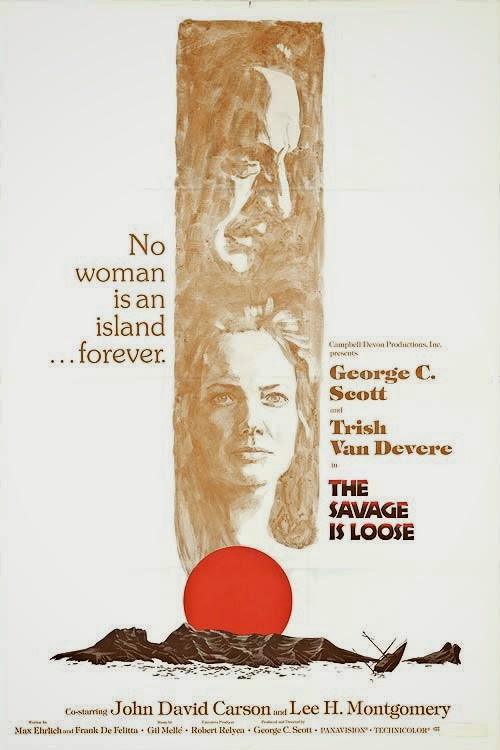
In 1902 John (George C. Scott) and his wife Maida (Trish Van Devere) take their infant son David (Lee H. Montgomery) on a sea cruise. Unfortunately the ship hits some rocks and sinks killing all those onboard except for the young family who manage to swim ashore to a deserted island. They make a home for themselves and slowly begin to age. By the time David reaches adolescence (now played by John David Carson) he begins to have sexual urges especially as he watches his father make love to his mother late at night. As his sexual feelings grow stronger he begins to lust after his own mother and compete with his father for her affections.

Unusual production that was directed by Scott and financed mostly with his own money. After the disaster of The Day of the Dolphin you’d think he’d have learned his lesson and gone with a script with a more mainstream storyline, but instead he dove into something that was sure to offend many and then proved incredulous when it didn’t score well with either the critics, or the box office. Despite starting the decade with an Academy Award win his career, especially after two financial duds back-to-back, began to peter-out after this one and he was really never able to regain his star status, or get offered top parts afterwards.

The film runs hot-and-cold. The opening is a bit cheesy as it features only a painting of a ship hitting some rocks and sinking, most likely the budget was too small to recreate an actual shipwreck, which surprisingly, despite the compromise, kind of works especially with the sound effects of the people screaming particularly the young child. It’s once they get on land that the action really begins to sink. The huts that they build, which we never actually see them make, but can only presume, look too well crafted, when factored in all the utensils, eating bowls, table, chairs, and even bamboo blinds, to have been built by two people with limited resources. It’s also hard to understand, with the front end of the ship still always in view, why they didn’t bother to create a raft, since their carpentry skills are clearly quite superior, in order to leave the island and find help. They eventually do, with relative ease but only after coming up with the idea 18 years later, but why the hell did it take them that long to eventually consider it?

The characters are quite dull and don’t have much to say and it would’ve helped had there been a fourth survivor on the island with them to allow for some diverse dramatic perspective, or even for some much needed comic relief. Montgomery plays the young David quite well, but Carson is terrible as the older version and fails to effectively convey the intense inner frustrations of his character and his acting delivery is robotic. Van Devere is okay as an actress, but her character fails to age. The father and certainly the son do have their appearances change, as you’d expect during almost two decades, but the mother remains youthful and glowing. Maybe this was done to keep her looking ‘desirable’ to the two men, but in reality she should’ve taken on gray hair and wrinkles especially after having to deal with all the stress and hardships of being stranded for some many years.

The incest theme is not handled in any type of interesting way. Instead of being this shocking twist that we’re not expecting it gets telegraphed right from the start and even ponderously talked about amongst all three of the characters until the viewer is totally expecting it to happen and to a degree even waiting for it. It’s confusing too why the son only has his eyes set on the mother. If his quandary is really just trying to release this strong sexual urges and having hardly anyone around to do it with then why doesn’t he try having sex with some of the animals that inhabit the island, or even the old man? Why not have sex, or at least attempt to, with all three at different times? Again, the movie wants to force the viewer out of their comfort zone by exposing the animalistic urges people can have, which in civilization will be repressed, but out in the wild it won’t. With that in mind then why not go ‘all-in’ and explore all the various types of perversions besides just the mother-son one?

Spoiler Alert!

While it remains strangely captivating, despite lots of lulls and slow spots, the ending doesn’t get played-up enough to make it worth it. I commend the idea, showing the mother deep kiss the grown son, but since they’re going for shock value why not show them from a bird’s eye view on the sand, naked and humping? Movies succeed by having unforgettable images and that would’ve been one hard to get out of most viewers heads. Having the father view them going at it was a bit ridiculous as he had been tied-up just moments earlier and trapped by a fast moving fire and no chance for escape, so how he was able to survive it is not clear and doesn’t make much sense.

My Rating: 3 out of 10

Released: October 30, 1974

Runtime: 1 Hour 54 Minutes

Rated R

Director: George C. Scott

Studio: Campbell Devon Films

Available: DVD

The Hospital (1971)

hospital1

By Richard Winters

My Rating: 8 out of 10

4-Word Review: An incompetently run hospital.

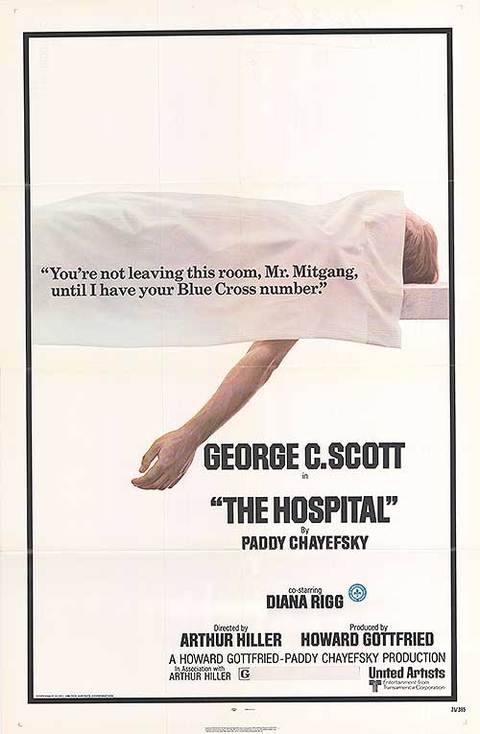
Dr. Herbert Bock (George C. Scott) is the chief of staff at a teaching hospital in New York where patients routinely die due to misdiagnosis and other blunderings. There’s also a protest by a group of tenants from a nearby apartment building that’s been annexed by the hospital to make room for a drug rehabilitation center. Bock not only must deal with these issues, but also his crumbling personal life which has turned him to both alcohol and thoughts of suicide. His only ray-of-light is meeting the beautiful Barbra (Diana Rigg) who has come to the hospital to seek treatment for her father (Barnard Hughes), but just as Bock starts to come out of his depression the place becomes terrorized by an unseen assailant who begins killing both the patients and staff.

In 1969 after his wife had received poor care at a local hospital Paddy Chayefsky set-out to write a script exposing what he felt was the corruption and incompetence going on inside the American medical institutions. He managed to get full control over his screenplay and final say over any proposed changes, which was a good thing since initially the studio felt it was filled with too much medical terminology that would go over many viewer’s heads. I’ll admit there’s an excessive amount of lingo, both with the dialogue between the doctors and staff as well as the opening voice-over narration by Chayefsky, that’s done at a rapid-fire pace and I really didn’t understand it, but I still kind of liked it. I have no medical background myself, so I and most viewers aren’t going to get the ‘medical speak’, but leaving it in helps make it sound more authentic. It also impresses the viewer with how much research was put into it and you basically trust what’s going on because it ‘sounds intelligent’.

Another complaint was the shift in tone where things start out in a darkly-humorous slap-dash fashion only to end up during the second act becoming quite serious. Normally this would’ve been a big problem, but I liked the shift here. I think the reason is because underneath the comedy there’s still life-and-death consequences going on and if you’re going to make a statement movie, which this is attempting to do, then at some point things have got to slow-down and get serious in order for that statement to get out, which this thing ends up successfully doing.

While I enjoyed the fluid pace that manages to encompass not only satire and drama, but even shades of horror without ever losing its realism I did find that it spends an inordinate amount of time telling us about all of the problems without bothering to give us any solutions. There’s no focus on what the underlying causes are nor any balance by showing an well-run hospital in comparison. One might start to believe that all hospitals are like this and become afraid to ever go into one even if they are really sick, which isn’t exactly a good thing. This may have been the reason why Chayefsky himself died at the relatively young age of 58 from cancer because he feared Dr.’s would “cut me up because of that movie I wrote about them” and thus refused surgery that might’ve saved his life.

Spoiler Alert!

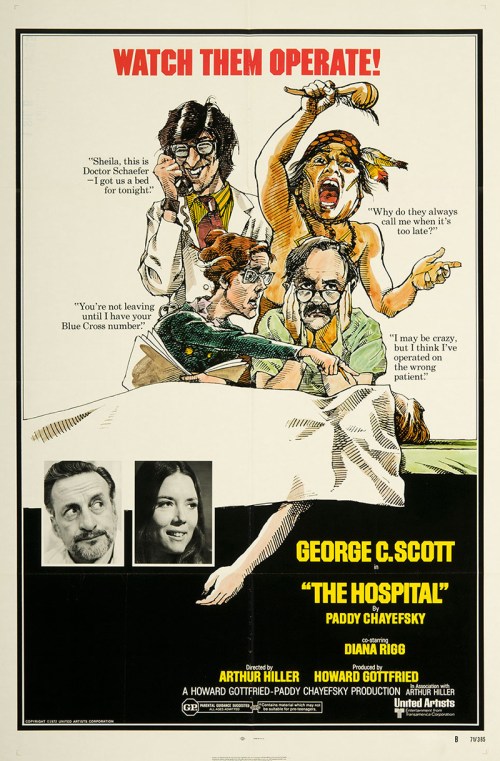
There’s a few issues with the casting as well. Overall, I was impressed with the performances particular Scott who got his second Oscar nomination for his work here. Rigg is also quite good, in a part that seemed better suited for Jane Fonda, who was the studio’s choice, but Rigg’s British accent and terse style makes for an interesting dynamic. You can also glimpse young soon-to-be-stars in small bits including: Nancy Marchand and Robert Walden, who later went on to co-star with each other in the TV-show ‘Lou Grant’ as well as Stockard Channing, in her film debut, and Frances Sternhagen as an exasperated medical clerk. The main problem though comes with Barnard Hughes, who appears for some strange reason in two completely different roles. He is very funny as the surgeon who finds he’s been operating on the wrong person, but then later he reappears as Rigg’s father, which didn’t make much sense. Since the father turns out to be the mysterious killer many people thought the scene with Hughes as the surgeon was meant to be the father in disguise, but that was not the intention. Again, if there’s no specific/underlying purpose story-wise for an actor to play two different parts in the same movie then don’t do it. There’s no lack of actors out there clamoring for work, so one of the two parts could’ve easily have been filled by someone else and thus avoided confusing the audience for no good reason.

It’s possible that the reason Chayefsky had Hughes playing dual roles was to help explain how the killer was able to get away with his crimes for so long. While the killer is always shown off camera, so the viewer does not know the identity, the Dr.’s and nurses do seem to recognize him as being a colleague and are put at ease just before he kills them. Of course the odds of a patient entering a random hospital and looking similar to one of the staff is astronomically low, but if this was the underlying concept, and it very well may have been, then the film should’ve eventually made this clear by having a split screen scene where Hughes the surgeon bumps into Hughes the killer.

hospital3

My Rating: 8 out of 10

Released: December 14, 1971

Runtime: 1 Hour 43 Minutes

Rated GP

Director: Arthur Hiller

Studio: United Artists

Available: DVD, Blu-ray, Amazon Video, Tubi, YouTube

The New Centurions (1972)

By Richard Winters

My Rating: 7 out of 10

4-Word Review: Rookies on the force.

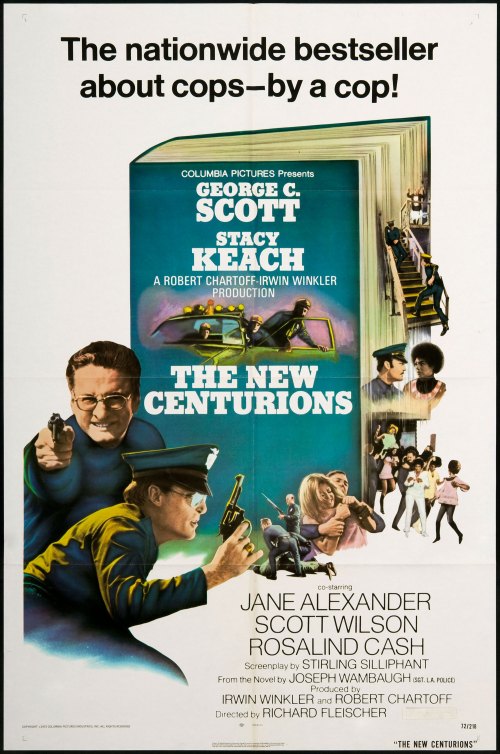
Roy Fehler (Stacy Keach) is a young law student who decides to join the LAPD until he can complete his degree. After graduating from training he gets partnered with Andy Kilvinski (George C. Scott) a veteran with almost a quarter of a century of police work under his belt. Roy likes Kilvinski’s unique approach to cop duty and enjoys his police work more and more to the point that he puts his law studies on hold, much to the consternation of his wife (Jane Alexander). Then one night Roy gets shot while on-duty forcing him to go through a painful recovery, but his determination to return to the force puts a major strain on his marriage and when his wife leaves him he turns to liquor for solace.

The film is based on Joseph Wambaugh’s debut novel, which he wrote in 1970 and based loosely on his own experiences and observations while working as a cop. The novel though differs greatly from the film in that there were three main characters in the book while the film focuses mainly on Keach while leaving the other two, which are played by Eric Estrada and Scott Wilson, as only secondary players that are seen only sporadically. The novel also delved into the Watts Riots at the end, which the movie completely ignores.

The film though does succeed at humanizing those that work on the force as we see them as regular people who just so happen to wear a badge as opposed to authority figures. The story thankfully avoids police cliches and seeing how Keach’s job affects both his home life and personality is quite interesting and something I wished had been explored even more.

The best moments come during the first act as the viewer gets thrust onto the street scene along with Fehler and Kilvinski where in almost cinema vertite style we see what an average night patrolling a poor African American neighborhood in Los Angeles is really like. Some of the time their experiences are quite lighthearted like when they pick up a group of black prostitutes, one of which is played by Isabel Sanford, who later went on to star in the TV-Show ‘The Jeffersons’, who get put into a paddy wagon where they drink hard liquor and tell bawdy stories. Other moments though become tense and serious particularly when they have to wrestle a crying infant away from his abusive mother.

Keach plays his part quite well and one of the reasons that the film is successful, but his character isn’t well defined. We have no understanding why he enjoys patrolling the streets so much and ignores his family life the way he does. Without any insight to what drives him it makes his obsession to return to the force after his shooting injury seem bizarre and confusing. In the novel he was portrayed as being quite arrogant and thinking he was smarter than everyone else, which gets toned down considerably here.

Spoiler Alert!

Scott’s character is another confusing mess. For most of the film he’s shown as being rather laid-back only to suddenly shoot and kill himself without warning after he retires. Yet the character is not fleshed-out enough making what he does senseless. The film seems to imply that he was bored in retirement, which is what lead him to do it, but do other policemen who retire also kill themselves at a high rate? I haven’t heard of that many who do so it seemed to me there needed to be a better reason than just that and without one being sufficiently supplied it makes the scene come-off as unnecessarily jarring that creates confusion instead of clarity.

The segment where Fehler joins the vice squad are quite funny and manage to be both outrageous and believable at the same time. However, his sudden descent into alcoholism gets too rushed and the film would’ve worked better had it reflected the same structure as its source novel where the character’s lives are examined every August of each succeeding year after graduating instead of keeping the time period undefined, which makes everything that occurs look like broad composites instead of a fluid situation.

The scene where Scott Wilson’s character shoots and kills an innocent black man gets poorly presented too as we never get to see the aftermath of his actions as the subsequent investigation is never addressed at all. We simply see him back on the force in later scenes like it never happened. The moment is startling, so not answering the question of what penalty he may or may not have faced is frustrating.

My Rating: 7 out of 10

Released: August 3, 1972

Runtime: 1 Hour 43 Minutes

Rated R

Director: Richard Fleischer

Studio: Columbia Pictures

Available: DVD

Taps (1981)

By Richard Winters

My Rating: 3 out of 10

4-Word Review: Cadets take over academy.

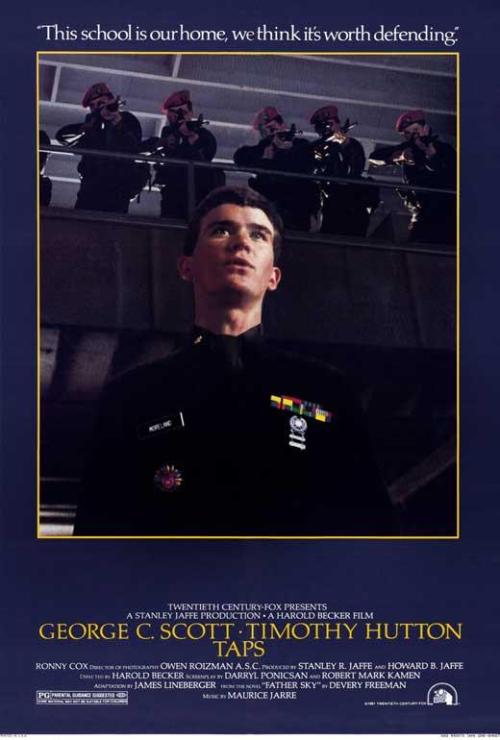
At the conclusion of another school year at Bunker Hill Military Academy, General Harlan Bache (George C. Scott) announces, to his shocked cadets during the commencement proceedings, that their school has been sold to real estate developers and will be closed in 1 year. Then that evening tragedy strikes forcing the board of trustees to close the school immediately. The students lead by Brian Moreland (Timothy Hutton) who had just been promoted to Cadet Major decide to take matters into their own hands by taking over the school with force and refusing to leave it unless guarantees are made to keep it open.

The film is based on the novel ‘Father Sky’ by Devery Freeman and the first half has excellent potential. The drama is intense and on-target and brings up a myriad of interesting conundrums dealing with the thin line between loyalty versus rebellion and how at different times both can be good and bad. It also deftly examines how bad things can come from the best of intentions.

Unfortunately all the action takes place in the first hour leaving the second half woefully undernourished with nothing happening. Everyone stands around expounding until all the tension that had been so nicely built-up at the beginning gets sapped away leaving boredom in its wake. The film also tries too hard to make its point becoming overwrought and preachy in the process. The dialogue between the characters loses its conversational quality and instead starts to sound like mini speeches.

The acting by the soon-to-be-stars is good and includes Sean Penn in his film debut as well as Tom Cruise in a breakout role that originally he rejected because he was only hired to be a background character, but his presence during rehearsals so impressed director Harold Becker that he decided to give him a bigger part and he  leaves a lasting impression particularly at the very end. Hutton, who was just coming off his Academy Award winning work from Ordinary People is effective too despite his thin frame and the scene he has where he discusses the situation with the cadets’ distressed parents are his best moment.

Scott on the other hand comes off as old and tired, granted that was the type of character he was playing, but it still isn’t a showy role for an otherwise famous actor and in fact he only appears in the film’s first act. The scene dealing with him trying to break up a ruckus between a group of students and cadets is poorly edited. One shot has his gun being taken out of its holster by another student only to magically reappear in Scott’s hands in a later shot, which comes off looking like a jump cut.

From a simply logical perspective it becomes abundantly evident right from the beginning that these kids have gotten in way over their heads with no endgame and nothing is worse than seating through a plodding plot that you know won’t end well.

My Rating: 3 out of 10

Released: December 9, 1981

Runtime: 2 Hours 6 Minutes

Rated PG

Director: Harold Becker

Studio: 20th Century Fox

Available: DVD, Blu-ray, Amazon Video, YouTube

Hardcore (1979)

By Richard Winters

My Rating: 6 out of 10

4-Word Review: His daughter does porn.

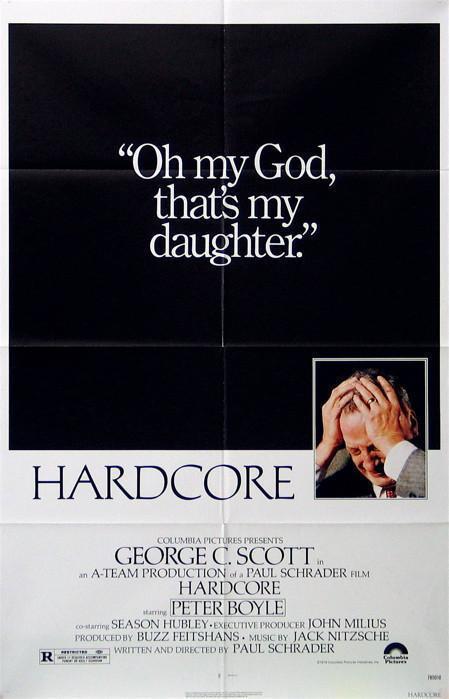
Jake (George C. Scott) is a conservative businessman living in Grand Rapids, Michigan, who is raising his teenage daughter Kristen (Ilah Davis) as a single parent only to have her disappear while on a church sponsored road trip to California. Jake then hires a detective (Peter Boyle) to track down her whereabouts and after some searching he finds that she’s entered the world of porn, which compels Jake to go to California and pose as a adult film producer in hopes that he can get information from those working in the business that will eventually lead him to Kristen.

While the storyline has some potentially interesting aspects it gets handled in too much of an over-the-top way, particularly at the beginning, to be fully effective. The opening song sung by Susan Raye is too heavily tinged with a country music sound and the religious aspects of the citizens, who debate Bible passages even during a holiday dinner, gets overplayed. Having a brief scene showing Jake leaving church after attending a service was all that was needed to convey that the character was on the conservative end without having to throw in all of the other heavy-handedness.

The segments dealing with the porn scene are equally botched. For one thing with the advent of the internet the adult film business has changed drastically making what we see here quite dated and irrelevant.  We also learn barely nothing about the daughter, or how exactly she got into doing porn. The film implies that she meets some man on her trip who apparently ‘tricked’ or ‘drugged’ or ‘kidnapped’ her into doing porn and that could be the only possible explanation for why anyone would ever do it, which I suppose at that time was the answer most mainstream audiences would accept. However, there are many famous female porn stars from that era who insist they choose to get into the business and weren’t forced.

The film would’ve been far stronger had writer/director Paul Schrader actually done some research into the people who worked in the business, which I felt he hadn’t done as the porn producers are portrayed in the same broad caricature way as the religious people at the beginning. Having the daughter choose to get into the business and then cutting back-and-forth between her dealings inside the adult movie world and her father’s search for her would’ve made the movie more insightful.

I did however enjoy seeing conservative/small-town Jake get plunged into a dark, seedy world that he wasn’t used to and the many adjustments that he makes, including buying a whole new wild wardrobe in order to fit in. His friendship with one of the female porn stars, which is convincingly played by Season Hubley, is quite fascinating especially their conversations and an aspect of the film that I wished had been played-up more.

Spoiler Alert!

The ending, which involves a big shoot-out on the streets of L.A. gets too Hollywood-like and should’ve been avoided. Having Jake finally meet-up with his daughter and their subsequent stilted conversation, was equally dumb and really hurts the movie as a whole. Originally the script had the daughter dying in a car accident before Jake was able to find her and since her character remains pretty much an enigma anyways, that’s the ending that they should’ve kept.

My Rating: 6 out of 10

Released: February 9, 1979

Runtime: 1 Hour 48 Minutes

Rated R

Director: Paul Schrader

Studio: Columbia Pictures

Available: DVD, Blu-ray (U.K. release) Amazon Video, YouTube

The Formula (1980)

By Richard Winters

My Rating: 3 out of 10

4-Word Review: Nazis create synthetic fuel.

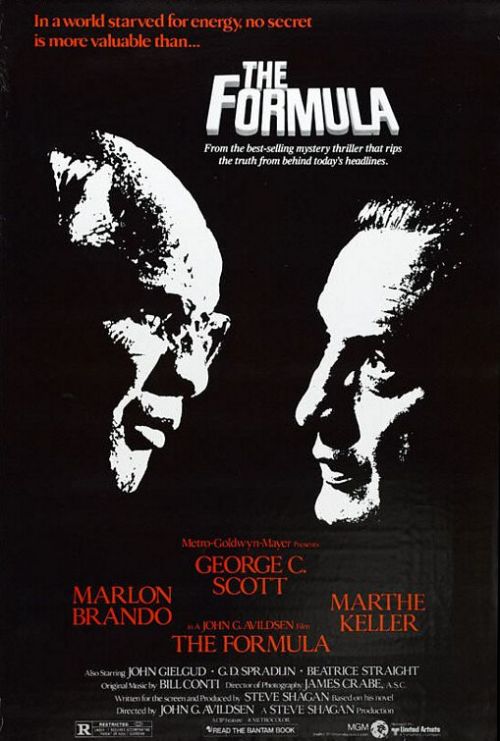
While investigating the murder of his former police mentor, Lt. Barney Caine (George C. Scott) stumbles upon a an underworld of drug money and illicit funds that connect back to a petroleum company run by Adam Steiffel (Marlon Brando). He later learns that it has to do with a synthetic fuel invented by the Nazis during World War II that could be created from coal instead of oil, which if unleashed would unbalance the world markets and those that know about it are now being silenced permanently.

MGM offered to make the movie before Steve Shagan had even completed the novel of which is is based figuring that the topic of synthetic fuel would grab audiences since it conformed to the issue of the energy crisis that was making headlines during that era. Unfortunately the story works better in novel form because as a movie it amounts to nothing more than scene after scene of talking heads with no visual style or cinematic quality to it and the only interesting images, which include watching a frog swim across a chlorine filled pool and alligators munching on their lunch, has nothing to do with the actual plot at all.

Scott’s character is equally dull. He’s seen at the start leaving a movie theater with his son (Ike Eisenmann), which I guess is a cheap attempt to ‘humanize’ the character, but then he’s never seen with him again. He’s also initially straddled with a police partner (Calvin Jung) and their relationship gets off to a rocky start, which I thought would offer some secondary drama, but then he disappears too leaving him only with Marthe Keller, who replaced Dominique Sanda who Scott disliked because of her French accent, who acts as a potential love interest that is both stale and unneeded.

The film’s only entertaining aspect is Brando who manages to steal every scene he’s in by playing up the comic angle. He demanded complete control over how his character dressed and in the process sported a goofy comb-over and a hearing aid, which gives the guy a quirky charm. He also mostly ad-libbed his lines and refused to learn the ones in the script, which helps enliven the otherwise staid drama with some nice offbeat touches that I wished had been played-up more and it’s a shame that he wasn’t made the star as he’s the only thing that saves it.

The plot does have some intriguing qualities to it, but Shagan who also acted as the film’s producer, gives away all the secrets too early. Instead of waiting until the very end to find out what the code name Genesis stands for we’re told the answer at the halfway mark making the second half seem pointless and petering itself out with one of the dullest, most anti-climactic finales ever filmed.

My Rating: 3 out of 10

Released: December 19, 1980

Runtime: 1 Hour 57 Minutes

Rated R

Director: John G. Avildsen

Studio: MGM

Available: DVD

Firestarter (1984)

firestarter

By Richard Winters

My Rating: 5 out of 10

4-Word Review: Girl has fire power.

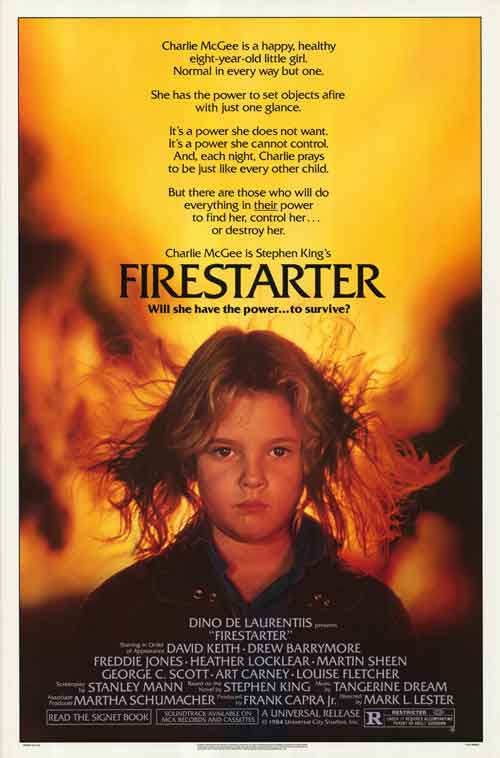
Andrew (David Keith) and Victoria (Heather Locklear) are two struggling college students who in an attempt to make some extra money decide to take part in medical study where they receive injections of a drug that give them telepathic abilities. They later get married and have a child named Charlene (Drew Barrymore) who has the same type of abilities except hers allows her to start fires using only her mind. Now a secret governmental agency known as The Shop seeks to kidnap Charlene so they can use her abilities for their own nefarious means, which sends Charlene and her father on a cross-country run to try and escape the agency’s clutches.

If there is one thing that really stands out in this movie and makes it worth the watch it’s Drew’s performance. She was only 8 at the time, but has a presence and acting awareness that was well beyond her years and she easily upstages her more seasoned co-stars. Her character isn’t completely fleshed-out and I’ll agree with Roger Ebert in his review that she was created more like a “plot gimmick”, than anything, but Drew still makes it engaging nonetheless. My only real complaint with her character is why, when she does get apprehended by the governmental agency, that she doesn’t she just use her fire ability to burn down the door of the room that she is trapped in to escape?

George C. Scott is an equally interesting as the bad guy even though he ends up being trapped into the same type of contrived character with motivations, particularly his reasons for befriending the girl, that seem quite nebulous and even illogical. However, his presence lends an added edge and I loved his ponytail as well as the contact lens put into his left eye that gives him an android-type appearance.

The rest of the cast though does not fare as well. Art Carney and Louise Fletcher, two Academy Award winners, get stuck in a small, almost insignificant roles as a father and daughter farm family who temporarily takes in Andrew and Charlene when they are on the run, which is okay, but the idea that this same couple would later happily take in Charlene again after they had witnessed her frightening ability first-hand and the burning deaths of several people that she helped create is ridiculous. In reality they would’ve seen her as some sort of ‘freak’ to be wary of and scared that she might do the same thing to them one day and thus want nothing to do with and certainly not welcomed back into their home.

As for the plot it’s okay, but it takes quite a while to get going and only becomes moderately gripping during the second-half. The script is based of course on a Stephen King novel and the scenes showing Charlene setting various people and things on fire seemed too much like an offshoot to King’s more famous Carrie character and thus the originality is lost. There’s also just so much objects/people being set on fire one can watch before it starts getting redundant, which makes the climactic finish boring, lame and even laughable.

I also wasn’t sure how Charlene was able to stop bullets from hitting her. This subject gets discussed in a thread on IMDb with some posters surmising that it was apparently a ‘heat shield’ that she was able to create through her pyrokinesis. However, if that was the case then it should’ve gotten explained earlier otherwise it comes off looking like the filmmakers were just making up the rules as they went whenever it was convenient for them.

My Rating: 5 out of 10

Released: May 11, 1984

Runtime: 1Hour 54Minutes

Rated R

Director: Mark L. Lester

Studio: Universal

Available: DVD, Amazon Video, YouTube

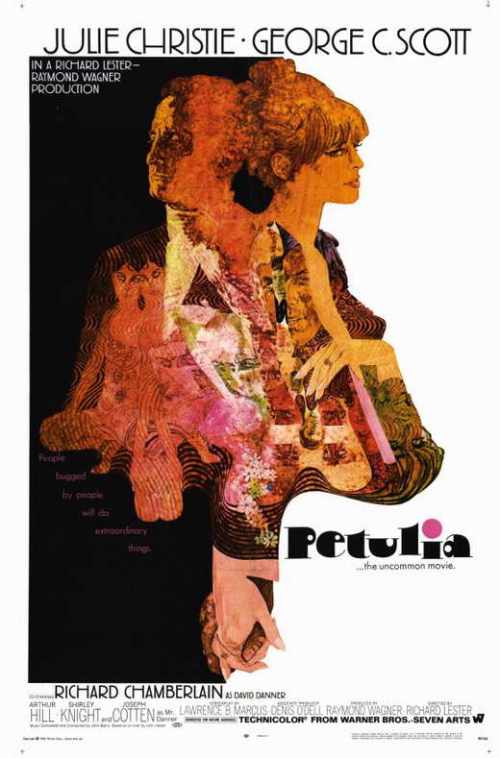
Petulia (1968)

petulia 2

By Richard Winters

My Rating: 9 out of 10

4-Word Review: A very brief affair.

While attending a medical fundraiser Petulia (Julie Christie) who is a married rich socialite, decides to come-on to Archie (George C. Scott), a doctor who performed a life-saving surgery on a young Hispanic boy (Vincent Arias) that she brought to him a few months earlier. Archie is still hurting from his recent divorce to his wife Polo (Shirley Knight) and not sure he wants to jump into another relationship so quickly especially with a woman that behaves in such an eccentric way. However, her kooky personality and good-looks get the better of him and the two spend the night together. In the days that follow Archie learns of her abusive relationship with her husband David (Richard Chamberlain), but when he makes an attempt to help her get out of it she resists, which causes him a great deal of frustration as he is unable to get a good grasp on why she behaves the way that she does.

The film is based on the novel ‘Me and My Arch Kook Petulia’, which was written by John Haase who worked as a dentist and wrote his stories between his appointments. What makes this plot stand out from the rest of the romances is that it focuses on the chance meeting between two people who share an immediate attraction, but are unable due to various extraneous circumstances to ever get it into a relationship stage. They become like two-ships-passing-in-the-night and go on with their lives and even other relationships while quietly longing for ‘the-one-that-got-away’. Most movies portray romances where everything falls into line and works out while blithely ignoring the ones that get shown in this film even though these are much more common.

Director Richard Lester, who is better known for his slapstick comedies, shows an astute eye for detail and his fragmented narrative works seamlessly. I enjoyed the quick edits and color detail as well as the subliminal symbolism including showing the David and Petulia characters wearing all-white to display their sterile marriage as well as capturing David’s father (Joseph Cotton) sitting in front of a giant window that looked like a cobweb to help illustrate how he had entangled Petulia into his own personal web. The film, which was shot on-location in San Francisco, features great shots of the Golden Gate Bridge and the world famous cable cars as well as an interesting scene at the Jack Tar Motel, which has now been demolished but was famous for its ability to check customers into their rooms without the use of a live clerk, but instead through close circuit TV and a room key that would light up when the person passed by their assigned room.

The two leads give strong performances particularly Scott who for a change doesn’t play a character with a forceful personality, but instead someone who inadvertently gets bowled over by a woman who has an even stronger one than he. Even Chamberlain does well. Normally I find him to be quite bland, but here he is surprisingly effective.

This movie also marks the film debuts of many performers who are seen in brief, but quirky bits including: Richard Dysart as a virtual hotel clerk, Howard Hesseman as a hippie, Rene Auberjonois as a seat cushion salesman and Austin Pendleton as a hospital orderly. Members of the Grateful Dead get some funny moments while inside a grocery store and Janis Joplin can be seen onstage singing during the opening party sequence.

Romance fans will like this, but so will those living in the Bay area during the ‘60s as the city gets captured well. However, fans of that decade will also like it as it expertly exudes the vibe from the period and making it seem very real to the viewer even if they weren’t alive during the time it was made. Also, John Barry’s haunting theme nicely reflects the character’s mood and evasive film style.

petulia 1

My Rating: 9 out of 10

Released: June 10, 1968

Runtime: 1Hour 45Minutes

Rated R

Director: Richard Lester

Studio: Warner Brothers

Available: DVD, Amazon Instant Video, YouTube