Tag Archives: Entertainment

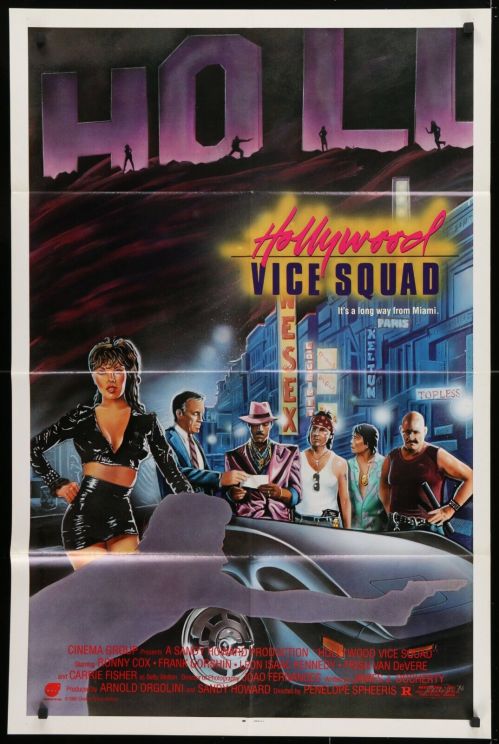
Hollywood Vice Squad (1986)

hollywood2

By Richard Winters

My Rating: 0 out of 10

4-Word Review: Trying to stop prostitution.

Based supposedly on actual police cases the film consists of three different scenarios that get interwoven throughout. The main one deals with a distraught mother (Trish Van Devere) who comes from the Midwest to Hollywood in search of her teen daughter (Robin Wright) who’s run away. Police Captain Jensen (Ronny Cox) informs her that her child may have slipped into prostitution, which she refuses to believe. The other two stories deals with a small town racketeer (Julius Harris) who runs a shady hustle out of his home and finds himself being harassed by both the cops and the mob. The third segment focuses on two bickering cops (Evan C. Kim, Joey Travolta) who try to stop various prostitution situations from occurring by implementing stings, which mostly prove to be inept.

The project is a misguided attempt to take Vice Squadwhich was written by the same screenwriter that did this one, Kenneth Peters, and turn it into a comedy, or at least throw in humorous elements in between the action. While I was no fan of the first one, as I found the topic in general to be uninteresting, it at least gave off a gritty feel, but this thing can’t even do that. The humor is sporadic and while some of the car stunts are okay everything else is a bore and the film offers no new insight into what is otherwise a very tired and cliche subject.

Frank Gorshin was only one of two things that I liked. Gorshin of course is best known as an impressionist and for his Emmy Award winning performance as the Riddler on the ‘Batman’ TV-show from the 60’s, but he’s also done a lot of acting roles outside of that, which were quite compelling. This one required a lot of sliminess, which he’s more than able to provide with some of it ad-libbed that makes it all the better. He even during a couple of segments offers his trademark, spontaneous Riddler laugh, which is great. The only problem with his presence is that supposedly the police are unable to find him in order to bring him in for questioning in regards to the mother’s missing teen daughter, which didn’t make a whole lot of sense since he works and lives out of a giant, gaudy mansion that most anyone should’ve been able to easily spot.

I also really enjoyed Carrie Fisher who ended up satirizing her experiences filming this in her novel and screenplay Postcards from the Edge. She had just gotten out of drug rehab when she was offered the part, but studios were reluctant to give her work and director Penelope Spheeris really had to go to bat for her, but the effort was worth it. She plays the only character that’s likable and she should’ve been given the lead and had the whole thing revolve around her exclusively. With that said though the case that she’s on, trying to put a halt to a porn production that’s supposedly employing a minor, doesn’t totally work as the kid they’re trying to save has a boyish face, but a body that made it seemed he was most likely over 18 and I was fully expecting the cops, who raid the production without a search warrant, to learn this lesson the hard way, but we’re never shown any finality to it, so the viewer doesn’t know. Also the scene where she sneaks into the sleazy producer’s garage and gazes at adult magazine covers that he has stored in a box, which features no nudity and simply depicts models wearing generic leather bondage outfits and she grimaces like she’s looking at something ‘extreme’ seemed rather silly.

The storyline dealing with Van Devere’s quest for find her daughter are unintentionally laughable. What baffled me was the way she would walk through these really trashy areas filled with dangerous looking people and appear completely content and at ease. If she’s from a sheltered small town then seeing these seedy areas should make her quite shocked and frightened and these are the reactions we should be seeing on her face. Also, she’s a good-looking milf and I was surprised some of the creepy men didn’t attempt to accost her as she ambled by them. The casting of Robin Wright as her runaway daughter, in her film debut, is problematic too as she looks to be over 20 and for shock value you really need to cast someone who’s 16 or 17 and looking it in order to create that true loss of innocence image.

I’ve always been curious why people who get into the vice squad work feel it’s worth it. The characters in the film even admit that these hookers and pimps will be right back out on the streets the next day even if they manage to make a few arrests, so why keep on spending so much time and effort if it’s really not making a difference? Have one of the police agents ponder this would’ve given the story an extra dimension that it needed.

It seemed to be almost cruel that they would stop a goofy old man, amusingly played by Marvin Kaplan, from having sex with a streetwalker who was willing. Clearly this was the only way the old guy was going to find any action, so if he’s going to pay and the sex worker, who is of age of course, is willing to perform then why not consider it a basic capitalist business transaction and be done with it? Spending so much effort trying to stop things like this when so many worse things are going on in is what makes the whole thing come-off as petty and trivial.

If anything the storyline involving Fisher’s attempts at putting a halt to what appeared to be a child porn racket should’ve been the central plot. This is something most if not all viewers could get behind and it’s a shame that it gets watered down here and then lumped in with other stuff, which isn’t compelling at all.

hollywood1

My Rating: 0 out of 10

Released: February 28, 1986

Runtime: 1 Hour 41 Minutes

Rated R

Director: Penelope Spheeris

Studio: Cinema Group

Available: DVD, Tubi, Plex, Amazon Video

The Day of the Dolphin (1973)

dolphin2

By Richard Winters

My Rating: 3 out of 10

4-Word Review: Training dolphins to talk.

Jake Terrell (George C. Scott) along with his wife Maggie (Trish Van Devere) run a remote island research station where, along with a small team of researchers, try to teach dolphins to communicate with humans. They’re prime subject, which they’ve been working with for 4 years, is Alpha whom they’ve successfully trained to speak some English words, but when they team him up with another dolphin named Beta he goes back to his old ways of communicating and no longer speaks with Jake, or his team. Things become further hampered when Curtis (Paul Sorvino) arrives on the island supposedly under the guise of being a journalist, but in reality he’s a spy there to infiltrate what Jake has been doing with the dolphins and report back to a secret government organization who want to then use the dolphins for their own nefarious means.

With the early success of director Mike Nichols and screenwriter Buck Henry, especially The Graduate, it seemed like these two could do no wrong and they both became a much sought after Hollywood commodity and given many top project offers. This production though came crashing down horribly and stymied Nichols career, which had previously been skyrocketing, for the rest of the decade as he helmed only one other film after this during the 70’s before finally getting his reputation back in order with the critically acclaimed Silkwood.

This thing comes-off as a misfire almost immediately and the biggest problem are the dolphins. There’s just so much they can do, liking mainly jumping in and out of water, until it becomes really boring. The long dream-like segment of watching Jake swim around in the tank with the dolphin adds nothing and got so prolonged that it practically put me to sleep. The only part where the dolphins did hold my attention was when Jake decides to split the two up where Beta is put in a pool on one side and Alpha the other and a steel partition between them. This then causes the dolphins much stress as Alpha angrily smashes his tail repeatedly against the partition in anger, but to no avail. While I did find this moment to be rather intense it does backfire in a way in that it makes Jake and the other researchers seem cruel and you start to not like them, which I don’t think was the filmmaker’s intent.

Having them learn to talk was misguided and makes it seem like a silly flick for kids with no barring in reality. Initially I was okay with them learning a few words as it came-off like they were parrots repeating sounds that they had heard, so it was borderline plausible, but then having it graduate to the point that he and others can have ongoing conversations with them and even ask them questions is when it starts to get too absurd for its own good.  In fact the only moment in the film that’s truly fascinating to see is when a mother dolphin gives birth using actual footage, which made me believe this would’ve been better off had it been done as a documentary and the fictional story left out completely.

Sorvino does add some energy with his scenes and pretty much outclasses Scott, who with his $750,000 salary, which would equate to $5,484,886 in today’s dollars, is quite dull and he manages to get completely upstaged by even the dolphins themselves. All of the main characters are quite one-dimensional, especially Van Devere who seems to agree with Scott on everything and echoes whatever point-of-view he has making her presence completely unneccesary as she’s simply him in a female form.

Having one of the research crew members turn out to being a spy doesn’t work either as the viewer is given no forewarning about this. We’re just informed later that this individual had betrayed them, but a good movie should offer hints upfront that a traitor may be in their midst and thus allow the audience to become more of an active participant as they try and figure out which of them it is. The secret government organization thing gets equally botched. A better scenario would’ve had a former friend, or associate to Jake turn on him and seek revenge by trying to destroy the research facility and all of their findings. He would be constantly lurking about, which would’ve added more ongoing tension that is otherwise lacking and given the bad guy more of a personality versus the bland government agents that are too generic to be either frightening, or memorable.

My Rating: 3 out of 10

Released: December 19, 1973

Runtime: 1 Hour 44 Minutes

Rated PG

Director: Mike Nichols

Studio: AVCO Embassy Pictures

Available: DVD, Blu-ray

Stewardess School (1986)

stewardess

By Richard Winters

My Rating: 1 out of 10

4-Word Review: They become flight attendants.

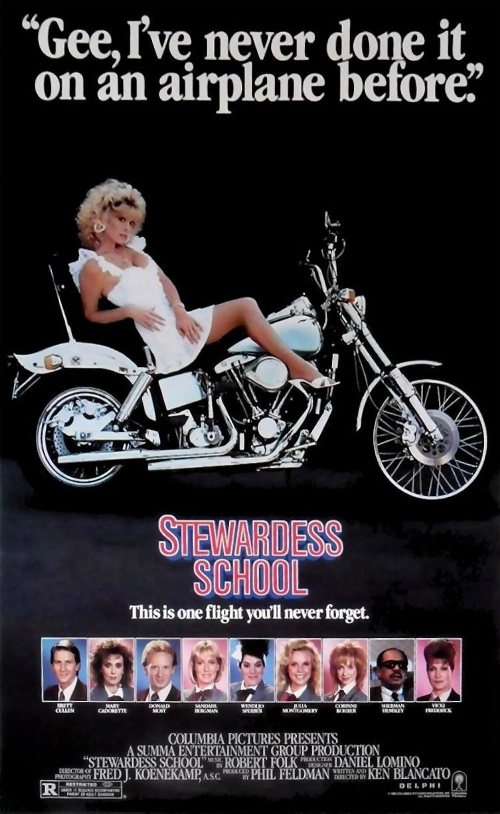
Philo (Brett Cullen) and George (Don Most) are training to become airline pilots, but an unexpected calamity during the flight stimulator test causes them to flunk out. Without a job, or money they decide to enter into a school that trains people to become flight attendants. They feel this way they’ll still be able to be up in the air and can also hit-on all the hot women. They’re class is full of misfits, but somehow they all manage to graduate despite the presence of Miss Grummet (Vicki Frederick) who runs the school and tries to make each of their lives a living hell. After graduation the students get a job with Stromboli airlines, but Miss Grummet is onboard and wants to make sure things do not go as planned while a mad bomber (Alan Rosenberg) wants to blow the aircraft up.

This was another in a long line of Police Academy imitators that did nothing but make that one, which wasn’t too great to begin with, seem like a masterpiece. The film, which per later interviews with star Sandahl Bergman where she attests the cast and crew including the director were snorting cocaine during the production, is nothing but a barrage of lame jokes and uninspired storyline making it pretty much dead on arrival from the first frame in. It doesn’t even have all that much nudity and what little it does comes from gals looking well over 30. The women cast in the leads keep their clothes on even though they’re far more attractive. Judy Landers, who plays a hooker who speaks in the most annoying Flossie-like accent, in order to conform to the caricature of a NY streetwalker, I found to be the most perplexing. She’s clearly sexy and yet is never seen naked even though she goes to a Dr.’s office for a medical exam, but just as she’s set to remove her bra the camera cuts away, which will frustrate certain viewers as the only point for watching this vapid thing is to see some good-looking flesh and if it can’t even succeed with that then it’s pointless to sit through.

I found the characters to be the most irritating as everything gets approached from a 13-year-old perspective with no inkling of nuance. Star Cullen is a prime example as he plays this pilot who can’t see without his glasses even though most people who use them can still make out things when they’re not on but they’re just real fuzzy and yet here this guy doesn’t know when he’s in a shower room full of naked women. The thick coke bottle type of glasses that he does wear was severely dated as by the 80’s the technology had improved that people with bad eyesight could wear lenses that weren’t so thick and obvious.

Wendi Jo Sperber, who is slightly overweight though the film acts like she’s ‘obese’, gets stuck with a part that’s genuinely insulting as it does nothing but make fun of her few extra pounds the whole way through. At one point it even has her spotting a cheese cake in a refrigerator and going ‘oink, oink’, which I found to be quite shallow as they’re can be many reasons for why someone as a bigger body type than others that has nothing to do with overeating.

I did enjoy Mary Cadorette who’s probably best known for playing in the short-lived ‘Three’s a Company’ spin-off ‘Three’s a Crowd’. She definitely gives a likable performance of a terminal klutz. While her clumsiness does get overplayed, with none of the pratfalls ever being funny, I felt the way she overcame her problem by going through hypnosis was a cop-out. A good story should have a character grow and succeed through their own initiative versus having it all go away with the literal snap-of-a-finger.

The worst part may be the ending where the film inadvertently turns into a airplane disaster flick, which has been done better in many other parodies. The mad bomber is too obvious and everyone should’ve been eyeing him suspiciously from the get-go instead of having him being ignored until it was too late. The film should’ve played against type with this part by having the nut turn-out to being what initially seemed like a sweet old lady, or someone else you wouldn’t expect, but of course that would’ve required creativity, which filmmakers here were clearly lacking. The film does stand out in one way as it holds the record for being the most played movie on the Comedy Central cable network, which says more about their subgrade level of programming than anything else.

My Rating: 1 out of 10

Released: August 20, 1986

Runtime: 1 Hour 29 Minutes

Rated R

Director: Ken Blancato

Studio: Columbia Pictures

Available: VHS, DVD-R, Amazon Video, Tubi

Last of the Mobile Hot Shots (1970)

lastmobile

By Richard Winters

My Rating: 4 out of 10

4-Word Review: A game show wedding.

Myrtle (Lynn Redgrave) and Jeb (James Coburn) meet at a game show being taped in New Orleans and find themselves working together as contestants when brought up onto the stage. They end up winning some money, but are told that they cannot collect it until they’re officially married on live television, which they both agree to. After the nuptials they travel to an old mansion known as the Waverly Plantation that has been in Jeb’s family since 1840. Jeb wishes to use the money earned on the game show to fix up the place, but finds his plans being stymied by Chicken (Robert Hooks) a multi-racial half-brother that has been residing at the place and maintaining it for many years. Chicken insists that he’ll become the next owner of the place once Jeb succumbs to terminal cancer, but Jeb wants Chicken off the premises immediately and have the document stating that Chicken is the next of kin to be destroyed. He orders Myrtle to flirt with Chicken until she can get him into a compromising position so that she can steal the document. Once that is retrieved he then wants her to kill him with a hammer while Jeb waits upstairs. Though initially reluctant Myrtle decides to go through with the plan only for Chicken to turn-the-tables on them with an unexpected twist.

While playwright Tennessee Williams is celebrated for his acclaimed work like A Streetcar Named Desire and Cat on a Hot Tin Roof many people don’t realize that his biggest success came early in his career while towards the end,  especially by the mid-60’s through to his death in 1983, his output was very little and what he was able to get produced was generally not well received by either the critics, or the public. This film is based on his play The Seven Descents of Myrtle, which was originally written as a short story in 1942 and published in 1954. Williams then decided to turn it into a one-act play in 1967, but then expanded it to a full length stage production, which premiered on Broadway on March 27, 1968 with Harry Guardino as Chicken and Estelle Parsons playing Myrtle. This version though only ran for 29 performances and was generally considered a failure.

However, director Sidney Lumet saw the production and decided he wanted to take a stab at turning it into a movie. He made several changes to the story with the biggest one being that in the play the Jeb character, who was called Lot, was a closeted transvestite, which is something that the movie doesn’t bring up at all though would’ve been far more interesting had it done this. The play also doesn’t feature the game show segment, which was very surreal and makes the film seem almost like a misguided parody.

I did enjoy the way famed cinematographer James Wong Howe captured the decaying mansion, which was filmed on-location in St. Francisville, Louisiana, a famous small town known for its abundance of historic old buildings. Everything else though falls flat. The opening bit at the game show is funny, but becomes jarring with the second-half, which is more dramatic making it seem like two completely different movies with highly inconsistent tone rammed into one. The Myrtle character is not fleshed-out enough to make any sense, or even seem remotely believable and ultimately like with the rest of them comes-off as an empty composite that is not relatable in any way to real people.

The acting though by Redgrave is quite strong. Normally British actors have a hard time masking their accent, but here she’s able to speak in an authentic Southern dialect without her European voice being detectable in the slightest and she puts on a provocative striptease to boot. Hooks dominates the proceedings and ultimately outclasses Coburn who later admitted regret at doing the project and considered his appearance here to be a low point in his career. Having Williams write the screenplay might’ve helped and I’m not sure why he wasn’t asked, but Gore Vidal doing the task turns the whole thing into an absurd misfire that should never have been attempted.

My Rating: 4 out of 10

Released: January 14, 1970

Runtime: 1 Hour 40 Minutes

Rated X

Director: Sidney Lumet

Studio: Warner Brothers

Available: DVD-R (Warner Archive)

Square DANCE (1987)

square

By Richard Winters

My Rating: 3 out of 10

4-Word Review: Moving to the city.

Gemma (Winona Ryder) is a country girl whose never known life beyond the small Texas farm that she lives on with her grandfather (Jason Robards). She at times though does think about her mother (Jane Alexander) who lives in Dallas and what city living would be like. One day her mother takes a rare trip to the farm and invites Gemma to come live with her. Gemma is turning 13 and intrigued to spreading-her-wings. While she loves her grandfather she’d be interested in trying something new, so she agrees to go with her while promising to write home to her grandfather regularly. Once there she finds the jaded lifestyle of her mother and the people around her not to be to her liking as Gemma is quite religious and reads her Bible often. She does though meet-up with Rory (Rob Lowe) a young man who is mentally handicapped, but professes to love her and the two plan to one day get married despite the opposition by her mother and those around her.

This was a film produced by Michael Nesmith better known for being a part of the Monkees rock band in the 60’s. Some of the other films he produced were of a comical/surreal nature, but this is one of the few dramas that he did (the film was also co-produced by co-star Jane Alexander and actor Charles Haid) and while some of his comedies weren’t so great this thing could’ve used some laughs to help liven it up. While the intentions may have been laudable the result is mostly tedium as its attempts to reflect the slow lifestyle of country living backfires creating a movie that’s too methodically paced to ever become interesting and the fact that it managed to only recoup $225,000 at the box office out of its initial $4 million budget is no surprise.

If you watch this movie for any reason do it for the acting, which is exemplary. Ryder, in only her second film appearance, crafts a shy, awkward and sheltered teen quite well and her performance helps guide the viewer through the lulls. Robards and Alexander are equally fine, which is to be expected, but Lowe is probably the most impressive playing against type. Usually he played cocky, worldly-wise types, but here shines as a kind, but dim-witted soul though his delivery, in retrospect, comes-off too much like Tom Hanks in Forrest Gump. Granted this one came out 6 years before that one, but since that film is more famous than this one you can’t help but compare the two and come away feeling, despite Lowe’s best efforts, that his acting here is a bit affected.

The story is too minimalistic as not enough happens to justify sitting through 90-minutes of it. I had a hard time buying into Gemma believing she could marry a mentally handicapped man and having it work out. Granted she’s not worldly-wise and lacks sophistication, but I felt this type of thinking was too naïve even for someone with her background. Wanting to help the man and take care of him possibly as a guardian of some kind would be fine, but the love aspect gets overblown and makes the film come-off as overly idealized and not realistic.

None of the characters, with the exception of maybe Lowe’s, goes through much of a transition. I was expecting Gemma to become corrupted by the jaded ways of the people she meets and possibly even becoming less religious, or even beginning to question her faith, but none of that happens. Gemma basically remains the same, even after a few tussles, and returns back to the farm like nothing happened, which made me wonder what was the point. There’s way too many loose ends that are left open like the grandfather’s lingering racism and his inability to get along with a black friend he used to play with when he was a kid. Gemma invites the black man over for dinner, but the film fails to show us whether the two men begin talking, or remain silent. A good drama should give us some conclusion to things and see the characters grow, which in this case it doesn’t do making the whole thing seem half-baked and not worth the effort or time.

My Rating: 3 out of 10

Released: January 16, 1987

Runtime: 1 Hour 52 Minutes

Rated PG-13

Director: Daniel Petrie

Studio: Island Pictures

Available: DVD-R

The Twelve Chairs (1970)

twelve

By Richard Winters

My Rating: 7 out of 10

4-Word Review: Which chair has fortune?

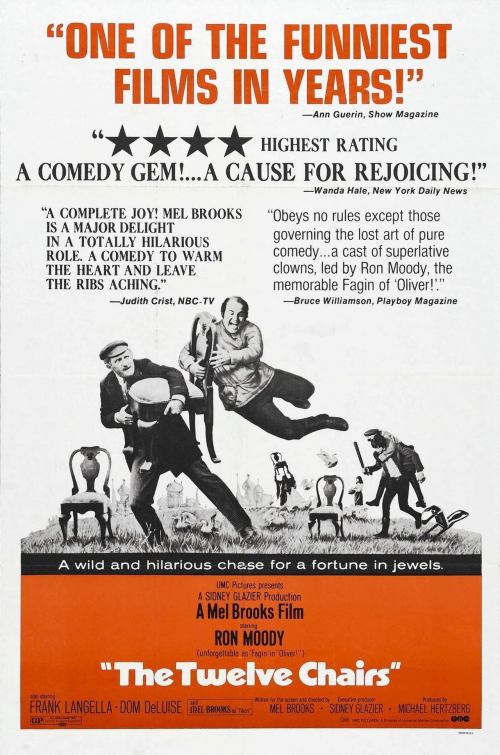
Vorobyaninov (Ron Moody), an poor man living in 1920’s Russia, is summoned to the deathbed of his mother-in-law. She confides in him that there’s a stash of priceless jewels sewn into the seat cushions of one of the twelve chairs from the family’s dinning room set. Unfortunately the newly formed Russian state has appropriated all private property and it’s up to Vorobyaninov to track them down. He teams up with Ostop (Frank Langella) a local con-man to help him, but they have competition. Father Fyodor (Dom DeLuise), a priest, also becomes aware of the jewels when he goes to the mother-in-law’s home to give her the last rites. All three go on a mad dash to retrieve the jewels, but the more chairs they manage to find the more frustrated they become.

The film is based on the 1928 Russian novel of the same name by Ilf and Petrov a famous duo who were quite popular during the early soviet period and wrote not only many satirical novels, including this one and its sequel ‘A Little Golden Calf’, but also several short stories, articles, theatrical plays, and even screenplays. The Twelve Chairs novel though was their most popular and has been made into a movie 18 different times. It had already been done 6 times before Mel Brooks did his with the first version being in 1933 and the most recent rendition of it done in 2013 in Italy.

This version is the most popular and a bit of stretch from Brooks’ other films, which relied on a lot of gags and slapstick. This one has its fair share of those though the first act is quite talky and not too much going on. Brooks himself appears as a character, but he can’t really enliven it. It’s not until the men finally come upon the chairs and start tearing them up one-by-one that it really starts to get funny. The chair thing could’ve gotten redundant as the men rip open the seat cushions in pretty much the same quick way, but Brooks manages to approach each of these scenes in a creative way, so instead of becoming monotonous it remains fresh and comical. My favorite of these is when Ron Moody and Frank Langella chase Dom, who has one of the chairs, through an open field that’s done in stop-action.

The film’s detraction though is the casting of the two main characters. Langella is a terrific actor, but not in comedy. He did appear in the dark comedy Diary of a Mad Housewife, where he was very good, but that took advantage of his glib demeanor and pouty expression and his character there was meant to be unlikable. Here though he has nothing amusing to say and remains a complete jerk the whole way. There is one point where he and Moody are in a row boat and Moody states that he’s cold and Langella gives him a jacket to wear, which I guess was Brooks’ attempt to make him likable, but it’s not enough and the movie is really hurt by spending so much time focused on a guy who’s one-dimensionally cold and responds to antics around him in the same sneering way. He was recommended to Brooks by his wife Anne Bancroft who had performed with Langella in a Broadway play that had a short run, but I felt this is one time when he shouldn’t have listened to her.

Ron Moody, a talented actor as well, has the same issue. The character is meant to be dim-witted, but it doesn’t come-off in a natural way. His banter with Langella is flat and annoying with the bickering doing nothing but slowing up the pacing. Without question DeLuise is the funniest. He’s just as conniving and greedy as the other two, but for whatever reason it doesn’t seem as ingratiating. His character’s ineptness had me laughing and he should’ve been the star while Langella and Moody could’ve been shown only sporadically as the occasional nemesis.

Spoiler Alert!

The ending is much different than the one in the book. In the novel version Vorobyaninov kills Ostap by slitting his throat with a razor in order to keep the loot for himself only to find that it’s not there, so he then goes insane. In the movie Vorobyaninov and Ostap team up to become beggars on the street by pretending Vorobyaninov has an epileptic condition and requesting people throw money at him to help him. Wikipedia, in a line that has since been deleted, stated that this was a ‘happier’ ending though trying to make a living being a street beggar all day can’t be all that fun.

What amused me though is that in both versions the jewels are never recovered by the two men. In the movie the jewels were found first by someone else who used it to build a clubhouse for pompous old men making it seem like greed was inevitable. In the book though the money gets used to build a recreational center that can be used by the entire community and thus giving it more of a pro-communist bent.

My Rating: 7 out of 10

Released: October 28, 1970

Runtime: 1 Hour 33 Minutes

Rated G

Director: Mel Brooks

Studio: UMC Pictures

Available: DVD

The Squeeze (1987)

squeeze

By Richard Winters

My Rating: 4 out of 10

4-Word Review: They rig the lottery.

When struggling artist and conman Harry (Michael Keaton) goes back to his ex-wife’s apartment to retrieve a mysterious package she had forgotten he finds a dead body and immediately becomes entangled in a complex mystery as well as a target of a secret organization. He enlists the help of private investigator Rachel (Rae Dawn Chong) and together they come to realize that the package that everyone is after is a large magnet that can be used to rig the lottery as it can manipulate the ping pong balls that display the winning numbers since those numbers are painted using a metallic substance. They proceed to try and stop the live broadcast of the lottery, which is being held onboard a naval ship and being hosted by the secretly nefarious Honest Tom T. Murray (John Davidson).

The film has come to have a notorious reputation on many levels. Not only did it sink at the box office where it managed to recoup a paltry $2 million from its $22 million budget, but the film’s promotional poster has star Keaton being squeezed between the World Trade Center buildings, which ultimately went down on 9-11. Even worse is that behind-the-scenes stunt driver Victor Magnotta, the movie is dedicated in his memory, died when the car he was driving went into the Hudson river on its side instead of flat, which trapped him inside the vehicle and unable to get out before he drowned though the stunt itself is left in.

While many critics and even commenters on IMDb have very little to say that’s nice about it I kind of felt that the movie was misunderstood as I saw it more as a parody of spy espionage stories and in that vein I think it works well, but since American audiences aren’t all that adept to satire and many times don’t get it, or take it seriously when they shouldn’t, it’s easy to see why this thing fell through the cracks. It does though have a few memorable moments including an unusual car chase where instead of having the hero speeding away from the bad guys they instead play a game of chicken where they intentionally crash their vehicles into the other one until both cars are left almost inoperable. I also thought the giant sized bull that Keaton created inside his apartment and made-up of a bunch of television sets was pretty cool too.

Keaton is certainly quite likable and without him the movie would’ve done far worse than it does. His engaging ability to make a joke, or even an insult, to someone, but always able to get away with it, by displaying his boyish trademark smile, is what makes his screentime entertaining though I felt the running conversation involving the old TV-show ‘Bonanza’ was a mistake. Young people of today won’t even know what that show was and even back then during the 80’s many teens would have only a vague idea of the series was as it had already been off the air since 1972 and didn’t do well in syndication and thus making the humor and inside jokes about it as out-of-touch and dated even for its own time period.

Chong is miscast, the part was intended for Mariel Hemingway who unfortunately got fired early on. While Chong can be great playing strong minded, outspoken characters she’s not as adept as a romantic lead and I failed to see much chemistry between the two. She falls-in-love with the guy a bit too quickly especially since they don’t get off to a good start. Having her come back to Keaton’s place and become outraged at seeing him in bed with another woman was out of place as no relationship had been established at that point. If anything she would’ve masked the feelings she had for him when seeing him with another lady and played it cool in order to avoid embarrassing herself when it became painfully obvious, at least at that point, that she was more into him than he was in her.

Ronald Guttman as the chief villain is a total bore and with his greased back hair looks more like a model for an Italian chick flick romance than a bad guy and his collection of shrunken heads doesn’t get played-up enough to be interesting. Meat Loaf though as his henchman is great. He has no lines of dialogue until he gets killed, via the pointy needle of a giant sized replica of the Empire State Building, which is pretty cool, though what he does say is very funny.

The film does at least give one a vivid feeling of what living in New York is like as it captures all the different levels of the city from its skyline, to the river, to its neighborhood shops and even the skid row area. Even this though does get botched as there are segments done late at night where there appears to be no other cars on the street, or pedestrians giving it a surreal look that isn’t realistic as New York is known as the city that never sleeps and thus portraying it as being virtually empty just because the action takes place in the wee hours of the morning isn’t authentic.

My Rating: 4 out of 10

Released: July 10, 1987

Runtime: 1 Hour 41 Minutes

Rated PG-13

Director: Roger Young

Studio: TriStar Pictures

Available: Blu-ray, Amazon Video, YouTube

The Last Word (1979)

lastword1

By Richard Winters

My Rating: 2 out of 10

4-Word Review: He won’t move out.

Danny (Richard Harris) is a stubborn and eccentric man who refuses to move out of an apartment building that has been marked for demolition. After his attempts to get a lawyer and also collect welfare prove futile he decides to kidnap the Marshal (Jorge Cervera) who comes to his apartment to serve him his eviction notice. He chains the Marshal to a pipe in his bathroom and then barricades himself and his three children inside. A TV news reporter (Karen Black) feels this will be a juicy story and gets permission to go up to Danny’s place in order to interview him live on the air while the police captain (Martin Landau), who was at one time an old friend to Danny, plots on a way to get him out even if it means deadly force.

This stale drama borrows on a lot elements that have been done before and fails to add anything interesting to the mix. The chief flaw is that there isn’t any explanation for why Danny won’t move out when everyone else in the building does. The apartment itself is quite cramped and nothing special and chances are he could’ve found something bigger, or just as adequate. Without proper motivation the protagonist’s quandry becomes rather irrelevant and even selfish as his stubbornness puts the rest of his family through a lot of needless stress and trauma and having the character be someone who is old and on a fixed income with nowhere else to turn, as much of a caricature as this is, would’ve at least gotten more emotional appeal from the viewer, which with the way it gets done here you really don’t get.

Harris execellent acting helps, but all his inventions start to become a bit cheesy especially his ‘gas masks’ which is nothing more than paper folded around the face with a Campbell’s soup can taped to the bottom, which apparently should be ‘sufficient’ to breath through if under attack, but look laughable and most likely the gas vapors would seep through the paper and thus making them a poor defense. Black, who would co-star with Harris 6 years later in Martin’s Day, plays a serious career driven woman, which is a nice variation from her usual flaky, ditzy types, but her character is unlikable, who initially tries to exploit Danny’s situation for her own gain and having her ‘come around’ at the end to be on his side isn’t enough to make up for it and she should’ve been portrayed as being more emphatic from the beginning.

His three children, played by Penelope Milford, Dennis Christopher, and Natasha Ryan all display the same type of personality and thus become indistinguishable and boring. They all seem to love their father quite a bit and are very loyal and yet refer to him as Danny instead of Dad, which is a bit weird. Landau displays a nice acerbic quality, and the first film where his hair begins to show a few spots of gray, but his character should’ve been the one to go up to the apartment and break into it, especially since he and Danny had a history together, versus having him remain on the ground while his men did the task, which loses out on what could’ve had more dramatic impact.

Spoiler Alert!

The first act is a strain to sit through and is approached in a way that would’ve made it better served as a TV-movie. The second act gets a little more tense when he barricades himself into the apartment and the way he uses all of his different inventions to stop the cops from getting inside is marginally entertaining, but the film leaves way too many things open ended. He eventually gets cuffed and arrested, but no closure as to what happens to him after that. Does he go to trial and win his case? Does he and his family get a new place, or does the building get saved and what happens to the Governor (Biff McGuire) who was exposed as being corrupt? None of this gets answered, which makes the ending like the rest of the film quite unsatisfying.

My Rating: 2 out of 10

Released: October 10, 1979

Runtime: 1 Hour 42 Minutes

Rated PG

Director: Ray Boulting

Studio: Variety International

Available: None

The Last Hard Men (1976)

lasthard

By Richard Winters

My Rating: 3 out of 10

4-Word Review: Kidnapping a lawmen’s daughter.

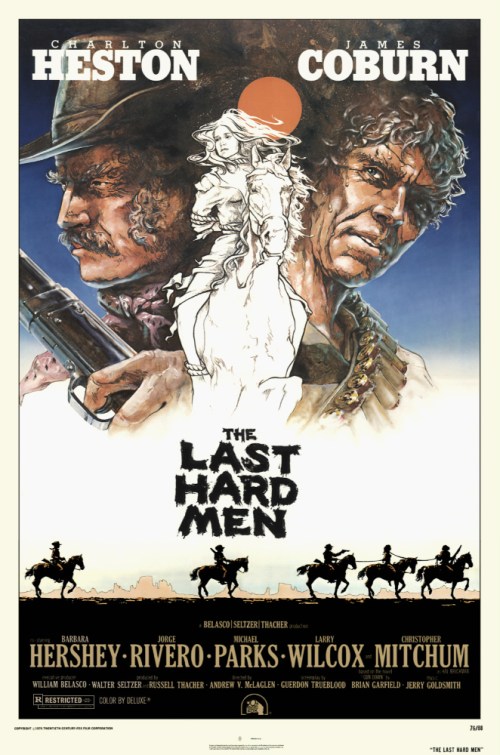
Based on the 1971 novel ‘Gundown’ by Brian Garfield who’s better known for having written Death Wish, the story is set in 1909 and centers on Sam Burgade (Charlton Heston) a retired lawman living with his grown daughter Susan (Barbara Hershey) who is engaged to Hal (Christopher Mitchum). They though are tormented by Provo (James Coburn) and his gang who have just busted out of a Yuma prison. Provo seeks revenge on Sam because years earlier Sam killed Provo’s Indian wife during a shoot-out. Provo though doesn’t want to just kill Sam, but instead inflict the cruelest revenge possible by kidnapping Susan and then having his men gang rape her while both Sam and Hal are forced to watch.

A stale, unimaginative approach that lacks any atmosphere and makes getting into it rather hard. Coburn and Heston are given equal screen time, so it’s confusing who we’re supposed to be rooting for. Sure Coburn has dark motives, but he also at one point gets rid of one of his own men (Robert Donner) for being a racist, so he’s not completely bad. The film’s biggest transgression is that it never shows, via flashback, the crucial shoot-out between the two that caused Provo to get so angry. Just having Heston briefly describe the incident to his daughter is not enough we needed to see what happened for ourselves especially since Heston becomes downright skittish about what went on and like maybe he had something to hide. Without having it played-out the movie lacks much needed context.

Coburn is a personal favorite, but as the protagonist, which he always does quite colorfully. As the villain it doesn’t work and he seems unable, or unwilling to go to the nasty depth that the script demands and instead leaves this to his henchmen, played by John Quade. Heston is adequate and Mitchum (Robert’s son) certainly displays a youthful, wide-eyed quality and it’s intriguing seeing how he grows from a young man who doesn’t seem rugged enough to take on the challenge to eventually proving himself.

In support I enjoyed Larry Wilcox, but known for starring in the ‘CHIPS’ TV-show, as he’s one of the evil henchmen that manages to show some redeeming qualities and it’s genuinely sad when he gets shot. While I’m a fan of Hershey and appreciated how she took a stretch here by playing a part outside her comfort zone I still felt she was miscast. The character needed to be sheltered and helpless in order to get the viewer to care about her predicament, but she’s too savvy and streetwise from the start making it seem like she can handle matters and take care of herself, which lessens the tension. Having her grow into becoming this way during the ordeal would’ve been more interesting.

Spoiler Alert!

The third act does have a few moments that enliven things including a large bush fire that gets started by Heston that traps Coburn and his men, but the scene that really stood out is the gang rape of Hershey, which gets done in slow-motion on the side of a hill. I’ve seen many films that feature a rape, but never done in this way, which almost gives it a sort-of lyrical quality and the only thing from the movie that stands-out. Yet even this gets botched as Heston doesn’t run out from his hiding spot to save his daughter when it occurs making it seem like he might’ve been cowardly and this was a personality trait he had been hiding only for us to learn that it was because Mitchum who knocked him out, but this seemed implausible. Heston was much bigger than Mitchum and proved to be far more astute than him in everything else, so why would this be the one moment when the young kid would be able to overpower him?

The story would’ve been more intriguing had this moment exposed a flaw in Heston’s character, which would’ve given this otherwise one-dimensional story the depth and unexpected twist that was needed and it’s just a shame it didn’t take it. Certainly if put in better hands this is the kind of material that could have strong potential, but the way it gets played-out here, even with the violent moments, it’s boring and a disappointment.

My Rating: 3 out of 10

Released: June 1, 1976

Runtime: 1 Hour 37 Minutes

Rated R

Director: Andrew V. McLaglen

Studio: 20th Century Fox

Available: DVD, Amazon Video, YouTube

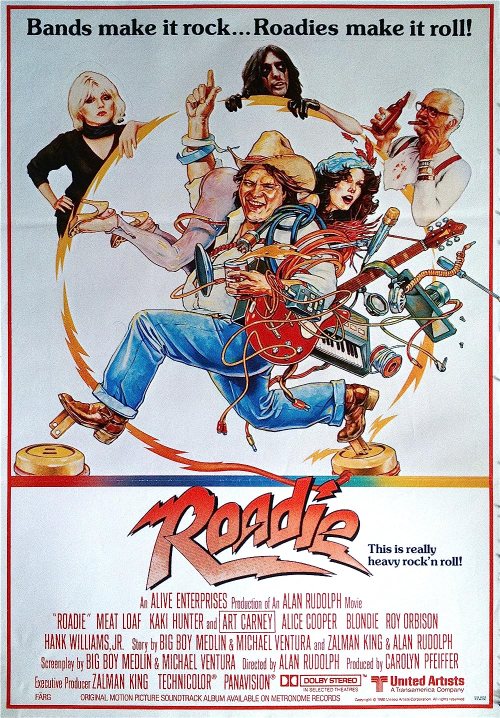
Roadie (1980)

roadie1

By Richard Winters

My Rating: 7 out of 10

4-Word Review: Truck driver and groupie.

Travis (Meat Loaf) and B.B. (Gailard Sartain) are two truck drivers out making deliveries when they come upon a disabled RV on the side of the highway. Initially they don’t plan to stop, but when Travis sees Lola (Kaki Hunter), a would-be rock ‘n’ roll groupie, peering out the RV window he decides he’s ‘fallen in love’ and pulls-over. His ability to fix mechanical issues using unorthodox tools impresses Ace (Joe Spano) who’s a road manager and wants Travis to drive them to Austin to set-up equipment for a Hank Williams Jr. show. Because of his fondness for Lola he agrees and promptly quits his job as a trucker to travel all over the country meeting such rock ‘n’ roll legends as Roy Orbison and Blondie while also awkwardly courting Lola who’s more infatuated with meeting her idol Alice Cooper.

While director Alan Rudolph has never had a box office hit his movies have usually achieved success amongst the critics except for this one, but  I considered it his most original effort. Roger Ebert described it as being ‘disorganized and episodic’ even though life on the road in a tour group works that way with new issues coming up almost hourly and like driving on the open road there can be many detours and speed bumps as well as fleeting faces, which in that context the film recreates, in quirky comic form, quite well. He also complained about the lack of character development and maybe in Travis’ case there wasn’t much, but he’s such a funny caricature that I didn’t think he needed any. With Lola though I felt there was and impressed me with how much depth she ultimately showed especially since she initially seemed like nothing more than a caricature too. I really liked that she wasn’t as into Travis at the start like he was into her, which can happen a lot, and she has to grow into liking him during their many adventures though still never really openly admits to it to either herself, or others, which I felt was a refreshing change from the ‘love at first sight’ thing in the Hollywood formulas. Ebert also complained that the songs were never played to completion though the ones that are about Texas are.

There’s many unique laugh-out-loud moments. Some of my favorites was the laundromat scene where Travis and Lola have a box of Tide that supposedly holds cocaine. The car chase in Austin done at night in front of the state Capitol building is amusing as is the barroom brawl. Granted there’s been a lot of those in movies, but like with everything else it has a quirky style unlike the others especially as Travis gets hit in the head and begins rambling out incoherent nonsense. The scenes at Travis’ boyhood home where his father (Art Carney) and sister Alice Poo (Rhonda Bates) are a riot including the telephone booth connected to machine belts that allows it to go from the exterior of the home to the inside and the BBQ chicken eating scene, which may be, at least visually, the best moment in the film.

It’s also nice to have a movie that’s all about Texas to actually be filmed in Texas. Too many try to cheat it, a few of them have been reviewed here recently, that mask the Arizona desert, or even the California one to Texas, but anyone from the Lone Star State could easily detect the difference. This one truly has the Texas look and you can see this from the very first shot which features armadillos crossing the highway and because of this it gets the honor of being put into the Scopophilia movie category of ‘Movies that take place in Texas’ versus the ones that say they are set here, but filmed elsewhere.

Spoiler Alert!

Probably the only thing that doesn’t quite work is the ending where Travis and Lola are kissing in the front seat of a pick-up only to see a bright light of a spaceship. I realize the intent was to do a parody of the ‘Paradise by the Dashboard Light’ song and maybe if we had actually seen the ship, which got inadvertently destroyed before shooting began I might’ve forgiven it, or maybe even been impressed, but entering in a sci-fi genre that late becomes almost like a sell-out and too surreal for its own good. Something that stayed true to the playful quirkiness that came before it would’ve tied the bow better.

My Rating: 7 out of 10

Released: June 13, 1980

Runtime: 1 Hour 45 Minutes

Rated PG

Director: Alan Rudolph

Studio: United Artists

Available: DVD, Blu-ray