Tag Archives: Alan Rudolph

Endangered Species (1982)

By Richard Winters

My Rating: 4 out of 10

4-Word Review: Investigating mysterious cattle mutilations.

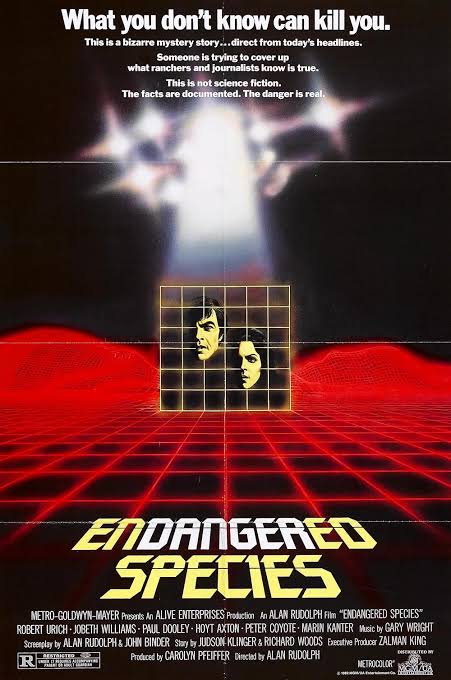
Ruben (Robert Urich) is a recovering alcoholic who quits his job as a cop and decides to move to rural Colorado with his teenaged daughter MacKenzie (Marin Kanter).  Along the way their vehicle breaks down in the small-town of Buffalo.  They decide to make their temporary home there and Ruben meets up with Harriet (JoBeth Williams) the newly elected sheriff. He learns that she’s investigating, with the help of local newspaper reporter Joe (Paul Dooley), some mysterious cattle mutilations that has been plaguing the area. Ruben, who grows fond of her, helps her in the pursuit for answers and comes to determine that it may have something to do with a nearby abandoned military complex as well as a neighboring cattle baron Ben (Hoyt Axton) who seems awfully worried about anyone snooping around.

The film’s direction, done by the still budding Alan Rudolph, is probably the best thing to recommend about what’s otherwise a pedestrian story. I liked the soundtrack, which despite the setting being quite rural, has a cool sci-fi vibe, and the grainy cinematography gives it a documentary feel. Rudolph’s use of capturing dialogue, which was clearly inspired by his mentor Robert Altman, is cool too as the camera will focus on one person, but we’ll hear the conversation of two other characters who are not in the shot. Unfortunately, the plot is unimaginative, and the mystery portion becomes too obvious.

Urich is miscast in the lead, the part was intended for Robert Mitchum who would’ve been far superior. Urich’s a nice guy and all, but not convincing as a brash, hard-edge cop making his entire performance come off as affected. His character arch, which focuses on an alcoholic trying to redeem himself, both with his career and relationship with his daughter, is too formulaic to be either gripping, or compelling though it’s interesting to hear him casually utter the slur ‘faggot’ at one point as it would be impossible for someone in a movie today to say that and still be deemed the hero.

I also didn’t feel an outsider was needed here as Urich seems to come up with all the clues that you’d think somebody living in the town would’ve deduced far earlier. A good example is when he follows some trucks to the military complex and starts to connect this to the cattle killings, but any other resident could’ve done this too and most likely would’ve. Most small-town people are characteristically suspicious of government agencies, so knowing that there was an abandoned federal outpost nearby would’ve made that area number one on their suspect list and would not have required the assistance of some big city cop to get them there.

Jobeth looks awkward and uncomfortable in her police uniform. I dug the idea of having a female sheriff, which hasn’t been done too much, so it offers a unique angle, but it approaches it in an illogical way. For instance, it has her attempting to break up a male bar fight by her trying to somehow tackle one of the men, who immediately fling her away as if she were a rag doll and it looks as pathetic as it sounds. Clearly, she should’ve gone into that with some backup by male deputies, or a taser, but for her to go in it alone and think somehow, she can ‘handle it’ makes both her and the film look like it has no common sense.

I will though give some credit to the scene where Urich is in her shower and he makes a pass at her and she in returns gives him a gut punch, which was unexpected as I was afraid it was going to turn into some sort of sappy, stereotypical love scene, which does occur later, but I at least enjoyed the momentary attempt to go against the grain.

Spoiler Alert!

I did enjoy Axton’s bad guy part. He performance isn’t anything spectacular and his poisoning moments, where he brushes his teeth with a contaminated toothbrush that causes his gums to bleed looks more like he’s just swishing around red Kool aid in his mouth. I also thought it was ridiculous that Urich would force Axton to drive the pick-up at gunpoint when he was clearly in a weakened and distressed state that could’ve killed them both. However, his death scene, where he kneels on the highway and has his abdomen burst out of his body, is awesome and the film’s best moment though it could’ve been extended.

The ending unfortunately offers no resolution. It has the night helicopters of the bad guys flying away while JoBeth and Urich remain on the ground watching helplessly. To sit through nearly 2-hours of this thing, which is at times a bit slow, there needed to be more of a finale. Preferably nabbing the baddies and breaking open the case and the fact that this doesn’t happen makes the whole thing feel like one big waste of time.

My Rating: 4 out of 10

Released: September 10, 1982

Runtime: 1 Hour 37 Minutes

Rated R

Director: Alan Rudolph

Studio: MGM

Available: DVD, Blu-ray, Amazon Video, YouTube


Remember My Name (1978)

remember

By Richard Winters

My Rating: 7 out of 10

4-Word Review: His ex-wife returns.

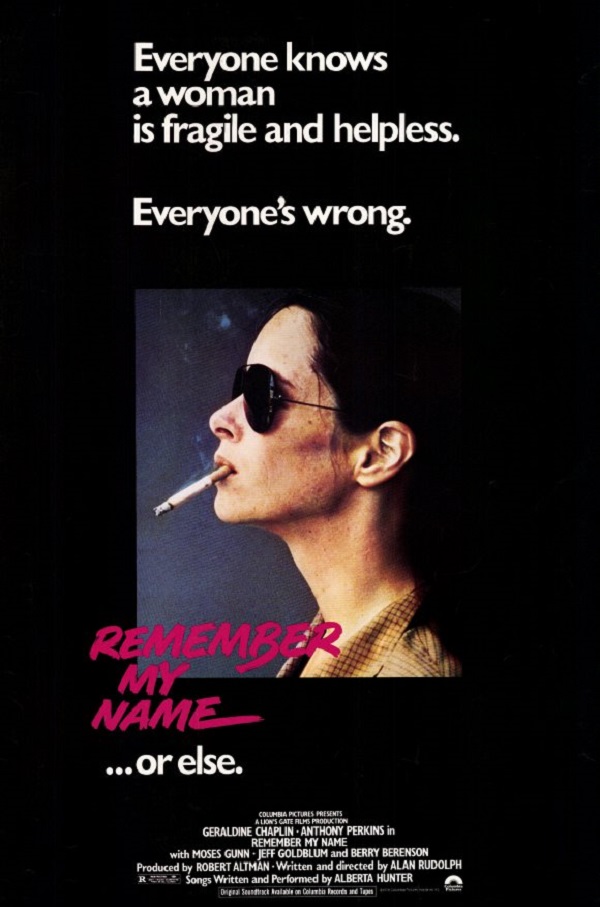
Neil (Anthony Perkins), who works as a local carpenter, is married to Barbara (Berry Berenson). While the two have their share of ups-and-downs they mostly find a way to work it out and get along. Then comes Emily (Geraldine Chaplin) whose been recently released from jail. She begins harassing the couple for no apparent reason. After she breaks the window of their home Barbara insists on pressing charges. Neil though resists while divulging that he had previously been in a relationship with her and because of certain things that occurred has a misplaced sense of guilt to cover-up for her actions. Barbara does not understand this and the two break-up while Neil decides to rekindle things, but while Emily initially seems receptive she may actually harbor ulterior motives.

Alan Rudolph does a marvelous job of directing this emphasizing the working-class existence with a pale color scheme and great use of on-location shooting, which gives the viewer a vivid and intimate portrait of the character’s lives and their environment. The use of showing that Emily had previously been in prison without actually saying it by simply using certain sounds and visuals as she sleeps is a genuinely inspired moment as is the use of the brief dialogue that reveals things slowly and deliberately using subtle hints that achieves a certain fragmented narrative.

Chaplin is brilliant and convincing in the lead and her unique colored eyes helps build a riveting psycho-like effect though with her extremely thin frame it’s hard to imagine she’d be able to take-on and even beat-up the Alfre Woodard character as she does though one could possibly justify it by saying she learned fighting skills while in jail. Perkins is also quite good, but the use of his real-life wife Berenson, who didn’t have a lot of acting training, hurts as her time on screen is rather blah including the otherwise tense confrontation that she has with Emily when Emily invades her home, which might’ve been a more interesting scene with a better qualified actress in the part.

While the first-half is quite slow I was thoroughly gripped and found the whole thing fascinating, but this tapered-off by the third act when Perkins and Chaplin rekindle things while at a restaurant. The scene gets done in amusing way as the couple keeps ordering alcoholic drinks one after the other, much to the consternation of the waiter, played by Terry Wills, but having Perkins go back immediately to Chaplin with almost no apprehension kills the intrigue. This is a woman that supposedly murdered someone before, so how does he know she can be trusted? Having him more defensive and cautious and even conflicted as he was technically still married would’ve helped continue the tension instead of deflating it.

Spoiler Alert!

The scene in which the Moses Gunn character, who was having a bit of a fling with Emily, goes back to her apartment apparently to murder Perkins who had been temporarily staying there, could’ve been done better. It’s only intimated that Gunn kills him as we see a nervous look on Perkins face as he hears somebody at the door and then it cuts away to the outside of the building with loud crashing music to display that there was violence, but I really felt it should’ve gotten played-out visually. Perhaps it could’ve been done Rear Window-style with it being captured through the windows, which would’ve stayed consistent with the film’s detached tone, but to leave the story’s most crucial moment up to speculation was a letdown.

The same can be said to Alfre Woodard’s character who promises revenge on Chaplin, but it never comes. A good physical confrontation between the two could’ve added some much needed action, which otherwise is sorely missing and makes the film seem incomplete. Having Chaplin terrorize the couple by messing up their flower garden is a bit too tame as any squirrel or raccoon could’ve done the same thing while putting a bloody animal on their doorstep, or nailing a graphic picture of the person she had killed before would’ve been far more frightening.

Overall I liked the style, but the attempt to keep things buttoned-down all the way through doesn’t work. At some point, just like with the ticking time bomb mentality of its main character, it needed to explode with violence that would’ve awakened the viewer with a shocking effect. The fact that this is only slyly hinted at is a letdown and doesn’t give the movie the strong pay-off that it should.

My Rating: 7 out of 10

Released: October 1, 1978

Runtime: 1 Hour 34 Minutes

Rated R

Director: Alan Rudolph

Studio: Columbia Pictures

Available: DVD-R, Tubi

Roadie (1980)

roadie1

By Richard Winters

My Rating: 7 out of 10

4-Word Review: Truck driver and groupie.

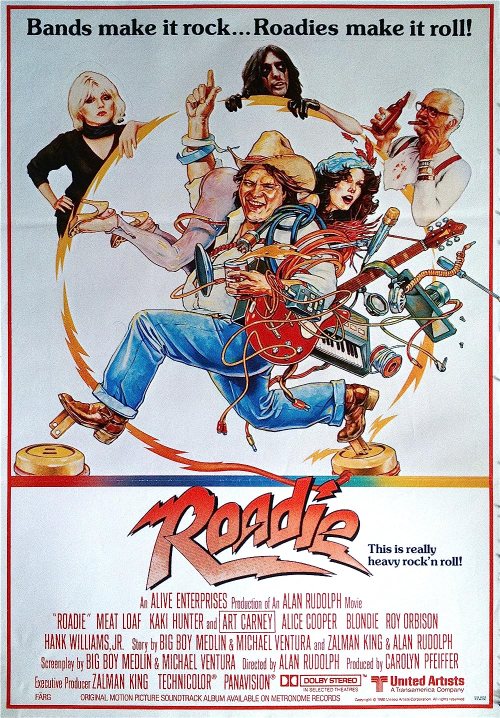
Travis (Meat Loaf) and B.B. (Gailard Sartain) are two truck drivers out making deliveries when they come upon a disabled RV on the side of the highway. Initially they don’t plan to stop, but when Travis sees Lola (Kaki Hunter), a would-be rock ‘n’ roll groupie, peering out the RV window he decides he’s ‘fallen in love’ and pulls-over. His ability to fix mechanical issues using unorthodox tools impresses Ace (Joe Spano) who’s a road manager and wants Travis to drive them to Austin to set-up equipment for a Hank Williams Jr. show. Because of his fondness for Lola he agrees and promptly quits his job as a trucker to travel all over the country meeting such rock ‘n’ roll legends as Roy Orbison and Blondie while also awkwardly courting Lola who’s more infatuated with meeting her idol Alice Cooper.

While director Alan Rudolph has never had a box office hit his movies have usually achieved success amongst the critics except for this one, but  I considered it his most original effort. Roger Ebert described it as being ‘disorganized and episodic’ even though life on the road in a tour group works that way with new issues coming up almost hourly and like driving on the open road there can be many detours and speed bumps as well as fleeting faces, which in that context the film recreates, in quirky comic form, quite well. He also complained about the lack of character development and maybe in Travis’ case there wasn’t much, but he’s such a funny caricature that I didn’t think he needed any. With Lola though I felt there was and impressed me with how much depth she ultimately showed especially since she initially seemed like nothing more than a caricature too. I really liked that she wasn’t as into Travis at the start like he was into her, which can happen a lot, and she has to grow into liking him during their many adventures though still never really openly admits to it to either herself, or others, which I felt was a refreshing change from the ‘love at first sight’ thing in the Hollywood formulas. Ebert also complained that the songs were never played to completion though the ones that are about Texas are.

There’s many unique laugh-out-loud moments. Some of my favorites was the laundromat scene where Travis and Lola have a box of Tide that supposedly holds cocaine. The car chase in Austin done at night in front of the state Capitol building is amusing as is the barroom brawl. Granted there’s been a lot of those in movies, but like with everything else it has a quirky style unlike the others especially as Travis gets hit in the head and begins rambling out incoherent nonsense. The scenes at Travis’ boyhood home where his father (Art Carney) and sister Alice Poo (Rhonda Bates) are a riot including the telephone booth connected to machine belts that allows it to go from the exterior of the home to the inside and the BBQ chicken eating scene, which may be, at least visually, the best moment in the film.

It’s also nice to have a movie that’s all about Texas to actually be filmed in Texas. Too many try to cheat it, a few of them have been reviewed here recently, that mask the Arizona desert, or even the California one to Texas, but anyone from the Lone Star State could easily detect the difference. This one truly has the Texas look and you can see this from the very first shot which features armadillos crossing the highway and because of this it gets the honor of being put into the Scopophilia movie category of ‘Movies that take place in Texas’ versus the ones that say they are set here, but filmed elsewhere.

Spoiler Alert!

Probably the only thing that doesn’t quite work is the ending where Travis and Lola are kissing in the front seat of a pick-up only to see a bright light of a spaceship. I realize the intent was to do a parody of the ‘Paradise by the Dashboard Light’ song and maybe if we had actually seen the ship, which got inadvertently destroyed before shooting began I might’ve forgiven it, or maybe even been impressed, but entering in a sci-fi genre that late becomes almost like a sell-out and too surreal for its own good. Something that stayed true to the playful quirkiness that came before it would’ve tied the bow better.

My Rating: 7 out of 10

Released: June 13, 1980

Runtime: 1 Hour 45 Minutes

Rated PG

Director: Alan Rudolph

Studio: United Artists

Available: DVD, Blu-ray